The authorities did not report a date for the reopening of the section that goes from B to C street.
This morning, according to ’14ymedio’, several traffic police were guarding the forbidden area, but no significant damage was noted in the visible structure of the Malecón / 14ymedio
14ymedio, Juan Diego Rodriguez, Havana, 29 September 2024 — With several barriers to divert traffic, a section of Havana’s iconic Malecón has been closed since Saturday. According to a post on social media from the capital’s government, the sea intrusion caused by Hurricane Helene “caused structural damage to the road,” leaving the section from B to C street in need to repairs.
The area that poses a “danger to vehicle traffic” and where “total closure measures” have been applied is located in El Vedado, in the municipality of Plaza de la Revolución. The authorities did not offer a date for the reopening of the section and declared that it will be closed “until the work is completed.”
This morning, according to 14ymedio, several traffic police were guarding the forbidden area, but no significant damage was visible to the Malecón structure. Aside from a crack in the sidewalk that borders it, the wall seemed to be in the same state as always, eaten away by the sea and salt. continue reading
Beyond a crack in the sidewalk that borders it, the wall seemed to be in the same state as always, eaten away by the sea and saltpeter / 14ymedio
Located opposite the luxurious Grand Aston hotel, the closed section belongs to one of the most tourist-centric areas of the capital, where old and refurbished Chevrolets drive around. The area is, curiously, one of those that suffers the most flooding and sea intrusion every time there is a storm.
Nearby is the Girón building, a grey mass built in 1967 whose stairs are now a real danger for residents. The cement slabs intended to prevent people from falling have gradually come loose and the residents themselves have replaced them with pieces of railings or sheets of zinc.
In recent decades, the Malecón has undergone several repairs. One of a major nature was carried out at the beginning of the century by the government with the help of Spain, in which 14 blocks of the seafront were restored and the project even received an award at the 2nd Havana Architecture Biennial in 1999. Later, other works were carried out in 2016, 2020 and 2021, but humidity and the sea cause the area to deteriorate rapidly without the authorities being able to keep up with the maintenance.
The passage of Hurricane Helene also caused the closure of the road that goes from La Cabaña to the city, through the tunnel under Havana Bay. According to Minister of Transport Eduardo Rodríguez Dávila, the rains flooded the road and the drainage system, due to a blockage, was not working.
Earlier this year, the tunnel remained closed for several days after authorities announced that maintenance work would be carried out. However, the repairs did not last long and Rodríguez Dávila soon explained that they had finished 48 hours earlier. During a tour of the road, 14ymedio confirmed that the promised repairs had been nothing more than a little cement and paint on the most damaged sections of one side of the tunnel.
The minister then explained that work would soon begin on the opposite lane, but just five months later, drivers in the capital have to detour again due to problems on the road.
____________
COLLABORATE WITH OUR WORK: The 14ymedio team is committed to practicing serious journalism that reflects Cuba’s reality in all its depth. Thank you for joining us on this long journey. We invite you to continue supporting us by becoming a member of 14ymedio now. Together we can continue transforming journalism in Cuba.
The official press defends the work of the Family Care System, but the food is far from being the least bit healthy
The Family Care System offers meals for about 1,118 residents of Ciego de Avila. / Invasor
14ymedio, Havana, 1 October 2024 — If a balanced diet were made up of soup and bread with pasta, the State would not have to use so many resources to justify its precarious attention to “vulnerable people” and “social cases.” An article published this Tuesday in Invasor attempts to defend the social attention of the regime, which claims to “offer food guarantees, no matter how difficult the situation is,” but the reality the article depicts is different.
In Ciego de Ávila, the business group of Commerce, Gastronomy and Services manages 58 food distribution establishments which, however, accommodate only 1,118 diners from the Family Care System (SAF). The diet, according to the official newspaper, includes “rice, proteins, soups or stews, meats, salads and desserts” but, taking into account that “practically one hundred percent of what they offer is self-managed” and that they cannot charge more than 13 pesos per dish, it would be difficult to find two of these foods together in the same meal.
Amid the alarming State shortages, the provincial governments are forced to resort to all kinds of entities and companies that can provide them with a meal – regardless of its quality – to feed the “vulnerable.” continue reading
In a country that, after decades of scarcity, has lost all notion of gastronomy – and even its own cooking culture – meals are far from making up a nutritious dish.
In a country that, after decades of scarcity, has lost all notion of gastronomy – and even its own cooking culture – meals are far from being a nutritious plate. “Different types of bread with prices between 40 and 70 pesos, such as bread with pasta, with mayonnaise or with croquettes, as well as other more expensive ones, with Viking ham and sausage roll” is what is offered in “both in the Gastronomy cafeterias and outside of them, in districts, vulnerable neighborhoods and schools.”
To the cocktail of fats and sausages, are added chemical-based soft drinks, “Coral and canned drinks,” which are sold not only to the poor, but also in state hostels, “at municipal fairs and fairgrounds that exist in the main city, districts and Committees for the Defense of the Revolution.”
In the entire collection, there is no mention of foods that really form part of a healthy diet, such as fruits and vegetables, fish, nuts, cheeses, milk and natural drinks or shakes. Among the soups, peas – the legume of the poor – are the main ingredient on the tables of schools and hospitals, along with broth. Both, generally, are devoid of seasoning or substance.
“Sale of soups and pea stew at prices between 15 and 30 pesos per serving, white rice at 40 pesos,” lists the state offering that rarely includes any cuts of meat because, if it did, it would be impossible for the authorities to maintain low prices.
Some 15 companies from Ciego de Ávila are also responsible for providing food to the poor. “The Arnaldo Ramírez agricultural company sells in the towns of Ognara and Trucutú, La Cuba does so in Pesquería, the Agroindustrial Ceballos in the neighboring town, Ruta Invasora in Jicotea, Acopio in the neighborhoods of the city of Ciego de Ávila and the Turiguanó livestock company in the town of the same name,” says the newspaper. The mystery, however, lies in what foods they offer – if they depend on their own preparations – and what their cost is.
“Sale of soups and pea stew at prices between 15 and 30 pesos per serving, white rice at 40 pesos”
Only the information from the State company Acopio includes some data. “They deliver around 800 servings of soup a week. In addition, from Tuesday to Friday they hold fairs in places that are difficult to access to bring the products to families and in order to benefit teachers and health personnel, they go to universities, schools, hospitals and homes for children who lack parental care.”
According to the article, the authorities are not sitting around with their arms crossed. But in a country where the average monthly salary is equivalent to the price of a carton of 30 eggs, and shortages have driven many foodstuffs off the market, it is hard to believe that those with fewer resources can afford something resembling a “balanced diet.”
In an article published in February, 14ymedio reported on the situation of the Family Care System facilities in Holguín. “Sometimes there is no protein, although in the canteen where I work the workers are quite combative and they fight with the people from the municipality to get supplies, but it seems that it is becoming more difficult for them to get them,” said Tomás, an 81-year-old man, speaking to this newspaper. At that time, some 76,175 Cubans were registered with the Family Care System and attended the 445 canteens of this type on the Island.
____________
COLLABORATE WITH OUR WORK: The 14ymedio team is committed to practicing serious journalism that reflects Cuba’s reality in all its depth. Thank you for joining us on this long journey. We invite you to continue supporting us by becoming a member of 14ymedio now. Together we can continue transforming journalism in Cuba.
The reason for this strike is the lack of cash in the banks
The widespread opinion among provincial farmers is that the problem of non-payments will get worse / Escambray
14ymedio, Mercedes García, Sancti Spíritus, 5 October 2024 — Although the udders of the cows continue to give milk in Sancti Spíritus, the farmers of the province refuse to continue selling their production to the State. The reason for this is the lack of cash in the banks, which prevents them from receiving payment for the product. Without paper money, the farmers refuse to fulfill their commitments to the official companies.
“They are making fun of us apparently. On the one hand they tell us that we must comply with the rule of delivery, that this is a strategic sector for the country, and on the other they don’t give us our money,” a member of a dairy cooperative with more than a dozen farms located on the outskirts of the capital tells 14ymedio. “You can’t do that,” says the farmer, who prefers anonymity, with annoyance.
Each producer has a mandatory amount of milk that they must sell to the State company Combinado Lácteo Río Zaza, according to the number of animals they have and the average yield they have shown in recent years. Each liter of milk within that rule is paid at 75 pesos, and for each one that exceeds the assigned amount, the farmer will receive 38 pesos.
At the time of paying its debts, the Combinado deposits in the bank, either physically or electronically, the amount allocated to each cooperative. That money must be withdrawn from the bank branch by the administration of the cooperative, which will be responsible for distributing the income among its members according to what is contributed by each one. But “the umbrella gets jammed when it comes to releasing the money,” complains the farmer from Sancti Spíritus. continue reading
Being outside the official umbrella is also very complicated. Throughout the province there are 32 agricultural cooperatives that encompass most of the producers of meats, vegetables, fruits and milk. In the case of the cow owners, the pressures to join the cooperative system, the constant controls of the inspectors and the recent census of their animals make it almost impossible for them to exist outside the mechanism of State deliveries.
For the owners of cows, it is almost impossible to exist outside the mechanism of milk deliveries to the State
Last July, the Governor of the province, Alexis Llorente, said on the local radio that the “contracting of milk” with the farmers had been completed and exceeded 6 million liters. The official pointed out the indisciplines of the producers as one of the problems they had to overcome to comply with the annual plans but did not allude at any time to the situation of payments to farmers who were already in crisis at that time.
“The bank has been empty for months. It doesn’t have cash to give to the cooperative, and people don’t want electronic money because you have to pay for everything here with a wad of bills in your hand,” adds the farmer. “From the pound of rice that I have to buy to feed my family, to the salary of my employees, the money has to be tangible, not numbers on a mobile screen.”
After four months of delays and in view of the fact that the banking situation does not seem to be resolved in the short term, producers such as Mario, his name changed for this report, resident in the municipality of Jatibonico, has also joined the work halt. “I’ve been selling milk on my own for a couple of weeks; anyway, I don’t do business to sell it to the State because the payment is bad. That same liter of milk that I deliver after fulfilling my commitment, which they only pay me at 38 pesos, I sell on the street at 120,” he says.
It doesn’t seem that the banking situation will be resolved in the short term
The People’s Power delegate of the area “called a meeting to scold the farmers,” says the man. “He told us that we could not continue selling milk on the outside, but it fell on deaf ears because we live from what we manage to sell, and if the State does not pay us what are we going to do? Starve to death?”
Most of the milk that the State buys is distributed through the rationed market, for children under 7 years of age and people with specific medical diets who have the product allocated to them. The rest is sent to nursing homes and children’s daycare centers, where the food supply has suffered multiple oscillations in recent years.
Now, the most widespread opinion among provincial producers is that the problem of non-payments will get worse. “There is often no money even to pay doctors and teachers, who have to go to the bank several times to see if they can get their salary. Imagine what’s going to be left for us. Everyone wants to drink a glass of milk but that takes effort and expense; you don’t get milk from a cow by whispering in her ear and telling her that she has to fulfill the plan.”
Translated by Regina Anavy
____________
COLLABORATE WITH OUR WORK: The 14ymedio team is committed to practicing serious journalism that reflects Cuba’s reality in all its depth. Thank you for joining us on this long journey. We invite you to continue supporting us by becoming a member of 14ymedio now. Together we can continue transforming journalism in Cuba.
The online news source did not reveal the identity of any of those affected “to avoid further reprisals”
In recent months, several ’Cubanet’ collaborators have suffered outright harassment by State Security / 14ymedio
14ymedio, Havana, 4 October 2024 — A group of journalists and Cubanet collaborators has suffered “threats, intimidation, arrests and confiscation of work assets and money in recent days.” This was announced by the online news source in an alert published this Thursday, warning about the Regime’s “repressive escalation” after the new Social Communication Law went into effect this week.
Cubanet did not reveal the identity of those affected, “to avoid further reprisals,” but it reports that they were threatened with ” prison sentences” and consequences for their families. They have also been filmed by agents for hours – something they describe as “psychological torture” – and had their electronic devices and money taken away from them.
Although it admits that this is a “common tactic” of State Security, Cubanet draws attention to the “increasing wave of harassment,” not only against independent journalists but also against opponents who publicly denounce the country’s crisis.
The objective of the political police – “to suppress critical voices and avoid the dissemination of information not controlled by the State” – remains the same, but with the entry into force of the law the State has one more legal tool to repress, Cubanet points out. It is a “new instrument of the Cuban authorities to limit freedom of expression and access to information,” which has been condemned by several international organizations, such as the Inter-American Press Society. continue reading
The objective of the political police is to “suppress critical voices and avoid the dissemination of information not controlled by the State”
The truth is that, despite the law’s entry into force, the situation of the independent press remains as vulnerable and dangerous as that of the previous day. The exercise of non-state journalism was already punishable by the Constitution, the Criminal Code and Decree Law 370.
Responses cannot be demanded from leaders – a right reserved for State reporters – and any critical information provided is considered an act of “communicational aggression that takes place against the country” or an instigation to “terrorism and war in any of its forms and manifestations, including cyberwar.” Nor does the law provide new penalties, since it does not mention possible sanctions for those who break the law and refers to other documents to resolve each case.
Despite this, several independent journalists have already published statements on their social networks that imply that they have been intimidated and forced to resign from their work. This was the case of Yennys Hernández and Annery Rivera – collaborators of several media such as Periodismo de Barrio and Cuba Próxima – who said this Thursday that they would not “collaborate and/or participate in any media or project of an independent nature and/or considered subversive or contrary to the interests of the Cuban government.”
The situation is similar to that which occurred in September 2022, when at least 16 members of the El Toque team living in Cuba were forced to resign from their work on the newspaper. At that time, its managers denounced the “sick insistence” of the Cuban political police to obtain “confessions” on video from the journalists, which they then manipulated and broadcast on Cuban Television.
In recent months, several Cubanet collaborators have suffered outright harassment by State Security. This was the case of the Camagüeyan journalist José Luis Tan Estrada, who on Thursday held State Security responsible for “anything” that happened to him after the Regime’s “repressive escalation.” On the eve of the anniversary of the 11 July 2021 protests, Tan Estrada was arrested and interrogated. He was forbidden at that time to attend public places under the threat of going to prison for disobedience and contempt, or to publish statements about the date on his social networks.
However, Tan Estrada told the story of his arrest on his Facebook page. While connecting to the Internet in the Agramonte park in the city of Camagüey, he was approached by a political police officer who arbitrarily arrested him. He was transferred in a patrol car to the Third Monte Carlos Unit of the National Revolutionary Police where he was intimidated. “They gave me a warning letter, which I didn’t sign,” he said.
Journalist Camila Acosta and her partner, the writer Ángel Santiesteban, have also been harassed on several occasions for denouncing the involvement of State Security in the crisis that for nine months shook the leadership of Cuban Freemasonry. Acosta is responsible for the first reports on the theft, last January, of 19,000 dollars from the office of Grand Master Mario Urquía Carreño.
Acosta’s coverage of several meetings of the Freemasons put her in the crosshairs of the offensive that several Regime spokesmen, such as the so-called Cuban Warrior, carried out against the independent press. The Cuban Warrior not only tried to discredit Acosta’s work but also her personal life, spreading rumors and false information.
Acosta’s coverage of several meetings of the Masons put her in the crosshairs of an offensive from several of the Regime’s spokesmen
Santiesteban, for his part, was briefly arrested in July and accused by the official YouTuber of “revealing Masonic matters to the profane,” that is, to those not initiated in the order. Acosta denounced the arrest as “a direct affront to Freemasonry” and accused the police of giving the protest of July 23 – in which the Freemasons demanded explanations for the robbery – “a political connotation” to justify the arrest of several Freemasons critical of the Regime, such as Santiesteban.
The Cuban Warrior also launched the now usual accusation against Acosta and Santiesteban: that every independent journalist is an undercover agent of the CIA.
Translated by Regina Anavy
____________
COLLABORATE WITH OUR WORK: The 14ymedio team is committed to practicing serious journalism that reflects Cuba’s reality in all its depth. Thank you for joining us on this long journey. We invite you to continue supporting us by becoming a member of 14ymedio now. Together we can continue transforming journalism in Cuba.
“Cuba is not the country with a long, verifiable tradition of hacking, espionage and control,”claims a speaker at an official press seminar.
Etecsa technicians making repairs on a street in Central Havana. / 14ymedio/Archive
14ymedio, Madrid, 7 September 2024 — The Castro regime cut off 14ymedio’s internet access, the first time it has taken such action since this independent media outlet first began more than ten years ago. It did the same to all the country’s independent news outlets – Martí Noticias, Diario de Cuba, CiberCuba, CubaNet – which now cannot be accessed on the island without a VPN, something available only on State Security devices. However, Cubadebate, the country’s primary state-run news website, went online Saturday with its usual complaint that the United States is waging a “cyber war,” preventing Cubans from having full access to the internet.
“Today, 7.5 million Cubans (more than 70% of the population) are connected to the internet but cannot view Google Earth, use the Zoom videoconferencing system, download free Microsoft software, shop on Amazon, or acquire international domains that appear to favor tourism to the island, not to mention some of the more than 200 blocked services and applications,” Cubadebate highlights in its cover summary. “When Internet providers detect access from Cuba — whether these companies are in California, Madrid, Paris or Toronto — they act as a funnel and warn users that they are connecting through a ‘prohibited country.’”
The article coincides with a conference at a bilateral seminar between Vietnam and Cuba and “Socialist Press in Transformation” held on Thursday in Havana. It claims the U.S. has blocked Cuban access to the internet and has, at least once, publicly admitted doing so. This is a reference to a recommendation by the U.S. Department of Justice to the Federal Communications Commission in November 2022 to deny Cuba access to ARCOS-1, the fiber optic cable network that connects Caribbean countries to the continent. continue reading
Cuban officials claim that the 11 July 2021 protests were incited by “segments of the Cuban far-right in the United States, which actively participated in the creation of private groups
“The argument was ridiculous,” they claim. “It cited the alleged danger of Cuba’s relations with other foreign adversaries such as China or Russia, which could use the island as a gateway to hack the U.S. network.”
At the time, the then Deputy Attorney General for National Security, Matthew G. Olsen, defended the claim, saying, “As long as the Cuban government remains a counterintelligence threat to the United States and is allied with others who do the same, the risks to our infrastructure are simply too great.”
Without referring to this statement, the article states that ARCOS-1 passes twenty miles from Havana and has been in operation for more than two decades, connecting twenty-four landing points in fifteen countries in the region, most of which have “long-standing, fluid relations with foreign adversaries that keep Washington awake at night.”
Recounting a history of the internet, pro-government journalist Rosa Miriam Elizalde said, “It was conceived as a network in which information travels through alternative paths to guarantee the vitality of the circulation of data,” adding that it has more limitations today than when it was created. “Almost all the fiber optic cables lead to the United States. Additionally, the large fiber optic pipes that cross the oceans are the property of a handful of corporations linked to the intelligence services.”
“Cuba is not the country with a long, verifiable tradition of hacking, espionage and control,” Elizalde later claimed. She failed to mention the monopoly the regime maintains on access to information through the state-owned telecommunications company Etecsa or the periodic connectivity “blackouts” strategically imposed following certain events such as the massive protests of 11 July 2021.
The speaker did refer to this crucial date, but denounced that they were incited by “segments of the Cuban far right in the United States, who actively participated in the creation of private and public groups on Facebook, the most popular platform on the Island, to poison the national public agenda.”
Ignoring the fact that there are U.S. initiatives that have specifically sought to establish an internet connection for the island, nor the state of the issue today, Elizalde mentioned no less than three times the Department of Justice’s decision from two years ago. She concluded, “Perhaps by this path Washington will be encouraged to recognize that it has been and continues to be Cuba’s number one enemy of Cubans in terms of internet access.”
____________
COLLABORATE WITH OUR WORK: The 14ymedio team is committed to practicing serious journalism that reflects Cuba’s reality in all its depth. Thank you for joining us on this long journey. We invite you to continue supporting us by becoming a member of 14ymedio now. Together we can continue transforming journalism in Cuba.
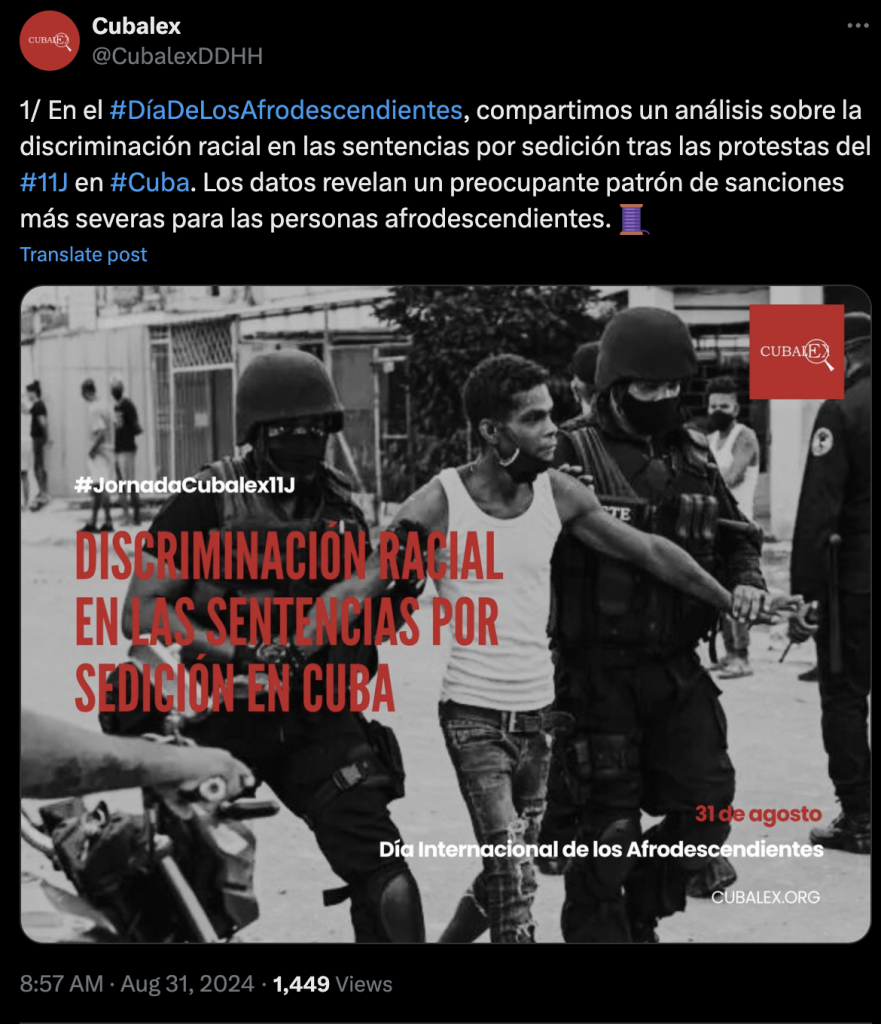
Cubalex, 5 September 2024 — In this analysis, we examine the sedition sentences handed down in Cuba following the protests of 11 July 11, 2021. Our findings reveal a worrying racial bias that results in harsher sentences for people of African descent. This trend suggests the existence of systematic discrimination within the judicial system, disproportionately affecting one of the most vulnerable groups in Cuban society, who already face multiple forms of exclusion and inequality. Below, we present a detailed examination of these discriminatory patterns and their implications in the human rights context.
Below we present the key findings of this analysis.
Key Findings:
1. Duration of sanctions for “unfavourable conduct”:
People of African descent who are classified by the State as having “unfavourable conduct” receive sanctions with an average duration of 13.02 years, while non-Afro-descendants, under the same classification, receive sanctions with an average duration of 12.0 years.
Unfavourable conduct appears to have a greater impact on the length of sanctions for people of African descent, who receive longer sentences compared to non-African descendants who exhibit similar conduct. This finding suggests that the combination of being of African descent and having unfavourable conduct may exacerbate the negative impact on sentence length, which may indicate a racial bias in the legal treatment of people of African descent.
The analysis was carried out exclusively on the basis of photographs, which allowed us to include both black and other racialised people. This method was necessary due to the lack of official data disaggregated by race in Cuba, forcing us to use visual indicators to identify Afro-descendants and racialised people. While this approach has limitations, it is crucial to highlight racial disparities in a context where access to information is restricted and where the administration of justice is not transparent. This methodology highlights the need for broader access to official data to allow for a more comprehensive analysis of inequalities in Cuba.
2. General duration of sanctions:
According to the analysis of the first instance sentences to which Cubalex had access, Afro-descendants receive sentences with an average duration of 13.63 years, while non-Afro-descendants receive sentences with an average duration of 12.61 years.
These figures indicate that, regardless of conduct, people of African descent are subject to longer sentences compared to people of African descent. This suggests that the judicial system may be affected by racial biases that influence the severity of sentences. continue reading
Each municipality will be sponsored by a ministry so that garbage collection is carried out regularly
The garbage has become part of the church of San Nicolás de Bari y San Judas Tadeo / 14ymedio
14ymedio, Havana, 4 October 2024 — That Cuban PresidentMiguel Díaz-Canel walks through the neighborhoods of Havana to admire the titanic garbage dumps populating the city seems more like a rumor than a reality. This Friday, the official press reports the president’s excursion in the streets of the capital the day before, specifically to the Diez de Octubre neighborhood, where they say that the authorities have found “the formula” to contain the waste.
Freshly arrived from a tour of Las Tunas and Holguín, Díaz-Canel claims to have visited the Havana municipality to verify the “good reports about the work that is being done” thanks to the sponsorship of the ministries of Agriculture and Labor and Social Security, in addition to the watchful eye of the Central Committee of the Party. The strategy, repeated on countless occasions, is to demonstrate that only with the direct intervention from the summit are orders fulfilled at the local level. Díaz-Canel baptized the new State crusade as the “garbage issue contingency.”
So far, “they have managed to recover parks previously full of garbage, stabilize the collection of solid waste, paint trash containers and clear the ground of invasive grass,” lists the state newspaper Granma, saying that in the coming weeks there will be other visits by the president to the municipality to “know the experience” and replicate it in other areas of the capital that will be, in turn, supported by other ministries.
“Today you see parks that were once sadly converted into micro-dumps, full of children, older adults, students doing physical education. It is a different atmosphere at any time of the day in these parks. Although there is still a lot to do, we have to continue gaining in the culture of detail,” President Lisara Corona, first secretary of the Communist Party in the Diez de Octubre neighborhood, described in a poetic tone. continue reading
Finally the local government got down to work and planted trees, painted containers and “recovered institutions”
Finally, the local government got down to work and planted trees, painted containers and “recovered institutions,” said the official, who, however, is not satisfied and says that the population must get involved. “We have added the work centers and given them the tasks of clearing the ground, beautifying, painting and adorning their facades with our symbols. But we still feel dissatisfaction.” For the changes to last, she said, the neighbors themselves must get involved.
Nor did she overlook the private companies, which she accused of monopolizing the landfills arranged for the residents. “A lot of waste is generated, especially cardboard, which they sell to the Raw Materials Company. Today it all goes into the containers used by the population,” Corona said.
The leader tried to show Díaz-Canel that she works hard and that State institutions “do not have to be ugly, dirty or covered with grass. That does not depend on resources; it depends on the will to transform, to have a beautiful, pleasant place, to love the city and have a sense of belonging to the municipality where we live.” The inability to collect the 30,000 cubic meters of garbage that the city produces daily, without fuel, trucks or workers, was overlooked.
From Díaz-Canel, only one sentence, with the usual voluntarism, was reflected in the article: “We should never stand idly by; what is being done now shows that we can organize ourselves and do things well.”
“One would never see this in front of MININT or some other important Government building”
While working on other “fronts” such as foreign investment, teams of workers are mobilized in the capital to clean the city, says Granma. This Friday, however, 14ymedio visited one of the largest trash dump sites in the capital, located at the confluence of San Nicolás and Rayo streets, in Central Havana.
A mountain of garbage surrounds the church of San Nicolás de Bari y San Judas Tadeo, the latter very popular in Cuba for being considered the patron saint of difficult causes. The families of the prisoners, the rafters lost at sea and the migrants who take the “volcano” route (through Nicaragua) pray and frequently carry candles.
The garbage, which has merged with the uneven architecture of the block, seems to form plazas and gazebos around the buildings themselves. The waste not only overflows from the containers and covers the entire facade of the church – obstructing doors and windows – but also, there are old frayed shoes hanging from the electric wires.
The trash has attracted numerous dumpster divers, who pile up around the containers looking for trinkets and food. “One would never see this in front of the MININT (Ministry of the Interior) or some other important government building,” complains a neighbor. “It’s here because no one cares about the faithful who have to pray the Hail Mary while they swallow flies.”
Translated by Regina Anavy
____________
COLLABORATE WITH OUR WORK: The 14ymedio team is committed to practicing serious journalism that reflects Cuba’s reality in all its depth. Thank you for joining us on this long journey. We invite you to continue supporting us by becoming a member of 14ymedio now. Together we can continue transforming journalism in Cuba.
The official press woke up this Friday with alerts about the problem in almost all the provincial newspapers
A group of divers installs an underwater pipeline to improve the supply in Havana / Aguas de La Habana
14ymedio, Havana, 4 October 2024 — Along with blackouts and shortages, the lack of water has completed the triad of the crisis in Cuba during the last year. The official press woke up on Friday with alerts in almost all the provincial newspapers attesting to the debacle. Aware of how little has been done and with the usual voluntarism, Deputy Minister Inés María Chapman asked the employees of the sector to “work quickly” to solve a problem that is now urgent.
Chapman traveled to Santiago de Cuba this Friday to check the state of a project that, in theory, will solve the supply problem that affects 85% of the inhabitants of the provincial capital and two neighborhoods of the municipality of San Luis – Paquito Rosales and Dos Caminos – for a total of 15,000 inhabitants. The minister did not spare scolding or utopian requests: “We have to multiply and create work groups, because, in the midst of this complex situation, the priority has to be water,” she said.
The eastern province has shut down its water treatment plant for a general maintenance that is not progressing according to plan. Local leaders said that in some neighborhoods of the city water can only be supplied every 20 days and that the situation has generated “annoyance.” The installations, in addition, suffer from multiple “leaks and other deficiencies,” such as damaged valves. continue reading
The San Luis pipeline, 10.7 kilometers long, should be finished by October 10, but there are no guarantees that the deadline will be met. The Government spent, said one of the engineers, 38 million pesos, because the area had “historic problems” with the supply.
In Cienfuegos, on the other hand, the press tells readers that the water problem is “temporary”
In Cienfuegos, on the other hand, the press tells readers that the water problem is “temporary” – the word with which Cuban President Miguel Díaz-Canel designated the crisis in 2019. There will continue to be “instability in the pumping schedules,” and a “bad handling of the valves” has been detected.
According to the Empresa de Acueducto in the province, “more than 24,000 Cienfuegans are affected, due to the drought, breaks in pumping equipment and exits from the grid, the latter everywhere and in plain sight.” The number of temporarily sealed leaks gives the measure of the state of the pipes: 2,495, and they are “not always suppressed with the required quality.” Some even have remarkable proportions, capable of affecting 8,000 people, according to Acueducto.
The territory also suffers from drought, so the news of the breakdown of five pumps was the straw that broke the camel’s back. For weeks, entire municipalities, such as Aguada de Pasajeros, were left without water. Managers are now asking the Government for “spare parts and fittings” in addition to more fuel.
“There are projections for a lot of investments,” officials say. There is money to rehabilitate the pipes of Damují and Paso Bonito, and install one in Rancho Luna. But everything is in the process of “getting started.” There will be no short-term solutions.
As for Havana, where the situation has been stagnant for months, the press has made regular reports on the hydraulic crisis. Recently, the capital newspaper says, a pump was repaired to send 400 liters of water per second to the Central Aqueduct System.
The newspaper published photos of the bulky installation, with divers assembling the pipe and replacing the broken segments. “The recovery and assembly of the equipment was a challenge since its dimensions and weight required high technical skill and operational rigor.
The newspaper published photos of the cumbersome installation, with divers assembling the pipe
Divers and hydraulic system specialists worked together to fix the equipment connected to the electrical energy systems and the pipelines,” explained Tribuna de La Habana.
There is a long way to go, however, for the improvements to be felt in homes, where blackouts also affect the arrival of water. Sara, a resident of Nuevo Vedado, an area that has suffered blackouts at least four hours every day, told 14ymedio. Without electricity, the water can be in the cistern of the buildings, but it will not reach the tanks without the help of the pumps.
Sara does not have false hopes about the supply. “This is like a sickly old man who has a disease and when he recovers no longer returns to the point where he was, but continues downhill to the coffin,” she laments.
Translated by Regina Anavy
____________
COLLABORATE WITH OUR WORK: The 14ymedio team is committed to practicing serious journalism that reflects Cuba’s reality in all its depth. Thank you for joining us on this long journey. We invite you to continue supporting us by becoming a member of 14ymedio now. Together we can continue transforming journalism in Cuba.
Judoka Dayle Ojeda trains at the Specialized High Performance Center in Benimaclet, Valencia / Facebook/Dayle Ojeda
14ymedio, Havana, 5 October 2024 — Cubans Dayle Ojeda and Ayumi Leiva expose the reality of judo on the Island, the sport that has been awarded 37 medals (six gold, 15 silver and 16 bronze) in the Olympic Games. Only “the top figures travel” to international events, and Ojeda told the Spanish newspaper El Mundo that she received a minimum wage and needed the help of her parents to survive in this very poor scenario. She only had two paths: “leave the country or leave the sport.”
Ojeda, a competitor in the 78 kilograms category, faced the phantom of the four-time Olympic champion (Tokyo 2020, Rio 2016, London 2012 and Beijing 2008), Idalys Ortiz. With Ortiz at the front, Ojeda had little chance of excelling. “There were no resources for anything; there was no way to develop a sports career, and I had no means to live.” That was the reality for the 31-year-old judoka.
The habanera was part of the team that between May 6 and July 26 supported the training of the athletes qualified for Paris 2024. However, she had a plane ticket to return to the Island on the same day of the opening ceremonies. Minutes before boarding she knew it was time to separate from the group.
“I was nervous, I looked back in case they followed me, I didn’t know what would happen,” she told El Mundo. Some friends picked her up at the airport; then she boarded a bus to Barcelona and stayed there a few days, before traveling to Valencia to meet Ayumi Leiva. continue reading
In her sporting career, Ojeda has won a national championship, two runners-up in the open Pan Americans of Varadero, in addition to participating in the Grand Slam of Paris and Dusseldorf. With these credentials she was received at the Specialized High Performance Center in Benimaclet, where Olympians Salva Cases and Tristani Mosakhlishvili Tato train.
Ayumi Leiva adds four events with medals as a Spanish judoka / Instagram/@ayumileiva
The Cuban athlete has a place offered to her by the Valencian Judo Federation; in addition, they help her with living expenses and training material, but she urgently needs to compete and win. She knows that it would be a key point in her training to be able to obtain Spanish naturalization. “I would love to be able to go to the next Olympic Games and give back to Spain all the help it is giving me.”
The humiliations and threats led Ayumi Leiva to flee in 2022 from the Cuban judo team, while making a stopover in Madrid on her way to Cali (Colombia). “In my first junior competition, they forced me to sign a paper saying that I promise to come back with a medal,” she told the Spanish sports newspaper AS. “If I didn’t sign, they would kick me out of school,” she added.
The 22-year-old judoka reported that “the whole time (in Cuba), you had to put up with the mistreatment of the coaches.” As an athlete “you couldn’t have an opinion, you couldn’t ask for anything, they humiliated you; I endured, but I couldn’t stand it.”
Leiva separated from the group of judokas and asked for political asylum from the passport control police. Due to her condition and lack of money, she spent three months in a Red Cross facility. At that time she wrote to coaches Sugoi Uriarte and Laura Gómez and agreed to meet with them at the Benimaclet High Performance Center.
In July 2023, she was granted Spanish nationality. Since then she has won four medals in the 52 kilogram category: bronze in the Grand Slam of Antalya (Turkey), the Qazaqstan Barysy Grand Slam and the Madrid European Open, and silver in the Grand Prix of Zagreb. She has her sights set on the Los Angeles 2028 Olympic Games, defending the flag of Spain.
Translated by Regina Anavy
____________
COLLABORATE WITH OUR WORK: The 14ymedio team is committed to practicing serious journalism that reflects Cuba’s reality in all its depth. Thank you for joining us on this long journey. We invite you to continue supporting us by becoming a member of 14ymedio now. Together we can continue transforming journalism in Cuba.
Every minute, in any Cuban town, an old man who is skin and bones, of indeterminate color because of the dirt, dragging his feet without strength, comes into view / 14ymedio
14ymedio, Juan Diego Rodríguez, Havana, 1 October 2024 – The official newspaper Victoria, from the Isle of Youth, has joined the commemoration, this October 1, of the International Day of the Elderly; that is, the elderly and older adults. Established by the United Nations in 1990, the date aims, in the words of the organization itself, to “respond to the opportunities and challenges of the aging population in the 21st century and to promote the development of a society for all ages.”
As far as Cuba is concerned, the elderly are, in fact, a fundamental bracket of the population. Not only because there are ever more of them and will be even more – according to official data, in 2023 they totaled almost two and a half million, almost 23% of the census – but also because of their very poor living conditions.
On the frontispiece of its digital cover, it placed the slogan “International Day of the Elderly,” accompanied by two images of older people / Capture / Victoria
Every minute, in any Cuban town, an old man, all skin and bones, of indeterminate color because of the dirt, comes along, dragging his feet without strength, or in a wheelchair: the living dead, man or woman. Some sell fourth-hand trinkets; others simply ask for alms. There are those who don’t even have the strength to raise their hands and pick up the coin. They are the living image of the country today, marked by scarcity and exodus. continue reading
However, this is not the image offered by the Victoria newspaper, which does not even dedicate a written text to the subject. Instead, on the frontispiece of its digital cover, it placed the slogan “International Day of the Elderly,” accompanied by two images of elderly people: one, of a couple, man and woman, hugging each other; another, the same couple, even older, hugging their grandchildren. In both, the figures are white and well-fed, with a non-tropical background, smiling serenely. Both are created by artificial intelligence. Not in vain: only in a virtual world is there a healthy and happy Cuban old person.
Some sell fourth-hand trinkets; others simply beg for alms / 14ymedio
____________
COLLABORATE WITH OUR WORK: The 14ymedio team is committed to practicing serious journalism that reflects Cuba’s reality in all its depth. Thank you for joining us on this long journey. We invite you to continue supporting us by becoming a member of 14ymedio now. Together we can continue transforming journalism in Cuba.
Cuban doctors returning from South Africa are received in Havana in 2021, after serving during the Covid-19 pandemic / EFE
14ymedio, Madrid, 2 October 2024 — The hiring of Cuban doctors is, once again, a source of controversy in South Africa. As was revealed in the local parliament last week, the Gauteng Department of Health – the province where Pretoria and Johannesburg are located – mistakenly continued to pay, for one year, seven Cuban health workers who had already left the country.
The specialists, who were part of a group of 28 hired in 2020 to help at the peak of the Covid-19 pandemic, ended their contract on May 14, 2021, but continued to receive their salary until the same date the following year. In total, the province paid more than 3.9 million rands (about 225,000 dollars); that is, 557,000 rands for each person (more than 32,000 dollars).
Of that amount, said the provincial head of Health, Nomantu Nkomo-Ralehoko, 1.2 million rands were recovered, but not yet the remaining 2.7 million. To do this, the authorities say, they have contacted the Cuban government, which has not publicly commented on the issue. Nor has the Cuban government given details of where they deposited those salaries, if inside or outside the country, or to whom; if in an individual way, to each worker or to the Marketer of Medical Services, the usual intermediary between the Regime and the contracting countries. continue reading
The authorities also excused themselves by saying that the officials who extended the contracts claimed not to have been aware that the Cuban professionals were no longer in South Africa.
“Someone made a mistake. It could be a crime, in fact”
“There was an overpayment that was made as a result of the extension of the contracts of those health workers without following the required process,” Nkomo-Ralehoko said on television. In addition, “Someone made a mistake. It could be a crime, in fact, but investigations have been carried out, so we will definitely take action in this regard.”
The data was revealed last week in a written response to South Africa’s opposition Democratic Alliance (DA) party, persistently critical of the Government for the import of specialists from the Island. Jack Bloom, a member of DA who has been overseeing and denouncing the hiring of Cuban doctors for years, described in a statement as “outrageous” the fact that the missing money has not yet been recovered – “more than two years after it was squandered” – and complained that the responsible officials “have not yet been sanctioned.”
For Bloom, what happened is “one more example of the deep incompetence and possible corruption in this department.” There is no reason, says the opposition politician, “to hire Cuban doctors when so many local doctors are unemployed.”
Last April, DA managed to get the Gauteng government to reveal what it had paid annually for 11 health workers from the Island: approximately 14.3 million rands or 750,218 dollars. The authorities then detailed the spending by district: in Johannesburg, 4,788,600 rands ($251,328), for four doctors; in Sedibeng, 2,833,917 rands ($148,754) for two doctors; in Thelle Mogoerane, 1,642,858 rands ($86,224) for one doctor; and in the Tembisa Hospital 1,197,150 rands ($62,845) also for one.
At the beginning of 2024, South Africa put at 700 the number of national doctors who did not get a job in the public sector, a figure that, according to the Government, has improved compared to last year, when the number was 800.
What happened is “one more example of the deep incompetence and possible corruption in this department”
In 1996, South Africa and Cuba signed a bilateral agreement for the implementation of the Nelson Mandela/Fidel Castro Medical Collaboration Program. “The program was established to address the excessive concentration of health personnel in urban areas and in the exclusive private sector, as well as to increase the number of qualified health professionals,” said the Minister of International Relations and Cooperation, Naledi Pandor, during a parliamentary debate on Cuba.
The matter, however, has been the result of countless controversies over the years. One of the most recent was linked to a donation of three million dollars (50 million rands) from the Government of South Africa to Cuba that has remained blocked by the courts since October 2023, when a judge ordered it stopped until a legal scrutiny was properly carried out, since it was adopted without a quorum in the advisory committee.
It is not the only case that has generated friction between the Government and the opposition. The sending of engineers and additional doctors during the pandemic – for which at least 14 million dollars were spent – have caused different controversies, in addition to the one in 2021 concerning a party held by several South African students at the University of Villa Clara, which ended in blows by the Cuban Police, who said they had received an “out of control” report that forced them to intervene.
Another major scandal was the sale of interferon alpha 2b, whose purchase was not authorized by the pharmaceutical authority of South Africa but was acquired with the consent of the Armed Forces, under the category of a “defense weapon” by believing – they claimed – that Covid-19 could be a bacteriological attack. The amount paid for that product amounted to more than two million dollars, which would have been much more if two subsequent shipments had not been canceled.
Translated by Regina Anavy
____________
COLLABORATE WITH OUR WORK: The 14ymedio team is committed to practicing serious journalism that reflects Cuba’s reality in all its depth. Thank you for joining us on this long journey. We invite you to continue supporting us by becoming a member of 14ymedio now. Together we can continue transforming journalism in Cuba.
The recently deceased Jorge Luis Guerrero Almaguer was part of the “cleansing” of the Escambray, of the literacy campaign, and of the war in Angola.
On the left, Cuban General Jorge Luis Guerrero Almaguer // Screenshot / Canal Caribe
14ymedio, Havana, 19 September 2024 — The list of generals who died in the last month continues to add names. After he passed away on Tuesday, the major general of the reserve, Jorge Luis Guerrero Almaguer will become part of the pantheon of the Armed Forces (FAR) in the Colón cemetery in Havana. The military officer is the fourth of his rank to die this month and the third of the week.
On the Cuban Television newscast, the official press assured that the military will bid farewell, in their umpteenth visit to the Havana cemetery, to Guerrero Almaguer with full honors this Thursday. The soldier was cremated and his ashes will be deposited next to those of other “combatants” of the so-called historical generation.
According to the newscast, since joining the FAR in 1960, Guerrero Almaguer was part of key actions such as the Cleansing of the Escambray – as the hunt for “counterrevolutionary bandits” in the mountains of the center of the island is called – and the literacy campaign, and he even served as a major general in the war in Angola and participated in the battle of Cuito Cuanavale. A militant of the Communist Party, a member of the Central Committee and head of artillery in the Army, his military career is described as impeccable for the Revolution. continue reading
A militant of the Communist Party, a member of the Central Committee and head of artillery in the Army, his military career is described as impeccable for the Revolution.
A day before his death, Juan Antonio Hernández, former head of the Youth Army of Labor, died at the age of 91; his ashes were also buried in the FAR pantheon. A member of the Youth Labor Army of which he would later be in charge, head of transport and armaments in the Army of Camagüey, a militant of the Communist Party, a literacy teacher, and even a student in the defunct Union of Soviet Socialist Republics: the record of his life – also unquestionable, according to the obituary – shows his loyalty to the regime.
Curiously, Hernández was part of the internationalist contingent “to repair the damage caused by the war in the People’s Republic of Angola,” while Guerrero Almaguer also participated in that campaign.
Before Hernández’s death, the death of Juan Israel Cervantes Tablada was in the news, in which he is credited with “the modernization of war material” in the country and the creation of the Union of Military Industries. A minor figure in the history books of Castroism, Cervantes Tablada was buried in niche 47 of the Pantheon of the Armed Forces.
Weeks earlier, on September 1, a notorious Cuban repressor, General Romárico Vidal Sotomayor García, died.
Weeks earlier, on September 1, a notorious Cuban repressor, General Romárico Vidal Sotomayor García, died. A member of the Central Committee, a deputy in the National Assembly and a senior official in the FAR and the Ministry of the Interior for decades, he was one of those responsible for the violence unleashed during the demonstrations of July 11, 2021 (11J), for which he was sanctioned by the United States.
Despite the fact that their military careers are described as exceptional, none of the generals merited that Miguel Díaz-Canel or Raúl Castro Ruz – who limited themselves to sending floral arrangements – attend their funerals. Only the funeral of Cervantes Tablada had some figures from the top brass such as the prime minister, Manuel Marrero – who has a military background and is a retired colonel – or Álvaro López Miera.
Translated by: Hombre de Paz
____________
COLLABORATE WITH OUR WORK: The 14ymedio team is committed to practicing serious journalism that reflects Cuba’s reality in all its depth. Thank you for joining us on this long journey. We invite you to continue supporting us by becoming a member of 14ymedio now. Together we can continue transforming journalism in Cuba.
The Law of Social Communication, which has just entered into force, targets officials who refuse to “give answers” to the regime’s journalists
Staff, journalists and PCC ideologues must attend a training seminar on the law / Venceremos
14ymedio, Havana, 3 October 2024 — The Cuban press wakes up this Thursday celebrating the entry into force of the Law of Communication, approved by Parliament last June. For Escambray – the newspaper of the Communist Party in Sancti Spíritus, which publishes an enthusiastic article about it – there is no better news than knowing that the leaders, who until now have ignored the responsibility of offering information to the population and the media, will not be able to “avoid the consequences.”
From this Wednesday until next Friday, the heads of the ideological departments of the Party in each province, accompanied by journalists, must attend training sessions to “deepen the study of the Social Communication Law and achieve its intelligent, consistent and distortion-free application.”
They must “respond with immediacy, opportunity, transparency and veracity, particularly to facts and situations that by their nature, sensitivity and public connotation demand urgent communication with the population,” according to the law.
Escambray says that for each “infraction” there will be fines of between 3,000 and 30,000 pesos
Escambray says that for each “infraction” there will be fines of between 3,000 and 30,000 pesos, but it clarifies that “the logical thing, the reasonable thing” is for the leaders to comply with the law and avoid those extremes. It’s especially important for “managers and officials who have been on the left foot with social communication,” if they don’t want to get into trouble.” continue reading
The warning, in a more overlapping way, is repeated in many provincial newspapers and even in the State newspaper Granma, which celebrates its 59th birthday this Thursday. Granma, founded in 1965 after the suppression of media such as Hoy and Revolución – which, with various approaches and loyal to Fidel Castro, were still considered “free press” – recalls that since then its “commission” was “to disseminate the work of the Revolution.” This precept is repeated by the Law of Communication, which again insists that anyone who discredits the Regime can be sanctioned.
“The Social Communication System acts in accordance with the socialist State principles of law and social justice, democratic, independent and sovereign; the expression of the thought and example of Martí and Fidel; and the ideas of social emancipation of Marx, Engels and Lenin,” clarifies Article 5 of the document.
The new law barely affects the independent press, which is patently illegal according to the Constitution itself
The new law barely affects the independent press, which is patently illegal according to the Constitution itself, the Criminal Code and other laws that limit freedom of expression and the press, including Decree-Law 370. Therefore, “the legal obligation of managers, officials and employees of State bodies, agencies and entities to provide the information requested by journalists and managers of media organizations,” is an exclusive right of the State media.
The work of the independent press is considered an act of “communicational aggression that takes place against the country” and an instigation to “terrorism and war in any of its forms and manifestations, including cyberwar.”
The Law of Social Communication, which includes the obligation to register a medium in the national registers – something that would be denied to anyone “against the Revolution” – contemplates a regimen of sanctions for those who violate any of its precepts. For the independent press, however, the Criminal Code approved in 2022 remains, which provides for the punishment of ten years in prison for anyone who receives funds or finances “activities against the State and its constitutional order.”
In fact, not only can any independent media not, like the official media, demand answers from the leaders and institutions of the country, but their work is directly considered an act of “communicational aggression against the country” and an instigation to “terrorism and war in any of its forms and manifestations, including cyberwar.”
The Law of Social Communication does not include the possible sanctions that infringing these precepts would entail – which creates a legal vacuum that can be taken advantage of by the regime’s courts – and vaguely refers to other legal instruments (“The non-compliance with what is regulated in the previous article implies the requirement of responsibility, in accordance with the laws and other regulatory provisions”). The Criminal Code approved in 2022, for example, provides for the punishment of ten years in prison for anyone who receives funds or finances “activities against the State and its constitutional order,” something similar to some of the provisions in the Law of Social Communication.
It will be enough to contravene the law to make a comment or react to a publication that is considered to have the “objective of subverting the constitutional order”
For the population, the worst part remains. In practice, it will be enough to make a comment or react to a publication that is considered to have the “objective of subverting the constitutional order” – another ambiguity – to contravene the law.
Article 51 contains a no-less-disturbing section that calls for “implementing and informing users of the self-regulation procedures that avoid publications that violate the provisions of the Constitution, this Law and other normative provisions on this matter,” from which it follows that Cubans will also be told what they can and cannot share, applaud or complain about on their social networks.
Some citizens have already been investigated for their publications, as stipulated in Decree-Law 370. This is the case of the opponent José Manuel Barreiro Rouco, arrested in June last year for sharing memes that affect “the honor and integrity of relevant figures of the Cuban Revolution,” including President Miguel Díaz-Canel.
Barreiro finally had his trial in early September in the Provincial Court of Cienfuegos. The Prosecutor’s Office requested a sentence of two and a half years in prison for the crimes of contempt and illegal possession and sale of dollars.
In August, Samuel Pupo Martínez – who was imprisoned for two years, eight months and 21 days following the demonstrations of 11 July 2021 (’11J’) – was threatened by State Security agents to be returned to prison for his posts on social networks. The posts that sting the Regime, for which he was forced to sign a warning, are, in the words of the authorities, proof that Pupo is “prone to commit a crime of propaganda against the constitutional order.”
Translated by Regina Anavy
____________
COLLABORATE WITH OUR WORK: The 14ymedio team is committed to practicing serious journalism that reflects Cuba’s reality in all its depth. Thank you for joining us on this long journey. We invite you to continue supporting us by becoming a member of 14ymedio now. Together we can continue transforming journalism in Cuba.
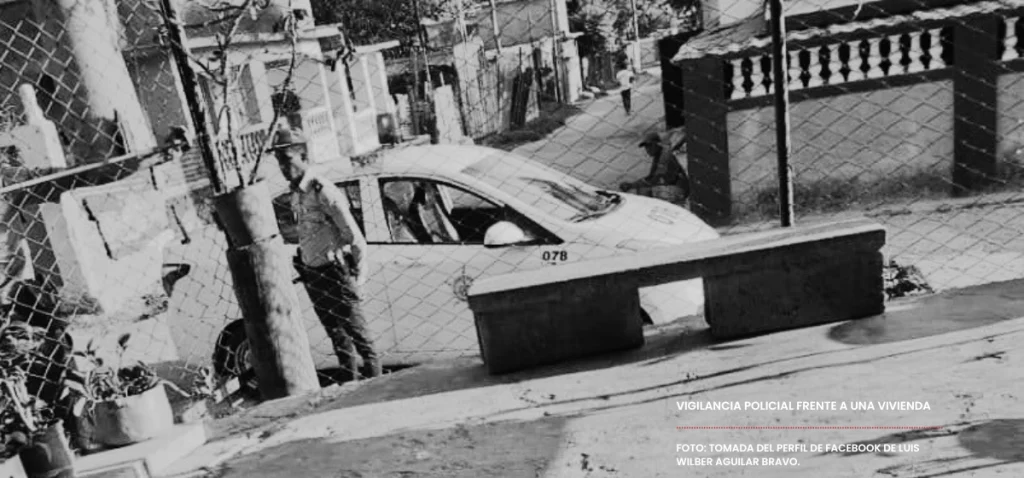
Cubalex, Alertas, 03 October 2024 / On Wednesday, October 2, we received information about surveillance and repression operations in Guantanamo, following a protest in the sugar town of Argeo Martinez, due to the prolonged blackouts in the area.
Juan Luis Bravo Rodríguez, member of the Union for a Free Cuba Party (PUNCLI) and manager of the Emilia Project, complained that State Security interrupted his Internet access and that his home was under surveillance.
Activist Miguel Angel Lopez Herrera was also under surveillance by State Security and paramilitary groups, and his home was attacked with stones.
Independent journalist Niober García Fournier was also subjected to surveillance, with the presence of an officer known as “Víctor Víctor” and a member of Inder around his home.
These repressive acts occurred one day after the protest in Argeo Martinez, Manuel Tames municipality, as part of the regime’s strategy to intimidate activists and prevent these demonstrations from gaining strength.
On October 1, after a 14-hour blackout, local residents took to the streets for several hours, banging pots and chanting anti-government slogans, due to being unable to prepare food.
According to information sent to Cubalex, officers of the National Revolutionary Police (PNR), State Security and provincial government authorities went to the site to try to quell the protest. The following day, vehicles carrying food arrived at the locality. So far, no arrests have been reported among the protesters.
Officials point out that “there are several provinces and municipalities without directors” of the Housing program, which has barely completed 39% of its activities.
The only municipality in Granma province that complied with the housing plan was Pilón, which built wooden houses. / Granma
14ymedio, Madrid, 2 October 2024 — Of the 13,492 homes that the 2024 plan had planned, as of August only 5,262 had been built, 39%. The figure is even worse when compared to the number needed on the island, it represents 1.1% of the 447,375 properties that, according to the Government in June, are required to meet demand. In three months between the end of May, when the count stood at 3,579 homes, and August, only 2,047 were built.
The data, part of the report presented at the meeting between Prime Minister Manuel Marrero and the governors, is not the only negative one. According to the official press, “all provinces show setbacks” in the local production program of construction materials, another conclusion that must not have satisfied the Cuban government, which is determined to delegate the issue to the territories.
Nancy Acosta Hernández, head of the Office for Assistance to Local Administrations, pointed out an unprecedented element in these analyses. According to the official, the Housing Program at the territorial level is being affected by the lack of human resources. “There are serious weaknesses in the appointment of staff, since there are several provinces and municipalities without directors in this area,” she generalized.
“All provinces show setbacks” in the local production program of construction materials
Staff shortages have been widespread on the island since the largest exodus in recent Cuban history began at the end of 2022, but in the case of executives, this shortage can also be attributed to the decline in the number of Communist Party cadres, a fact denounced on several occasions by Party leaders. continue reading
Havana, Camagüey, Las Tunas, Santiago de Cuba and Guantánamo are the territories where the situation is worst, a problem largely due to “the marked limitations of resources,” as the director said, calling for “urgent reversal” of this situation “which, although it will not translate into higher levels of cement and steel, which are very deficient today, will contribute to optimizing the available resources.”
Acosta Hernández was most likely referring to the progress of the program promoted by the authorities since the middle of last year for the manufacture of bricks with clay. “We live in a country rich in clay; in other regions there is natural sand, limestone. There is a diversity of natural resources that together make up different alternatives and possibilities for each of the regions to obtain their own materials for construction,” said Delilah Díaz Hernández, Director General of Materials of the Ministry of Construction, as she asked to build houses without cement as far as possible. In the same speech, the increase in the export of marble, mortar, grey cement and processed sand was announced “as the only way to obtain income.”
In the months since then, various ministers and senior officials have scolded local authorities for not following the guidelines properly, and although reports in the provincial press of successful local brick and ceramic production thanks to kilns, whether ecological or not, have not ceased, the tally has not yet been added up, spurred on by the energy crisis.
Salvador Valdés Mesa, vice president and one of the most emphatic high-ranking officials when it comes to blaming subordinates and citizens for non-compliance in all areas, insisted that autonomy has been given to municipalities, but that this entails responsibilities. “Not only are fuel and the allocation of foreign currency decentralized, this is a decentralization of decisions, which are assumed by the Government,” he said.
“It is not just fuel or the allocation of foreign currency that is being decentralized, this is a decentralization of decisions, which are assumed by the Government”
Other issues of local interest were discussed at the meeting, such as the deficient water supply service, the delivery of idle land, the slowness of the bureaucracy and “territorial planning,” in reference to illegal constructions, which will be legalized with a recent decree that, however, prohibits those built after the rule.
Manuel Marrero also insisted on the message that price controls are not a declaration of war on the private sector, in light of the complaints of some merchants. “We are not against points of sale, as long as they comply with the law, do not violate the planning, have fair prices and legal products,” he said, despite criticism from private companies about the fairness of prices. “We have responsibilities to cover, such as salaries, rent for the premises, freight of goods, electricity, legal services, taxes…”, a merchant from Villa Clara recently denounced to this newspaper.
The Prime Minister also noted that these days accountability meetings are being held, “which – he praised – constitute the very essence of Cuban democracy.” Marrero asked that these meetings be used to exchange ideas with the population. “All the cadres, at all levels, have to speak with the people.”
____________
COLLABORATE WITH OUR WORK: The 14ymedio team is committed to practicing serious journalism that reflects Cuba’s reality in all its depth. Thank you for joining us on this long journey. We invite you to continue supporting us by becoming a member of 14ymedio now. Together we can continue transforming journalism in Cuba.

 14ymedio, Juan Diego Rodriguez, Havana, 29 September 2024 — With several barriers to divert traffic, a section of Havana’s iconic Malecón has been closed since Saturday. According to a post on social media from the capital’s government, the sea intrusion caused by Hurricane Helene “caused structural damage to the road,” leaving the section from B to C street in need to repairs.