The gods do not descend from the ecstasy of the clouds, nor do psychopaths apologize for the consequences of their actions. Sometimes, however, they need to show signs of life, like people who, in an extreme situation, go to the notary to prove their existence in a public way.
Something like this happened with Fidel Castro Ruz, ex-president of Cuba and still the Secretary of the Communist Party, who a few days ago appeared at the National Center for Scientific Research and, as if this weren’t enough given the state of his health, on Monday the 12th he presented himself in the evening on the Roundtable News Program on Cubavision, where Randy Alonso and the camera crew gave a Proof-of-Life of the “retired” leader, who spoke with a certain coherence for more than an hour.
The public intervention of the ex-leader coincided with the beginning of the release of half a hundred prisoners of conscience from the Black Spring of 2003, and the cessation of the long hunger strike of the journalist Guillermo Fariñas Hernández, subjects evaded by Mr. Castro, who was busy predicting, in an apocalyptic form, the start, destiny and the end of the last battles in the war of the hemisphere, and coming down on the side of his allies.
The media vocation of our oracle coming as no surprise to anyone, many assume that the questions is not that expressed by the new oracle a la Walter Mercado of Cuban politics, who said similar things before his little intestinal fit took him to the operating room, if not as a demonstration of his physical existence and relative improvement health-wise, but so that the ill-intentioned can’t say that this island Narcissus has been turned into stone at the source of social inertia.
So fine, we note a Goal of the old Comandante, who instead of writing another Reflection left the laptop and the wheelchair and sat down at the desk of the television cameras. He doesn’t have a lot of energy, but demonstrated his ability to speak, read and misplace the pages of his notes. The message is that the man is alive, he’s put on a few pounds, and he weaves together some ideas.
The Comandante gives a “proof of life” and, in passing, offers a strong signal about the release of the men he ordered confined in 2003. Are they wrong, those who think the bars opened because of his deteriorating state of health and the taking of real power by his little brother? Is F.C. showing that the decisions are based on his personal arbitration or, at least, bear his signature? Is it a display of heatl to overcome the brevity of previous appearances?
People have already speculated on the “I’m here and now” of the Old-Man-in-Chief, who apparently spoke without breaks or editing, even though the program wasn’t live. His followers would have liked to change the Nike logo track suit for the red and black diamonds of the suit of the Comandante. For them it was another sign of eternity.
We still don’t know if Castro I will speak at the Plaza on July 26, or continue his tour around the scientific institutions of the island. For those of use who aspire to seal the source of his inertia, his public appearances are one sign of hopelessness.
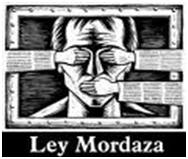
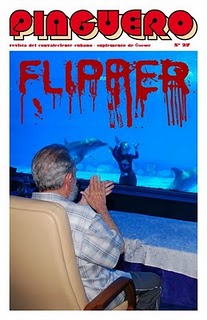 Image:

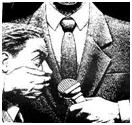 The Cuban Penal Code (CP) characterizes and punishes behavior that goes against the security of the state, the economy, public policy, etc. But in a different area of the law there is another criminal provision, which carries the same weight and promotes the same goals: Law No. 88, “Protection of National Independence and the Economy,” popularly known as “the Gag Law.”

 Movement is a universal property: nature changes and society changes. The difference is that changes in nature respond to objective laws which operate with or without human involvement, while history is made by men, allowing them to hasten or delay change, but not to stop it. The need for social change manifests itself as a permanent dissatisfaction with what has been achieved, which makes society a perfectible entity.
 He received me on Monday in a quiet apartment in Mantilla from where he has written almost all his work. On a polished table he put cold water and strong coffee for both of us. He lit a cigarette whose smoke, luckily, chose as its victim the bust of Cervantes resting on a nearby sideboard. And began to answer my questions.
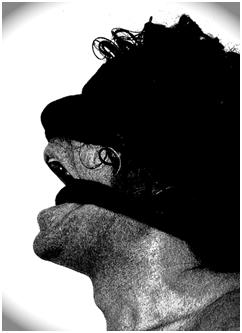 Freedom of expression is internationally recognized in the Declaration of Human Rights (Article 19). These prerogatives include being safe from oppression due to expressing an opinion, conducting research and receiving and spreading information, regardless of borders, by any means.