Another School / Claudia Cadelo

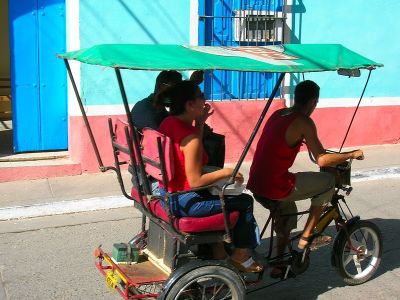
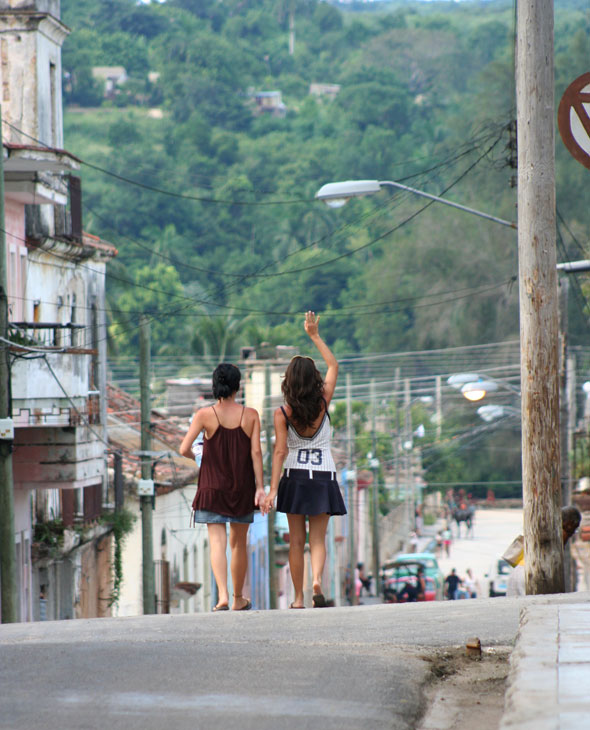
Photo: Leandro Feal

She has moved her son to three different schools. Between the “emerging teachers,” those who swear there are no Spanish words accented on the antepenultimate syllable (the word for which, in Spanish — sobreesdrújulas –is itself accented on the antepenultimate syllable), and the political propaganda, she couldn’t take it any more. The last time she put the boy in a theater workshop, she discovered with horror that he was assigned the role of Antonio Guerrero, one of the “Cuban Five” in prison in the U.S. for spying. The little guy left the first school with three warnings in his file: for asking to borrow an eraser; for crying because he wanted to go home; and, the most absurd, for not wanting to sign the previous warnings.

In the second elementary school the director welcomed the new students and their parents with the nice information that, “This school is on double section.” The poor thing was trying to say they had classes in the morning and classes in the afternoon. Then, at the group meeting, the guide warned, “Don’t worry if it’s five o’clock and your children haven’t arrived home, those who misbehave are punished with detention.”

I don’t know what human form the “historic leaders” are planning to get their hands on to reverse all the damage done to the educational system. An increase in the education budget would be insufficient as what is wrong goes far beyond the economy; paying a decent salary to teachers might serve some purpose if they had the necessary pedagogical and academic knowledge, but they don’t. To develop a new faculty nationwide would take, at least, ten years. And meanwhile, what are our children learning?

September 16, 2010

Gandhi Smiling in the Wee Hours / Henry Constantín

Early morning hours. Eight students from “Marta Abreu” Central University of Las Villas, passengers without tickets on a train. They are between cars, standing or crouching, shivering from the most intense cold in the world. In the door to the right, two cops: they don’t let them pass. At the door to the left, three railway officials: they have them surrounded. A man of enormous size and arrogance shouts from the station: the train will start only when those damn students who got on in Santa Clara without tickets get off. This happens at two in the morning in a place isolated even from itself: the town of Guayos, more than halfway to Camagüey, the destination of the boys.

There are many other travelers who don’t have tickets, and they don’t bother them, then why harass the young people?

Two months earlier, some of those same students boarded a train without tickets. That is normal in Cuba: the national railway doesn’t meet even twenty percent of passenger demand and there is a regulation that allows people who board without tickets to ride once they are on the train by paying double the established fare, to the delight of some industrious pockets. This system was applied to these boys, with the peculiarity that after having been squeezed (each one had to give a third of their monthly university stipend to stay aboard), they saw the money disappear into a pocket without getting any ticket or other proof of the transaction. So, it was the officials who got fatter.

What did they do then? They wrote about it in a letter to the State newspaper Juventud Rebelde, the national escape valve of anyone disgusted who can’t deal with the primary causes, and that let to a purification process in certain instances on the Cuban Railways. There were sanctions against a couple of people. We return to Scene 1.

The little train boss, fired up by that event, in a Mafia-like revenge decided to take it out on the Santa Clara university students, until one night we, forced by inevitable lack of transport, got on the train. Far from the station, the character noted our unmistakable presence and ordered us to get off. Faithful police and functionaries pushed us from car to car until they had us all cornered. And there, with shouts, threats of fines and jail cells, they demanded that we get off the train at the first stop.

We decided this was discrimination and vengeance and abuse and they had no right and in the end we decided to remain still and silent. We didn’t want to get off in Placetas. A girl explained to the police the reasons for the disobedience. The train boss swore definitely to stop it in Guayos: “I’m going to call the Party and whomever.” Instinctively, we move closer. The police smoke nervously, without looking us in the eye. A civilian with the suspicious air of a negotiator wants to know what we want. To go to Camagüey and pay what we owe. The shrieks of the train boss, obstinate about telephoning the station, feeling it all on the dark platform. Some hesitated: What if they arrest us? What if they kick us out of the University? No one answered the one who had spoken: his girlfriend looked at him and spit her gum out the window.

Welcome to the land of El Mayor*, says the most visible sign on the Camagüey train station. With our bags over our shoulders, still smiling still scared, we separate that morning at the station. We look back, the stopped train, its masters incapacitated and its servants hideous, in the early morning when some young men lost their fear.

*Translator’s Note: El Mayor is the nickname of Ignacio Agramonte (1841-1873), a hero of Camagüey in the fight for independence from Spain.

September 15, 2010

The Mea Culpa of the Powerful / Ernesto Morales Licea

What normally happens when a common citizen is at fault for an act of social significance? He is made to pay for his mistake, and in many ways, with a wide range of penalties; depending on the magnitude of his act, it can range from a simple reproach, to deprivation of liberty.

But in certain countries and under certain systems, the events taken as the “errors” or “mistakes” of one individual have a much broader range than under those of others.

In the Kampuchea of Pol Pot, to be an intellectual was an “error” punishable by death, or at least by agricultural work. In Nazi Germany, having too large a nose was an error paid for by having one’s bones made into buttons.

In Cuba, until very recently, to be a homosexual was an unacceptable error that was expiated by expulsion from your job, work as a prisoner in the Military Units to Aid Production (UMAP) camps, or being held in a cold nocturnal jail cell under the pretext of vulgar or outrageous practices.

But under these semi-divine systems, with justice at all cost and any cost, who punishes the error of the infallible ones when they miraculously recant? Who makes them answer, ever, for their human mistakes?

Homophobia Revisited

A few days ago, the historic leader of the Cuban Revolution, Fidel Castro, gave an interesting interview to the Mexican newspaper La Jornada. Faced with the journalist’s questions about Cuban practices with respect to homosexuals and the discrimination they suffered, particularly starting in 1965, el Comandante admitted:

“Yes, there were times of great injustice, whomever might have done it. If we did it, we, we… I am trying to outline my responsibility in all this because, after all, personally, I don’t have these kind of prejudices. If someone is responsible, it is me. It’s true that at that time I wasn’t involved in this… I found myself immersed, principally in the October Crisis, in the war, in political questions… We didn’t know its value. But in the end, someone has to take responsibility, it is mine. I am not going to put the blame on others.”

The topic is too difficult to summarize in a few comforting phrases. There is too much evidence to doubt this recognition of guilt (for example, The October Crisis dates to 1962, when the harshest period of the anti-gay repression had not yet begun).

Among other things, Fidel seems to admit only that he didn’t act against homophobia which arose spontaneously in the society, not that this homophobia was encouraged and guided by all the leaders of the Revolution, including himself.

Here are his words to Lee Lockwood in 1965, published in the book, Castro’s Cuba, Cuba’s Fidel:

We have never believed that a homosexual could personify the conditions and conduct requirements that would allow us to consider him a true revolutionary. A deviation of that nature clashes with the concept we have of what it means to be a militant communist. I think we should carefully consider this problem. But I’ll be honest and say that homosexuals should not be allowed in positions where they can influence young people.”

This was his famous speech in Havana, 1963:

“Many of these vague girlie-boys, sons of the bourgeoisie, who walk around in too-tight trousers (…) have taken their licentiousness to the extreme of wanting to go to places of public assembly to freely organize their drag shows. Do not confuse the peacefulness of the Revolution with the weakness of the Revolution. Because our society cannot accommodate such degeneracies. Youngsters aspiring to that? No! What would our strong, enthusiastic, energetic youth think of all these evils?”

I think it redundant, however, to focus my analysis on the contradictions in Fidel’s speeches from forty years ago with those of today. On this topic — or topics — there are plenty of examples of sheer gibberish: Whatever you said I said what I said isn’t what I said.

More interesting is the attitude of the powerful who, with the passage of time, revisit history and reinterpret their actions based on the needs of the moment.

They Can’t Whitewash the Past

In 2007 an incident took place in Cuba that shook the roots of our society, particularly in the artistic and intellectual worlds.

Two of the most well-known hangmen of the so called Five Grey Years (when the witch hunt against those who didn’t fit with the concept of the “New Man” reached its height), reappeared on National Television.

Luis Pavón Tamayo and José Serguera, former powers of the Cuban Cultural Nomenklatura, censors with sharp teeth and no turning back, were interviewed in two separate programs and treated as dignified officials who had left their happy mark on the national culture.
The event provoked indignation in a number of important intellectuals who, although now bearers of national prizes in literature, fine arts or architecture, seemed not to have forgotten the silent, joyless years of sad parameterization.

The protest was known as “The Little Email War,” but the digital platform was not the only place in which these intellectuals could express their indignation. (Let’s see, for the readers of this blog: Can you guess what the Cuban press has been focusing on these past few days?)

Ultimately the incident sparked a series of talks on that bitter period, and the publication of a book of these talks. Nothing, absolutely nothing changes in the culture nor in the lives of Cubans in the wake of this incident. But, could we say that the intellectuals, with their protest, sent a concrete message to the leaders of the nation?

Definitely.

The message would be this: “Do not touch the wound that has not healed despite the prizes of apology. The wound of memory never heals. We are calm today, but don’t try to whitewash the past.”

Reconciliation With The “Soft Side”

I can not ignore, of course, that the mere fact that Fidel has assumed his share of responsibility in the sexual segregation suffered by gays in Cuba is a positive and unique.

But after talking with some young homosexuals, and asking heterosexual men in their fifties who also wore long hair and tight pants at that time what they think, I want to point out that the reconciliation of this large sector of the population with the historic leaders of the Revolution is more complex than a simple Mea Culpa with shades of justification.

Why? Well because in the field of human experience, as Ludwig von Mises said, you can’t do laboratory experiments. That is fine in the individual sphere, for personal decisions.

But when millions of people, a whole country, depend on the viewpoints and decisions of someone, when the real control of one’s life is not left up to the individual, but to the State, to the Government, and sometimes to a single leader, who decides how each person should behave, and what their share of happiness will be within the society, there is no margin for error.

How does a homosexual who lost their job, who was unable to live a full life in a hostile society, take in, now, that the one who took over the reins of their country admits, as if it were the most natural thing in the world to say so, that at that time he was focused on other things.

How can the one-time prisoners of UMAP, the mistreated, those despised as sick or evil, understand that the person whom an entire people cheered as their savior, now redeems his history with a pair of last-minute arguments.

I know: there are rarely sanctions for the mistakes and lies of the powerful. Sometimes not even in democracies. No one tried George W. Bush for the nonexistent Iraqi weapons of mass destruction. Nobody imprisoned those responsible for British Petroleum’s Deepwater Horizon with its insufficient precautionary measures for disaster, which caused ecological chaos of horrific proportions.

But in the case of this island of the former New Men, where the macho revolutionary had to fight fiercely against the weak and degenerate, instead of a justifying Mea Culpa, I think it would be better to keep a respectful silence regarding the past, and to begin to build, but for real this time, a country where gays, blacks, intellectuals, workers, freethinkers and socialists can coexist without the need, for another fifty years, to hear confessions of repentance.

September 5, 2010
The Dying Bay / Miriam Celaya

The desolate bay

Ever since Sebastián de Ocampo circumnavigated Cuba, between 1508 and 1509, the seduction of the then blue and clear waters of Havana Bay began. He named it Puerto Carenas* because he stopped here to repair some damage to his ship and to renew his fresh water reserves. Two small rivers flow into this bay. Ocampo did not know it then, but he had discovered, this early in the conquest, what would be the key port of Spanish trade with its American colonies. Anyway, the indigenous name prevailed, and the twins, the city and the bay, went on to share the same name: Havana. With its magnificent natural conditions, its narrow entrance channel, its three wide inlets, the width of its space and depth of its waters, Havana Bay is, even to date, ideal as a port and, consequently, an excellent geographical point, both as a destination for passenger ships and for maritime commerce. Almost from the beginning, and for numerous other reasons, the bay was the heart of the city, the center that inspired life and encouraged the economy. The city owes much of its history to its bay and she –for her part- jealously treasures the remains of ancient facts and legends in the mysteries of her dark cradle.

Since the seventeenth and eighteenth centuries, maritime traffic in Havana was already the most intense of the New World, and some of the largest galleons of the time were constructed in its shipyards. In the nineteenth century, it attained hectic commercial activity due to the Cuban sugar boom after the Haitian Revolution. Through the bay entered, over the centuries, tens of thousands of immigrants and an even greater number of African slaves; it was a widely open door through which poured many of the components that later scattered throughout the Island to lend flesh and spirit to the national culture.

Until the 1980’s, a period of false prosperity derived from the honeymoon with the defunct Soviet Union and of shady deals with the CMEA, Havana harbor was a veritable floating city for the large number of merchant ships that frequented its waters. Moored, anchored or flowing in and out, maritime traffic in the old bay imprinted on the city an atmosphere of movement that contrasts vividly with the spectral appearance it shows today. The bay is like a desert.

Towing crane next to the Santa Clara Pier

With its old docks, Machina and Santa Clara, in ruins, the floating dock empty and covered in rust, an old towing crane abandoned near the Santa Clara pier, sewage and waste-laden greasy water and the smell of pollution invading the space, the bay is a testament to the desecration of the historical memory of the city. She is a distinctive victim of the official apathy, but nobody seems to care. What difference does a little more or less crap in such a dirty city? Many young Havanans shrug their shoulders or look at me in disbelief when I tell them that the Havana Bay of my early childhood had blue water where you could find sea bass that were plentiful, flying fish and many seagulls. Not even my children believe it (“Are you sure, Mom, could it be that you are confusing your memories with your wishes?”) But grey-haired Havanans do know that what I am saying is true.

Dismantling of the jetties

These days, there is a rumor going around that at least part of the scarce maritime commercial activity has been relocating to the port of Mariel, and that a certain Brazilian company is financing the work that will result in a cruise ship terminal in the area of the old piers of the old city, in the so-called Casco Histórico. I don’t know how much truth there is in any of this, but I have seen some work being done in the demolition of the four piers adjacent to the Alameda de Paula and the old fire station, adjacent to the Regla launch pier.

I’m such an optimist that I want to believe that someday there will be changes that will benefit the bay, that -like before- will once again be a fountain of life and of well-being for the city and its inhabitants, that its waters will be clean and that, on a very special day I will invite my suspicious children to walk along the wall of the Malecón, as we so often did when I was still a young girl and they were two little kids. I dream about being able to show them then the quick flutter of the fins of the sea bass frolicking once again in the blue waters of my bay.

* From carenar: (to careen) to clean, caulk, or repair (a ship in this position).

Translator: Norma Whiting

September 14, 2010

Riot Squads? … If There Are No Riots in Cuba… / Luis Felipe Rojas

Photo: Luis Felipe Rojas

Why is everyone so surprised to see photos of riot troops putting down a student protest in Jaguey Grande**?

I saw riot troops, led my Military Counterintelligence in Camagüey. Their objective was to avoid the public joining the demonstrations of the Eastern Democratic Alliance, which took to the streets in solidarity with Reina Tamayo while her son, Orlando Zapata, was dying in the provincial hospital in that city.

It was February 3, 2010. First came the paramilitaries, beating and arresting people, followed by the leaders of the province’s Communist Party with the plain-clothes police. They took the 29 activists away by force in civilian cars, patrol cars, and some car they found along the way. The clear intention was to remove them from the crowd that had formed and that hadn’t joined in the repression nor the repudiation. Then came the riot police to prevent any outbreak of rebellion in the crowd that was standing around watching women and men being beaten and arrested right and left. I saw it but I couldn’t take photographs because the friend I was with who had a camera had already left so his equipment wouldn’t fall into the hands of the repressors.

I’ve been told from sources outside this isolated-from-information island, that images are circulating on the Internet of a video where a strong operation controls a protest of dissatisfied Pakistanis at a school in Jagüey Grande, Matanzas.

In February, when they controlled the funeral of Orlando Zapata Tamayo, some acquaintances in the area of Banes told me that some military men wearing uniforms they’d never seen before appeared. The told me categorically — they are not the “black wasps” nor the “red berets” among others. I can’t affirm this because I remained under house arrest, but I have no reason to doubt the comments of the residents of the area, who are fully aware of the various military uniforms.

A month ago when the Baracoa dissidents led a resounding protest some I spoke to after their release, told me of the new clothing and equipment of those who controlled the place. But there, as in Camagüey and around Banes, there were no video cameras to record it and put it out on the sites where there is freedom of expression.

The ones I saw in Camagüey while giving the details by phone to the foreign press, wore a dark blue or possibly black suit (it was nearly dark and I was a distance away). They got out of two trucks covered with canvas, there were around thirty of them, with four or five technical canines and their German Shepherds (without muzzles). I was impressed by the helmets with transparent protectors from the forehead to down below the chin, hanging on their belts something like a knife or bayonet, and concave shields like the shell of a giant nut. I’d only ever seen these in demonstrations against the World Trade Organization, in South Africa which they’d shown us on Cuban television, and in the Los Angeles riots in 1991 and other areas from the tropical benevolence of Cuban socialism.

I have two testimonies of people huddled under these disguises to attack their countrymen. The first was in 1994, I was studying philology at the Universidad de Oriente in Santiago de Cuba, and the most radical students were grouped into Mambises and Manicatos*. Their mission was supposedly to guard against thefts at night, but we soon learned that in addition they prepared reports about the outstanding students, the life styles of the rest, watched the young people who fell into the arms of foreign students (better living conditions, clothes, stereos, and secretly hoping to get away to Togo, Mali or Burkina Faso).

They were a kind of teenage Rapid Response Brigade. Many of them like others hid behind a supposed sports rivalry, learning and conduct that demonstrate the worth of the “New Man.” They were given sweaters with appropriate letters, we said hello to them, had them in our cubicles, and smiled at their stupidity, but we all knew who they were: real whistle blowers.

Another who told me about it was a computer engineer friend, what in Cuban is known within the canon or racial discrimination as “a Yankee”: six feet tall, blond, intelligent and well versed in martial arts.

According to him (already working in another branch of the economy), his knowledge of combat sports earned him an extra profit, because in the case of civil unrest, his mission was to beat up the crowd, whomever it might me. So he told me.

I’ve had described to me the images of the fuss against the Pakistanis and I can’t believe it. Assault troops against Cubans? Aren’t we the most cultured country in the world where human rights are not violated and everyone is happy under the reign of the Olive-Green?

*This refers to the soldiers of the Liberation Army in the Cuban wars of independence of the 19th century and to the first natives they had news of on the island, respectively.

**Translator’s note:
A video has recently begun circulating on the web of Cuban riot police — wearing Chinese-made helmets — containing a student protest at a Cuban medical school specifically for students from Pakistan in Jaguey Grande, Matanzas, which apparently occurred sometime before March of this year.

September 13, 2010

The Evil Master / Yoani Sánchez

One of the most frequent topics of discussions when talking about Cuba, is whether the reality in which we live can really be called “socialist.” For my generation, which grew up with books on Marxism, manuals on scientific communism, and volumes of the writings of Lenin, it is difficult to find the Cuban model in those works. When someone asks me about it I say that on this island we live under state capitalism, or, as one perhaps could call it, on the Party’s plantation… the family clan’s plantation…

My theory derives from those ancient books I was forced to study, where there was one factor essential for characterizing a society as socialist: the methods of production were in the hands of the workers. But what I see around me is an “omni-proprietary” state, owner of the machines, the industries, the infrastructure of a nation and of all the decisions made about it. A master who pays the lowest possible wages and demands applause and unconditional ideological fealty from his workers.

This miserly owner now warns that he cannot continue to employ more than one million of those working on the public payroll. “To advance the development and actualization of the economic model,” we are told payrolls must be drastically reduced, while opportunities for self-employment will see only the smallest and most controlled expansion. Even the Cuban Workers Center — the only labor union allowed in the country — reports that the layoffs will come soon and we must accept them with discipline. A sad performance for those whose role it is to represent the rights of their members vis-a-vis the powers-that-be and not vice versa.

What will the antiquated owner, who has possessed this Island for five decades, do when his unemployed of today become the dissatisfied of tomorrow? How will he react when the labor and economic autonomy of the self-employed turns into ideological autonomy? Then we will hear cursing and stigmatization of the prosperous, because any surplus — like the presidential chair — can only be his.

September 14, 2010

Will a Half Million Laid Off Cubans Find Work in Private Enterprise? / Yoani Sánchez

The line at a home-based private “pizza parlor” — takeaway only — in Havana.

Exclusive to The Huffington Post.

Under the strict canons of the socialist economy — planned, centralized and subsidized — self-employment has always been seen as an undesirable species of pest that periodically needs to be abated and occasionally even exterminated. One day the specialists will write the history of the correspondence between the performance of the macroeconomy, the pace of foreign trade, and the response from the corridors of power in loosening or tightening the reins of this denigrated, but successful, creature.

Cuba once had a long tradition of small private businesses: bars, restaurants, shops, kiosks, repair shops and others, unimaginable. On the long night of March 13, 1968 they all disappeared at the exact moment in which, from the public square, Fidel Castro proclaimed the Revolutionary Offensive that confiscated everything.

In the mid-seventies there were a few small openings, but it wasn’t until 1994, under the crushing impacts of the fall-out from the collapse of the Soviet block, that self-employment and the establishment of small private businesses was authorized on a major scale. The country filled with places where you could eat a beefsteak or a Neapolitan pizza. The straitjacket that had controlled creativity began to loosen. Surprised, but happy, we Havanans saw how our city filled with little enterprises and houses converted into restaurants. The euphoria was short-lived, however, because faced with high taxes, a law that prevented the hiring of employees, and the long list of forbidden products, many of these entrepreneurs eventually gave up and shut down.

Now, Raul Castro’s government has announced that half a million State employees will be terminated and that self-employment will be expected to pick up the slack, with a broader authorization of licenses and more flexible contracting mechanisms.

My neighbor Humberto is relieved. In his private restaurant he serves more than a dozen dishes on the sly. Few know that on brilliantly white tablecloths he offers his customers lobster, shrimp and beef. These three products are highly penalized by Cuban law and their possession, “without papers,” can lead to a long prison term. Hence, they are not listed on the menu. But if trustworthy looking clients whisper in his ear, the forbidden delicacies emerge from the kitchen, far from the watchful eyes of the inspectors.

As the law, to date, has prevented Humberto from hiring anyone outside his own family, he tried to convince his daughter to marry — only on paper — an excellent chef who had recently left his job in a tourist hotel. When he discovered that his daughter was making secret plans to elope with her boyfriend, he thought he might have to surrender his license and trade the saucepan for an illegal taxi. Now, the government’s words have offered hope that he might not have to marry off his daughter to gain a chef. Who knows whether the new flexibility could also allow him to openly offer the proscribed menu items which for now he keeps hidden in his kitchen.

September 14, 2010

Open Letter to a Confused Supporter / Miriam Celaya

Mr. Josep Calvet:

I have hesitated for some weeks to respond to comments that you have occasionally poured into our little forum, but recent events that will mark the fate of my country in a not-so-distant future, force me not only to answer, but also to do so publicly. My intention is, of course, to instigate debate while exposing how damaging the official propaganda has been and continues to be, and how much distortion it creates in the minds of people, including those living in the so-called society of information and democracy. I lay as a premise that, although I feel that your comments have not been disrespectful in their design, they have indeed been so in their content, as I will make clear in this letter.

A fellow countryman of yours paved the way for me when you made some statements, among them, the “subtle” difference that exists between solidarity with the people of Cuba or with its government. At this stage of the game, almost everyone knows that both positions –support for the dictatorial government of the Castro brothers or for the Cuban people- are mutually exclusive, but you obviously have not heard. And you could not find out in any way because, judging by your approach, you – in the best of cases – have been a victim of the media’s misrepresentation and manipulation that you attribute to others in your comments; the revolutionary eloquence has made you dizzy, as indicated by various symptoms: I see that your comments are profusely dotted with those ingredients that the official Cuban discourse has created and disseminated in what we might call the “Manual for collecting foreign solidarity”; its first chapter containing a main tenet: anyone who is not in agreement with the Cuban government is “without doubt or appeal” an enemy, spy, mercenary, etc., at the service of the U.S. government, ergo, he is being funded by that country’s Treasury Department. That’s why this ideal Manual abounds in acronyms used as menacing and demonic accents, such as USAID and USIS, which, by (and only by) the grace of the olive-green verbiage, become per se crime, trial and sentence. “They are funded by USAID,” “they connect to the Internet from the U.S. Interests Section,” are phrases that are used irresponsibly as you do in reference to anyone who questions the government, without considering that, because of the repetition of that chant, the supporters of the longest dictatorship in Latin America have caused the arbitrary imprisonment of many brave Cubans and has contributed to the suffering of tens of thousands of Cuban families.

And, believe me, I make an enormous effort to understand you, because it is difficult to believe so much cluelessness and such fierce indoctrination. If you even admit to not having understood many of the clarifications made in the post “A Pause,” where I explained how I connect to the Internet and the limitations we have in Cuba in order to maintain a blog while facing official harassment, how can you pretend that you do not succumb to the official propaganda machinery that has all the resources and all the power? Yet, I will not allow you to pin attributes that don’t fit me: I do not receive funding from anyone or any institution (my blog, far from being a source of income, is an expense to me), though I reserve the right to accept the personal help of friends who have occasionally offered it to me. I do not connect, nor have I ever connected from the USIS, not because I consider it sinful, but because I have not had the opportunity to do so. I do not consider it shameful to try to find in alternative sites the information and communication opportunities that the Island’s government denies me.

I understand that you do not have much knowledge about Cuban history beyond propaganda and text carefully edited by the regime. If you knew more about this country and its heroes, you would not commit such an offensive blunder as to state that this revolution is Martí-like. Be informed that José Martí was decidedly against socialism and the Marxist ideas, and that he made clear his rejection in an article entitled “La esclavitud moderna” (Modern Slavery), which was how he defined such a system. I suggest you find and carefully read this article which, by the way, the Cuban government has never released here, and which most of today’s Cubans are possibly unaware of. It so happens that you are also sadly mistaken even about this fact, when you contradict the pronouncements of the historic leader of the Cuban revolution himself, who has stated in more than one occasion that he has studied Marx since his youth, and that he read his works during his incarceration (a vacation, by the way) of a little more than a year, after rising up in arms and attacking a military barracks and causing the deaths of dozens of Cubans. For a lot less, other Cubans have faced the firing squad for the sake of “revolutionary justice.” The revolution has not really been, as you absurdly say, “a humiliation” for the U.S., but has reduced millions of Cubans to the humiliating condition of slaves.

Another glaring blunder: the Cuban people did not “rise in arms.” The guerrillas that fought the previous dictator, Fulgencio Batista (another big shot not worth talking about, but a mere amateur compared to Castro), consisted of only a few thousand Cubans, although it is true that the revolution, in its initial years in power, had resounding and massive popular support. The ICAP*, meanwhile, has not “existed for fifty years” as you claim, but was founded in the 1970’s as an institution created to support the government, not the people of Cuba. But don’t be embarrassed by a wrong date, which is not all that important, nor elementary. It is not surprising that someone who believes that an example of great altruism and solidarity is participating in a harvest of cooking bananas that will feed revolutionaries and dissidents alike is confused. That’s scarcely a symbolic gesture. I know that we Cubans have the widespread reputation for making light of things, but be informed that many of us cherish our freedom infinitely more than fried plantains.

On the other hand, let me inform you, Mr. Calvet, that your farm sacrifice does not impress me. Since the early age of 12 until I was 17, for six consecutive school years, I had to participate in agricultural tasks, separated from my family for 45 days each year, incorporated into that monstrosity of the revolution known as the Field Schools. I could not enumerate the number and variety of foods and vegetables I harvested, weeded, fertilized and even sowed, and none of it meant any improvement in my life. Contrary to what many believe, what we need here is Freedom, not foodstuffs. Not all Cubans have the brains of a pig.

As for your comment about the Ladies in White, whom you rudely described as “a crude imitation” of the Grandmothers of the Plaza de Mayo, it is a heinous insult. As woman, mother and grandmother, I will not let you get away with such a transgression. Dictatorships, whether right or left, remain dictatorships. The Argentine Grandmothers you mention deserve all of mankind’s respect and consideration, but, in equal measure, the Ladies in White have given the world in general and Cuba in particular an unforgettable lesson in dignity. Know that their struggle is more valuable than that of the guerrillas in the Sierra Maestra, because they have confronted the longest dictatorship in this hemisphere in the midst of the city and openly, not hiding in the thicket, not chasing after privileges and power, but demanding the release of husbands, brothers and children captive of the system, not with weapons, but with flowers in their hands, with truths and rights, not killing other Cubans, but marching peacefully through the streets, confronting the fascist hordes organized and financed by the government to suppress and beat them, and chanting a word that should be sacred to all human beings: freedom.

The Ladies in White have the extraordinary merit of being the first civic movement in the history of this country that has achieved an unprecedented victory against the government by sheer force of their will and of the righteousness of their cause. They do not need to imitate anybody, because they are authentic. Today, the Cuban government itself belies you and leaves you exposed for all to see.

I would suggest you go to the Official Cuban Gazette website to find out about the new law that grants the state the right to sell the land it owns (it owns virtually all lands) to construction companies for tourism purposes (Law-Decree 273, Articles 221 and 222.1, published August 13th, 2010), with 99-year leases and also to make sales with rights in perpetuity. It states, explicitly, that the law was enacted “For the purpose of expanding and facilitating the process of foreign investment participation in international tourism.”.

What The Gazette does not state is that this Law-Decree was created expressly to legitimize investments that some American companies are anticipating, in order to build more than a dozen golf courses for the exclusive tourism of millionaires, which is not, in itself, necessarily something negative, only that we citizens are excluded and do not have the right to invest or acquire land to participate in development plans of any kind. That is, we cannot be capitalists, but the state capitalism that prevails in this country gives itself the right to sell the country off in pieces, as if it were a birthday cake, with Cubans not taking any part in the festivities.

I do not know if Mr. Calvet will also perceive the subtlety that preferential buyers who will enjoy the privileges of ownership are precisely the “imperialist enemy” that attacks us, blocks us and harasses us, the same one that — so-called “illegally” — occupies the naval base at Guantánamo. The truly peculiar thing is that, if the base exists today, it is by virtue of an amendment that granted a foreign government the privilege of owning Cuban territory, promoted on the dawn of the twentieth century by an American politician. This new one, which gives away our country to American entrepreneurs and has been designed and imposed on the Cubans by the government of Cuba itself, is the “Castro Amendment.” Contrast this law with one published before it in the same Gazette, giving peasants the land they work and produce with their own hands “in usufruct for a term of 10 years.” It is not necessary to be an astute individual to detect who the owners of power in Cuba are codling, plus let’s not mention the mysterious fate of the proceeds from such sales.

As you can see, Mr. Calvet, the Official Gazette itself is responsible for confirming what “we, mercenaries” are saying. As you may see, additionally, it is a brazen impertinence for you to try to indoctrinate me about the needs of the Cuban people. Unlike the olive-green royalty that you so passionately defend, the same one who so anxiously share in the spoils of the country, I am part of this people, deprived of rights and hopes. How can you have the audacity to point out to the Cuban people what we need and against whom we need to fight? You are definitely clueless: over a century has passed since 1898, my good man, though I suspect that date means absolutely nothing to you.

As I stated at the beginning, Mr. Calvet, your fellow countryman has taken the responsibility to respond with dignity to your twisted interventions in this space. He gives you the benefit of a doubt; I wish I could do the same, but I keep some reservations, because if you allow yourself the suspicion of considering independent bloggers as paid by the U.S. government, you might be giving me the right to assume you are a paid employee of the discredited and despotic Cuban government, which is in the business of buying the world’s solidarity while mortgaging the present and future of this Island and of Cubans. At any rate, I appreciate your participation in this blog, but you lack the moral authority to judge those who are not in love with this government. If you have any intention to participate in this debate again, be truly respectful: do yourself a favor and get informed about the Cuban reality, arm yourself with arguments, and, above all, save yourself the slogans.

Sincerely,
Miriam Celaya

* Cuban Institute for Friendship with the Peoples

Translator: Norma Whiting

September 9, 2010

Congratulations, Poet! / Regina Coyula

Manuel Díaz Martínez turns 74 today, one of the most important Cuban poets of his generation. If Manolo wasn’t my friend, he’d still be one of my favorite poets. As if that weren’t enough, conversations with him are full of anecdotes and humor; and when he turns serious, he’s of a great clarity and erudition, with that virtue of knowing much without being pedantic. As an homage on his birthday, I’ve posted one of his poems and I invite you all to leave him birthday wishes on his blog: diazmartinez.wordpress.com

Homeland

For Fabio and Grace

An expanse of land,

An arch of coast, a sea,

Some houses, some streets

Three or four rivers,

A pattern of rainfall,

A garden, some mountains,

Some frustrations,

And perhaps a utopia,

A stew, a song, a tree,

A somewhat moving history,

A way of saying things,

The aging parents

In a provincial patio,

Perhaps some siblings too

That complete the family saga

And some friends…

That and something more is homeland

If there is space for liberty there.

If there is no space, I prefer

to die from a distance.

Translated by: Yoyi el Monaguillo

September 13, 2010

Brain Drains? / Rebeca Monzo

"Now We Are Going to Construct Socialism!"

I still haven’t gotten over my amazement upon hearing, on the short-wave radio, of course, the unbelievable declarations that would be made by the Guru of my little planet to a North American journalist: “The Cuban model can’t be exported, because it hasn’t worked even in Cuba.”

Of course, whoever doesn’t have a short-wave radio here, has neither heard nor possibly will hear about this, since the daily papers haven’t published such statements up until now. These took me back to those statements of December 27, 1986, when this very same figure said: “Now we’re really going to build socialism!”

At that moment, many well-intentioned citizens asked themselves: ‘So, what were we doing until now?’

I think that it shows a great lack of respect, or sensitivity, to make such assertions. If something isn’t working and is detrimental to no more and no less than 11 million people, not counting the almost 3 million in the diaspora, how is it possible that it’s insisted upon? What consolation can be given to those millions who’ve lost relatives, because they’ve died trying to cross the sea, or who’ve been forced by these very measures (which don’t work) to leave the country, leaving behind elderly parents and even children, in search of freedom and better opportunities? And what can be said of those of us who, for a wide range of reasons, haven’t wanted to leave the country and have lost our youth waiting for change? I believe they’ve had 51 years to prove that the model wasn’t working, so, why insist on keeping it going at all costs?

Translated by: Yoyi el Monaguillo

September 10, 2010

Olivia / Yoani Sánchez

My friend Miguel left, tired of waiting for a sex change operation, and knowing full well that he was never going to get a better job. He left the red wig to a friend who worked in the same hospital and sold, illegally, the room he had in Luyanó. The day he asked permission to leave he put on a suit and tie, which made him roar when he looked at himself in the mirror. At the immigration office he tried to keep his hands off the fold of his trousers, so that the last gasp of homophobia wouldn’t spoil his departure.

He escaped before they closed the river of Cubans which, for a brief time, flowed to Ecuador. His was one of some 700 marriages contracted between citizens of both countries, many of them with the sole objective of obtaining residency in that South American nation. Miguel paid the equivalent of $6,000 and in return got a wedding in Havana with a woman from Quito he’d known for barely a couple of hours. He faked pictures of the honeymoon, paid an official at the Ministry of Public Health so he would give him his “release”and even handed over a little cash so that his white card — the exit permit — wouldn’t be too delayed. He pretended to be what he was not which was easy for him, because those of us born on this Island are good at putting on a mask.

Now he expects difficult times because the Ecuadorian police have started to investigate the 37,000 Cubans who entered that country in recent years. He doesn’t seem scared, however. He is gay, one of those they loaded into police trucks under a rain of blows, and for years he was also monitored for his critical views. After experiencing both edges of the blade of censorship, nothing frightens him. When called to testify — if he is called — he will go wearing the red dress he always wanted to wear here. Nobody is going to stop him from gesturing while they interrogate him, because already Miguel has escaped that Miguel he once was, to become — happily — Olivia.

September 13, 2010