ALL NIGHT I LISTENED to my neighbor’s wife weeping. At intervals she claimed to be tired. Very tired, she insisted. Most of the time her husband wouldn’t respond, but when he did, he agreed: me too. Then she would moan, in a choking way that called to mind the crying of childhood. My anguish grew and dreams escaped me. I got used to it. The lament came to seem like inevitable music.
In the morning the sound of hammers makes me look out the window. My neighbor, the husband, with his two teenage sons, is making a raft from several empty tanks. I looked on the roof and they no longer have anything to store water. The wife spends the whole day shut in the house. She doesn’t open the windows, clearly so as not to watch the preparations for the family’s escape.
By the afternoon they already had the vessel ready. A refrigerated truck came to collect the raft. The three men went into the house to say goodbye, one by one. They came out even more sad, as if it were possible to increase the burden of so much anguish.
Before closing the refrigerator door they looked back at the house, perhaps hoping to see her one last time. But she didn’t look out. They gave the money to the truck driver, who then counted it and they took off. When the neighbors saw the dogs running behind the truck they couldn’t understand their desperation.
Long days passed and she remained shut up inside her house. From time to time worried neighbors called on some pretext, but she didn’t answer.
A sister who came from the countryside broke down the door. The doctors assured them that her family still hadn’t put the raft in the water and that she had been poisoned.
A few days before the start of the new school year I was browsing my son Malcom’s school books and it seems to me he is going to have a heavy weight to struggle through. My wife and I bought colored jackets and cut our pieces of nylon to cover them, and pasted some little figures on them so they would look better. But what worries me is not the outsides, but rather the venomous burden he will receive in the next ten months.
His second grade reading book is infected with cartoons with militias, photos of Camilo Cienfuegos and Che Guevara, an Abel Santamaría, the Moncada barracks, a high contrast black splotch that must be Fidel Castro jumping off a tank at the Bay of Pigs… and a thousand more slogans.
In the ruckus of the mornings to come his teacher will inject him, as if fulfilling a sacred duty, what she herself was injected with over nearly half a century of existence: hatred of the enemy, love of the leader, attachment to an ideology that at his age he can’t evaluate as optional.
In the middle of the new school year, the textbook — “which, as a sign of revolutionary benevolence, they have not made us pay for” — we see the lessons for April (a month that reminds me of the flowers the poets talk about), in which my son will have to forcibly repeat that yes, he wants to be like Che Guevara, while he salutes with his open hand to his forehead. Also, in October he will have to complete the Camilo-Che Lesson, where they always talk more about the latter.
It is a trap against the innocence of his nearly seven years. Banners with images of “The Five,” spies imprisoned in the United States, the television jingles that are not commercial but ideological, in short, a fence that it will be very difficult to escape from without a scratch. It will be up to us at home to speak of spring and winter, the pollen of the flowers and the stars of the night. Similarly we will have to bring him down to earth to teach him to plant the trees that will give shade, flowers and fruits tomorrow, and to try by any means to teach him to be a good man. It will be a long and thorny road.
Working for the state is an ordeal: the wages are not nearly enough, productivity is zero, accountability is chaotic and worst of all you have to put up with the torpid meetings of a union which represents anyone but the worker. There are, however, those who have accepted all these conditions stoically and have endured years and years of state control in their jobs. It is not masochism that ties them to the apron strings of the state bureaucracy, but rather the little faith that a private investment will see them into their old age.
This isn’t the first time the government has decided — with a rope around its neck — to allow citizen initiative to sustain the national economy. We already saw, in the nineties, the emergence of private restaurants — los paladares — B&Bs, taxis, and little jobs in food service and household help. Today there is little left of that explosion of the self-employed. That is the problem: for how long will they let you keep your business?
To launch a restaurant, rent a room, or sell pizzas is not a short-term investment. People want to see the fruits of their efforts but the likelihood that the bureaucracy will, one day, knock on your door to take away all your permits has cycled through the history of the Revolution. I have a friend who had been operating a fairly popular restaurant for two years, when one afternoon an inspector came and took her papers to “verify them.” She is still waiting for them to be returned and in the meantime she cannot open the doors of her restaurant. She has received no explanation. She committed no crime.
Excerpt from documentary by Fabian Archondo and the
Foundation for New Latin American Cinema.
My son is at that age where he could eat the columns of the house if we didn’t keep an eye on him. He opens and closes the refrigerator door, as if he believes that this appliance could produce — just for him — food. His appetite is so insatiable and so difficult to satisfy, in the midst of shortages and high prices, that we’ve nicknamed Teo after that voracious fish, “La Claria.” His ravenousness reminds us of this species which some bright person brought to our country to promote fish farming, and which is now a pest in our rivers and lakes. Of course this is just a family joke, because even our fretful adolescent is incapable of wolfing down the things that enter the mouth of this walking fish.
Blue-gray, with a pronounced mustache and the ability to survive up to three days out of water, this African Catfish has already become a part of our country, both rural and urban. One of the few animals that can survive in the polluted Almendares river, it has managed to displace other, tastier, specimens in the fishmongers’ freezers. Not even its ability to adapt, nor its ugliness, however, have aroused as much alarm as its extreme predatory nature. Clarias eat everything from rodents and chickens, to puppies and every kind of fish, frog or bird.
As a solution to the food problems of the so-called Special Period, after the collapse of the Soviet block, our authorities imported this foreign species and so precipitated colossal damage to the ecosystem. Similar irresponsibility had already occurred with the introduction of tilapia and tench fish, but the results were incalculably more dramatic with this dark and elusive creature which today reigns in our waters. Whether nestling in the mud, emerging from a manhole in the middle of the city, or crawling along the side of the road, its spread demonstrates the fragility of nature when faced with ministerial directives. I have no doubt that this fish will be with us for a long time to come, long after those who introduced it into the country are only a memory, as fleeting as crumb in the mouth of a claria.
For a long time when I heard the word teacher, it brought to mind the word respect; it was one of those unconscious associations from which the psychoanalysts draw surprising conclusions. I associated the noun that indicated this profession with the names and faces of all those who taught me from elementary school through the university, men and women endowed with patience and wisdom.
Now in Cuba, the word teacher calls forth other associations. I read in the newspaper Granma, the official organ of the Communist Party, that an official from the Ministry of Education said, “As parents we want the best teachers for our children, but we don’t like the idea of their deciding to be teachers themselves.” The fact is that the shortage of teachers has become a real crisis at almost all levels of education, due to the growing desertion of those who hold these positions and the reduction of those who enroll in schools of education. The problem has become so bad that the State has now created a class of what is called “emerging teachers,” who train to be the teachers of other children starting in the 11th grade, at age 16.
There are many causes that have led to this crisis and so far the solutions applied have only served to exacerbate the loss of prestige of this noble profession. The secret is that almost no one in Cuba lives on the salary they earn, but must rely on what they can find to steal, what we call “the diversion of resources,” from their workplace, be it time, materials or equipment. Teacher have no chance to earn some extra money this way and their salaries do not differ from others who do.
Now, when I hear the word teacher, what I feel is pity for those who are educators, for their students, and for the future of our country.
Salvador Valdés Mesa, Secretario General of the CTC
On Monday, September 13th, in an unusual statement issued by the Cuban Workers Organization (the CTC), it was announced that half a million Cubans will lose their jobs in the coming months. The amazing thing is not the wave of layoffs in itself, (for a while, it has been rumored that about one million in total will lose their state jobs), but that the announcement, instead of being made by the employer, was assumed specifically by the organization which, by virtue of its name, calls to defend workers’ rights; such an organization which stands, in addition, for moderating to “maintain the systematic monitoring of the development of this process” (of layoffs). This is the paradigm of anti-unionism.
That is how it was made explicit that we will have 500,000 more unemployed by the end of March, some of whom are expected to swell the ranks of the so-called self-employed who will feed, by way of their taxes and leonine locks, the insatiable state coffers.
Without a doubt, this blogger would be guilt of false naiveté if she had ever believed that “the union”, as it is commonly called in every workplace, represented the interests of Cuban workers. Anyone who has ever been occupationally linked to a state job knows that the union is a pulley over the administrative machinery of the State. It is subordinate to it and to the nucleus of the single party at each center. As for me, I cannot remember once in my 23 years of official employment that the union, its members or its leaders ever supported me in any of the conflicts that I had to settle with different administrative levels, or in numerous complaints I had to file during my turbulent working life. I don’t remember “the union” ever forgetting to put out its hand… each payday. The financial collector of the CTC was present alongside the paymaster, to ensure the collection of union dues before the anemic wages would slip through the fingers of the “unionized”.
Another feature of Cuban trade union membership is automatic enrollment when entering the workforce, as with the CDR – an organization in which every Cuban is included as soon as he turns 16 – or with the FMC*, to which each girl “enters” at that same age. You start to work somewhere, and the mere fact of being part of the work force turns you into a member, per se, of the organization. No one asks if you want to unionize, no one explains your rights or the labor successes of the organization in favor of its members. You are limited to compling with its work plan, paying your fees, performing your “labor guard” and attending meetings and performing “voluntary” or “productive” jobs (they are not the same, but both are equally unproductive). That, and an enormous feeling of helplessness, are common attributes that the union imparts to Cuban workers today.
From the very beginning of its commandeering of power, the Castro regime has been responsible for destroying each autonomous organization in Cuba. More than half a century of union struggles that became popular in the nineteenth century and brought significant benefits during the era of the Republic were cleverly monopolized by the revolutionary government, beginning in 1959. The legendary Sierra Maestra commander knew all too well what great power autonomous civic organizations safeguarded. The Cuban labor movement, dazzled with the populism of the revolution’s first steps and with the charisma of its leader, gave up its strength and its independence in the presence of the olive-green caste, and soon it evolved into the servile mass it is today. There are no more traces of union leaders of the stature of Jesús Menéndez or Aracelio Iglesias, just to mention two of the best known, or a union like that of the port workers or the employees of the electric companies of the 50’s.
But, in spite of all that, not even in my moments of extreme fantasizing would I have thought that it would be the Cuban Workers’ Union – the country’s only union – that would consent to make the appalling announcement of a record unemployment rate. I never heard of any country – not even those where “wild capitalism” prevails – in which the organization that protects the workers is the one announcing and controlling layoffs. If any of my readers knows of a case, please enlighten me.
Finally, the facade covering the arrangement is cracking. It is exposing, naked and publicly, the perfect plot between the CTC and the sole employer, the State Party Government, counter to the detriment to workers. Interestingly, we had true unionism while capitalism lasted. Tropical socialism did nothing but crush organized labor. At the present time, when the past structures of “socialism” are blurring, in Cuba we are going back to capitalism, though such confessions have not yet been made public. With its return, workers, without rights or awareness of their own strength, are confined to the most difficult place while the government safeguards us, in another of its usual gestures of infinite sacrifice: it is appropriating the “maleficent capitalist tools” for its own use.
*Federation of Cuban Women
Translated by: Norma Whiting
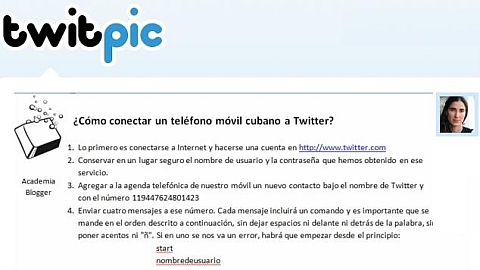
Enter the code *#06# and immediately the phone will display your IMEI code which is a 16 digit number.
Send the first 8 digits of the IMEI number by Text Message to 4222.
You will receive a Text Message that will tell you if your phone model accepts the activation of Text Messaging. It does not work on a Blackberry or iPhone; recommended phones are the Motorola K1, Motorola U6, Motorola V3 and Nokia models that are not too modern.
If the phone accepts the Text Messaging service, you will receive a second message that says “Accept” or “Install.” When it gives you one of these two options it will ask for a code, you should enter 1234.
When the application is installed, you may need to shut down and restart your phone.
When you turn it on, you will see, next to the signal coverage icon, if you have a Motorola, a pair of green diamonds; if you have a Nokia you will see the same thing next to the capital “G.”
You can now send images by Text Messaging to another Cuban mobile phone with the Text Messaging service activated, at a cost of 30 centavos a message.
You can also send an image to an email account at a cost of 2.30 convertible pesos (about $2.50 U.S., 1.90 euros), which is very useful for sending images overseas.
I have a friend, who is an International Chess Master with the title of Grandmaster, whom we consider almost as part of the family, but I hadn’t heard from her since she got a contract to work in Costa Rica last year. Last May I went to the Capablanca in memoriam tournament and, being in the right place, I asked about her. I was surprised by the fact that everyone I asked grinned, looked at each other if they were a group of people, but no one dared to tell me anything about the whereabouts of my friend Tania Hernández. One thing did seem clear among all the evasive responses: Tania was not coming back to Havana.
There was no self-censorship or questioning from the part of those I asked, since Tania is a very lovable person. Despite her career in the sport of Chess, after twelve years as part of the National Chess Team, Tania still lived with her parents and grandmother in the same block in Central Havana where she was born, a home to which improvements were made thanks to the travel stipends she saved from each trip. When her results left her out of the team, they “turned off her lights”, and Tania had to leave her sporting career, give lessons, sell her Chess books, all of which I know was very hard for her.
I suppose she used the contacts she had made while participating in international events to obtain the contract to work in Central America. In this new chapter in her life, Tania will work as a coach or teacher, activities for which she has as much talent as she had for playing; her work will allow her to pay the rent for a cozy little apartment, and also to help her family in Cuba. Now that everyone knows her decision, the Sports Institute (INDER) will not forgive her. Branded as a deserter, she will be forbidden to re-enter Cuba for at least the next five years. Of course we are talking about five years counting from 2010, so I expect to be able to hug my friend in Havana before the sentence, sanctioned by public officials who know nothing about what it’s like to live in a small overcrowded room, expires.
It turns out that now, after the unexpected declaration that our model can’t be exported, that it doesn’t even work for us. An answer confirmed by the journalist who conducted the interview, because he couldn’t get over his astonishment. It happens that this wasn’t true, rather he was referring to the capitalist model, which has just been proven to work, at least much better than the old one. Nothing, as usual, changed one thing for another, trying to complicate everything.
This is something that has been happening for many years. The character has not changed at all, the ones who have changed are us. Before we swallowed everything without saying a word, and now we have learned to question everything. As always, we have gone from one extreme to the other. Not on a whim, simply because we’ve stopped believing in him. Some sooner, others later, but in general, no one believes. I think we don’t even believe in what he says.
The truth is that he treats us like we are kids or simple-minded. He tries to keep us asleep with old and worn out lies. And don’t even talk to me about the “coconut” (the war). We’ve been waiting fifty-one years for the enemy to attack us. And justifying, based on that, all the more and more harsh measures imposed on our people: a conflagration would justify everything. Not to mention it would bury in its fallout the failure of the famous model.
Recently the talk on my planet is the imminent dismissal of half a million workers who are on staff performing work which, in reality, could be done by half as many people.
In the seventies, there was a large decrease in the staffing at some of the central agencies. At that time it was given the euphemistic name of rationalization. It reduced the payrolls. Those workers who were available, or surplus, as they preferred to call them, found work in other workplaces, regardless of the knowledge or experience acquired. In reality, it was no more than that, moving them from one place and putting them on another. Years later the number of new workers in each agency, is twice what it was.
Later, in the nineties, with the investment of foreign capital, some could go work for the newly created companies, bettering their economic status. It was a small privileged sector, envied by the other workers. We all wanted to work in some company, even just to mop the floors. It didn’t matter what the job was, the thing was to be in contact with those unattainable dollars.
Now they say that the “redundant” workers can go to work in the private sector. And I wonder, in what private sector? Because up to now, outside a few private restaurants, the paladares, what’s left? What are their options?
Wouldn’t it be more reasonable to create and pass the first official labor law for the private sector, its regulations and options, before this mass layoff that will affect three times as many people, as for every individual who loses their job, there are at least two or three family members who depend on them.
What was the previous government thinking when they increased these payrolls, putting three people in a position that really only needed one. What I believe that we are once again turning the wheel.
I remember how surprised I was in 1990 when I read in the newspaper Granma some of the letters exchanged between Fidel and Khrushchev during the October 1962 Missile Crisis. It was clear to me that Fidel encouraged the leader of the now extinct superpower to get ahead of their adversary and strike the first powerful blow, and he doesn’t mention the possibility of talking first. Even though he now derides the former leader of the USSR as a drunk, the truth is that the Russians handled the crisis as if it were a Chess match; trying to predict plays in advance, they obtained the withdrawal of missiles Turkey and a moratorium for Cuba. Fidel swallowed his pride and only after the fall of the sister republic has he expressed his displeasure at not being invited to the negotiating table back then. He wrote what he wrote, even if now he would like to spin it differently.
Fidel “amuses himself” seeing how the same American journalist who gave him the opportunity to reinterpret his intentions expressed in the letters from 1962, quotes him verbatim when he says the Cuban model doesn’t even work for Cuba anymore. But no, Fidel of course meant to say the opposite.
To sum up the little we know in Cuba about his interview with Goldberg, it’s possible that here in our country the capitalist model will not work as Fidel says; but I’m sure, since I live under it, that socialism, as we know it here and any other place it has been tried, doesn’t work either.
The tiny hardworking ant dug with her legs into the sticky black mud covering the stone, and with a gigantic effort loaded the heavy fern leaf onto her back, staggered under the weight, and started walking towards the old oak where she had been born, a tree eaten away by the years and burnt by a lightning that struck during the summer’s last storm. She walked with a limp and slowly, struggling with her own legs while trying not to get trapped in the mud. She looked around, straightening her antennas. The humidity had stuck to her body, which shone like it was slick with oil. She kept going painfully slowly, and the small distance she had covered seemed like a great victory. She had lagged behind the long column that had departed at dawn to search for food, while trying to free the juicy leaf, which would prove useful at the end of the fall when the trees become bare, from the mud.
The sun had barely begun to warm the land and it cost her a supreme effort to reach her destination before noon. While making up her mind to the task, she had calculated all the time she would need: to move the leaf, to get it out of the mud, to load it onto her back, to unstick every one of her legs from the mud, to walk the whole way back, to fight against the mid-morning wind making her movements even more difficult. She felt safe, and capable of accomplishing her goal. She gathered all her strength, and step by step, began to approach the oak. There weren’t any predators in the surroundings and this made her feel more certain of her coming success. She reached the tree, completely exhausted, before eleven o’clock. Right before entering the cave, the index finger of the man who was resting there, and who had watched her since the very beginning, crushed her against a bare root.
RECENTLY I HAVE BEEN HOPING I might read my blog for the first time. Some friends have seen it and described it to me, and I feel the same pleasure as when they speak to me about my children. They suggested that I buy a card that would let me enter cyberspace from the services in hotels. Two and a half months after starting the site, I still haven’t been able to see it. I’m anxious to read it, feel it, smell it. I imagine its design would give me a feeling of tenderness. Recently an old man asked me if I was sure if civilization existed outside this island.
Shrugging my shoulders, I think so, I told him. And he looked at me a long time, seeking the lost truth. It’s that, he commented, how is it possible that we’ve forgotten?… I got tired of throwing bottles into the sea, he said. I got tired, he repeated and took off, pondering. Recently a lady told me that the scenes of war on the news seem to have been filmed in secret television studios. I told her no: in other places there are also social contradictions, political conflicts, famines, diseases, etc. It’s that they never show happiness, she observed, except on the national news where everything is going well, all the plan targets are met, the people interviewed are happy, they don’t complain, they’re not worried, they don’t have different ideas… Beyond our borders the people are always killing? Sometimes, I answered. Then, she continued, they don’t eat apples, don’t go on cruises, don’t vote peacefully? In some places, I said. The woman kept staring at me.
Surely you are one of them, she declared. Who? I wanted to know. Those who write the national news full of happiness and make us believe we are living in paradise… Do me a favor, she asked, I’m losing my sight, if I try to make conversations with you another time remind me that it’s you, so I won’t waste my time… When I got home I turned on the news, the Afghans were running back and forth. I wasn’t sure if in the background I thought I saw a sugar cane field, and even the smoke from a smokestack. I went to the TV and turned it off.
Recently they have also, “Interrupted the Email Service.” Now, I go to Havana in search of a kind soul who uploads a text to my site; it makes me remember the excitement I used to feel in those early years of writing when I was wandering around the city trying to find a typewriter with a good ribbon and someone who would type, behind their boss’s back, several pages of a story I planned to send off to a literary contest. I have no complaints. From the beginning I knew what would happen if I chose the “status” of a writer within the island; in consequence, some benefits, or managing a space to write the problems that surround and distress me, and by extension, receiving institutional attacks.
Recently in Havana the cost of the written word has gone up. Owners of authorized email charge in convertible pesos (cuc) for a service to communicate with families in other countries, or for the whores to keep in touch with their foreigners. Since the beginning of last year, when they tried to deny access to Cubans to connect from the hotels, the private rentals have gone up to three cuc, and they say that before the end of the month it will increase to five.
Recently I have my doubts: I don’t know if words are going up in price or have lost their value.
Looking through an old suitcase one always finds interesting things, that once brought happiness and sadness and that today, forgotten by all, seem to have no value. However, if you feel them, put them to your ear, they vibrate with their own life as if reborn, full of noises and sounds for those who want to hear and smell them. This happened to me on a day when, yearning for the memories of my childhood, I opened an old suitcase of my grandmother’s, saved for who knows how many years in loft of the stairway.
Putting the key into the worm-eaten lock it gave way, moaning like a virgin on being possessed. On opening the lid, dozens of sprites of different shapes and sizes, leaped out onto the floor, and ran in all directions, hiding behind the furniture and curtains. I was caught between shock and surprise, but recovered quickly, staying still, just watching them. As they gained confidence they abandoned their hiding places and approached me, looking at me with bulging eyes and feeling me with their little hands. I felt like Gulliver in Lilliput, but I was reacting as if ignoring them, rummaging through the contents of the suitcase. Then it seemed that the leader, being the oldest, pulled on my pants leg and in a bell-like voice said to me:
“What are you looking for in the past?”
“The reason for the present,” I answered.
“The present is the present.”
I became pensive and closed the suitcase. In there were my grandmother’s things, but the goblins also got free and accompany everywhere all the time. Only I am the only one who sees and feels them. In old suitcases one always finds interesting things.
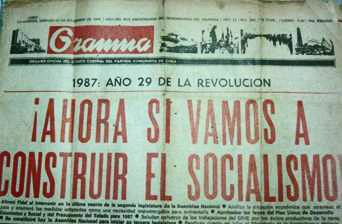
1987: Year 29 of the Revolution: “Now, indeed, we are going to Build socialism!”
Fidel Castro’s recent confession that the Cuban System doesn’t work, not even for us, and the unfortunate clarification that sought to amend the slip, have surprised and excited those addicted to the regime, its opponents, and neutral Cubanologists.
The initial phrase, slipped into an interview with the journalist Jeffry Goldberg from The Atlantic magazine, came to be interpreted by some as a sign of changes to come, although others took it only as an inconsequential rant.
I remember the newspaper Granma’s front page from December 27, 1986: “1987: Year 29 of the Revolution,” and in letters even larger, the Maximum Leader’s brilliant line, “NOW INDEED WE ARE GOING TO BUILD SOCIALISM.”
A few years later, when Real Socialism collapsed in Eastern Europe, another journalist (obviously a foreigner) asked the Commander-in-Chief if Cuba would now dedicate itself to building capitalism. His answer then also stunned many: “What is built is socialism, capitalism gives birth to itself.”
Now, the first question that comes to mind is whether there has really existed a “Cuban system” susceptible to being defined under some theoretical formulation. The absence of a definition is what has allowed the pervasive voluntarism and improvisation with respect not only to the economy, but also to political culture, international relations, and all spheres of ideological work. If this is the model of the Cuban system we are now being told doesn’t work: thank you very much, we already know that. For denouncing or issuing warnings about its disfunctionality, many honest members of the Communist Party were expelled, many journalists, artists, professors and employees of the superstructure lost their jobs, and many citizens, considered dissidents, ended up in prison.
But we don’t seek vengeance. Let’s be positive. Start with a clean slate. Look to the future. If this “system” does not work, let’s design another, keeping in mind that socialism, as defined in books, never came to the point of failure of Cuba because it was never possible to implement it.
One of the problems we have faced, at least recently, has been the insistence on the irrevocable character of our system, with public discourse being allowed to advance only as far as promoting the idea of perfecting or realizing it. The “Not Working” sign which, in a Freudian slip, the Maximum Leader hung on the doors of the system, calls for replacement rather than repair; for change, rather than improvement. But it can also leave us at a dead end, marching in place.
The clumsy explanation that he was amused to see how he had been interpreted, because what he meant to say was exactly the opposite, makes me think of the late comedian Chaflán, who explained to the public that when he was wearing his hat everything was a joke, he only spoke seriously bare-headed. Was el comandante wearing his cap when he was speaking with Goldberg?
The oft repeated story of the King wearing invisible clothes has found a different ending in Cuba. It is no longer an innocent boy who shouts that the emperor is nude. To the astonishment of the credulous, it is the monarch himself who, in an obscene display of exhibitionism, admits loudly, “I am stark naked.”
Note: This article originally appeared in Spanish in Diario de Cuba
 Photo: Alejandro Ascuy





 RECENTLY I HAVE BEEN HOPING I might read my blog for the first time. Some friends have seen it and described it to me, and I feel the same pleasure as when they speak to me about my children. They suggested that I buy a card that would let me enter cyberspace from the services in hotels. Two and a half months after starting the site, I still haven’t been able to see it. I’m anxious to read it, feel it, smell it. I imagine its design would give me a feeling of tenderness. Recently an old man asked me if I was sure if civilization existed outside this island.