The 35th Anniversary of the Wall, a Time of Dissent in Germany

The far right and far left are taking advantage of the persistent socio-economic gap and the differences in mentality between the two parts of the country


Berliners tearing down the Berlin Wall, in November 1989. / EFE/Archive

14ymedio biggerRodrigo Zuleta/EFE (via 14ymedio), Berlin, 9 November 2024 — The 35th anniversary of the fall of the Berlin Wall in 1989 is taking place at a time of dissent between West and East Germany, reflected in the electoral successes of the far-right Alternative for Germany (AfD) and the far-left Sarah Wagenknecht Alliance (BSW), which are taking advantage of the persistent socio-economic gap and differences in mentality between the two parts of the country.

The two parties are questioning part of the consensus that has guided German politics for decades. Despite the differences that mark their respective policies, there is one thing that brings them together: their rejection of arms shipments to Ukraine and sanctions against Russia, and their ability to take advantage of popular discontent in the east.

And the 35th anniversary comes with the added political uncertainty generated by the break-up yesterday — on Wednesday — of the governing coalition formed by social democrats, greens and liberals.

The fall of the Wall in 1989 was the greatest triumph of the citizens’ movement in the German Democratic Republic (GDR) — the East —  and at the same time it was the moment when it began to lose importance and when the West German government, headed by Chancellor Helmut Kohl, took into its own hands the process that would lead to reunification. continue reading

“The two events had different actors. The fall of the Wall was driven by the citizens’ movement in the GDR from the summer and autumn of 1989.”

“The two events had different actors. The fall of the Wall was driven by the citizens’ movement in the GDR from the summer and autumn of 1989,” historian Arne Bauerkämper, emeritus professor at the Free University of Berlin, told EFE. Although the fall of the Wall was key in the process that led to reunification, the actors who had promoted it subsequently lost strength.

A key moment was the elections of 18 March 1990, the only free elections in the history of the GDR, in which the coalition representing the citizens’ movement barely won 3%. “Many see this result as unfair to those who took great risks in 1989 and had unleashed a dynamic that led to the fall of the Wall,” Bauerkämper said. The elections were marked by a fundamental question: what the path to reunification should look like.

Some, such as representatives of the citizens’ movement, were in favor of the GDR undertaking a series of reforms and then entering into negotiations for a reunification on relatively equal terms with the Federal Republic of Germany.

On the other side were the supporters of a rapid reunification who ended up winning the elections with the Alliance for Germany, led by the Christian Democratic Union (CDU), chaired by Lothar de Maizière, who would be the last Prime Minister of the GDR. Among other things, his program included the immediate introduction of the Western framework into the East.

“The price of not having attempted something common and on equal terms, that is, a true reunification, is being paid now”

In a recent article entitled From Revolution to Reunification via the Fall of the Wall, historian Sascha-Ilko Kowalczuk recalls that the then British Prime Minister Margaret Thatcher congratulated Kohl on Maizière’s victory, which “hit the nail on the head.”

After Maizière’s victory, the road to reunification was dizzying, but the process — which between May and November 1989 had taken place on the streets — had moved into the offices.

The end result was the dissolution of the GDR, whose territories ended up assuming the legal order and economic system of the West, with almost no room for negotiation.

“The price of not having attempted something common and on equal terms, that is, a real reunification, is being paid now and at the risk of democracy,” writes essayist Dirk Oschmann in his book “The East: An Invention of West Germany.”

The euphoria of 9 November 1989, when the Wall fell, gave way months later to the first disappointments when, following the introduction of the West German mark in June 1990, companies in eastern Germany lost competitiveness, leading to an increase in unemployment.

“In September 2022, it was found that confidence in democracy in eastern Germany had fallen to 39%, while in the west it was 59%”

Although the material situation has improved steadily since 1990, the differences between the two parts of Germany and the fact that East Germans have little presence in positions of responsibility have led to a kind of protest culture.

At some AfD demonstrations, one can even hear the slogan “Wir sind das Volk” (We are the people), which was the motto of the peaceful revolution in the GDR.

“In September 2022, it was found that trust in democracy in eastern Germany had fallen to 39%, while in the west it was 59% – a horrendous difference of 20 percentage points, which is almost equal to the horrendous wage gap of 22.5%,” writes Oschmann.

It is this discontent that the AfD and BSW are taking advantage of in eastern Germany to attract votes with populist messages from the right and the left, which allow them to win regional elections in the first case and to play a key role in the formation of governments in federal states such as Thuringia and Brandenburg in the second.

____________

COLLABORATE WITH OUR WORKThe 14ymedio team is committed to practicing serious journalism that reflects Cuba’s reality in all its depth. Thank you for joining us on this long journey. We invite you to continue supporting us by becoming a member of 14ymedio now. Together we can continue transforming journalism in Cuba.

Total Blackouts Deepen the Multidimensional Crisis Cuba Is Suffering

The UN and the European Union will send 94 tons of supplies for those affected by Hurricane Oscar

Cubans’ incomes do not allow them to navigate this context of food insecurity and energy crisis. / EFE

14ymedio bigger14ymedio, Havana, 9 November 2024 — The two total blackouts that Cuba has suffered in the last three weeks are an economic, political and social disaster that deepens the multidimensional crisis that the country is suffering, experts consulted by EFE agree. As of Saturday, Cuba is still recovering from the total blackout caused three days ago by the passage of Hurricane Rafael through the western provinces of the island. Just 19 days earlier, a breakdown in a key thermoelectric plant also caused the National Electric System (SEN) to collapse and left the entire country in the dark for more than three days.

The consequences of these multi-day power cuts are impossible to list: from the paralysis of almost all industries to the loss of refrigerated food in stores and homes; from lines at service stations to the suspension of water supplies; along with the paralysis of schools and the effects on hospitals, transportation and the precious tourism sector. At the macroeconomic level, the impact is evident. “I would expect a very significant fall in the gross domestic product (GDP) this year,” says Cuban economist Pavel Vidal, who predicts “the third recession since the pandemic” for Cuba.

In his opinion, the country has fallen into a “poverty trap” and has run out of “capabilities and possibilities for recovery.” “Even if things are done well, there is no longer the capacity to get out of this crisis,” he argues. continue reading

There is no growth, no development and no satisfaction of human needs in the 21st century without electricity

Tamarys Bahamonde, an economist and doctor in Public Policy, believes that “in a country with such precarious conditions – social and economic – as Cuba, the impact of the paralysis of the productive sector and the provision of services is devastating. There is no growth, no development and no satisfaction of human needs in the 21st century without electricity,” she concludes. In addition to highlighting the impact on the productivity and efficiency of companies due to the direct and indirect costs of blackouts, Bahamonde emphasizes the situation in which prolonged power cuts leave people. “The income of the majority of Cubans does not allow them to navigate this context of food insecurity and energy crisis simultaneously with success,” she says.

Rita García, director of the Christian Centre for Reflection and Dialogue, emphasizes this point. She refers to the “terrible physical and mental exhaustion” of “every elderly person, every child, every mother” in this situation. “People can’t stand it any more: it’s terrible. More hours (of blackout) than during the Special Period [after the collapse of the Soviet Union and the loss of its subsidies to Cuba]. We’re working 20 hours a day and we’re desperate,” she says of the city of Cárdenas, in Matanzas. García also describes the “tension” that it means for her institution to maintain the care of 120 very vulnerable elderly people, for whom they provide daily home delivery of food.

For her part, Cuban sociologist Cecilia Bobes believes that in this situation there may be “isolated protests,” although not an “outburst similar to that of 11 July” of 2021, the largest anti-government demonstrations in decades. The “extreme precariousness” fuels “indignation,” “anger” and a “feeling of injustice,” explains Bobes, but it also provokes sadness and hopelessness, which is demobilizing, as is the need to ensure survival and the deployment of “resources” by the authorities to avoid protests.

For social anthropologist Katrin Hansing, a professor at the City University of New York and an expert on Cuba, the prolonged power outages are generating “a lot of uncertainty,” a “very negative energy” that causes “anguish,” “anxiety,” and “stress.” “We have woken up to the new reality that at any moment the power can go out for a long time, and knowing that produces not only enormous uncertainty, but also permanent discomfort,” she explains. Hansing argues that these total blackouts have put the spotlight symbolically, but also more generally, on “a system that is very fragile,” something that encourages doubts about “the future of this country.”

Several countries and institutions have offered their help, but donations are far from being able to cover the economic needs.

In this context, several countries and institutions have offered their help to the island, but the donations are far from being able to cover the country’s economic needs. The United Nations system in Cuba reported this Saturday that it will send, together with the European Union (EU), more than 94 tons of essential supplies valued at 600,000 dollars, as part of the aid to those affected by Hurricane Oscar. The contribution will arrive in the province of Santiago de Cuba between this Sunday and next Wednesday and consists of medicines, medical supplies, water storage tanks, hygiene kits, chlorine tablets, tarps, mosquito nets, solar lamps and tools, among others.

The shipment is part of a coordinated action plan between the Cuban authorities and the United Nations Agencies, Funds and Programs, to benefit almost half a million people in the province of Guantánamo. The aid will reach the east of the country via four flights financed by the EU. Logistical support has been provided by the United Nations Humanitarian Response Depot Network managed by the World Food Program, according to the statement.

With this action plan in response to Hurricane Oscar, announced at the end of October by the office of the United Nations coordinator in Cuba, the UN seeks to mobilize up to 33 million dollars.

____________

COLLABORATE WITH OUR WORKThe 14ymedio team is committed to practicing serious journalism that reflects Cuba’s reality in all its depth. Thank you for joining us on this long journey. We invite you to continue supporting us by becoming a member of 14ymedio now. Together we can continue transforming journalism in Cuba.

Havana Loses Its ‘Abbey Road’ With the Fall of the Traffic Light in Front of Coppelia

Without the traffic light, passers-by lose the ability to cross 23rd Street at that point

The traffic light at 23rd Street in Havana the day after the passage of Hurricane Rafael / 14ymedio

14ymedio bigger14ymedio, Natalia López Moya, Havana, 7 November 2024 — First the traffic light that regulated the passage of pedestrians in front of Coppelia, the city’s iconic ice cream parlor, stopped working, and now Hurricane Rafael has given the final machete chop to the crossing that connects the most famous ice cream shop in Cuba with Tower K, by knocking down the traffic light intended for vehicles that pass through 23rd. Without the light, passers-by lose the possibility of crossing the central avenue at that point, and Havana loses its umpteenth crosswalk.

Among the first photos of the recovery work in Havana published this Thursday are some that show young recruits of the Military Service collecting debris, fallen fences and tree branches in the vicinity of the building known as Torre López-Calleja (from the name of the late leader of the military conglomerate Gaesa, responsible for its construction). The tallest building on the Island stands out with its immaculate glass facade in the midst of the chaos left by the hurricane. The damage included the fall of the perimeter fence that surrounds the building, where construction work is still being carried out.

Hurricane Rafael has deepened the damage that laziness, lack of investments and the crisis have caused in what was once the cultural and economic heart of Havana

In the surroundings of the luxurious complex, which will house a hotel, shops and offices, Rafael has deepened the damage that laziness, lack of investments and the crisis have caused in what was once the cultural and economic heart of Havana. The broken sidewalks, the shortages at Coppelia, the closure of numerous restaurants and the decrease in the number of people who travel the area daily, due to the mass exodus and transport problems, now make up the landscape that extends along an avenue that runs from the sea to the Almendares River. continue reading

The broken traffic light in front of Coppelia will hardly be noticed in the midst of so much deterioration. Not much will be missed either: the shortage of fuel has significantly decreased the number of cars that travel 23rd, and the “island of flight” that Cuba has become has also depressed the number of pedestrians interested in crossing from one side of the street to the other.

But the places that memory treasures are lost. The kisses given before walking across that pedestrian passage; the braking saved in the memory of that day when an almendrón* was about to go through the red light; the trova** music coming from a guitar, while the green signaled the pedestrians; the taste of a scoop of chocolate ice cream on a fragile wafer, licked while planning to step on the crosswalk’s stripes.*** The setting that evokes these memories is missing more and more pieces.

Translator’s notes:
* A 1950s American car used as a shared taxi with a fixed route.
** Trova is a popular Cuban style of music, created by itinerant musicians in the 19th century who traveled around Oriente province singing original songs accompanied by guitar.
*** A crosswalk is called a “cebra” (zebra).

Translated by Regina Anavy

____________

COLLABORATE WITH OUR WORKThe 14ymedio team is committed to practicing serious journalism that reflects Cuba’s reality in all its depth. Thank you for joining us on this long journey. We invite you to continue supporting us by becoming a member of 14ymedio now. Together we can continue transforming journalism in Cuba.

At the Heights of the Escambray Some Young Volunteers Take Care of a Soviet Radar Station

There are no meteorologists or scientists working there, but a group of amateurs have taken charge of the place

Young people in the area consider that working on the radar station is “an opportunity” /Radar Pico San Juan/Facebook

14ymedio bigger14ymedio, Juan Izquierdo, Havana, 7 November 2024 — Lost in the undergrowth of the Cienfuegos Escambray, the MRL-5 Soviet radar station looks more like a relic of the Cold War – it was inaugurated in 1989 – than a functional meteorological installation. To get to it you have to go seven kilometers away from the road and climb 223 concrete steps. Whoever manages to conquer the route will be 1,140 meters above sea level and exposed to winds of extreme violence on hurricane days.

Among the few willing to go up to the radar of Pico San Juan – although in reality the station is on the mountain known as La Cuca – there are no meteorologists or scientists, but a group of amateurs who have taken charge of the place after the stampede of the professionals. “Salaries that do not reach 4,000 pesos, isolation and transportation difficulties drove away the specialists and experienced teams,” explains Televisión Cubana, which interviewed the workers during an expedition to the Sierra de Guamuhaya.

The radar station employs two groups of three or four operators. There are ten in total. They go up in a truck as far as the road allows and from there climb a ladder with a 45-degree slope that leads to the radar. In the distance, among the vegetation, the huge sphere of cement that the device contains is visible. The “mountaineers” – as the official press calls them – remain there for a week. continue reading

The terrain is 1,000 kilometers in diameter and has 785,000 square kilometers of area

The terrain is so intricate that the workers in charge of opening the road that leads to the place gave up in the 80s until a farmer in the area showed them a path. The anecdote is famous in the Escambray. “Look for a bulldozer and let it fall behind my mule,” said the man, a kind of healer in the area – and militiaman in the service of Fidel Castro – known as the Gallego Otero.

Young people in the area consider that working on the station is “an opportunity,” because as children they regarded the installation with reverence. Cuban Television does not reveal how much the State pays them, but it implies that either they do not receive any salary or the payment is minimal. The most “experienced” worker, Lázaro Moreno, has been a “principal specialist” of radar for just over eight months.

Moreno says that it only takes “a few notions of electricity and mechanics” and some meteorology to work in the facilities. The rest of the “boys,” he says, are “young and from my own neighborhood.” The transport crisis has forced the recruitment of operators only from nearby homes, in case “they have to come suddenly.”

A married couple, Ada and Erwing, are also part of the group as “observers.” Erwing hopes to “be able to prepare better” in the future. It’s been “barely three months,” he confesses. Moreno, just as enthusiastic, plans to “retreat” there. “We have many programs on the computer and are preparing,” he adds.

In Pico San Juan, temperatures sometimes approach zero, and conditions are precarious /Radar Pico San Juan/Facebook

“They have overcome their fear of being inexperienced,” says the reporter who interviewed the group. The radar does not have a high technological level either; it has been operating for 35 years with the same equipment sent by the Soviet Union. With a few instructions, they can handle it.

“The radar works automatically. It makes an observation every ten minutes and sends it to the National Radar Center of Camagüey,” explains Moreno. From its coordinates – 21º 59’ north latitude and 80º 08’ west latitude – the radar collects information on a circumference that goes from the beaches of Baconao, in Santiago, to the Cape of San Antonio, and from Hollywood (Florida), to a point in the Caribbean Sea not far from the island of Grand Cayman.

The sweep is 1,000 kilometers in diameter and over 785,000 square kilometers of area. The height of the radar allows eliminating the effect of the curvature of the Earth and expands the range of observation.

The station was built by orders of Castro, who claimed that several hurricanes had wreaked havoc on the Island because there was no station in the Escambray. Working on it, at the beginning, was the dream of many ambitious meteorologists. However, the place soon fell into oblivion, and the Government abandoned it to its fate. A house next to the station, an electrical plant and the radar building itself attest to the fact that Pico San Juan has seen better times.

The plant is essential to maintain operations during a hurricane, but activating it – say its operators – is a nightmare. The wind can “tear off the clothes” of a worker while he is pouring the fuel. Other times, in order not to risk their lives during the wind, several have to hold on to each other if they want to light the plant.

In Pico San Juan, temperatures are sometimes close to zero, and conditions are precarious. There is only one sign of the Government’s concern for one of the key points of Cuban meteorology: a diploma with a photo of Díaz-Canel, signed by local officials, which celebrates the operation of the radar station after 35 years.

Translated by Regina Anavy

____________

COLLABORATE WITH OUR WORKThe 14ymedio team is committed to practicing serious journalism that reflects Cuba’s reality in all its depth. Thank you for joining us on this long journey. We invite you to continue supporting us by becoming a member of 14ymedio now. Together we can continue transforming journalism in Cuba.

Three Cuban Baseball Players Escape Two Hours Before a Game in Mexico

The Cuban baseball team arriving in Mexico, including the three escaped baseball players / Francys Romero

14ymedio bigger14ymedio/Swing Completo, Havana, 7 November 2024 — Cuba arrived this Wednesday at the Mexican stadium Coloso del Pacífico, in Tepic (Nayarit), without three of its players. Two hours before the baseball team boarded the bus that transported them, Branlis Rodríguez, Over Cremet and Alexis Varona “were absent from the group,” reported journalist Francys Romero.

A few weeks ago, a committee of the US Major Leagues said that the Mexican stadium met all the requirements to hold international professional competitions, reported Swing Completo.

Accompanied by the ghost of the escapees, Cuba suffered a 9-1 defeat against Mexico in the exhibition game this Wednesday. The 18 players were escorted by three coaches and three other team members, who did not try to prevent the escapes. At the head of the delegation was Ángel Ortega, manager of Granma in the last National Series, accompanied by coaches Guillermo Carmona from Industriales, Abeicy Pantoja from Las Tunas, and Jorge Hierrezuelo, Jesús Bosmenier and Carlos Marín.

The Cuban Baseball Federation decided to form an alternative team, because the national team is in Taiwan for the Premier 12 tournament, which will be held between November 13 and 18 in Japan, Taiwan and Mexico. continue reading

Start of the game between Mexico and Cuba at the Coloso del Pacífico stadium / Facebook / Por la Goma

The athletes arrived in Mexico last Tuesday and had to have their luggage ready a day later before leaving the hotel, to return to the Island as soon as the match against the Aztecs ended.

The receiver Alexis Varona was part of the team that Ortega summoned. In that same position were called William Saavedra, Yunier Mendoza, Osvaldo Abreu, Yunier Rondón and Jeison Martínez.

Last May, on Facebook, Por la Goma highlighted Varona as one of the “best second bases” of the National Series. “He has defended more than one position, even in the outfield. He is a very useful baseball player in any team.”

The outfielder Luis Cremet “had a luxurious year” in the last National Series, according to the All In 1 Deportes portal. “He is a natural slugger, one of the few that the province of Guantánamo has,” it said. The player from Guantanamo was accompanied in the team that arrived in Tepic by Frederich Cepeda, Dennis Laza, Yaser Julio González and Ariel Hechavarría.

Branlis Rodríguez was among the five pitchers called up by Ortega. The others were Dani Betancourt, Randy Cueto, Armando Dueñas and Alberto Pablo Civil. The left-hander was an important piece of the Pinar del Río team that lost the National Series against Las Tunas.

Translated by Regina Anavy

____________

COLLABORATE WITH OUR WORKThe 14ymedio team is committed to practicing serious journalism that reflects Cuba’s reality in all its depth. Thank you for joining us on this long journey. We invite you to continue supporting us by becoming a member of 14ymedio now. Together we can continue transforming journalism in Cuba.

Year-on-Year Inflation in Cuba Stood at 29 Percent in September

The index that experienced the greatest price increase was that of alcoholic beverages and tobacco, with 48.6%.

The social perception on the island is that inflation is much higher than the official figures. / 14ymedio

14ymedio biggerEFE (via 14ymedio), Havana, 1 November 2024 — The annual inflation rate in Cuba’s official market was 29.05% in September, the lowest value in years and the first time it has fallen below the 30% threshold, the National Office of Statistics and Information (ONEI) reported on Friday. The increase in prices has marked a slight downward trend so far this year, according to official data, but continues at rates that harm the economy as a whole, and especially families, workers and retirees.

In fact, Cubans spend 90% of their income on the basic basket of goods that Onei uses to compile its price index. The social perception on the island is that inflation is much higher than the official figures, where it is difficult to include in a representative way the movements of the country’s extensive black market, which is more varied and dynamic.

In comparison, 2021 closed with an annual inflation rate above 77% and since then it had mainly fluctuated between 30% and 40%. The change in the consumer price index (CPI) compared to August was 0.76% (compared to 0.42% in the same month of the previous year) and so far this year it stands at 20.05% (compared to 19.28% in the same period of 2023). continue reading

Broken down, the largest year-on-year increase in prices occurred in alcoholic beverages and tobacco (48.61%), followed by food and non-alcoholic beverages (33.67%), restaurants and hotels (32.65%) and transport (30.98%).

As is usually the case in these reports, all categories experienced year-on-year increases of over 10% except for recreation and culture (9.60%), communications (0.73%) and health (0.70%).

Cuba has been mired in a serious economic crisis for four years, which is reflected in shortages of basic products (food, medicine and fuel), rampant inflation, increasing dollarization and frequent power outages.

The combination of the Covid-19 pandemic and failed national economic and monetary policies have aggravated structural problems in the economy.

The situation has caused despair and widespread social discontent, which has resulted in protests and a wave of migration unprecedented in scale and duration.

____________

COLLABORATE WITH OUR WORKThe 14ymedio team is committed to practicing serious journalism that reflects Cuba’s reality in all its depth. Thank you for joining us on this long journey. We invite you to continue supporting us by becoming a member of 14ymedio now. Together we can continue transforming journalism in Cuba.

Eyeglasses, Another Problem Cubans ‘Resolve’ Thanks to ‘Families in the Exterior’

In Cienfuegos you can only find material of dubious quality or at impossible prices in the private shops

In the optical shop on the boulevard the shelves are empty / 14ymedio

14ymedio bigger14ymedio, Julio César Contreras, Cienfuegos, 7 November 2024 — In Cienfuegos, optometrists are as scarce as the eyeglasses themselves. Plastic frames of poor quality from a dollar store in Miami is the most that those who are condemned to solve their vision problems within the Island can aspire to. For those who have relatives abroad, the answer is easier. A doctor is found to test the eyes, and the prescription travels to the United States or Europe, where relatives will assume the payment.

The shortage of specialists is not the only thing that affects ophthalmology in Cuba. It is a challenge to find eye drops for vision tests, and the measuring devices often don’t work. Therefore, it is not uncommon that in the Pediatric Hospital of the city, where the equipment is more or less better preserved than in other centers and some supplies still arrive, there are several adults waiting to be treated – alleging friendship or offering “gifts” – by an optometrist.

Maritza is one of them. She managed, through the friend of a friend, to have the doctor see her after months of suffering from headaches because her glasses no longer worked for her. With prescription in hand, the Cienfueguera prepared to go to the optician, but on the rickety shelves there was not a single frame that she could wear. continue reading

It is not uncommon that in the Pediatric Hospital, where the equipment is more or less better preserved, there are several adults waiting to be treated

“The first thing that surprised me was to see that the optical shop itself has rented a space to private cell phone repairers. I immediately knew that the other people and I were not there for the same thing,” the woman tells 14ymedio. Maritza approached the counter and handed the prescription to the clerk. “The lady, almost of retirement age, said that they only had small graduations available, and that I should return in a week to see if there was anything new.”

According to Maritza, for years she has seen that the shelves of the optical shop, located on the boulevard, are practically empty, with a few dull frames that don’t please the tastes of the needy. But she always thought that at least there would be some options, even if they weren’t better quality or in good taste.

On other occasions, Maritza also found it difficult to get glasses, but now she has no choice but to go to the informal market. “It’s a lot of work because I have different prescriptions for each eye. Sometimes it has taken more than six months for the manufacturing. For me it’s a very big economic sacrifice to pay for the service, but I have no choice but to do it,” she laments.

The premises of Ópticas Miramar is located two blocks from the store. Except that the payment must be made in hard currency, the attention to the public and the offers do not differ that much from the establishments that sell frames in pesos. “Supposedly the work will be finished in one or two days, but, in practice, it takes weeks to be able to pick up the glasses. Nor is there a variety of frames to choose from, so not even by paying dearly can you buy what you want,” says Idalmis, a retiree who left the shop disappointed.

At Ópticas Miramar there are more options, but the payment is in hard currency / 14ymedio

The client hoped to order some progressive lenses, but Ópticas Miramar has not been manufacturing them for months. “Street vendors often go around offering all kinds of stuff, but since I don’t know where they come from, I prefer to go to places where I can have a minimum of guarantees. In addition, they are usually poor quality and break easily, and the lenses look like plastic,” she says.

Finally, Idalmis found the glasses she was looking for in the home of some private sellers who are dedicated exclusively to eye products. “The glasses cost me 6 MLC [freely convertible currency] and can cost up to 20, depending on the type. It’s not that I have plenty of money, but since this is a necessity for me, I try to find something of quality because, undoubtedly, cheap becomes expensive,” she explains.

Some private businesses have also emerged in the city that manufacture graduated prescription glasses. “I went to a private optician in front of the Provincial Hospital. If I bring the frames, it costs me 5,000 pesos, and if I buy them there, it costs twice as much. With those prices it’s better to continue with my old frames, which are now missing an arm,” complains Tomás, who, for more irony, worked years ago in an optics store in Cienfuegos.

When I worked there, most of the frames and lenses didn’t reach the people”

“When I worked there, most of the frames and lenses didn’t reach the people, because the technicians kept the raw materials themselves for their private jobs,” confesses Tomás.

In the small stalls and houses that serve as improvised stores, graduated lenses cost between 800 and 1,200 pesos. Those specialized for serious vision problems, different measurements in each eye or other particularities cannot even be found or are extremely expensive. “If I calculate based on my salary, my wife and I would have to devote three entire monthly salaries to buying the glasses we need,” Tomás reflects. “Seeing or eating? That is the question.”

Translated by Regina Anavy

____________

COLLABORATE WITH OUR WORKThe 14ymedio team is committed to practicing serious journalism that reflects Cuba’s reality in all its depth. Thank you for joining us on this long journey. We invite you to continue supporting us by becoming a member of 14ymedio now. Together we can continue transforming journalism in Cuba.

Luis Tiant, the Cuban ‘Fred Astaire’, Nominated for the Baseball Hall of Fame

Also called ‘El Tiante’, the baseball player considered it “an injustice” not to have been included in the Hall of Fame

Luis Tiant is nominated to the second time to the Baseball Hall of Fame / Instagram/@realeltiante

14ymedio bigger14ymedio, Havana, 6 November 2024 — The legend of Cuban pitching, Luis Tiant ‘El ‘Tiante’, appears on the ballot of the Classical Era Committee that will meet on December 8 in Dallas to vote for the new inclusions in the Baseball Hall of Fame. For the pitcher from Havana, born in Marianao, to receive his commemorative plaque in Cooperstown, he needs 75% of the votes of the committee members.

If elected, Tiant would add his name to those of his compatriots Tany Pérez, Orestes Minnie Miñoso, Tony Oliva, Cristóbal Torriente, Martín Dihigo and José Méndez.

The name of El Tiante appears on the ballot alongside Dick Allen, Ken Boyer, John Donaldson, Steve Garvey, Vic Harris, Tommy John and Dave Parker, all with outstanding careers in the United States Major Leagues before 1980. “We will see if El Tiante enters the temple of the immortals,” journalist Francys Romero said on his social networks. “Although [the inclusion in the Hall] did not happen while he was alive, better late than never,” he stressed.

Tiant died at the age of 83 on October 8, and in life reiterated on several occasions his displeasure at not being included in the Hall of Fame. He even “asked his family not to attend any induction ceremony if it happened after his death,” said Pelota Cubana USA. continue reading

Tiant’s feelings for what he considered an injustice was recalled by ESPN in a publication on the day of his death. “I should have been in the Hall of Fame 21 years ago,” the legendary baseball player told the sports network in 2016. “The only thing [I want] is that they don’t put me on after I die. When you are alive you can enjoy it with your family, your children, your friends. But dead – you’re not going to enjoy it dead. That’s not good,” he said then.

Tiant recalled that a similar situation occurred with baseball player Ron Santos: “If they knew they were going to honor him, why did they wait for the man to die? At least give him the honor, that satisfaction, in life. It doesn’t matter if you die the next day.”

David Ortiz and Luis Tiant in a golf cart / Instagram / @realeltiante

In 1988, the Cuban pitcher was nominated for the Hall of Fame but got only 30.9% of the votes. Other efforts to include him were also unsuccessful, such as Tony Oliva’s demand for his inclusion in July 2022.

According to the Cuban right-hander, who deployed a rotating wind-up in his throws that confused his rivals, his father always reminded him that he could not return to Cuba because Fidel Castro “did not want him” on the Island, “so you stay here” in the Major Leagues. Tiant left the Island in 1959 to play with the Mexico City Tigers, where he was discovered by the Cleveland Guardians, who bought his contract for $35,000.

The Cuban later became an emblem of the Boston Red Sox (1971-1978), the team that introduced him into their Hall of Fame. In the Major Leagues he has a record of 229 wins and 172 defeats in his 19 active seasons, in which he also played for the New York Yankees, Minnesota Twins, Pittsburgh Pirates and Anaheim Angels.

Throughout his career he won 20 or more games in four seasons (21 in 1968, 20 in 1963, 22 in 1974 and 21 in 1976), in addition to the effectiveness title in the 1968 campaigns (1.60) and in 1972 (191). He also participated in three editions of the All-Star Games (1968, 1974 and 1976).

Tiant finished three times among the top six in the votes for the Cy Young award, which distinguishes the best pitcher of the season in the American League, and on two other occasions he was among the first eight contenders for the Most Valuable Player award.

Translated by Regina Anavy

____________

COLLABORATE WITH OUR WORKThe 14ymedio team is committed to practicing serious journalism that reflects Cuba’s reality in all its depth. Thank you for joining us on this long journey. We invite you to continue supporting us by becoming a member of 14ymedio now. Together we can continue transforming journalism in Cuba.

Mexican and Colombian Companies Do Business With the Cuban Private Sector

Some recognize that the situation forces them to maneuver more, but they plan to continue on the Island in the long term

Exhibition from Colombia at Fihav 2024 / EFE

14ymedio biggerEFE (via 14ymedio), Havana, 6 November 2024 — Latin American businessmen with a presence in Cuba said on Tuesday that, despite the deep crisis in which the Island is immersed, their commitment to the country remains long-term.

In a tour made by EFE at the Havana International Fair (Fihav), the main business event in the country, four representatives of companies from different countries in the region said that their firms will continue to look at the long term, although some did recognize that the situation has forced them to maneuver more.

Others stressed that the rise of private businesses has helped them maintain an acceptable level of sales.

Others stressed that the rise of private businesses has helped them maintain an acceptable level of sales

“If we didn’t have the private sector, we wouldn’t be exporting the amount we are exporting to Cuba today,” Ariel Morales, from the Mexican company Hidrogenadora Yucateca, dedicated to exporting edible oils and fats, tells EFE.

However, he clarifies that the volume of purchases made by the private sector does not yet reach the State levels.

That is not the case for the Colombian Avícola Santa Elena. Since July, it has exported 10 shipping containers of eggs to the Island and expects that this will be the monthly average in the future.

The product is scarce on the Island, and the cost for a carton of 30 eggs in private stores can cost more than 3,500 Cuban pesos. The average monthly State salary is 4,500 pesos. continue reading

In the case of Avícola Santa Elena, its manager, Alejandro Cabrera, hopes that they can soon become a much more important provider.

“It has been a very good experience that has opened the market to all Colombian poultry farming,” he told EFE.

The Fihav – with more than 700 participants from 63 countries, according to the organizers – opened its doors on Monday with a call from the Cuban Government for foreign investment, key to the country’s economic recovery. In addition to Spain, the presence of Russia, China, Vietnam and Mexico stands out.

“It’s always a challenge when you do business with another country. For us from Brazil, Cuba is no different.”

The country suffers from prolonged daily blackouts, inflation that has tripled formal market prices in the last four years and a public deficit of more than double digits, which has generated an unprecedented migratory wave.

Despite that scenario, Leonardo Ferreira of the Brazilian Interunion, dedicated to exporting equipment for the sugar industry – once the economic engine of the Island and in decline in recent decades – told EFE that the crisis has not been a factor when doing business.

“It’s always a challenge when you do business with another country. For us from Brazil, Cuba is no different. There are always difficulties working with other countries, but we manage very well,” he told EFE.

In the 19,000 square meters of the ExpoCuba fairgrounds, on the outskirts of Havana, Cuban companies predominate, both State and private. Among the foreign ones, the Chinese, Russian, Vietnamese, Mexican and Spanish stand out. Spain, with 63 companies, is the country with the highest representation.

Translated by Regina Anavy

____________

COLLABORATE WITH OUR WORKThe 14ymedio team is committed to practicing serious journalism that reflects Cuba’s reality in all its depth. Thank you for joining us on this long journey. We invite you to continue supporting us by becoming a member of 14ymedio now. Together we can continue transforming journalism in Cuba.

Academics, Engineers and Retirees Sell Their Goods in a Second-Hand Market in Havana

“Everyone is doing it, selling the belongings of family members who have emigrated”

This Saturday, the improvised market was full of vendors and stalls / 14ymedio

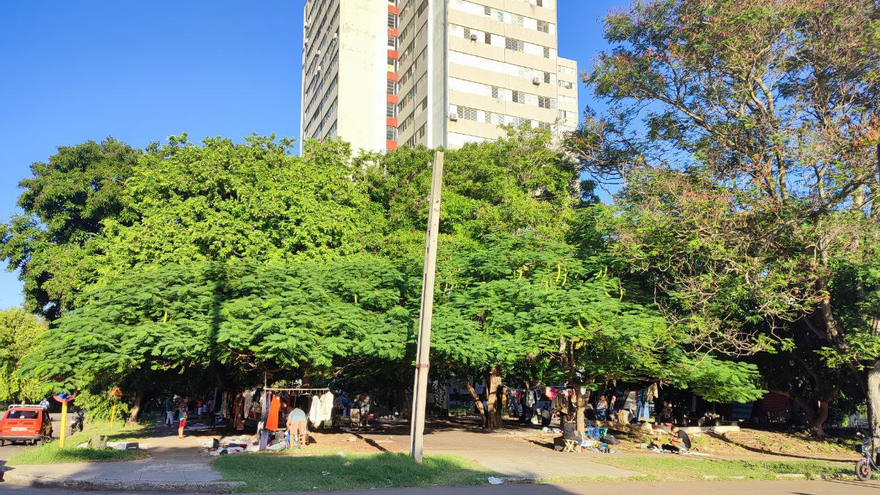
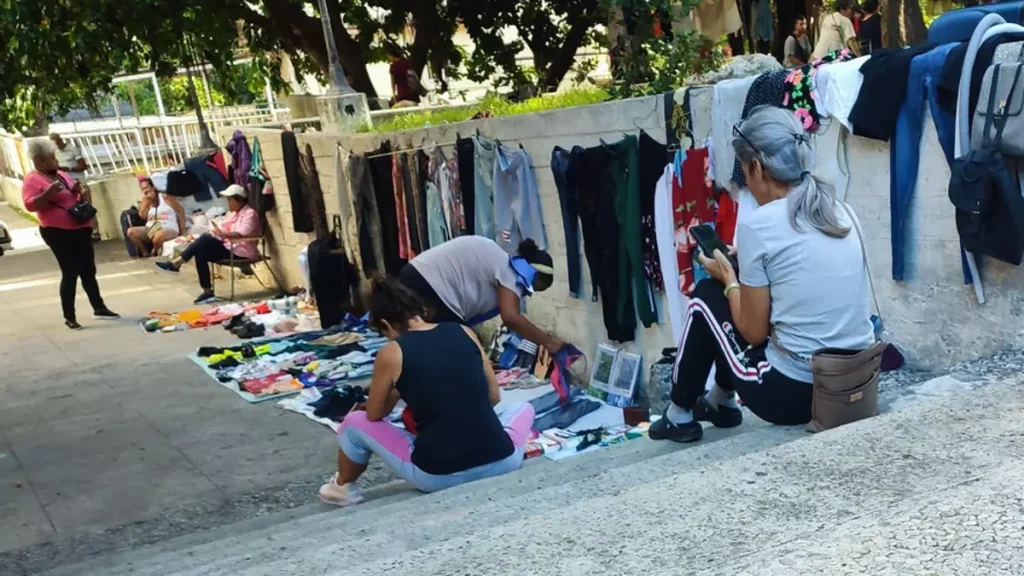
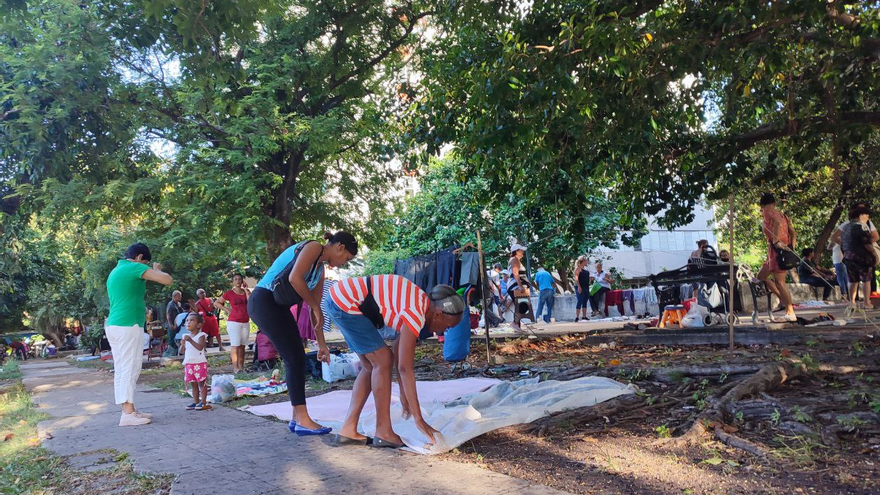
14ymedio bigger14ymedio, Natalia López Moya, Havana, 3 November 2024 — They arrive early; some spread a blanket but others simply used the stairs of a building to spread their goods. The flea market on the corner of Loma and Tulipán, in Nuevo Vedado, brings together dozens of residents every weekend. They are eager to make some money from the sale of used clothes and other belongings, mostly left behind by those who emigrated.

“I have baby and women’s shoes, plates, cutlery and some ornaments for the house,” offers Mirta, 75, a former radio worker currently retired with a pension of 1,600 pesos per month. “They are things that belonged to my daughter and my grandson who left in June,” she explains to 14ymedio. “But I haven’t sold much in the three Saturdays I’ve been coming,” she acknowledges

After ten in the morning, you can barely take a step on the access stairs to the park in front of two concrete blocks, 20 floors each. The buildings were built at a time when the Soviet subsidy allowed the rise of the microbrigade movement that left a permanent mark in Nuevo Vedado. But from those times only the huge buildings that are increasingly deteriorated remain.

I live right here, so I just have to walk a little, and as I arrive early, I choose a place where my products have more visibility from the sidewalk,” says Mirta. “What sells the most right now are suitcases, backpacks, coats and well-made sneakers. Everything that can be used to travel the route of the volcanoes (between Nicaragua and Mexico, to get to the United States) or go somewhere else is in demand, but the other things do not sell very much.”

The merchants start arriving at half past eight in the morning, every Saturday. “There are those who have more patience and stay until two or three in the afternoon, but others lose hope, and if they don’t sell much they leave at noon,” the woman explains. “It also depends on whether rain is coming or if there is a blackout, because on days when there is no electricity many people come down from the buildings because of the heat, and that increases the clientele.” continue reading

“At first you had to ask for a credential to sell, but now everything is more flexible. Anyone who comes can ask a neighbor, a school teacher, who is responsible for organizing this, to get assigned a space to put things down. There are even people who arrive and simply look for an empty space and put their goods down right there. No one objects,” adds Mirta.

The credential, a piece of handwritten cardboard, only has the name of the merchant, and in the time that Mirta has been bringing her products to the park “no one has come to check it,”or to see if she has it. “It’s a pure formality because everyone knows that those of us who sell here are not going to get rich; this is for daily survival, to eat.”

Near Mirta’s improvised point of sale, Manuel, 77 years old, has unfolded a colorful carpet from the time when, through his work in a cultural entity, he visited Peru with an official delegation. The carpet, in which diamonds, triangles and lines of different tones alternate, “is also for sale,” he says, but he retains his state employment. “From Monday to Friday I go to work and on weekends I’m here.”

Manuel’s goods are very diverse. Some wooden hookahs from when he still smoked, before a prostate cancer put him almost on the verge of death and convinced him to quit “certain bad habits,” he tells this newspaper. He also has many books of the boom period in Latin American literature that he has accumulated for more than half a century. “There are some first editions. If you buy more than one we can come to an arrangement,” he explains to a young man who approaches.

Gabriel García Márquez, Julio Cortázar, Alejo Carpentier and Juan Gelman are some of the names on the volumes. Right next to them, a sequence of used office supplies underlines the fact that Manuel’s is the sale of an intellectual. “The university degree, the academic publications and the official events have been of little use to me because here I am,” he says.

The flea market is full, without room for one more piece of merchandise / 14ymedio

Manuel has a daughter in Mexico but prefers not to ask her for “even a penny.” The young woman, newly married and with a small child, “already has her own problems. She can’t blame herself for not being able to support, in addition, an old man in Cuba.” So he is selling everything that once had some professional or personal value in his life: “That lighter was a gift from Nicolás Guillén; he used this frame with glass for his university diploma, and that bookmark was given to me in the National Library for a Day of the Librarian.”

Every little thing on Manuel’s carpet has a story, but he prefers to think about what he could buy if he manages to sell them. “I almost have enough for a carton of eggs, which is now more than 3,000 pesos, so if I manage to sell these boots, some rings of my wife that are quite beautiful and this frying pan, that’s enough for me.” But after two hours, he has barely managed to sell some kitchen handles and a doorbell button.

Now it’s almost noon, and on the steps and walls there’s no room for one more piece of merchandise on display. In the crowded flea market there are dresses, jeans, baby shoes, flip-flops, women’s bags, radios, hair dryers, headphones, casserole dishes, ornaments and trinkets. “Everything is washed and clean,” says an old woman who sees a couple showing interest in some children’s pants.

“They were from my grandson who took great care of things,” adds the woman who hurries to say that “he now lives in Seville, with his parents. Everything they left me here is of very good quality, imported clothing, well-made.” Most people who approach just look. “Today sales are bad because word of this place has now spread, and there are more and more people selling. It’s already saturated with products,” she sighs.

In the past, the neighborhood was the residential area of ​​officials, military personnel and highly-positioned professionals. / 14ymedio

To pass the time, two nearby vendors share a little coffee they have brought in a thermos, another tells a woman selling children’s toys and sewing accessories to look after her wares because she has to go to the bathroom. Tied between two trees, a newly hung rope serves as a hanger for another vendor who has men’s shirts and some girls’ robes. “Come on, I’m already clearing up because I’m leaving, take two for the price of one,” she shouts, without much success.

In the neighborhood, which was once the residence area of officials, military personnel and highly-positioned professionals, a few years ago such a scandal was unthinkable . “If the people of Nuevo Vedado are like this, asking for water by signs and selling off even their underwear, what is left for those of La Timba or Pogolotti,” says the woman who finally manages to sell a couple of soccer jerseys “used but almost new.”

Others have not had any luck and by almost two in the afternoon they start to pack up. Mirta puts everything in a shopping cart that her daughter sent her. “I’m coming back next Saturday but I’m going to have to lower the prices a little because I see that everyone is doing the same thing, selling the things of those who left.”

Translated by Regina Anavy

____________

COLLABORATE WITH OUR WORKThe 14ymedio team is committed to practicing serious journalism that reflects Cuba’s reality in all its depth. Thank you for joining us on this long journey. We invite you to continue supporting us by becoming a member of 14ymedio now. Together we can continue transforming journalism in Cuba.

Ferry Service Between Havana and Regla Was Suspended Due to the Waves

The interruption coincides with the paralysis of a journey that, according to rumors, occurred due to lack of fuel

The Government asks citizens to travel by bus, but that option is not working well either / Provincial Transport Company of Havana

14ymedio bigger14ymedio, Havana, 4 November 2024 — The ferry service, which crosses the Bay of Havana between central Havana and Regla, was suspended this weekend, and it is unknown when it will resume. The provincial transport company of Havana announced the decision for the first time on Saturday, and although the boat circulated again the next day, at 6 pm, coinciding with the decision to put the entire west and center of Cuba on alert because of the proximity of a tropical depression that could become a storm, the measure was announced again this Sunday.

“Taking into account the situation existing at this minute in the Bay of Havana, due to the force of the winds that offer danger to navigation, it was decided to suspend the service of the Regla ferry on its last lap, in order to protect the lives of passengers and the environment. It will be restored as soon as possible, weather permitting,” the company announced on Facebook, urging passengers to travel by bus and apologizing “for the inconvenience caused.”

The message was almost identical to the one the day before: “Taking into account the deterioration of the existing weather conditions and their impact on navigation at the moment in the Bay of Havana, it was decided to stop the transportation service by the Regla ferry from 5:40 pm on November 2, 2024, until the weather allows it to be restored,” the company announced. It also urged people to opt for road transport but hours later warned that the road was not very clear either.

Also on that occasion it urged people to opt for road transport but hours later warned that the road was not very clear either

“Due to the non-availability of fuel at the supply points of some bus terminals, the means of transport have had to move to other bases that have enough fuel. It was advised that buses run on the routes that link these terminals, and once they are refueled, they will be incorporated into their continue reading

usual routes to continue providing services to the town,” it added, questioning the option of being able to choose any public transport.

The shutdown of the service coincided with a video of the ferry stopping before reaching its final destination, which went viral. Internet users have shared the video countless times. Its recording date is unknown, although it could have been taken on Friday when the sea was calm, something that didn’t happen during the weekend.

The rumor circulating on social networks is that the boat must have stopped when it ran out of fuel before completing the journey, running aground far from its pier at the Muelle de Luz. Although the video clearly shows the ferry stopping, it has not been possible to confirm what happened, how the passengers were informed or how they were rescued.

The Regla ferry is one of the transports with the most ups and downs in Havana. Its countless breakdowns constantly force the suspension of service, with the peak in July 2023, when service was suspended at the pier because all six boats were broken.

This May, one of the last serious incidents occurred, when according to a statement from the Provincial Transport Company, the propeller of the engine “came loose” and was lost in the water, forcing divers to try to locate it and increasing the uncertainty of those who use the connection daily to get to their work in the coastal town across the bay from Havana.

Since the Rafter Crisis in the summer of 1994, the authorities decided to limit the fuel supply of the vessel

Since the Rafter Crisis in the summer of 1994, the authorities decided to limit the fuel supply of the vessel to only the amount it needs for each trip, a way to prevent the boat from being stolen by people desperate to emigrate, who seek to take it out of the bay and direct it towards the coast of the United States. Every time the boat docks at the pier of Old Havana, it must be refueled.

In April 2003, the Regla ferry was hijacked by a group of migrants shortly after starting its journey and ran out of fuel in a short time. Ten people were arrested in the incident. Most were sentenced to prison, while Lorenzo Copello, Bárbaro Sevilla and Jorge Martínez were sentenced to death and shot nine days later. That incident was denounced by the international community.

Translated by Regina Anavy

____________

COLLABORATE WITH OUR WORKThe 14ymedio team is committed to practicing serious journalism that reflects Cuba’s reality in all its depth. Thank you for joining us on this long journey. We invite you to continue supporting us by becoming a member of 14ymedio now. Together we can continue transforming journalism in Cuba.

With Only One Company Registered in Mariel, Russians Resist Investing in Cuba

At the Havana International Fair, Brazilians and Iranians also offer their products and services

Tatiana Mashkova, president of the National Committee of Russia for Cooperation with Latin America / Prensa Latina

14ymedio bigger14ymedio, Madrid, November 5, 2024 — Behind the scenes of the Havana International Fair, which began this Monday at Expocuba, the Cuban authorities try to convince the Russia-Cuba Business Forum to get more involved in Cuba’s economy.

The official press said that the strong presence of Russian companies at the Fair “evidences the mutual commitment to strengthen commercial and logistical relations between Russia and Cuba, opening up new opportunities for collaboration in various areas.” But beyond the words, what was evident was exactly the opposite.

Tatiana Mashkova, director of the Committee for Economic Cooperation with Latin American Countries and Vice President of the Russia-Cuba Business Council, admitted that there is only one Russian company registered in the Mariel Special Development Zone. “This is a challenge and a request to Russian companies: think about the possibilities offered by Mariel,” she invited.

Mashkova cited companies from Russia that collaborate with those of the Island: Polar Trans, Artis Logistics, Nordline Logistics and Unigroup

The grandiloquence about the potential of the port of Mariel to become “a logistics hub” for the entire continent contrasts with the facts. However, Mashkova cited companies from her country that collaborate with those of the Island: Polar Trans, Artis Logistics, Nordline Logistics and Unigroup.

“Although today we aren’t solving all the problems, it is crucial that we work on these issues,” she said, with the idea of promoting businesses that for now are largely limited to tourism. “There are direct flights between Cuba and Russia, as well as routes that connect with Venezuela, but continue reading

maritime transport, especially through Istanbul, is not always convenient,” she added.

Therefore, she clarified that “a great effort is being made together with the Ministry of Industry and Commerce of Russia to develop a subsidy system that facilitates the transport of cargo to Latin America and Africa. “Cuba could play a key role,” she added, regarding the importance of organizing subsidized maritime lines between the Island and Russia.

Mashkova welcomed the fact that Cuba has joined the BRICS group as an associate member, “where the use of electronic money in transactions is discussed.” She called for the creation of a binational bank, which would join the Russian Novikombank. This entity, which belongs to the Russian state corporation Rostec, opened its first branch in Havana this June with the idea of supporting Russian companies on the Island, one of the biggest milestones in the financial cooperation of the two partners, along with the implementation of the MIR card.

The logistics of payments in national currency, rubles to Cuban pesos, was also a topic of discussion

The official also talked about tourism, one of the areas of greatest interest to the Island, but one which is not going well in general terms. The logistics of payments in national currency, rubles to Cuban pesos, was also a topic of discussion. “We are seeing an increase in the tourist flow to Cuba, which is fundamental. This generates a large sum of rubles on the Island,” she said.

According to the most recent data, from January 1 to September 30, 141,615 travelers from Russia arrived in Cuba, 11.9% more than in the same period of the previous year, being one of the few countries bringing a growing number of tourists (ahead of Mexico, 5.4%; and Argentina, 1.4%).

Cuba’s sales to Russia are not going smoothly either. “Recently, we have received the first batches of Cuban avocados and mangos through a private company, the first in 35 years, and we can say that the Cuban avocado is the best in the world,” she said, encouraging the increase in collaboration between MSMEs of both countries, “an area in which there is still much progress to be made.”

However, everything points to the fact that the aforementioned “private company” is Cítricos Arimao, a State-owned business in Cienfuegos – created in 1967 by order of Fidel Castro – which two years ago began to announce the export to Russia of several products, including fresh mango, avocado, cassava and dehydrated pineapple pulp.

On the 8th, the Vice President of the Government of the Russian Federation, Dimitri Chernyshenko, will visit the exhibition

On the 8th, the vice president of the Government of the Russian Federation, Dimitri Chernyshenko, will visit the exhibition. He is expected to announce other cooperation agreements, although in everything outlined this Monday by the ambassador, Victor V. Koronelli, there were many words but few specifics.

Something similar happened during Miguel Díaz-Canel’s walk through the Iranian pavilion, where Seyed Sattar Hashemi, Minister of Communication and Information Technology of Iran, said he felt “at home” and brought the leader a “warm greeting” on behalf of his president.

The senior official came from Venezuela, where this Sunday he talked with his counterpart in Caracas, Gabriela Jiménez, about “new agendas of scientific and technological cooperation in telecommunications, digital transformation and AI (artificial intelligence).” The visit coincided with the signing of the Iranian company MDC to begin “adaptation work” to install a fiber optics factory in the state of La Guaira.

Its manager, Marcos Meléndez, explained that “the work of architecture, engineering and adaptation is beginning,” and that, by the middle of next year, the country is expected to have “a new technological company with an export vocation,” from which Cuba could benefit, as Cuba and Venezuela are both allies.

Brazil is another important ally, in this case in agriculture and, therefore, in food. Ydael Pérez Brito, Minister of Agriculture, talked with Ambassador Christian Varga at the exhibition and asked him to promote collaboration in this area.

Pérez Brito assured that the regime is focused on “guaranteeing the energy and food security of the people”

“We open our doors to the new Brazilian entrepreneurs who have joined and give our deepest gratitude to those with whom we have consolidated business relationships,” he said.

Pérez Brito assured that the regime is focused on “guaranteeing the energy and food security of the people, evaluating solutions that help reduce the negative effect of the unilateral measures imposed by the United States.”

Vargas, for his part, explained that Brazil has made “humanitarian donations, food, medicines and solar panels” in recent weeks and added that it is the intention of his Government to continue helping the Island. “We are aware of the importance of supporting the Cuban economy, which has not yet managed to recover dynamism in its tourism sector, due to the rise in international food and energy prices caused by the unilateral sanctions, which in turn harms the trade relationship between Cuba and Brazil,” he said.

Translated by Regina Anavy

____________

COLLABORATE WITH OUR WORKThe 14ymedio team is committed to practicing serious journalism that reflects Cuba’s reality in all its depth. Thank you for joining us on this long journey. We invite you to continue supporting us by becoming a member of 14ymedio now. Together we can continue transforming journalism in Cuba.

‘Hunger Strikes Were the Only Way I Could Make a Demand’

Opposition leader Pedro Albert, released from prison after eleven days of protest, talks to ’14ymedio’

Image of Albert taken after his release. / 14ymedio

14ymedio bigger14ymedio, Havana, 5 November 2024 — Activist Pedro Albert Sánchez was released last Thursday from prison 1580, in San Miguel del Padrón, Havana, after spending eleven days on hunger strike. The dissident must appear before the Guanabacoa Prosecutor’s Office this Tuesday to find out his legal situation, but the hurricane alert could postpone the process. Before the meeting, he spoke with 14ymedio about his time in prison and his most immediate plans.

“Hunger strikes were the only resource they left me to protest,” says Albert Sánchez about the successive hunger strikes he has undertaken over the years and specifically about the one he began on October 20 while he was in prison. “It is the only tool that State Security has left me and with it I have defended my right to exist.”

After more than ten days without eating, the opposition activist was released on October 31 without the prison authorities informing him of his current situation. This Tuesday, the activist should know more details about the status of his five-year prison sentence for participating in the popular protests of 11 July 2021 (’11J’). If the meeting takes place, amid the weather conditions due to the proximity of Hurricane Rafael, State Security agents (SE) could be waiting for him at the site. continue reading

 “I have never agreed to any kind of interrogation” with the political police, the professor clarifies

“I have never agreed to any kind of interrogation” with the political police, clarifies the professor, who nevertheless acknowledges his willingness to talk “with anyone about the situation Cuba is going through” and possible solutions for the future. “As for threats, warnings or promises,” he knows that many times these offers from the SE agents are “loaded with poison.”

His time in prison, initially for a year in Valle Grande Prison and later for eleven months in Prison 1580, both in Havana, has been “a real school for getting to know Cuba, better than if he watched television or read the newspapers every day.” Contact with the inmates, some of whom were imprisoned for political reasons and most for common crimes, has shaped Albert Sánchez’s view of the island.

“I spent a year in Valle Grande and I saw my country from prison. I had already seen it from the classroom as a student, as a teacher, as the father of my children and as a teaching staff,” he describes. “From Prison 1580 I have seen Cuba from an incredibly informative place. Kids from all houses come there and I was in the admission area where the prisoners enter and spend ten days or more until they are taken to the galleys or the camps.”

“I have shared with the best and the worst of each house,” says Albert. / 14ymedio

“I have shared with embezzlers, pickpockets, beach bums, people who specialize in stealing on the beach, and others who steal motorcycles. I have shared with the best and the worst of each house,” he explained. “I have seen the total collapse of this regime from the galleys, I have lived in the country and I have felt the change in the country from contact with the prisoners. I have attended a sociology seminar there.”

In December of last year, Albert Sánchez was returned to prison after the Havana Enforcement Court revoked his limited freedom sentence that allowed him to serve his five-year prison sentence for protesting on 11 June outside a penitentiary.

The opposition figure, a prostate cancer patient, had been arrested in November 2023 in Havana when he was trying to deliver a letter addressed to Eamon Gilmore, High Representative for Human Rights of the European Union (EU), who was visiting Cuba at the time. After his arrest, he was transferred to the Detention Center known as the Vivac de Calabazar.

The activist’s clashes with the Cuban regime go back a long way. In October 2022, after leaving Valle Grande prison, he described part of his journey: “Since 2007 I have been concerned about the closed circle, analogous to a vicious circle, where the economy declines, discontent and protests grow, repression grows. As repression grows, the logistical infrastructure to implement it and justify it has to grow. This implies that it has to feed off that economy, and the cycle repeats itself.”

____________

COLLABORATE WITH OUR WORKThe 14ymedio team is committed to practicing serious journalism that reflects Cuba’s reality in all its depth. Thank you for joining us on this long journey. We invite you to continue supporting us by becoming a member of 14ymedio now. Together we can continue transforming journalism in Cuba.
Castrochavismo is Anti-Semitic

Governments similar to those of Cuba, Nicaragua, Venezuela and Bolivia are bitter enemies of Israel

Miguel Díaz-Canel and other members of Cuba’s Government march in support of Palestine / Vanguardia

14ymedio bigger14ymedio, Pedro Corzo, Miami, 3 November 2024 — The leaders of that cocktail of repression and inefficiency that we know as Castrochavismo are by nature anti-Semitic. They feel repulsion towards the Jewish state and its citizens, and are complicit with terrorist groups like Hamas and Hezbollah, maintaining a close relationship with their godfather, Iran.

The Jewish nation is a promoter of democracy and the rule of law and a defender of civil and religious freedoms, which directly clashes with the proposals of Governments associated with Castrochavism.

Israel, without being a perfect state, is a socio-political heresy for the mentality of the faithful, especially if compared to the State of Iran.

Perhaps the most conspicuous of these leaders in their attacks against the Jews was Hugo Chávez, who on the eve of Christmas 2006 declared: “The world has enough for everyone, but it turns out that some minorities, the descendants of those who crucified Christ, took possession of the riches of the world.” This was largely ratified by his successor, Nicolas Maduro, who declared that “the Zionists control the world” and that Jews were behind the opposition protests.

Perhaps the most conspicuous of these leaders in their attacks against the Jews was Hugo Chávez

The governments of Cuba, Nicaragua, Venezuela and Bolivia are the bitter enemies of Israel on the continent, in addition to Gustavo Petro’s Colombia, which broke off relations with Tel Aviv over the attacks on Gaza without continue reading

condemning the abominations of Hamas on October 7, 2023. The president of Chile, Gabriel Boric, also broke off relations and condemned Israel’s offensive in Gaza but not the crimes committed by Palestinian terrorists.

Although Fidel Castro invented Castrochavismo, he never confessed to being anti-Semitic. However, the hatred mixed with envy he felt towards the United States and his deep rejection of democracy led him to act against the State of Israel by developing close alliances with Arab nations.

In 1973, in Algeria, during a summit of the Non-Aligned Movement, Castro announced that Cuba would break diplomatic relations with Israel. In October of that year, he helped Egypt and Syria in the Yom Kippur war, and sent troops and equipment to Syria. Israel, since 1992, has voted in favor of the U.S. embargo against Cuba but abstained in 2016, as did Barack Obama.

The Cuban dictator was the first to receive the Iranian despots as saviors. During one of his presidencies of the Non-Aligned Countries, in 1979, Castro invited the leaders of the Islamic revolution to join the entity by participating in the summit in Havana. Thus began a long friendship between both governments that would have an impact on the satellite regimes of Venezuela, Nicaragua and Bolivia, laying the foundations for the presence of fundamentalist terrorist groups in those countries.

Castro was not a theorist but a talented and dedicated practitioner of taking and holding onto totalitarian authority

Fidel concluded alliances with countries, personalities and proposals that coincided with his interests. He allied himself with the Soviet Union and wrapped himself in atheistic Marxism, but this did not hinder his alliance with the most uncompromising Islamic leaders, such as the Iranian theocracy.

Castro, as a fundamentalist of power, was not a theorist but a talented and dedicated practitioner of taking and holding onto totalitarian authority. In Cuba, he forged a network of faithful who are unable to survive without him. Neither the accumulated failures nor the collapse of the Cuban economy has broken the regime that Castro inaugurated more than 65 years ago.

Forty-nine years of absolute power allowed the Caribbean pharaoh to create a framework of officials within Cuba that he could replicate in numerous Latin American countries, by providing material, logistics and advice to any aspiring leader who shared his grudges. Many of the democratic leaders of the hemisphere should recognize that their stupidity and tolerance for Castroism has forced them into exile, and their Cuban peers are also responsible.

Translated by Regina Anavy

____________

COLLABORATE WITH OUR WORKThe 14ymedio team is committed to practicing serious journalism that reflects Cuba’s reality in all its depth. Thank you for joining us on this long journey. We invite you to continue supporting us by becoming a member of 14ymedio now. Together we can continue transforming journalism in Cuba.
A Cuban Journalist and His Family Request Asylum in Peru To Avoid Deportation to the Island

Enrique Díaz planned to make a stopover in El Salvador, but Nicaragua, his final destination, denied him entry

The asylum application in Peru for the Cuban journalist and his family is being processed / Cubanet

14ymedio bigger14ymedio, Havana, 3 November 2024 — Cuban journalist Enrique Díaz Rodríguez and his family, who were stranded on November 1 at Lima airport (Peru) after Nicaragua denied them entry, “will not be returned to Cuba.” According to the Press and Society Institute (IPYS), on Saturday, the reporter formalized the asylum request, which is already “in process.”

The CubaNet collaborator said that Migraciones de Lima told him that it had no responsibility for his case and, given Nicaragua’s refusal, “he had to coordinate with the LATAM airline, which brought him to Peru, for his return to Cuba.” However, IPYS later clarified that it was “the airline that transported them and not Migration that indicated that they should return to the Island.”

Díaz Rodríguez and his family boarded a flight that would make a stopover in Peru, then head to El Salvador and Nicaragua. From that point, they would cross by land through Honduras and Guatemala, enter Mexico through Chiapas and reach the southern border of the United States.

The Peruvian National Superintendence of Migration specified that the journalist was not assisted by its staff because “being a connecting flight to El Salvador, it is not up to Migration to carry out immigration control, since this procedure is carried out only for those who enter our country.” continue reading

Journalist Enrique Díaz Rodríguez in Havana / La Tijera

According to the agency, “upon arriving at Jorge Chávez International Airport, the journalist went to the boarding area for his Avianca connecting flight, and at that moment the airline informed him that he could not board.”

Díaz Rodríguez’s departure was “conditioned” by “intimidation of State Security,” which knew that the reporter had purchased plane tickets. “He was cited and pressured with the situation of his 18-year-old son for failing to comply with Military Service,” Cubalex reported on its social networks.

The regime warned the journalist that “they would lift his immigration restriction and exempt his son from military service” as long as he did not return to Cuba, emphasizing that “they hoped he had no intention of returning.”

Díaz Rodríguez left Havana last Friday after receiving the ultimatum. “In Cuba they told me that either I go or I stay and face the consequences,” he told the newspaper El Tiempo.

The journalist is accompanied by his wife, the Lady in White Lismeirys Quintana Ávila; his children Melanie Ly and Pedro Enrique; his son-in-law Yoxiet Dariel Rizo Almas; and his grandson Iván Daniel Rizo Díaz, barely three years old.

Translated by Regina Anavy

____________

COLLABORATE WITH OUR WORKThe 14ymedio team is committed to practicing serious journalism that reflects Cuba’s reality in all its depth. Thank you for joining us on this long journey. We invite you to continue supporting us by becoming a member of 14ymedio now. Together we can continue transforming journalism in Cuba.