In the Dominican Republic and scattered throughout the world, many friends await, who tried to protect me when I still hadn’t detailed the gross “stories” which later led to the accusations against me. They inferred what would happen to me. They predicted a future I didn’t want to see or that I didn’t care to suffer.
In 2008, when I last traveled abroad months before opening my blog The Children Nobody Wanted, Rafael Lantigua, the Secretary of Culture, a position which in Cuba would have been the Minister, tried to tell me not to return, and introduced me to his personal attorney to arrange the paperwork for me so that I could stay his country.
On the other hand, the poet and narrator Camilo Venegas took me into his home like another son his mother never had. He begged me not to return, envisioning what would happen to me later. Finally I left, with a promise I was not able to keep: I would be back soon.
Pequeño, after receiving me in his home, entertaining me along with his wife and children, addresses himself, through another Cuba, to getting me a job in a subsidiary of an important publisher in that country, with the intention that I would not return to Cuba.
My sister Mary, from Miami, promised to send money to support me, until I had gotten settled.
Freddy Ginebra offered that his Casa de Teatro would hire my partner, in her work as an actress, once again fulfilling his mission as a protector of Cubans.
Lilo Vilaplana called on the phone to offer me passage via Colombia.
Amir Valle, through chat, opened his arms to receive me in Germany.
I left that half-island, leaving behind, probably, my immediate tranquility; but I did not conceive, and I still can’t conceive, abandoning my country and leaving it in the grip of the Castro brothers’ dictatorship.
The only pain prison causes me if the suffering of these people from knowing I am a prisoner; because if the situation were reversed I would be making the same cries, demanding justice, that I hear today; because disgracefully, it is a characteristic of totalitarianism to impose force against those who disagree with their policies.
In any event, as incredible as it may seem, I am comply as a good Cuban, with what I believe to be reason and rights.
My thanks to all of you from this great Dominican land, and for those scattered around the world, who tried to protect me, but within me I had the dream of José Martí lighting my path.
Hugs, Ángel
Prison 1580. July 2013
Translator’s note: This is another of the posts Ángel wrote from Prison 1580 before he was transferred to his current prison where he is being held incommunicado.
Article 129.1 – Property confers on the title holder the possession, use, enjoyment of and disposal of the assets, in accordance with its intended socio-economic use.
Rolando González Camacho received from his grandfather Eufemio González Martínez a property situated at Apartment 4 of building 19213a, fronting onto Avenue 81 between 102 and 194, Alturas de la Lisa Neighborhood, Havana.
The said property was awarded, according to Deed number 1120 by way of Gift, issued in the City of Havana the 25th August 2009 before Licenciado Uber Rae Arias Rodríguez who was Notary at 4604, 37th Street in the Playa Municipality.
Rolando, in spite of his 30 years of age, is legally represented by his mother and stepfather, as he suffers from hepatitis C, partial epilepsy symptomatic of the frontal lobe, neuroblastic migration disorder and bronchial asthma; according to a medical certificate issued 23rd June 2013 by Dr. Víctor Raúl Frades García of the neurological consultancy at the Havana Salvador Allende Hospital.
His infirmities do not limit his conversational ability, given that when I turn up at his house, he speaks happily and expresses his regret that his grandfather left him a property in which he couldn’t even cook since the next door neighbour María del Pilar Olivera Delgado, taking advantage of a period when the property was empty, broke down a dividing wall and taking over a part of his property.
He says he has spoken to María del Pilar Olivera Delgado asking that she remove herself, because he doesn’t want problems with his parents and is afraid of the police.
In August 2009, Rolando issued a SPECIAL POWER, before a notary in the name of his stepfather Jorge Luis García Casañas, his legal representative. García Casañas has made claims in relation to all stages of the proceedings, in order to get them out of his property, not just the person who in August 2011 broke the wall and illegally entered Rolando’s home, but also another two people who joined María del Pilar Olivera Delgado in this unbelievable violation.
Furthermore, the failure of the relevant bodies in this case has been contradictory and completely lacking in clarity.
The legal absurdity of giving support to illegalities committed in his home, has caused Rolando González Camacho damage which may be irreparable, given the effects he is experiencing in his health.
The obvious question therefore is: who takes responsibility for the situation of this fellow countryman who is suffering torture in his own home?
—You messed up the form—said the officer as he offered them a new sheet—. You wrote “climatic” and this is a survey of just checking the boxes, it does not admit calligraphy.
—But we are asking for asylum due to climatic reasons —replied the man.
—The choices are “economic” or “political.” Nobody asks for asylum due to climatic motives.
—We do —insisted the man—. We hate the heat of the summer.
—We do not grant asylum for hating the heat of the summer.
—Why?
—It’s not a serious reason.
—And what’s a serious reason?
—The political and economic causes listed in the form.
The man scratched his head. He looked at his wife.
—But it’s a very closed-ended question, if at least there were a few lines where we could explain…
—I already told you that it’s a survey of just checking the boxes—replied the upset officer—. If you are going to mess it up again, you’d better give it back to me. We’re running low on forms.
The man and the woman looked at each other sadly.
—Listen —intervened the officer—, just check any of the two boxes and that’s it, don’t be a fool.
—You think so?
—Of course I think so —the officer put his mouth near the opening in the crystal window. He did a mysterious sign, as if asking them to get closer too, from their side, to the crystal in the cabin—. What is the real reason you’re asking for asylum?
—Because we hate the heat of the summer —insisted the man; he then took a pencil, looked at his wife—. You tell me, dear: What reasons are closer to our hatred of the heat, political or economic?
—Check political —she suggested—. It must be the government’s fault.
—It could also be due to the economy.
—Yes, it could —she agreed.
—No —the man was fed up—. The right thing to say is “climatic.”
And he wrote again: “climatic”
—Here you go.
—But…, are you stupid?! —the officer crumpled the form.
The man tried to raise his fist, but the woman stopped him in time.
—Leave it —she said—. Stuck in this cabin and with that uniform, he is probably more upset by the heat than we are.
The Law of Criminal Procedure is clear when it indicates in the penultimate paragraph of Art. 251 that: The Police, the Instructor, the Prosecutor or the Tribunal, as the case may be, will decide in relation to the application for modification of the provisional measure* in regard to a time period not to exceed five working days counting from the moment in which the application is made.
It is not clear why the preceding period is breached so often, sometimes doubled or trebled, without complying with the requirement by the legislature to respond to the application for variation of the provision status* of the accused in the brief space of a week. The most serious instance case of such violation occurs when the variation in question is in relation to an accused who is has been remanded in custody, given the very nature of this provisional measure.
An even more unfortunate circumstance is when, in the face of an application for change in a measure, time passes without receiving the due response, ending up with the prosecutor declaring the matter finalised whenever it suits him, in complete disregard of the law.
Unhappily, we see a lot of behavior by the authorities who seem to be acting in a sort of discretionary manner and not in accord with the requirements of the law. This sad reality is even more sensitive when such conduct is in relation to the system of justice, infringing the most basic rights of those subject to legal proceedings.
They are just one example of what should not happen in our battered social system.
*Translator’s note: The provisional status (see next paragraph) under discussion here refers to requests for changes in the custody status of the accused, that is, for example, requests to be released pending trial.
In the town of Playita in Jamaica Beach area in the municipality of Antilla* in the province of Holguin, the peasant Israel Cardoso Gonzalez had two cows of which one has been confiscated by the delegate of the municipality, and in addition they have fined Cardoso 500 pesos.
Israel laments that his cow gave milk for the three minor children of the family. “They said the cow was a danger because it was near the street. That’s not true I had it tied up and there are other cows are running loose here.”
The Defender of the People of Cuba, Manuel Martínez León, who attended the denunciation of the humble peasant, explained that this is a remote area that is three miles from the road, where there are reeds that the government leaves uncared for, and a dirt road where cars don’t travel frequently.
The Defender prepares action for the cow to be returned to the family. Manuel said, “We can not allow this to happen here, we are going to do whatever we have to end this arbitrariness because they take advantage here of any nonexistent breach to steal from people what is theirs.
Report #10 of the Defender of the People of Cuba (CID) of Velasco, Holguin.
*Antilla is the smallest municipality in the province of Holguin, 40 square miles in size. It’s between the Bay of Nipe and the Bay of Banes, on the El Ramon peninsula.
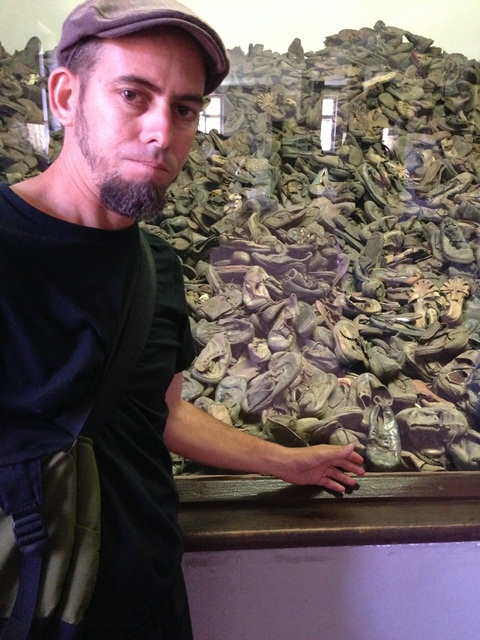
Pastor Mario Felix Lleonart in front of a pile of shoes in Auschwitz. Photo: Lilianne Ruiz
Havana, Cuba, August of 2013, www.cubanet.org — “As long as the Office of Religious Affairs of the Communist Party’s Central Committee exists to monitor pastoral work, one cannot speak of religious liberty in Cuba.” So said Pastor Mario Felix Lleonart from the Baptist Church of Taguayabon to Cubanet in the province of Villa Clara.
The absence of a religious law offers an opportunity for the Office of Religious Affairs to control the churches, driving them toward the political goals of the only party. If there were a law regarding religion, churches would be able to count on a legal foundation with duties and rights. All those religious who do not threaten the society in which they live could be legalized, but this message of non-violent resistance could bury the ideological pillars of the dictatorship.
Monitoring by the Office of Religious Affairs translates into rigorous control over those who have been chosen, or appointed, as leaders of legally recognized religious institutions, and into maintaining strict contact with them. “Faced with any matter that they think requires them to put pressure on a religious denomination, they quickly call its leader. They coerce him, they blackmail him, they manipulate him, depending on his reaction,” commented Pastor Lleonart.
“Many enter into open plotting with this office, and there’s suddenly a divorce between these religious guides and the people of this denomination. They take advantage and make business deals out of the perks that the government can give them, while the people suffer from shortages and lack of liberty,” he added.
The good pastor
Lleonart is a human rights activist and from his Twitter account he was the first to break the news of the political beating in Santa Clara, which caused the death of the political opponent Juan Wilfredo Soto in 2011.
Everything indicates that the approximately $27,000 bank account of the Baptist Seminary of Santa Clara, which is frozen by the State, is being used, among other reasons, as a means of coercion to keep Pastor LLeonart and his wife on the school’s faculty and Reverand Homero Carbonell as its president. These two figures, who are active members of Cuba’s persecuted and authentic civil society, are not to the liking of the Office of Religious Affairs. For this reason, they are pressuring them to abandon their positions of influence.
This bank account is the result of the generosity of other Baptist churches in the United States, but they are not in communication with the Cuban government. “Maybe if the churches making the donation had come to say ’Liberate the Five’*or gave the regime what it wanted, then they would have maintained good relations, but that is not the case.”
The Baptist Convention of Western Cuba, founded in 1905, does not submit to the interests of the government. The church in Santa Clara, which is a member of the Convention, opened its account with the International Financial Bank (BFR), which assumed they had been able to use the money. That is until one day when the government declared that, because of “political sanctions,” it would be frozen. The following was the BFI’s response when asked why the funds were not available: “These are directives from the Party in Havana, from the Office of Religious Affairs.”
When the Latin American Council of Churches (CLAI) held its seventh General Assembly a few months ago in Havana, the government made a show of unfreezing the seminary’s bank account. But it was a farce, as noted by the pastor:
“We cannot withdraw so much as a penny. They let it be known through the BFI that the account would be unfrozen, but only for construction purposes. Who are they to tell the church how to use its money? Or that to withdraw a penny we have to verify that it was used to buy a brick and not cement? Even then we have not been able to withdraw one cent because we are waiting for a signature that never comes.”
State Security, in the person of one of its agents, told Pastor Lleonart on one occasion that he “would not be treated like a pastor but like a counter-revolutionary.”
Another agent told the pastor while in detention that he had heard very good things about him from the community he had gathered together through his pastoral work in Taguayabón, but that there was no reason for him to be in Santa Clara, spending time with “those blacks,” a reference to the province’s opposition leaders, who for the most part are black, such as Guillermo Fariñas, Jorge Luis García Perez (aka Antúnez) and Damaris Moya Portieles.
“The agent from State Security took the liberty of briefing me on what I should do in my pastoral work, presenting it as though it were completely divorced from my work in the field. His briefing is the same as that of the Office of Religious Affairs which — though perhaps not using the same words he did but with the same goal of limiting one’s rights — asks pastors in Cuba to be calm, to focus on singing, on prayer, on giving sermons only within our four walls, to do our part to keep the people calm and to distance ourselves from the reality outside,” says Pastor Lleonart.
In 2009 the prestigious magazine Christianity Today chose for the cover of its July issue a photograph of Lleonart with a quote from him: “Here I am, easing the suffering of my people.”
On July 7, 2013 a religious service was interrupted by a man suffering from mental disabilities. As he was being led out of the church, he shouted death threats against the pastor. The man’s family regularly attends the church and described how he was locked up for twelve days, but was returned home without having received medical treatment and in worse shape that when he left, still threatening the pastor and his family.
“It is not my own life that concerns me, nor that of my family. I hope and trust in God that absolutely nothing will happen. But for me the evidence that State Security is indeed involved is when I realized that — even though everyone knows about the incident and it has even been discussed on Twitter — the authorities have done absolutely nothing. They have let it be known that this matter does not interest them.”
The esteemed Haroldo Dilla, after having had a look through ECURED (a reference site maintained by the Cuban government), has written an entertaining article where he notes some of the shortcomings of that which hopes to establish itself as the encyclopedic model for all Cubans. Although I am not a frequent user of the page, I agree with Dilla regarding its slowness and other defects signaled by him and Rafael Rojas.
What is alarming is that, unlike Wikipedia, ECURED can be found on every computer in educational centers, it is the obligatory reference of students for class assignments and its access is advertised through mobile phones and digital television. Moreover, to sustain ECURED, the employees of the Youth Club of Information Technology, the students of the UIS, and others who fit the profile, must contribute to its growth with ten monthly articles copied from printed sources. That there is the definition of the “collaborative”: without rigor, without specialization, quantity for quality.
In light of its imminent apparition, it could not manage to unravel the need for a clearly enormous effort, even with the duplication of content that had been previously published in other places; and, in fact, ECURED can only be understood as the Ministry of the Truth, like a version of a world beyond the “destruction of history” in the face of the excessive liberty of Wikipedia.
It might have been more rational to create a Cuban team of collaborators to contribute content to the global encyclopedia, to put those other viewpoints to counterbalance (or not), and to have avoided this ill-thought network, no worse executed and without future. This is particularly demonstrated in the diffusion and appetite for the portable versions of Wikipedia, the one that can be accessed from multiple channels, through the same tech specialists that offer their private services, not without first reaching the goal of feeding ECURED.
HAVANA, Cuba, August , www.cubanet.org. Revolutionary tourism is a first world practice. It’s like it is the tourism-tourism. The second and third world revolutionaries don’t have the time or money to travel all over the globe to idealize the misery produced by the violence which triumphs in the name of the people.
I ought to make it clear right away that first, second and third world aren’t geographical notions, as I see it. All countries have their own particular combinations of them, and always in relative terms. In Cuba too there is an element of first world. So that those people who are involved in the tourism of the revolution come from all over the place, all of them sharing three things: a blindness in regard to social reality, an anthropological disapproval of the poor people who inevitably generate the revolutions, and a bulging wallet.
But recently a piece of information drew my attention: the loss of hygienic awareness on the part of the revolutionary tourists. Because Cuba is the dirty country of tomorrow. I wonder, therefore, how from the status of the first world can you defend a filthy revolution. You can be on the side of nationalism, populism or indigenousism, regardless of their aseptic quality. Of unhygienic revolutions, no.
Cuba, hygiene and revolutionary tourism
Anyone visiting any part of Cuba should be frightened, except in small towns or small cities like Cienfuegos, by their foul odors. It’s as if Cuba were uninterruptedly evacuating the gases of a slow digestion, hearty and heavy in virtue of the food it eats. Except that in this case the public waste system is broken and doesn’t have the capacity to resist an environment of putrefaction.
A country without bathrooms for pedestrians, without water or soap to wash your hands after going to cafes or restaurants, no napkins nor toilet paper in public places, without even slightly effective garbage collection, with doorways that accumulate three decades of dirt, with half-collapsed buildings serving as “motels” for young couples without private spaces for sexual pleasure, with steambath-buses in the morning, with hospitals and polyclinics ready to transmit infection, all in a hot climate that synthesizes natural outgrowths between the heat and humidity, such a country can not treasure its own future.
What distinguishes utopias is hygiene. If you think of the funding vocabulary of revolutions: throughout history it has associated with the past destroyed by rot, with trying to start some kind of sanitization of society to build the beautiful country of tomorrow. Everything about them seems to come down to health and hygiene: mental hygiene, the difficult relationship of totalitarianism with the madness that equates aristocracy with the plague; of social hygiene, separation and isolation of the offender are also pathological reactions for the construction of utopias; and body hygiene,which we see in the obsession with health in a type of society that thinks its subjects are always sick.
These hygiene are basically totalitarian techniques of control and discipline where no cracks are permitted. However, all these areas of health-related work are collapsed. The number of mentally ill continues to grow, the population is almost endemically criminal and the sick crowd the statistics. And let’s not even talk about the language.
Unthinkable development
That utopias are unproductive, well that’s not a big problem, the stresses of productivity and consumption are theoretically alien to the revolutions of the future. They are unimaginative, it does not matter; imagination is an individual trait that, in essence, threatens the coherence and rigid core of the powers-that-be of the builders of peoples. What should be an alarming signal prosaic filth of the Cuban utopian city. As a sign of its health, its people should be wearing patched clothes, but clean, as recommended by my grandmother.
And worst of Cuba is not the stench of daily work, but a type of medieval dirt shows in four features: the accumulation of filth, the indifference as if everyone is immunized against the city’s garbage, the proximity of the centers for processing the population’s waste, and the lack of modern infrastructure for the recycling of waste. As in the Middle Ages, the septic tanks are very close to the bedrooms and it’s easy to confuse drinkable water with sewer water.
Why doesn’t revolutionary tourism realize that the Cuban Revolution might have leaked out the sewer? Getting to Havana, Holguin and Santiago de Cuba and having to drink bottled water, sold at prices inaccessible to those who supposedly made the revolution, should be the supreme test that without hygiene it is impossible to see the outlines of the streets of the future. Also broken and filthy.
Our Father who is in heaven!
Why have you forgotten me?
You remembered the fruit in February,
when your flesh became ruby
My side is open as well,
and you do not want to look at me!
Nocturno, G. Mistral
Peter Newell, coordinator of the GLOBAL INITIATIVE TO END ALL Corporal PUNISHMENT OF CHILDREN is categorical in his 2010 report referring to corporal punishment inflicted upon Cuban children:
The Family Code of 1975 allows “moderate” punishment by parents (article 86) and by those who are responsible for the care and/or education of children (article 152).
The legal regulations against violence and abuse in the Family Code (1975), Penal Code (1987) and the Constitution of the Republic, do not explicitly express prohibitions against corporal punishment in the upbringing of infants.
Corporal punishment outside the home
Corporal punishment in schools is legal.
The resolution, along with the Ministry of Education and the Ministry of Higher Education (1987) approved disciplinary regulations at work during educational activities. However, it is said that “every worker in educational activities can’t maltreat students by words or actions (article 4)” doesn’t specifically prohibit physical punishment. continue reading
In the penal system, physical punishment is criminal (article 30). This article also applies to prisons, but Mr. Newell explains that if evidence is lacking in other institutions pertaining to children it may conflict with the law. The Code of Children and Youth (1968) also does not prohibit the use of physical punishment in minor detainees.
Physical punishment is also legal in alternative child care centers …
On June 17th 2011, the Committee for Childrens’ Rights, later referred to as the Committee, in paragraph 36 section D. Civil Rights and Liberties (articles 7, 8, 13-17, 19 and 37 (a)) of the Convention (CRC), in the final report (CRC/C/CUB/2) explains its worries to the Cuban government given that:
Articles 86 and 152 of the Family Code are still enforced by the Cuban legislature. The committee highlights its dismay that corporal punishment is often used (in Cuba) as a disciplinary measure in schools as well as in social institutions.
In paragraph 37 the Committee recommended to the Cuban government that they pass legislation explicitly prohibited corporal punishment of children, both in State institutions and in the home.
The Committee defines “corporal” or “physical” punishment as any punishment that uses physical force with the objective of causing any pain or discomfort, however mild.
The Committee says that corporal punishment is always degrading. There are other forms of punishment that are not physical, but equally cruel and degrading, also incompatible with the Convention. There are punishments that humiliate, denigrate, scapegoat, threaten, terrify and ridicule the child.
Since September 2001, in the recommendations adopted following the general discussion on “Violence against children in the family and in schools,” the Committee on the Rights of the Child urged States to “urgently enact or repeal, as necessary, legislation so as to prohibit all forms of violence, however slight, in the family and in schools, including as a form of discipline, as provided in the Convention on Children’s Rights.”
Another result of the discussions held by the Committee in 2000 and 2001 was to request the Secretary-General of the United Nations, through the General Assembly, to conduct an in-depth international study on violence against children.
In 2001 the UN General Assembly enacted that recommendation. The United Nations study, conducted between 2003 and 2006, highlights “the need to ban all legalized violence against children, as well as a deep concern for the children themselves almost universal prevalence of corporal punishment in the family and for its persistent legality in many states, schools and other institutions, and correctional systems for children in conflict with the law.”
Fifteen years ago (1997), when Cuba presented an initial report before the Committee of Children’s Rights expressing its worries against the abuse committed against minors under the age of 18 and in this context recommended the development of a campaign to prevent corporal punishment. In 2011, the Committee calls on Cuba as a State to prioritize the elimination of all forms of violence against children, with particular attention in the case of girls. Among other recommendations proposed on the contentious issue, one stands out for its importance in Cuban society to help to discover how deep the scourge of violence against Cuban children is:
To consolidate a national data system, analysis and public dissemination that includes an agenda of investigation against child abuse.
MEMBER STATES. Countries that are members of the United Nations.
PARTY STATE(S). Countries that have ratified an agreement or a convention and therefore are obliged to abide by its provisions.
Pass all the dry ingredients through a sieve or colander. Separate the whites and yolks. Beat the whites until stiff, like meringue, and little by little add the sugar while beating constantly. Add the yolks one by one. Pour this mixture in the bowl with the dry ingredients, without beating, fold them together little by little until the mix is homogenous. Pour this into the pan and bake it at 425 degrees for 20 minutes.
If you live on “my planet” and you were able to gather the six eggs, get the flour, either in the hard currency store or on the black market, happen to have a little nutmeg (if not ask your friend who travels for a little,) have a lemon, because the ideal would be orange, but if there’s none in this moment, “not even in the spiritual centers,” then you will see how easy it is to make this delicious recipe, to accompany a good breakfast or a frugal afternoon snack.
Please, don’t complain, these are very easy recipes for a very complicated country.
They read rather decadent things: Little novels of characters who committed suicide just before the authors who wrote them, second-hand editions as useful as recycled paper, banned books, unpublished pamphlets, raw gems, and etceteras of this style. Of course, reading decadent things made them think that they lived in “an absurd era, of little or no action, as often happens after great revolutions or little catastrophes.” A quote that they both liked very much and that could have come from Silvia, by Gerard de Nerval (Orlando’s favorite), or from Orlando, by Virginia Woolf (Silvia’s favorite). In any case, they loved to be the protagonists of such beautiful and sad desperation. Thus, they were now waiting for the first opportunity to act.
Every night, very late, Orlando called her to say: “Silvia, nothing happens, but it hurts me,” she in silence. Every night, by telephone, Orlando would repeat: “Silvia, I am not me, but you won’t be you again,” she in silence. Until, every night, Orlando assaulted her by provoking her: “Silvia, it is useless to hope for love to come: I wish I never knew you,” she in silence, without paying enough attention to his pathetics.
“Fear kills you, Orlando,” said Silvia’s calm voice.
And then he felt rage. A resentment that drilled everything inside: Spiked worms in his brain, screaming in a schizo chorus of terrible tuning. Orlando shook with a desire to kill her, from behind, without warning. The desire to tear that magnificent skull into a thousand and one pieces with the phone. The pleasure of spitting an obscenity precisely at his love: “Silvia, die!” for example, and hang up the phone without giving her a chance to react. And just like this Orlando did it, angry to the point of imbecility: “Silvia, die!” and hung up without giving her a chance to react.
For two or three minutes he closed his eyes and breathed considerably better. Suddenly he felt like the most desolate and sincere being in the universe. For two or three minutes Orlando read, tattooed on his chest, the acronym of that crazy word: l.i.b.e.r.t.a.d. At last he was free from Silvia, and Silvia was free from him. Without decadent readings or free radicals in their neurons: Beyond wreckage and rescue, almost beyond the stagnation and the revolution. Silvia was finally free from Orlando, and Orlando was also free from her.
Until a cold paralyzed his lungs and stomach, and twisted it to the point of panic and pain. An almost physical mental ulcer. A vomit that pushed his teeth out for being so violent and empty. Then Orlando opened his eyes maddeningly and picked up the phone, capturing all of the helplessness of Lawton, his neighborhood. Panicking, he dialed her number in Guanabacoa, flying over the six keystrokes that separated him from Silvia like a madman.
And when Silvia’s voice answered, Orlando couldn’t even say Silvia. Nor save me. Nor anything else. He could only swallow a dead paste, without saliva, before throwing up a sort of silent cry—his childish way of apologizing: “Forgive me, Silvia,” she in silence. “Forgive me, Silvia, I did not want it to be that way,” she in silence. “Forgive me, Silvia, I did not want it to be that way, or any other way either,” she in silence, already ready to be God and resurrect Orlando with her mercy: The two touching themselves until nausea and the over-voltage of that state-owned telephone line. continue reading
All. All of the small hours. In all of the small hours of Lawton and Guanabacoa it happened like this. A miniature tragedy which ended with whimpers and laughter and squeals of delight. All, all, all of the small hours. They wanted to float in the foam of a boring age, and such a delirium seemed entertainingly genial. They wanted to sink in the zero years of the 2000’s. And they suspected an end of something and a beginning of a nothing that, from reading to reading, Orlando and Silvia felt that Silvia and Orlando were about to protagonize.
2.
For Orlando, sitting in the park of Street B was the cruelest way to experience horror. They always went there in Lawton, between flamboyants and sparrows bitten by the national sun. There was an area full of holes built for shelter during times of peace, anti-aircraft pools flooded by decades of rain and fermentation. A block ravaged by barbaric neighbors fighting against their banks, lanterns, and paths. Over the meandering rivers of sewer witchcraft. Over their seesaws and swings with rust and termites. Over the pines stunted by the excessive Cuban light. Over Silvia just arriving by bus from Guanabacoa; her gaze unfocused because of the limitlessness of Lawton.
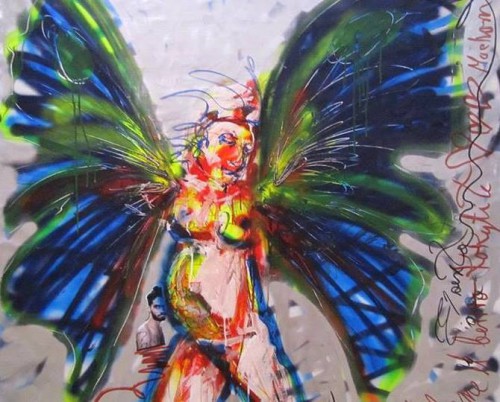
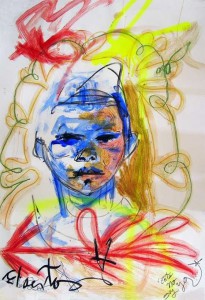
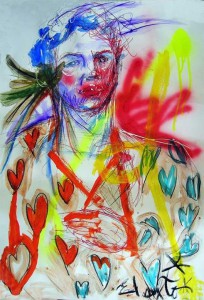
By El Sexto
For Silvia, sitting in Park B was the friendliest way to experience horror, feeling less alone hugging him: Being almost inside of Orlando. And there they headed, noon after noon. To do nothing. To look at each other. To kill the time and the perennial nervous breakdown in which they survived. To tremble and to pass the pages. To read little volumes of paper as deteriorated as the landscape, or wasteland. To feel lost in the readings, unsung heroes that no suicidal writer would write about. They were letting the official names of the years pass by. Without history and time, Orlando and Silvia without names, without past or future: Creatures of a pure, over-saturated present, gasping the air of the barred city. And nothing seemed more exciting than this day-to-day progression without rules or consequences, this cluster of stories bought in bulk from the moths and tedium of a state library.
From Street B, they let the buses, stinking like tractor trailers and liverwort, pass by Porvenir Avenue. From there they counted, as if they were at a lookout on ground level, the drunks without a homeland whose livers hadn’t murdered them yet. From there Silvia and Orlando mutually admired—almost grateful to God, or to the chronic lack of God—having that boring bench to read and entertainingly love each other on and, hopefully, from month to month and from millennium to millennium, privately resist the cruel and friendly experience of such a public horror.
3.
They drove between cars, dodging honks and squealing brakes, mocking traffic lights hanging by their necks, without believing in any message or signal. They had decided that there had been a lesson sufficient enough. For this reason they hated this lovely city: Because of its style of a permanent classroom, of cloistered uniformity, of a little disciplinary school impossible to ignore or transform. They waited for the right moment for each other, before emitting a howl and pouncing, like cunning beasts, on what, who, or for why they could not yet say.
For the moment they drove blindly on his motorbike, a Júpiter with cannibalized pieces of a Harley Davidson. On the Júpiter-Davidson they were merged into a single body, Orlando and Silvia alternatively sticking their nails into each other, depending on who was driving, penetrated on the promise of making themselves free before finally making love: The promise of waiting so as to not feel guilty beneath the shapeless inertia of repetition. For the moment they drove at night, discussing the sights that caught their attention at that time, when they seemed most likely invented, from neighborhood to neighborhood, the barbarity of a map more theatrical than gloomy: An open book abandoned even by its anonymous author.
“Silvia, the lover of Virginia Woolf, jumped off of that roof,” was said on Ñ St. and 23rd. “Orlando, in this encampment the Cuban Nazi Party was founded,” was said on San Lázaro and Lealtad streets. “Silvia, this curved building is a sickle and its tower would be a hammer,” was said on Línea and L. “Orlando, buried under those bronze shoes is the broken kneecap of Gerard de Nerval,” was said on the Avenue of the Presidents and Malecón.
Driving together cheered them up, and chased away the tedium of driving together. Havana was filled with foolish and breathable images, and it seemed fun and rebellious to retell everything again just for them, from zero and even less, without ever stopping for any scenery, and without remembering the next night which detail was false and which was true.
“Silvia, Orlando, the best character of Virginia Woolf, died in this asylum,” was said on Dolores and Acosta. “Orlando, in the ruins of this restaurant the atomic reactor of Jaraguá still operates in secret,” was said on Infanta and P. “Silvia, there is a night of the world when the bay tunnel connects two times with the same shore,” was said on Prado and La Punta. “Orlando, in this church there is a chalice with Silvia’s blood that does not clot, Gerard de Nerval’s worst character,” was said on Novena and 84th.
They drove, taking turns steering, until they were tired, until they were leaning over the exhausted gas tank. Then, they dropped the motorbike in the first State parking lot they could find, took a taxi, paid in dollars, and in twenty minutes each one was back in their rooms: Lying upon the beds they fell onto, the two already ready for the telephone, with that terrible and tender offensive ritual, crying, forgiveness, and pleasure through a cable.
All of the small hours this occurred. All of the small hours. All of them. In Guanabacoa and in Lawton and all over the world: They resisted or pretended to resist. Until a minimal variation was sufficient enough for Orlando and Silvia to unravel this story that was sewn only to be protagonized by them.
4.
In the liquid noon of Park B, Silvia appeared with a revolver. “This is from my grandfather,” she said. “Look at the date on the handle: 1910.” Orlando was motivated: “The year of the murderer comet. In 1910 the twentieth century should have disappeared by its own will.”
Silvia pulled him towards her on the bench. She put Orlando’s head on her lap and leaned forward to cover his head from the zenithal sun. Orlando closed his eyes. The glare was too much, and went through the strands of Silvia’s hair like a silk palm tree or a crystal pyramid. The same heat burned for the entire year. Reality evaporated for them, and it made them angry to exist like this, humid and humiliated, without the illusion of those Novembers described in any random open or closed book.
Orlando asked for the revolver. He licked it. The revolver tasted like ferrous hemoglobin, like a dried salty residue of iodine, even though it was kept far from the sea. He tangentially blew into that century-old canon, improvising the playing motions of a funeral flute: “It feels like this is carved from the tibia of a whore or from the femur of a man who has been shot,” he said without opening his eyes. The sound remitted the lethal tunes of a wedding march. This wild whistle awakened something in Silvia, and when the death relic was returned to her, he heard her make a decision: “It is now or now, Orlando, we can’t be so mediocre and lose this opportunity.”
And, without feeling the need to draw back his eyelids, Orlando knew she smiled beautifully bent over him: Her mouth open like a cave, like the cracked crater from a spring. It was very easy for Orlando to feel Silvia’s joy because, from where he was, he could almost chew the warm steam of her laughter. Silvia’s breath was made of fruits nonexistent in this fierce climate: Grapes, pears, apples, and those rare almonds without shells. Orlando pretended to be a wine taster and in an inaudible voice he spoke to the world, to all, in a cry of war for his love: “We will do it because today Silvia tastes like a murderer comet, a frustrated harvest from 1910.”
5.
So they went to the ground mines of Guanabacoa. They packed a large backpack where the revolver was hidden, floating like a kidnapped baby in a placenta of bullets: A hundred, a thousand, a hundred-thousand projectiles of light caliber. On one side of the cemetery they advanced toward the national freeway, an endless eight-way strip. “The 8 is an infinity symbol, but it’s standing up,” Orlando heard Silvia shout from the back seat. “And also a closed, double S, without claustrophobia but without liberty,” she continued.
Night was falling, and they left behind the rabid divisions of martyred and vulgar names. They passed dairy farms, foundries, high-voltage towers and others for fuel extraction, and also desperate fields of flowers for sale: Most of them were sunflowers, heads twitching like fists at that time of day. Finally, the Júpiter-Davidson’s motor stopped at the decayed mouth of the quarries, with the moon bouncing between the cliffs until falling into the silver lagoon. From afar, the fields of sunflowers looked like a stationary parade that the next morning someone would decapitate. Then Orlando doubted: “Do we do it now, Silvia?” and she replied by taking off her clothes right there, straddling the lukewarm fuel tank.
By El Sexto
Orlando was still clutching the handlebars when Silvia pointed the revolver at his neck. Silvia put the first ten or ten thousand bullets in the drum, and loaded the gun with a click-clack. Then she ordered him to undress too. After this, for her, a mocking English phrase was enough to begin the scene that will, in turn, start rolling for the rest of the film: “Run for your life,” laughed Silvia, and she began shooting.
Orlando ran naked like a moon sliver. He fled for his life, but without fear, as had been agreed upon, feeling the pecking whirrs around him: Nocturnal sparrows diving fatally. Underneath his feet, the sharp quartz stabbed him to the bone with each spin, and the drops of blood cooled that beautiful, almost-criminal scene: A red fluid flowed from Orlando becoming frost from the coldness of his sweat.
Many minutes of fleeing passed. A half hour, or an hour and a half maybe. He finally fell, exhausted. Breathing thanks to the sibilants, his pores were little tracheotomies straight to his lungs. Silvia had shot a little less than two thousand bullets, like the year, and now their backpack seemed empty after that rehearsal of an anti-personal mine war. Orlando panted, his sternum wanting to crack, and his asthma competing with the wind’s blades that sharpened the cliffs, shaving the quartz into a diamond. Shine on you Cuban diamond.
He crawled a few feet to the edge of the lagoon. He looked up. He saw a double metal moon. And then he drank twice. The water, or the light, was brackish. He felt nauseous, but he swallowed that moldy fluid, oily and pure, seminal more than sidereal. And then he was completely introduced into that solid sea, still gripping a stone shaped in the form of a handle. Then he felt Silvia’s silhouette, giving him her hand while warning Orlando: “Come, at night the water is more treacherous than the rest of reality.”
He went outward and began to kiss all of her skin, stopping first at her armpits and after at her naval doormat: The shaggy mane that tattooed her pelvis. They hugged trembling, in a half fever, half chill. They cynically manipulated their genitals under the celibate heaven of Cuba, but neither intended to make love. That night still not. The two still lacked enough words for such an act: A tragic luxury and a release. Both of them still felt plenty of panic. So they remained there, onanist-angelical virgins, until shortly before dawn when the whole cosmos looked mauve and then orange, and then yellow and then white, and then colorless and then blue: Cyan-aqua necrotic stripes, where neither day nor night could completely erase what was among them.
The idea was to recover and then do the opposite in broad daylight: Silvia practiced her best style of flight, her naked body under the sun’s rays, while Orlando pointed the remaining bullets, ready to miss. But as dawn was getting higher and higher, a hysterical howling of sirens and speakers came from the other side of the cliffs. The siege had begun, or perhaps, already, the assault.
Silvia and Orlando got dressed before peering over the cliff to view the ostentatious police convoy, drawing cross-country esses between the rows of sunflowers, cutting the throats of their oily heads, scraping a blurred Van-Gogh that, from the height from which they were entrenched, seemed better than any painting or painter. The shootings in the small hours had probably given their game away: Orlando said something like (“This is a land without weapons”) and Silvia nodded with a yawn that he changed into a kiss, just when her lips were at the maximum point of tension (“This is a country without a soul,” she whispered). Orlando thought that, surely, the vapor of Silvia’s mouth was more eternal than the very word “Silvia” that defined it.
They held hands. Paradoxically, their respiration slowed down, as did their pulse and the nervousness in which they survived. And they decided in unison, with a glance, without the need to see each other again, their eyes lost in the horizon, from where the authority was already urging them to surrender without escape and without resistance.
It was the time without time, that of Orlando and Silvia, that of Silvia and Orlando: In any order of anarchy and despair. Neither wanted to erase the acronyms that stood for freedom from each other: l.i.b.e.r.t.a.d.: A puzzle they would never regret, only sure of this under the threat of dawn. Besides, it had been so long since they were hoping for a gap like this, that it was already pointless to forget it or think it again. Now, a first gesture of reaction was enough. An act, an expression, a blow: After living within the words of so much decadent culture, the verb “to act” was now the only verb that was worthwhile for them to spell.
6.
They fled in his motorcycle through the rear gutters, through that archipelago of florid and bland villages that eventually lead to Tarará. And from there, straight through Vía Blanca, toward Matanzas or to the posthumous bridge of Bacunayagua—the altar of local suicides—whether or not they wrote books where the characters killed themselves a little before or after the author who wrote them.
Orlando drove furiously, throwing up asphalt at top speed, while Silvia encouraged him, wedged between his kidneys and his vertebrae, sitting open like scissors on the back seat. They were a little queasy, but they went through the stampede with a euphoric calmness. They fled: Fugitives capable of any action. And this vital energy breathed the vertigo of a free fall into them. At last, it was they who were making things happen. Or at least they were refusing to let them happen indolently. So, at any moment, they couldn’t keep quiet, tripping over plans in unison that neither Orlando nor Silvia comprehended very well, as the 200 or 2,000 km/hr gusts of wind kidnapped their voices.
The motor reverberated like the remaining reality: Its remains of unreality. One thing they both understood that made them laugh a lot, the crazy laughter that escapes in a State ambulance: From now on he would always be Orlando Woolf (“A proud wolf in honor of Virginia,” he said), and she would always be Silvia de Nerval (“A volatile vision of Gerard’s V’s,” she said). Renaming themselves seemed to be the best clinical symptom of the eight, infinite acronyms of the word: l.i.b.e.r.t.a.d.
And it was very strange. The landscape did not advance. Palms, carobs, kapoks, and flamboyants splashed with primary colors. Cows and horses, plows and tractors, old people of centuries and children of weeks, women and soldiers. The lines of the pavement homogenized the sketches of the journey. Everything was flying before their eyes, but the landscape didn’t seem to advance. Orlando Woolf and Silvia de Nerval revolved in a bubble of kinetic exception, in a freeze-frame of any local road-movie: A very strange inertia that, to them, seemed like a habitual ancestral miracle.
The Júpiter-Davidson roared like a dragon’s throat. It spat sparks through the four ports of the exhaust pipe, dragging a string of murky smoke more turbo than turbid. A racing comet on concrete. The White Road looked unrecognizable that morning. Orlando Woolf felt Silvia de Nerval’s lips on his neck, where just hours before she had nailed the deadly 1910 canon: “Cuba is so slow,” he heard her complain: “Love, can you just speed up?” And he loudly explained that the pistons were already about to melt into national plasma. Then they turned the corner of North Santa Cruz and, even though they saw nothing, they both felt a dry blow that shattered the headlights and the lights into shards that covered them in a paste or fine powder.
They instinctively looked back, without stopping. And they saw a kind of blue puppet, zigzagging between the eight lanes; red ink jets were launched from its extremities, drawing an illegible graffiti on the road. “Did we kill a cop?” Orlando Woolf hesitated after such an obvious image. And Silvia de Nerval waited several seconds or kilometers before she responded: “Hopefully we did.”
It made no sense to stop at the scene, and even less for an accident. They were involved and the price of being free was still the same. The rubber of the tires became viscous and, from the crash, they drove without being sure if they retreated forward or if they continued in reverse. In fact, Orlando Woolf now scratched her back, and Silvia de Nerval guided the helm over the fresh footprints of the bike that, without a doubt, were those of their own Júpiter-Davidson a few minutes or kilometers back: The static passage gave them the impression that they were just turning back on their own breaks. They moved in fast-forward upwind, but downwind in rewind.
So they crossed the railroad lines and recognized the outlines of the rickety pines against the light and the flamboyants without birds, cut above the same grass without neighbors or banks or streetlights or paths: An infected slew of infantile diversion machines as threatening as prehistoric dinosaurs. Again, it was the provincial park of Street B, just a couple of blocks from Porvenir Avenue.
Silvia de Nerval didn’t stop. Nor did she even flinch. Nor did she warn Orlando Woolf about it, although he already knew about it, who, in turn, fought against his astonishment that Silvia didn´t notice it, shaking at the steering wheel, traversing a shortcut to the staircase of the State convent. No other explanation was necessary: The naught neighborhood of Lawton reappeared the more they moved away from it. Then Silvia de Nerval tangentially crossed the ballpark, and at once they regained, in wide angle, the vision of those fields of flowers for sale that swarmed in the outskirts of Guanabacoa: Desperate sunflowers in their majority, still with the drooling scars of the police assault from which they thought or sought to be fleeing.
A few more meters, and the Júpiter-Davidson was back at the decayed mouth of the quarries, with the moon bouncing between the cliffs until falling into the silver lagoon. Suddenly, they sensed that the whole escape was only an illusion, because the zero time of the year 2000 returned to them the four, very fulminate acronyms of the century: c.u.b.a. everywhere, c.u.b.a. for all of the ages, c.u.b.a. as gratuitous and obligatory freedom, c.u.b.a. as ubiquitous cubiquity, c.u.b.a. as scaffold.
In fact, they were surrounded by the authorities again and so it was impossible to distinguish. Nor resist, nor escape, nor nothing. It was a cosmic, closed cycle. But Big-Boring more than Big-Bang. Orlando and Silvia aborted their anxious desires to protagonize, like their last-minute surnames. Or precisely the opposite: Each were thankful to be followed and surrounded because Silvia and Orlando could now perform their birth of death, or maybe their pact of life. An act not as gloomy as it was theatrical. The debacle of returning to themselves seemed to be the shortest way to finally be another.
7.
The quarries shimmered. The patriotic quartz crackled furiously in their pupils. From the moon’s milky hole, a rabbit skull grimaced obscenely, despite the rising sun. They felt so alien and so part of it all… So ambiguous, so distant, so final and so close, that this had to be the end…
They settled on the Júpiter-Davidson, the mechanical horse collage with pieces in Cyrillic and English. Orlando was once again at the steering wheel. He accelerated. They smelled the reheated gasoline at dawn, with its most intimate, home-distilled alcohols. He removed the hand break and Silvia stood on tiptoe on the four wind pipes of the tailpipe. The bike reared up, still standing, two-footed doing acrobatic stunts on the rear tire. And, without even agreeing, Orlando and Silvia hurled a dry howl that evaporated the remaining morning dew. Howl. Aullido. Howllido.
They jumped. Only then they remembered that, despite remembering it well, they still weren’t dressed. The bike began to rise in a crazy parabola above the cliff and, once in the air, they discovered that they were as naked as they were during the previous small hours. The military deployment that almost caught them remained below. More than reading it, this was an unread self-dissolving scene, a pose literally taken from a film: Plagiarism of two thousand or so cheap movies, where the script of the final scene jumps over the barrier of verisimilitude. Orlando and Silvia knew very well that it was all just a show. Silvia and Orlando knew very well that, in that instant, precisely because of this, they manipulated the innermost threads of reality.
They heard the fanfare of the speakers and the hysteria of the sirens. From below their pursuers seemed to be a toy army. Above the horizon in the form of a noose, they craved the clouds to be loaded with water and electricity: Delocalized waves in an insoluble, unfathomable equation. The silver lagoon was nothing more than “An uncirculated currency of 1910,” he said: “The spit of an exiled god put in a comet,” he said, “the surface of a mirror with nothing to reflect.”
At some point Silvia stopped screaming in the air and said: “I see nothing from back here.” Orlando immediately consoled her: “There is not much to see.” With a jovial tone: “Down there it just seems like quarries of dead quartz and fields of sunflowers that are about to be executed.” In return, she emitted a brief “hopefully,” compressed almost into one syllable, and then they both laughed, floating in the peak of the parabola, the two weightless but already at the point of regaining the mass lost after their impulse.
By El Sexto
Orlando felt that Silvia pushed with her best strength. Her breasts drilled his lungs and came out on both sides of his sternum. Silvia threatened him again through his back: She had him at gunpoint or was devouring from behind. Orlando felt Silvia’s savage hands, placed as opaque lenses under his eyelids, putting her fingers in roots, scraping off his retina. Now he could not even see, perhaps because he didn’t care about anything at all. Not seeing is the best way to stare. Gram by gram, the bike regained its gravity, and descended with avidity to make itself fragments against a vocabulary of heavy words, outfashioned, compressed to a single syllable, or to the whole of an official vocubalario.
And there, the sleepless magic of waiting months or millennia to make love consumed itself. That mortal somersault was the climax of an unfree fall from which they wanted or believed they could flee. That was the only option that, the two blind over the ravine, could finally choose to resist and escape: “Choose, love,” he said: “Dead quartz quarries or fields of sunflowers soon to be executed?” Even though she, for all answers, only penetrated him a little more, until overflowing him inside and filling both bodies with Silvia, after that dizzying and voracious selection: “Of course, sunflower fields forever,” she calmly pronounced. “Even though the fear kills you, Orlando, eternity is still to be exercised.”
8.
The following midnight, after another long and narrow day’s journey of reading rather decadent things, they were consequently convinced that they lived in “an absurd era, of little or no action, as often happens after great revolutions or little catastrophes,”—a quote that they both liked very much and that could have come from Silvia, by Gerard de Nerval (Orlando’s favorite), or from Orlando, by Virginia Woolf (Silvia’s favorite)—he picked up the phone and desperately flew over her six keystrokes. As usual, through the tone of their bundled voices, it was evident that their unwoven story was only now about to begin.
One of the big boasts of those who took power in 1959 was to have converted military jails into schools; today, these schools are being converted into penitentiary centers.
The old “schools in the countryside” were closed thanks to Raul Castro’s new politics, to save what was invested in the logistic means designated for those students.
Those old schools are again opening their doors to receive convicts, after having been transformed into jails, with the required bars on windows and doors, and the security barrier around the perimeter to avoid escapes.
The tortures in those jails under the Batista dictatorship have returned with the dictatorship of the Castros.
One of the young men they sent to a prison in distant provinces, because of his relationship with me and because he offered me help in my communicating with the exterior, has returned, after two months, with horror reflected on his face. The method used to harm him was written in his file, the classification of “dissident.”
Upon arriving at the jail, an old “Youth School” in Santa Clara, the 22-year-old prisoner, Pedro M. Ferro, because he was political, was beaten savagely by the head of the unit, Lieutenant Colonel Delvis, who, after filling his body with hematomas, and without taking off the handcuffs, locked him in the “cubicles,” a place, says the young convict, of inhuman conditions. This was his punishment for collaborating with a dissident.
Thanks to the petition of his mother, a nurse, who demanded the return of her son to Havana, and also because he was a lieutenant colonel, they agreed.
What must there be inside the breast of that mother, who surely turned over her own youth to the totalitarian system that now abuses her son? Was her own sacrifice worth it? Any political system that tortures is fascist. Ours included.
Now Pedro M. Ferro wants to be a dissident. He doesn’t want to accept any utensil that hands him re-education. What is really undisputed is his full right to choose his own way of thinking and acting, maximized after witnessing the continual abuses of the penitentiary regime.
At least Pedro M. Ferro will not suffer the deception his mother suffered.
Operation in prison: Sleeping inmate victim of the officers.*
On Friday, 12 July at 6:00 in the evening, an operation started in the prison. The guards ran about desperately, holding clubs and bats. Reinforcements showed up, making a cordon, shirtless and in shorts, rifles at the ready. The guard dog was given a shirt to smell and the dog immediately took off running, perhaps mocking them, because a heavy rain had fallen recently; but it was fun to see the excitement around the German shepherd, excited about finding the escaped prisoner.
It’s been just a week since the first fugitive, who still hasn’t been captured, and they’ve taken every coercive measure, thinking someone else will try it.
Now I will tell you in the first person present, what one re-educator said, embarrassed about what happened:
“We had counted all the prisoners who were in the barracks. We now had no doubt that a prisoner was missing. For the duty officer, an escape is the worst demerit, it will mean being demoted, so you can imagine the desperation with which he tries to find the fugitive. Coincidentally, the duty officer of the day is Major Erasmus, who was removed from Combinado del Este precisely for two escapes at the beginning of 2012, when he was Head of the Building 1 Unit.
“Now Mayor Erasmus is Head of Internal Order, and is more nervous than ever, he walks the floor asking everyone around if they have seen some strange movement. Some soldiers look inside the cistern, in the grass, on the roofs.
“The despair is widespread. At ten in the evening, the news goes out that there’s been movement seen in the dining room where there shouldn’t have been anyone at that time. We all run towards it. When we get there, the First Lieutenant and Secretary of the Party for Prison 1580, Tamayo, is already beating the inmate who works there and who’s shouting that he had fallen asleep from the pills he took. I can not hide that an anger burns within us, we want to evacuate; but practice and maturity tell us to behave, although we do not all think alike. This same captain was demoted — along with Lieutenant-Colonel Mediaceja — when the minor Dayron was assassinated in the Cotorro Youth Prison.
“After Officer Tamayo handcuffed him with his hands behind his back, the slugfest begin, they all had rubber batons, bats, and fists. They were beating him from the dining area to the cell area, fifty yards of constant beatings.
“The prisoner fell and they forced him up, without stopping the blows. Upon reaching the cell, Mayor Erasmus was already waiting for him, who had been informed by the plant, and he joined in the punishments. When they all had sweaty uniforms, they stared at me because mine was completely dried, I had no choice, I kicked him but it hurt me more than him, at that point he couldn’t not feel anything. His body was completely red. They immediately stripped him and threw him into the cell.
“As we were leaving, a soldier showed me some empty pill packages found around the prisoner when he was caught in the mess hall.”
“Keep them to serve as evidence,” I told him.
At this Officers Erasmo and Tamayo appeared and took the packages and threw them out the window.
“They’re not going to show any leniency; nor make known what is chronic, nor take psychotropic drugs.”
We were silent and continued watching the rest of the night.
At dawn, when we went to the count and saw him again, if it weren’t for the cell number I would have thought they’d moved him. He no longer looked like the person we’d left, red and watery, much less surprised by that trouncing in the dining room. We had before us a monster, literally, with swollen and purplish eyes, bumps in the skull, his body completely purple with the marks of the beatings by rubber truncheons, boards and bats. He was still weeping, aching.
“He spent the whole night complaining,” said the soldier guarding the cell.
There were blood clots on the floor.
“Take him to the doctor and get him injections for the pain.”
We had to load him up to transfer him to the medical station. When the doctor saw him he couldn’t hide the impression it made on him, and immediately begin to examine him. The officers tried to stop him when they saw he was filling out a medical certificate of the injuries, but he refused.
“If this man dies, the responsibility will be yours; he has to be taken to a hospital for a more thorough exam and X-rays.”
The officers, frightened now, refused to move him, knowing that if he was taken this way there would be a scandal. They threw him back in his cell, naked, and fourteen hours later the blood is still running there.
“I swear, ’Political’ [political prisoner] that the kick I gave him was in the leg. These people are crazy, as if they don’t think that at some point the time is going to come to pay for these abuses. My wife’s family in Spain warns me not to get involved in the crimes they commit, especially against the ’Human Rights’ [activists].”
The officer finished telling me everything with his head in his hands.
“I want out of MININT [Ministry of the Interior], this sucks,” he told me.
He then went off, afraid, like someone who knows that in the future he’ll have to narrate this event in front of a court that does not owe its power to the government or to the repressive forces.
Now there’s nothing we can do but pray for the life the young man who suffers intense pain in the punishment cell.
Ángel Santiesteban-Prats
* There are several posts that Angel sent me while he was still in Prison 1580 that I still have to post. This is one of them. In the coming days I will publish others.