


Collapse / Yoani Sanchez
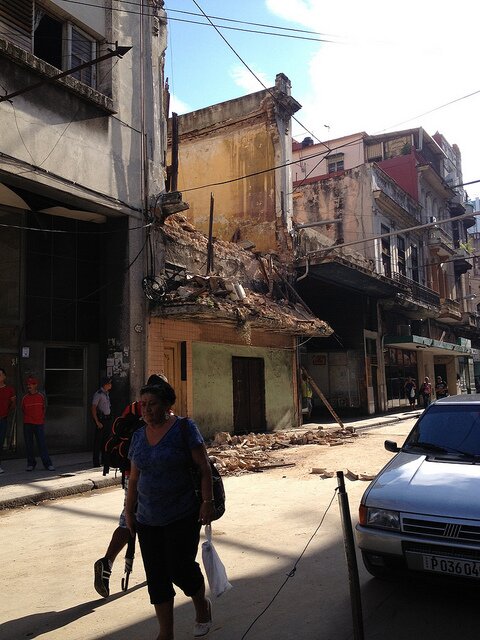
Before the Storm / Yoani Sanchez
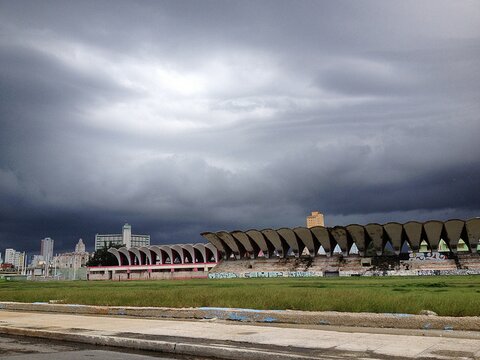 4 September 2013
Vacationers Infected with Cholera in Caibarién, Cuba / Yoel Espinosa Medrano

SANTA CLARA, Cuba , September 3, 2013 , Yoel Espinosa Medrano / www.cubanet.org.- Two men and a woman are hospitalized in the Marta Abreu clinic in the Brisas del Oeste neighborhood, infected with cholera. Gilberto Caballero is one of the names of those infected; he is in serious condition. The outbreak began in the Caibarién Beach, in the north of the province.
Also, a one-year-old girl was admitted to the José Luis Miranda Children’s Hospital in the provincial capital. The patients had dehydration caused by vomiting, diarrhea and of the only weakness.
“Gilberto was very bad, now he’s stable, the three are in isolation under strict medical supervision; in a few days they will return to their homes; here we have all the conditions for treating these patients; we decided to move only the pediatric case,” said one polyclinic worker who requested anonymity.
The infected spent a week on a work-sponsored vacation on the beach in Caibarién. They stayed on the 2nd and 3rd floors of the only 3-story building, located on 3rd and Circunvalación, in the Brisas del Oeste neighborhood in Santa Clara. Right in front of the building the waterline is broken. It was repaired just three months ago but every time drinking water service comes, every five or six days, the precious liquid pours down the street.
Dogs and horses drink water from the opening. There are people who scrub motorcycles and bicycles in the water stream.
This area, west of the provincial capital, is on red alert due to the high prevalence of Aedes aegypti mosquitoes, which carry dengue fever.
This Monday, workers were blocked from entering the 1st of May National Industry of Household Production (INPUD), where the infected work, to allow it to be sanitized and rule out any possible outbreak of cholera.
The INPUD cottages, the Mechanical Plant of the Ministry of Agriculture and the hotel of the Interior Ministry, located in the seaside resort of Caibarién, were closed until further notice. The work of clean up is also underway there.
Health and epidemiology officials banned the sale of liquids in private restaurants and food outlets, state and private, in the Brisas del Oeste neighborhood.
Public health and government authorities have not commented. The numbers of people infected with cholera and dengue fever are a secret.
The local media only issue calls to maintain proper health and hygiene measures to prevent disease outbreaks.
About the author
 Yoel Espinosa Medrano, born Matanzas, October 1973. His parents were peasants and at the end of the 9th grade he began his studies in a school for English teachers, in Santa Clara, from which he graduated in 1992. In 1998 he earned his teaching license in the English Language. In 2005 he began working at the Villa Clara School for Social Workers, from which he was fired for not being politically reliable. In 2006, he took up independent journalism through the Cubanacán Press Agency, where he was later made Managing Editor.
From Cubanet
3 September 2013
Raul Castro: Seven Years of Governing / Ivan Garcia
 Giving an accounting of their administration was never among the priorities of the Castro brothers. The modern caudillos are considered beyond good and evil.
Indeed, Fidel Castro managed the nation like a private bodega, with outlandish economic plans, bypassing the state budget, bleeding its finances, material resources and human lives sacrificed in civil wars in Africa or subversive plans in America. To Raul Castro has fallen the difficult task of saving and perpetuating the olive-green revolution.
It may seem a mission impossible. On July 31, 2006, Castro II inherited a country in the red. The domestic economy was a real mess. In bankruptcy and with a powerful cartel of corrupt bureaucrats pulling the strings of domestic trade behind the scenes.
Cubans, exhausted and with no future, living from campaign to campaign. The ideological factor was one of the keys of the bearded one. The nation was mobilized and industry paralyzed to plant burro plantains in the fields, to demand the return of Elián González and the release of five spies imprisoned in the United States.
Cuba was the closest thing to an asylum. Fidel, historical leader of the Revolution, transformed the continent’s third largest economy into a quagmire.
Little or nothing worked well. Inefficient public transport and unprofitable production. People went to work to lie around or steal. The best, health and education, began to recede.
The Cubans were not or are not happy. There is no way to express complaints publicly. The media is a caricature administered by the regime.
The solution of many, flee. In rubber rafts, as stowaways on a ship or commercial aircraft. Hijacking a boat passenger or marrying a European or Canadian gentleman or lady, three times their age.
The picture Comrade Raul had before his eyes on July 31, 2006, when his brother handed over power, was very ugly. Cuba was broken. Shut down.
The Cubans were fourth-class citizens in their homeland. “Prohibited” is the buzzword. We had no right to sell our homes and cars purchased after 1959. We could not stay in a good hotel and travel abroad; a commission of the Ministry of the Interior had to approve your departure.
The General came in as a relief pitcher, although by the mid-90s, military companies controlled 80% of the national economy through a network in key sectors.
The differences between one management of the government and another were glimpsed from the inception. Fidel Castro never learned to listen. He ran the country like a military camp. Meteorologist one day, cattle geneticist or national baseball coach others. He had no friends, only sycophants and partners of convenience.
For the comandante, democracy was an aberration created by liberal drunks . The people needed leaders of his stripe. After his studies at a Jesuit school, he became an incorrigible egomaniac.
Raul is another thing. Communist in his heart, without much political talent, likes teamwork and is a good listener. But it is a hard and pure autocrat.
Juan Juan Almeida, the son of a guerrilla commander who lived in Raul Castro’s home for a while, told me he came home from work, downed a shot of vodka, and sat and chatted with his children and grandchildren.
His fondness for his family did not mean he liked the people. He enlisted in the socialist youth and felt admiration for the Soviet dictator Joseph Stalin.
In his office hung a painting of the Georgian butcher of inordinate proportions. Those who suspected that Castro II would bury Real Socialism and lead the island within the canons of Western democracy, may have been wrong.
The timid economic reforms of the Raul Castro regime demonstrate the fear of losing control. Everything is slow predictable and calculated. The general dislike surprises.
He surrounded himself with a team of colonels and generals converted into technocrats. Two of his trusted men, Abdel Yzquierdo, minister of economy, and reform czar Marino Murillo are military men who now wear spotless white guayabera, but years ago they worked in business development management in the armed forces.
Before initiating his economic proposals, Raul Castro swept out the barracks. All men loyal to his brother were retired discreetly, sent to jail for corruption, or, in the cases of Carlos Lage and Felipe Pérez Roque, dismissed dishonorably.
On July 26, 2007, Raul Castro publicly enumerated the financial problems and warned that Cuba needed structural reforms. Soon after, in February 2008, he was elected president of the republic.
In April 2011 he was appointed first secretary of the Communist Party. In its management he has introduced a dozen economic measures. According to renowned economist Carlos Mesa-Lago, some reforms have been structural and others nonstructural, because they do not change the nature of the regime.
For Mesa-Lago, Castro II reforms are positive, but slow, face excessive regulations and are insufficient. The ordinary people are of the same mind as the Cuban economist.
Richard, selling pirated discs, applauds the sale of cars and homes. “Cubans who have money can go sightseeing. The expansion of self-employment and immigration reform are also positive. The downside is that everything is designed so that those with a small business do not accumulate a lot of money.”
Seven years later, there is a less ideological atmosphere in Cuba. The tiresome speeches and campaigns have been minimized.
Politically, Raul Castro has moved few pieces. In 2010, after the death on hunger strike of dissident Orlando Zapata, and then the marches of the brave Ladies in White demanding the release of their husbands, fathers or relatives, Castro II initiated a dialogue with the hierarchy of the Cuban Catholic Church.
As a result, and thanks to the mediation of the Spanish Foreign Minister Miguel Angel Moratinos, hundreds of political prisoners were released and exiled. It was the only positive step. Because repression of dissent has not stopped.
Right now, opponents Sonia Garro and her husband Ramón Muñoz have spent a year and a half behind bars without a trial. They are in limbo, in deplorable conditions. Nationwide beatings of dissidents have risen. Countless arrests occur in a few hours. Surveillance and harassment of independent journalists has continued.
In the summer of 2013, more than 400,000 Cubans earned a living without the help of the state. With exaggerated taxes without a wholesale market, the self-employed learn the ABCs of capitalism.
The citizenry has been loosened its tongue. It’s common to hear coarse criticism against the regime in an old private taxi or at a bus stop.
After seven years under President Raul Castro, in Cuba there are things that have changed. Others, such as low wages and the unification of a single currency, should be addressed promptly by the regime.
But the future is still a dirty word. Without profound changes, the country will continue to drift.
Photo from the blog Solución Cuba.
3 September 2013
No Good, Attractive, Cheap Shoes in Cuba / Gladys Linares
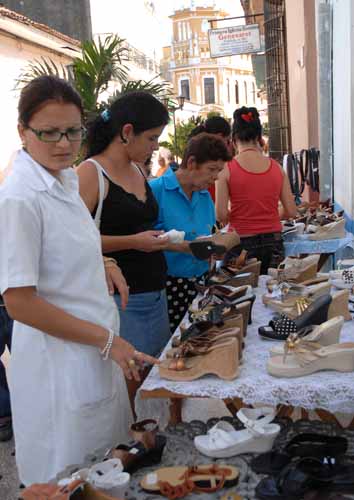 HAVANA, Cuba, August 2013, www.cubanet.org — The school year is about to begin and parents are now shopping around for shoes for their kids. It has been many years since those lace-up leather shoes, known as school shoes, have been sold. They complimented school uniforms well, were durable, protected children’s feet and were fungus resistant.
For some time they have been selling black tennis shoes called Pioneers instead. They go for 120 Cuban pesos, or about 5 CUC (approximately five US dollars). Although children do not like them, they are popular with parents because they hold up well if you reinforce the soles. According to some people, however, they can be hard to find them in the correct size, if you can find them at all.
If Pioneers are not available, then parents have to turn to the hard-currency shopping mall, where quality is not great and prices are high. Finding something that looks good is difficult. Another problem is that after a month’s wear you have to take them to a shoemaker to have the soles repaired.
Shoes for running errands
Similarly, it is impossible to find the kind of closed toe, low-heeled ladies’ shoes appropriate for those daily errands that require long walks. There is no justification for this, especially considering the number of women over fifty in this country.
Some time ago the National Office for Standardization acknowledged that imported goods in Cuba — including shoes — were of poor quality. Then why are they so expensive? This means they remain in the display windows of shoe stores so long that, on those rare occasions when they finally go on sale, they already show signs of wear.
 A neighbor, Juan Alberto, bought a pair of shoes at a boutique. He paid 46.75 CUC* for them. The second time he wore them, the leather started to come apart.
Orthopedics, forget about it.
“Looking for a pair of shoes is like finding your way through a maze,” says Gloria, a seventy-two year old woman who needs special footwear because of paralysis she suffers resulting from a stroke. Gloria went to a custom shoe store after her orthopedist wrote her a prescription. She was told she would have to call and make an appointment because they were not filling new prescriptions at that time.
 Finally, after several months, it was her turn. Once at the store they took her measurements and told her she could pick them up in ninety days. Imagine her disgust, however, when, on the day she went to pick them up, she found out they were two sizes too big and were made with velcro instead of buckles. When she complained to an employee, he acted annoyed and told her, “This is it. Take it or leave it.” Gloria took them home and now uses them as slippers.
There is a popular alternative one can often find in building entryways or areas near commercial centers: people selling shoes recovered from buzos, or trash dumpsters, which have been repaired and cleaned. Prices vary between four or five CUP and ten CUP. Believe it or not, there are always customers, especially among elderly retirees.
About the autHor
 Gladys Linares was born in Cienfuegos in1942 and is a school teacher. She worked as a professor of geography and as director of various schools for thirty-two years. In late 1990 she joined the Movement for Human Rights through the Women’s Humanitarian Front. She was an active participant in the Cuban Council and the Varela Project. Her writings reflect daily life in Cuba.
September 1, 2013
*Translator’s note: Cuba has two official currencies: the Cuban peso, or CUP, and the convertible peso, pegged roughly one-to-one to the dollar. The price paid for the shoes mentioned above represents more than two months wages for the average Cuban.
3 September 2013
Voces Magazine Returns / Orlando Luis Pardo Lazo

The magazine Voces [Voices] welcomes you to a plural space,
where you can always say what you think
and respect the diversity of opinions.
After a necessary silence for those of us who want to express ourselves freely,
Voces reopens its pages to collaborations, with the only purpose to unite all Cubans in the world.
Although issue #18 is titled “Is the transition in Cuba a utopia?”
you can publish about theater, visual arts, ethnoculture, gender, politics, philosophy, ethics, narrative, poetry, recipes, lyrics, good public messages, publicity and more.
The texts should be between 500 and 1,500 words.
Those who want to write about the topic of the dossier for this #18
the deadline is Monday, September 9.
For the rest, we are open 24 hours.
A secure email until 1 October will be:
menosveinte@gmail.com
That’s it, María Matienzo Puerto
2 September 2013
X / Luzbely Escobar
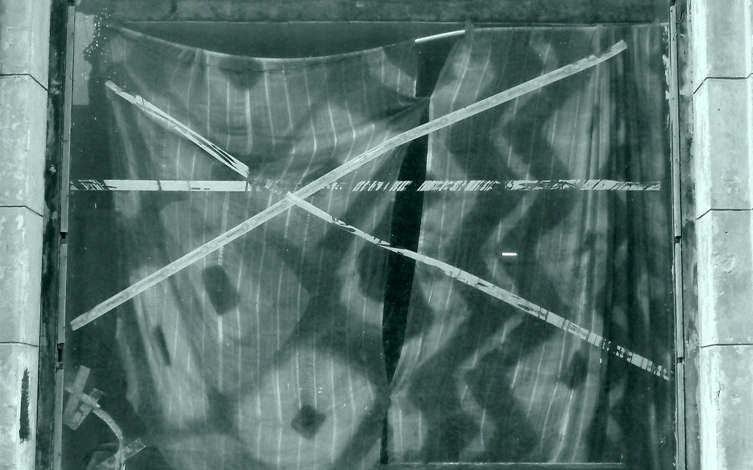
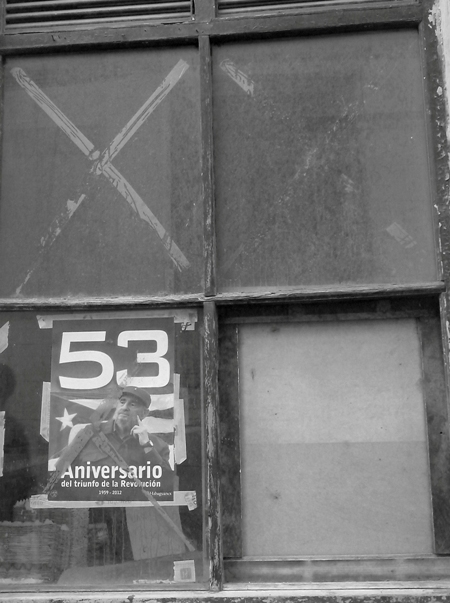
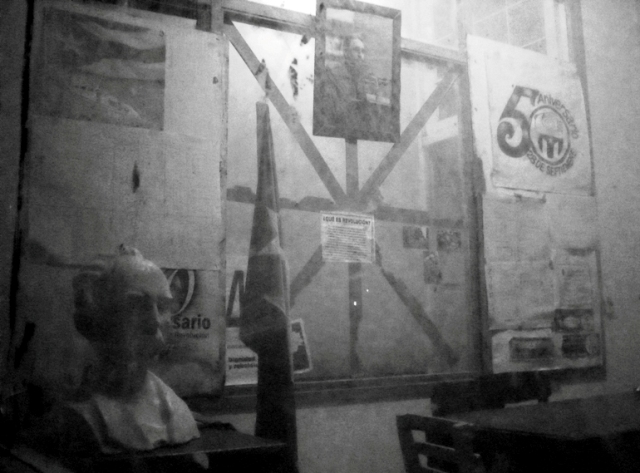
2 September 2013
Playa Brawl: Cops Versus “Frikis” / Camilo Ernesto Olivera Peidro
 HAVANA, Cuba, September, www.cubanet.org- At the beginning of the nineties, the Argentine journalist Andrés Oppenheimer published a book entitled, Castro’s Final Hour. The first chapter begins with the description of the execution of the accused in the murky Cause No. 1 of 1989. Then came the event, today nearly forgotten, of the rockers and metalheads of that generation of ‘80s remembered as The Playa Brawl.
One Sunday in August 1992, in what was then the House of Culture of the Playa Municipality. A a rock group called Dark Metal played. In the vicinity of Fifth Avenue and 70 and near the House of Culture on 68th Street, the police stopped and searched those who were heading to the concert. Later, various uniformed men showed up there. One version places the director of the House of Culture as the first responsible for what happened. This lady thought she saw a fight, in the “hard-core” exchange or clash between members of the public. She called for the police to come to the site and they used the pretext to unleash a spiral of violence and repression.
Outside, a growing number of police were using their batons left and right. The buses with members of the Special Brigade, equipped as anti-riot police, surrounded the site. Some agents arrested a guy and put him in a patrol car. Inside the car they sprayed with pepper spray and locked him in the closed car. A stone thrown at the rear window of the car and a courageous rescue saved the boy from suffocating. A group that tried to flee to the bus stop at 70th and Third was intercepted by the uniforms with a beating from their batons. Meanwhile, the traffic police closed Fifth Avenue.
The people in the cars looked on horrified at the guards mercilessly beat them, including girls who were almost children. In a moment the repressors launched dogs without muzzles against youth groups. A scene we had only seen in pictures coming from other countries. It intensified into something very much like a “Friki Intifada.” The police had to retreat from rain of stones. Several shots rang out. One of the guards, with an AK 47, shot a blast into the air. Another policeman took his gun. The soldiers retreated vowing to free the arrested. They lied.
Soon, a crowd of survivors began to march toward the police station at 5th and 62nd. It was there where they had taken most of the arrested. The initial provocateurs of the incident where there. Once in front of the place, the young people began to scream, demanding the release of detainees. It was the first time, since 1959, that this happened in front of a police station. The prisoners were released, most of the baring marks of the beatings.
Later, the authorities misrepresented everything. The lack of rule of law did the rest. However, the news went around the world immediately through foreign news agencies.
From Cubanet
1 September 2013
Havana, City of Columns / Yoani Sanchez
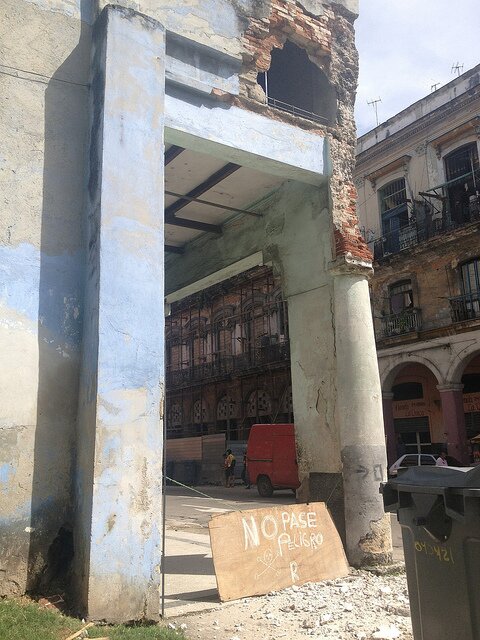 The sign says: Don’t Pass. Danger
3 September 2013
Havana is Falling Down Around Us / Yoani Sanchez
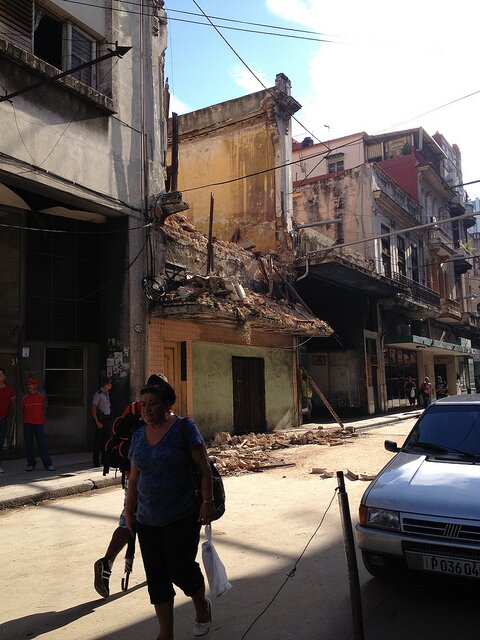
A Collapse at Neptune and Manrique
28 August 2013
Useless? Without Virtue? / Luis Felipe Rojas

Photo: LFelipe Rojas
An event has shaken the forums on Cuba and Cubans lately. The trips abroad of some Cuban opponents of the regime has focused attention on the tendency of we Cubans to be who we are: passionate, extremists, relaxed, dazzling, contemptuous, in short, human. But there are three women in particular I want to talk about: Yoani Sánchez, Berta Soler, and Rosa María Payá. Each one stretched the cord until it broke, from one side and the other, of Tyrians and Trojans.
In order of appearance, the linguistic slip and use (perhaps incorrect) of irony in a battlefield (the media) where gaps of misunderstanding are not allowed, unless for the use of their own machinations, painted with the first scandal the multi-award winning girl from Factor Street. All the posts she wrote over five years, taken together, didn’t generate the flood of comments as great as her 15 seconds of “fame,” and that’s bad… but it’s good. If anyone really doubted that Yoani could grab the attention of the world, they were as wrong as she was.The verbal stumbling had the same company of cheers and repudiation. We all learned the lesson, she not to again trade her communication tools, we to demonstrate once again our propensity for intolerance, and Europe and Washington to serve as a clear path to show themselves exquisite hosts.
For her part, Rosa María Payá is in, probably, the most delicate moment in her political career, Cuba doesn’t know it. Even the Human Rights activists don’t know, the Independent Civil Society (not forgetting that the opposition is not exclusively in Havana… far from it) and the contacts with the movement she hurriedly inherited (the Christian Liberation Movement) have not taken a couple of trips from the capital of the country. But the strength with which she has led the fight to denounce the death of her father, Oswaldo Payá Sardiñas, and the activist Harold Cepero Escalante, had demonstrated the fiber she is made of, seasoned with three ingredients very dangerous for her adversaries: clarity of thought, ease of communication, and a clinging to the truth that could put the Castro regime in a position as delicate as that it faced three years ago with the death of Orlando Zapata Tamayo.
Berta Soler Fernandez brings the experience of a decade plotting strategic actions, reckless and brave against a repressive machine that went down in the annals of the twentieth century and has taken the lead in the twenty-first. Seconding the peerless Laura Pollán was a difficult test, but she took it on with ease in ten years of the struggle with the Ladies in White. Steering the mythical and effective female group, working as a team and gaining their blind trust was the final exam, conquered cum laudem. Berta Soler has deployed her agenda on the old continent as one who knows every word, every phrase the political prisoners whispered in her ear, the spirit of Pollán and the Ladies in White who continued protesting in Havana as long as she represents them. Soler has flatly denied having political ambitions, she has focused on Human Rights and with simplicity and bravery continues to support her ideals.
Three voices, three women called to tell the story and they are narrating it in a tone of voice that anyone of us would wish.
22 March 2013
The Tug of War of Economic Reform / Fernando Damaso

Photo: Rebeca
The authorities seem to have given the order to shut down so-called “shopping houses” (small private stores run by the self-employed), which now face the threat of being taken over and having their inventory confiscated. Several days ago the Council of Ministers issued Decree no. 313 and took other similar measures outlining the procedures that must be followed when dealing with goods and furnishings involved in criminal trials and subject to administrative confiscation. The decree establishes the bodies that will deal with storage, preservation and disposition of these goods as required. In other words it codifies the redistribution of the seized goods to lucky recipients in order to avoid discussion and blowback.
It is a kind of tug of war. One day something is authorized but, as soon as enterprising citizens see a way to legally improve their economic status through their own initiative, it is outlawed. There is no way to advance, only regress to the same old stagnation, which kills off any hope of real change.
These actions are repeated so often that the “updating*” has become like bubble gum. It is a continual back and forth, constantly inflating and deflating, losing credibility each time. Increasingly, the policy is not being taken seriously by citizens, who have not lost their ability to think for themselves.
As long as the authorities fail to offer a realistic program, they will just keep wasting time. Without a well-defined and clear roadmap for solving the nation’s crisis — one without so many potholes, detours and backtracking, all summed up in some generic “guidelines” which are more theoretical than practical — everything just gets more complicated and any solution just becomes more difficult.
How nice it would be if they just put their feet on the ground, set aside failed utopian ideologies, and stopped hoping for new Messiahs to come along and “pull their chestnuts out of the fire.”
*Translator’s note: The Cuban government’s term for Raul Castro’s program of economic reform.
3 September 2013
After the Rain / Luzbely Escobar


30 August 2013
Sense and Sensibility / Regina Coyula

Translator’s note: At the end of this post is a video (without subtitles) of the State Security operation around Estado de Sats during the event Regina appeared in (shown in the above photo). It is this type of operation that she is referring to in the opening lines of her post.
It seems the Estado de Sats setbacks will become an ordinary thing: discouraging apocryphal messages, intimidating operations, unnecessary detentions. They are trying to prevent Estado de Sats from achieving a quorum, by my impression is that it has come to stay, satisfying a need not met by any institutional space, however open it pretends to be.
Invited to speak about self employment, I shared the panel presented by Antonio Rodiles with the journalist Orlando Freire and with Antonio Ocampo and Francisco Valido, engaged in private dining and transport respectively.
I believed that my foray as an “expert” on the topic would make me nervous, but not at all. A relaxed air connected with those present for more than two hours. Questions, opinions, laughter, and in the end, more questions and many compliments.
I had the pleasure of meeting in person a Cuban who lives in Spain whom I already knew virtually. All would have been very fine except for several people being prevented from coming.
At home, after breakfast, I undertook (or took on) the kitchen. A thorough cleaning, of the kind not done every day, in order to put the ego in its place, to remind myself that it’s not about speaking well on a panel, that I continue to be one more citizen.
[youtube=http://www.youtube.com/watch?v=5teUDeXNX3g&w=560&h=315]
Translated by mlk
2 September 2013