As the fifth anniversary of ’11J’ approaches, an increase in patrols is evident across several municipalities.
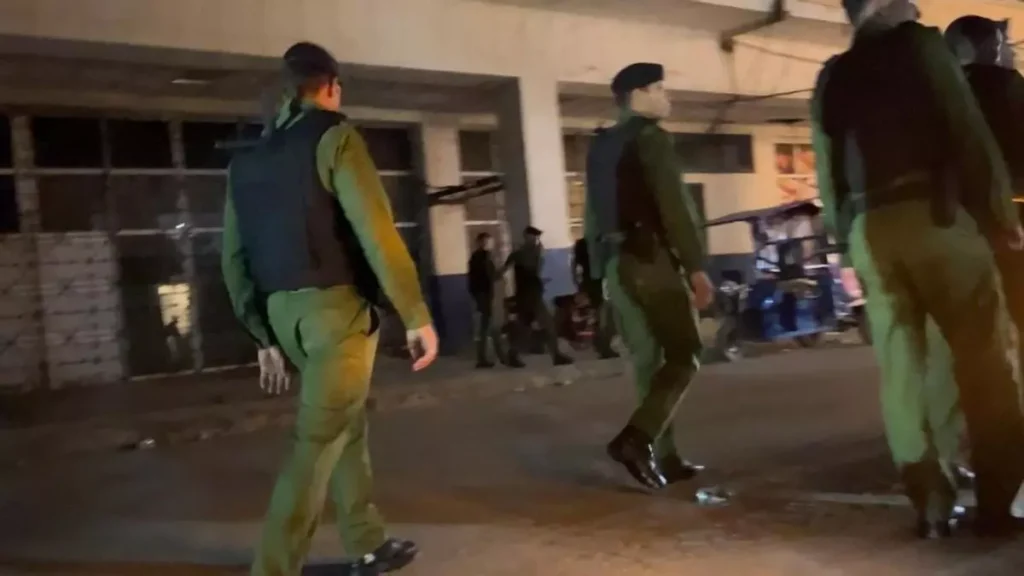
 14ymedio, Havana, Diego Hernández, 22 June 2026 / The weekend has given no respite to the Havana municipality of Regla. Hours of heat, lack of water and absence of electricity have been piling up, made worse, perhaps, by a transformer breakdown on Sunday. Or perhaps not, since the day before, pots and pans were banging in protest again across the area in broad daylight after 30 consecutive hours without power. That movement is under the microscope. The authorities are doing everything in their power to prevent a new 11J whose fifth anniversary is fast approaching. That explains the reinforced military and police presence right in the heart of the capital.
“The guards were patrolling up and down the busiest spots, and especially in front of the People’s Power offices. You saw them on every corner. They were going past the cafeterias and bars on Calle 24 de Febrero and just staring at you. They’ve been at it for about three days now,” a resident of the area tells 14ymedio as an abnormal presence of olive green is visible in the streets. These images were taken by this newspaper on Saturday night through to Sunday, though they could not be sent to the editorial office until the following day, as the lack of power has kept communications at a bare minimum for many weeks now.
Protests in Regla have been recurring in recent days. On Thursday, around thirty residents demonstrated outside the Communist Party headquarters, and the following day they overturned rubbish bins and set them alight.
The regime’s fear of an explosion is plain to see. The conditions are ripe and the police presence is multiplying as a constant reminder of what can happen to anyone who protests. What happened this Sunday in El Vedado is another example. At least four patrol cars and several police motorcycles gathered in front of the Malecon, where a handful of young people had gone to take a dip. Images taken from the Giron building have gone viral, and although several people have welcomed the idea of officers removing people from a dangerous area – where swimming is prohibited – the criticism has grown louder.
“Once again the police are acting as a repressive instrument against kids who have no water, no electricity, and probably no food in their homes. They weren’t doing any harm to anyone – they were simply swimming at the Malecon. For this there’s fuel. The people against the people,” said a witness who reported that at least one person was detained over the incident.
“If they saved all the fuel burned daily on police deployments, we wouldn’t have so many electricity problems,” wrote one social media user. “Yes, because the deployment is across all of Cuba, not just Havana,” they added.
That was not an idle observation. On Friday, Cuban President Miguel Diaz-Canel paid a visit to the very same area in his capacity as president of the National Defence Council. “The Defence Zone must be the Party and the Government of every community, both in times of peace and in times of war – that is what the complex situation Cuba is living through demands,” said the leader, who made reference to the high population density of the Carmelo neighbourhood in El Vedado.
On Friday, Miguel Diaz-Canel visited the area in his capacity as president of the National Defence Council
Diaz-Canel spoke of periodic military exercises that must be carried out, while highlighting defence plans including the protection of vulnerable people and “citizens’ prior knowledge of shelters to ensure a smooth evacuation.” Jorge Luis Aneiros Alonso, president of that defence zone, said it is important for citizens to know “in the event of an aggression against the country, where they can go to be better protected. The first thing is to identify and verify the locations available to us in the zone that offer safety… making use, above all, of basements, semi-basements and certain tunnels,” he explained.
The sight of uniformed personnel, however, is not reassuring to a population focused primarily on carrying out the most basic tasks of survival – eating, drinking, sleeping – in the midst of unbearable blackouts. On Sunday, the state electricity company Union Electrica dedicated its social media accounts to paying tribute to the recently deceased commander Ramiro Valde’s Menendez through numerous messages in his honour, including one praising him for leading “the Government programme, together with the country’s highest authorities, for the recovery of the National Electricity System and actions related to the energy transition.” “RIP, but I want to talk about something else,” responded users exhausted by hours without power and the company’s failure to provide any answers.
In the early hours of this Monday, the Antonio Guiteras thermoelectric plant in Matanzas – Cuba’s largest – began restarting after its most recent breakdown, which took it offline for the fifteenth time this year. But not even that gives anyone hope any more. With it or without it, a deficit of 2,000 megawatts has become virtually permanent on the Island, and the regime is mobilising its control apparatus to ensure that no new mass protest like the one five years ago erupts – one that would first trigger repression on its part and, ultimately, a possible response from the United States.
Translated by GH.
______________________
COLLABORATE WITH OUR WORK: The 14ymedio team is committed to practicing serious journalism that reflects Cuba’s reality in all its depth. Thank you for joining us on this long journey. We invite you to continue supporting us by becoming a member of 14ymedio now. Together we can continue transforming journalism in Cuba.