The Boycott of ALBA / Juan Juan Almeida

As part of the commemoration of the 500th anniversary of the discovery of the South Sea (Pacific Ocean) by Spanish explorer and conquistador Vasco Núñez de Balboa, the leaders of 22 Latin America countries plus Spain, Portugal and Andorra gathered in Panama October 18-19.

They held, there, the XXIII Iberoamerican Summit, for this occasion, taking as the central theme “The political, economic, social and cultural role of the Iberoamerican Community in a new global context,” with a primary interest in the desire to re-evaluate this inclusive meeting and, as a marvelous irony, a substantial number of absences.

His Majesty King Juan Carlos did not attend, he is recovering from a recent hip operation. However, in the ultimate gesture of respect and elegance, worthy of royal protocol, he addressed the audience by a video message that was viewed in the opening session.

Nor did the President of Argentina, the lady Cristina Fernández de Kirchner come to the great event , she was also recovering from surgery a few days earlier to remove a hematoma from her skull, and now must keep what he doctors call “strict bedrest.”

What is peculiar is that, in a defiant and obviously premeditated act to reduce the  reputation of and tarnish the event, also absent were the illustrious leaders of the Bolivarian axis. A reaction expected and typical from unenlightened people.

It is not a blessed coincidence that in the digital version of the Sunday edition of Gramna they published, and I quote, ” It is symptomatic, for example, that from the South American region only two leaders attended, Colombia’s Juan Manuel Santos and from Paragua, Horacio Cartes , while no one attended from the Bolivarian Alliance for the Peoples of Our America (ALBA).”

It is rational to expect this manner of behavior from the members of ALBA. Boycotting the event is nothing more than a show of force to promote the culture of fragmentation and also to show their disagreement as a bloc with the fact that Costa Rica and Panama are about to enter the newly proposed Latin American alliance in which Peru, Chile, Colombia and Mexico merge their economies and define joint actions to develop Asia-Pacific ties based solely on respect for bilateral trade.

For this, and other reasons, none of the leaders of the Bolivarian gang attended the meeting, rather, offering false internal commitments, they sent their representatives.

But on the case of Cuba, General Raul Castro, knowing ahead of time that the first document to be signed refers to counteracting, jointly, the application of unilateral measures that violate the principles of international rights and that could affect regional peace and international security, decided to send a special emissary in his place (the CEO of “who knows”) who, judging by his aspect, behavior and dress, it’s easy to come to the conclusion that he’s the director of “Whatchamacallit,” a grand prize winner for business excellence, in the vanguard producing breaded croquettes made out of God-knows-what, or the administrator of those FAR (Revolutionary Armed Forces) homemade schemes to exceed their planned sales of crates of festering fruits, rotted roots and wilted vegetables.

Who could expect more, after the resounding success of the Chong Chon Gang  carrier ship, the sweetened armaments and the diabetic crew.

22 October 2013

Prison Diary LXI: Solidarity with Dania Virgen Garcia / Angel Santiesteban

Today I heard that the independent journalist Dania Virgen García is being warned by State Security that her constant opposition to the system is disturbing to them.

For this, as is their modus operandi, they use criminals, who are themselves, as you can see in the clandestine videos when they abuse the Ladies in White and the opposition in general. First she suffered a freak accident, I remember that I heard it from the prisoner of conscience David Piloto, when I was in that horrible Prison 1580. In the accident she suffered a broken leg. If that weren’t alarming enough, we have to add that when Dania Virgen suffered the “accident” she was with her grandson.

We know that State Security doesn’t send warnings for nothing, they continue to escalate, to the point of taking your life if necessary, and if they have entered her home on several occasions, it’s no surprise that in this scene there is a script where Dania Virgen seems to have been murdered by some criminal who flees and is never found.

I know it seems like a grade-B movie, but it’s enough to look at what has happened in the last three years with the dissidence, to understand what they’re capable of to stay in power.

They know Dania Virgen is stubborn because her denunciations appear everywhere, she is a busy active Human Rights Activist, always attentive to news of abuses and violations and writes them up and circulates them. Her value as an opponent to the dictatorship is vital. A brave and determined woman respected for her decision to fight against the totalitarian regime, she has publicly warned them that she will not think of abandoning the country to save her live, and mentions Laura Pollán, because like her, she warns them, they will have to tear her life from her.

Ángel Santiesteban-Prats

Lawton Prison Settlement, October 2013

23 October 2013

The Cuban Adjustment Act: Does it Contribute to Demoralizing and Draining the Opposition? / Miriam Celaya, Jose Hugo Fernandez, Luis Cino,

LEY-bandera-usa-fila-dibujoHAVANA, Cuba, October, www.cubanet.org – Should the controversial law be annulled or changed? No Cuban who emigrates does so for purely ‘economic’ reasons. Hundreds of thousands of our fellow citizens, persecuted or not, live freely in the U.S. thanks to this law.

“It’s hard to argue that Cubans who can come and go as they please need special considerations, normally reserved for victims of political repression,” stated the influential Chicago Tribune, referring to the Cuban Adjustment Act .

The controversial law was passed by the U.S. Congress in 1966, and provides a special procedure for Cuban-born or Cuban citizens and their accompanying spouses and children to obtain permanent residence in the United States. The Cuban Adjustment Act (CAA, its acronym in English) gives the Attorney General discretion to grant permanent residence to Cuban natives or citizens seeking their green card if they:

– have been living in the United States for at least 1 year
– have been admitted or have been granted permission in advance
– are acceptable as immigrants

The Cuban regime’s official newspaper describes the Cuban Adjustment Act as “murderous”. It has stated that the law was passed in order to encourage Cubans to leave the country illegally, thus endangering their lives under the illusion of the American dream.

The Cuban Adjustment Act was not won over by the Cuban-American right; it was created by the Democratic administration of Lyndon Johnson for thousands of Cubans whose admission process was changed to “fleeing from a communist regime” from “refugees under threat of persecution”.

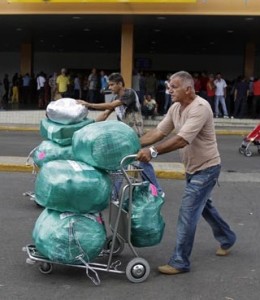
But, with the passing of the migration reform that became effective in Cuba and that – it’s said — allows for more liberal granting of passports, for most Cubans to come and go at will, and for the actions of President Barack Obama in 2009 to facilitate travel to the Island by Cuban-Americans, Cubans arriving in the U.S. benefit from the Cuban Adjustment Act, and, after a year in the U.S. return to the Island, carrying goods and merchandise.

U.S. Sen. Marco Rubio [R., Florida] is of the opinion that the 47-year old law giving Cubans special status to obtain permanent residence in the United States should be “re-examined”.

Two other Cuban Republicans in Florida, Reps. Ileana Ros-Lehtinen and Mario Díaz-Balart of Miami, also have called for changes to the law.

“The Cuban community in the United States is divided”, says Jaime Suchlike, director of the Institute for Cuban and Cuban-American Studies at the University of Miami (UM). Some have family they wish to be in contact with, while others say the law removes any motivation for people to remain in Cuba and confront the government.

Cubanet wanted to know the opinion of three of its writers:

Miriam Celaya’s Opinion

The Adjustment Act is, along with the Embargo, one of the most controversial issues on the subject of US- Cuba relations. Personally, I find it difficult to criticize a measure that has helped and continues to protect hundreds of thousands of my countrymen. However, it makes sense that there are those who believe that the law should benefit individuals who leave Cuba for political reasons and not people who view themselves as economic migrants and continue to regularly visit the Island.

That is, the fundamentals of political protection implicit in this law disappear when the individual is allowed entry and exit to and from a country with a prevailing political system which he allegedly fled. However, this should not mean the repeal of the law but its modification, with the implied compliance on the part of the emigrant with the applicable, fixed parameters of his political refugee status. Failing that, the same standards that apply to groups migrating from any other country should be taken into consideration.
LEY-cargado-de-paquetes-260x300Actually, no Cuban who emigrates does so for purely ‘economic’ issues, since the Cuban regime, dictatorial by its nature, imposes special conditions both at the economic and the socio-political levels, which are essentially the causes of the population’s constant and growing exodus. At the same time that the living conditions in Cuba impose widespread poverty, they impose political incompetence on the population, and this is the point where Cubans differ from other Latin American migrants, so conditions for Cubans and for other Latin Americans are not the same. But protection for political considerations contained in the Adjustment Act must go through the tacit recognition as beneficiary of political émigré conditions.

As for the supposed changes that have taken place with the January 2013 migration reforms and for the current relaxation of travel restrictions between Cuba and the U.S., the Cuban government remains intact in its ability to approve or not the Cuban passport from inside or outside of Cuba, to prevent the Island’s residents from traveling (depending on considerations of “public interest”), and to turn back the relative liberalization of travel, therefore, politics continue marching at the step of Cuban Emigration, and the Adjustment Act remains valid.

José Hugo Fernández’s Opinion

What action has most influenced the loss of reputation of the Cuban dictatorship and the gratitude and admiration of the ordinary Cuban towards the U.S.? The economic Embargo or the Cuban Adjustment Act, with all their many demons at both ends of the Florida Straits?

Now that some circumstances that gave rise to them have taken place, and since, in effect, they need to be amended (not canceled), let’s not forget that making comparisons at a political level is not only political ineptness, it is also an inhumane act.

Hundreds of thousands of our countrymen live in the U.S. today as civilized citizens, humble but free, thanks to the Cuban Adjustment Act, whether they belong or not within the group persecuted by the regime, another assessment that seems to greatly matter to politicians, but seems not to have much value when it comes to evaluating the population of a country that, as a whole, is victim and hostage of politics.

Doesn’t stripping that law of its eminently humanitarian character, thus reducing it to a mere political instrument turn it into something as wrong as those who allege that it should not benefit Cubans exclusively, forgetting that in Latin-America, and perhaps even worldwide there isn’t another country with a dictatorship as iron-clad, impoverishing, cruel and long as that of Cuba?

Luis Cino’s Opinion

The Cuban Adjustment Act, passed in 1966 to regulate admission to the United States for those fleeing the Castro regime in a sense has been overtaken by the modification of the Cuban emigration laws. Since many Cubans living in the U.S. abuse the law, it would have to be re-evaluated and modified, but not eliminated.
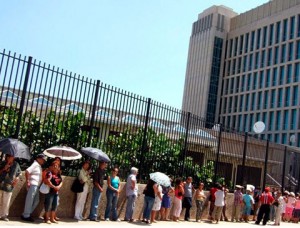
LEY-cola-embajada-usa-habana-300x228The elimination of the law, which the Castro regime has branded as “murderous” would be to treat the regime to a victory. It would serve as its version of “those who leave Cuba do so for economic, not political reasons, just like emigrants from any other third world country.”

As long as the dictatorship exists, there will be Cubans who will try to flee. The elimination of the Cuban Adjustment Act would leave no hope for those who don’t have the means to leave legally, or to qualify for the program of 20,000 annual visas for Cubans that the US has had in existence since 1994.

We should also review the “wet-foot dry-foot” policy and reformulate the policies of the Refugee Department of SINA [U.S. Interest Section] which is used by many as a springboard to leave the country, contributing to demoralizing and draining the opposition.

Translated by Norma Whiting

From Cubanet, 22 October 2013

Where the Rabble Came From / Juan Juan Almeida

fda400e3-944a-4907-a202-f49d59364966_mw1024_n_s1The government in Havana, as a transformative method to fight the alarming reality of the times, visibly marked by social deterioration, goes all out and launches a highly publicized campaign to restore lost civic norms and restructure popular morality through the force of laws imposed, articulating expectations and establishing rules. It’s as absurd as an athlete trying to cross the finish line and getting tangled up in the tape.

They say their new battle is against vulgarity, marginalization and coarse behavior. Conduct that we mustn’t forget, without looking for who’s to blame, because in reality the times deserve solutions; they were brought about by the young rebels, the outlaw troops arriving in 1959, who implanted disrespect as the order of the day, Liquidating our traditions and ending up destroying everything.

The Revolution was imposed as a factor of civilization. Then, belief in a God not wearing olive-green, using a napkin, toilet paper, and phrases such as “excuse me, please, and thank you,” were customs that were criticized because they were considered petit bourgeoisie relics. It was established and became the custom to address others informally, and thus, at a stroke of a pen, respect and courtesy were erased.

That monster was born, raised and trained in the arts of mimicry and camouflage. Now they want to show the superiority of some sectors which, knowingly or not, coexisted and coexist on the margins of morality, and like  part of an emancipating Utopia they created an apology for the skilled criminal who is respected much more than a scientist, a teacher, a soldier, a doctor, a construction worker, a housewife, a farmer or an artist.

The phenomenon entailed — in addition to a great spiritual stench — absolute popular saturation before the official rhetoric of the bright tomorrow, the political mythology and a morality that were assumed as a forced behavior. The few who didn’t accept it revealed themselves in a subtle and silent way.

Those of us who to the schools in the countryside learned that the onset of puberty in females was a source of hallway gossip and jokes. A girl’s first menstruation used to be a private thing. Modesty became a devalued noun. So it is not surprising that those same little girls now push their daughters into the arms of tourists, and see sex as currency

We are concerned about the disturbing social pandemic , which is nothing more than the result of that awful “idyll.” But the whip is not a solution, nor is giving more power by decree to the repressive organs of State Security and the National Police.

Social indiscipline is a serious issue that involves us al , we must act together without fear to find the causes that gave rise to this dangerous form of questioning power and end the collective self-laceration as a means of escape.

The so-called Revolution is collapsing; how sad and tragic that it is falling on us. A terrible metaphor describing the national reality.

15 October 2013

Three Words / Fernando Damaso

In the recently concluded Second Congress of the Hermanos Saiz Association (AHS), a government organization that brings together young artists from the art world, the three most repeated words were Fatherland, revolution and socialism.

Furthermore, most of the time were used together, as if the first had no life without the presence of the other two, which is absurd, since the Fatherland existed before the revolution and socialism, exists now, and will exist when the latter two no longer exist. The reason is very simple: the Fatherland is absolutely independent of them.

The concept of Fatherland is eternal and includes all Cubans, without exception, whatever they think and wherever they live, and is above politics and ideologies, which does not happen with revolution, which is just a temporary social phenomenon, generally violent, and socialism, also transitional, which is just one of several known social systems: slavery, feudalism, capitalism, and so on.

The use of these three artificially united concepts, is a long-standing government practice, intended to confuse the public and take them for a ride. It was denounced in 1998 by the late Bishop of Santiago de Cuba, Pedro Meurice, in his words prior to the Mass of Pope John Paul II in this city, but fifteen years have passed and the formula continues to be used by the authorities.

It’s a shame that young creators, who in all eras have represented societal forces of renewal, accept this manipulation and do not raise their voices against it. I am convinced that not all accept it (examples abound), but silence gives consent and, unfortunately, this is what has happened in this Congress, and what happened at the congress the Union of Journalists of Cuba (UPEC), and it will happen in the congress of the Workers Center of Cuba (CTC): words and more words and more of the same, unchanged.

Losing the opportunity to influence the economic, political and social life of the nation, wasting these few opportunities to be heard and, even more, to make demands to the authorities, does not reflect well on the Association or its members. Every day we see it demonstrated that, over here, the various congresses, organized and carried out under the control of the State, are only small enclosed oasis, so that participants feel they can breathe a little easier, in the great desert of national life.

22 October 2013

South Africa Reports Alarming Increase in HIV among Adolescents / Wendy Iriepa and Ignacio Estrada

Madrid, Spain (15 Mar 2013) – The South Africa government reported today an alarming increase of school-aged girls and teenagers infected with the human immunodeficiency virus (HIV), the cause of acquired immunodeficiency syndrome.

The South African Minister of the Department of Health, Aaron Motsoaledi, published figures on the AIDS situation in the country, where at least 5 million South Africans—10.0% of the population—live with HIV, and on youth sexuality.

In a speech during an official event in the northeastern province of Mpumalanga, Motsoaledi said that there is an alarming increase in the number of cases of HIV-positive young girls with respect to boys.

He specified that at least 28.0% of adolescent girls in South Africa are infected with the AIDS virus, 85.7% more with respect to the 4.0% of affected boys, according to a report by the official news agency SAPA.

The Minister attributed this stratospheric difference to older men that sexually abuse or exploit adolescent girls. “It is clear that these girls were not involved in sexual relationships with boys of the same age, but with older men,” he said.

“This is destroying our children,” the Minister added, in reference to adults that abuse or seduce adolescentes with gifts and promises to give them a better life than what their parents can provide.

The leader of the South African Department of Health also gave figures regarding the incidence of pregnancies and abortions among South African teenagers. These have also increased in recent years.

In agreement with data from 2011, at least 94 thousand South Africans between 10 and 15 years old become pregnant, some of them HIV-positive, while more than 77 thousand have abortions in public centers and many more have them in other places.

“We cannot continue like this any longer. We have to put an end to this,” affirmed the Minister, who has been widely praised for his efforts to stop the spread of AIDS.

Motsoaledi has directed the largest anti-retroviral (ARV) program in the world, under the attention of 1.5 million affected people, since the South African President, Jacob Zuma, appointed him Minister of Health in 2009.

In addition, he has fought to reduce the spread of AIDS and to prevent more people losing their lives due to this disease, which affects 10.0% of the population and caused the death of 260 thousand people in 2012, half of all such deaths throughout the world.

Translated by: M. Ouellette

14 October 2013

Camaguey Political Police Back Down / Fernando Vázquez Guerra

CAMAGÜEY, Cuba, October 21, 2013, Fernando Vázquez Guerra. On Friday October 18 , at 8 am, the dissident Ernesto San Juan Vazquez, with his mother, Xiomara, and his sister, Yaimara, accompanied by everything they possessed in what was their home (refrigerator, cabinet, stove, TV, bed, radio, etc.), planted themselves in Cristo park — opposite the cemetery — in the center of the city of Camagüey.

The reason for the protest was that the State Security forced the owner of the house they rented to throw them out, under an immense operation of the Political Police, the Special Brigade, rapid response brigades, and several patrol cars from the National Revolutionary Police (PNR), and a special brigade truck.

Activists of Human Rights Party of Cuba and the Orlando Zapata Tamayo National Civic Resistance Front offered them support at all times.

At the encampment, which lasted for seven hours, the solution came when the political police chiefs went to Ernesto’s landlord, Mr. Ramón García Hidalgo, and lowering their heads denied all slander towards this opponent and asked him to again rent to them at his house located at No. 54 San Juan Bosco street, between San Ramon and 3rd Street, in this city.

Noteworthy is the support of hundreds of neighbors who booed the entire police operation. The human rights activists who were present are:

Alexander Pérez Aguilar
Pedro Ifraín Pérez Inferrer
Daniel Miyé Jiménez
Andrés Fernando Bilbao Garcés
Santo Manuel Fernández Sánchez
Fernando Vázquez Guerra
Yarisley Rodríguez Ramírez
Indomar Gómez Izaguirre
Josvany Arosteguí Armenteros
Marisol Peña Coba.

From Cubanet, 21 October 2013

Three Cuban Women Under the Boots of Crime / Luis Felipe Rojas

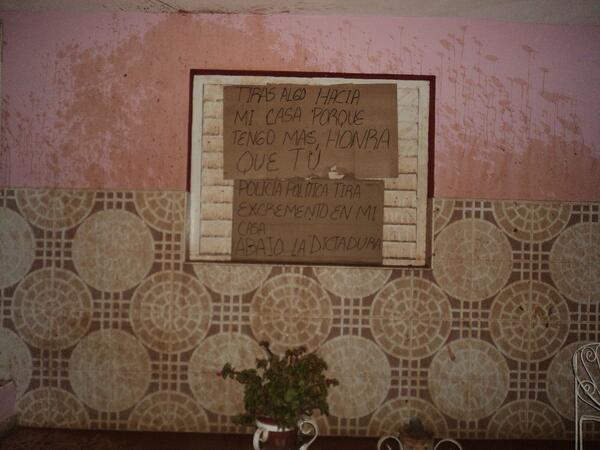
Signs: Throw something at my house because I have more honor than you. Political officer throws excrement at my house under the dictatorship
This appeared on the house of Caridad Burunate after being pelted with eggs by a mob.

“On October 4, they had me in a choke hold, it was the Special Brigade.  There were men, I was talking to one of the big men, they took me to the door of the house, inside the house.  They came with their uniforms.  Some men dressed in overalls painted the house in asphalt, five times they have done it, without taking into account that there are minors here,” that is the testimony of Damaris Moya Portieles, President of the Central Opposition Coalition, resident of Santa Clara.

Violence against women, dressed in white or not; with or without gladioli in hand has become recurrent all over the island.  It has to do not only with the hate sessions like the Acts of Repudiation, the physical mistreatment and the torture are “a piece of cake” in the containment measures against the opposition.  Damaris herself relates:  ”Some months ago I was admitted into the Arnaldo Milian Castro hospital, the result of a beating that the State Security officers dealt me,” she says, and offers the name of the oppressors:  ”Yuniel Monteagudo Reina, Erik Francis Aquino Yera and Ayor vigil Alvares, plus Pablo Echemendia Pineda,” she concludes.

Fourteen Sundays Under Rocks and Words

She is a hardworking woman and always likes to prepare the best dishes for her family; one day she decided to do it for the poor.  Caridad Burunate hosts each week in her home some twenty elderly and destitute people to give them a little ration of food.  She does it under the project “Capitan Tondique,” and the name of the anti-Castro guerrilla fighter has cost Burunate, in Colon, Matanzas, the well-known acts of repudiation, beatings, arrests and the painting of her house black.

“The mobs prepare, they are criminals, and they cuff us, fight us.  Even prisoners have been brought from the Aguica prison, because they tell them that they are going to give them passes, they even kick us.  When we arrive at my house from the walks (every Sunday with the Women in White), they wait for us with bags of rocks, eggs, they even painted my house because they wrote, “Long live Fidel, Long live the Revolution” and I wrote to them on top of that:  ”Down with the Revolution” and “Down with Fidel.”

The president of the People’s Power, Dignora Zenea Sotolongo, brought a jeep full of eggs, which are non-existent, people do not have them to eat, and they threw them at my house; and of course, she has almost all her family in Miami.  This house they bathed in eggs and asphalt.  They give eggs to children for them to throw.  I made myself an opponent because we have no rights, and because I have always enjoyed expressing what I feel, I did not do it just for myself, but also to help others,” she concludes.

A Violent Beginning

Tania Oliva Chacon resides in Palma Soriano, Santiago de Cuba.  She received the first beating “in March of this year,” when she joined the Ladies in White.  ”On October 10 I found myself at a friend’s house and we were about to watch the class they broadcast on TV every day, but the house was surrounded since early morning, and when we were about to sing the national anthem, they threw themselves on us like beasts, like animals.

They knocked me down with a kick to the leg, and injured me.  They immobilized me for 21 days, but I had no way to heal.  The one who kicked me is Captain Arsenio, the chief of the sector Police.  One of my companions was badly hurt, they got him in the ribs and he is still in a very bad way.  On many occasions they come dressed as special troops in order to impress us.  I was in my last year of studies for a Bachelor’s in History, but as I began to demonstrate and to tell about the thefts that were happening, then I “fell ill” and could not finish.  My son has graduated and has not been able to get a job,” she said.

Translated by mlk.

21 October 2013

Cuba: Journalism in the Cross-Current / Ivan Garcia

periodocubaAn autocracy’s efficiency can be measured by, among other things, its immutable capacity for controlling information. Everything passes through an ideological filter. Some guys sitting in an air-conditioned office minutely evaluating it to determine what people can see, hear or read.

Books, records, news, novels, films and television programs must be approved by the Cuban Communist Party’s censor. Anything the regime has not approved can be considered illegal.

Granma, Juventud Rebelde, Trabajadores and all the other party organs must play the same tune. Everything is planned. Very little is left to chance.

Once the order from on high goes out, docile reporters must write about the economic crisis in Europe, the lack of social discipline on the island or the private middle men who are blamed for the high price of agricultural products.

Fidel Castro has always said that the Cuban press serves as one of the weapons of the revolution, one it does not hesitate to use. And while you can find examples of good reporting and sharp social commentary, it is never of a heatedly controversial or political nature.

The most talented official journalists play in the minor leagues. They are not highly visible. Obedience takes precedence. The local press — a synonym for mediocrity — is designed to misinform. The color of its style manual is olive green.

Fidel Castro used to stride through a secret passageway that connected his office in the Palace of the Revolution to that of the director of the newspaper Granma a few yards away. It allowed him to review news stories or change a layout.

It is said that he personally wrote its most inflammatory editorials. Unless an official journalist has been accredited by the communist party, a government minister might not respond to his phone call or might even hang up on him. Officials and institutions — if you can call them that — bury information and statistics. Raúl Castro would like to turn the this situation around.

Awhile back, some provincial media outlets, local broadcasters and TV talk shows initiated a discreet and very cautious form of tropical glasnost. One can now read crime reports, sports writers criticizing the policies of INDER,* and one daring reporter accusing a state agency of bureaucratic foot-dragging.

While it is good thing that the national press is beginning to reflect the opinions of the average Cuban, it’s a bit too little, too late. By our count a handful of men and women began to write in the mid-1990s about the side of Cuba that the regime was trying to hide.

Almost all of us were empirical journalists, educated by daily life. Twenty or so — I was one of them — had the good fortune to attend workshops led by the poet and journalist Raúl Rivero. We were reasonably well-educated and had an enormous desire to learn and get ahead.

Journalism for us meant going out and looking for news in the neighborhood and in the ranks of the dissidents. It meant reporting daily using old typewriters and, because there were no computers, filing our stories by phone.

As in every aspect of life, there are independent journalists who are good, average and poor. And people who think clearly but write badly. Whether good or bad, they go on reporting on areas of national life that the official media ignores.

The credibility of independent journalists has grown since 1995. Their points of view and social critiques have influenced opinions outside the island. The regime knows this, which is why it is begun trying to compete without mentioning its competitor.

It is independent journalism that has caused official journalism to rethink its role and forced its reporters to go out into the street.

It is not a battle for information. Completely independent journalists are swimming against the current; their reports will never be published in state-run newspapers. Their colleagues — independent journalist licensed by the state — are monitored, harassed or accused of alleged crimes.

This is because there is a gag law which allows a reporter working outside the control of the state to be sentenced to more than twenty years in prison. The official press operates on an uneven playing field. Nevertheless, it is losing to the competition.

Photo: Cover of the first issue of a magazine that has remained a symbol of alternative journalism and that in the mid-1990s gave independent journalists their start. The regime allowed only two issues to be circulated. It blamed their publication on Raúl Rivero y Ricardo González Alfonso, who were later convicted and sentenced to jail. From “Remembering the Revista de Cuba.”

*Translator’s note: Acronym for The National Institute of Sports, Physical Education and Recreation.

17 October 2013

The Poet Rafael Alcides Dedicates his Presentation to the Unjustly Jailed Writer Angel Santiesteban

The Quixotic Soul of Rafael Alcides
For Luis Rafael

An emotional Havana evening, the kind which seals memory with a light of fire, I met the poet Rafael Alcides Pérez (Barrancas, 1933). Choosing to remain anonymous, as is his custom, he was in the audience which was attending the launch of my poem-book Colómbico, being held in the bright room of Havana’s Hotel Inglaterra.

I learned he was there almost immediately after I had finished my duties, after signing a few autographs for friends and strangers, when the poet and critic Virgilio López Lemus, who had made the eulogy for my book, came with Alcides and introduced me to him. “It’s a must have for Cuban poetry,” said López Lemus and Alcides smiled indulgently. Silent, hardly daring to comment. His eyes, however, scrutinized every gesture, like his poetry.

Born in the eastern town of Barrancas, Alcides moved to Havana to study for his baccalaureate and thence to Havana, where he graduated as an industrial chemist. A nomad since he was young, he traveled to Mexico, USA, Argentina, Chile, Uruguay, Venezuela, writing poems here and there like someone taking photos.

A member of the “fifties generation” — writers born between 1925 and 1945 — affiliated with Cuban revolutionary project headed by Fidel Castro and which sought to banish exploitation and inequality from the island, Rafael Alcides put his literature at the “service” of a nationalist  and justice-seeking ideology, writing crystal clear, intimate and clearly understandable verses for the people who shaped his poetry, colloquial, at times choral, other times intimate and questioning, which bears witness to the present and defends the future.

During those years of dreams and hope, he worked as a producer, director and writer for radio and unveiled the new conversational, lyrical canon of articles and reviews for the magazines Unión, Casa de las Americas and La Gaceta de Cuba, and on his radio programme, In the place of poetry. So he was recognised as an author of value, who published the poetry books: Mountain Hymns, 1962, The Wooden Leg, 1967. 

History, however, was in charge of clipping the wings of dreams and the 1970s came with their censures and excesses. After a publishing silence, the lyrical work of Alcides reemerged in the eighties, with poems that speak of a change of themes and approaches, where the poet becomes questioning, doubtful, raising his voice of dissent and seeking answers in epic genre of everyday life.

He dares to deal with issues and questions which speak of this “Quixotic soul” for which he is recognized, and that leads him to confront “windmills” knowing that they can throw mud at him, under the indifferent gaze of Sanchificados. The artist decides to retreat and write from the margin. His commitment to justice, sentencing him to be an exile within his own country, which however takes the point of view that a poet is a creature “charged with bearing witness to the present day and announcing it tomorrow”.

His writings express the irony of someone who knows that his work doesn’t deny but rather affirms. Grateful like a dog, 1983, And they die, and they return, and they die, 1988, Night in memory, 1989 Nobody, 1993, all carry his rebellious speech, his faith in humanity and his desire for communication, which is also evident in the anthology published in Spain by Renaissance and entitled GMT (Seville, 2009), a compilation of articles written between 1963 and 2008. And with each poem Rafael gallops upon Clavileño, dreaming of a utopian island which his sincere verse and Quixotic attitude have conquered.

– See more HERE

The writer Ángel Santiesteban Prats will receive a new tribute, this time from the poet Rafael Alcides. State of SATS* will open Cafésatso, a space for literature, conversation and pure coffee.

Rafael Alcides will dedicate his presentation to Ángel Santiesteban, wrongly imprisoned by the Castro dictatorship.

Friday, 12 July 2013. 6:00 pm

1st Avenue between 46 and 60 #4606

Miramar, Havana, Playa

Free

Translated by Shane J. Cassidy

9 July 2013

Prison Diary LX: Mr. Miguel Ginarte: the Guiding Light of Cuban TV / Angel Santiesteban

Miguel Ginarte (photo courtesy of the blog by Yusnaby)

My mother always warned me that the Cuban government proceeds through their actions: “When they no longer need you, the squash you like a cockroach”.

In the cultural media, it is well known that there are very few shows on Cuban TV that do not use Miguel Ginarte to produce their programmes; in fact, very few are those who in the end who are not grateful for his disinterested help, his constant effort, because he takes the care with each show as if it were the final project that he would ever collaborate on. A man who people rarely hear say no, and when he has had to say no it is because it really was beyond his reach to help.

But that ranch not only provides work for the The Cuban Institute of Radio and Television (ICRT), but also for the Ministry of Culture, who closed events at that location, like a peasant with a pig being roasted under the stars. I was able to participate in some of these closures before opening my blog, of course, and there we could also see the make up of the diet of then Minister of Culture Abel Prieto, now adviser to President Raul Castro: Fish and wine.

At that time, Ginarte wasn’t selling or diverting resources, as he is now being accused of. The television directors, when they wanted their guests to be treated decently, approached Papa Ginarte: who never turned his back, and after giving the respective indications, persevered to make sure that the requests were met.

As the actor Alberto Pujol said in his letter, there was no luxury to be found there; on the contrary, everything was very modest, to the point that it looked like somewhere one would film a mambises* cabin in the foothills of a mountain. Ostentation never interested Ginarte, only the quality of his work, because as every good Cuban peasant knows “A bull is tied by his horns, and a man by his words”.

As always on the island, behind this web of lies against Ginarte, there must be an official in love with the place, to at a whim do away with the work accomplished by the sweat of another; perhaps someone who resents Ginarte because at some time he should have said no, as only he knows how to do with bureaucrats. But it should come as no surprise to anyone: everyone’s time will come, regardless if they are excellent professionals, altruists, creators, honest, revolutionary people; they need only to be inadequate for the plans of those in power to be literally swept under the carpet.

I remember him with his jovial smile of a macho peasant who enjoyed very few days before entering prison. I would like to be able to say to him “the master should be ashamed, Papa Ginarte”, and remember him on his horse, back in the seventies, going to see Luyanó with his daughter Dinae and, patiently, lifting us up one by one to give us each our turn on his beautiful auburn steed.

At any rate, despite the pain that the injustice committed against Ginarte has caused us, there is something that makes it worth it, and that is his friends and admirers who have joined him by tooth and nail. I am sure that, as always, those who are ashamed will sign the petition, as they have done for decades. Others will want to do it but their lack of courage, or their commitments or perks, won’t let them; they think that it is not their problem, for now. But when someone does it from their heart, then that is already more than sufficient.

 Ángel Santestiban-Prats

Lawton prison settlement. Ocotber 2013

*Translator’s notes: Mambises is a term used to refer to independent guerillas who, during the 19th Century in Cuba and the Philippines, fought in the wars of independence. 

Translated by Shane J. Cassidy

The Literary Mafia in Cuba / Víctor Manuel Dominguez

HAVANA, Cuba, October, www.cubanet.org -The overall control the authorities have established over the publishing system, promotional spaces, travel agendas, and whatever takes place on the country’s artistic-literary plans, brings many writers together in a kind of mafic that some prefer to call a “clan,” a “pineapple” and other words that mean the same: “Interest groups.”

Joined by friendship and affinities of aesthetics, politics, generations, race, sexual orientation, or simply for advantaged access to publishing opportunities, spaces of influence or prevalence in the rarefied Cuban literary market, those involved in this war of interests defend, by any means, the groups chosen for their personal realization.

In a country where everything is measured by the common denominator of the unconditionality of the regime, these groups, driven to certain tricks that allow them to expel or disqualify others, living together without public displays of animosity, but alone tripping each other up, setting dirty traps, and making use of their space gained at any price for their works, styles, shapes and themes: these are the literary reference points of the nation.

That’s why the Cuban literary mafia, beyond their ambitions for or vision of the national literature, share control, participate in book presentations, and even serve on contest juries that know ahead of time who will win, or organize a story or poetry anthology where members of each group appear in equal parts, like a pact of honor among mediocre authors who represent the interests of the clan.

For many years, and in the corridors of clerks, careerists, believed, and other members of the various literary trends, walking the gardens of UNEAC (Union of Writers and Artists of Cuba) — mojito in hand — among other places of cultural interest, four denominations have arisen to “characterize” each group in the national literary watering hole.

Cafe Literario Attendees -- Photo from VMD
Cafe Literario Attendees — Photo from VMD

The first, baptized The School of ’Socialist’ Realism (also know by its rivals as The Penis Club), brings together the macho egocentrics who call themselves realists, “filling key posts in magazines, publishers, and the country’s promotional institutions, despising other current modalities. Their totem is Mario Varga Llosa.”

For natural opposition, the second group is called The Pink Mafia, with the principle characteristic of its coreligionists being homosexualities. The defend fantasy and absurdist literature, and their works revolve around the issue of gays looking for a place in society. They are belligerent, to the point of scandal, toward their counterparts in the Penis Club. Their idol is Virgilio Piñera.

The third is called The Black Colony, because it “brings together individuals of this race united in asserting their neglected rights in a mass mixed-race yearning, at all costs, to pass through Aryan, Nordic, Slavic or Latin, according to its spokespeople.” Their literature is a provocation, conceptual, deconstructivist. Your guardian angel is Severo Sarduy .

In last place, The School for Wives, whom The Penis Club call Clitoris Hall, or Hell, due to the fickleness of their demands, and a fierce feminism which advocates a generic discourse to gain areas of sociocultural emphasis, and is uses to achieve their purposes. Their idol is Simone de Beauvoir.

These and other qualifications heard at gatherings, exhibitions, bars; or read in publicized controversies in literary magazines (Yoss), and books such as Questions of Water and Earth (Jesus David Curbelo), show us the interior panorama of an exclusive literature, divided and censored, that lost its influence on the cultural heritage of the nation.

Víctor Manuel Domínguez, vicmadomingues55@gmail.com

Cubanet, 18 October 2013

A Cyber Cafe in Cuba? No chance.

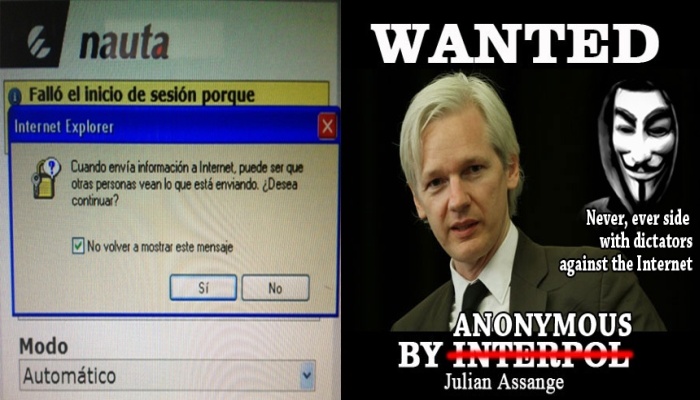
Illustration: photomontage The Singularity of the Island.

Under the heading “Protect Internet Cafes in Cuba. Julian Assange Bungles It,” the website  http://www.lasingularidad.com offers good advice for Cuban citizens and digital non-conformists wanting to get around censorship restrictions.

Every time that I receive questions from activists in Cuba about the internet browser rooms, I never tire of repeating the phrase “Begone, Satan”, “Good riddance”, “Take them winter wind”, or any other interjection I can think of at that moment to make it clear that they should run as though from the devil himself. Like moths to a flame, they are designed to attract the unwary, who are bedazzled by its radiance.

The Cuban regime took its time designing these “booby traps” and — in what it considers a masterful sleight-of-hand — is attempting to make itself look good in the eyes of the modern world, which increasingly considers internet access to be a basic human right.

In fact, it has already reaped some rewards this week by successfully recruiting a “figure” of no less international stature than Julian Assange to proselytize politically on behalf of the Cuban regime. This is a completely surreal and incomprehensible development since, supposedly, the hacker’s code of ethics mandates fighting for free access to information.

His support for one of the world’s most repressive communist dictatorships — one known for restricting access to the free flow of ideas on the internet — is a senseless action that will very probably cause Assange to lose face in the eyes of the hackers who support him. Will Assange turn out to be one of those typical useful, misinformed fools or an opportunist looking for free vacations in the Caribbean? Whatever the answer, the betrayal of the ideals of hackers like Anonymous will not go unnoticed.

Why is Nauta a trap?

1 – Price censorship.

The cost of one hour of access to the internet in these rooms is 4.50 CUC, some $5 US if we convert it. Considering that the average salary in CUCs is approximately $20 per month, we can calculate that one hour of internet use costs Cubans close to 25% of their monthly salary. In a country where the salary is barely enough for one or two weeks’ worth of food, very few can afford to visit these rooms. By way of comparison, if in the United States or Europe one hour of internet cost more than $1,300, social network sites like Facebook would be very bleak places…

2 – Total lack of security, privacy and basic functionality.

To be able to buy a Nauta card, users have to display their identity cards. Their names, addresses and surnames, together with the identification code of the cards sold, are registered in a database. In this same database all their activity is stored: the sites they visit, passwords they enter, screen captures and general captures of all that they type (keyloggers).

The computers available are in fact thin clients* running a modified and highly restricted version of Windows Xp, an operating system so antiquated that it will soon be discontinued by Microsoft, which will no longer issue updates for it.

Short Restrictions:

It is not permitted to right click with the mouse. This reduces functionality for those who are used to cutting and pasting text using menus and eliminates all the information that right clicking in Windows provides. Hint: You can use the keyboard shortcuts ctrl+C to copy, ctrl+X to cut and ctrl+V to paste.

It is not permitted to run any programme from USB memory sticks.

It is not permitted to run any programme from command lines (CMD.exe).

Task Manager is disabled, the Ctrl + Alt + Del and don’t even dream of administrator access in order to install some program that you may need.

Overcoming Nauta

The number one rule is : If you can avoid it, DO NOT USE IT. In Cuba, there are many other alternatives: Access from work centers, much less restrictive network dial-up access, illegal accounts shared by foreigners, friends who can send your emails as a favor, and of course access to offline internet content like the Web Packets Weekly Mulitmedia Packets that reign across the island.

If you have no other option you can protect yourself using these simple tips:

1.  Use disposable email accounts, ask your contacts to do the same if possible. The value of your messages lies not only in their contents but also in those to whom they are directed and from whom and from where you receive them (Metadata).  Never use your name or personal information to create an email account or to search websites on the Internet.  If you use false data and a fake name it will be much more difficult for government analysts or their spy programs to determine if your mail or user profile is worth the effort of analyzing.  These spy programs are used by almost all governments, including the United States and, of course, Cuba.

2.  Mask “complicated” words in your messages by using spaces, repeated letters and punctuation signs at random.  This will prevent automated software or analysts that search for key words from being able to flag your messages or profile as being of interest for analysis.  For example, instead of writing “the dissidents screamed liberty at the demonstration” write “the di. Si-dde :ntes shouted lib. ee.r t y in the demi. str *ati-on”  A text search for the words “dissident” and “demonstration” will not detect your messages.  Government agencies in other countries like the C-I. A and the N-S. A will not appreciate this advice, either.:)

3.  Mask your messages by excess information.  For example, began your email with several paragraphs of weighty poems and by prior agreement let your recipient know in which paragraph will be the true message.  The poor analyst that has to read your email will simply go to the next when he sees your long poem. The idea is to make his work difficult all the time.  Remember to mask words as explained above.

4.  Be aware that everything that you type and capture on-screen is being recorded on your user profile.  If you are forced to use a personal password, mask it with random fillers that you will then remove with the mouse and the Delete key. For example, if your password is “freecuba123,” write “iwantfreecub123456.”  Then select “iwant” and “456″ with your mouse and hit delete.  This is not 100% safe with advanced keyloggers but it will make it hard for the analyst who is watching your information to discover which is the true password.  There exists no completely secure protection in the world of information nor in the real one.  It is like protecting your home:  the more difficult you make it for the thief, the less likely your house will be the one in the neighborhood that gets hit.

5.  Use PHP proxies for accessing web pages whose navigation is censored and that you do not want to be kept in your navigation history.  Write on Google:  ”php proxy list” to access web pages that keep lists of proxies that constantly change in order to prevent them from being blocked.  These proxies will permit you to navigate as if your were in another country and will hide the website addresses that you visit.  Nevertheless, remember that your screen is being recorded and if you do something that calls attention they might check your user profile.

6.  Https is your friend.  Always prefer web pages in which the URL or address begins with https.  This means that all traffic between your navigator and the web page server is automatically encrypted in a secure way, hence the letter “s.” However, remember that what you type is being recorded so you cannot stop using the tricks listed above or better still, if you can avoid it, do not enter your search information on any page from Nauta.

If you have other ideas and suggestions for the protection of privacy and security of users in browser rooms in Cuba, write them in the comments below.

Archived in Cuba

*Translator’s note: Computers or computer programmes which depend heavily on other computers (their servers) to fulfill their computational roles.

Translated by Shane J. Cassidy, mlk

30 September 2013