The Cuban Government Mocks its Citizens / Anddy Sierra Alvarez

The Cuban government reaffirms to its citizens that transformations are directed towards psychological oppression, and at the same time it mocks Cubans as a way of demonstrating absolute power.

The law approved in January 2014 by the Cuban president — the sale of automobiles — reveals the great achievements that will be realized in 2014 by the present governing system.

With the development of approved prices for the acquisition of an automobile ranging up to a quarter of a million (250 thousand dollars) the news caused many capital residents laughter and disappointment for those who were planning to buy a car in better and more current condition.

One of those affected, Reinier Corrales, 45 years old, resident of Arroyo Naranja, considers that he sold his Toyota at 18 thousand convertible pesos (CUC) in order to improve by another more modern one.

“And now what do I do,” anguished Corrales asks, “I planned to trade up and not even my house is worth what the government wants for a 2013 car,” he says.

Reinier and many others have been affected by this decadent and brutal situation of supersonic price manipulation that the government has established through 55 years of totalitarian power. continue reading

If some fortunate one were to decide, the gain would be for them three times greater than the wholesale cost, and I am sure that it would not exceed 50 thousand dollars.

Currently it is the main topic on the streets.  Cubans have stopped worrying about food and have focused on whispering and debating opinions on the topic in question.

Maybe State Security has not noticed Cubans distracted a little from their daily economic distress by what many repeat, “What will I buy myself. . .?”

Translated by mlk.

17 January 2014

Generational Collision in the Alejo Carpentier Charity / Orlando Freire Santana

Havana, Cuba, December – http://www.cubanetorg – It’s not a secret for anybody that, in general, youngsters favour transformations which advance social development. As far as Cuba is concerned, the majority of young people who are academics and researchers urge that the economic changes being implemented by Raul Castro’s government be taken forward more rapidly. And journalism should not lag behind.

This understanding was corroborated in the winding up of the course entitled “Journalism is not a job for cynics”, which took place at the Alejo Carpentier charity. On this occasion, the journalists Jesus Arencibia and Ricardo Ronquillo, both from the newspaper Juventud Rebelde took part in a panel, along with Doctor Graciela Pogolotti, president of the above mentioned cultural institution.

The first one to mention it was the youngest of the panelists, Jesus Arencibia, who, to the astonishment of some of the people present, strongly criticised the present situation of the Cuban press. Responding to the question, “What journalism do we need today in Cuba?”, Arencibia stated that we lack media able to function without approval from above; and, pursuing this line, argued that editorial policy should not be the preserve of a political party. Arencibia also questioned the activities of the official Union of Cuban Journalists (UPEC), who insist on not mixing up journalism with commercial publicity, without saying anything about political propaganda which dominates the work of the news-pages, the radio and the television in our country. continue reading

Right after that, Ricardo Ronquillo, deputy director of the Juventud Rebelde daily chipped in. Although at intervals he tried to continue his predecessor’s critical comments, Ronquillo explained that his suggestions were directed at “ensuring that the Cuban press was equal to the challenge of the revolution.” According to this panelist, we are watching a structural crisis in Cuban journalism; driven by a lack of resources in terms of journalists and the press, as well as the loss of their credibility due to the role they were playing in the service of the governmental institutions.

Referring to a situation which should not be repeated, as it demonstrates the inflexibility which impoverishes the work of the press, Ronquillo recalled what happened subsequent to the revelation of the announcement that Fidel Castro had passed the leadership over to his brother Raul. According to the journalist, it was incredible that no-one in the Cuban press will comment about this significant event. Nevertheless, we can only suppose that past events like that have been brushed to one side in the heat of Raul Castro’s protest against media secrecy.

Doctor Pogolotti, the senior member of the panel, gave us the most conservative presentation. After talking about her times as a journalism student in republican Cuba, she applied herself more to the form as opposed to the substance when it came to assessing the kind of press we need. In her opinion, the Cuban media should abandon headlines which don’t invite you to read; they need to improve the image and graphical design which accompany the information; and they should also be able to count on journalists capable of investigating the most varied aspects of our reality. In essence, this representative said almost nothing about the official culture of government control of the press.

The panelists’ contributions were lengthy and there was not time for the public to express their opinions or ask questions. Notwithstanding, in the door of the institution, I was able to hear the opinion of a young student of journalism:

“We haven’t moved forward at all in eliminating secrecy and self-censorship. It seems as if Mr. Ronquillo has forgotten that, following our government’s official declaration about the capture in Panama of a North Korean ship carrying Cuban arms, not one journalist dared to open his mouth …”

Cubanet, 9 December 2013

Translated by GH

Different Strokes in Havana / Regina Coyula

I would like not to commit a blunder and put myself in tune with the times, and instead of talking about layers of the onion, say that any city, any society, resembles also a multi-system disc where the tracks spin and re-write themselves without affecting the various files among them.

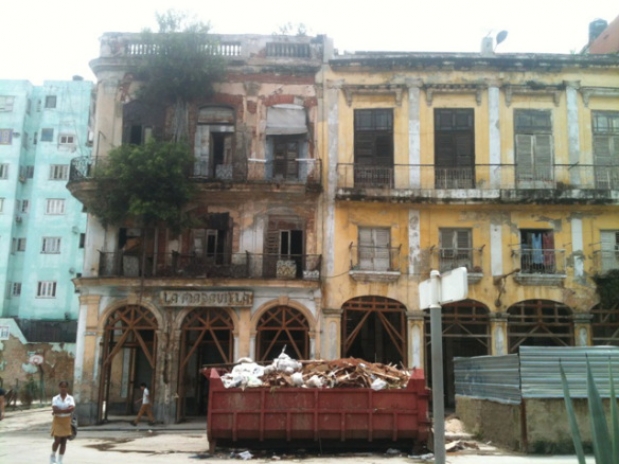
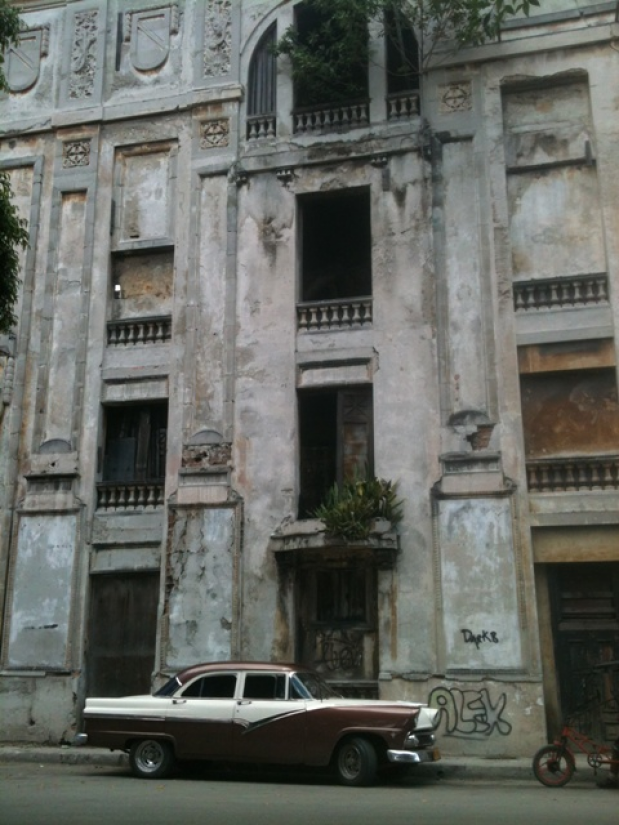
After this rhetoric, Havana these days is a city whose manifest decay has cross-dressed into a vintage beauty; tourists, with cameras that a Cuban doctor could not buy with an entire year’s salary, wander around taking a picture of a ’54 Chevrolet here, a collapse there or a smiling, chubby, dark, cigar-smoking woman with the sound track from Chan Chan or Guantanamera.

Another refined and glamorous Havana perfumes the air conditioning of trendy new places open to the heat (warmth, no need to exaggerate) of the Raulist reforms. With restaurant licenses, operating in practice as bars open until dawn, the celebrity has found there an ideal space; also firm managers, successful private workers.  Foreigners do not make up the majority in these places.  A happy and unworried gathering of women without any ugly, fat, old or poor ones, accurately calculate at a glance the value of their potential companions. continue reading

My son, a very worthy specimen of masculinity, was “disqualified” at Esencia Habana, one of these places in Vedado where, for a bottle of Smirnoff vodka that sells in a Miami liquor store for 20 dollars, they charge without a blush 63.2 CUC (more than $65 US).

A friend of Rafa who lives there came for four days to the wedding of a friend of his girlfriend.  It was the girlfriend’s first visit after her departure as a girl, and she was reunited with her childhood friends, almost all university students, and they suggested the place.

Rafa was the rare one with his casual attire among those long-sleeved shirts tucked into the pants, the dress shoes and the catwalk dresses.  The girls danced to the rhythm of Justin Bieber, Pitbull or Gente D’Zona, while they made faces before their latest generation iPhones and Samsungs whose only advantage in Cuba is the flash.  My son felt the separation, but it did not matter to him because he and his friend had a ton of things to talk about.

They next day they were to meet again, this time at a more calm place but based on the advice of the friends of the girlfriend, they went to Espacios, another of these places in the “miky” fashion*.  Rafa said goodbye after a while: “Bro, it’s not my scene, I’m leaving.” His friend understood, and I, though they who aspire to a life of luxury may criticize me, I felt very comfortable with the idea that, in the rewritable disc of Havana, my son is in the file of the rare.

*Translator’s note: A comment from a Lonely Planet site defines “miky” (or “miki”) as follows: Miki is the opposite of “freaky” (friki). It’s Cuban youth slang for go-with-the-flow youth following trends, meaningless fashion music (salseros, regetoneros etc) and are not really “special” or doing anything thoughtful. Freakies on the other hand see themselves as “deeper”, with opinions, “quality” and more rebellious. Mikis are deemed by their “adversaries” are shallow, uneducated and daft, while freakies are seen by mikis as snobbish intellectual brats.

Translated by mlk.

17 December 2013

Detained for Distributing “The New Republic” / CID, Rolando Pupo Carralero

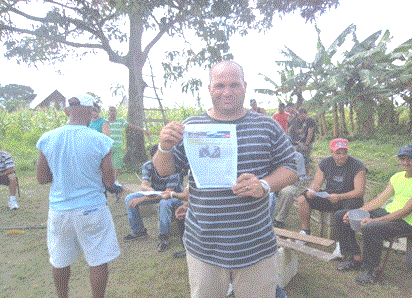
On the morning of Tuesday, 14 January 2014, the president of the CID’s Citizen Committee Against Cruelty, independent journalist Roberto Blanco Gil, was arrested in the public street of Pinar del Rio while distributing the weekly news report, “La Nueva República”.

Blanco Gil was arrested in front of the Reparto Hermanos Cruz supermarket carrying 100 copies of the weekly, which were seized by the repressive agent known as “the dwarf”, badge number 11804, and the sector chief, badge number 11869.

After putting handcuffs on him they put him in a patrol car and took him to the bus terminal sector. There he was interrogated and threatened by State Security Official Yoel, who said he would go to prison if he continued to distribute enemy propaganda, and who threatened that he would not be allowed to deceive people and disparage the Revolution.

After being detained more than 7 hours Blanco Gil was released.

By: Rolando Pupo Carralero

A Year Without the White Card (Travel Permit) / Lilianne Ruiz

HAVANA, Cuba, 14 January 2014, www.cubanet.org.- How has the Cuban political scene changed for human rights activists and leaders of the political opposition who have left and returned to Cuba? Is the day after the fall of the Castro regime close? To answer, Cubanet contacted some of the protagonists of this story.

Miriam Celaya (blogger and independent journalist)

Why is immigration and travel reform so important? Well, because we know that until that time you needed a permit to leave; and of course the dissidents, opponents, nonconformists, independent civil society members, anyone ’uncomfortable,’ if you don’t sympathize with the government, they simply forbade you to leave and you didn’t leave.

I believe it’s a positive measure in the sense that it opens up for us the possibility of traveling when we’ve been invited. We have been able to have direct contact with institutions, with other governments and with free societies in the free world. It has strengthened our voices, people have met us personally.

But one can’t overestimate these things, because I don’t think this has substantially changed the Cuban political scene. Yes, we have been able to get solidarity, to find support, there have been groups that have now found sectors aligned to their respective activities, to the spheres where they operate as activists and they are receiving more effective support.

To me, this seems very good. But on the other hand I don’t see that these trips have significantly changed the Cuban political scene. It also tends to focus attention, to give to large a role to what the government does. The measures the government takes, which could mean some real opening on the road to democracy.

I think it’s time for civil society and all of us to understand that what we do doesn’t completely depend on what the government does, because the government is on the defensive: why give them that role?

To the extent that we can’t understand our own political reality, our own position toward the interior of Cuba and occupy a place in the political game of the country… I don’t think that because there is travel it’s going to substantially change the political situation in Cuba; we can’t change outside of Cuba, we change the interior of Cuba.

Guillermo (Coco) Fariñas, winner of the European Parliament’s Andrei Sakharov Prize in 2010, General Coordinator of the United Anti-totalitarian Forum (FANTU) and spokesperson for the Patriotic Union of Cuba (UNPACU)

Guillermo-Fariñas-300x150The timid reforms, including the immigration and travel reform, implemented by general-president Raul Castro’s government on 14 January 2013, should not be perceived as an advance of achievement, but rather as the fulfillment of a long postponed or delayed right. We must have the civic courage to demand other rights that they still don’t recognize. continue reading

The significance that the various anti-Castro political leaders and other prominent dissidents have been able to go abroad is dichotomous, because on the one hand we understand that it’s a cynical political maneuver to cleanup the image of the regime and manipulating international public opinions, to stop the pressure for changes toward a State of Law.

On the other hand, it’s a unique opportunity to enjoy exchanges with interlocutors abroad and with allies in the Cuban exile. To invite Cubans on the Island to international forums, where they can talk, denounce, and then return to the bowels of the totalitarian beast as a symbol of courage and resistance for the people of Cuba.

Dagoberto Valdes (Director of the magazine “Coexistence” www.convivenciacuba.es; Catholic layman and intellectual)

Dagoberto-ValdésIn my opinion, it’s the reform that has and will have the most impact on the situation in Cuba. I have to point out that it is unfair there are still Cubans who can’t enjoy this human right for being on parole, I’m referring to those of the 73 of the 2003 Black Spring who are still in Cuba.

It’s been good for those Cubans who have the economic resources to travel or who have invitations to travel with the expenses paid. For those who travel it’s good because they have direct access to a vision of the world that can’t get through the official media inside Cuba.

It’s also very good for their interlocutors abroad who can get to know face to face the members of civil society, be they opponents, dissidents, bloggers, independent journalists, small businesspeople, and who can hear, without intermediaries, the opinions, criteria and proposed solutions of them in relation to the serious problems Cuba experiences.

It’s good for their families and friends and contributes to strengthening the cultural, family and religious exchange of the Cuban nation, which is unique in being dispersed all over the world. I hope that this inalienable right isn’t considered the property of any government, but an unrestricted freedom of every citizen for the mere fact of being a person.
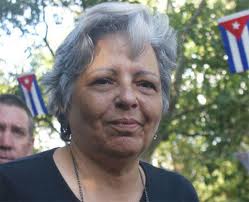
Marta Beatriz Roque (economist, journalist, former prisoner of the Cause of 75, can not leave Cuba because of the limitation imposed by being on parole).

The political scene here is very complicated, because it is always divided. There is a political scenario toward the exterior and another within. The government has tried with all their measures to change the political image of Cuba abroad, and that’s why they’ve allowed people to leave the country, but they don’t want to saw that people can benefit from this reform because, in the first place, if someone wants to go on vacation in Jamaica, for example, with what money can they do that?

It will be the child of a leader, or someone whose trip is paid for from Jamaica because clearly people don’t have the necessary capital to pay the feels for all the paperwork. It’s one thing to say that in Cuba people can travel, or they can buy houses or cars, or they can work for themselves, but what are the restrictions on all this?

There are the economic restrictions in the case of self-employed workers, and they don’t allowed professionals to be self-employed at all. But abroad, the political scenario has totally changed, because now they have the chance to talk with the dissidents who have traveled abroad.

This indicates that there possibilities of freedoms toward the exterior, but we know that inside Cuba, these freedoms don’t exist. I think that if the particular case of those in my situation, according to Article 23 in the migratory law, those who have pending sanction, can’t travel. They can ask permission of the court that tried and sentenced them. But you just have to remember that the courts here are subordinate to what the government decides, and the government decides through the political police.

Cuba and the United States wouldn’t have to talk about new immigration conventions, simply because the American border guards won’t have to worry about someone coming by sea and people are constantly going by sea. I want to say that the freedom to travel hasn’t been a solution for those who want to leave Cuba.

Elsa Morejon (blogger and freelance journalist, wife of opposition leader Dr. Oscar Elias Biscet)

Elsa-Morejón-300x225The reform is still discriminatory because there are a lot of Cubans who can’t leave or enter Cuba. I have been able to travel in the past and since these changes and the pressure at the airport when you leave Cuba and later return, it’s incredible.

There is no free and democratic country where you are watched by the police when you leave and enter your country. Plus, the reform makes Cubans wait 2 years after leaving the country (as emigrants) before they can return to their own country and this is a violation of the Universal Declaration of Human Rights, because in all the countries of the world people leave and return to their countries when they see fit.

It’s discriminatory because for one group it’s “yes,” and for another group, “no.” In Cuba, most people can’t afford a ticket to leave. When they get that money what they do is stay abroad.  Others go to work in other countries,; but they don’t have the money to travel and return. It’s very humilliating that we have to depend onsomeone elsoe, on a friend who gives us the money to trael because we can’t earn enough money from our own work. That is, they are making modifications to the laws in Cuba, but Cubans don’t have access to them because our economic conditions are so prcarious.

The opposition in Cuba is peaceful. Though it the people have come to know many things that were unknown because there is no press freedom. And thanks to this strong dissidence that has been here going back years and persisting until today. the government had to make these modifications.

Wilfredo Vallín  (Attorney; President of the independent Cuban Law Association)
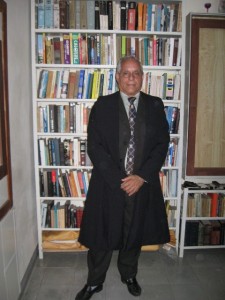
There was an external view of the Cuban opposition as an opposition with a low cultural level, people with very little or no preparation, and this has been an opportunity to demystify it. It has been important to give the real picture of the internal situation in Cuba. On the other hand, this has allowed contacts with people who, in one way or another, are interesting and important for is. I managed to meet in Spain with the head of the Spanish Notaries, and had the chance to talk with him for several hours.

In Sweden I talked with the president of the Bar Association. In Costa Rica I got to meet and talk Mr. Oscar Arias, twice president of Costa Rica and Nobel Peace Prize winner. And so, from this point of view, establishing contacts, links, collaborations, courses, for us it is very important. It is also very comforting that the vast majority of Cubans who have now let, have returned to Cuba. This gives a dimension to the maturity the internal opposition has acquired.

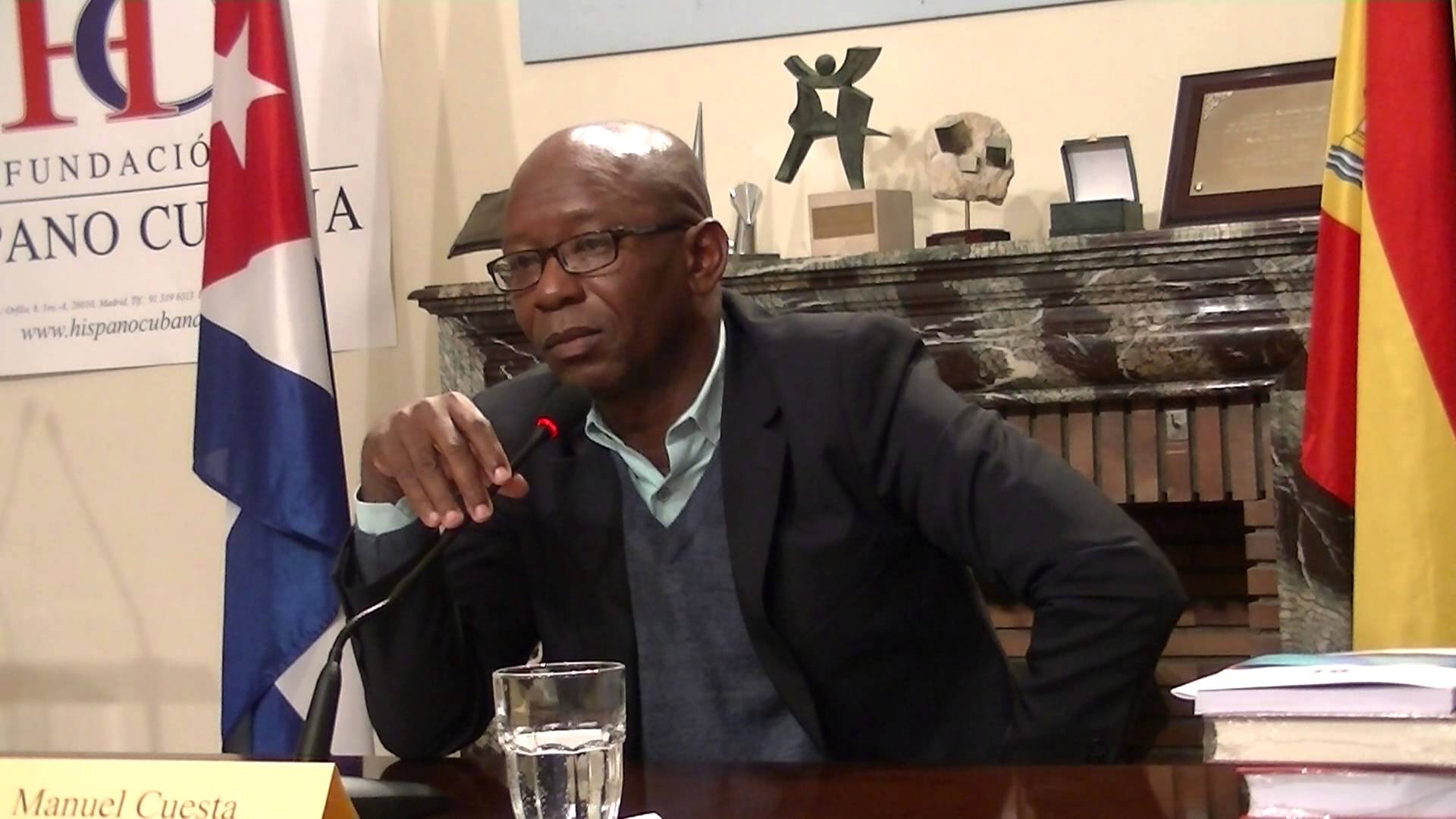
Manuel Cuesta Morúa (President of the Progressive Arc Party president and general coordinator of the New Country Project)
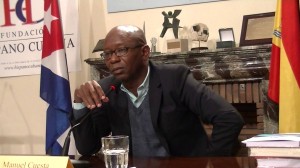
In political terms it has allowed several things. The first is visual contact. Not even the social networks substitute for person to person contact, which is what creates crust between interlocutors to confirm and promote initiatives. Another aspect is the perception of others. To leave andmake contact in all environments allows others to get an idea that democratic change is possible.

Prior to January 14 there was a struggle and support that it seemed more heroic and testimonial. We are supporting a community of people who want change for the country, but will they have the capacity and possibilities, really? Because the first freedom of man is not free speech, but of movement; what makes freedom of expression authentic or now, is precisely the possibility of escaping when you express yourself in closed regimes.

For example, in North Korea the fact of freedom of expression is neither effective nor real, regardless of fighting for it, because in the end you can’t escape and you stay in the trap of a brutal regime like this. The ability to flow from one side to another in the porous borders in the world is what gives force to the struggle for democratic change.

The possible impact of freedom of expression and other civil liberties becomes more real; and then the exterior community sees that it is much more viable, that it’s really practicle to work for the democratization of the country. That has had an impact within the country, because these travels have allowed redefine the stage. People begin to be measured with real politics: how to think, what is said, how politics are done, what is language, what are the levels at which the politics are being developed in the world.

Eliecer Ávila (computer engineer, young political leader)
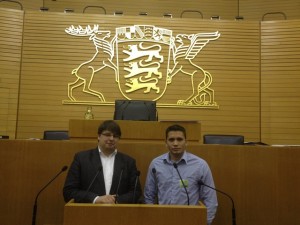
The balance has been positive for activism, despite our inexperience in almost all aspects of diplomacy and ongoing dealings with the media. Then came a crisis from the opinions and attitudes of the different activists; which is normal because each one was consolidating a character and forging an opinion which, fortunately, wasn’t unanimous.

Today, thanks to all those experiences are creating infinitely superior projects and the results will be seen very soon. To have the ability of submitting yourself to the scrutiny of international settings is a great strength and at the same time the greatest professional and moral challenge that anyone can face.

Antonio Rodiles (leader of the Estado de SATS Project)
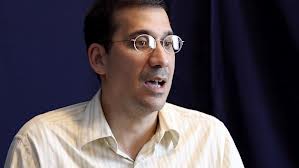
This is a process where you will not see results in the short, but in the medium term, both inside and outside. Inside, I think has been very favorable first that we were able to go to other forums outside the island and have our voices heard. We were able to communicate directly what’s going on here, the dynamics in the country, what are the needs, what are the weak points, what are some strengths. That was necessary. We were able to interact directly with Cubans outside the island we have seen, we have known. I think that part is obviously very positive. It has meant new experiences, we could see other realities such as occurred in Eastern Europe, and well, anyway, this whole part of trade, flow of information and contacts, I think has been very positive.

The negative part is that one can disassociate from the work being done on the island, if the trips are too long, if we’re not in total contact with the rest of Cuban society, we can weaken that link. Personally, I have tried to travel for short periods, to maintain the rhythm of my work. There has also been a realignment of political activists, thanks to the how they see themselves relative to the exterior and the interior with this new possibility. It seems these are necessary things that have to happen.

With time these rearrangements will settle, and little by little we’ll see what the consequences of these trips are, now in practice. In any event, I do think that the trips are absolutely necessary.  We need now that Cubans who do not agree with the system can come out. The government has sent a clear signal: “Outside the island you can meet whomever you desire, you can talk, you can participate in the forums, but here inside we are the ones who still have all the control, all the power,” and whomever crosses the line they have drawn, they simply have to face the consequences.

This is what we’ve been seeing in practice. I think that it will continue to be the logic of the regime and well, we’ll see what the effect is of the support we receive from the international arena to stop this policy of repression and violations. The effectiveness of our work remains to be seen.

Mario Félix LLeonart (Baptist pastor, blogger, community leader)

Dialog in international forums has made possible a new kind of citizen diplomacy, which represents the people, the civil society that we are rescuing. Until 14 January 2013, diplomacy was only representative of the official voice. In my case, I felt that there would be bridges between Cubans inside and I represented outside; and between churches which, in the past, tried to separate. I felt I occupied spaces that until then were only accessible to the emissaries of the regime.

The official diplomacy, which was all that could exist before, is now confronted by another alternative. There are two versions that are now circulating through the world and are beaten, both in political spaces as well as cultural and academic ones. It will no longer be so easy for the official diplomacy because now they have to face a new version that has come out of the island itself. Also, the distances between the internal and external opponents have been shortened and alliances and cooperation between them are favored.

The faces of the internal opposition have also become known with greater impact within the island, thanks to the media in the world that have covered them, which the media within the island have not, and like a boomerang the coverage has spread within Cuba thanks the informal networks where all kinds of content circulates. Moreover, the travels and the returns of the opponents destabilizes and confuses the acolytes of the regime who for decades have been used to repress and now are surprised to see their usual victims traveling and becoming empowered. Obviously, these repressors lower their levels of obedience.

Reinaldo Escobar (blogger and freelance journalist)
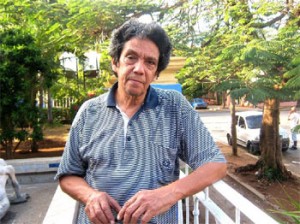
It is perhaps a little premature to evaluate the repercussions of the January 2013 migratory reform, on the atmosphere of Cuban civil society. In fact, Cuba is not longer the island where people can’t leave without permission from the government and that is a  transcendental event. It’s no longer necessary to be “well behaved” to get permission to leave.

Cuba’s dissidents have had the chance to present an image of what’s happening in the country outside the country, which has somehow broken the monopoly the Cuban authorities have to give this sugar-coated and idyllic image of the socialist Revolution “of the humble, by the humble…”

On the other hand, it has changed many people’s opinion of Cuba and this has influenced many people who used to come here only to applaud, and now they’ve come to question, to challenge the Cuban authorities, who have no option other than to give an answer.

One year after migratory reform, the government has lost the monopoly on the dissemination of the reality of Cuba abroad and the opponents and civil society activists have gained in experience and with respect to other scenarios. What

Lilianne Ruiz, Cubanet, 14 January 2014

I’d Rather go Back to Prison / Martha Beatriz Roque Cabello

martha-roque-300x226HAVANA, Cuba, January www.cubanet.org – The building where I live has 42 apartments and three floors. Most of the time did not see anyone in the hallways. However, on January 13, at 9 pm, for the second time since the last beating I received (November 19)  a group of about 8 or 10 neighbors stood at the door of my house to tell me that “they will not allow more meetings.”

Act two, they then began a rally of repudiation in front of my apartment with a television they placed and videos, apparently about the opposition and myself. Since November, when the dictatorship decided not to allow meetings at my home, they have filled the corridors, the stairs and the wall opposite my apartment with pictures of Fidel and Raul Castro and banners and a mural in which there’s is newspaper Granma with a picture of me and offensive words.

During these months, Wednesday after Wednesday, the political police have been at the entrance to the building, accompanied by the National Revolutionary Police and two or three of the neighbors have stood at my door to prevent entry to people who want to access to my house, and even to arrest or kidnap them, with the idea of leaving them stranded far from their homes*.

It is impossible to live with the political police harassment of me. I practically can’t open the windows since they boldly look inside. They have taken a common area that gives access to my house and have put a locked gate, which means I can not even clean the outsides of the windows.

They let the water run under the door to the apartment, also in the kitchen window overlooking the courtyard of one of the members of the Rapid Response Brigade, just to point out some of the situations that I experience in the day, although it is known that in April 2013 they beat me and sprained my left shoulder. continue reading

Although the Municipal Director of Public Health was in my house and ordered fumigation with a special liquid spray for asthmatics**, directing that they weren’t do it again for another 3 months, which is how long the chemical lasts, the neighbor continued to demand that they smoke the common area, knowing that afterwards I’d have to use my inhaler.

I have tried to legalize my stay of 15 months in this apartment and they haven’t allowed me to, on the pretext that I made repairs where I lived before, so won’t allow the house to be recognized in the Land Registry.

Last Thursday, one of the people who are usually in the door watching me, pushed me to the exit of the store on the bottom floor. I was accompanied by two dissidents who plan not to let this happen again without the aggressor having an answer. I tried not to act violently, but so much ignominy exhausts me.

Although they use these citizens as a front, it is the political police who don’t allow the meetings of the Cuban Community Communicators Network, which obviously upset the regime. Who is going to believe that it’s the outraged neighbors who don’t want us to meet?

I have asked my lawyer, Dr. Amelia Rodriguez Cala, who took the request to the Board of State Security of the Provincial Court, who judged us, to releasing me from parole, because I’m as much of a prisoner as I was when I was in the Manto Negro prison.

When they came to deliver the parole document, 22 July 2004, it was presented by an officer of State Security and another Jails and Prisons. Before taking it in hand, I asked, “Does this has any limitation?” And the official of the political police, who worked as an instructor at State Security’s Villa Marista prison, replied, “The only thing you can’t do is walk on the grass.”

While it is true that most of those who are part of the internal opposition know intimately the harassment of the regime and have suffered from it for many years, it is very difficult to live with this situation 24 hours a day. I feel alone in Cuba. My family emigrated in its entirety, there was no one left even to bring me anything in prison. However, I prefer to be behind those bars, because then I’m a prisoner, formally, and the difference now is that I’m still a prisoner but without the political cost to the regime.

Maybe some people think that a solution would be that we stop meeting at my place, but to cede that space would imply making the dominoes fall one after the other and consenting to other abuses by the regime.

Although most members of the Cuban Community Communicators Network attend the weekly meetings, they are human beings who are being abused in word and deed. For example , one of the members of the Group of 75, Arnaldo Ramos Lauzurique, who is 73-years-old, the officer by the name of Buck hit him and broke his glasses (prescription glasses). Still, he keeps coming to my house every Wednesday.

To be a part of the United Nations Human Rights Council is to approve the regime that acts in this way with the internal opposition, with the farce that is an enraged revolutionary people, that does not allow the “mercenaries ” to act; while the “good cops” take a position to prevent the “masses” from going to harm those who disagree. Such is the country. I’d rather go back to prison.

Translator’s notes:

*State Security commonly detains people briefly, simply driving them far from their homes and leaving them stranded with no way home.

** Marta is speaking here of the regular fumigation for mosquitoes

Martha Beatriz Roque Cabello, Cubanet, 17 January 2014
A Closed Circle / Fernando Damaso

Official propaganda has always defended the view that the recognized social organizations in Cuba, are NGOs (Non Governmental Organizations). Although it is a lie, because they are organized and led by the party, but outside of Cuba they are deluded and believe it, and they even provide them with financial assistance, in addition to political support.

It is no secret to anyone that every time one of them (FMC, CTC, CDR, ANAP, FEU, FEEM, UPEC, UPC, UNEAC, etc.) holds their conference, the person appointed by the party and head of the organizing committee will be the next secretary general or president, as appropriate. If the head of the commission is the general secretary or president currently in office, it means they will remain in office.

This has happened before and is happening now with the upcoming CTC (Cuban Workers Center) congress to be held in the first quarter of this year: the head of the organizing committee, a party cadre who was formerly first secretary of a province, will be the next secretary general even if he has never done anything with the union nor is recognized as a leader of the workers.

The method has become so widespread, it is already accepted as normal by most citizens. Reading an article in the Granma newspaper on 26 December 2013, the journalist, writing about the merits of a leader who is 80 years old, without any modesty, said: he was chosen by Arnaldo Milian, first secretary of the Territory Party to direct the FMC (Federation of Cuban Women). Crystal clear. The Party, though it denies it, is who chooses and appoints anyone who has any connection with power, either as minister, president of an institution or agency or officer of any social organization.

As a result, in this very closed circle, where they will admit of no differences, it is difficult to analyze something democratically and, even more, to find solutions to national problems, as everyone responds unconditionally to what the director of the orchestra says. This explains the repeated unanimous approval of the agreements at conferences and in reports and the legislation in the National Assembly.

16 January 2014

Fun (or not!) with Fridges, Part 5: Rendering of Accounts (and refrigerator gaskets) / Claudia Cadelo

Photo: Claudio Fuentes

As Yoani called it in one of her posts. Yesterday was the Rendering of Accounts meeting in my CDR, but in an impulsive act I didn’t go. The truth is that I’m already repentant, I’m sure I could have written a humorous post.

The last time I participated in one of these meetings, a man who really took it to heart gave a most aggressive speech against the Ten Cent vendors at 23rd and 12th, who are no longer called that, but nobody knows what they’re called because nothing is worth 10 centavos, because they outdo themselves stealing pesos from the customers. They decided, those involved in the discussion, that they’d call down the police on the Ten Cent sellers, but they achieved nothing, either with the police or with the denunciations.

The next topic was the point about the refrigerator gaskets: the majority of my CDR, including me, didn’t receive our refrigerator gaskets for some “strange reason,” they just brought them.

Later they talked about bread, something relating to milk and yogurt for the children, the diversion of construction materials, among other problems without solutions. One woman said it was going on 20 years that we’d been discussing the same issues in these meetings… we must be persistent or completely mad.

Then they talked about increasing the surveillance and political ideological work, no one knows to what end, if all the real problems can’t be solved with that.

They want early release of the 5PE (five prisoners of the empire); said that the party was immoral, excuse me, immortal; badmouthed the United States, sang the anthem and everyone left, reluctantly, to go home and watch the soap opera.

Claudia Cadelo, 29 December 2008

Note: In conjunction with Miriam Leiva’s post about bank loans to buy saucepans, Translating Cuba has decided to re-post an old series of posts Claudia Cadelo about refrigerators, to give our readers a fuller understanding of how things work in Cuba. This is Part 5.

Fun (or not!) with Fridges, Part 4: They finally arrived / Claudia Cadelo

Screen Shot 2014-01-16 at 11.02.14 AMMonday, November 24, 2008, 11:00 am:
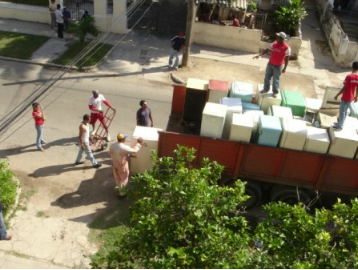
I came running from work to meet the social workers who take the old refrigerators. Atmosphere of madness, all the old refrigerators rolling down the stairs, they say a neighbor was on the edge of tears. I too was a little sad, it hurts to see them rolled away after nearly a half century of working without fail. My Mom’s fridge, for example, they gave it to my grandmother like a wedding present, she was born in 1919 and got married when she was 16. It’s impossible to be indifferent to its death. I understand OLPL and other friends who aren’t changing theirs, but truly for me, although I’m sad, I prefer the change. In addition, it’s expensive to get rid of them, because I’ve been told there are people out there who think it is only exchanged, but no, it’s exchanged and charged: value 260 CUC. Luckily you can pay in installments. After 50 years they realize if they don’t sell them on the installment plan they’re not going to sell them, because with what are we going to pay.

There were two guys, I don’t know where they went, who loaded the refrigerators and took them down for you for 20 pesos.

6:30 pm:
The truck with the new ones arrives, as Claudio calls them, the “Comandantes Haier.” The odyssey of bringing them up and more, and thankfully with Yoani’s camera I was able to capture all of it, most of all Claudio and Ciro, posing before starting up.

For the social workers, who didn’t get lunch, I made them coffee. They told me they hadn’t even given them a snack the whole day.

Translator’s note
The “Haier Group” is a Chinese appliance manufacturer with a contract to supply energy efficient refrigerators to Cuba.

Claudia Cadelo, 26 November 2008

Note: In conjunction with Miriam Leiva’s post about bank loans to buy saucepans, Translating Cuba has decided to re-post an old series of posts Claudia Cadelo about refrigerators, to give our readers a fuller understanding of how things work in Cuba. This is Part 4.

Fun (or not!) with Fridges, Part 3: The coming of the refrigerator (II) / Claudia Cadelo

juan suarez
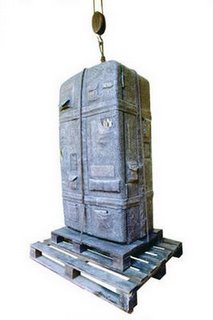
Photo: The piece by Juan Suarez for the exhibition “Monstrous energy eaters.”

Sunday November 23, 11:00 am:

I leave for work (yes, I also work on Sunday) and the Surveillance guy asks me where I’m going because they’re already picking up the refrigerators on the sidewalk out in front. Ciro’s at a student’s house giving a lesson, so he’s not home either.

We’ve spent this week waiting for the refrigerator, I haven’t missed any more work but many people have. Since that disastrous Friday of last week there have been people without a refrigerator until the following Friday; there weren’t any trucks so they couldn’t bring the new refrigerators. By chance we saved ourselves, because the list of those of us who were exchanging fridges was wrong and the president of the CDR wouldn’t let us get rid of them until it was fixed, and those who were fixing it stopped working, and so we were left with our old refrigerators.

I’m running to leave things at work under control and then head back home, which I make in the record time of one hour, including the ten peso cost of a car between there and here to get here faster.

When I get home a neighbor is shouting at me: Go back! Go back! They’re not going to pick them up from us today! He gave me a small attack of hysterics which fortunately passed quickly when I saw the face of the president of the CDR who has spent the last week taking meprobamate and who was on the verge of strangling somebody. She’s more exasperated than I am. In her work they give encouragement in foreign currency and if she fails she won’t get it.

They say it’s coming tomorrow.

(to be continued)

Claudia Cadelo, 26 November 2008

Note: In conjunction with Miriam Leiva’s post about bank loans to buy saucepans, Translating Cuba has decided to re-post an old series of posts Claudia Cadelo about refrigerators, to give our readers a fuller understanding of how things work in Cuba. This is Part 3.