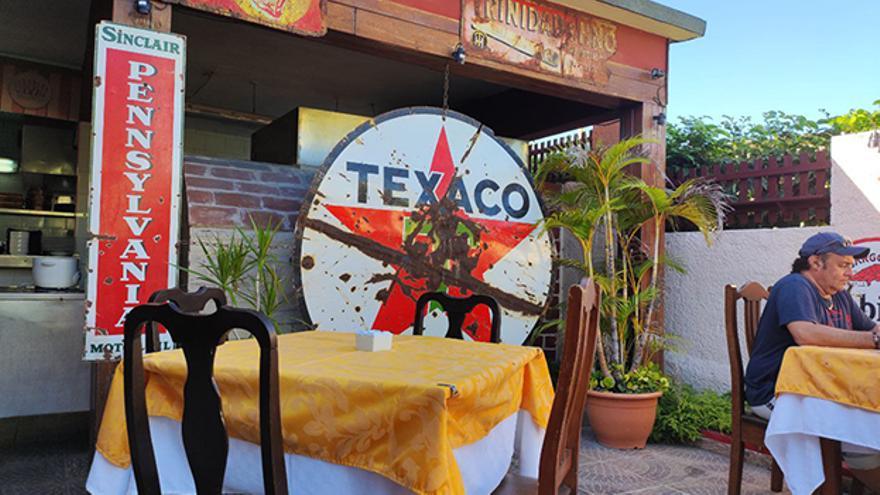

There Will Be No Foreign Investment for the Private Sector in Cuba

One has to worry about what the communists don’t know how to do, which is nothing more than creating a favorable environment for the prosperity of business. (14ymedio)

14ymedio bigger14ymedio, Elías Amor Bravo, Economist, 23 July 2022 — In recent days, we have witnessed a torrent of measures by the Cuban regime to get the economy of the island out of the vicious circle in which it has been locked by the communist economic model that the authorities are stubbornly determined to apply.

And of all the ministerial hodgepodge of proposals, some hilarious ones such as the recovery of the “microbrigades” or the “in-person learning” reminiscent of the revolutionary old days, those related to foreign investment in Cuba have undoubtedly been the ones that have received the most attention — in some cases, resulting in undesirable confusion.

The person responsible for this mess has been the Minister of Foreign Trade and Foreign Investment, Rodrigo Malmierca, who reported in the National Assembly on the activity of his department, exemplified in the negotiation of 57 projects with foreign capital in prioritized sectors of the economy, valued at almost $5 billion, all of them still without a materialization date.

Malmierca, immune to discouragement and the fact that the application of Law 118 on foreign investment has been a resounding failure since 2014, told the deputies that “if you work well and make an effort, we have the conditions to attract more foreign capital despite the existing difficulties,” with less conviction than what these words really say.

The difficulties, in line with the official argument of the regime, come, of course, from the ‘blockade’, but also, and here comes the interesting thing, from what Malmierca called “works that depend on us, including delays in the procedures and the lack of preparation in the negotiating groups.”

Actually, if those were the obstacles to the development of foreign investment in Cuba, there could be some hope, but when you compare the Cuban experience since 2014 with that of, say the Dominican Republic, you can understand why foreign capital turns its back on Malmierca and, nevertheless, lines up to be able to enter the neighboring Caribbean island.

Trying to attract investment only with a law is a waste of time. First, you have to worry about what communists don’t know how to do, which is nothing more than creating a favorable environment for business prosperity, so that people can increase their standard of living and companies can operate freely. In Cuba, that is simply impossible, and therefore, not because of laws or obstacles, foreign investment passes it by. continue reading

But Malmierca knows how to catch attention and that is why, after recognizing that the management of his department leaves much to be desired (at the end of last year, 285 businesses had been approved in Cuba since 2014, 49 located in the Mariel Special Development Zone and 29 reinvestments), he announced that “about seven foreign investment projects linked to forms of non-state management are being studied, and the relevance of approving businesses in domestic trade is being analyzed.”

The deputies of the Assembly, who at that time were sleeping peacefully, felt a small convulsion. Some even used their mobile phones to say that Malmierca was thinking of authorizing foreign investment in the private sector. People couldn’t believe it.

So when the minister changed the subject and began to talk about the virtues of the unique digital window and the measures to attract foreign capital at the municipal level, everyone’s interest was in that mention of the possible entry of foreign investment into private businesses — something that, until now, had been banned. Everyone wanted more information, but the deputies of the Assembly rarely bother the top leaders of the regime, so it would be best to wait.

Little by little, the State newspaper Granma’s headline summary of the news — “There are possibilities of attracting more foreign capital” — began to run from mobile to mobile. Yes, but how would that idea be translated into reality, in view of the experience since 2014? It seemed evident that Malmierca was proposing an update of the policy for attracting foreign investment in Cuba and its flexibility in favor of more profits, as well as the actions being taken to encourage and improve this mechanism, but was there really a will to open foreign capital to the private sector?

Malmierca had said that the reforms that were going to be introduced would in no case mean that “the socialist character of our government would be violated,” but someone saw that the portfolio of opportunities for foreign investment had included, among other options, small projects and 60 others that emerged from the territories. They were no longer the great millionaire pharaonic projects that used to frighten foreign investors for the mobilization of required financial resources.

But so far, nothing more. The natural date would be the 38th Havana International Fair (Fihav-2022) to be held in November. Apparently someone said that there were preparations being made “for exceptional projects, and the strategic axes of the National Economic and Social Development Plan until 2030 will be taken into account.”

And reading the news, someone said they had mentioned it. Granma reported “the minister pointed out that another flexibility of the policy is the possibility that the more than 4,000 forms of non-state management can work with foreign investment, in accordance with the provisions of the law.” That’s it. This is the key to authorizing the entry of international capital into the private sector, but it’s advisable to read it in detail and to not be in a hurry.

“Working with foreign investment” is not well known and is not the same as receiving foreign capital and offering a stake in it, by the way, which at no time is mentioned. These are very different things, and until the proposal is outlined, you have to understand the first version: “work with foreign investment.” And that’s not nothing.

Then there are the dangers that aren’t obvious. If Malmierca wants there to be foreign investment in the retail sector, the first thing that has to be achieved, and this seems almost impossible in the Cuban economy, is that there are products to be sold and bought and also purchasing power to do so, and it doesn’t seem that these two parameters are currently in the reality of trade and the retail trade circulation of the Cuban economy.

Little by little, people calmed down. No one should expect any change in the foreign investment policy because the communist regime’s nature is to have absolute control of the economy and to prevent the accumulation [of profit] and the prosperity of private businesses. There will be no foreign investment in the private sector, at least with the 2019 communist constitution in force. The alarms stopped going off. It’s very difficult to get out of the vicious circle of the Cuban economy.
________________________

Note from 14ymedio: This article is reprinted with the permission of the author. I was originally published in Cubaeconomía.

________________________

Translated by Regina Anavy

____________

COLLABORATE WITH OUR WORK: The 14ymedio team is committed to practicing serious journalism that reflects Cuba’s reality in all its depth. Thank you for joining us on this long journey. We invite you to continue supporting us by becoming a member of 14ymedio now. Together we can continue transforming journalism in Cuba.
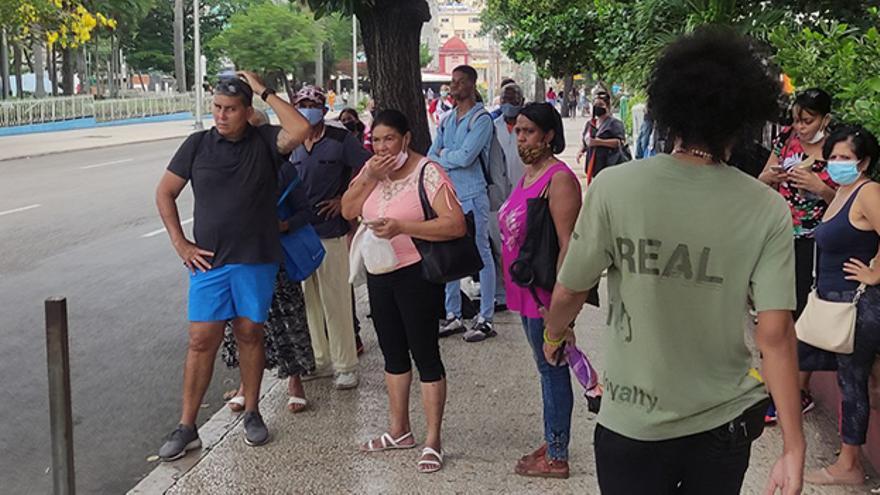
In Cuba There is Not Even Enough Sugar Cane to Make Guarapo

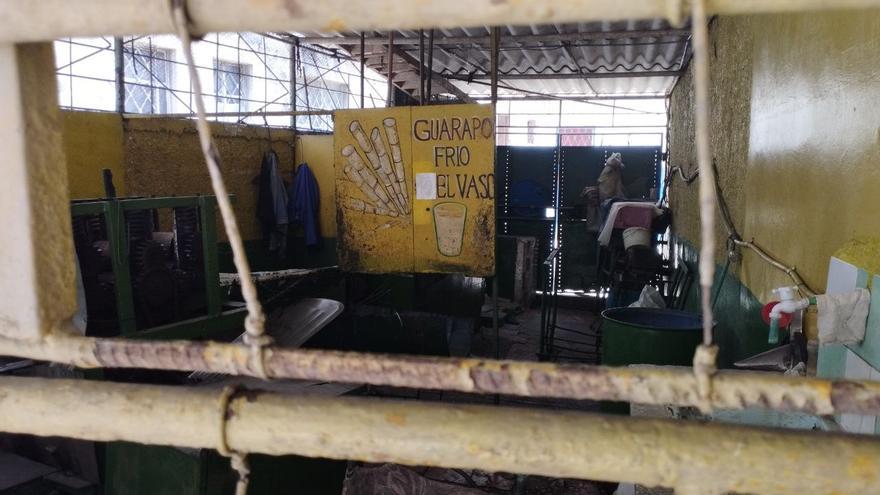
Guarapera on Infanta and Carlos III, in Havana, completely closed this Friday. (14ymedio)

14ymedio bigger14ymedio, Juan Diego Rodríguez, Havana, 22 July 2022 — The debacle of Cuba’s sugar sector, which recorded catastrophic harvests in the last two years, is affecting an entire cultural tradition in Cuba: the guaraperas, selling guarapo — sugar cane juice.

Instead of guarapo this Friday, they sold mango juice at the premises of Neptuno, between Belascoaín and Lucena, Central Havana. “There is not even a little piece of cane to grind,” the employee told a customer who went in to cool off in the middle of the hot morning in the capital. “The harvest hasn’t even given enough to tie a goat,” the man commented ironically, having to settle for mango juice and complained that it was acidic.

Not far from there, the guarapera located on Infanta and Carlos III, one of the ones that sells the most products in the capital, dispatching it even in bottles, is completely closed. An old woman who came to quench her thirst, turned around, disappointed: “This Revolution gives neither sugar, nor water, nor ice nor shame.”

Traditionally, guarapo has been a drink to quench thirst in the midst of high Cuban temperatures. Served with plenty of ice, it helps to cool one down, in addition to providing enough energy to continue on the road. However, it is also a fragile liquid, which quickly becomes acidic and must be consumed as soon as the cane is ground.

Guaraperas were very frequent in Havana, but in recent years they have disappeared and, currently, there are only a few scattered throughout the city. Given its rapid deterioration, the guarapo is not sold on an itinerant basis nor is it stored in cans or bottles. Although in other countries it has been preserved in containers, in Cuba it is still an ephemeral drink. continue reading

Therefore, going to a guarapera was, in addition to a necessity to relieve the heatwave, a cultural experience: the press crushing the cane, the liquid between yellow and milky coming out of the stalks, the fragments of ice served loudly in the glasses that were then filled with a sparkling and sweet drink. The first sip was like an energetic jolt that ran through the body.

The first blow to the guaraperas was a matter of hygiene, with the lack of detergent to wash the glasses. Then, the supply of ice and, later, the cane began to diminish. The blackouts have given the final blow to many of these places that need electricity for the cane presses. At the counters where a few years ago impatient customers waited while they watched the guarapo flow from the grinding mill, now there are only flies and silence left.

Translated by Regina Anavy

____________

COLLABORATE WITH OUR WORK: The 14ymedio team is committed to practicing serious journalism that reflects Cuba’s reality in all its depth. Thank you for joining us on this long journey. We invite you to continue supporting us by becoming a member of 14ymedio now. Together we can continue transforming journalism in Cuba.

Cuba Exceeds One Hundred Daily Cases of Covid for the First Time in Two Months

Health authorities warned ten days ago about a slight increase in Covid cases due to the subvariant BA.5. (14ymedio)

14ymedio biggerEFE (via 14ymedio), Havana, 23 July 2022 — Cuba exceeded one hundred daily cases of Covid-19 on Saturday for the first time in more than two months, confirming 114 new infections.

The last time the Ministry of Public Health registered more than 100 new positives in one day was on May 14, when it reported 103 infected.

Then, the number of people newly infected with SARS-Cov-2 began to fall for several consecutive days, and deaths were not reported.

The total number of PCR tests has also decreased, accounting for about 2,509 daily, according to official statistics.

“As of the end of yesterday, July 22, a total of 714 patients were admitted, 290 suspected cases and 424 active confirmed,” the Ministry of Health said on Saturday in its daily report on Covid.

Health authorities warned ten days ago about a slight increase in cases due to the circulation in the country of the subvariant BA.5 of the Omicron variant of the virus.

They assure that they maintain “control” of the disease, due to the high rates of vaccination with their own anti-Covid 19 formulas that reach almost 98% of the population considered “vaccinable.”

Havana and Matanzas lead the regions of the country with the most reported cases, although they don’t reach one hundred or the levels of last summer, when they exceeded a thousand.

On the other hand, this Saturday the World Health Organization declared an international emergency, due to the current outbreak of monkeypox, after some 16,000 cases have already been reported in 75 countries, many of them in Europe, where the disease was not endemic. Of the total, only five people with the disease have died. continue reading

The decision was announced at a press conference by the Director General of WHO, Tedros Adhanom Ghebreyesus, two days after an emergency committee with experts in this disease met to discuss the possible declaration, which will oblige national health networks to increase their preventive measures.

The committee had chosen not to declare the emergency at a first meeting held in June (when cases were at 3,000), and on this occasion, according to Tedros, there was also no total consensus among the experts, but the director general decided to declare the emergency in view of the high and growing number of cases in various regions around the world. At the moment, Cuba has not registered any cases of monkeypox.

Translated by Regina Anavy

____________

COLLABORATE WITH OUR WORK: The 14ymedio team is committed to practicing serious journalism that reflects Cuba’s reality in all its depth. Thank you for joining us on this long journey. We invite you to continue supporting us by becoming a member of 14ymedio now. Together we can continue transforming journalism in Cuba.
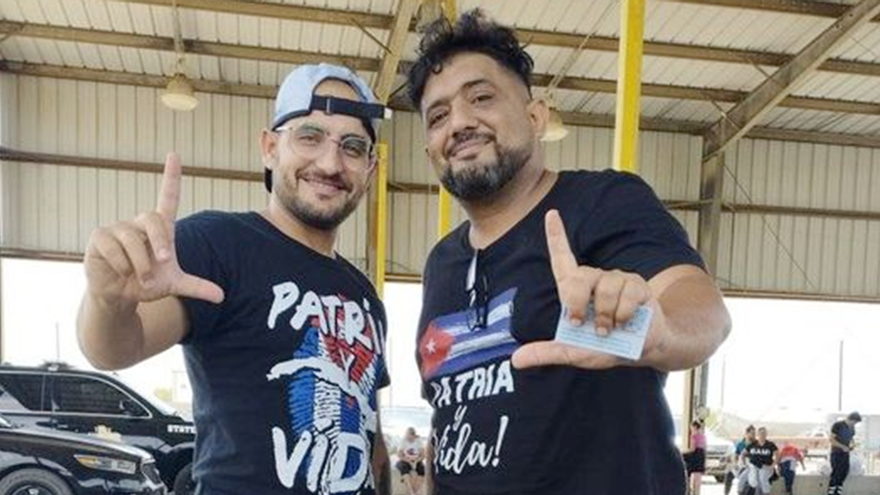
Tourism in Cuba in the First Half of 2022: From Information Manipulation to the Reality and the Inflation that is Causing Harm

In the middle of the week, calm reigned on the beaches of Varadero, which see the presence of Cuban tourists on Saturdays and Sundays. (Roma Díaz)

14ymedio bigger14ymedio, Elías Amor Bravo, Economist, 21 July 2022 — In the first six months of 2022, according to the National Office of Statistics and Information [ONEI], a total of 987,008 travelers arrived in Cuba, representing an increase of 557.3% over the same period in 2021, which is equivalent to 809,808 more travelers. Of these, there have been 682,411 international visitors, and they represent 596.3% compared to the same period last year. That is, 567,972 more international visitors than in the first half of 2021.

These data indicate that the Cuban tourism sector is growing and that it’s doing so at an important rate, multiplying by five the figures of the previous year. But once again you have to look at the information manipulation campaigns of the communist regime, and in this case, one can only question the data that, triumphantly, the leaders are offering.

And for four reasons.

First, because despite the dynamism that tourism is experiencing worldwide, the results of the last normal year before the pandemic, which was 2019, are still not achieved in Cuba. That year, at the end of the first semester, 2,561,719 visitors had arrived in Cuba, about three times more than this year, 2022, which, although it has improved compared to 2021, was a year of border closures until November, as a result of COVID-19 infections.

Therefore, it’s advisable to be cautious with the figures. The level of tourist activity in these first six months of 2022 barely reaches 27% of the 2019 figure, and that year 4.2 million tourists arrived during the year. The data for 2022 are still not good, and manipulation campaigns have to be considered, even more so when weak months are now coming for Caribbean tourism that coincide with the summer and the hurricane season. Once again, we will have to wait until November to see if the miracle takes place.

Second, because there are significant changes in the composition of tourism. In fact, the arrival of Canadians is activated and already accounts for 31.3% of the total, with 214,122 visitors (six points more than in 2019, for example). But it should be borne in mind that the second block is made up of the Cuban community abroad, which with 151,008 visitors, already accounts for more than a quarter of the total (ten points more than in 2019). And in third place, the United States, which with 40,600 is ahead of the Russians. continue reading

Leaders should be aware of this data and be careful when disqualifying and attacking their northern neighbor because they can affect demand preferences. Despite the “embargo/blockade,” tourists from the United States to Cuba outperform those from any European country.

Meanwhile, tourists from the markets of the old continent, despite the rise of traditional powers such as Spain, France or Italy, don’t show special interest in coming to Cuba, or they register growth much below the average, which, in the specific case of the Russians, confirms that the measures of the international community are taking effect.  Only 37,654 Russian tourists arrived in Cuba in the first half of the year.

Third, because other competitive destinations in the Caribbean have been launched so far this year, leaving Cuba far behind in the process of recovering tourism after the pandemic. This is the case of the Dominican Republic, which in the first five months of this year received a spectacular figure of 2,396,864 tourists out of a total of 3,000,000 passengers.

The results of this Caribbean destination once again leave Cuba far behind, almost 71% below, which shows considerable difficulty in growing tourism. Other destinations such as Cancun or Costa Rica also show positive data, which may indicate that Cuba’s tourism policy is not adequate and that it should be reviewed.

Fourth, because the results of this first quarter move the economy away from the objectives of the plan for 2022. And we can’t forget the almost sick relevance that Cuban communists attach to their plan for the economy, which is usually rarely fulfilled. If the results of these six months were doubled, tourism in Cuba at the end of the year would not exceed 1.3 million visitors, a figure that is far removed from the communist regime’s goal of 2.5 million, almost by half.

No. Tourism is not going well in Cuba in 2022. Growth is insufficient to overcome the crisis and has nothing to do with what is happening in other countries in the area that have been able to mobilize their market. The worst thing is that the Cuban private sector, linked to tourism, loses growth opportunities and remains stagnant, waiting for the situation to improve. And now there is inflation.

The inflation of the CPI, for example, of the “Restaurants and Hotels” component directly related to tourism, has confirmed the growing loss of competitiveness of the sector. The prices of this component until May increased by 24.61% year-on-year, two tenths less than the average of 26%. Rising inflation reduces the attractiveness of Cuban tourism and reduces demand. It’s a serious problem that the authorities don’t know how to solve.

The authorities have invested too much in the construction of hotels, and now when it comes time to occupy them, they find that other destinations in the area are more competitive in price because they have been able to tackle inflation with effective measures. Suddenly, in addition, they see that the euro and the dollar are on parity, and any possible attraction of European tourists is dismantled. The Cuban communist leaders have no idea how an economy is run, but they won’t accept this, and their obsession with intervening, planning and controlling economic activity has led to disaster. Likewise, for purposes of manipulation, it’s not good to give figures that are fake. Cuban tourism is a good example of this.

Translated by Regina Anavy

____________

COLLABORATE WITH OUR WORK: The 14ymedio team is committed to practicing serious journalism that reflects Cuba’s reality in all its depth. Thank you for joining us on this long journey. We invite you to continue supporting us by becoming a member of 14ymedio now. Together we can continue transforming journalism in Cuba.

After Three Months of Crossing, Two Doctors Harassed by the Cuban Regime Arrive in the United States

Cuban doctors Alexander Pupo Casas and Alexander Jesús Figueredo Izaguirre. (Facebook/Dr. Alexander Raúl)

14ymedio bigger14ymedio, Havana, 21 July 2022 — “Family, we are now in the United States.” With that phrase Cuban doctors Alexander Pupo and Alexander Jesús Figueredo reported on Thursday through Facebook that their three-month journey had ended. The doctors were forced to leave the island after being harassed by the regime.

“I am free, and soon my Cuba will be to take care of my people again,” Figueredo said. He clarified that his arrival in the United States was due to the fact that he “has been fleeing the Cuban nightmare” and was not in search of the American dream.

“[I brought] with me a bag of dreams that I never achieved on the island, some papers, a cell phone and my medical stamp, with which I once treated thousands of patients,” explained the health worker, who lost his job due to his confrontational stance against the Government. “There’s nothing here for me,  but I will remember that one day I was #108356.”

According to figures from the Customs and Border Protection Department, in the past nine months, 157,339 Cubans arrived by land in the United States. Of these, 16,170 requested political refuge in June alone.

Just on July 7, Pupo announced the dangers and insecurity faced by migrants on their journey to reach the United States. “Guatemala has been a total hell,” the doctor said in a video he posted on his Facebook account. “We had to hide from the police again,” he said as a group was watched hiding behind in the undergrowth. continue reading

Pupo reiterated that “in Guatemala, an immigrant lives with fear always present. The police mainly pursue Cuban emigrants to extort them.”

The health worker said on that occasion that “the coyotes were bad” and, because they didn’t pay the bribe to the officers, the group with which they were traveling had to go into the mountains.

“We’ve practically had to become soldiers  in here: jumping fences, hiding and trying to evade all the dangers among the pica pica* bushes,” the doctor explained. “It seems that the shocks are never going to end.”

Pupo recalled that from Nicaragua, his journey to reach the United States had been one complication after another. “Unbelievable what we have experienced in these last few hours: going hungry and in need… I wouldn’t recommend this to anyone.”

Before this publication, Pupo had confessed to 14ymedio that they had the most difficult emigration: without visas, without the support of diplomats, practically without money. “And there were those who said that we were financed, that we were well paid by the CIA,” he added ironically.

*Translator’s note: Source: The scientific name for Pica pica is Mucuna. The course hairs on the pods contain the proteolytic enzyme mucunain which cause the itch and sometimes blisters. 

Translated by Regina Anavy

____________

COLLABORATE WITH OUR WORK: The 14ymedio team is committed to practicing serious journalism that reflects Cuba’s reality in all its depth. Thank you for joining us on this long journey. We invite you to continue supporting us by becoming a member of 14ymedio now. Together we can continue transforming journalism in Cuba.
The U.S. Congress Refuses to Let Cuba Purchase Food on Credit

In 2021, the United States doubled its chicken exports to Cuba, which amounted to 253 million dollars. (14ymedio)

14ymedio bigger14ymedio, Havana, 21 July 2022 — On Wednesday, the United States Congress rejected, by 260 votes to 163, an amendment presented by Democratic legislator Rashida Tlaib that proposed expanding agricultural trade with Cuba and authorizing deferred payment for a year.

Republican Congressman Mario Díaz-Balart celebrated the defeat of the measure and said that he won’t support initiatives that seek to make unilateral concessions to the Cuban government, which he called a “brutal and anti-American regime.” He added that while “hundreds of political prisoners are still in prison, we cannot reduce the pressure on a regime that uses its income to further oppress the Cuban people.”

Last Tuesday, the Foreign Affairs Committee of the Lower House of the United States issued a statement explaining Amendment 137, which aimed to facilitate the export of food and agricultural products to the island.

In the statement, Congressmen Gregory Meeks and Jim McGovern supported the amendment. “This common sense legislation, which has been supported by both sides and by agricultural groups throughout the country for more than a decade, would create thousands of agricultural jobs in the United States while providing desperately needed food at a lower cost to the Cuban people.”

Both legislators argued that the economic crisis facing the island is what forces thousands of Cubans to stand in line for food and leave for the southern border of the United States. “This amendment would help alleviate the economic burden by suspending U.S. agricultural export regulations and extending credit to Cuban food buyers for a year.”

However, they didn’t explain that food and medicine are exempt from the U.S. embargo. Among the demands is that Cuba has to pay in cash up front, an anomaly in the international context, but one which hasn’t prevented tons of food from arriving monthly on the island. continue reading

In 2021, the U.S. Department of Agriculture indicated that the U.S. doubled its chicken exports to Cuba, which amounted to $253 million.

Last April, a group of U.S. farmers participated in the Third Agricultural Conference in Havana, where they discussed the possibility of increasing trade and selling, in addition to chicken, wheat, corn, beans, milk and beer, but affirmed that the embargo was an obstacle.

After the conference, the Cuban side claimed the right to export to raise money and buy other products that cannot be produced on the island. “We don’t want them to give us anything. We want the possibility to buy and sell,” said the cooperative member, Abelardo Alvarez.

According to data from the United States Congressional Research Service, before 1959 Cuba was the ninth country in the export market for U.S. agricultural products, while today it is below 50th. In addition, the island also sold products to its northern neighbor.

The National Association of State Departments of Agriculture of the United States maintains that without the embargo, exchanges would be around $1 billion per year, compared to the current $250 million.

Translated by Regina Anavy

____________

COLLABORATE WITH OUR WORK: The 14ymedio team is committed to practicing serious journalism that reflects Cuba’s reality in all its depth. Thank you for joining us on this long journey. We invite you to continue supporting us by becoming a member of 14ymedio now. Together we can continue transforming journalism in Cuba.

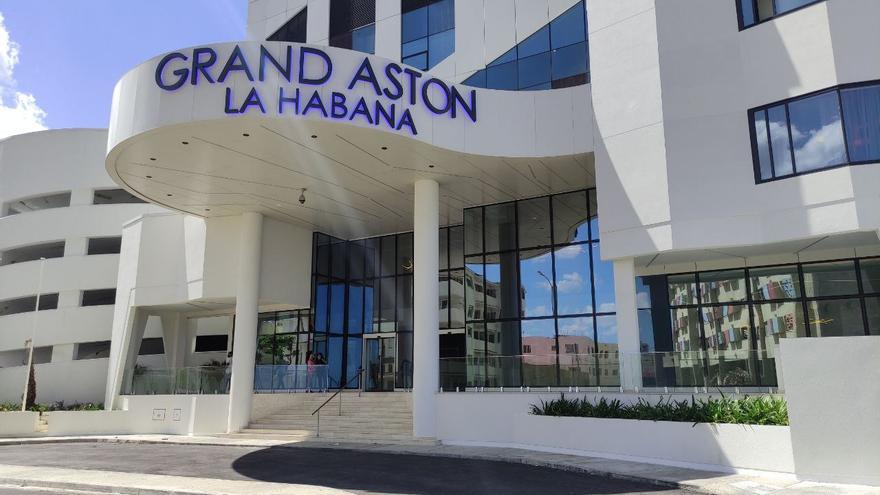
A Cuban Deputy Regrets That All Hotel Stores Accept Payment Only in Hard Currency

Hotel Grand Aston Havana, built in 2022 by Gaesa on the Malecón. (14ymedio)

14ymedio bigger14ymedio, Havana, 20 July 2022 — Cuba’s Minister of Tourism is sticking to his forecast and maintains once again that the target of 2.5 million foreign travelers will be met this year. Although in the first six months of the year, the island received only 682,297, the Cuban authorities are determined that geometric progression cannot be applied and that, since growth has been exponential in recent months, the goal will be achieved.

“For the July-October period, 1,105,000 visitors are expected to arrive,” said Juan Carlos García Granda, head of the branch, on Wednesday at the meeting of the Commission for Attention to Services, where parliamentarians analyze the different sectors as a preliminary step to the ninth ordinary session of the National Assembly of People’s Power.

Despite optimism, the meeting brought to light some problems in the tourism sector, on which the Cuban Government has placed all its hope for the future.

“The most important problems are road signs, currency exchange and car rental. In some places there was dissatisfaction with hygiene in the municipalities and with the infrastructure of roads, buildings and cities,” said García Granda, who also admitted that transport and workers’ uniforms are scarce.

The worst thing, however, is the lack of variety in food and drink, something that occurs every day in the daily life of citizens but that, in the case of tourism, should be on the fast track by extending contracts that would “favor the acquisition of resources.”

In the middle of the session, a deputy, José Castañeda, drew attention to the serious disadvantage that in hotels all stores accept only freely convertible currency (MLC), “which is a problem with the national market.” continue reading

García Granda placed the rooms on the island at 78,862, with Havana, Matanzas and Villa Clara in the lead. The minister said that travelers value the destination Cuba despite all the inconveniences, suggesting that the investment seems appropriate to him, but contrary to what it may seem, it is still little.

“In this year, 1,049 rooms have been recovered out of the 5,167 planned until December,” added the official, who estimated the number of rooms that are not in order at 13.2%, even though during the wide stoppage of the pandemic an investment plan was implemented to update the situation.

The perception of Cubans, even among those closest to the ruling party, theorized by different economists, is that the Cuban authorities are investing wildly in hotel facilities and tourism while the country falls apart. However, García Granda categorically said at Wednesday’s meeting that the pace is proportional since, even, “the growth of tourists has always been higher than that of rooms since the 1990s.”

When calculating, the minister chose 2019 compared to 1990, and stated that the growth of visitors was 9.1%, while that of rooms was 4.9%. In 2022, the Cuban economist Pedro Monreal argued that even if the long-awaited 2.5 million international visitors were reached, there would be a little more than half of Cuba’s hotel rooms left over. “69 tourists rotating per room in 2018 compared to 32 in 2022. It would seem rational to adopt a ’pause’ in hotel investment. There are other priorities,” he said.

Translated by Regina Anavy

____________

COLLABORATE WITH OUR WORK: The 14ymedio team is committed to practicing serious journalism that reflects Cuba’s reality in all its depth. Thank you for joining us on this long journey. We invite you to continue supporting us by becoming a member of 14ymedio now. Together we can continue transforming journalism in Cuba.
Honduras and Cuba Sign a Memorandum to Strengthen Their Bilateral Relationship

The Honduran diplomat pointed out that the memorandum of understanding will serve for the peoples of Honduras and Cuba to persevere in strengthening ties of closeness and solidarity. (EFE)

14ymedio biggerEFE (via 14ymedio), Tegucigalpa, 19 July 2022 — The Governments of Honduras and Cuba signed a memorandum of understanding to strengthen bilateral relations between the two nations, an official source reported on Monday in Tegucigalpa.

The memorandum was signed on Sunday by the Honduran Minister of Foreign Affairs, Eduardo Enrique Reina, and the Cuban Minister of Foreign Trade and Strategic Investment, Rodrigo Malmierca, along with the Cuban ambassador in Tegucigalpa, Juan Roberto Loforte, the Presidential House said in a statement.

“This memorandum opens up to us the possibility of going through new paths of collaboration in science and technology, literacy programs and scholarship exchange, among others,” Reina said.

“Cuba has a lot to teach in the field of health and public education, because it has obtained universally recognized achievements in these fields, and I hope that this valuable acquisition will be a fundamental ingredient in this new stage that begins,” he added.

The Honduran diplomat pointed out that the memorandum of understanding will serve for the peoples of Honduras and Cuba to persevere in strengthening ties of closeness and solidarity, as well as mutual understanding, the statement adds.

Reina also expressed the solidarity of the Honduran Government, chaired by Xiomara Castro, in the face of the economic blockade “of which the island has been a victim,” in addition to “continuing to raise its voice to condemn interference and intervention in the self-determination of the Cuban people and in the internal affairs of Havana.” continue reading

The Cuban Minister of Foreign Trade and Strategic Investment indicated that the signing of the memorandum “represents the rebirth and strengthening of the bonds of brotherhood, solidarity and cooperation between Honduras and Cuba.”

Malmierca recalled that his country has supported the people of Honduras in areas such as health and education through medical brigades and literacy campaigns.

“Nothing says more about solidarity and friendship between our peoples than the presence of our Cuban doctors in Honduras,” he said.

The senior Cuban official said that the program of cooperation in health matters between the two countries was “truncated by the coup d’état” of June 28, 2009 against the then-president of Honduras, Manuel Zelaya, who is now an advisor to Xiomara Castro, his wife.

Translated by Regina Anavy

____________

COLLABORATE WITH OUR WORK: The 14ymedio team is committed to practicing serious journalism that reflects Cuba’s reality in all its depth. Thank you for joining us on this long journey. We invite you to continue supporting us by becoming a member of 14ymedio now. Together we can continue transforming journalism in Cuba.
‘If You Lock Yourself In Your House, You Die of Heat and, If You Open the Windows, Mosquitoes Kill You’

Cuba has been producing less than 40% of its electricity generation capacity since May. (EFE)

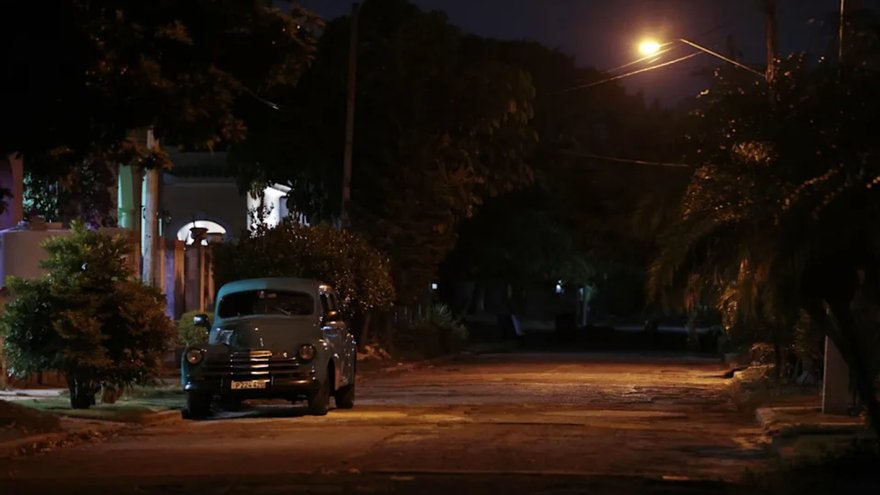
14ymedio bigger14ymedio, Havana, 20 July 2022 — Cuba faced one of its worst days of electricity deficit on Wednesday due to the increase in demand. The Electric Union of Cuba (UNE) has announced an availability of 2,499 MW, very insufficient due to the need for 3,000 MW planned for today on the island. In previous weeks, the shortage translated into 12% to 18%, due to the demand of about 2,500 MW, but today it reaches 24%.

The state company also points out that yesterday the maximum impact was 694 megawatts, at 9:00 p.m., but that there were blackouts throughout the day.

The deficit and blackouts continue due to the breakdowns reported in three units of the Mariel thermoelectric power plant, two other units out of service due to damage to the Nuevitas thermoelectric power plant and one more in the Felton and Renté thermoelectric power plants.

Although blackouts have been common in Cuba for decades, in the last two years the situation has been aggravated by the pressing economic crisis, which has worsened the chances of maintaining and repairing the old thermoelectric plants. The last few weeks are further testing the patience of Cubans, especially outside Havana, where power outages are lasting for many hours.

“If you stay at home you die of the heat, and if you open the doors and windows the mosquitoes kill you,” complained a man about last Tuesday’s night blackouts. It’s difficult to rest because of the summer heat on the island, where temperatures exceed 97F degrees. continue reading

Summer rains and lack of fumigation have also caused mosquitos to multiply throughout the country, aggravated in the early hours of the morning by the fact that you can’t turn on the fan or close the windows to enjoy the air conditioning.

Last Monday, the Trotskyist Communists Collective complained that the authorities limit electricity cuts in Havana as much as possible and impose “long blackouts in the rest of the provinces of the country, mainly in regions where the protests of July 11 [2021] didn’t take place, or at least were weak.” On a daily basis, the brief statement of the UNE states that “all measures to restrict consumption in the state sector are implemented.”

But these restrictions and blackouts have led, in other places, to night protests such as those that occurred in Los Palacios, Pinar del Río, where the weariness of the population was demonstrated in the middle of a power outage through slogans such as the already known “Put on the power, goddamnit!” to the sound of banging on pots and pans.

The phrase was heard for the first time during another demonstration by the residents of the Camagüey University campus who had been without water and electricity for days.

The situation of blackouts and lack of electrical energy worsened after the fire at the Lidio Ramón Pérez Thermoelectric power plant, in Felton, located in Holguín, last Saturday that caused severe damage.

During the last days of May, Cuban President Miguel Díaz-Canel assured that the electricity situation would improve by the end of June. However, the deadline was met with new difficulties and more blackouts. The president postponed the “solution” until the end of this month.

Power outages were one of the factors that fueled social discontent last year in Cuba and led to the outbreak of ’11J’ (11 July 2021). Now, they are repeated throughout the island, along with the discomfort they cause in the population.

Translated by Regina Anavy

____________

COLLABORATE WITH OUR WORK: The 14ymedio team is committed to practicing serious journalism that reflects Cuba’s reality in all its depth. Thank you for joining us on this long journey. We invite you to continue supporting us by becoming a member of 14ymedio now. Together we can continue transforming journalism in Cuba.

Cuba Remains on the U.S. Blacklist for Human Trafficking

Cuba is among 11 countries that present “a documented policy or pattern of human trafficking,” such as “trafficking in government-funded programs” and “forced labor in medical services.” (EFE)

14ymedio bigger14ymedio, Havana, 19 July 2022 — The United States Government once again includes Cuba, for the fourth consecutive year, on its list of countries that don’t comply with international standards regarding human trafficking.

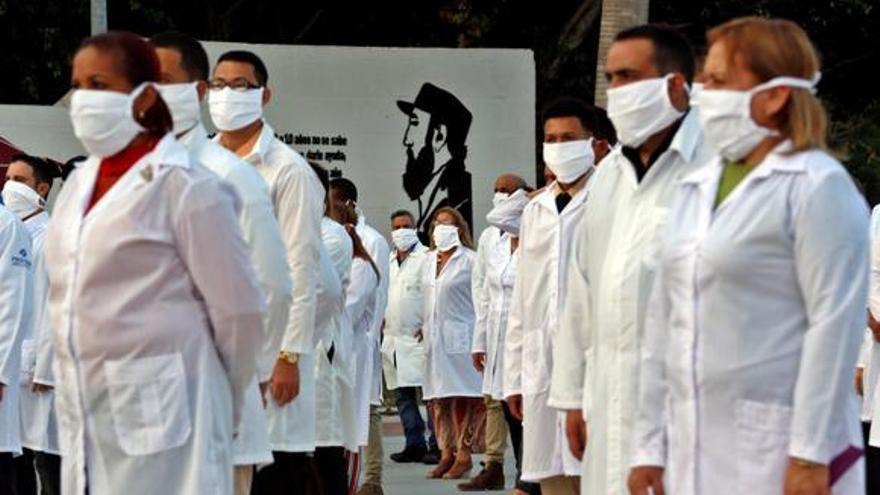
In its latest report on the subject, published on Tuesday by the State Department, the Island is among 11 countries that present “a documented policy or pattern of human trafficking,” such as “trafficking in government-funded programs” and “forced labor in medical services,” in clear allusion to internationalist missions, which have been denounced by international organizations.

In addition to Cuba, Russia, North Korea, Iran, Syria, Afghanistan, South Sudan, Yemen, Eritrea, Burma and Turkmenistan are also listed as nations where it is the State itself that participates in human trafficking.

In general, the island is on the list of 22 blacklisted countries that don’t comply with the “minimum standards” set by the United Nations against human trafficking — mainly the Palermo Protocols — and that are also not making significant efforts to comply with them. continue reading

Belarus is on the list for the first time, with the United States saying that the government of Alexander Lukashenko “orchestrated an immigration crisis on its borders with Latvia, Lithuania and Poland,” encouraging irregular migrants to cross without addressing possible indicators of human trafficking.

Countries such as Venezuela, Nicaragua, China and Vietnam are also listed. Regarding the regime of Nicolás Maduro, the United States emphasizes that “it continued to provide support and maintained a permissive environment to non-state armed groups that recruited and used child soldiers for armed conflict and collaborated in sex trafficking and forced labor while operating with impunity.”

As for Cuba, which first entered the list in 2019, the document admits that, “despite the lack of significant efforts,” the regime of Miguel Díaz-Canel has taken “some steps” to address human trafficking, such as “the investigation, prosecution and conviction of traffickers.” However, it emphasizes that during 2022 there was a “government policy or pattern of profit” of workers’ export programs “with strong indications” of forced labor.

On this point, Washington specifically mentions Cuban medical brigades in other countries and says that Havana “continued to deploy Cuban workers in foreign countries using deceptive and coercive tactics” and without addressing “labor violations and trafficking crimes.”

In addition, it mentions “the growing number of allegations” by NGOs, former participants in these missions and foreign governments about the alleged involvement of Cuban officials in these “abuses.”

Thus, as organizations such as Human Rights Watch and Prisoners Defenders have denounced, the United States accuses Cuba of not informing the participants in these programs about the terms of their contracts, which varied from country to country; of confiscating their passports, professional accreditations and salaries; and threatening health professionals and their families if they abandoned those missions.

With regard to Nicaragua, the report says that Daniel Ortega’s government has “minimized” the seriousness of this phenomenon, despite having also carried out “some measures” to address it, such as “the prosecution and conviction of four human traffickers for sexual exploitation.”

Translated by Regina Anavy

____________

COLLABORATE WITH OUR WORK: The 14ymedio team is committed to practicing serious journalism that reflects Cuba’s reality in all its depth. Thank you for joining us on this long journey. We invite you to continue supporting us by becoming a member of 14ymedio now. Together we can continue transforming journalism in Cuba.

Two Cuban Baseball Players are Suspended for Life for an Escape Attempt in Mexico

The Cuban Baseball Federation announced on Tuesday the sanctions of Alfredo Fadraga and Yosvani Ávalos. (Collage)

14ymedio bigger14ymedio, Havana, 19 July 2022 — The Cuban Baseball Federation “suspended for life from all sports activity” baseball players Alfredo Fadraga and Yosvani Ávalos. They are punished, says journalist Yordano Carmona, for having abandoned the team that participated in the Pan American Under-23 Championship in Aguascalientes, Mexico.

Fadraga and Ávalos saw their escape attempt frustrated last June, due to the collaboration of the Mexican authorities who located and detained them. The arrest of the young people generated criticism; Amnesty International’s Director for the Americas, Erika Guevara, demanded an explanation from the Secretariat of Public Security of the state of Aguascalientes for not providing protection to the two Cuban athletes.

Also, Cuban baseball players Javier Carabeo and Yulián Quintana were also sanctioned. In their case, they will not be able to play on the island for two years. According to journalist Francys Romero, they were punished for “an unproven attempt to leave the hotel where they were staying in Aguascalientes (Mexico) during the Under-23 world cup last June.”

The journalist questioned the disciplinary measure leaked to him by a source, because the athletes were used until the end of the tournament by manager Eriel Sánchez. “If so, it must be denounced. It makes no sense for two players who are going to face a penalty to continue playing in the tournament.”

The Under-23 world cup was a terrible sporting disaster for Cuba. The bleeding of players was a constant; of 24 athletes who traveled to Mexico, only 12 returned. And the Cuban authorities found no other recourse than to blame the United States for encouraging the emigration of its talent. continue reading

Romero points out that we are facing a “discrepancy.” This is because Carabeo’s performance in the contest was outstanding. He was “the most distinguished batter in Cuba for hitting three home runs, the first time that a baseball player hits three in a world cup.”

Quintana, on the other hand, was the fastest pitcher. “He is a talented pitcher,” said the U.S.-based reporter. Among the audience were people who measured his speed with the help of gadgets.

While Carabeo and Quintana get the punishment of a year and some days after having committed an indiscipline, Yuddiel González, who abandoned the team at the Ramada hotel in Aguascalientes, was not sanctioned. This young man from Avila returned to Cuba and last May took advantage of his stay in Mayabeque to leave the island on a boat.

Translated by Regina Anavy

____________

COLLABORATE WITH OUR WORK: The 14ymedio team is committed to practicing serious journalism that reflects Cuba’s reality in all its depth. Thank you for joining us on this long journey. We invite you to continue supporting us by becoming a member of 14ymedio now. Together we can continue transforming journalism in Cuba.
Concern Among Doctors About the Increase in Severe Cases of Dengue Fever in Cuba

This Tuesday, in Havana neighborhoods such as Nuevo Vedado, the fumigation smoke was noticeable. (14ymedio)

14ymedio bigger14ymedio, Havana, 20 July 2022 — The spread of dengue fever in Cuba in recent weeks has forced the Government to approve a reinforcement plan against the disease. According to official figures, provided by the Ministry of Public Health, if the incidence rate in April was 12.2 cases per 100,000 inhabitants, in June it reached 46.3, something that the Deputy Minister of Health, Carilda Peña García, referred to as “intense transmission.”

Between April and June, 21,505 locations of Aedes aegypti, the mosquito that transmits the disease, were detected on the island, more than in the same period last year.

Although last week the rate dropped to 2,791 cases of dengue per 100,000 inhabitants, doctors and ordinary citizens confirm that the situation is serious.

“We are alarmed,” an internist at the Manuel Fajardo hospital in Havana tells this newspaper. “What we are seeing this year is not usual.” He refers to the number of patients who are developing severe dengue or hemorrhagic fever, which can be fatal, and says, “In previous epidemics, perhaps approximately 10% of cases had warning signs (those that alert you that the patient is not progressing well), but now it is more than 30%.” continue reading

The doctor explains that the dengue virus has four serotypes or four variants: “When you get infected with a serotype, it gives you immunity for that serotype in the long term and for the others in the short term. But if after three months you get infected with a different serotype, chances are that you will have a serious form.”

At their meeting on Tuesday, the health authorities did not refer to dengue hemorrhagic fever, which in recent days has claimed the lives of adults and children. The Minister of Health, José Ángel Portal Miranda, did report that 32 patients have been admitted to intensive care, 29 of them in serious condition and 3 in critical condition.

At the end of last week, again according to official figures, there was transmission of the virus in eight provinces (Pinar del Río, Havana, Matanzas, Villa Clara, Camagüey, Las Tunas, Holguín and Guantánamo), “in 16 municipalities and 23 health areas.”

Regarding the variants of the virus, Portal Miranda reported that serotype 1 was detected in the provinces of Havana, Camagüey and Las Tunas; serotype 2, in Havana, Villa Clara, Sancti Spíritus and Camagüey, and serotype 3, in Havana and Camagüey, the two provinces that present the most worrying situation.

What the minister also didn’t say is that there is a lack of reagents in health centers, essential in this disease, the internist warns 14ymedio, “to evaluate clotting.”

Juan Carlos, a young resident of Central Havana who, feeling bad, went to Manuel Fajardo and couldn’t have the necessary exams, suffered from body aches. They sent him home with the recommendation to rest. Two days later he returned, with a pain in his abdomen that was unbearable. So they did the tests and admitted him. The diagnosis: dengue with alarming symptoms. “The question is if a couple of days ago there would have been reagents for my blood tests, maybe they would have acted in time,” laments Juan Carlos.

The truth is that because it is a virus, little can be done in the face of dengue other than hydration and rest. At best, you can take medications like acetaminophen for pain and fever.

The plan approved on Tuesday focuses on the fight against the vector that transmits the disease, the Aedes aegypti mosquito, which caused 11,551 outbreaks in 71 municipalities classified as high risk.

Among the 20 measures included in the document, are “intensifying biological treatment with fish in large water tanks,” carrying out “antivecctorial actions in abandoned premises,” reviewing and treating “one hundred percent of elevated tanks” and carrying out “intra-domiciliary adult treatment by fumigating.

On Tuesday, in neighborhoods such as Nuevo Vedado, fumigation fumes were noticeable.

The doctor at the Manuel Fajardo hospital, like many other colleagues, is pessimistic: “The problem is general, and there is no solution in the medium term.”

To top it all off, the growth in COVID-19 cases on the island has caused the health authorities to return to different measures to prevent contagion. The most notorious is the mandatory use of a masks on transportation and in children’s daycare centers.

In addition, the Government says that the second booster vaccination for Covid will be given to Cubans between the ages of 19 and 49, and the first to children between 2 and 11 years old, with the national antidotes Sovereign or Abdala, which have not yet been approved by the World Health Organization.

The calamitous state of the old jewel in the crown of Castro propaganda is completed with the information provided this Tuesday by BioCubaFarma: there is a deficit of basic medicines of almost 40%.

The vice president of the state pharmaceutical company, Tania Urquiza Rodríguez, reported at a press conference that there has been a “complex situation” since 2021, and alleged that “most of the funding was dedicated to the fight against COVID and for the development and production of vaccines.”

She also blamed the U.S. embargo on Cuba, without mentioning that it allows the purchase of medicines as well as food, as long as they are paid in cash in advance, and that the country could also buy the active ingredients in countries such as China or India, with which the island has free trade.

Translated by Regina Anavy

____________

COLLABORATE WITH OUR WORK: The 14ymedio team is committed to practicing serious journalism that reflects Cuba’s reality in all its depth. Thank you for joining us on this long journey. We invite you to continue supporting us by becoming a member of 14ymedio now. Together we can continue transforming journalism in Cuba.
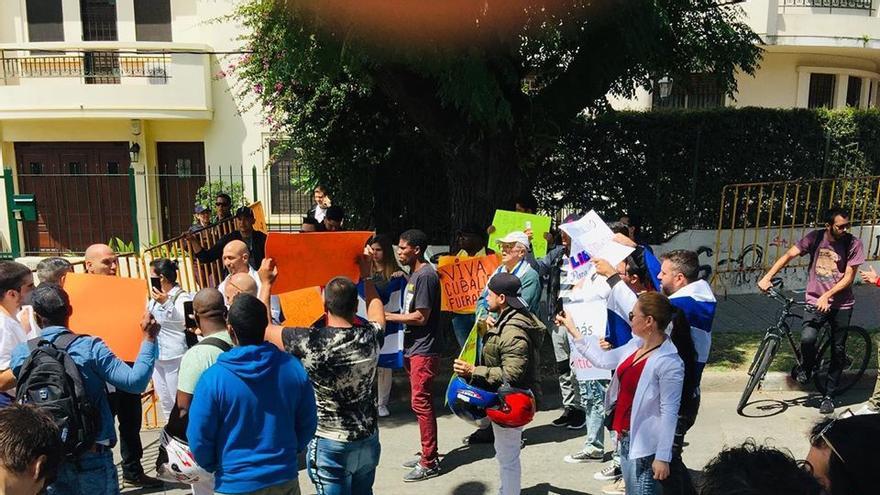
Cuba, Protests Against Totalitarianism

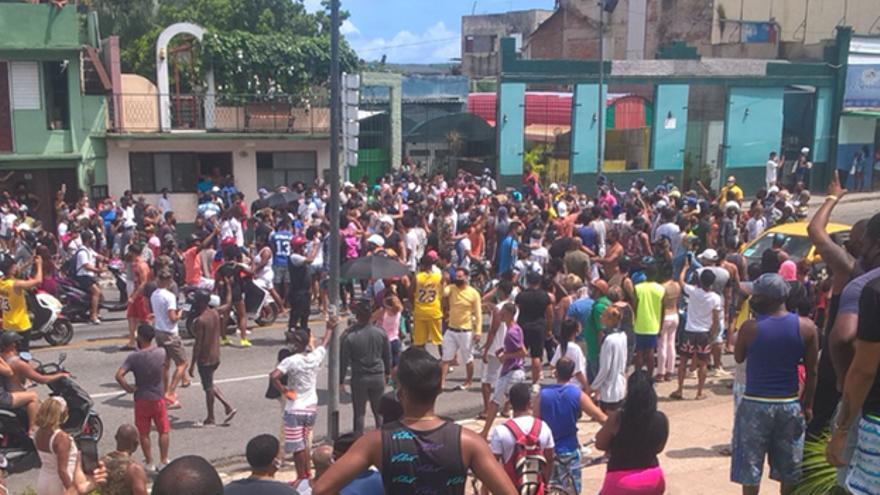
Protesters in Santiago de Cuba, on July 11, 2021. (Screen capture)

14ymedio bigger14ymedio, Pedro Corzo, Miami, 17 July 2022 — The protests of July 11, 2021 were a glorious feat for all of us who reject the Castro totalitarian regime.

That bravery, to a certain extent, neutralized the criticisms issued by some about what they describe as the extreme passivity of the Cuban people in the face of an iron dictatorship — an unpleasant saying, but one that reflects a real perception of what is happening on the island.

Without pretending to justify what must be criticized, the cowardice and apathy of many, we should brandish the epic courage of men and women who have never stopped confronting Castro totalitarianism.

Many have been martyrs in this bloody process and even more so the political prisoners who have served years behind bars in these more than six decades, including the large number of young people trained under the Castro regime who populate prisons for refusing to submit to tyranny.

It’s true that for so many years there have been few protests, but it’s an irrefutable truth that the more closed the regimes of force are, the more difficult it is to oppose them, and a totalitarian regime like the Cuban one, which has been able to establish strict social and police control, doesn’t cede space but must be taken away, which has a high human cost as history has shown.

The average Cuban, apparently, has concluded that it’s better to conspire to overthrow the regime than to participate in a media demonstration, because it’s as criminal to the Castro authorities to take to the streets demanding freedom as it is to participate in a plot to overthrow the tyranny. Other dictatorships brutally beat protesters and imprison them for hours; on the island of the Castros, the beating is joined by long years of sentences to be served under subhuman conditions. continue reading

Young people in prison for participating in barely-known protests or in other high-profile protests are in the same condition as artists who, through their creations, manifest dissent and freedom of opinion.

The first anniversary of the protests of July 11, 2021, lead us to remember some of the popular demonstrations against Castroism, many of them forgotten by the long years that have passed and whose protagonists have mostly left for eternity.

Lost in the mists of time is the protest organized by mothers, wives and daughters, in January or February 1959, to demand an end to the shootings.

In February 1960, discontent with communist penetration into universities materialized with a protest organized by students in the Central Park of Havana, on the occasion of the visit to Cuba by the Soviet Deputy Prime Minister, Anastás Mikoyan. In October, the students demonstrated again in Santa Clara, against the execution of five captured guerrillas, including the president of the FEU of Las Villas, Porfirio Ramírez Ruiz. That same year, the electricity sector carried out a massive march in the capital rejecting the regime’s measures against workers.

In 1961, the provinces of Oriente and Camagüey were the scene of student protests against communism and, in September of that same year, parishioners and Catholic organizations organized a procession in the church of La Caridad, in Havana, which had been banned by the authorities. However, the religious walk occurred with exclamations of “Long live Christ the King,” “Cuba Yes, Russia No.” The authorities reacted violently and shot dead the young Arnaldo Socorro.

In June and July 1962, the cities of Cárdenas and Perico, in Matanzas, were shaken by large protests, and in Cárdenas the regime took out tanks to repress it, a legacy that had its climax in the great protests of July 11 of last year, with its sad aftermath of numerous wounded and hundreds of prisoners, many minors.

Translated by Regina Anavy

____________

COLLABORATE WITH OUR WORK: The 14ymedio team is committed to practicing serious journalism that reflects Cuba’s reality in all its depth. Thank you for joining us on this long journey. We invite you to continue supporting us by becoming a member of 14ymedio now. Together we can continue transforming journalism in Cuba.
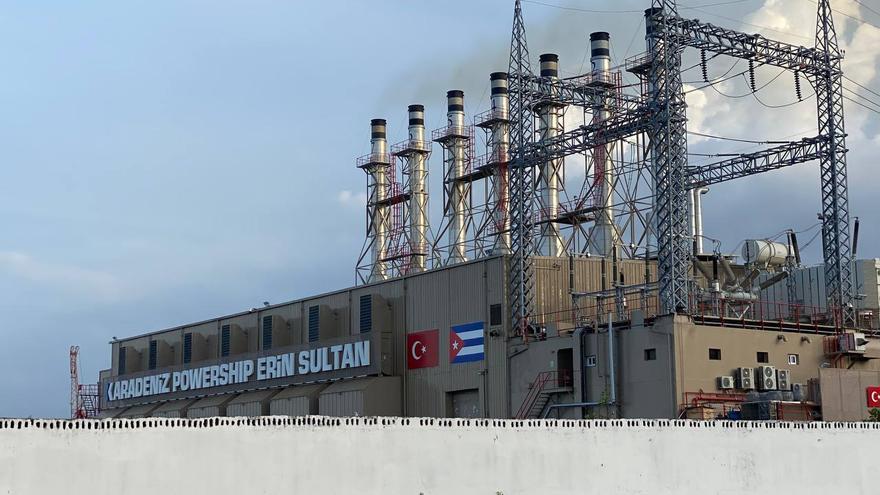
For the Government, the Problem of Light is ‘Complex’; For Cubans It’s Unbearable

Turkey has so far sent five floating generating plants that are strengthening the system. (14ymedio)

14ymedio bigger14ymedio, Havana, 19 July 2022 — The fire in unit 2 of the Lidio Ramón Pérez plant in Felton (Mayarí) has been “a hard blow” for the Cuban electrical system, and repairing it “will not be a quick process. It will take us at least more than a year to recover that boiler and put the machine into generation,” warned Edier Guzmán Pacheco, technical director of the Electric Union of Cuba (UNE), on national television on Monday.

The technician appeared with the Minister of Energy and Mines, Liván Arronte Cruz, head of the most unstable sector at the moment on the island, who spoke last night to give explanations to a population fed up with the situation — generated by the endless blackouts and power outages — that for the official is “complex and tense, but has a solution, which is not immediate, but gradual.”

Arronte recalled that Felton 2 has a high generating capacity (about 255 MW per hour) that has been lost since the accident, of which he gave details last night. The unit, which had been subjected to maintenance and entered the system at the beginning of July, suffered a “fracture in a fuel return pipe of the burners, causing significant damage to one of the four main columns of the boiler,” which put an end to the forecasts that the Government had made, since even the reserves were lost.

Guzmán Pacheco explained that the maintenance work on the unit lasted a month longer than expected. When finally, and after several more inconveniences, it was going to come into operation, they shut down the boiler to change the gas. At that time, one of the elbows of the pipe failed, and the fuel spilled on the boiler, which was turned off but still hot, resulting in a big fire.

Although the firefighters managed to control it in 15 minutes, the intensity of the fire was great. “The flame had a direct impact on one of the columns that supports the structure of the entire boiler, which failed to move on the vertical axis more than a meter, causing the movement of all the columns of the boiler.” It could have been even worse, the official explained, and the boiler could have collapsed, but the risks persist, since the structure is damaged and could still fall. continue reading

The technician explained that there are parts of the boiler, such as air heaters or fans, that aren’t damaged, but the situation is being evaluated to determine the consequences and how long it will take to recover.

More dedicated to the political side, Minister Arronte Cruz reviewed the well-known data, such as that the reserves are non-existent, that the national system operates at less than 40% of its capacity — with an availability of around 2,500 MW of the 6,558 MW installed; that the plants should have been retired years ago and that the country must invest large amounts of money in energy because “the blockade” forces them to bring the fuel from further away, the value of which is not included in the 250 million dollars per year that the system costs to maintain.

“The last ships we have been able to acquire cost around 64 or 67 million dollars and bring about 40,000 tons, which are enough for a maximum of 10 days of consumption in the country. It costs us almost 30% more, because we have to bring it from distant markets,” he said. Last Thursday, a shipment of 700,000 barrels of Russian fuel arrived on the island, although this is not the fuel used in power plants. The minister did not mention the free oil that has been received from Venezuela for more than 20 years and that, although in dwindling amounts, still reaches the island.

Electricity generating plants were also discussed on State TV’s Roundtable program, not to mention that it was Fidel Castro’s idea to develop this program during the years of the so-called energy revolution. The director, Arles Luna Leiva, gave plenty of technical details about the system, which consists of 1,334 MW in diesel, of which only 560 are obtained per day (944 groups in 154 power plants), and 1,272 MW in fuel that generates just 300 MW (507 groups in 35 power plants). There are 752 groups out of service for different reasons, ranging from breaks to lack of maintenance.

“In the distributed generation there are no projections of foreign investment at the moment,” the official said. Turkey has so far sent five floating generating plants that are strengthening the system, but the deficiency is so great that the problems are not solved with the approximately 15 MW provided by each of these structures.

Cuban energy managers said last night that they were concerned about the long hours without electricity that Cubans spend, although they again asked the population for savings and sacrifice and insisted that they maintain a constant communication policy to try to affect the lives of citizens as little as possible, even at this time of year when, they said, the climate considerably affects electrical structures, causing more breakdowns than expected.

They said that’s what happened in Los Palacios last Thursday, when the four- or five-hour cuts in electricity planned in the municipality were joined by a break as a result of a storm. Users, as reflected in the multiple comments on the news of the electricity deficit, claim that the provinces, where power outages are longer, are being punished to the extreme. That claim was reflected in a statement from the Trotskyist group, Communists of Cuba, which stated on Friday that the restrictions are in place where the population expressed less discontent on July 11 (11J) of last year, such as in Pinar del Río, where there were no demonstrations.

In the program, the specialists offered a detailed schedule of how maintenance and repair actions will be carried out that should lead to energy recovery, but a dialogue between two readers of Cubadebate this Sunday reflected with great precision the problem of the country’s energy system and in much fewer words than those used yesterday by officials.

“And what happened again to Felton 1?” one asked. To which another replied: “The same thing that happens to someone who never goes to the doctor and has a problem. It’s cured and another one comes up.”

Translated by Regina Anavy

____________

COLLABORATE WITH OUR WORK: The 14ymedio team is committed to practicing serious journalism that reflects Cuba’s reality in all its depth. Thank you for joining us on this long journey. We invite you to continue supporting us by becoming a member of 14ymedio now. Together we can continue transforming journalism in Cuba.

Uruguay Denies Refuge to Cubans, Allegedly for Economic Reasons

Cubans in Uruguay in 2020, in a demonstration in support of Lidier Hernández Sotolongo, who had been banned from leaving Cuba. (Facebook/Archive)

14ymedio bigger14ymedio, Havana, July 14, 2022 — Only three Cubans obtained refugee status in Uruguay during the first six months of this year. In that period, as published Wednesday by the Montevideo Portal newspaper, the Refugee Commission (CORE) of the South American country denied 89 applications for refuge, of which 82 were from Cubans, who are the most rejected national group with 85% of the total.

The reason for granting asylum to so few nationals of the island, sources from the Uruguayan Foreign Ministry allege to the local media, is the argument that the applicants give in their applications: “What they say in the interview is that it’s for economic reasons, and economic reasons are not reasons that justify refuge.”

The Uruguayan authorities thus ignore not only the scarcity and permanent crisis to which the island is subjected by an economic system that doesn’t work, but also the political persecution of those who disagree with the Cuban government, which increased with the repression of the anti-government demonstrations of 11J (July 11th) last year.

Venezuelans, however and strikingly, are accepted in Uruguay almost in their entirety. According to CORE data, since 2019, asylum has been granted to all Venezuelan nationals who have applied for it except two. From January 1 to May 31, 2022, they were one hundred percent of the applicants, a total of 83.

According to Montevideo Portal, the Refugee Commission has a high demand for refugee applications that could be around 10,000, which it can’t cover.

With Uruguayan law, Right to Refuge and Refugees, which the publication cites, the process of requesting refuge and resolution can take up to four years. continue reading

Under international standards, the administrative process of refuge must be efficient and adaptable, according to the United Nations Refugee Agency (UNHCR), but in practice it involves cumbersome and lengthy procedures.

In contrast to Uruguay, for example, the Spanish Refugee Aid Commission accepted only 10.5% of asylum applications in 2021. It adds that this percentage is an increase compared to 5% the previous year. It also clarifies that for the previous year’s asylum applications, those requests from countries such as Mali, which had been rejected previously, were favorably resolved.

Translated by Regina Anavy 

____________

COLLABORATE WITH OUR WORK: The 14ymedio team is committed to practicing serious journalism that reflects Cuba’s reality in all its depth. Thank you for joining us on this long journey. We invite you to continue supporting us by becoming a member of 14ymedio now. Together we can continue transforming journalism in Cuba.