Diana Meizoso, with her daughter, Elizabeth, who was killed in the Bahía Honda (Honda Bay) massacre. (Facebook/diana.mean)
14ymedio, Madrid, 10 November 2022 — Diana Meizoso, the mother of the girl Elizabeth, one of the fatalities of the boat sunk by the Cuban authorities in Bahía Honda, Artemisa, was arrested this Thursday by State Security and taken to its headquarters in Villa Marista, in Havana, her brother Héctor confirmed to 14ymedio.
The young man explained to Radio Televisión Martí that the day before, other survivors of the tragedy were cited. On Thursday morning his sister was taken away, although, he says, “the officer in charge promised his mother that they would return her at the end of the investigation.” The agents did not allow anyone from the family to accompany her.
During the last few weeks, Meizoso, who saw her two-year-old daughter die after the raft on which they had left for the United States was attacked by the Cuban Border Guards on October 28, has had no qualms about talking to the media to tell what happened.
“They rammed the boat and broke it in the middle,” the woman said in an interview with Radio Televisión Martí, who detailed how one of the Cuban officers warned, before turning around and heading towards the boat of the balseros [rafters] and destroying it: “Now I’m going to break them in the middle.”
Meizoso’s words corroborated both the version given to this newspaper by her brother Hector — “it was not an accident, but murder” — and the version of different organizations of Miami’s exile community, which describe the events as “a crime against humanity.” continue reading
On the boat, in which at least 25 people were traveling, there were ten relatives of Meizoso, of whom three died: in addition to Elizabeth, Yerandy García Meizoso and Aimara Meizoso. Four others — Israel Gómez, Indira Serrano Cala, Nathali Acosta Lemus and Omar Reyes Valdés — lost their lives, and one more remains missing.
Considering them responsible for what it considers a “cold-blood murder,” the Foundation for Human Rights in Cuba has on its list of repressors four officers of the Border Guard Troops: Raidel Rodríguez López, Leovanys Cutiño Rodríguez, Jorge Argelio Samper Muarra and Jorge Luis Navarro Nolasco.
Translated by Regina Anavy
____________
COLLABORATE WITH OUR WORK: The 14ymedio team is committed to practicing serious journalism that reflects Cuba’s reality in all its depth. Thank you for joining us on this long journey. We invite you to continue supporting us by becoming a member of 14ymedio now. Together we can continue transforming journalism in Cuba.
Pérez thanked each of the six directors of Cuentos de un día más [Tales of Another Day], who performed the work “in very, very limited conditions, but with a lot of heart.” (Lataff)EFE (via 14ymedio), New York, 12 November 2022 — The feature film Cuentos de un día más, by a collective of Cuban independent filmmakers, won the coveted award for Best Film at the Havana Film Festival in New York this Thursday.
The film, which was made under the coordination of director Fernando Pérez, presents six stories about Cuban society during the COVID-19 pandemic and competed with 24 films for the Havana Star Award.
The jury, which evaluated the films in the fiction category, pointed out when announcing the prize that “this is a film that poetically portrays the deadliest chapter of contemporary health history.”
“The world was impacted by the pandemic, and this is a beautiful record of that collective suffering and a visual document of how humanity tried to adapt and keep going. For all that, Cuentos de undíamás wins the award for Best Film,” they noted.
Pérez, director and writer, who was not present at the award ceremony, sent a video message in which he thanked each of the six directors who performed the work “in very, very limited conditions, but with a lot of heart.” continue reading
He was also pleased because, a year after the film was made, “we can now go to the cinema to see movies like this.”
The Havana Star Award for Best Director went to Diego Lerman for Elsuplente [The Substitute] (Argentina), for which he was also a screenwriter. The film revolves around a teacher from Buenos Aires who must abandon his duties when one of his students is threatened by a local boss.
The awards for Best Actor and Best Actress went to Roberto Quijano for AmoryMatemáticas [LoveandMathematics] (Mexico) and to Barbara Colen for Fogaréu [Flame](Brazil).
Quijano, Mexican, pointed out that the festival “was a great experience,” as was receiving his first award. “So I treasure this in my heart.”
In Amorymatemáticas, directed by Claudia Sainte-Luce, Quijano gives life to a musician who had a moment of glory with a song and abandons his passion to be with his wife and baby.
The award for Best Documentary went to Clare Weiskopf and Nicolas Van Hemelrick for Alis [Alice] (Colombia), and Special Mention in that category went to Squatters/Okupas by Catalina Santamaría, a co-production of the United States and Colombia.
Dominican director Natalia Cabral and the Spaniard Oriol Estrada won the award for Best Screenplay for Una película sober parejas [A Film about Couples].
The 22nd edition of the Havana Film Festival, which presented more than 30 films from ten Latin American countries and Latinos in the United States, concluded yesterday with the award ceremony in a movie theater in Manhattan. Also presented was the world premiere of the documentary LaHabanadeFito, [Fito’s Havana] by Juan Pin Vilar, a co-production of Cuba and Argentina, about the memories of the Argentine singer-songwriter in his relationship with Havana.
The director wasn’t present, but the well-known Cuban film critic Frank Padrón presented the documentary and stressed that Pin Vilar has “a special sensibility for musicians” and recalled that in addition to various works for television he made a documentary about the singer-songwriter Pablo Milanés.
“Now he has a very special approach to an Argentine singer-songwriter closely linked to my country: Fito Páez, a reference point for several generations in Cuba,” he said.
Padrón was also proud that this was Cuba’s night, winning the Best Film award and closing the festival with another Cuban film.
Translated by Regina Anavy
____________
COLLABORATE WITH OUR WORK: The 14ymedio team is committed to practicing serious journalism that reflects Cuba’s reality in all its depth. Thank you for joining us on this long journey. We invite you to continue supporting us by becoming a member of 14ymedio now. Together we can continue transforming journalism in Cuba.
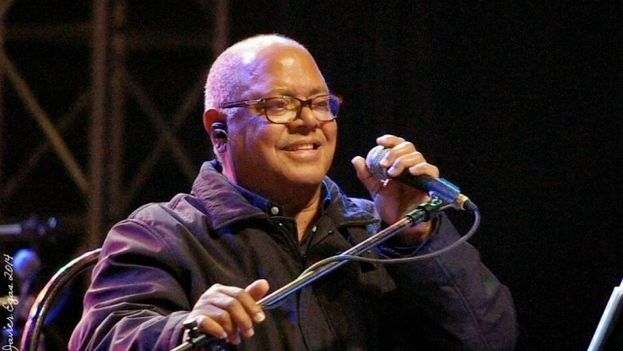
Caption: Milanés sang for the last time in Cuba last June, in a concert not without controversy and tensions. (Archive of Pablo Milanés)
14ymedio, Madrid, 11 November 2022 — Cuban singer-songwriter Pablo Milanés, 77, is hospitalized in Madrid and has been in delicate health in recent months with various infections, due to his disease, a type of cancer, myelodysplastic syndrome, which decreases his immune response, according to family members. The artist, who suffers from inflammation of the gallbladder and a kidney infection, has had to cancel his upcoming concerts.
However, another nearby source reassures, “at this moment his health is under control, and we hope that he will be discharged soon.” It was to receive cancer treatment that Milanés moved five years ago to Spain, where he currently resides.
Milanés’ medical situation has forced him to cancel several concerts he planned to give in Spain and the Dominican Republic. “That has depressed him a lot,” says the same source, interviewed by this newspaper, “but now the important thing is that he achieves an improvement that allows him at least stability.”
The family announced that it will soon issue a press release on the musician’s official networks to “generate calm” about the artist’s hospital admission. continue reading
Milanés had to cancel a concert in Santo Domingo on December 5, initially scheduled for September, which also was delayed due to his health.
“The local production company, in full concordance with the artist’s office, decided to cancel the date,” Alfonso Quiñones reported in the Dominican newspaper ElCaribe. The musician “had to be hospitalized in Spain,” added the journalist, who noted that his shows in the Spanish cities of Pamplona and Granada were also canceled.
For its part, the DiariodeNavarra also reported on the cancelation of the concert in Pamplona, on November 13, and attributed it to an alleged “intestinal indisposition recently suffered which required the artist to rest due to medical indications.”
Milanés sang in Cuba for the last time in June, in a concert not without controversy and tensions. The crowded performance, with a strong police and State Security presence, finally took place in the Coliseo de la Ciudad Deportiva, in Havana, after several protests over the location initially chosen by the cultural authorities, the National Theatre of Cuba.
A large part of the 2,000-seat capacity of the National Theater has been sold to “organizations,” which caused popular discontent and the transfer of the concert to the Coliseo, which has 15,000 seats. Although the show took place normally and Milanés showed no signs of ill health, many attendees agreed that it had the tone of “a farewell.”
Translated by Regina Anavy
____________
COLLABORATE WITH OUR WORK: The 14ymedio team is committed to practicing serious journalism that reflects Cuba’s reality in all its depth. Thank you for joining us on this long journey. We invite you to continue supporting us by becoming a member of 14ymedio now. Together we can continue transforming journalism in Cuba.
Image released by the Cuban Foreign Ministry of the meeting of the Deputy Minister of Foreign Affairs, Carlos Fernández de Cossío, with American officials this Wednesday. (MINREX)
14ymedio, Madrid, 10 November 2022 — The two senior American officials who were in Cuba these last two days not only talked to their counterparts on the island about migration. According to a statement released on Wednesday by the U.S. Embassy in Cuba, Rena Bitter, Undersecretary of Consular Affairs of the State Department, also expressed to the Cuban officials their “concern” about the human rights situation and asked the Government to “unconditionally release” all political prisoners.
Both Bitter and Ur Mendoza Jaddou, director of the U.S. Citizenship and Immigration Service, visited Havana at the end of a work tour that also included Guyana and Miami.
At their meetings on the Island, the officials discussed issues such as the complete resumption of immigrant visa procedures at the Embassy in Havana, beginning on January 4, and diversity visas. In addition, they advanced the resumption of the processing of K visas for fiancés in the same diplomatic headquarters.
Both met on Wednesday with the Cuban Deputy Foreign Minister, Carlos Fernández de Cossío, the Chancellery reported in a statement, which doesn’t allude to the issue of human rights, as the U.S. statement does.
On the contrary, the document alludes to the suspension five years ago, by the previous U.S. Administration, of the consular services “under a pretext discarded by scientists and official reports,” the so-called “Havana Syndrome,” the health incidents suffered by American and Canadian diplomats, which Cuba denies. continue reading
The Deputy Foreign Minister also reproached its northern neighbor for having granted Cubans in recent years only about 4,000 visas per year, when “in the 1984 immigration agreements the United States committed to grant at least 20,000 visas per year.”
The lament continues: “In the last five years, Cubans were forced to go to third countries for all their procedures, which increases the costs, without certainty of approval, and there are those who are committed to an irregular migration that puts lives in danger,” he said, referring to Guyana and the Cubans who leave through Nicaragua and on boats.
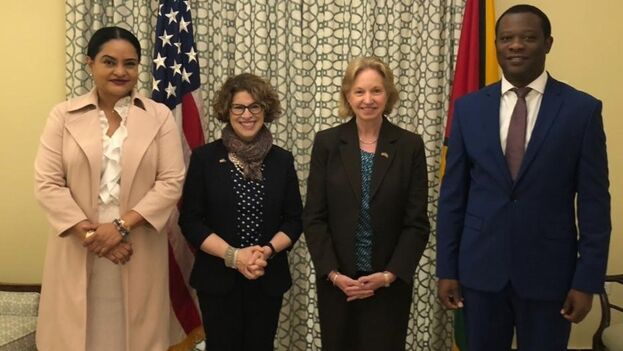
In Georgetown, on Monday, the U.S. diplomatic headquarters published a photo of Bitter and Mendoza Jaddou along with the Minister of Human Services and Social Security of Guyana, Vindhya Persaud, and the Minister of Foreign Affairs, Hugh Todd, indicating in a message that they discussed the process of international adoptions of The Hague and “reduced waiting times for nonimmigrant visas in Guyana.”
The exodus from the Island has exceeded 224,000 people in just one year, a figure that is far greater than the previous major migratory waves of the Island, in 1980 and 1994, and one that grows day by day.
Translated by Regina Anavy
____________
COLLABORATE WITH OUR WORK: The 14ymedio team is committed to practicing serious journalism that reflects Cuba’s reality in all its depth. Thank you for joining us on this long journey. We invite you to continue supporting us by becoming a member of 14ymedio now. Together we can continue transforming journalism in Cuba.
The 38th edition of the Havana International Fair (FIHAV) will be held from November 14 to 18, 2022. (FIHAV)
14ymedio, Havana, 10 November 2022 — Few revelations were made this Wednesday night on Cuban State TV’s Roundtable program dedicated to the Havana International Fair, which opens next Monday at Expocuba.
The appearance on the program of the Minister of Foreign Trade and Foreign Investment, Rodrigo Malmierca Díaz, raised the expectation that some of the most interesting issues surrounding this fair would be reported, such as who the American exhibitors will be. His presence, at the end, seemed to justify itself more by taking seriously the Cuban government’s promise to pay its debts to its investors.
“They [the investors] have been informed that late payments or other problems in fulfilling the commitments made will be resolved gradually,” Malmierca seriously assured after saying that 60 countries and entrepreneurs from different countries will be present, which, in his opinion, is a guarantee of the confidence “that the international community has in doing business in the Cuban market despite the blockade.”
Among the most impressive novelties was the announcement of the presentation, next Wednesday, of a new national beer with a joint venture (no details were given), and the expansion of the Mexican meat producer, Richmeat, already present in the Special Development Zone of Mariel, where, in addition, a new joint venture with the British multinational Unilever will be inaugurated, although little about the joint venture was revealed. continue reading
Malmierca gave some figures, including that there are about 400 Cuban companies that will be present at the fair, which will occupy 53,820 square feet. The director didn’t say that the price ranged from 335 to 1,345 pesos per square foot, depending on the location and the benefits, moderate prices compared to other fairs of its kind.
Antonio Carricarte Corona, president of the Cuban Chamber of Commerce, delved into the national data and explained that the companies of the Island participate in two modalities, that of “presence on the stand,” with 227 companies of which five are SMEs [small and medium-size businesses] and three are non-agricultural cooperatives; and that of “professional visitor,” with 177 companies, including 46 SMEs.
“In the case of micro and small companies, they are the ones with the greatest potential for export within their economic activity,” the minister said, while Carricarte said that “for Cuban companies it’s an excellent opportunity, because the fair gives them visibility and the possibility of establishing links with other entities.”
The foreign countries most represented in the commercial exchange are China, Russia, Spain, France, Canada, Mexico, Brazil and Venezuela, but there are also two new ones, the United Arab Emirates and Laos. “There are more than 25 official delegations chaired by ministers, deputy ministers and even a vice president and secretaries of state,” Malmierca boasted.
He was more restrained in the case that attracts the most interest, that of U.S. companies, announced weeks earlier. “Not a large number, but yes, there are already nine confirmed that will participate as exhibitors, and some others that will participate in the fair through different delegations,” he said.
In parallel, as in every year, the fifth investment forum will be held, where the new portfolio of business opportunities with foreign capital will be presented.
The president of the Chamber of Commerce advanced some more projects, including a renewable energy project “which is based on the circular economy with the use of biomethane gas for transport exploitation,” and a platform to export organic coffee using blockchain technology.
Eduardo Correa González, president of the Palco group, was also on the Roundtable program to give some data on the logistics of the fair, in which they have “relied on the support of both the state and the SMEs, which also helped to make the facilities operational.”
Translated by Regina Anavy
____________
COLLABORATE WITH OUR WORK: The 14ymedio team is committed to practicing serious journalism that reflects Cuba’s reality in all its depth. Thank you for joining us on this long journey. We invite you to continue supporting us by becoming a member of 14ymedio now. Together we can continue transforming journalism in Cuba.
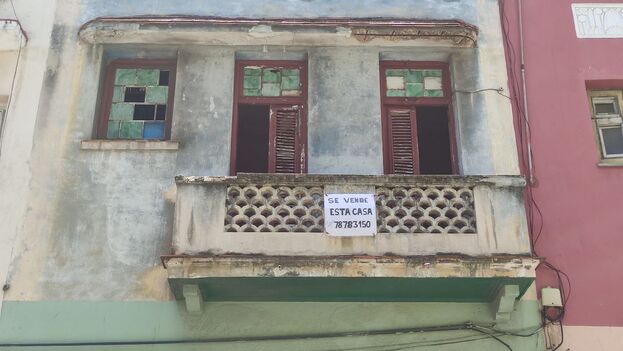
Not only to be able to afford a plane ticket, but also to avoid the loss of property, Cubans who emigrate sell their houses at a very low price. (14ymedio)
14ymedio, Havana, 10 November 10, 2022 — “My sister left, closed her house, and I am taking care of it, but if she doesn’t return in 24 months she will lose it,” says María Clara, a 65-year-old woman from Havana who also has a nephew’s apartment under her care. The mass exodus has spread this phenomenon and also low-priced sales to be able to pay for travel expenses, a trend that could change with the new housing legislation studied by the Cuban Government.
“A commission of lawyers, experts on the subject of housing, has been formed to suggest changes that fit the current scenario of large numbers of emigrants,” says a law graduate linked to the Land Registry, who prefers to remain anonymous.
“We are now in the proposal phase, but the guidance we have received is that it’s about adjusting the current legislation so that it contemplates the possibility of making the issue of property and its conservation in the hands of those who spend some time abroad more flexible. We are still in the preliminary phase, although we have been told that everything could be approved very quickly.”
Among the proposals made by some of the lawyers involved in the commission is to allow the same person to own more than one home, something that is only allowed now if it’s a house in the city and another in a rural or beach area. “In that way, the family member who remains in Cuba could assume the ownership of the house and be able, in addition to taking care of it, to carry out all kinds of legal arrangements on it.”
With an unprecedented exodus — about 200,000 Cubans have reached the southern border of the United States since January — the Cuban real estate landscape highlights the challenges posed to the country by the massive departure of so many residents. “The number of powers over homes, vehicles and other properties has multiplied significantly,” recognizes an employee of the notary on 10th Street, between 15 and 17, in El Vedado. continue reading
“They arrive early in the morning and mark their spot in line, especially to leave a power of attorney to a family member so he can sell the house, rent it or donate it, as the case may be,” the same source adds. “They are people who haven’t decided to dispose of their property because they don’t know how migration will go, or people who, although they have tried to sell their house, haven’t been able to, because the real estate market is saturated with offers.”
“Normally they leave the power to a family member or a friend, but the case is already happening of a person who has several powers for several relatives and, on top of that, must physically take care of the homes that are in his care, which makes everything more complicated,” explains the notary worker. “We have to look for a solution to all this, and relaxing the time of 24 months that the person can stay outside the country without losing his property is a first step.”
The perception that the two-year barrier has become narrower is widespread, especially on an island where the numbers of migrants can continue to grow as many commercial flights stopped or cut by the pandemic are restored.
“The market is notable by the rush, the rush of the one who wants to leave and must sell before getting on the plane,” says Liuba, 35, who acts as an intermediary between sellers and home buyers. “But we also have to do business not just with the owner but also with the person to whom he left the power to decide on the house. It’s an increasingly common phenomenon.”
Authorizing Cubans to stay abroad longer without losing their residence on the Island and allowing them to have more than one property would be a way to “relieve this problem a bit and, above all, encourage people who are leaving not to feel that it’s forever, that they have a place here to return to,” Liuba considers.
Recently, Ernesto Soberón, general director of Consular Affairs and Attention to Cubans Living Abroad of the Ministry of Foreign Affairs, announced, during a meeting with emigrants from the Island in Uruguay, that Cuba was working on a citizenship law. The official assured that in the next Legislature of the National Assembly, which begins in 2023, a passport and immigration law will be approved.
Although the announcement has provoked a lot of speculation, it shouldn’t be surprising, as the adjustments to this legislation were already expected since the adoption of a new Constitution in 2019. However, the current migration context seems to be rushing the pace and forcing deeper flexibilizations.
“We are working intensively and sending broad proposals that connect not only the issue of home ownership with migration, but also facilitate many procedures related to property to be carried out from abroad,” explains the lawyer linked to the commission that prepares the new road map.
“But what is proposed, what is finally legislated no longer corresponds to us. That is decided “up there,” he recognizes. “I have several colleagues, excellent lawyers, who were proposed to be part of the commission and declined, because on other occasions they have sunk up to their knees in countless documents, and laws have been studied, but in the end their proposals have not been accepted.”
For this expert on property issues, “there is a pressing need to relax the right to several properties and the time frame abroad, but I don’t know if the Government is aware of the urgency.”
Translated by Regina Anavy
____________
COLLABORATE WITH OUR WORK: The 14ymedio team is committed to practicing serious journalism that reflects Cuba’s reality in all its depth. Thank you for joining us on this long journey. We invite you to continue supporting us by becoming a member of 14ymedio now. Together we can continue transforming journalism in Cuba.
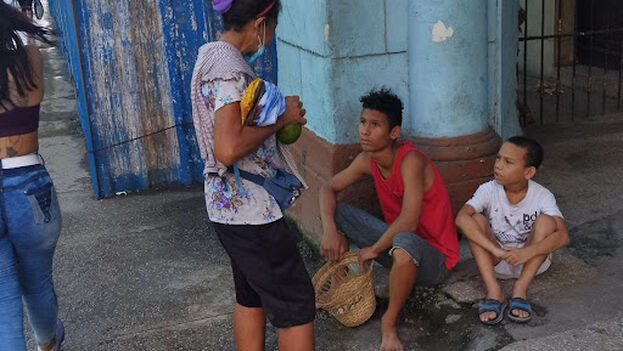
At the corner where the child beggars operate, an infirm lady arrives and scolds them for begging. (14ymedio)
14ymedio, Juan Izquierdo/Juan Diego Rodríguez, Havana, 9 November 9, 2022 –Ragged, with hollow eyes and a slightly hoarse voice, two children ask for money in Central Havana. The older may be fourteen or fifteen years old, the younger not more than eight. One is barefoot, with curly hair and a face stained by dirt. The other wears a pair of tattered flip-flops.
They ring a bell and extend a wicker basket, taking advantage of the activity at Belascoaín and Carlos III. At the corner where the child beggars operate, an infirm lady, not very presentable, arrives, and she scolds them for begging. “Where’s your family?” she asks them, without the children being able to respond.
The rate of begging on the Island has skyrocketed tragically, and if before you saw only older men begging in the streets, usually alcoholics, now women, the disabled, psychiatric patients, adolescents and children also do so.
The “homeless’ euphemism which the Government has applied to beggars has proven to be a crude simplification. Although many of them, in fact, live on the streets and sleep in the doorways or corners of a dilapidated building, others beg “as a job.” They are located on central avenues and question not only tourists, but also Cubans.
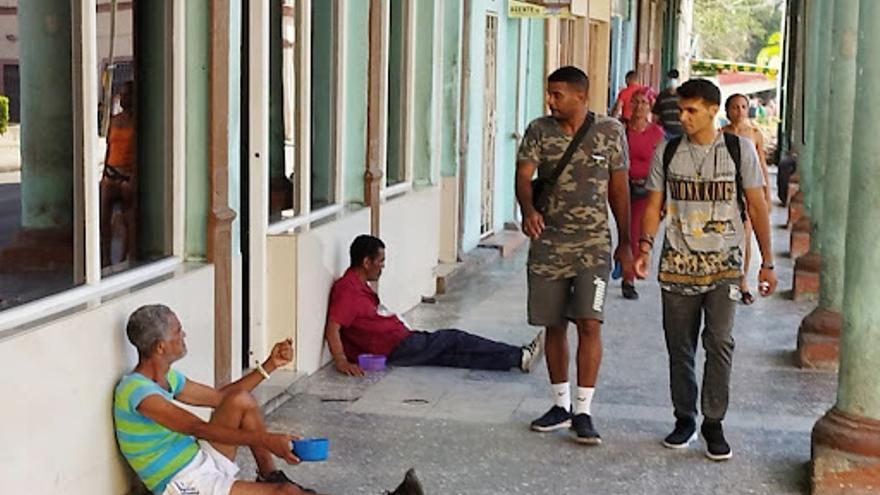
In many cases they are “stationary” beggars; they choose a neighborhood or a specific corner, and learn to take the pulse of their space: the best hours, the faces of passers-by, the precise words to earn a coin or a loaf of bread. continue reading
“Most of the adults are very deteriorated from alcohol and age,” Julia, a neighbor of Central Havana, tells 14ymedio. They are the typical drunks, who always carry their plastic bottle to store the chispa, the alcohol of any category they consume. Most are adult men.”
In many cases they are “stationary” beggars: they choose a neighborhood or a specific corner, and learn to take the pulse of their space. (14ymedio)
The reason that begging has proliferated so much, says Julia, is due both to the resounding crisis that is going through the Island and the closure of several old-age homes in Havana. “These are things that have a lot to do with it: the collapse of the economy, the emergence of poverty and the forced parental responsibility in the new Family Code. Everything is designed so that the State can wash their hands,” she says.
“On the ground floor of my building,” the woman says, “several beggars ’alternate’. There was an old and very sick one, with a tube from his urine collector, always stained with a bloody liquid. He slept between cartons and right there he urinated and defecated, right in front of the front door.”
Like other neighbors, Julia avoids leaving the building when the beggars are “on guard.” A recent episode of violence confirms this forecast. “Recently, a neighbor came down at ten at night to throw out the garbage and one of them took advantage, pushed the door and tried to enter the building. I don’t know what he intended, whether to lie inside, urinate or settle on the roof.”
“The neighbor tried to bar the way and the man became aggressive. Since then, we never take out the garbage at night,” explains Julia.
One of the variants of poverty in Havana is the “beggar sellers.” (14ymedio)
Faced with government rhetoric, which closes its eyes to extreme poverty on the Island, the woman insists that there have always been beggars, but now they are increasingly aggressive, and it’s common for them to become “fixed tenants” of doorways and buildings. Even so, they still frequent the “boulevards for beggars” of Havana: Infanta, Carlos III, Belascoaín streets and other central avenues.
“Cubans don’t have a culture of giving money to beggars,” Julia adds. Children are always warned that beggars want someone else to “pay for their vices,” and they use that capital to buy rum or cigars. That’s why it’s uncommon for passers-by who walk through Havana’s long covered sidewalks to place a banknote in the baskets that the homeless extend.
One of the variants that poverty adopts in Havana is that of the “beggar-sellers,” sitting on the ground outside the buildings. “The most notorious thing about their ’goods’,” says Julia, “is that they’re things that are old, used, sometimes dirty, in a variety that goes from pots, casseroles and other kitchen utensils, to equipment, plugs and, of course, broken shoes and old books.”
Translated by Regina Anavy
____________
COLLABORATE WITH OUR WORK: The 14ymedio team is committed to practicing serious journalism that reflects Cuba’s reality in all its depth. Thank you for joining us on this long journey. We invite you to continue supporting us by becoming a member of 14ymedio now. Together we can continue transforming journalism in Cuba.
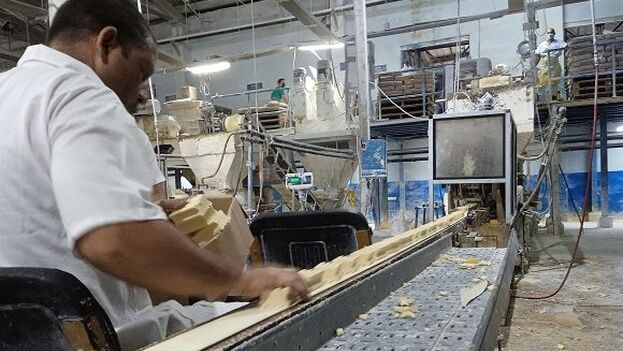
The shortage of the product is mainly due to the Government’s deficient management of production. (Cubadebate)
14ymedio, Juan Diego Rodríguez, Havana, 9 November 2022 — Soap is another of the basic products that are disappearing from Cuban stores. The few bars available are sold on the black market at prices that are unaffordable for most people: more than 90 pesos for laundry soap and 80 pesos for personal-use soap.
Luis’s neighbor spent two weeks asking him for help to get a bar. “She practically begged me to find one for her, because she hasn’t bathed in 15 days,” says this Centro Habana resident.
Luis usually buys a large number of bars, because when he gets to stores that only take payment in freely convertible money (MLC) “there’s a long line. At home we don’t use the rationed soap, which itches tremendously, but there are people who have to bathe with it,” Luis says.
The shortage of the product is mainly due to the poor production managed by the Government. The Basic Business Unit (UEB) Suchel Cetro, in Habana del Este, had plans to develop 13,383 tons of washing soap for this year, but in October it had only achieved 44.6% of the quota, with a little more than 5,978 tons. continue reading
The same difficulties are present in the production of toilet soap: the company had a plan of 10,200 tons this year, and it has only produced 4,970, tons, 47% of the goal. “The main cause is the increase in the price of the raw materials necessary for this product,” apologized Alexander Puig Varona, director of the UEB, in a post in Cubadebate where, according to the media, he sought to clarify the doubts of readers about the shortage of the product.
Cuba imports most of the raw materials it needs, mainly base soap chips, which, due to the pandemic, it has not been able to acquire in the amount required to boost manufacturing. Nor does it keep the Cuban chip plant operational, Puig Varona explained, because it’s “impossible” to bring in the tankers with the fat.
Given the shortage of antiseptic, in Guantánamo, the Labiofam company has resorted to substitute materials to make soap for humans and pets. An example of this is the Jatrophacurcas, a plant imported from the Mexican state of Morelos, acquired with funding from the Swiss Agency for Development and Cooperation (COSUDE).
With four cups of its oil, 418 units were made, of 1 ounce each, in the minimum format of “hotel soap.” This production, which took 30 minutes, was allocated to health and veterinary services, the company reported on Facebook on September 19.
The production also includes a batch of soap made from neem, a plant native to India with medicinal properties. A production of 5,000 bags of 8 ounces of soap was planned for September.
Translated by Regina Anavy
____________
COLLABORATE WITH OUR WORK: The 14ymedio team is committed to practicing serious journalism that reflects Cuba’s reality in all its depth. Thank you for joining us on this long journey. We invite you to continue supporting us by becoming a member of 14ymedio now. Together we can continue transforming journalism in Cuba.
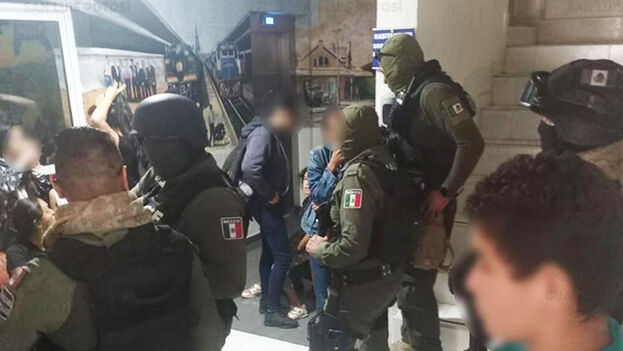
The migrants will be taken on Tuesday night to the U.S. border. (GCE)
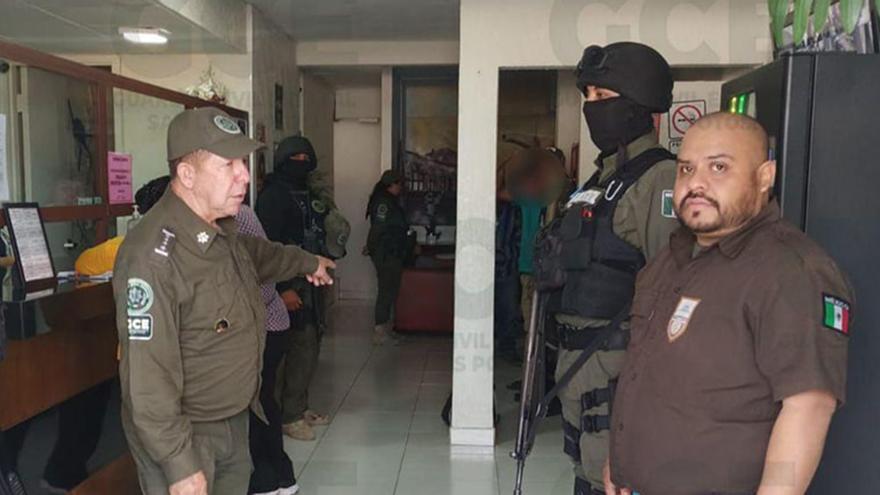
14ymedio, Ángel Salinas, Mexico, 9 November 2022 — On Tuesday, the State Civil Guard of Mexico arrested more than 100 migrants, mostly Cubans, who were abandoned by coyotes in two hotels in the municipality of Soledad, in the state of San Luis Potosí.
“The group waited for the evening to continue on its way to the United States,” said one of the guides, speaking to the clerk of a store where they bought water, ham and bread. The business is located a few feet from one of the hotels.
Contacted by 14ymedio, the clerk, who identified himself as Josué, pointed out that, between Saturday night and early Monday morning, several vans “of Cubans” entered the California Hotel. The establishment is located four minutes from federal highway 57, one of the routes used by coyote networks for the smuggling of migrants, according to what Miguel Gallegos, a spokesperson for State Security, said in May.
Josué specified that on Monday, several Central Americans, mostly men who stayed at the España Hotel, descended from a truck normally used for the transport of cattle. “I know because one entered the store and asked me if I accepted quetzales. That’s when I found out that he was from Guatemala and the others came from Honduras and Ecuador,” he clarified.
“I can’t give you exact numbers, but several groups of between 40 to 60 people per day pass through the municipality. Some stay, others are escorted, like the Cubans,” Josué explained. continue reading
The authorities of San Luis Potosí reported to Migration the detention of Cubans and other migrants. (GCE)
Gallegos pointed out that, because of the increase in roadblocks, the polleros (coyotes) began to use alternate roads, and the state administration is trying to cover the “gaps” used by human traffickers for the transfer to the U.S. border.
On Tuesday, the governor of San Luis Potosí, Ricardo Gallardo Carmona, addressed the immigration issue and reported that the authorities “rescued” more than 100 undocumented people, almost all of Cuban origin, but wondered how they managed to get almost half-way on their journey without having been intercepted by any authority.
From San Luis Potosí, migrants can take the route that brings them to the state of Coahuila and try to cross the Rio Grande through Ciudad Acuña or Piedras Negras. The crossings through Matamoros, Reynosa and Nuevo Laredo are another alternative, but they are controlled by the drug cartels. Several Cubans have told 14ymedio that the Gulf Cartel uses keys and colored bracelets for the passage of migrants, depending on the payment they make for the transfer.
According to the authorities of San Luis Potosí, the National Migration Institute will take care of the corresponding procedures for the repatriation of irregular migrants.
Translated by Regina Anavy
____________
COLLABORATE WITH OUR WORK: The 14ymedio team is committed to practicing serious journalism that reflects Cuba’s reality in all its depth. Thank you for joining us on this long journey. We invite you to continue supporting us by becoming a member of 14ymedio now. Together we can continue transforming journalism in Cuba.
The Electric Union of Cuba (UNE) again announced that the Antonio Guiteras thermoelectric plant, in Matanzas, stopped working due to a technological failure. (TV Yumurí/Facebook)
14ymedio, Havana, 6 November 2022 — The largest thermoelectric power plant in Cuba, Antonio Guiteras de Matanzas, was disconnected again this Saturday. The Electric Union of Cuba (UNE) reported that its departure from the National Electricity System was due to a “technological failure” that occurred 19 days after its synchronization to the network.
In an article in the official newspaper Cubadebate, the UNE pointed out that Guiteras is still out of the system for maintenance work this Sunday, as are units 4 and 5 of Nuevitas, Camagüey, and unit 3 of Renté, in Santiago de Cuba.
In addition, units 6 and 7 of the Mariel thermoelectric plant, in the province of Artemisa, and the Otto Parellada power plant in Havana are out of service due to breakdowns. Also out of service are unit 3 of Santa Cruz, Mayabeque; unit 4 of Cienfuegos and unit 2 of Felton, in Holguín.
For this Sunday, the UNE forecast is that there will be a generation capacity of 2,100 megawatts (MW) for a maximum demand of 3,100 MW in the peak hour, with which the deficit would be 1,000 MW. That is, 32.2% of the electricity demand required by Cuban households will not be covered. continue reading
The maximum impact on the service on Saturday night was 1,187 MW at 8:20 p.m., coinciding with the peak hour, when 21 MW were not generated due to damage to the plants after the passage of Hurricane Ian.
The Government warned in October that the Antonio Guiteras power plant would be out of the national electrical system for three months for the comprehensive repair of its outdated and defective technology, which makes its operation impossible. The thermoelectric plant has also been affected by the fire in the Matanzas supertanker fuel base and by the passage of Hurricane Ian.
Vicente de la O’Levy, Minister of Energy and Mines, said on October 31 that the “capital maintenance” of Cuba’s largest thermoelectric plant will take place between November 2022 and June 2023. The official assured that the work will be done “with great precision” and will include rigourous diagnoses “without false optimism.”
The exit from operation of the Guiteras plant again raises questions about the ability of the Díaz-Canel Government to fullfil its promise: that by December 2022 the blackouts, exacerbated since last May, will end. The blackouts have been the main trigger for the protests in Nuevitas and other parts of the country.
In the article published by the newspaper, negative comments abound about the plant’s exit from operation. “Didn’t this thermoelectric receive maintenance recently? How is this possible now? Who explains this? Are all failures not technological? No one believes what the electrical company says about maintenance, repairs, etc. Is it a practical joke?” questioned the commentator, identified as Jorge Milanés.
At the end of October, the authorities announced that the Lidio Ramón Pérez thermoelectric plant, also known as Felton, in Mayarí, would stop again for seven days to perform maintenance work, but its unit 2 is already out of service due to breakdowns.
Euclides Rodríguez Mejías, general director of the plant, explained that improving the efficiency of the boiler is the essential objective, specifically high-pressure heaters and recirculating gas fans. After the work, the official added, the block is expected to produce between 250 and 260 MW.
Translated by Regina Anavy
____________
COLLABORATE WITH OUR WORK: The 14ymedio team is committed to practicing serious journalism that reflects Cuba’s reality in all its depth. Thank you for joining us on this long journey. We invite you to continue supporting us by becoming a member of 14ymedio now. Together we can continue transforming journalism in Cuba.
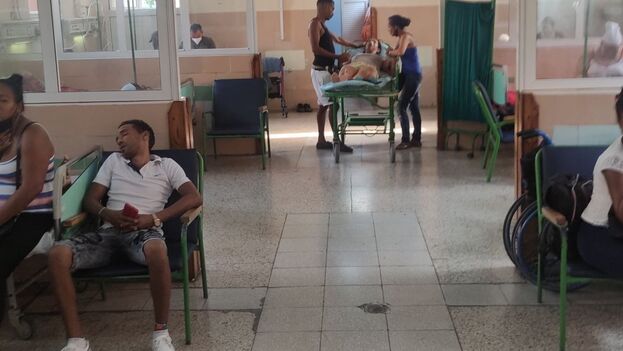
“Everyone was waiting in the hospital corridor without any separation, even a lady full of blisters, as if she had monkeypox.” (14ymedio)
14ymedio, Juan Diego Rodríguez, Havana, 7 November 2022 — Today the General Calixto García University Hospital in Havana is far from being the center of prestige that it once was. Even less does it honor the propaganda that, on official pages, sells its services as “high quality.”
Sandra remembers the week she spent at the Calixto García with her mother, Luisa, as a nightmare. Both resisted going to the doctor, like so many other Cubans, until the woman, about seventy years old, began to run out of breath, and the chest pain she suffered became unbearable.
They took it for granted that they would have to travel by taxi and not by ambulance, given the fuel shortage. What outraged both, as soon as they entered, was that there were not even stretchers. “I had to look for a stretcher and move it throughout the hospital,” Sandra tells 14ymedio. The shortage of personnel, precisely, is something widespread in health services due, above all, to the unstoppable migration.
The wait to go to the consultation was not in a room, but in the middle of the corridor, where the smell of disinfectant was overshadowed by the bad smells and urine coming from the bathrooms. “My nose is very sensitive,” says Sandra, “and that was unbearable.” continue reading
Right there, they observed a whole parade of patients, many of them with severe dengue fever, which this season has ravaged the Island. “Everyone was waiting there, without any separation, even a lady full of blisters, as if she had monkeypox,” the young woman continues. “Without any privacy or anything like it, on a stretcher in the middle of the hallway, they pumped the stomach of a woman who had overdosed with Diazepam. The woman said she wanted to leave all this shit. What can I say, not everyone is strong.”
The worst, however, was yet to come. Luisa, diagnosed with pneumonia, spent the night alone in the hospital. Her daughter, when she went to visit her the next day, observed that her arm was swollen. “It’s very common, they told me, that the needle comes out of the vein and the serum accumulates under the skin,” she says. “The problem is that the nurse told me there were no more needles anywhere and they couldn’t change it.”
Sandra soon knew that “no side” was defeated with a little will… and money under the table. The young woman first approached the supervisor and the deputy director of the hospital. “They swore that they couldn’t change it, that I had to put up with it.” When she turned around, already resigned, an employee of the center, who witnessed the scene, approached her and said: “I can solve that for you, tell me what bed she’s in, wait for me there, I’m going to bring it to you.” Sandra gave her 200 pesos, and another 200 to the nurse who, in collusion with the assistant, gave Luisa the new needle for the drip line.
“They also offered me Rocephin [the antibiotic specifically prescribed for her mother] at 250 pesos per vial, and if I needed a person to stay with my relative, they would also solve it for me,” Sandra explains.
And she adds: “With all that, they tell you any amount, they lie constantly. One day they didn’t give my mother the antibiotic and told her some story. In the morning, in another shift of nurses, I complained, and one said: ’Yes, they gave her the Rocephin, because here in the book it’s recorded’.”
Sandra can’t explain “how a simple hospital employee has the needles, medicines, everything, and yet, the bosses assured me that there was nothing in the hospital. Everything is pure corruption; Cuban hospitals have become a horror.”
As if that were not enough, one morning, several patients’ mobile phones were stolen. “In the same room, in 24 hours, there were three similar robberies,” says Sandra. “If it wasn’t an employee, it was someone disguised as an employee.”
In the midst of the sufferings of their relatives, people were forced to go to an Etecsa (State telecommunications company) office, with the identity card of the patients and a medical certificate stating that they were hospitalized, so that the state-owned company could cancel the phone number and allow them to take out a new line.
Sandra is telling all this, she says, “so that people have an idea of what someone who has a sick relative in this country has to go through. Going to a hospital has become a disaster.”
Translated by Regina Anavy
____________
COLLABORATE WITH OUR WORK: The 14ymedio team is committed to practicing serious journalism that reflects Cuba’s reality in all its depth. Thank you for joining us on this long journey. We invite you to continue supporting us by becoming a member of 14ymedio now. Together we can continue transforming journalism in Cuba.
14ymedio, Elías Amor Bravo, Economist, 5 November 2022 — In a previous post we highlighted the actions of confrontation with illegalities that have been launched by the communist regime in Havana. The state press reported actions of control and monitoring in establishments and points of sale in the capital in the local development project of Recreatur Paseo Marítimo 1ra and 70, in the municipality of Playa, where, among other “illegalities,” workers were detected illicitly selling 39.47 pounds of lobster and nine pounds of shrimp. The official note said that equally abusive and speculative prices were found with excessive profits in products such as soft drinks and canned beers, mineral water and cans of Redbull. We have to see what illegalities are so serious.
As a result, the so-called municipal confrontation groups concerned with the illicit sale of food, hoarding, diversion of resources and abusive prices carried out four confiscations and imposed 41 fines, of which 37 were by the Directorate of Inspection, two by the Provincial Directorate of Finance and Prices and two by the National Directorate of State Inspection of the Food Industry (ONIE).
Another official report said that an operation in the Melones store, in the municipality of Diez de Octubre, found as “illegalities” that workers retained goods, and that 6,129 pesos were missing, corresponding to the sales of the day. In this case, the communist authorities seized 11 packages of chicken, six of minced meat, three cartons of H. Upman cigarettes, 14 Sedal shampoo bottles and three bottles of conditioner, which were later sold to the population.
A night inspection was also carried out in the Cuba-Italia, Ciro Redondo and Gran Esfuerzo bakeries and detected that the standardized bread was low in weight and didn’t meet the quality parameters established in the technical standards charts. For these “illegalities,” master bakers and administrators were fined 8,000 pesos for violating the provisions regarding rules and prices.
There were also sanctions in the area of El Lido, in Havana, where the inspection bodies imposed fines of 8,000 pesos on a group of self-employed, for the fixing of abusive prices. On the other hand, in the municipality of Playa, the owner of a private cafeteria was fined 1,500 pesos for not being able to justify his possession of soft drinks, rums, sweets and cookies with the corresponding invoices. Two forklift operators were also fined 8,000 for establishing abusive prices on the sale of onions (600 pesos per pound), tomatoes (300 pesos per pound), lemons (250-300 pesos per pound) and peppers (350-400 pesos per pound). continue reading
The official note reports that in the Cojímar People’s Council two citizens were detected and arrested for the illegal sale of medicines; and in Guanabo the Police were led to an individual for illegal sale of shrimp. Finally, in an operation carried out at the Víbora Park People’s Council, in the municipality of Arroyo Naranjo, 116 cartons of eggs, 43 packs of detergent, 34 bath soaps, 29 packs of wet wipes and 23 packs of sanitary napkins were dealt with in a home-warehouse.
The official press wants to draw attention to all these “illegalities” without granting to those sanctioned the right to a defense. They are simply fined, which in many cases, amounts to a month’s income.
The logical thing is that many of these producers stop providing their services and, as a result, consumers will find stalls closed and less merchandise to buy. It’s the same story of the last 63 years, and in addition, the communist regime warns of it even in the constitution: in Cuba private enrichment is not allowed.
The informal market can arise to satisfy the social needs not met by the state, but at any time, the authorities can persecute, harass and eliminate it with a stroke of a pen and that’s it. There is no country in the world where it’s so risky to engage in a private economic activity. Yes, the communist regime says it is fighting against “illegalities” that harm the national economy. But this is not entirely true.
For example, add up the amount of those “illegalities” that appear in this article, and you will see that it doesn’t exceed 200,000 pesos [ed note: $8,000 US as of today’s exchange rate]. That may not even be the total figure. We are talking about a ridiculous amount by Western standards, which may not even cover the salaries of police, inspectors and snitches, but in Cuba, the sanctioned will have a very bad time. There is no doubt about it. And this is what is intended with this type of repressive action.
In addition, everything happens because, according to the communist economic model imposed on the country, certain activities are qualified as “illegal” by the government. Of course, these activities aren’t illegal elsewhere, but in Cuba the parameters are different, and it depends on how it looks.
A good example of the parameter of “illegalities” in this case, committed by the regime that punishes Havana sellers, is how, for example, the hotel exploitation system of Cuba works.
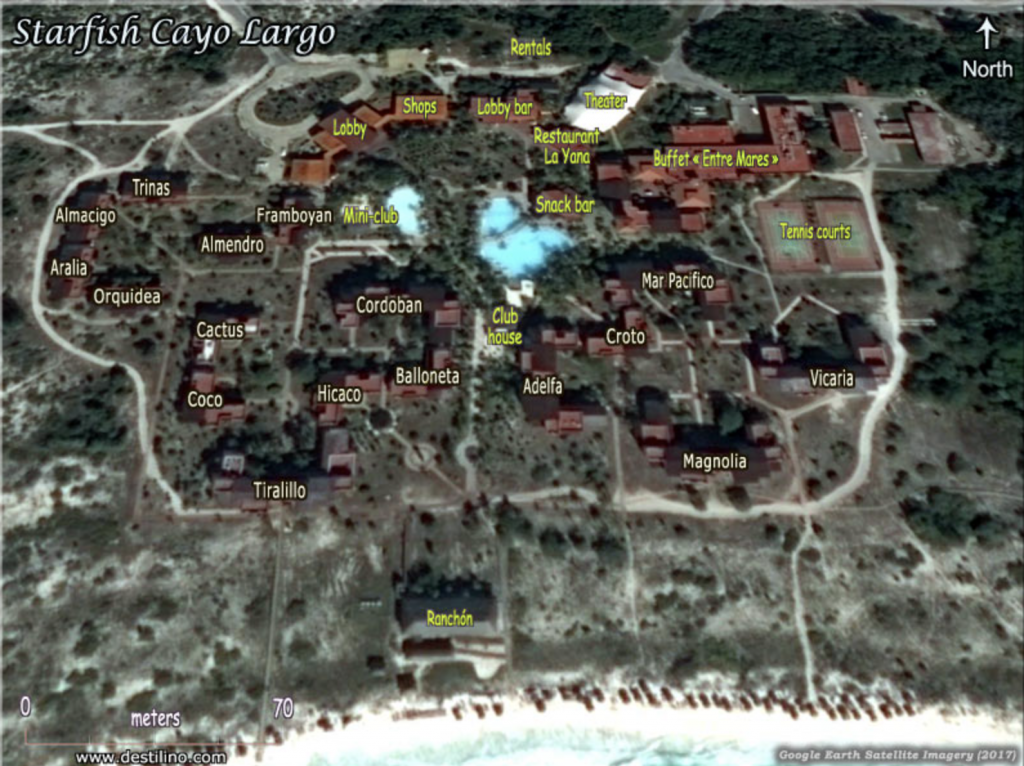
It turns out that the state press these days has reported that Blue Diamond Resorts, exclusively, will begin operations in Cayo Largo del Sur. The Canadian hotel company Blue Diamond Resorts together with its Cuban counterpart in the business, the Gran Caribe Group, whose shareholding is known for its links with the regime, announce that four of 11 renovated properties in Cayo Largo del Sur will open their doors on November 4. The hotels that welcome the renovated destination are Memories Cayo Largo, Starfish Cayo Largo, The Villas Linda Mar and Marina.
When was the bidding and awarding of this business carried out? Was there any kind of oversight or was it awarded by decree. We find ourselves suddenly tongue-tied at witnessing a first “illegality”: in recent months the regime had been planning to transfer the hotels, which supposedly belong to the people, as productive assets to this Canadian hotel group.
In addition, the award has been made according to the global interests of citizens around the world, since Cubans will find the prices beyond their reach when these resorts open. Second “illegality.” Cubans cannot enjoy tourism in their own country.
So with these two sonorous “illegalities,” easy to appeal in independent courts, the first doesn’t invite other international companies to participate; and the second, the objective difficulty that those who are paid their salaries and pensions in Cuban pesos would have to be able to stay in these resorts. However the communist regime pursues the illegalities of poverty, of the eternal “resolving a problem,” of unmet needs, specifically for the Havana merchants, accusing them of illegalities and destroying their small businesses.
On the other hand, the same communist regime, with high-caliber “illegalities,” has made Blue Diamond Resorts Cuba the fastest growing hotel management company in the country, leaving behind other companies that already operated with the favor of the regime.
In reality, when we talk about illegalities in Cuba, we access a whole universe of injustices that have their most evident example in the crony capitalism and illicit pacts that exist in the tourism system. There is no need to think too hard. Someone will have taken a cut from the Blue Diamond deal. From time to time. So yes, there are illegalities… and multimillionaires.
Translated by Regina Anavy
____________
COLLABORATE WITH OUR WORK: The 14ymedio team is committed to practicing serious journalism that reflects Cuba’s reality in all its depth. Thank you for joining us on this long journey. We invite you to continue supporting us by becoming a member of 14ymedio now. Together we can continue transforming journalism in Cuba.
14ymedio, Juan Diego Rodríguez, Havana, 8 November 2022 — Barely two or three people in line filled their generators this Tuesday at the service center on Libertadores de Holguín Avenue. A day before, there were more than thirty customers, and their photos spread like wildfire on independent networks and media.
At the back of the long line they had already heard the news about the fuel shortage that plagues the country, which requires increasingly strict rationing measures. In Holguín, in particular, the owners of generators are obliged to “register” the device in the Cupet if they want to receive 2.6 gallons of gasoline.
“First we were told that the district delegate was in charge of making the list of generators that people have, especially those who use them to maintain a cafeteria or a rental house,” says Elisa, the owner of a guest house in that city. “But on the weekend, another neighbor who also rents to foreigners told me that we had to wake up on Monday and go to the gas station to be able to register the generator.”
At the gas station, they found more people in the same situation, some with their physical power plants, others with a photo or something that showed ownership of the device.
“The employees didn’t know very well what to do, but they finally noted down the identity card and serial number of each generator,” Elisa says. continue reading
The confusion was because, in reality, the latest official provisions for the province leave nothing explicit regarding this new “census.” According to a publication by the Cimex state corporation in Holguín on November 1, from that day on, a “scheme” would be established to “organize and expedite the dispatch of fuel,” indicating the type of vehicle, device or need for each Cupet gas station.
The one on Libertadores Avenue would serve for generators, “all fuels,” private and state cars, basic services, people with disabilities and tourism (“when there is no availability or current in Transtur,” they specify). Nothing was said, however, about quantity or frequency.
This Monday, after standing between motorcyclists and cars, Elisa bought her first 2.6 gallons of gasoline and was told to stop by the service center in the next few days to see what the “final” schedule would be to buy again. They detailed: “At the moment it’s between 10 and 12 days, depending on the availability of fuel.”
The young woman took the opportunity to leave her tax number in case that can help her in the future to buy more fuel for her private business, which shows her desperation and that of so many others in the same situation. “I have to guarantee customers that they will at least have a light in the bathroom if there is a power outage.”
User comments on Cimex’s provincial publication are full of complaints and criticism. “Every time they talk about ’reordering’* they make things worse; this country needs resources, not reordering,” complains Yunier Batista González.
“What they tell me about the licensed private motorcycles is that only the Cupet 4 de Abril is assigned to them for fuel, and they have to share it with all the other motorcycles that aren’t licensed,” says Yamil Naciff, who wonders why they are assigned a certain Cupet if “we are also taxi drivers… They don’t take us into account at all or give us importance, and that’s very serious, because we support our families with that work. Fuel instability kills us.”
Ivan Alexander Chacón, who explains his situation, believes that the new measures don’t solve anything: “I’m seeing it in person. I have been in line for three days and on a list to buy [fuel] for my motorcycle in La Loma. I needed to travel to Cacocum, and I couldn’t buy because I was from Holguín. You have to make sure to go to the Cupet and not miss [your turn]; this madness is seen only in the province of Holguín.”
In the same vein, Reydel Pereira protests: “I don’t know what happens with Holguín. Everything here is a line, scarcity and high prices, because in Havana this doesn’t happen, in Santiago this doesn’t happen.”
The panorama in Holguín, however, is neither new nor unique. The first province to decree a rationing system for generators, more in demand as the blackouts increased, was Pinar del Río. There, since last August 20, only 5 gallons of gasoline are sold to generator owners “when it’s in stock in the Cupet.” To prove membership, they must present their identity card and proof “of ownership of the generator” to the Municipal Directorate of Economy and Planning.
In Havana, anyone who wants to buy fuel for their generator must also prove they own it, although they only need to bring the serial number to the service center, where 5 gallons will be dispatched, as reported to 14ymedio this same Tuesday by an employee of the Cupet at 25th and G, in El Vedado. Of course, he pointed out, “only when there is [fuel], because now there is nothing at all.”
*Translator’s note: The commentator is referring to the so-called “Ordering Task” [tarea ordenamiento] which is a collection of measures that include eliminating the Cuban Convertible Peso (CUC), leaving the Cuban peso (CUP) as the only national currency, raising prices, raising salaries (but not as much as prices), opening stores that take payment only in hard currency, which must be in the form of specially issued pre-paid debit cards, and a broad range of other measures targeted to different elements of the Cuban economy.
Translated by Regina Anavy
____________
COLLABORATE WITH OUR WORK: The 14ymedio team is committed to practicing serious journalism that reflects Cuba’s reality in all its depth. Thank you for joining us on this long journey. We invite you to continue supporting us by becoming a member of 14ymedio now. Together we can continue transforming journalism in Cuba.
The 19th and B market, in El Vedado, is almost entirely privately managed and is governed by the law of supply and demand. (14ymedio)
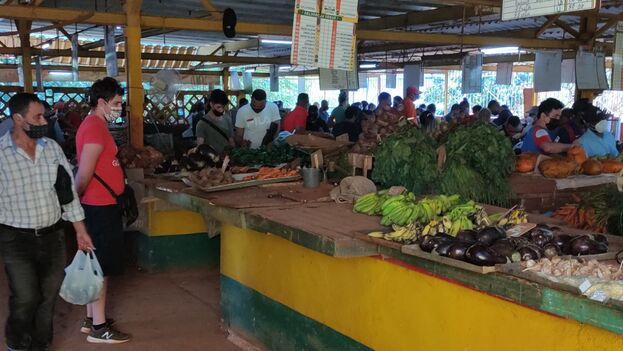
14ymedio, Natalia López Moya, Havana, 7 November 2022 — What is expected this season, when temperatures begin to fall in Cuba, is that tomatoes will reach the markets. However, this year, the fruit is absent from many agricultural stands in Havana. The reason is the daily police raids, launched recently, against high prices, and the decision of merchants to withdraw the product so as not to sell at a loss.
“There is no one selling tomatoes in this market,” said a young man this Sunday morning. He manages one of the stands at the Juvenile Labor Army (EJT) premises on Tulipán Street, in Nuevo Vedado. “We have been told that we can’t sell them for more than 200 pesos per pound, and that amount doesn’t give us a good profit,” he adds, speaking to 14ymedio.
This weekend, in the different kiosks located in the EJT market, you could see burro bananas, cabbages, sweet potatoes and leeks, but not the characteristic red color of the tomatoes needed to make a tasty salad. “That product is candela. You get a fine right away,” the young man warned.
“To be able to recover the investment, a tomato must be sold right now at 250 to 270 pesos a pound,” says Jorge, a 38-year-old habanero who transports goods from the area of Güira de Melena and Alquízar, in the province of Artemisa, to the 19th and B market in El Vedado. “Below that price I would now be working at a loss.” continue reading
The El Vedado market, known for its wide variety of products and high prices, is almost entirely privately managed and is governed by the law of supply and demand. An avocado at 100 pesos, a pound of small onions at 350, and cucumber at 80, turn a modest purchase in that market into a four-figure bill.
“They come here to try to pressure us to lower prices, but they are the same ones who later sell you beer in a state restaurant for more than 180 pesos,” Jorge says. “For us everything has become more expensive, too, from the fuel that we get ’on the left’ to the price that the farmer puts on his harvest.”
“What people are doing is that they prefer not to bring some products for sale here in the market,” he explains to this newspaper. “If through digital sites, where they buy from abroad for their family in Cuba, a product can be sold at a more reasonable price for us, what need is there to look for a fine by bringing the merchandise here?”
In on-line sites aimed at emigrants, a pound of tomatoes is around 4 dollars, almost 500 pesos at the official exchange rate. Deliveries are made directly to homes, and the customer pays online with their credit or debit card. “You get rid of the inspectors, the police and having to hide the product every time they warn you of a raid,” Jorge explains. “If it continues like this, the only ones who will be able to eat a tomato salad will be those who have family in Miami.”
In markets such as the EJT, administered by the military, the pressures on merchants are greater. “It’s not that we have been banned from selling tomatoes, but they might as well have done so, because they want to force us to keep the price low; but on the other hand when asked if prices are capped, they tell you that no, it’s not that, it’s part of a battle against illegalities,” explains the intermediary.
For the official press, it’s not a question of recovering investments but of speculating. “In other words: it’s about obtaining, by all those involved in the chain, logical profit margins, from fair and reasonable sales prices, contrary to those who, with legal status or not, monopolize the productions, speculate and fleece the public without a minimum of modesty,” the official State newspaper Granma pronounced this Sunday.
“It’s urgent to close all loopholes to the flight of products to illicit destinations, and call to account those who participate directly in selling, calling themselves markets, plazas, points of sale, pushcarts or street vendors,” threatened the official organ of the Communist Party.
The offensive also extends to sellers who, like Dayron, offer their goods on a tricycle in some corner of Havana. “Last week I was fined 6,000 pesos that I haven’t yet been able to pay. The inspector told me that I couldn’t sell chopped onion at 1,000 pesos or tomatoes at 220, as I was doing.”
With his point of sale, Dayron travels through some parts of the Los Sitios neighborhood. “Now you have to sell a tomato as if it were a lobster tail. Carefully watching that an inspector or policeman doesn’t approach,” the man says. “I prefer that they spoil at home and my wife has to turn them into puree, but at 150 or 180 pesos a pound, I won’t be able to to sell them.”
And he concludes: “That’s what they did with pork: they began to impose fines on the sellers, and the result was that pork was lost from the markets. Now it’s the tomato’s time, and tomorrow the time will come for something else, the malanga or the cucumber; it makes no difference, because they just want to control everything.”
Translated by Regina Anavy
____________
COLLABORATE WITH OUR WORK: The 14ymedio team is committed to practicing serious journalism that reflects Cuba’s reality in all its depth. Thank you for joining us on this long journey. We invite you to continue supporting us by becoming a member of 14ymedio now. Together we can continue transforming journalism in Cuba.
U.S. officials Rena Bitter and Ur Mendoza Jaddou (in the center), flanked by Guyana ministers Vindhya Persaud and Hugh Todd. (Twitter/@EmbassyGuyana)
14ymedio, Madrid, 7 November 2022 – – Rena Bitter, Undersecretary of Consular Affairs of the U.S. State Department, and Ur Mendoza Jaddou, Director of Citizenship and Immigration Services, will visit Havana as part of a tour that also includes Georgetown (Guyana) and Miami (Florida), until this coming Thursday.
In the Cuban capital, according to the brief statement made public this Monday by the State Department, they will meet with government officials to discuss the “total resumption” of immigrant visa services in Havana “at the beginning of 2023” and the recent resumption of Parole for Family Reunification interviews at the same diplomatic headquarters.
The official U.S. note also reports that in Guyana, Bitter would express her gratitude “for the country’s cooperation in consular services,” which includes the processing of U.S. immigrant visas for Cubans at the Georgetown Embassy since 2018, a pressing issue for hundreds of families on the Island, who want the option of migrating by family reunification. continue reading
On its social networks, this Monday, the U.S. diplomatic headquarters in Georgetown showed the officials together with the Minister of Human Services and Social Security of Guyana, Vindhya Persaud, and the Minister of Foreign Affairs, Hugh Todd, indicating in a message that they discussed the process of international adoptions in The Hague and “the reduced waiting times for nonimmigrant visas in Guyana.”
“The Hague Adoption Agreement provides greater security, predictability and transparency for all those involved in international adoptions,” the State Department said in a tweet. “We welcome Guyana’s commitment to protect children and parents.”
From Guyana, and before Havana, Bitter will visit Miami, where, according to the same official statement, she will review the U.S. passport facilities “and meet the staff.”
They also arrive at a time when the exodus has exceeded 224,000 people in just one year, a figure that far exceeds the previous major migratory waves of the Island, in 1980 and 1994, and that doesn’t stop.
Translated by Regina Anavy
____________
COLLABORATE WITH OUR WORK: The 14ymedio team is committed to practicing serious journalism that reflects Cuba’s reality in all its depth. Thank you for joining us on this long journey. We invite you to continue supporting us by becoming a member of 14ymedio now. Together we can continue transforming journalism in Cuba.

 14ymedio, Madrid, 10 November 2022 — Diana Meizoso, the mother of the girl Elizabeth, one of the fatalities of the boat sunk by the Cuban authorities in Bahía Honda, Artemisa, was arrested this Thursday by State Security and taken to its headquarters in Villa Marista, in Havana, her brother Héctor confirmed to 14ymedio.