The Shortage of Milk Reaches Sancti Spiritus, the Only Cuban Province Where it Was Not Lacking in 2022

The leaders will visit the producers in Sancti Spíritus to obtain more. (Granma)

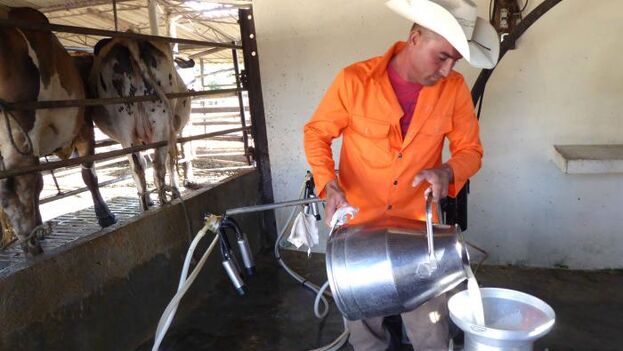
14ymedio bigger14ymedio, Havana, 27 December 2022 — The only Cuban province in which there was no shortage of milk during 2022 has not been able to close the year with such an achievement. Rumors that Sancti Spíritus was going to withdraw the product from medical diets have been denied by the official press, which, however, confirms that in recent days it has not been possible to distribute it in several municipalities, and it will have to stop using it in some by-products to guarantee the essential amount.

“It’s true that there was a lack of milk to cover the entire demand for two or three days, but in the next few days we will make up for it. We have already started a strategy that includes leaving aside other assortments in the food-related mini-industries of La Sierpe and in the Mérida factory to send all that milk to the Sancti Spíritus industry,” Alberto Cañizares Rodríguez, general director of the Provincial Dairy Products Company Río Zaza, told Escambray.

According to the official newspaper of the province, 5,283 gallons are needed every day, just to cover medical diets and that  intended for children’s consumption, and 1,321 gallons of that have been lacking. The Delegation of Agriculture and companies in the sector have started an “exchange program with producers” that means visiting them, including those who “have already fulfilled their milk delivery plan and who in their own right can make use of the surplus,” to negotiate an extra supply of milk.

In addition, those who have not delivered according to their contracts will also meet with the sector officials.

The situation of shortages affects the municipalities of Sancti Spíritus, Trinidad and part of Cabaiguán. They say the rest of the territories are supplied directly from the productive bases. continue reading

Cañizares Rodríguez said that in Sancti Spíritus — where until now there were no problems in obtaining fresh milk — there is no powdered milk to replace that supplied to the rationed basket and social consumption, and supplies are only available for children up to 12 months old, since imports have decreased.

The manager said that melted cheese and soy yogurt will continue to be made, since the necessary raw material is available, and that until the lack of liquid milk is resolved, the delivery of ice cream for social consumption in the main municipality will be guaranteed.

Indignation, meanwhile, runs through the affected municipalities. Social networks have been filled with messages in search of the lost product, especially milk powder, which is now being sold at 500 pesos for 1.1 pounds.

But speculations continue on the street, and many do not believe the official denial. “In my ration store, I was informed that the special diet milk will not be available any more until further notice,” says a network user.

Meanwhile, in Escambray itself, readers maintain that the authorities are not straight with the population. “That manager didn’t tell the whole truth; they do have powdered milk but don’t want to release it. Why do they keep it then?  The provincial decision-making authorities should make an in-depth analysis and release the powdered milk they have stored,” says a commentator.

“Once again, the Government doesn’t provide timely reporting. It was the drivers of the milk cars who ’informed’ the people about the suspension of the delivery,” says another.

The article doesn’t raise any hypothesis as to why the current situation is occurring. Last week, the newspaper Invasor addressed a similar issue in Ciego de Ávila, where the shortage of milk is chronic. The directors of the sector revealed that many producers, given the non-payments of the State and the low price they get for the product, which does not even cover the costs, have decided that it is preferable to pay the fine of 10 pesos per 2.2 pounds of undelivered milk and sell it on the informal market, where they can get up to 100 pesos.

Another commentator on the official newspaper complains: “What poverty and lack of resources! I have not visited a country, no matter how underdeveloped it may be, that has to invent so much to guarantee a glass of milk to a minimum percentage of its population. That product can be found anywhere in a grocery store.”

Translated by Regina Anavy

____________

COLLABORATE WITH OUR WORKThe 14ymedio team is committed to practicing serious journalism that reflects Cuba’s reality in all its depth. Thank you for joining us on this long journey. We invite you to continue supporting us by becoming a member of 14ymedio now. Together we can continue transforming journalism in Cuba.
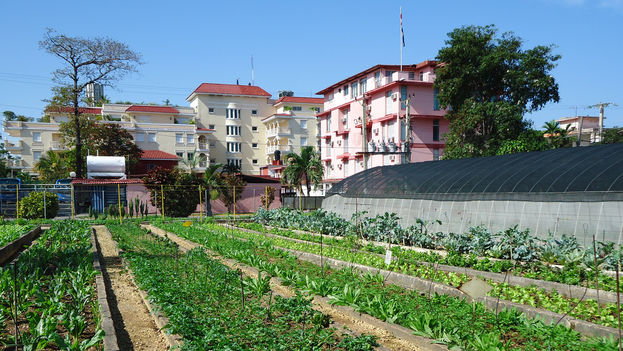
Urban Agriculture Still Doesn’t Feed Cubans

Urban agriculture in Havana (Flickr)

14ymedio bigger14ymedio, Elías Amor Bravo, Economist, 27 December 2022 — Urban, suburban and family agriculture is another of the “inventions” of the communist regime that has been in force for 35 years but which has certainly had a minimal impact on the supply of food. In other words, it does not solve the problem of lack of food. The communists attribute to Raúl Castro himself nothing more and nothing less than the idea of this system, destined at the time to satisfy the growing demands of the population. Therefore, any approach to shelving this idea does not have the slightest political support.

To go back in history, it is worth remembering that then, back on December 27, 1987, when urban agriculture took its first steps, the reality was that the productive model of state agriculture had failed resoundingly in its productive objectives, and the agricultural sector, then 100% concentrated in the hands of the state, was unable to feed the entire population. This is more or less the same as now, with the exception that there are more than 200,000 land tenants who continue to fight to occupy a space with their own rights within the Cuban communist agriculture.

To Raúl Castro, in the middle of that wasteland of incompetence and unproductivity, it occurred that urban, suburban and family agriculture could be a solution that could help meet unmet demands. This would be done by cultivating pieces of plots that were left without activity on the periphery of the cities, and then extending the cultivation to patios, flower pots, parks and gardens, and to any area that was susceptible to this type of activity. Communists continue to believe that, even today, the potential of this system has not been sufficiently exploited, despite the 35 long years of its continuous failures. It’s not a valid option for strengthening local food systems.

Marrero, in the national balance of the program, along with other communist leaders, has been in charge of praising a system that, of course, has contributed very little to the solution of the lack of food for Cubans. And then there’s the data. continue reading

Marrero, however, was optimistic and pointed out in his speech that urban agriculture is the key to the implementation of the Law on Food Sovereignty and Food and Nutrition Security. In his opinion, “it is appropriate that government, political, business and technical actions are designed in all localities, which allow the potential of urban agriculture to be used in the production of food for the population.” It’s not surprising that Díaz Canel publicly has shown reservations towards that Law and what it claims to do. He knows the score.

The previous message should already sound false to the readers of this blog. It is none other than the strategic line of the 2023 economy plan of decentralization to local corporations of state competence. One of them — what a coincidence — is the whole shebang of urban agriculture. Up a creek without a paddle, and seeing that in 35 years little or nothing has been achieved, the communists in 2023 want 1,117,000 of courtyards and plots to increase by the work and grace of the local governments, although it’s necessary to transform “to more efficient forms of economic and productive management, the strengthening and dignity of food production units, and a greater incorporation.” A clear recognition of the low or non-efficiency of urban agriculture.

According to official data, the program is based on the permanent cultivation of 31,234 acres (0.2% of the total farmland), an insignificant amount of the land available for the program (about 4.9 million acres) in the Cuban economy, which in turn conditions any increase in production to the proper application of intensive techniques, combined with principles of agroecology and food sovereignty. Of these, 5,649 acres will be in organics, 7,579 acres in intensive orchards, 1,001 semi-protected acres, 12,894 acres in technified plots and 867 acres of rustic houses.

In addition, other subprograms such as crops and animals have been integrated into the urban agriculture program, so that “in these 35 years, 11 subprograms have been developed, including 5 for animal breeding, and 5 for crops. The most significant impacts are in increasing the amount of areas and in performance.” But the end result has been quite poor, if you take into account the supply that has reached the consumer markets.

The main strengths of urban agriculture, in light of what the authorities have said, are in the production of seeds, which allows the replacement of imports for six crops (kidney beans, lettuce, cucumber, okra, Swiss chard and radish), advances in agroecological culture with intercalation, crop rotation and pest control with biological and natural products. There is also the  development of bioproducts from different natural extracts with a local impact, the elaboration of rustic catch traps, planting of living barriers and the use of lime hydrate, with a favorable impact on agriculture ecosystems.

Some local experiences were also addressed. Approximately 355,800 tons of vegetables have been produced in Havana’s yards in 2022, less than 1% of the total. The task is to produce in such a way that “there can’t be one inch of land that is not planted.”

In Sancti Spíritus, there are eight UEB Urban Farms, where all the representatives of the popular councils and members of the mass organizations work directly and are part of the 290 that exist in the province. There has been an increase of 660 patios compared to last year.

In Santiago de Cuba, family patios reached 92,516, and there were 20 organoponic gardens in 2022, up from 18 in 2021.

In the speech, Marrero finally had words of special recognition fornthe main promoter of the system: Raúl Castro, and distinguished workers and provinces in this period were also mentioned. In conclusion, the Federation of Cuban Women also paid tribute to the best producers in the country. Another announcement, undoubtedly important, was that on the occasion of the 35th anniversary of the program, “and because of its laudable performance during these years, the Central de Trabajadores de Cuba instituted December 27 as Worker’s Day of Urban, Suburban and Family Agriculture.” Almost nothing for something that has not served — far from it — to feed the population.

Translated by Regina Anavy

Related articles:

Organoponics and Food Self-sufficiency in Cuba

Without Water There Won’t be Squash in Urban Gardens

Another ‘Great Achievement’ of the Revolution: Havana Turned Into an Urban Garden

Fidel Castro’s 13 Most Notorious Failures

____________

COLLABORATE WITH OUR WORKThe 14ymedio team is committed to practicing serious journalism that reflects Cuba’s reality in all its depth. Thank you for joining us on this long journey. We invite you to continue supporting us by becoming a member of 14ymedio now. Together we can continue transforming journalism in Cuba.

Vietnam’s Ghost Investments in Cuba’s Hotel Sector

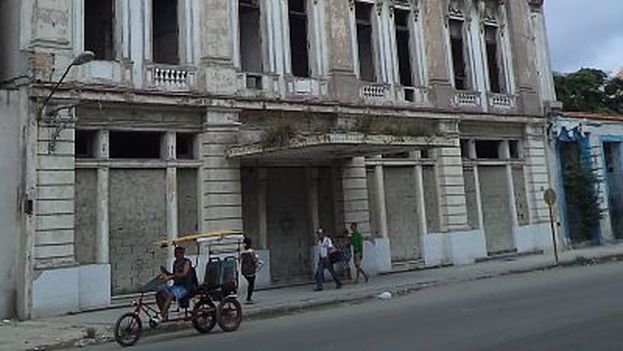
The gigantic building on Dragones Street that once housed the New York Hotel, the first expropriated by Fidel Castro after the Revolution. (14ymedio)

14ymedio bigger14ymedio, Havana, 27 December 2022 — Vietnam’s investment in Cuba’s tourism businesses, announced several times in recent years, will become a reality in 2023, according to the official media.

An article published by the Cuban News Agency on Tuesday, indicated that “Vietnamese companies will assume the construction of a hotel and the repair of two others in this capital.”

The text does not specify the number of companies that will invest or the names of the hotels, but four years ago, in 2018, the Hosteltur page echoed a similar news — never realized — after a bilateral business forum.

Then, it was claimed that a Vietnamese company, Hanel, agreed with the state-owned Cubanacán to build a five-star hotel on the Island on the grounds occupied by the Pedro Borrás pediatric hospital, closed in 1988 and then demolished, and that another company, Chao-Viglacera, signed a contract with the Gran Caribe chain to administer “another old facility in Havana.” The latter was none other than the old New York hotel, the first to be expropriated by Fidel Castro after the triumph of the Revolution, located on Dragones Street, next to the Capitol building, in Central Havana.

It’s a gigantic building that is not only closed, but also in ruins, with entire trees growing from the structure of the walls and roof and an intense smell of urine around it. The canopy of its facade had already fallen years ago, and the danger of a collapse constitutes a constant threat to those who pass by the place, where there is intense traffic.

As for the grounds of Pedro Borrás, nestled in the central Avenida de los Presidentes (Calle G) of El Vedado, a space that until recently was full of garbage bags and, at night, furtive shadows, you can see earthworks that for months have given rise to all kinds of speculation among the neighbors. continue reading

None of that is referred to in the article published on Tuesday, including the statement to Prensa Latina by the Cuban ambassador to Vietnam, Orlando Hernández Guillén, who affirms that “everything is well advanced for this incursion to happen at some point in 2023.”

The diplomat also points out that in the new year “there will be consolidation and development in the economic sphere” for new Vietnamese sectors in the island’s economy. In this regard, he says that “at the moment a detergent factory is being concluded,” without specifying that it is a plant belonging to the joint venture Suchel TBV S.A. and that, four years after obtaining the permits to settle in the Mariel Special Development Zone, it has not yet been possible to finish it.

In addition, Hernández Guillén mentions the construction of a feed plant for livestock, the expansion of the existing one for napkins and diapers and a photovoltaic generation plant, specifying that “it is small but precedes other larger ones that are being negotiated.”

Last year it was also announced that there were tourism projects between Cuba and Vietnam. Specifically, some “letters of intent” signed by the state conglomerates Gran Caribe and Cubanacán with the Vietnamese company City Land Investment Company Limited “for the constitution of a joint entity that will be responsible for the construction and development of hotel projects.”

So far, none of the publicized plans have been realized.

Translated by Regina Anavy

____________

COLLABORATE WITH OUR WORKThe 14ymedio team is committed to practicing serious journalism that reflects Cuba’s reality in all its depth. Thank you for joining us on this long journey. We invite you to continue supporting us by becoming a member of 14ymedio now. Together we can continue transforming journalism in Cuba.

All Beneficiaries of Aid for Spaniards Abroad in ‘Extreme Need’ Live in Cuba

The 344 recipients of aid for people in extreme need from Spain’s Junta de Castilla y León live in Cuba. (14ymedio)

14ymedio bigger14ymedio, Madrid, 26 December 2022 — All beneficiaries of direct aid for Castilians and Leonese abroad who are in conditions of special need live in Cuba.

The regional government published in the Autonomous Official Bulletin last Wednesday, the 21st, the list of beneficiaries of this aid, aimed at “covering the basic needs” of those who “are in a situation of extreme need or precariousness.” It shows the 344 applicants who will receive 349.25 euros, but just this Monday, in a press release from the Junta de Castilla y León, was it revealed that all the beneficiaries reside on the Island.

“This aid consists of a direct economic benefit, of non-periodic receipt, individual and of a social and welfare nature, aimed at Castilians and Leonese abroad who are in a situation of need because they lack income or don’t have the income necessary to cover their basic subsistence needs, in accordance with the socioeconomic reality of the country of residence,” said the Spanish counselor of the Presidency, Jesús Julio Carnero.

The aid is part of an autonomous plan – and, in principle, not incompatible with state aid for Spaniards abroad – that has been underway for several years and is aimed at financially supporting Spaniards who reside outside the country and who have established a municipality of Castilla and León as a reference for their registration in the Register of Spaniards Living Abroad (PERE). The Board has 120,000 euros for this aid and received 476 applications, without specifying which countries they come from, but the 344 who obtained it currently live in Cuba.

Of these, 119 set the reference town in León, 111 in Zamora, 33 in Burgos, 32 in Salamanca, 16 in Valladolid, 13 in Palencia, 8 in Ávila, 7 in Soria and 5 in Segovia. At the beginning of this year, there were 183,676 Castilians and Leonese registered in the PERE, of which 114,556 are in American countries and 9,712 in Cuba. continue reading

To receive one of these grants, relating to the year 2021, the registration period for which was between July 7 and August 31, it was necessary that the income of that year for any concept of the family unit be not higher than the minimum level of subsistence established in the rule. In the case of Cuba this level was 3,492 euros per year or the equivalent, established at 106,254 pesos.

In addition, neither the applicant nor any member of the family unit can have patrimonial assets with values higher than those established, with the exception of habitually used housing.

Meanwhile, it was also a criterion of exclusion to have received the same aid last year, while for beneficiaries between 2015 and 2019, it could be accessed if there was money left over after the grant to new applicants, which has not happened.

On the other hand, the Board also announced the concession of 15,000 euros in favor of the Association of Castilian and Leonese Societies in Cuba, whose purpose is to “finance the expenses derived from the acquisition and distribution of food and other basic necessities, as well as inputs for protection and hygiene, which allow alleviating the situation of special need and lack of resources for Castilians and Leonese residents in Cuba, derived from the degradation of socio-economic and health conditions,” which the Autonomous Government attributes to the pandemic.

The Association of Castilian and Leonese Societies in Cuba is the only federation of Castilian and Leonese residents that exists on the Island, says the press release, which adds that “it has the necessary experience and has demonstrated its competence to channel and carry out the actions of support and attention to the Castilians and Leonese living in Cuba.”

Translated by Regina Anavy

____________

COLLABORATE WITH OUR WORKThe 14ymedio team is committed to practicing serious journalism that reflects Cuba’s reality in all its depth. Thank you for joining us on this long journey. We invite you to continue supporting us by becoming a member of 14ymedio now. Together we can continue transforming journalism in Cuba.

The 25,000 Tons of Wheat Donated by Russia Will Supply Cubans With Bread for a Few Days

The government of Havana acknowledged that there was a shortage of flour that affected the production of bread. (Cubadebate)

14ymedio bigger14ymedio, Madrid, 26 December 2022 — Russia will invest more than 11.7 million dollars in sending wheat to Cuba, according to the note published this Sunday in the Island’s official press about the delivery of more than 25,000 tons of wheat from Moscow to Havana. The news fell as a Christmas gift to the readers of the state media, who wondered, however, how much bread that would translate into. The answer is disappointing.

If all the wheat sent by Russia were used to make flour and this in turn were used in the manufacture of bread, the State would obtain approximately 41 million pounds: not even four pounds per Cuban.

Although the bread recipe varies, the calculation has been made taking into account the approximation of the Agricultural Foundation for the Development of Argentina (FADA). The organization calculates that 1.4 kilos of wheat is the amount of wheat needed to make 1 kilo of flour, and 0.96 kilos of flour is needed to make 1 kilo of bread. Or even simpler, to make 1 kilo of bread you need 1.34 kilos of wheat.

The Cuban government has not given details on how it will sell the wheat donated by Russia, which will arrive by sea in the coming days and at the beginning of 2023. There are 469 million rubles (about 6.7 million dollars) destined for the purchase of the product and more than 300 million rubles for the transfer.

The Prensa Latina agency explained that the Russian Ministry of Emergencies is responsible for the entire procurement, transport and delivery process, although the Foreign Ministry will help in the operations. continue reading

The exchanges between Russia and Cuba for the acquisition of wheat flour are not something new nor can they be linked to Miguel Díaz-Canel’s recent visit to Moscow. For several years, supplies have been constant and stable, although in recent years — and with the worsening of the crisis on the Island — donations have multiplied. Already during the pandemic, Havana received several shipments of humanitarian aid that included wheat.

As for this year, this is the second time that donated Russian wheat has arrived. In April, Moscow sent almost 20,000 tons of the grain with a great delay compared to what was agreed, which was attributed to international sanctions.

The Russian ambassador to Cuba, Andrei Guskov, said at the time that the “important item” of “humanitarian shipment” had problems because the shipowner could not be paid “because of the sudden disconnection of several Russian banks” from the international Swift payment system.

The shortage of wheat flour has generated significant discomfort among the Cuban population due to its impact on the poor quality of the bread. Criticism even reached the official press, which regretted that the product looked “less and less like bread and was more expensive.”

The Government of Havana even stated in August that the State had a shortage of flour that affected the production of bread, but that bread would be guaranteed in “the regulated family basket,” prisons, hospitals, orphanages, nursing homes and psychiatric hospitals, as well as for the Cuban Bread Chain.

In Sancti Spíritus, state bakeries began to add up to 20% of rice peel residue to the dough, according to 14ymedio.

Upon learning of the last donation, this Sunday, the readers of Cubadebate celebrated the success of the collaboration with Russia and thanked the “brother country” for its help. However, many wondered what real quantities those tons, that at first glance seemed so much, would be translated into.

Many were also concerned about the destination of the product, which can be poorly managed and go on sale in foreign exchange stores or resellers. “We must protect and control that this donation does not fall into the hands of criminals and is dedicated to a fair production of bread aimed at the most dispossessed. Our control is still insufficient; we have gaps and an unprecedented ladder of corruption,” said one on-line commenter.

Russia has also taken the opportunity to congratulate, a week in advance, “the Cuban people and government on the advent of the 64th anniversary of the triumph of the Revolution,” according to Prensa Latina.

Translated by Regina Anavy

____________

COLLABORATE WITH OUR WORKThe 14ymedio team is committed to practicing serious journalism that reflects Cuba’s reality in all its depth. Thank you for joining us on this long journey. We invite you to continue supporting us by becoming a member of 14ymedio now. Together we can continue transforming journalism in Cuba.

Alexis Diaz de Villegas, Cuban Actor and ‘Survivor’

Actor Alexis Díaz de Villegas. (14ymedio/Luz Escobar)

14ymedio bigger14ymedio, Havana, 26 December 2022 — About the actor Alexis Díaz de Villegas, who died in Havana at the age of 56, the writer Néstor Díaz de Villegas, his uncle, said that “Alexis had existed in the tragedy and for the tragedy.” However, many Cubans identified his elongated arms, his ironic and smiling face, and his messy hair as the attributes of a comedian.

Those who thought so had not been able to forget his performance in Juan de los Muertos [Juan of the Dead], the film that earned him the sympathy of the general public in his country. It was the role of his life: a Cuban”survivor” — as the character himself would say — an everyday fighter against absurd circumstances and people who, by dint of political lobotomies, behaved like zombies.

Tired but without losing his humor, about to anchor himself forever on the Island, the character of Díaz de Villegas pronounces the phrase that, for the Cubans who repeated it again and again after his death, summed up his existence: “I survived the Mariel, I survived Angola, I survived the Special Period and the thing that came after. Just give me a machete and I’ll manage.”

Díaz de Villegas was born in Cumanayagua, Cienfuegos, and worked as a theater actor and university professor at the Higher Institute of Art. He acted in films such as Entre ciclones [Between Hurricanes], Kangamba and Larga distancia [Long Distance] as well as in the film adaptations of several novels by Leonardo Padura. The death of his son Pablo, who hung himself at age fourteen, was a hard blow for the actor.

The cancer that caused the death of Díaz de Villegas, a non-Hodgkin’s lymphoma, had already affected him a decade earlier and even during the filming of Juan de los Muertos. “He was leaving a chemotherapy session to appear before the camera, and he was convinced that this providential role saved his life,” Néstor Díaz said in a chronicle about their reunion in Havana, after several decades without seeing each other.

His uncle said that, despite the fame that the film had given Alexis and his tireless work, the actor had to be a “fighter” to get food, medicines, clothing and building materials in an increasingly poor and hostile country.

At the end of his career, Alexis Díaz de Villegas had completely returned to the theatrical universe, already consecrated as one of the most talented and influential actors of his generation. In an interview he gave to 14ymedio in 2015, he said that he only aspired to be remembered as “a man of theater.”

Translated by Regina Anavy

____________

COLLABORATE WITH OUR WORKThe 14ymedio team is committed to practicing serious journalism that reflects Cuba’s reality in all its depth. Thank you for joining us on this long journey. We invite you to continue supporting us by becoming a member of 14ymedio now. Together we can continue transforming journalism in Cuba.

Two Health Workers Arrested in Santiago de Cuba for Stealing ‘Hearts of Possible Human Origin’

Public Health officials confirmed the arrest on December 9 of two employees of the Doctor Ambrosio Grillo Portuondo Hospital. (Provincial Directorate)

14ymedio bigger14ymedio, Havana, 26 December 2022 — After an intense wave of rumors, Public Health of Santiago de Cuba has confirmed that two employees of the Doctor Ambrosio Grillondo Hospital have been arrested after being found with “hearts of possible human origin.” The incident had been reported last Friday by a Twitter user who demanded explanations about this “terrifying and creepy” event.

“Indeed, there are two workers of the referenced hospital who work as a surgeon and an occupational therapist, arrested on December 9, 2022, for the  alleged criminal act of stealing two hearts of possible human origin,” reads the brief note disseminated on the Facebook page of the Ministry of Public Health (MINSAP) of Santiago de Cuba this Saturday.

The entity clarifies that both employees are currently “in the investigative process by the organs of the National Revolutionary Police and a commission” that seeks to clarify the facts. The text has already accumulated hundreds of comments from Internet users, who want detailed information about what happened.

The unusual note from MINSAP, which rarely alludes to complaints about the operation of their hospitals, came more than 24 hours after Yannis Estrada warned that something had happened. “An employee of the Ambrosio Grillo Hospital, very close to the Sanctuary of the Copper Virgin, was sentenced to 30 years in prison when it was known that he was extracting organs and body fat from the deceased to crush them and sell them as picadillo,” he said in a tweet that provoked an avalanche of indignation and questions.

This Saturday, Estrada warned about the official response: “Finally, the Ministry of Public Health of the Cuban regime has spoken about the news I shared yesterday. I simply received some information, published it and classified it as what it is: a terrifying and creepy fact.” continue reading

Sources in the activism and religious life of Santiago de Cuba had already assured 14ymedio of the existence of the rumor, but no one had been able to confirm the fact. As the hours passed, however, “it was clear that something had happened because the hospital workers were terrified to talk, but they didn’t deny the complaint,” says a neighbor who called the hospital to inquire about what happened.

In the comments on MINSAP’s note, the responses of readers range from discomfort to the demand for a detailed investigation. For José Hidalgo, the punishment must be severe: “Let an exemplary measure be taken. Those are the characters who try to sink our people, and there are the others who wait for a negative action like that for malicious propaganda.”

But the ghost of the economic crisis and the adulteration of food that go hand in hand with the shortages are also present among those who give an opinion. “Something so serious and just one brief description and that’s it. This is delicate, horrendous, and there is more than one person in charge including the management. What is rumored that I don’t doubt is that it’s a crime of the officials. You have to take down the buyers and the sellers,” claims another commentator.

Urban legends and confirmed cases of food handling that proliferated during the economic crisis of the 90s, officially known as the Special Period, include cloths to clean the floor being converted into alleged pork steak and tomato sauces made from foods and dyes; also the use of antibiotics to replace yeast or melted condoms to imitate cheese in pizzas.

Recently, the video of some Cuban children who are skinning several cats to allegedly eat them has fueled those ghosts of the past. Until now, the ruling party had remained silent about these incidents, but the case of the Ambrosio Grillo Portuondo hospital seems to have forced a pronouncement on an issue that has been the main topic of the Christmas conversations in Cuba.

Translated by Regina Anavy 

____________

COLLABORATE WITH OUR WORKThe 14ymedio team is committed to practicing serious journalism that reflects Cuba’s reality in all its depth. Thank you for joining us on this long journey. We invite you to continue supporting us by becoming a member of 14ymedio now. Together we can continue transforming journalism in Cuba.

The Drop in Energy Demand Relieves the Blackouts in Cuba

The fall in temperatures has caused a decrease in demand. (Archive /14ymedio)

14ymedio bigger14ymedio, Madrid, 23 December 2022 — The Electric Union of Cuba is about to achieve a week without announcing an electricity deficit. The blackouts, which were a constant during the second half of 2022, have made a partial truce with the Government, which pledged — after the failed prediction of May — that in December the situation would improve. The data, however, show how the fall in demand — around 12% — is one of the factors that most helped the authorities.

The Deputy Prime Minister of Cuba, Ramiro Valdés Menéndez, visited this Thursday in Mayarí (Holguín), the Lidio Ramón Pérez thermoelectric plant, known — by its location — as Felton. The largest plant on the Island, with a capacity of almost 500 MW, has completed the maintenance carried out weeks ago to recover block 1, which was producing just 175 MW of the 260 MW of maximum capacity.

The comandante congratulated himself, together with the director of the plant, Euclides Rodríguez Mejías, for the improvement experienced after the repair of the leaks, which have made it possible to obtain 245 MW per day in the last 15 days.

The gain is, in any case, a small part of the energy recovered on the Island, according to the calculations of the Minister of Energy and Mines, Vicente de la O’Levy. The official said days ago that the import of materials has made it possible to increase the generation capacity of the eight plants and that, in addition, units of the distributed network have been incorporated that provided almost 300 MW more. continue reading

According to the analysis of the EFE agency, which has calculated the UNE data, since September 30 and this Thursday, the generation has increased by almost 1,000 MW, a third of the demand. But the fall in demand is part of the relief, since this Thursday it was 2,800 MW compared to 3,170 MW on December 2.

Temperatures, according to the Spanish agency, have been at 93 degrees since November 26, but they have also been below 68 degrees, requiring lower consumption in homes, which spend a lot of energy on air conditioners and fans to relieve heat, according to the Government itself.

In addition, the graphs also show that cuts or disconnections due to deficit forecast (which the authorities call “affects”) have fallen since November. “If on November 29 the affects accounted for 37% of the maximum demand, by December 7 they fell below 10%,” EFE says.

While the weather cools down, the repair on Unit 2 in Felton, which burned down this summer, continues. In yesterday’s visit, Valdés Menéndez learned that 53% of the work has been done, and that currently, work is being done on the disassembly of the boiler and the high-medium pressure cylinder of the turbine, as well as the maintenance and conservation of several elements.

The disassembly phase of the furnace, the main steam pipes, the roof, the middle wall, the convective shaft and other aggregates have already been done, they explained to the comandante, who asked that as many personnel as possible be involved to ensure safety and deadlines.

Felton was designated by Miguel Díaz-Canel himself as key to the recovery of energy. At the end of August, and on a tour with Raúl Castro through the Holguín plant, the president stated that all the country’s resources were at the disposal of the thermoelectric plant. “Felton 1 decides today on the course of the recovery strategy, and its start is vital for the fulfillment of the objectives set, of prime importance, to minimize or eliminate the blackouts next December,” he said.

At the beginning of December, the president toured the countries that can potentially supply the most energy to the Island: Algeria, Turkey, China and Russia. Although the fruits of those meetings are not yet palpable in the area, Díaz-Canel urgently needs this week’s respite not to be a mirage that will fade in the coming months with the rise in temperatures. The protests that shook the Island this summer confirm that he depends on it and so does the survival of the system.

Translated by Regina Anavy
_______________

COLLABORATE WITH OUR WORKThe 14ymedio team is committed to practicing serious journalism that reflects Cuba’s reality in all its depth. Thank you for joining us on this long journey. We invite you to continue supporting us by becoming a member of 14ymedio now. Together we can continue transforming journalism in Cuba.

Cuba Receives Permission from the United States to Bring MLB Players to the Classic

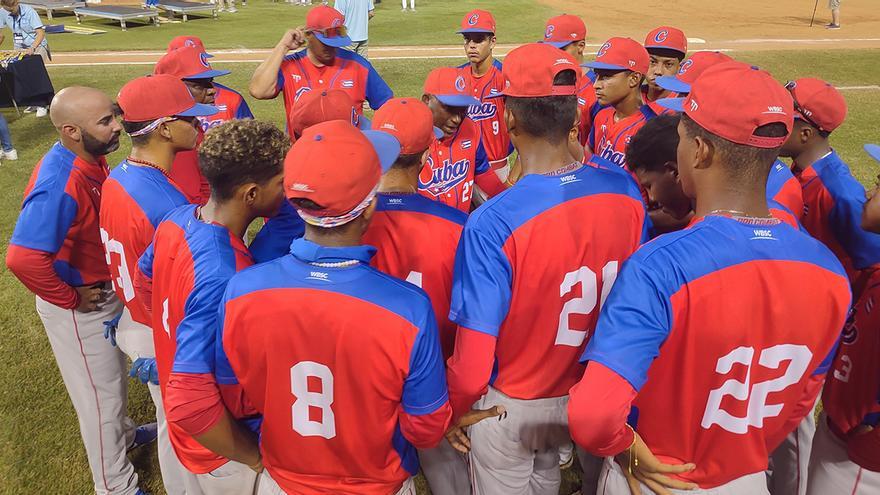
The Cuban baseball team has 50 players to choose from for the Fifth World Classic. (Jit)

14ymedio biggerEFE (via 14ymedio), Havana, 26 December 2022 — Cuba has received a permit from the United States that will allow it to include baseball players who play in the Major Leagues (MLB) in the national team that will participate in the Fifth World Classic.

“We have received a communication from the organizers of the Classic in which they announce that the license requested by them was granted so that the Cuban team can register Cuban athletes, whether from the MLB or not, who reside in the United States,” the Cuban Baseball Federation (FCB) reported in a note published this Sunday by state media.

The Fifth Baseball Classic will be held from March 8 to 21, 2023, in the cities of Taichung (Taiwan), Tokyo (Japan), and Phoenix and Miami (United States).

Andy Ibáñez (Detroit Tigers) and Yoan López (New York Mets) are some of the players who confirmed their presence on the Cuban payroll for the tournament.

The note signed by the president of the FCB, Juan Reinaldo Pérez Pardo, recognizes “these gestures as positive steps” and points out that “it was the only fair solution to the issue.” continue reading

“It is arbitrary and discriminatory that a permit from the United States Government is needed so that the organizers of a sporting event can guarantee the participation of a country like Cuba,” says the federation.

Remember that Cuba “is not only the founder of these competitions but also earned its inclusion by qualifying like the rest of the 19 teams that will participate in the Fifth Classic.”

“It is equally unfair that Cuban athletes, because those we are going to convene are Cubans trained in our country and who, despite all the pressures, want to represent their people, also depend on an authorization from the US Government to fulfill their dreams of playing with the country that gave birth to them,” Pérez Pardo said.

He also appreciates the work of the MLB and the World Baseball and Softball Confederation in their role as organizers of the Classic.

Regarding the communication from the organizers of the competition, he says that they will soon report on the details of the license granted to Cuba and, in that sense, the FCB said that it will then announce the pre-selection of the Cuban team.

In 2018, the Cuban authorities signed a historic agreement with the MLB that allowed Island players to sign professional contracts to play in the US Major Leagues without losing their residence on the Island or their link with the Federation.

That agreement was annulled in April 2019 by the administration of the then-US President, Donald Trump, claiming that the Baseball Federation belongs to the Cuban government and violates US trade law.

At the beginning of last November, Pérez Pardo warned that “pressure and harassment” were being exercised against players in foreign leagues so as not to play with Cuba in the Fifth Classic.

Baseball, declared a Cultural Heritage of Cuba, is not experiencing its best moment on the Island and suffers an unprecedented exodus of players.

Translated by Regina Anavy

____________

COLLABORATE WITH OUR WORKThe 14ymedio team is committed to practicing serious journalism that reflects Cuba’s reality in all its depth. Thank you for joining us on this long journey. We invite you to continue supporting us by becoming a member of 14ymedio now. Together we can continue transforming journalism in Cuba.

The United States Infiltrates ‘Foreign Groups’ to Divide Believers in Cuba, Says the Official Press

Alemán says it’s an “accomplishment” that the Communist Party has admitted believers to its ranks since 1991, a membership that was prohibited before the Special Period. (Twitter/Cuba Presidency)

14ymedio bigger14ymedio, Juan Izquierdo, Havana, 22 December 2022 — The inclusion of Cuba on the blacklist of countries that violate religious freedom according to the United States has motivated a campaign, by the official press, to prove otherwise. This, despite the fact that several priests, nuns, pastors, Santeria believers and practitioners of different beliefs have been systematically harassed by the Government.

Enrique Alemán Gutiérrez, director of the Cabildo Quisicuaba cultural project in Centro Habana, is one of the regular interlocutors of the regime to discuss the issue. Hence, interviewed by the State newspaper Granma on Wednesday, he once again defended that the State “recognizes, respects and guarantees” all religions, although at no time did he admit the political role, as critical voices, that several religious leaders have assumed.

The director of Quisicuaba — a project that also has a social and religious focus — alleges that the Government has registered “innumerable institutions” in the Register of Associations and attributes that “recognition” to the Cuban Revolution.

Alemán says it’s an “accomplishment” that the Communist Party has admitted believers to its ranks since 1991, a membership that was strictly prohibited before the Special Period. In addition, he also mentions a deputy to the People’s Assembly, and that in 1992 the State was defined as secular instead of atheist. The visit of religious leaders such as Patriarch Kirill, the permission to spiritually care for inmates and the granting of religious visas are, in his opinion, signs of the Government’s support for religion. continue reading

Therefore, says Alemán, the inclusion of Cuba among the countries disrespectful of religious freedom is a strategy of “imperial politics,” to “divide the people and Balkanize faith.” We must look with distrust, he alleges, at the “religious groups induced from the outside” — sects, Protestant denominations, brotherhoods — that “are neither so religious nor so newly formed.”

For Alemán, these groups are foreign to the “very wide religious range” of Cuba, whose components have already resolved their “common points” and their coexistence within what the founder of Quisicuaba understands as “religious syncretism.” The real problem, he points out, is the blockade, which prevents money and donations from Quisicuaba’s allies and other organizations related to the regime from going to the Island.

During the summer of this year, a report by the Prisoners Defenders organization, based in Madrid, showed how the Cuban government had founded a network of its own religious associations, while infiltrating numerous agents into churches and brotherhoods.

“In the case of Christian Churches, it has created the Council of Churches; in the Yoruba religion, the Yoruba Cultural Association; and in the Islamic religion, it has created the Islamic League of Cuba. The three organizations are controlled by State Security,” the document said. Quisicuaba, a spiritualist sect with social projection, is part of the “strong core” of these organizations, and has received visits from the country’s senior leadership.

At the beginning of December, the U.S. State Department included Cuba and Nicaragua — where the Catholic Church and civil society have been persecuted by Daniel Ortega — on the list of countries of “special concern”, along with China, Saudi Arabia, North Korea, Russia, Iran, Pakistan, Burma, Eritrea, Tajikistan and Turkmenistan; as well as organizations such as the terrorist groups Al Shabab, Boko Haram, the Islamic State, the Taliban, the Houthis of Yemen and the Russian paramilitaries of the Wagner Group.

Translated by Regina Anavy

____________

COLLABORATE WITH OUR WORKThe 14ymedio team is committed to practicing serious journalism that reflects Cuba’s reality in all its depth. Thank you for joining us on this long journey. We invite you to continue supporting us by becoming a member of 14ymedio now. Together we can continue transforming journalism in Cuba.

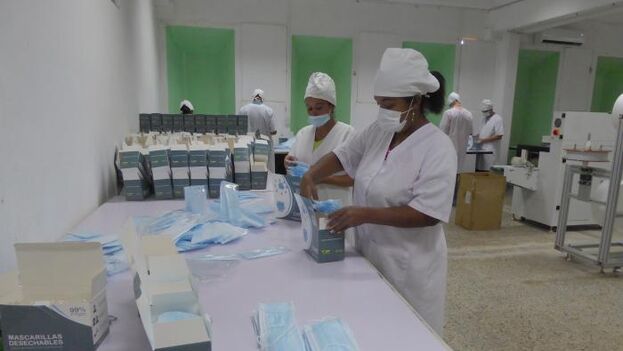
Nobody Wants the Cuban ‘Azulitas’, the Little Blue Masks

14ymedio bigger14ymedio, Madrid, December 22, 2022 — The azulitas [little blue masks] are piled up in the Gardis warehouses. The plant, located in Matanzas, Cuba, already has  accumulated 300,000 units, and, although there is enough raw material to make half a million more, its fate seems doomed to the point that “there are those who question the purpose of keeping this factory active,” the State newspaper Granma says.

The company Unimoda, belonging to the Gardis group, began to produce national masks after a huge and catastrophic chain of hardships. The process was so delayed that, when the azulitas arrived at the stores, the pandemic was already on its way out and now its only option seems to be its incorporation into the Health system, a position currently occupied by the state Medical Supply Company (Emsume), which imports them, mainly from China.

Omar Tápanes Hernández, general director of the business group, explains to the official press that, if the country considers its contribution necessary, masks will continue to be manufactured, although it appears from his statements that for this it will need to ensure raw materials in a stable way.

Fulfilling this condition “would make it possible to meet the needs of the health system for a long time and even export about three million masks to countries in the area every month,” the text reads. “We have the equipment and the young and already qualified workforce,” says the official.

Tápanes Hernández maintains that “the resources generated” have managed to cover the investment, but the managers have never shown signs of a significant sale of masks, and the quantities accumulated in the warehouses or the excess of raw material — all a novelty on the Island — seem to support the failure of the masks. continue reading

During the outbreak of the pandemic in 2020, and in the midst of a global fight to get hold of the coveted masks, Cuba announced with great fanfare that “for the first time” it would manufacture its own “disposable, hygienic and surgical” masks. The process, they said then, would allow the country significant savings in imports. “Cuba imports them at an average of 46 cents; it would cost only six cents to make them at home,” said the then-director of Gardis, Diosdado Abreu Falcón.

Thus, Lway Aboradan, a Syrian resident in Cuba since 1994, won the contract tender. His proposal came as soon as the pandemic broke out in the West, in March 2020 and, although his intention was to partner with the Government, the bureaucracy led him to make the decision to be only a supplier of machinery and raw materials. In addition, although his disbursement was in foreign currency, he had to initially agree to collect — little by little and depending on the sales — in Cuban Convertible pesos (CUC) and, after the Ordering Task*, which abolished the CUC, in Cuban pesos.

In October 2021, he complained of not having seen a centavo yet and unraveled a whole series of annoyances, among which were the mishandling of the machinery and the problems training employees by videoconference, which infinitely delayed the start-up process. At that point, shortly after beginning production, they already had 250,000 surgical masks gathering dust, because not a single one had left the premises.

Months later, in April — the mandatory use of masks was eliminated on the Island on May 31, with the exception of health services — Unimoda exposed the extraordinary situation of low demand, motivated mainly because its main recipient, the Public Health system, already had its needs covered by Emsume, which by that time already had a normal availability.

Emsume is the marketer of medical materials, integrated into the Medisol state group and, according to its own data, imports 95% of its products, most of them from China. The national cost, finally, was not the main expected advantage since, according to Unimoda, the ones that Emsume delivered were also cheaper.

Thus, the sale was restricted almost exclusively for tourism, to other organizations and online sales. The company alleged that the marketing had to be in freely convertible currency (MLC) to support the import of raw materials, and its price ranged between 10 and 12 cents. Although it did not specify whether the cost was for sale or manufacture, it was already almost the double announced by Abreu Falcón. “In total, we have about twenty customers, including distribution to the population in national currency,” said Maribel Rodríguez Argüelles, director of Unimoda.

Granma wondered why masks of lower quality than those of Unimoda were still seen on the street, although a reader blurted out with clairvoyance: “The demand of the population was met by private sellers. Action was delayed, as well as the newspaper article, after so many months.”

This Thursday’s article in the official press, dedicated to noting that there are still cases of COVID-19 and there is no need to lower our guard, states, however, that the company contributed “to the confrontation with the SARS-COV-2 coronavirus in the province.” The explanation makes something clear: that the brand new masks made in Cuba have barely left Matanzas.

*Translator’s note: Tarea ordenamiento = the [so-called] ‘Ordering Task’ is a collection of measures that include eliminating the Cuban Convertible Peso (CUC), thus leaving the Cuban peso as the only national currency, raising prices, raising salaries (but not as much as prices), opening stores that take payment only in hard currency which must be in the form of specially issued pre-paid debit cards, and a broad range of other measures targeted to different elements of the Cuban economy. 

Translated by Regina Anavy

____________

COLLABORATE WITH OUR WORKThe 14ymedio team is committed to practicing serious journalism that reflects Cuba’s reality in all its depth. Thank you for joining us on this long journey. We invite you to continue supporting us by becoming a member of 14ymedio now. Together we can continue transforming journalism in Cuba.

Creative Resistance and the Cuban Economy

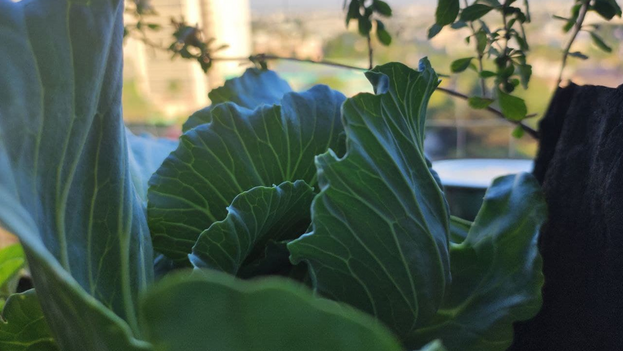
Cabbage planted in an old can on a balcony a few meters from the Ministry of Agriculture offers more hope than the ephemeral plans of Acopio. (Yoani Sanchez)

14ymedio bigger14ymedio, Elías Amor Bravo, Economist, 12 December 2022 — Analysts of the Cuban economy attribute to Cuban President Díaz-Canel the concept of “creative resistance” that the communist president uses every time he refers to the possibility of overcoming economic problems. In essence, Díaz-Canel understands creative resistance as “a capacity of the people not only to resist, but to innovate, create and go forward with development solutions.” That capacity will have been observed somewhere, probably in Hialeah, Madrid or London, but unfortunately in Cuba, it is non-existent. The problem with creative resistance is that whenever it appears in the Cuban economy it is violently crushed by the regime, and vice versa. Another mess.

In the communist and assembly conclaves that are usually held at this time of the year, economic information that cannot be known by the official bodies responsible for its dissemination is usually leaked by the minister of economy. This year, for example, it has been known in the economic affairs committee of the National Assembly, that the communists believe they can gradually resolve the situation of the country by betting on macroeconomic stabilization, with aspects such as monetary balance, the currency exchange market, prices and the tax system.

And here comes the surprise. Let no one expect a manual on the use of instruments and economic policy objectives. According to Díaz-Canel, the economy can only be stabilized if the concept of creative resistance is channelled and enhanced in all activities, which is splitting hairs, because now he will say that macroeconomic stabilization has to do with the capacity of the people, not only to resist, but to innovate, create and move forward. Not even the example of COVID-19 serves, since Cuba at the end of 2022 is one of the few countries in the world that has not yet recovered the levels of activity prior to the pandemic. So much for creative resistance; Cubans are poorer today than three years ago. continue reading

So forgetting what happened this year, the economic affairs committee said that the projections of the Ministry of Economy and Planning for 2023 are better, which does not coincide with the latest Economic Commission for Latin America (ECLAC) forecast that lowers growth in 2022, and foresees growth from 2% to 1.8% in 2023. Someone is not right.

Díaz-Canel later stated that the two main problems he identifies in the economy, inflation and a low supply of national currency, can be overcome with creative resistance. But at the same time he announced “a path that brings sacrifices,” which implies for the Cuban people more uncertainty and economic unrest than there is  currently. A disgrace.

And at this point an analysis was carried out that, it’s hard to believe, defied the regime. According to Díaz-Canel, there are some companies that raised prices “against the purchasing power of the population, after moving from an environment of 1×1 to 1×24, while others have increased expenses without raising prices, due to a political commitment.” How curious. Companies that raise prices do so against the population. Those who do not, assume a “commitment” to the people and of course, that, according to Díaz-Canel, “causes losses in their labour force, which has no incentive  for profits.” Is that creative resistance or are we talking about something else?

Does the Cuban communist leader really believe that the Marxist-Leninist economy that he directs puts forward this type of behavior? Are companies that raise prices bad? Are those who don’t do it good? How far does the political commitment to those companies go? And how far does creative endurance go?

Along with this simple business scenario of good and bad, which Cuban communism likes to create, it is pointed out that there is “an excess of liquidity, but concentrated in few hands. For example, there are state-owned companies that, just because of the 1×24 exchange, generated high levels of profit.” Magic or simply manipulation of information? Where is the monetary policy that fulfills its functions? What would Mrs. Wilson do?*

The truth is that the exchange rate of the ordering task** for monetary unification was what caused more than half of the socialist state companies to go into bankruptcy and experience losses, a situation that many have not managed to reverse. Yes. Those who were “good” and did not raise prices ended up entering a crisis. Creative resistance didn’t work here either.

Díaz-Canel also said that even when there are expensive things (minimizing a problem that affects most goods and services) “a group of people can buy them because certain sectors accumulate money asymmetrically.” And he asked: “How do you solve this?” The communist leader’s recipe is clear: “producing more so that there is more supply, but currency is needed for the purchase of inputs.” And then, why are those inputs not produced nationally by Cuban companies? They do not need to be state companies; they can be private or associated with an international investor. Doesn’t Díaz-Canel realize that the solution to the problem is to change what he just defended? Why isn’t creative resistance used here?

He recognized in his analysis that “the people most affected are in the budgeted sector and among retirees and pensioners,” and this is true, because inflation hits the most vulnerable sectors the hardest, for which government spending cannot be stretched further. There is no margin.

Unfortunately, the estimated figures for the closure of the 2022 plan and the one planned for 2023, as well as the progress of the provisions approved to address the crisis, remained for the next plenary session of the Assembly, so we will have to be attentive to them. They won’t be good.

In the agri-food commission there was also an opportunity to assess the concept of creative resistance. The result of the verification of the Acopio System of Companies*** was evaluated. The report explained that “among the main causes of losses, the non-compliance with the hiring that supports the economy plan, inefficiencies in marketing, high financial expenses with interest, the inefficient management of collections and payments, and the delay in the application of the labour availability process stand out. The eternal situation of lack of control and disorganization contrasts with the iron ideological intervention of the economy. Creative resistance still doesn’t work.

The balance of the agricultural sector is regrettable. Cuba has to prepare for a bad, a very bad, year. The report highlighted the breach of contracts by suppliers, with losses of more than 38,000 tons of agricultural products, representing about 32 million pesos. No one cited the real reasons for these breaches, forced by the demotivation caused by trade debt, prices and lack of inputs, among other things. To this is added the chain of defaults, which at certification amounted to 604 million pesos in accounts receivable and payable.

At this point, the Minister of Agriculture, the main person responsible for this chaos, blamed Acopio “for not having taken enough advantage of Decree-Law 35, which aims to create flexibility in the marketing of products,” as if Acopio had nothing to do with the regime. Not content with transferring his management responsibilities to others, the minister “proposed that not only the Acopio System of Companies but also all the institutions are related to the process.”

He also warned that the Law of Promotion and Development of the Livestock Project, which will be fully debated in the coming days, “will not recover the sector on its own but with what the agencies and workers involved in this sector are able to implement.” In all these cases, you will see if creative resistance is of any use.

With regard to the sugar industry, “the importance in this sector of the collectives working organically with bosses who have extensive knowledge would directly benefit the socialist state enterprise.”

The next sugar campaign, defined as a “short harvest” by the president of Azcuba, “will guarantee domestic consumption with fewer sugar mills, with the purpose of gradually rescuing sugar production.” In reality, the state of the sugar sector after the restructuring decided by Fidel Castro at the beginning of the century is so regrettable that its resurrection is very complicated.

The improvement in the economy that the leaders foresee will happen because “the plan focuses on a new business model, in which there is financial planning, not only in sugar production, but also in the circular economy in a prioritized way, as well as in the model of science and innovation.”

Is this the path for Cuban sugar? The regime is simplifying a sector of great possibilities as an engine of the economy, betting on an “objective, flexible and although small harvest, with good practices, concentrating resources on fewer sugar mills to achieve greater efficiency.” From here the path to Insignificance  is short. Creative resistance, in sugar? What for?

Then the service commission analyzed the passenger transport activity, which has presented results very far from those needed in the last three years.

Recognizing that the sector functioned in 2022 below the 2019 levels, the minister of transport pointed out that among the priorities for 2023, “there are measures that act on the objective problems with greater control and rigor; working with the Ministry of Economy and Planning to continue recovering the availability of freely convertible currency and to begin gradually recovering  transport in the country.”

He also asked, together with the Ministry of Finance and Prices, to “advance in the ordering of prices, a task that must be completed before the beginning of 2023, and another action is to work better with human resources and cadres.” All of them are very important and outstanding measures to improve transport, of course, with the necessary creative resistance.

The serious situation of passenger transport and especially merchandise led Marrero to intervene at this point to emphasize that this sector “does not escape the situation of transit in the country, with the characteristic of being cross-sectional to all processes,” and referred to “the difficulties in the acquisition of materials such as fuel, tires and batteries for foreign exchange, and the need to look for alternatives. Creative resistance won’t reach this far.

In the same committee, the Minister of Internal Trade listed what he defined as “main trends that have an impact on the current behavior of the phenomena of corruption and illegalities.”

Among these trends he cited, “the theft of volumes of high-demand resources in wholesale and retail supply chains,” “the lack of demand in the protection and control of material, human and financial resources, by administrative structures,” and the “breaking of marketing standards, in a scenario of diversification of state and non-state economic actors, which generate negative criteria for the population.” Of course, creative resistance worked here as a means of facing the legal and control framework that regulates communist trade. For this it was worth Díaz Canel’s coined concept.

But the communists don’t give up, and at this point, the governor of Havana reported the work that is being carried out in the capital “to face the processes of corruption and illegalities, among them, in gastronomy and commerce, in addition to the collections and payments outside the terms established in the contract,” without wanting to recognize that this alleged corruption and the illegalities have their origin In the regulatory complexity of the model and the limited space that is granted to private activity.

Marrero said that “the confrontation with crime and illegality is a complaint of the population,” which is not entirely true, seeing the protests that occur when a merchant is penalized or a business closed and the merchandise confiscated. He added that “the fact that these demonstrations exist is intolerable,” while “the measures taken go against the harm done, no matter who the actor is  who is charged. It’s a task that requires the participation of all to achieve sustainable control over time and, as a result, that the available resources reach their final destination.” And with that, you can end up eliminating that creative resistance.

Translator’s Notes:

*Mrs. Wilson was married to a British spy. Her life is featured in a BBC series.

**The “Ordering Task” is a collection of measures that include eliminating the Cuban Convertible Peso (CUC), leaving the Cuban peso as the only national currency, raising prices, raising salaries (but not as much as prices), opening stores that take payment only in hard currency which must be in the form of specially issued pre-paid debit cards, and a broad range of other measures targeted to different elements of the Cuban economy. 

  ***Acopio is the Cuban state collection and distribution agency. It is a highly centralized entity intended to collect and distribute all agricultural production.  

Translated by Regina Anavy

____________

COLLABORATE WITH OUR WORKThe 14ymedio team is committed to practicing serious journalism that reflects Cuba’s reality in all its depth. Thank you for joining us on this long journey. We invite you to continue supporting us by becoming a member of 14ymedio now. Together we can continue transforming journalism in Cuba.

The United States Accidentally Reveals the Identity of 46 Cuban Asylum Seekers

The exodus from the Island to the United States through the Central American route “of the volcanoes” has already exceeded the figure of 220,000 Cubans. (Reinaldo Escobar/14ymedio)

14ymedio bigger14ymedio, Havana, 21 December 2022 — An indiscretion from the Immigration and Customs Enforcement Service (ICE) has compromised the situation of 46 Cuban asylum seekers in the United States. At the end of November, the institution accidentally published a list of 6,252 immigrants in ICE custody that included sensitive information about their identity, dates of birth and immigration status.

The severity of the incident increases considering that the Cubans listed were part of a group of 103 people about to be deported to the Island. The Cuban government, consequently, will receive these citizens knowing that they requested international protection in the United States.

In an apology note published on November 30, ICE reported that a document was “wrongly” published on its website, during “routine updates.” The text, which was available for five hours, was removed as soon as notification of the incident was received. “Although it was not intentional,” the report states, “this disclosure is a violation of policies, and the agency is investigating the incident and taking all the necessary corrective actions.”

According to several emigration officials as told to the US newspaper Los Angeles Times, the disclosure is, in practice, a delivery of data by the U.S. Department of Homeland Security to the Government of Havana about the 46 asylum seekers, who sought federal protection against persecution and torture in their country.

They added that ICE is trying to prevent the regime’s possible reprisals against these citizens and has decided to delay the deportation of the 103 Cubans and has even considered releasing them from federal custody. In addition, those affected will be given the opportunity to renew their asylum applications and contact their lawyers.

Deportation to the Island would be a “nightmare scenario” for the Cubans, said Robyn Barnard, associate director for the Defense of Refugees at the Human Rights First organization. According to Barnard, those affected also risk their families on the Island being harassed by State Security. continue reading

The usual practice is to keep any information about asylum seekers strictly secret. “And we are not talking about just any foreign government,” Barnard said, “but about a government that, according to irrefutable evidence, systematically arrests and tortures its opponents.”

Anwen Hughes, director of legal strategy at Human Rights First, acknowledged that “nervous” asylum seekers seek the services of the NGO, as they fear that their relatives will be arrested when their petition is known. That is why the US Government should ensure confidentiality in the processing of its information, he told the Los Angeles Times.

In addition, Cubans are not alone in the consequences of this indiscretion, as they are part of the more than 6,000 migrants who appeared on the list and who had also claimed to suffer “persecution and torture” in their countries of origin.

This is a scandal that concerns, in the first place, the U.S. National Security institutions, since the information disclosed by ICE had to be treated as secret by those responsible for the incident.

A few weeks before the list of asylum seekers leaked, Reuters revealed that the Cuban government again accepted the deportation by air of migrants detained at the border with Mexico, although it assured that it would only apply to “occasional groups.”

The Biden administration saw the measure as a “new but limited tool to stop the number of Cubans crossing the border,” three anonymous US officials told Reuters.

At that time it was learned that the ICE held a dozen citizens of the Island who were denied asylum. In less than a month, the number rose to 103. The exodus from Cuba to the United States on the Central American route has already exceeded the figure of 220,000 Cubans.

Translated by Regina Anavy
____________

COLLABORATE WITH OUR WORKThe 14ymedio team is committed to practicing serious journalism that reflects Cuba’s reality in all its depth. Thank you for joining us on this long journey. We invite you to continue supporting us by becoming a member of 14ymedio now. Together we can continue transforming journalism in Cuba.

For Cuban Newswoman Yailen Insua, Crossing the Darien Jungle was Less Dangerous than the Mexican Mafia

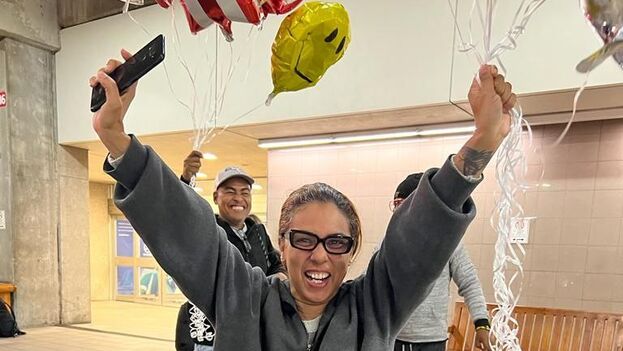
Yailén Insúa arrived in the United States on the day of her 43rd birthday. (Courtesy)

14ymedio bigger14ymedio, Havana, 23 December 2022 — Yailén Insúa Alarcón, former director of the Cuban Television Information System and the morning program Buenos Días, arrived in the United States on December 19 after a complicated journey through the Darién jungle, and after being scammed and detained in Mexico. “I arrived in the land of liberty on December 19 at 2:00 in the morning, on my birthday. I was  blessed, as I say, it was the best gift I could have,” the journalist tells 14ymedio from Jacksonville, Florida.

Insúa arrived in Colombia accompanied by her husband, Boris Luis Llamo Salgado, on February 5, 2022. The journalist planned to stop at El Dorado airport, in Bogotá, to get to Nicaragua and continue, like so many Cubans, her trip to the United States. But the situation became more complicated when Managua refused to let her enter the country, leaving her stranded in Colombia. Insúa’s fear was being returned to Cuba where the authorities would retaliate against her. “My biggest fear was setting foot in the José Martí airport in Havana because I knew they would be waiting for me,” she told this newspaper.

In mid-February, a Colombian judge granted Insúa and her husband, a member of the Yoruba Cultural Association, a safe conduct pass for 48 hours, thanks to which they both were able to leave the airport and seek asylum in the country. But in October, after several months of waiting, the authorities rejected her request. Although the case was in the hands of the Supreme Court, the former official attributes the judicial decision to Gustavo Petro’s electoral triumph.

“Coincidentally, you know that Cuba is the guarantor of the peace talks between the National Liberation Army in Colombia and the Government. And, well, it seems that they also decided to take sides with the Cuban government and not approve my asylum application,” says the journalist, who just turned 43.

“So I told my husband: ’We have to get out of here, we are in danger, we have just been denied asylum after so long,’” she continues. At that time, both decided to follow the route they had planned from Nicaragua, only starting from much further back and going through the dangerous passage of the Darién jungle. According to data from the Ministry of Public Security of Panama, about 5,530 Cubans crossed that way between January and November. continue reading

“The journey through Central America was quite easy, despite everything, after I passed the Darien. What was the problem? Arriving in Mexico. It took us twenty-some days to get to the United States, because when we arrived in Puebla I was detained for 10 days; that is, kidnapped in a house because a coyote scammed us and they didn’t let us leave,” reveals Insúa, who is forceful about what she experienced in that country: “Mexico is a mafia,” she says.

The journalist and her husband paid again and finally crossed the Rio Grande just four days ago. “When we crossed there was no Border Patrol. We walked two kilometers to a road and there I made a call to 911, which must be registered with my name, saying that we were a group of Cuban migrants, Hondurans, two Peruvians… We ask that, please, send the Border Patrol to pick us up. At that moment the sheriff came; they sent us to the Patrol and so I got here, to this country,” she says.

Insúa Alarcón was harshly attacked, after her arrival in Colombia, by Cuban influencer Alexander Otaola. He was going to warn the media not to allow the journalist to enter and described her as an “infiltrator.”

“I called them and said: ’Don’t give them asylum, don’t give them anything, because there are people who arrive, get asylum, start work at Radio Caracolm, and from Radio Caracol they begin to undermine Colombian democracy,’” he said on his program Hola! OtaOla.

Insúa Alarcón, however, says she suspects that Cuban intelligence has set its sights on her. “Since the media is saying that I arrived in the United States, coincidentally, I have received 43 friend requests from people I don’t know. So State Security is starting to work,” she concludes.

Translated by Regina Anavy

____________

COLLABORATE WITH OUR WORKThe 14ymedio team is committed to practicing serious journalism that reflects Cuba’s reality in all its depth. Thank you for joining us on this long journey. We invite you to continue supporting us by becoming a member of 14ymedio now. Together we can continue transforming journalism in Cuba.

Jose Daniel Ferrer’s Son Arrives in Miami After ‘Pressures’ from Cuban State Security

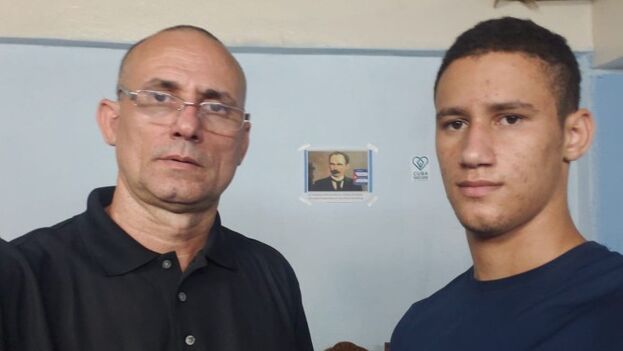
José Daniel Ferrer with his son in an archival photo. (Cubanet)

14ymedio biggerEFE (via 14ymedio), Miami, 22 December 2022 — Daniel Ferrer Cantillo, son of Cuban political prisoner José Daniel Ferrer García, leader of the opposition organization Unión Patriótica de Cuba, arrived in Miami after suffering “various pressures” to try to convince his father to leave the Island, as he told América Tevé.

“They wanted me to get my father out of prison; they were going to use me to try to get him out of the country, and I did not accept any condition that they put on me,” Ferrer said on América Tevé radio.

In the interview, released exclusively on Wednesday, the young man confirmed that he “recently” visited his father and that he continues on a hunger strike after beatings suffered in prison.

“He was super weak, physically he is very thin. He told me that he had been hit countless times in the ribs and kidneys that left them destroyed (…); since that day he began a hunger strike,” he told journalist Mario J. Penton.

The Council for the Democratic Transition in Cuba (CTDC) recently denounced that the opponent José Daniel Ferrer, in prison after trying to join the anti-government protests of July 11, 2021, was assaulted in front of his family, for which he began a hunger strike.

According to a statement from the CTDC, Ferrer “was beaten in the presence of his children and his wife during a family visit” in the Mar Verde prison, in Santiago de Cuba, on December 9. continue reading

“My father has made many advances, he is the person who has made the most progress, but he has still not been able to achieve what he wants, which is freedom,” said the son of the opponent, who added that from exile he will “try to study for a university career and continue to support the opposition in Cuba.”

“In Cuba, people have lately chosen more to leave the country than to continue fighting,” said the young man, who, according to América Tevé, by taking the path of exile is reuniting with his mother and two of his sisters.

Ferrer was arrested on October 1, 2019 and sentenced to prison in February 2020 after a closed-door trial for an alleged crime of injury to another man, a charge that his relatives and collaborators deny.

After six months in prison, and in the midst of strong international pressure, in April 2020 his sentence was commuted to a sentence of four and a half years of house arrest.

More than a year later, the dissident was imprisoned again for joining the 11 July 2021 (11J) protests.

In August last year, Cuban justice revoked the benefit of house arrest of the well-known dissident and sentenced him to remain in prison for the remaining years of his sentence for an alleged assault.

Translated by Regina Anavy

____________

COLLABORATE WITH OUR WORKThe 14ymedio team is committed to practicing serious journalism that reflects Cuba’s reality in all its depth. Thank you for joining us on this long journey. We invite you to continue supporting us by becoming a member of 14ymedio now. Together we can continue transforming journalism in Cuba.