
‘Life in Cuba is Almost a Heroic Act’

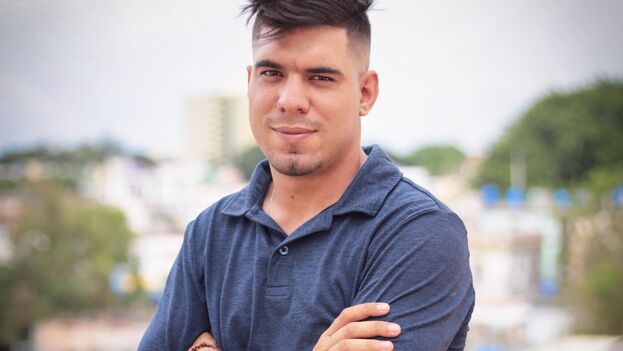
Adrián Martínez Cádiz has had to “chat” several times with the political police. (Facebook)

14ymedio bigger14ymedio, Xavier Carbonell, Salamanca, 25 October 2022 — Silent, emphatic, direct in what he thinks and says, the young Havanan Adrián Martínez Cádiz has had to “chat” several times with State Security. The agents are difficult interlocutors and gesticulate too much. The last appointment, on October 21, lasted an hour, with an effusive and rough lieutenant colonel who calls himself “Kenya,” a well-known stalker of numerous activists.

Martínez, who works as a journalist in several initiatives of the Catholic Church in Cuba and for the EWTN network, tells 14ymedio what it’s like to “dialogue” — so to speak — with the G2 officers, at the police station in Plaza de la Revolución.

“The gestures, the looks, the tones and the manner were threatening all the time,” says the young man, who spent an hour in interrogation with Officer Kenya and another soldier who identified himself as José Antonio.

“They wanted to officially warn me that I’m engaging in pre-criminal behavior by posting on my networks, ’inciting a crime’ and publishing texts that disparage Díaz-Canel, which they consider contempt,” says Martínez, who was threatened with criminal proceedings if he continued to be critical of the Government on his social networks.

The agents showed him photos of himself with activists and opposition figures such as Anamely Ramos, Omara Ruiz Urquiola, Rosa María Payá and rapper El Funky. “They won’t do anything for you,” they told him. “What they want is to send you to do things from the United States and ’perform theater’.” He replied that Ruiz Urquiola and Ramos, for example, had been prevented from entering the country. continue reading

Lieutenant Colonel Kenya then raised his voice and said that “it was a lie,” and that the Government didn’t prevent anyone from entering the Island. “Almost at the end he asks me what I was committed to, to write it in the warning act,” Martínez says. “Nothing at all,” he said, refusing to sign the document.

“Better for me,” the officer spat and left the room. After the interrogation, the police let in two officials of the Ministry of Communications. Martínez left the station with a fine of 3,000 pesos, although — by order of the officers — they didn’t confiscate his phone.

That day, activist Adrián Cruz, known as “Tata Poet,” a friend of Martínez, was also questioned. A group that included several Catholic priests was waiting for both young people outside the station.

“They’ve never clearly told me to ’get out of Cuba’,” he says, but indirect campaigns have become increasingly aggressive.  Ciberclarias [online “catfish”], he continues, are increasingly active in the groups that buy and sell, on common access sites or popular pages. “And, unfortunately, there are people who still believe them. I have friends in Camagüey who went to a family member’s house where I was the subject of conversation, saying  that I’m paid from the United States to publish and tell the truth,” he says.

Another notable difficulty arises when it comes to temporarily leaving the country. “It’s an odyssey,” complains Martínez. “They always review me exhaustively and ask me questions. Upon my arrival from a trip I was interrogated for 45 minutes in a room at the airport, and I was threatened with jail if I kept publishing.”

On that occasion they examined his luggage piece by piece, and kept “under investigation” two laptops, hard drives, USB sticks, cameras and other items related to communication. “When the objects were returned to me, the laptops had been forced and didn’t close well.”

For Adrián Martínez, life in Cuba is almost a “heroic act.” To the daily difficulties, blackouts and shortages, the surveillance of the political police is added. Religious spaces, such as Catholic university groups and “problematic” parishes, are continuously infiltrated by young agents.

“We Cubans have an ’extra sense’ to recognise them,” says Martínez, although he can’t specify what it is that immediately betrays the spies. “However, you have to be sure before accusing someone,” he says, “because there is also a tendency to think that we are always monitored. In addition, those of us who are disturbed, attacked and harassed can fall into the excess of thinking that everything bad that happens to us is caused by them.”

“There are infiltrators and collaborators at all levels,” he adds, “but you have to live without fear. We do nothing but tell the truth and try to do good.”

The persecution and surveillance of State Security on activists, religious leaders, artists and intellectuals has caused people of different ideologies to be united against the Government’s oppression. This has also contributed to many priests and nuns of the Island, such as Lester Zayas, José Luis Pérez Soto, Jorge Luis Gil and Nadieska Almeida, taking a more radical position against the regime in the capital.

’Each one of us has gone through these interrogations, through the threats, and we know what they represent,” says Martínez. “I understand that people are afraid, I am too, but there are things bigger than fear: that is what unites us in front of a police station to accompany, to embrace those who are being repressed not only for defending their rights, but also the rights of others. It’s not fair to abandon someone who is defending my right.”

The young man believes that State Security has managed to expel many “inconvenient” Cubans from the country. Those who remain on the Island — “those who are remaining” — will have to face the viciousness of the Government. “As for those who have left, I respect and hug them. I fight every day, like so many others, against the temptation to leave and forget everything.”

Regarding the passivity before the regime of which the Cuban bishops, who met last Friday with Pope Francis, are accused, Martínez points out that “many times I don’t agree with ways of proceeding, with particular opinions or other things. When I have the opportunity, I let them know and set out my opinions. I have always been listened to with respect.”

Translated by Regina Anavy

____________

COLLABORATE WITH OUR WORKThe 14ymedio team is committed to practicing serious journalism that reflects Cuba’s reality in all its depth. Thank you for joining us on this long journey. We invite you to continue supporting us by becoming a member of 14ymedio now. Together we can continue transforming journalism in Cuba.
The Police Sweep up Vendors from the Doorways of Havana

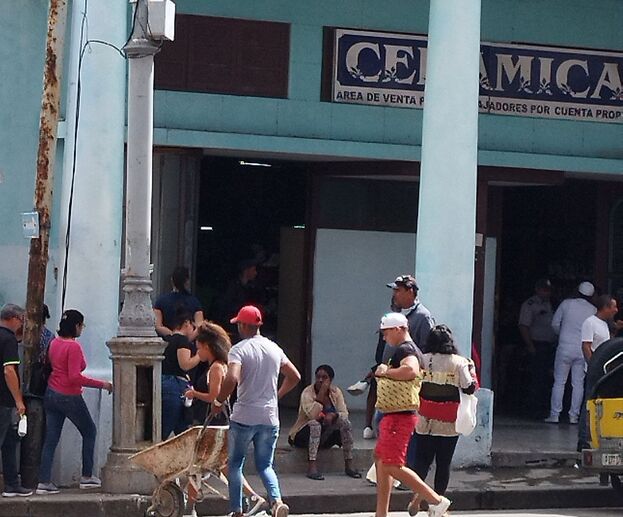
Police operation carried out last week in a shop on Neptuno and Galiano, in Havana. (14ymedio)

14ymedio bigger 14ymedio, Natalia López Moya, Havana, 23 October 2022 — The urban landscape of Havana lacks an important element these days: informal vendors who, in parks and doorways, offer everything from matches to soft drinks. A police operation carried out last week swept up these vendors, who sell basic products that are scarce in state stores.

“Not even one was left. These doorways on Galiano Street were always full of people selling many useful things for the home,” said a resident in Centro Habana who, approached the central avenue with the intention of buying a washer for his Italian coffee maker. “At first I thought it was too early and they hadn’t arrived, but a neighbor told me that the police had removed them.”

According to this resident, the raid took several minutes. “They arrested some and took away all the merchandise. Others were fined and warned that if they see them here again the fine will be even higher,” explains Luisa, a resident on nearby Águila Street, who rents part of her room to informal sellers to keep their merchandise.

The operation reached the self-employed fair also located on Galiano Street. Although those who sell there are licensed to sell local handicrafts and other privately-produced goods, according to the police, some were offering industrial products brought from abroad or bought in stores in freely convertible currency. continue reading

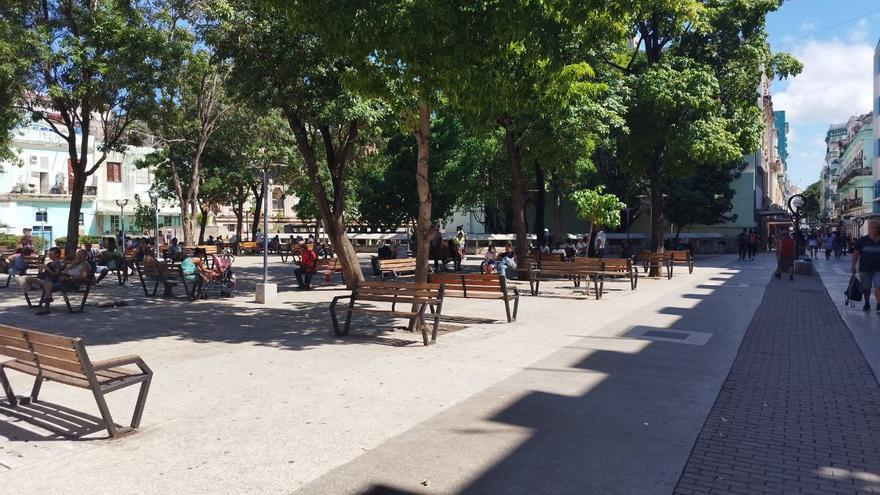
Fe del Valle Park, in Centro Habana, without the vendors’ tables. (14ymedio)

The usually-bustling place on Tuesday was practically empty and without the in-and-out of customers that has characterized it for years. Through the doorways in Galiano, from time to time you can see police, who monitor the area so that the street vendors don’t return. A daring one manages to take advantage of the fact that the agents move away to quietly hawk sponges and small bags of detergent.

“There are people who say that it’s the fault of the resellers who hoard the little they buy in the store and then resell it, but most of the things that these vendors sell are brought from abroad,” explains the woman, alluding to the mules that import all kinds of goods from Mexico, Panama, the Dominican Republic and the United States.

“If you need a sewing needle right now, where do you buy it?” asks Luisa. “Many of the things they sell don’t exist anywhere else, for example, dyes for clothes, lighters for gas stoves or shoe polish,” the woman says. “None of them have become rich selling all that junk,” she emphasizes.

The panorama, when you walk along Reina Street or San Rafael Boulevard is strange without the small tables or blankets on the ground of these informal merchants. The hope that some of their most assiduous customers have is that the waters will soon reach a level when the police raids against them end, and then the stalls will return with their tubes of glue and belts for men.

They do this all the time but then the vendors come back,” considers another neighbor. “Now they are again with the ’battle against illegalities,’ but they don’t recognize that these sellers solve a problem.” In the Fe del Valle park, where until a few days ago the tables alternated with bargains and school items, now there are only a few people sitting on the benches or connecting to the wifi area. It looks like the same place as a few weeks ago, but it no longer is.

Translated by Regina Anavy

____________

COLLABORATE WITH OUR WORKThe 14ymedio team is committed to practicing serious journalism that reflects Cuba’s reality in all its depth. Thank you for joining us on this long journey. We invite you to continue supporting us by becoming a member of 14ymedio now. Together we can continue transforming journalism in Cuba.
Mexico Opens 749 New Positions with High Salaries for Doctors and More Than a Hundred are Cubans

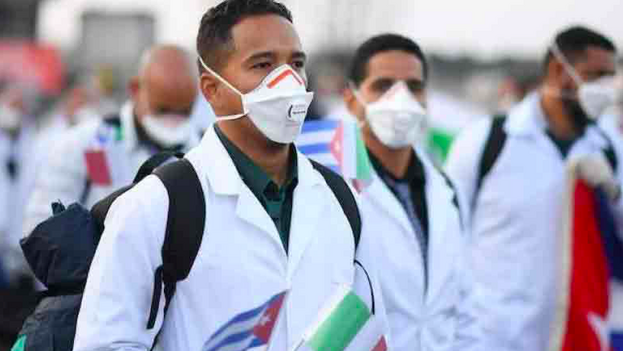
Former Mexican deputy Beatriz Pagés pointed out that the mission of Cuban medical groups is “more political, more military and more indoctrination than health.” (Prensa Latina)

14ymedio bigger14ymedio, Havana, 22 October 2022 — The Government of Andrés Manuel López Obrador will pay more than $2,600 a month for each of the 749 foreign doctors he invited on October 11 to fill positions in remote areas of Mexico. The amount almost doubles the $1,400 that national physicians currently receive, according to data from the Government of Mexico.

“It’s an insult to Mexican doctors,” Marco Antonio, an orthopaedist who works in Mexico, tells this newspaper. “It’s not fair that while my salary is $1,600 a month, they’re giving $1,000 more to foreigners.”

He also explained that the data isn’t a surprise: “There’s a disparity between the salaries of the Institute of Health for Well-being (INSABI), those of the Mexican Institute of Social Security (IMSS), and the Institute of Security and Social Services of State Workers (ISSSTE).”

According to the Centre for Economic and Budgetary Research (CIEP), last year the salary of a specialist doctor was between $830 and $2,300. While at the INSANI, the average salary is $2,000; in the IMSS it is $537, and in the ISSSTE it’s $780.

Of the 2,067 applications received by the Mexican Government, 104 are from Cubans, said the general director of the IMSS, Zoé Robledo, last Tuesday. Another 169 specialists come from the United States, Argentina, Bolivia, Colombia, Ecuador, Nicaragua, Paraguay, Peru, and Venezuela.

For the contracted health workers, Mexico will pay the “round-trip airfare, transfer to the place of residence and work center, immigration procedures and requirements, academic validation of educational institutions, food support, and accommodation.” In total, expenses of $36,000 per year are expected for each doctor.

This salary is also higher than that received by the 436 Cubans from a group of 642 hired by the Government of Mexico, who are already serving in several hospitals in marginalized areas. The López Obrador Administration pays the Island $2,042 per specialist and $1,722 for each general practitioner. continue reading

Robledo confirmed that the hiring of new Cuban specialists will be carried out through the Island’s Ministry of Health and Cuban Medical Services, S.A. The latter company, created in 2011, has been accused internationally of human trafficking and forced labor.

The last week of August, the Madrid-based organization Prisoners Defenders (PD) revealed in its report, “The military truth behind Cuban medical missions in Mexico,” that the more than 600 Cubans hired by Mexico “are military” and “none is a specialist doctor” (only family doctors or generalists).

The president of PD, Javier Larrondo, denounced the López Obrador Government for “allowing slavery on Mexican soil” and “financing” the Cuban regime.

Meanwhile, Beatriz Pagés, former deputy of Mexico and director of Siempre magazine, pointed out that the mission of the Cuban doctors is “more political, more military and more indoctrination than health.”

The most demanded specialties in that country are gynecology, obstetrics and anesthesia. Personnel specialized in pediatrics, general surgery, orthopedics, internal medicine, cardiology, neurosurgery, neonatology, ophthalmology, oncology, and cardiology are also needed.

Translated by Regina Anavy

____________

COLLABORATE WITH OUR WORKThe 14ymedio team is committed to practicing serious journalism that reflects Cuba’s reality in all its depth. Thank you for joining us on this long journey. We invite you to continue supporting us by becoming a member of 14ymedio now. Together we can continue transforming journalism in Cuba.
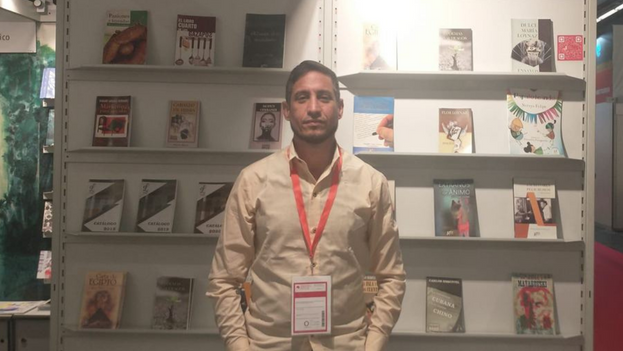
The Cuban Publisher That Rescued the Work of Dulce Maria Loynaz Presents its Catalogue in Frankfurt

Editor Osmany Echevarría Velázquez represented Ediciones Loynaz on October 15 at the introductory seminar of the program. (Facebook/Ediciones Loynaz)

14ymedio bigger14ymedio, Havana, 20 October 2022 — Ediciones Loynaz, the publishing house of Pinar del Río that publishes Pedro Juan Gutiérrez and Dulce María Loynaz, presents its titles at the International Book Fair in Frankfurt (Germany), which is held from this Wednesday through Sunday.

The invitation was made possible thanks to a program for small publishers, from which twenty companies from Asia, Africa, Europe and Latin America benefited. According to reports on the event by the publishing house on its social networks, editor Osmany Echevarría Velázquez represented Ediciones Loynaz on October 15 at the introductory seminar of the program.

During the presentation, Echevarría introduced the publisher’s catalogue, its distribution processes and its “positioning as part of the Territorial Editions System,” an official network of the Cuban Book Institute in all the provinces of the Island.

Echevarría pointed out that, after the passage of Hurricane Ian through Pinar del Río, where the publishing house has its headquarters, the province was “wounded in its soul and its land.” He added that, after the hurricane, “we managed to save a selection of printed and digital titles.”

The publishing house was visited this Wednesday by the director of the library of the Ibero-American Institute of Berlin, Peter Altekrueger, and the director of Acquisition and Cataloguing of that institution, Ricarda Musser, who assured there were 180 volumes of Ediciones Loynaz. continue reading

For Ediciones Loynaz, the Fair is “a privilege, a recognition” for its three decades of work. Like other provincial publishing houses, it began in 1991, during the Special Period, in the midst of paper shortages and the Cuban economic crisis after the fall of the Soviet Union.

On the Island, Luis Enrique Rodríguez Ortega, its director, had guaranteed the official newspaper Granma that the organizing committee of Frankfurt invited them as a tribute to their three decades of work, but, even more so, as recognition of “the System of Territorial Editions created by Fidel.”

The mention of Castro tried to rid the publisher of all suspicion: it’s not the first time that members of Cuban delegations at international fairs take advantage of the trip to leave the country and request international protection.

Granma points out that titles such as Carta de Egipto [Letter from Egypt], from the Cervantes Dulce María Loynaz Prize, or Cuentos de Guane [Tales of Guane], by Nersys Felipe, will be part of the catalogue of Ediciones Loynaz. It modestly mentions the author from Mantazas, Pedro Juan Gutiérrez, whose novels are known worldwide thanks to the Spanish publishing house Anagrama.

Echevarría comments enthusiastically that Gutiérrez’s volume, Escritores peligrosos y otros temas [Dangerous Writers and Other Subjects], is the jewel of Ediciones Loynaz: “This book shows another facet of its publisher, the facet of the journalist,” he told the EFE agency.

Born to disseminate the works of the Loynaz siblings, despised by the regime along with other Republican writers, it remains to be seen if the Pinar del Río publishing house will resist the temptation to not return to an Island that is experiencing its most critical moment in decades, after participating in the largest book fair in the world, dedicated this year to Spain.

Translated by Regina Anavy

____________

COLLABORATE WITH OUR WORKThe 14ymedio team is committed to practicing serious journalism that reflects Cuba’s reality in all its depth. Thank you for joining us on this long journey. We invite you to continue supporting us by becoming a member of 14ymedio now. Together we can continue transforming journalism in Cuba.
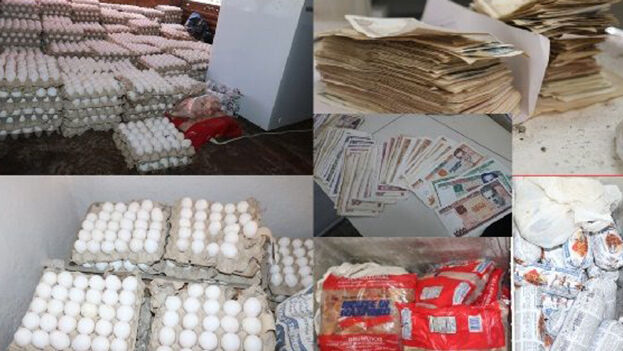
Cuban Police Arrest Egg and Chicken Vendors at the 100th and Boyeros Fair

The authorities confiscated packages of chicken and more than 400 cartons of eggs. ( Facebook)

14ymedio bigger14ymedio, Havana, 21 October 2022 — At least 30 people were arrested by the Cuban police for reselling basic necessities in the area known as Feria de 100th and Boyeros, in Havana. In the police procedure, carried out this Thursday, hundreds of cartons of eggs, chicken and picadillo packages were seized, the official media confirmed.

Elements of the Police and the Technical Investigation Department (DTI), a unit of the Ministry of the Interior, participated in the search. The uniformed officers arrived at the popular fair in the morning, when “from one moment to the next, they began to take away all the resellers who always walk through the area,” said La Página de Mauro Torres, sympathetic to the regime.

A witness to the operation said that merchants sold the products at exorbitant prices, according to the official press, which reproduces the user’s text on Facebook. Among these were the egg cartons at 2,000 pesos and the chicken packages — which in stores costs 90 pesos — at 1,500. “This was an abuse, so good for the police and the DTI,” the neighbour allegedly added.

Another witness pointed out that the operation reached a house near the fair, where they removed a truck loaded with chicken and picadillo packages. This person said that the house “contained more than four hundred cartons of eggs,” which were seized by the officers.

The publication points out that this type of operation enjoys “popular backing” because people who “profit from the needs of others” by selling basic products from the Cuban food basket at prices ten times above the market value are stopped.

The shortage of food and basic products on the Island causes distortions that contribute to fueling the black market, where you can find everything from technology items to sanitary pads for women at high prices. continue reading

The news of the operation has been applauded by many readers of the official newspaper, but there have been quite a few who have complained to the authorities about the inefficiency in controlling “stockpiling” and not being able to guarantee the supply of basic products. “At last we see something that helps break the criminal chain, although they have to get to the bottom, because 400 cartons of egg don’t just come out of nowhere, even less now that there isn’t anywhere you can find them,” said a online commenter.

“Resellers are abusers, but who is to blame for this happening? Where do those amounts of products come from? Are they really resellers?” asks Elina Mendoza. Another commenter, identified as Freddy, asked that those who buy dollars in the Cadecas [currency exchanges] and then resell them on the street be investigated.

Officialdom, for its part, announced that this is one of the investigations they will carry out in Havana against the “resellers who do so much damage to the population.”

The popular Fair, also known as “the candonga [the joke] of 100th and Boyeros” specializes in the sale of hardware products, plumbing, household supplies and other high-demand items that are scarce in state stores. Although, according to the law, merchants or street vendors who offer their goods on site can only sell domestically-manufactured products or handicrafts, the truth is that usually a shopper can find accessories and parts imported or taken from state warehouses.

Among the tables that offer Superglue, children’s toys and pipe joints, other sellers, who quietly tout packages of frozen chicken, eggs, powdered milk and other food items often hang around. The practice is so widespread that the Fair has the reputation of being a place where “everything or almost everything can be found.”

Translated by Regina Anavy

____________

COLLABORATE WITH OUR WORKThe 14ymedio team is committed to practicing serious journalism that reflects Cuba’s reality in all its depth. Thank you for joining us on this long journey. We invite you to continue supporting us by becoming a member of 14ymedio now. Together we can continue transforming journalism in Cuba.
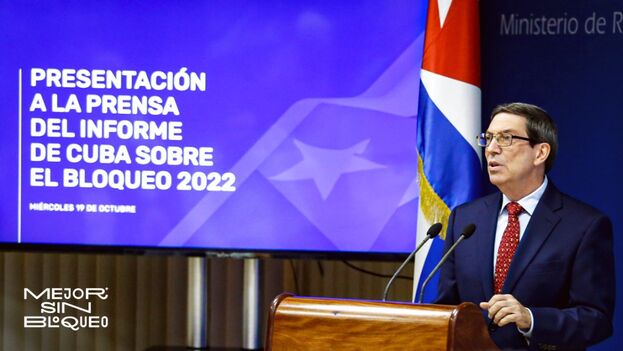
Cuba’s Foreign Minister Overwhelms the Press with Complaints and Dubious Figures About the ‘Blockade’

For this occasion, the Ministry has designed a logo that reads “Better without blockade.” (Cubadebate)

14ymedio bigger14ymedio, Madrid, 20 October 2022 — Cuba’s Foreign Minister, Bruno Rodríguez Parrilla, accused the Biden administration on Wednesday of having reached a record for damage to the Cuban economy with the embargo. The minister met with the international press to make the traditional assessment by the authorities before the resolution condemning the US economic policy on the Island is presented to the United Nations General Assembly, which this year will be held on November 2 and 3.

According to the updated report, between August 2021 and February 2022, the losses caused by the embargo amount to $3.8 billion, “a historic sum for a reduced period,” the chancellor said. The figure, calculated by an unknown methodology, is $6.4 billion in the 14 months of the current Democratic mandate, another historic record according to Rodríguez, which accounts for $454 million per month and $15 million per day.

Following the deluge of figures, the Cuban chancellor set the total in sixty years at $154.2 billion, which, translated into the value of gold, would be $139 trillion. “Imagine what Cuba could have done for its people by having those resources,” he complained.

Rodríguez Parrilla, aware that he didn’t count anything other than the last 60 years, added some drama in the language. “It’s not a new design of the blockade, but it has been surgically better designed, targeting each of the main sources of income for the country, seeking to increase the impact on the daily life of our population.”

After presenting the panorama in figures, the chancellor began to concretize it by presenting a reality: Cuba buys in the US market, and this is demonstrated by the data month after month, which confirm that the neighboring country is a supplier of a multitude of basic necessities. “It’s true that Cuba can buy food in other markets, and it’s true that it even acquires food in the US. But the blockade deprives Cuba of the indispensable financial resources* to make those purchases in the US or to make similar purchases in third markets,” he said. continue reading

Since the data, promptly disseminated, corroborate the massive purchases of the Island from the US, Rodríguez Parrilla has insisted on that point, which has become his fundamental argument. Thus, this Wednesday he repeated that Washington applies measures against financial institutions that prevent Cuba from functioning normally.

“Dozens and dozens of banks deny services to Cuba in fear of US fines. Others are forced to reach agreements by the illegal, extraterritorial actions of the US Government, to avoid those fines,” said the chancellor, who added that producers, carriers, shipping companies and insurers are prosecuted, among others, making the purchase of fuel more expensive by a third or half.

“Between January 2021 and February 2022, new data revealed a total of 642 direct actions reported by foreign banks that, in the face of threat by the US financial system, refused to provide services to the country,” reproached the chancellor, who accused the US of discriminating against Cuban citizens, who cannot have personal accounts in some countries, and of causing embassies to go without banking services.

The minister moved on to the central issue of Cuban reality at the moment: the National Electricity System, whose situation he described as “extremely serious.” Although he attributed this reality to a multitude of factors, including lack of fuel, he explained that the impossibility of using American technology has a decisive influence. The blackouts, he said, are “emergency measures” that “our people understand and support,” he said, without even mentioning the daily discomfort caused by power outages, which has been taking citizens out of their homes for weeks to demand the return of power.

“Cuba cannot acquire, anywhere, in any way, technologies, equipment, parts, digital technologies or software that contains 10% of US components, which is a direct impact, as serious as that of the lack of foreign exchange to guarantee supplies,” he argued.

Rodríguez Parrilla insisted that the “blockade” is undeniable — “nobody can seriously or soundly affirm that it doesn’t exist or is a mere pretext” — and is aimed at “provoking the inability of the country to meet the fundamental needs of the population,” and, thus, he considers the attitude of the US to be immoral.

There was no longer the slightest hint of self-criticism, nor of modesty. The chancellor praised the work of the Cuban government in the midst of so much derision and celebrated how the country overcomes each difficulty only to be harmed again. Among those examples were medications, which the country produces 60% of itself, but which are again affected by the lack of funding.

He also cited the vaccines against covid-19, whose endorsement in the World Health Organization remains on hold more than six months after documentation; respirators and oxygen have been submitted, all of them self-produced alone or with the help of partner countries in the face of the “deliberately cruel act” of the US of not “flexibilizing sanctions” in the worst of the pandemic. However, Rodríguez Parilla forgot that humanitarian aid arrived from the US not only at that time, but just one day earlier, when he himself thanked Washington for its contribution to repairing the damage of Hurricane Ian.

“We appreciate the US humanitarian aid offer. The material contribution valued at 2 million dollars through the International Red Cross Federation will contribute to our recovery efforts and support those affected by the ravages of Hurricane Ian,” he said on Twitter.

The chancellor vindicated the changes made by the regime — from its small economic measures to the “diversification of its productive matrix,” and the legislative modifications, although he cited only the Family Code, knowing that the Criminal Code wouldn’t be a very appreciated example — and praised its commitment to modernity. “Cuba changes every day and will continue to change. Cuba is renewed all the time. What doesn’t change, what isn’t renewed, what is anchored in the past, is the policy of the blockade,” he said.

Finally, Rodríguez warmed up to the next presentation of the resolution against the embargo, recalling that historically only two countries vote against it, the US and Israel. “It is universal to repudiate a criminal policy that has neither defeated nor achieved the objectives it set, although it causes a lot of human damage,” he said. And he ended with a plea that sounded like an eternal lament. “Cuba has the right to live without a blockade; it has the right to live in peace. Cuba would be better off without a blockade. Everyone would be better off without a blockade. The US would be a better country without the blockade of Cuba. The world would be better without the blockade of Cuba.”

*Translator’s note: The “financial resources” in this case is the ability to buy on credit, that is without paying anything up front, or potentially ever, as Cuba is known for not paying its debts.

Translated by Regina Anavy

____________

COLLABORATE WITH OUR WORKThe 14ymedio team is committed to practicing serious journalism that reflects Cuba’s reality in all its depth. Thank you for joining us on this long journey. We invite you to continue supporting us by becoming a member of 14ymedio now. Together we can continue transforming journalism in Cuba.
‘The Artist is a Dissident by Definition, says Cuban Filmmaker Orlando Jimenez Leal

Cuban filmmaker Orlando Jiménez Leal in an archive image. (EFE)

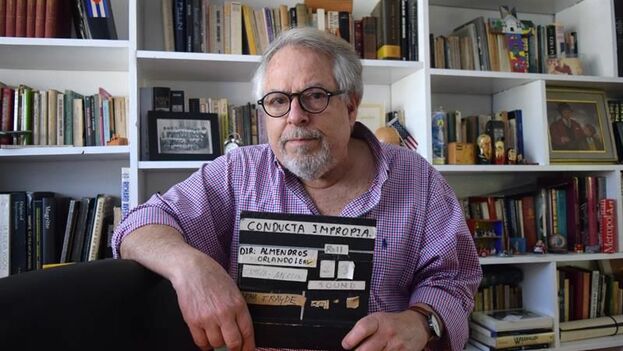
14ymedio biggerEFE (via 14ymedio), Ana Mengotti, Miami, 20 October 20, 2022 — We artists are by definition dissidents of reality,” says Cuban filmmaker Orlando Jiménez Leal, who took the path of exile after Fidel Castro banned his short film PM in 1961, warning those who protested, “against the Revolution nothing.”

“That was a before and after; it opened our eyes,” says Jiménez Leal, who has been in exile for 61 of his 81 years and will receive an award this Thursday for his career at the American Museum of the Cuban Diaspora in Miami.

Jiménez Leal left Cuba on January 2, 1962, and has never returned because, although he admits that he is “curious,” he finds it “embarrassing” to have to ask for permission to enter, he says in an interview with EFE.

When intellectuals asked Castro after the censorship of PM, co-directed by Sabá Cabrera Infante, if there was freedom in Cuba, he replied that “within the Revolution everything, against the Revolution nothing,” recalls the director, who, among other films, directed with León Ichaso El súper [The Super] (1979), a feature film presented and “applauded” at the Venice Film Festival.

The newly created Archive of Cuban Diáspora Cinema, an initiative that emerged at Florida International University (FIU), will give him an award this Thursday for his career.

The founders of the archive, Cuban filmmaker Eliecer Jiménez Almeida and Spanish professor Santiago Juan-Navarro, consider that PM, a short documentary about nightlife in the slums of Havana, is the “zero kilometer” from which Cuban cinema in exile begins. continue reading

For Jiménez Leal it’s exactly that: the start of a life outside Cuba with stops in the United States, Puerto Rico and Spain. He has been living in Miami now for nine years.

Although he says that his memory of life in exile is “aged” and the previous one in Cuba, on the contrary, fresh, the filmmaker perfectly remembers his time in Madrid during the final years of Francoism, what he calls “watered-down” Francoism.

At that time he was dedicated to advertising, which was also his livelihood in the United States and the way to finance the films he longed to make.

One of those ads was seen by Julio Iglesias in Puerto Rico and, as he liked it, he contacted Jiménez Leal to direct Me olvidé de vivir [I Forgot to Live] (1980), of which he remembers above all its protagonist, an “charming person” and a “good actor,” capable of improvising.

Previously, he had presented The Super in Venice, which he defines as a “Cuban neorealist film” that “opened the eyes to many who had a fixed idea of the Revolution” by presenting the truncated lives of the exiles in the United States.

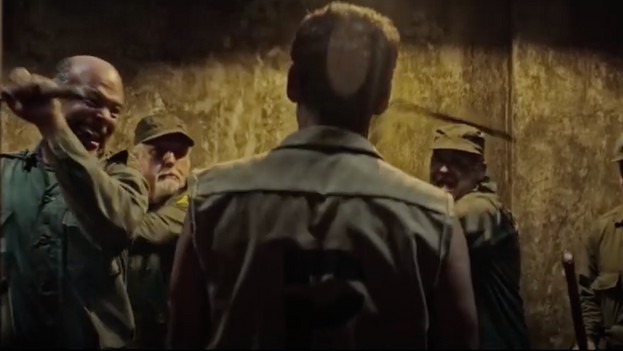
Friend of film photography director Néstor Almendros, with whom he directed the documentary on the repression of homosexuals in Cuba, Improper Behavior (1984), and of the writer Guillermo Cabrera Infante, who went into exile like him, Jiménez Leal says that in Cuba they have not been able to “erase him from memory,” and he has become “a ghost that returns.”

Young independent Cuban filmmakers, many of them also outside Cuba, look for his films and declare themselves his admirers, he proudly says.

The authorities don’t mess with him. “As the saying goes, they  (those who govern in Cuba) have other fish to fry,” and he mentions “the demonstrators who demand water, electricity and freedom” in the streets of Cuba, and the “imprisoned artists.”

Jiménez Leal no longer makes movies but is still very connected to the cinema and attentive to news on platforms like Netflix, although he confesses that he is, above all, reading books he has already read and watching classic films.

Cinema has changed a lot, especially with the incorporation of digital media. Before, you needed real talent to succeed in cinema; you had to know about technique and industry issues. Now there are more opportunities but there also is a lot of garbage,” he emphasizes.

Over the years, his cinematographic tastes have changed. The “arrogance of youth” made him consider Vittorio De Sica’s Miracle in Milan (1951), a minor film, while at the age of 81 it seems to him a “masterpiece.”

About Blonde, Andrew Dominik’s recently released film about Marilyn Monroe, Jiménez Leal says that it produces “a mixture of feelings” and exhibits the “exceptional” work of Cuban-Spanish actress Ana de Armas.

Among the things he knows he will no longer be able to do is a film that was to be called Cuba Does Not Exist, paraphrasing the exiled Russian writer Vladimir Nabokov, who in an interview proclaimed that “Russia does not exist.”

Translated by Regina Anavy

____________

COLLABORATE WITH OUR WORKThe 14ymedio team is committed to practicing serious journalism that reflects Cuba’s reality in all its depth. Thank you for joining us on this long journey. We invite you to continue supporting us by becoming a member of 14ymedio now. Together we can continue transforming journalism in Cuba.
Tobacco Planting Begins in the Area of Cuba Most Devastated by Hurricane Ian

The 2021-2022 campaign was affected by a lack of fertilizer and other inputs necessary for the cultivation of tobacco, the country’s main agricultural export. (Granma)

14ymedio biggerEFE (via 14ymedio), Havana, 22 October 2022 — The Cuban province of Pinar del Río, known for the cultivation of the tobacco leaves of the famous Havana puros [cigars], began planting this week, despite being the area of the Island that was the most devastated by Hurricane Ian at the end of September.

According to state media this Friday, planting began on about 15,500 acres of land, and the tobacco will be mainly destined for export.

The planting program will be extended until January 31 and will be concentrated in the municipalities of San Juan y Martínez, San Luis, Pinar del Río and Consolación del Sur, considered the “tobacco massif” of the province that produces half of the most demanded tobacco leaf. continue reading

About 2,200 acres of covered tobacco — intended for the wrappers of cigars — will be planted, along with  other varieties such as Burley, Virginia and Vegas Finas, which are used in the production of pipe tobacco, will be planted, according to the delegate of Agriculture in the province, Víctor Hernández, as quoted by the state Cuban News Agency.

He said that plantings have also begun of seedbeds that were not damaged by the scourge of Hurricane Ian, which crossed Pinar del Río from south to north on September 27, where it left considerable damage to agriculture, housing, communications and electricity service.

He also specified that about 6,200 curing houses are needed — where the tobacco leaves are stored for natural drying — of the more than 10,000 that were damaged by the hurricane winds, equivalent to 90% of the approximately 12,000 in the region.

The impact of the hurricane also caused about 11,000 tons of tobacco that were in the process of curing to get wet, so many of them will have to be discarded, according to official reports.

This blow to the sector occurs at an already delicate time for the Cuban tobacco sector, which produced from January to June less than half of what was planned due to lack of basic supplies, logistical problems and breakdowns, among other problems.

The tobacco harvest, Cuba’s fourth largest income sector, went from 32,000 tons in 2017 to 25,800 tons in 2020, according to official data. The sector employs about 200,000 workers, which increases to 250,000 at the peak of the harvest.

Translated by Regina Anavy

____________

COLLABORATE WITH OUR WORKThe 14ymedio team is committed to practicing serious journalism that reflects Cuba’s reality in all its depth. Thank you for joining us on this long journey. We invite you to continue supporting us by becoming a member of 14ymedio now. Together we can continue transforming journalism in Cuba.

Cuba Needs 1.4 Million Travelers to Meet its Tourism Goal in 2022

Tourists in Havana before the pandemic. (EFE)

14ymedio bigger14ymedio, Madrid, 20 October 2022 — Three months after the end of the year, the goal of 2.5 million tourists that Cuba expected is confirmed as impossible. In the first nine months of 2022, 1,074,814 international travelers arrived on the Island, so in October, November and December, there must be 1.4 million more to reach the goal. Although the high season begins next month, the best figure of the year (152,480 in July) would have to triple in those three months to achieve it.

The Ministry of Tourism updated its data on Tuesday, with the publication in the National Office of Statistics and Information (Onei) of the arrival figures of travelers, including Cubans living abroad, through September. The figure reaches 1,553,461, an increase of roughly five-and-a-half times over the previous year. As for international visitors, discounting Cubans residing abroad, there were 1,074,814 in total, almost six times more than the 180,735 in 2021.

However, the Government is fooling itself again, since the 2021 figures are not comparatively useful. Although they do serve to measure the recovery of the sector after the pandemic, you have to put them in context with those of normal years for tourism, which between 2020 and 2021 plummeted worldwide due to covid-19. If you compare the data of international travelers between January and September of this year with those of 2019, 3,327,392, the difference is a decline of 68%. The contrast is even worse compared to the previous year, 2018, when 3,540,543 arrived. The decline in this case is 70%.

In detail, you can see how the collapse of Russian tourism is affecting Cuban accounts. The statistics break down the number of travelers from each country and compare it with the previous year, so in all cases it grows, given the closure of borders that was in force for much of 2021. Powerful examples are that of Canada, the first country to send tourists to Cuba traditionally, which increases from just 9,265 last year to 324,252 this year. continue reading

Cuban-Americans grew from 19,003 in 2021 to 240,197 in 2022, and the Spanish, at the head of European tourists, who as of September last year totalled 6,091, this year reached 62,157. This is repeated for all the main indicators, even for the catch-all category of “other.”

However, in the case of Russia, the figure completely reverses. In the first three quarters of 2021, 111,228 Russians arrived in Cuba, and this year in the same period barely 38,883 did so. In addition, as expected, almost all arrived until February, 35,871. At the end of that month, on the 24th, the invasion of Ukraine and the international sanctions on Russia began, which left many Russians  unable to fly to certain destinations due to the ban on crossing European airspace.

This October, the Russian company Aeroflot resumed its flights to Havana, with routes bordering the North Pole to avoid the exclusion zone, so it’s possible that in the last quarter the numbers of tourists from that country will rebound, the only one that grew in visitors before the pandemic. The market, however, was showing symptoms of exhaustion already at the end of 2021, when the Island was reopened to travelers, and it was shown that the Russians had changed their preferences for the Dominican Republic, which with its strategy positioned itself at the forefront of Caribbean tourist destinations since it opened its borders in September 2021.

In recent months, the Cuban authorities are giving their all to recover one of the sectors that brings the most foreign exchange to their coffers, discounting remittances and “medical missions.”

This week the Health Tourism Fair takes place in Havana, where Cuba tries to sell all kinds of therapies and medical services with a view to the Caribbean. At the end of September, the XIII International Nature Tourism Event was held, in which an attempt was made to convince potential travelers that the Island is more than sun and beach. And also in the middle of last month, the Varadero Gourmet International Festival took place, which generated discomfort in the population for being a showcase of products that citizens can’t even dream of.

In all of them, Manuel Marrero, Prime Minister of Cuba, has supported the target of 2.5 million visitors, defending the idea that it will undoubtedly be achieved despite the difficulties. Months earlier, in May, the leader was the first to postpone the recovery of the sector to 2023, contradicting the rest of the Government and the minister of the branch, Juan Carlos García Granda.

“Next year the leisure industry will recover in Cuba, and for that purpose, the development of FitCuba 2022 will mark a before and after,” Marrero said then at another event in the sector, the Varadero Tourism Fair, to end up joining the official speech. Perhaps his thesis, that of a man who was Minister of Tourism for 15 years, should have prevailed.

Translated by Regina Anavy

____________

COLLABORATE WITH OUR WORKThe 14ymedio team is committed to practicing serious journalism that reflects Cuba’s reality in all its depth. Thank you for joining us on this long journey. We invite you to continue supporting us by becoming a member of 14ymedio now. Together we can continue transforming journalism in Cuba.

A Cuban Pilot Escapes From the Island in a Russian Plane and Lands in Florida

The pilot landed the Antonov An-2 at the Dade-Collier Training and Transition Airport. (WPTV News/Screen capture/YouTube)

14ymedio bigger14ymedio, Havana, 21 October 2022 — Cuban pilot Rubén Martínez left the Island this Friday in a Russian-made Antonov AN-2 aircraft with registration 1885, which landed at Dade-Collier Training and Transition Airport, Florida, around 11:30 am.

According to local U.S. media reports, the authorities confirmed that the pilot had flown from Sancti Spíritus and that he “took a selfie next to the plane after landing,” reports NBC Miami.

In the Dade-Collier airport, located on Tamiami Trail, in the middle of the Florida Everglades and west of Miami, Martínez was interrogated by Customs and Border Protection agents.

The air terminal where the Cuban landed was built for supersonic planes and sometimes is used for pilots to practice takeoffs and landings, said WSVN News, which added that Martinez remains in the custody of Customs and Border Protection. continue reading

The AN-2 model, a single-engine biplane designed by the Russian company Antonov, had its first flight on August 31, 1947. Due to its versatility, it has been used as a tanker aircraft during forest fires. It has a capacity to transport 12 passengers and has also been used as an air ambulance. It is usually used in fumigation work.

A fleet of this type of aircraft was assembled in Cuba in 2017 for fumigation, offering services to the tourism sector, cargo transportation and firefighting, as published then by the official press.

Rubén Martínez was a pilot of the Cuban Air Services Company (ENSA) that belongs to the Cuban Aviation Corporation administered by the Cuban Government. ENSA provides services mainly with fumigation aircraft.

In 2003, an Antonov 24 aircraft from Cubana de Aviación was diverted from the Island to Key West (Florida). The Cuban Adermis Wilson Gonzále, armed with a hand grenade, wanted the plane to land in Miami, but due to lack of fuel the pilot had to make an emergency landing at the José Martí airport in Havana, where he stayed 14 hours.

After intense negotiations, 22 passengers were released, and the plane departed with 25 other people and six crew members to Key West, where it arrived on April 1, 2003, escorted by American warplanes.

A year ago, González, who worked as a civilian construction technician on Isla de la Juventud, was released after serving almost 20 years in a U.S. prison, after being sentenced by a Florida court for air piracy.

Rubén Martínez’s escape this Friday dusted off the case of spy René González Sehwerert, who in 1990, when Cuba began to feel the economic havoc after the fall of the Soviet Union, took one of the small planes from the airfield where he worked as a flight instructor to leave the Island and arrive after an hour’s trip to the United States.

Between October 2021 and August 2022, more than 200,000 Cubans were intercepted by U.S. authorities, according to data from the United States Customs and Border Protection Office. So far, in the first month of fiscal year 2022, more than 400 were intercepted at sea aboard rudimentary vessels.

Translated by Regina Anavy

____________

COLLABORATE WITH OUR WORKThe 14ymedio team is committed to practicing serious journalism that reflects Cuba’s reality in all its depth. Thank you for joining us on this long journey. We invite you to continue supporting us by becoming a member of 14ymedio now. Together we can continue transforming journalism in Cuba.

New Cuban Film ‘Plantadas’ Tells the History of the Island’s Female Political Prisoners

Frame from “Plantados” — Lilo Vilaplana’s earlier film about male political prisoners in Cuba. (Screen capture)

14ymedio bigger14ymedio, Pedro Corzo, Miami, 18 October 2022 — Cuban filmmaker Lilo Vilaplana recently announced that he had concluded the filming of Plantadas, a more than necessary historical document, which will do justice to the thousands of Cuban women who have been and are in prison for their struggle for freedom and democracy on the Island.

Vilaplana made a fundamental contribution to Cuba’s historiography when he filmed the epic Plantados, which shows the cruelty of the Castro prison system and the rage of the jailers, who apply the rules of Island totalitarianism. It also documents the patriotism of political prisoners.

This film promises to be at least as valuable as the previous one, because it records the experiences of the women who have faced the dictatorship and who, by their actions, ended up in the dungeons of totalitarianism, suffering a systematic violation of their rights, including that of life.

Cuba’s political prison for women has undoubtedly been the largest and most extensive in the American hemisphere for years. Its construction began in 1959 and is not yet finished, as reflected by journalist Yolanda Huerga in a work published on Radio Televisión Martí. In it, a young political prisoner, Rosa Jany Murillo, in response to a blackmail from her jailers, says: “I have nothing to learn. I have only one ideal, one principle, one concept: I want communism to fall, that there be democratic parties, that my people can be defended and served by a government. You don’t do it; therefore, I have nothing to regret.”

The courage of this young Cuban woman behind bars has been known in women’s prisons since the dawn of the Revolution. Behind those same bars, in different dungeons, thousands of women from different generations have demonstrated their commitment to freedom as did Cary Roque, Ana Lázara Rodríguez, Gloria Lasalle, Isabel Tejera, María Amalia Fernández del Cueto, Nelly Rojas, Maritza Lugo and Marta Beatriz Roque Cabello. We will learn about these heroines when Vilaplana and his team deliver Plantadas. continue reading

Trying to synthesize the heroism of the Cuban women in prison in these 63 years is almost an odyssey. There are many events to be noted — the shootings of friends of the cause, escapes, tortures, beatings, hunger strikes, deaths, separations from family, from their children for complying “with the Homeland,” the lack of the most essential resources, an infinite list of regrets that honors the deeds of these women, who always demonstrated the most worthy stoicism.

The teacher of every decent Cuban, José Martí, wrote “he who honors another honors himself,” and therefore it is right and appropriate to mention the person who, in my humble view, has promoted the filming of Plantadas like no other: Reynol Rodríguez, an activist in favor of democracy and the freedom of Cubans, who has dedicated his life to the fight against dictatorships.

Rodríguez is one of those people who understand that the struggle has many facets without denying any. He is a man of proven heroism, who participated in armed incursions against the dictatorship and supported with all zeal people like the unforgettable Vicente Méndez, who fell in combat a few days after arriving on Cuban coasts.

This fighter for freedom worked month after month to organize fund-raisers for this historical documentary on Cuban women. The organizing committee fully reached its objective, and I must highlight two members: Pedro Remón, another brave compatriot who never says no, and the son of Osvaldo Ramírez, a glorious martyr in the fight against Castroism who was the second head of the uprising of the Escambray mountains in the early 60s, also named Osvaldo Ramírez, another compatriot who joined all the efforts for democracy.

The exiled filmography dedicated to directly collecting the struggle for freedom has several filmmakers who, like Vilaplana, have demonstrated a commitment to Cuban art and reality: the pioneer Eduardo Palmer, Iván Acosta, Luis Guardia, Daniel Urdanivia and Wenceslao Cruz. We owe all of them, for their quiet efforts, a profound respect.

Translated by Regina Anavy

____________

COLLABORATE WITH OUR WORKThe 14ymedio team is committed to practicing serious journalism that reflects Cuba’s reality in all its depth. Thank you for joining us on this long journey. We invite you to continue supporting us by becoming a member of 14ymedio now. Together we can continue transforming journalism in Cuba.
Cuba’s Guiteras Thermal Electric Plant will be Out of Service for Three Months for Repairs

The Antonio Guiteras power plant managed to enter the National Electrical System on Tuesday, after repairing a breakdown in the boiler. (TV Yumurí/Facebook)

14ymedio bigger14ymedio, Havana, 19 October 2022 — The announcement that the Antonio Guiteras thermal power plant, in Matanzas, must be disconnected for three months for a comprehensive repair definitively contradicts Miguel Díaz-Canel’s promise about the end of the blackouts by December.

Outdated and defective technology, natural disasters and increasingly serious breakdowns, plus the impossibility of thorough maintenance, make the operation of the largest thermal electric plant in the country impossible. Its directors have received a “barrage of bad news,” said the official reporter Lázaro Manuel Alonso in a report on Cuban Television.

According to Alonso, Guiteras is faced with a dilemma: the progressive collapse of pipes, boilers and equipment, which makes it necessary to suspend service for 90 days, and, on the other hand, the impossibility of stopping the generation “under present circumstances.” At the moment, the journalist claimed, what’s left is only “innovating,” the euphemism that the managers continue demanding from the technical staff of the plant, until “better times” arrive.

It’s not strange that, in the face of the collapse of the plant and institutional pressure, many of its workers have decided to “emigrate” not only outside the Island, but to other less demanding and better-paid positions in Etecsa or outside the state sector. In addition, Alonso admits, there is a serious “wage demotivation,” since most technicians earn about 6,700 pesos*, an insignificant figure in the midst of the inflation that the Island is experiencing. continue reading

“After the financial reordering, we fell to a low level,” complained Yoandry Flores, one of the operators of the thermoelectric plant. Before, the Electric Union enjoyed good salaries, which covered his “needs,” he said.

In spite of everything,” justifies the reporter, “its workers, with low wages, now keep the unit online with more than 230 megawatts (MW),” a generation capacity that has demonstrated little stability in recent weeks.

The plant managed to enter the National Electricity System on Tuesday, after repairing a breakdown in the boiler. However, a cleaning of the structure and the replacement of several of its connecter tubes is still essential.

“It’s working but with risk and tension,” said Javier Quiroz, one of the directors interviewed by Alonso.

Meanwhile, the toll of the SEN’s collapse continues to be measured in the number of hours of blackouts, which reach twelve per day in most of the Island. Neither the continuous protests and caceralozos [banging on pots and pans] nor the dismissals of the Minister of Energy and Mines and the director of the Electric Union have solved the energy crisis on the Island.

*Translator’s note: The official and information market exchange rates between the dollar and the peso change constantly but, as of this writing, 6,700 pesos at the official exchange rate would yield $279 US. The informal market (often the only available) exchange rate would yield roughly $33 US.

Translated by Regina Anavy

____________

COLLABORATE WITH OUR WORKThe 14ymedio team is committed to practicing serious journalism that reflects Cuba’s reality in all its depth. Thank you for joining us on this long journey. We invite you to continue supporting us by becoming a member of 14ymedio now. Together we can continue transforming journalism in Cuba.

More Than 4,000 People are on the Waiting List to Buy Dollars at a Currency Exchange in Havana


If a walk by the ATMs of Havana demonstrates the shortage of pesos in the country, a stroll by the Cadecas [currency exchanges] illustrates another lack: that of dollars.
14ymedio bigger14ymedio, Juan Diego Rodríguez, Havana, 20 October 2022 — This Wednesday, in the Cadeca on Belascoaín, in Central Havana, only 10 people were served. Taking into account that, according to the official provisions in force since last August 22, each individual can get a maximum of 100 dollars a day, the branch sold only 1,000 dollars.

The Cadeca, located in the municipality with the maximum population density, cannot meet the demand: to date, the police officers in charge of “keeping order” in the line have a waiting list of 4,000 people. “In the next century maybe I can buy,” a young man said sadly this Thursday, as he walked away.

At the El Vedado Cadeca, located at 23rd street between J and L, the panorama is slightly more encouraging. Every day about 30 buyers manage to be served, which means a maximum sale of 3,000 dollars. However, more than two weeks ago there were 700 people on the list to enter, and this Wednesday, the number was 275.

“From what I see there are new faces, who don’t know how this works. I always start with the most important part: discipline.” The policeman in charge of the Cadeca on 23rd says, with his words denoting that day by day he usually attends to the same people, and takes pride  in the good progress of that branch.

“Here there has to be order, citizen tranquillity, respect for the person. From here [the line] to there [the door] there will never be a lack of respect,” he continues. “From there to here it has to be the same. I say this because other citizens of other municipalities, such as Arroyo Naranjo or Diez de Octubre, come here imposing. Nothing is imposed here. I don’t impose on what we’re doing. Everything is working fine.”

The officer warns that “scams cannot happen here” and that citizens who come to “propose” one must be denounced. “I’m going for fourteen scams here to clarify,” he says, while assuring that those suspects “have disappeared,” and clarifies, referring to the Havana prisons: “in the best sense of the word, of course: Valle Grande, Combinado del Este….” Thus, he says that six people have been arrested. continue reading

The idea of aiming at 700, he says, occurred to him two Saturdays ago, when such a tumult was organized that the authorities had to close the street. “There have been 275 people. We have about 425 left. When am I going to write them up, that’s what interests you the most?” he asks in a pedagogical tone, to answer, diffusely: when the list stays at “100, 150, or 200 and up to 300.”

“Three hundred! That’s a fantasy,” replies a woman, laughing, who has been approaching the Cadeca for several days in a row, and the policeman reprimands her: “Discipline, compañera, discipline.”

The reason, the officer explains, is because he has to “juggle the availability of what the Cadeca compañeros have and what the compañeros of the Ministry, the Management, tell me to do.” Indeed, as indicated by the rules approved in August, each branch will only be able to sell the few currencies it bought from customers the day before.

Normally, they let between 30 and 40 people pass, but one day, suddenly, 60 people managed to enter, which caused many to lose their place in line. “The one who missed his turn lost,” says the officer, who also warns that no one can take more than one turn, even if he comes with someone else’s card.

“The problem is that if you don’t know how many turns there will be, you have to come every day,” laments an old man in line, once the policeman has retired. “This is a debacle,” interjects a middle-aged man, who nevertheless concedes: “And this is the best Cadeca; the rest are dying. In Monaco [on Diez de Octobre] there is no list. You can go to sleep from one day to the next and you won’t qualify.”

I’ve been here for two weeks and haven’t been able to sign up, and I see how the list stays the same,” complains another woman, who immediately takes things with resignation and says sarcastically, “That’s the way it is. Imagine: we are happy here.”

Translated by Regina Anavy

____________

COLLABORATE WITH OUR WORKThe 14ymedio team is committed to practicing serious journalism that reflects Cuba’s reality in all its depth. Thank you for joining us on this long journey. We invite you to continue supporting us by becoming a member of 14ymedio now. Together we can continue transforming journalism in Cuba.
Despite the Change of Minister, More Power Plants are Shutting Down in Cuba

The breakdown will translate into more blackouts not only for Cienfuegos, but also for other provinces that depend on the generating capacity of the plant. (Cubadebate)

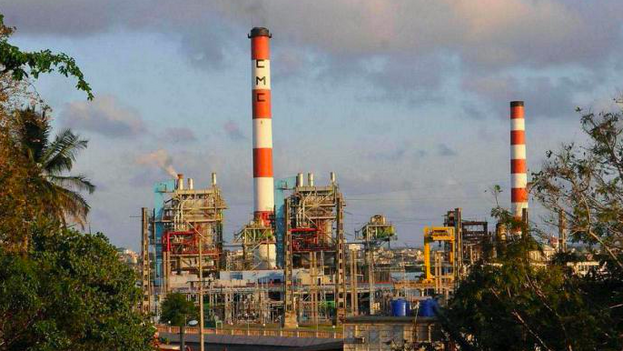
14ymedio bigger14ymedio, Havana, 18 October 2022 — On the same day that the official press dedicated a triumphalist article to the “stability” of the thermoelectric plant (CTE) Carlos Manuel de Céspedes, in Cienfuegos, unit 4 of this plant was disconnected from the National Electrical System (SEN).

With the usual euphemisms, a brief note from the Cuban News Agency reported on Monday that, due to “boiler failures,” the unit is subjected to a “natural cooling” process that will last three or four days, even if “forced-air fans” are used.

Beyond the technical explanations, as usual, the breakdown will result in more blackouts not only for Cienfuegos, but also for other provinces that depend on the generating capacity of the plant. “We have had to provide part of the energy that other thermoelectric plants have not been able to generate due to technical problems,” the general director of the Céspedes, Yeranis Zurita García, complained to the official newspaper Granma.

In the same report, the Granma boasted that in the daily deliveries, generation of the Cienfueguos thermoelectric plant is “recognized in the country for its levels of stability.”

Zurita indicated that, “despite the problems,” they exceeded their gross generation plan at the end of September with 132.4%, a surplus that had to be sent to other territories of the country.

Less optimistic, engineer Dariel Jiménez, of the Céspedes Brigade of Protections and Electrical Schemes, admitted that “practically every day there are breakdowns or other difficulties.” continue reading

“The breakage of the main transformer of the machine outlet had to be resolved “in a matter of 15 minutes,” he said regretfully, a not-ideal solution at which the technicians arrived “with what we had at hand.”

Urgency and short-term solutions are the daily bread of Cuban thermoelectric plants, said Jiménez, whose team is required to fix everything “in the shortest possible time” on a technology “with many years of exploitation.”

The head of maintenance of Céspedes, Yunior Estrada Zambrano, said that “we have characterized ourselves as always doing everything we can, sometimes against the short time that the system gives us.” However, he recognizes that the generation is “very depressed.”

Determined to highlight “the sacrifice and effort” of the Céspedes, Granma didn’t flinch in recognizing that unit 4 had left the National Electricity System (SEN). As the Unión Eléctrica logbook points out, it is added to the list of blocks out of service next to units 6 and 7 of the CTE Mariel (Mayabeque), the 4 and 5 of Nuevitas (Camagüey), the 2 of the Felton (Holguín), the 3, 4 and 5 of Renté (Santiago de Cuba and the only one of Otto Parellada (Havana). About the CTE Antonio Guiteras, which left the SEN this Friday, the official reporter Lázaro Manuel Alonso announced on his networks that it had already been “synchronized” again and that Televisión Cubana would offer more details about its operation.

The UNE report adds that the maximum impact during the night, this Monday, was 1,568 megawatts (MW) at 7:20 p.m., while this Tuesday a maximum demand of 3,200 is expected for a deficit of 1,125 MW.

The National Electricity System hasn’t shown signs of improvement in recent months and has been especially affected by the explosion of the Matanzas Supertanker Base and the passage of Hurricane Ian through the west of the country.

On Monday, the seriousness of the energy situation cost the Minister of Energy and Mines, Liván Arronte Cruz, and the director of the UNE, Jorge Amado Cepero Hernández, their positions. The new managers of the SEN, Minister Vicente de la O Levy and director Alfredo López, will have to attend to a system whose collapse has caused numerous protests against the long blackouts.

Translated by Regina Anavy

____________

COLLABORATE WITH OUR WORKThe 14ymedio team is committed to practicing serious journalism that reflects Cuba’s reality in all its depth. Thank you for joining us on this long journey. We invite you to continue supporting us by becoming a member of 14ymedio now. Together we can continue transforming journalism in Cuba.
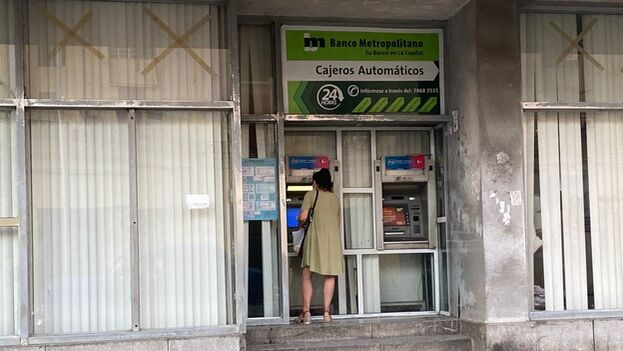
By Noon There is No Cash Left in Havana’s ATMs

“You have to leave early to get in line at the ATMs and wait for them to be supplied when the banks open,” says a 62-year-old Havanan. (14ymedio)

14ymedio bigger14ymedio, Natalia López Moya, Havana, 19 October 19, 2022 — “It’s not worth going to the ATMs in the small banks; you can only find money in the most central,” observes Pedro Luis, a 62-year-old Havanan who travelled to several municipalities of Havana this Tuesday trying to withdraw cash from his bank account. “In the end I could only do it on on Obispo Street, because it’s in a tourist area.”

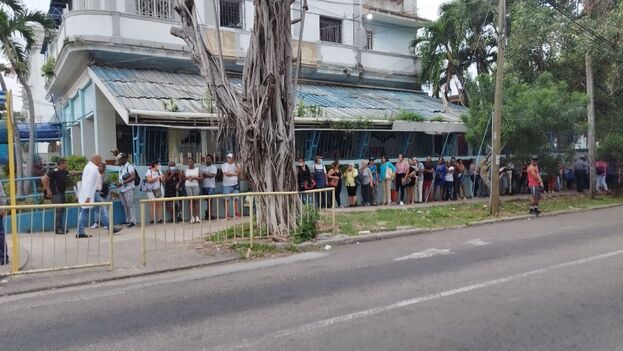
The shortage of cash jeopardizes any daily operation in Havana. From paying in a cafeteria to paying for service at a beauty salon, people are hindered by the lack of money. “You have to leave early to stand in line at the ATMs and wait for them to be supplied when the banks open, but already by noon most are empty.”

In the bank on Conill Street, very close to Ayestarán Avenue, an employee blames the problem on the fact that “the prices of everything have gone up, and now people need more money to pay.” In the small branch, located in an area where “not many people pass,” cash barely lasts a few hours in the morning. “People from Diez de Octubre, Rancho Boyeros and even Lisa come here to try to use the ATMs.”

But this Tuesday, frustration was painted on the face of those who approached this bank because “before ten in the morning we had already exhausted the cash at the ATM, although certain small amounts could still be extracted,” says the branch worker. “The problem is that the name on the debit card must match that of the identity card, and there are many people who get cash from the ATMs with someone else’s card.” continue reading

“The bills that run out faster are the 50 and 100 pesos; sometimes the cash can be subtracted from a 500-peso bill, but the ATMs reject the operation if it includes different denominations,” he explains to this newspaper. “Also customers are now looking for more cash at once so they won’t have to stand  in line several times a week, and this has made demand skyrocket.”

“Soon we’ll have to go out with a wheelbarrow to carry the money that is needed in a single day because so many pieces of paper won’t fit in our wallets,” says a young woman in line at the ATM in the basement of the Ministry of Transport in Plaza de la Revolución municipality. “Cash evaporates like water, and the 10 and 20 bills are almost useless because nothing is that cheap.”

To overcome the difficulties, some private businesses offer the customer the possibility of paying by Transfermovil, the application that allows both the payment of a electricity bill and making transfers to another client. “Many people prefer to do it this way because it saves them from having to stand in line at the bank,” says Rodniel, an employee in a restaurant on San Lázaro Street. “Our clientele is mostly young, and at their age the use of Transfermovil is very widespread.”

In some hotels, the rule has been extended so that you can only pay with magnetic cards, which can be in Cuban pesos, freely convertible currency or belong to a foreign bank. “We don’t work with cash,” clarifies an employee of the cafeteria of the recently opened Grand Aston hotel on the Havana coast. Some customers, when they pay their bill, add a tip in CUP for the waiters.

“I walked all over Línea Street, from the tunnel near Playa, and I didn’t find a single ATM with money. In the end I ended up at the bank on 23 and J, which, as it is so central, had cash but, of course, I had to stand in line for more than an hour,” regretted another customer on Tuesday night. He had to delay his dinner in a restaurant because “they only accept payment in cash.” By the time he finally managed to make the withdrawal, it was already after ten, and the romantic moment with his girlfriend had faded.

Translated by Regina Anavy

____________

COLLABORATE WITH OUR WORKThe 14ymedio team is committed to practicing serious journalism that reflects Cuba’s reality in all its depth. Thank you for joining us on this long journey. We invite you to continue supporting us by becoming a member of 14ymedio now. Together we can continue transforming journalism in Cuba.