
Despite its Enormous Benefits, Etecsa Runs Out of Resources

Etecsa is one of the few Cuban entities that generates large earnings, and, nevertheless, it is in crisis. (14ymedio)

14ymedio bigger14ymedio, Natalia López Moya, Havana, 17 October 2022 — With its blue logo, air-conditioned offices and no competition in the national market, the Cuban Telecommunications Company (Etecsa) is experiencing a paradoxical situation: it is one of the few national entities that generates a large income, and, even so, it is in a difficult financial situation.

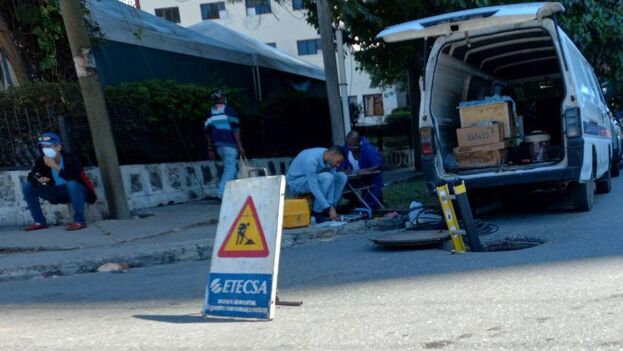
“We’re tying pieces of cables together in order to solve the breaks,” complains José Ángel, a worker of the state monopoly, a company that is experiencing “the worst crisis since its creation,” an employee of the Plaza de la Revolución municipality tells 14ymedio. “The bosses still have privileges, but we are without the resources to serve customers.”

José Ángel lists everything they lack. “There are no landlines to replace the old ones; we lack the boxes to install inside homes; the supply of cables is also having many problems, and even mobility is affected by the shortage of fuel.” The rosary of hardships stimulates the desertion of employees who once saw in Etecsa a “comfortable and privileged” place to work.

“This has changed a lot in recent years. They used to sell us products at a preferential price, but that happens less and less,” says a worker at the customer service office located in the Trade Market. “Here we are a little better because this place is very central and works like a display window, but in the other municipalities they can practically not even turn on the air conditioning.”

Every 15 days, Etecsa launches a cell-phone recharge promotion with extra bonuses to be paid from abroad. In 2019, computer science graduate Luilver Garcés Briñas estimated that on each of those occasions the state monopoly could be earning more than 7 million dollars from abroad. continue reading

But most of that hard currency isn’t invested in the telecommunications infrastructure. “About 90% of what Etecsa collects leaves the company in a large item marked “undefined,” clarifies another employee linked to the accounting area, who prefers to remain anonymous. “With what remains, it’s very difficult to maintain a quality service because we can’t make large investments.”

The lack of liquidity is also beginning to take its toll on Etecsa with its foreign investors. “In 2022, for the first time in 15 years, we haven’t been able to fulfill our financial commitment to Nokia,” the Finnish company that has worked on the Island to implement part of the data service for cell phones. “Investors are pressing us like crazy, but there’s no money,” says the accountant.

“A point has been reached where a large investment has to be made to improve connectivity, because the submarine cable with Venezuela is not enough now,” adds the source, who assures that alternatives are being sought with the Government of Andrés Manuel López Obrador. At the same time, he says: “Although negotiations are in the works with Mexico for the possible laying of another cable, such a project will need investments, and the company is not able to make them right now.”

“The problem is that cell-phone usage has grown very fast, and we went from almost zero to approaching the 8 million cell phones we have right now. Customers are increasingly making use of data, downloading and uploading videos, making video calls and watching movies on the Internet, and all that is overtaxing the infrastructure we have, which is not expanding and improving at the speed needed,” he explains.

Bad news will continue to accumulate for the monopoly. Etecsa has not updated the exchange rate between hard currencies and the Cuban peso, as state exchange offices have done since last August. The delay in assuming the new exchange rates brings many distortions, including for immigrants, who find it better to send euros or dollars in cash to their family in Cuba to pay for a recharge, instead of paying for the service from abroad.

“A recharge from the United States costs between 20 and 23 dollars, and my relatives in Cuba receive 500 pesos of fixed amount, plus the bonuses that Etecsa promotes,” explains Indira, an immigrant from the Island who has been in Miami for a few months. “That same amount of money in Cuba is equivalent to about 4,200 or 4,500 pesos, enough to put eight packages of 500 pesos and still leave money for a smaller package.”

“Every day that passes without Etecsa correcting this great difference, more people here realize it and prefer to send the money for the recharge directly to the relatives,” says the young woman.

In the customer service center, the phone rings and the operator says: “Good morning, Marilú is taking care of you, how can I help you?” On the other side of the line, a subscriber complains with an annoying tone that his landline has not been working for three months and that he has reported this five times. “I’m going to put it on the list, but right now we don’t have supplies for repairs,” the employee says.

Calls with similar claims will continue for the whole day. In his daily report, José Ángel receives calls to attend to breakdowns in his municipality. “I’m going to see what happens, but if you need cables or boxes I can’t do anything. I’m only going to fulfil the formality that we review the problem,” he says while driving a van with a half-deleted Etecsa logo.

Translated by Regina Anavy

____________

COLLABORATE WITH OUR WORKThe 14ymedio team is committed to practicing serious journalism that reflects Cuba’s reality in all its depth. Thank you for joining us on this long journey. We invite you to continue supporting us by becoming a member of 14ymedio now. Together we can continue transforming journalism in Cuba.

Cuban Painter Juan Moreira, Illustrator of Don Quixote, Dies

The painter Juan Moreira illustrated the edition of Don Quijote that was produced in 1972 in Cuba, replacing the Frenchman Gustavo Doré’s illustrations. (Prensa Latina)

14ymedio bigger14ymedio, Havana, 18 October 2022 — The plastic artist Juan Moreira, known for being the first Cuban painter to illustrate Don Quijote de la Mancha in a Cuban edition, died this Monday in Havana at the age of 83, the Ministry of Culture confirmed to official media.

Born in Havana in 1938, he assisted the Chilean painter, José Venturelli, in designing the murals of the Hotel Habana Libre and the buildings where the official agency Prensa Latina was founded. He also created portraits of friends, ornamental designs and paintings with erotic content. He was a member of the Union of Writers and Artists of Cuba (UNEAC) and the International Association of Plastic Artists.

His works have been exhibited in museums in Havana and in galleries in Poland, Austria, Jamaica, Germany, the United States and Canada. There are also pieces by the Cuban artist in the personal collections of King Emeritus Juan Carlos of Spain, former U.S. President Jimmy Carter, and in the United Nations building in Geneva.

The press, which praised the artist who remained “firm to the Nation,” recalled that he was a drawing teacher at the San Alejandro Professional School of Plastic Arts, where he directed more than twenty personal exhibitions and collective shows.

Moreira received the first Drawing Award from the Provincial Salon of Teachers and Instructors of Plastic Arts in Havana in 1973. A decade later, in 1984, he received an honorable mention in the Biennale de Pintura Kosice, in Czechoslovakia. In 2001, he was awarded third prize in the painting competition of the Nicomedes García Gómez Foundation, held in Segovia, Spain.

Translated by Regina Anavy

____________

COLLABORATE WITH OUR WORKThe 14ymedio team is committed to practicing serious journalism that reflects Cuba’s reality in all its depth. Thank you for joining us on this long journey. We invite you to continue supporting us by becoming a member of 14ymedio now. Together we can continue transforming journalism in Cuba.
The Cuban Opposition Expresses Solidarity With Ukraine and Rejects Havana’s Support for Moscow

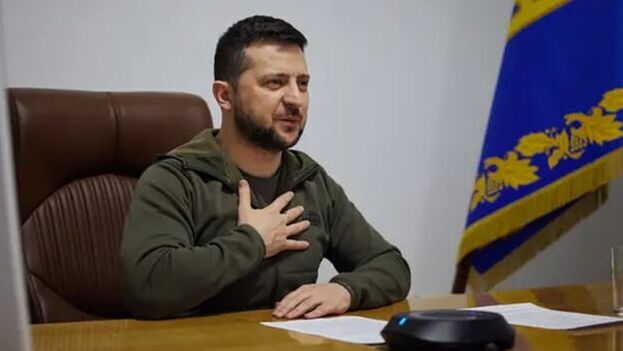
The D Frente collective addressed a letter of solidarity to the Ukrainian president, Volodymyr Zelensky. (EFE)

14ymedio biggerEFE (via 14ymedio), Havana, 18 October 2022 — A coalition of opposition groups from Cuba has expressed “solidarity” with Ukraine in an open letter to its president, Volodymyr Zelensky, rejecting their country’s support for Russia.

The D Frente collective, which brings together Cuban dissident groups “opposed to the totalitarian system prevailing in Cuba,” says in the letter that “a considerable part of Cuban civil society has seen with deep pain and concern” the “justification” and “support” of Havana for the Russian invasion.

They emphasize that Moscow’s February decision to attack Ukraine is “in frank violation of the principles of international law, the self-determination and sovereignty of its people, the peaceful and negotiated solution of disputes, and a breach of peace and good neighborliness.”

The signatories assure Zelensky that “the Cuban people are not their government.” Havana has not condemned the invasion, has not applied sanctions against Russia and has abstained in the votes on the issue at the United Nations. The official media on the Island replicate Moscow’s terminology and narrative about the war.

The letter refers to Ukraine’s Soviet past in which “citizens and aspirations were ignored. There are many of us who don’t feel represented by our leadership and who also reject the position of our government regarding this unnecessary and cruel conflict,” it states. continue reading

In the letter, D Frente applauds the “courage, deep love and attachment to their culture, sovereignty and territorial integrity” of the Ukrainians and conveys to Zelensky “our most sincere respect and feelings of solidarity towards your people and your government.”

“We are convinced that a plural, democratic and totalitarian-free Cuba, in which the rule of law and the will of the Cuban people prevail, would categorically reject the acts of aggression against your country and make every effort to achieve a peace in which the legitimate aspirations of the Ukrainian people are respected,” they say.

Bilateral relations between the Governments of Cuba and Russia are politically and symbolically close, but not economically or commercially so.

Translated by Regina Anavy

____________

COLLABORATE WITH OUR WORKThe 14ymedio team is committed to practicing serious journalism that reflects Cuba’s reality in all its depth. Thank you for joining us on this long journey. We invite you to continue supporting us by becoming a member of 14ymedio now. Together we can continue transforming journalism in Cuba.

The United States Will Donate $2 Million to Those Affected by Hurricane Ian in Cuba

A shipment of humanitarian aid from the United States that arrived in Santa Clara, Cuba, in 2021. (Archive/Customs of Cuba/Facebook)

14ymedio bigger14ymedio, Havana, 18 October 2022 — On Tuesday, the United States Department of State announced  that it will provide humanitarian aid of 2 million dollars to those “in need in Cuba” who were affected by the passage of Hurricane Ian in September.

A statement signed by the institution’s spokesperson, Ned Price, reported that the United States will send the aid through the United States Agency for International Development (USAID), to “international partners who work directly with Cubans whose communities were devastated by the hurricane.”

“We are currently reviewing requests from organizations such as the International Federation of Red Cross and Red Crescent Societies (IFRC) to provide this assistance,” the statement details.

The U.S. authorities said that they will continue to “monitor and evaluate the humanitarian needs” of Cubans in coordination with organizations and the international community. “We will continue to look for ways to provide significant support to the people of Cuba, in accordance with U.S. laws and regulations.”

At the beginning of October, it became known that Cuba had sent an urgent request for help to Joe Biden’s Administration, after the crisis caused by Ian, according to an article published in The Wall Street Journal. continue reading

At that time, after an exchange of mail between the two governments, Havana had not asked for a specific amount of money, so Washington was still evaluating the extent of the damage, although a formal request had not been received from the Island.

Within a few hours of the article being published in the U.S. newspaper, the Cuban government confirmed that it maintained contact with the United States regarding the material damage suffered by Hurricane Ian.

“The Governments of Cuba and the United States have exchanged information about the amount of damage and the regrettable losses caused by Hurricane Ian in both countries,” the Cuban Foreign Ministry said on the social network Twitter.

Hurricane Ian crossed the western end of Cuba from south to north on September 27, with heavy rains and winds of up to 125 miles per hour, leaving five dead and heavy material damage.

For reasons not fully clarified, the passage of the hurricane generated a complete blackout on the Island, damage to 200,000 homes and a serious impact on crops and infrastructure.

Translated by Regina Anavy

____________

COLLABORATE WITH OUR WORKThe 14ymedio team is committed to practicing serious journalism that reflects Cuba’s reality in all its depth. Thank you for joining us on this long journey. We invite you to continue supporting us by becoming a member of 14ymedio now. Together we can continue transforming journalism in Cuba.
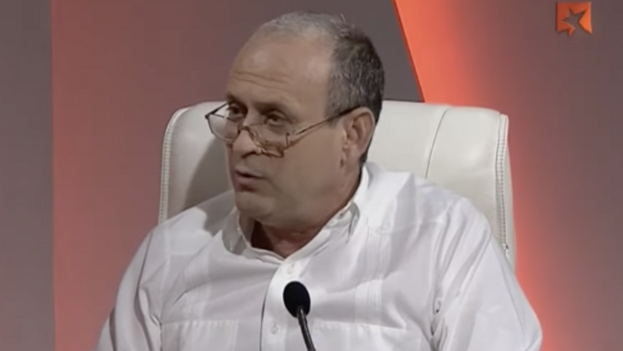
The Blackouts Cost the Cuban Minister of Energy and Mines his Position

Liván Arronte, recently dismissed as Minister of Energy and Mines, in an appearance on the Mesa Redonda [Roundtable] TV program. (Screen capture)

14ymedio bigger14ymedio, Havana, 17 October 2022 — The Cuban Minister of Energy and Mines, Liván Arronte Cruz, and the director of the Electric Union of Cuba (UNE), Jorge Armando Cepero Hernández, were dismissed from their respective positions this Monday. Without mentioning the names of those dismissed, in a brief note, Cubadebate reported that Vicente de la O Levy will be the new minister, and Alfredo López Valdés, the new director of the UNE.

“Both were general directors of the Electric Union at other times. Likewise, Alfredo López Valdés previously held the position of Minister of Energy and Mines, and of Industries,” the text states.

These dismissals make Cubans fear that the promised solution to energy shortages will not occur in December.

The deposed Arronte, who had been in office since 2019, had become in recent months a media figure, in the middle of the unprecedented energy crisis that the country suffers, being the main figure of authority who went out to give explanations about the daily scheduled blackouts that the population suffers, for example in programs such as Mesa Redonda.

It should be noted that this ministry is under the orders of Deputy Prime Minister Ramiro Valdés. continue reading

The UNE had predicted, again, a huge energy deficit, which on Monday would cause a “simultaneous blackout” of 41% of the service. According to his daily statement, the electricity generation capacity at peak time will be 1,941 megawatts (MW) for a maximum demand of 3,200 MW, and the deficit would be 1,259 MW, 65% of the maximum generation capacity. However, the “allocation” — which will be disconnected — the state estimates, will be more: 1,329 MW.

There are 11 nonfunctional thermoelectric units. Last Friday, less than 24 hours after it was connected, Antonio Guiteras left the system again, in Matanzas.

With the blackouts come numerous protests. Project Inventory has registered 176 since July 14. The Prosecutor’s Office has already threatened to charge the protesters with “vandalism,” as they did after the mass protests of July 11, 2021.

On October 7, the organization Justice 11J published an update on the detainees, based on the statements of their relatives and other information. According to the NGO, they will be prosecuted for the crimes of public disorder, contempt and resistance, although it cannot accurately provide the number of people imprisoned, which is around 30 according to several organizations.

Translated by Regina Anavy

____________

COLLABORATE WITH OUR WORKThe 14ymedio team is committed to practicing serious journalism that reflects Cuba’s reality in all its depth. Thank you for joining us on this long journey. We invite you to continue supporting us by becoming a member of 14ymedio now. Together we can continue transforming journalism in Cuba.
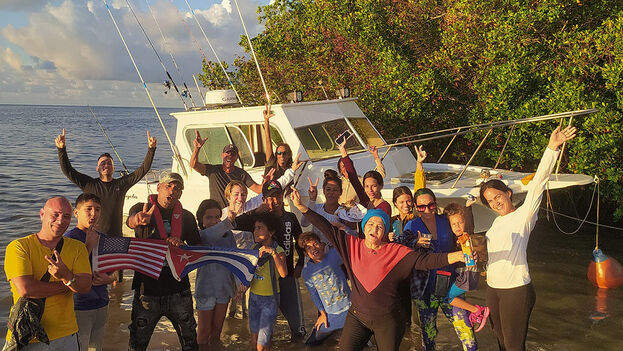
A Family of 20 Cubans Arrives in the United States Aboard a Speedboat from Cojimar

The group of Cubans left immigration headquarters and are already with their relatives, a Havana professor confirmed. (Facebook/V Sorjes Martín)

14ymedio bigger14ymedio, Havana, 17 October 2022 — A group of 20 Cubans who left the Island through the port of Cojímar (Havana) arrived in the United States, according to a post shared this Monday on Facebook by Professor V. Sorjes Martín. “Dream fulfilled,” said this habanero, who has studied engineering and law.

“We all left immigration today for our family homes,” said Sorjes Martín, who had “maintained a low profile” with some friends due to the imminent escape that was being planned.

Sorjes Martín, who among many other sacrifices had to sell his house to make the trip, said in a video that the crossing took 10 and a half hours, and there were times when the crew was “stressed. We had to go around three or four boats and finally a coastguard boat that fell behind and couldn’t catch us.”

The current situation in Cuba “with a tremendous amount of political problems,” commented Sorjes Martín, motivated this group to “flee.” The professor, who shared several images in which four children and a dog are observed, said: “Here everyone is family.”

On the speedboat, the habanero reported that the U.S. authorities will determine his fate. continue reading

So far in October, 205 Cubans have managed to make landfall in Florida, most on rustic rafts, although two of them arrived on October 12 on windsurfing boards. The latter “will be subjected to a deportation procedure,” warned the head of the Border Patrol of the Miami sector, Walter Slosar.

Just as the arrival of Cuban balseros [rafters] doesn’t stop, neither do the deportations, and the American Coast Guard repatriated 80 Cubans between Saturday and Sunday. The migrants were returned to the Island aboard the ships William Flores and  Paul Clark.

The repatriated balseros are part of six interceptions made in the vicinity of Key West, the Tavernier Creek sports fishing port, Marathon and Sugar Loaf.

The Coast Guard non-commissioned officer, Nicole Groll, urged Cubans to choose a safe and legal path to get to the U.S. “so that families don’t wonder where their loved ones are when they choose to migrate illegally.”

Translated by Regina Anavy

____________

COLLABORATE WITH OUR WORKThe 14ymedio team is committed to practicing serious journalism that reflects Cuba’s reality in all its depth. Thank you for joining us on this long journey. We invite you to continue supporting us by becoming a member of 14ymedio now. Together we can continue transforming journalism in Cuba.

The Argument of the Embargo and the Ridiculousness of the Cuban Communist Regime

A Cuban farmer makes extra money turning the invasive marabou weed into charcoal for export. (14ymedio)

14ymedio bigger14ymedio, Elías Amor Bravo, Economist, October 16, 2022 — When a government ignores economic problems, it does so for two reasons. Either because of incompetence, or because there are substantive reasons that prevent the adoption of appropriate measures to meet social demands. Or it can happen as in communist Cuba, where the two converge. For example, incompetence and ideological pressure are the factors that condition the terrible results of Cuban agriculture, with declines in GDP in the second half of the year that are above the average of the economy as a whole.

In other words, neither the “63 measures” planned for agriculture, nor the “94 of sugar” have served to change the trend of the two fundamental sectors of the Cuban economy. And, as always, in these cases, the state press directs its accusations to the U.S. blockade, holding it responsible for alleged millions of losses in agriculture, which are added, of course, to those of the other sectors.

Strangely enough, Cubans have experienced this sequence of events since the earliest times of Fidel Castro. Blaming the blockade has always been present, and now, when people can’t take it anymore, Cuban communists shamelessly unleash the embargo/blockade doberman again. The point is that this excuse is no longer believed by anyone in Cuba or in the rest of the world.

In an amazing way, the anti-blockade argument changes over time. Interestingly, the regime now says that “the blockade is the main obstacle to the implementation of the 2030 Development Agenda.” A false complaint, which aims to reach the United Nations forums where these issues are addressed, like the Summit on Sustainable Development Goals, held in the context of the 74th session of the U.N. General Assembly two years ago, where such a statement still has force.

Foreign Minister Rodríguez, increasingly irrelevant in international forums, seeing that friends are fewer and fewer, pulls this new story of the embargo/blockade and the 2030 agenda out of a hat. If this aptitude for defining insubstantial paradigms were applied to food production, maybe things would go another way.

Cuban communists, seeing themselves isolated at the international level, have returned to the charge against the impact of the economic, commercial and financial blockade, insisting that it slows the country’s economy and considerably affects  development in all sectors. They have now set their sights on agricultural production. And to that end, they have unloaded again a numerical figure that says the losses due to the blockade amounted to 270 million, 852 million, and 548 million dollars between August 2021 and February 2022, according to estimates by the Ministry of Agriculture. Almost nothing. continue reading

Where does that absurd figure come from? Specifically, it was the director of International Affairs of the Ministry of Agriculture, Orlando Díaz Rodríguez, who was in charge of making it known that the estimate, “summarizes the income not received by exports of goods and services, losses due to geographical relocation of trade, as well as from effects on production and services, monetary and financial ones and technological limitations.” Of course, optimistically, no one can beat them.

Income not received from exports is child’s play. The first thing would be to see if those exports have a demand or interest in the U.S., and they don’t seem to. The concept of “geographical relocation of trade” follows the same trend as always but is false. All countries look for the necessary goods and services wherever they are, and then transport them. As for the “allocations,” this is already known. The internal blockade of the regime is much more negative and has been so for 63 years.

The tireless Cuban communists accuse the 243 coercive measures adopted by the Donald Trump administration (2017-2021), still in force with the Biden administration, and say that “they put the brakes on the business system, which includes cooperatives and individual producers, making it impossible to position their products in the North American market.” False. There is nothing in the dispute that prevents independent producers from placing their sales in the U.S. market. The problem is the same as always: is there demand for those products? Cuban communists talk about tobacco, fresh fruit, honey and charcoal  as the products affected by the embargo, but could more of them even be produced? We doubt it.

According to the communist leaders, Americans have been deprived of these Cuban products and cannot purchase them because of the blockade. In particular, in the health sector, he alluded to Vidatox-30 CH, a homeopathic drug developed by Labiofam used as a complementary therapy for the treatment of cancer, which, due to the “criminal policy,” cannot be commercialized in the northern nation. As if the pharmaceutical industry in the U.S. didn’t have similar drugs, validated by the World Health Organization.

Not satisfied with everything said, there was also talk of the interest of entrepreneurs, producers and other “representatives of the agricultural sector in denouncing the blockade, as well as the measures that intensify it, and they’ve expressed their interest in cooperation, investment and commercialization with the Island.”

Do you know when they’re going to collect if they sell on credit to Cuba? The U.S. chicken producers and farmers already market their products under the current conditions [i.e. payment in cash at time of sale]. What reason is there to sell if they can’t collect until later? In addition, agriculture in Cuba needs to import animal feed, inputs, technologies and raw materials for the sake of food production for the people. What are they going to pay for it with?

It’s the same old song. The embargo is guilty of everything. They fall into the most absolute ridiculousness. More opportunities will come for accusing the embargo/blockade of all the ills of the Cuban economy.

Translated by Regina Anavy

____________

COLLABORATE WITH OUR WORKThe 14ymedio team is committed to practicing serious journalism that reflects Cuba’s reality in all its depth. Thank you for joining us on this long journey. We invite you to continue supporting us by becoming a member of 14ymedio now. Together we can continue transforming journalism in Cuba.
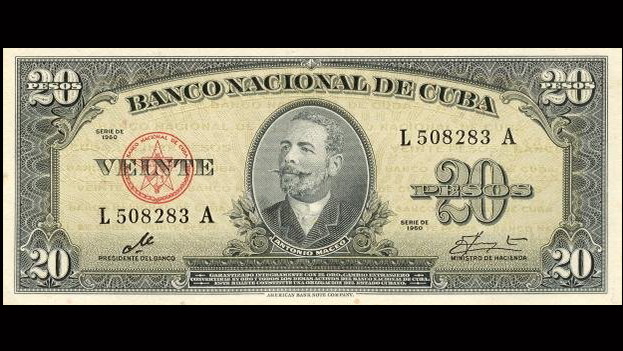
Exchange Market Analysis and State Intervention (II)

Cuban 20 peso note signed by Che Guevara.

14ymedio bigger14ymedio, Elías Amor Bravo, Economist, 17 October 2022 — When Cuban Minister of Economy and Planning Gil decided, unilaterally, two months ago, to create an exchange rate of 1×120 for the dollar relative to the peso in an attempt to counteract the trend in the informal market, it was soon observed that the limits imposed on the availability of currencies, the geographical scope and access to purchase, limited to natural persons, would cause more problems than solutions, since this process eliminated the basic principle of convertibility of the foreign exchange market.

The minister’s decision, far from redirecting the situation, alerted the informal market, which began an unprecedented escalation of the dollar to around 200 pesos. After all the failures, the authorities now intend to redirect the situation and position the foreign exchange market between the national currency and the foreign currencies, preventing the Cuban economy from being dollarized. It won’t be easy. A very valuable amount of time has been lost, and now the cost of the adjustment will be higher.

The minister is determined to control all the currencies that enter the economy to channel them into the state coffers, and as they are fewer and fewer, decisions are increasingly risky. We remember that the stores that only accept payment in MLC (freely convertible currency) were adopted as a temporary and necessary solution to maintain socialism, and they are still there after more than two years. Everything that is proposed for a while ends up becoming permanent. And that’s how it goes.

On the other hand, there is concern among Cubans about what may happen with the peso exchange rate in the coming months. Those who have stocks in this currency don’t know whether to change now, at 190-200 per dollar, or to wait and see. The uncertainty is great, because the functioning of the informal market deviates from the conventional schemes that explain the trends in the value of currencies, and there is no anchor for the analysis. In any case, it doesn’t seem that the leaders are going to change the conditions of the environment that have led to this situation, so things will continue in the same way. continue reading

So, in the face of the current exchange rate crisis of the peso, which the authorities are unable to reverse, there are messages in the official press regarding the fact that the Cuban peso should be the center of the financial system, including an inclusive price system for all economic actors and a market that works with a certain level of wholesale and retail offers. So, why don’t they succeed?

The foreign exchange market is considered one of the essential elements in the recovery of the convertibility of the national currency, but it’s much more than a nominal exchange of currencies. In fact, the official thesis points out that its absence was a great obstacle to the full use of productive capacities, limiting the country’s economic growth. The foreign exchange market is a reflection of other balances or imbalances that affect the relative value of the currencies. It’s not an isolated entity.

The directors of the Central Bank of Cuba rightly consider that the foreign exchange market involves the possibility of connecting the national currency with foreign currencies, through a well-founded exchange rate and that, in addition, this should be reflected in practice, in the relations that are established between economic agents, both state and private. The inconvertibility that occurred after the approval of the rate of 1×24 meant the emergence of alternative mechanisms to access foreign currencies, such as the dollarization of the economy in informal markets. The leaders want to set limits on this, since it opposes the objective of increasing the purchasing capacity of the national currency.

From this perspective, the official position assumes that the non-convertibility of the currency generates imbalances, because economic actors cannot meet their currency needs with the national currency at the current official exchange rate. When this process is carried out in a disorderly manner, it puts the economy in a complex situation, and an example of this is the current scenario of the dollarization and development of the informal market, which the authorities want to stop.

On this point, the official vision emphasizes the need to correct the sources of imbalance that gravitate on the foreign exchange market, mainly those associated with large national currency issues to support the fiscal deficit. So, they suggest that through an orderly and coherent intervention, using the economic policy instruments that the state has as a regulatory body, a foreign exchange market can be implemented that responds to the purposes of convertibility.

The directors conclude that macroeconomic stability is essential to be able to grow, and that growth is what allows the expansion of productive capacity, which enables the economic development of the country, and in that development lies the possibility of building socialism. To achieve this objective, a set of structural transformations that lead to the full convertibility of the national currency must be implemented on the fly. The question is the same as always: what structural transformations?

Translated by Regina Anavy

____________

COLLABORATE WITH OUR WORKThe 14ymedio team is committed to practicing serious journalism that reflects Cuba’s reality in all its depth. Thank you for joining us on this long journey. We invite you to continue supporting us by becoming a member of 14ymedio now. Together we can continue transforming journalism in Cuba.
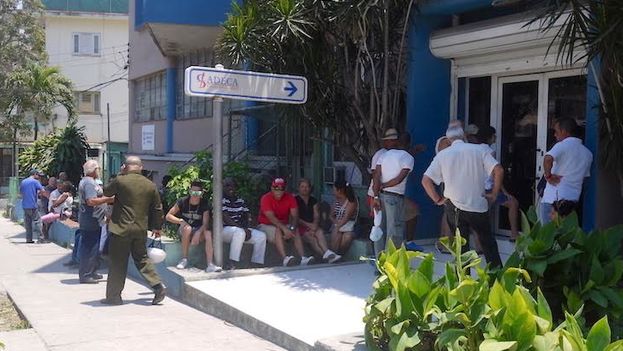
Cuba’s Exchange Market Crisis and State Intervention (Part I)

A line outside a currency exchange (Cadeca) in Havana. (14ymedio)

14ymedio bigger14ymedio, Elías Amor Bravo, Economist, 17 October 2022 — The official voice of the party has finally spoken. Like Don Rafael del Junco in that radio serial of the great Félix B. Caignet that paralyzed the country for a long time, the official state newspaper Granma talked about the foreign exchange market in order to blame the informal market and inflation for everything bad. And it has done so with arguments that are more political than technical, with evidence that is more propaganda than scientific. Let’s take a look. What it has always done is nothing more and nothing less than what we could expect.

According to Granma’s official analysis, “in the nation’s current conditions, it’s essential to capture a greater number of currencies, formalizing their entry into the financial system, stabilizing the exchange rate and making it the only one, for both natural and legal persons.” [A ’natural person’ is an individual human being, while a ’legal person’ can be an entity.]

Wrong. A greater influx of foreign exchange doesn’t guarantee control of the financial system, nor will exchange rate stability be achieved. So what does Granma want? Let no one be mistaken: to fill the state coffers and then allocate these funds to the regime’s objectives, which, as we know, have little to do with ordinary Cubans.

This idea was what led Cuban Minister of Economy and Planning Gil two months ago, to improvise a new exchange rate for the purchase of foreign exchange by the State (1 USD per 120 CUP), as he said at that time, to establish an exchange market in the country aimed at “increasing foreign exchange income and gradually advancing in the recovery of the economy.” This is the first thing, of course. The second thing has already been seen. Quarterly GDP growth fell from 10.7% in the first quarter to 1.7% in the second, a full-fledged collapse of the economy, dragged down by the terrible results in agriculture, sugar and manufacturing. continue reading

The communists cannot understand, under such conditions, how in a very short time the official exchange rate collapsed compared to the informal market, which at one point reached 200 Cuban pesos/US dollar. There were many reasons for the failure, but it was clear that the simple sale of foreign exchange, limited in amount and only for natural persons, was not going to go very far, as in fact happened.

It is useless for Granma to launch all kinds of attacks against the informal market, which they describe as a “crooked and illegal” business. Although Granma doesn’t recognize it, the informal market has been the winner of this whole process, and unless the State represses or eliminates it, it will continue to be so. Basically because this market, unlike the state of Minister Gil, provides its services to the population without limits, regulations or ties. Granma says, belittling the agents of the informal market, that “it is the only exchange service that is now profitable and open at midnight outside the CADECA [the state exchange service], attending to the line and then selling places in line at 1,000 or 2,000 CUP, or even at dollars.”

With a Price Increase of 20.53 Percent in a Year, Pork is the Most Expensive Food in Cuba

Pork has become more than 20% more expensive in the last year. (14ymedio)

14ymedio bigger14ymedio, Madrid, 14 October 2022 — Inflation in Cuba reached its ceiling in April this year, but prices don’t stop rising compared to 2021. The monthly increase in consumer prices, 2.33%, continued in August but is more moderate than in July (3.35%) and June (2.83%), and much lower than in April and May, when it was 3.54% and 3.55% respectively.

However, far from taking a break, the year-on-year variation rises and already stands at 34.31%, compared to 32.32% last month. According to official data, prices have already risen by 20.01% so far this year.

Once again, the Consumer Price Index (CPI) is pushed by the rise in the prices of food and non-alcoholic beverages, which increase by 2.74%. Although apparently the situation improves compared to last month, when they grew by 4.67%, the accumulated variation in the year is 30.89%, and compared to last year, Cubans are paying 54.19% more than in 2021 for these products, which are of primary importance.

In detail, lamb is the product that increased the most this month, with an increase of 5.04%. It’s followed, curiously, by garlic, with 3.81%, together with rice (which increases its price again by 2.74%), the only plant product that is more expensive in a prominent way. Pork, although the price increases again but discreetly (2.70% this month), accumulates a huge annual increase, with 20.53%, well above all the selected food indicators. continue reading

Restaurants and hotels are the sector that registers the highest increase this August, with 3.67%, and in annual and year-on-year terms, it’s the second area with the highest increase, with 27.72% in 2022, and 36.88% compared to last year.

Also in general terms, alcoholic beverages and tobacco are on the podium of products that push the rise of the CPI. This month they rose less, 1.85% (compared to 6% in July), but together since January they reached 21.60%, and the year-on-year variation is almost 40%.

One of the services that increased its prices the most this August, which is also essential for citizens, is transport. Prices increased by 2.43%, and although the year-on-year increase is not as high as those mentioned above, it costs Cubans 16.64% more to use transport than a year ago.

The transports that recorded the highest increases, possibly stimulated by the holiday period and fuel shortage, were interprovincial, especially taxis, with a monthly variation of 19.26% and other types (vans, trucks, etc.), with 13.18%.

The spectacular rise in culture and recreation is striking. Cubans who wish to attend a performance, concert or museum must pay up to 67.96% more than in 2021, despite the fact that in August the increase was only 0.95%.

In an intermediate sector of increases are furniture and household items, housing services, various goods, and services and education. All of them register increases of between 1.25% and 1.54%, with year-on-year increases of between 9.76% and 11.68%.

In the line are communications (0.03% monthly and 0.09% both accumulated and year-on-year) and health, which grows by 0.18% and accumulates 0.95% compared to the previous one. Finally, clothing and footwear increased this month by only 0.43%, although so far in 2022 the growth is 2.39% compared to the previous year’s 4.15%.

All in all, there is no section that doesn’t record increases, and Cubans continue to see how their salaries are increasingly serving them less. According to Cuban economist Pedro Monreal, “now 100 pesos are needed to buy food that cost 65 pesos in August 2021 (according to official data).”

In the black market, where most Cubans are supplied, the situation is much worse. American economist Steve Hanke, who creates balance sheets taking into account the parallel economy, pointed out on October 5 that the increase in the CPI at the end of September was approximately 208% year-on-year, with Cuba being the second country with the highest price increase in the world, after Venezuela and far ahead of Sudan and Zimbabwe.

Translated by Regina Anavy

____________

COLLABORATE WITH OUR WORKThe 14ymedio team is committed to practicing serious journalism that reflects Cuba’s reality in all its depth. Thank you for joining us on this long journey. We invite you to continue supporting us by becoming a member of 14ymedio now. Together we can continue transforming journalism in Cuba.
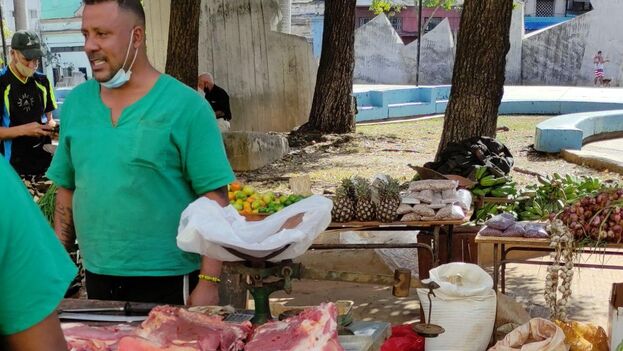
The Cuban Prosecutor’s Office Threatens ‘Criminal Charges’ for Current Protests

The threat becomes more emphatic by addressing parents who “used” their minor children, for having neglected “their duties of protection.” (EFE/Yander Zamora)

14ymedio bigger14ymedio, Havana, 15 October 2022 — On Friday, the Attorney General’s Office of the Republic of Cuba issued a harsh warning against those who participated in the recent protests over the long blackouts after the passage of Hurricane Ian. In his statement, he said he was investigating the facts that “disturbed public order and citizen tranquillity.”

As already happened with July 11, 2021 (11J), the Prosecutor’s Office attributes to the demonstrators the “setting fire to facilities, the execution of acts of vandalism, the closure of public roads in order to prevent the movement of vehicles and people, attacks and offenses against officials and law enforcement agencies, and incitement to violence.”

The threat becomes more emphatic by addressing parents who “used” their minor children, whom the institution accuses of having neglected “their duties of protection, assistance, education and care towards them.”

The Prosecutor’s Office affirms that “they will receive the appropriate legal-criminal response.”

The statement doesn’t provide information on how many Cubans have been accused or imprisoned during the protests. On October 7, the organization Justice 11J published an update on detainees, based on the statements of their relatives and other information. continue reading

According to the NGO, they will be prosecuted for the crimes of public disorder, contempt and resistance, although it can’t accurately provide the number of people imprisoned, which is around thirty according to several organizations.

Justicia 11J offered to send families any audiovisual material or document that could be useful in the trials and claimed “the cooperation of civil society, the independent press and the accredited foreign press to visualize this injustice.”

This Wednesday, a neighbor of Bejucal, in the province of Mayabeque, told 14ymedio that during the protests that took place in that municipality on Monday night there was no police repression. However, the next day the parents were summoned to the schools for a meeting with the municipal prosecutors.

There they were warned that “the law covered them,” and they would serve two to seven years in prison if they allowed their minor children to participate in the protests. In addition, those who were over 16 years old would be sentenced to house arrest.

The new Criminal Code stipulates, in article 407, that it’s a crime “to induce a person under the age of eighteen to leave his home, miss school, reject the educational work inherent in the national education system or breach his duties related to respect and love for the Homeland.”

The sanction provides for “deprivation of freedom of six months or one year, or a fine of one hundred to three hundred assessments, or both,” and no longer than two to seven years in prison, as the Bejucal prosecutors threaten.

The passage of Hurricane Ian exacerbated the energy crisis in the island and sparked a new wave of protests against blackouts and shortages.

Some neighborhoods in Havana were out of power for up to six consecutive days after the hurricane. The blackouts lasted twelve hours in some parts of the country. The independent media Proyecto Inventorio has recorded about a hundred in the last fifteen days from testimonies and videos disseminated on social networks.

Translated by Regina Anavy

____________

COLLABORATE WITH OUR WORKThe 14ymedio team is committed to practicing serious journalism that reflects Cuba’s reality in all its depth. Thank you for joining us on this long journey. We invite you to continue supporting us by becoming a member of 14ymedio now. Together we can continue transforming journalism in Cuba.
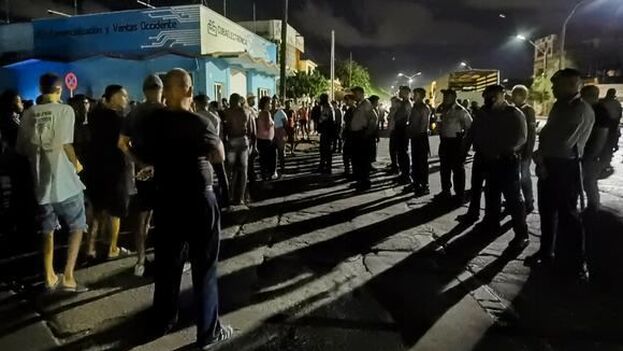
The Cuban Economy is Without Direction and Internationally Isolated

The corner of Galiano and San Lázaro in Havana crumble away without restoration. (14ymedio)

14ymedio bigger14ymedio, Elías Amor Bravo Economist, 15 October 2022 — With the Cuban economy’s GDP in the second quarter practically stagnant, 1.7% compared to the same period of the previous year; with CPI inflation climbing to 32% also in a year-on-year rate in August; with the blackouts that don’t cease, the depreciation of the Cuban peso in informal markets, the difficulty with choosing a combination of economic policies that puts an end to the process of deterioration suffered by the Cuban economy, like sugar and manufacturing, and in the face of a new default on the tourism plan, the Cuban communist leaders remain unmoved, incapable of choosing  a combination of economic policies that can put an end to the process of deterioration suffered by the Cuban economy.

The bad thing is that the worst is yet to come. While in other Latin American countries the pre-pandemic GDP levels have recovered, efforts are made by central banks to control the increase in inflation, and the depreciation of exchange rates and adjustment measures are adopted to face the new global competitive scenario, in Cuba no one does anything. The people live every day with the anguish of what to eat, and the regime remains stuck in its obsolete, failed communist model, unable to provide solutions to problems.

This is a differential element that Cubans who can travel abroad immediately see as soon as they get off the plane. Nobody understands what is happening on the Island, and therefore, the protests are increasing, the banging of pots and pans in protest is heard daily, louder and louder, and people have lost their fear of talking.

And instead of acting to eliminate daily anguish in the population, adopting economic policies that facilitate the take-off of productive forces, the regime is the same as always: take the doberman dogs for a walk and put fear into the population, from the rapid response brigades, to the Black Berets, through the prosecutor’s office. continue reading

Once again, the machinery of repression and communist control is put at the service of the single party to prevent Cubans from exercising their rights and freedoms. It’s the worst possible path, before the astonished gaze of the international community.

Consequence: fewer and fewer friends. The regime has looked for them and reacts clumsily and slowly, as when the other day it abstained, along with China, in the United Nations vote against Putin’s referendums in the conquered areas of Ukraine. With friends like that, anyone can go party.

With everything, the international allies of the Cuban communist regime are being diluted, and bank demands arise for unpaid debts, for which the communist organisation is not prepared and which will mean a real blow to the waterline when, perhaps soon, the sanctions are known.

What’s coming is not good, and it is necessary prepare. The friends of this aimless and futureless Cuba disappear. Unlike that honeymoon of Fidel Castro and Chávez that saved the regime after the Special Period, now no one appears willing to sustain an economic system without the capacity for indebtedness. There are only a few old communists left in Europe who are reluctant to recognize the failure of their dreams, if they ever had them, and when other countries visit the Island, their leaders are received by Raúl Castro, who, by the way, gives signs of life, as happened during the visit of of Vietnam’s minister of public security.

The Cuban economy is not here to play cat and mouse. Sooner rather than later it will have to face an internal and external agenda, for which the current leaders have no answer, nor do they want to offer one. Installed in defending the communist ideological model, they haven’t realized that the world is going any other way, and that any decision that has to be made, doesn’t allow for delay.

They should listen to their Vietnamese colleague. In five years that country overcame food famines and is now the number one exporter of rice in Asia, ahead of China. Cuban communists don’t want to believe it but reforms in property rights can change the direction of a country. Cuban communists don’t dare. For good reason.

Translated by Regina Anavy

____________

COLLABORATE WITH OUR WORKThe 14ymedio team is committed to practicing serious journalism that reflects Cuba’s reality in all its depth. Thank you for joining us on this long journey. We invite you to continue supporting us by becoming a member of 14ymedio now. Together we can continue transforming journalism in Cuba.
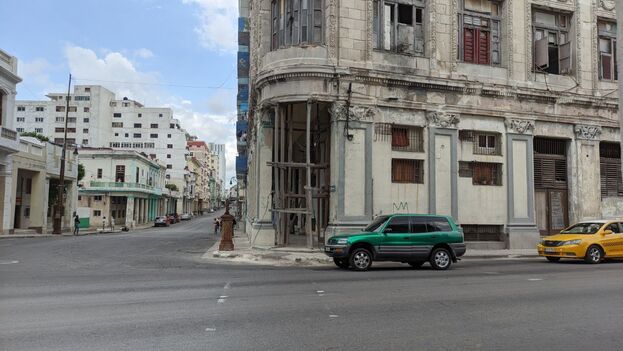
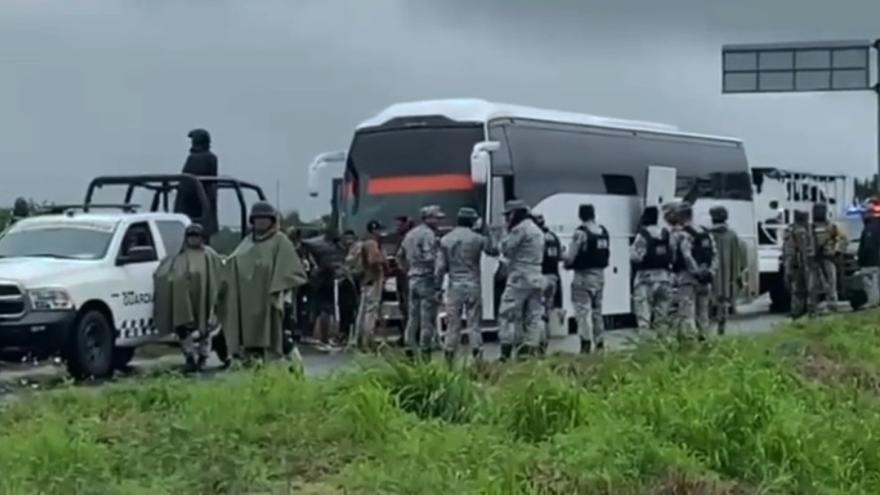
About 50 Cubans Barricade Themselves in a Bus in Mexico and Manage to Avoid Arrest

The Cubans were trying to go to Mexicali, in Baja California, to cross to the United States. (Screen capture)

14ymedio bigger14ymedio, Havana, 12 October 2022 — On Tuesday, a group of 50 Cubans took the driver of their tourist bus hostage in the Mexican state of Veracruz, so as not to be arrested by officers of the National Guard. The officers, who intended to deliver them to the National Institute of Migration, intercepted the vehicle on a section of the Transisthmic road, which connects the municipalities of Sayula de Alemán with Acayucan.

“In Acayucan they deport you; we’re not going there,” the Cubans warned the National Guard and said they intended to continue their journey to Mexicali and cross to the United States from there. One of the migrants said that each Cuban paid 2,500 pesos (75 dollars) for transport.

An officer confirmed to 14ymedio that there were several children in the group and that “although the people presented residence permits and free transit passes, these were for the states of Chiapas and Oaxaca.”

By insisting that their situation be resolved by Migration, the Cubans cornered the driver and removed the keys to the bus. In support of the National Guard, other vehicles arrived, but this further bothered those detained. After five hours of negotiations, they were allowed to return to the state of Oaxaca, with a warning that a recurrence of transit without permission would be penalized. continue reading

National Guard officers reached an agreement with the Cubans to return to the state of Oaxaca, where they have permission to transit. (Captura)

Migration did not issue any report on the incident, nor details about the arrests, this Tuesday, of 29 other migrants after a pursuit in the city of Córdoba.

Last April, lawyer José Luis Pérez Jiménez complained that the arrest of Cubans and their internment in the Acayucan Migration centre became a way of raising money for the coffers of the officials.

Wilmer Mantos, a 27-year-old Cuban who was in detention in Acayucan, told 14ymedio that this place “is a prison where human rights don’t exist: they take away your cell phone, your papers, and  you eat because you’re hungry, but the food is rotten and there’s almost no water or medical assistance.”

In their transit through Mexico to reach the United States, Cubans have had to face arbitrary detentions, violations of their human rights and extortion. On the last day of September, a group of 14 migrants from the Island reported that a senior Migration official demanded $70,000 from them to not be deported.

The Cubans were detained in Campeche and transferred to Mexico City, and despite having legal protection, they were detained for several days. They are currently on their way to the U.S. border.

Nearly 200,000 Cubans have arrived by land in the United States and more than 6,000 by sea since October 2021.

Translated by Regina Anavy

____________

COLLABORATE WITH OUR WORKThe 14ymedio team is committed to practicing serious journalism that reflects Cuba’s reality in all its depth. Thank you for joining us on this long journey. We invite you to continue supporting us by becoming a member of 14ymedio now. Together we can continue transforming journalism in Cuba.
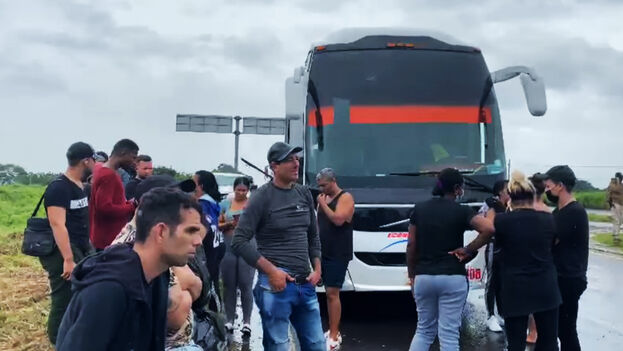
Cow Theft Goes From 48 to 1,200 Heads in a year in Sancti Spiritus, Despite High Penalties

To try to avoid irregularities with livestock breeding and trade, the Cuban Government established fines of up to 20,000 pesos. (14ymedio)

14ymedio bigger14ymedio, Havana, 12 October 2022 — The theft of cattle in Sancti Spíritus has multiplied 25 times this year compared to last year. The figures are official, made public during a meeting of the vice president of Cuba, Salvador Valdés Mesa, with the agricultural producers of that province. According to an article published in the state newspaper Granma, in September alone 292 of these crimes occurred in that territory. So far this year, 1,249 head of cattle were affected, compared to 48 in 2021.

All this, despite the new sanctions approved by the Government last August to try to avoid irregularities with the breeding and trade of livestock, which entail fines of up to 20,000 pesos.

Valdés Mesa assured that “intensive work has begun with the organs of the Ministry of the Interior,” “a regular livestock count has been established” and “surveillance and control guards have been intensified” to avoid these criminal acts.

The vice president didn’t miss an opportunity to blame the ranchers: “There’s a lot of indiscipline; you have to control and register the country’s vaccinated cows. And if the farmer doesn’t come to register, you have to go to his land to inspect. We have to put order in the field.” continue reading

However, it wasn’t the only problem that was on the agenda. In the face of the “cold” season, Sancti Spíritus faces other obstacles. For example, a deficit in planting. Compared to the planned 5,974 hectares, 5,550 hectares were planted. The “non-compliance,” the authorities said, “is caused by fuel constraints and rain.”

In the same meeting, they emphasized “the need to use organic fertilizers such as worm humus, since there won’t be any chemical products: neither fertilizers nor pesticides.”

Although the officials assured that agricultural companies in the province “don’t report non-payments to producers,” they recognize that the Dairy Company owes 1,453 producers a total of 329,453 pesos, and the Meat Company owes 91 producers a total of 43,048 pesos.

As for tobacco, it was spoken, in the usual communist tone, of “the importance of production in the territory given the considerable loss suffered at the largest tobacco centers in the province of Pinar del Río,” as a result of the scourge of Hurricane Ian, on September 27.

There were also words at the meeting for sugar production. The representative of Azcuba in Sancti Spíritus, Aselio Sánchez Cadalso, recalled that the Uruguay sugar mill, “the colossus of Jatibonico,” will no longer grind cane, but only the Agroindustrial Azucarera Melanio Hernández Company. The harvest begins on December 10, with 21,254 tons of sugar foreseen.

Translated by Regina Anavy

____________

COLLABORATE WITH OUR WORKThe 14ymedio team is committed to practicing serious journalism that reflects Cuba’s reality in all its depth. Thank you for joining us on this long journey. We invite you to continue supporting us by becoming a member of 14ymedio now. Together we can continue transforming journalism in Cuba.
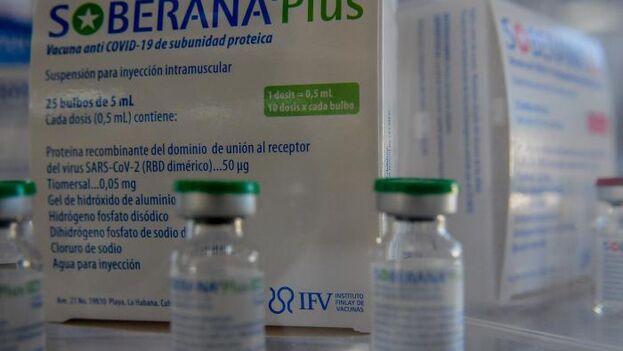
Belarus Begins to Receive the Cuban Sovereign Plus Vaccines Purchased in July

Sovereign Plus is conceived as a booster vaccine. (Granma)

14ymedio bigger 14ymedio, Havana, 13 October 2022 — This Wednesday, almost three months after Belarus agreed to buy the Cuban Soberana Plus vaccine, the first batches of the drug arrived in the European country. According to the Twitter account of the Finlay Institute of Vaccines in Havana, a “regulatory agency” also registered Sovereign 02 for future use.

This July, Belarus became the first country in Europe to approve the use of Cuban vaccines to achieve the immunization of its citizens against COVID-19. According to Cuba’s new ambassador to Minsk, Santiago Pérez, the news was received with enthusiasm by the press, which argued that “Cuban vaccines have proven their effectiveness.”

The authorities of both countries have not given details about the number of vaccines included in the agreement nor about the amount paid by the Belorussian Government.

In the case of Soberana Plus, it is a “booster” vaccine, and on the Island it has been applied after one of the other two national products, Soberana 02 and Abdala, or to patients recovered from the coronavirus. continue reading

Given the suspicions raised in the most critical sectors of the country by the purchase of a drug not approved by the World Health Organization, the authorities emphasized that “all vaccines used [in Belarus], regardless of the manufacturer, [have been] registered and authorized for use, and are immunobiological drugs of high efficacy and safety.”

A Cuban delegation at the Business Forum held recently in that country met with the Deputy Minister of Health, Dimitri Cherednichenko, to establish more links on issues of “drug production, professional exchanges and joint scientific research,” according to a statement from the Ministry of Foreign Affairs of Cuba.

In July of this year, another delegation of Cuban officials visited Dimitry Vladimírovich, director of the Expertise and Testing Centre of the Belorussian Ministry of Health. During the appointment, Vladimírovich presented Vicente Vérez Bencomo, director of the Finlay Institute, with the certificate that endorsed the use of Sovereign Plus in his country.

On that occasion, the Island officials took the opportunity to negotiate subsequent contracts with the Belorussian Minister of Health, Dmitry Pinevichs, who considered “issues related to cooperation in the field of the circulation of medicines and medical products, in particular the location of Cuban medicines and vaccines in the territory of Belarus, as well as the possibility of exporting Belorussian pharmaceutical products to Cuba.”

On July 26, the day the agreement for the purchase of Sovereign Plus was signed, the president of Belarus, Aleksandr Lukashenko, referred to the date in congratulations to Miguel Díaz-Canel, assuring him that the “economic and commercial cooperation” of his Government with the Island was guaranteed.

Like Iran, Venezuela, Nicaragua and Mexico, Belarus is part of the list of Cuban allies who opt for the purchase of the drug against COVID-19. With vaccines, the Island also sends the promise of political and even military support.

Not in vain has the sale of vaccines worldwide been preceded by a propaganda campaign that has included concerts, academic events and diplomatic delegations at medical symposia.

Translated by Regina Anavy

____________

COLLABORATE WITH OUR WORKThe 14ymedio team is committed to practicing serious journalism that reflects Cuba’s reality in all its depth. Thank you for joining us on this long journey. We invite you to continue supporting us by becoming a member of 14ymedio now. Together we can continue transforming journalism in Cuba.