Taiwan’s comeback against Italy was combined with Cuba’s triumph against Panama, and Cuba remains with possibilities in the World Classic. (Jit)
14ymedio, Havana, 11 March 2023 — The Cuban team “woke up” in the World Baseball Classic this Friday after beating Panama 13-4 in Taiwan and connecting with 21 hits. The performance of the national team, which could guarantee its classification in the next round of matches, was celebrated by the official press, which in recent days harshly criticized its defeats.
The offensive of the so-called Team Asere in this Classic match — held in the United States, China and Japan from March 8 to 22 — almost equals the record of 22 hits in Australia, in 2009. Cubadebate and Jit proclaimed the results of the game and noted the favorable changes in the lineup, designed by manager Armando Mandy Alonso, who replaced the players Yoenis Céspedes and Lorenzo Quintana with Roel Santos and Ariel Martínez.
Jit described the game as a “home run party” where eight of the members gave their best. Of them, seven “got at least two hits,” the magazine said, which highlighted the role of Yoan Moncada, a Major League baseball player (MLB, who hit 5-3 and boosted the advance of four other players to home). Moncada had been one of the most remarked on — along with Luis Robert Jr. — by the official media, which pointed out his poor performance in the matches against the Netherlands and Italy.
Despite the praise, the analysis of the game itself was more measured. The game was separated into two parts, according to journalist Renier González Jr., a contributor to Play-Off Magazine. Before the sixth inning, he said, the team reached the performance of the “last times,” with an “improved” selection that can compete.
Francys Romero highlighted the score of 4-4 achieved by outfielder Yadir Drake. The result placed him as the leader of Team Asere’s offensive. “He becomes the second Cuban player with 4 hits in a World Classic since Yoandy Garlobo (2006),” noted González, who said he was waiting for “other favorable results.” continue reading
At the end of the game at the Intercontinental Stadium in Taichung, Taiwan, manager Alonso appeared before the media accompanied by MLB players Yoan Moncada and Luis Robert Jr., to address the lack of results at the international level.
According to the coach, this “drought” is due to “the newest athletes at a level,” where “they are not very focused on what we want.” For Alonso, “there are baseball players who are young and perhaps do not have the mastery” of Major League players. That, he said, was the goal of the tour prior to the World Classic, in “that the boys saw throws that sometimes we don’t see in the National Series.”
The last time Cuba won a global title was in 2016, when it won the Under-15 World Cup. For this reason, the inclusion of players from international teams — especially from the MLB — has aroused the interest of thousands of followers.
Johnson put forward that they must win the confrontation with the Taiwan team and then wait for the results to see if they qualify for the next round. “The starter must be Elián Leyva. The lineup is going to be the same because, as they say, you don’t touch a winning line-up.”
The one victory that Cuba obtained this Thursday over Panama doesn’t seem enough to get excited about the classification, since this came after the comeback of Taiwan 11-7 against Italy. The Netherlands continues to lead group A of the World Classic (2-0), then Panama, Taiwan and Italy (1-1), with Cuba closing the list (1-2).
Now Cuba must win over Taiwan, but it depends above all on whether Italy continues to lose, whether the Netherlands continues to win and whether Cuba’s classification is defined against Taiwan or Panama. “All this, of course, is if Team Asere wins in its last challenge of the World Classic,” published Swing Completo.
Translated by Regina Anavy
____________
COLLABORATE WITH OUR WORK: The 14ymedio team is committed to practicing serious journalism that reflects Cuba’s reality in all its depth. Thank you for joining us on this long journey. We invite you to continue supporting us by becoming a member of 14ymedio now. Together we can continue transforming journalism in Cuba.
Nancy Peña, 49, was murdered by her ex-partner last Sunday at her home. (Facebook/Nancy Peña)
14ymedio, Havana, 9 March 9, 2023 — Nancy Peña’s is the first femicide recorded in Cuba in March. The 49-year-old woman was murdered by her ex-partner last Sunday at her home in the Alcides Pino People’s Council, in Holguín, according to CubaNet.
She herself, the independent newspaper documents, had published on social networks her fear that something would happen to her. “I feel threatened by a man,” Peña wrote on March 1, saying she wrote it “in case something happens to me,” since she had reported it to the police and the individual had not been arrested. “What a country I live in, that doesn’t care about the life of a Cuban citizen,” she lamented.
A friend of the victim told CubaNet that the killer, who used a knife and had previously assaulted Peña, waited for her son to leave the house to attack her, and that he also stabbed a neighbor who was talking to her. “Nancy was killed simply because she didn’t want to continue with him, as if he owned her, and the neighbor because he was unlucky enough to be there,” the source told the media.
So far in 2023, there have been 17 women killed at the hands of their partner, ex-partner or sexual aggressors, according to the reports on independent platforms and media, in the absence of official data.
On March 5, authorities reported the arrest of Liván Reinaldo Mora Pérez, accused of stabbing Vanelis Macola to death, on February 28, in the town of Tuinicú, in Sancti Spíritus. According to the official newspaper Escambray, the detainee had “multiple criminal offenses for the crimes of threat, injury, theft, rape, robbery with force, among others.”
At the beginning of this month, the organization Yo Sí Te Creo [Yes, I Believe You] in Cuba had identified Isabel Rodríguez Díaz as the victim of a femicide that took place on February 11 in Camagüey. continue reading
On March 8, when International Women’s Day was commemorated around the world, the group of activists who planned to hold a peaceful demonstration had to protest in silence.
The National Assembly did not accept the letter sent to them by the women, and some of them were later harassed by State Security and detained. Two initiatives did take place: wearing a black ribbon on the wrist as a sign of mourning and a “virtual March” to continue asking the Government to protect women.
Translated by Regina Anavy
____________
COLLABORATE WITH OUR WORK: The 14ymedio team is committed to practicing serious journalism that reflects Cuba’s reality in all its depth. Thank you for joining us on this long journey. We invite you to continue supporting us by becoming a member of 14ymedio now. Together we can continue transforming journalism in Cuba.
According to Jiménez, the launch of the first AWE course on the Island caused a controversy, as several independent media accused the first promotion of seeking ways to leave the country. (Screen capture)
14ymedio, Havana, 11 March 2023 — On Thursday, the US State Department launched the call for a free online entrepreneurship course promoted by the Academy for Women Entrepreneurs (AWE). It is the second time that this program has been launched in Cuba, with the support of the US Embassy in Havana, and its objective is to advise on “the development of business projects that are led by women.”
Twenty women from all over the Island, chosen by the Heroikka Association — a Spanish company dedicated to women’s “empowerment” — will enjoy the educational resources offered by AWE, the advice of mentors and communication with other women entrepreneurs through the “existing exchange programs.”
According to the call, AWE is part of the Initiative for Women’s Development and Global Prosperity, conceived by Washington so that 50 million women “around the world by 2025” can reach their “economic potential,” “stability, security and prosperity.” The application forms are open from March 7 to 28.
One of the beneficiaries of the first launch of the program, the entrepreneur and journalist from Villa Clara, Yinet Jiménez, posted a video at the end of 2022 about the characteristics of the AWE course and pointed out that the program would be carried out by the Thunderbird Business School in the United States, under a program called DreamBuilder.
Among the participants in the first course of AWE are project managers such as Humidores Duyos, which offers boxes for storing tobacco to embassies and companies, the El Bazar de Tito store, La Casa del Jabón, the Casa Dagda hostel, the Decoluz handmade lamp store and the audiovisual company Wajiros Films.
According to Jiménez, the launch of the first AWE course on the Island caused a controversy, since several independent media accused the participants in the first program of looking for ways to leave the country through the resources of the State Department, when the call specified that it was an online course. continue reading
In addition, AWE’s support was looked at with suspicion by the Cuban Government, which has limited the options of the private sector and closed numerous initiatives. Jiménez herself, who runs a YouTube channel and had a small advertising advisory agency, ended up going into exile in Montevideo, Uruguay, at the end of 2022.
Other U.S.-based institutions have offered opportunities to both Cubans living on the Island and exiles. This is the case of the Cuban American Alliance for Leadership and Education scholarship, also called Pinos Nuevos, which offers $10,000 to students born on the Island or descendants of Cubans for university studies.
Translated by Regina Anavy
____________
COLLABORATE WITH OUR WORK: The 14ymedio team is committed to practicing serious journalism that reflects Cuba’s reality in all its depth. Thank you for joining us on this long journey. We invite you to continue supporting us by becoming a member of 14ymedio now. Together we can continue transforming journalism in Cuba.
14ymedio, Elías Amor Bravo, Economist, 9 March 2023 — The tentacles of the Cuban communist regime extend to all areas of the economy and society. There is no space in Cuba that is not penetrated and controlled by the model devised by the so-called revolution. SMEs [small and medium-sized enterprises], for example, must be authorized by a political decision of the Ministry of Economy before advancing legally and administratively. Now, during the closing of the second general assembly of the Union of Computer Scientists of Cuba, Mayra Arevich, the Minister of Communications did the same with the group of computer professionals in the Union of Computer Scientists of Cuba, an entity of 7,000 members, among the youngest Cubans on the Island.
The ministry invaded the association’s jurisdiction, such as increasing membership or continuing alliances to support the management of territorial governments. This “accompaniment” of the ministry aims to control the organization of computer scientists, and it enters such specific areas as the training of members and citizens, in order to achieve “greater impacts on digital transformation.”
The minister even dared to point out what kinds of projects the organization should promote, and cited, for example, the 2022 Cuban Digital Agenda encouraging the training of local development agents, a kind of reissued “literacy campaign” that confirms that Fidel Castro’s grandchildren continue to deploy the same crazy initiatives as their grandfather. Then, they complain about the ’blockade’ [US Embargo] to justify the overall unproductivity of the system, but this is a good example: stay in your lane.
And all this interventionist apparatus of the ministry on the organization of computer scientists makes sense for the regime, to the extent that it contributes to promoting the digital government project. It is affirmed that, with this, it is possible to give greater opportunities to the citizenry in the development of a digital society. And here comes something amazing, because those opportunities must be based on the “construction of socialism and the fight against inequalities,” such as the digital divide. continue reading
The Castro regime mixes concepts in this way that are unrelated to each other: digitization, knowledge and socialism. Three legs for a table that will necessarily wobble, from the first moment.
It occurs to me that fighting the digital divide from Cuban socialism has a downside; that is, instead of developing the most advanced and innovative skills that exist in the field of new technologies, it is intended to extend literacy in basic skills, as was done in 1960; that is, to teach the four rules [Input, Processing, Storage and Output] and then, with the propaganda of the state press, tell everyone that In Cuba there are no digital breaches. And the bad thing about all this is that they believe it.
In reality, the Union of Computer Scientists has little to do to get out from under the clutches of the regime. And like the vast majority of organizations that barely survive in the Castro regime — I’m thinking of the ANAP [National Association of Small Farmers] — it will continue to play the same game of “support and commitment to continue supporting the revolutionary government in the process of digital transformation of society within socialism,” as recognized by Febles Estrada, president of the Union, before President Díaz-Canel, at the closing of the assembly of the organization at the Palacio de Convenciones.
That’s what the regime wants. Organizations aligned with their objectives to meet political goals that later end up being forgotten or openly violated. Everything else, which is really necessary, such as the professional and cultural growth of the members of the organization, takes a back seat. Obeying, from unity, is essential so that conflicts do not occur. It is not surprising that the assembly of computer scientists talked about voting together on March 26. I’m afraid that from now on we’re going to talk about this even at dinner.
At the same event, Díaz-Canel highlighted the importance of supporting the concept of the development of a digital society and knowledge. It must be evaluated positively, if we take into account that two or three years ago the concepts of computerization and digitization were confused, confirming a notable delay of the regime leadership on the subject of new technologies. It seems that they have been brought up to date, but the distance that Cuba maintains with respect to the technological challenges of the fourth industrial revolution is still remarkable.
And what would be the alternative for a really beneficial Union of Computer Scientists for Cuban society?
Let’s get to it with a few brief brushstrokes. Of course, computer professionals and new technologies are a source of creation for entrepreneurial projects that can generate business opportunities, not only in the present, but in the future.
The professional field of digitization services is advancing in all sectors in all countries and could pose opportunities for openness to foreign investment. The creation of startups of this type of services on the Island could serve to accumulate enough critical mass to generate more business projects, not only in the field of video games, but also in cybersecurity, the digitization of physical spaces, or telemedicine and the care of the elderly, among other things.
It would be a matter of betting on an international projection of the sector that would allow foreign capital to access concrete opportunities within the Island without state interference, at the same time that Cuban professionals are provided with exchanges with the outside world to advance in the creation of joint business projects.
In terms of training and qualification, we must also bet on the most advanced technologies of the fourth industrial revolution, intensifying exchanges with world-leading training centers. In short, the development of the sector should be coupled with a progressive consolidation of digital services in the economy, of course actively fighting against the digital divide and raising the level of the Cuban population and society, facilitated by initiatives for the structural transformation of the economy.
Have we seen anyone who in any of these initiatives needs a ministry or a government behind it for something? Not at all. This sector, that of new technologies, started in many countries in the garages of homes in the suburbs and with little capital. Talent is key, and in Cuba it exists. Unfortunately, the communist regime is not in favor of that kind of work. Its objectives do not go beyond mere alliances with Cuban civil society organizations, or with institutions such as the World Institute for Software Quality and Linux (free operating system), in addition to helping territorial development and little else. It’s an agenda for professionals of new technologies in Cuba controlled by the State and at the service of socialism.
Translated by Regina Anavy
____________
COLLABORATE WITH OUR WORK: The 14ymedio team is committed to practicing serious journalism that reflects Cuba’s reality in all its depth. Thank you for joining us on this long journey. We invite you to continue supporting us by becoming a member of 14ymedio now. Together we can continue transforming journalism in Cuba.
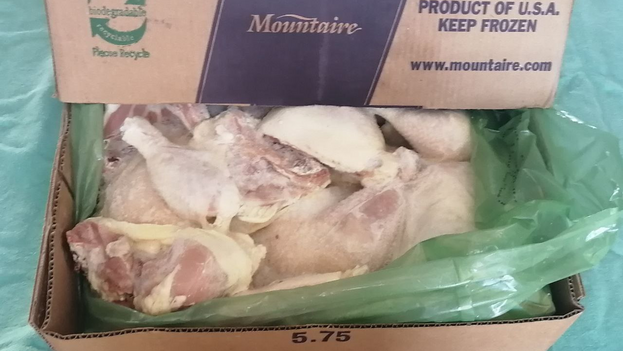
Chicken imported from the United States is less expensive for the first time since last May. (14ymedio)
14ymedio, Madrid, 9 March 2023 — In January, 29,412 tons of chicken arrived in Cuba from the United States, 11% more than in December, and yet the consumer must go look for it in foreign exchange stores or in the informal market. The same goes for the price: the Cuban state took advantage of a fall in the cost of the product in the international market and spent 26% less in January than in December for a greater amount of meat, while the price to the public is still skyrocketing.
In the last month of 2022, a kilo of chicken cost $1.26, and in January it dropped to $0.93. The bird returns to prices that have not been seen since May 2022, when it was marketed for $0.91. In that month, an upward spiral began that reached its peak in October, with a cost of $1.29.
The decrease allowed Cuba to spend 27.2 million dollars in the first month of the year, instead of the 33 million dollars it invested a month prior, for the importation of 26,460 tons of chicken.
“We will have to wait to confirm if this was a temporary interruption in the trend,” says Cuban economist Pedro Monreal, who publishes and analyzes monthly the statistics for chicken, the product that the Cuban government buys the most from the U.S., despite its constant accusations about the damage caused by the “blockade.” continue reading
Cuba has exemptions to purchase food products and medicines in the United States, among other things. The condition, which the regime describes as unfair and contrary to international trade rules, is that Cuba must pay in cash, and in advance.
In July 2022, the United States Congress rejected an amendment presented by Democratic legislator Rashida Tlaib that proposed to expand agricultural trade with Cuba and authorize deferred payment for a year. It is not the only movement in Washington aimed at relaxing the restrictions.
This week, a bipartisan project arrived in the Senate, already presented in the same chamber a year ago, which proposed to “eliminate barriers” to American trade with the Island. Its defenders allege that the policy regarding human rights requirements would be maintained but economic opportunities for Americans and the Cuban population would be increased.
The United States International Trade Commission believes that if trade restrictions were lifted, exports of products such as wheat, rice or soy could increase by 166% in five years, to a total of 800 million dollars. However, Cuba’s lack of access to credit and financing as a result of its break with international organizations and its systematic non-payment of its debts leaves doubts about how the Island could deal with the payments.
In 2022, the figure paid by Cuba to the United States for purchases of agricultural inputs and food products reached a record 328.5 million dollars, an increase of 7.7% from the 304.7 million reported in 2021, according to the US-Cuba Economic and Commercial Council.
In 2022, the Island invested $295 million just to buy chicken from the United States, compared to $279.1 million in 2021. The figure has doubled since 2020, when the State spent $143.7 million, although that year it bought the least amount. Among the reasons is the rise in price of the product in international markets, which in 2022 was widespread.
The statistics of the Latin American Chicken Institute, which show a comparison of prices for the three main world exporters (United States, Brazil and the European Union), show the simultaneous rise that occurred in 2022, when the crisis in Ukraine and the increase in maritime transport costs began to push up prices.
The Cuban people have gone from aspiring to put pork on their table to dreaming of getting a piece of chicken, and they complain about having to spend long hours in line to get the meat, while they can hardly afford it in the informal market.
On the on-line site Revolico.com, the price of a chicken of approximately two kilos (4.4 pounds) is sold for an average of 1,500 pesos, approximately 12 dollars, more than half the minimum monthly wage in Cuba; or about $8.50 USD if Cuban pesos are changed on the foreign exchange black market. In any event, the consumer pays many times more for a kilo of chicken than the import price paid by the Cuban State.
Translated by Regina Anavy
____________
COLLABORATE WITH OUR WORK: The 14ymedio team is committed to practicing serious journalism that reflects Cuba’s reality in all its depth. Thank you for joining us on this long journey. We invite you to continue supporting us by becoming a member of 14ymedio now. Together we can continue transforming journalism in Cuba.
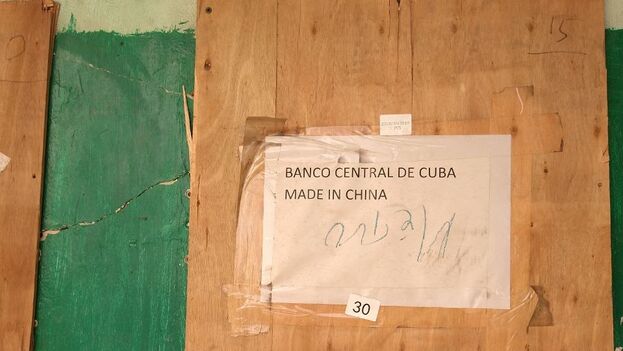
Along with the name, the Central Bank of Cuba, the notices say: “Made in China.” (14ymedio)
14ymedio, Natalia López Moya, Havana, 9 March 2023 — One day there appeared a significant number of ATMs around Tulipán Street, in the Havana neighborhood of Nuevo Vedado. The nearby market of the Youth Labor Army, which attracts not only local residents but also buyers from other municipalities due to its lower prices and the availability of wholesale purchases, made them necessary.
In addition to Tulipán Street itself, there were more ATMs on the ground floor of the Ministry of Transport and in the Metropolitan Bank on Conill Street, and still more at a Cadeca, an exchange house, which in its time changed the now non-existent Cuban convertible pesos.
All these machines were deteriorating, broken down and, therefore, disappearing, without the authorities doing anything to replace them. To such an extent that the neighbors of Nuevo Vedado have to travel to other neighborhoods such as El Vedado, Centro Habana or even Old Havana to withdraw cash.
These days, people have been surprised to see signs announcing the reinstallation of ATMs on Tulipán Street. Along with the name, the Central Bank of Cuba, the papers say: “Made in China.” People do not know, because the end of the work has not been announced, when these machines will be ready, but, for the moment, they smile suspiciously at the paper sign.
Translated by Regina Anavy
____________
COLLABORATE WITH OUR WORK: The 14ymedio team is committed to practicing serious journalism that reflects Cuba’s reality in all its depth. Thank you for joining us on this long journey. We invite you to continue supporting us by becoming a member of 14ymedio now. Together we can continue transforming journalism in Cuba.
14ymedio, Mexico, 9 March 2023 — “Passengers who do not have a passport, stay seated.” That phrase, which on any other flight would sound strange, is already routine for the Aeroméxico flights between Havana and Mexico City that end in Managua. Cubans continue to use that route to get to the United States.
Between hugs and tears, Dayuris and Julio said goodbye to their families this Wednesday before heading to the migration check-in area of terminal 3 of José Martí International Airport. After passing the controls and approaching gate 13, where in a couple of hours the boarding for Aeromexico flight AM 052 would begin, the couple felt that they had completed “half the journey.”
“My sister filled out all the forms to obtain humanitarian parole in the United States, but it is delayed and we prefer to wait for the response in Mexico,” Dayuris says. “We have a cousin in Monterrey who has offered us his house, and maybe we can also regularize ourselves to work while we wait for the papers to go to Miami.”
After the entry into force last January of a new program that offers up to 30,000 monthly permits for Cuban, Nicaraguan, Haitian and Venezuelan citizens to enter the United States, the number of travelers from Cuba who take the so-called “volcano route” through Managua has decreased significantly. continue reading
However, there are still people interested in leaving the Island who take advantage of the flexibility that Daniel Ortega’s regime offers to Cubans, who don’t need a visa to visit Nicaragua. Some don’t want to continue waiting in Cuba, and others fear that something will happen to complicate their departure. The truth is that “tickets are still being sold as Havana-Mexico City-Managua,” an airline employee acknowledges to this newspaper.
Unlike a few months ago, when most of the travelers who boarded the Aeromexico flight were going to Nicaragua with a stopover in Mexico City, now Cuban migrants on the flight are intermingled with Russian, Canadian and European tourists who, after a stay on the Island, are heading north.
The difference between these passengers is that while foreign tourists disembark at Benito Juárez Airport, Cuban migrants must remain inside the plane until it takes off again, this time for Managua. They also have to hand over their passports at the time of boarding the flight, a measure that has been in force since last October 30, when Aeromexico resumed its flights to Havana.
Then, Aereomexico’s representatives reported that it was essential for travelers with a final destination in Managua to buy the round-trip ticket without connecting to other airlines, since they would be allowed to transfer to an aircraft other than their company’s at the Mexico City airport. Almost five months later, the mechanism remains intact.
Dayuris and Julio’s travel document was removed by airline employees before getting on the plane. “We are calling passengers to the final destination Mexico City for boarding. Passengers who don’t have a visa must wait to be called,” an airline employee repeated several times in the boarding hall of the Havana airport. A dozen people stayed apart until the rest of the passengers got on the plane.
“Then they took away our passports and gave us a number to recover them in Managua,” says Julio. In the Nicaraguan capital, a “guide” awaits them who will take them to a modest hotel, and the day after their arrival they have “arranged a transport” that will take them to the border with Honduras. “If everything goes well, next week we will be with our cousin in Monterrey,” he speculates. “The idea is to leave; once outside we’ll see.”
On the same flight as the couple, there was also a retired teacher with two sons in Miami who want her to “get as close as possible to the border” south of the United States; a father with his son who “in July is old enough to enter military service and must be taken out of Cuba as soon as possible,” and two sisters from Güira de Melena in Artemisa who claim to “have a contract to dance” in Ciudad Juárez until they gather the money to get to Houston, where an aunt lives.
Each one paid a figure close to $2,000 for the round trip, a return ticket that everyone hopes they won’t have to use. With a tiny package of salted peanuts, all the food distributed by the airline employees on the way between Havana and Managua, they embark on a migratory journey that provides more doubts than certainties.
Translated by Regina Anavy
____________
COLLABORATE WITH OUR WORK: The 14ymedio team is committed to practicing serious journalism that reflects Cuba’s reality in all its depth. Thank you for joining us on this long journey. We invite you to continue supporting us by becoming a member of 14ymedio now. Together we can continue transforming journalism in Cuba.
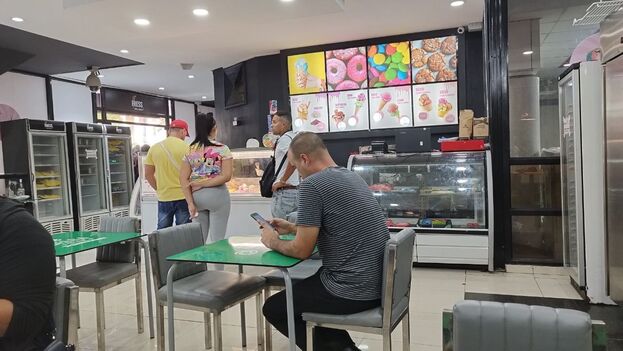
The controversial Fress private cafeteria, located in the state-owned Plaza de Carlos III. (14ymedio)
14ymedio, Madrid, 7 March 2023 — The Grupo de Administración Empresarial S.A. (Gaesa), the all-powerful conglomerate belonging to the Revolutionary Armed Forces, has been deliberately drowning the private sector in Cuba since 2016, and the SME law (micro, small and medium enterprises), promulgated in 2021, is only a “false opening” to attract foreign investment and facilitate a new rapprochement with the United States, a “thaw 2.0.”.
Those are the main conclusions of a report made public this Monday by the organization Cuba Siglo 21 [Cuba 21st Century], signed by the Cuban economist and consultant Emilio Morales, founder of the Havana Consulting Group, and made with the help of the Cuban Observatory of Citizen Audit and independent journalists of the Island.
With the title “Entrepreneurship in Cuba Suffocated by Gaesa,” the research shows how, after the economic opening began on the Island in 2011, when Fidel Castro had withdrawn from power and his brother Raúl governed, the private sector had an unprecedented boom between 2013 and 2016.
It was at that time, even in the midst of the thaw between Cuba and the United States headed by President Barack Obama, that Gaesa, then chaired by Raúl Castro’s former son-in-law, Luis Alberto Rodríguez López-Calleja — who died in Havana on July 1, 2022 — began what the Miami-based organization calls a “ruthless offensive” to “stop the largest citizen entrepreneurship movement that had occurred in recent decades.”
“The power and strength achieved by the movement of entrepreneurs, born in the heat of the reforms implemented in 2011, and the impact of the thaw were so strong, that even with the limitations allowed, in the period 2010-2016 there was a real boom in the non-state sector throughout the Island, which gave rise to a powerful middle class,” says the text. It pointed out that “the market showed the creation and consolidation of a very successful business structure made up of thousands of businesses in various modalities, most of them with their own brand.”
Thus, the report continues, Gaesa “began to resent the strong competition coming from the entrepreneurial sector,” for example in tourism. In just seven years, the lodging capacity of private individuals grew 268% compared to the “poor growth” of 3% of the state sector. “The CEO of Gaesa [López-Calleja] understood that the situation was getting out of control in an accelerated way, so this movement of citizen entrepreneurship had to be stopped categorically.” continue reading
Beginning in 2016, the document recalls, “no more licenses were issued to people for self-employment. The creation of new non-agricultural cooperatives (CNAs) was also stopped, even eliminating several of them and limiting the scope of action for those that remained.” In the following years, the regime continued to impose penalties on the private sector, decreasing the number of methods of self-employment and restricting the maximum wage, which could not exceed more than three times the minimum wage. Business licenses would be limited to a single activity per entrepreneur, and restaurant owners could operate in only one province or taxes would increase.
“Under these conditions, entrepreneurs saw the possibility of investing in their own country exhausted, so a strong movement began to export capital and go outside to look for new investment opportunities abroad,” the report details. “At the same time, the business of buying merchandise abroad to resell it in the informal market increases. This meant that the volume of dollars that left the country from the hand of the entrepreneurs was higher than the volume that the Government attracted as foreign investment.”
The devaluation of the Cuban convertible peso (CUC), which began to be quoted in the informal market at 50 pesos, caused people to prefer to buy the CUC “on the left” rather than at the exchange houses or banks, where they gave 25 pesos per CUC. This, the document asserts, “brought heavy losses for Gaesa, by exhausting the inventories of its stores faster and collecting CUCs and not dollars,” and it “meant that they ran out of liquidity to pay their debts with suppliers, many of whom would no longer sell to the Island.”
Faced with this reality, in the second half of 2019, Miguel Díaz-Canel announced two measures that, “far from achieving the effect of alleviating the country’s financial crisis, quickly led it towards an inflationary wave”: a wage increase without productive support, and price controls in both the state and private sectors. And the text continues: “This situation put the country at the gates of an inflationary powder keg.”
To combat the problem, the State did nothing but start a process of dollarization of the economy that exacerbated the problems even more. The COVID-19 pandemic, which the Cuban government is constantly using along with the US blockade to justify the crisis, only put the “headstone” on the island’s economy, in the words of the report.
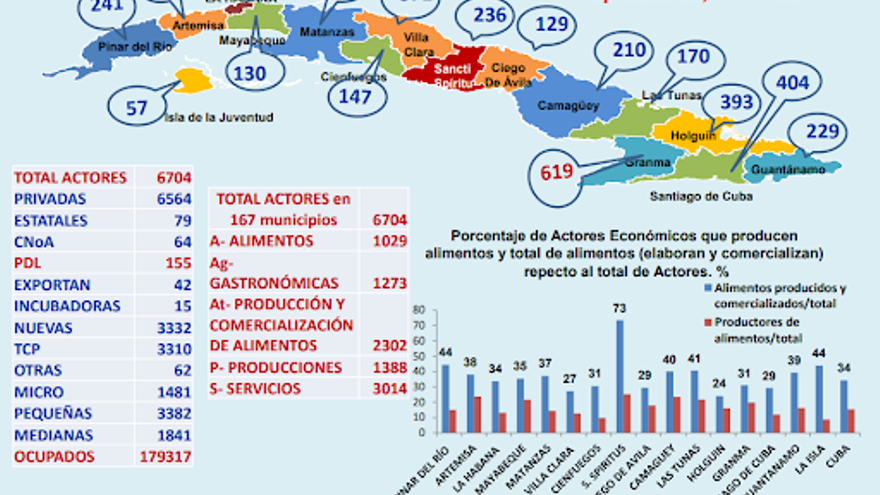
Number of “new economic actors” in Cuba: SMEs [Small and Medium Enterprises], CNAs [Non-Agricultural Cooperatives] and PDLs [Projects of Local Development] approved, as of January 2023. (Cuba 21)Why create a new category of entrepreneurs, SMEs, instead of consolidating businesses that already had a license for self-employment, “allowing them to exercise the right to register their businesses as property with legal personality, to export and import directly and even to receive investments from the United States since being genuinely private and autonomous of the State they could be exempted from the Helms Burton Act”? asks the report. “Very simple,” it answers: “With SMEs, there is no desire to strengthen the private entrepreneur but to artificially create a middle class dependent on Gaesa, whose ’owners’ are chosen from among less fortunate relatives of the oligarchs, retired repressors and members of the rapid response paramilitary brigades.” An opening, in short, more like Russia than Vietnam or even China.
This would create a kind of entrepreneurial middle class, “with the discreet capital of the oligarchy and its phantom companies,” the dossier argues, that Cuba’s own “agents of influence” in the United States would try to promote and sell to the Office of Foreign Assets Control (OFAC) of the Treasury Department as “legitimate private account holders and entrepreneurs” to allow them commercial, financial and credit transactions with the United States and the European Union. In this regard, they give as an example the mysterious financial company Orbit, which is already working with Western Union on the resumption of remittances to Cuba.
The strength of the arguments in Morales’ report lies in the data. The 6,161 SMEs registered on the Island at the beginning of 2023 represent only 1% of the number of entrepreneurs in 2016.
In that year, Cuba Siglo 21 points out, there were more than 500,000 Cubans with a self-employed work license, which in total generated more than 3 billion dollars. The debacle was progressive: “The obstruction to the reforms in 2016 removed some 80,000 self-employed people from the market. Subsequently, the pandemic and the monetary Ordering Task* caused more than 139,000 entrepreneurs to hand over their licenses or close their businesses. The country has lost two-thirds of this labor force because the State, which now boasts of creating SMEs that do not represent even 1% of those businesses, has since applied deliberate policies to repress them through prosecutors and police (the most successful often ended up in jail). A considerable part has emigrated, convinced that there is no future in Cuba.”
Against the possibility of what it calls “thaw 2.0,” the report also alleges that the Obama Administration’s rapprochement with the Island only benefited the “oligarchy” of the regime when 42 billion dollars of its foreign debt was forgiven, allowing them to obtain new lines of credit, increasing the tourist flow, using resources to build hotels and acquiring military equipment for repression.
“Pretending to draw up a policy of engagement with the aim of empowering the Cuban people and trying to promote a private sector that does not exist is to reiterate the errors of the first thaw,” says Cuba Siglo 21, because “concessions were made without reclaiming those that should have materialized, first or in parallel, on the Cuban side.”
The report concludes: “If the Cuban dictatorship on the Island and the Cuban exiles in the world have proven anything, it’s that without freedom there is no progress.”
*The Ordering Task [Tarea Ordenamiento]is a collection of measures that include eliminating the Cuban Convertible Peso (CUC), leaving the Cuban peso as the only national currency, raising prices, raising salaries (but not as much as prices), opening stores that take payment only in hard currency, which must be in the form of specially issued pre-paid debit cards, and a broad range of other measures targeted to different elements of the Cuban economy.
Translated by Regina Anavy
____________
COLLABORATE WITH OUR WORK: The 14ymedio team is committed to practicing serious journalism that reflects Cuba’s reality in all its depth. Thank you for joining us on this long journey. We invite you to continue supporting us by becoming a member of 14ymedio now. Together we can continue transforming journalism in Cuba.
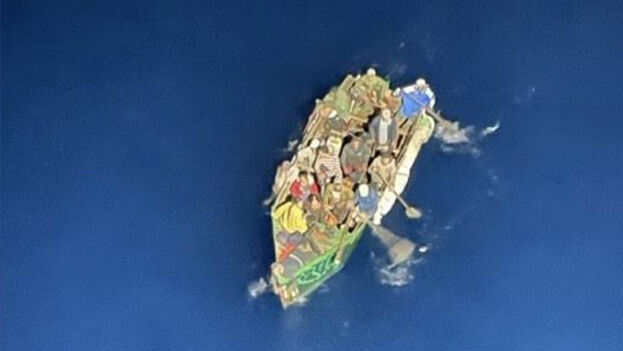
The crew of Cutter Paul Clark repatriated 26 Cubans to Cabañas, Cuba this Friday. (@USCGSoutheast)
EFE (via 14ymedio), Havana, 11 March 2023 — Cuba has received a total of 2,724 irregular migrants returned by several countries in the region so far this year, including a group of 26 delivered this Friday by the United States Coast Guard Service, Cuba’s Ministry of the Interior (Minint) reported.
The last migrants deported by the US authorities — 23 men and three women — bring the total to 1,944 rafters deported to the Island in some twenty U.S. Coast Guard operations that intercepted them at sea after their illegal departure from Cuba.
In recent weeks, other groups of irregular migrants were returned to Cuba by the governments of Mexico, the Bahamas and the United States (41).
The Cuban government affirms that it maintains its commitment “to regular, safe and orderly migration” and insists on “the danger and life-threatening conditions represented by illegal departures from the country by sea.”
In the case of the United States, since last October 1 — which marks the beginning of the current fiscal year — the crews of the U.S. Coast Guard have intercepted more than 5,740 Cubans, a high figure compared to previous years.
At the beginning of 2023, the Washington implemented a policy to welcome 30,000 monthly migrants from Venezuela, Haiti, Cuba and Nicaragua.
In parallel, the United States will immediately expel, to Mexico, undocumented migrants from those countries who try to cross the southern border to the U.S. in an irregular manner.
Mexico, for its part, agreed to admit 30,000 migrants a month who are expelled from U.S. territory.
Translated by Regina Anavy
____________
COLLABORATE WITH OUR WORK: The 14ymedio team is committed to practicing serious journalism that reflects Cuba’s reality in all its depth. Thank you for joining us on this long journey. We invite you to continue supporting us by becoming a member of 14ymedio now. Together we can continue transforming journalism in Cuba.
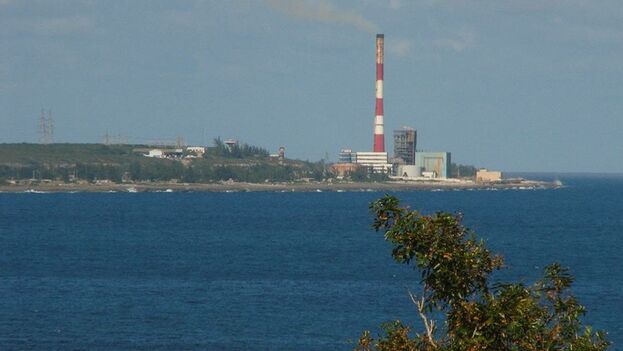
Unit 2 of the Matanzas thermoelectric plant, Antonio Guiteras, is also out of service. (14ymedio)
14ymedio, Havana, 7 March 2023 — Heat begins to squeeze the inhabitants of the Island, and the demand for energy grows faster than the generation recovers. This Tuesday, many Cubans choked on their breakfasts when Cuban television announced power cuts of up to seven hours in some parts of the Island.
“Yesterday in Sancti Spíritus they turned off the electricity around 5 in the afternoon and turned it on around 8:30. The blackouts are taking off,” says the 14ymedio correspondent in the province, which is already enduring the first prolonged cuts.
A little later, the Unión Eléctrica (UNE) disseminated on its social networks the summary of yesterday’s activity, confirming 7 p.m. as the worst moment of the day, when there was a deficit of 541 MW. The company also published its generation forecast for today, when a deficit of 23% of electricity is expected in the evening, the time of highest consumption. The company expects an electricity generation capacity of 2,277 megawatts (MW) and a maximum demand of 2,860 MW.
In total, 237 MW of the generation produced in the thermoelectric plants are missing, since the following are out of service: unit 6 of the Máximo Gómez, in Mariel (Artemisa); unit 3 of the Ernesto Guevara, in Santa Cruz (Mayabeque); unit 2 of the Antonio Guiteras, in Matanzas; unit 5 of Diez de Octubre, in Nuevitas (Camagüey); Unit 2 of Lidio Ramón Pérez, in Felton (Holguín); and unit 5 of Antonio Maceo, called Renté, in Santiago de Cuba. continue reading
They are joined by three units under maintenance, one in Cienfuegos and two in the Renté plant, in addition to the deficiencies in the distributed generation. As for the generation, 933 MW do not work and 322 MW are under maintenance. In that context, the 20 MW provided by the Puerto Escondido unit and the 70 MW of the Renté plant, whose unit 5 enters at peak time, fall short.
Despite the lack of expectations that citizens already have in the face of the Government’s promises, some customers regret having believed the words of the Minister of Energy and Mines, Vicente de la O Levy, who proposed a maintenance program aimed at repairing the thermoelectric plants that would began in January, when the climate is cooler and therefore favorable, and end in May, to tackle the warm weather when demand skyrockets.
In January, the minister announced that with this plan the power cuts weren’t going to disappear, but they would be for only one or two hours compared to 14 to 16 hours last summer, when an unprecedented crisis led to a multitude of protests in different parts of the country. However, already in February, blackout periods began to be extended to three and four hours.
“And we thought that at this point the situation was going to be resolved with scheduled maintenance,” complains a disappointed user on the UNE networks.
Between February 13 and 22, from the center to the east of Cuba, there were four large blackouts that left half the Island in the dark, fueling the fears of the population and the feeling of grievance among the inhabitants of that area, who feel discriminated against. All the Turkish floating power plants that contribute to electricity generation are located in the west.
The authorities of the sector said that one floating plant was going to be sent to Santiago de Cuba to minimize the problem, since the location of all of them in Havana — due to the greater presence of companies and concentration of population — was catastrophic for the east of the Island, but the inhabitants continue to feel affected and report that the floating plant still hasn’t arrived.
“The party started again, to suffer with the Apagón [blackout] orchestra giving their annoying concerts all over Cuba. The same never-ending story,” a client bitterly quipped, in a play on words that recalls the traditional Aragon orchestra. Another is already ahead of the fear that exists on the Island: “I’m just saying that the heat is coming and they are fucking us again with 10 or 12 hours of blackouts.”
Translated by Regina Anavy
____________
COLLABORATE WITH OUR WORK: The 14ymedio team is committed to practicing serious journalism that reflects Cuba’s reality in all its depth. Thank you for joining us on this long journey. We invite you to continue supporting us by becoming a member of 14ymedio now. Together we can continue transforming journalism in Cuba.
The number of repatriations from the United States grows by the hundreds almost weekly. (Twitter/Chief Raul Ortiz)
EFE (via 14ymedio), Havana, 7 March 2023 — More than 2,600 Cubans who were trying to migrate have been returned to their country from different nations so far this year, the Ministry of the Interior of the Island reported on Monday after including the last 75 returned by the United States.
The United States Coast Guard delivered a group of rafters a day earlier — 54 men, 20 women and a minor, most of them residents in the provinces of Matanzas and Granma — to the Cuban authorities through the Port of Orozco.
These people, without documentation, had participated in six illegal exits from the country by sea and were then intercepted by the US Coast Guard, the note said.
It also specified that with this operation — number 25 of the US Coast Guard Service in 2022 — a total of 1,918 Cuban rafters had been returned.
One of those returned is under detention “for finding himself as an alleged source of serious criminal acts, which were investigated prior to his departure,” it added. continue reading
Last week, other groups of irregular Cuban migrants were deported by the governments of Mexico (22 people), the Bahamas (128) and the United States (41).
The Government of Cuba insists that it maintains its commitment “to regular, safe and orderly migration” and insists on “the danger and life-threatening conditions represented by illegal departures from the country by sea.”
In addition to the Bahamas, Mexico and the United States, so far this year migrants have also been deported to Cuba from the Cayman Islands and the Dominican Republic.
In the case of the United States, since October 1, U.S. Coast Guard crews have intercepted more than 5,740 Cubans, a high figure compared to previous years.
At the beginning of 2023, the Government of Washington implemented a policy to welcome 30,000 monthly migrants from Venezuela, Haiti, Cuba and Nicaragua. In parallel, it will immediately expel to Mexico migrants from those countries who try to cross its southern border in an irregular way.
Mexico, for its part, agreed to admit 30,000 migrants a month who are sent from U.S. territory.
Translated by Regina Anavy
____________
COLLABORATE WITH OUR WORK: The 14ymedio team is committed to practicing serious journalism that reflects Cuba’s reality in all its depth. Thank you for joining us on this long journey. We invite you to continue supporting us by becoming a member of 14ymedio now. Together we can continue transforming journalism in Cuba.
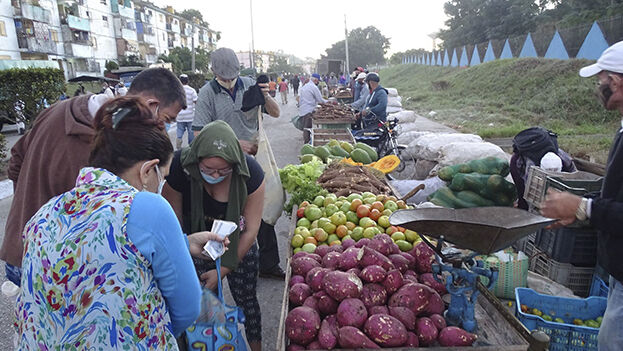
The pricing of 20 agricultural products will take effect on March 11. (Provincial Government)
14ymedio, Havana, 7 March 2023 — Despite the failure of this type of measure in the past, Villa Clara will begin to control the prices of some agricultural products in the face of the “excessive and intolerable” rise of prices in the basic food basket. The resolution, issued by the Governing Council, establishes the maximum values for the wholesale and retail marketing of 20 high-demand foods, as of March 11.
Alberto López Díaz, governor of Villa Clara, announced the measure as “our own war” against high food prices and assured that the “opinions” of individual producers and other productive forms of 13 municipalities were taken into account. The price cap will be flexible and periodic, according to the production of the agricultural harvests.
In the meeting with farmers, the official lashed out at vendors, whom he accused of “indisciplines, illegalities and high prices,” while pointing out that “it is preferable to lose some product rather than allow impunity for those who abuse the humble people and demoralize society.”
The rule includes malanga, banana and tobacco, sweet potato and cassava, while in the vegetable group there are squash, cabbage, cucumber, pepper and tomato. Among the grains are rice, black and red beans, dry and tender corn. The fixed prices also include papaya, guava and pineapple. continue reading
The decree establishes that the marketing margin of the twenty foods may not exceed 40% of the value paid to the producer. It also includes a “reorganization” in the sales network in areas that are “really needed” because, the provincial government argues, right now there is disorder, and “anyone can mount” an illegal business without a license and payment to the treasury.
Authorities say that a pound of rice — a food that has been scarce in most Cuban families — is sold in the province at 135 pesos ($5.70). With the new rule, the price to the commodity stockpiles will be 70 pesos ($2.92), the price in the wholesale market will be 84 pesos ($3.50) and for the retailer (final consumer) 90 pesos ($3.75).
A pound of black beans for the retail buyer will be set at 120 pesos ($5), a pound of red beans at 130 ($5.42), dried corn at 45 ($1.88), tomatoes at 42 ($1.75) and pepper at 55 ($2.29), for example.
Food sales will only be allowed with an authorization issued by the provincial delegate of Agriculture, which in turn will have to have the endorsement of the municipal authority and be “reconciled” with the president of the productive form to which the producer belongs.
The decree also includes other market surveillance measures, such as the creation of five engagement groups with territorial authority to reduce the risk of illegal food transfer to other provinces. Their powers will not replace the municipal structures, but they will monitor compliance with what was agreed by the Government Council.
Producers who sell above the set limits will be forced to market the merchandise at the price set by the decree, and if they re-offend, the decree warns, their marketing license will be withdrawn. Similarly, the new rule orders telephones and emails to be available for complaints from citizens about irregularities.
In 2021, the Cuban government failed with a similar experience in setting the prices of agricultural products. At the beginning of that year, the maximum prices for sales in the private sector were approved, but, in August, the authorities reversed because the measures were a brake on production since the producers could not recover the money they invested.
Translated by Regina Anavy
____________
COLLABORATE WITH OUR WORK: The 14ymedio team is committed to practicing serious journalism that reflects Cuba’s reality in all its depth. Thank you for joining us on this long journey. We invite you to continue supporting us by becoming a member of 14ymedio now. Together we can continue transforming journalism in Cuba.
After losing to Italy, the so-called Team Asere is at the bottom of group A, with “minimal” chances of moving to the next round. (Jit)
14ymedio, Havana, 9 March 2023 — Cuba’s options within the World Classic seemed to evaporate after adding another defeat, in an extra inning, 3-6 against Italy. It was “a good game,” said Cuban manager Armando Johnson. “I thought that once we tied we could do the job, that we could win the game, but you already saw that we couldn’t.”
Journalist Francys Romero was blunt after the defeat of the Cubans when he commented that the options for Team Asere in the World Classic are “minimal” and “reduced to 20%.” He did not fail to recognize, however, that it was “a game of total vertigo with constant returns of both teams in 10 innings” in front of some 6,000 spectators at the Intercontinental Stadium, in Taichung, Taiwan, with a capacity of 20,000.
The newspaper Pelota Cubana lamented that the Cuban representative “could not defend the great mound work of Roenis Elías.” The Chicago Cubs baseball player also offered his opinion about the panorama: “This is baseball. We have to keep fighting and moving forward. We went out to win; things didn’t go the way we wanted, but here we are, ready for tomorrow.” continue reading
The official newspaper Cubadebate, in its publication this Thursday, found those responsible for this defeat. There was the possibility of “breaking the tie in the third inning, after consecutive singles by Yadir Drake and Yadil Mujica” to which the “sacrifice of Yoelkis Guibert” was added, but “the major league players Yoan Moncada and Luis Robert were incapable of scoring.”
The same media stressed that against the Italian starter Matt Harvey, “Moncada perished in a fly to third and Robert tapped a harmless grounder to David Fletcher. Meanwhile, in the fifth inning, Moncada again struck out, with Quintana on third and Guibert on first.”
Faced with the comments about the lack of productivity presented by the Cuban batting, Johnson acknowledged at a press conference that “the offensive has not been working” and that “we wanted to have some runs, but (Italy) was ahead and we couldn’t.”
As for indications of a possible rotation of Yoan Moncada and Luis Robert, the Cuban manager said it would be analyzed among the “group of coaches” in the hotel. “I think that if there has to be some movement, it will happen. We are waiting to meet and do the relevant analyses.”
Francys Romero confirmed that “a conversation between the coaches and players took place at the clubhouse in Cuba.” In that talk, the one who took the baton was the manager and former shortstop of Industriales, Germán Mesa, who recalled that they still have possibilities and will continue fighting in the tournament, taking up the phrase of Lawrence Peter “Yogi” Berra: “It ain’t over ’til it’s over.”
The collaborator of Play-Off Magazine, Renier González Jr., lamented that although we have the best players in the world, “if we continue with these managers, we will not make much progress.” Through his Twitter account he exhibited his annoyance: “A team with a lot of potential is not being managed in the right way. Outs are given away in bunt hits. The pitching is handled badly. Players are lined up with a terrible defense.”
González Jr. stressed that “as long as we aren’t looking for trainers, coaches and people prepared in the world’s major leagues, we will continue the same way.”
Group A accomplished its second date in which the Netherlands remains undefeated (2-0,) followed by Italy (1-0), Panama (1-1), Taiwan (0-1) and Cuba (0-2).
Translated by Regina Anavy
____________
COLLABORATE WITH OUR WORK: The 14ymedio team is committed to practicing serious journalism that reflects Cuba’s reality in all its depth. Thank you for joining us on this long journey. We invite you to continue supporting us by becoming a member of 14ymedio now. Together we can continue transforming journalism in Cuba.
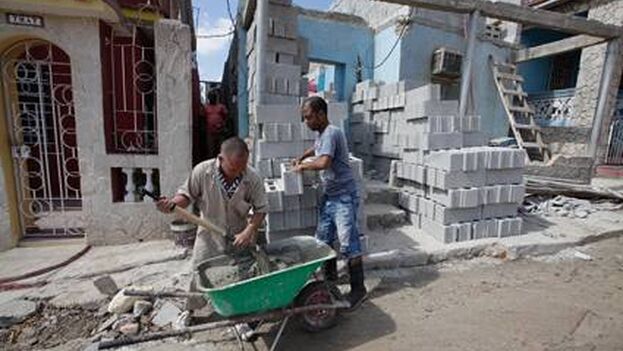
Last week it was announced that 10,000 electrical workers left their positions in 2022, and this Monday the news was amplified with a report on the absence of construction employees, in this case in Sancti Spíritus. (Juventud Rebelde)
14ymedio, Madrid, March 6, 2023 — The flight of professionals from the state sector in Cuba has become an issue for the official press, which gives figures for a situation that was already known at street level. Last week it was announced that 10,000 electrical workers left their positions in 2022, and this Monday the news was amplified with a report on the absence of construction employees, in this case in Sancti Spíritus.
In the last eight years, the province’s Construction and Assembly Company lost 1,000 workers, 500 of them in 2022. The Ministry of Construction estimates that the province needs at least twice as many personnel as it has at the moment.
In 2015, the entity had 2,426 employees, but emigration and flight to the private sector have left it without manual labor, the official newspaper Escambray said on Monday, “I don’t want to spend my last years of work with a salary that doesn’t even reach 3,000 pesos [$125/month] because how am I going to retire? That’s why I went to an SME [small and medium-sized enterprise], with the expectation that my salary would be increased, which is now triple and sometimes more,” argues one of the former workers, who after 30 years in construction refuses to return because he seeks to “subsist.” continue reading
According to Osvaldo Acosta Rodríguez, the company’s head of human resources, there is a lack of incentive to keep workers trained in the sector. “We have a school that still trains workers in the different specialties, but there is no established mechanism to retain those who graduate. The same happens with the inmates who go through school and when they leave the penitentiary center are no longer a responsibility of the Ministry of the Interior or of the Court, which also does not have a legal apparatus for them to stay in construction, even when we give them an evaluation that serves anywhere.”
The lack of employees joins the thousand problems that prevent having the raw material for construction. Hydraulic works, industrial construction, tourism, road works and, of course, the execution of housing programs hang in the balance.
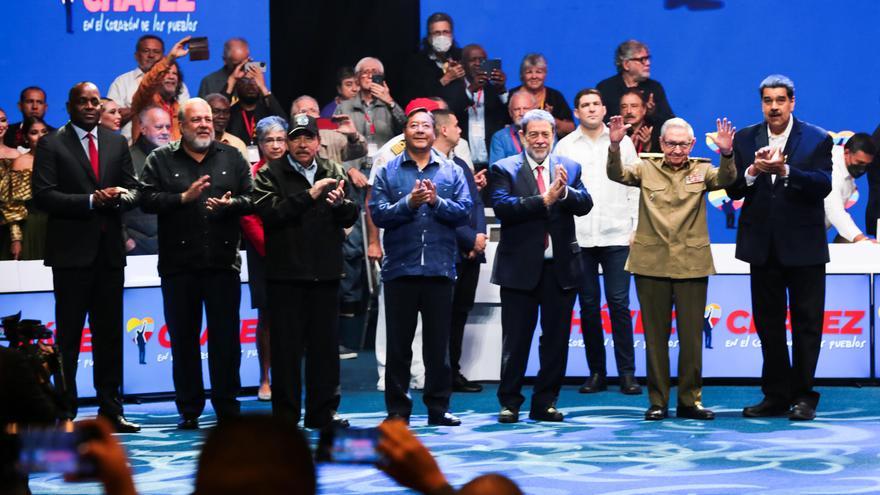
Meeting of politicians related to chavismo in Caracas, to commemorate the tenth anniversary of the death of the Venezuelan commander. (EFE/ Prensa Miraflores)
14ymedio/EFE, Madrid, 6 March 2023 — “Chávez and his compañeros in the struggle shook our continent and impacted the contemporary history of our America,” claimed General Raúl Castro this Sunday at the closing ceremony for the tenth anniversary of the death of Hugo Chávez. The former Cuban president knew how to thank the generosity of the deceased, from which the Island continues to consume at the rate of about 50,000 barrels of oil per month on average, and he praised the favorite son of the Cuban Revolution in Venezuela.
“His departure was very painful for us. Chávez was our brother in the struggle, who instantly won the sympathy of our people. (…) Very early Fidel saw in him a revolutionary leader and foresaw his political future, when many still did not even know him,” Raúl said at the event, held under the bombastic name of “World Meeting: Validity of the Bolivarian Thought of Commander Hugo Chávez in the 21st century.”
Castro, who traveled to Caracas, as did Rafael Correa, Evo Morales, Daniel Ortega, Manuel Zelaya and Luis Arce, among others, referred at length to the friendship between his brother Fidel and the “eternal commander,” who shared, he said, the idea “that victory exists as long as you fight for it.”
“They didn’t stop planning how to turn their dreams into reality. (…) Fidel and Chávez linked their ideas with that colossal ability to think big,” he added. He also explained that Maduro and Chávez himself frequently visited his older brother, giving him “love and affection” during his illness, which was reciprocated by the leader of the Revolution during Chávez’s medical treatment in Havana. continue reading
“He set goals that also point the way for us,” Castro insisted in his speech. We have been marked by Chávez.” There was no lack among the general’s words of the always-present reproach against the United States for “the continuous imperialist aggressions against the Bolivarian Revolution, to overthrow it,” although he praised the “ability of the people and the Bolivarian leadership to resist.”
The event was headed by Nicolás Maduro who requested that they maintain the political, ideological, moral union and ward off any “divisionist force.”
“There are always destructive forces (…) that intend to blur the path of resistance of the revolution, that intend to take advantage of the difficulties (…). The people have to say No very clearly to these forces (…) and take care of the political union, the ideological union, the spiritual union, the moral union of our people,” he said.
The current Venezuelan leader said that, despite the ten years without the physical presence of his predecessor, “there has been a permanent presence of his ideal, his revolutionary drive and the sworn commitment to advance in the construction of the free, independent, sovereign, socialist homeland.”
“Who knows about the difficulties our people have, the threats, aggressions, criminal sanctions, and they believed, the American empire, that they could impose their colonial model on our country. But we have said very clearly, colonial model no, free homeland yes (…) that’s how we are shaping the path for the years to come,” he added.
Earlier, the ruling party paid another tribute to Hugo Chávez in the barracks from which he led the 1992 coup d’état against then Venezuelan president, Carlos Andrés Pérez.
In the Cuartel de la Montaña, an old military museum renamed Fourth of February in honor of the date in 1992 when, from its premises, Chávez led the coup d’état, members of the Government and sympathizers of the man who governed the destinies of Venezuela until 2013 remembered his legacy.
“We have the enormous commitment, 10 years after the physical departure of our commander, (to) continue strengthening popular unity, the vanguard of the revolution in Venezuela and beyond, because this is an internationalist project,” said the Venezuelan ambassador to Cuba, Adán Chávez, brother of the deceased president.
Thousands of Chávez supporters attended the event. “Today I come here to honor our eternal commander Hugo Rafael Chávez Frías, the man who woke up the Venezuelan people, the man who told the people that yes, there is love here,” said Francisco Morillo, a Venezuelan interviewed by the EFE agency who was grateful to Chávez for “waking up the Venezuelan people” and ratified his support for the current president, Nicolás Maduro.
The last ten years, said María Eugenia Barrios, another attendee, have been “a very hard battle,” but Maduro “has been overcoming each of the difficulties to benefit us, to continue with the legacy and responsibility that Commander Chávez left him.”
Chávez died on March 5, 2013 at the age of 58, a victim of a cancer for which he was treated for months in Cuba.
Translated by Regina Anavy
____________
COLLABORATE WITH OUR WORK: The 14ymedio team is committed to practicing serious journalism that reflects Cuba’s reality in all its depth. Thank you for joining us on this long journey. We invite you to continue supporting us by becoming a member of 14ymedio now. Together we can continue transforming journalism in Cuba.

 14ymedio, Havana, 11 March 2023 — The Cuban team “woke up” in the World Baseball Classic this Friday after beating Panama 13-4 in Taiwan and connecting with 21 hits. The performance of the national team, which could guarantee its classification in the next round of matches, was celebrated by the official press, which in recent days harshly criticized its defeats.