Aggravation Inflames Spirits in the Gas Lines in Havana

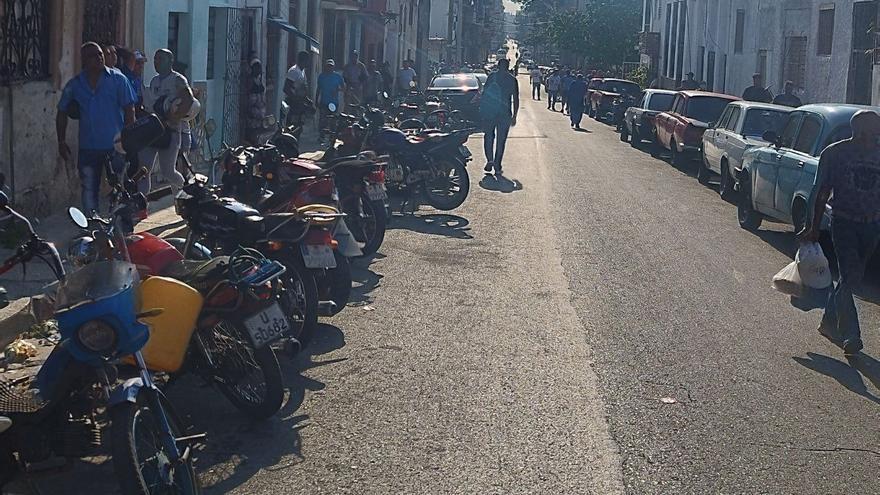
Those waiting in line at the gas station look serious as they talk about the daily vicissitudes that people suffer. (14ymedio)

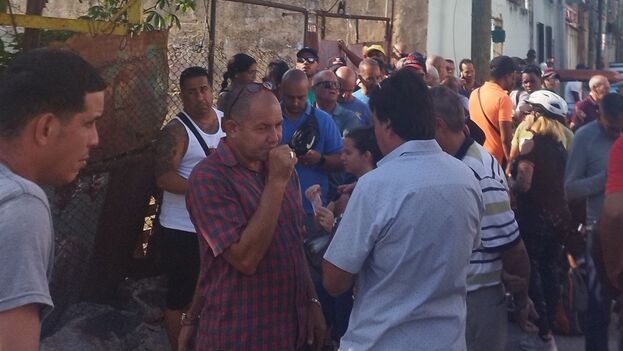
14ymedio bigger14ymedio, Juan Diego Rodríguez, Havana, 4 May 2023 — Hundreds of people milled around at dawn this Thursday on the corner of San Rafael and San Francisco, in Central Havana. They were part of the large line of people waiting to fill up at the nearby gas station on Infanta Street.

They talked about many topics, but far from the idyllic image that the official press offered a few weeks ago, in an article that outraged Cubans and that extolled the opportunity to “establish bridges of friendship” in the endless lines at gas stations, they did so with serious gestures, discussing the daily vicissitudes that people are suffering.

One had turned off his motorcycle and complained about having to drag it to the station, while another complained about the bread situation. The guy behind him talked about “Díaz-Canel’s lies in the news.” Many were silent, scowling; none of them protested out loud. However, people were upset, and there was a feeling of contained violence in the environment.

Watching them was a massive operation of police and “prevention” brigades of the Revolutionary Armed Forces, something unprecedented for this type of line.

As the authorities have done on other occasions when shortages have increased the number of people in lines, this one at the San Rafael gas station was “distributed” onto adjacent streets, out of the way, to disguise the magnitude of the problem. continue reading

The line at the San Rafael gas station was “distributed” onto adjacent streets, out of the way, to disguise its magnitude. (14ymedio)

This was not the only “organizational measure” that the provincial government took in the face of the May Day events, postponed for this Friday, in which numerous foreign guests are expected to participate. Tribuna de La Habana echoes the suspension of the sale of fuel at six gas stations in El Vedado, from seven in the evening on Thursday to ten the next morning.

The measure affects service stations at 3rd and 12th, Riviera, Tángana, Vista al Mar, Rampa and G and 25th. The official note says that “customers who are waiting at these stations will be guaranteed their same place in line according to the established records or listings, and, for security reasons, there can be no parking of vehicles in these places or their surroundings at the aforementioned time.”

“If that happens here in San Rafael, I don’t know what I would do; I’ve been here for two days now,” commented a taxi driver, desperate. Another driver responded: “Maybe we’re the ones who start the next social explosion.”

Translated by Regina Anavy

____________

COLLABORATE WITH OUR WORKThe 14ymedio team is committed to practicing serious journalism that reflects Cuba’s reality in all its depth. Thank you for joining us on this long journey. We invite you to continue supporting us by becoming a member of 14ymedio now. Together we can continue transforming journalism in Cuba.
The United States Keeps Cuba on the List of Terrorist Countries Despite Dialogue With the Island’s Regime

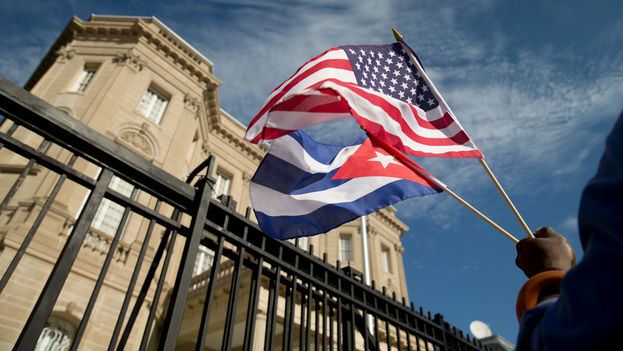
The Cuban embassy in Washington. (EFE)

14ymedio bigger EFE (via 14ymedio), Washington, 3 May 2023 — On Tuesday, the United States said it would not remove Cuba from the list of countries that sponsor terrorism, despite having held a meeting with the Government of Havana on cooperation to confront terrorist activities.

“These conversations take place on a regular basis. We still are not changing our policy regarding the presence of Cuba on the list,” said the deputy spokesman of the State Department, Vedant Patel, at a press conference.

Patel said that Washington and Havana have to carry out “important cooperation tasks” because they share maritime borders, and he said that security dialogues with the Island take place from time to time.

However, he insisted that “the regime has a long history of repression against civil society and other factors that keep Cuba on the list” of state sponsors of terrorism.

The talks in question took place last Thursday and Friday in Havana, where representatives of both governments had a technical exchange on cooperation in the fight against terrorism.

They spoke about the hijacking of aircraft and maritime vessels, as well as the use of digital networks for violent purposes, according to the Cuban Ministry of the Interior. continue reading

The inclusion of Cuba on the list of sponsors of terrorism in January 2021 was one of the last decisions made by the Government of Donald Trump (2017-2021) before leaving power.

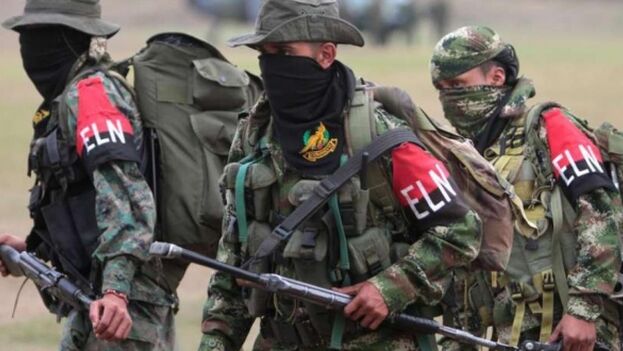
The United States then justified the measure, which entails several sanctions, alluding to the presence on the Island of members of the Colombian guerrillas of the ELN, who traveled to Havana to start peace negotiations with the Colombian president.

The Island was taken off the list in 2015, during the rapprochement promoted by then-President Barack Obama (2009-2017). Cuba was put back on the list by Trump, who during his term redoubled the sanctions on Havana and put the brakes on the “thaw.”

The current Biden Administration has made some gestures towards the Island, such as the elimination of the remittance limit for Cuba, but is still far from Obama’s approach.

Translated by Regina Anavy

____________

COLLABORATE WITH OUR WORKThe 14ymedio team is committed to practicing serious journalism that reflects Cuba’s reality in all its depth. Thank you for joining us on this long journey. We invite you to continue supporting us by becoming a member of 14ymedio now. Together we can continue transforming journalism in Cuba.

An NGO Hopes for the ‘Intermediation’ of the Church for the Release of Cuban Political Prisoners

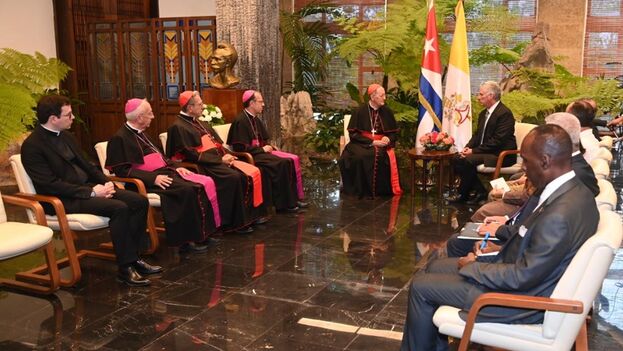
Cardinal Beniamino Stella with President Miguel Díaz-Canel during his visit to Cuba in February 2023. (Presidency of Cuba/Twitter)

14ymedio bigger14ymedio, Havana, 4 May 2023 — “The situation is critical, a kind of perfect storm between government repression and famine.” The assertion is from the Cuban Observatory for Human Rights (OCDH), which hopes for “the intermediation of the Cuban Catholic Church” for “the release of political prisoners, the end of repression and changes that the country urgently needs.”

In its latest report, the organization, based in Madrid, reports at least 231 repressive actions during the month of April, of which 53 were “some type of detention.” The greatest amount of abuse was suffered by political prisoners, says the OHCHR. In addition, they point out “a high number of homes of activists raided by the political police, police subpoenas, harassment, assaults, travel impediments, fines and trials.”

For its part, the Cuban Center for Human Rights (CCDH), led by Martha Beatriz Roque, in its most recent report gives a total of 582 arrested for the massive demonstrations of July 11, 2021, who are still in prison.

Among them are 46 women and four minors: Alejandro Rosa la Fuente, 16, Rubén Alejandro Parra Ricardo, 15; Llenson Enson Rizo, 14, and Giuseppe Belaunzarán Guada, 16.

The latter is a special case, because, sentenced to 10 years in prison, he was released, details the CCDH, “for being the grandson of a lieutenant colonel” of the Ministry of the Interior, Carlos Javier Guada. continue reading

From the list, it is striking that 192 were sentenced to 10 years or more of deprivation of liberty, and that many of those who received long prison terms demonstrated in the Havana neighborhood of La Güinera, where on July 12 a policeman killed Diubis Laurencio Tejada.

A witness to that crime, Roberto Pérez Ortega, for example, was sentenced to 17 years in prison, after an annulment that lowered his initial sentence of 25 years. Ángel Hernández Serrano, from the same neighborhood, was sentenced to 23 years; sentenced to 22 years was Dayron Martín Rodríguez, who “was under psychiatric care for depression and suicidal thoughts,” says the NGO based in Cuba; Miguel alias El Calvo was sentenced to 18 years; and Eliéser Gordín Rojas (epileptic and asthmatic) to 18 years.

Those who suffer the greatest penalties, of course, were those who demonstrated in Güines. They are Lázaro Ramírez Lugo, sentenced to 30 years; José Alberto Oliva Arencibia,  to 27 years and Lázaro Jesús Piloto Campos, to 25..

Translated by Regina Anavy

____________

COLLABORATE WITH OUR WORKThe 14ymedio team is committed to practicing serious journalism that reflects Cuba’s reality in all its depth. Thank you for joining us on this long journey. We invite you to continue supporting us by becoming a member of 14ymedio now. Together we can continue transforming journalism in Cuba.

The Reactivation of a Few Productions of BioCubaFarma Excludes Cancer Medication

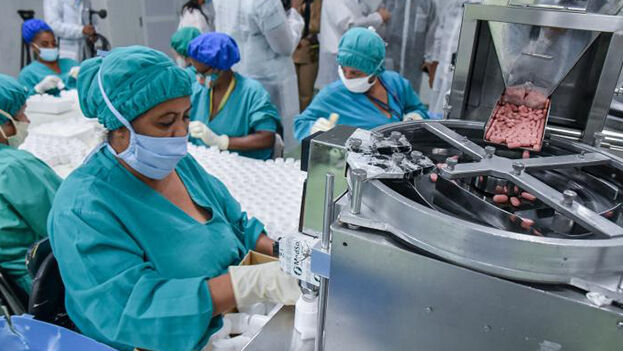
BioCubaFarma supplies 60% of the basic medicines in Cuba, but in recent months it has not been able to meet its quota. (Granma)

14ymedio bigger14ymedio, Havana, 2 May 2023 — The state business group BioCubaFarma has reactivated some drug production lines that had disappeared for months in the Island’s pharmacies, but its directors recognize that the measure will not be enough to meet “all the needs” of the population.

The shortage of medicines is attributed to the lack of raw materials, the company’s Director of Operations and Technology, Rita María García, told the state newspaper Granma on Monday. On the one hand, the Government does not have enough financial liquidity to buy the finished supplies or drugs and, on the other, there are also problems in the supply of packaging in the international market, he explained.

After months of a “very complex” situation, García assured that the state plant — which is allocated 60% of the production of basic medicines at the national level — has managed to reactivate some  drug production lines in high-demand among the population with the arrival of inputs purchased by the Government and other “managements,” without specifying whether they are donations.

Among the drugs that will be manufactured again are the injectables of aminophylline, labetalol, fenoterol and morphine of 10 and 20 milligrams (mg), of wide hospital use for patients in intensive care. The laboratories dedicated to the manufacture of these drugs were paralyzed for almost four months because they did not have containers — such as ampules, plungers or cartridges — due to the shortage of glass. continue reading

“This brought with it deficiencies in over 10 products needed for patients in serious condition. Once these packaging containers  arrived, production was restored, and the products are gradually coming out for hospital distribution,” the executive told the official newspaper.

The scenario is much more complicated for cancer patients, for whom “at the moment there is a significant deficit” of medicines, mainly cytostatics, despite the alarming increase in cases in recent months. The director was clear: “There will be no presence” of paclitaxel, cisplatin and oxaliplatin.

This newspaper collected the testimony of several people who, after being diagnosed with cancer, could not register for treatment at the National Institute of Oncology and Radiobiology in Havana. The response they received from the doctors is that they are attending only to “patients already registered, and new registrations are not being accepted due to lack of medicines.”

García acknowledged that the business group has not had the capacity to supply the medicines, and no improvement is expected in the short term. The official warns that the problem of deliveries will continue “for the moment.”

The entry of inputs gives a slight boost to the production of some controlled chemicals, such as the diuretic drug hydrochlorothiazide, which since last March is being manufactured again and delivered to hospitals. However, the official said that “the population still does not feel it, because it’s a drug that has been missing for many months.”

The business group has enough raw material to guarantee the supply of hydrochlorothiazide until August. For the rest of the year the panorama is uncertain, but García assured that “actions” are being carried out to guarantee supplies before the available ones are exhausted.

The production line for nifedipine (antihypertensive), warfarin (anticoagulant) and clonazepam (anxiolytic) has also been reactivated. In the case of medicines for diabetic patients, the production of glibenclamide and metformin has resumed. The latter, however, will have low coverage because an excipient is missing that is difficult to import.

The BioCubaFarma directive announced that the availability in pharmacies of enalapril, used for hypertension, a condition with high prevalence in Cuba, will continue to be limited in the coming months.

Similarly, the shortage will continue in deliveries of allopurinol, which is used in patients with uric acid deficiencies, amiodarone for heart problems, omeprazole for heartburn, and the antipsychotic haloperidol. García said that in the case of the last two drugs they cannot be produced due to breakage of the equipment, but that the replacement parts will arrive soon.

In his report to Granma, he pointed out that there will be “stable” deliveries in the next four months of the antibiotics cephalexin, cefixime and ciprofloxacin, although their continuity depends on the arrival of raw material from a supplier who has not been able to dispatch a container ship due to lack of availability. For the rest of the drugs in this range there are no supplies, nor is it known when they will be able to reach the Island, he said.

After a long litany of regrets about the lack of medicines, García assured the official newspaper that BioCubaFarma’s income has been maintained in large part thanks to the sale of “business models” and patents, since “in principle” they cannot export the drugs that are needed in the country.

Translated by Regina Anavy

_______________

COLLABORATE WITH OUR WORKThe 14ymedio team is committed to practicing serious journalism that reflects Cuba’s reality in all its depth. Thank you for joining us on this long journey. We invite you to continue supporting us by becoming a member of 14ymedio now. Together we can continue transforming journalism in Cuba.

Failed Reforms Complicate the Latin American Left

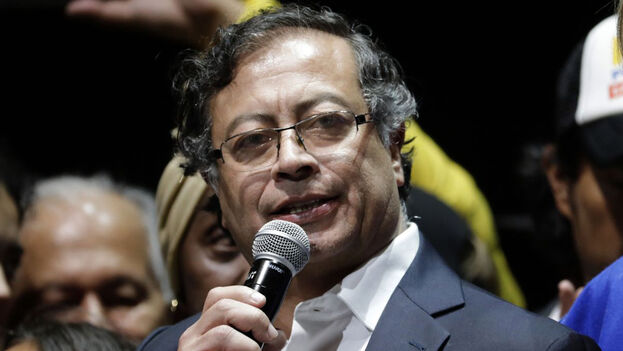
The president of Colombia, Gustavo Petro, has had to renew his cabinet for the second time because of the health reform bloc. (EFE)

14ymedio bigger EFE (via 14ymedio), Manuel Fuentes, Redacción América, 3 May 2023 — The leaders of the Latin American left in power are encountering serious difficulties in carrying out ambitious structural reforms of their governments. The weakness of the political support that allowed them to achieve power and the fragmentation of parliamentary representation are the main reasons, according to experts consulted by EFE.

In Chile, Gabriel Boric has not managed to get Congress to approve the tax reform and, what is more serious, the draft Constitution originating in the Convention that was going to replace the Constitution that came from the dictatorship of Augusto Pinochet.

The Colombian president, Gustavo Petro, also has problems promoting health, labor and pension reforms. The distrust of the parliamentary groups that supported him has forced him to make a profound restructuring of his cabinet, the second since he assumed the Presidency, just nine months ago.

And in Mexico, Andrés Manuel López Obrador has also failed to move forward with the militarization of the National Guard, the reform of the electoral body and the modification of the regulatory framework on energy matters that he proposed.

The reasons why the leaders of the Latin American left are having so many difficulties in implementing basic elements of their political programs are diverse. continue reading

But except in the case of the draft of the Chilean Constitution, mostly rejected by a citizenry dissatisfied with the text submitted to a plebiscite, the common denominator of these setbacks is the absence of political support from the legislative power, a phenomenon that the Argentine political scientist and jurist Daniel Zovatto calls “the overnight vote.”

“I loan you the vote during the night so that you win the election and then withdraw it in a timely manner,” describes the regional director of the International Institute for Democracy and Electoral Assistance (IDEA).

“The big issue is the governance of presidential systems in the contexts of political fragmentation,” he explains.

In Mexico, President Andrés Manuel López Obrador led what he called “the fourth transformation,” but the structural reforms of key sectors he proposed did not go ahead due to legislative and, in some cases, even judicial rejection.

Among the latter is the militarization of the National Guard, overthrown by the Supreme Court because it is a civil security organization that cannot be attached to the Ministry of Defense.

Likewise, the attempt to eliminate the institution in charge of organizing the voting processes, the National Electoral Institute (INE), generated rejection and criticism from the opposition and the Judiciary, which could affect the presidential elections of 2024.

The reform of the energy sector, which would have benefited the state companies Petróleos Mexicanos (Pemex), the Federal Electricity Commission (CFE) and the creation of the Institute of Health for Welfare suffered the same fate.

In Colombia, President Gustavo Petro has not had it easy in Congress either, since he doesn’t have the necessary majority to achieve the approval of his ambitious social reforms.

The coalition that he had managed to form for that purpose was declared broken by himself a week ago, after noting that his project to reform the health system aroused strong resistance in Parliament.

The Government’s machinery, which worked in the first six months of its mandate, has stumbled into the discussions on health reform, which have finally precipitated a cabinet crisis that has cost seven of the eighteen ministers their positions, including those for Finance, the Interior and Health.

With those changes, Petro seeks to rebuild his support base in Congress and will try to negotiate separately with each senator and representative to the House, but not with the entire bench, as before.

Except in Mexico and Venezuela, the presidential elections in Latin American countries provide for a second round if none of the candidates reaches a sufficient majority in the first round.

And although in the ballot, the candidate who manages to attract the vote of the electorate that supported the candidates who did not pass to the second round is usually imposed, the truth is that “the Congress was constituted in the first vote.”

This is the case for Gabriel Boric, Gustavo Petro and Lula da Silva, who prevailed “with the votes given to them by those who did not want their opponent to win, but who are not from their party,” explains Zovatto.

“They come to the presidency without their own majority in the Congress or with a coalition that is a kind of Noah’s ark, due to the high degree of heterogeneity of those who make it up.”

Post-election support “is not enough later to have its own majority in Congress, and if they manage to get it, it is very difficult for them to maintain it, because their proposals for structural reforms can break up the coalition,” says the regional director of IDEA.

“And since they can’t quickly fulfill their promises of change, they begin to wear out quickly,” concludes the Argentine political scientist.

Translated by Regina Anavy

____________

COLLABORATE WITH OUR WORKThe 14ymedio team is committed to practicing serious journalism that reflects Cuba’s reality in all its depth. Thank you for joining us on this long journey. We invite you to continue supporting us by becoming a member of 14ymedio now. Together we can continue transforming journalism in Cuba.

Forced Into Exile, Artist Tania Bruguera Says That She Will Return to Cuba in August

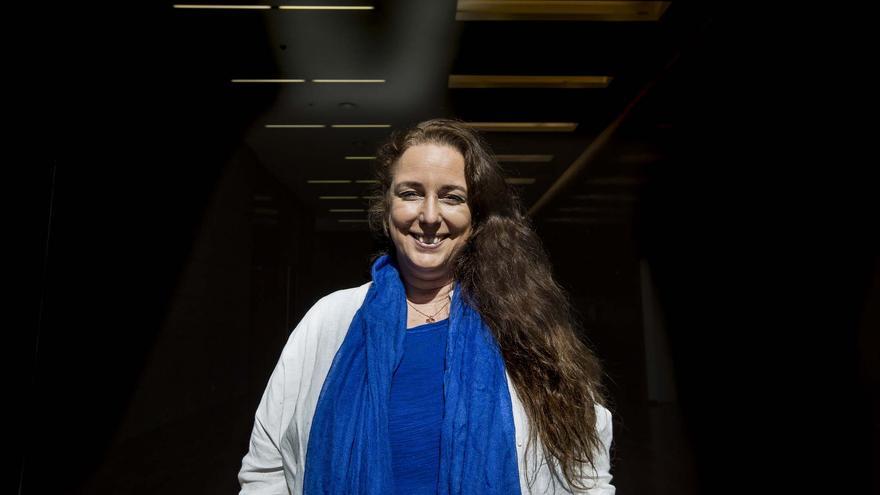
The artist Tania Bruguera on a trip to Argentina. (Romina Santarelli / Ministry of Culture of the Nation)

14ymedio bigger14ymedio, Madrid, 3 May 2023 — Cuban artist Tania Bruguera will return to Cuba in August. Or, at least, she will try, according to the Spanish newspaper La Vanguardia, which interviewed the activist during a visit to Barcelona where she participated in a conference on art and power at the Center for Contemporary Culture (CCCB).

“They have let me know through a fellow activist that they are not going to let me in. But I always return, no matter what it costs me,” says the artist, who resides in Cambridge (USA), where she works as head of media and performance at Harvard University, and she warns: “Let them take note.”

Bruguera, who left Cuba in August 2021 after a negotiation for the Government to release twenty political prisoners, including rapper Maykel Osorbo Castillo and artist Hamlet Lavastida, accuses the regime of having agreed, in desperation, to that exchange with the sole intention of deporting her. “There was one protest action after another and they felt weakened. Many saw the departure of the artists as a defeat, but from that moment it has been the people who have taken the initiative for the protests. And that’s fantastic,” she argues.

The artist believes that the regime has reached a level of “impressive moral, political and social weakening” and believes that international public opinion should be aware of the situation and update its vision of Cuba. “It’s very uncomfortable for us that people continue to talk about Cuba as if the Revolution had just triumphed and was doing everything it promised,” she says.

Bruguera downplays the importance of the Government reading her interview with the Catalan newspaper, mentioning how fake news and profiles operate on the Island. “They watch my Facebook, how ridiculous, and there are also people who are dedicated to bullying me on social networks. They are more sophisticated about repression than people can imagine,” she warns. continue reading

The artist talks about her relationship with fear, a feeling with which she lives, especially minutes before and after carrying out a protest action. However, she argues, “what the dictatorship has not calculated is the power of the feeling that they are being unfair to you or to someone you love. That is a force greater than fear.”

She is also positive, because she remembers having engaged in  activism alone while now “there is a whole generation willing to fight,” and she feels that fear has changed sides. “Those who lead us are so mediocre and have so much fear that they are not even able to sit at the table with people who think differently,” she emphasizes.

The artist, winner in 2021 of the Velázquez prize awarded by the Spanish Ministry of Culture, also addresses her relationship with art and dictatorships. Dictators, she says, perfectly understand the power of art to generate feelings and provoke sensations that they use for propaganda. She points out that songs by Silvio Rodríguez and Pablo Milanés are known in all latitudes. “[But] when artists use art to show reality, they stop them in a brutal way. Our greatest revenge is that dictatorships pass and art remains,” she says.

Her artistic experiences, which she talks about with La Vanguardia, are linked to her own body. In the performance of Autosabotaje, [Self-sabotage], she played Russian roulette with a real weapon. Bruguera confesses that after exposing her body in the most radical way possible in that performance, she promised not to do it again, although her artivism — as she calls her use of art to protest — has led her to compromise her physical integrity on many occasions.

“When in 2014 I went to the Plaza de la Revolución in Havana with the intention of putting up a microphone for any citizen to speak freely about the future of Cuba, it was somehow like putting a symbolic gun to my head. She was aware that it would have consequences, that she could never exhibit there again and that the confrontation was going up a level,” she says, recalling her performance of Tatlin’s Whisper*.

Despite this, the artist maintains that she resorts to performance because “it is a simple language, accessible to everyone. It is a medium very close to the theater because it uses a narrative, some bodies, but at the same time it opens a space for the unthinkable to happen and for the spectators to have the possibility of influencing what happens.”

In addition, she claims the speed of this mechanism helps to confront power. “When you make political art you have to be fast, so that the Government doesn’t have time to react or know what to do with you.”

*Translator’s note: Here is a link to video of a portion of that event

Translated by Regina Anavy

____________

COLLABORATE WITH OUR WORKThe 14ymedio team is committed to practicing serious journalism that reflects Cuba’s reality in all its depth. Thank you for joining us on this long journey. We invite you to continue supporting us by becoming a member of 14ymedio now. Together we can continue transforming journalism in Cuba.

Rice and Sardines in the Donated Packages That Will ‘Save’ Santiago de Cuba From Hunger

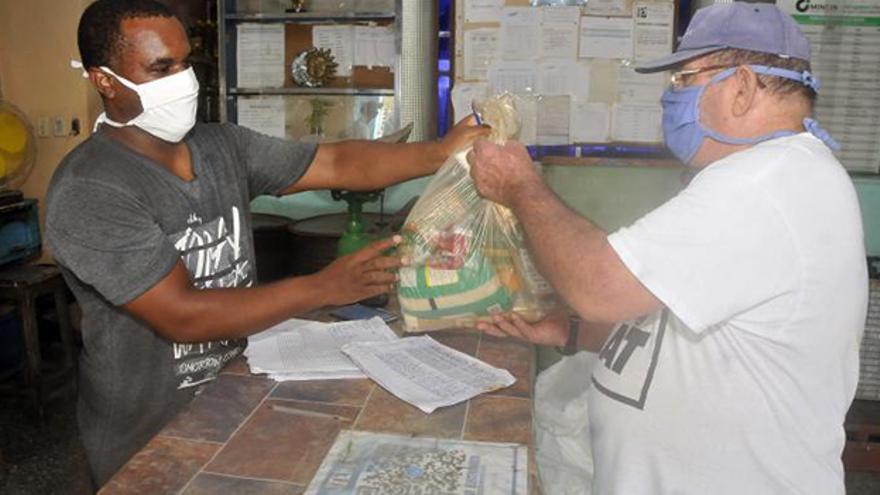
Cuban Government delivers packages of food donated from “solidarity” countries in the midst of a shortage of products. (Granma)

14ymedio bigger14ymedio, Havana, 3 May 2023 — On Tuesday in Santiago de Cuba a shipment of 30,000 food packages arrived, which the authorities plan to allocate to the most vulnerable families in the province. The local press pointed out that the packages were made with “donations from solidarity countries,” but did not say which ones.

The distribution will begin in the José Martí District, a neighborhood of the provincial capital that presents one of the most serious situations in terms of food, in addition to numerous squatters. Then supplies will be sent to the main municipalities and other emergency areas, according to the merchandise director of the Internal Trade Business Group, Leonardo Lamela.

Each package consists of two kilos of rice, legumes, spaghetti and elbow pasta, as well as two cans of sardines, Lamela said in an interview with the Cuban News Agency (ACN). The social workers of each popular council will make a list of the possible beneficiaries and, through the warehouses, will deliver the packages.

The authorities will give priority, he said, to the most precarious cases they have registered: 1,938 pregnant women, 22,301 disabled or in need of some type of assistance and 1,154 children with low weight. Bárbara Rodríguez, mother of a child with a disability, celebrated the “gratification” represented by the packages, which arrived at a time of maximum crisis in which the indispensable food to support her child has reached prohibitive prices.

However, Rodríguez reminded the press that the packages “do not meet all the needs of a household,” although “they do alleviate the monetary burden in terms of family support.”

With the news that, as of May, Cubans over the age of 13 will no longer receive rationed chicken, the situation became even more precarious. Other foods, such as eggs and oil, have been on the “disappeared” list for months. continue reading

Many Cuban families have crossed the threshold of poverty and food insecurity. Last April, the World Food Program put numbers on the crisis: Cubans between the ages of 14 and 60 only cover 36% of energy intake, 24% of the daily protein ration and 18% of fats.

In an extensive report of the Global Network against Food Crises, published this Wednesday in collaboration with several United Nations agencies, a small section is dedicated to Cuba, which lists the problems faced by the Island since the COVID-19 pandemic.

“In 2022, the capacity to import critical foods and basic fuel products continued to be limited by high international prices, which reduced the supply and availability of agricultural inputs,” the report says.

It also notes that the Island has not yet been able to make up for the losses caused by the passage of Hurricane Ian in September 2022, which affected the province of Pinar del Río with losses in crops and infrastructure.

However, the maximum responsibility continues to lie with the poor economic management of the Government, which has systematically neglected its food strategy and decreased imports. Meanwhile, domestic production is still not able to alleviate the deficit that, for years, has plagued a country in which short-term solutions are no longer effective.

Translated by Regina Anavy

____________

COLLABORATE WITH OUR WORKThe 14ymedio team is committed to practicing serious journalism that reflects Cuba’s reality in all its depth. Thank you for joining us on this long journey. We invite you to continue supporting us by becoming a member of 14ymedio now. Together we can continue transforming journalism in Cuba.

Authorizing the Controlled Slaughter of Livestock Was a ‘Mistake’ Cuban Officials Say

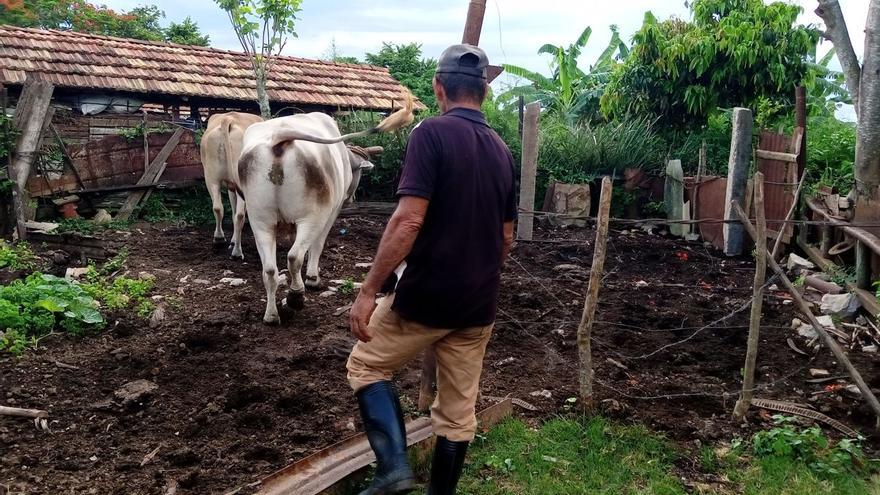
The aging Cuban farmers no longer know what to do with the thieves, who robbed 82,445 cattle and horses in 2022. (14ymedio)

14ymedio bigger14ymedio, Juan Izquierdo, Havana, 3 May 2023 — The livestock scenario in Cuba, marked by brutal robberies and police inaction, could not be more chaotic. Resolution 88 of the Ministry of Agriculture, which approved in 2022 a “procedure for the slaughter and consumption of beef for self-consumption” for authorized entities and producers, is now seen by officials as “erroneous” and somethng they regret, because instead of alleviating the situation, the level of crime has skyrocketed, according to Cubadebate.

The aging Cuban farmers no longer know what to do to face the thieves, who in 2022 robbed the huge figure of 82,445 cows and horses throughout the country, according to the official press. Few  now go to the police, whose terrible investigative mechanisms are well known by the victims of this “common” problem.

“In the end nothing happens,” is the conclusion of the second part of a report on the theft and slaughter of cattle published this Wednesday by Cubadebate, with a third installment announced. Producers, officials and agents have offered the official media their thoughts on the subject, and no one dares to foresee a less bloodthirsty panorama: thieves are increasingly effective and violent, and in the countryside the early morning is filled with tension.

“Producers are very disappointed with this whole situation. It is very painful for them that a cow they have for milk is stolen to produce meat or to work,” says the director of livestock of the Ministry of Agriculture, Adrián Gutiérrez. Many no longer even know “where to [safely] put their animals to sleep.”

“They kill the cow, take it and nothing happens. There is also a safe market, which is not only fresh meat but the production of sausages,” says Gutiérrez. The farmers, for their part, know the score: what matters to criminals is to make easy money: “Did anyone think that with livestock it was going to be any different?” continue reading

In San Cristóbal, Artemisa province, the police managed to arrest a criminal who was up at dawn with two sacks full of meat. With complete peace of mind, he told the officers where the product had come from, on which farm he had killed the animal and what he intended to do with it.

However, when he arrived at the station, the man changed his entire statement. He said that had had found the sacks and that, naturally, with the hunger on the Island he did not hesitate to pick them up to feed his family. He spent three days in detention and left after paying bail. “It didn’t take long for them to find him again one morning, killing another cow,” Cubadebate says.

Releasing known criminals is an increasingly common practice in the rural areas of the Island. The “excessive request for evidence,” criticized by the official press, goes above common sense and the fact that thieves, in general, are repeat offenders. It is enough for a person to declare that “the bag of meat was found lying around” so that, sooner or later, the crime goes unpunished.

Osbel Benítez, a farmer from Manatí (Las Tunas) interviewed by the Cuban Observatory of Human Rights, reported that he had also suffered the consequences of police inaction. “They slaughtered three cows on January 12. I made the accusation and they haven’t done anything. The police do whatever they want,” he lamented, despite having provided all the evidence.

“It seems that it was a matter of patronage,” Benítez explained, alluding to the fact that several criminals are under the protection of the police.

Meanwhile, local meetings with the Ministry of Agriculture are increasingly frustrating. The authorities attribute the ease of committing crimes to the lack of control of the livestock herds. “It is the absolute responsibility of the owner,” say the managers, who wash their hands of the problem when the animal is not registered, despite the fines of 10,000 pesos and the confiscation that is imposed on those who violate the accounting of their livestock.

“If the livestock is counted, the person must report to the police when an event occurs,” they point out. But if the cow or horse is not listed in the state registry, it is not even worth the complaint. According to the newspaper, the animal does not exist, and neither does the crime.

For Yudith Almeida, the head of the National Livestock Registry, if a producer doesn’t have the “marker” — with which the animal’s skin is identified — or the ear tag, he is committing a serious “indiscipline,” and this exonerates the authorities from the damage.

The official lists the sanctions that can be applied to violators: 500 pesos and confiscation if there are no documents that prove the accounting of the animal in the registry; 10,000 pesos if the declaration of birth of major livestock is violated; 10,000 if a death is not declared; 10,000 for each missing cow or horse; 5,000 for each unauthorized process of sale or transfer; and 20,000 if the update of data for each animal is not already registered.

Given the legal complexity of explaining that he was the victim of a theft, “the farmer often prefers not to testify,” Almeida acknowledges.

Not even the official numbers can hide the situation: 82,445 cases of theft and slaughter of animals in 2022 — almost 2.5 times more than in 2021, when 33,690 were registered — of which 45,315 correspond to cattle and 37,130 to horses. The most affected provinces are Villa Clara (12,243 cases), then Holguín (9,825) and finally Matanzas (2,926).

Meanwhile, the government is promoting alternatives to relieve the deficit of meat and milk in the country, such as raising water buffalo. In Las Tunas, since 2013, a herd of 765 head has been supplied, but the farmers don’t accept these animals,” according to the president of the company in charge of breeding, Leonel Ávila.

Optimistic, Ávila says that buffalo ’have more advantages than cattle,” and he gives their reproductive capacity as an example. In addition, he points out that their milk production is progressing well, and “everything they eat is quickly converted into live weight.” But he acknowledges that these animals “require greater volumes of food.” However, the breeding of large-scale buffalo on the Island is, according to the farmer himself, on the plane of mere possibility.

Translated by Regina Anavy

____________

COLLABORATE WITH OUR WORKThe 14ymedio team is committed to practicing serious journalism that reflects Cuba’s reality in all its depth. Thank you for joining us on this long journey. We invite you to continue supporting us by becoming a member of 14ymedio now. Together we can continue transforming journalism in Cuba.

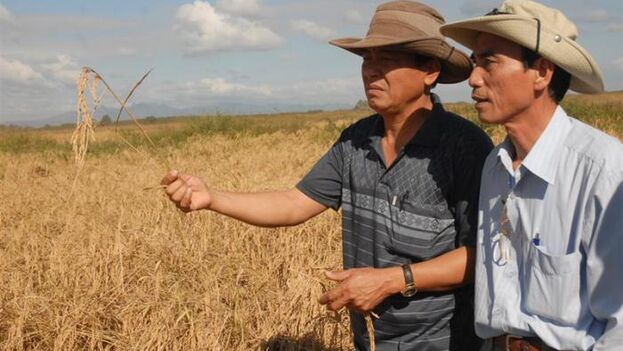
Tired of Cuban Inefficiency, the Vietnamese Abandon Their Successful Rice Project

Vietnamese technicians in Sancti Spíritus. (Granma/Archive)

14ymedio bigger14ymedio, Mercedes García, Sancti Spíritus, 2 May 2023 — The residents of La Sierpe, in Sancti Spíritus, glued their eyes and ears to national television this weekend while the news of the official visit of senior Cuban officials to Vietnam was presented.

The tone disseminated by the Ministry of Foreign Affairs was exalted. “For Vietnam we are still willing to give even our blood,” Roberto Morales Ojeda, a member of the Political Bureau of the Communist Party and former Minister of Public Health, said in Ho Chi Minh City.

What many residents in La Sierpe expected was a mention that would give them hope for the return of the Vietnamese technicians, who, in the middle of last year, broke their collaboration agreement with the Island to support rice production in the area and packed their bags to go home.

“With the departure of the Vietnamese we all felt a loss,” laments Diosdado, 68 years old and a resident in the vicinity of the Agroindustrial Company of Granos Sur del Jíbaro. “They arrived 20 years ago but got tired, because this was worse than plowing the sea; it was plowing in a sea of inefficiency,” says the farmer, one of the producers of the municipality who benefited from the agreement between the two countries.

The collaboration project began in 2002, and, in addition to providing equipment and machinery to Cuban producers, it kept dozens of Vietnamese specialists and technicians in Cuba. The area of La Sierpe was the main focus of this collaboration, and dikes were built, canals were cleaned and local specialists were trained.

But, over the years, the performance of the rice fields failed to meet the expectations of the Vietnamese, who also had to deal with the clumsy state bureaucracy, the lack of a stable supply of fuel and the inefficiency of the Agroindustrial Company. The final blow to the relationship occurred last year, when the hydrocarbon crisis deepened. continue reading

“The Vietnamese technicians demanded a quota of fuel to keep working, advising and connecting directly with what was happening in the fields,” Diosdado tells 14ymedio. “But the amount they needed almost never arrived, and then they were told that they had to supply it themselves, buy it abroad and bring it to the Island.”

In the end, “the Vietnamese did not renew the contract, as they had in previous years, and the technicians left,” an employee of the administrative area of the Agroindustrial Company tells this newspaper. “The Communist Party bosses gathered us at the beginning of this year to tell us that the Vietnamese were leaving, and they warned us not to say anything about it.”

The company’s national employees were faced with a problem. “They had to be sent to look for farmers in the area who wanted to request part of the rice cultivation area in usufruct, in order to save the current campaign, but they could not be told why the Vietnamese were no longer there,” explains the state worker.

“But it hasn’t stopped there. Now we are in the middle of a dispute with Vietnam because, since the agreement was not renewed, they want to take back a lot of the equipment they had brought,” he says. “Without those machines, we will have to go back in time to harvest the rice.”

In the nearby Mapos Basic Unit of Cooperative Production (UBPC), which was also part of the project, some affiliated producers feel the departure of the Vietnamese is the prelude to the collapse of the sector in the province. “What had been achieved was the result of their insistence and industriousness,” acknowledges a local farmer, who prefers anonymity. “They were very persistent people, who got up in the morning and immediately went to the fields. They followed every step of the rice crop.”

“It was possible to improve performance a lot after they arrived,” admits the farmer. “Now there are almost no more than three tons of grain per hectare, but when the project with the Vietnamese was at its best, back in 2015, up to five tons per hectare were extracted. It seemed that we were never going to lack rice in the province, and it’s hard to believe the situation we’re in now.”

In the Sancti Spíritus agricultural markets this week one pound of the grain was sold at 160 pesos [$7]. “And it’s not even good rice;  it has a high percentage of broken grains, and customers buy it because there’s nothing else, but it’s a product that looks more like animal feed than something to put on a table at home,” he says.

In the port of Nuevitas, Camagüey, another employee of the commercial department confirms that “the Vietnamese took out a good part of the rice that was harvested in La Sierpe to export it. It was part of the agreement: they kept a percentage of the harvest and sold it on the international market.” According to this source, the non-payments on the Cuban side were due to tons of the product that were left for national consumption, but the expense was never repaid to Vietnam.

In December of last year, when the Vietnamese had already left, the official press alluded to the debacle that the sector was experiencing and predicted that for the cold season it was intended to plant only about 7,500 hectares of the up to 13,000 that they had reached with the Vietnamese collaboration. They added that La Sierpe had been “hit” by a “contraction of resources that endangers a scenario of optimal development in Cuba for the cultivation of rice.”

“Of the 7,500 hectares provided for in the cold-planting plan until February, around 2,600 hectares are protected, but for the rest there are no inputs. The producers are going to risk planting the area by alternative, biological means,” Edemir Hernández Meneses, technical productive director of the Agroindustrial Company, acknowledged at the time.

Reality seems to have further sunk the poor forecasts. “We didn’t get the seeds on time, and there is no fuel to irrigate or to transport the workers, not to mention the fertilizers. There were farmers who risked planting without knowing if they were going to be able to get what was necessary to achieve the harvest, but most said no, rice cannot be grown this way,” says Diosdado.

“Today’s visit to the Coop Mary market and the Smart N Green Joint Stock Company shows us how much more we can do in Cuba,” Morales Ojeda, writing from from Vietnam. posted enthusiastically on his Twitter account on Monday. Thousands of kilometers from there, in the plains of Sancti Spíritus, rice farmers also know what to do, but they don’t have the resources to achieve it.

Translated by Regina Anavy

____________

COLLABORATE WITH OUR WORKThe 14ymedio team is committed to practicing serious journalism that reflects Cuba’s reality in all its depth. Thank you for joining us on this long journey. We invite you to continue supporting us by becoming a member of 14ymedio now. Together we can continue transforming journalism in Cuba.

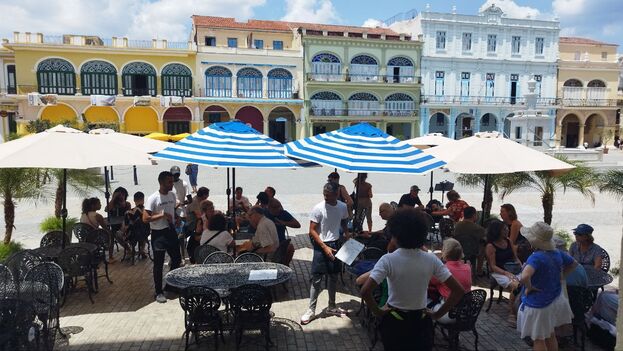
The Cuban Government Entrusts Itself to ‘Cachita’ and the Santeros To Improve Tourism Data

Among the Island’s “potential attractions” to recover tourism, Marrero points out “the quality infrastructure,” the extensive historical and cultural legacy and “legendary heritage cities.” (14ymedio)

14ymedio bigger14ymedio, Madrid, 2 May 2023 — The sanctuary of the Virgin of Charity of Copper [“Cachita”], in Santiago de Cuba, with the superimposed effigy of a Cuban santera, is the striking image of one of the promotional posters of the 41st edition of the International Tourism Fair of the Island (FitCuba), inaugurated on May 1st.

The event, which will take place until next Friday at the Morro-Cabaña complex, brings together “about 73 international tour operators, more than 51 hotel chains and an equal number of airlines,” according to the official press.

Cubadebate highlighted that it is the first FitCuba held in the capital since the pandemic — last year’s took place in Varadero — and that it is dedicated “to culture and heritage.”

At the same time, in Cayo Santa María (Villa Clara), almost 400 travel agents from Spain and Portugal will meet until May 7, in the so-called Annual Macro Convention DIT Management. The Cuban News Agency picked up the statements of the president of the Spanish company, Jon Arriaga, who said that the event had been planned for half a year “with the interest of promoting the sale of Cuba as a destination.”

The firm, based in the Basque Country, arrived with the professionals summoned to the Havana airport on April 30, with the intention that their agents would participate in the May Day parade, ultimately postponed until Friday, May 5. continue reading

“They come to Cuba and Havana in extraordinary circumstances, marked by the crisis caused by the Covid-19 pandemic and the US blockade. Despite this, they will enjoy the customs, habits and traditions that distinguish us,” the governor of Havana, Reinaldo García Zapata, said in his welcome speech to FitCuba.

In the same vein, the Minister of Tourism, Juan Carlos García Granda, declared that this sector “has demonstrated great potential and has been able to maintain its competitiveness in the international market despite the challenges it faces.”

Those “challenges” were also alluded to by Cuban Prime Minister, Manuel Marrero, who, attributing the situation to the Covid-19 pandemic and the US blockade, acknowledged that they have had “difficult years.”

Poster of the 41st edition of FitCuba, 2023. (Presidency)

Among the “potentialities” of the Island to recover tourism, which is the third source of income in the country behind the sale of medical services and remittances, Marrero points out “the quality infrastructure, a trained human capital, the extensive historical and cultural legacy, legendary heritage cities, 290 national monuments, a preserved nature, 600 km of beach and a town characterized by its joviality.”

Despite the usual self-congratulations, official figures show that the crisis is far from over. According to the National Bureau of Statistics and Information (Onei), Cuba received 1.6 million international travelers in 2022, which was below the 1.7 million target, which in turn had been “re-adjusted” from an initial forecast of 2.5 million.

Although more foreign tourists came than in 2021 (356,470), the figure is far from the levels of 2019 (4.2 million) and 2018 (4.6 million), before Covid-19.

Several experts have already warned that the target of 3.5 million international visitors projected by the Government for 2023 will be very difficult to reach, given the current crisis, with frequent blackouts, shortages of food, medicines and fuel, and roads and other public infrastructures in poor condition.

Translated by Regina Anavy

____________

COLLABORATE WITH OUR WORKThe 14ymedio team is committed to practicing serious journalism that reflects Cuba’s reality in all its depth. Thank you for joining us on this long journey. We invite you to continue supporting us by becoming a member of 14ymedio now. Together we can continue transforming journalism in Cuba.

The Cuban Tourism Festival, Who Pays for it?

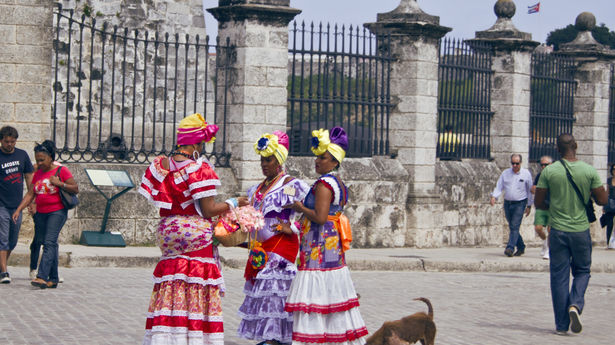
Women dress up in costume to earn a few convertible pesos from the foreign tourists in the historic center of the city.

14ymedio bigger14ymedio, Elías Amor Bravo, Economist, 1 May 2023 — This blog will directly monitor the regime’s tourism policy to detect its inconsistencies and errors, and before the FITCuba tourism festival begins, we already have a good example. The communist state press is flattering and describes as a success that “almost 400 Spanish tour operators are going to attend FITCuba.”

When it comes to inviting friends and paying for meals and hotels, it’s already known that the Cuban communist regime does not skimp on expenses. In the 60s, 70s and 80s of the last century, delegations of foreign communist parties came to admire the constructions of Cuban socialism. Fidel Castro hoped that they would speak well of his regime when they returned to their countries. It was the solidarity that Cuba needed to gain more followers in order to penetrate the leftist and revolutionary movements around the world. You know this already.

And now the tour operators hope for travelers and income. If almost 400 Spanish tour operators travel to the tourism fair, how many Spanish tourists arrived in Cuba in the best years of tourism before the pandemic? Sixty, 70, 80 thousand, could be more. What does it matter? The figure places the Spaniards in fourth or fifth place in the ranking of origin of tourism that reaches the Island. Ahead are Canada and the United States, even Russia in its favorable years. Since before the pandemic, Spanish tourism to Cuba had dropped many places in the ranking. The Spaniards traveled to different destinations and did not repeat the Island, unlike other destinations. The image of Cuba was perhaps blurred.

But it doesn’t matter. The state press celebrates that Barajas airport in Madrid seemed “a hotbed with the presence of 389 Spanish travel agents, who will take part in a convention and in the Cuba Tourism Fair,” many of them, tour operators, DIT Gestión de España associates, on an Iberojet flight. continue reading

What has happened to Spanish tourism to Cuba to end up being one of the least relevant? One of the Spanish representatives of a travel agency said that he has not visited the largest island in the Caribbean for 20 years, and now he hopes to see its “infrastructure, hotels and other facilities.”

Twenty years without traveling to Cuba. That is, the last time he was on the Island was at the beginning of the century when the Island began to emerge from the Special Period and Fidel Castro was sending to re-education camps the prostitutes and others who offered their services to Spanish tourists, mainly single men, according to statistics on the sociodemographic profile of those travelers. The fun was over, the commander arrived with the oil from Venezuela, Spanish tourism plummeted, and the figures were not repeated.

These Spaniards who now travel to the Island invited by the regime were practically children at the beginning of this century, and in these 20 years they have been able to travel to countless destinations of a much higher level of quality and competitiveness. Therefore, they are going to observe what is on the Island, and many of them are going to be surprised, but not for the better. The great opportunity to promote the Caribbean nation, which the communist regime expects from the expenses, will fall apart, because the leaders of Cuban tourism cannot think that in 2023 they can attract demand for tourism with a similar supply, in quantity and quality, to what there was in 2000.

And, of course, with much less “fun” despite the fact that Spanish travel agents are going to enjoy the paradisiacal environment of Cayo Santa María. I hope that the farmers with supply contracts have obtained sufficient quantities of products for them to enjoy the hotel buffet and breakfast. Sometimes there isn’t enough food.

That the authorities have planned tours of Havana for these travelers says a lot about their age and the number of times they have visited the Island: zero. We will see what they think of the streets without water or electricity, the semi-destroyed buildings, the lines of hunger or the lack of gasoline. Oh no, of course, that tour is not planned.

A recommendation: it would be good for these travel agents to take a walk by themselves to know the true reality to which they are going to send tourists. It does not seem that this idea is in the plans of the regime’s partner, the DIT Gestión group, located in Guipúzcoa, which hopes to achieve business once the action of the fair is over. The question is, why can’t that business be done by a private Cuban company, and should it be left in the hands of foreigners?

In the midst of all these trappings, the state press reported that the tourist company TUI Spain has launched a promotional campaign called “Two Weeks in Cuba,” which will be active until May 7, or that the firm TUI AG, from Germany, has more than 2,300 places with guaranteed departures from May to October to the Caribbean island. It was also said that from this coming June the connections between Spain and Cuba will increase depending on tourism, with the new air route of Enjoy Travel Group/Enjoy Barcelona-Havana.

All this is very nice and with great expectations, but the goal of the plan for 2023 of 3.5 million tourists is not going to be achieved.  Tourism to Cuba comes mainly from Canada. It’s almost 65% of the total. Have you heard anything about Canada at this Havana fair? No. Why does the regime disdain and not pay attention to tourism from the main market? Are they that confident about it? The regime’s tourism policy is an absolute failure, and in addition, these glories end up being paid for by Cubans. The same ones that tourists are going to see, if they manage to escape from their controllers, standing in the lines of hunger.

Translated by Regina Anavy

____________

COLLABORATE WITH OUR WORKThe 14ymedio team is committed to practicing serious journalism that reflects Cuba’s reality in all its depth. Thank you for joining us on this long journey. We invite you to continue supporting us by becoming a member of 14ymedio now. Together we can continue transforming journalism in Cuba.

‘In Cuba, There Is No Good or Bad Opponent: The Opponent Is Whoever Confronts the Regime’

14ymedio bigger14ymedio, Havana, 29 April 2023 — According to French reporter Francis Matéo, the key to understanding Cuba’s political convulsions is to track the regime’s money: its phantom accounts abroad, the debts it cannot pay, what it charges for sending medical brigades and the budget it allocates to propaganda. The wear and tear of its methods after six decades of abuse, coupled with repression and shortages, put the order established by power in crisis during the protests of July 11, 2021 [11J].

Matéo, who could not enter the country until the travel restrictions were lifted due to the coronavirus pandemic, collected dozens of testimonies from the protesters and published them this year in Cuba… la patrie et la vie! [Cuba… Homeland and Life], VA Éditions), a detailed report that will soon come to light in Spanish by Ediciones Ecúmene. From Barcelona, the city where he lives, the author talks to 14ymedio about the present and future of the Island.

Question. How was the process of writing Cuba… Homeland and Life? Did you know all the interviewees in person or was it essentially an online work?

Answer. I didn’t know them all personally, but I talked to them directly, on WhatsApp. For this book, a Cuban friend named María del Carmen, a resident of Barcelona, who knows many of the protesters in the La Güinera neighborhood, was very important. It was she who helped me make contact by various means.

For the journalist Iliana Hernández, one of the interviewees, I did go to see her directly when she was still in Havana. I met her at her house, where she was guarded by the police with a camera that pointed at her door day and night. I have been to Cuba almost 30 times in the last two decades, and the two most recent trips were in November 2021 — when the country was opened to tourism after the pandemic — and in May 2022.

When I arrived on November 16, a day after the so-called Civic March for Change scheduled for the 15th, there was no one on the streets. Everyone was still confined. There was talk of Yunior García and his flight to Madrid with a lot of disappointment. continue reading

I have been reproached for interviewing certain opponents who now live outside Cuba and whom other exiled Cubans do not recognize as such. But I think there is no good or bad opponent: the opponent is whoever confronts the regime. The same thing happens with the media. A good media outlet about Cuba is the one that tells the truth. In that we must congratulate this newspaper, which, of course, is one of my sources of information.

It must be said that none of the characters in this book or the situations described are fictitious. The sufferings expressed are also real. In addition, most of the people cited have agreed to testify “openly.” The only concession to this reality refers to the (scarce) names modified for obvious security reasons. As I point out at the end of the book, some fictitious details also give coherence to the narrative to facilitate reading, without compromising witnesses. These small elements of fiction are actually necessary artifices in the story, to prevent the book from being a succession of facts that could be incomprehensible, especially for readers who do not know Cuba well or who have never been there.

Q. You talk about the difficulties of speaking to Europeans about the true Cuban reality. Is there an interest in the European media to know that true Cuba you describe or do they want to maintain the myth of “paradise” defended by the publisher who rejected your report, as you recount in your book?

A. In France there is still a kind of romanticism about the Cuban Revolution, Fidel Castro and Che. I wanted to tell the anecdote of that rejection because it was what drove me to write the book. To tell the reality of the Island you need a means of communication that allows you to do so, and I realized that in France it is very difficult to write about Cuba, in some cases because of that stale romanticism and in others because a caricature of the country is expected.

If you want to write about the Cuban political and social situation, you have to clarify. We must avoid falling into the trap of pointing out “the good and the bad,” with which we journalists struggle so much. Now Europeans are beginning to see things differently, because the tourism relationship with Cuba has also changed. You are seeing what never happened before: violence towards the tourists themselves, such as the famous “punctured tire scam” in the parking lot of the Che mausoleum in Santa Clara, where a French couple had to pay 400 euros to the criminals who damaged the tire themselves to have it repaired. That has changed the fantasy for tourists, but they are far from understanding what is really going on.

Q. Tell us more details about the perception of Cuba in the French media, the public and universities.

A. Before writing the book, I thought there wasn’t much interest in the Island. Now I realize that this disinterest was the result of misinformation. In the university system of France there is a left influenced by a certain philosophical tradition that starts from Sartre and, even in these years, the myth of Cuba is still alive. Many students are still seen with Che’s image on their clothes.

I have also realized that Castro propaganda is very effective. In addition, there is a very strong cultural relationship between the two countries, with music and cinema. The only major foreign film festival on the Island is French. And in Havana there are two very important cultural centers sponsored by France: the Alliance Française and the French Lyceum Alejo Carpentier, in addition to the Napoleonic Museum, which are still open and operating despite the situation.

On the other hand, the influence of Cuban diplomacy is such that it has managed to get the Paris Club to forgive a multimillion-dollar debt to the Island without knowing very well why.

Q. You comment on the complicity of French companies such as Pernod-Ricard and Bouygues with the regime. What is the position and interests of French businessmen on the Island? What about the Government?

A. The US pressure on the European banking system is so strong that French companies have decided to withdraw from the Cuban market, except for some historical ones, such as Pernod-Ricard and Bouygues. Accor sold its last hotel in Havana — the Royalton — and others have followed its example. There was a lot of interest in the 1990s, after a visit by Fidel Castro to Paris in 1994, and several cooperation agreements were signed with Cuban joint ventures. It was the moment when Pernod-Ricard bought Havana Club. Everything was ended due to corruption and the country’s own difficulties, in addition to US measures to prevent business from being done with Cuba.

Q. The US embargo, according to your book, remains one of the reasons for poverty in the country. Don’t you think that it’s a government alibi that has been working for six decades?

A. The embargo, as everyone knows, is one of the Cuban regime’s ways to stay where it is. But, in the end, those who suffers the most are the people. They have always known how to play with this very skillfully. For the United States it is a good operation; for the regime it is not bad business either, because that way they remain in power. I think that if the Americans had lifted the embargo from one day to the next, the regime would have fallen like a ripe fruit. Fidel learned from the Soviets about the effectiveness of suffering an external blockade. In the long run, the student surpassed his teachers.

Recently, the Cuban government called for the exiles to return as tourists. I find it incredible that citizens were forced to leave and now they are asked to return to consume and to send remittances. Who is left there? Those who have not been able to leave because they don’t have money or the opportunity to do so.

Q. Why do you consider that the medical brigades are the most effective tool of the “soft power” of the Cuban regime?

A. For me they are also a mafia. Now the management is in the hands of the Medical Services Marketer. When they arrived in France and Italy, everyone was happy and said: “The Cubans are coming to help us.” Some went so far as to say that we had to resort to the doctors of the Island because in France we do not have an adequate system. They spoke with ignorance, because they thought they were coming with humanitarian intentions, as they did in Andorra. But it is a system of slavery, without a doubt.

Q. Do you think that the conditions exist for a new series of protests such as those of 11J, despite the immigration stampede and the increase in repression?

A.. Things have only changed for the worse. The cry of the Cubans has not ceased either. But the most relevant phenomenon, since 11J, has been the flight of thousands of Cubans, and this is a new weapon for the regime. I’m not very optimistic. The last time I went, the state of discouragement was much greater than during the year of the protests. The conditions do exist: they are the same or harder than when 11J occurred. If something breaks out, it will be so violent that I don’t think it can be hoped for with joy.

There is a fundamental element in the exile, which is getting bigger and bigger. There are many activists and intellectuals who have left, and that is a disaster for the country. There are only the old people and those who are so discouraged that they can’t do anything. The country will have to be rebuilt one day from the ruins, but who will be left to do it? There is also a danger that the Cuban exile will become the active hand of the United States to take over the country. Everything could end up happening in a very chaotic way.

Q. You affirm that in 1959 “one dictatorship replaced the other.” Now there are changes that seem timid and uninteresting in the regime’s hierarchy, but that could be the prelude to a new era. What do you foresee for Cuba in the coming years, now that Raúl Castro has little time to live and his “strong man,” Luis Alberto Rodríguez López-Calleja, has died?

A. The closest thing to what could be expected for Cuba is perhaps the transition after the fall of the Berlin Wall in countries such as Poland, Russia or Ukraine, where many people took advantage of the situation to earn money. The Castros have already done everything possible to preserve their memory. A clear example is the museum that the family opened in Láncara, Galicia. It is a symbol: with the museum they launder their memory as much as their money, and Spain helped them. Without the commitment of democratic governments such as that of France or that of Spain itself, the transition will be a disaster for the Cuban people.

Translated by Regina Anavy

____________

COLLABORATE WITH OUR WORKThe 14ymedio team is committed to practicing serious journalism that reflects Cuba’s reality in all its depth. Thank you for joining us on this long journey. We invite you to continue supporting us by becoming a member of 14ymedio now. Together we can continue transforming journalism in Cuba.

A Strong Storm Gives the Finishing Touch to May Day Events in Cuba, Which Are Postponed to May 5

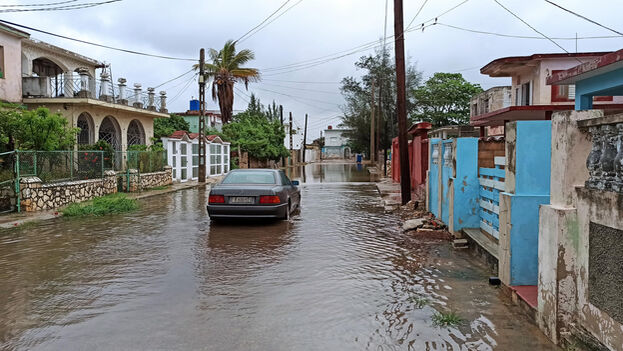
Havana was hit with an intense storm, strong winds and electric shocks that left flooded streets and other consequences. (EFE/ Ernesto Mastrascusa)

14ymedio biggerEFE/ 14ymedio, Havana, 1 May 2023 — A storm of heavy rains, strong winds and electric shocks affected Havana and other areas of western Cuba this Sunday, causing material damage in the capital and power outages. The forecast that the storm will be prolonged has led the authorities to postpone the events for International Workers’ Day to May 5.

The downpours mainly hit the Cuban capital, where they left flooded streets and a partial building collapse in Old Havana without personal injury.

In a residential building in the historic center — located on the streets of Empedrado between Aguacate and Compostela — there was a partial collapse of several balconies, and the rubble blocked access to the exit staircase to the street.

The storm is associated with the arrival of a cold front in the western region of the island, as previously warned by a report from the Institute of Meteorology (Insmet).

Some of the main streets of the capital were flooded for an hour, and the electricity supply was unstable throughout the day.

On social networks, neighbors of provinces such as Artemisa and Cienfuegos also reported heavy rains that tore off roofs and downed poles, leaving a multitude of people without electricity. continue reading

“The events for International Workers’ Day in Cuba have been postponed to May 5 due to “the climatic instability that has caused heavy rains in several territories and the forecast for the next few hours,” announced the Central de Trabajadores de Cuba (CTC) [The Workers Central Union of Cuba], organizer of the event.

“In the territories where weather conditions allow it, the planned cultural and recreational activities will be held. According to the provisions of our legislation, the work recess is maintained this Monday,” the CTC said in a statement.

Cuba had suspended the traditional May Day parade in the Plaza de la Revolución in Havana, due to the fuel crisis that has been affecting the country for several weeks.

Instead, a central event in the Malecón area of Havana was planned for this Monday, and commemorative activities in “communities, labor and student centers for several days and parades in the municipalities of the country had been programmed in parallel.”

The divide among the population to this postponement has been visible. In social media posts or comments on the articles in the official press, many Cubans have accepted the government decision, calling it prudent.

However, many users have recalled that a May Day had never been suspended due to rain and remembered getting wet listening to Fidel Castro’s speeches. “With Fidel it was with rain, with him as the Sun warming up the crowd. What happened to continuity?” asked  one commentator.

According to a report published on the Insmet website, the weather conditions in the provinces of Mayabeque and Matanzas have deteriorated in the early hours of this Monday.

The forecast indicates that the activity of showers and rains will begin to decrease from the early hours of the afternoon gradually in Pinar del Río, while the rest of the archipelago will be partially cloudy, with rain expected in the central region.

Winds from the south and southeast are also expected, with speeds between 12 and 22 miles per hour, and waves on western coasts could cause water accumulations in low areas, including the Havana Malecón, an area prone to flooding when these weather conditions occur.

Translated by Regina Anavy

____________

COLLABORATE WITH OUR WORKThe 14ymedio team is committed to practicing serious journalism that reflects Cuba’s reality in all its depth. Thank you for joining us on this long journey. We invite you to continue supporting us by becoming a member of 14ymedio now. Together we can continue transforming journalism in Cuba.

Cuba Says It Cooperates With the US Against Terrorism and Supports Russia’s Invasion of Ukraine

Cuba’s refusal to hand over the ELN negotiators is among the reasons given by Washington to accuse Cuba of being a sponsor of terrorism. (EFE)

14ymedio bigger14ymedio, Madrid, 1 May 2023 — Nothing new happened in the  meeting held by Cuba and the United States in Havana on April 27 and 28 to evaluate the cooperation of both countries in the fight against terrorism. The official media Cubadebate published on Monday a brief “exclusive” interview with Inés Fors Fernández, Foreign Ministry Director of Bilateral Issues with the United States.

In the conversation, the official insists that the Island must be removed from the US list of sponsors of terrorism while accusing Washington of having committed most of the “more than 700 acts of international terrorism” perpetrated against Cuba.

Fors Fernández, who begins the interview by normalizing the meeting with Washington — the fourth since the agreements were signed in 2015 — claims Cuba’s “unquestionable” commitment to the fight against terrorism, which she attributes, precisely, to being a victim of attacks “organized, financed and executed by the US Government or by individuals and organizations that receive refuge or act with impunity on its territory.”

The official gives the figure of 3,478 fatalities and 2,099 wounded, although she does not explain the origin of the data and mentions “some examples,” including alleged projects “to shoot down Cuban civilian planes between 1974 and 1979,” “more than 600 plans for an attack against Commander-in-Chief Fidel Castro, bomb attacks on hotels, shopping and recreational centers in Havana between 1997 and 1998” and “the hijackings of boats and aircraft that occurred between 1959 and 2001”. continue reading

She also includes the attack suffered by the Cuban Embassy in Washington in 2020, for which a man with mental health problems was arrested in the US, and another attack in Paris, in July 2021.

She does not stop there and, as usual, adds to those facts the economic impact generated by the embargo. “The figures of economic damage derived from the acts of sabotage to our sugar mills, pig production, tobacco and various facilities are in the millions,” adds Fors Fernández, and these facts are enough for Cuba to be, as a victim, a country committed to the fight against terrorism.

Despite the abundance of contrasting data on the role of Havana in the reception and military preparation of thousands of guerrillas and terrorists from dozens of countries, the official assures that “the territory of Cuba has never been used, nor will it ever be used, to organize, finance or execute terrorist acts against any country.”

In 2021, just before leaving the White House, Donald Trump’s government included the Island on the list of sponsors of terrorism and highlighted Cuba’s refusal to hand over to Colombia the representatives of the National Liberation Army (ELN) who were in Havana for the peace negotiations. Bogotá demanded they be returned because of an attack, claimed by the ELN, against a military school in 2019 in the capital, which cost the lives of 23 cadets. The regime rejected the extradition claiming that the immunity of the negotiators was part of the agreement for the talks.

To this are added the refuge given to several criminals claimed by the United States, from Joanne Chesimard, known as Assata Shakur, who murdered a state police officer, to two plane hijackers, who stole more than 7 million dollars from a US bank.

However, for Fors Fernández, “Cuba’s presence on that list is an action of political and economic coercion, which does not acknowledge the genuine and honest willingness to face the danger posed by terrorism. American experts on national security have confirmed that there is no evidence that Cuba supports terrorism, and that it can be an important partner in the region in confronting this phenomenon.”

The Cuban government tries to show itself as a reliable partner of the United States — which, for the moment, does not consider taking the Island off the blacklist — but did not stop reproaching, as it had already announced, “the hijacking of aircraft and boats,” in reference to the recent cases of people who fled Cuba using state means of transport and have received immigration protection in the US.

The interview is one more example of the Island’s shifts with the United States, which it tries to approach on the one hand, specifically because of the economic consequences of being included on the aforementioned list of sponsors of terrorism, but without ceasing to make all kinds of accusations on the other. The most recent accusation this Saturday — although for the umpteenth time — is being guilty of the Russian invasion of Ukraine.

Meeting with the president of the Duma, Viacheslav Volodin, who visited the Island to participate in the cooperation commission between the parliaments of both countries, Miguel Díaz-Canel referred to Russia’s “unconditional support” and “firm and systematic denunciation, in every international event, in relation to the conflict orchestrated by the Government of the United States, with the aim of moving closer to unacceptable lines of NATO’s borders with Russia.”

The Russian politician joins the list of compatriots who have traveled to Cuba in recent months, from the Minister of Foreign Affairs, Sergey Lavrov, to the spy Nikolai Patrushev and, with greater intensity, the economic adviser Boris Titov, who already acts as a de facto consultant to the regime. “This visit is an expression of the excellent state of relations between the Russian Federation and Cuba,” said the president of Cuba, confirming the fears of civil society, which already speaks of “loss of sovereignty in favor of Moscow.”

Translated by Regina Anavy

____________

COLLABORATE WITH OUR WORKThe 14ymedio team is committed to practicing serious journalism that reflects Cuba’s reality in all its depth. Thank you for joining us on this long journey. We invite you to continue supporting us by becoming a member of 14ymedio now. Together we can continue transforming journalism in Cuba.

Rats and Sewer Water in the Heart of the Cuban Capital

The sewage slides through Jovellar along several blocks, to Soledad, where it bends to the right and almost reaches San Lázaro. (14ymedio)

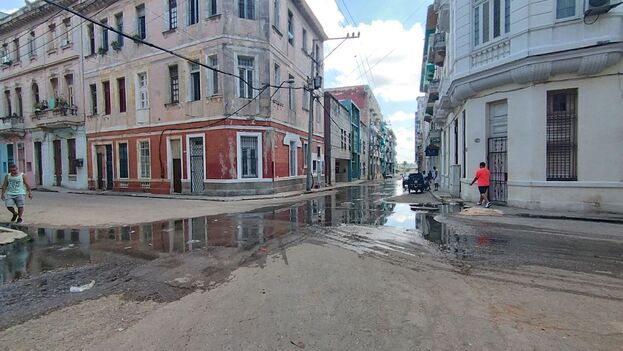
14ymedio bigger14ymedio, Juan Diego Rodríguez, Havana, 28 April 2023 — A pestilent river runs this Friday along Jovellar Street, in Central Havana. If we continue upstream, the origin is seen in number 62, where it spurts forcefully from the door, as if a pipe had burst.

The sewage slides along several blocks, to Soledad, where it bends to the right and almost reaches San Lázaro, widening on its way. The foul-smelling stream passes in front of the Joaquín Albarrán polyclinic.

Asked about the reason for this disaster, the neighbors point out: “Look at the drains, they’re all clogged.”

On the edge of the waves of filth, full of human feces, other objects, such as paper and plastic water bottles, are dragged. In a bend between the street and the sidewalk, a rat splashes in the puddle that has formed.

Residents of the area have reported to the authorities of their municipality that they frequently suffer from intestinal problems resulting from water contamination and lack of cleanliness. At the beginning of this month, the inhabitants of an entire building in the vicinity fell ill for several days.

“I went to the office and they told me that the Government, that Hygiene and Epidemiology are aware of the situation, and that they don’t recommend using tap or boiled water,” a neighbor tells this newspaper. “We spend our lives carrying bottled water now. And all because of the contamination of the cistern, because that sewage is blocked, and no matter how much we ask for it, they don’t fix the drainage pipes.”

Translated by Regina Anavy

____________

COLLABORATE WITH OUR WORKThe 14ymedio team is committed to practicing serious journalism that reflects Cuba’s reality in all its depth. Thank you for joining us on this long journey. We invite you to continue supporting us by becoming a member of 14ymedio now. Together we can continue transforming journalism in Cuba.