From the Cosmos to the Absolute Limit / Juan Juan Almeida

One 29th of January, but in 1942, Arnaldo Tamayo Méndez was born in the city of Guantanamo, Cuba, the first Cuban, and the first Latin American, cosmonaut.

What Cuban doesn’t remember the joint Cuba-USSR flight undertaken in the Soyuz 38 space craft commanded by the Russian Yuri Romanenko on 18 September 1980?

Obviously the man with the fridge isn’t Tamayo, but another Cuban who with sweat and toil is attempting to conquer his cosmos.

Translated by GH

30 January 2014

Granma Eggs / Juan Juan Almeida

The objective of the Poultry Company of the Cuban province of Granma, for the year 2014, is to increase egg production. It exceeded last year’s in the company’s balance sheet, last January 29th.

Juan Carlos Reyes, sub-director of Combined National Poultry (CAN), highlighted the support and dedication of the local Granma workers and reported that although there are material limitations, the level of resources on some lines will be higher this year which has just begun. Nevertheless this month, January, they didn’t produce more than 700,000 eggs owing to defaults in contracts and deliveries of feed.

The poultry breeders, notwithstanding their difficulties, are seeking increased efficiency, and doing the impossible in order that everyone can have eggs.

Translated by GH

30 January 2014

CELAC: Declaration of Havana and the Tibetan Book of the Dead / Juan Juan Almeida

Without doubt, the pro tem presidency of the largest of the Antilles at CELAC, has been significant in achieving influential goals, to the benefit of Cuba, going well beyond the scope of commercial and diplomatic considerations.

Not even the Cuban Foreign Minister Bruno Rodriguez Parilla himself could accept anything other than that this alliance of Latin American and Caribbean countries represents the common regional aspirations.

What’s strange is that there are gathered there serious regional political managers, famous practitioners in the art and folklore of politicking, psychedelic gurus, dictators disguised as democrats and angry favourites, a rare mixture. continue reading

During the weekend, the vice Ministers of Foreign Relations of each country, worked, or put on a show, of arriving at a consensus on the documents to be approved at the summit, among them the Declaration of Havana and the action plan for the organisation in 2014. For today, Monday, to be discussed by the Foreign Ministers and then to be signed by the Heads of State and Government which, like skilled dancers are now arriving in Havana. And, as added value, among other things, to show support for a government which says it is in a genuine period of change. To be more exact, “transformation of its economic model”.

A document which — according to what we were briefed on by Mr. Abelardo Moreno, who this time is functioning as National Coordinator on the Cuban side and vice minister of Foreign Relations — is enigmatic and manipulative in shape, more so than the famous Bardo Thodol (Tibetan Book of the Dead), because it describes as a zone of peace a part of the planet where there is no liberty.

Although, taking into account that this Comunidad de Estados Latinoamericanos y Caribeños (CELAC) is no more than a strategic grouping created in the middle of a changing international environment, the report is pretty well predictable.

The final document, after a ceremony, will agree to establish a forum of cooperation between China and CELAC which will serve to strengthen and institutionalise the relations between the Asian country and this kind of iconic structure put together by a group of different nations which, in order to demonstrate a monolithic unity as a strategic zonal partner, are inviting to the meeting the Secretary General of the OAS (Organisation of American States)   and the Secretary General of the United Nations.

Just by chance? No, The government of the island has an excellent talent for sending us its message with absolute subtlety and a total lack of merit. Anybody with half a brain and a frontal lobe is able to recall that the Panamanian president, Ricardo Martinelli, announced publicly that he would not come to the CELAC summit in Havana to make clear his unhappiness with the government for its handling of the matter of the North Korean ship Chong Cho Gang, detained in Panama, transporting Cuban arms to North Korea without declaring it, thus violating the resolution prohibiting this issued by the United Nations itself.

Now, does the name Ban Ki-moon sound familiar? Obviously. There springs to mind the excellent advice my grandmother gave me when I was a child; “Truffles can turn an ordinary dish into a culinary delicacy.”

Translated by GH

27 January 2014

An Undignified Old Lady / Regina Coyula

This weekend I devoted to music. I had told my friend Karen, a likeable Brazilian twentysomething, that I like watching films knocking around the house, but it was Karen’s last night in Cuba, and under the influence of a forecast cold front which never arrived, we went with Rafa as chaperone to the Yellow Submarine. We saw the performance of Tierra Santa, (Holy Land) a cover group with a singer who is a cross between Ozzy Osborne and Geoff Tate, and a voice which, while not approaching that of either of those performers, has a good shot at it.

On Friday, now without Karen, Rafa took me to Maxim Rock to see Ánima Mundi (Soul of the world). It is a privilege to see this group, never mind that the sound system is not very good. In the first part they did interpretations of some of their original material. While waiting for the second part, I heard Miel con limón (Honey and lemon) and the band La vieja escuela (The old school). I sang along to famous songs, the stranger in that place where everyone seems to know everyone, and with everyone else singing from memory. I enjoyed both bands, especially the second, a forward preparation for what came next.

Shine on you, crazy diamond was the start of a short trip through Pink Floyd. Only musicians like Ánima Mundi would also take on Money, Another Brick in the Wall, and Wish you were here; a little of EL&P with Lucky man, to finish off in an amazing way with Rick Wakeman’s Arthur.

After this lavish dose of rock; Saturday blend in El Sauce. I persuaded my son to take me, as my husband is impossible in matters musical. Rafa argued with me because for me present day Habana Abierta (Open Havana) is like a cover group for the original Habana Abierta, but what are these young kids going to know about that concert in the Salón Rosado nightclub of el Tropical? I enjoyed the enchantment of the live music and, despite my son’s scolding, I was able to make myself look silly without any bother.

… And don’t ask me any more about the Community of Latin American and Caribbean States Summit (CELAC) which doesn’t affect me one way or the other.

Translated by GH

3 February 2014

Generational Collision in the Alejo Carpentier Charity / Orlando Freire Santana

Havana, Cuba, December – http://www.cubanetorg – It’s not a secret for anybody that, in general, youngsters favour transformations which advance social development. As far as Cuba is concerned, the majority of young people who are academics and researchers urge that the economic changes being implemented by Raul Castro’s government be taken forward more rapidly. And journalism should not lag behind.

This understanding was corroborated in the winding up of the course entitled “Journalism is not a job for cynics”, which took place at the Alejo Carpentier charity. On this occasion, the journalists Jesus Arencibia and Ricardo Ronquillo, both from the newspaper Juventud Rebelde took part in a panel, along with Doctor Graciela Pogolotti, president of the above mentioned cultural institution.

The first one to mention it was the youngest of the panelists, Jesus Arencibia, who, to the astonishment of some of the people present, strongly criticised the present situation of the Cuban press. Responding to the question, “What journalism do we need today in Cuba?”, Arencibia stated that we lack media able to function without approval from above; and, pursuing this line, argued that editorial policy should not be the preserve of a political party. Arencibia also questioned the activities of the official Union of Cuban Journalists (UPEC), who insist on not mixing up journalism with commercial publicity, without saying anything about political propaganda which dominates the work of the news-pages, the radio and the television in our country. continue reading

Right after that, Ricardo Ronquillo, deputy director of the Juventud Rebelde daily chipped in. Although at intervals he tried to continue his predecessor’s critical comments, Ronquillo explained that his suggestions were directed at “ensuring that the Cuban press was equal to the challenge of the revolution.” According to this panelist, we are watching a structural crisis in Cuban journalism; driven by a lack of resources in terms of journalists and the press, as well as the loss of their credibility due to the role they were playing in the service of the governmental institutions.

Referring to a situation which should not be repeated, as it demonstrates the inflexibility which impoverishes the work of the press, Ronquillo recalled what happened subsequent to the revelation of the announcement that Fidel Castro had passed the leadership over to his brother Raul. According to the journalist, it was incredible that no-one in the Cuban press will comment about this significant event. Nevertheless, we can only suppose that past events like that have been brushed to one side in the heat of Raul Castro’s protest against media secrecy.

Doctor Pogolotti, the senior member of the panel, gave us the most conservative presentation. After talking about her times as a journalism student in republican Cuba, she applied herself more to the form as opposed to the substance when it came to assessing the kind of press we need. In her opinion, the Cuban media should abandon headlines which don’t invite you to read; they need to improve the image and graphical design which accompany the information; and they should also be able to count on journalists capable of investigating the most varied aspects of our reality. In essence, this representative said almost nothing about the official culture of government control of the press.

The panelists’ contributions were lengthy and there was not time for the public to express their opinions or ask questions. Notwithstanding, in the door of the institution, I was able to hear the opinion of a young student of journalism:

“We haven’t moved forward at all in eliminating secrecy and self-censorship. It seems as if Mr. Ronquillo has forgotten that, following our government’s official declaration about the capture in Panama of a North Korean ship carrying Cuban arms, not one journalist dared to open his mouth …”

Cubanet, 9 December 2013

Translated by GH

December Tells Me / Orlando Luis Pardo Lazo

December starts in New York.

The people don’t notice it, because they are not Cubans. But December is the month of death and of hope. The end of a year. We are still here. Another year begins. We don’t know if it will be our final date. Beauty and liberty surround us leaving us no alternative to sadness. We miss some love.

That’s Manhattan. The place where with each new life we miss the same old love. Although people don’t notice, because they aren’t Cubans, and December just appears to be another excellent commercial opportunity.

My name is Orlando Luis. I was born on the 10th of this month in 1971. I will turn 42 outside Cuba. Pardon the ambivalence. Maybe outside of Cuba I will turn 42. Perhaps it has been 42 years since my homeland deported me.

Whatever the statistics of the Revolutionary State say and their comparisons with other emigrants, there is not one Cuban outside of Cuba who has not been deported. The dreams demonstrate it, although they are not enough to take the Castro brothers to an international court. continue reading

Those recurrent nightmares of exile bring us together around the evil axis of what Castroism has meant for our bodies. We know that the Cuban people is a fascist invention from before independence. But our bodies suddenly collimated by the same sovereign dreams still permit us to recognise ourselves as a nation.

We are Cubans because we dream the same terror, because our land terrifies us so that nobody who is really Cuban really wants to return.

We are Cubans because our heads sway in communion during the mornings of sweat, tremors, sleepwalking, funny faces, halitosis, frog in the throat, pills, snoring, apnea, and awakening with tears, while we imagine we are in Havana, but what perversely persists outside is now New York.

December in Manhattan is the most desolate and uncomfortable season of the year.

We remember, also, our cadavers abandoned with the prosaic haste of the party. Well, I have bad news recently arrived from our island: in the Cuban cemeteries there is a dismal sacrilegious fraud going on. Many bones have been looted by the negruno pantheon. Others have been captured by the political police to osteoporosisize the history of their crimes and, in passing, to sabotage any future homage to their victims. Still others are in the hands of apprentice doctors and also artisans working for CUC (Cuban convertible currency) making tortoiseshell jewellery.

The rest is a mixing up of common graves with family ones. Neither Martí nor Ché nor any of the remnants of our despotic heritage are what it says on the label. The marble tells lies. Neither grandmother nor aunt nor your love are waiting for you there. Cuban cemeteries are a puzzle which our own flight has left without a code to decipher.

I repeat it but not without pain: it’s very late already, we won’t go back there where no-one is left.

The diffused December nation waits for the first snows and celebrations summing up the year. The Cubitas diaspora thickens little by little, according to the Cuban exile it disappeared. We are a will-o-the-wisp, juggling lights, an optical error of refraction.

We breathe. We swallow the free air of New York. We recognise ourselves as strange beings in front of the shop windows of almost mournful luxury. To be the phantom mannequins on this side. Not mixing with anything, because we will always be with one half of our soul on each side of the glass, violently Cuban shadows whose memory is fragile but very well fermented. We are not simply at the moment, but we are indeed half New York and half Havana.

I put up my coat collar. Stick my hands in my pockets. I look like someone out of a crime thriller, half way between private detective and serial killer. I cough. The New York cough of Cubans without a Cuba is also a lingering symptom. We cough out of sheer stubbornness. We worry about our lungs, about the rheumatic rhythm of our breathing, but in practice we hardly ever get ill unless it’s to die.

By then, by the time we suffer a New York December, we will be destroyed, consumed.  People will not notice, because they will not be Cubans. But December will again be the month of the death of hope. Another year which will not have put an end to everything. Still we will not be so many here. Another year which never stops starting, since no date would be able to finish us off.

The sadness which surrounds us makes us free and beautiful with that brilliance which is wonderful and has no alternative, implying complete truth. We do of course miss some love.

 Translated by GH

2 December 2013

Castro, Correa and Maduro Awaiting 2014 in Varadero / Juan Juan Almeida

We are almost at 31st December and in all the world people celebrate that holiday. In Cuba, the incoherence of our life obliges us, at midnight, to make a toast and express our wish that the next year, 2014, will be better and less painful for the prisoners, the ill, and for all those people who, without much choice will receive the coming year awaiting a call or a hug from those people who cannot be here. For everyone, a prosperous new year.

The president of the Republic of Cuba as you would expect, will also celebrate this date, receiving a select and chosen group of friends, the first day of January, and with that, the coming of another anniversary of the Revolution, number 55.

Yes, Raúl Modesto Castro Ruz will welcome in 2014 in his house in Varadero. In his private villa, or, rather, in the complex of houses which make up the “discreet” and modest mansion, recently done up for the occasion. continue reading

All prepared with punctilious care. The doors and windows (made by KÖMMERLING) imported from Germany and installed afterward by trusted specialists in this shameless summer house, for family recreation. Appropriate for a great leader who publicly advances a stubborn policy of austerity.

The menu is no problem, in the purest and most exquisite Parisian style, with island tweaks. The culinary offer will be professionally served by glove-wearing waiters, and supervised by an official of the FAR (Cuban Revolutionary Armed Forces),whom they call Albert Einstein because he has no talent, and who authorised the music to be provided by an orchestra of such cultural ineptitude that they played recorded music instead.

And, how can we speak of the food without mentioning the guests? Right, we will take it one step at a time, because the story still has some unknown quantities.The current president of the Bolivarian Republic of Venezuela, his majesty Nicolás Maduro is expected, and, they say, the Ecuadorian head of state, his excellency Rafael Correa. Friends whom they will put up in the recently repaired guest houses, inside the private villa.

And the drink won’t be lacking, catering for all tastes, there will be drink waiters, equally trustworthy, for whatever last-minute fancy. And for those drinkers who lose it after drinking too much, they will serve a reinforcing consomme with meat and chicken and lamb. To finish the night, or start the day as the case may be, they will provide beautiful white deckchairs, in the Mediterranean style, on the sand.

If there are any snags with the party, or if at the last minute they change the plans due to my fateful indiscretion, you need to know that I was happy to break the secret, but the credit isn’t mine, rather that of an army of idiots wearing sunglasses who made it impossible to hide it.

Now I remember the braying, sorry, the speech of the comrade General when he predicted, during the recently-finished second regular session of the 8th term of the National Assembly of Popular Power, that in 2014 we hope to get to a prosperous and sustainable socialism, less egalitarian and more just, with new targets and more sacrifices. The politics of obsolete octogenarians racing against the calendar.

Tomorrow we will drink a toast to all Cubans, those who are here, those who are there, and those who are over there. And we wait for the new year with the absolute conviction that our day is just around the corner.

Translated by GH

30 December 2013

How They Banned Christmas in Cuba / Juan Juan Almeida

With a cloudy sky and rough seas which were dangerous for small craft, last Wednesday the 18th the Council of Ministers of the Republic of Cuba approved, as if by chance, the import of new and used cars into the country.

Dear God, they arranged the same media distraction when, in 1997, just before the visit of His Holiness Pope John Paul II to Havana, without any explanation, the revolutionary government, pen in hand, decreed, or re-decided, that 25th December should be a public holiday.

Since then, without fear, our grandparents dust and polish their traditions and, in spite of adversities, disguise the island with odours because, some more and many  less, on Christmas Eve they brighten up their homes with some pork, chicken, rice, beans, and food, preferably yuccas, seasoned with a delicious mojo sauce based on bitter orange and lots of garlic.  You can come across the same thing in the Christmas specials in restaurants. continue reading

A complete national calorie binge, uniting sad people, proud people, happy ones, peaceful ones, Catholics, non-Catholics, agnostics, protestants, devotees of the saints, masons, atheists, all of them, to celebrate the festivities and await the coming of a child who was born over 2,000 years ago.

They made use of all sorts of reasons to erase Christmas: The death of Ernesto Guevara, the sugar harvest period, revolutionary priorities, in the end, everything you all know perfectly well; but it was a Christmas message which paradoxically fell from the sky on December 24, 1968, which aroused the fury of the ex-commander-in-chief and after some mad cursing put an end to the celebration.

It turned out to be the Man, I am of course referring to the one dressed in olive green, seated to the right of a short wave radio tuned to VOA. Suddenly he heard the voice of astronaut Bill Anders approaching the moon’s dawn, and, instead of an announcement of war, read the opening verses of Genesis, expressing his admiration for the wonders of the cosmos and the greatness of its creator.

Fidel Castro went mad, he felt diminished, nevertheless he carried on listening, awaiting the sound of cannon fire, and received a bolt of lightning in the vein.

The transmission from the sky ended with: “And on behalf of the crew of Apollo 8 we will end by saying Goodnight, Good luck, Happy Christmas and may God bless you all on the good earth.”

His pride overwhelms him. He gets up, scowling, waves his arm in an arc and – like a Spanish dancer – stamps his heels as if the ground were Tablado de Corazones [Ed. note: quote from a poem by José Martí, El alma trémula y sola]. After a moment, they heard “………(a swear word), that’s the end of Christmas.”

That wasn’t all he suspended, from then on all religious events were victim to a bout of amnesia imposed by the triumphant young government of 1959. After about 30 years of exaggerated prohibition, it is making a comeback like a new opportunity. Our family-eclectic-religious cultural heritage and our traditions which were wounded by the Spanish conquest, cannot be erased by decree, they endure, this is the proof. HAPPY CHRISTMAS

Translated by GH

24 December 2013

Correct interpretation of the law, a problem for us all / Cuban Law Association, Yureisy Ceballos Pendones

Yureisy Ceballos Pendones

Recently I was consulted about a case in an action which seems to form part of the working style of those who are, one way or another, employed in the law. I am referring specifically to the office of the Port of Cuba.

A young man decided to leave the country illegally, he was repairing a boat on the north coast of Camagüey when he was surprised by the authorities of the said organisation and went through the administrative process with a fine of 3000.00 Cuban pesos (CUP). continue reading

The kid immediately admitted his intention, affirmed to the functionaries his intention to put in good order the boat which they found on the ground in order to set out to sea once his work was done. Nevertheless they applied Art.1 Point g of the Decree 194, which establishes, and I quote,”to enter or leave or navigate through territorial waters, without the corresponding dispatch note or authorisation from the port office or disobeying a person duly accredited.”

As you can appreciate, what he was accused of did not occur in any of the actions described and checked, to apply correctly the regulation covering such conduct they should have referred to Art. 1 Point b, which basically refers to, “to repair vessels without due authorisation from the port office,” an offence which only carries a fine of up to 1500.00 CUP, on the basis of which I am now representing this citizen, on the basis of the considerations I have mentioned.

Following these comments, all we need to do now is consider on what does the office base its action, if roughly speaking they are aware of the injustice which results from interpreting the regulation in the way they have clearly set out.

Translated by GH

13 December 2013

Downpours Emphasize the Chaos / Martha Beatriz Roque

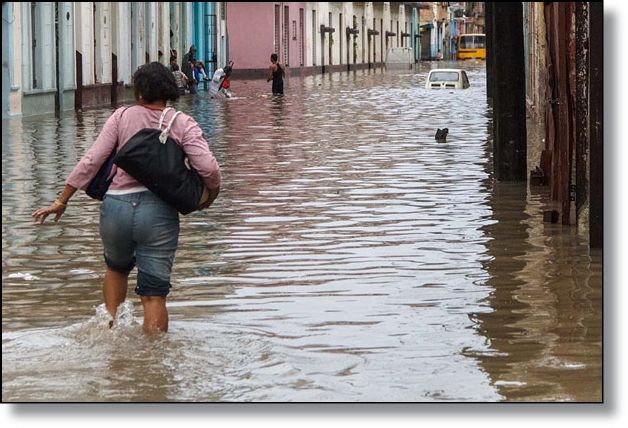
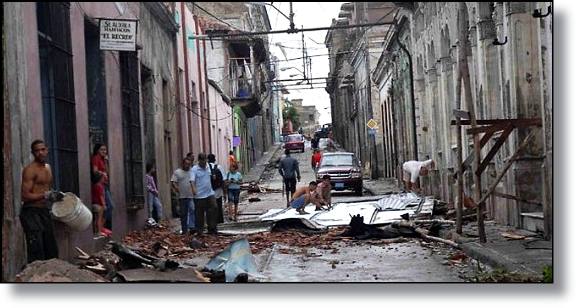
HAVANA, Cuba, December 2013,  www.cubanet.org.- . It’s frightening the number of housing collapses that have occurred in Havana, up to the end of November and in the first days of December. Officially, there have been 227 collapses, including 26 which were total and the rest partial. 627 individual families have been affected. They haven’t listed the localities where they occurred, to enable one to check the accuracy of the figures, and whether those identified by human rights organisations are included in the official government report.

In most of the neighbourhoods of the capital, including Miramar, which is crossed by 5th Avenue, the sewage system doesn’t work. When there is a downpour, the streets flood and the traffic is affected. But the drains appear so clogged as if they were cemented up, and some houses at a higher level also flood, because the gutters in the roofs have no way to run out onto the streets.

There are streets which remain full of mud and debris. That makes getting about difficult, including on the pavements, which are already affected by trees, whose roots break the concrete and form potholes which make it difficult to pass. In some municipalities like Centro Habana, Habana Vieja and Diez de Octubre it is dangerous to pass down the streets because the balconies are at risk of collapse, and the buildings too.

Given such government apathy, most of the streets have dumpsters crammed full and overflowing, with great mountains of solid rubbish. The divers, which is what they calll the people who rummage in the dustbins, spill the rubbish and the surroundings are converted into focal points for possible disease. And when it rains, like in recent days, this trash flows down the streets with the water.

Although you don’t see cats in public spaces, because they end up as the main course on the dining table of the Cuban poor, the dogs are all over the place, covered in scabies, near food shops. They also enter into some shops and annoy the customers.

The bicycle taxis go the wrong way along the streets, especially in Central Havana, endangering the lives of passers-by. The mobile salespeople also, in accordance with their custom, move their carts along different streets, and park them on any corner, dumping the waste from their sales. Both situations produce problems when it rains.

It’s very hard to find a public toilet in the city. If there is one, there is someone there who charges for its use, and because of that many people have used rubbish bins on the corners, out-of-the way columns, and other uninhabited places, as toilets. Even worse, those that have some sort of shelter, because they have walls, have been converted into accommodation for sexual acts.

The water falling washes away substantial quantities of urine and excrement from those sites.

The list of problems is endless, but the most unbearable is that there won’t be a solution, not even with the 10 million guidelines of the Cuban communist party, because solving the problems requires financial resources and political will, and both things are absent in the government’s programmes.

18 December 2013

Translated by GH

Neither Fresh Milk Nor Diet Milk / Osmar Laffita Rojas

Havana, Cuba, December, www.cubanet.org – Last year 2012, the Ministry of Agriculture reported the production of fresh milk at a level of 516,246,500 litres nationally. Out of this total, the province of Camagüey occupied the first position with 96,299,600 litres. Followed, at a distance, by Villa Clara with 51,794,100 litres; Sancti Spíritus with 49,923,100 and Matanzas with 44,352,800 litres.

As part of a long list of inefficiencies and unfulfilled commitments, the state was not able to fulfill its commitment dated July 26th 2007 to guarantee a daily litre of fresh milk to every child under 7 years.

With a few days to go to the end of 2013, this year’s milk production is not known. That silence is a sign that things aren’t going well.

In most of the provinces, they are continuing with the standard sale of 3 kilos a  month of powdered milk, at the subsidised price of 10 cents a kilo. Every 10 days, children under 7 have the right to a kilo of this miik.

Not being able to guarantee the supply of fresh milk and in order to ensure the children get the diet they need, the state had no choice but to import thousands of tons of powdered milk whose price in the international market was over $4,000 dollars a ton.

That imported powdered milk is also for pregnant women and those diagnosed with chronic illness like diabetes, who get a voucher for a kilo of powdered milk a month, whose price is similar to that sold for children.

It seems like the milk production in the past year has not been what was hoped.

Last August 5th, the weekly Trabajadores, official publication of the Cuba Workers Centre (CTC) , announced the construction of a powdered milk factory in the province of Camagüey with capacity to produce 100,000 litres of milk a day, using milk from the dairies in the Camagüey area.

Production testing of the factory in question will be started at the end of September.

They are putting up the new factory in the place where the old factory was to have been in the 90’s, which would have been the first powdered milk factory in Cuba. Construction was held up for lack of funding. Since then, the state has kept on importing powdered milk, thousands of tons, paying tens of millions of dollars.

The powdered milk factory which they are putting up in Camagüey is fitted with Chinese and Italian technology and its cost has reached 528,000 dollars. It should produced 2,350 tons of powdered whole and low-fat milk a year and 1,100 tons of butter.

The newspaper Granma, on 31st August, announced that work on the project was over 70% advanced  and that at the end of September they will start assembly of the machinery and, if there are no holdups, they forecast completion for the end of December. But, up to now, they haven’t given any more information on this.

At the beginning of December, they announced that pregnant women and the chronically sick in the provinces of Mayabeque, La Habana, Artemisa and Santa Clara, who received powdered milk for their diet, by way of an experiment, will, from January, instead of that, receive a new dairy formula made up of casein, lacto-whey, water, and animal or vegetable fat with different levels of protein.

On this point, the Vice Minister of Internal Trade, Bárbara Acosta, said that this measure was taken because of the over-consumption of powdered milk and assured the deputies that it would not be extended past the date indicated

It seems like there was a setback in the production of milk in the second half of this year.

In the Foreign Currency Recovery Stores* (TRD, from its Spanish initials) they have not offered butter or condensed and evaporated milk produced locally for months.

You only find cheese in certain supermarkets, and not always. The price is about $15 a kilo, which is in fact prohibitive for most Cubans, whose salary doesn’t exceed $20 a month.

The official press keeps completely silent about the crisis in the production of fresh milk. It seems like the government has ordered that they don’t touch on such a sensitive topic.

ramsetgandhi@yahoo.com

Translated by GH

*Translators note: This interesting name makes clear the government’s interest in operating stores that sell products only in hard currency; their purpose is to “recover” the remittances sent to Cubans from family and friends abroad. Products in these stores are generally sold at significant markups.

23 December 2013 / Cubanet

Marina Ochoa’s Messages / POLEMICA: The 2007 Intellectual Debate

Before anything else, please forgive me for entering so late into the discussion. My life is very complicated precisely because of the climate of indifference, incapacity and/or corruption that I see confirmed in all the applications to the housing “machine”. I am appalled! I mention it because in my opinion what brought an end to socialism in the countries in the East was the unpunished mixing up of interests on the part of those who became millionaires during the socialism, opportunism, corruption and repression. Criminals who went unpunished because of the absence of opportunity for criticism, debate and for a culture of criticism of course. Gorbachev and Yeltsin only delivered the coup de grace ... we should all think about that and those involved should take appropriate action.

I am not a theorist and am speaking to you on the basis of my principles and experiences.

I think it’s the moment to get to the essence, or rather, to other essences. First I want to talk about the demoralising effect of repression. And the confusion and paralysis it produces. That would partly explain why the response from the culture, on many occasions, did not display the necessary consistency. I know a lot about that. The assemblies for purging the School of Architecture (in the second half of the 60’s), in the middle of my adolescence, truly terrified and confused me. The lack of correspondence between the political debate, full of high-sounding ideas, and the meanness in practice bewildered me. I didn’t understand anything, I couldn’t articulate anything. I tasted the flavour of impotence. Many of the members of the “purification” tribunals are in exile. “Purification”, for God’s sake, seems like something imported from fascism!

Later, in the 70’s, it happened in the School of Journalism. I was a student of Eduardo Heras [Ed. note: Cuban short story writer] and the same thing happened again. In both places the devaluing of the human essence was part of the strategy. Then came a period in which it seemed we had suffered some kind of collective amnesia, from which we didn’t want to awake to avoid going through the story of our weakness? And then, a new low hit with Alicia … frustrated because she was responded to by the film producers and the members of the culture which supported us with principles, unity, coherence and firmness. We manage to sort out the differences between us, which exist, as they do everywhere and we declare a truce in the fighting in order to safeguard our cultural project, which we are still getting on with.

Now I ask those who cite our intellectuals for not answering forcefully at the given moment, is it better to march off into exile, which is anyone’s right, which I don’t question, rather than collect the fragments of our beings, feelings, hopes, and also our revolutionary existence and remain here, fighting in our own way, as best we can, to rescue a cultural project we believe in? We must respect the way each one of us fights, because we are all products of traumatic events which have overwhelmed us. I believe we have to express clearly and coherently what kind of country we want to have and what kind of culture. Therefore I propose we take up again the concepts which were current in the foundation period of the Revolution, later distorted by interpretations which were circumstantial, obtuse, opportunist and convenient for the Palabras a los Intelectuales [Ed. note: Words to the Intellectuals – famous speech of Fidel Castro’s in 1961, setting out his views on freedom of cultural expression] which unfortunately they use because of the lack of conceptual definitions.

Take up again “the inclination of the avant-guard, the freedom of expression, the independence of individual evolutions, the search for the roots of creative feeling and the attempt to make clear the spiritual values of man”, to be found in Origenes [Ed. note: Origins, a Cuban literary cultural magazine] and what Carlos Rafael Rodriguez (Hey! called “the prince of Cuban Marxism”) expressed on March 23, 1982 on the 30th anniversary of the foundation of the Nuestro Tiempo society [Ed. note: Cuban cultural institution in the ’50’s].

I think we have to get the bogeyman of openness away from our cultural and political life.  The permanence of the Cuban Revolution is a symptom of the fact that our “specificities” are stronger than our “regularities”. We can’t delay any longer the culture of exercising opinion and debate, or we will pay dearly, even more so than up to now. Our people are the most defenceless in the world against the avalanche of neoliberal culture. We painstakingly modelled ourselves as passive recipients. As consumers, in all senses of the word of what they give us.

The battle of ideas should be this: a battle and I think this debate illustrates how it never should have been.

I hope I have contributed something to this debate. Big hug.

Marina Ochoa

Another message from Marina Ochoa to Gustavo Arcos Fernández-Brito.

 Dear Gustavo (Arcos Fernández-Brito):

I’ve been filming and I am getting prepared to start editing, and therefore although I have wanted to get in touch I haven’t had the time or the energy, so I end up with dispersed neurons.

The creation of a wailing wall for artists is bad news. They don’t understand anything. We say tweet tweet and they answer quack quack.

The 47 years in which the “vanguard of the proletariat” has been translated as the right to think for us, deciding for us whatever does or doesn’t suit us as individuals, family, nation, has corroded the capacity to use our judgement and has put us in the rearguard, while the thinking of our people has become more complicated, growing, and overflowing the society “designed” from above, which functions less each day; (the other, the underground, parallel or floating society which functions as a diversion, gives the lie to it every minute) but on the screens of our television, which often seems to be directed by Walt Disney, it appears as ideal.

The son of one of my nieces, 9-years-old, sighed while he was watching the national TV news, “I would like to live there!” Childish wisdom … and I swear to you I didn’t make this up.

I was very grateful to receive the intervention of the wonderful Colina and that of Belkis Vega [Ed. note: Cuban film producer]. Indispensable. I think that Criterios [Ed. note: Desiderio Navarro’s magazine, produced by the Centro Teorico Cultural] should collect everything they have expressed and bring out a number of the magazine and include what the 30 will produce. Certainly, knowing professionals of Belkis’ stature, in all senses of the word, professional, moral, humane, revolutionary, I can’t understand how it’s possible that her name does not position her to occupy roles such as the presidency of UNEAC [Cuban Writers and Artists Union], the presidency of ICAIC [Cuban Film Institute], as they are looking at the names of possible substitutes, all machos, men, masculine.

Colina refers to the responsibilities of Torquesada [Ed. note: Armando Quesada, member of the Stalinist National Council of Culture in the 70’s] in the ICRT [Cuban Institute of Radio & Television].

I also know that they made Torquesada adviser to the programme “Open Dialogue” following a negative report about the programme put out by this man, with a recommendation to take it off the air, which shows a very interesting practice: I put you in as adviser to someone you want to destroy and explain the drop in the quality of the debate in the said programme.

I won’t take any more of your time and congratulate you on your honesty and integrity

A hug

Marina Ochoa

Translated by GH

Messages of Desiderio Navarro / POLEMICA: The 2007 Intellectual Debate

Dear Friends and Comrades:

Suddenly, more than thirty years after his dismissal, Luis Pavón, ex-president of the National Council of Culture during the euphemistically called “Five Grey Years,” reappeared in the public sphere on nothing more nor less than an entire programme on National Television dedicated to “his cultural impact on Cuban culture.”

So, was what we saw and heard yesterday Luis Pavón’s impact on Cuban culture?

Or is it someone else who irreversibly damaged the lives of the great and less great creators of Cuban culture, “defined as unacceptable” in one way or another?  Who blocked the creation of many artistic performances and the dissemination of many works of literature and art in Cuba and abroad?  Who forever deprived us of innumerable works because of the almost inevitable forced self-censorship that followed the abundantly fertile ’60s?  Who filled an entire period with a dismal literary and artistic production now justifiably forgotten by those who championed it and bestowed awards upon it in days gone by?  Who flooded us with the worst of the contemporary culture of the countries of Eastern Europe, not letting us know about  the most creative and profound of them?  Who in the short or long term built up the resentment and even caused the emigration of many of these creators who were not revolutionaries though they weren’t counterrevolutionaries, whose apprehension Fidel had tried to assuage in “Words to the Intellectuals”? [A book published in 1972 – Ed.] Who created and inculcated styles and neo-Zhadov cultural doctrines that took decades to eradicate, as they had come to be “normal.”  [The Andrei Zhdanov cultural doctrine, developed in Soviet Russia in 1946, required all artists to conform to the Communist Party line in their workEd.] Perhaps we are really a country with such a short memory that we no longer remember the painful state to which our national cultural institutions were reduced by the efforts of the National Council of Culture, which was captured by Cuban humour at the time in a trio of sendups: “If you don’t listen to the Council, you won’t live to be old,” “There is no strength in numbers,” and “A wooden knife in the House of the Americas?”

It is true that Pavon was not always the main driver, but neither was he simply obeying orders.  Because to this day an important mystery has not been explained or clarified: How many wrong decisions were taken “higher up” on the basis of information, interpretations and assessments of works, creators and events provided by Pavón and his associates of that time, on the basis of their diagnoses and predictions of supposedly serious threats and dangers originating from the cultural environment? continue reading

If we are going to talk about courageous cultural impacts in Cuban journalism, we need to mention ones like the man of letters who was Agustín Pí, who, in the same period, from his modest position on the newspaper Granma, helped many valuable people who were “out of favour” and ensured that the cultural pages of Granma were as open as possible at any given moment, and not turned into a wasteland of mediocrity and opportunism like so many other Cuban publications of that time.

In my article In media res publicas, I have talked about the responsibility of the politicians for the limitation of the critical role of the intellectual — above all in the years in which culture was managed by Luis Pavón — but this is only half the problem.  The other half — worthy of another similar article — is the responsibility of the intellectuals: without the silence and passivity of almost all of them (not to mention the complicity and opportunism of more than a few) the “Five Grey Years” or the “Pavonato,” as many now call it, would not have been possible, or, at any rate, would not have been possible with such great destructiveness. With certain exceptions, among the intellectuals, the heterosexuals (including those who were not homophobic) ignored the fate of the gays; the whites (including those who were not racist), the problems of the blacks demanding vindication; the traditionalists, of the fate of the vanguardists; the atheists (including the tolerant ones), the vicissitudes of the Catholics and other believers; the pro-Soviets, the fate of the anti-Real Socialists and of the Marxists unconnected with the philosophy of Moscow, and so on.  One wonders if this lack of individual moral responsibility could be repeated today among the Cuban intelligentsia.

We must, therefore, ask ourselves responsibly and without delay: Why at just this special moment in the history of our country when all our people are waiting to see what happens with the convalescence of the Commander in Chief, do we get this sudden and glorious media resurrection of Luis Pavón, with the generous iconographic unfolding of various old scenes with the the highest political leaders, and this just days after the no less sudden reappearance on the television of Jorge Serguera, who from the presidency of the ICRT [Cuban Institute of Radio and Televison] formed a perfect political cultural double-act with the CNC during the “Five Grey Years”?

“Happy is the man who finds out what causes things.”

Desiderio Navarro

January 6, 2007

Message from Desiderio Navarro to Reynaldo González

Dear Rey:

You can count on me for the collective development of this document, but it seems to me we should wait for other reactions like those of the three of us in the coming hours or days, which could reveal other angles to the problem and greatly enrich the document (and, incidentally, give us a measure of the sensibility and current attitudes of the intelligentsia with respect to this).  I speak of “days” because I am taking into account that many people only have email access through their workplace, that is, starting on Monday.

Do you agree?  Or do you think there are reasons to speed it up?

A hug

Desiderio

January 6, 2007

Another message from Desiderio Navarro

And, in addition to the one from Quesada, which I also find out about now, it was about two or three months ago, a whole programme on the Education Channel dedicated exclusively to extolling the crucial importance to Cuban culture of the National Congress of Education and Culture, but I saw it only a solitary swallow, outrageous but isolated. Now I see that that’s not so. Let’s talk about this proposal this evening (I’m leaving in the opposite direction now, from Los Naranjos to Havana). Even though the ICRT doesn’t accept it, they would be forced to drop the mask of “impartiality” as the nation’s mass media and make it very clear that they are abusing the State information tool to favor a cultural policy contrary to the Minister of Culture — one might rightfully say, if not with much quantitative accuracy, the cultural policy of a “tiny group.”

A hug,

Desiderio

January 8th, 2007

Message from Desiderio Navarro to Loly Estévez

Dear Loly:

I enclose the letter that, in response to one sent to me by Zenaida Romeu, I also sent to the members of the UNEAC Secretariat and other friends participating in the debate(s) arising from the three sudden reappearances, over a short period of time, of these three awful characters of Cuban cultural policy in the three programmes, without any mention of the Pavón years as president of the CNC in a programme on his “cultural impact.”  As you will see, I speak there of the many objections on my part (shared by Arturo Arango) to the writing of the document.  I was able to express them immediately in another meeting with the Secretariat, and can tell you that among them were found some that also figure in your Open Message to the UNEAC Secretariat:

We are not talking about a group” of intellectuals who are protesting:its relatively large size, and its lack of articulation for reasons of ties of friendship, class, aesthetic orientation, etc., does not permit us to call them a “group”, but rather “a large number of” intellectuals; I added that we are not looking at only “our most important” intellectuals, but also many others equally or less important who were also adding their voices and reasons;

...  that the lack of any mention of the true specific cause of the intellectual outrage, or the sudden reappearance of these these three awful characters of Cuban cultural policy, after thirty years, in three television programs so close together, would make people, the millions in the street, wonder what happened on these programs that was so bad: an attempt at another live wedding? sexual indecency? corruption, bribery? a counterrevolutionary comment or joke? and so many other questions about possible attacks on the irreversible cultural policy of the Revolution, leaving the figure of these characters and specific political meaning of what happened in the shadows, and putting under the spotlight, without distinctions, the teams of the three programmes who, together or not, could have been complicit with external forces, or simply acting on directions from higher-ups (which is what people are inclined to believe in your case), or clumsy ignoramuses with initiative and ingenuity (which almost no one believes in the case of the “Impact” and “The Difference”).

What I could not fail to personally tell the President of the ICRT is that I do not believe in lack of control as an explanation of the three incidents, because I have more than one personal experience to base that on: as you will remember, when you kindly invited me to participate in the programme “Open Dialogue” in a discussion about mass culture–a theme on which I’ve written and spoken a lot – it was put to you as a condition that I would not participate in a live programme, rather my participation would be recorded three days in advance so that it could be reviewed, eventually approved by the management bodies and only afterwards mechanically juxtaposed with the live dialogue of the other three participants (Julio Garcia Espinosa, among them), which, of course, I indignantly refused.

Control is what there is more than enough of in the ICRT for anything except racism, homophobia, mocking people with physical defects, a Yankeephilic worship of the Oscars, Grammys, MTV etc. as perfect examples of global assessment of the arts; nostalgia for pre-revolutionary kitsch, the cult of ancestry and artistic lineages, New Age ideology in its various manifestations, worship of the millions earned in contracts, ticket sales or auctions, and media fame, as criteria of artistic success; militant defense of banality from the neo-liberal relativism and consumerism, and much much else.

But, just as in the ’70s being in the CNC did not mean sharing its political culture (I myself worked in it between dismissal and dismissal) I know that still today to be in the ICRT is not to approve all its policies or, if you prefer the euphemism, its lack of control.

Best wishes and my hopes for a successful stay in Gijon.

Desiderio Navarro

Message from Desiderio Navarro to Zenaida Romeu

Dear Zenaida:

I agree with you and thank you very much for having included me in the addressees of your letter.

Well, in the text of the Declaration is states that in the two meetings they tried to reach a consensus with some of the authors of protests (in fact, with the first ones, chronologically), which is totally and absolutely true.  But neither I nor Artura Arango, nor other authors of protests participated in the subsequent formulation written in response, nor in its revision and final approval, which explains, that as expected, the only signer is the UNEAC Secretariat, and there are no signatures from the authors of protests, none of whom are members of the Secretariat.  Unfortunately, the wording gives the impression that we are co-signatories of the document, despite the fact that several of us — I know this includes at least Arturo Arango and myself — have numerous objections to make on the text itself, whose formulation does not reflect the frankness, depth and firmness with which, with names and surnames, facts, dates and the corresponding descriptions, they debated these themes at those two meetings, meetings about which UNEAC, our UNEAC, can be very proud and would have nothing to hide.

As a member of the National Council of UNEAC and as a member of the ranks, I hope that they will correct what has happened.

With best wishes

Desiderio Navarro

P.S.  I have just read this letter to Arturo Arango and he is totally in agreement with its contents.

Another message from Desiderio Navarro about the National Social Sciences Prize to Fernando Martínez Heredia.

Friends and comrades:

Arturo Arango’s recommendation to us to pay attention also to the National Social Sciences Prize awarded to Fernando Martínez Heredia, is so relevant that I followed it seven days before he formulated it in his message today, and thus, some days before the “cleaning of the biography” on television that worried us. I reproduce below the message I sent to Fernando the 31st of last month, as soon as I heard the good news.  There, as you will see, as well as celebrating the intrinsic value of the work and struggles of Fernando, the prize is also seen as a sign of fruitful possibilities.

Sadly, the two events that Arturo juxtaposes in his message–Fernando’s Prize and Pavón’s Epiphany–have to be seen as antagonistic signs, and not contradictory, as they come from very diverse institutional and political-cultural sources and not a single source which would be contradicting itself loudly and thoughtlessly or trying naively to reconcile the irreconcilable.

And now, to share that bottle  and  those stubborn revolutionary dreams with Fernando.

A hug

Desiderio

7 January 2007

Dear Fernando:

I have just found out, by reading the magnificent text by Guanche [Cuban lawyer, writer, essayist, editor – ed.] in La Jiribilla [a magazine about Cuban culture – ed.] , that they have awarded you the National Social Sciences Prize. Honestly, is one of the few great joys I have had this year. In culture, and even more in cultural policy, justice is slow … Eppur si muove [“and yet it moves” – what Galileo is supposed to have muttered after being forced to recant by the Inquisition – ed.] and finally arrives. In the words of Althusser [French Marxist philosopher – ed.] from  our youth, this award honours the Ideological Apparatus of the State [book by Althusser published 1969 – ed.] and opens up new hope in these times full of fruitful possibilities and insidious dangers.

Those who noticed the lexical and semantical similarity between the names of “Criterios” and “Pensamiento Crítico”, as being elements of the same lineage, weren’t mistaken. Those who saw, in the emergence of “Criterios” just seven months after the disappearance of “Pensamiento Crítico” a catalytic relationship, weren’t wrong either. In the history of the cultural struggles of the Cuban Revolution, both editorial efforts will be seen as a united desire to practice and preach Martí’s ethos of the grafting of the world into the core of our republics and the Marxist ethos of radical criticism. As I told Abel about three years ago at a meeting with Fowler and Reina María in his office, I haven’t lost hope that a Cuban journal of social thought will emerge that could be today, mutatis mutandis, what “Critical Thinking” was in its time, a magazine bearing the same name and directed by you. What an encouraging sign of health, strength and renewed ideological and cultural youth for a socialist revolution that would be! What news it would be of that critical and creative socialism which your essay advocates and prefigures with clarity and passion! Let me dream.

Dear Fernando, it is lucky to have the certainty that you will not be absorbed by any Canon and will make use of all the symbolic capital this award gives you on your continued efforts to do what Marx would really have done now.

A fraternal hug and I wish you and Esther a 2007 filled with new successes.

Desiderio

January 7, 2007

Another message from Desiderio Navarro

Comrades and friends, this is outrageous; not only does the ICRT not apologise, but rewards the director of the programme with an appearance in the headline midday programme, the same person whose work responsibility — if not policy intention — had been evident in recent meetings.

This is going to cause general indignation with unforseeable outcomes. Who is behind all this provocation? What microfraction, what little group? If there is no official condemnation, no-one is going to believe that it doesn’t have the blessing of the highest circles in the party. It is essential that we think up a deserved, but quick, response to this lack of respect for all those who last week met on two occasions in the UNEAC, starting with the Minister of Culture, and for all those who inside and outside Cuba have hoped for concrete results from that meeting and those who gave a vote of confidence to the Party and UNEAC.

A hug in these crucial moments for Cuban society.

Desiderio Navarro

Desiderio Navarro’s reply to Orlando Hernández

Dear Orlando

It seems to me there are some unfounded and unfair statements in the final paragraph of your letter to Arturo Arango, which I reproduce here:

I have just received Desiderio’s invitation for a conference in Opinions “The Five Grey Years: Revisiting the Term”, by Ambrosio Fornet as a part of the Cycle “The cultural policy of the Revolutionary period: Memory and reflection”, where you will also make an appearance. I think it’s excellent of course, but I am also worried that it will convert itself into an academic, “terminological”, etc. debate. Apart from this message from Desiderio, I have hardly received any new messages, only Amir’s text and the discussion between Rosa Ileana and Desiderio. And the El Pais article of course. So anyway, either there is nothing new to say, or it’s all been said? Hopefully, neither of these.

How can you say, not that you are worried that “this will convert”, “is going to be converted”, or “could be converted” into an academic “terminological” etc. debate, but, durative gerund and all, that you are worried that “it is converting itself” into such a debate? The last meeting in the UNEAC about this matter ended the day before yesterday at seven or eight at night and already yesterday at 11:10 at night I was sending around an email with an invitation for a whole cycle of conferences which had been organised in the 27 or 28 hours which had passed. I think very rarely has a Cuban cultural academic institution reacted so fast as Criterios has to the pressing needs of Cuban intellectual life. There are still some weeks to go before that conference, which would be the first, and you can already say that this is converting itself into an academic “terminological” debate? It looks as if you are rushing to prejudge it.

That said, is it damaging and unnecessary to have an academic debate about that period of Cuban cultural policy and its consequences, survival and relapses? Isn’t it perhaps the absence of investigations and academic events, of a whole academic literature, and not just essays about the topic, with its descriptions, analysis, interpretations, explanations and assessments, one of the principal causal factors which allow, among other things, that period and the phenomena of that period to subsequently survive or revive, remaining so unknown or unexplained for so many generations who didn’t live through it as young people or adults — as we have seen in many messages about those times?

On the other hand, who said that an academic debate implies the silencing of all non-academic debate about the same theme? In the first place, even if you wanted to, is there any way of silencing it? Since there isn’t any power, or technological media, to hold up the interchange and circulation of electronic messages which started a week ago. On the contrary: if the academic debate is serious, and not just pseudo-academic speculation, we need to listen carefully to all the empirical material floating around in those other discussions, all the ideas and experiences, the reflections and witnesses statements — which, in this case are very scarce — about everything that has been silenced or self-repressed for decades. And each and every one of us has the responsibility for continuing the discussion about these matters one way or another as long as there is a need to do so.

Ambrosio’s conference is called “The Five Grey Years: Revisiting the Period”. Do you believe that discussing the expression “Five Grey Years” is just a superfluous terminological debate? Those of us who have taken part in the last few days’ electronic correspondence, also myself, in “Medias Res Publica” (“Public Affairs Media”) seven years ago, and César López before me — as Ambrosio himself said to me the day before yesterday — have questioned the “Five Grey Years” as a name for the period and as a chronological limitation. Having said that, can we view that questioning of the expression — and others besides which have come up, such as that of Rine Leal (Cuban theatre writer and critic) and also what I am sure Ambrosio will talk and argue about on the 30th — as a useless debate with aseptic academic terminology, or as a crucial problem of historical periodisation about cultural policy, in which you have to take a position about everything that happened, with so many creative works and lives, for years before 1971 and also years after 1975? It’s enough to remember that that the last attempt to impose the most dogmatic form of Soviet-style socialist realism as official doctrine took place between 1980 and 1983, in the middle of a tense ideological-political struggle between cultural personalities and institutions, given the change in the correlation of forces in the prolonged journey from total control to jockeying for position. None of this is just a question of words.

Having said that, Dear Orlando, I believe Ambrosio’s conference, which is father to the little child which has run so far, will start up the debate in media res – or going from the Latin to the language of local people — in concrete terms, far from Byzantine complications and closely focused on the relationship between words and deeds, without academic-speak, but also without vulgarity. The rest depends on the public, which is to say, including you. On that basis I am very happy that Ambrosio has agreed to participate in this round of remembering and reflecting and, more than that, to start it going.

About UNEAC’s reply, to repeat, I am not pressuring you, and we will wait for the President of UNEAC’s document, which he will shortly issue, on what has happened.

Best wishes, brother

Desiderio

14 January 2007

Desiderio Navarro’s reply to Rosa Ileana Boudet

For those who don’t have acces to the internet, or the time, to do a search, I show below the text which I emailed in October 2002 to the e-publication Teatro en Miami, in reply to an unexpected atack by Rosa Ileana Boudet in their pages.

In the name of the Rose

Desiderio Navarro

What has happened is that Rosa Ileana Boudet, in the website www.teatroenmiami.com, now writes something which from 1994 up to her recent emigration to the USA, she has never expressed here in a public conference or in writing, although she had, among other platforms, the pages of the theatre magazine Conjunto — which she was the director of for years before her departure — in which to offer whatever opinion about whatever theatrical publication, whether Cuban or foreign.

In her keenness to go off with a great fanfare in praise — which she also never did here in writing, as far as I know — of the relationship between the also-emigrated Cuban Gloria María Martínez [ex-teacher at the Instituto Superior de Arte, now working at a university in Chile – ed.] and the work of Patrice Pavis [Professor of Theatre Studies in the University of Kent, in England – ed.], the sees it as necessary to create a dramatic counter-figure resident in Cuba who had put up obstacles in the way of the success of the elevated cultural objectives her heroine had been fighting for Prometheus-like here up to her departure. Below I cite a passage from her recent article entitled “Patrice Pavis: his own vision”, which you can see in the above-mentioned website.

In 1989 (Pavis) participates in the Second International Debate, held in Havana, at the invitation of Desiderio Navarro, who, years later, compiles and translates El Teatro and its reception, semiology, crossing of cultures and postmodernism, published in the same collection in the magazine of opinion and culture studies in 1994, and which is perhaps still to be found in the Rayuela de la Casa de las Américas bookshop. Navarro has gathered together the worries of the author about that “other” Latin American. Unfortunately a history of disputed translations — and some pedantry — made it more difficult, when it came out, for the book to bring us up to date on Pavis, and publishes texts unknown in our language relating to Le Théâtre au croisement des cultures (1990) or Theatre at the Crossroads of Culture, (1992) and Confluences. Cultural dialogues in contemporary performance (1992).

On the other hand, the contrast created between Gloria María’s “handcrafted editions”for the ISA students (mentioned just before by Rosa Ileana) and my anthology in the form of a book, tries to get across connotations of semantic opposition between the “fringe” and the “official”, as if Criterios, from some position of supreme political power (ludicrous and risible fantasy in the eyes of any knowledgeable Cuban in the last few decades), which would have obstructed Gloria María Martínez from publishing her translations in any of the Cuban editorials of that time (as evidenced by her publishing them in the Cuban magazines Conjunto and Tablas); as if the intermittent and hazardous history of Criterios had not precisely been a story — unfortunately in large measure of one person — of battles, defeats, frustrations and small victories against official dogmatism to open Cuba up to the wide variety of international theoretical thought.

Saying that, it happens that my anthology of the general theory of Pavis, El teatro and its reception includes, among others, exactly four of the five general theory texts from Pavis’ book “Theatre at the crossroads of culture”, namely,” “Toward a theory of culture and theatrical production,From the text to the scene: a difficult childhood”, “The classical heritage of postmodern theatre” and “Towards the special character of theatrical production: translation between gestures and between cultures”. (The fifth theory text, an analysis of theatrical theory in 1985, was not included because it was already obsolete in 1993 and Pavis himself in two 1990 footnotes asserts: “This chapter drives me toward a level of subjectivity which I would not want to deal with any more today”, and with respect to his own theories about the theory in the East, “I am pleased to see that in 1990 all of that is past history.”)

More than that, my anthology also includes Pavis’ postface article, “Towards a theory of interculturality in theatre?” from the book Confluences. The Dialogue of cultures in contemporary performance (of which Rosa Ileana seems unaware that it is not a theory book by Pavis, but his anthology of other peoples’ writing). Or that in my anthology I translated and published the “texts unknown in our language” which, according to Rosa, I prevented being published.

On the other hand, my anthology, finished at the beginning of 1994, included texts published by Pavis not only between 1982 and 1990 (up to his last book at that time) , but — thanks to the generosity  and diligence of Pavis himself — also a text published by him in the autumn-winter of 1993 (“Towards a theory of the actor’s art”, Degrés, no.75-76), that’s to say up to only one month before the conclusion of my work as a translator and editor and only six months before the appearance of the printed edition (July 1994). Never in Cuba has the appearance of a foreign book of theory followed so closely in time after the initial publication of the work in its original language — and what’s more in the worst publishing moment of the so-called “Special Period”. And that was how I obstructed “the book updating us on Pavis”.

I am not surprised at the “men’s probable ingratitude” toward the only person in Cuba who, committing a good part of his investigative time and his income, has translated from twelve languages and published more than 300 texts of foreign theory over more that 30 years — among those authors Pavis is only one among more than 100 — in order that his Cuban colleagues could have access to examples of the best of worldwide theoretical thought which would otherwise have remained inaccessible materially and/or linguistically to many of them. I have pretty well got used to that demonstrable ingratitude on the part of many men — and women.

Neither do I feel surprised by the meanness with which that same person who, trusting in the nonexistent marketing and limited international access to the editions of Criterios, this same person who more than once rejected an article of mine when she (co)directed the Revolution and Culture magazine, as a trusted and diligent assistant to Luis Pavón (President of the National Culture Council) in questions of policy relating to cultural information during the period which some continue to insist on calling the “Five Grey Years”, now, from Miami reverts to the clumsiest lies in order to throw mud at my work and my intellectual ethics, in her hasty baptism in the waters of Theatre in Miami, Meeting in the Network and other similar diaspora publications. As far as I’m concerned, she can continue doing her “theatre in Miami” with every kind of true or false Glorias of the diaspora; there will be a good friend who recommends that she write for herself a script whose local villains can’t reply demonstrating easily the untruthfulness of her slurs, either because they are dead, or they are decrepit.

Oh dear, Gertrude, a Rosa is not always a rose …!

Los Naranjos, October 24th 2002

Appendix: As a demonstration of the kinds of discrepancies in translations — inadmissable above all in a work on theory — whose challenge by me Rosa Ileana, there and now, dares to call “pedantry” with a view to rescuing her heroine, I show below the footnote to page II of the introduction to my anthology. Not even the Spanish subtitles to North American films reach such heights!

  • Here is a small example, taken at random, of a translation of “La herencia clásico del teatro postmoderno” (The classical legacy of postmodern theatre”) published in Apuntes, Santiago de Chile, 1-101, spring, 1990, pp. 117.127:
  • It says”Vitez wants to reinvent tradition, removing all trace of it from herself. (en s’en démarquant) It should say “Vitez wants to reinvent tradition, distancing herself from it” (“se démarquer”: “to distance yourself from something”): from here on the dictionary definitions are from Petit Robert)
  • It says: “opening it (the text and the mise en scene) to a series of trails which are self-contradictory, they cut back [se recoupent]” It should say “opening it  to a series of trails which are self-contradictory, which happen to meet” (recouper, pronoun., “Intersecar. Fig. to meet, agreeing”).
  • It says: The work vigorously denies the feeling is respectful, by this logic with [est tenue par cette logique à] the same coherence and the same unity as those which should, at another time, evoke this feeling.
  • It should say: “The work that rigorously denies the sense is obligated, by this logic, to have the same coherence and same unity that formerly should have evoked the sense.” (être tenu à: “estar obligado a (una acción)”.
  • It says: “The postmodernism, conceived as a practice of destruction (déconstruction)”
  • It should say “The postmodernism, conceived as a practice of deconstruction
  • It says: “This record is effected … by the recovery (des reprises) of sentences”
  • It should say: “This record is effected … by repetitions of sentences (reprise: “action of saying again, repeating)
  • It says: “The music of Stockhausen like the theatre of Wilson is not in fact notable or respectable”
  • It should say: “The music of Stockhausen, like the theatre of Wilson, is not, in effect susceptible to notation, or repeatable.”
  • In the same translation of the text where these examples are taken from, you can find more than one case of conversion from negation to affirmation – “Even the theatre of the absurd belongs to modernism (and [not] to postmodernism)”; “The ’post’ – of ’postmodern’ means (ne signifie pas) a movement of comeback, of flashback” — of neologisms due to ignorance of the original meaning — “Jacobismo” for “Jacobinismo; “anamorfis” for “anamorfosis” — big differences.
  • “The man doesn’t now have anything of the individual written in the history or historical which regulates all the problems”, where what is missing is after the word “or”, and in place of the word “historical”, the phrase: “historicised by a radical scenic treatment, by a sociohistorical explanation” — all of them attributable to mistakes if they don’t repeat themselves in other documents carrying the same signature (for example, “From text to scene: a difficult labour” and other things published in Conjunto y Tablas, Havana).

Another chance oversight by Cuban television

Dear friends:

In today’s programme Midday on TV (Tuesday February 6), intended to celebrate the Camagüey Culture Conference which is taking place now, dedicated a segment, put together by the journalist Aimée A. Margoz, to presenting the principal cultural historical achievements of Camagüey, which started, as it should, with the Mirror of Patience, from which it went on to Gertrudis Gómez de Avellaneda and Carlos J. Finlay, but, in a fatal leap (maybe there was a blackout?) they omitted, and left within the category “and others”, ever mention of none other than the twentieth century Camagüeyan poet who is our National Poet, our greatest social communist poet, Nicolás Guillén — and what’s more founder-president of our Cuban Union of Writers and Artists until his death. Those of us who are still waiting for Camagüey to totally rid itself its prerevolutionary and Pavonist prejudices, in its local “Giordano-Atiénzar” form, and finally start to be proud of the novels and essays of the internationally celebrated emigré-mullato-gay Severo Sarduy, see ourselves kilometres away from that horizon, with this step backwards, which, even more inconceivably and impardonably, ends up with Nicolás Guillén, the great revolutionary poet of Cuba and the world, left outside the cultural historical record  of our city, province and nation.

With best wishes

Desiderio Navarro

6 February 2007

Desiderio Navarro’s reply to the message signed “Betty”

One of the most pathetic things for me these days has been seeing how people who have been silent and uncritical all their lives in the public sphere — in the assembly, on paper, by email — after carefully waiting a week or two to see “what happens to me” after my initial critical letter, and after my invitation to the debate on taboo topics, they join in the discussion only in order to ask me in a modest way, not to say this or that — always something they themselves have never done or said in the Cuban public sphere. I am not only talking about the political prostitutes who are now abroad, who never wrote hardly a controversial line about anything in Cuba in the “public media” (2001) or, decades earlier, “Literary criticism: also a moral question” (1981), and who never gained any reputation as a controversial person in any congress, assembly or debate they attended between the 70s and now, paying the resulting biographical and intellectual price.

You interpolate me in the following terms: “in the same way that you didn’t accept  Pavón on the TV, neither should you concede now to them choosing the quorum on your behalf.” You don’t have to be a semiotic genius to see how the tendentious ellipsis works in that sentence: who is the subject of the action of “choosing”? Who are the “them” that you don’t name? By not naming them you are creating what is known as an area of doubt which can be filled by the reader with subject like “the bureaucrats”, “the Power”, “the closed circle”, “the elite”, “the apparatus”, etc. depending on the individual person’s suspicions, experiences or expectations. Or, let’s say, a symmetrical variant, going off in the opposite direction, the much criticised “Mystery Syndrome”. No less a part of the Orwellian “newspeak” is the implication: the verb “to cede” has two very different meanings: transitive verb – “give”, “transfer, pass to another thing action or law” — and the other, as an intransitive verb — “give in”, “subject oneself to” (DRAE). The verb “to cede” in its transitive form is an action that the subject may carry out of his own accord and volition (like giving up a seat to a pregnant lady in the bus). Nevertheless, you use the verb in its intransitive form: “concede to”, that’s to say, to not offer much resistance to, to give in to the will of another, capitulate, not resist pressure, or force (like to give in to the threats of an aggressor), sneaking in the impression that there are newly unspecified pressures on the part of “them”.

Now, Betty, although I have not “conceded” that they “choose the quorum,” for me, at all times I have made it clear that I have ceded the right to” choose the quorum.” As I explained in messages widely disseminated by email, after having got the Che Guevara Room and quadrupled the capacity for the public, and having soon seen that those interested in attending exceeded even this capacity, I decided I had to assure the participation of Cuban writers, artists and intellectuals in general, but it turned out even the number of these interested in attended vastly exceeded the capacity, and that’s when I refused to play the role of omnipotent czar singlehandedly deciding who may enter and who may not, and I passed this responsibility — and this is explained again here, one more time, to the “them” of the message whom I informed them of my decision — to the numerous cultural institutions of Cuban writers, artists and intellecturals who are members or workers. It is therefore up to these organizations to question or not any decision of the bodies that they themselves have chosen in the institutions of which they themselves have decided to join voluntarily, including the criteria for making those decisions. What, even so, I did do was insist that they do not allow the diversion of invitations in favour of secretaries or officials; so as not to leave off the lists important cultural figures, simply because they don’t have important positions in UNEAC or elsewhere, and they were taken into account, especially the critics and researchers of the cultural sector, which is the natural and usual public for Criterios, cultural theory center/publisher. I am sure that if I had not done so, indignant letters would now be raining down upon me, not for having made supposed “concessions,” but for having acted in the same autocratic and undemocratic way that I have criticized in such and such institutions or agencies and which you also seem opposed to.

The insinuation, or rather the accusation in advance that the audience will receive “an edited version (as has always happened) of reality” is more than offensive, in the case of Criterios, and I won’t waste time in answering it, because to any honest intellectual, Cuban or foreigner, who knows the work of Desiderio Navarro and Criterios for 35 years, it will be disgusting and unacceptable. Not to mention how offensive it will be to the speakers themselves. In any case, you also — though you haven’t requested them as have, already, more than four hundred people — will receive the texts of the lectures, if only so you can scrutinize them looking for some sloppy trail of an eraser and editorial scissors.

Desiderio Navarro

Translated by GH

28 January 2007

Message from Ramiro Guerra / POLEMICA: The 2007 Intellectual Debate

I have just received your message about Pavon’s unbelievable appearance on national television a few days ago; I saw the commercial for it, but I couldn’t bring myself to get unnecessarily irritated by watching him in view of the revulsion I feel for this man. He is in the habit of coming out from time to time like a phantom from the dead, in important places, and then disappearing afterwards. A few years ago he turned up in the corridors at UNEAC [Writers and Artists Union of Cuba] and I let Aurora Bosch know, who was the then president of the Dance Section, that she could not count on my presence there as long as that person was walking around the floors of UNEAC.

Some time passed, which I have forgotten about now, and she let me know that he had disappeared and I could return to the institution. I didn’t bother looking for the programme in which the person would appear, unconsciously rejecting the possibility which you now point out, that “a revival” may occur with the additional appearance of the deservedly-forgotten Serguera, partner-in-crime of the cultural disaster of the 70’s. All that had to happen was for him, whose name I have forgotten, to appear, take the reins of the performing arts at that sad opportunity, and he swept the theatre into the shadow of the Revolution. The dance also suffered the setback of making me disappear, although, strangely, I believe that I was one of the few who kept a salary which should have gone to pay into a ghostly bag which was created and was kept going for various years in equally phantasmal parts of the area of the National Opera Council.

Important names from the theatrical movement were “peremptorily” sent to the Ministry of Work, where the only options for work they had was filling holes in the road or digging graves in the cemetery. The puppet theatre was mercilessly destroyed and its beautiful puppets were sent to Cayo Cruz to the rubbish dump which then existed in the bay. And the Camejos were especially harassed and erased from the national culture.

Meanwhile, my work, el Decálogo del Apocalipsis, which was supposed to have opened, according to the invitation printed in beautiful bright red with the date 15th April 1971, after a year’s hard work and enormous expense in costumes and scenery and should have been an important milestone in the development of contemporary dance in Cuba, and whose absence has been regretted by following generations of art school graduates in this area, who lost the model dances I promoted over 12 years and which marked the successful development of a dance movement rooted in a national identity but also informed by the vanguard movements of the era.

A lot has been written about this phenomenon by the choreographers who followed me, especially Marianela Boan, inheritor of my creative work with her group Danzabierta.

What you have told me in the message I received has opened my eyes to the danger, which seems fundamental in these days of possible changes in the direction of the country’s cultural policy, of the appearance of those phantoms from the past who want to return in an opportunistic search for new laurels.

The fact that the national tv dragged them out of the grave of oblivion gives us notice of a new storm.

Ramiro Guerra

Translated by GH

About Alfredo Guevara’s Words / POLEMICA: The 2007 Intellectual Debate, Maria de las Mercedes Santiesteban

The first thing you notice about the document presented by Alfredo Guevara is its dreadful wording. A man, who has always prided himself on his clarity and intelligence, has written a text which is hard to read, repetitive and unoriginal. The first, very long, paragraph demonstrates this:

The Writers and Artists Union of Cuba [UNEAC] interprets and takes on that ethical, Martiana [pertaining to the ideas of José Martí] and Fidelista [pertaining to the ideas of Fidel Castro] lesson, of opposing, by use of its authority and prestige, the impunity of that abuse of power demonstrated by our television in trampling on its ethical obligations and developing or trying to advance a plan which is in opposition to the cultural policy of the Revolution, a policy of respect and praise for creative freedom and intellectual work, and the intellectual qualities which make it possible.

It isn’t clear what is “the plan which is in opposition to the cultural policy of the Revolution”. Up to now, what they were criticising and questioning was, in the first place, the appearance of the “grey triad” composed of Pavón-Serguera-Quesada and everything they might stand for in terms of a set-back to the national culture. Guevara goes off on another track and accuses the television of “trampling on its ethical obligations”; practically accusing them of being traitors although he quickly makes it clear that all the programs dreamed up by the “great communicator” are just fine: he does not want people to in any way to misunderstand what he is saying.

Further on, another confusing paragraph:

“… it is the people who deserve to be, who are, and who must be, the real protagonists in the war of ideas, if an instrument, which has ended up being usurped in certain respects, is not to develop another campaign of praising vulgarity, imitating the worst programs put out by the Empire (the US), and which favours the destruction of our language, which is the reflection of the clarity, structure and exercise and expression of thought.”

Why? On the basis of what premises? We don’t know.

Guevara never mentions the names of Pavón-Serguera-Quesada, nor acknowledges any awareness that the centre of the debate is the general cultural policy of the country; many want to take it further than that, and demand that the problems in the production sector are looked at. Guevara directs his attack at television, which seems like a good idea to me, because a large part of the programming is rubbish and vulgar.

But where has Guevara been all this time? Why has he decided to criticise it now if this problem has existed for years? Why is he diverting, or trying to divert, the centre of the debate? Could it be because he is afraid that the snowball is growing too big and that, in a moment of such tension, unprecedented in the history of these forty nine years, people are going to question the very essence of the system, as happened in 1991 during the phony and manipulative “Appeal to the 4th Party Congress”?

Cuban television is a ruthless media, intolerably politicised, with a rigid news bulletin structure and the added irritation that every time they want to do so – which has been frequently – they interrupt the simple entertainment programs to insert the transmission of long boring political events. Many people leave the television switched on, without sound, waiting patiently until the function ends and the soap opera starts. But, as far as the people who direct the television are concerned – who are not the directors of the television but the ideologues, or The Ideologue, of the Party – that doesn’t matter very much.

In order to get a bit of fresh air, people have invented lots of ways of avoiding the tedious official refrains. I remember that in 1993 Havana was filled with home-made satellite dishes which, angled towards the Habana Libre Hotel, caught the Miami channels. This was abruptly interrupted because the government was not going to put up with the people having a different source of information. continue reading

What is happening now is something similar and thousands of people, for the “modest” price of ten convertible pesos, are enjoying “alternative broadcasts”, watching different news programs and forgetting all the day-to-day hustle and bustle. Those programs, it’s true, for the most part, are dreadful, in terribly bad taste: as Guevara correctly puts it, they are the “glorification of vulgarity, mimicking the worst of the programs put out by the Empire”.

What’s strange in all this is not “the foreign channels”, as they’re called, what’s worse and more worrying is that people are willing to pay the equivalent of an average monthly salary to watch such productions. Why doesn’t anybody ask themselves what happened in all of those years of “wholesale” culture?

Why, after all that genuine effort which the country made to elevate the cultural level of the people, what they want is to watch the worst television from the United States? (and, by the way, the best programs offered in our television are also from that country, like the Discovery Channel and National Geographic documentaries, just to give two examples).

Guevara continues:

The highest authorities in our executive, such as the Ministry of Culture and the Party, have been aware, from the start, of my indignant rejection, which I have expressed directly, as it is my business to do, from the very start, in relation to the repeated mistreatment to which the Cuban intellectuals have been subject and, in practice, the intelligence which the Revolution has awoken, making it part of our education, so that it may be, and has started to be, the most important asset in our society in this epoch, the first century in which knowledge becomes the most important spiritual, economic and social area of wealth.

What is “the repeated mistreatment to which the Cuban intellectuals have been subjectthat Guevara talks about? The presence of the “ash-grey-looking trio” or “the belligerent, usurping ignorance” of the television functionaries? It isn’t clear. Guevara assures us that he has rejected it with indignation, I don’t doubt it, although we don’t know where or when he did it.

Finally, he ends up with a very serious accusation:

What has happened now is not just an affront to the Cuban intelligencia, to our culture in its artistic expression, it has been – it is – a trap laid for Fidel and Raúl by mediocrity and belligerent ignorance; a game played by interests determined to confuse and divide.

A trap for Fidel and Raul? A game played by interests determined to confuse and divide? The trap is treason and in our country that is a capital offence, with the aggravating factor that now, the Comandante can’t even defend himself. The people who run the television have been named by the “highest executive”, as the mass media are a very powerful weapon for the transmission of ideology, among many other things. So, those people who run those media want to confuse and divide? Is Guevara talking about some kind of conspiracy, is there some kind of “micro fracción” [a sector of the left in 1960’s Cuba regarded as a threat by Castro] which has infiltrated our TV channels?

Although confused, that doesn’t stop Guevara’s accusations from being very serious – he energetically supports the “Declaración del Secretariado de la UNEAC”, a document most people consider inadequate, stupid and nothing special. Fortunately, the debate carries on. Let’s hope that all the injustice, abuse of power and dogmas are reversible, for the good of our culture and all of us.

María de las Mercedes Santiesteban

Havana, January 22, 2007

Translated by GH