If Jose Maria Heredia (1803-1839) and José Martí (1853-1895) live on for their poetry of patriotic concerns, Gertrudis Gómez de Avellaneda (Camaguey, 1814-Madrid, 1873) slipped into immortality for her lyrical, narrative and theatrical contributions. The three were a kind of tropical cyclone that converged on the tongue in the nineteenth century; though they didn’t coincide on the map of the island. She admired Heredia and went to Niagara Falls to evoke him with another Oda. Meanwhile José Martí binds them in their differences and rescues them as symbols of the nation that works.
Gertrudis Gómez de Avellaneda was like a mirror superimposed on horizons. For her, Spain was the promised dream of her Andalusian father, the home of ancestors who knew how to lift the drowsy parochialism. She left with her family in April 1836. Her sonnet Leaving is a cry of love and Cubanness, an expression of the uprooting and anticipation that accompanied her to the Peninsula, where she established himself independently in spite of prejudice and ethical and social conventions. Her life ranged from Cadiz, Seville and Madrid, in a succession of creative goals and personal passions, against the grain of cultural otherness and her native condition: a beautiful criolla, rebellious and cultured.
This writer with the fascinating personality, complex and authentic, sensitive, and talented, breached the nineteenth century hierarchy and the patriarchal ideology to establish herself in the cultural field of Spain through the press, printing and theater stages. She signed her poems with the pseudonym “La Peregrina,” The Pilgrim. Her loving correspondence is a cultural heritage of human depth and pre-feminist affirmation, a theme that runs through her dramas, comedies and stories, in which women compete with other characters and drive the plot.
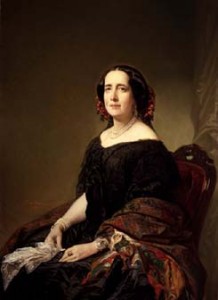 Avellaneda’s literary profile falls within the Spanish context of early romanticism. Her first publications were poems which started to appear in 1838 in the newspapers and magazines of Andalusian cities. Critics say that the originality of her frame of mind exceeded the thematic and stylistic expectations of feminine writing of that era. Fame surprised her when her tragedy Leoncia was released in Cadiz, Granada and Seville, although she excelled in drama, comedy, novels, and poetry, and wrote essays and letters that recreate certain keys of her lyrical, passionate relationships and dramatic characters that populated her imagination.
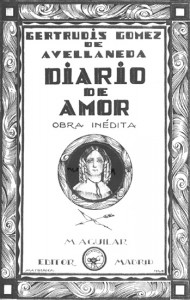
In 1841 she published her first volume of poems and her novel Sab, inspired by a young slave, black and virtuous. These were followed by the novel Two Women (1842), banned in Cuba as was Sab; the stories Espatolino, The Baroness de Joux, and the Biography of the Countess of Merlin; and the dramas Alfonso Munio and Prince of Viana, all in 1844, for which she was honored by the Liceo de Madrid — which gave prizes to two of her poems — and the Laurel Crown, and she was named to the Society of Merit. Between 1844 and 1858 she also published the drama Egilona, an autobiographical article for the Mellado Dictionary of History and Geography, the novel Guatimozin, The Last Emperor of Mexico, and the second enlarged edition of her Poems. Meanwhile her other works premiered: Saul, Flavio Recaredo, The Truth Wins Appearances, The Daughter of Flowers, Errors of the Heart, and Balthazar; as well as the comedies, Like and Dislike, The Daughter of King René, The Oracle of Thalia and The Millionaire and the Suitcase, These were well represented in Cuba where she returned in 1859 with her second husband, the Spanish official Domingo Verdugo, who witnessed two extraliterary failures of his wife: her rejection for membership to the Royal Spanish Academy of Language (1853); and the staging of the play The Three Lovers, which led to scandals and duels. She also left us with the unpublished work, The Diary of Love.
 During her second stay on the island (1859-1864), she continued the intense social and intellectual life she had enjoyed in the cities in Spain. She is honored in her birthplace of Camaguey, and in Matanzas, Cárdenas and the Tacón Theater of in Havana, where the poet Luisa Perez de Zambrana offered a laurel wreath carved in gold, on behalf of the capital’s intelligentsia; meanwhile in Cienfuegos the Avellaneda Theatre is named after her.
In 1860 she founded the Cuban Album Review of the Good and the Beautiful, directed and written in collaboration with renowned countrymen who shook the cultural and literary torpor of the island. In 1863 she published the novel The Boatman Artist, and immersed herself in grief at the death of her husband, who was then the head of the Government in Pinar del Rio, a position he held earlier in Cienfuegos and Cardenas. She returned to Madrid, where she dedicated her last years to preparing her Collected Works.
Gertrudis Gómez de Avellaneda, one of the leading voices of letters in Latin America, has been widely studied by the critics. Experts believe that her main contribution lies in the domain of the metric, because she cultivated all types of verses from the rhythmic arsenal of the neoclassical to the Romanesque. They say that she was influential in the theater among Spanish playwrights of her generation; but not in Cuba, where her works were less frequently staged and seen as part of the work coming from the mainland; but her impact on the island is in her poetry and prose, with its historical-biographical and reflexive character, despite the fact that poetry here was then more intimate than the novel and expressive lines of La Peregrina.
For her excellence, breadth and sense of renewal, the work of Avellaneda still moves the sensibilities of those who approach her writing. Her subtle spirit, her innate pride and the rebellion voiced in her poems, novels and dramatic characters, seem to gallop in the stillness of the treasured books in the library collections of Cuba and Spain.
October 3, 2010
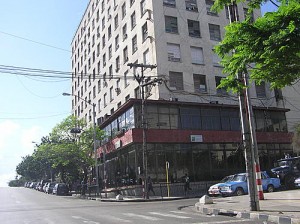 To the calendar of Cuban celebrations we add, these days, the sixtieth anniversary of the beginning of television, recorded on October 24, 1950, which started in the building in the Vedado neighborhood occupied by the Institute of Radio and Television, expropriated from the founders of the medium, who went with their images and sounds to other lands of America, where they found new support for cultural information.
 In October, when the Swedish Academy awarded the Nobel Prize in Literature to the Peruvian writer Mario Vargas Llosa, author of The City and the Dogs, Conversation in the Cathedral and The Feast of the Goat, the Cuban press downplayed the contributions of the great novelist and wasted ink on slander, due to the author’s criticism of Castro, whose spokesmen break their spears over anyone who demystifies our dictatorship.
 In Cuba we are far from applying those definitions, although we know that in other latitudes Pulitzer’s advice is included in the codes of ethics of newspapers, magazines, digital media and radio and television stations. Set-ups and half-truths are expensive because the media are based on news sources, but to reverse the pyramid and expose the voices of people without an agenda, elucidates the problems and oxygenates the atmosphere.
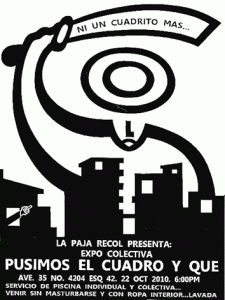 On Friday, October 22, at 6:00 PM, Gorki Águila, leader of the rock band
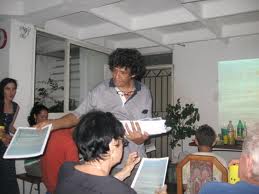
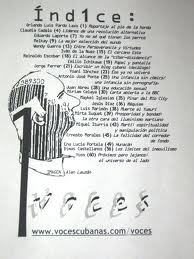 Since August 6, a bunch of copies of Voices Magazine have been circulating in Havana, presented by Yoani Sánchez at the headquarters of Cuba Bloggers Academy, an independent nonprofit organization dedicated to disseminating the technologies that are revolutionizing communications and encouraging citizen journalism on the island, which broke the information monopoly of the military government.
 Voices also brings us Claudia Cadelo, with Leaders of an Alternative Revolution; Eduardo Laporte with the suggestive
 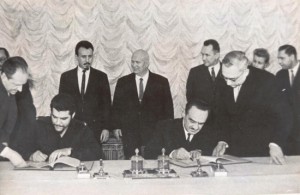 That Che was a Marxist and true to his ideals is fine; that he committed errors and made arbitrary decisions during the war, also fine; but to portray him as a humanist, liberator and Christian is a mockery of the guerrilla, who rejected the respect of his worshipers in a letter to his mother from a prison in Mexico: “I am not Christ nor a philanthropist, I am quite the opposite of Christ. I fight for things that I believe in with every weapon at my disposal and try to kill the other so that he won’t nail me to any cross…”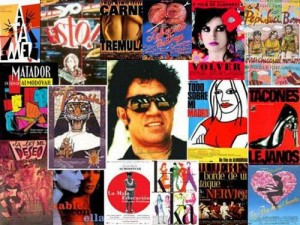
 Of greater human depth and artistic excellence are both, Live Flesh, based on the novel by Ruth Rendell; Talk to Her and Return. In the first, three men who meet in the residence of a diplomat in Madrid, are marked for the rest of their lives on setting of a brawl that leaves one of them in a wheelchair and the others in jail. The second recreates a chance encounter between two strangers who harmonize elsewhere in extreme circumstances. Return is a film of women, performed by notable actresses: Penelope Cruz, Carmen Maura, Blanca Portillo, Yohana Cruz, Chus Lampreave and Cuban Maria Isabel Diaz.
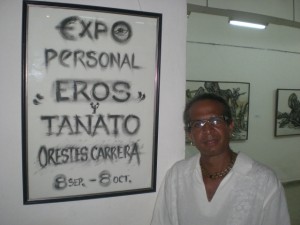 Wednesday, September 8, the painter Orestes Carreras Alarcón opened an exposition of his paintings, Eros and Thanatos, at the Fernando Boada gallery in the municipality Cotorro. There are 12 mixed media paintings worked with charcoal, graphite, acrylic and blended with textures. In them, the painter subordinates color to figuration, focusing on the relationship between eroticism, bullfighting and death. Eroticism as a necessity, death as a part of life and its connections with vigor and energy, symbolized by the human figure.
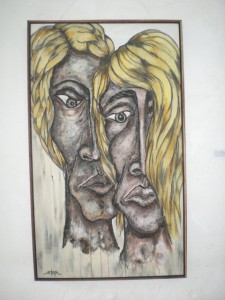 The work of Orestes Carreras is essentially expressionistic and surreal, highlighting evocative provocative textures, and using universal codes that reveal his creative maturity.
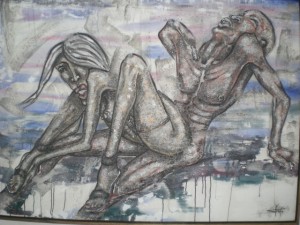 The peculiar spiritual sensitivity of Orestes does not have many precursors in Cuban art, except in the syncretic vision of teachers such as Lam or Mendive, those who differ in the color palette and converge in the figurative overflow. The stylized Greco faces, the recreations of the Guayasamín Aboriginal environment and works of German Otto Dick, appear to be sources for the island artist.
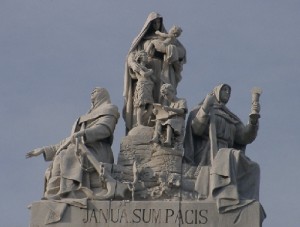 Only two cemeteries in Paris and Barcelona exceed in funeral sculptures and architectural layout the majesty of the Cementerio de Colon (Columbus Cemetery) which occupies 140 acres in the elegant district of Vedado and is bounded by a fence that silences the bustling Havana, while those who make the cross as they walk or drive along Avenue Zapata, the obligatory destiny of the mortals who don’t avoid the Catholic rituals of burial and exhumation, nor opted for cremation in the ovens common in some hospitals in the city.
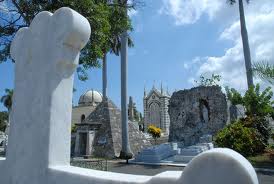 Colon Cemetery, a kind of museum with walls running for four kilometers through Havana, is a life’s work to preserves its universality. Living together there for eternity and in perfect harmony are a Byzantine dome, an Egyptian pyramid, a Westernized obelisk, the entrance to a Roman catacomb, a Florentine Gothic palace, the miraculous French Lady of Lourdes and four very Cuban royal palms. Other groups of sculptures and mausoleums dedicated to heroes, dignitaries and artists of the colonial and republican period confirm the power, spiritual wealth and values bequeathed by our predecessors.
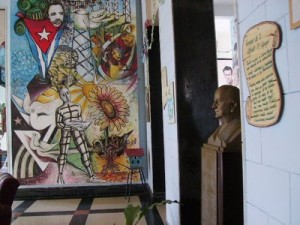 And speaking of the past, we remember that in Cuba, since the educational reform undertaken by our teachers during the U.S. Occupation from 1899 to 1902, special importance was given to primary education and to arts and crafts, free and compulsory since 1901, six decades before the nationalization of education which did away with the coexistence of different models of education, abolished private schools and the prestigious Teachers Normal Schools and other institutions that shaped generations of Cubans.
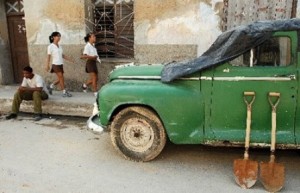 Nearly half a century after the devastating “Revolutionary Offensive” of March 1968 — in which the State took control of virtually all private businesses remaining in Cuba — the same government officials that ended the small and medium-sized private ownership, approved a list of 120 activities people can pursue on their own. Nice! The measure becomes a door in the wall of intolerance, but is insufficient because it does not release the means of production now in the hands of the State, which preserves almost absolute control to the detriment of millions of people and the national economy.
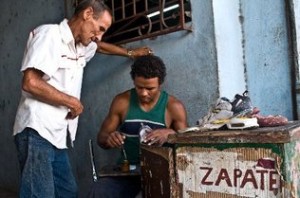 A wolf in sheep’s clothing because the government still owns all the movie theaters, cultural centers, art schools, art galleries, bookstores and theaters, and the network of centers and businesses that control music programming, dance groups, and of course radio, television and the printed press. Hardly anything? Right?
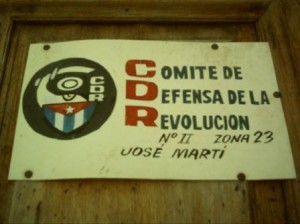 Two signs about 30 inches wide by six feet long were displayed by state officials in many offices and shopping centers in Havana and in other cities in Cuba. They both have the Committee for the Defense of the Revolution (CDR) logo. One says: “Caring for the neighborhood, vigilant and united”; and the other says, “Combative and united with the Fatherland.”
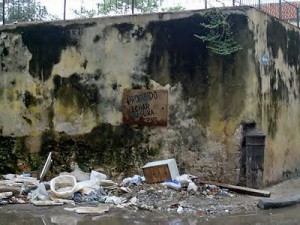 To not belong to the CDR is a challenge that inscribes your name in bold type on the political police blacklist. Whoever says “No” when they knock on the door falls out of favor, however much of a “combatant” they may have been, however virtuous or humane. Failure to pay your CDR dues or to attend their worthless meetings is equivalent to untying the strings of the lackluster Revolutionary fanfare, whose icons continue on despite the passage of time, along with the police reports and the dependence of thousands of unfortunates who felt important before “the call of the Fatherland.”
 The CDRs are as discredited as the Cuban Workers Center (CTC), the only labor union allowed, the Federation of Cuban Women, the Association of Combatants, and other organizations that move no one, but which play a role in the bureaucratic structure of a regime that came to power in the name of freedom and eliminated all the rights and freedoms of citizens.
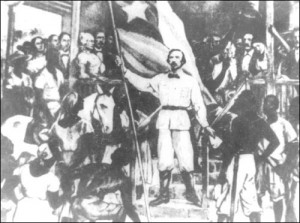 Since 1980, Cubans have celebrated 20 October as National Culture Day, in evocation of a local date of warrior exaltation, the triumphal entry of the small Bayamo Liberation Army, centered around the planter Carlos Manuel de Céspedes, who on 10 October 1868 gave freedom to the slaves of his sugar mill and proclaimed the beginning of the struggle for the independence of Cuba.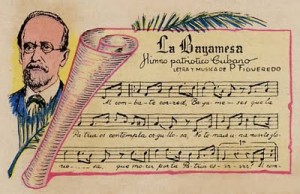
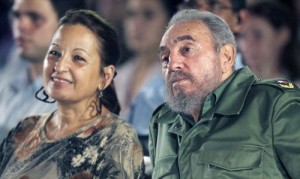 From all sides comes the news of layoffs in Cuba, some with the illustrious names and surnames of officials who rose to the top of the pyramid of power, where at times they renew the loyalties and new figures swear fidelity and allegiance to the gerontocracy perched on the top of the triangle.
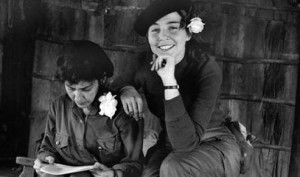 I suspect that her subordinates in Basic Industry will not be surprised, because in Matanzas she already got her comeuppance when she was leading the region. They had to replace her in 2000 following the uncovering of corruption in Varadero, but the Commander appointed her head of the “Battle for the Rescue of Elian,” and then consecrated her Minister. Maybe she will now re-emerge, like a phoenix, as she doesn’t lack experience, is attractive and wants to survive.
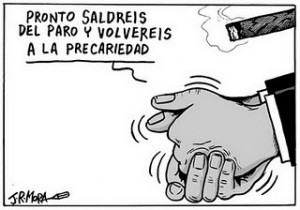 Cartoon: Soon you will recover from unemployment and we can return to uncertainty.
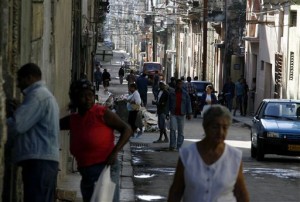 The friend and his father-in-law were speaking calmly about the subject, when the old man recalled that he was the union leader at West Indian Steel and he knows that behind the problems of that country is the long arm of the U.S. Central Intelligence Agency. Faced with such a long arm, my friend smiled.