Santo Domingo is offering a subsidy to its producers so they can compete with the U.S. in the Cuban market
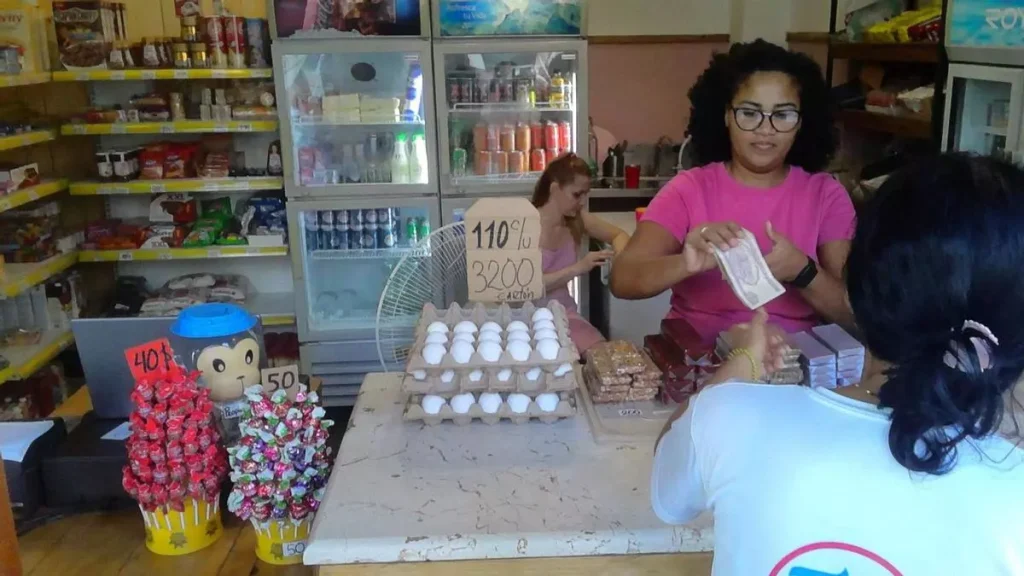
 14ymedio, Madrid, July 24, 2026 / The Dominican Republic resumed egg exports to Cuba this week, which had been suspended for several months due to logistical difficulties stemming from the most recent U.S. sanctions against the regime in Havana.
The resumption of trade was made possible by a new regulation approved by the Dominican government to subsidize maritime transport. The measure aims to offset rising logistics costs and ensure the continuity of shipments to the island, as Miguel Lajara, a member of the Dominican Poultry Association, explained to El Nuevo Diario.
Lajara also noted that 12 containers containing 3,900,960 eggs—corresponding to the first export batch—have already been shipped, with the companies Agrokilda, Granja Wilse, Huevos Perla, and Agropecuaria SSK participating. He added that shipments could take place twice a month, with an expected volume of more than 13 million eggs sent to Cuba each month. The figure, however, remains well below the nearly 60 million eggs per month that Argentina used to export to Cuba before shipments were suspended.
“We had been building up capacity for Cuba. That market disappeared overnight, and it will take time to recover that volume.”
“We encountered a setback due to the restrictions the U.S. has imposed on ships, and we are working to resume that trade,” Pavel Concepción, president of the Dominican Poultry Association (ADA) told the local press. He added that the interruption in shipments was not due to a total suspension of maritime travel, but rather to the fact that, as a result of U.S. sanctions, shipping companies reduced the availability of refrigerated containers. He noted that the sector secured a new shipping company willing to cover the route to Cuba, which allowed exports to resume.
During the time the Dominican Republic was absent from the Cuban market, the U.S. filled its role as a supplier of eggs to the island, according to Concepción. “We managed to get the government to help with part of the transportation costs, which lowers the price of eggs and may allow us to compete with U.S. eggs.”
“We had been building up capacity for Cuba. That market disappeared overnight, and regaining that volume will take time,” the leader explained.
The government program includes a fund of 25 million Dominican pesos—about 430,000 dollars—administered by the Dominican Poultry Association, in coordination with the National Association of Laying Hen Producers, and establishes a subsidy of 4,500 dollars for each container exported, with a limit of up to 20 containers per week, until available resources are exhausted.
“We managed to get the government to help cover part of the transportation costs, which lowers our expenses and may allow us to compete with eggs from the United States.”
In Cuba, eggs have become a luxury item in recent years. They cost around 3,000 pesos for a 30-count carton in a country where the minimum wage is 3,210 pesos per month (less than five dollars), while prolonged power outages—exacerbated by the energy crisis—make it difficult to store them.
The island’s poultry sector has been in a state of severe decline for nearly a decade. Domestic production fell from about five million eggs per day in 2020 to around 2.2 million in 2023, as a result of shortages of feed and other poultry farming supplies. The lack of feed even forced the culling of more than 50,000 laying hens in Holguín, further reducing the country’s egg production capacity.
Egg distributions through the “canasta familiar” (basket of essential goods) have been reduced or suspended in numerous provinces, while the crisis has forced the Cuban government to rely increasingly on imports to meet part of domestic demand.
Since 2023, Cuba has turned to imports from the Dominican Republic to try to cover part of the production shortfall, a dependence that has intensified as the national poultry industry has deteriorated. The resumption of exports will ease supply constraints, but it will not resolve the structural problem of domestic production, which remains limited by the lack of poultry feed and other inputs.
“The difficult situation regarding feed production in Cuba—which is vital for livestock farming and the production of meat and eggs—has been a persistent burden on the national economy and the people’s food supply,” the State newspaper Granma acknowledged earlier this year, before the U.S. tariff sanctions that have exacerbated the crisis on the island had been implemented.
Translated by GH
______________________
COLLABORATE WITH OUR WORK: The 14ymedio team is committed to practicing serious journalism that reflects Cuba’s reality in all its depth. Thank you for joining us on this long journey. We invite you to continue supporting us by becoming a member of 14ymedio now. Together we can continue transforming journalism in Cuba.