Experts agree that private investment and the diaspora will be essential to modernizing the island after a democratic transition.
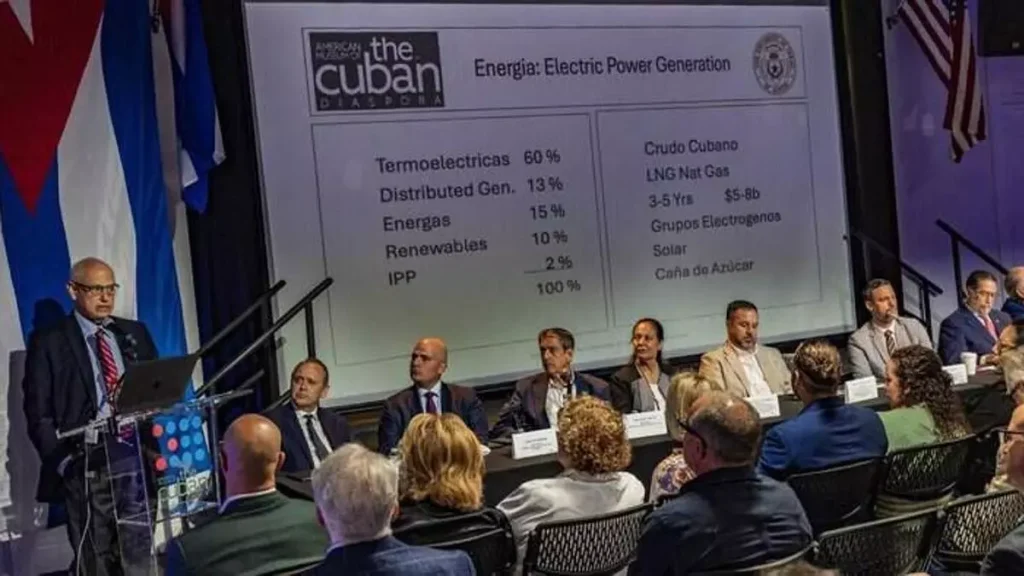
 14ymedio, Havana, July 24, 2026 / Decades of neglect have left Cuba with an obsolete and deeply decayed infrastructure. Rebuilding it will be the main challenge facing a future democratic transition, according to specialists gathered at the forum “Reconstruction of Cuba’s Infrastructure as Part of the Transition to Democracy” held on July 22 at the American Museum of the Cuban Diaspora in Miami.
Cuban-American academics, business leaders, engineers, and architects analyzed a hierarchy of urgent needs—electricity, water, sanitation, transportation, and connectivity—and proposed recovery strategies that, above all, will depend on creating a legal framework capable of attracting private investment and facilitating the participation of the Cuban diaspora. This was emphasized especially by economist Rafael Romeu, president of the Association for the Study of the Cuban Economy.
Romeu proposed an initial phase of humanitarian aid aimed at sustaining basic services and responding immediately to the urgent social situation: the deterioration of the electrical grid, the water supply, and the healthcare system. The analyst noted that Cuba does not have immediate access to aid from organizations like the International Monetary Fund, from which it withdrew in 1964. “Waiting for international organizations could lead to chaos and suffering for the Cuban population, who would have to face worsening hyperinflation, dollarization in the black market, and the collapse of essential services.”
“Waiting for international organizations could lead to chaos and suffering for the Cuban population.”
Romeu insisted that the recovery will depend on a combination of public and private resources, with private investment as the main driver. Among his stabilization measures is the dollarization of the economy, a proposal he believes would curb inflation and dismantle the distortions that currently fuel the informal market.
The reconstruction of Cuba, in any case, would cost billions of dollars, and that’s where “the venture capitalists” would come in, according to Romeu, who also pointed to tourism as one of the activities with the greatest potential for attracting capital. The economist estimated that an open Cuba with adequate infrastructure could receive between seven and ten million visitors a year.
For his part, Jorge Piñón, a researcher at the Austin Energy Institute at the University of Texas, addressed his area of expertise. “Without energy, there is no country,” he affirmed. For him, the immediate priority is to ensure a reliable and clean energy supply, essential both for daily life and for attracting investment.
As he told 14ymedio in an interview, Piñón is committed to expanding the use of natural gas, which Cuba already extracts in Canasí and Puerto Escondido, and complementing it with solar energy and ethanol produced from sugarcane. His proposal involves gradually abandoning crude oil refining and transforming existing refineries into open-access fuel storage and distribution terminals. According to the expert, this conversion would avoid the high costs of modernizing aging facilities, reduce pollution, and facilitate competition among suppliers.
The expert explained that although Cuba has 59 treatment plants, many barely function or do so with low efficiency.
With regards to the water crisis also affecting the island, engineer José Enrique Cueto, former director of the Miami-Dade Water and Sewerage Department, spoke. The expert explained that although Cuba has 59 treatment plants, many are barely functioning or operating at low capacity due to a lack of chemicals, equipment, pumps, and adequate filters. He advised that the use of chlorine gas as the primary disinfectant adds risks due to its toxicity. Furthermore, an insufficient sewer system forces a large part of the population to rely on septic tanks.
Cueto proposed starting by restoring pumping, drinking water treatment, and pipelines, prioritizing hospitals, densely populated cities, and vulnerable communities. He estimated two to five years for basic rehabilitation, up to ten for modernization, and more than a decade to expand wastewater infrastructure, industrial capacity, and agricultural supply. This is not, therefore, a quick fix, but a long-term national program.
Transportation in Cuba has also suffered from severe deterioration for decades. Carlos Peñín, founder of CAP Government and former president of the Miami-Dade Expressway Authority, stated that 70% of Cuban roads are in poor condition. The Central Highway and the National Highway—unfinished for decades—reflect the neglect of a network where fatal accidents are frequent and vehicles, carts, and pedestrians coexist without minimum safety conditions. According to Peñín, there is potential for transportation development on the island, but a significant investment would be needed for it to have an economic impact.
Regarding port infrastructure, experts noted that Cuba has 30 ports, including Mariel, but cautioned that many require comprehensive modernization. Even so, they highlighted the potential for reviving cruise tourism and leveraging the reconstruction of the transportation system to incorporate the most advanced technologies from the outset.
Lebeña stated that the transition to a modern telecommunications network, including 5G technology, could be completed in less than three years.
Willy Bermello, president of Bermello Ajamil & Partners, estimated that modernizing Cuban airports and bringing them up to international standards would require between $8 billion and $10 billion over 15 years.
Jesús Lebeña, vice president of corporate operations at MasTec Communications Group, addressed the topic of telecommunications. In his view, a Cuba in transition should guarantee unrestricted access for the entire population to voice, messaging, and data services with international connectivity.
Lebeña stated that the transition to a modern telecommunications network, including 5G technology, could be completed in less than three years if Cuba connects via fiber optic cables to the US and other countries and opens the sector to competitive bidding among international companies. According to him, this would lower service costs for consumers and allow the entry of satellite internet platforms like Starlink, currently prohibited on the island. In that scenario, Cuba could even aspire to become a regional data center.
In conclusion, Marcell Felipe, president of the American Museum of the Cuban Diaspora, maintained that the talent and capital of the exile community exist, but their participation will depend on a change of government in Cuba and the creation of rules that guarantee economic freedom, competition, and legal security. According to the specialists gathered at the forum, post-Castro Cuba will inherit a devastated infrastructure and an exhausted population. The question will no longer be whether the country will need aid, but rather which institutions will be prepared to administer it without repeating the monopolies, improvisation, and opacity that led to the current crisis.
______________________
COLLABORATE WITH OUR WORK: The 14ymedio team is committed to practicing serious journalism that reflects Cuba’s reality in all its depth. Thank you for joining us on this long journey. We invite you to continue supporting us by becoming a member of 14ymedio now. Together we can continue transforming journalism in Cuba.