So far, only Bruno Rodríguez has spoken out: “an attack on the human right to access health care for hundreds of thousands of people in many parts of the world”
 14ymedio, Madrid, July 24, 2026 / The Cuban regime’s response to the most recent round of sanctions announced by the U.S. has been, so far, more restrained than the previous one. Neither Miguel Díaz-Canel nor Manuel Marrero—the president and prime minister, respectively—have spoken out, nor has the person directly affected, Health Minister José Ángel Portal Miranda.
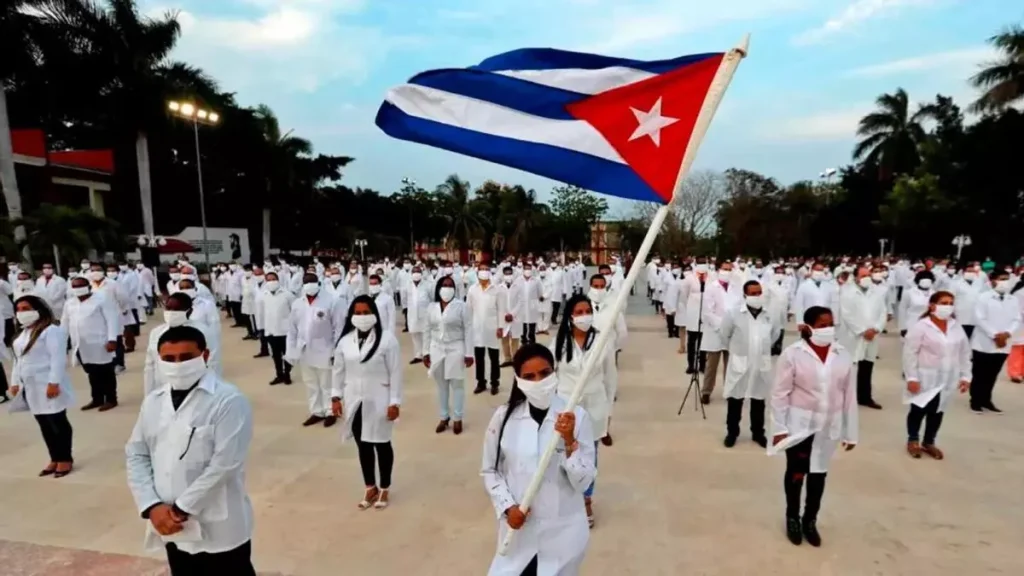
Bruno Rodríguez has been tasked with issuing the main statement of condemnation via his X account, where he denounced what he considers “an attack on the human right to access health services for hundreds of thousands of people in many parts of the world.” Some of the measures are directed against the Cuban Medical Services Marketing Company, S.A. (CSMC) and the Central Unit for Medical Cooperation (UCCM), as well as Gretza Sánchez Padrón, director of the latter, and Portal Miranda.
“They are punishing Cuba for providing a humane and compassionate service that has been recognized by the international community. This is being done by the government of the world’s richest country, which is determined to deny that basic human right to tens of millions of its own citizens,” the foreign minister argued, referring to a free and universal public health system, although part of the sanctions are specifically directed at the company that sells health services for foreign currency, both domestically to tourists and abroad to governments.
“They are punishing Cuba for providing a humane and compassionate service that has been recognized by the international community”
CSMC operates in medical tourism—offering packages that include medical treatment, wellness, and natural therapies—sells university programs, provides healthcare at border crossings (ports and airports), organizes scientific events, forges biotechnology partnerships, and, most importantly, exports doctors to other countries upon payment.
In contrast, the sanctions against UCCM do affect services linked to humanitarian work, such as the Henry Reeve Brigade, or the commercial management of medical missions in foreign countries. This department is responsible for mobilizing its response to emergencies, as well as for the selection, training, and deployment of international missions. In this regard, it is held responsible for the conditions under which Cuban doctors live, including restrictions on socializing, curfews, and—far more seriously—the withholding of passports.
“Every act of aggression by the U.S. government—such as the measures announced on July 23 by the Secretary of State—demonstrates that the objective is to impose collective punishment on the entire Cuban people. Although the U.S. government continues to deny the existence of the economic blockade against Cuba, it is finding it increasingly difficult to hide its genocidal intentions and its desire to provoke a humanitarian crisis,” Rodríguez protested.
Although the foreign minister focused on medical services, just as—if not more—worrisome for the population are the new sanctions against the port of Mariel, which expand upon the existing ones. Until June, the terminal was operated by the company Terminal de Contenedores de Mariel S.A., owned by Gaesa, but when the military conglomerate was sanctioned, the state transferred control to two new entities: Coral Marítima S.A., which took over the assets, and the Grupo Empresarial de Transporte Marítimo Portuario (Gemar), which controls the country’s port infrastructure, ships, freight, and maritime logistics operations.
On July 13, the U.S. Department of State included these two companies in its previous round of sanctions. But now, it has added the original company, Terminal de Contenedores Mariel, on the grounds that all three are responsible for a scheme to circumvent the sanctions. This closes any legal loophole for sanctioning the port through which approximately 85% of the goods received by the island pass, according to data from the Ministry of Transportation, the port operator PSA International, and the State Department’s own assessment.
Major shipping companies, such as France’s CMA CGM and Germany’s Hapag-Lloyd—which, according to two Reuters analysts, account for approximately 60% of cargo bound for Cuba—had already ceased operations in anticipation of these measures. Currently, as reported by Medicuba, ten containers holding medical supplies and medications are being held by these companies in ports in Jamaica and Colombia, while food is beginning to run short.
Ten containers of medical supplies and medications are being held by these companies in ports in Jamaica and Colombia, while food is beginning to run short.
Ernesto Soberón, Cuba’s ambassador to the United Nations, took the opportunity to denounce the new measures during a debate on Thursday at the UN dedicated to “strengthening mechanisms for the peaceful settlement of disputes.”
“Preventing conflicts requires full respect for the United Nations Charter, international law, and the sovereign equality of states. I denounced the intensification of the U.S. blockade against Cuba, the energy siege, and the use of unilateral coercive measures, which contradict the principles of peaceful coexistence and pose a threat to regional and international peace and security,” he said. At the same time, he affirmed that the regime remains open to serious and respectful dialogue.
The announcement of new sanctions, which also affect other entities in the energy and financial sectors, coincides with recent remarks by the U.S. Secretary of State, who spoke in Manila, where he was attending the Association of Southeast Asian Nations (ASEAN) Summit. There, when asked about Cuba, Rubio stated that talks with the regime are continuing to see “what kind of changes they can make.” “We are willing to be very realistic and patient about how. A serious process is needed to bring that about,” he added, offering the carrot just hours before delivering another stick.
Translated by GH.
______________________
COLLABORATE WITH OUR WORK: The 14ymedio team is committed to practicing serious journalism that reflects Cuba’s reality in all its depth. Thank you for joining us on this long journey. We invite you to continue supporting us by becoming a member of 14ymedio now. Together we can continue transforming journalism in Cuba.