The Cuban crisis forces people to give up the basic habits that sustain communal life
 14ymedio, Yoani Sánchez, Havana, July 22, 2026 / The street I walk down is called Hidalgo, but on one of its corners, the poorest people in my neighborhood gather, while waiting for their bread from the ration books. Some couldn’t survive without this support, which, for others, is just a small piece of dough, sometimes sour, sometimes almost greenish. I have a neighbor who goes down more than ten flights of stairs and then back up just to make sure he gets this extra portion of his daily ration. Poor quality, but still subsidized, this bread remains the main source of sustenance for many of the people I pass every morning.
I jump over a sewage-filled stream, just a few meters from where a tamale vendor is hawking his wares. I quicken my pace toward La Timba. Only the building of the General Customs of the Republic appears freshly painted. Everything around me is parched from the heat and lack of rains, peeling from the crisis, and dulled by neglect. Even Paseo Street, once the sacred thoroughfare of power, where caravans of official vehicles escorted by motorcyclists used to parade, looks abandoned. Have the Party leaders boarded that plane and we don’t even know it? Like in some novels, is it that power in Cuba is nothing more than an empty shell that survives only in our imaginations and in the offices of State Security?
For the work and grace of daily survival, now “five” means five hundred and “two” is enough to describe two hundred.
It’s not summer. In July and August, everything usually slows down a bit; the heat is oppressive, and the city seems to yawn at every turn. But this year is different. This isn’t slowness. It’s paralysis.
“It’s three to Prado,” the driver of the electric tricycle tells me as I hop on in Vedado. Money has become so difficult to pronounce that we’ve ended up simplifying it. Thanks to the daily grind of survival, now “five” means five hundred and “two” is enough to describe two hundred. We drop zeros from conversations as quickly as those colorful bills disappear from our pockets. But if “one” equals one hundred, what do we do with that bill that showed José Martí’s face and that for so long represented one peso? That one no longer exists. It has been erased by inflation and by forgetfulness.
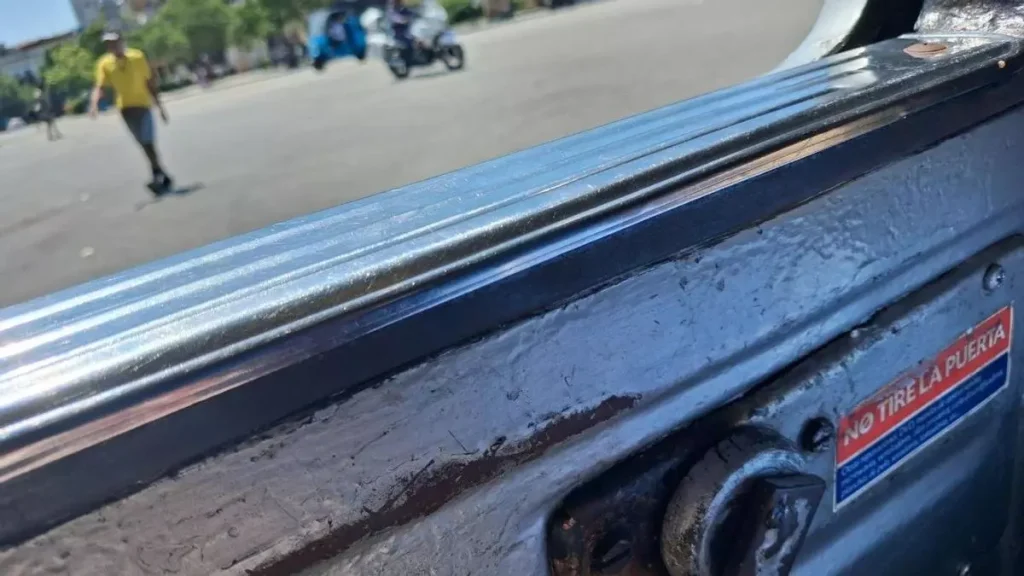
The almendrón, the classic American car, that’s taking me home speeds by. I’m pressed against the back door, and right in front of my face is a sign that warns: “Don’t slam the door.” They’re asking for a kind and courteous gesture amidst the chaos. “It’s five to Boyeros and Tulipán,” the driver explains. His statement confirms that zeros to the right of the fare are worthless; they’ve become as useless as those on the left. Just as we’ve eliminated hundreds and thousands of our conversations, we’ve also been stripping our days of any embellishment. There’s no room for frills anymore. Only the most urgent and basic needs remain.
Animalization rarely happens suddenly. It creeps in little by little. The real deterioration is not just in the streets or on the facades.
While walking down Colón Street a few days ago, a bag full of excrement flew over my head before hitting the pavement. The residents of that area have been without water for days. Instead of accumulating their waste in a toilet that seems unlikely to be flushed, they throw it in the nearest garbage can. In this country, we’ve been pushed to disregard centuries of basic lessons: mixing shit with public space ultimately turns life into shit.
It is not the only setback. There are neighborhoods where people cook with firewood in the middle of the city and where the darkness of the blackouts forces them to sleep with the chickens. A friend called me a few days ago to invite me to a comedy show. “I can’t,” I told him, “I have to get up before five in the morning to get online for a few minutes and get some housework done.”
Progress can not only stop; it can also reverse at great speed.
Havana wasn’t sustained solely by buildings or avenues. It was also raised on unspoken agreements: don’t throw excrement out the window, keep sewage away from where you cook. These are rules so old they seem instinctive, but a prolonged crisis is enough to reveal that they aren’t. We’ve begun to accept as normal scenes that just a few years ago would have seemed like something out of a refugee camp.
Animalization rarely happens in one blow. It creeps in little by little. The real deterioration isn’t just in the streets or the facades. It’s in realizing that, to survive, we’ve had to forget too many things that kept us healthy and sane.
Previous Havana Chronicles:
From the Mariel Boatlift’s Weaponized Eggs to the Luxury Egg
Cuba Is Once Again Without Internet
Under the Shadow of a Giant Syringe, Cuba Remains the Land of Waiting
The Time For Reforms Has Passed
Surrounded by Garbage, Miramar Is No Longer the Glamorous Neighborhood It Once Was
A Circus Facing Off Against Power, and a City Growing Increasingly Lonely
Chronicle of a Monday That Feels Like Wednesday
“We Used to Complain About the ‘CUC’, But Now We Miss It”
The Roar of Despair of a Cuban Woman Returning to Her Country After Many Years
The Tulipán Market Closed: “They’ve Given the Order To Go to the March for Raúl”
Along Carlos III Street and towards Ethiopia
Sleeping Is Also a Privilege in Havana
A Desperate Plea in the Middle of the Dark Havana Night: ‘Light!’
Under a Picture-Postcard Blue Sky, the Country is Crumbling
Fatigue Barely Allows One to Enjoy the ‘Lights On’ in Havana
Dollars, the Classic Card, and a Havana Without Tourists
A Journey Through the Lost Names of Havana
The Shipwreck of a Ship Called “Cuba”
Havana Seen From ‘The Control Tower’
In Havana, the Only Ones Who Move Are the Mosquitoes
Reina, the Stately Street Where Garbage is Sold
Searching for Light Through the Deserted Streets of Havana
The Death Throes of ‘Granma’, the Mouthpiece of a Regime Cornered by Crisis
The Anxiety of the Disconnected Cuban
One Mella, Three Mellas, Life in Cuba Is Measured in Thousands of Pesos
It Is Forbidden To Leave Home in Cuba Today Because It Is a “Counter-Revolutionary Day”
Vedado, the Heart of Havana’s Nightlife, Is Now Converted Into a Desert
_________________
COLLABORATE WITH OUR WORK: The 14ymedio team is committed to practicing serious journalism that reflects Cuba’s reality in all its depth. Thank you for joining us on this long journey. We invite you to continue supporting us by becoming a member of 14ymedio now. Together we can continue transforming journalism in Cuba.