The hotel company attributes the decision to the “significant operational, legal, and economic-financial difficulties” in the country following U.S. pressure measures.
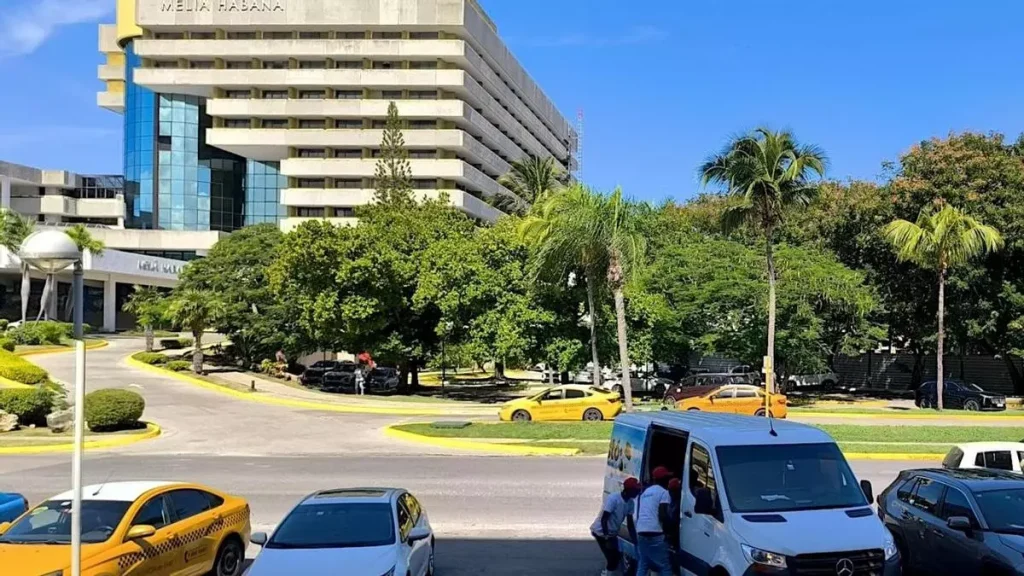
 14ymedio, Madrid, July 21, 2026 – Spanish hotel company Meliá will cease all of its operations on the Island this Friday, July 24, due to the “significant operational, legal, and economic-financial difficulties” in the country following U.S. pressure measures, the company announced Tuesday in a filing with Spain’s National Securities Market Commission (CNMV).
“The company informs that its Portuguese subsidiary, Ilha Bela, has decided to cease, effective July 24, 2026, the provision of its hotel management and marketing services for all of its establishments in Cuba. This decision also extends to the use of licensed brands, inbound tourism services, and the local supply chain associated with supplying the aforementioned establishments, whose operations will also be discontinued,” the Escarrer family company stated in a filing submitted to the CNMV.
In a statement sent to 14ymedio, the company firmly denied that its chief executive officer, Gabriel Escarrer, had recently traveled to Cuba, as Cubanet claimed in a report published Monday that first revealed the Balearic hotel company’s decision. Aside from that, it referred entirely to the official statement it had released.
The company firmly denied that its chief executive officer, Gabriel Escarrer, had recently traveled to Cuba, as Cubanet claimed in a report published Monday
“The company is working to ensure an orderly and responsible transition, minimizing as much as possible the impact on the various stakeholders involved in the operation, including employees, customers, suppliers, and local partners, while maintaining transparent communication with all of them. In keeping with the principle of prudence, it is also evaluating the financial impacts of this decision,” the statement said.
The company, the first foreign hotel operator to enter Cuba to manage state-owned hotels, concluded its statement by expressing “its gratitude to all the individuals and organizations that have been part of its history in Cuba over the years, as well as the company’s respect and consideration for the country.”
Meliá arrived in Cuba in 1990 under the leadership of the founder of the Mallorca-based company and father of its current CEO, Gabriel Escarrer Juliá, who developed a close friendship with Fidel Castro. Castro had initially been reluctant to embrace tourism, which he considered closely tied to capitalism, but after the collapse of the Soviet Union he had little choice but to accept the idea of profiting from the Island’s only free resource: its natural environment. Melia celebrated its 35th anniversary in May 2024, when its executives said they hoped for “another 50 years of growing together.”
That first hotel, Sol Palmeras in Varadero, marked the beginning of an adventure that lasted until 2026. Meliá had contracts with Gran Caribe and Cubanacán to manage 19 hotels, while it managed another 15 for Gaviota, the tourism arm of the military conglomerate Gaesa. Altogether, it operated 34 hotels with about 14,000 rooms that, in recent years, had generated only minimal returns.
For Meliá, however, this was not a major problem. The substantial profits the hotel chain earned worldwide allowed it to maintain its ties with Cuba while waiting for conditions to improve, but in May everything began to change.
As early as February, with the suspension of most international flights and the resulting collapse in tourist arrivals, the hotel chain was forced to alter its strategy by consolidating guests into a smaller number of hotels and closing nearly half of its properties. But after U.S. President Trump signed an executive order in May under which any company maintaining ties with Gaesa risked being sanctioned, events accelerated.
On June 3, the company officially announced that it was withdrawing from all of the Gaviota hotels it managed
On June 3, the company officially announced that it was withdrawing from all of the Gaviota hotels it managed, while temporarily retaining management of the remaining 19 properties. Gabriel Escarrer, who had been personally committed to remaining in Cuba, had stated in recent weeks that everything depended on whatever developments occurred on the Island and that, as a publicly traded company, it would ultimately make whatever decision was necessary out of responsibility to its shareholders.
Despite the exodus of foreign hotel companies that have abandoned nearly all of the properties they operated in Cuba in response to the U.S. threat of sanctions, few experts had predicted that Meliá would leave the Island entirely. Most specialists, who had expressed confidence that Trump had set his sights on the tourism sector, believed that some hotel chains—especially the Mallorca-based company, which was foremost in everyone’s mind—would remain to contribute their expertise and capitalize on the many years they had invested in the country. For some reason, that has not been the case.
Translated by Regina Anavy
______________________
COLLABORATE WITH OUR WORK: The 14ymedio team is committed to practicing serious journalism that reflects Cuba’s reality in all its depth. Thank you for joining us on this long journey. We invite you to continue supporting us by becoming a member of 14ymedio now. Together we can continue transforming journalism in Cuba.