In a country where the state no longer provides electricity, water, medicine, or bread, each family tries to survive however they can.
 14ymedio, Yoani Sánchez, Havana, July 16, 2026 / Today I couldn’t take the trash down the stairs. It wasn’t any heavier than usual, but my body sent me a telegram, brief and forceful: “Don’t even try. Every cell is carrying too many days of accumulated fatigue.” So I left the bag by the door and went out with only my purse, umbrella, water bottle, mosquito repellent, and the garbage bags. I also threw my cell phone in my bag, increasingly useless in a country where connecting to the internet or making a call can take longer than delivering the message in person.
As I descend the building’s more than 120 steps, the greetings become increasingly brief, almost whispers. Few dare to say “good morning” or “good afternoon” anymore, because there’s very little goodness left. Conversations revolve around the accumulated hours without electricity, the unbearable heat that barely allowed anyone to sleep a wink the night before, or the problems with the water supply. One neighbor sums up the collective mood with a phrase that has become a greeting: “Here, surviving.” He says it as if we were all participating in one of those reality TV shows where you have to cross raging rivers, hunt for food, and find a cave to spend the night.
Few dare to say “good morning” or “good afternoon” anymore, because there’s very little good left.
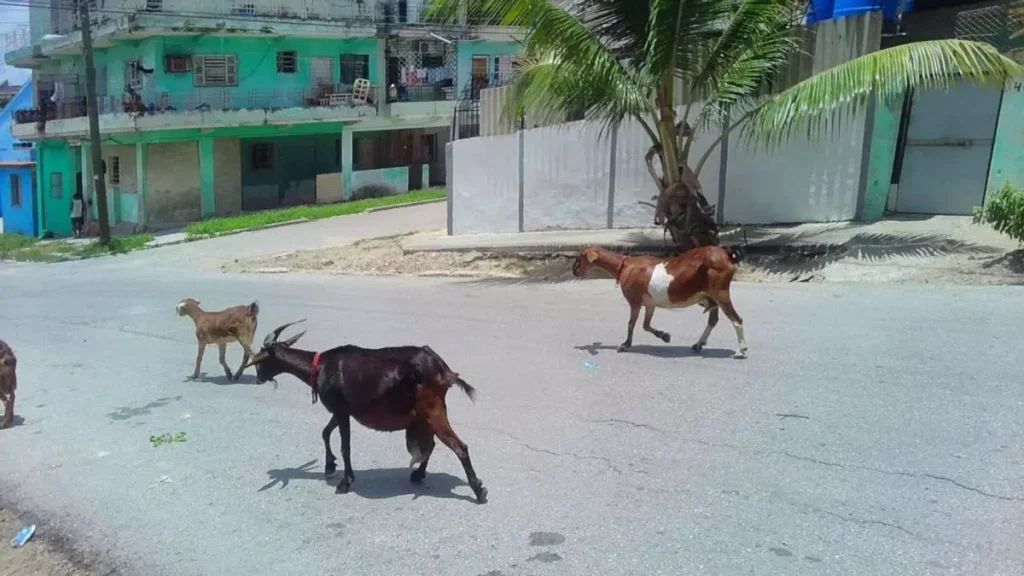
I advance along Tulipán Street toward Ayestarán. The bakeries at the rationed market, which I pass every morning, remain closed. A woman warns another not to waste her time going back to the dark counter because today, she assures her, “they won’t even have enough to tie up the goats.” Coincidentally, just a few meters ahead, a young man has taken a small flock of goats out to graze among the grass that has sprouted on the ruins of a collapsed building. In this Cuban version of televised survival, that urban shepherd would have a good chance of becoming a finalist.
While some wage their daily battle in the streets and on the sidewalks, others have decided to barricade themselves indoors. Since no one places much hope in thermoelectricplants nor in the national energy system anymore, everyone is trying to construct their own island of stability. Those who can afford it buy a rechargeable battery; those with more resources install a generator or solar panels.
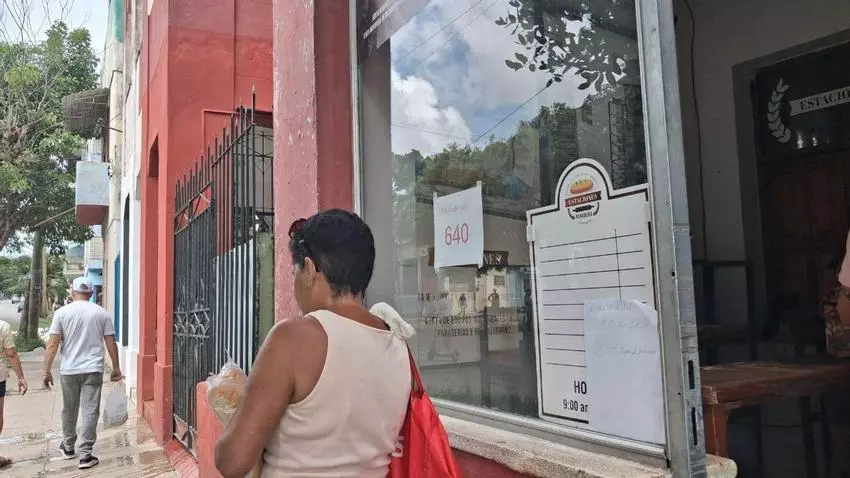
A friend, fed up with paying up to 640 pesos for a bag of bread at some private businesses, ended up buying a bread maker. To the initial investment, she’s had to add the price of flour, yeast, and the uncertainty of power outages. “I’ve used it three times,” she tells me. “Only once did it manage to complete the entire cycle.” The other two times, the power went out before baking, and the machine was left guarding a sour, inedible mass.
Another acquaintance has covered his roof with solar panels and designed an electrical system that allows him to power his entire house with a simple switch. “Now I run my electricity from the Indio, the Amarillo, the one whose boiler never breaks down or trips due to a fault,” he jokes, mocking the endless stream of explanations offered by the National Electric Union to justify each blackout. “I actually carried out an energy revolution,” he boasts, showing off the inverters and batteries that have restored something resembling normality to his life.
Even leisure activities continue to be organized independently. Faced with constant television signal interruptions, several young people in the neighborhood have improvised a small room in the basement of their building to watch the World Cup. An EcoFlow, a television, and some planks converted into benches are all that’s needed to gather the fans. From an apartment on one of the upper floors, a cable runs down to one of those satellite dishes that remain illegal, even though they’ve become almost as commonplace in Cuba as the daily insults hurled at Miguel Díaz-Canel.
After fracturing her collarbone, a former university classmate decided to prepare for a possible hospitalization. What she keeps in several boxes isn’t exactly a first-aid kit. There are urinary catheters, IV catheters, saline solutions, sutures, syringes, disposable gloves, and other supplies that any hospital should provide. “If I’m hospitalized again, I prefer to arrive with everything,” she explains. She, too, is trying to protect herself against shortages.
Every story seems different, but they all follow the same logic: to create, within the confines of the home, a small, functional country.
Every story seems different, but they all follow the same logic: to create, within the confines of their home, a small, functional country. A home bakery. A private electric company. An improvised cinema. A private medical supply store. As if each family were building a tiny republic where it was still possible to address what the State had ceased to provide.
But no house can become a country. There’s no bakery capable of replacing a network of bakeries baking every morning, nor enough solar panels to replace a national electricity grid, nor a dedicated medical supply depot to feed a healthcare system in ruins. Nor can we fit between four walls the hospitals, transport, communications, and much less the pieces of the nation we gather from the outside world each day.
When I got home, the trash bag was still by the door. Tomorrow, if my body allows it, I will try to take it down. In this competition, nobody wins a prize. The goal is simply to make it to the next episode alive.
Previous Havana Chronicles:
From the Mariel Boatlift’s Weaponized Eggs to the Luxury Egg
Cuba Is Once Again Without Internet
Under the Shadow of a Giant Syringe, Cuba Remains the Land of Waiting
The Time For Reforms Has Passed
Surrounded by Garbage, Miramar Is No Longer the Glamorous Neighborhood It Once Was
A Circus Facing Off Against Power, and a City Growing Increasingly Lonely
Chronicle of a Monday That Feels Like Wednesday
“We Used to Complain About the ‘CUC’, But Now We Miss It”
The Roar of Despair of a Cuban Woman Returning to Her Country After Many Years
The Tulipán Market Closed: “They’ve Given the Order To Go to the March for Raúl”
Along Carlos III Street and towards Ethiopia
Sleeping Is Also a Privilege in Havana
A Desperate Plea in the Middle of the Dark Havana Night: ‘Light!’
Under a Picture-Postcard Blue Sky, the Country is Crumbling
Fatigue Barely Allows One to Enjoy the ‘Lights On’ in Havana
Dollars, the Classic Card, and a Havana Without Tourists
A Journey Through the Lost Names of Havana
The Shipwreck of a Ship Called “Cuba”
Havana Seen From ‘The Control Tower’
In Havana, the Only Ones Who Move Are the Mosquitoes
Reina, the Stately Street Where Garbage is Sold
Searching for Light Through the Deserted Streets of Havana
The Death Throes of ‘Granma’, the Mouthpiece of a Regime Cornered by Crisis
The Anxiety of the Disconnected Cuban
One Mella, Three Mellas, Life in Cuba Is Measured in Thousands of Pesos
It Is Forbidden To Leave Home in Cuba Today Because It Is a “Counter-Revolutionary Day”
Vedado, the Heart of Havana’s Nightlife, Is Now Converted Into a Desert
_________________
COLLABORATE WITH OUR WORK: The 14ymedio team is committed to practicing serious journalism that reflects Cuba’s reality in all its depth. Thank you for joining us on this long journey. We invite you to continue supporting us by becoming a member of 14ymedio now. Together we can continue transforming journalism in Cuba.