The rapper received his first family visit at Guanajay prison after being transferred from Kilo 8.
 14ymedio, Madrid, July 21, 2026 — The U.S. government has approved a special travel permit (parole) for Cuban rapper and political prisoner Maykel Castillo Pérez, known as Maykel Osorbo, according to information released Tuesday by the Observatory of Cultural Rights and activist and art historian Anamely Ramos.
The authorization is similar to the one granted to artist Luis Manuel Otero Alcántara, who arrived in Miami last Saturday after fully serving his five-year prison sentence and being forced into exile. It was processed in parallel by those close to him. According to the joint statement from the Observatory and Anamely Ramos, the application is based “on the certainty that his arbitrary imprisonment has political origins and has violated his human rights, as well as his right to freedom of expression and artistic creation.”
It is therefore expected that the regime will follow the same course with Castillo as it did with Alcántara and grant his release from prison in exchange for exile.
The statement also reports that Osorbo received his first family visit on Tuesday since being transferred on July 10 to the maximum-security prison in Guanajay, Artemisa. During the visit, the musician confirmed that he had been placed in “La Incrementada,” the same section where Otero Alcántara was held until three days before being removed from the prison. He also explained that the authorities allowed him to bring his personal belongings into the new detention facility.
It is therefore expected that the regime will follow the same course with Castillo as it did with Alcántara and grant his release from prison in exchange for exile
Unlike Otero Alcántara, the rapper and fellow member of the San Isidro Movement (MSI), Maykel Osorbo, has not completed his sentence. Both artists share the same criminal case despite having been arrested at different times, one of the clearest signs of the arbitrariness of their prosecutions. While Alcántara was arrested on July 11, 2021, before he could take part in that day’s demonstrations, Osorbo was detained nearly two months earlier, on May 18, 2021
Both artists share the same criminal case despite having been arrested at different times, one of the clearest signs of the arbitrariness of their prosecutions
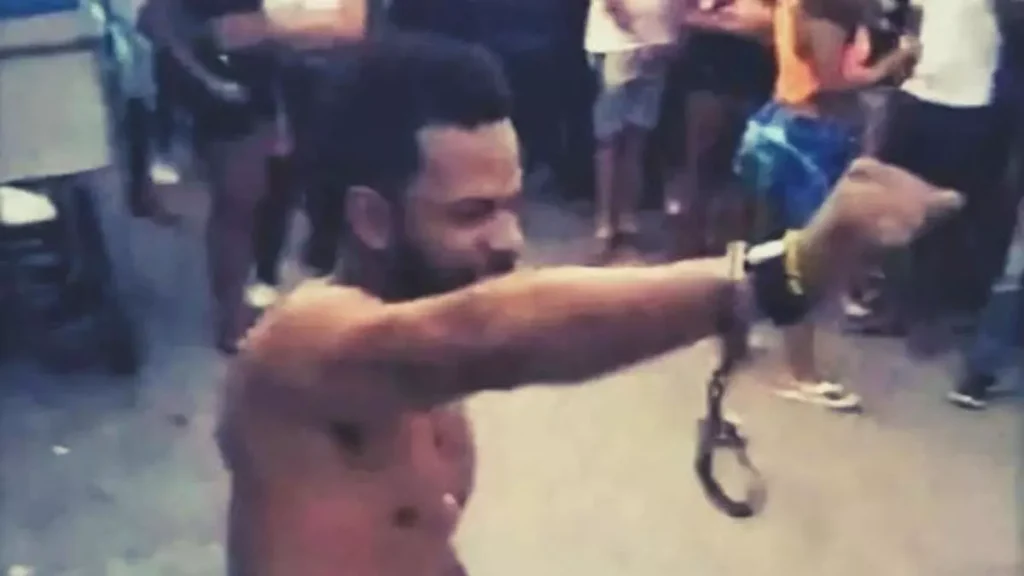
The events for which they were prosecuted took place in early April of that same year when they organized a street party outside Damas 955, the headquarters of the San Isidro Movement and Otero Alcántara’s residence, where Patria y Vida, by then already an anthem of dissent, was sung. On that occasion, the police, who had deployed a heavy operation throughout that area of Old Havana, attempted to arrest Maykel Osorbo, but he resisted. The image of the rapper with a handcuff dangling from one wrist went viral.
More than a year after his arrest, in June 2022, a court sentenced him to nine years in prison on charges of assault, resisting arrest, contempt, public disorder, and defamation of institutions, organizations, heroes, and martyrs.
Last June, the Inter-American Commission on Human Rights (IACHR) concluded that Osorbo’s detention was arbitrary and recommended that the Cuban government overturn his conviction, release him immediately, and investigate the human rights violations committed against him.
“Maykel is a survivor and a fighter, and if I survived, he’ll be alright as far as possible.”
Having just arrived in Miami last Saturday, during an event at the Shrine of Our Lady of Charity where he reconstructed a broken image of the Virgin of Charity as a symbol of Cuba’s reconstruction, Otero Alcántara assured everyone that Maykel Osorbo would be in Miami “very soon.” According to him, the rapper could arrive in the US “in less than a month,” based on information he had received from the US Embassy in Havana. “Maykel is a survivor and a fighter, and if I survived, he’ll be alright, as far as possible,” he added.
The Observatory of Cultural Rights and Anamely Ramos concluded their statement demanding the immediate release of Osorbo and denouncing “the instrumentalization of the Cuban penitentiary system against artists, activists and critical voices that confront the Cuban government.”
Translated by Regina Anavy
______________________
COLLABORATE WITH OUR WORK: The 14ymedio team is committed to practicing serious journalism that reflects Cuba’s reality in all its depth. Thank you for joining us on this long journey. We invite you to continue supporting us by becoming a member of 14ymedio now. Together we can continue transforming journalism in Cuba.