Luis Enrique Valdes: “Most the Emigrants Took ‘La Edad De Oro’ in Their Suitcases”

14ymedio bigger14ymedio, Yoani Sanchez, Havana, 21 April 2019 — Luis Enrique Valdés has inhabited an obsessive spiral for four months. The reason is his efforts is to achieve a facsimile edition of La Edad de Oro (The Golden Age), written by José Martí; a version so perfectly identical to the original that readers will feel transported 130 years back in time when the four notebooks of this monthly magazine aimed at children were published.

This week he responded, via email, to some questions from14ymedio where he details the obstacles, joys and expectations that the project has generated.

14ymedio: Almost every Cuban believes he knows ‘The Golden Age’ by heart. What novelty will this new edition offer over previous ones?

Luis Enrique Valdés: The Golden Age – just to say that it is a title given by A Dacosta Gómez, its first editor – appeared as a magazine. It was a “monthly publication of recreation and instruction dedicated to the children of America,” written entirely by José Martí, which only had four numbers: those corresponding to the months of July to October 1889. This 2019, so they are 130 years old. However, we have known it in the form of a book all this time. continue reading

In these 130 years it has seen the light in the original format only once. This is the Cuban edition in four issues, published in the year of its centenary. That edition, which to be fair I must say is very good, is almost impossible to find, it is very similar to the first and in its spirit we have been inspired, although starting now, for ours, the original numbers of 1889.

At that time it was stapled to a half-page white cardboard stamped with words from Luis Toledo Sande thanking the Office of Historical Affairs of the Council of State, as well as with the credits of that impression, that made the object itself not identical to the Martiana edition. There is something in it that was not in the 1889 edition.

We want this edition to be, for the first time in history, identical in everyway to what came from the hands of José Martí. This means that each issue will be an independent booklet with the exact appearance that José Martí gave to the magazine in 1889, without any additions or deletions in each one of them. We want them to be millimetrically equal to those in New York. That is why a fifth notebook will accompany the collection, as a presentation and study, so as not to touch the facsimiles with so much as a comma and it will include Marti’s correspondence about La Edad de Oro, as well as articles and announcements in publications of the period, unknown until now, and several subsequent essays among which is a very long one by Herminio Almendros.

14ymedio: What changes or vicissitudes did the book go through every time it was published until now?

Luis Enrique Valdés: In the letter known as Marti’s literary testament, written to Gonzalo de Quesada in Montecristi, on April 1, 1895, on the eve of his definitive return to Cuba to begin the struggle, he entrusted him with: “La Edad de Oro, or whatever part of it would suffer reprinting.” Martí’s request was fulfilled ten years after his death. Thus La Edad de Oro was published as a book in Rome in 1905. In Cuba it did not happen until 1932, when Emilio Roig de Leuchsenring published it, forty-three years after its appearance.

The first edition already had misprints, most likely associated with the work of copyists or printers. Most of them were inherited in successive editions. However, most of the current editions are perfectly corrected.

14ymedio: How was the process to get the original version available to the editors of this project?

Luis Enrique Valdés: It began with a worldwide search against the clock. I knew that the magazine had been distributed in five countries: the United States, Cuba, Mexico, Venezuela and Spain. We should not think that this distribution was massive. Absolutely. Martí spent a lot of work to find friends to help him distribute it. In Mexico, no. There was his “brother” Manuel Mercado, to whom he sent no less than 500 copies of the first issue.

In Cuba it came in through Guantanamo. There is still a sign on the site where the magazines were received. So the first thing I did was to consider that in the Public Library of New York there could be copies of 1889. But it was not like that.

I thought then that Dr. Eduardo Lolo, who has a critical edition of La Edad de Oro, could give me a tip about the whereabouts of some collection outside of Cuba. His response could not have been more discouraging: the only surviving collection was the one that Martí had placed in the hands of Quesada, which is currently on the island. That a man who had studied it so deeply told me this filled me with discouragement. However, his research is from the ‘90s. At that time the Internet wasn’t as extensive s it is now. I grabbed onto that to think that maybe there was an accessible collection somewhere in the world that Lolo did not know about.
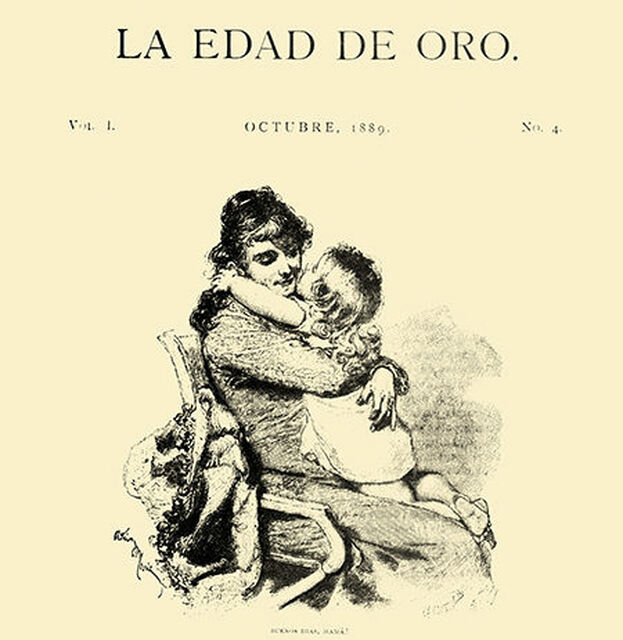
‘The Golden Age’ is an immense source of values. More than one person would be surprised to see it again and realize that it is a text of enormous appeal. (Courtesy)

It was not in the national libraries of any of the aforementioned countries, so I started looking into the libraries of others. Then National Library of France said they had them. Zoé Valdés helped me a lot in communication with them and yes, they supposedly had them. I received a notice with the clarification that, unfortunately, there was a cataloging error.

They had “a facsimile edition of 1989” that is not in the public domain and I had to ask the editors for permission. It was the edition I spoke of before; With all logic they had confused it with the original ones since to catalog the magazine they did not need to open it, as all the information – editor, author, year, month, number, city – everything appears on the cover. After thirty years and the high degree of conservation that documents can have in dry and cold countries, it was normal that they would confuse the 1989 one, which had aged very badly, with the one from 130 years ago.

It occurred to me to call my good friend María José Rucio who is the Head of the Manuscripts and Incunabula Department of the National Library of Spain. The first thing she told me was something I already knew: they did not have it. But she was immediately willing to lend a hand, giving me hope because librarians understand each other very well.

A few days later, in which I continued to delve into whatever library was going through my mind, she called me to tell me that a certain library in Madrid – that of the Agency for International Development Cooperation – which I had not yet looked at because I was focused on older libraries – claimed to have them. I called the AECID immediately.

A very kind gentleman who was already aware of my inquiries helped me. He looked at his catalog and assured me, firmly, that he had the originals. I was invited to spend the weekend in the Madrid house of my friend Thais Pujols, and I raced from Valladolid to arrive just before the library closed. It was a Friday.

I emerged from the mouth of the Moncloa Metro Station with an overwhelming emotion. I was running, crying, with Alberto Maceo on the phone. In just three minutes I was going to be before them at last. I arrived. I was helped by a being full of light: Rodrigo Sorando. He had bad news for me: his colleagues believed that it was a facsimile. I only had to see the backs to realize that, probably, they were not the ones I was looking for. And on opening them came the confirmation of the disaster: the same mistake as the French.

Rodrigo probably noticed that I was about to cry. My lips and hands trembled. I did not have the slightest hope of finding them, but he told me about a tool that could do in half a second what I had been doing for half a month on my own: search in all the libraries of the world at the same time. “You have it in Paris.” And I, no, no, which is the same as here, and then the light came, but a still dim light: “They’re in a Miami library!”

That weekend I could not contact them, but the next week the great news came: they were there!

Several Spanish institutions that by absolute discretion I do not mention, were willing to establish a library exchange to obtain high quality copies that I needed. That type of reproductions can reach a very high price, so an exchange like the one we were proposing, and the free gift later, smoothed the road a lot.

However, from Florida they did not hesitate in their generosity: they would freely give the copies with the characteristics that we needed, even if they were immense, without the need of the intervention of the Spanish institutions, with the only condition that this be confirmed in the special number of the edition. That’s how it will be and there you will be able to know, with details, who these people are who are so charitable and such excellent professionals.

In the middle of all this process, I managed to join my purposes with a person who is one of its fundamental pillars: Carlos Martín Aires. Besides being one of my greatest friends, he is also one of the best editors I know. His experience in editorial work is immense and his absolute dedication to work will ensure, with all certainty, La Edad de Oro remains exactly as we dream it.

14ymedio: Any anecdotes about what happened in recent months and what is there anything you can say now that the project has started?

Luis Enrique Valdés: I think the most beautiful anecdote is in the genesis of this idea. My friend Alberto Maceo, a brother to me, insisted on inviting me to spend the end of the year with him and his family in Flensburg, the city where he lives in northern Germany. What we couldn’t get out of our heads is that, to the joy of being together on holidays, we were going to add the emergence of such a beautiful idea and the best legacy of that trip. Alberto and Petra, his love, prepared the room usually occupied by their children for me. They have a bookshelf full of books there and, of course, I went to browse.

Among them are several editions of La Edad de Oro. All of them very unattractive. And as a throwaway comment I said: “What bad editorial luck has had La Edad de Oro!” Making a beautiful book is the result of a series of successful decisions. That magazine was conceived by Martí with immense good taste. Both the form and its contents were meditated and measured by him with exquisite manners that those later editions have sacrificed.

CAPTION: With these pieces is built, as it can, a possible Cuba on this side. In this Cuba, as it is logical, this temple of our childhood that the Martian magazine is. (Courtesy)

So Alberto, knowing that the edition of books is a weakness for me, snapped at me: “Well, make one that looks beautiful to you.” In the year that began the day after that conversation in Flensburg, this year, La Edad de Oro turns 130. So when Alberto told me that I was completely clear. And as soon as I set foot in Spain, I set out to find the originals, the only way to make a responsible facsimile edition. As I have called, all this time, the copies of that first edition of New York: “The originals.”

14ymedio: They have launched a fundraising campaign to get the five notebooks published. How is the initiative going so far?

Luis Enrique Valdés: As of now we’ve collected 30% of the total. We are still a long way from achieving it, but there’s still time. We can’t say we’ve got the wind in our sails, or that it is soporifically slow. There are days when it slows down more and I feel immense discouragement, others advance a little and hope returns.

If four hundred Cubans, or non-Cubans who are kind enough to contribute, join in this noble purpose, providing the minimum that the rewards indicate, we will achieve it. It doesn’t seem to be too much. It would be really sad that La Edad de Oro does not have this special edition with its 130 years because 400 Cubans have not agreed on it, after everything that this magazine and “the man of the Golden Age ” have given us as a legacy.

14ymedio: What a José Martí who lived so many years in exile returns in an edition also promoted by emigrants. More than coincidence?

Luis Enrique Valdés: I think that more than coincidence it is something natural. Those of us who carry on our shoulders the weight of not living in our Homeland, as he brought it, we are always aware of the memory of the Island. One leaves there with fragments on their backs.

This experience has led me to speak with hundreds of Cubans from exile I’ve directly asked to collaborate. Most tell me that, in their crammed suitcase, they left with their copy of La Edad de Oro. And those who did not, tell me that if there is something they remember with pain it is to have left it there. With those pieces one is built, as far as one can, a possible Cuba on this side. In that Cuba, as it is logical, this magazine created by José Martí is a temple of our childhood.

14ymedio: In times of ebooks, video games and mobile applications, what is the attraction for Cuban children to look at this magazine again?

Luis Enrique Valdés: As we have said, La Edad de Oro is an immense source of values. More than one person would be surprised to return to it to realize that it is a text of enormous appeal. It is true that today’s children are very enthralled by new technologies and this, properly channeled, is not bad. However, the charms that the printed book has always had, its touch, its smell, and this time the knowledge that what you have in your hands has the exact appearance of what Martí created for them, cannot be substituted with anything.

__________________________

The 14ymedio team is committed to serious journalism that reflects the reality of deep Cuba. Thank you for joining us on this long road. We invite you to continue supporting us, but this time by becoming a member of 14ymedio. Together we can continue to transform journalism in Cuba.
University Autonomy is Not Compatible with a Police Officer’s Pistol

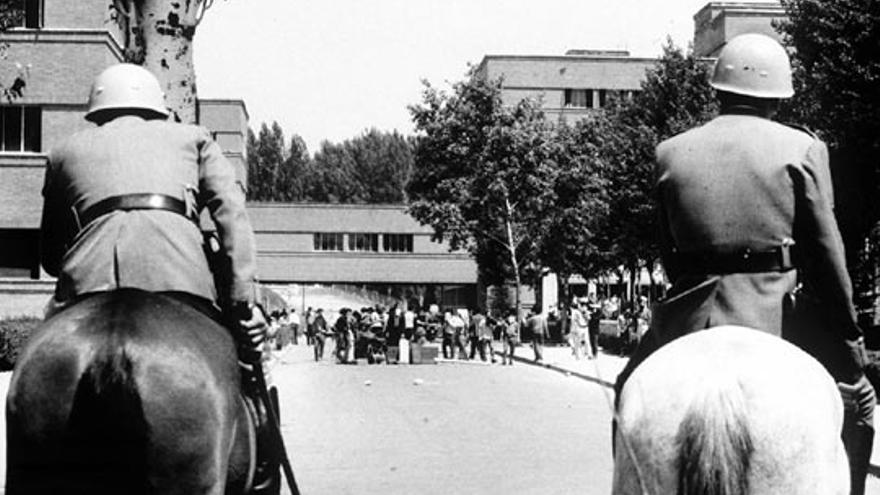
Police facing student demonstrators during the Franco dictatorship in Spain in 1968. (Courtesy)

14ymedio bigger14ymedio, Rosa Pascual, Madrid, 13 April 2019 — Unlike in Cuba, the images of police officers beating unarmed students in Spain are gray. And called by the color of the uniform, the “Grays” were the members of the body responsible for order in Franco’s Spain. And the photographs from that era, the last years of the 1960s, are also gray, with their caption, “Running from the Grays,” imprinted in the vocabulary of generations of Spaniards in the present and the future.

The anti-Franco student movement swelled in those years in the Spanish universities and the Grays came, usually on horseback, to break up with blows of their truncheons those crowds of wayward young who rose against the regime. For this reason, one of the main achievements of democracy in Spain was the recovery of university autonomy, enshrined as a fundamental right in Article 27 of the 1978 Constitution.

University autonomy is at the very origin of the institution. In the eleventh century, the Emperor Federico Barbarroja granted shelter and protection to the University of Bologna (the first in history) against the Government. Since then, it has been considered one of the most powerful mechanisms with which to protect Higher Education from political fluctuations and external interference, endowing the institution with its own governing and administrative bodies that protect its independence and freedom. continue reading

The context in which this concept must be placed is that of an institution that is constituted from its beginnings as a center of ideas, where intellectual restlessness, critical thinking and the exchange of opinions are part of its nature and favor an environment more prone to the questioning of authority as a given.

It is, therefore, natural that university autonomy is intrinsic to democracy. Or, in other words, incompatible with the dictatorship.

One of the most controversial aspects of university autonomy, even in consolidated democracies, is the inviolability of the campus. This implies the assumption that the Police Forces and State Security Forces can not enter the campus unless expressly authorized by the highest authority, the rector.

During the Transition to Democracy in Spain, the pitched battles between Franco’s police and the student movements were very recent. It counted for something that some of the politicians who sat in the first Courts of democracy had been colleagues or teachers of Enrique Ruano, an iconic student leftist who died in strange circumstances (they claimed he fell out of a window) during an arrest for distributing labor union leaflets.

The newly born Spanish democracy struggled for decades to keep the police as remote as possible from the universities. The protests inside the campuses, which in the worst case involved some graffiti or vandalism, were allowed to wind down or resolved or by negotiation between the student bodies and the rector. The security guards seldom dealt with demonstrations or disorder and, in no case, did they carry firearms.

On a few occasions the police have intervened  on a Spanish campus in democracy. A judgment of the Supreme Court of 2003 guarantees that the entry of agents into the premises does not in itself violate the right to university autonomy and affirms that the institution lacks independence with regards to citizen security or the right to assembly or demonstration.

However, rarely has there been a political, academic or police authority that wants to be the one who allows the riot police to dissolve a protest with blows, which would involve to their name in the slightest shadow of the memory of the Franco regime’s police. This presence not only implies the inability to resolve conflicts in a dialogued manner, but it also violates some of the fundamental pillars of democracy and the fundamental rights of citizens.

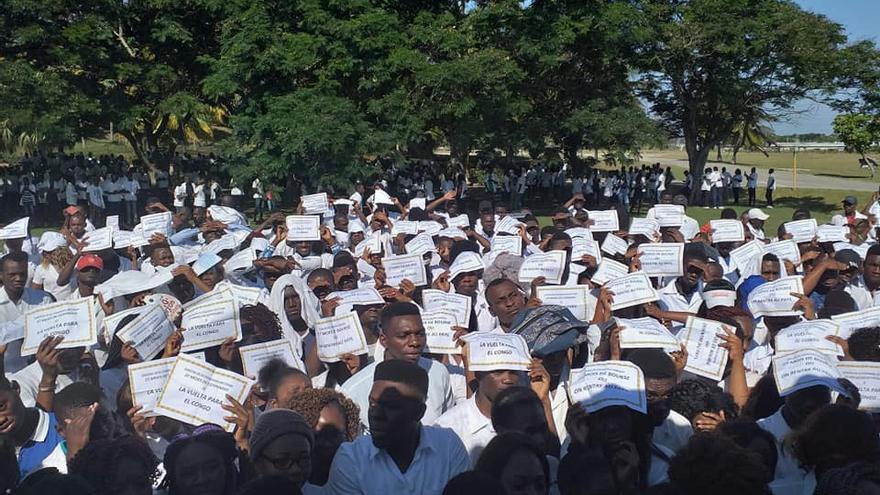
The image of an agent of the National Revolutionary Police pointing a gun at an unarmed Congolese student, no matter how enraged the protest, should be intolerable in a country that, although we know it is not a democracy, does claim to defend the rights human beings in every international forum.

With a new democratic Constitution, which will not be the same as yesterdays, the photos of police hitting students in Cuba will continue to be in color, but very likely they will go down in history.

________________

The 14ymedio team is committed to serious journalism that reflects the reality of deep Cuba. Thank you for joining us on this long road. We invite you to continue supporting us, but this time by becoming a member of 14ymedio. Together we can continue to transform journalism in Cuba.
Congolese Students Who Protested in Havana Apologize

African students banded together on social media under the heading “I Won’t Go Home without My Diploma”

14ymedio bigger14ymedio, Havana, April 12, 2019 — Congolese students who staged a protest this week in Havana have apologized to Cuba in a statement posted on Facebook on Thursday. The declaration comes a few days after a major clampdown on the protesters by the island’s police and military.

The African students joined together on the social network under the heading “Je Ne Rentre Pas Sans Mon Diplome” (I Won’t Go Home without My Diploma). In the post they explained that they do not hold Cuban authorities responsible for the non-payment of their stipends. Instead, the Congolese students blame their own government for the twenty-seven month delay in payment.

“We wholeheartedly extend to the Cuban people our sincere apologies for the inconveniences and misunderstandings caused by comments and photos published on this page,” wrote the students, who were part of a peaceful protest at the Salvador Allende School of Medicine in Altahabana. continue reading

The statement, which was immediately picked up by the island’s official press, explains that the students’ motivation in calling the strike was not to criticize Cuba. The sole intention, they explained, was to “draw attention and stir the conscience of Congolese authorities.”

The students denounced their country for abandoning them “without the sligtest remorse” to the care of the Cubans. They added, “During last twenty-seven dark months we could only count on the support of Cuba and, in some cases, our families.”

Missing, however, was any mention of the repeated criticisms some of them had made about the medical school’s bad food and poor living conditions.

Cubadebate, an official online media outlet that published the Congolese students’ letter, took the opportunity to attack what it considered to be a “political manipulation” of the issue.

Though initially there was no reporting on the student protest in front of the embassy of the Democratic Republic of Congo in Havana, the news site claimed the incident on the university campus last Monday was twisted to “damage the image of the Revolution.”

“It is difficult for us to watch our words being taken out of their initial and true context by some people to serve selfish and defamatory ambitions against the Cuban people,” the students wrote in their letter.

Videos were posted that same Monday afternoon showing uniformed officers from the National Revolutionary Police as well as from other special units barging into the medical school to restore order. In a brief statement explaining what happened, the Ministry of Public Health said it would not tolerate such “lack of discipline.”

In their letter on Thursday the Congolese students noted they were seeking to “restore the truth and dispel any misunderstanding.” They added, “We say to the enemies of Cuba who distort our words, ’We are never going to be the weapon you use to destroy this beautiful country.’”

They went on to say, “Since our arrival on the island Cuban authorities, whenever possible, have put at our disposal whatever they had… We are not the the enemies of the Cuban people. On the contrary. We are and always will be their most faithful allies.” They added, “Just as we have risen up to defend our rights, so will we, whenever necessary, do the same to defend the honor and reputation of the Cuban people.

__________________________________

The 14ymedio team is committed to serious journalism that reflects the reality of deep Cuba. Thank you for joining us on this long road. We invite you to continue supporting us, but this time by becoming a member of 14ymedio. Together we can continue to transform journalism in Cuba.

The Annoying Wait of the Luyano Residents

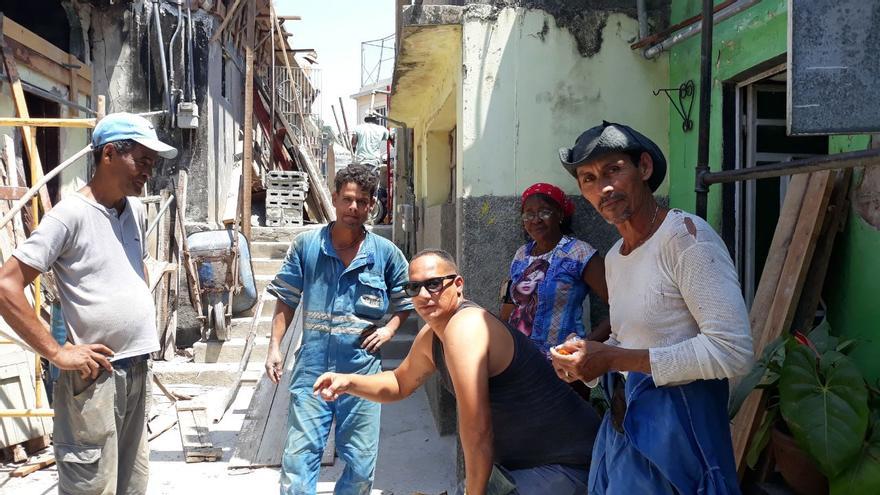
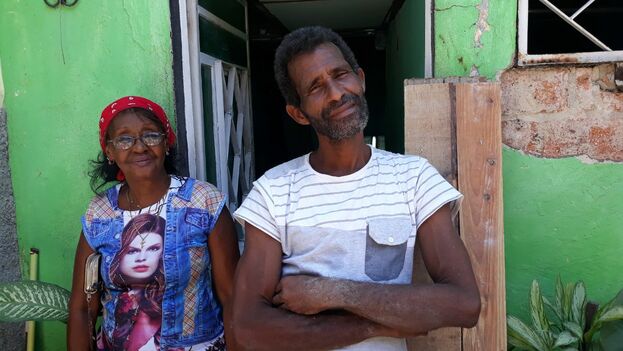
Mercedes Caballero with red handkerchief is part of the brigade March 13 that works in the reconstruction of the Otero area. (14ymedio)

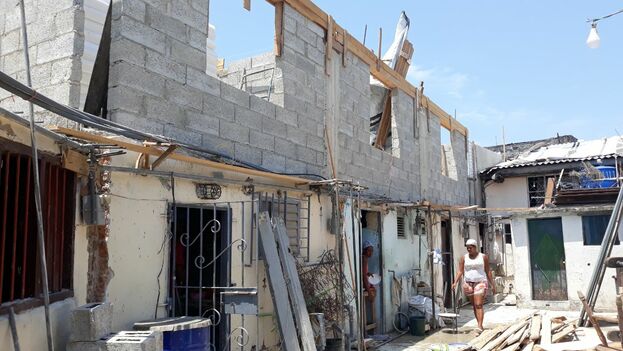
14ymedio bigger14ymedio, Luz Escobar, Havana, 18 April 2019 — Sitting at the entrance of his house, Yanisley Valdés blocks the sun on his face with his hand and does likewise and the swirls of dust that rise with the winds of Lent. Since the tornado of January 27 devastated his home, his days are reduced to a succession of negotiations that do not lead to anything. His roof is still waiting for demolition and his room is filled with the materials it has taken him months to obtain.

One of the reasons why the repairs in Luyanó incomprehensibly go on forever is the lack of materials, which seem to be lost at some point in the chain, according to one of the workers who is rebuilding the Otero site, in front of Valdés’ house. continue reading

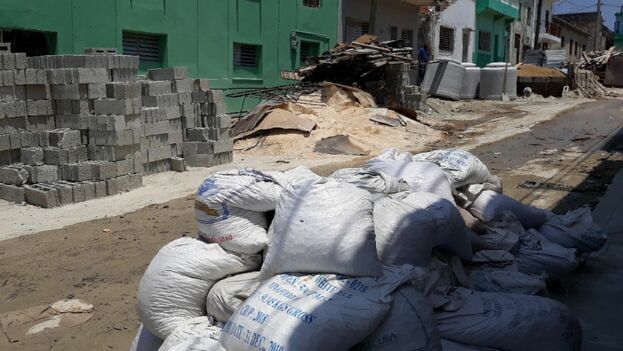
“If you lack a nail, you have to stop. Right now we don’t have the electrical boxes to install, we do not have nails for the formwork, the other day it happened, the same as now, the supplies did not come. Finally we got what we needed five o’clock in the afternoon, almost when we were leaving, and we left at almost ten o’clock that night. That’s not right, I do not understand why those things happen, because onm paper there is everything. There is money for the materials, which in turn are in the warehouse, but here they are not arriving on time,” he explains.

Yanisley Valdés sat at the door of her house on Reyes y Mangos street in Luyanó. (14ymedio)

There, despite the shortcomings, the picture is different than in the home of Valdés. There are dozens of workers from the March 13th brigade who work from morning to night. Juan Antonio, one of the workers, says that he hopes that “by February or March of next year” all the works in the Otero neighborhood will be finished and together they can celebrate “the happiness of delivering everything new and with quality.”

The residents are happy with their work, although, again, the sticking point is the tools. “They arrived here the first week after the tornado and the truth is that they have tremendous willingness to work,” one of the residents tells this newspaper while serving lunch to the workers.

“Here the problem is that there is a lack of materials and that is why it doesn’t go any further, they are stopped right now because supplies have not come in. I stay at my son’s house, I come every morning to help and I stay until late. The buses are wearing me out, but this is my home and I want it fixed soon,” says Mercedes Caballero, one of those affected by the tornado, tells 14ymedio. She has not missed a single step of what it takes to build a new roof on your home.

Mercedes Caballero at the entrance of her house next to one of the workers. (14ymedio)

Yanisley Valdés, on the other hand, has so far barely been able to buy a water tank, rebar, stone and cement. To prevent the roof from coming down, the interior of the house has been propped up, but the brigade that has to demolish the roof still doesn’t come. In her case, the slowness of the bureaucracy has been the first obstacle she has had to face. And it continues.

Four days after the tornado, Valdés went to the office to start the procedures and recover her house, but she had to wait two months for a technician to measure the house and obtain the document for the purchase of the materials.

The waiting did not end there. “I was told the site, very close to here, but there was no truck and they sent me to Alma’s site, which is very far away. Thursday I went because they told me there was concrete, but when I got there, I had to sign in first. I was ready but the person responsible for carrying it out was not in. I got up on Friday, I arrived at about five in the morning, and there were so many people in front of me, I got number 49.”

So that day she didn’t achieve her goal either. The authorities at the supply site told her not to wait, because in one day they only dispatch five people. Valdés has taken five days to get some of the materials, but others that she needs are still missing. She paid for everything in cash, without credits or subsidies, although she did get the reduction of 50% authorized by the Government to deal with the construction crisis derived from the tornado.

Otero under construction. (14ymedio)

“Here I am, still waiting for the demolition, they told me they were going to send a brigade to demolish the second floor that is falling in, but ’you have to wait, now there is no brigade’, ’they are all working, you have to wait’. That’s the only thing they can say every time. I’m going to protest,” he complains.

While she spends his days here and there, she lives in the house of her ex-husband and father of the youngest of her two children. “That’s in Lawton, every day I have to get up at six in the morning to take my kids to school, then sit here, and in the end I lose the whole day.”

In addition, Valdés complains that she is not treated well when she goes to the offices or has received confusing information. “At one point, they told me that for the houses with property there is no brigade available, but another told me that there is and that I have to wait.”

Some materials that Yanisley Valdés has not been able to keep in his house are in the middle of the street like those sacks of stone. (14ymedio)

However, what angers her the most is that she has not been given a shelter while the situation of her house is resolved. “The lack of respect is very great, I am a woman with two children, they have not offered me shelter, I can not cook here, I have everything in sacks, I can not even walk,” he says.

“All the work that I’m going through and it turns out that I also have to come and hear lies. Diaz-Canel said clearly on television that everyone will have their situation resolved and that women with children are a priority, the question is when and how will it be. They have not explained to me, I’m going to wear out my shoes from so much going from one office to another, there’s a big mess, they work as they please.”

According to the latest official figures, released in March, of 7,923 homes affected, 2,480 have been totally resolved. The President of the Government of Havana, Reynaldo García Zapata, affirmed that all resources for reconstruction are assured and that 90% of the victims have already purchased the resources they need. But those who don’t appear in the statistics still see the open sky from their homes.

_________________

The 14ymedio team is committed to serious journalism that reflects the reality of deep Cuba. Thank you for joining us on this long road. We invite you to continue supporting us, but this time by becoming a member of 14ymedio. Together we can continue to transform journalism in Cuba.
Rapid Response Brigades Reactivated in Cuban Universities

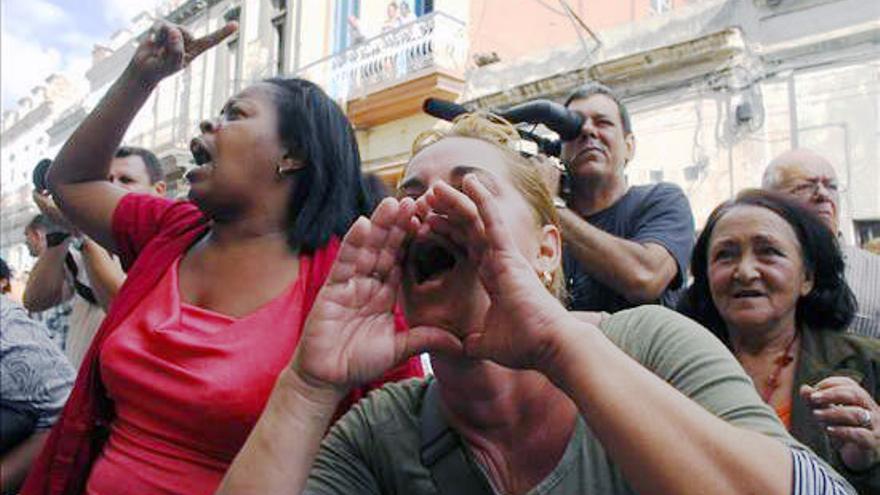
A Rapid Response Group stars in an act of repudiation against the Ladies in White. (Cubasindical)

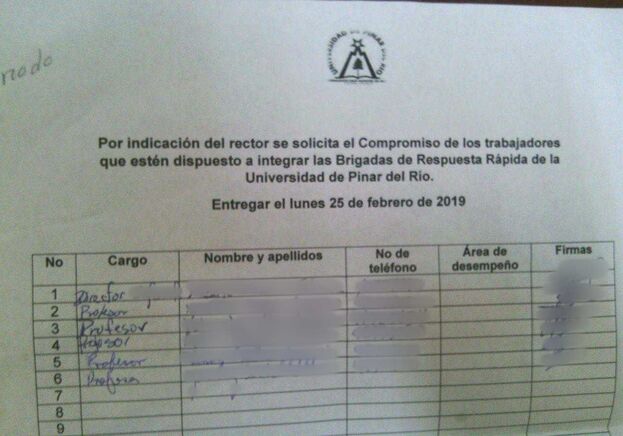
14ymedio bigger14ymedio,  Marcelo Hernández, Havana, 14 April 2019 — In several Cuban universities, professors and directors are being required to ratify their membership in the Rapid Response Brigades (BRR), para-police groups destined to confront popular protests. Teachers must sign a document with the commitment to join these groups, according to testimonies and documents collected by 14ymedio.

“At the end of February they circulated a page where each teacher had to put their name, position and phone number, in addition to adding their signature as a commitment to be part of the Rapid Response Brigades,” a young professor at the University of Pinar del Rio who preferred anonymity told this newspaper. “Everyone in my department, we all signed,” adds the teacher who works in the computer area.

Since its inception in the early 90s, the Rapid Response Brigades were conceived as a vigilante organization that controlled outbreaks of popular dissent. The Cuban authorities wanted to avoid the image of uniformed people repressing the people and founded these bodies of “brown shirts” as the first ring to neutralize the protests. continue reading

The BRRs have had a particult participation in acts of repudiation against opponents and activists, especially against the Ladies in White movement. But their consecration arrived in August 1994, when together with the police and armed with sticks they faced those who took to the streets in the popular revolt known as El Maleconazo which was the preamble to the so-called Crisis de los Balseros (Rafters Crisis).

“I was surprised because I had not heard about these brigades for years, but I think that now it is something more formal, that they will never call us to do anything,” says the professor from Pinar del Río. “A colleague of mine was on leave in those days and they called her to come and sign because they said it was very important and that the country is going through difficult times in which there are new threats.”

The form, to which 14ymedio had access, details that the commitment is carried out at the request of the rector of the “Hermanos Saíz Montes de Oca” University of Pinar del Río (UPR), the doctor of educational sciences, Yorki Major Hernández. Graduated initially with an English Degree, Major Hernández was promoted from teaching and administrative positions to reach his current position.

Registration form to belong to the Rapid Response Brigades at the University of Pinar del Río. (14ymedio)

This newspaper contacted by telephone several of the professors that appear in the commitment document, but none of them wanted to make statements about their affiliation with the Rapid Response Brigades. Nor did they deny the authenticity of the return or the process of reactivation of these shock troops. “I have every right to belong to whatever I want,” said one of them before hanging up the phone in the middle of the conversation.

“The Rapid Response Brigades have never ceased to exist in Artemisa,” says Niurka, 42, who lives in the municipality of Candelaria. “Last year, when Defense Day was held in this area, many workers from the state sector were mobilized and contingency exercises were carried out in case of massive protests, the members of the Rapid Response Brigades were summoned.”

“In order to expand knowledge and learn to face special situations,” was now the call for these practices was reflected the local press. “It was nothing secret, it came out in the newspaper, but of course it caught our attention to talk about something that many thought had ended that it was a Special Period,” adds Niurka.

In the training, Niurka recalls that they insisted that the people themselves had to “defend the Revolution” and they were taught some techniques to “keep [the protesters] silent, avoid their shouting counterrevolutionary slogans and even how to immobilize” elements disaffected to the process. They also emphasized “being careful not to present an image of physical violence to people who are recording with mobile phones.”

Unlike the decade of the 90s, when communications on the island were very precarious, Cubans are now making more and more intense use of mobile phones and social networks. In recent months there have been viral images of protests against Miguel Díaz-Canel’s caravan in a neighborhood affected by a tornado in Havana and numerous images of violent arrests of activists.

A report of the Inter-American Commission on Human Rights, dated October 1996, described the BRR as groups that “the Cuban government throws into the streets with weapons and clubs to beat its opponents.”

The BRRs have not been deactivated since they were created almost 30 years ago but have languished in the last decade. Now, with the increase in social unrest due to the rise in food shortages, the deterioration of public services and the rising cost of living, the authorities seem worried about a possible social explosion and are dusting off these vigilante groups.

Teachers of the “Marta Abreu” Central University of Las Villas and of the Havana José Antonio Echeverría Technological University, also confirmed to this newspaper that a similar form has circulated in recent weeks among professors, administrators and directors of these centers of higher education. So far there is no confirmation that the commitment has also been extended to the students.

The reactivation of the BRRs revives the memory of many who were part of these groups or were victims of their acts of repudiation.

Roberto, 68,  who emigrated to Miami remembers that day very well. “I worked in a warehouse on Zanja Street in Centro Habana when they told us there was a provocation near the Ameijeiras Hospital and that we had to go out and confront it,” he recalls now, using a pseudonym. “They gave us construction workers’ helmets and rods, but on the way I lost the group on purpose because I knew I was not going to be able to hit anyone.”

Now, working with a contractor repairing homes in Florida, Roberto says he could not fulfill his duty as a member of the BRRs in part because his eldest son “had left that early morning for the Regla Ferry because the rumor had spread that they were going to leave for the United States.” Just thinking that “among those who were going to take hits was my son, paralyzed me.”

Finally the young man managed to get out on a raft, be picked up by the US Coast Guard and settle in Miami. A decade later, he managed to get his parents out of the island. However, Roberto rarely tells his story because he fears that they will point him out in public as a member of the BRR, a past membership that could cost him his residence in the US.

Recently, the Foundation for Human Rights in Cuba (FDHC), based in Miami, launched the Cuban Repressors initiative, to “identify, investigate and collect information on the military (MININT / MINFAR) or paramilitaries (Rapid Response Brigades)” that exercised “violent political repression against the citizens” and now live in the United States.

“I signed up not to lose my job but I never hurt a fly,” says Roberto. “Although I do remember co-workers who enjoyed coming out with the od to break their heads, but most of them do not want to remember that now, and many even live here in the United States and they show themselves to be tremendous anti-Castro people.”

______________________

The 14ymedio team is committed to serious journalism that reflects the reality of deep Cuba. Thank you for joining us on this long road. We invite you to continue supporting us, but this time by becoming a member of 14ymedio. Together we can continue to transform journalism in Cuba.
US Imposes New Restrictions on Travel and Remittances to Cuba

John Bolton, National Security Advisor to US president Donald Trump spoke at the press conference in Miami. (EFE)

14ymedio bigger14ymedio, Havana, 17 April 2019 — The United States government announced restrictions on travel and remittances to Cuba on Wednesday, as detailed by national security adviser John Bolton in a speech at the Biltmore Hotel in Miami.

Bolton noted that remittances to Cuba will be limited to “1,000 dollars per person per quarter” and that the US Treasury Department will also reduce “non-family travel” to the island, or, in other words, “veiled tourism.”

Likewise, it announced that five Cuban military companies, including Aerogaviota, will be added to the list of entities that with which “direct financial transactions are prohibited” due to their links with Cuban military personnel and services. continue reading

The Secretary of State of the United States, Mike Pompeo, announced this Wednesday in a press conference that on May 2 Titles III and IV of the Helms-Burton law will go into effect, provisions that have been frozen since its approval in 1996, due to opposition from the European bloc.

Washington has warned that no company, whether American or European, will be exempt from its new policy towards Cuba, which allows suits to be brought before US over courts properties expropriated by the Revolution.

“There will be no exceptions,” Assistant Secretary of the State for Latin America and the Caribbean, Kimberly Breier, told a news conference.

“The Cuban regime has exported its oppression to Venezuela for years, and the Cuban military, intelligence and security services keep Maduro in power, which undermines the stability of countries in the Western Hemisphere and represents a direct threat to the national security of the United States,” said Pompeo.

Participating in the announcement this afternoon in Miami were members of the 2506 Assault Brigade, composed of a group of anti-Castro fighters of the so-called “historical exile”, veterans of the Bay of Pigs invasion in 1961, as well as new members representing the “hardest” wing of the opposition to the Cuban Government from the United States.

The Secretary of State said that with this measure, “after more than 22 years, Americans will have the opportunity for justice.”

The Cuban government has reacted immediately by rejecting the predictable measure in a tweet from Foreign Minister Bruno Rodríguez.

“I strongly reject the announcement by the Secretary of State Pompeo of activation of Title III of the Helms-Burton Act, which is an attack on International Law and the sovereignty of Cuba and third States. Aggressive escalation of the US against Cuba will fail. As at Girón [the Bay of Pigs], we will win,” the Minister of Foreign Affairs wrote, adding hashtags to “Cuba” and the “US”.

This policy change will open the door to lawsuits in the US against companies from all over the world, including Spanish hotel chains such as Meliá, Barceló and Iberostar; as well as the Canadian company Sherritt, dedicated to the mining sector and one of the main foreign investors in the Island.

“Sadly, Cuba’s biggest export these days is not cigars, nor is it rum, it’s oppression,” said Pompeo.

That decision promises to inflame tensions with the European Union, whose High Representative of the European Union for Foreign Affairs and Security Policy, Federica Mogherini, warned this month in a letter to Pompeo that the bloc could sue the United States before the World Trade Organization (WTO) if Washington implemented that measure.

The EU already sued the United States before the WTO two decades ago, when the Helms-Burton Act was passed, but it suspended that procedure once the White House agreed to freeze those sections of the Act.

As of yesterday, the European Union warned that it will take the measures that are within its reach to defend its companies, although it waited until the news was official to be more specific.

In a study published in 1996, the US State Department estimated that the activation of Title III would allow between 75,000 and 200,000 lawsuits to be brought before US courts.

________________

The 14ymedio team is committed to serious journalism that reflects the reality of deep Cuba. Thank you for joining us on this long road. We invite you to continue supporting us, but this time by becoming a member of 14ymedio. Together we can continue to transform journalism in Cuba.
Kenyan and Somali Elders Try to Negotiate Release of Kidnapped Cuban Doctors

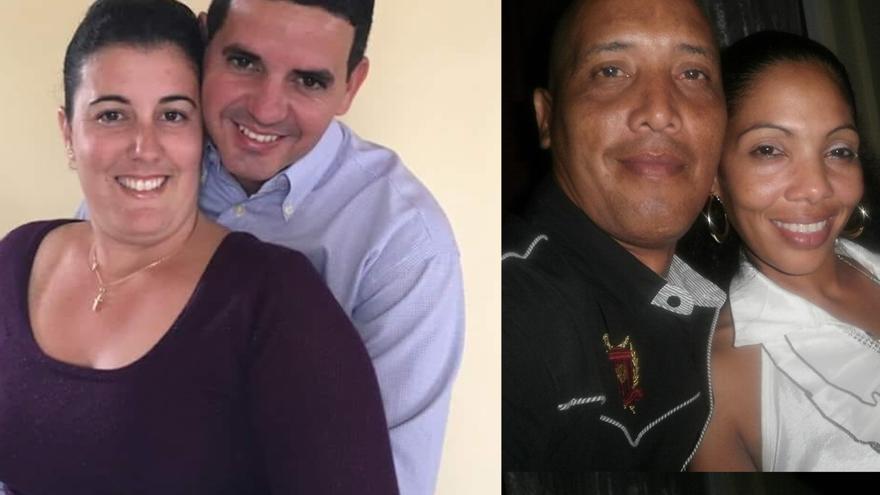
Cuban doctors Landy Rodríguez Hernández and Assel Herrera Correa, with their wives. (Facebook)

14ymedio bigger14ymedio, Mario J. Penton, Miami, 13 April 2019 — The 10 elders from the community of Mandera, in northeastern Kenya, who left for Somalia to negotiate the release of two Cuban doctors kidnapped on Friday morning revealed that the doctors are alive in the neighboring country.

The Kenyan authorities made the decision to evacuate the Cuban doctors who were in the counties of Garissa and Wajir. Wajir’s governor, Abdi Mahamid, said they were ordered to evacuate the two Cuban doctors to Nairobi following a national security warning, Kenyan media reported on-line.

Cuban doctors Landy Rodríguez Hernández and Assel Herrera Correa were escorted to their work at the Hospital de Mandera when their transport was ambushed by two Toyota Probox cars. The attackers killed one of the bodyguards, while the other fled, and they kidnapped the health professionals. continue reading

The doctors were quickly transferred to neighboring Somalia, where Al Shabab, a terrorist group linked to al Qaeda, is fighting to topple the central government and establish Islamic law. The doctors performed surgeries and cared for the local population, including in the neighboring countries of Ethiopia and Somalia.

Kenya had difficulties sending national doctors due to the dangerousness of the area, where there are frequent attacks by Al Shabaab to pressure the Kenyan government to withdraw its troops from Somalia. In January, the terrorist group organized a major attack on a hotel complex in Nairobi in which 26 people died.

This has been the second kidnapping of foreigners in five months by the extremist group Al Shabab. Last November, the Italian aid worker Silvia Costanza Romano, 23, was kidnapped by armed men in the town of Chakama, near the tourist town of Malindi (east). To date, her whereabouts are unknown despite army searches.

The Government of Kenya has deployed its elite troops to search for Cubans, so far with no results. The governor of Mandera, Ali Roba, condemned the attack and asked the elders to initiate talks with their counterparts in Bulahawa and to ensure that the doctors are returned to Kenya, reported The Star.

“We call on the security agencies to do whatever is necessary to save the lives of our Cuban doctors and to bring them back from captivity. I sent my condolences to the family of the deceased officer,” he said.

Landy Rodríguez Hernández and Assel Herrera Correa are part of the contingent of 100 doctors Cuba sent to Kenya in June last year amid heavy protests from medical unions in that country.

According to the digital site Mwakilishi, Kenya pays  4,000 per month for each doctor, a higher figure than paid to their local counterparts. Generally, the Cuban government keeps 75% of the doctors’ salary. The export of health services is the main source of income of the Island, according to official figures, with an annual income of close to 10 billion dollars.

The Ministry of Public Health said in a brief official note published on Friday afternoon that it was keeping in touch with the Kenyan authorities and had created a “governmental working group” to follow up on this “sensitive issue.”

National Assembly Deputy Mariela Castro Espín, daughter of former president Raul Castro, said on Twitter that the kidnapping of doctors was “another hoax of imperialism.”

“The Islamic State responds to them, but they got into a swamp by kidnapping the Cuban doctors,” said Castro, a leader of the government’s National Center for Sex Education.

Assel Herrera Correa is a native of Puerto Padre, in the province of Las Tunas. He graduated as Integral General Practitioner he has participated in “missions” of the Cuban Government in Botswana, Brazil and Venezuela. In Cuba, he has a 17-year-old daughter, Sheyla Herrera, who attacked officials of the Ministry of Public Health in an interview with Radio and TV Martí.

“I do not know anything yet, we do not know anything,” she said, adding that no Public Health official has informed the family about her father’s condition, or what measures will be taken to return him home safely.

Landy Rodríguez Hernández is a surgeon by profession, born in Placetas, province of Villa Clara, in the center of the country. In Cuba he worked in the General Hospital of Remedios. According to the information on his social networks, he is married and has a five-year-old daughter.

______________________________

The 14ymedio team is committed to serious journalism that reflects the reality of deep Cuba. Thank you for joining us on this long road. We invite you to continue supporting us, but this time by becoming a member of 14ymedio. Together we can continue to transform journalism in Cuba.
A New Constitution and "Preparing for the Worst" on the Economy, Says Raul Castro

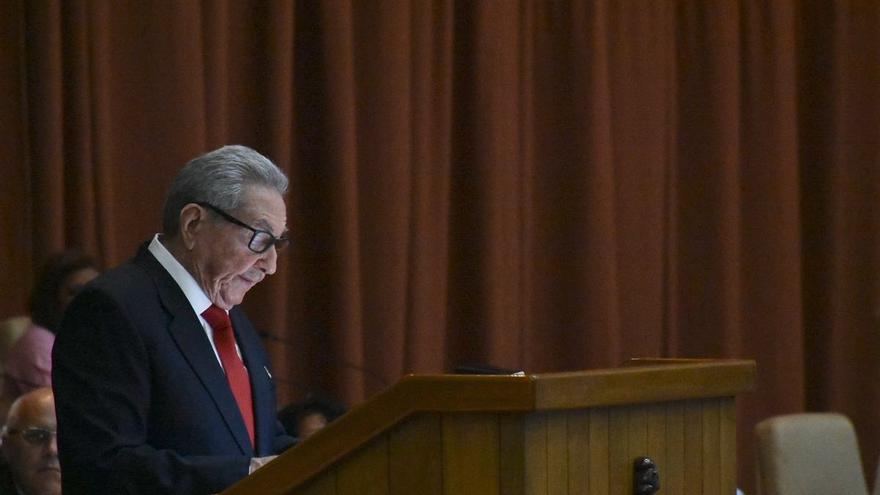
In his speech in the National Assembly, General Raul Castro stood up for Nicolás Maduro and described international pressure on the Venezuelan government as “unconventional methods of warfare.” (@AsambleaCuba)

14ymedio bigger14ymedio, Havana, 10 April 2019 — The proclamation, this Wednesday, of the new Constitution of the Republic of Cuba was accompanied by the bad news that the ex-president Raúl Castro was commissioned to announce in a speech before the National Assembly. He warned that the country faces “additional difficulties and that the situation could worsen in the coming months.”

The day began with a symbolic act, where Castro was not present, in the Camagüey town of Guaimaro, where on April 10, 150 years ago, the country’s first Constitution was approved.

Later, in the Palace of Conventions in Havana, the parliamentarians began the act of promulgating the constitutional text that the ex-governor defined as a “child of its time,” which “guarantees the continuity of the Revolution” and “safeguards, as fundamental pillars, the unity of all Cubans and the independence and sovereignty of the country. “ continue reading

Given the criticism the constitutional text has provoked, Castro said that “as expected, the historical enemies of the Revolution have sought to question the legitimacy of this comprehensive constitutional exercise,” and he noted that among those who voted No in the referendum there were those who rejected only some issues of the Constitution.

With regards to the worsening of the economic situation, the 87-year-old general clarified that “it is not a question of returning to the phase of the Special Period of the decade of the 90s… Today is another scenario in terms of the diversification of the economy, but we must always prepare for the worst variant.”

“Faced with the turbulent scenario that has been formed,” he said, “we have defined as an unavoidable priority the preparation of the country for defense and the development of the national economy,” he said. He gave as an example the measures adopted “in the interest of strengthening the capacity and combative disposition of the Revolutionary Armed Forces and the entire defensive system of the country, under the strategic conception of the war of the whole people.”

In his speech, the general stood up for Nicolás Maduro and described international pressure on the Venezuelan government as “unconventional methods of warfare.” He recalled that last year he had warned that “the siege of the empire is tightening around Venezuela, Nicaragua and Cuba.”

The new Constitution has 229 articles, 2 special provisions, 13 transitory and 2 final. The text was updated with several of the economic reforms of recent years in an attempt to get closer to the reality of the Island, in a way that recognizes private property and applauds foreign investment.

However, the new Constitution does not leave open any possibility for a change in the country’s political model and consecrates the supremacy of the Communist Party of Cuba (PCC) over other organs of powers, in addition to ratifying, in its preamble, communism as the ultimate goal.

With its publication, today, in the Official Gazette, the Constitution enters into force. However, the adoption of a new electoral law is pending, which will be presented in Parliament in July during the next ordinary session.

Then, the Parliament will have three months to elect its president, vice president and secretary, the other members of the Council of State and the President and First Vice President of the Republic.

The new Constitution, which limits the office of President of the Republic to two terms, creates the figures of a prime minister and also of provincial governors.

____________________________

The 14ymedio team is committed to serious journalism that reflects the reality of deep Cuba. Thank you for joining us on this long road. We invite you to continue supporting us, but this time by becoming a member of 14ymedio. Together we can continue to transform journalism in Cuba.
Cuba Establishes Priorities so as Not to Return to the Crisis of the “Special Period”

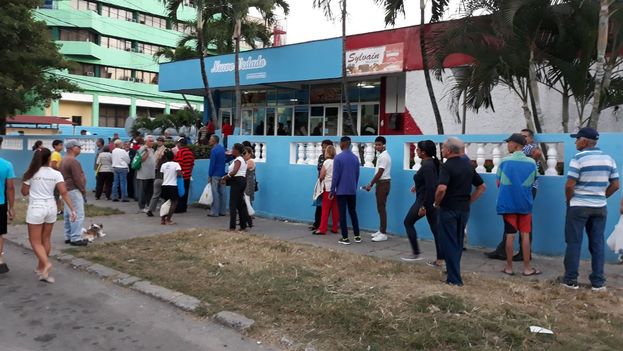
Shortages of food have made the daily routine difficult for Cubans who now have to stand in long lines to buy it. (14ymedio)

14ymedio biggerEFE, via 14ymedio, Havana, 14 April 2019 – Given the renewed pressure from the from United States and the inefficiency of its economy, Cuba established “clear” priorities in a plan looking ahead to 2030 to avoid at all cost falling into a serious crisis like that of the so-called “Special Period” in the decade of the 1990s, according to president Miguel Díaz-Canel.

The harshness of the moment requires us to establish clear and well-defined priorities, so as not to return to the difficult times of the ‘Special Period’,” said Díaz-Canel at the end of an extraordinary session of the National Assembly, which, this week, approved the new Constitution.

The leader, who will complete his first year as Head of State this coming Friday, recognizes that the Island still bears “the weight of administrative inefficiency, import mentality, lack of savings and insufficient income from exports.”

“We cannot exclude the manifestations of corruption and illegalities, unacceptable in the Revolution,” he added, outlining two absolute priorities: preparation for defense and the economic battle.

The priorities will be tourism, biotechnology and the pharmaceutical industry, renewable energy sources, food production, and construction, along with the export of professional services which analysts believe to be the country’s main source of income.

__________________

The 14ymedio team is committed to serious journalism that reflects the reality of deep Cuba. Thank you for joining us on this long road. We invite you to continue supporting us, but this time by becoming a member of 14ymedio. Together we can continue to transform journalism in Cuba.

The Impossible Agreement

Higinio Vélez, president of the Cuban Baseball Federation, signing the agreement with the MLB of the United States. (FCBA)

14ymedio bigger14ymedio, Ernesto Santana, Havana, 9 April 2019 — It was expected that Donald Trump’s administration would cancel the agreement that the Cuban Baseball Federation (FCB) and Major League Baseball (MLB) authorities had achieved. As soon as it was signed last December, Senator Marco Rubio announced that he would act to undo it. Honestly, it didn’t take much effort to achieve that.

Passions aside, the heart of the matter is that, according to the laws of the US embargo, MLB teams can not pay any amount of money to the Cuban government. Although the Obama administration had considered the FCB as a non-governmental organization, for the Trump administration it is one more pro-government institution.

When the agreement was signed, its two weakest points became immediately evident. The first is that the FCB, to legitimize its agreement with MLB, tries to compare itself with the Japanese Baseball League, the Chinese Professional Baseball League and the Korean Baseball Organization, which are private entities, independent of their governments. continue reading

On Cuban television, Higinio Vélez, president of the FCB, used two arguments that prove nothing at all to demonstrate that his organization is, in effect, nongovernmental: First, that the FCB “has existed for some years,” and second, that “it is recognized by organizations such as the World Baseball and Softball Federation, the Pan-American Baseball Confederation and other international institutions related to this sport.”

The other weak point is the clause allows that the FCB to charge a percentage for releasing each player and for the training given to him. For this, a license from the Office of Foreign Assets Control — an arm of the Department of the Treasury of the United States — is required, which the Trump Government will not allow.

The FCB claims to be a non-governmental association. In other words, the same as the Committees for the Defense of the Revolution and the Federation of Cuban Women, which the Cuban government itself created but insists are part of civil society. However, the fact is that the FCB belongs to the National Institute of Sports and Recreation, whose presidency has just been changed by a decree of the Council of State. As a picturesque note, it must be added that the second in command of the FCB is Antonio Castro, son of the late Fidel Castro.

In the declaration of the Cuban entity with regards to the cancellation of the Agreement condemns the actions of Marco Rubio and US National Security Advisor John Bolton, along with the politicization that has been made of this sports agreement “mostly supported by both Cuban and American societies,” but the government of Cuban’s neighbor to the north is not interested in “the welfare and tranquility of the Cuban family.”

In fact, the FCB is trying to convince us, the main reason it signed the pact was to protect our players from human trafficking, the risks of illegal emigration and the “humiliating and discriminatory treatment of which they have been victims” previously.

To demonstrate its goodwill, the Cuban federation had accepted the return to the national baseball team of Yuniesky Riquimbili Betancourt, for many years considered a deserter, who returned after participating in foreign leagues in Mexico, Japan and the United States, where he played nine seasons and, he confessed, was able to realize his dream of proving himself in the best baseball in the world.

Almost at the same time of Betancourt’s arrival in Cuba, Victor Labrada departed, the first player to turn his back on the agreement, a few days ago, unconcerned about the possibility of spending two years without being able to sign a contract with MLB teams, or perhaps anticipating that this arrangement with Major Leagues did not have much future, as has just been demonstrated.

Labrada did not wait to be “liberated” by FCB. He had been chosen among the most outstanding youth athletes of 2018 and captained last year’s Cuban team to the Pan American Under 18. In the last National Series, Labrada grabbed attention when he hit a home run in the first at-bat of his career and finished with a .350 average. However, he preferred to strike out on his own and left legally for Haiti.

At the moment, everything will continue as it was before: every Cuban player, in order to play under the “Grand Tent,” will need a specific license from the US Department of the Treasury. In fact, it sounds absurd that the FCB seriously believed in the possibility that, had the agreement survived, it would be the organization mediating between each player and the team that wanted to hire him.

More absurd, and very cynical, it sounds like the Cuban sports authorities are trying to make us believe that they are really worried about the fate of our players in their dangerous adventure of finding a place in the best baseball in the world.

If they care so much about the players, they could pave the way for them by waiving the right to collect any percentage as a “nongovernmental organization, letting each one sign the contract that they get and, even more, allowing the creation of a truly independent union that looks after the interests of the players, because, as we know well, the FCB, whatever it says, has never dedicated itself to defending them.

______________________________

The 14ymedio team is committed to serious journalism that reflects the reality of deep Cuba. Thank you for joining us on this long road. We invite you to continue supporting us, but this time by becoming a member of 14ymedio. Together we can continue to transform journalism in Cuba.
Cuban Police Raid the Home of Journalist Augusto Cesar San Martin

After the police search of his home, Augusto César San Martín was taken to the Zanja Street Police Station. (Cubanet)

14ymedio bigger14ymedio, Havana, 9 April 2019 — Tuesday, the police raided the home of journalist Augusto César San Martín in Havana, as confirmed 14ymedio by his wife Yanela Duran. After the search the reporter was taken to the Zanja Street Police Station, where he was released after being detained for five hours.

At seven o’clock today nine people showed up to undertake a police search in the independent journalist’s house in Carlos III street, at the corner of Marqués González. The raid concluded at 10:45 am, said Durán.

“An official from the Interior Ministry informed me that Augusto Ceesar would be taken to the Zanja Street Station to be informed of the charges. They took all his work equipment, computer, camera, microphone, flash memories, a NanoStation and numerous documents,” explained Durán. continue reading

San Martín is a frequent contributor to the Cubanet information site and activist of the Pro Libertad de Prensa Association (APLP). During the search this Tuesday they had to take him to the hospital because his blood pressure was very high, his wife details.

Among the nine people involved in the operation were two police officers, two plainclothes individuals who presented themselves as technicians in telecommunications, Lieutenant Colonel Kenya Maria Morales Larrea, two from State Security and two other witnesses from the local Committee for the Defense of the Revolution (CDR), as required by law.

After being released, San Martín explained to 14ymedio that he was shown search warrant but was not allowed to read it. “They came with the justification of looking for communication equipment but they took everything they felt like,” he said. He also explained that when he was released, they did not levy charges or say he would go to trial, but he does have fines to pay. “They gave me two fines, one for having telecommunications equipment and the other for illegal economic activity without specifying absolutely anything about what they are referring to.”

This is not the first time that Augusto César San Martín has been the target of a repressive action. Last December, San Martín was summoned to the offices of the Department of Immigration, Identification and Emigration (DIIE) in Havana’s Plaza municipality. An officer warned him then that if he continues with the work of an independent journalist, he ran the risk of being arrested and having his work tools confiscated.

Last February, the Inter-American Commission on Human Rights (IACHR) published a detailed account of violations against freedom of expression and the exercise of the free press in Cuba. The IACHR denounces that “despite the years that have elapsed and the repeated recommendations on this matter, intolerance continues to be the rule on the part of the Cuban authorities towards any form of criticism or opposition.”

For its part, the most recent report from the Inter-American Press Association (IAPA), presented in Cartagena de Indias (Colombia), denounced that freedom of expression and the independent press fall into the category of “criminal behavior” according to the Cuban Constitution. The IAPA adds that article 149 of the Penal Code maintains the crime of “usurpation of legal capacity” — that is, working in a profession without a license — is used to punish independent journalists.

_________________________________

The 14ymedio team is committed to serious journalism that reflects the reality of deep Cuba. Thank you for joining us on this long road. We invite you to continue supporting us, but this time by becoming a member of 14ymedio. Together we can continue to transform journalism in Cuba.
Requiem for Havana / Fernando Damaso

Fernando Damaso, 19 March 2019 — That Havana is falling apart stopped being news a long time ago. The institutional abandonment, the widespread apathy and irresponsibility, during the six decades that the city has been affected by the “tornado” that hit down in January 1959, have totally destroyed it.

In November will be Havana’s 500th anniversary of its foundation and, for this reason, the authorities have foreseen to beautify it a little, that is, to give it some rouge, so that it looks a little better and is somewhat more presentable, at least for the foreign guests who will surely attend the celebration.

As usual, this involves many more words than actions and, everywhere, the date is announced with the slogan “For Havana the Greatest.”

However, the work that is being done, except in a few cases, is quite sloppy, of low quality and over it by those responsible. Examples of bad work can be seen on Línea Calle in Havana’s El Vedado neighborhood, full of cuts that hinder vehicular and pedestrian traffic, which has been going on for months and, most of the time, without anyone working on it.

Meanwhile, in Nuevo Vedado’s Acapulco Park they have demolished some of its areas, rebuilt and demolished then again, thanks to the bad quality of the work undertaken, also for months. If this is the case in these two examples, I think that very little can be done for the celebration.

We all know that, a situation that represents the deterioration accumulated over decades can not be solved in a few months, but, at least, what is done should be done with quality.

Why Am I Not Going to the XIII Havana Biennial?

The Cuban Artist and “Artivista,” Tania Bruguera. (Twitter)

14ymedio bigger14ymedio, Tania Bruguera, Havana, 14 April 2019 — Before giving my reasons I want to clarify that I admire the work of the curators of La Bienal de La Habana and I do not consider any of my reasons to be their responsibility. Rather, they are a response to the cultural policies of the Ministry of Culture. I am an artist formed by the Havana Biennial and maybe that’s why what is happening pains me more.

I am not going to the XIII Havana Biennial because I do not understand the incoherence of suspending the Biennial in 2017 to redirect its resources to the reconstruction of Hurricane Irma — which was a position posed as aesthetic-ethical — and now, in 2019 , when a few months ago a tornado devastated several of the poorest and most hard-working areas of Havana, the Ministry of Culture (MINCULT) has decided that it is more important to spend a good part of its budget in promoting and using the Havana Biennial to clean up its international image in the face of the campaign against Decree-law 349.

Because MINCULT does not practice institutional transparency. When the Deputy Minister of Culture was asked openly through Twitter for the budget of this year’s Bienniel, the response was a string of personal accusations without, of course, answering the question. continue reading

When I explained that this was an internationally established practice, his response was silence. That silence continues even when the Ministry of Culture and promotional material support to the project of an artist is determined based not on artistic quality but on their loyalty to the government and the use it can make of that artist to enhance the international image of the country.

Because the objective of this Biennial is not to promote Cuban artists (it affects each one according to their possibilities), but that everyone understands that Decree-Law 349 will be applied only to those who are independent and ask uncomfortable questions.

Because it could not attend a party to share my impressions about the artistic merits of a work of the XIII Biennial of Havana while I know that Congolese medical students are being repressed, abused and confronted at gunpoint by Cuban police in the same streets that we walk to go to see an exhibition, and nobody is doing anything to avoid this happening or to show solidarity with the students.

I could not take a selfie among friends while I know that, at that moment, there are artists who are prisoners and constantly harassed because they are considered ’uncomfortable’ and do not fit into the official narrative of the Biennial created by MINCULT.

I can not continue to justify with the official euphemism “bad work” when in reality it means “I’m not getting involved in this because it will bring me problems.” I can not be an accomplice, because I already know with irrefutable evidence that State Security gives orders to MINCULT.

Because the double standards of those who support the protests in the Whitney Museum (because a member of their council is ethically unacceptable), or in the Guggenheim (so as not to accept ethically unacceptable money), are the same people who in Cuba justify ethically unacceptable attitudes and do it with tremendous joy; this is incomprehensible to me.

Nobody is innocent anymore, the person who is blind is so because he took out his own eyes so as not to see. Who cares about the injustices that exist in Cuba? Not those who visit The Biennial, Cuba is not their problem, they are passing through and have exchanged for a party and sunny skies their power to pressure the Cuban government to get Luis Manuel Otero Alcántara and the rappers Pupi and Maykel Osorbo out of jail and to stop harassing Amaury Pacheco, his wife Iris Ruiz and their children.

Injustice can not be a rumor circulating among mojitos and solidarity in places like Cuba is not a ’pretty slogan,’ it is not Venice nor is it Kassel; Cuba is a country that represses freedom of expression (especially when there is no Biennial).

Because my struggle to achieve freedom of expression in Cuba, my defense of cultural rights, to achieve the end of political hatred among Cubans and to defend the right to demonstrate in the streets is not limited to an event but is a life mission.

This is the biennial where no one is innocent anymore, this is the biennial where everyone must act according to their conscience. My conscience does not let me be part of the spectacular process of whitewashing which Mincult has made of the Havana Biennial.

_____________________________

The 14ymedio team is committed to serious journalism that reflects the reality of deep Cuba. Thank you for joining us on this long road. We invite you to continue supporting us, but this time by becoming a member of 14ymedio. Together we can continue to transform journalism in Cuba.
Change and Continuity in Cuba

Tourism is one of the few sectors in Cuba that has seen growth in the past six decades. Nearly all the others have fallen.

14ymedio bigger14ymedio, Carmelo Mesa-Lago, Pittsburgh, April 9, 2019 — The 60th anniversary of the Cuban Revolution is an opportune time to examine how things have changed and how things remain the same in the intervening years. The country’s market economy lasted until 1958 but, by 1961, had been transformed into a centrally planned economy overwhelmingly dominated by state-owned enterprises and collectivized agriculture. The market took a back seat to the central plan.

Though it has failed throughout world, this economic model survives largely intact in Cuba, resulting in monumental economic inefficiency that has negatively impacted growth. The dependence on the sale of sugar, which constituted 75% of total exports in 1958, was replaced with an 80% reliance on professional services and tourism.

Cuba was not exporting any professional services in 1958, while the number of tourists in 2018 was 18 times what it had been thirty years ago, with income from this activity 53 times what it had been back then. continue reading

Oil production is 79 times what it was in 1958 and Cuba now even produces natural gas. The dependence on energy imports has been reduced from 99% to 50%. Previously, social services were mainly limited to urban areas and were provided, at least partly, by privately-run organizations. Now those services are state-managed, virtually universal and free.

On the other hand, Cuba’s foreign debt is 190 times what it as in 1958, and that is after significant debt forgiveness by the Paris Club, Russia and other countries. Annual population growth in 1953 (the last time a census was taken) was 2.1% compared to a 0.2% decline in 2017 due to an increasingly aging population. The proportion of older adults rose from 9% of the total population to 20%. Cuba has the oldest population in the region, which has increased the health care and pension costs.

In regards to continuity, in the past six decades Cuba’s socialist economy has not managed to eliminate or significantly reduce its enormous reliance on trade with, or investment, aid and subsidies from another nation.

A 55% reliance on exports to the United States in 1958 became a 72% reliance on the Soviet Union and, since the beginning of the 21st century, a 44% reliance on Venezuela.

Between 1960 and 1990, the Soviet Union loaned Cuba the equivalent of 58.5 billion euros but only got back 450 million. The rest was written off as price subsidies and non-reimbursable aid. The collapse of the Soviet bloc in the 1990s led to a severe crisis in Cuba. At their peak in 2012, Venezuelan aid, subsidies and investment amounted to 11% of Cuban GDP.

In spite of substantial foreign assistance, the economy stalled — average annual growth from 2014 to 2018 was only 1.7% — due to the economic system’s inherent inefficiency. The target for 2019 is 1.5%, a quarter of the 6% officially acknowledged as the level needed to generate adequate growth.

In 2017, most manufacturing, mining, agriculture and fishing production was below the 1989 level. Only tourism showed a significant increase. Foreign trade has suffered a systematic decline: 6.76 billion in 2017.

The surplus generated by the Cuba’s primary source of foreign exchange — the export of professional medical services provided by doctors, nurses and related professionals — decreased 35% from 2012 to 2018 due to the economic crisis in Venezuela, which had been paying 75% of the cost of these services. Overall trade with Venezuela also fell from 44% to 17% of GDP, the supply of oil fell by half, and all the country’s investments in Cuba were halted.

These problems led to a cut of eight percentage points in social spending from 2008 to 2017 with a resulting decline in health and education services. From 1989 to 2017 the value of pensions fell by 50%, home construction by 80%, and the wage adjusted for inflation by 61%.

The US embargo is blamed for these problems. This was true 25 years ago but Cuba now trades with at least eighty countries, including the US, and has received investments from multiple nations. The embargo still has negative impacts — sanctions are imposed on international banks that do business with Cuba — but the fundamental cause of these problems has been the inability to generate exports to pay for essential imports, both of which have declined in recent years.

Between 2007 and 2018, Raúl Castro tried to solve these problems with market-oriented structural reforms. They had no tangible effect, however, due to extremely slow implementation, disincentives, taxes and an about-face starting 2017.

Neither the new president, Miguel Díaz-Canel, who favors continuity, nor the new Constitution, which was ratified on February 24, have changed the essential economic model. This is an absurd attitude given the collapse of the Venezuelan economy and the teetering of its regime due internal rebellion and international pressure. Maduro’s fall would further aggravate the current crisis in Cuba.

__________________

The 14ymedio team is committed to serious journalism that reflects the reality of deep Cuba. Thank you for joining us on this long road. We invite you to continue supporting us, but this time by becoming a member of 14ymedio. Together we can continue to transform journalism in Cuba.

Cuban Constitution: A False Legacy / Miriam Celaya

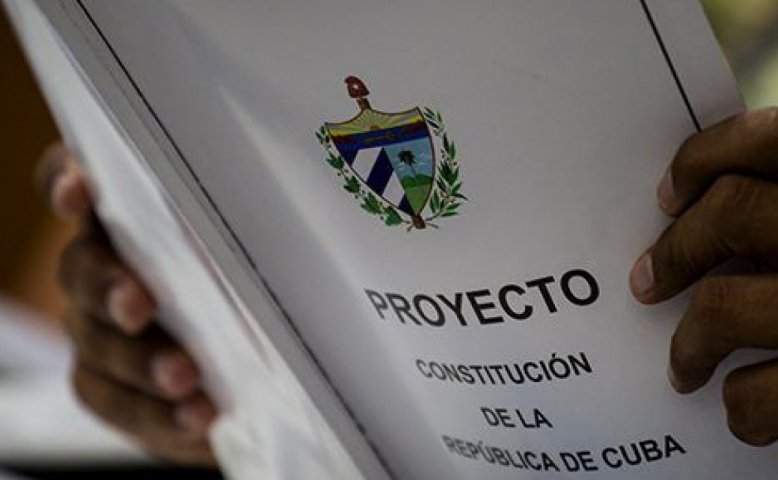
Constitution Project (Cubadebate Photo)

Cubanet, Miriam Celaya, Havana, 12 April 2019 — As implausible as it may seem, 60 years after its arrival in power, the Castro regime has not yet been able to legitimize itself. The self-awareness of the nature of its bastard lineage is reflected with particular force in the persistent insistence of inventing associations of historical continuity with the wars of Independence and their heroes, and also with the civic and intellectual legacy of the Republic.

The matter is not trivial. For the regime, the search for historical legitimacy became an essential strategic issue at the beginning of its storyline. Not coincidentally, Fidel Castro placed the blame for his audacious armed assault on a military barracks on José Martí’s constitutional army, an alarming sign of recklessness and almost suicidal violence completely alien to Martí’s legacy.  However, this pronouncement was ignored by a people too attached to the worship of leaders.

But the epics of the Moncada, the Granma and the Sierra Maestra  ̶ whose essential purpose was the restoration of the model 1940 Constitution – which was tainted in 1952 by Fulgencio Batista’s military coup – disappeared as soon as the Castro’s yearned-for democratic revolution turned into a dictatorship, although many Cubans of that time didn’t notice it. continue reading

Now, in another forced round of acrobatics, today’s Castro regime is, once again, desecrating the historical memory when proclaiming the new Constitution on exactly the same date it was approved 150 years ago, by consensus and by means of a Constituent Assembly of the Republic in Arms, consisting of delegates representing the three insurgent regions of the Island of Cuba  ̶ Oriente, Las Villas y Centro (Camagüey) ̶  the first authentically Cuban Law of laws: La Constitución de Guáimaro.

For further derision, it was Army General Raul Castro, First Secretary of the Communist Party and heir dictator by dynastic line, who proclaimed the spurious ‘Magna Carta’ (today’s constitution) instead of the “civil power” representative, supposedly sanctioned at the National Assembly.

According to the General, the recently imposed new Constitution, “is a continuity” of the one at Guáimaro’s (1869) and of the Constitutions of Jimaguayú (1895) and La Yaya (1897), “because it safeguards the unity of all Cubans and the Homeland’s independence and sovereignty.” The truth, however, is that there are not only abysmal differences between the old Constitutions and the shady Castro regime’s edict recently established, but that the latter means a true regression with respect to those in terms of recognition of civic rights and freedoms.

The first difference is in its origin. The the genesis of the current legal embryo was the dictatorial Power’s creation of a dark Commission charged with writing, in greatest secrecy, what would be the “Project” of a Constitution. This “Project” would later be submitted to what they called “popular consultation”  ̶  whose debates, “contributions” and proposals were never published ̶   a process that continued with the formal amendments carried out by the same mysterious “Commission,” always under the autocratic power’s baton, giving us the above-mentioned Project, which today was officially consecrated as the “Constitution.”

Regarding the differences in essence and text, it is enough to mention, for example, the perception among the delegates to the Constituent of 1869 of the need to divide powers, a democratic-liberal spirit that begins to be reflected in the Constitution of Guáimaro, in spite of it being a political proposal under war conditions and being destined to exist only while the armed conflict with Spain lasted. In its Article 22 (of a total of 29 Articles) it endorses: “The Judicial Power is independent; its organization will be the object of a special law”.

Later on, Article 28 establishes rights that, 150 years later, are only remote aspirations to essential rights, whose exercise may result in repression, imprisonment, or exile of Cubans: “The Chamber will not be able to attack the freedoms of worship, printing, peaceful assembly, education and petition, nor any inalienable right of the People.”

So significant was this democratic principle for the founding fathers that they kept it in force in the Constitution of La Yaya, through its Thirteenth Article: “All Cubans have the right to freely express their ideas and to meet and associate for the lawful purposes of the living.” A basic right of every free and democratic society because of which thousands of the best Cubans of that time lost their lives, and which found a place in the magnificent Republican Constitution of 1940, only to be violated by corrupt leaders of different political groups but with identical ambitions and thirst for power in the past 67 years.

Therefore, such continuity does not exist. If invoking Guáimaro is what this is about, we are facing a false legacy. The Castro Constitution is not only the negation of the rebellious and libertarian spirit of Guáimaro, but, on the contrary, it condemns us, from 10 April 2019 onwards, to live under a permanent dictatorship. The General’s constitution is neither legacy nor continuity: it is an epitaph.

Translated by Norma Whiting