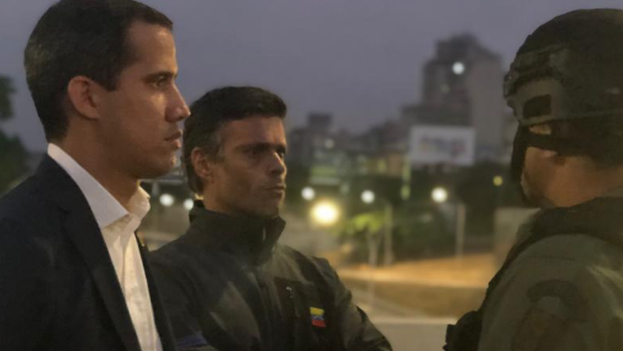
Juan Guaidó and Leopoldo López in La Carlota with military deserters from the Maduro regime.
14ymedio, Yoani Sanchez, Generation Y, Havana, 30 April 2019 — The Americas awoke today with all eyes on Venezuela, an attention that extends to the other side of the Atlantic Ocean and that keeps governments, citizens, exiles from that South American country, journalists and analysts in suspense. The world pulses today in Caracas, after months of tension and years in which the oil producing nation has been sliding down the slope of economic collapse, political authoritarianism and social deterioration.
The release of Leopoldo López and the call of Juan Guaidó to put an end to the “usurpation” have brought the Venezuelan situation to a turning point. In the next few hours the first steps could be taken towards a call for free elections or, to the contrary, a repressive blow – of unprecedented proportions – could be launched from the regime of Nicolás Maduro against those who demand his departure from power.
Beyond predictions or forecasts, the main actors of this political drama have reached a point of no return. The principal protagonist is a Venezuelan people weary of the inefficiency of the system, galloping corruption, inflation and the lack of basic products. A population that has seen its quality of life collapse and that has had to say goodbye, every week, to friends and family members as they emigrate to escape the crisis. continue reading
Also in the “cast” of this tragedy is starring young Guaidó, a man who has made a meteoric ascent in recent months, supported by the international community and by a good part of Venezuelans who have found, in the President of the National Assembly, hope for change. Now, accompanied by his mentor Leopoldo López, the passionate engineer is at the center of danger and of dreams. He could see out this day strengthened and borne on high, but his chances of arrest or assassination are also very high.
On the other side of the conflict, there is the Chavista leadership that tries to protect a regime that has allowed it to roam at ease throughout the country, lining its pockets. Ministers, officials and senior military officers who are supported by Havana, which has provided them with intelligence agents and advisors on the matters on which the Cuban political police are experts: the submission of a society and the surveillance of each individual. In the early hours of the morning, Cuban president Miguel Díaz-Canel was already on Twitter supporting Maduro and he is expected, throughout the day, to raise the tone of the official rhetoric against the Venezuelan opposition.
Both a tragedy and a peaceful exit are on the table. Each role in the conflict could bring influence to bear during the course of the day, but it is in the Miraflores Palace in Caracas and in the Plaza of the Revolution in Havana where the cruelty or peace of of this Tuesday will be decided. To that scenario we must add Washington, attentive to every detail and knowledgeable about everything that is at stake in Venezuela today.
___________________
This text was originally published in the Deutsche Welle for Latin America.
The 14ymedio team is committed to serious journalism that reflects the reality of deep Cuba. Thank you for joining us on this long road. We invite you to continue supporting us, but this time by becoming a member of 14ymedio. Together we can continue to transform journalism in Cuba.
The Inter-American Press Association, during its most recent meeting, revealed that freedom of expression and of the independent press are becoming “criminal behavior” according to the Cuban Constitution.
14ymedio, Havana, 27 April 2019 — In recent hours journalist Roberto Jesus Quinones Haces and activist Hugo Damian Prieto were set free. The reporter had been arrested last Monday when he tried to cover the trial of two evangelical pastors while the dissident was sentenced in December of 2018 for the supposed crime of “pre-criminal dangerousness.”
The liberation of Prieto, leader of the Orlando Zapata Civic Action Front (FACOZT), happened this Friday night. The dissident was freed from the prison known as the Toledo II Unit in Valle Grande municipality La Pisa, Havana, where he was transferred after the December trial in which he was sentenced to one year of deprivation of liberty.
“They gave me a letter of freedom that says suspension of security measure,” explained Prieto to this daily. “The two agents from State Security who gave me the document searched me in prison and took me to a house for an interrogation.” The officials threatened the activist with surrounding his house so that he will take no opposing action during the May 1 Workers’ Day. continue reading
Prieto complains of the bad conditions in the jail where “there is no transportation for prisoners if they have an emergency, everything is full of bed bugs and poor sanitation,” he says. The dissident spent a good part of his incarceration in a makeshift medical post in the dining room, given the precarious state of his health, especially due to his cardiac problems.
“In the last month they did not give me the medications needed for my heart ailments and previously I had missed some,” he says. In spite of the hard months he endured, Prieto reaffirms his decision to continue his civic activism and his street actions.
For his part, journalist Roberto Jesus Quinones Haces, a contributor to CubaNet who was detained at the beginning of the week by agents of the political police in Guantanamo, was set free this Saturday.
Before leaving prison the reporter received a citation to appear next Tuesday in the provincial Military Tribunal where he must be informed about the supposed crimes of “contempt” and “attempt” of which he was accused when he was arrested.
During the almost five days that the arrest of Quinones lasted he did not have access to water for personal hygiene.
The journalist was arrested in the afternoon last Monday at the entrance to the Guantanamo Municipal Tribunal when he tried to cover the trial that took place there against Ramon Rigal and Ayda Exposito, an evangelical couple sentenced to prison for refusing to send their children to school in order to have the opportunity to home-school them.
Before being arrested Quinones Haces managed to make a phone call to his wife, Ana Rosa Castro, from the police patrol car and tell her that he had been beaten, especially in the face, as she was able to prove after she visited him Tuesday at the National Revolutionary Police (PRN) station where he was detained.
According to Castro, Quinones Haces had trouble hearing from his right ear, swelling of his mouth, lacerations to his tongue, a fracture of his right thumb, and extreme difficulty swallowing solid foods,” she detailed in a note to the Pro-Freedom of the Press Association (APLP).
After the detention, several politicians from the United States such as Cuban-American Senator Marco Rubio and Assistant Secretary of State in the Bureau of Western Hemisphere Affairs, Kimberly Breier, demanded that the Cuban government immediately release Quinones.
The Inter-American Press Association (SIP), during its most recent meeting in Cartagena de Indias, presented a report in which it complained that freedom of expression and of the independent press are becoming “criminal behavior” according to the Cuban constitution. The SIP adds that Article 149 of the Penal Code maintains the crime of “usurpation of legal capacity” [i.e. practicing a profession without a license] which is used to punish independent journalists.
Translated by Mary Lou Keel.
_________________
The 14ymedio team is committed to serious journalism that reflects the reality of deep Cuba. Thank you for joining us on this long road. We invite you to continue supporting us, but this time by becoming a member of 14ymedio. Together we can continue to transform journalism in Cuba.
Police surround the outskirts of the Embassy of Congo in Havana (14ymedio)
14ymedio, April 27, 2019 — Dozens of Congolese students who are studying medicine in Cuba find themselves being detained and guarded in a place close to the international airport in Havana, waiting to be repatriated to their country, according to several students who managed to remain in the Salvador Allende Faculty of Medicine in the Cuban capital.
”They took them in a bus on April 18, and at first we thought it was for a meeting where they were going to explain things, but they never came back,” one of the students who remained on the university campus said, under condition of anonymity. “They’re not letting them speak with anybody, but we’ve learned that they are holding them in a well-guarded place to send them back to the Congo.”
“They carried out a raid at the Faculty of Medicine and put them on a bus,” the neighbors confirm. “All of us in the neighborhood thought that finally the situation was going to be managed because later we saw only a few buses return,” they add. continue reading
This newspaper can’t confirm if repatriation of the students has begun, but several sources said that they are awaiting “a response from the Congolese.”
Last Monday, an opposition group in this African country, in a comminication, had denounced the fact that the students were called to the Embassy of Congo in Miramar under the pretext that they were going to receive part of their overdue stipends. “Actually, the Cuban and Congolese authorities laid a trap for them,” the opponents explain.
“Shortly after they arrived, the students were separated into groups, and more than 200 were forced, by Congolese and Cuban agents, to get on the bus, supervised, and then were taken to an unknown stop. Other students waited more than 6 hours for their friends, without success. The telephones of the detainees had been out of service this whole time,” explains the text.
New images have come to light of the violent repression against students from Congo by the Cuban police. The student interns were protesting because of the delay of two years for their stipends and the poor conditions in which they are living on the island. Images here
— Mario J. Pentón (@marijose_cuba) April 9, 2019
The detention was also confirmed on the Facebook page, “I’m not returning without my diploma,” created by Congolese students to demand back-payment of 27 months of their stipends. On this platform, the students clarify that the protests that began at the end of March aren’t the work of a leader manipulated by “dark forces” as claimed by the Congolese Government.
The group of medical alumni also said that they presented legal remedies in agreement with Cuban law, and they launched a petition to the authorities on the island to allow release and academic reinstatement of the detainees.
After this happened, the Chancellor of Congo, Jean-Claude Gakosso, went to Havana, where he met with Miguel Díaz-Canel and presented him with a letter from the Congolese President, Dennis Sassou Ngueso. However, the official press only mentioned the visit as an opportunity to strengthen commercial and political ties.
Junior Bokaka, a Congolese student of epidemiology, who has been featured as one of the protest’s spokesmen, said on Facebook that the complaint about the stipends for the Congolese students has “nothing to do with the Cuban Government.”
Bokaka took advantage of the opportunity to point out that, contrary to what some press media have said, he is a simple student who reported the situation on his Facebook account, but he doesn’t consider himself a leader of the demonstrations nor a student representative.
Translated by Regina Anavy
_______________________________
The 14ymedio team is committed to serious journalism that reflects the reality of deep Cuba. Thank you for joining us on this long road. We invite you to continue supporting us, but this time by becoming a member of 14ymedio. Together we can continue to transform journalism in Cuba.
Hunger in Cuba: A people living on croquettes. Photo file
Cubanet, Miriam Celaya, Havana, 18 April 2019 — Only a few days have passed since the proclamation of the new Castro Constitution, but nobody is talking about it on the streets of the Cuban capital. Of the entire boring speech by the Army General, the central character of the announcement and of his shiny new work, only one sentence –as lapidary and ominous as the last nail that seals a coffin — stuck in the minds of Cubans, and that was when the head of the geriatric power elite made public what was already an open secret: we must “prepare for the worst variant” of the economy. Officially, the feared ghosts of the “Special Period” of the 90’s, which have been circling for the last year, and which the most deluded considered over and done with, have become reality.
Leaving aside the very questionable exceptionality that makes Cuba the only country in the Western world where a new Constitution and a new economic crisis are announced at the same time and on the same stage, the most contradictory fact is that the aforementioned ‘Magna Carta’, Far from adapting to current times and promoting changes that help oxygenate the economy, is designed to consecrate precisely all the elements that guarantee a state of permanent and irremovable crisis, with the sole objective of perpetuating a class in Power.
By keeping the economy strongly centralized, with state ownership and the inefficient management of the State as its main economic pillars, by refusing to open up to a market economy, and by limiting the minimum expression of citizens’ private initiative and economic freedoms and civil rights — not to mention their political rights — it is more of an epitaph than a Constitution. continue reading
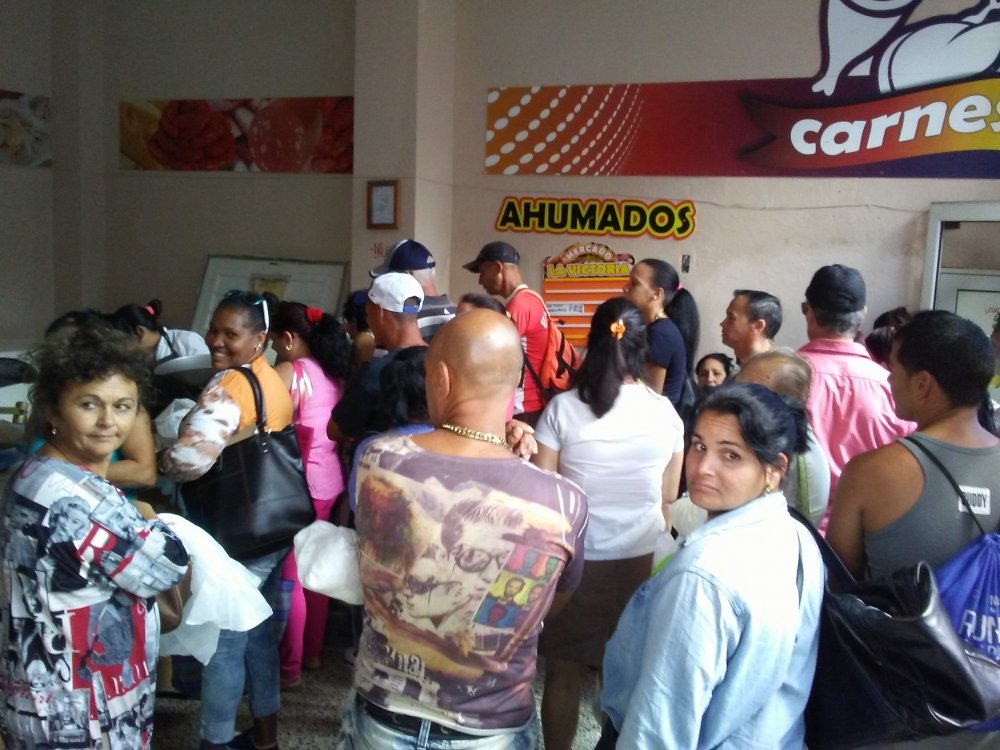
Before the total lack of will to make changes, and given that no miracle or saving source is seen on the horizon to subsidize the unquestionable failure of the system, Cubans have been plunged into the critical phase of the battle for survival in the midst of shortages, extreme rationing and hordes of people in the few markets where some foods in high demand are still marketed, especially oils and meat.
The shopping center Plaza de Carlos III, in the Havana municipality of Centro Habana, is one of a few favored markets enjoying what we could call “the assortment grace” and, consequently, a habitual scenario of that silent battle. Despite the small and limited variety of the supply of increasingly scarce products, in the meat department of this shopping center — as in the other regular city markets, including the one at 3rd and 70th, in the privileged neighborhood of Miramar — the supply of some of the most popular products has sustained relative regularity, so far.
As a result, there are daily swarming crowds at the Plaza de Carlos III, jam-packed for hours before the gates open that give access from the parking lot, which has been exclusively assigned for individuals who want to do their shopping at the butcher shop. The long line crosses a good part of the parking area, particularly on weekends, when many people also come from the provinces near the capital, or even from more distant places, where the shortages are atrocious.
It is generally unknown which products will go on sale each day, but the feeling of urgency and the need to bring food home does not allow most people viable options. Day after day, the same scene is repeated throughout the opening hours of the market: a constant human tide, forced to dedicate hours of their daily lives carting around food at prices that do not correspond to Cuban wages.
And while hardships are becoming the norm, the exclusions are growing at the same time. At the end of March, the directors of the Gastronomy and Services Company of Centro Habana, in a meeting with the directors of each establishment, reported that it is strictly forbidden for them and their subordinates to even mention the phrase “Special Period.”
At the same time, the employees of the shopping centers that operate in foreign currencies received the same orientation. “Special period,” “crisis,” “shortages,” are some of the terms that have swelled the extensive list of subversive words, as if the terminology — and not the bad performance of the country’s administration — was the cause of the economic setback that dooms Cubans to a state of poverty.
Meanwhile, the regime has been oiling the mechanisms of repression and controls. The National Bus Company has recently begun to apply strong restrictive rules to control the contents of passengers’ baggage. Each traveler can transport up to two liters of edible oil to the interior provinces. There have also been drastic limitations on the allowed weight, with significant added fees for excess baggage.
Other food and hygiene products — such as bath soap, toothpaste and detergent — are also being restricted in baggage. According to the officials in charge of these controls, these measures seek to avoid speculation and smuggling on the black market, but this regulation also affects families who are forced to get their supplies in the capital city, all those necessities that have practically disappeared from the villages in the interior of Cuba.
“And that’s nothing, the worst is yet to come!” predict the most famous who lived through the unspeakable hardships of the 90s as adults, and know that, this time, the situation in the interior, as well as at the regional and international level, is a lot more complex than it was then, and doesn’t leave any room for extemporaneous optimism.
At any case it is a sentence much more realistic than all the unfulfilled promises of the Castro regime through more than 60 years, and more realistic than the Constitution, whose birth, on April 10th, was announced with all the solemnity and fanfare along that of its twin sister: the new Castro economic crisis, maybe the worst of all.
The singer Haydée Milanés, with sunglasses, was one of the first artists who, of her own accord arranged donations for neighbours affected by the tornado, which caused fatalities, injuries and a lot of damage in various parts of Havana on the night of Sunday January 27th, 2019. Afterwards, again, of their own free will, dozens of musicians, comedians, actors, sportsmen, informal journalists and private business people joined in.
Iván García, 15 February 2019 — Before the violent tornado overturned cars in the Santos Suárez neighbourhood, pulled out electricity poles, and destroyed hundreds of homes, Aniel, a cook in a five star hotel in Old Havana, hardly said hello to his neighbours.
He fenced in his house and transformed it into a fortress, proof against burglars and muggers. Every morning he ran five kilometres through the back streets of Santos Suárez, then he took a shower, while he listened to jazz on his smartphone, and took a shared taxi to his work.
“That was my daily routine. I didnt say good day or hello to anyone in the area. Nor did my wife, and my 10-year-old son hardly had any friends. Stuck in his room all the time, entertaining himself with videogames on his computer. The inequality in our society, people who looked on with envy when their neighbours improved their quality of life, and general egotism, has converted us into hermits. continue reading
Havana is a long way from the violence of Caracas or Rio de Janeiro, but when you take a walk down the streets here, you can see that the majority of families have shut themselves in behind railings or walls, to protect their privacy.
“Most of my stuff I got under the counter (illegally), and, so as not to do it in full view of the CDR (Committee for the Defence of the Revolution), and the neighbours, it seemed the best solution was to shut myself off from everyone. Parties were just with family or work colleagues.
But, after the tornado had gone by, when I looked out of my door, and saw the destruction around me, I was left speechless. I went around the neighbourhood, and when I got back to my house, after having seen all that stuff, which was like scenes from a film about the Second World War, many things changed, right away”, admitted Aniel.
As his house wasn’t damaged, he prepared a spare room and offered it to a young couple and their daughter. “I knew them by sight. Their house was three doors down from mine, but I didn’t even know their names. One night I came home from the hotel and it broke my heart to see them sleeping out in the open as they had lost their house. My wife, my son and I agreed we should put them up. Where three people can fit, so can six. People don’t need to go to church to listen to a mass in order to redeem themselves,” Aniel concluded.
It has become a cliche in the streets of Havana to go on about the loss of social values, bad manners, and people deforming the Spanish language with shouting and swearing when they talk, using vulgar and incomprehensible slang. Regina, a single mother with two children, trying to get by in the difficult conditions of Cuban socialism by doing the washing and cleaning private houses, has this to say:
“You saw how the rich kept their distance from the poor. They looked down their noses at us, because of our bad luck in life, with no fashionable clothing, or latest model cellphones. But, after the tornado passed, they showed support and altruism. Neighbours who had never spoken to me, gave me money, food and clothes. And I wasn’t one of the worst off.
When the government gives you a few building materials, even though they let you have them for half price, you still have to pay for them, you have to support an enormous bureaucracy, and, as well as that, they ask you to vote Yes to the Constitution. But people give you the little extra they have without asking for anything in return.”
Although the olive green government has described neighbours’ supporting each other, the state media has devoted little space to the free and disinterested aid given by hundreds of private businesses, artists and famous sportsmen.
Carlos, a sociologist, thinks that “the government, as always, goes on exaggerating its own successes and hiding its failures. They avoid the fact that the procedure for buying building materials (and not all the materials you need to build a house), apart from being annoying, you have to pay for them.
The conditions in the accommodation provided for those who lost their homes, aren’t the best. But Diaz-Canel, in a boastful kind of voice, prefers to emphasise that it was the government that restored the electric supply in five days and the water in four. That is what any public administration is supposed to do. They have tried to brush aside the help provided by the private sector, the church and Cuban ex-pats.”
A few little examples. The singer Haydée Milanés went around distributing water , clothing and cleaning materials in Luyanó. The Fábrica de Arte Cubano has organised dozens of musicians and artists to help people in Regla and Guanabacoa.
The young actress María Karla Rivero Veloz, daughter of the journalist Raúl Rivero and the actress Coralita Veloz, travelled from Miami to Havana with a load of useful things which she collected in record time from fellow countrymen in Florida.
The baseball player Alfredo Despaigne, who plays in the Japanese league, gave $21k to victims in the Jesús del Monte area. Owners of independent restaurants and cafes in the capital gave food and served meals at knock-down prices.
After the tornado, thousands of ex-pat Cubans sent money and parcels to the victims, whether they were family members or not. “Every day, on average, we delivered 10 – 15 thousand convertible pesos. But over the last two weeks, the money orders from the United States and Europe have tripled,” according to a Western Union employee in Tienda Brimart in Diez de Octubre.
While she is waiting in a line to pick up the money sent by her brother from Tampa, Diana, a housewife, got things off her chest: “It annoys me that the government boasts about how quickly and efficiently it has made good the damage, when that is its responsibility. Not everything it says is true, some things are lies.
There are people who lost their homes 20 years ago because of a cyclone and they still haven’t given them a home. It also annoys me that the government and the press in Cuba don’t like to recognise the important role played by Cuban families living abroad.
They never publicise the amount of money sent, but it is thousands of millions of dollars. A greater percentage of Cubans can eat and live better because of that money. Now, following the tornado, while the state asks for a mountain of paperwork to give you sand, blocks and cement, and lets everyone know about it, a friend of mine who lives in Miami sent me $500 to fix the roof of my house, without any of that stupid nonsense.”
If there is one thing ordinary Cubans agree about is that the efforts of thousands of people in Havana was impressive. We have never seen such an enormous and spontaneous movement. Hopefully this feeling of togetherness will continue.
Photo: The singer Haydée Milanés, with sunglasses, was one of the first artists who, of her own accord arranged donations for neighbours affected by the tornado, which caused fatalities, injuries and a lot of damage in various parts of Havana on the night of Sunday January 27th, 2019. Afterwards, again, of their own free will, dozens of musicians, comedians, actors, sportsmen, informal journalists and private business people joined in.
Some of the “escorts” for foreign prisoners once worked as prostitutes on the streets but others declare themselves “mothers of families” in need of an additional entrance. (Jan A.)
14ymedio, Reinaldo Escobar, Havana, 26 April 2019 — While she waits, she retouches her lips, fixes her hair and asks another woman who is waiting next to her if this is the first time she’s come. On the outskirts of La Condesa, a prison for foreigners 50 kilometers from Havana, several women arrive for the matrimonial visit. Most are wives of inmates but there are also some like Margarita, who offer sex for money to prisoners who are far from their country.
Margarita has been preparing weeks for the Pavilion as the room where prisoners receive their partners is popularly known. “I bring a mosquito net to put on top of the bed and have some privacy because you never know if someone is looking through a gap, plus wet wipes for hygiene, food and coffee,” she tells 14ymedio. “This client has been good to me because I’ve been with him for three years and he gives me 50 CUC (roughly $50 US, or two month’s wages) each visit.”
The woman, who prefers to hide her real name, visits an English prisoner serving time for drug trafficking. “I look for prisoners who have long sentences because they last longer and because in the end a relationship is established almost as if it were a husband,” she explains. “I’ve been lucky, all the times I’ve done this because I’ve connected with serious and non-violent men.”
The current Regulation of the Penitentiary System, updated in December 2016, establishes the frequency with which an inmate can enjoy the Conjugal Pavilion in a rigorously stratified penal regime with different degrees of severity, which also takes into account if the inmate is “primary, recidivist or multi-recidivist.”
In the best case the prisoner can enjoy the Pavilion at least every 30 days, and in the worst every four months. In an explanatory note, the Regulation specifies that the duration of the visit is three hours, regardless of the inmate’s status, “with the right to eat during the same,” but sometimes “the guards take the long view and you can stay up to 12 hours,” says Margarita.
The woman, 46, is married and her husband knows that she makes a living visiting foreign prisoners. At first he did not take it very well and displayed some scenes of jealousy when she returned from visits to the prison, but then realized “the person who puts food on the table is elyuma*,” he says categorically. Now, when the payment comes to Margarita through some English friends, the husband leaves the house while the transaction is going on.
The prison benefit of matrimonial visits has existed in Cuba since 1938 when the Social Defense Code came into force, where compulsory work and study in prison and the Conjugal Pavilion was incorporated as a way to alleviate the consequences of the prolonged confinement the prisoners suffer.
In the case of foreign prisoners whose partners are unable to travel to the Island, they are often allowed a partner who charges for it. The way to find these lady companions is quite varied, but it is usually done through the trust and recommendation of a woman who is already visiting another inmate.
Many of the women who dedicate themselves to this work have worked as prostitutes in the streets. They are jineteras who, due to the passage of time or the harassment of the police, have decided to look for a “safer” sector in which to continue making a living. Others begin in the prison with the exchange of caresses for money and declare themselves “mothers of families” in need of an additional entrance.
Margarita saw a prison for the first time when she went to visit her brother in Canaleta prison in the province of Ciego de Ávila. One of the inmates told her directly: “If you come with me to the pavilion I’ll make things better for you.” She did not understand the meaning of the proposal until ten years ago when a friend told her that there was an Italian who could give her $50 if she saw him in the Conjugal Pavilion.
“The man was not bad looking and paid half in advance,” explains Margarita. Each month he sent the money and everything ended four years later when the Italian, who was serving a ten-year sentence, met another woman who was younger and charged less. “Luckily I found this Englishman that I have now with whom I am doing very well. He is affectionate and in a few years he will be released and maybe he can help me get my son out of the country,” she adds.
Some decide to change prisoners because they do not like the one they have chosen or because another offers a higher price. According to the unwritten rules, in order to change the name of the person participating in the Conjugal Pavilion, the prisoner must allow at least six months to pass between one visitor and the other, in addition to giving a good justification to the prison authorities. But like everything in Cuban prisons, it depends on what the guards decide.
The Penitentiary Regulation does not consider the Pavilion as an inalienable right, rather it is subject to the conduct of the inmates, the severity of their incarceration and the time served. Among the sanctions contemplated for certain violations of the discipline, the suspension of this benefit is included.
Yolanda is what is called “a woman of character” which is why she firmly refused to serve as a police informant when they took her to an office to propose that she collaborate. “They ’put their feet’ on all the women, especially those who have been previously signed up as prostitutes. If the prisoner left any loose ends in the investigation, the guards do anything to get information, but with me they can’t count on that.”
According to Yolanda, in order for a foreigner to receive a visit to the Conjugal Pavilion, all of the women’s information must be presented to the warden of the prison. “Then they call you in and ask you a million questions, do not even think about mentioning money!” she clarifies to all those who start new in the business. In her case, she also brings food and medicine to the inmate she “attends.”
The detail of the food introduces an additional line of work. As has been frequently reported, in Cuban prisons people go hungry. When a foreigner imprisoned in the Island manages to establish a stable link to enjoy the Pavilion, it is usually extended in parallel to the visit program where the jaba is included, that is, a bag full of food.
As these visits to bring food alternate with the Pavilion and have a frequency regulated under the same patterns, the inmate satisfies several appetites through the same person, the gastronomic, the sexual and in many cases the emotional.
Yusimín cohabits with her Cuban husband but is legally married to a Canadian who could be her grandfather. She agreed to talk about the subject but without the presence of her partner. “He knows that I am married to a foreign prisoner and when the days come when it is my turn to visit the Pavilion he becomes jealous. When I return he spends days without even touching me, but then he gets over it.”
The Canadian, is serving his sentence in a prison in La Condesa, a building that was originally conceived as one of those “schools in the countryside” where teenagers were sent to be trained as communism’s “New Man.” The rooms dedicated to the Pavilion “are not bad” according to Yusimín’s opinion. “It’s a room with everything, mattress springs, fans, closed with a single door and you have to open two bars before entering.”
What her Cuban partner does not know is that Yusimín’s plan is to go with the Canadian when he finishes serving his sentence. “This yuma has worked out terrifically for me and his family gives me many things to give him and also things for me,” she says. The condemned man has two years left in Cuba and the young woman has already shown him the photos of her young daughter with whom she intends to emigrate.
She has passed on the data of another prisoner to a cousin who has just turned 30 and already has two police warnings for being a jinetera. “If she is still in the streets, they will put her in a reeducation farm and I have already told her that the safest place for her right now is to work in a prison,” she explains, but she does not know if the cousin will pass the controls to be able to dedicate herself to ” this business.” It is the great paradox: getting a job in prison so as not to fall prey to the law.
*Translator’s note: “Yuma” is a term similar to ’yankee’ or ’gringo’ but with a more positive connotation.
__________________________________
The 14ymedio team is committed to serious journalism that reflects the reality of deep Cuba. Thank you for joining us on this long road. We invite you to continue supporting us, but this time by becoming a member of 14ymedio. Together we can continue to transform journalism in Cuba.
Rigal and Expósito refuse to send their children to public school managed entirely by the State, because they believe that it is tainted by intense ideological propaganda. (Facebook)
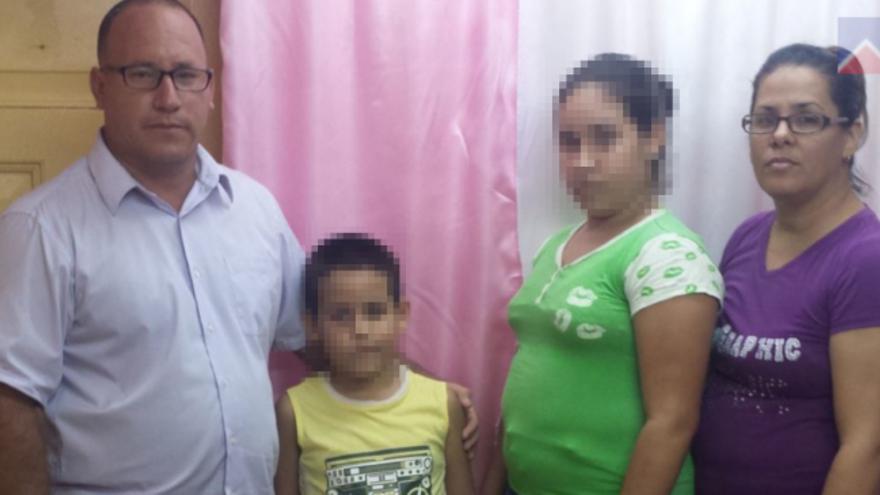
14ymedio, Havana, 23 April 2019 — The evangelical pastors Ramón Rigal and Ayda Expósito were sentenced, on Monday in Guantánamo, to two years and 18 months in prison, respectively, for not wanting to send their children to public school.
In the midst of a strong police operation both were sentenced for the crime of “acts contrary to the normal development of the child.” In addition, Rigal was convicted of “illicit association and instigation to commit a crime,” according to the daughter of both, Ruth Rigal Expósito, 13 years old.
The pastors were arrested last Tuesday when plainclothes officers showed up at their home and conducted a search in which they confiscated a computer and numerous school supplies. continue reading
The closest relatives and friends, including the daughter, were not allowed to attend the trial and the authorities detained the lawyer and independent journalist Roberto Jesus Quiñones Haces when he tried to cover the trial against Rigal and Expósito.
In the next 72 hours, the sentence will be made final and the pastors must go to prison while their defense lawyer appeals the decision of the court, said family sources.
In 2017 Rigal and Expósito Rigal were convicted for not sending their children to school; at that time they were 7 and 11 years of age . The pastor was sentenced to one year of correctional work without internment while his wife had to spend a year in house arrest.
The London NGO Christian Solidarity Worldwide showed concern about the case and said in a statement that the conviction violated the right of parents to give their children an education according to their principles.
Rigal and Expósito refuse to submit their children to public education managed entirely by the State, because they believe that it is tainted by intense ideological propaganda and because in state classrooms atheism is promoted.
In 2017 Hebron College, a Christian institution based in Guatemala, began to advise them to teach the classes at home with compact discs, printed material and some sessions through the internet.
In a statement on Tuesday, the Cuban Observatory of Human Rights (OCDH) condemned “the manipulated legal process” against the two evangelical pastors for only seeking “for their children an educational model different from the one forced by the totalitarian State on the island: to educate them at home.”
The independent organization based in Madrid defends “the natural right of parents to choose the type of education they want for their children” and ensures that in the state classrooms “children are trained under a personality cult of Fidel and Raúl Castro, and the training plans include political subjects and even military training.”
“We condemn the judicial farce, the severity of the sentence and demand their immediate release,” concludes the document signed by Alejandro González Raga, executive director of the OCDH.
___________________________________
The 14ymedio team is committed to serious journalism that reflects the reality of deep Cuba. Thank you for joining us on this long road. We invite you to continue supporting us, but this time by becoming a member of 14ymedio. Together we can continue to transform journalism in Cuba.
The hospital maintains that it has taken measures to resolve the situation.
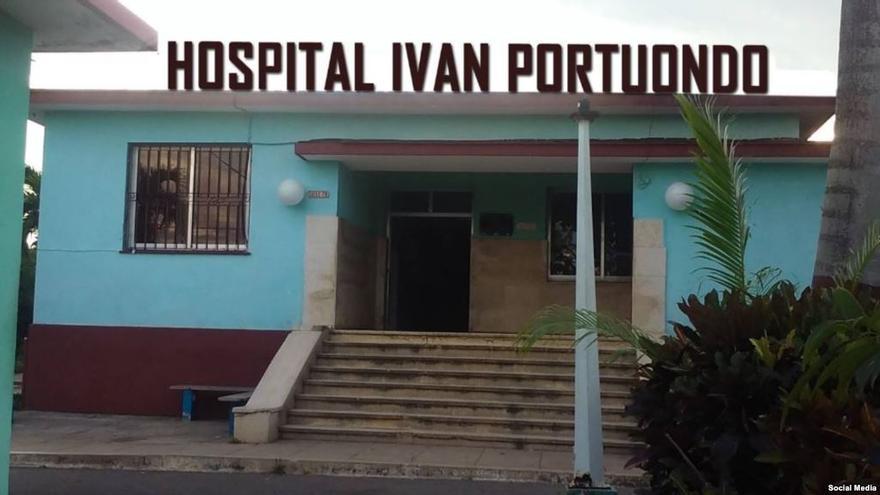
14ymedio, Havana, April 26, 2019 — The information that had been circulating for several days on social media was true: they had found, last Saturday, a body in a cistern of the Iván Portuondo hospital in San Antonio de los Baños (Artemisa). The official press has confirmed it this Thursday in an article published on the Facebook page of the local newspaper El Artemiseño, which speaks of an “unpleasant incident” and calls for “ill-intentioned rumors” to be avoided.
“According to the doctor Alden Peláez, provincial director of Public Health, upon finishing work in the cisterns, which has a quandrant system that makes them difficult to inspect, a body was detected, on April 20, inside one of these,” explained El Artemiseño, which clarified that the deceased “is not a patient of the hospital.”
“In San Antonio they aren’t talking about anything else,” Rosenda Calvo, a resident of the area near the hospital, tells 14ymedio via telephone. “It was the patients themselves and their families who put so much pressure on them with their complaints of the poor state of the water that they ended up making workers inspect what was happening.” continue reading
“The water coming out of the sinks didn’t only have a bad odor, but it was also murky and, for several days, the patients’ visitors had had to bring the sick people even water to bathe,” confirms Calvo, who had a family member hospitalized. “They thought that maybe it was a matter of a turkey vulture or a dog, but never a person.”
This newspaper attempted to communicate on several occasions with the hospital, the local Police office, and local media to confirm the information, but only received evasive answers and on several occasions the people who answered hung up.
However, the publication this Thursday of the news in El Artemiseño is an unusual gesture in the official press, little given to reporting incidents that occur inside hospitals, schools, or prisons.
The Ministry of the Interior is in charge of the investigation and, according to the publication, took measures like the “halting” of the water supply in the hospital and the use of barrels and tanks of certified water for the hospital to continue functioning.
“Other measures taken were the monitoring of residual chlorine three times a day in different parts of the network and microbiological surveillance of the water on equal numbers of consecutive days,” added Peláez.
According to the director, the contaminated cistern and the tanks that it supplies will not be in service until “the pressure washer and the hydrology team carry out the cleaning, disinfection, and certification.”
According to Martinoticias, which interviewed a resident, the deceased was named Villo Mantilla and was a former employee of the hospital. According to her, the body had been in the water tank for at least 15 days.
“I don’t know how he fell in the water, which is potable water for the consumption of the patients, the sick, the doctors,” said Rolando Yuset Pérez Morera, another resident of San Antonio de los Baños.
“Inside the cistern they found trash, a wheelchair, a great amount of filth,” added Pérez Morera.
The official press added in its statement that it will provide a “follow-up” to this “lamentable incident” in order to not give space to comments “that undermine the sensitive Cuban health system.”
Translated by: Sheilagh Herrera
_________________________________
The 14ymedio team is committed to serious journalism that reflects the reality of deep Cuba. Thank you for joining us on this long road. We invite you to continue supporting us, but this time by becoming a member of 14ymedio. Together we can continue to transform journalism in Cuba.
Cuban doctors in the Herminia Farías school, Venezuela (Facebook)
14ymedio, Havana, April 26, 2009 — A home in Caracas where 20 Cubans lived was broken into on Thursday by six men in hoods who carried knives and blunt weapons. According to the victims, the criminals robbed them of cell phones, televisions, a power generator and $1,300 dollars in cash, the Venezuelan newspaper El Nacional reported.
Troops from the Bolivarian National Police and the Corps of Scientific, Penal and Forensic Studies went to the home, located in Alta Florida, to begin the investigation.
Members of Cuba’s medical mission in Venezuela have repeatedly complained about being victims of the widespread violence that exists in this South American country. continue reading
In July 2018, eight armed, hooded men attacked a group of prominent Cuban doctors in Venezuela and robbed them of more than $152,000 and 30,000 pesos, according to statements collected by this newspaper.
The thousands of doctors that the Cuban Government maintains in Venezuela are experiencing the political struggles and growing violence without any plans for evacuation.
After Guaidó’s proclamation as President, many health professionals confessed to feeling they would be in the middle of a crossfire if the tension led to civil war.
“The Venezuelan army is expecting an invasion from the United States, and the criminal gangs are rampant,“ a doctor of general medicine in Táchira told 14ymedio.
in addition, they are under suspicion of having been infiltrated by members of the Cuban Armed Forces who support the Chavista government, and some have complained about being used to transmit the regime’s ideology.
Translated by Regina Anavy
_________________________________
The 14ymedio team is committed to serious journalism that reflects the reality of deep Cuba. Thank you for joining us on this long road. We invite you to continue supporting us, but this time by becoming a member of 14ymedio. Together we can continue to transform journalism in Cuba.
The program of the Miracle Mission eye center at the Santa Gertrudis hospital in San Vicente was closed. (Photo/Mauricio Cáceres/ elsalvador.com)
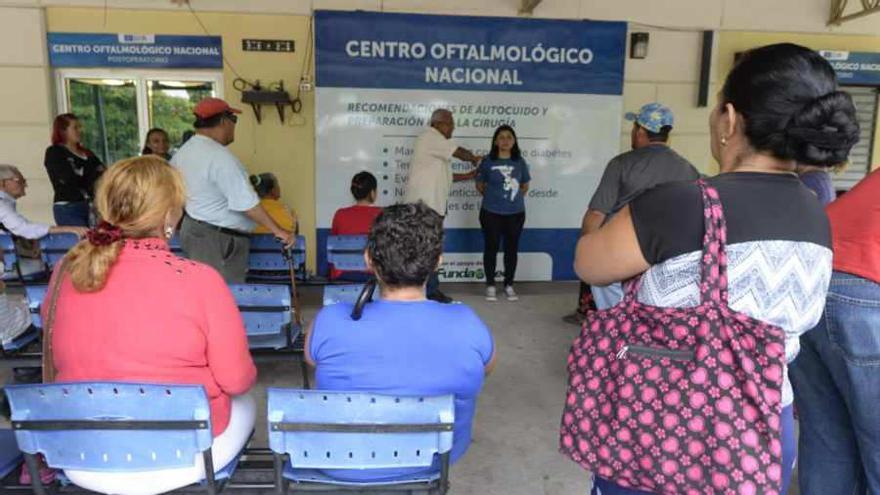
14ymedio, Havana, April 24, 2019 — The Cuban Government decided to withdraw its doctors and other health professionals who were working in El Salvador, after the Medical Profession Oversight Board (JVPM) notified the Attorney General of the Republic of an alleged illegal practice of the profession by Cubans in the Central American country.
The Island’s Ministry of Public Health decided to withdraw 19 doctors, technicians, and nurses who were part of the Miracle Mission in El Salvador and who provided services at the National Eye Center (CON) at the Santa Gertrudis hospital in San Vicente, according to the Minister of Health of that Central American country, Violeta Menjívar, of the outgoing cabinet.
The winner of the Salvadoran elections this past February was Nayib Bukele, a 37-year-old businessman from the advertising sector, who will take office on the first of June. Until then the office will be held by the current president, Sánchez Cerén, an ex-guerrilla of the Farabundo Martí National Liberation Front (FMLN) and a traditional ally of the Plaza of the Revolution of Havana. continue reading
Menjívar expressed this Wednesday her dissent because the Oversight Board was “criminalizing” the Cuban doctors by demanding the “originals” of their graduate diplomas instead of copies, and for that reason the Cuban Government withdrew them from the mission. Additionally, she described the action of the JVPM as a discrediting campaign against Cubans.
On the team of specialists who returned to Cuba were ophthalmologists, optometrists, retinologists, nurses, a clinical lab technician, biomedical professionals, a chemist, and a pharmacist. They all left El Salvador last week under orders of the Cuban Government.
The Minister of El Salvador requested that the JVPM not ask for the Cubans’ original diplomas. “Don’t be finicky,” she said, to which she added, “not a single professional is fake, a legal analysis must be done.”
Despite that request the JVPM insists that the original diplomas of the Cubans be shown in order for them to be authorized, because they believe that the Cuban professionals cannot present only copies because they are not part of The Hague agreement.
The president-elect, Nayib Bukele, said on Twitter that “starting in June the Miracle Mission will be re-established and increased.”
“When I was mayor of Nuevo Cuscatlán I saw how hundreds of older adults benefited, many of whom no longer had any hope of seeing,” added the leader, who emphasized that his government will place a special emphasis on hiring Salvadoran doctors and asked his compatriots “not to politicize good things.”
Cuba has been present in El Salvador with the Miracle Mission since 2015, thanks to the Specific agreement for the Implementation of an eye center in the Santa Gertrudis hospital of San Vicente, signed by the Ministries of Health of El Salvador and Cuba.
Last week the doctor Milton Brizuela, president of the Salvadoran Medical College, affirmed that the Miracle Mission “is an eminently political project of the Farabundo Martí National Liberation Front (FMLN) governments, created with electoral ends and with the aim of helping their Cuban allies.”
The official version for the reasons for the withdrawal of the Cuban medical mission from El Salvador has still not been publicized, but it is happening in a similar setting to what occurred with the doctors who participated in the Mais Medicos program in Brazil.
At the end of 2018 the Island’s Government withdrew thousands of doctors from that South American country after Jair Bolsonaro, at that time president-elect, described those professionals as “slaves” of a “dictatorship.” He had also conditioned the continuity of the program on the fulfillment of threec onditions: a test of the qualifications of the more than 8,500 Cuban doctors in the country; that they be able to receive their whole salary rather than most of it going to the Cuban government; and the demand that they would all have the freedom to bring their family members with them.
Translated by: Sheilagh Herrera
_____________________________
The 14ymedio team is committed to serious journalism that reflects the reality of deep Cuba. Thank you for joining us on this long road. We invite you to continue supporting us, but this time by becoming a member of 14ymedio. Together we can continue to transform journalism in Cuba.
USB sticks have become so common that they have become part of the merchandise of the street vendors in Cuba. (14ymedio)
14ymedio, Marcelo Hernández, Havana, 25 April 2019 — If a decade ago, when the first USB memory sticks began to circulate in Cuba, someone had insisted that a few years later they would share space with scrubbing sponges, instant glue, and disposable razors on the blankets of street vendors, they would have received a loud burst of incredulous laughter. Now, the devices, also called pendrives or flash memories, have become so common that they have become part of the merchandise of the street vendors in Cuba.
This storage device is not only everywhere, but its capacity to save files surpasses by many times that of the first USBs that barely held a few megabytes. “I have memories of 16 and 32 gigabytes,” explains an elderly man who sells batteries and aluminum scouring pads, among other products, outside the Central Train Station in Havana. Although the retiree does not even have a mobile phone, much less a computer, he says that “these are the good kind, the ones that don’t break.”
“For 15 CUC you can have the biggest and for 8 the one with the smallest capacity,” says the informal vendor to an interested party who tries to get a discount. “No, I can’t lower it by even a peso because that is what they are worth everywhere, you aren’t going to find them cheaper,” he adds. To convince the indecisive customer he assures him that “with this in your pocket you won’t ever have to watch Cuban television again because anyone can copy series and movies for you.” With the same one, he turns to another customer and tells her of the advantages of the teflon rolls he has on sale for plumbing jobs.
In the late afternoon, the man has managed to sell a few USB sticks. With his blanket placed on the sidewalk he is a small but vital link in the long process of digitalization that Cuban society is experiencing.
Translated by: Sheilagh Herrera
___________________
The 14ymedio team is committed to serious journalism that reflects the reality of deep Cuba. Thank you for joining us on this long road. We invite you to continue supporting us, but this time by becoming a member of 14ymedio. Together we can continue to transform journalism in Cuba.
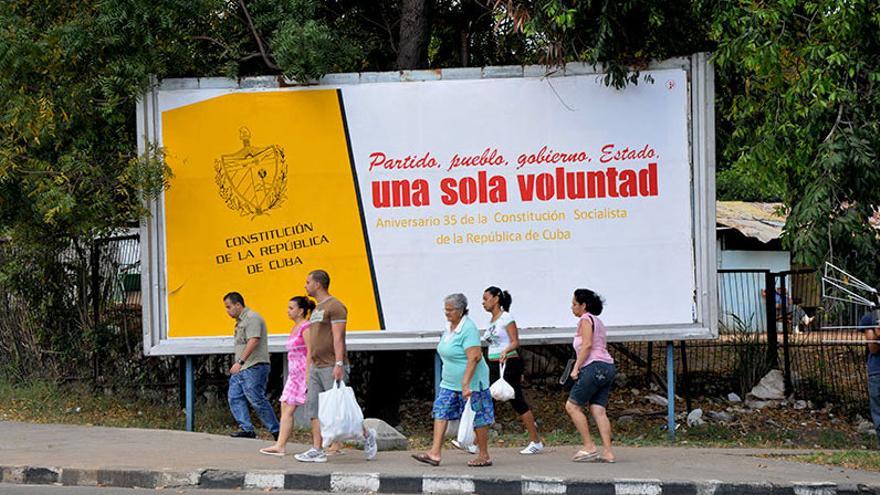
A billboard with the text “Party, people, government, state, one single will” celebrates the 35th anniversary of the 1976 Constitution with a message similar to the current one for the new Constitution, also a socialist one. (EFE / File)
14ymedio, Reinaldo Escobar, Havana, 20 April 2019 — As of April 10th the new Constitution is an accomplished fact. Although some equate it with the statutes of a party, compare it with prison regulations or identify it as “an old woman with some rouge,” it is already mandatory for everyone.
Regardless of the irritation provoked by Article 4, which supports the irreversibility of the system, known as Article 5, which establishes the dictatorship of the only party allowed, there are some articles that can be described as positive, provided that end of being followed to the letter of the law.
For example, Article 10 serves to remind state officials that they are obliged to “respect, respond and answer to the people” and, in almost any case, one can appeal to Article 41 which states that the Cuban State “recognizes and guarantees each person the enjoyment and the inalienable, imprescriptible, indivisible, universal and interdependent exercise of human rights.” continue reading
Even if a Cuban is publicly recognized as an absolute opponent of the regime and has broadcast to the four winds his rejection of the new Constitution, he has the right to rely on its provisions, even if he does not believe in it and does so only to demonstrate the falsity of its postulates.
If a television program such as Cuba’s Reasons shoots down the reputation of a political opponent, activist or independent journalist, they could call on existence of Article 41 that explicitly states: “All people have the right to have their personal and family privacy respected, their own image and voice, their honor and personal identity.”
When the police break into a house without showing the occupant a search warrant and seize the computers, cameras, telephones and documents, the victim of the assault will have the right to demand that the government follow Articles 49 and 50 that consecrate the inviolability of the domicile and its contents and, in addition, may invoke Article 59, which states that “the confiscation of property is applied only as a sanction ordered by a competent authority, in the processes and by the procedures determined by law.”
The same can be applied to by all those who suffer arbitrary detentions, including beatings, because they will be protected by Article 51, which prohibits people from “being subjected to enforced disappearance, torture or cruel, inhuman or degrading treatment or punishment.” They will also be covered by Article 96, which grants them the right, “to establish a habeas corpus proceeding before a competent court.”
And when, in front of the immigration window of an airport, a uniformed person says “you can not travel because you are ’regulated’,” or when a citizen is deported from the capital to his province of origin, in both cases he can turn to Article 52, which with all clarity states that “people are free to enter, stay, transit and leave the national territory, change their address or residence, without further limitations than those established by law.”
If a Cuban citizen is involved in a judicial process, he must know that Article 94 in the current Constitution allows him to enjoy a “due process” where he can have legal assistance from the beginning.
It should be noted that, although what is related to judicial matters is clearly expressed in the Constitution, it is likely that it will be necessary to wait until October 2020 for its effective application, since it will be on that date that the Governing Council of the People’s Supreme Court will present Parliament the draft Law of the People’s Courts and the rest of the proposed amendments to the Law on Criminal Procedure, among others.
There are a lot of corners to explore on this issue, such as the constitutional recognition of certain rights, including enjoying adequate housing, accessing personal data in public records, or being compensated when one has been harmed by state officials.
The Constitution of the Republic could become a new “battlefield” especially for Cubans to demand their citizens rights, permanently trampled by those who should have the obligation to defend them.
Double standards or pragmatism? Someday the country may have a constitutional text conceived by democratically elected assembly members. Meanwhile, this is what there is.
The double standard was put into practice by those who rule the country today by imposing the dictatorship of a single party that establishes an irrevocable system and at the same time promises that all human rights will be respected.
___________________
The 14ymedio team is committed to serious journalism that reflects the reality of deep Cuba. Thank you for joining us on this long road. We invite you to continue supporting us, but this time by becoming a member of 14ymedio. Together we can continue to transform journalism in Cuba.
Picota Street, in San Isidro. The water can cost up to 50 CUC for each water truck in these circumstances. (14ymedio)
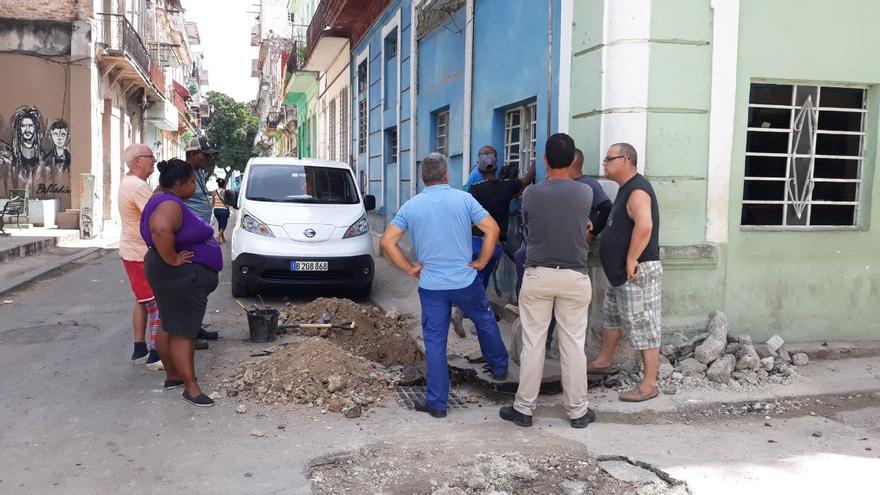
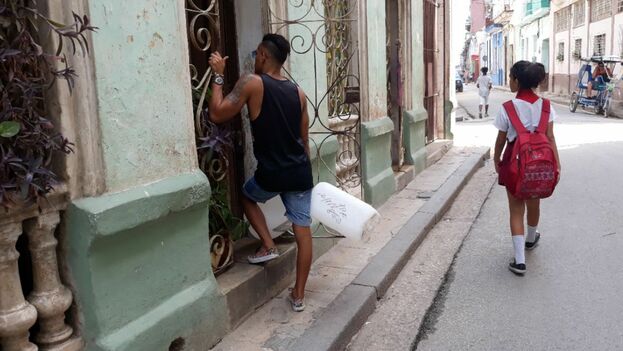
14ymedio, Luz Escobar, Havana, 10 April 2019 — On Merced Street in Old Havana a cloud of dust rises that floods the entire block every time debris is thrown off the roof of a house under construction. All the neighbors have their doors and the windows closed, very few show themselves to the block. A lady who sells sweets in one of the side passages of a building looks up and says, “And all this without a drop of water.”
The neighbors affirm that in Merced “almost no water has arrived for three months” but that the worst has been ten days with a complete absence of water. That’s why Laura has gone to the house of a friend who lives in Calle Picota and has a small cistern that receives a trickle of water, “by gravity,” between 4:00 in the afternoon and 10:00 at night. “That’s why I come to bathe here; as of January water hasn’t come to my house in the normal way.”
On his block, he explains, the neighborhood delegate “is playing a role now” to ’resolve’ a water truck but only “because people pressured him” after a week no water. The supply cycle through this alternative route is only once a week, insufficient for the needs of a home. “When people protest they react, when we haven’t had a water truck for five days, the service is not constant,” complains Laura. continue reading
Eduardo, a resident from San Isidro who looks out the door of Laura’s friend’s house with two empty buckets, complains. “Those who have money can pay for the water trucks, the poor have to wait for it to happen whenever it is, now it comes once a week,” he says.
Laura’s friend’s house is like a small oasis inside the San Isidro neighborhood, one of the neighborhoods by the crisis of the water supply. “The whole world comes by here, my cistern is small and what I have is what arrives by gravity, but it is something, we help those who do not have a drop,” says the good Samaritan as she cleans beans on a table full of junk.
Neighbors loaded with empty containers approach for water in San Isidro, in Old Havana. (14ymedio)
Eduardo tells it like a story from a book that, on Egido Street, “people launched themselves into the street” about two weeks ago. “They closed the block with children and everything, putting out mattresses and posters and then the police and six trucks appeared. You ask yourself, is this what we have to do, go out into the street, to resolve things, is this how the problem is solved.” On every corner, he adds, there is the company from Aguas de La Habana (Havana Water) with a brigade “digging with picks and shovels without a solution coming.”
In the 658 Egido Street building there is still talk of the protest a fortnight ago. Since that day the water truck has come every two days to fill the cistern.
At the entrance of the building, a group of girls talk about the reasons that led them to take to the streets to demand water from the authorities. “The problem is money; when you fill all the tanks you want, it can cost between 20 and 40 CUC, but right now, as it is, it can cost up to 50 [each water truck] and nobody here has a single peso, that’s why what we did what we did that day and it worked for us,” says the youngest of them all.
“The problem with water is very serious. I’ve seen people going nuts when the truck comes. It looks like we’re going back to the same time as before, that there was nothing and everyone was fighting over a bucket of water,” says another of the girls at the foot of the stairs.
Several residents of Merced Street explained to 14ymedio that the crisis began with the works for the 500th anniversary of La Villa de San Cristóbal (Havana). According to the official press it is “a large-scale project” that aims to improve water supply to more than 9,000 inhabitants. It began in March, just the month when supply problems reached their worst in the seven people’s councils of Old Havana.
The technical director of the Havana Water Company, Esther García, told the official press that this area of the city receives water with low pressure, with an intermittent and bad service and that for this reason the execution of the project was approved.
“On television it’s one thing and the reality is very different, there’s talk about building a new pipeline and that will be the solution, but here we only see scarcity,” says Mirna Flores, a resident of Merced Street.
The official data shows there are 8,600 people who currently receive water from tankers in that area while the new pipeline is finished. Brigades from the Havana Water Company, forces of the National Institute of Hydraulic Resources and the Ministry of Construction are involved in the task with the promise of concluding it by September of this year.
While the commitment becomes reality before the eyes of all, the neighbors of Old Havana are still waiting for the arrival of a water truck and carrying buckets of water. The president of the Méndez building Council of Neighbors in the San Isidro neighborhood, assures this newspaper that there are cases of “elderly people over 90 years old who live alone” and can not go down to carry water, and “sick people.” They are more vulnerable to these crises. “Here the solution is would be that once again one opens the tap and the water comes out, as it should be.”
_________________________
The 14ymedio team is committed to serious journalism that reflects the reality of deep Cuba. Thank you for joining us on this long road. We invite you to continue supporting us, but this time by becoming a member of 14ymedio. Together we can continue to transform journalism in Cuba.
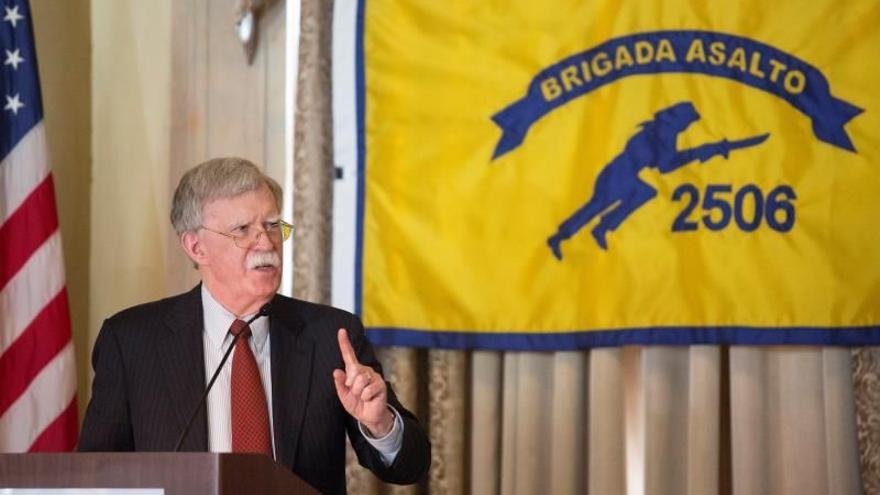
John Bolton, presidential adviser to the president of the United States, Donald Trump, speaks during a press conference in Miami, Florida. (EFE)
14ymedio, Carlos A. Montaner, Miami, 21 April 2019 — Cuba is behind the Venezuelan horror. The island learned from the Soviets the art of controlling a society, even though 80% of people oppose the imposed system. It is enough for 0.5% of the population to be affiliated with counterintelligence, to achieve the submission of the whole.
People obey out of fear, not out of love, much less for ideological reasons. In Cuba and in Venezuela, as in the whole field of 21st Century Socialism, in which only Bolivia and Nicaragua remain, there is barely a handful of brainless people who create Marxist-Leninist slogans.
But that’s not the problem. After all, it is not the first time that a small island has controlled a much larger, more populated and richer nation. That is the history of the United Kingdom and India. The problem is what the colony dedicates itself to, beyond being exploited by the implacable Cuban metropolis. continue reading
The Venezuelan military leadership, led by Nicolás Maduro, the puppet chosen by Havana, is primarily engaged in drug trafficking. From that murky business they get billions of dollars. But the Venezuelan commitments to crime do not end there. They lend support to Islamist terrorists, to Iran and to anyone who claims to be against the West. It is the way they of dignifying their criminal activities. They cover them with an ideological “anti-imperialist” mantle on the left.
That’s what John Bolton, Mike Pompeo, Elliott Abrams and the Cuban-Americans Marcos Rubio and Mauricio Claver-Carone think. There has never been a unit of opinion in Washington so consolidated. Everyone knows what is going on in Venezuela and they do not ignore the importance of Cuba as the power behind the throne.
The problem is how to deal with that danger. They have even asked Raúl Castro to abandon his Venezuelan prey. It seems that was the message that Prince Charles delivered on his amazing trip to Cuba disguised as a tourist with his sweet Camila hanging on his arm. This is what Abrams transmits to his interlocutors in Cuba and Venezuela.
But it is useless. Cuba is ready to fight until the last Venezuelan. First, because they need it from a material point of view. The system imposed on Cubans — the “Military Capitalism of the State” — is absolutely unproductive and requires joining another nation to sustain and maintain them. And, second, because for 60 years it has worked for them in controlling power and they know that their adversaries change or get tired. Everything rests on staying firm in the same position.
Given these facts, John Bolton, Security Advisor Donald Trump, on April 17, in Miami, revealed the measures that the US will adopt against Cuba, Venezuela and Nicaragua, the three nations that today constitute “the axis of evil.”
As is well-known, the United States has opted for economic sanctions included in the Helms-Burton Act passed during the Clinton administration. That law, promulgated by the US Congress and the Senate, goes on to say that any country that does business with Cuba, in transactions involving US properties confiscated by the communist revolution, could face reprisals and lawsuits before US courts.
It also limits remittances and visits by Cuban-American migrants, a measure similar to that taken during the George W. Bush (son) government. In addition, boats that have previously touched Cuban soil cannot land in the United States for six months. This measure has already caused terror among some shipowners and the paralysis in Venezuelan waters of the Greek tanker, the Despina Adrianna, originally destined for Cuba.
Actually, these are reasonable tactical measures to maintain a semi-hostility, but they do not necessarily lead to the end of the dictatorships of Cuba and Venezuela. If the intention is to liquidate those governments, enemies of the United States, the development of a strategy, subject to a timetable, is necessary to achieve those goals before the 2020 elections, when the tables could turn.
To achieve those goals, it is important to align all the essential factors, and that can only be done by the United States if it is serious when it states that it “reserves all the cards.” No major international actor (Canada, the Lima Group, the European Union, NATO) would deny Washington its support to eliminate outlawed states dedicated to drug trafficking and antidemocratic conspiracies, and would surely collaborate in the effort.
On the contrary, if Washington chooses to limit itself to showing its teeth and being a “paper tiger,” as Humberto Belli, the Nicaraguan essayist, fears and writes, it does not make sense to mortify Cuban society with more hardships. In that case, the United States must return to the strategy of containment: vigilance, propaganda and precise denunciations against the transgressors of the laws. Naturally, the Caribbean pistol would continue to threaten everyone’s heads, as has happened over six decades.
________________
The 14ymedio team is committed to serious journalism that reflects the reality of deep Cuba. Thank you for joining us on this long road. We invite you to continue supporting us, but this time by becoming a member of 14ymedio. Together we can continue to transform journalism in Cuba.
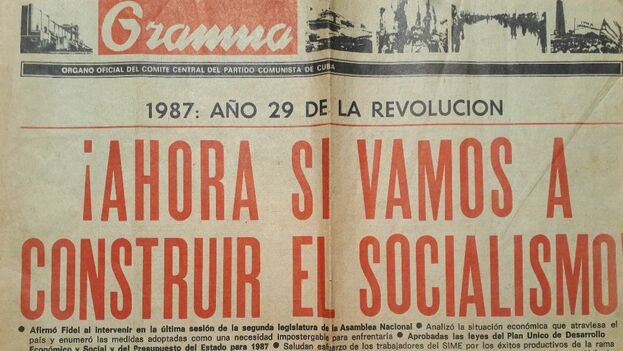
The ‘80s were also years of experiments and official programs marked by the voluntarism of Fidel Castro. Headline: “Now We Are Going to Build Socialism!” (14ymedio)
14ymedio, Yoani Sanchez, Generation Y, 22 April 2019 — That day I did not want to watch national television but rather some documentary on the ‘Weekly Packet’, but when I turned on the screen there was Ramiro Valdés, speaking before the National Assembly about the “diversion of resources,” the official euphemism used to talk about stealing from the State, and how “ethical values” had deteriorated in Cuban society with the arrival of the Special Period. In his tone and choice of words there was a nostalgia for the 80s, for that “golden” decade before the economic crisis.
I perceive a similar recollection in many Cubans over 40, who consider that time as the best we have experienced in the last 60 years of socialism on the island. The longing leads them to see everything that happened in that decade through rose-colored glasses. With a highly selective memory they remember markets full of products, bread and eggs for sale freely without having to go through the rationed market, an average salary being enough to feed a family, and public transport operating with numerous routes and sufficient vehicles.
They forget the shadows of those years and only emphasize the lights. Their melancholy over the lass of those times ignores the control the Plaza of the Revolution exercised over every aspect of our individual lives. Those were the years when we could shop only in state stores, watch only the television controlled by the Communist Party, and travel outside the country only on official missions. Every pair of pants, shoes or shirt that we wore had been acquired through the ration card controlling industrial products, as had been any furniture in our homes not inherited from parents or grandparents.
The repressive structure functioned like clockwork and the ‘80s had started with acts of repudiation around the Peruvian Embassy, crowded with 10,000 Cubans wishing to leave the country who had been granted diplomatic protection there. With every worker in the country tied to the state sector, the coercion mechanisms to achieve social docility were highly effective. The so-called ‘verifications’ – consisting of a neighborhood inquiry and investigation of the behavior of anyone who wanted to ascend the career ladder, get a voucher to buy a refrigerator, or win a scholarship to study abroad in socialist countries – were fully greased and seemed omnipresent.
Making contact with a foreigner was considered a crime and having correspondence with relatives who had emigrated a probable stain in one’s file. The prevailing atheism placed a mask on those who professed some religious belief and in the ritual “tell me about your life” – indispensable to enter a job or achieve a promotion – you had to confess if you had a religious belief and if you practiced it.
People were much more afraid to issue a critical opinion than they are now, the dissident groups were reduced to their minimum expression and, between ‘schools in the countryside’ where teenagers were sent for their high school years, and the pioneer camps for younger children, the children of that time received a complete brainwashing and ideological indoctrination.
All writers who wanted to see their works published had to jump through the hoop of official censorship or see their writings languish in a drawer, musicians could only record their music in official studies, painters exhibited their works only in government managed galleries, and taxi drivers drove only vehicles with the blue state license plate.
Although totalitarianism was in its moment of splendor as far as control of society, the economic situation was not the result of the efficiency or productivity of the country, but rather of the “pipeline” of subsidies that arrived from the Soviet Union. The Kremlin was sustaining a bubble of false prosperity, a bubble that burst as soon as the USSR itself fell apart and the old comrades exchanged the hammer and sickle for a market economy.
The ‘80s should not be remembered for the cans of condensed milk that abounded on the shelves, nor for the markets where it was possible to buy juices from Bulgaria at very cheap prices or canned fruits from some member country of the Council of Mutual Economic Assistance (CAME/ or Comecon in English), much less for the stacks of intensely colored magazines with bombastic titles promoting a failed model.
Looking at the ‘80s, we must evoke them in their proper measure: the decade in which the cage was more effective, in which Fidel Castro had enough birdseed at his disposal to make us silently accept the bars.
_________________________
The 14ymedio team is committed to serious journalism that reflects the reality of deep Cuba. Thank you for joining us on this long road. We invite you to continue supporting us, but this time by becoming a member of 14ymedio. Together we can continue to transform journalism in Cuba.
 14ymedio, Yoani Sanchez, Generation Y, Havana, 30 April 2019 — The Americas awoke today with all eyes on Venezuela, an attention that extends to the other side of the Atlantic Ocean and that keeps governments, citizens, exiles from that South American country, journalists and analysts in suspense. The world pulses today in Caracas, after months of tension and years in which the oil producing nation has been sliding down the slope of economic collapse, political authoritarianism and social deterioration.