The BBC says the intermediary “foreign bank” has severed its relationship with Fincimex for fear of US sanctions
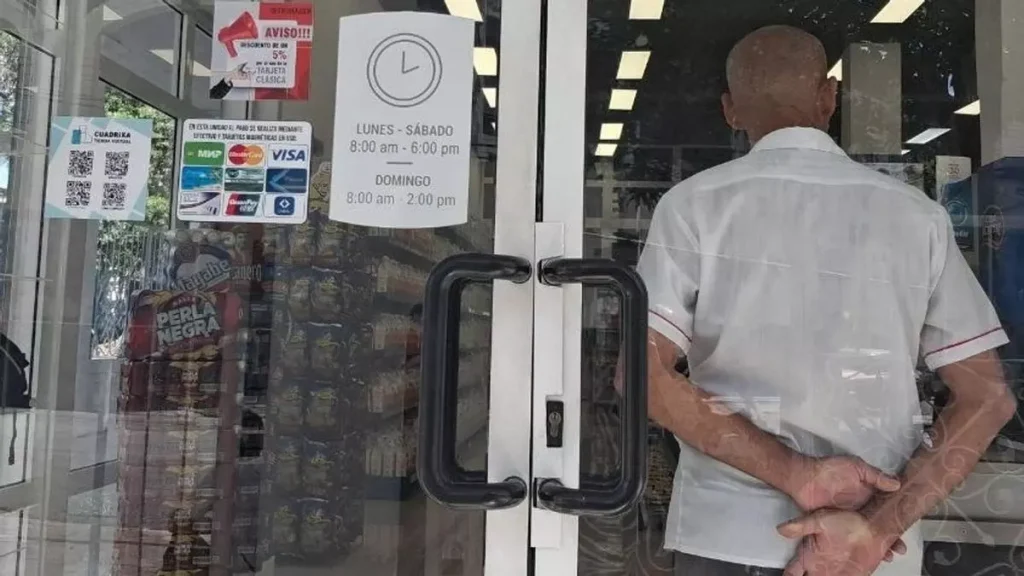
 14ymedio, Havana, June 3, 2026 / The Central Bank of Cuba has announced that, starting Saturday, Visa and Mastercard payments will no longer be accepted on the island. According to a brief statement broadcast by state-run radio host Lázaro Manuel Alonso, the bank explained that the reason is that the “foreign bank processing transactions in Cuba using Visa and Mastercard”—whose name was not disclosed—informed on June 2nd that it is severing its relationship with Fincimex, the financial arm of Cimex, part of the Cuban military conglomerate Gaesa.
This “interruption,” the statement continues, is “directly” related to the executive order issued by US President Donald Trump on May 1, which opened the door to new sanctions against officials, agencies and companies of the regime and which the Central Bank calls “part of its strategy of suffocating the people of Cuba.”
“The foreign bank announced that as of June 6, the date the Empire’s measure takes effect, it becomes illegal and impossible to continue executing agreements with the Cuban entity,” states the notification, which does not mention whether Visa and Mastercard have taken action. It does indicate that the “100% Cuban” Clásica and Tropical prepaid cards, as well as the Russian Mir and the Chinese UnionPay, can still be used, in addition to cash. The Central Bank of Cuba’s statement attempts to project an image of normalcy at the end, but the list of alternatives confirms the scale of the problem, because replacing these cards with the permitted ones is far from equivalent.
Visa and Mastercard are the most widely used payment methods among European, Latin American, and Canadian travelers.
The decision by this mysterious “foreign bank” adds to the growing list of companies leaving the island in recent weeks or terminating their contracts with the Business Administration Group (GAESA), which is specifically sanctioned by the US. Just this Wednesday, the Spanish hotel chain Meliá confirmed its withdrawal from 15 of its 34 hotels on the island, all owned by GAESA. Previously, Iberostar ceased operating and marketing 12 hotels, and Blue Diamond Resorts announced the complete cessation of its operations in Cuba.
Canadian mining company Sherritt International, one of the largest foreign investors in Cuba, suspended its direct participation in its joint ventures on the island in May and announced the repatriation of its staff after Washington sanctioned Moa Nickel SA, the company it co-owns with the Cuban state-owned Compañía General de Níquel. The multinational, however, later halted plans to dissolve its Cuban businesses, while also announcing negotiations with a former Trump advisor to purchase a majority stake in the company.
Visa and Mastercard are the most widely used payment methods among European, Latin American, and Canadian travelers. Mir has a limited reach and operates within the context of international sanctions against Moscow, while UnionPay has a greater global presence but is not part of the payment habits of most tourists traveling to Cuba from the West.
The measure may also put pressure on the price of the dollar in the informal market.
The Central Bank’s announcement could provoke an immediate reaction among foreign correspondents, diplomats, aid workers, and employees of foreign entities in Cuba—one of the groups that most frequently uses international credit cards to shop in hard currency stores. With the suspension of operations starting June 6, an increase in purchases is expected in the preceding days, especially for food, toiletries, and other scarce goods. For many foreign residents, the international credit card was a direct route to these stores without relying on the informal currency market.
The measure could also put pressure on the dollar’s price in the informal market. In recent months, paying with foreign cards has become increasingly difficult due to blackouts, connection failures, and disruptions in banking systems. Some customers will have to resort to domestic prepaid cards, such as Clásica or Tropical, or to cash in foreign currency. The latter becomes the most practical option for many businesses because it can be accepted even during power outages, increasing the demand for physical dollars in an already strained market.
The decision is a devastating blow, not so much for tourism, which is practically at a standstill, but for dollar stores. A significant percentage of shoppers use prepaid cards issued by relatives abroad—the so-called stored-value cards where the amount to be spent is loaded.
______________________
COLLABORATE WITH OUR WORK: The 14ymedio team is committed to practicing serious journalism that reflects Cuba’s reality in all its depth. Thank you for joining us on this long journey. We invite you to continue supporting us by becoming a member of 14ymedio now. Together we can continue transforming journalism in Cuba.