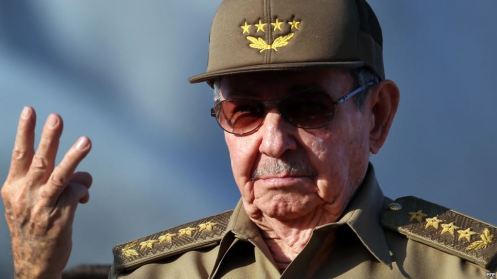
A screen shot of General Arnaldo Ochoa at the televised trial where he was sentenced to death by firing squad. (CC)
14ymedio, Marta Requeiro, Miami, 15 July 2017 — July 13, 1989, began with a morning of radiant sun, however since that day, the fear of injustice and a terrible coldness stole from me that peak of inner tranquility that I might have had and for a long time now has crushed me.
I did not hear the shots, nor screams, much less the smothered moans, but somewhere in Havana they escaped through the orifices caused by the bullets, or perhaps through their half opened mouths as they collapsed the souls of the four Cubans who had been executed.
The maximum penalty for a crime that could have been paid for with prison. For me, an injustice in the midst of the 20th century in a country that talked about justice. continue reading
The neighborhood, and I dare say the people, began their day like any other. I remember that I cared for my children as usual, taking one to school and their other to daycare.
Those of us who knew what was going to happen stood watch in the silence of the morning, that began to feel dense and irritating when we though about what happened without being able to speak openly of the conflict that, we felt, had been brought to an exaggerated end.
Four soldiers betrayed Fidel Castro’s revolution, sufficient for such a sentence. That was the biggest of the reasons, and so it remains.
Just after nine o’clock in the morning the radio reported that General Arnaldo Ochoa, Colonel Antonio de la Guardia, Major Amado Padron, and Captain Jorge Martinez had been shot dead in a military compound, a unit of the Revolutionary Armed Forces.
From that moment I had the lucidity to understand that the four faces that had been waiting for us during the long sessions of the televised trial had ceased to exist. It was not even a mitigating factor that Ochoa, the man who won the Ethiopian war against Somalia and risked his life on so many occasions for Cuba, would be no more.
Fidel Castro in the company of General Arnaldo Ochoa. (CC)
We were told that they had all carried out operations during the last year and a half in which they transferred tons of cocaine produced in Medellín to the United States, and through their ties with Pablo Escobar they had plans to carry out new and more ambitious shipments. Hence, what would have been a matter to be resolved within the tight circle of the armed forces became a matter of maximum betrayal of the country.
Fidel Castro tried with that decision to launder his own image and that of the Revolution, while at the same time reinforcing his authority and the discipline of the armed forces at a time when Soviet perestroika had isolated Cuba from the rest of the socialist countries.
Knowing the rebellious personality the main soldier executed, Ochoa and the subsequent dismissal of those in high positions of the government administration, some came to think that the Ochoa case was in fact an aborted military coup.
And I ask myself: how many did the Revolution betray afterwards? How many crimes did they commit and of what scale which, although we suspect, have not seen the light of day and will not be known until the regime falls.
Juan Juan Almeida, 12 June 2107 — With a decade’s worth of fledgling but stalled attempts at reforming Cuba’s economic system, a convulsive situation in Venezuela that could have repercussions in Havana and less than eight months to go before the end of his term as president of the Council of State and Council of Ministers of the Republic of Cuba, General Raúl Castro’s preference is for the novelty of the three-dimensional image.
“In collaboration with the Office of the Historian of the City of Havana and with financial support from the European Union and the Barcelona city government, the Interpretive Center for EU/Cuba Cultural Relations opened last month in the Palacio del Segundo Cabo. As part of the project, a 3D movie theater also made its debut. Its goal is to provide support to scholars and researchers studying Cuba’s cave formations and natural heritage. But ever since Raúl Castro learned of the facility and discovered the third dimension, he hasn’t left the place and his constant presence is hindering normal activities in the area,” claims someone who works at the center, which is housed in a historic structure. continue reading
“The general,” the employee adds, “is not coming here to learn more about the subterranean riches of the Cuban archipelago, which is our reason for being. He is coming to see Godzilla, Jurassic Park, Pompeii, The Hobbit, Spiders and other 3D movies he brings with him, as though this were his private screening room or neighborhood movie theater.”
“What goes around comes around,” he sarcastically notes. “The Palacio del Segundo Cabo has reverted to its original use as military fortress. Raúl Castro might show up at any hour of the morning, noon or night. Security around the site has been tightened, with uniformed military personnel present. They have even removed the horse-drawn carriages and 1950s convertibles that tourists like so much. Military-run businesses in the area are suffering but, with Habanaguanex in charge…”*
According to the official online encyclopedia ECURED, “in commemoration of Europe Day on May 9, 2017, the permanent exhibition spaces in the Center for Interpretation of Cultural Relations between Cuba and the Old World were inaugurated in the renowned Palacio del Segundo Cabo. The building’s restoration is a major project made possible with funds from the European Union and with the direct involvement of the United Nations Educational, Scientific and Cultural Organization (UNESCO). The most up-to-date technology has been used to create a beautiful center that will allow for exploration of cultural, historical, literary and artistic phenomenon but, more importantly, of our shared communal legacy.”
During the opening reception and in the presence of Cuban officials and foreign diplomats — among them was Herman Portocarrero, ambassador and head of the European Union delegation — Dr. Eusebio Leal, Historian of the City of Havana, referred to the founding of Europe, based on deep and solid traditions, and made a timely reference to the collapse of the Roman Empire and the formation of a new era.
*Translator’s note: In 2016, profitable tourism-related businesses such as hotels and restaurants in restored sections of Old Havana that had been operated by the Office of the Historian were taken over by the Habanaguanex conglomerate, led by the Cuban military.
Ivan Garcia, 15 July 2017 — Even the street dogs, ragged and hungry, take cover under the roofs in Havana when the clock marks 1 PM.
The sun burns and humidity gives you sweat marks on your clothes. After noon the Havana’s street look like the Saharan desert. People take cover in their houses and those out walking are just desperate go into any store, cafeteria or a state bank with air conditioning to get a blessed shot of air from the refrigerated climate.
In that desolate tropical picture of a July noon in Cuba, where everyone flees from the steel heat, Antonio, along with his workers brigade, works asphalting streets in the district of Diez de Octubre. continue reading
After having two boiled eggs for lunch, along with white rice and a watery black bean soup, Antonio, places against his shoulder, as if it was a baseball bat, the heavy pneumatic hammer and starts breaking streets.
“I work twelve hours a day. Nobody likes repairing and asphalting streets. Almost all of us that work here are ex-prisioners, incurable alcoholics or mentally impaired. I make the equivalent to US $50 (approximately 1,250 Cuban pesos) a month, sometimes a little more if we meet the plan,” explains Antonio.
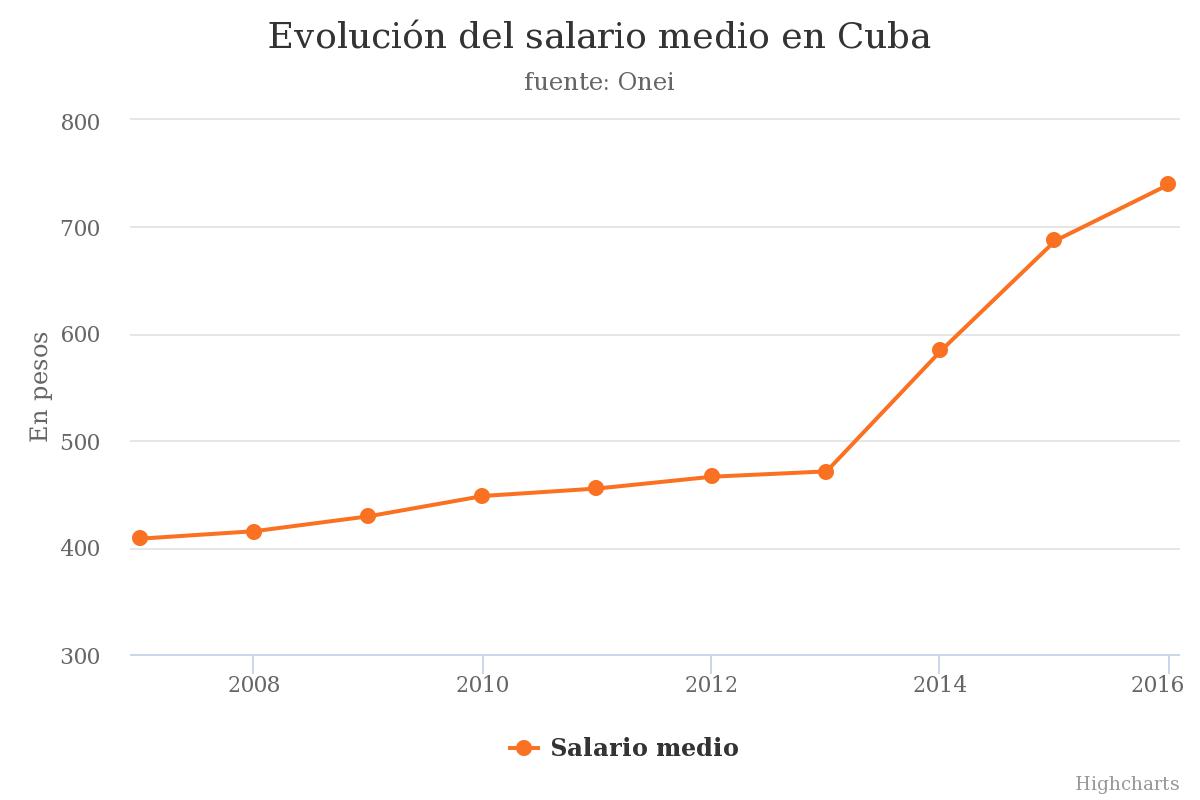
Even when his salary is almost double to the average in Cuba ($740 Cuban pesos), the money that Antonio makes for his hard work doesn’t cover a quarter of his basic family’s needs. “I have two kids, 12 and 14 years old, and the salary is not enough to buy them clothes and shoes, nor take them out on the weekends. It is enough just for two plates of hot food on the table every day. We don’t eat what we’d like, but rather the most economic.”
Antonio, a black and burly man, was able to get work as a doorman in a private bar. “Like many Cubans, I get into any business that gives me money. Fixing the streets is exhausting work, but I can’t stop it because it’s a steady salary. In addition, I don’t know how to do anything else.”
In other countries, the maintenance of public roads is done during the night time, among other things to help with the heat during the day. But in Cuba, the supposedly socialist Mecca with a human face, it is done with a sun from hell.
The olive green regime is a complex game of mirrors. They sell the social justice narrative, love for the people and productive successes that are only met on the television newsrooms.
If you really want to understand the authentic military power that governs Cuba, please, stop at the salary of their workers. Since Fidel Castro came into power, using military force in January 1959, a part of one’s salary, between 5% and 9%, was deducted to pay for education and universal health care.
The majority of the Cubans agree on keeping their taxes to support the health care and education. But with the passing of time, the galloping inflation, the lack of productivity of the communist system and the bloated apparatus of the state system, taxation feeds on sales of goods and workers’ salaries as if they were a sandwich.
That salary of state workers, which is 90% of the labor force in Cuba, is joke in bad taste. The minimum monthly salary is 225 Cuban pesos or approximately US$10.
With that money people pay for the lean “basic basket” that the State gives to all people born in Cuba: 7 lbs. of rice, 5 lbs. sugar, 20 ounces of beans, half a pound of vegetable oil, a pound of chicken, a pack of pasta and a small piece of daily bread of approximately 80 grams.
The described merchandise costs no more than 20 Cuban pesos (or less than US$1). But it only lasts for one week. The rest of the month, the ones that earn minimum salary, like retirees, have to do miracles to eat.
Then you have the electricity bill. It’s very expensive. A family with a television, two fans, a fridge, a rice cooker, a blender and a dozen light bulbs pays between 30-40 Cuban pesos monthly.
If you have air conditioning and more than one TV in the house, the consumption increases to 300 Cuban pesos per month. Except the high level government leaders — and no one knows exactly how much they make — the next highest paid salaries are earned by doctors or ETECSA (the only telecommunications company) engineers. A medical specialist could earn the equivalent of US$60. For an ETECSA professional, adding the hard currency bonus, it can be close to US$90.
But is that enough to support a family? Of course not. Ask Migdalia, the engineer. As an answer, the young professional shows a pile of paper full of numbers and expenses.
“I am a single mother to a son. For food for two people it costs between 1200-1300 Cuban pesos. The rest, it just evaporates in school snacks. It’s not even enough to pay the electricity, buy books or any other entertainment. My father lives in Miami, he sends me US$200 monthly and once a year pays for a week-long vacation in a hotel in Varadero. Although my salary is one of the highest paid in the country, it doesn’t let me have a quality nutritional diet. To buy clothes, go to the hair salon or go to dinner at a paladar (private restaurant) you have to make money under the table,” explains Migdalia.
In Cuba, that euphemism translates to a hard and simple aphorism: stealing from the State. “It is the only way to get to month end, fix the house that is in shambles or go to the beach with the family,” confesses Orestes, a port worker.
A national joke defines truthfully the non-existent social contract between the salaried workers and the regime: “people pretend to work and the government pretends to pay us.” It’s never been said better.
Raul Castro announced that he would step down in 2018, ten years after assuming power. (EFE)
14ymedio, Reinaldo Escobar, Havana, 15 July 2017 – In his most recent public speech before Parliament, General-President Raul Castro offered a self-criticism about “political deviations” under which the private sector and cooperatives are governed. “Mistakes are mistakes, and they are mistakes… they are my mistakes in the first place, because I am a part of this decision,” he emphasized.
In the list of mistakes he didn’t mention, he should have put in first place the absence of a wholesale market to serve these forms of economic management. It that option existed, honest entrepreneurs wouldn’t have to turn to the diversion of state resources to get raw materials and equipment to allow them to produce goods and services in a profitable way.
The greatest advance in this direction has been opening shopping centers were goods are sold “wholesale,” meaning in large volume sacks or boxes, but with the retail price per unit unchanged. continue reading
If, in addition, self-employed workers were allowed to legally import and export commercially, with the required customs facilities, then these forms of management would be on an equal footing with the state companies, and be able to perform efficiently.
The underreporting of income to evade taxes is a problem that exists in most countries where citizens must pay tribute to the state treasury. As a rule, evasion of these payments is seen as a dishonest act where taxes are fair, and as an act of self-defense where the state tries to suck the blood out of entrepreneurs.
When governments have the vocation to grow the private sector, they reduce taxes, whose only role is to redistribute wealth and increase the financial capacity for social spending, but not to act as a drag to reduce individuals’ ability to grow and prosper.
Raúl Castro’s most profound mistake, when he decided to expand self-employment and the experiment of non-agricultural cooperatives, has been to do so with the purpose of depriving the state of “non-strategic activities, to generate jobs, deploy initiatives and contribute to the efficiency of the national economy in the interest of the development of our socialism.”
This opportunistic vision, of using an element alien to the economic model as the fuel to advance it, generates insurmountable contradictions. An entrepreneur who starts a business is interested in increasing his profits (according to Karl Marx) and growth. He does not care that hiring workers will reduce unemployment and that their particular efficiency will have repercussions on the country’s economy. Much less, that his good performance contributes to perfecting a system that takes advantage of his success in a circumstantial way.
The entrepreneur dreams that in his country there are laws that protect his freedom to do business, that his money is safe in the banks, and that he has the right to import and export, to receive investments, to open branches, to patent innovations without fear of unappealable seizures or sudden changes in the rules of the game. Without fearing a report will arrive on the president’s desk detailing how many times he has traveled abroad.
The entrepreneur would also like to be able to choose as a member of parliament someone proposing such laws and defending the interests of the private sector, which he does not see as a necessary evil, but as the main engine to advance the country. Not understanding this is Raul Castro’s principal mistake.
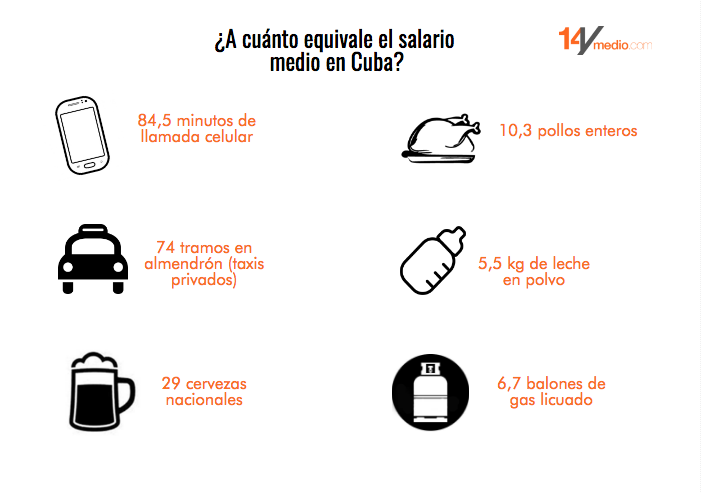
Currently, it would take the earnings of an entire month for a Cuban worker to buy 10.3 chickens, OR 7.6 tanks of liquefied gas for their stoves. (14ymedio)
14ymedio, Mario Penton and Luz Escobar, Miami and Havana, 14 July 2017 — Ileana Sánchez is anxiously rummaging through her tattered wallet, looking for some bills to buy a toy slate for her seven-year-old granddaughter who dreams of becoming a teacher. She has had to save for months to get the 20 CUC (Cuban convertible pesos, roughly $20 US) that the gift costs, since her monthly salary as a state inspector is only 315 CUP (Cuban pesos), about 12 dollars.
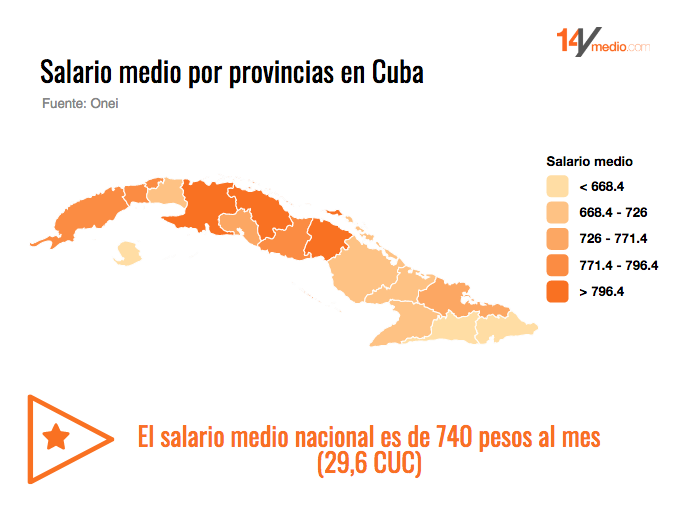
At the end of June, the National Bureau of Statistics and Information (ONEI) reported that the average salary at national level reached 740 CUP per month, slightly more than 29 CUC. However, the increase in the average salary does not represent a real improvement in the living conditions of the worker, who continues to be able to access many goods and services only through remittances sent from family abroad, savings and withdrawals.
Average Monthly Wages in Cuba: 2017-2017. 25 Cuban pesos = $1 US
continue reading
“I do not know who makes that much money, nor what they base these figures on, because not even with the wages my husband earns working in food service for 240 CUP a month, along with my wages, do we get that much,” says Sanchez.
The ONEI explains that the average monthly salary is “the average amount of direct wages earned by a worker in a month.” The calculation excludes earning in CUC. However, the average salary is inflated by the increases in “strategic” sectors, such as has happened in healthcare, where the pay has been more than doubled, while in other areas of the economy wages have remained practically unchanged for over a decade.
“If you buy food you can not buy clothes, if you buy clothes you can not eat, we live every day thinking about how to come up with ways survive,” she says in anguish.
Most Cubans do not support themselves on what they earn in jobs working for the state, which employs 80% of the country’s workforce.
President Raúl Castro himself acknowledged that wages “do not satisfy all the needs of the worker and his family” and, in one of his most critical speeches about the national reality in 2013, he said that “a part of society” had become accustomed to stealing from the state.
Sanchez, on the other hand, justifies the thefts and believes that the “those who live better” are those who have access to dollars or those who receive remittances. “Anyone who doesn’t have a family member abroad or is a leader, is out of luck,” she says.
According to the economist Carmelo Mesa-Lago, when speaking of an increase in the average wage, a distinction must be made between the nominal wage, that is, the amount of money people receive, and the real wage, adjusted for inflation.
A recent study published by the academic shows that although the nominal wage has grown steadily in recent years, the real wage of a Cuban is 63% lower than it was in 1989, when Cuba was subsidized by the Soviet Union and the government had various social protection programs. At present, the entire month’s salary of a worker is only enough to buy 10.3 whole chickens or 7.6 tanks of liquefied gas.
Among retirees and pensioners, the situation is worse. The elderly can barely buy 16% of what a pension benefit would buy before the most difficult years of the so-called Special Period – the years of economic crisis after the fall of the Soviet Union – according to Mesa-Lago.
Or by another measure, spending an entire month’s salary a worker can only afford 19 hours of internet connection in the Wi-Fi zones enabled by the state telecommunications monopoly, Etecsa, or 84.5 minutes of local calls through cell phones.
What an entire month’s salary will buy in Cuba (only ONE of these things): 84.5 minutes of cellphone service, 10.3 chickens, 74 shared fixed-route taxi rides, 5.5 kg powdered milk, 29 national beers, 6.7 tanks of liquified natural gas
To buy a two-room apartment in a building built in 1936 in the central and coveted Havana neighborhood of Vedado a worker would need to save their entire salary for 98 years, while a Soviet-made Lada car from the time of Brezhnev would cost the equivalent of 52 years of work.
However, the island’s real estate market has grown in recent years at the hands of private sector workers who accumulate hard currency, or by investments made by the Cuban diaspora. In remittances alone, more than three billion dollars arrives in Cuba every year.
According to Ileana Sánchez, before this panorama many people look for work in the areas related to state food services or administration where they can steal from the state, or jobs that provide contact with international tourists such as in the hotels.
Other coveted jobs in the private sphere are the paladares – private restaurants – and renting rooms and homes to tourists where you can get tips. The “search” (as the theft is called) has become a more powerful incentive to accept a job than the salary itself.
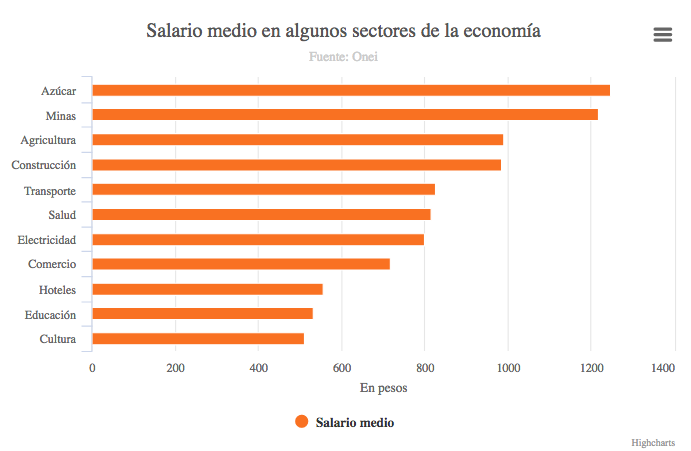
Average monthly salary in Cuba by sector
Although, according to the document published by the ONEI, workers in the tourism and defense sector earn 556 and 510 pesos on average, many of them receive as a bonus a certain amount of CUC monthly that is not reflected in the statistics, and they also have access to more expensive food and electrical appliances than does the rest of the population.
Among the best paid jobs in CUP, in order of income, are those in the sugar industry, with 1,246 CUP on a monthly basis, and in agriculture with 1,218. Among the worst paid jobs according to the ONEI are those working in education, with 533 CUP, and in culture with 511.
For Miguel Roque, 48, a native of Guantánamo, low wages in the eastern part of the country are driving migration to other provinces. He has lived for 12 years in the Nuclear City, just a few kilometers from Juraguá, in the province of Cienfuegos, where the Soviet Union began to build a nuclear plant that was never finished.
“The East is another world. If you work here, imagine yourself there. A place stopped in time,” he explains. Roque works as a bricklayer in Cienfuegos although he aspires to emigrate to Havana in the coming months, where “work abounds and more things can be achieved.”
Average monthly salary by Cuban province. The lowest, 668.4 Cuban pesos, is the equivalent of $26.75 US, and the highest, 796.4 Cuban pesos, is the equivalent of $31.85.
The provinces where average wages are highest, according to the ONEI, are Ciego de Avila (816 CUP), Villa Clara (808 CUP) and Matanzas (806 CUP), while the lowest paid are Guantanamo (633 CUP) and Isla de la Juventud (655 CUP).
“Salary increases in the east of the country are not enough to fill the gaps with the eastern and central provinces,” explains Cuban sociologist Elaine Acosta, who believes that cuts in the social services budgets are aggravating the inequalities that result from the wage differences.
“It is no coincidence that the eastern provinces have the lowest figures on the Human Development Index,” he asserts.
Juan Juan Almeida, 16 June 2017 — Alejandro Marcel Mendivil, successful entrepreneur, owner of El Litoral, a restaurant located at Malecon #161, between L & K, and the restaurant Lungo Mare, located in 1ra Esquina C, in the Vedado district, was arrested in Havana on June 8.
The reasons are not clear. Some claim that Marcel Mendivil is accused of money laundering and ties to drug trafficking; and others claim that if you are “noticed” in Cuba, it has a price.
“Alejandro is a young man hungry for challenges and pleasure. He has money, social recognition, he helps all his neighbors, has ties to diplomats as important as the ones in the American Embassy. He also has dealings with high ranking Cuban military and maintains very important access to the government elite. His ambitions go beyond those of common entrepreneurs, and to that add that the fact that he has charisma. Isn’t that a lethal combination? Alejandro is no drug trafficker or money launderer; he only tested power and ended up making it angry,” says one of the neighbors of his restaurant El Litoral, a retiree from the Ministry of the Interior. continue reading
“It was early in the morning, says an employee, the sea was flat as a plate when the operative began. Not even the Interior Ministry (MININT), nor the state officials gave any explanations in order to close the restaurant. They (the police) only told the employees that were present that we had to leave the place and look for another job in another restaurant because this closure was going to last. We were closed once, when an issue with the alcohol, but Alejandro solved it”.
“They got in and identified themselves as members of the State Security’s Technical Department of Investigations (DTI). They checked the accounting, the kitchen, lifted some tiles from the floor and they even took nails from the walls. An official with a mustache, who wouldn’t stop talking with someone on his BLU cellphone, was saying that they would find evidence to justify the charge of drug trafficking.”
“That looked like a theater, but with misleading script. It was not the DTI. In fact, Alejandro was not jailed at 100 and Aldabo, but rather held incommunicado in Villa Marista (a State Security prison). The whole thing was a State Security operation to put a stop Alejandro, who was earning money working and was becoming an attractive figure; in a country such as this one, where leaders, all of them, are very weak.”
The incident is timely to a discussion held during the extraordinary session of the National Assembly of People’s Power, which took place last May 30, where the Cuban vice-president Marino Murillo asserted that the new model of the socialist island “will not allow the concentration of property or wealth even when we are promoting the existence of the private sector.”
According to sources consulted in the Prosecutor General of the Republic of Cuba, there are plans for measures similar to those taken against Marcel Mendivil for these wealthy and influential owners of a paladar (private restaurant) located in Apartment 1, Malecon 157, between K&L, Vedado. And also against another one in Egido 504 Alton, between Montes & Dragones, Old Havana, in addition to two in Camaguey that were not identified.
Outside of the US Embassy in Havana. Taken by 14ymedio.
Ivan Garcia, 14 June 2017 — What you lose last is hope. And those who have plans to immigrate to the United States maintain bulletproof optimism.
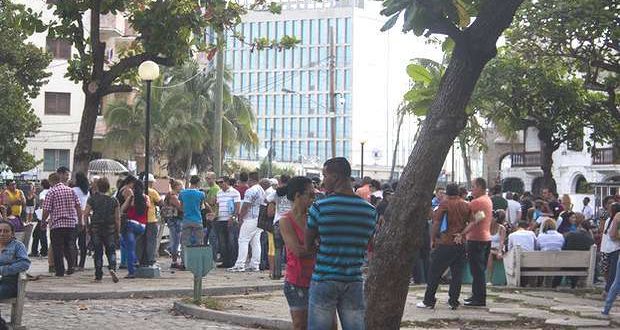
Close to a small park in Calzada street, next to Rivero’s funeral home, dozens of restless people await their appointment for the consular interview at the American Embassy located at the Havana’s Vedado district.
Ronald, a mixed-race man of almost six feet, requested a tourist visa to visit his mother in Miami. Before going to the embassy he bathed with white flowers and sounded a maraca gourd before the altar of the Virgen de la Caridad, Cuba’s Patron Saint, wishing that they would approve his trip. continue reading
Outside the diplomatic site, dozens of people await restlessly. Each one of them has a story to tell. Many have had their visas denied up to five times while some are there for the first time with the intent to get an American visa; they rely on astrology or some other witchcraft.
Daniela is one of those people. “Guys, the astral letter says that Trump instructed the embassy people to give the biggest possible number of visas,” she says to others also waiting.
Rumors grow along the line of those who read in social media — never in the serious news — that Trump, in his next speech in Miami, will reverse the reversal of the “wet foot-dry foot” policy.
In a park on Linea Street with Wi-Fi internet service, next to the Camilo Cienfuegos clinic, two blocks from the United States Embassy, Yaibel comments with a group of internet users that a friend who lives in Florida told him that Trump was going to issue open visa to all Cubans.
The most ridiculous theories circulate around the city among those who dream to migrate. The facts or promises made by Trump to close the faucet of immigration mean nothing to them.
Guys like Josue holds on to anything that makes him think that his luck will change. “That’s the gossip going on. Crazy Trump will open all doors to Cubans… Dude we are the only country in Latin America that lives under a dictatorship. If they give us carte blanch three or four million people will emigrate. The Mariel Boatlift will be small in comparison. That’s the best way to end this regime. These people — the government — will be left alone here”… opines the young man.
In a perfect domino effect, some people echo the huge fantasy. “Someone told me that they were going to offer five million working visas to Cubans. The immigrants would be located in those states where they need laborers. The people would need to come back in around a year, since the Cuban Adjustment Act will be eliminated,” says Daniela, who doesn’t remember where she heard such a delirious version.
Now, let’s talk seriously. If something Donald Trump has showed, aside from being superficial and erratic, it is being a president profoundly anti-immigrant. But more than a few ordinary Cubans want to assert the contrary.
The ones who wish to immigrate are the only segment that awaits with optimism good news from Trump. The spectrum of opinion of the rest of the Cubans ranges from indifference to concern.
In the local dissidence sector, the ones who believed that Trump was going to open his wallet or go back to Obama’s strategy towards dissent, became more pessimistic after the White House announced a decrease of $20 million dollars for civil society programs.
“Those groups that obtained money thanks to the Department of State are pulling their hair out. But the ones that receive financing from the Cuban exiles are not that unprotected,” indicates a dissident who prefers to remain anonymous.
The Palace of the Revolution in Havana is probably the place where Trump’s pronouncements are awaited with the greatest impatience. The autocracy, dressed in olive green, has tried to be prudent with the magnate from New York.
Contrary to Fidel Castro’s strategy, which at the first sign of change would prepare a national show and lengthy anti-imperialist speeches, Raul’s regime has toned that down as much as possible.
In certain moments they have criticized him. However, without offensiveness and keeping the olive branch since the government is betting on continuing the dialogue with the United Estates, to lift the embargo, to receive millions of gringo tourists and to begin business with American companies.
Official analysts are waiting for Trump to act from his entrepreneur side. The autocracy is offering business on a silver plate, as long as it is with state companies.
According to a source that works with Department of Foreign trade, “The ideal would be to continue the roadmap laid out by Obama. With the situation in Venezuela and the internal economic crisis, the official wish is that relations with the United States deepen and millions in investments begins. The government will give in, as long as it doesn’t feel pressured with talk about Human Rights.
“I hope that Trump is pragmatic. If he opens fire and returns to the scenario of the past, those here will climb back into the trenches. Confrontation didn’t yield anything in 55 years. However, in only two years of Obama’s policy, aside from the panic of many internal leaders, there was a large popular acceptance,” declares the source.
In Havana’s streets Trump is not appreciated. “That guy is insane. Dense and a cretin and that’s all. If he sets things back, to me it’s all the same. The majority of ordinary Cubans don’t benefit from the agreements made on December 17. Of course, I think it was the government’s fault,” says Rey Angel, worker.
And the reestablishment of the diplomatic relations and the extension of Obama’s policy to get closer to the the island’s private workforce, caused more notice in the press than concrete changes.
The people consulted do not believe that Trump will reduce the amount of money sent in remittances by Cubans overseas, or the number of trips home by Cubans living in the United States. “If he does, it will affect many people who live off the little money and things that family living in the North (United States) can send”, says a lady waiting in line at Western Union.
The rupture of the Obama strategy will decidedly affect the military regime. And it looks like the White House will fire its rockets against the flotation line. But anything can happen. Trump is just Trump.
Cuban members of the National Assembly of People’s Power lodge in the Hotel Tulipán during their regular sessions (14ymedio)
14ymedio, Generation y, Yoani Sanchez, 14 July 2017 — Wednesday night. The neighborhood of Nuevo Vedado is sliding into the darkness. Catchy music resonates in the Hotel Tulipán where parliamentarians are staying during the current regular session. They dance, drink under the sparkling lights of the disco ball and sing karaoke. They add their voices to a programmed score, the exercise they know how to do best.
With only two sessions a year, the Cuban legislative body gathers to stuff the population full of dates, figures, promises to keep, and critiques of the mismanagement of bureaucrats and administrators. A monotonous clamor, where every speaker tries to show themselves more “revolutionary” than the last, launching proposals with an exhausting generality or a frightening lack of vision. continue reading
Those assembled for this eighth legislature, like their colleagues before them, have as little ability to make decisions as does any ordinary Cuban waiting at the bus stop. They can raise their voice and “talk until they’re blue in the face,” and enumerate the inefficiencies that limit development in their respective districts, but from there to concrete solutions is a long stretch.
On this occasion, the National Assembly has turned its back on pressures that, from different sectors, demand new legislation regarding the electoral system, audiovisual productions, management of the press, same sex marriage and religious freedoms, among others. With so many urgent issues, the deputies have only managed to draft the “Terrestrial Waters Bill.”
Does this mean that they need to meet more often to fix the country’s enormous problems? The question is not only one of the frequency or intensity in the exercise of their functions, but also one of freedom and power. A parliament is not a park bench where you go to find catharsis, nor a showcase to demonstrate ideological fidelity. It should represent the diversity of a society, propose solutions and turn them into laws. Without this, it is just a boring social chinwag.
The parliamentarians will arrive on Friday, the final day of their regular session, in front of the microphones in the Palace of Conventions with the same meekness that they approached the karaoke party to repeat previously scripted choruses. They are going to sing to music chosen by others, move their lips to that voice of real power that emerges from their throats.
Juan Juan Almeida, 19 June 2017 — Teresa Sulien Castillo Sotto, a 27-year-old Cuban doctor born in Bayamo, died due to multiple fractures and traumatic brain injury on the night of Tuesday 13 June, at 10:20 PM, after jumping off the 8th floor of the C-05 building of Ciudad Tiuna in Tiuna Fort.
“It’s a delicate issue that they are treating with great tact and major caution,” comments a member of the National Coordinating Department (COOR), which, along with the National Directorate of the Cuban Medical Mission in Venezuela (MMCVEN), located in the Crillon Hotel. “We are talking about the death of a cooperating doctor within a military community where the only ones who enter are Cubans who are linked to some military person, people with overwhelming confidence, cases that call for control, or some of the collaborators who are related to Cuban leaders.” continue reading
Tiuna Fort is an enormous military installation, the most important in Caracas, and also in Venezuela which, among other things, is the headquarters of the Ministry of People’s Power, the General Command of the Army, the official residence of the vice president, and sports, cultural and financial facilities. It was in this urban complex where, in apartment 10-F, the young Cuban doctor lived.
Several officials from the Homicide Division of the Scientific, Penal and Criminal Investigations Corps (CICPC) came to the scene of the tragedy. The prevailing narrative is that Teresa made the tragic decision to kill herself because she found, on the cellphone of her husband, also a Cuban doctor, compromising text messages involving another woman. However, on her personal profile on Facebook, the deceased young woman appears as single.
That night, troops from the Bolivarian National Intelligence Service (SEBIN) and Cuban officials who have not been identified, put Teresa’s body in a van, took it to the morgue and did not allow members of the CICPC to preserve the scene of the tragedy nor to collect expert evidence.
The next day, Wednesday, three Cuban citizens came to the morgue in cars with official plates with the intention to accelerate the paperwork to collect the cadaver of the Cuban doctor. They accomplished this the same day and at four in the afternoon, after establishing contact with high level officials of the Bolivarian government and the representatives from the Cuban embassy.
“Normally what happens,” my interlocutor continued to explain, “they close the box in the morgue and send it to Maiquetia [the International Airport]. There, they finish the paperwork, and with the first flight they head to Cuban, accompanied by two officials dispatching the coffin and then the family members. In extreme or strange situations, the deceased is simply buried and they don’t even allow them to hold a funeral.”
“What they don’t want to reveal,” my informer breathes deeply and adds, in a tone appropriate to the shocking confession, “is that Teresa maintained a close relationship with a military man, an official with the National Guard who was captured by SEBIN for being involved with the right and the opposition marches against chavismo. They used the girl as an informer, she couldn’t refuse, because it would mean cancelling her mission, expulsion, threats and a ton of other things. She felt cornered with no alternative. She couldn’t do anything other than betray her friend and, in an act of honor, with a certain touch of ethics, she committed suicide, or she was pushed to suicide.”
The body is already in Cuba, having left on Thursday the 15th in an A320 airplane of Cuban Aviation on the Caracas-Havana route.
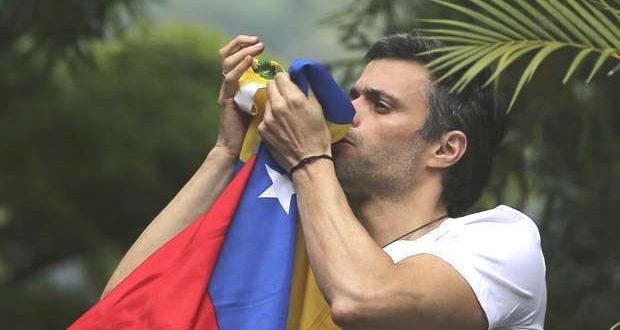
Leopoldo López, kisses the Venezuelan flag shortly after arriving at his home in Caracas. After serving nearly 4 years of a 13 year sentence for “arson and conspiracy” he was sent home under house arrest.
Iván García, 11 July 2017 — After painting the facades of several buildings along 10 de Octobre street, the workers of the brigade shelter from the terrifying heat in doorways, eating lunch, having a smoke or simply chatting.
These days, in Havana’s La Vibora neighborhood, in the area between Red Square and the old Bus Terminal, there is a hive of workers dedicated to converting the one-time terminal into a cooperative taxi base.
The work includes asphalting the surrounding streets and a quick splash of cheap paint on the buildings along the street. continue reading
“They say that Raul Castro or Miguel Diaz-Canel is going to come to visit the Luis de La Puente Uceda Limited Access Surgical Hospital and to inaugurate the taxi base,” says a worker sweating buckets.
When they finish talking about the poor performance of the national baseball team against an independent league in Canada, a group of workers comment on the street protest that have been going on for more than a month, led by the opposition in Venezuela, and how much the economy and energy picture of Cuba could be affected.
Yander, in dark blue overalls, shrugs his shoulders and responds, “I don’t follow politics much. But I hear on the news is that place (Venezuela) is on fire. According to what I understood, the Venezuela right is burning everything in their path. They’re as likely to burn a market as they are some guy for being a chavista [supporter of Maduro’s government]. If Maduro falls off his horse, things are going to get ugly in Cuba. The oil comes from there
Opinions among the workers, students, food workers consulted about Venezuela, demonstrates a profound disinterest in political information among a wide sector of the citizenry.
Younger people are active in social networks. But they pass on political content. Like Susana, a high school student, who with her smartphone is taking a selfie which eating chicken breasts in a recently opened private care, to post later on Instagram. When asked about the Venezuela challenge, she answers at length.
“You can’t fight with a political grindstone. What are you going to resolve with that. You’re not going to change the world and you can make problems for yourself. I heard about Venezuela on [the government TV channel] Telesur, but I don’t know why they started the protests. Nor do I know why there have been so many deaths. The only thing I know is that Cuba is strongly tied to Venezuela by oil. And if the government changes, if those who come, if they are capitalists, they will stop sending us oil. So I want Maduro to remain in power,” explains Susana.
Not many on the island analyze the crisis in Venezuela in a wider context. The South American nation is trapped between the worst government management, a socialist model that doesn’t work, and the hijacking of democratic institutions.
Ordinary Cubans don’t know to what point the Castro regime is involved in the design of the the local and continentals strategies of Chavismo. Opinion in Cuba is fueled by a myopic official press and Telesur, a propagandistic television channel created with the petrodollars of Hugo Chavez and Rafael Correa.
Except for specialists and people who look for information in other sources, most of the Cuban population believes that the violence originates with the opposition, classified as terrorists and fascists by the official media.
They know nothing of the fracture within chavismo itself, as in the case of Attorney General Luisa Ortega or the former Interior Minister Miguel Torres. Nor that at least 23 of the 81 who have died in more than ninety days of protests, was due the excessive use of violence by the Bolivarian National Guard.
Alexis, a private taxi driver, believes that the state press sweeps under the carpet any news that shows the brutality of the chavista regime. His concern is that “if they’re fucked, we’re fucked too. Man, then the blackouts will start, the factory closures, and eating twice a day will be a luxury. There’s no certainty about the origins of what is happening in Venezuela. I suppose the Venezuelans would like to free themselves from a system like ours. If they manage to do it then Cuba isn’t going to know what to do with itself.”
A wide segment of Cubans think that if the street protests in Venezuela end up deposing Maduro, given the domino effect, hard times will return to the Cuban economy.
“These people (the regime) have never done things well. That is why they are always passing the hat to survive or live off favors from others. We have not been able to made the earth produce. Everything we have we export. We are a leech. Thanks to the Venezuelan oil and the dollars that come from relatives in Miami, the country has not sunk into absolute misery,” points our Geraldo, an elderly retiree.
Geraldo clarifies, “It’s not out of selfishness, political blindness or love of Maduro that many Cubans are betting on the continuity of chavismo. It’s pure survival instinct.”
And the fact is that the economy has not yet hit bottom. Statistics and predictions forecast new adjustments and an economic setback if there is a change of government in Miraflores Palace.
Cuba is still not at the level of Haiti, the poorest country in Latin American, but it is headed that way. As the former USSR was, Venezuela is our lifeline.
Fernando Damaso, 6 July 2017 — It is no secret among Cubans that their government is inept and inefficient. Fifty-eight years of failure attest to this.
With the emergence of self-employment, however, officials have found a way to fill the state’s coffers without having to devote resources or effort to it. It’s called taxes.
They have devised (and continue to devise) taxes of all kinds to drain citizens who have decided to work for themselves rather than depend on the state. continue reading
The recent tax increase on the sale of homes is one example and there is talk of increases in other areas as well. A contract was recently announced in which homeowners would provide rooms to Public Health clients in order to care for those who are ill or need medical attention.
As logic would have it, it would be at the homeowner’s expense even though every medical tourist’s insurance pays for it. Never in Cuban history, even during the colonial era, has there been a government that exploited its citizens more than this one.
No one disputes the need for taxes as a contribution to the maintenance of the state and its social services. But the assumption is that the state will create wealth and not use taxes as its main source of income. There is also no entity or authority that exercises control on citizens’ behalf over the expenses of the state. The so-called Comptroller General of the Republic exercises this role only over her own ministry, not over the president or vice-presidents.
According to the legislation passed last month at a special session of the National Assemby, “the accumulation of property and weath by citizens is not and will not be permitted.”
Fortunately for the citizens, the laws are made by men, and when they disappear most of the time the laws disappear as well. Nothing is eternal. To believe otherwise shows a lack of intelligence.
Juan Juan Almeida, 11 July 2017 — The President of the Councils of State and of Ministers of the Republic of Cuba recently underwent cosmetic surgery to improve his chin. The chief of Cuban communists wants to be rejuvenated so that young people won’t feel they are being governed by an old man of 86.
The absurdity is that a process so normal and ordinary acquires, on the island, the unusual dimension of a “State Secret.” The problem that arises from such a “mystery” is that as a recognized public figure he is under the magnifying glass of the public observer who, from now on, will compare his current appearance with old photographs of him. continue reading
Apparently, and this could not be confirmed, patient Raul Castro refused general anesthesia for fear of bad intentions. The truth is that the operation on the president was performed by a Cuban eminence of cosmetic surgery, a celebrity of the guild, of whom I will only say that he is an assistant professor and first class specialist in plastic surgery, because I want to protect his identity from future attacks or implacable witch hunts. Some time ago he had problems at CIMEQ hospital, and later started to work in one of the most well-known teaching hospitals in Havana.
General Raul Castro is a man of particular appetites that grew over time, the influence of alcohol and a real frivolity. It is normal with this surgery to try to correct the traces of a person’s excesses, without exaggerating or abandoning his disagreeable natural aspects. However, he is not the first president, nor will he be the last, who tries to improve his image using surgical techniques.
Plastic surgery (“plastic” derives from the Green “plastikos” which means to mold or give shape) is the medical specialty that deals with the correction or restoration of the form and functions of the body through medical and surgical techniques.
In 1994, while Libya was faced with an international embargo, a group of Brazilian doctors traveled to Tripoli via Tunisia, to perform a hair implant and neck surgery on the now deceased Muammar Ghaddafi.
In 2011, the former Italian prime minister Silvio Berlusconi underwent a long cosmetic surgical procedure on his jaw which, according to reports from his personal doctor, lasted more than four hours.
Argentina’s former president Cristina Fernández de Kirchner also succumbed to vanity and was remodeled with the help of the scalpel.
And although the Kremlin spokespeople insist on the contrary, one only has to look at old photos and images of President Vladimir Putin and compare them to recent ones. The change is obvious.
It is normal that the Cold War raised the conflict between ideologies and the leaders of that time needed to focus on strategy and wisdom. Then, with the coming of globalization, nationalist discourses lost political strength. Now, in today’s world, several leaders, some fierce, some bullies, prostitute their political ends paying special attention to self-promotion on the internet and on social networks.
Raul Castro cannot escape the desire to look like a modern old man and subjects himself to discrete adjustments with the truculent intention of showing himself to be less despicable.
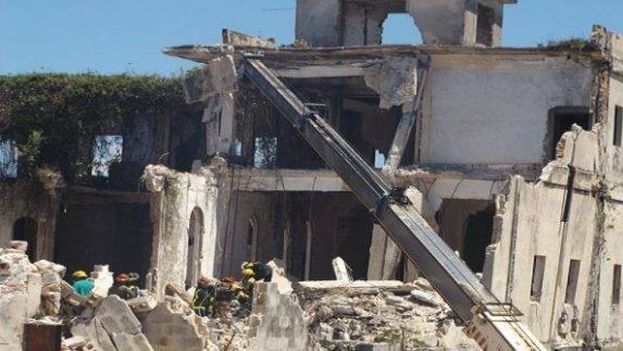
Hotel Commercio in Caibarién, in the reconstruction to which two workers died. (Radio Caibarién)
14ymedio, Havana, 11 July 2017 — The collapse of a wall during the reconstruction of the Hotel Commercio in Caibarién, in the province of Villa Clara, cost two workers their lives on Tuesday and left eight others injured. The crew was working on rehabilitating the property, as confirmed to 14ymedio by a resident who lives nearby.
The work accident occurred when a wall collapsed which caused a part of the second floor of the build to collapse, the local press reported.
The deceased are Dorian Toledo Pascual, 40, and Felix Morales Dominguez, 28, both residents of Caibarién. According to statements by the authorities, both were buried under the hotel debris. The builder Richard López Pérez is in critical condition and Andrés Estévez Báez, is in serious condition.
The less serious injured are at Caibarién Hospital, where all the injured received first aid, 14ymedio confirmed by telephone.
After the accident, several fire rescue crews deployed to search through the debris, where they found the workers trapped in the rubble, but two of them were found dead.
For years, the Hotel Comercio has experienced a long process of deterioration. The current rehabilitation work is intended to allow it to to reopen its doors at the end of 2018.
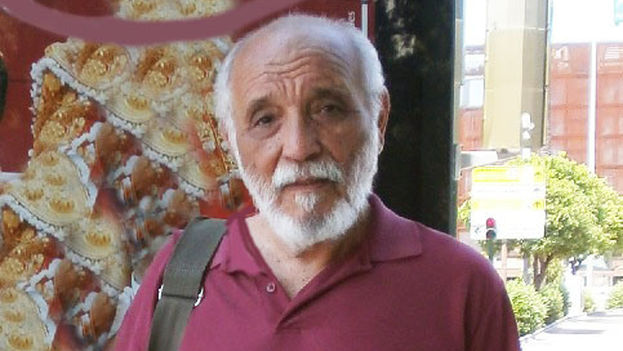
The poet Rafael Alcides. (Regina Coyula / lamalaletra.com)
Jorge Enrique Lage interview with Miguel Coyula (fragments) 2
Miguel Coyula: [… the cinema where I first encountered anime.] [… like the video games of the late eighties and early nineties, the anime of that time had no big budgets for a fluid animation at twenty-four frames per second, Disney-style. Then they went to a visual design and assembly and sound very often shocking.] [… in the subconscious, that left a mark on the film I make.]
For me it is very important to work the space and design the storyboard to the last detail, so that no image is repeated during the editing of a scene. That is something that comes from anime, and the comic book in general. Each panel expresses an idea, just as in literature each sentence expresses something different.
As for video games, the animation was even more limited: 2D, but that same limitation …] [… it made me shape an aesthetic where the image is as loaded as possible with small elements that add density to the setting.
[… the anime stories often left me with a bitter taste. Yaltus, known as Baldios outside Cuba, was a film that marked me a lot. Its apocalyptic and depressing ending, where the earth is completely contaminated with radioactivity, left me in a state of discomfort that I have pursued in my films.
[… one of the most striking films for me, for the stylistic collage it represents, was Belladonna of Sadness, 1973. For some reason it’s the 70’s that keeps calling me over and over again as a source of inspiration.
Site Manager’s note: Once all the fragments of this interview are translated (by different volunteers) we will unite them in order, in a single post.
Iván García, 28 June 2017 — On Havana there are illegal stores for all tastes. Pirated jeans at 20 CUC, copies of Nike shoes at 40 CUC and imitation Swiss watches at 50 CUC. People with higher purchasing power mark the difference. By catalog, they buy fashions, smartphones, LED lights, Scotch whiskey, Spanish wines.
And although the General Customs of the Republic of Cuba applies retrograde and severe laws on the importing of merchandise, rampant corruption always opens a gateway to singular private commerce. Although there are no exact figures, it is calculated that it moves twice as much money on the island as does foreign investment.
Let me present Rolando, the fictitious name of a guy who has been a ‘mule’ for three years. “My grandparents live in Miami and to supplement their pension, they became ‘mules’. They took the orders to customers’ homes, whether it was clothing, medicine, household goods or dollars. When travel abroad became flexible in 2013, I obtained a multiple-entry visa for the United States. Every year I travel seven or eight times and I bring stuff either for family use or to resell. All for a value of four to five thousand dollars.” continue reading
The complicated Customs regulations only allow Cubans to import certain goods once a year and to pay the customs fees in Cuban pesos — rather than convertible pesos, each of which is worth 25 times as much — but by means of bribes under the table the provisions of the law can be evaded.
Yolanda, an assumed name, is dedicated to bringing garments and hair products. “In Cuba, the stake fucks anyone who follows the letter of the law. This is the case for Cubans living in other countries when they send things by mail: they can only send three kilograms and if the package exceeds that weight, every additional kilogram is taxed at 20 Cuban convertible pesos (CUC). A real abuse.
“What do those of us who dedicate ourselves to this business do? We have good contacts in Customs and so we can take all the stuff through. You pay the people according to what you bring. If you bring in goods valued at $10,000, for example, you have to give them $200 and a “present” which can be a flat screen TV, a home appliance, or some clothing.”
According to Yolanda, “Palmolive, Colgate, Gillette or Dove toiletries sell like hot cakes in Cuba. If you buy in the free zone of Colon, Panama, you earn a little more. In Miami, it depends on the place: in small stores and wholesale markets you get more for you money. Gillette deodorants purchased wholesale will come out at $1.50 and in Havana they will be sold at 5 CUC (roughly $5 US).
“An appliance or television is not profitable if you buy it at Best Buy, you have to buy it in Chinese stores or have a contact that sells it wholesale. The problem of the electrical appliances is that they weigh a lot, that’s why they are shipped by boat.
“With the exception of certain items that my regular customers order from me, the rest I buy to sell in quantity to the resellers. On a trip, apart from recovering expenses, I can earn up to 800 CUC. And I am a new ’mule’ in this market, the ones that spend more time, they earn three times more, because they bring more expensive items such as car parts and air conditioning equipment.”
Several ‘mules’ consulted believe that the best places to buy merchandise are Panama, Miami, Peru, Ecuador and Mexico. “Moscow is expensive for the cost of the plane ticket. But if you have the way to bring into the country large quantities of parts and components for cars and motorcycles, you earn a lot of money. Any trip leaves a percentage of profits that ranges from 30 to 100 percent,” says Rolando.
Recently, the Wall Street Journal published a report on the traffic of automobile parts between Moscow and Havana: “They travel 13 hours, sleep crowded in emigre apartments and ask for borrowed coats and boots to rummage and bargain in a cold weather looking for used parts of the Russian capital. But do the accounts: a Lada car of the Soviet era in good conditions sells on the Island for 14 thousand dollars.”
The current collection of Soviet-era vintage cars has made the supply of parts and components for these cars into a highly profitable business. “In Russia there are few Moskoviches, Ladas and Volgas manufactured in last century still running. With the help of Cubans residing in Moscow, full cars are bought for the equivalent of 300 or 500 dollars and scrapping them for pieces increases the values tremendously. There are also small businesses where you can packaged new parts,” explains Osiel, dedicated to the selling of car parts bought in Russia.
It may seem like an unimportant business, but a Soviet-era car, with an American chassis and parts from up to ten different nations, costs $10,000 to $20,000 in Cuba.
In the Island you find ‘mules’ specializing in the most diverse branches. “I only buy smart phones, tablets, PCs and laptops. After paying the respective bribe, in a single trip I bring in up to ten phones, five or six tablets, two PCs and four laptops. The profits can exceed 3,000 CUC. Smartphones are a gold mine. Companies buy them, then through payment they activate to unlock them and there are those who know how to ’crack’ them. In Havana, the iPhone 7 or Samsung 8 is cheaper than in Miami,” says Sergio.
At the beginning, the ‘mules’ started as a business managed by Cubans living in the United States and they moved any amount of money and stuff. The parcels are delivered personally to people in their homes.
After the olive-green state did away with the so-called White Card — the travel permit you use to have to have — that blocked Cubans from traveling freely, thousands of compatriots on the island decided to become ’mules’ and started to traffic in goods.
According to Rolando, “It has many points in its favor: you do not work for the government and do not depend their shitty wages. On each trip, you earn a ticket that makes your life more comfortable, you disconnect, meet people and travel to clean cities and well-stocked stores. And the government has not opened fire on the ‘mules’ as much as they have on the self-employed.”
In addition, they don’t pay taxes to the state for their underground business.