Dozens of Opponents Attend Mass in Honor of Oswaldo Paya in Havana


Our apologies for not having subtitles for this video.

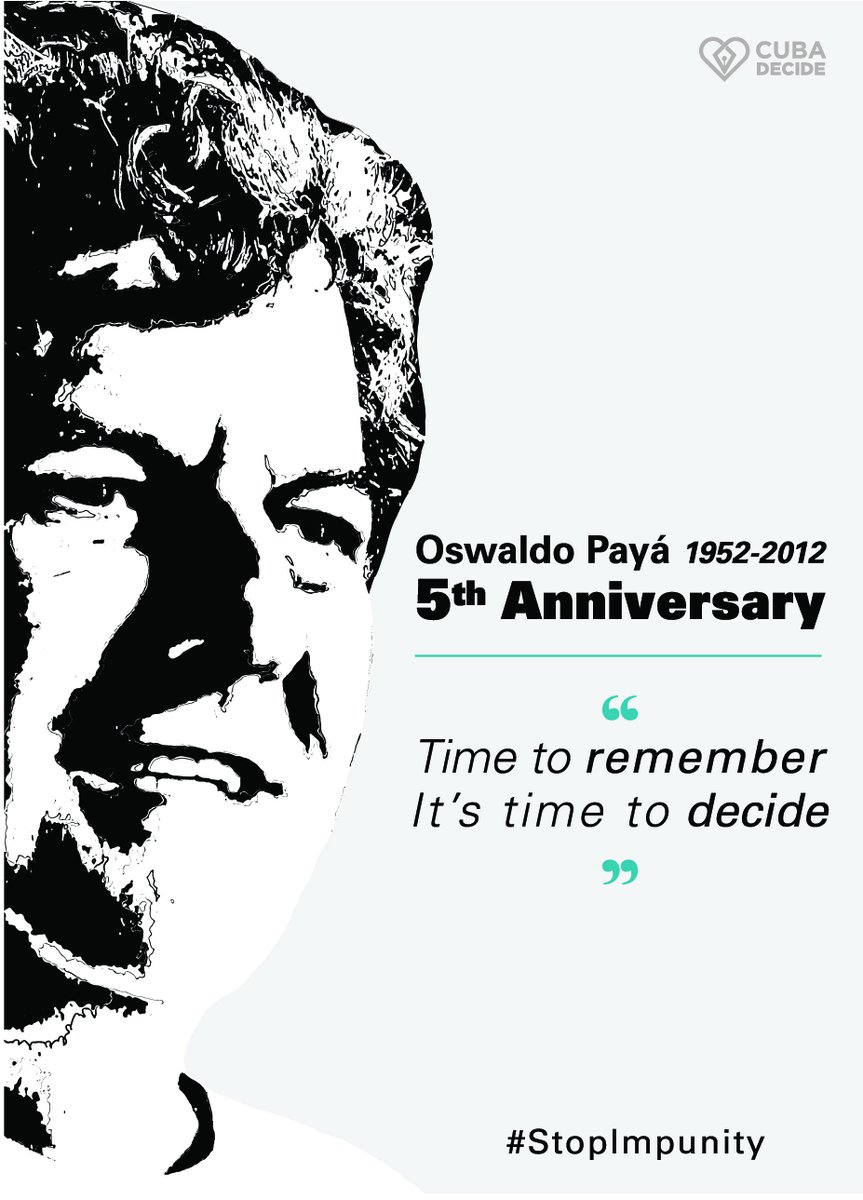
14ymedio, Havana, 21 July 2017 — At least 40 activists attended a mass in tribute to opponents Oswaldo Payá and Harold Cepero on the fifth anniversary of their deaths, on Thursday evening. The ceremony took place in the church of Los Quemados in Marianao, Havana, and passed without incident.

The daughter of the leader of the Christian Liberation Movement (MCL), Rosa María Payá, traveled from the city of Miami, where she lives, to participate in the memorial. About 60 people attended the mass, among whom were family, friends and opponents of the Castro government.

Among the activists who participated were former Black Spring prisoner Félix Navarro, the dissident Manuel Cuesta Morúa and the leader of the Ladies in White, Berta Soler.

Speaking to 14ymedio Rosa María Payá said she found “the whole of civil society represented” to honor the memory and legacy of his father. “[All opponents] agree fundamentally: this system does not work and we have to change it.”

Berta Soler said that “the Cuban regime thought that killing Oswaldo Payá was going to do away with him” but that was not the case because “he lives among us.”

Oswaldo Payá founded the MCL in 1988 and died on 22 July 2012 with Harold Cepero, after the vehicle in which they were traveling, driven by the young Spanish politician Ángel Carromero was driving, went off the road and hit a tree.

Payá’s daughter is carrying out an intense international campaign to demand an independent investigation of the case and maintains that the death of her father was a murder orchestrated by the authorities of Havana, and that the car was purposefully run off the road.

A report by the international Human Rights Foundation (HRF) points to “solid indications” that the car in which Payá and his companions were traveling was hit by another vehicle before the crash.

Cubans Want to Vote in Free and Open Elections: Oswaldo Paya and Harold Cepero Are Two of the Many Who Have Died For It

5 years since the death of Oswaldo Paya and Harold Cepero

On NOT Waiting for the King to Die / Rosa María Payá

Cuba Decides: Continuing Oswaldo Paya’s Work for a Plebiscite

Oswaldo Payá Remembered On The Anniversary Of His Birth / 14ymedio

Rosa María Payá: “Totalitarianism is not broken in Cuba, we can not pretend it is” / EFE (14ymedio), María Tejero Martín

Je Suis Cuba / Rosa Maria Paya Acevedo

“The Cuban people must get their voice back to begin the transition” / 14ymedio, Reinaldo Escobar, Rosa Maria Paya

Virginia Dandan, The Expert Who Asks No Questions

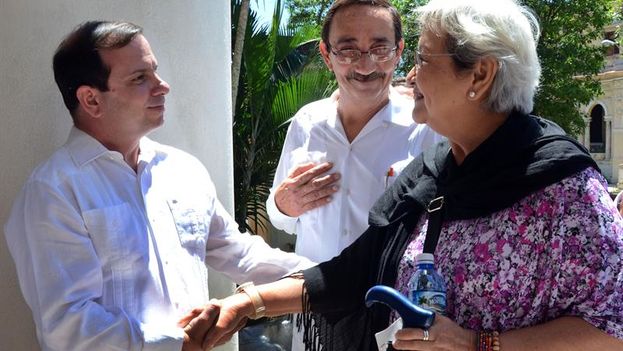
The UN Rapporteur on Human Rights and International Solidarity, Virginia Dandan, with the president of the Cuban Institute of Friendship with the Peoples (ICAP), Fernando González. (EFE / Joaquín Hernández)

14ymedio bigger14ymedio, Eliecer Avila, Havana, 15 July 2017 — The visit to Cuba by United Nations expert on Human Rights, Virginia Dandan, ended this Friday. The press conference she offered before leaving fueled expectations, after spending several days in an intense program of meetings and activities “on the ground.”

In her statements, however, the official from the Philippines made no mention of the human rights situation on the island, but merely praised its system of international cooperation. In passing, she regretted the country’s limitations in accessing new technology, due to the US embargo.

Her analytical myopia revived the criticism of many towards international agencies linked, or not, to the United Nations. An international “bureaucracy” that no longer responds to its original meaning and has become a lever of influence for some governments to manipulate its mechanisms and officials. continue reading

This practice came to a head when representatives from North Korea, Venezuela and Cuba joined the Permanent Council on Human Rights in Geneva. That these confessed violators occupy such responsibilities is not the most worrisome, rather it is that the rest of the world accepts it without pressing for their immediate dismissal.

In her statements, the Philippine official made no mention of the situation of human rights on the island, but merely praised its system of international cooperation

After that, there is little room for astonishment, but Mrs. Dandan has succeeded in sparking outrage against the agency she represents. Despite being an expert, she allowed herself to speak from disinformation about a government that does not hide from – and even prides itself on – violating the fundamental rights of its citizens.

It would have been enough for the expert to search in the social networks to find evidence of the situation Cubans live in. She would have seen the videos with the mobs gathered by the government shouting “down the human rights” and images of police searches where copies of the Universal Declaration of Human Rights are taken as “proof” of the crime of subversive activity.

If, before arriving in Cuba, Dandan did not have time to check the internet, just looking out the window of the vehicle that brought her from the airport to the city she would have noticed the cult of personality that crushes, bores and frightens. The numerous billboards and posters that along the way impose the image of the two brothers who have ruled the country for almost 60 years are a distinctive detail of a totalitarianism, and should not have gone unnoticed by her keen eye.

On the other hand, Mrs. Dandan specializes in the area of ​​education but did not go out into the streets of Havana to ask a child about the teaching of human rights in his or her school, or, more precisely, the rights of the child. Instead, she preferred meetings in the comfortable halls of the Cuban Institute of Friendship with Peoples or in the Ministry of Foreign Affairs.

Undoubtedly, the Government of Raúl Castro estimated the usefulness of the expert’s visit and scheduled it to take place a few days after seeing the new Bilateral Agreement with the European Union

The expert could have inquired of any passer-by whether they belonged to one party or another, or who their favorite candidate is for the upcoming election, to receive the disturbing answer that there is only one party and the president is not directly elected. But was Virginia Dandan willing to listen to that part of reality?

Undoubtedly, the Government of Raúl Castro estimated the usefulness of the expert’s visit and scheduled it to take place a few days after seeing the new Bilateral Agreement with the European Union and its clause regarding respect for human rights that have so greatly bothered officialdom.

This situation coincided with the change of rhetoric of the United States and the new policy of Donald Trump towards the Island. “A good moment,” the Place of the Revolution surely must have thought, to pull out a letter and generate some positive headlines about human rights.

However, the opinion of the chosen expert has been so precarious and biased to make the diagnosis that she didn’t even manage to amortize the investment made by the Government to cover her days spent on the island.

In the case of Cuba, Dandan lost the opportunity to put her ear closer to parents, elders, young people, entrepreneurs trying to carry out an independent project and activists who report frequent human rights violations. She preferred to listen to the victimizers instead of the victims.

Ethical Defense Of Migration

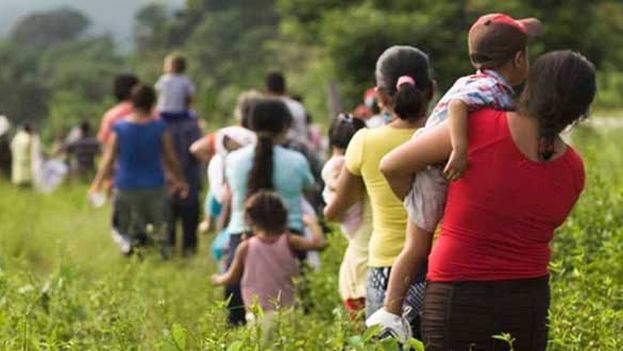
Migrants cross the Guatemalan border with Mexico. (EFE)

14ymedio bigger14ymedio, Jose Azel, Miami, 18 July 2017 — In an earlier article I argued that migration is an individual right; an expression of the desire for freedom to improve one’s quality of life. At that time, I wanted to emphasize the libertarian defense of open immigration, taking care to clarify that open immigration is not the equivalent of uncontrolled immigration. It does not imply guaranteeing the right to eligibility for citizenship, social benefits or other governmental services.

I defined open immigration only as the right of people to freedom of movement to enter a country by places established for inspection, where specific reviews are made to protect the nation from diseases, enemies, and crimes. People have the right to cross a border seeking freedom and happiness. But borders mean something. continue reading

People have the right to cross a border seeking freedom and happiness. But borders mean something.

Here I want to focus on the ethical aspect of open immigration based on the book by Michael Huemer Intuition Ethics. Let’s start with an experiment of reflection. Imagine that Juan, hungry and poor, goes to the local market to buy food with the little money he has. There, the salesman is happy to do business that allows Juan to meet his needs.

You, knowing Juan’s intentions, forcibly interrupt his movement, to prevent him from reaching the market. Unable to reach it, Juan remains hungry.

Your conduct is morally wrong because now you are responsible for Juan’s hunger. This reflection provides an analogy to the government’s restriction of immigration. Note that potential immigrants would like to travel to a country where there are entrepreneurs eager to hire them for mutual benefit. And governments use armed border guards to prevent by force those people from entering the country to work. But note also that your treatment of Juan would not be morally permissible even if some of the following conditions were present:

  1. If you want to prevent people who are already in the market having to compete with Juan for the products of food stores.
  2. If you are concerned that Juan influences the culture of the market in ways you disapprove.
  3. If you were concerned that, given your program to help the poor, you would have to give Juan free food by taking it away from others who are in your program.

These considerations are analogous to: (1) Immigrants taking jobs from low-skilled native workers. (2) Immigrants changing the local culture. (3) Immigrants using government services. These considerations do not justify their actions to prevent Juan from reaching the market. Their actions are immoral from the point of view of moral realism. However, there are other moral focuses.

Moral realism holds that some values ​​are objectively true. That is, the truth of those values ​​does not depend on one’s attitudes. But not everyone accepts moral realism. Relativists, for example, consider that what is right or wrong must be determined by what society approves or disapproves. For a relativist, the truth depends on the culture of each person. Others, like the subjectivists, consider that what is good, bad, right or wrong, depends on people’s attitudes.

Libertarians, always distrustful of authority, defend open immigration with the premise that governments must adopt the same ethical standards as people

Libertarians, always distrustful of authority, defend open immigration with the premise that governments must adopt the same ethical standards as people. In contrast, based on some variant of the “social contract” theory, non-libertarians believe that governments are exempt from the moral restraints that apply to people. Under the theory of the social contract we all have implicitly agreed to grant the government the right to the monopoly use of force in exchange for protection. We have accepted, in an implicit contract, that the Government acts immorally.

But social contract theory does not provide a satisfactory explanation for why the government should be exempt from the moral rules that apply to the rest of us. These rules imply a commitment to the moral equality of individuals, a supreme respect for individual dignity and rights, and reluctance to use force or coercion. In other words, these libertarian values ​​demand that Juan be allowed to come to the market without hindrance.

_______________________________

José Azel is Senior Researcher at the Institute of Cuban and Cuban-American Studies at the University of Miami, and author of the book Mañana in Cuba.

It Is No Longer Forbidden To Get Rich In Cuba

The MarAdentro paladar (private restaurant) in Havana. (14ymedio)

14ymedio bigger14ymedio, Reinaldo Escobar, Havana, 19 July 2017 — The most controversial point of the Conceptualization Of The Economic And Social Model has been changed with discretion and without public announcements. The concentration of property and wealth that was prohibited in its first version, is only regulated in the final document, released after the last session of Parliament.

The change of formulation, which is of major importance, has passed without pain or glory in the national and foreign press. However, that relaxation entails a victory for the reformist forces within the official apparatus. A triumph that paves the way for the mid-sized private company on the island.

The definitive version of the Conceptualization has few essential differences when compared to its first proposal released in May 2016. The “most discussed” document in the nation’s history has become old to the extent that the internal and external reality outstrips it in momentum. continue reading

Perhaps the fear its becoming irrelevant led its drafters to prefer the present tense to formulate precepts and principles for future application. A grammatical style that has confused more than one naïf, who took what they dreamed of achieving and projected it as already done.

To avoid pressures, the managers of the document also clarified that it isn’t about a “finished and static template,” but rather an “active and perfectible pattern.” This condition avoids dogmatic interpretations, but it also gives the Conceptualization a very comfortable elasticity for those who implement it.

Despite the vagueness of certain concepts, one of the statements in the text provoked strong arguments from the beginning. Item 104 of the original version read: “The concentration of property and wealth in natural or legal persons is not allowed.” A bucket of cold water for the entrepreneurs.

During the months that the document was discussed at Communist Party headquarters and among other chosen ones, no other matter provoked more debate. Some warned of the dangers of categorically denying this accumulation of wealth, and others pointed to it as the end of the present system. The latter just lost the game.

The new version softens the prohibition and clarifies that the concentration of property and material and financial wealth in non-state natural or legal persons will be regulated. The change in nuance shows that pragmatism prevailed above orthodoxy.

However, there is also no carte blanche so that a citizen can create a restaurant franchise or purchase numerous homes for rent. The Conceptualization is not deprived of the excessive scrupulousness of the official discourse that praises humility and stigmatizes the prosperous, but nor does it allow itself to be owned by those who promote strict egalitarianism.

If in the initial version of a starring element of the text was the absence of the concept of “exploitation of man by man,” whose eradication is the main objective of the socialist system, now it continues to be present through a euphemism.

In Cuba, “ownership by non-state ownership and management of part of the surplus of the work of contracted persons is allowed,” it reads; but immediately clarifies that “socialist relations of production prevail.” Something very different from what happens in “social systems based on the exploitation of the work of others,” according to this new version.

With its patches and changes, the Conceptualization has ended up being a demonstration of the different tendencies of those who participated in its final development. A sequence of ideas to please both reformers and conservatives, to sit well with both dogmatists and innovators. The editors intuited that Thomas More did not get his head cut off for writing Utopia, but for being disloyal to the King.

The concept of privatization that is presented in its pages is a good example of these contradictions. It talks of “temporary transfer of ownership or management of certain means of production owned by all the people to non-state economic actors” and goes on to warn immediately that such a transfer should not “compromise the principles of our socialism.”

To calm those who fear the distribution of the pie, the document pointed out in its first version that the state retains the capacity for strategic decision or domination over these means. Something softened in the final version, where it “maintains the exercise of the principal powers that correspond to him by virtue of the status of representative of the owner.”

The changes in the text show the fluctuations in the coming course and also its anchors in the past. The current Conceptualization presents as “particularly relevant antecedents” the Programmatic Platform born from the First Congress of the Communist Party and the Program of the Cuban Communist Party that was issued in 1986. At first, however, the document only recognized as precedent “History Will Absolve Me.”

The nuances introduced in the new version are the result of what has happened in the last year: the death of former President Fidel Castro, the crisis of the leftist governments in Latin America and the coming to power of an unpredictable actor in the United States. The document that was born to be letters chiseled in marble now looks like an elastic canvas full of patches and gaps.

The Simple Story Of Roof Sealant

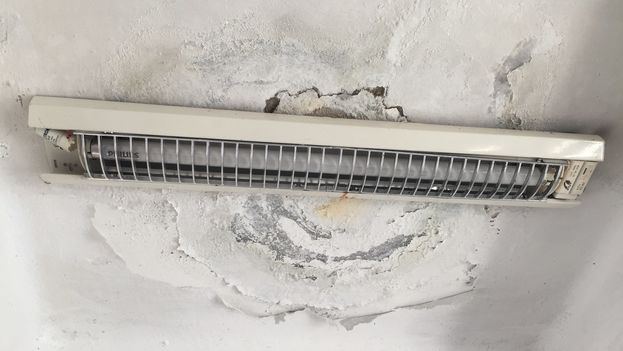
Short circuits in ceiling lamps, leaks and stains are some of the consequences of poor placement of a sealing cover on the roof. (14ymedio)

14ymedio bigger14ymedio, Generation Y, Yoani Sanchez, Havana 20 July 2017 — One day they came carrying rolls of roof paper to waterproof the roof of this concrete block where we live with more than a hundred families. Those state employees were deaf to the warnings. “We do not need coverage here,” some neighbors told them. “No apartment leaks when it rains,” said others. However, the installation continued its course without listening to the citizens, like all directions “from above.”

There was no way to convince the authorities that this multifamily building, built in the years of the Soviet subsidy, had other emergencies. Water pipes have collapsed over the years and the lightning rod has been inactive for decades. “What we have is a roof sealer and that is what we are going to install,” said the head of the team of workers who for several days toiled over our heads. continue reading

Shortly after, the cover began to breakdown in several places. The rainwater accumulated underneath and, as it could not evaporate in the sun, leaked into the houses. The residents on the top floors have suffered all kinds of problems as a result from that awkward decision. Short circuits in ceiling lamps, leaks and yellow stains that increasingly cover a larger area in the ceilings. What should have been a solution, has become a real headache.

Now the community is battling to remove the sealing sheets, but the authority to do so does not arrive at the same speed with which some bureaucrats ordered it to be installed. The most daring residents have ripped off the pieces above their own apartments, while the most cautious wait for official directions from above.

During the years the cover has remained in place, several areas of the roof have been filled with mold and have developed cracks due to moisture, a damage that, now, each affected resident must repair with the resources of their own pockets.

A few yards away, in the neighborhood of La Timba, several families have been demanding that they be given roof paper — at affordable prices — to repair their homes. With summer rains, their homes “get wetter inside than outside,” they say. Some have approached our concrete building to get what we obtained in the lottery of state inefficiency.

The history of this sealing or roof paper is just one of the thousands of absurdities that Cubans are forced to deal with every day. A sample of how the country’s resources are wasted on superfluous tasks designed to fill in the numbers or meet irrational goals while the real difficulties are avoided or hidden.

The useless roof covering has not only left significant damage in several apartments, but has further hurt the decision-making ability of a community, a group of neighbors that does not even have sufficient autonomy to remove the shreds of the mistake that remain on our roof.

Nothing Has Changed* / Fernando Dámaso

Fernando Damaso, 12 May 2017 — At the recently concluded Fifith National Council of the National Union of Writers and Artists (UNEAC), during skin-deep presentations, one timorous playwright expresed this thought: “A critical mindset is fundamental in society. UNEAC must become the thermometer wherein discussion is allowed.”

It appears that in UNEAC, as in the rest of Cuba, discussion is not allowed and requires permission to practice. And here I thought this was an inherent right of every citizen and not only for members of the UNEAC (with its appropriate authorization).

We all know that the UNEAC is a governmental organization, commanded and controlled by the Ministry of Culture, a body which lacks independence and whose principal duties are designated by the government and the party. continue reading

This Council, as more of the same, stands behind the execrable repression inflicted, in plain light of day this past May Day, on a citizen who had the gall to get ahead of the official start of the parade and run while waving a North American flag. If he had done this with a Venezuelan flag, perhaps he would have been applauded and even congratulated–but he did it with that of the “eternal enemy” and that, over here, constitutes a criminal act.

Both events demonstrate the prehistoric dogmatism and intolerance of our authorities, incapable as they are of setting aside their totalitarian stances.

Only in dictatorships are discussion and the display of a flag (even that of a country with which we have recently reestablished diplomatic relations) prohibited, and are those who do these things beaten up.

To speak of tolerance and of respect for diverse opinions is one thing, but to practice them is something else entirely. It constitutes a yet-unlearned lesson for the Cuban authorities. The old and new rulers do not tire of repeating the same old, broken record of defending the sovereignty, independence and identity of the Nation–which has always served as the basis of violating the most basic rights of the citizenry.

In this country nothing truly important changes. The few changes are limited to insignificant matters, which often are even more detrimental than beneficial to Cubans. To understand this, you need only sense the public opinion on the street and set aside the tired official rhetoric.

The matter of the Cuban flag could not be left out of the UNEAC Council, albeit already a tired topic.

Señores, the elements of the flag, or even the actual flag, reproduced in a piece of apparel, a tool or a craft, are not the flag. Let us leave aside extreme positions and let us truly repect the flag, not utilize it for cheap political and patriotic acts nor as a background for demogogues, thus breaking with the established tradition for its use–which actually has been and is systematically violated by the authorities. A similar thing occurs with the national anthem and emblem.

Translated By: Alicia Barraqué Ellison

Translator’s Notes:

*The orginal title of this piece in Spanish is, “El Cuartico Sigue Igual,” which can be literally translated as, “the little room is unchanged.” The author is riffing on a song that became very popular in Cuba in the late 1940s, “El Cuartico Está Igualito.” The phrase is a jilted lover’s refrain addressed to the departed love object, describing how everything in their love nest remains the same, just as she/he left it. Ever since, Cuban writers have used this phrase or a variation when referring to all manner of unchanged situations.

‘Fidget Spinner’, The Toy That Has Taken The World By Storm, Arrives In Cuba

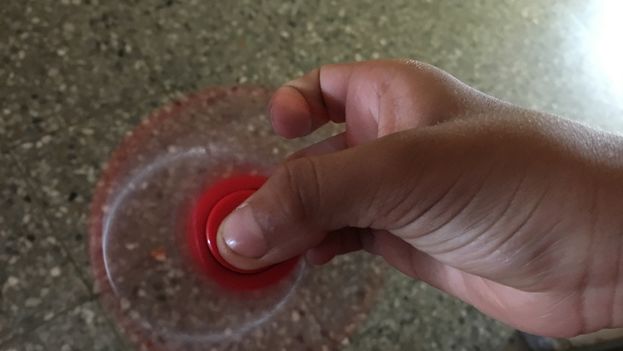
Samuel, 9, playing with his ‘fidget spinner’. (14ymedio)

14ymedio bigger14ymedio, Zunilda Mata, Havana, 17 July 2017 — Samuel is nine years old and has broken several of the windows in his building playing ball. His nearest neighbors see that he is very calm these days since his mother gave him a Fidget Spinner, a fad toy that some schools in the US, UK or Argentina have had to ban because of the distractions they cause among students. The toy has just landed in Cuba.

Simple and hypnotic, the little amusement with bearings can spin for several minutes. There are lights, phosphorescent colors, patterns and it even can emit repetitive tunes. In reality it is like the old yoyos or the spinning tops have returned, this time made of plastic.

Until a few weeks ago there were only a few specimens on the island, but in the summer vacation its presence has multiplied and it has become one of the most common requests from children to their parents. Although not yet sold in the legal market, illegal networks have versions for all tastes. continue reading

“It is said that it can help to alleviate the deficit of attention but it does not convince to me, because I have not seen any scientific work that demonstrates it”

The spinner was created in 1993 by the American Catherine Hettinger, age 62, who suffers from myasthenia, a disease that weakens muscles and generates fatigue. Her difficulties led her to create this game for her daughter to be distracted and it is believed to combat anxiety and attention deficit problems, coming to be used in the US as a therapeutic toy even though its benefits are not credited on a scientific basis.

“I just saw one, although I had read about the subject,” says Maria Antonia, 69, a retired psychiatrist who specializes in working with children. “It is said that it can help to ease attention deficit, but I’m not convinced because I have not seen any scientific work that demonstrates it,” she clarifies.

In Cuban schools it has not yet started to be a problem, but the spinner has been banned in schools of several countries. “It distracts students while they are in class and that conspires against the learning process,” says the psychiatrist.

“In the last weeks of the course a student started to bring one to classes and I had to take it from him and call his parents,” recalls Mercedes, a second-grade teacher in the Plaza de la Revolución municipality. The educator says that she did not do it “because it was bad, but because all the students were fascinated and wanted to spin it all the time.”

In many countries, businesses promote it as an ideal anti-anxiety device, to achieve greater concentration and also in cases of autism and hyperactivity. Forbes magazine considers it an indispensable toy for the office and it is among the most popular item on Amazon.

José Carlos, 38, travels as a “mule” between Havana and Panama City at least twice a month. Since May he began to add the famous spinners to the merchandise he imports. “First I brought one to my son and then the neighbors ordered them from me, but now I bring them to sell,” he says.

Small, cheap and light, the funny little toys are the perfect product to go through customs without major problems

Small, cheap and light, the funny little toys are the perfect product to go through customs without major problems. “I bring some made only of plastic, others of plastic and metal and the most sophisticated with lights,” says José Carlos. In his last importing trp he managed to introduce fifty units in the country.

“They sell between 5 and 15 CUC depending on the model,” a solid business if you consider that they cost between 2 and 3 dollars in Panama. “With the sale of these toys I think that I will be able to complete fixing the bathroom in my house, so I hope that the excitement lasts a long time,” he says.

José Carlos does not fear state competition, because the toy sales network managed by the Ministry of Internal Commerce has, in his opinion, a poor and outdated supply. “When the products arrive here, they are no longer fashionable out there,” he mocks.

The problems in the production and sale of toys in Cuba fueled debate in the last session of Parliament, when Deputy Aymara Guzman, President of the José Martí Pioneers Organization, acknowledged that the Government does not have a defined strategy for its “production, distribution and sales.”

The circulation of toys in the state market decreased from about 118 million pesos worth in 2012, to just over 94 million today. The fall has been noticed in the lack of variety and in the long lines outside the stores when Three Kings Day approaches, the day Cuban children are given Christmas presents. The demand has grown, fueled by families with higher incomes or who receive remittances from family abroad.

The high costs and the low quality of the goods in the children’s stores has led to many parents choosing to buy toys manufactured by the self-employed, or imported through the illegal market. This situation generated complaints among parliamentarians, who called for the state to have a greater presence in toy market.

The circulation of toys in the state market decreased from about 118 million pesos worth in 2012, to just over 94 million today

In a park in Havana’s La Timba neighborhood, two girls are taking turns passing the object from the tip of their index fingers to the tip of their noses. For more than an hour they try pirouettes and possible movements. Another child looks at them with a mixture of hope and envy.

But the taste for spinners is not just children’s thing. Among some young people it has become an essential object that accompanies them on their nights out and meetings with friends. This Saturday, some were incessantly roaming around Havana’s Calle G, where countless urban tribes gather every weekend.

“It relaxes me and I can’t look away when it’s spinning,” Jennifer, 16, tells 14ymedio. The young woman proudly says that she was the first person to have one of these toys in her La Lisa neighborhood. “This is the latest, what you have to have not to be out of it,” she says.

In the middle of the night, some lights are seen on both sides of the central street as more young people arrive. Pedestrians are alternately curious and surprised at the peculiar object. “It’s even good for attracting a date because it attracts a lot of people,” says Jennifer.
Havana, Nostalgia Capital

Any former times were better, is a refrain that is being fulfilled to the letter in Cuba.(Lahabana.com)

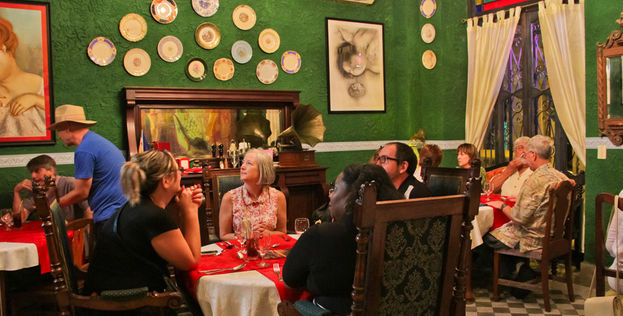
14ymedio bigger14ymedio, Miriam Celaya, Havana, 16 July 2017 — The walls full of photographs of old city landscapes and a whole host of famous artists from the Cuban Republic, record album covers from the same period, and old advertising posters from the 40’s and 50’s.

In a central space, an old off-duty Victrola captures the prominence of the small restaurant. On the tablecloths, old long-playing vinyl records double as tray holders, while the coasters are vinyl 45’s.

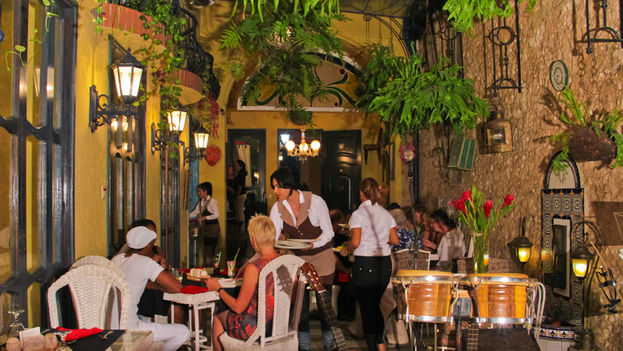
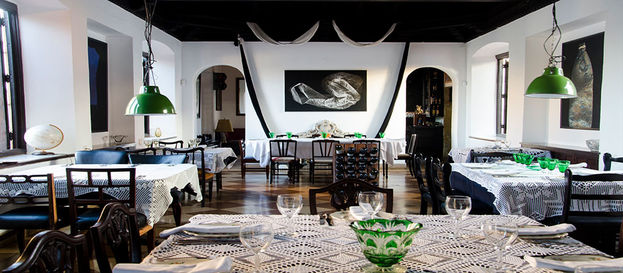
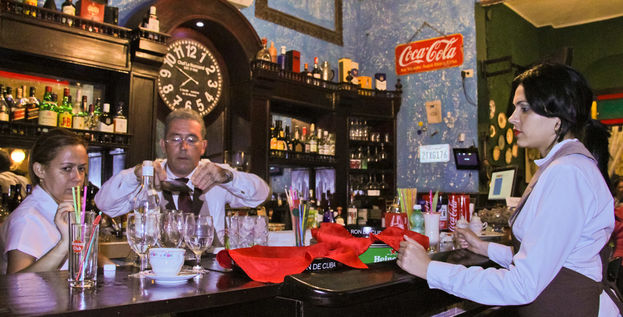
In this private business –as in many similar ones that began to proliferate in Old Havana and in other parts of the city since the so-called “Raul reforms” — the whole atmosphere exudes that unmistakable inspiration on the past, a cult that has been seizing the capital as an epidemic. “Any former times were better,” states a refrain that is being fulfilled in Cuba. continue reading

But it is not just any past. No. Because, curiously, these enthusiastic private entrepreneurs show no interest in appealing to the socialist aesthetic of Soviet encouragement that occupied thirty years of Cuban national life without silencing the native spirit. There are no matrioskas, balalaikas or “Russian dolls” characters decorating the stained glass or interiors of these businesses or on piñatas and private catering salons dedicated to children’s parties.

The paradox is that, after almost six decades of Castro regime, the republican liberal ideal is returning, camouflaged in its cultural symbols. (CC)

There’s nothing that evokes the indestructible Cuban-Soviet friendship of an era when almost all the members of that Cuban proto-entrepreneur were born, who today prefer to revive the Republic’s prosperity of strong Yankee influence and forget the hard years of drunken rule on the Island.

That explains why one can find decorations of a Benny Moré’s album cover and not ones of Van Van or Isaac Delgado in any of these environments. The glossy and smiling face of Kid Chocolate may be staring at us from the walls, but not the face of Teófilo Stevenson.

There is no doubt, glamour is a Western capitalist product. Although, as is the case, it is a glamour as old and encased as that of Cuba in the 1950’s, which — as is always the case in societies without rights, where mediocrity prevails — ends up being a model that tends to be standardized.

Because, as usually happens in the presence of any opportunity to thrive advantageously, there is no shortage of scoundrels who have decided to take advantage of the new lode that offers this sort of aesthetic for nostalgia to extract their own revenues, as is clear from a detailed announcement published in the very popular web site Revolico, where for the price of 25 CUC, or its equivalence in CUP (625 pesos), you can buy a collection of 27,000 Cuban photographs from before 1959, “for the walls of your business.”

The paradox is that, after almost six decades of Castro regime, the republican liberal ideal is returning, camouflaged in its cultural symbols. (CC)

“The history of our country lives through image,” a message tries to encourage while promoting the sale of a “wide selection of photos of cafes, hotels, streets, houses, monuments, shops, historical sites and main streets and avenues of the Cuban capital.”

Such an offer is not limited to photographs, but also includes “old maps, postcards, bus lines, architectural drawings, prints, very good quality scans of old beer advertisements such as Cristal, Hatuey and Polar, the loose propaganda of Cigar brands, hotels, casinos, beverages and much more that constitute a large and valuable treasure trove of value.” A whole cult to the pre-revolutionary past that shows the persistence of a lost paradigm, the more ingrained and endearing, the more decadent and ill-fated the present and the more uncertain and gloomy the future.

The paradox is that, after almost six decades of Castro regime, during which the ruling power spent the greater part of its efforts trying to erase the era of the 57 years of the Republic — “pseudo republic”, they call it — trying to impose a model (this one is truly “pseudo” socialist), falsely proletarian and alien to the national culture and aspirations, the liberal ideal of the Republic is returning, camouflaged in its cultural symbols, and today it grows as a cult to the memory of those “better times,” when prosperity and wealth were  plausible goals and not crimes.

As a result, and in view of the inability to project a promising future, the much-vilified Republic has become the symbol of paradise lost, and returns to occupy a place of preference in the collective imagination, despite the fact that more than 70% of Cubans today were born after 1959 and have been (de)formed under the doctrine of austerity and sacrifice.

While ideological battles and blistering anti-imperialist speeches continue to occupy public spaces, the enterprising class and the chameleonic Castro power cupola invent themselves a marketing Cuba. (CC)

However, the use of symbols pertaining to the Republic is not exclusive to the small niches of the private economy. The mediocrity and lack of imagination also reach the almighty State-Government-Party that almost controls the entertainment industry. Recreating the past before 1959 has become a very lucrative source of income even for the slayers of the Republic themselves, especially since American tourism became the main target of socialist marketing.

This is demonstrated, for example, by the careful reconstruction of old hotels, bars and other spaces destined for international tourism, which for decades were decadent localities or simple ruins, whose architecture and interior spaces were recently rescued to recreate the elegance and style of the ambiance of pre-revolutionary Cuba.

In this way, while ideological battles and fiery anti-imperialist discourses are maintained in public spaces and in the official press, for the indoctrination and control of the native proletarians and for the sake of regional progress, both the nascent entrepreneurial class and the chameleonic Castro regime have invented themselves a marketing Cuba, a parallel reality disguised as Republican era tradition and artificially rescued for the solace and delight of foreign visitors, who pay in dollars for attending this kind of theme park: a country frozen in the middle of the twentieth century.

And it is not necessary to deny a past that, which, for better or worse, is part of Cuban culture and history and represents a period of prosperity and expectations of that young nation. What is truly sad is that six decades under the regime have left us with the legacy of a people who, instead of pushing towards the future, assumes the past as a paradigm that, beyond its lights and democratic conquests, was sufficiently imperfect to incubate in its core the longest dictatorship in the hemisphere, in whose hands the destinies of all Cubans continue to be. It’s a shame.

Translated by Norma Whiting

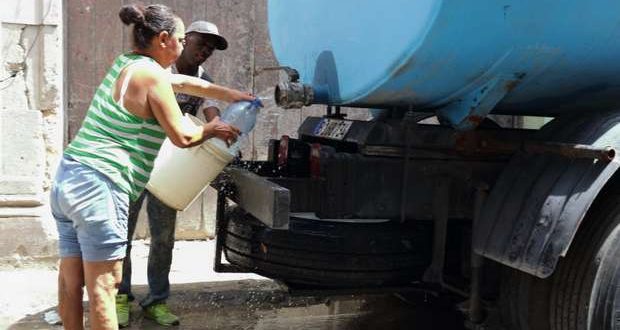
Without Water in Havana / Iván García

Photo: Havana Times

Iván García, 10 June 2017 — The heat is terrible. Not even a light breeze in the wide entry to Carmen Street, by Plaza Roja de la Vibora, thirty minutes from Havana centre.

Reinaldo, an old chap, depressed, seated on a wall facing the water tank of the building where he lives, waits for the water to flow.  “On the Havana Channel news they said that we will have water from six in the morning on Wednesday May 31st, until six in the evening”, he says without taking his eyes off the tank.

All his neighbours passing by ask him the same question. “Rey, has the water come on yet?”.  With a weary voice, the self-appointed water guard replies: “Not yet, but I’m sure it will in a minute”. continue reading

The neighbours don’t hide their ill-humour and vent their annoyance insulting the government’s performance. “These people (the government) are pricks.  How long do us Cubans have to put up with having our lives screwed up?” A retired teacher considers that “if they had kept the water pipes maintained, there wouldn’t have been any leaks”.

The official press tries to be positive. As always. It talks about “the efforts of the Havana water workers who are working 24 hours a day to repair the leaks”.

And they blow a smoke screen. “After the repair work the water pressure across the city will be a lot better”, says a spokesman on the radio in a tenor voice. But the man in the street is sceptical.

“When the government takes something from us, that’s the cherry on the cake. They snatched a pound of rice from each of us to give to Vietnam during the war. The Vietnam war finished 42 years ago, and now the Vietnamese are sending rice to us. The government never gave us back the pound of rice. That’s how it always is, they take us by the hand and run off. I am absolutely sure that, because of the fuel shortage and the drought, they will extend it to a three day water cycle in the capital”, is the angry opinion of a man who tells us he has a friend in Havana Water.

The negative rumours fly about. Some worse than others But few of them are good news. Emilio, from Santiago, visiting Havana,  tells us: “it’s worse for us in Santiago, my friend”. In the city centre it’s every eight days and on the outskirts every thirty or forty. All we’ve been able to do is learn to wash ourselves with half a bucket of water and walk around in dirty clothes, which get washed every two weeks.

Juan Manuel, a hydraulic engineer, explains that “the water problem in Havana is pretty complicated. Instead of new pipelines they have put in 748.6 km of old tubing. The company repairs one section, but then the water pressure damages a section which has not yet been repaired. On top of that there is the fact that their workmanship is not of the highest quality. And their old fashioned technology along with years of no maintenance complicate things further. It’s a complete waste of time.

A pipework and drainage specialist considers that “the government wants to improve the water quality and the pipe network. But they did no maintenance for decades. 60% of the water distributed through the capital leaks away. That figure has now fallen to 20%. It’s a complex task which needs millions of dollars and the government hasn’t got any money”.

In the last seven years, Kuwait and Saudi Arabia have between them donated about 50 million dollars.  “But it’s not enough. Don’t forget that the problem of out of date water pipes and drainage is not only in Havana. It affects the whole country. It’s obviously the government’s fault. When things were going well, they didn’t provide the necessary resources. And now, with the economic crisis, the reduced quantity of oil coming from Venezuela, and the drought, have made it more difficult to sort out the problem”, said our specialist, and he adds:

“Ideally we need to completely change our water management strategy.  Introduce renewable sustainable recycling methods for the water supply and for dirty water. Build a new aqueduct for sea water desalination and increase the existing capacity.

There are various water distributors in Havana. The main ones are  Albear Aqueduct, opened in 1893, the Conductora Sur, and El Gato. But, because of the deterioration of various sections of pipework, there are frequent fractures.

The water supply varies from one part of the city to another. In some parts they get water every day, at specific times. In most other places, on alternate days. And in different districts on the outskirts you get a three or four days’ supply.

The deficit in the precious liquid leads the Habaneros to increase their  water storage capacity by using tanks constructed without worrying about technical specifications or guaranteeing its drinking quality or ensuring they are protected against becoming breading zones for the Aedes Aegypti mosquito which spreads dengue and chikungunya.

“If you extend the water cycle in Havana, you increase the extent of stagnant water without adequate protection and increase the risk of insect-spread disease and get more rats. With less hygiene and reservoirs containing contaminated water you open the door to epidemics “, is the point made by an official of Hygiene and Epidemiology.

But the biggest worry for families like José’s, with his wife and three children, is having enough water to take a shower and run the toilet. In this heat, their mother has to wash with half a bucket of water and she cant flush the toilet”, José tell us.

Some places have it worse. Regla, a pensioner who lives in a run-down room  in a plot in Old Havana, the same as 170 thousand families in the capital, hasn’t received drinkable water in her home for years. “I pay 100 pesos to a water seller for him to fill two 55 gallon tanks which I have in my room. That lasts me a week usually. But with the water crisis, the man put up the price to 160 pesos. And I only get a coupon book for 200 pesos”.

The price charged by the water tanker trucks  has also shot up. “When there are no supply problems, a tanker charges 30 CUC. Now you have to pay 40 or 50 CUC. But you don’t get any, even for ready money,” is what the proprietor of a cafe selling local specialities tells us.

Food business owners have had to shut at certain hours because of the lack of water. “I hope they sort it out quickly, because sales have gone up 200%, as many people prefer to eat in the street so as to save water in their houses” says the self employed man.

According to the government media, water distribution will be back to normal on Thursday June 1st. But lots of Habaneros don’t believe it. ” They have lied to us so often that when they tell the truth, you always doubt it”, says Reinaldo, the guy living in La Vibora, who, from early morning on waits by the tank for the water to flow.

On June 1st precisely, the government announced an extraordinary session of the National Assembly of People’s Power, Cuba’s parliament. The Cuban in the street suspects that there will be more economic stringencies and they will be obliged to tighten their belts. Again.

Translated by GH

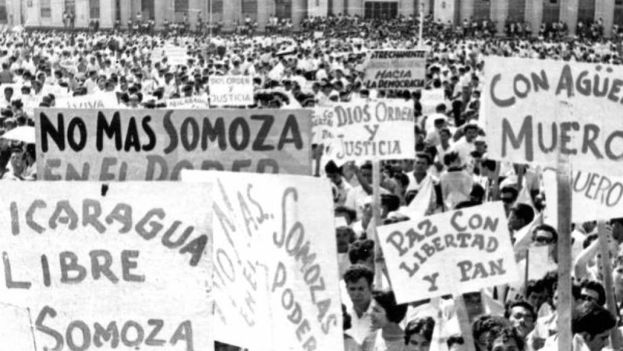
Daniel Ortega Resuscitated ‘Somocismo’*

Demonstrations against Somoza’s dictatorship in the late 1970s. (El Heraldo)

14ymedio bigger14ymedio, Hector Mairena, Managua Nicaragua, 18 July 2017 – July 19th marks the 38th anniversary of the overthrow of the Somoza dictatorship, without a doubt the most important date in Nicaraguan history. However, its meaning and consequences – even its ultimate causes – are still under discussion. Divergent opinions emerge not only because of the political and social contradictions of Nicaraguan society, but also because many of its protagonists see their personal experience through the lens of their narrative and interpretation of what happened.

The greatest alteration, however, has come from the propaganda interests of the Ortega regime, which has perverted the equitable analysis of the events. As Fidel Castro once said, “history is a byproduct of facts,” and the official version is written by power, altering or denying facts, removing or placing protagonists.

The overthrow of Somocismo was achieved through innumerable acts of individual and collective heroism, and it is precisely for that reason that one side has tried to mythologize it, while the other demonizes it, which is understandable in a society given to attributing extraordinary events to providential causes. continue reading

But it was not a miracle, nor was it a spontaneous event. It was the outcome of a decades long conflict between democratic and dictatorial forces. And just as this day of the struggle for democracy was not the first – because the history preceding July 1979 is abundant in guerrillas and uprisings that raised democratic flags – nor would it be the last.

The overthrow of the Somoza regime was only possible when the joint actions of the democratic forces and the massive involvement of the population crystalized in the final phase of the armed insurrection in a favorable international context. Thus, it was possible to resolve the main contradiction that had existed in Nicaraguan society since the 1930s, between democracy and dictatorship.

In the social sphere, the anti-Somoza participants embraced a wide range that reached the extremes of society: from the sectors of the bourgeoisie excluded from a share of power, to the lumpen proletariat. An unquestionable success of the Sandinista National Liberation Front (FSLN), and the insurrectional faction in particular, consisted in cementing that alliance on the basis of a democratic program that aroused an unprecedented and unrepeatable national consensus

Although the Sandinistas were the hegemonic force, it is necessary to remember, although it seems obvious, that they were not the only ones in the anti-dictatorial fusion.

One the political plane, two large blocks joined in the objective of that historical moment. On the one hand, the center-left block articulated in the People United Movement (MPU)/National Patriotic Front (FPN); and that of the democratic right grouped in the Broad Opposition Front (FAO).

On the military plane, the FSLN, with its three expressions, had absolute dominance, although in the final insurrection smaller units of the Nicaraguan Socialist Party (PSN) operated through the so-called People’s Military Organization (OMP), subordinate to the Sandinista command and tiny groups of the Maoist Popular Action Movement (MAP), which acted on the margins.

Special mention should be made of the media and journalists, which for decades were a daily vehicle of denunciation against the Somoza regime. It is impossible to hide the role played by La Prensa and its director Pedro Joaquín Chamorro, or that played by Radio Corporation and other broadcasters. Although their role is beyond dispute, today the Ortega version disdains it.

The overthrow of Somocismo, which was required to open the way to a democratic process, became the Sandinista Popular Revolution. Political pluralism, one of the three pillars of the program called for by the anti-Somoza alliance, was soon shunted to a lesser role at the convenience of the Sandinistas, and was only tolerated to the extent that it did not jeopardize the new power.

The consequences were not long in coming. Already in the first post-Somoza year there began a rapid settling of political forces around a new conflict between the Sandistas and the Anti-Sandinistas. The mistakes made in economic management, the loss of the social base of the peasants, and an early alignment with socialist countries – despite the formal non-alignment of the country’s foreign policy – ended up destroying the consensus.

The open intervention of the Reagan administration was a spur to the remnants of the defeated Somoza Army and to dissent in the countryside. The confrontation was radicalized, the social conquests foundered and civil war ensued, the consequences of which divided and bled the country to the limit.

With the withdrawal of military support from the USSR – already in its own terminal crisis – with the economy of the country destroyed by the war, and especially with the majority of citizens calling for a change, by the late 1980s the FSLN was helplessly forced to convene early elections. The results opened up once again the possibility of leading the country towards a democratic process, a path that the Ortega regime, allied with the corrupt liberalism, would destroy, in the same way that it destroyed the old FSLN to turn it into a group of docile subordinates, under the command of a family.

Although July 19, 1979 meant the end of the Somoza regime, its cultural heritage survived in practice and in the subconscious of important sectors of the population and even among militants and leaders of the FSLN. Thus, the Revolution did not manage to banish that disastrous legacy of Somocismo. In the last decade it has sprouted again under Daniel Ortega’s return to power, which has reversed the democratic conquests and resurrected the practices of the defeated regime.

New wine – and not so new – in old wineskins. Thus, and this time not by a miracle, it is already in an irreversible process of decomposition.

_________________________________

Editorial Note: This article was published in the blog of Héctor Mairena

*Translator’s note: ‘Somocismo’ refers to the movement to try to reestablish the dictatorship of Anastasio Somoza which was overthrown in Nicaragua in 1979.

Venezuela and Cuban Pretensions / Juan Juan Almeida

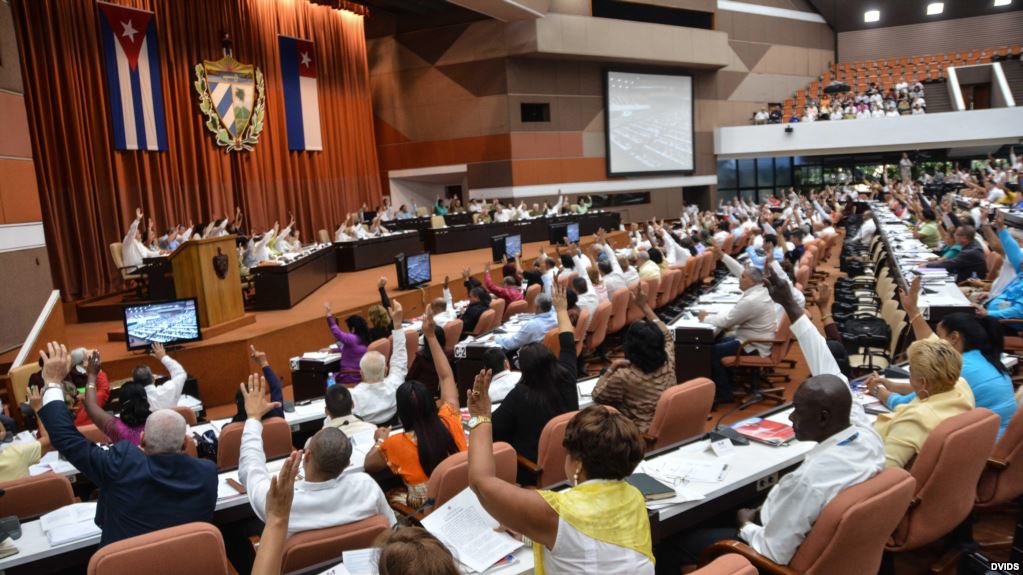
Juan Juan Almeida, 5 June 2017 — It was exercise in risk-taking in which the cons outweighed the pros. As it overlooked the fact that the Attorney General of Venezuela raised to sixty the number of fatalities and to more than 2,977 the number of those detained in less than nine weeks of anti-government protests, the Cuban Parliament seemed to be living in a parallel universe as it publicly declared its firm and resolute support for the government of Nicolás Maduro.

The controversial statement, signed by all the Cuban legislators, was published in the June 1st digital edition of the Cuban Communist Party’s official bulletin and one day later in its print version.

If Cuba is a nation dying of thirst, Venezuela is like a glass of water. It is quite understandable that political commitments have to be made to maintain alliances. But Nicolás Maduro is not Hugo Chavez. And the the South American country is not prepared to take on responsibilities toward the island that had been assumed by the former Soviet Union. So why demonstrate widespread support with such singular tenacity? continue reading

Even Russian president Vladimir Putin has been more restrained than the Cuban government, noting that “the crisis in Venezuela must be resolved in accordance with Venezuelan law.”

According the newspaper Granma’s overwrought gobbledygook, deputies of the National Assembly of the Republic of Cuba are demanding respect for the legitimate rights of the Venezuelan people to continue building a social system that advances the Bolivarian Revolution while simultaneously recognizing the efforts of the Venezuelan government to bring about peace and understanding.

This is a smokescreen. As Cuba’s leaders see it, the current, boorish Venezuelan president in office today is simply as a result of another man’s health problems. Once he has served his purpose, he becomes disposable and the “kind-hearted” opportunist who knows how to take advantage of the situation will be the only thing standing in the way of Nicolás Maduro and his hold on power.

Like the king who only makes promises that benefit his kingdom, the Cuban government , which knows its allies all too well, is attempting to achieve several things with this declaration.

The first is to focus on the conflict within its own borders and avoid intervention by international organizations.

The second is to flatter — this always works — an out-of-control tinpot dictator with no credibility in order to manipulate his emotions and hold onto power in a country also happens to have large reserves oil, gold and uranium.

The third is to mediate a resolution to the critical, systemic political crisis caused when Nicolás Maduro obstructed the country’s National Assembly by hinting at support for a possible (and perhaps already selected) alternative government to which he could assign an undue degree of power in the hopes of calming the opposition. This would also technically fulfill agreements to hold talks while satisfying certain minimal expectations for reviving hope in the Bolivarian nation.

Mass Celebrated At Ladies In White Headquarters ‘For The Freedom Of The Cuban People’

The priests Castor Álvarez and José Conrado Rodríguez celebrate Mass at the Ladies in White headquarters in Havana. (Courtesy)

14ymedio bigger14ymedio, Havana, 18 June 2017 — On Monday afternoon, in the presence of 27 people, priests Jose Conrado Rodríguez and Castor Álvarez celebrated a mass at the Ladies in White headquarters Havana’s Lawton neighborhood.

Berta Soler, leader of the women’s group, explained via telephone that they gathered at the building with “a lot of discretion” to avoid State Security preventing the Mass. “It was very important to hear from those two priests, as we are not able to get to the church, the church has to come to us.”

José Conrado Rodríguez told 14ymedio that the Mass was also a way to show that they both support “the right of the Ladies in White to attend Mass every Sunday” in the Church of Santa Rita, in the Cuban capital. continue reading

“That is also part of religious freedom and the right that people have to practice their faith,” added Castor Alvarez, who presided at the mass with Rodriguez.

“We feel as priests a concern to bring our faith to Cuban society,” added Alvarez, a native of Camagüey and for whom it was a joy to be able to share with the activists and “pray together for the freedom of the Cuban people.”

“We are part of the people and we want to enjoy freedoms, we want them to let us have peace and tranquility and share all the good that we Cubans have in order to progress,” added the pastor.

Along with the Ladies in White, attending the mass were the former prisoner of the Black Spring, Angel Moya, the activist Raul Borges, and the opponent Yosvany Martinez, a member of the Patriotic Union of Cuba (UNPACU).

For more than a year, the political police have prevented this civil society group from attending Santa Rita Church and carrying out its Sunday walk on Fifth Avenue.

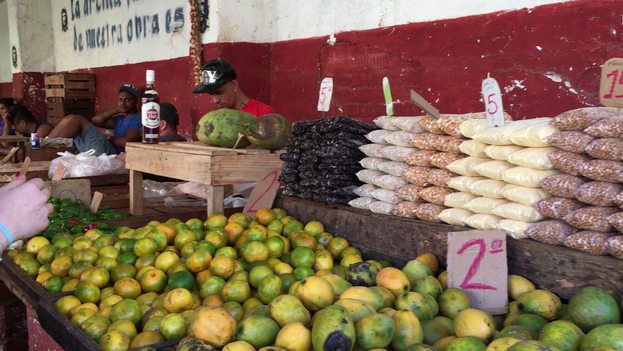
The Year Of The Lost Mangos

There are hardly any mangos in Havana markets while in the east of the country they are rotting. (14ymedio)

14ymedio bigger14ymedio Marcelo Hernandez, Havana, 18 July 2017 — “Everything smells like rotten mango,” says Pascual Rojas, who lives on the outskirts of Manuel Tames, a Guantanamo municipality where part of the mango harvest has been lost, leaving a total of 2,600 metric tons of rotten fruit in recent weeks.

“The rains of May and June were already announcing what was coming to us,” explains this peasant born among the furrows and pigsties. “For years we haven’t seen anything like this, where the bushes yield so much fruit,” but “it all turns into flies and garbage,” he complains.

In the deep countryside, where the farmers know how to interpret the signs of each plant and animal, the groves filled with mango trees were a source of worry to more than one. “I told my brother that it would be very difficult to get all that fruit to the people,” recalls Rojas, who considers what has happened to be a “crime.” continue reading

“This is a area where there are different varieties of mango, but the mameyson, manga and bizcochuelo are much harvested,” with the latter being very popular for its sweetness and immortalized in the traditional songbook. “All that sweetness has become bitterness,” complains Rojas, who has seen how “mountains of mangos became black and filled with bugs.”

The rainfall of recent weeks has been a boon to Cuban agriculture, experiencing its worst drought in more than a century. Farmers in the area also managed to keep the pests such as anthracnose – a fungal disease – under control. And they have worked to ameliorate the aging of the plantations, but the faltering state framework was again not up to par.

The largest losses are found in the mango crops of the credit and service cooperatives in areas near Bayate (Popular Council of El Salvador) and Manuel Tames, which could not efficiently process the crops with the state-run canning industry .

More than a third of the 6,794 metric tons of mango that were contracted for with producers in the area ended up being spoiled during the month of June, according to a Ramón Sánchez Ocaña, a fruit specialist at the Provincial Delegation Of Agriculture, speaking to the local newspaper Venceremos.

The official explained that the factory located in San Antonio del Sur started operations 20 days after the planned date. The other plant, located in El Guaso, was also working at half of its capacity because of a shortage of cans in which to pack the pulp. To the technical problems was added the inefficiency of the state service in charge of haulage and collection.

“We had many problems with transportation and truck breakdowns,” an employee of the Acopio Provincial Transportation Base in Guantanamo, who requested anonymity, told 14ymedio. The problems were mainly due to “breakdowns and complications in fuel supply,” he says.

“We took a big hit on boxes, because if we don’t have them we can’t bring the mangos to the factory in good shape,” he adds. He blames the several factors that joined together to cause the disaster on the “bad organization” of the state company.

This opinion is shared by Manuel, a farmer living in the vicinity of the Ángel Bouza Credit and Services Cooperative, one of the most affected by the losses. “Here the pigs have had to eat mangos morning noon and night, because there is nothing else we can do with so many mangos,” he says.

“Even the children, instead of throwing stones, were throwing mangos because they became worthless when we realized that they would not be able to transport all these boxes from here,” he explains. “This happens every year, and this time the television came to film it and then shared it with the National Assembly, but it is nothing new,” laments the farmer.

Little is said about the producers’ losses. “There are people here who are thousands of pesos in debt because they had put a lot of money into this harvest,” adds Manuel. “My brother-in-law lost more than 5,000 pesos with all this and who is going to pay back that money now?”

During the last session of Parliament the heavy losses reported provoked criticism among the deputies and annoyance among the consumers in the agricultural markets who saw the news on the national media.

“In Havana I have to pay between 3 and 5 CUP (Cuban pesos) for a medium mango, but in the East they are rotting without anyone being able to eat them,” complains Clara Carvajal, 71. The images transmitted on the national television “are pitiful,” she adds.

On the island the mango has a seasonal consumption cycle, which starts after the rains of May and ends in September. “Mangos are only available for a few months and nevertheless the State gives itself the luxury of leaving them in the fields.”

Far from Guantánamo, in the municipalities of Güira and Alquízar (Artemisa province), where they produce fruits and vegetables for the capital, the situation is also worrying.

“If we don’t do some serious work it will be the same here,” said a farmer with a basket of mangos on a small cart pulled by horses. “This is the year of the lost mangos,” he says while pointing out the branches loaded with tasty fruit that rise along the side of the road.

Cuba is Preparing to Send Military Doctors to Venezuela / Juan Juan Almeida

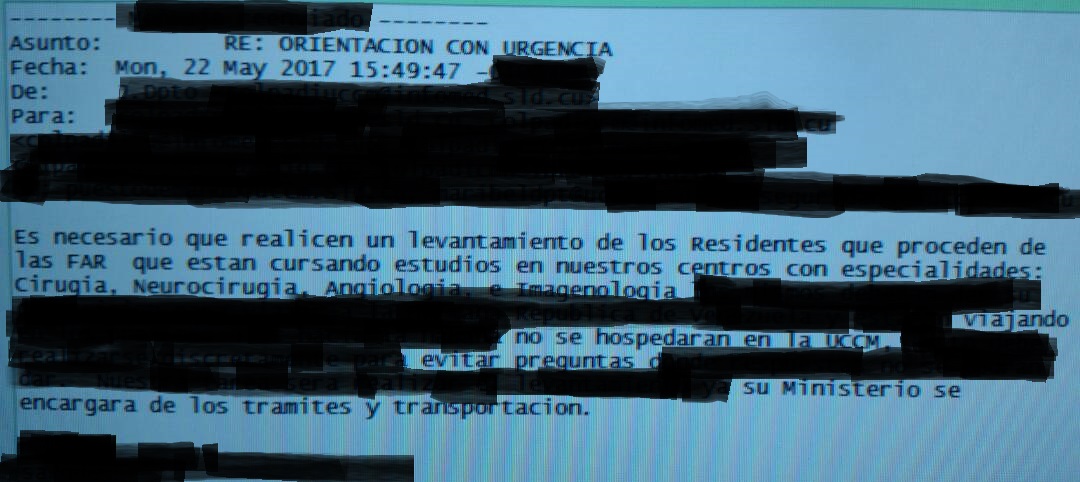
Juan Juan Almeida, 1 June 2017 — An email leak circulating on servers in Cuba confirms that Havana is planning to send soldiers to Venezuela.

According to the document, it is a small contingent of military doctors who are members of the Revolutionary Armed Forces (FAR).

The message, to which this author has had access, was sent on 22 May 2017 at 15:47:49 hours, ordering the authorities of Cuba’s Ministry of Public Health to carry out an urgent survey of doctors in the FAR who are studying in the following specialities: Surgery, Neurosurgery, Angiology and Imaging. continue reading

The professionals surveys, continues the order, “must state their willingness to travel to the brother Bolivarian Republic of Venezuela and, if they are outside Havana, will have to travel in the coming days to the capital.

The Ministry of the Armed Forces will deal with the paperwork and the transportation. “They will not stay,” the document says, “in the UCCM.”

Curious. The Central Unit for Medical Cooperation (UCCM) is subordinated to the Ministry of Public Health (MINSAP) and has the responsibility of guaranteeing the fulfillment of the commitments contracted by the Cuban government in the field of international medical cooperation, and is where those going to serve on medical missions abroad are always housed before leaving.

As always, the information the leaves the island is generating doubts: why has it become necessary to investigate people who have something to do with the regular sending of physicians to the South American nation?

“On the flight lists for Venezuela,” comments someone who deals with the paperwork for this type of agreement, “none of the names of the supposed collaborators appear. The majority of the flight lists we handle, are vacationers who are in Cuba and are returning. But there’s an explanation, maybe the doctors you are referring to are leaving or will leave on private or military planes.”

Lacking answers to why this is being handled this way, another Ministry of Public Health official comments:

“We are taking out of Venezuela the Cuban health workers who have already completed their missions, even if those who will relieve them have not yet arrive, and now they are surveying military doctors who are working in civilian hospitals, to put together a group of workers to send them urgently to Venezuela.

“This is not usual. The FAR residents, specifically, are doctors not very high up in the hierarchy, they are mostly lieutenants or majors, who do their specialities in our hospitals and, later, when they are specialists, return to their units.

“There is no difference between a civilian and military doctor. The objective must have military purposes, or the Armed Forces are using their doctors to guarantee some kind of secret that they don’t want to divulge.”