Real Power / Eduardo Martínez Rodríguez

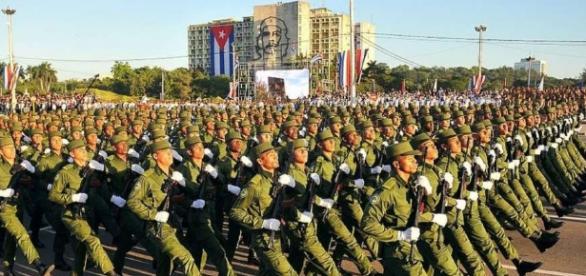
Cuban troops parading in Havana

Cuba Primera Digital, Eduardo Martinez, Rodriguez, El Cerro, Havana, 25 July 2017 –The Cuban people wish for, desire and silently demand changes that can lift us out of this sticky inertia wherein poverty resembles some plasticine or treacly substance that endlessly congeals in our hands.

The demand is silent because we lack access to communication media, although many of us would shout out certain truths.

We average citizens who make up 90 percent of the population—manual laborers and knowledge workers; service employees of all stripes; technicians, including engineers and architects working on projects related to their specialties; and more—we have no voice nor vote, we do not truly boast ownership of the means of production, nor of technical and technological resources. All we have to give is our labor force, our effort and sacrifice. Period. In general, we are treated as one more machine, dispensable and interchangeable, which when no longer serviceable, is traded for a functioning model, or else discarded, kicked aside. continue reading

The remainder of the population also tries to implement the needed changes of which Fidel spoke, and which Raúl knows are vitally important to saving the system.

Once upon a time, Raúl Castro said, “We cannot continue wobbling on the edge of the abyss. Either we change, or we perish.”

The octogenarian generation led by the obstinate Fidel Castro also includes delayed septuagenarians, but all of these together do not comprise even one percent of the total population of our country. They are the superstructure, the historic leaders–figureheads who appear to be running things, but in reality not so.

Between this layer of elders and rulers who are rapidly disappearing and the immense working class below lies another stratum of rich potentates who retain the true power in this nation, although for the moment they are keeping a low profile.

Beneath the veterans who can barely stand up anymore there operates, imperceptibly, a relatively large group of persons, ranging from the level of ministers to those functionaries charged with implementing their orders and directives, and including the military chiefs who command the armed services and the repressive structures of the Ministry of the Interior. These people are the ruling class that actually generates the high-level decisions, holds the reins of power, and runs the country behind the scenes.

One feels a little sorry for the ancient overlords with their greatly diminished capacities and ability to really call the shots. They should stay home and be enjoying a good rest, away from public life; instead, they remain apparently in control, when in fact they are no more than a sad semblance of power.

True power is in the hands of the much younger generals who direct regiments and battalions of armed and well-trained soldiers; the generals of the Ministry of the Interior who manage State Security, the police, and other agents of confrontation that are behind the always-possible and ever-imminent popular uprisings that can flare up at any given time; the generals and colonels who lead the corporations and enterprises in which great investments are made of national and international capital in the productive spheres and foreign tourism; the managers of joint ventures that raise high levels of hard currency; the corporate personnel of the Banco Metropolitano, which finances the army and dominates almost all monetary and financial activity; the ministers and directors of departments in all domains of national life, who determine and issue their own regulations parallel to the elastic and vaguely-defined laws published in the Gaceta de Cuba [Official Gazette of the Republic of Cuba], for which our inefficient National Assembly scarcely convenes a couple of times a year.

These highly privileged señores retain real power when it comes to deciding what can and cannot be done, who can approve what, and which changes to allow or not. They decide who will leave the country or be incarcerated, where shopping can be done and by whom, who escapes and who will be taught a lesson. This is a dark intermediate layer, highly corrupt and merciless, which could not care less about the common people below or the old geezers above.

These señores do not want—they will fight tooth and nail to prevent—change of any kind. Any. The feeble government of the octogenarians is no match for them, and the lower classes do not know what to do, or do not seem to know.

Were this to change, the señores who comprise this intermediate layer—a wall of contention immovable in the face of change—would have to give up their good state-owned vehicles; they would not be able to maintain their various private luxury cars; they would lose their special stipends for food and fuel; they would have to vacate their elegant and well-maintained residences in exclusive neighborhoods (generally built during the 1950s with the money of the millionaires back then) where new construction is not permitted, such as Siboney, Cubanacán, Atabey, Nuevo Vedado, Aldabó, etc. They would not be able to constantly travel abroad to make the expensive purchases on behalf of the State so that it can support the 11-million parasites that they say we have become. They would not be able to enjoy the many sweet, efficient and beautiful secretaries at their disposal everywhere. They would not be able carry out that vastly lucrative internal influence peddling that keeps the nation’s wheels turning, and which so much resembles embezzlement.

Were all this to change, these señores would have virtually nowhere to go, and they are well-accustomed by now to living well.

These señores are the ones who keep this country in a permanent state of bankruptcy, spending and squandering the little cash we generate, while they fatten their own bank accounts, hidden throughout the planet, on the backs of the people.

These same señores, on the day they come to realize that on the other side of change the universe looks more lucrative, will not hesitate to execute a coup d’état, will not hesitate to neutralize the octogenarian overlords, will not hesitate to order the troops to the streets to massacre the opposition. And it will be worse than in other places: in Cuba we are all soldiers.

They will become the nouveau riche, as has already happened in so many other nations that went through this process in Eastern Europe.

If you doubt it, take a look at how many ministers and other functionaries have fallen into disgrace in recent years, when the octogenarians tried to apply a few honest touches with what little authority and prestige they have left—as happened to the corrupt General Acevedo, or the previous Education Minister, who traveled abroad on the public dime more than 70 times in barely two years. This could be a long list…

Within that dark layer, subtly and silently, lies the real power. They are the ones who could trigger a sudden upset to our society, were they to consider it prudent or beneficial to do so, for they hold the means and resources in their hands, under their direct control. They have a lot of money and have become used to wielding unlimited power, good students as they are of the aged rulers who are on their way out. This bad seed will become our new opulent capitalists, cruel and merciless. For now, they are the ones who will set the status quo, the clamor for change from average citizens notwithstanding.

eduardom57@nauta.cu; Eduardo Maro

Translated by: Alicia Barraqué Ellison

Desertions, Love Affairs and Political Crises Rock Cuba’s Overseas Medical Services Business / Juan Juan Almeida

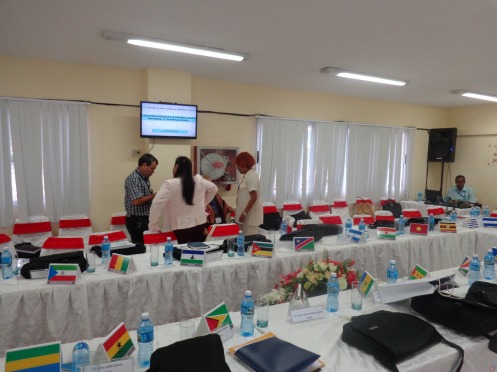
Juan Juan Almeida, 25 July 2017 — The Cuban government brought together all the heads of its overseas medical missions to analyze the work done during the previous year, provide guidelines and outline new strategies. It was the seventeenth such meeting of its kind.

The event was held from July 17 to 21 at the Central Medical Cooperation Unit (UCCM), located at KM 2.5 Carretera a la Cujae. It was headed by Minister of Public Health Dr. Roberto Morales Ojeda, Deputy Minister Marcia Coba Ruiz, UCCM Director Dr. Regla Angulo Pardo, leaders of the Communist Party, the secretary general of the health services trade union, officials from Cuban Medical Services, various heads of provincial departments from Medical Collaboration, and officials from the Ministry of the Interior overseeing the work the Ministry of Public Health (MINSAP).

The Cuban medical mission program got its start on May 23, 1963, when a group of doctors and health care technicians traveled to Algeria. Since then, Cuba has expanded the health service to other parts of Africa as well as to Latin America and Asia. continue reading

But according to a report, “Performance of the Economic Plan during the First Half of 2017” issued by the Cuban Medical Services Company, the country earned 27% less from overseas heath care services compared to the previous year.

Desertions, love affairs between employees and foreigners, illness, lack of discipline, changes in crude oil prices, extreme fluctuations in currency exchange rates and unforeseen political developments are among the causes for this sharp decline.

The document lays out a group of measures mission directors must take to prevent desertions and defections. One measure involves increased control and monitoring of workers’ behavior such as checking the websites they visit.

The memo indicates that one of the websites most frequently visited by workers hoping to leave their missions early lists job opportunities in Europe: www.jobandtalent.com.

Heightened propaganda campaigns to attract foreign patients to Cuba, increasing the number of medical missions and reestablishing those that have closed are among the strategies that, it is hoped, will increase MINSAP’s hard currency earnings.

The work of mission directors in Venezuela, Ecuador, Guatemala, Gambia, Haiti and Qatar was recognized at the meeting. Special mention was made of Brazil, where 1,230 general comprehensive medicine specialists arrived at the start of this month, and Jamaica, where the mission will expand its workforce on August 3 with the arrival of internists, radiologists, primary care specialists, cardiologists, pulmonologists, pathologists, biomedical engineers (anesthetic, medical gas, dental) histopathologists and oncologists.

The XVII Meeting of Cuban Heads of Missions culminated with a dinner for the participants and extended congratulations to other workers who, though not directors, are carrying out the mission.

Raul Castro Now a Retiree-in-Waiting / Iván García

Raul Castro (Prensa Latina)

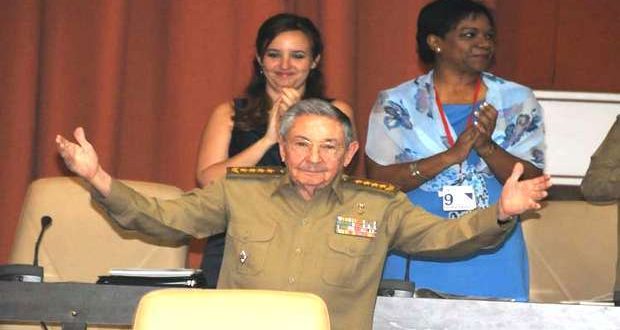
Ivan Garcia, 17 July 2017 — Hunched and wearing an oversized military uniform, helped by his grandson-cum-personal-bodyguard, Raul Castro rose from the beige leather armchair at the presidential desk and with the air of an exhausted old man, and went to the dais to give the closing speech of the conclave.

He placed a folder with several pages under the microphone, adjusted his glasses and in his rough voice began reading the speech that closed the eighth legislature of the National Assembly of People’s Power, an imitation of a Western parliament, one without opposing voices.

Castro II’s speech lasted little more than thirty minutes. As he spoke, Melissa, a high school student, exercised in the living room of her home in front of the flat screen of a 32-inch television. In the courtyard, her father and three of his friends played dominoes. When asked about what he said, the girl shrugs and smiles. continue reading

“I just had the TV on without sound. I was waiting for Raul to finish to see the soap opera. I’m not interested in politics and these meetings are always the same,” says the young woman.

At that time, nine o’clock in the evening in Havana, very few had followed the words of Raul Castro. In shorts and a Miami Heat jersey, Fernando was chatting with two neighbors in the doorway of a bodega.

When they were asked for an assessment of the speech of the country’s president of the country, offered a poke face. “About the speech I an’t tell you, but about the assembly of people’s power I know that, among other things, they talked about how expensive toys are, that more than half of the agricultural harvest is lost in the fields, and that there is a deficit of more than 800 thousand houses,” responds one of the neighbors.

Of 14 people surveyed, 11 said they had not heard Raul’s speech, they did not know that according to government forecasts, the economy grew 1.1% in the first half of the year and confessed that they were not interested in the topics discussed in the sessions of Parliament.

“Dude, it is always the same old blah blah blah. These people (deputies) do not really represent the true interests of the people. They meet twice a year carrying on about the same issues and in the end they do not solve anything. You have to be crazy or smoking something to pay attention to that on television,” says Ignacio, a metalworker.

Carlos, a driver for a bus co-operative, believes that ordinary people “are tired of the same thing. You see the deputies and leaders, most fat and potbellied, who gather, study and propose measures that never improve the quality of life of the people. That is why the majority of Cubans do not follow these meetings.”

And he adds, “I myself work in a transport cooperative, which is a cooperative in name only. The members are puppets. Government institutions are in charge. The State has set up a parallel business with public transport. They give the cooperative a lot of old cars and buses, the workers must pay for the spare parts and then they exploit us like slaves. The biggest percentage of the money is pocketed by the Ministry of Transport and nobody knows where that silver goes.”

Although the economy is taking on water and there are obvious shortages in agricultural markets, foreign exchange stores and pharmacies, a considerable segment of Cubans looks with indifference on the national political landscape.

“There is chronic fatigue. Apathy consumes a good part of the population. They do not want to know anything about politics. They are tired of everything. What they want is to live as well as possible and the youngest want, if given a chance, to emigrate. That apathy favors the regime because it governs without any upsets,” says a sociologist.

During his speech, Raúl Castro hammered his strategy of doing things without any hurry, so as not to fall into errors when promulgating new measures. In a rare exercise of self-criticism, he acknowledged he himself was at fault for several erroneous decisions. He emphasized capital control of new businesses and greater control of private entrepreneurship, although he stressed that the State supports and intends to expand self-employment and service cooperatives.

The pace of the reforms is what bothers Leonel, owner of a cafe west of Havana. “Raul does not lack grub and everything he needs is assured, so he makes changes with that slowness. But on the street people want reforms to be done more quickly. Right now I have grandchildren and everything is still at a standstill.”

Of the fourteen people surveyed, they noted that Castro II did not mention the resignation of his position next year.

“With these people (the regime) you have to be careful. Before, Raúl repeated that in 2018 he was withdrawing from power. Now that he is a short timer, he did not say so. At the end you will see that for any situation, whether because of Venezuela or an alleged US threat, the man is still in office,” says Diego, who works in a pizzeria.

Seven months before the hypothetical date of abdication of the Cuban autocrat, no one can certify what will happen. Although the presumed retirement of Raúl Castro will not prevent that a military junta continues administering the Island.

The end of Castroism is not near.

 Translated by Jim

A Professor Sees Similarities Between How Cuba and Spain Choose Their President

José Luis Toledo Santander, former University of Havana Professor and Chairman of the Parliamentary Committee on Constitutional and Legal Matters. (Roberto Suárez / Juventud Rebelde)

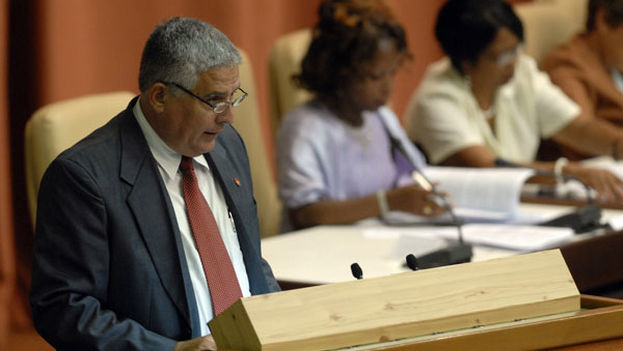
14ymedio bigger14ymedio, Havana, 25 July 2017 — The former Dean of the Faculty of Law of the University of Havana and current chair of the National Assembly’s Committee on Constitutional and Legal Affairs, Jose Luis Toledo Santander, is clear: there are similarities between the Cuban and Spanish electoral systems, although the island is free of those campaigns with “people covered with stickers, photos and the offensive battles that arise in other countries.”

“We are not sui generis. How does Spain elect the head of government? The parliament elects him, the president of the Spanish government is not elected by popular vote,” argues the deputy on being asked about the reason Cubans do not elect their leader. The official doesn’t mention in his comparison that the Spanish electoral system is a multi-party one.

The official argues that the deputies of Cuba’s National Assembly receive the sovereign power on behalf of their voters for the decision making, and one decision is the election of the president of the Councils of State and of Ministers. “In addition, our system is not a presidential system, it is a semi-parliamentary system. Our president does not have the power to make decisions alone.” continue reading

“Our system is not a presidential system, it is a semi-parliamentary system. Our president does not have the authority to make decisions alone”

Toledo, who has granted an interview on the electoral system published in three installments on the official website Razones para Cuba, notes that the president of Cuba goes through five phases until he takes office. “First he has to be nominated and approved by the votes of a full social or mass organization. Second, he has to be approved by a vote in a Municipal Assembly. Third, he has to be elected by direct and secret vote of the voters of an electoral district; if he does not get elected there he can not be a deputy. Fourth, his candidacy has to be approved by the National Assembly. And fifth, he has to be approved in a direct and secret vote by the deputies.” The professor does not explain, however, why only two people – both of the same family – have held the position in the last 40 years.

Toledo also refers to the particularity of the upcoming general elections of 2018 due to the absence of Raúl Castro, although he considers that the “wisdom” of the Revolution and the General have prepared the ground for the process to occur naturally. “It will not be a traumatic moment because we are all ready, there is an ideological political conditioning of the revolutionary force for a historic moment that this country is going to experience, and we are ready for change,” he says.

In the interview, Toledo again talks about the drafting of a future electoral law. The new law was planned for this term, but Castro’s promise has not been met. However, the official warned that changes in the composition of the elections and the presence of a permanent, professional body, dedicated to directing the electoral processes against the eventual one that now exists, will be studied.

The professor defends the scarce information available to Cubans when it comes to electing their representatives and denounces the electoral campaigns that exist in multi-party systems. “You can not confuse electoral propaganda with an election campaign. As part of the propaganda, there are tours organized by the Electoral Commission for the different territories and the candidates talk to the people, that’s one thing. A campaign is something else altogether where people cover themselves with stickers, photos, and there are the offensive battles that are provoked in other countries.”

The deputy considers that there is equal opportunities for all Cuban citizens when it comes to running, although he does not explain the difficulty of candidates emerging from outside the Communist Party 

In addition, the deputy believes that there are equal opportunities for all Cuban citizens when it comes to running, although he does not explain the difficulty of candidates emerging from outside the Communist Party. “Every citizen has the right to elect and to be elected,” he said. Of course, within the limitations of the single party, which “expresses the democratic unity of the Cuban people,” according to a tweet from the Cuban Foreign Ministry which Toledo quoted on December 10, 2013, World Human Rights Day.

As for territorial representation, Toledo rejects that the deputies are tied to their region. “The deputy is a national representative, and the National Assembly discusses and approves the great problems of general interest of the nation, not territorial problems (…) which are channeled and resolved at the level of the municipality and province. What we do have to work on is that there need to be more links and exchanges between deputies and voters in the precinct, district and municipality. Today we have a program for that that has been approved by the Party leadership, which is called Perfecting the Organs of People’s Power.”

Missing Words

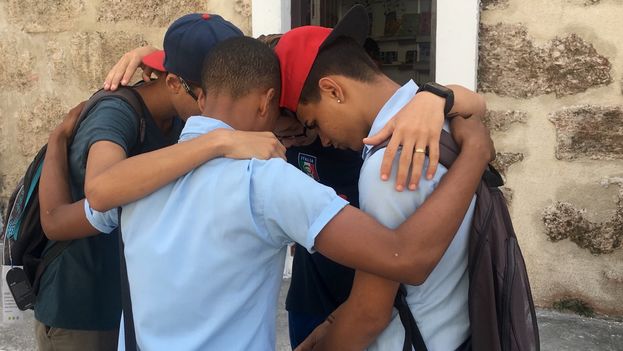
A group of high school students share audiovisual content through a cell phone. (14ymedio)

14ymedio bigger14ymedio, Yoani Sanchez, Havana, 28 July 2017 — The man forms a trumpet with his hands in front of his mouth to warn of the presence of an informant. It is a transcendental gesture warning not to blab in a daily life were people constantly appeal to body language, obscene words and metaphors. Failing to do so leads to jokes, scares those selling things under the table, and generates mistrust among friends.

The official media is expressing concern about the deterioration in Cubans’ oral expression. Several television spots in recent weeks have tackled the shouts and rude terms that fill talk on the street. Journalists attribute this poverty of vocabulary to the family and insist that the epidemic of vulgarities that plagues the country is incubated at home.

Another culprit pointed to is reggaeton. The songs loaded with lust and machismo cultivate an expression filled with denigrating concepts and sexual allusions, say the specialists who speak on these TV programs. According to the opinions of these sociologists and psychologists – linguist are seldom invited – listening to acts such as El Palo Divino makes teens utter more insults per minute. continue reading

So far, each one of the analyses aired has failed to point to any institutional responsibility for verbal degradation. They ignore that for decades everyone who has spoken “nicely” and has dared to pronounce all the letters in every word has been labeled “unpopular,” “arrogant” or “lacking in humility.”

Foul language is a distinctive feature of the revolutionary language that has been imposed in Cuba since January 1959. Since then, expressing oneself with the rudeness of a stevedore has become one of the many strategies that opportunists assume to disguise themselves as proletarians. Offending others has also been fashionable in this political uproar established in the country more than half a century ago.

Now, the authorities are shocked because young people insert a bad word in every sentence they utter. They blush for the constant allusions to sexual organs in conversation, a real trifle compared to the using the derogatory gusano, worm, against a political opponent, as was coined and promoted by the government.

After accusing those concerned about the correct use of language of being bourgeois, now they are afraid of this vulgar generation that was born of so many verbal castrations. After pursuing the free and frank word, today from government institutions, they complain of the incoherent monosyllables that so often arise when these children of censorship are asked about politics, human rights or the leaders of the country.

Many years ago, here, talking stopped being a way to communicate and instead become the fastest way to relax. Not only does expressing an opinion cause problems, but the style in which it is expressed can also be a source of conflict. Understanding the danger of articulate language has been one of the most successful survival mechanisms developed by Cubans in the times we have been living in.

Not recognizing the implication of the political system in this linguistic deterioration is another way of doing damage to the vocabulary… by not calling things by their names.

The Dark Side of Voter Registration in Cuba

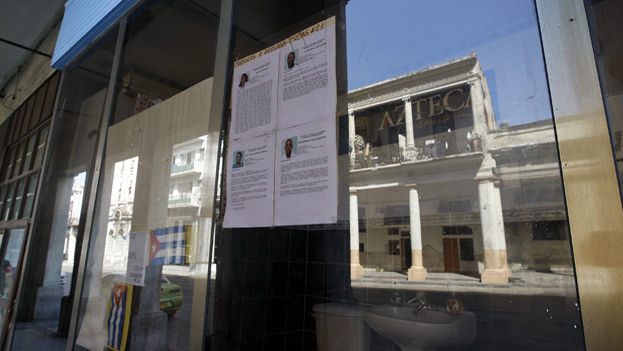
Voter lists that are posted in public places include the name of each voter, their last names, date of birth and personal address. (EFE)

14ymedio bigger14ymedio, Reinaldo Escobar, Havana, 27 July 2017 — The starting point for the Cuban electoral process is undoubtedly the disclosure of the voter register, the list of all those who have the right to mark a ballot at the polls. The preparation, public character and possible omissions of these lists decisively influence the course of the whole process.

The electoral commissions of each constituency creates this listing starting from something with a vague legal character known as the “Book of Registered Addresses.” A document that, as a general rule, is managed by the person in each precinct in charge of the Committee for the Defense of the Revolution (CDR) Vigilance Front.

The book has multiple functions, from serving as the basic voter list, to functioning as a control mechanism to prevent people who don’t have that address on their identity cards from living in a particular building. For years, the register from each CDR has been used as evidence to fine, evict and deport to another province, residents alleged to be illegal. continue reading

From this collection of names to what are clearly police matters, a process that should have a merely civic focus is entertwined.

One of the least known features of the island’s electoral system is precisely this lack of a permanent and independent entity that is responsible for registering voters and that deals with all the formal aspects of an electoral roll. Instead of that, it remains in the hands of a notoriously political organization like the CDRs.

In the announcements made by the official press on the elections, this detail, of transcendence importance, is ignored. The fact that, at the base of the People’s Power one can trace the signs of ideological control over this governing body, is not something that the media controlled by the Communist Party want to shine a light on.

Every time elections are called, the commissions that bring them to fruition begin to form, and after fulfilling their functions they dissolve. This process is a substitution for the National Electoral Councils with elected members that exist in other countries, and that answer to the voters and possible observers.

The 1992 Electoral Law gives the Council of State the responsibility to designate the National Electoral Commission, which, in turn, appoints members in the provinces. These make up the municipal commissions that select the members at the district and precinct level. They are the ones who choose the members of the Electoral College for each precinct.

As in a sequence of Chinese boxes of which no trace will be left, each of these commissions is dissolved as soon as the voting is over. They will only be constituted again, presumably with other members, when the Council of State calls for new elections.

In each municipality, the Registry of Voters is prepared with those who have the legal capacity to exercise the right to vote. The Law is ambiguous when it expresses that the citizen is registered, without specifying whether they do it of their own volition or if, without being consulted, they are included in the list.

A few days before the polls are opened, the printed voters lists are posted in public places. Next to the name of each voter, one can read their date of birth and personal address. In all the years that this method has been in use, few have commented on the violation of privacy represented by the disclosure of these private data.

The information is displayed for at least 30 days to provide an opportunity to correct errors or request the exclusion or inclusion of a person. A demand that can be made by the interested party, their representative, or an immediate family member.

There are very few cases of citizens who request to be excluded by on the basis of some kind of political disagreement. In fact, those who have some inclination to opposition are often erased from the lists because they did not vote in the previous elections. To demand the right to be registered is the only way that abstention is recorded in case of not voting in the elections.

Beginning on September 21, while residents of a neighborhood line up to buy bread or the latest products arriving in the ration market, the will see these election registers. Few of those who look for their names on these lists will

Instead of questioning the creation of the lists, the majority of voters will take advantage of them to discover that Roberto’s second dame is Filomeno, or that the single lady on the fifth floor just turned 50. They will find out that Yolandita was registered at birth under the name Ricardo, and that Teresa’s husband is not registered at his wife’s address. And so political control will have connected its first link.


Cuba Sets Up Emergency Plan for Medical Missions in Venezuela / Juan Juan Almeida

Juan Juan Almeida, 23 July 2017 — The Cuban government has put in place emergency procedures to deal with the onslaught of widespread protests in Venezuela, which are intended to halt plans for elections to the Constituent Assembly on July 30.

According to information obtained by Martí Noticias, officials at Cuba’s Ministry of Public Health (MINSAP) issued a memorandum to the heads of all medical missions in Venezuela on July 10.

The document was issued after several hours of meetings involving high-level government officials as well as the leaders of the Communist Party, the Council of State, the Commission for Defense and National Security and MINSAP according to anonymous sources from within the medical community. continue reading

The guidelines highlight the degree of concern Cuban leaders have over events that could be triggered in Venezuela, which has undergone more than one hundred days of street protests and growing tensions within the nation’s institutions.

The memorandum stresses the need to carry out “security meaures” at Comprehensive Diagnostic Centers (CDIs), which were established in 2003 to ensure emergency medical care and greater access to health services for the population. Approximately six-hundred CDIs are currently in operation throughout the country.

The directive also instructs all personnel to remain on duty from July 29 to July 30 at CDI facilities, which will be under the protection of forces from the Venezuelan National Guard.

CDIs have recently been the targets of aggression by demonstrators, and Cuban medical personnel, who are seen by some as agents of propaganda for the Venezuelan regime, have received threats.

Below is the text of the MINSAP memorandum obtained by Martí Noticias:

Upon orders from our country’s most senior leaders, you are being informed of preventive measures to be carried out from July 27 to August 3, a time period coinciding with elections for National Constituent Assembly on July 30.

1. Medical mission workers must be prepared to make travel arrangements with Cubana de Aviación, which has scheduled extra flights from July 21 to 25.

2. It is essential that security measures be put in place at every CDI. Administrative Guards must be reinforced.

3. For the time being, surgical procedures scheduled for this period are postponed.

4. Preparing a schedule of blood donations for July 23, 24 and 25 is of the highest priority. (Members of the Young Communist League and the Cuban Communist Party.)

 5. Every CDI must set up a command post and report any incidents that occur in its populated area every two hours.

6. Protection for every CDI has been coordinated with the Venezuelan National Guard.

7. All personnel must remain at their CDIs from Saturdy, July 9, until Monday, July 31, before they may return to their homes.

8. It is extremely important to educate the public on the political and ideological importance of these elections.

 9. Instructions were given to every head-of-mission and legal affairs officer during the last audio conference.

10. Perform and provide evidence (in photos) of a political act in commemoration of the events of July 26.

A Group Of People With Disabilities Organizes Outside The Cuban State

Architectural barriers are a constant in the life of the Cubans that makes life impossible for many people with physical disabilities. (14ymedio)

14ymedio bigger14ymedio, Reinaldo Escobar, Havana, 24 July 2017 — In a crowded bus, two women discuss who is entitled to the disabled seat. While one carries a cane, the other shows an ID card from the Cuban Association of Limited Physical Engines (Aclifim), an official entity with more than 74,000 associates that sets ideological requirements (i.e. fidelity to the government) to maintain membership.

Aclifim, along with the National Association of the Blind (Anci) and the Cuban National Association of the Deaf (Ansoc) call themselves Non-Governmental Organizations. However, complaints about their political bias led a group of activists to create a support group for people with disabilities without any conditions.

The Cuban Inclusive Culture Network, created last year, faces a difficult challenge in a country where much remains to be done for the social integration of people with disabilities. Added to this is the lack of legal recognition that allows its members to work under legal protection. continue reading

Juan Goberna, one of its founders, woke up one morning and was not even aware that it was daylight. After several operations that failed to restore his sight, he decided to start using a cane. In those early days in the dark he approached Anci hoping to take a Braille course and receive a computer program that read texts aloud.

Accompanied by his wife, Goberna arrived at the NGO’s office in the municipality of Central Havana with his identity card in his pocket, five pesos in stamps and a certificate that declared him “legally blind.” “What revolutionary organizations do you belong to?” asked the clerk filling out his form.

The activist still shows indignation when he remembers the scene. “I told her I did not belong to any and from there everything changed,” he explains to 14ymedio. The official informed him that his case had to be referred to the Ministry of Justice to verify if he belonged to any “human rights” group.

Two weeks later they told him that he could not be a member of Anci because the statutes do not allow the disaffected in its ranks. After several attempts and appeals to different entities claiming his right to membership, Goberna has only had silence for answer.

Last year luck smiled on him. During a trip to Peru, organized by the Institute for Political Freedom (IPL), the idea arose, along with other activists, to create an independent entity to “visualize the difficulties faced by people with disabilities and promote a change of thinking towards them.” The organization does not discriminate against anyone because of “their physical, sensorial, intellectual, cultural or ideological characteristics.”

Today, the network has 15 active members and has managed to have representation in several provinces. In September of last year, some of these pioneers attended the VIII International Congress of Persons with Disabilities, held in Medellín, to learn about the work developed in different countries of the region.

The Network collects testimonies from people who are in a precarious situation and are victims of institutional or family neglect and has also identified at least six cases of violation of the right to join Anci, Aclifim or Ansoc for ideological reasons.

Last Saturday, during their last meeting, the members of the independent group proposed to disseminate the Convention on the Rights of Persons with Disabilities, to which Cuba is a signatory and whose content is scarcely known on the island. In addition, they want to disseminate updated concepts about disability, accessibility and inclusive culture, among others.

For Susana Más, an independent journalist and member of the Network, “it is unacceptable that people working in the media, intellectuals and artists who are supposed to be up to date in the use of language, work outside these concepts.” The reporter opts for a “sensitization campaign” around the term “person with disability, instead of disabled.”

Relative to the NGOs set up by the government, The Inclusive Culture Network does not consider itself an opposition organization or an enemy entity. “What we would most like to do is to cooperate with these entities, not in the spirit of disqualification or competition, but as something complementary,” insists Goberna.

For the moment, the Network is dedicated to highlighting attitudes and denouncing the existence of architectural barriers, so that those with a disability are not seen as sick, and for those around them to shed their discriminatory prejudices, indifference or pity.

The biggest difficulty they have encountered so far is the negative attitude of the institutions they go to in search of information or to file complaints: the first thing they are always asked is whether they are authorized or if they belong to an official entity.

Daily Incongruities / Fernando Dámaso

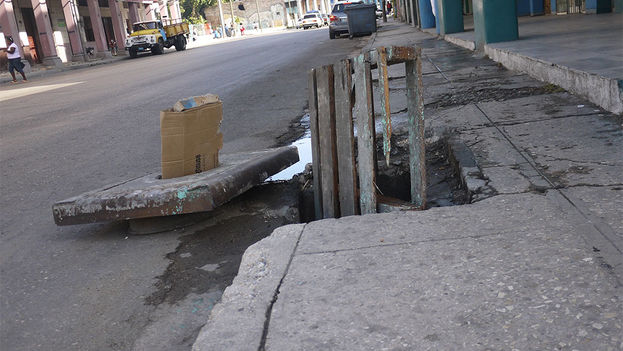
Panorama and Tulipan streets near the 19th of April Policlinic in Havana’s Nuevo Vedado neighborhood.

Fenando Damaso, 1 June 2017 — To the annoyance of the citizens, the annual campaign against the Aedes aegypti mosquito that carries Dengue fever and the Zika virus has begun anew, through weekly fumigations of homes. Undertaken year after year, it seems that the insect has been the winner since is has not been eradicated.

In 1900, the Cuban doctor Carlos J. Finlay and the American medical team presided over by Dr. Walter Reed succeeded in eliminating it and sanitized the country, declaring it free of yellow fever or black vomit, as it was known then.

To do this, ditches, streams, muddy places and wastelands were cleaned, and crude oil was spread on top of them to kill the larvae. They then sprayed infested and adjoining houses. The process of sanitation and control of the insect was maintained during the Republic and there were no new outbreaks. continue reading

The transmitting mosquito reappeared in the years of socialism, when “republican sanitation” was stopped and the city, which had been one of the cleanest in the world, became a veritable dump. Today it continues to be: garbage everywhere, sewage in the public thoroughfare.

When the nurse who distributed the papers with the day of the fumigation was asked why they don’t clean and fumigate the unhygienic places in the neighborhood, she replied: “The mosquito lives in clean places and not in dirty ones.”

Nice! Finlay and Reed are obsolete. The solution is to make the neighborhood and the city a real den of dirt, to force the mosquito to emigrate.

To the absurdity of the response is added starting this campaign at a time when the city lacks potable water, due to the rupture of the major line in the Southern Basin, with 70 years of unmanaged operation, and when the highest governmental authorities, instead of confronting and solving the serious problems of the present, are dedicated to rambling on about the future.

Like they say in the street, “This is Cuba, chaguito!”

Doctors With No Right To Laptops

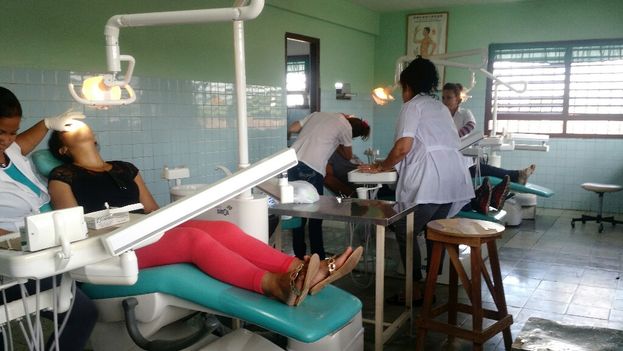
Dental clinic in Candelaria, province of Artemisa. (14ymedio)

14ymedio bigger14ymedio, Bertha Guillen, Candelaria (Artemisa province), 23 July 2017 — “Where is my laptop?” a dentist at the Candelaria polyclinic in Artemisa province asked Friday while attending a patient. The sale of laptops to doctors – at subsidized prices – does not include graduates in dentistry, by a decision of the Ministry of Public Health that is being strongly questioned.

As of the end of last year they have began to sell the laptops for 668 Cuban pesos (CUP), around 25 dollars, for doctors who obtained a diploma before the end of 2015. The list of beneficiaries includes those who have completed a medical mission abroad and requires that they pay the full amount all at once, not in installments.

The public health system employs a total of 262,764 workers in the island, of which 87,982 work as doctors, according to data from the Statistical Yearbook of 2015. The doctors receive the highest wages in the country, a total of between the equivalent of $50 to $70 US per month. continue reading

However, the sector is seriously affected by the desertions of professionals during their missions abroad and the exodus towards other better-paid economic spheres such as self-employment or tourism, of doctors who remain on the island. In addition, physicians must deal with long work hours, material deficiencies and the dissatisfactions of patients.

Since the beginning of this year the doctors have been able to buy laptops in the store for public health workers in the provincial capital. The offer has brought long lines outside the premises and complaints about the capabilities of the equipment.

Since the beginning of these sales, an indeterminate number of laptops has ended up in the informal market, where they are sold for a price ranging between 200 and 300 CUC, between eight and 12 times the original cost.

Recently the official newspaper Granma revealed that each year Cuba collects more than 8.2 billion CUC (roughly the same in dollars) for “the export of health services.”

This month, several meetings in the province of Artemisa notified staff working in polyclinics, hospitals and other health centers that only doctors are entitled to acquire these computers. X-ray technicians, lab workers, and even dental graduates “are not included in this offering,” ministerial authorities said.

The information has generated a barrage of criticism and discontent among dentists and other professionals in the sector. None of them, except graduates in medical sciences, will have access to the merchandise sold in stores authorized for public health personnel. Among these products are also the white coats that are currently distributed on a staggered schedule in Artemisa province.

“This has gone beyond a lack of respect,” said the dentist from Candelaria. “Now it turns out that we are not the same as doctors, but when it comes time to participate in acts of repudiation against the words of Donald Trump, we are.”

Raiza Machín, a dentist from the province, does not speak half-heartedly. “I feel offended, even the self-employed who work in coffee shops wear white coats, how is it possible that as a public health worker we cannot buy them in a store dedicated to us?” asks the professional.

According to the head of the Public Health Workers Union in Candelaria, the information came from the Ministry itself and applies to the whole country. In response to the workers’ discontent, the union representative demanded a meeting with “the highest authority” but has not yet received a response. “For the moment we are not doctors and therefore we can not use the same facilities as they can,” says Machin sarcastically.

“At first they told us that they had to wait until they finished distributing the laptops among the doctors in the hospitals, then it would be the clinics’ turn, and then finally our turn,” says Araceli, a dentist with several years of experience.

“They have strung us along and now that say that we are not doctors, that’s why we don’t get the computers,” complains the dentist. The refusal to allow dentists to buy them became known shortly after the official media assured that the dentists were “guaranteed” laptops.

“Since our title says ‘Doctor of Dentistry’ I have to consider that I am one,” Machín stresses.

By Show of Hands

A man exercises his right to vote in the elections to the Popular Power in Havana. (EFE)

14ymedio bigger14ymedio, Reinaldo Escobar, Havana, 21 July 2017 — In recent weeks, the official media have spared no space to explain the details of the Cuban electoral system, which they call “the most democratic in the world.” However, the infographics, data and explanations published so far neglect details that “firmly maintain” the mechanisms to avoid surprises.

Between September 4th and 30th the candidates for delegates of the People’s Power will be nominated. The process will occur in the different areas which together make up the 12,515 districts distributed across the 168 municipalities of the country. On this occasion, it is the first step in Raúl Castro’s departure from power in February 2018. continue reading

The call for citizens to participate in these assemblies is traditionally issued by the Committees for the Defense of the Revolution (CDR) Organization, with a clear political origin and a strong ideological affiliation. From wall signs, personal reminders, to written citations, all are a part of the strategies to call people to vote.

In the days leading up to the meetings, the Communist Party of Cuba (PCC) militants who live in each zone meet to agree on the positions depending on the directions that come from the higher levels. In these meetings they are warned how they should act in case any disaffection toward the Revolution is proposed, and which candidate enjoys the PCC’s sympathy.

Only voters of the district have the right to propose and be proposed in the assemblies of each area. In order to do so they have to ask for the floor, speak in the order granted to them and briefly explain the reason for their proposal. The nominee must show his agreement with being proposed and only then will he or she be put to a vote.

All voters may express their opinion for or against the candidate and the vote is made directly and publicly, in the same order in which each candidate was proposed. Each attendee has the right to vote for only one nominee and in the event of a tie a new nomination is initiated.

When the Electoral Law in its article 83 remarks that the vote is “public,” it minimizes one of the most important keys of the electoral system of the Island and that make it more controllable by the powers that be. At that initial stage of nomination, voters must express their preference by show of hands, that is with their faces uncovered. In a country full of masks and fears, few dare to show their neighbors a preference for a critical citizen.

When in one of these assemblies an elector proposes a candidate with a reputation of being politically uncomfortable, he knows that, immediately, the militants of the neighborhood will request the floor to discredit the nominee. The mechanism of “cauterization” of any nomination that does not conform to the tastes of the ruling party will be activated immediately.

In the midst of the meeting, a member of the PCC will warn in a loud voice, “this man is in the pay of the empire,” and someone else will speak up to express his doubts because someone “who feels himself to be Cuban votes in favor of this mercenary…” The performance seldom has to be carried out, because the instinct for self-preservation dissuades the majority of voters from suggesting a dissident for delegate.

They find it so difficult to encounter someone who, from dissenting positions, aspires to be a delegate, or to find another who dares to propose one to the assembly. How many will raise their hands in favor of a dissident after the militants make it clear they do not like the nomination? Almost nobody. This simple trick will have ensured the first and most important purge of the electoral system.

To ensure the minimum secrecy required by the vote, it would be enough to distribute a simple piece of paper among each of the participants so they could write the order of their candidate preferences. But that would add the privacy that the ruling party wants to avoid at all costs.

This variant would have the added value of eliminating the chance that someone, in the midst of counting the raised hands, violates – consciously or otherwise – the provision that allows each person to vote for only one candidate. In short, it would smooth out the process and make it more democratic and effective.

Not for nothing, was the elimination of voting on the nomination of candidates by a show of hands one of the proposals most repeated by those who believe that the current electoral process would be governed by new legislation as promised by Raul Castro in February 2015.

Changing what looks like a detail of slight importance, a methodological pedantry, would open a space for the plurality of citizen participation; it would allow us to express ourselves without fear on a critical topic: the presence of different thinking among the base.

Keeping the first piece of the Cuban electoral framework as it is now is only a way of perpetuating the fear that harms the civic action of a good part of the population. It is precisely the suppliers of this fear who prefer to leave things as they are.

Cuba, Elections and Electoral Reform / Dimas Castellano

Dimas Castellanos, 4 June 2017 — The “electoral” process which will take place in Cuba between October 2017 and  February 2018 lacks any relevance. Raúl Castro’s replacement as president does not mean he is relinquishing power, as, up until 2021, he will occupy the position of Secretary of the Communist Party, which is, constitutionally, the top man in the society and the state.

For the elections to have any influence on social progress you would need an electoral reform which would re-establish sovereignty of the people and, although in February 2015 a new electoral law was announced, it was not mentioned in the meeting of 14 June 2017.

According to Jean-Jacques Rousseau, from the joining together of those who wish to defend and protect their property emanates a general will to convert the cooperating parties into a collective political body.   The exercise of this general will is known as sovereignty and the people who do it are sovereign. continue reading

In Cuba the republican constitutions of 1901 and 1940 endorsed sovereignty as residing in the people, with all public powers flowing from that. In 1959, with the emerging of revolutionary power they promised they would hold elections “as soon as possible”. Seventeen years later, they enacted a law abolishing the sovereignty of the people. As long as this situation goes on in Cuba there will be no true elections.

In the year 2003, the total share of Cubans who did not go to vote and destroyed their voting papers was 6.09% of the electorate. In 2008 it went up to 7.73%, in 2013, 14.22% and in April 2015 was over 20%. That is to say 1,700,000 Cubans. In a totalitarian country without civic and political rights, these statistics demonstrate the need for a law that satisfies this part of the Cuban people. You can add to that those Cubans inclined to vote for opposition representatives – not legally recognised – as happened in the 2015 elections, when the opposition put up candidates in the Havana districts of Arroyo Naranjo and Plaza.

According to the Secretary of the unicameral Cuban parliament, in 2014, during the fourth round meetings where delegates give the electorate an accounting of what they have accomplished,  there were over 600 assemblies with fewer than half the electors present.

The present law limits the electorate’s direct voting to the Delegates of the Municipal Peoples’s Power assemblies, which may not exceed 50% of the total number of candidates. The other half is nominated by the Candidate Committees – made up of leaders of peoples’ organisations with the authority to include unelected people. Then, candidates for provincial and national positions are directly appointed by these committees. Therefore the Cuban parliament and government are the product of the decisions of these Candidate Committees, which are subordinate to the Communist Party, which cuts out the sovereignty of the people.

Transformations are needed in terms of rights – such as the right of association and a multi-party system – so that Cubans can take an active part in determining where their lives and the nation is going. Until that occurs, you can’t talk about true elections in Cuba and there is no indication that that will happen in the upcoming elections.

The absence of peoples’ power and the non-existence of the citizen as legal entity have been, and are, determining factors in the structural crisis of the Cuban model, which is reflected in  inefficient production, insufficient salaries, uncontrollable corruption, hopelessness and an unstoppable exodus.

Published in El Comercio, Lima, Peru.

Translated by GH

"Since 2013, 7 of every 10 Cuban dissidents have settled in the US" / Iván García

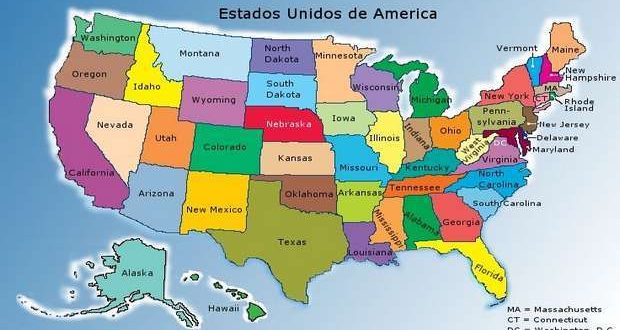
Political map of the United States taken from the Internet

Ivan Garcia, 24 July 2017 — Cuba’s incipient civil society, independent journalism and political activism on the island is starting to find the cupboard is bare.

According to a US embassy official in Havana, “Seven out of ten dissidents chose to settle in the United States after the Cuban government’s new immigration policy in January 2013.”

The diplomat clarified that, “Some stayed when attending events, workshops or university courses they’d been invited to. Others, with multiple-entry visas to the United States, simply boarded an airplane and when they arrived in the US they took advantage of the Cuban Adjustment Act.” continue reading

To this slow leakage, we have to add the opposition figures who leave Cuba under the political refugee program.

The cause of the migration of dissidents is varied.

It ranges from the Cuban Special Services repression of dissidents and free journalists, constant detentions, searches and seizures of their tools of the trade, to beatings and threats of prison sentences.

And believe me, the Castro brothers’ autocracy plays rough. A law, known as the Gag Law, has been in force since February 1999, under which public dissent can results in 20 years or more of imprisonment, whether of dissidents, journalists or state officials.

The peaceful opposition, which emerged in the late 1970s and which from its beginnings has been committed to democracy, respect for human rights, freedom of expression and a multi-party system, has been dismantled by the regime’s permanent repression, forcing many dissidents to choose exile as a way out.

It is a reasonable decision. We Cubans have no vocation for martyrdom. But this fleeing of brave people, capable of facing the powerful machinery of a totalitarian state, has been difficult to replace in the short term.

In spite of its repeated economic failures, Castroism maintains strong social control due to the absence of honest intellectuals, academics and journalists committed to the people who, from their official or individual positions, serve as counterpart to authoritarian outrages.

When Fidel Castro seized power in January 1959, a considerable percentage of the cream of society, including talented Cubans who had proven themselves capable of creating wealth, and also those who in their early days fought against Fidelism using their own violent methods, opted for the diaspora.

They decided to jump ship, leaving the bearded helmsman behind. Perhaps they thought that the Revolution would be a matter of a few months, that soon it would fail and they would return to save the mother country.

It was precisely this mass emigration that paved the way for the establishment of an almost perfect autocracy, which sealed all legal channels to other political viewpoints and allowed the government to maintain a swollen Praetorian guard. A Praetorian guard that currently holds in check the minority and weak opposition.

The Castros’ Cuba was left without a powerful national bourgeoisie, without successful entrepreneurs and without a seasoned political class, capable of confronting the president in all areas.

At the same time, State Security has been very adept at short-circuiting any bridge between the opposition and the citizenry. That is why on the Island we do not see protest marches with thousands of participants or a general strike.

Of course, the work of dissidents has also failed, particularly those who have emerged in recent years, and unlike their predecessors, are more focused on selling headlines in Florida newspapers than listening to their neighbors, showing an interest in their problems and trying to get them to increase and strengthen the membership of their groups

Right now, in Cuba, all the conditions exist for the emergence of a truly independent trade union movement or an association of private entrepreneurs that demands their rights from the rulers.

The miserable wages, the brakes on self-sufficiency, the daily hardships of families, the abandonment of old and retired people, the increase of drunks and beggars, the failure of the regime in the economy and agriculture, housing construction and the creation of quality services, are powerful reasons to replace the olive green state.

The discontent is in full bloom. Just stand in line for a few minutes, walk the streets of neighborhoods away from the tourist lights, or ride a bus or a shared or private taxi. Today, a large segment of the population openly criticizes the regime, something that did not happen three decades ago.

The vast majority of people want better lives, without so many material shortages, they want fair pensions and salaries and to be able to count on the power of the vote that allows them to dethrone inept politicians.

But there is a lack of dissident leaders capable of bringing together that mass that is now invisible, fearful and faking loyalty.

Many opponents and activists have left their country, almost all of them to the United States. And those who remain on the island do not seem to be up for the work of changing the state of things.

Some prefer to spend much of their time in meetings and conferences abroad. Others, “live on horseback” between Havana and Miami. And Cuba and the Cubans? Fine thanks.

Police Impose “House Arrest” On Journalist Sol García Basulto

Independent journalist Sol García Basulto. (Facebook)

14ymedio bigger14ymedio, Havana, 24 June 2017 — Independent journalist Sol García Basulto is under new restrictions of movement after police imposed a “precautionary measure of house arrest” during an interrogation held Monday in the city of Camagüey.

The 14ymedio correspondent responded to a police summons at ten o’clock in the morning. First lieutenant Yusniel Pérez Torres, from the criminal investigation and operations unit, issued an detention order effective during the time of the interview, which lasted a little over an hour.

The officer informed her that the investigative phase of her case had been concluded and a file had been opened for the alleged crime of “usurpation of legal capacity,” (that is, practicing a profession for which a person is not licensed). Going forward, the reporter can hire an attorney to represent her in the process. continue reading

The officer also warned Garcia about her job of interviewing and collecting information on the public right-of-way. In particular, he spoke of an article on “the subject district delegates to the People’s Power,” and article that the reporter denies having written.

Since last March, García and independent journalist Henry Constantín Ferreiro have been harassed for being part of the editorial team of La Hora de Cuba magazine and collaborating with other digital media.

Constantín is the regional vice president of the Inter American Press Association (IAPA) in Cuba and is not authorized to travel abroad to attend regional body meetings.

The crime of “usurpation of legal capacity” can be penalized with a sentence of between three months and one year of deprivation of liberty. The IAPA believes that these allegations are contrary to international provisions and supports the right of both reporters to “seek, receive, disseminate information and express opinions.”

At the end of Monday’s detention, the officer drafted an act of release and “a precautionary measure consisting of house arrest” against Garcia.

The first lieutenant informed her that she cannot leave the province and nor “have a social life.”

The journalist demanded a copy of the documents but the official assured her that he had no obligation to give her anything in writing. Henry Constantin “will be notified shortly,” according to the police.

On the accusation of usurpation of the legal capacity to exercise journalism García Basulto concluded that she has only exercised her “freedom of expression of speech and of the press recorded in the Constitution of the Republic and in the Universal Declaration of Human Rights.”

They Lost their Homes and Freedom Because of ‘Maria’

The life of Yuris Gabir Garrote Rodríguez was turned upside down when he was sentenced to ten years in prison in 2015 for carrying a cigarette with 0.38 grams of marijuana. (14ymedio)

14ymedio bigger14ymedio, Luz Escobar, Havana, 22 July 2017 — The future could only bring good things. His son grew up and his passion for photography allowed him to rub shoulders with numerous artists. But the life of Yuris Gabri Garrote Rodriguez was turned upside down in 2015 when he was sentenced to ten years in prison for carrying a cigarette with 0.38 grams of marijuana. The strict Cuban legal system destroyed all his projects.

The incessant controls and an inflexible penal code make the island one of the places in the world where drug possession and trafficking are judged with greatest severity. Cuba also ranks sixth in terms of number of prisoners per inhabitant, with an estimated 60,000 people living behind bars in the country. continue reading

Garrote was very unlucky, say friends and family. He had already had problems several years earlier when police found in his house two issues of the magazine Cannabis, a Spanish publication dedicated to the culture of cannabis. They also confiscated a poster with the drawing of a leaf of the plant that adorned his bedroom with its defiant silhouette.

Not a single gram of weed was found during the search, but he was tried because he was “acquiring enough culture about marijuana to successfully engage in” a business, according to court records. His detention occurred in the middle of the so-called Operation Coraza, a turn of the screw against “illegalities” that allowed the courts to apply exemplary sentences.

In Cuba the law tends to be as flexible as circumstances and power require. The independent lawyer Amado Calixto Gammalame, member of the Legal Association of Cuba, recognizes this. “The judicial treatment given to each person can be a bit capricious.”

For decades, the fight against marijuana has also been an ideological issue and official propaganda described republican Cuba as a place where vices such as prostitution, gambling and drug addiction proliferated. Maria, as many on the Island call cannabis, was a symbol of capitalist decadence.

This battle with political visions has remained to this day, despite the fact that other Latin American countries, such as Ecuador and Paraguay, have decriminalized its use in public spaces for personal consumption, although without fully liberalizing it.

If Cuba is the extreme of intransigence on the continent, on the other end is Uruguay which, after the definitive legalization of marijuana sales and production in December 2013, this month began to market small envelopes of 40 grams in more than a dozen pharmacies.

This decision has not done the government of the island any favors. Recently the authorities affirmed that the liberalization of cannabis in some countries of the region is nourishing the drug traffic.

The secretary of the National Drug Commission of Cuba, Antonio Israel Ibarra, said that so far this year they have seized three times the drug that was confiscated in the same period of 2016. For those who expected a relaxation, the official delivered a strong phrase: “We have not legalized it (marijuana), nor will we legalize it.”

This statement is in line with comments by Raúl Castro at the Summit of the Community of Latin American and Caribbean States (CELAC) held in Chile in 2013, when he remarked that on the island the drug would be fought “with blood and fire.”

Tourist guides warn that the island “is not a good place to smoke a joint” and murderers and rapists live in prison alongside inmates convicted of carrying a few grams of cannabis in their pockets. The “stain” of this criminal record on the history of anyone is a serious stigma when it comes to seeking employment.

Despite the severe punishments and controls, the consumption of the herb has not been eradicated. Marijuana has become common in the festivals of artists, successful entrepreneurs and the ruling class itself. But few of them dare to cry out in public for its decriminalization, for fear of being considered criminals.

A good part of the weed arrives aboard ships that land in the coasts. Its cultivation is also a juicy business for those who dare to plant the elongated herb, especially in the eastern part of the island.

In September of 2013 the young musician Roberto Carcassés improvised controversial verses in the middle of an official act: “I want to free the Five Heroes, and free Maria. Free access to information, to have my own opinion,” he sang in an unforgettable chorus whose reference to marijuana was clear.

Two years after that rhyme, the penal code remained just as tight and Yuris Gabir Garrote Rodríguez returned to jail.

For Iraiz Piña Gutiérrez, a 64-year-old from Holguin, the punishment was not just to be incarcerated for six years. The court also ordered the seizure of her home, a penalty that applies to anyone who “produces, traffics, purchases, stores or consumes” illicit drugs.

In a search in her house the police found ten chocolates “stuffed with marijuana,” says the former prisoner.

Aged and with only the clothes she wore, Piña left the prison after serving her sentence but still seeks justice for a case she considers “fabricated” against her. She has traveled to countless state agencies to get them to give her back her house and her “reputation,” but few want to hear or help a “marihuanera”, she tells 14ymedio.

For Lorenzo, a resident of Timba who prefers to change his name to tell his story, the feeling of helplessness will not let him sleep. He lost the house he inherited from his father because his brother kept several pots of marijuana in a room that was under the same roof that had, for years, a separate entrance.

“We did not get along and split the apartment so that everyone had their share,” he explains. Lorenzo had a thriving cafe but it all ended when a police raid found his brother’s little plants. After submitting several complaints, he has been told that the confiscation of the property is an “unappealable” decision because “that’s how it is with marijuana, there is no middle ground,” ​​a lawyer said.