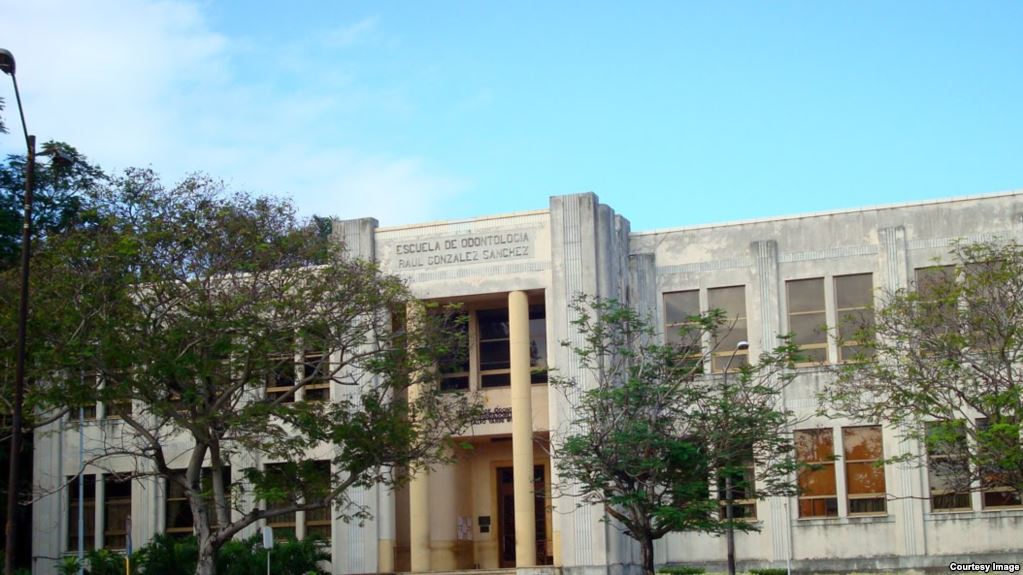
Juan Juan Almeida, 23 June 2017 — Located in the stately building with its exquisite art-deco style, at the Havana intersection of Salvador Allende Avenue (formerly Carlos III) and G Street, is the Cuban symbol of the oral health system. Officially known as the Raúl González Sánchez Dental Medicine Faculty, it is also on the point of collapse.
“The budget is tighter than the screws on a submarine. Most of the time the autoclaves used for sterilization don’t work, nor is there aseptic paper to wrap the dental instruments in; but the human material is there. Prices fluctuate between 15 and 300 CUC, according to the treatment or the urgency,” says a person who travelled from Miami to be treated in the “signature” Havana institution.
“There is no air conditioning in the treatment room, the windows are open and they have to position the chairs to avoid facing the sun. So you either bring a fan, or spend an extra 50 CUC to be treated in an operating room where there is only hygienic equipment, green clothing and adequate air conditioning. Being treated in Cuba, besides being cheap is folkloric,” my interlocutor continues, in tone so celebratory it provokes indignation. The saliva extractors are broken and so you have to bring a bottle of water and towel. And when the slime accumulates the dentist says, “spit it out.” continue reading
According to the constitution currently in force on the island, the Cuban state guarantees free medical attention to the population as one of the fundamental social paradigms; but the Healthcare system is suffering the restrictive effects of lack of resources because of the economic crisis, neglect, corruption and negligence, which among other things is a consequence of political mistakes.
“The politics of the country stipulate that the attention of every dental clinic should be free from payment; but then there is what we experience,” explains a professor of the fames institutions, who prefers to remain incognito, because to survive he has, at home, an old dental chair, a light and a pedal machine.
“Unless it’s an emergency, getting a regular appointment is very complicated and the receptionists charge for facilitating it. We have to live,” he breathes deeply and recites his price list. “For a mouth exam, prophylaxis, a light filling and a clinic diagnosis — 15 CUC. We visit many patients, the majority with chewing problems, gingivitis, periodontal disease. These conditions require long treatments, and this case they cost 2 to 10 CUC per visit. There are more expensive ones that require complex operations that in some other country would cost around $10,000 or more. Of course, the difficulties of the country force us to tell patients that to avoid problems they should bring their own anesthesia and the braces should they need orthodontic treatment.”
“Our prices,” concludes the professional, “vary depending on the patient. If it’s a Cuban living in Cuba, a Cuban living abroad, or a foreigner.”
Sadly, the above video is not subtitled, but whether or not you understand the words, you can observe Miguel Coyula and Rafael Alcides speaking.
Jorge Enrique Lage interview with Miguel Coyula (fragments) 3
Miguel Coyula: … And it’s [Rafael] Alcides for several reasons. First, because in my opinion he is the best Cuban poet alive. Pata de palo, Agradecido como un perro and Nadie are indispensable books; Especially Nadie [No one], written and censored in 1970, and that doesn’t see the light until 1993, when I read it for the first time and it hits me.
Alcides is often described as a sensualist, but his range is very wide. Take, for example, his poem “El Extraño“, which appears in the film: it is very brief, stripped of artifice, combines the existential and the political in a universal way, with an admirable economy of means.
But even if Alcides had not been able to write anything …] [… his own person is poetry; he has the gift of speech, a diaphanous word, he speaks of beauty and poetry without intellectual poses, despises politicians and yet can speak of them with poetry, to the point that the passion of his gestures makes him a force which seems more typical of the field of fiction than of the documentary. continue reading
[… probably Alcides is one of the few Cuban intellectuals of his generation (in fact, the only one I know of) who, residing on the island, has no qualms or filters when it comes to making public what he thinks. He has paid the price for his honesty with ostracism. Also contradictions and guilt coexist in his person. He gave himself up to a dream, sacrificed himself for it and accepted failure. I’ve always been interested in misfits. Alcides contained all the elements that interest me in the construction of a character. Perhaps his honesty and his nonchalance mean that the film can not find a place anywhere: neither in the diaspora nor in the intellectuals of his generation who remained on the island.
The fact that the film is indistinctly labeled “counterrevolutionary” and “communist” is something I am very pleased about.
The first thing we recorded was a four-hour interview, from which came a short web mini-series, seven chapters, titled “Rafael Alcides.” (Many people believe they have seen Nadie but what they have seen is the miniseries on YouTube that only totals twenty-nine minutes).
At first there was no theme at all, it was about Alcides talking freely, but he himself was outlining the theme of the Revolution and then we began to record more specific questions.
Site Manager’s note: Once all the fragments of this interview are translated (by different volunteers) we will unite them in order, in a single post.
The capital has 367 establishments dedicated to producing “ration bread.” Most with serious technical difficulties. (14ymedio)
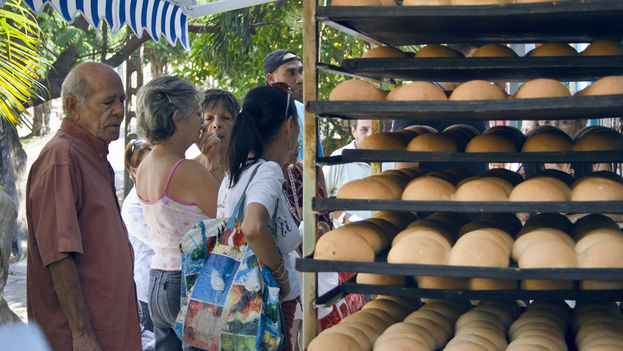
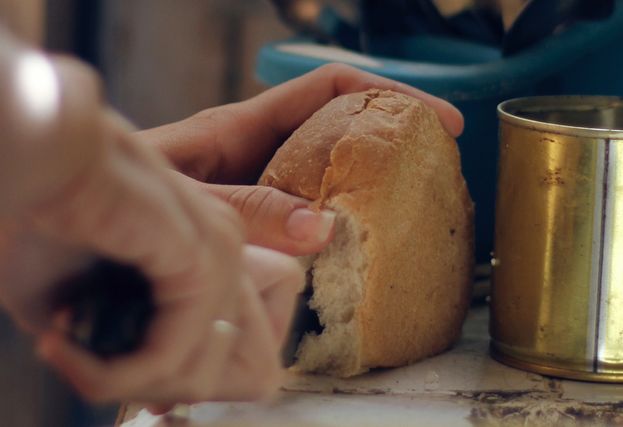
14ymedio, Zunilda Mata, Havana, 9 July 2017 — With a sharp knife and the skill of a surgeon, Luis Garmendia, 68, slices the bread from the rationed market into six small slices. Like so many Cubans, this retiree cannot afford to buy from the liberated (unsubsidized) bakeries and considers that, every day, the quality of the basic product is “worse.”
In the Havana neighborhood of Cerro, where Garmendia lives, the ration bread ‘starred’ in the last assembly of accountability with the local People’s Power delegate. “Since I started going to those meetings, the same problem arises, but it is not solved,” he protests.
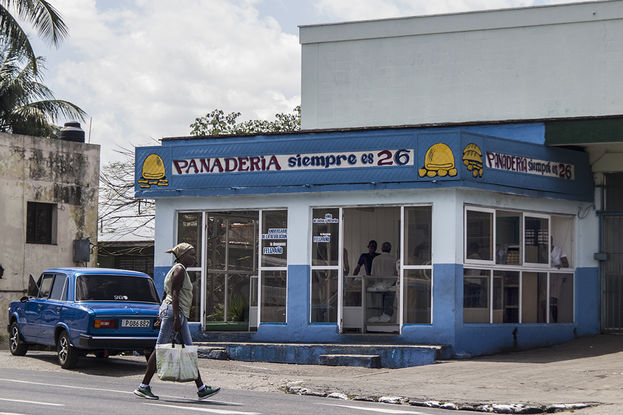
The capital has 367 establishments dedicated to producing “ration bread.” Most have serious technical difficulties, according to a recent report on national television. In the last three years at least 150 of them have been renovated but customer dissatisfaction continues to grow. continue reading
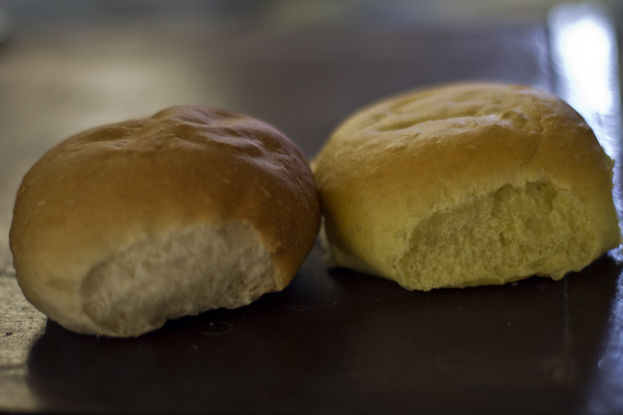
The taste, size and texture of the popular food are at the center of customer criticisms. Hard, rubbery, and weighing less than the required 80 grams (2.8 ounces), are the characteristics most commonly used to describe “ration bread.” Its poor quality has become a staple in the repertoire of comedians.
With more than 7,500 workers in the capital and a daily consumption of 200 tons of flour, the Provincial Food Company is directly responsible for the rationed bread. (14ymedio)
The product’s bad reputation leads families that are more financially comfortable to avoid consuming it. “Now we Cubans are divided between those who can eat flavorful bread and those of us who have to make do with this, subsidized and flavorless,” says Garmendia while displaying a bread roll this Friday.
According to María Victoria Rabelo, director general of the Cuban Milling Company, “It is sad and frustrating to hear the opinions of the population,” regarding the rationed product. Her entity is in charge of producing and commercializing the wheat flour used throughout the country for the manufacture of bread, confectionery and its derivatives.
In the informal market flour is highly valued especially by private business owners who make pizzas, sweets and breads. The diversion of resources from state-owned establishments has become the main source of supply to the retail sector and affects the quality of the regulated product.
“I have to take care of each sack of flour as if it were gold,” says the manager of a bakery in Marianao’s neighborhood, who preferred anonymity. “They also steal other ingredients involved in the process, such as the improver, fats and yeast,” he details.
“I am the third administrator to have this establishment in five years, the others exploited it to steal,” says the state employee. For years the business of state bakeries “has been robust, because there is a lack of controls and demand has grown as there are more cafes and restaurants,” he says.
The profession of baker has been a gold mine. In spite of the low salaries in the sector, which doesn’t exceed 30 CUC a month, there is a high demand to work in these establishments. “I know people have become millionaires with the resale of ingredients or of the product,” says the administrator.
Hard, rubbery and undersized, are the characteristics that are most heard when the rationed bread is described. (14ymedio)
“There are places where employees at the counter pocketed at least 400 CUP per day just selling the bread that is destined for the basic basket under the table.” Inside, near the ovens, “workers can get away every day with up to 800 Cuban pesos [Ed. note: more than the average monthly wage],” he confirms.
Each ingredient has its own market. “The baked bread is much sought after by paladares (private restaurants), coffee shops and people who organize parties,” he adds. While “the yeast and improver end up in the business of selling pizza and the fats have a wider clientele.”
The administrator of the bakery on Calle 19 and 30 in Playa, Reina Angurica, believes that in order to avoid embezzlement, she must “talk to the workers, communicate with them and not allow illegal productions.” In their place they meet weekly “to talk about the short-term problems of the bakery and to eradicate them,” she told the national media.
The Cuban Milling Company imports 800,000 tons of wheat each year which is processed in five mills throughout the country, three of which are in Havana. “Strong wheat or corrector” is mixed with “weak” wheat to produce the flour sold to the food industry.
The ration market bread is made with a “weak or medium strength flour” ideal for achieving soft texture. However, the wheat blend has been affected by import irregularities and the state bakers are only receiving strong flour, more suitable for a sturdier bread.
“Now we Cubans are divided between those who can eat flavorful bread and those of us who have to make do with this, subsidized and flavorless.” (14ymedio)
With more than 7,500 workers in the capital and a daily consumption of 200 tons of flour, the Provincial Food Industry Company is directly responsible for the ration bread. But the entity is floundering everywhere because of the lack of control, hygiene problems and the poor quality of its products.
In some 1,359 inspections carried out in the last months in the facilities of this state company, there were 712 disciplinary measures imposed for irregularities in the preparation of the product. The problems detected ranged from indisciplines and diversion of resources to lack of cleanliness.
For María Victoria Rabelo, from the Cuban Milling Company, the technological difficulties or the problems with the raw material are not the keys to understanding the current situation: one must “dignify the profession and, without speaking with demagoguery, bring love to what we do,” she says with determination.
But in Cerro, where Garmendia is waiting every day for a miracle to improve the rationed bread, the words of the official sound like Utopia. “I do not want anything fancy, I just want it to be tasty and softer, nothing more,” says the retiree.
After leaving, the complainant took a photograph of the car with her cell phone and noted the number of the license plate, which facilitated the arrest of the driver by the police. (EFE)
14ymedio, Havana, 10 July 2017 – The driver of a private taxi was arrested after being accused of racial discrimination by Yanay Aguirre Calderín, according to a report Monday in the weekly paper Trabajadores (Workers). The event has generated numerous articles in the official press which is making an example of the case.
On 2 July, the same weekly published an article by Calderín, a law student who is black, where she related how she engaged the taxi and was treated aggressively by the drive due to the color of her skin.
According to prosecutor Rafael Ángel Soler López, head of the Office of Attention to the Citizenry of the Attorney General’s Office, “We cannot yet anticipate what the end of the process will be,” since they are now “investigating to be able to prove the criminal act before the courts.” continue reading
The Cuban Penal Code establishes a penalty of between six months and two years of deprivation of liberty, or a fine of between 200 and 500 CUP, to anyone who denies “on the grounds of sex, race, color or national origin the exercise or enjoyment of the rights of equality established in the Constitution.”
Aguirre Calderín, who does not specify the exact date of the events, took the private car on Avenida 41, in the Marianao municipality, but when she wanted to change her destination, the driver reacted “very upset” and “very violently.” The young woman explains that at that moment the driver shouted that “every time there is a black person in his car it’s the same” and that for that reason “he could not stand them.”
Calderín then rebuked the driver, whom she accused of offending her, to which the taxi driver responded by asking the passenger to get out of the car before arriving at the place initially designated by her. At that moment the complainant took a photograph of the car with her cell phone and noted the number of the license plate, which facilitated the arrest of the driver by the police.
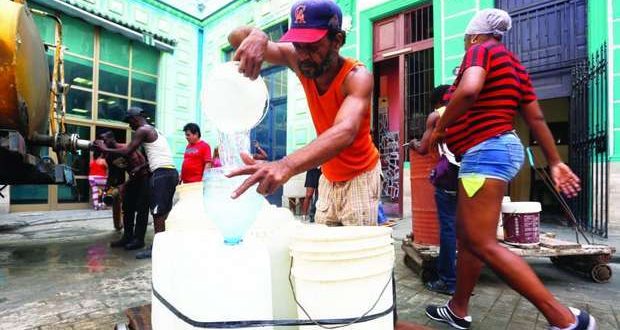
Almost a million Havanans have been affected by water shortages for more than a month. Taken from Diario las Americas
Ivan Garcia, 3 July 2017 — The fan stopped turning around 3:30 in the morning, when in the middle of a heat wave, a black out forced Ricardo, his wife and their two children to sleep on a mat on the balcony of their apartment in the Lawton neighborhood, a thirty minute drive from central Havana.
Several areas were left dark and lit only by candles and lanterns, dozens of neighbors complained with rude words and sharp criticisms of of the poor performance of state electricity and water companies.
The blackout lasted for seven hours. “I couldn’t iron my children’s school uniforms and they are in the midst of final exams. I sent them to school in street clothes. Nor could my husband and I go to work. When I the light came on, after ten in the morning, we lay in bed for a while. The situation is already so bad no one can stand it. It’s one problem after another. The water crisis, which is still affecting us, public transportation is the worst, food prices don’t stop rising and now this black out in the middle of this terrible heat,” says Zoraida, Ricardo’s wife. continue reading
Almost a month after a break in one of the main pipes that brings potable water to Havana, and then an intense information campaign on the part of the office press, filled with justifications and an exaggerated optimism, where radio, TV and newspapers report the hours there will be water in each neighborhood, after the repairs, completed two weeks ago, and with the promise that service would gradually return to normal in the different zones of the capital, they are still suffering the affects and the media doesn’t offer any explanations.
“Some 200,000 people are still affected and are receiving water every three days. By Thursday, June 22, it was expected to regularize the service, but some problems have arisen,” said an official of Aguas de La Habana in the municipality Diez de Octubre, the most populated of the capital’s districts.
The affected Havanans don’t stop complaining. “In my house, the tank that we have on the roof does not have the capacity for the water to last three days. Although we try to save it, in the bathroom, kitchen and laundry, the water that we are able to collect is spent in two days. The government comes up with one lie after another. First it was reported that the break was a matter of a week, at most two. And we’re going on for a month now. Instead of responding with so much noise to Trump’s measures, they should focus on improving the living conditions of Cubans,” complains Mario, a resident of Luyanó, a working-class neighborhood in the south of the city.
Rumors about the resurgence of the perennial economic crisis that Cubans are experiencing, spread throughout the city. “I have it on good authority, from a friend of my brother who is in the party, I know that by summer the government is going to make new cuts in companies’ fuel consumption, and they will close unproductive factories and industries until further notice. The scarcity is noticeable. The state farm markets are empty and the shortages in the hard currency stores are obvious. It is said that in the upcoming session of the National Assembly of People’s Power, on July 14, they are going to announce new measures of cuts. Thing looks ugly,” says Miriam, housewife, at the entrance to a bodega in Cerro municipality.
Diario Las Américas could not verify those comments and rumors.
A banking official who prefers anonymity believes that the country’s financial situation is “quite delicate.” He says, “There is not enough currency liquidity. Even payments of the various debts contracted with foreign companies are not being made. Tourism, which contributes about $3 billion in revenue, devours almost 60 percent of that revenue in the purchase of inputs. Remittances are the lifeline, but with shortages in foreign exchange stores and high prices, many people are spending their convertible pesos on the black market or in the parallel trade of the ’mules’ that bring products from abroad. A large part of that money is not being returned to the state coffers, as people involved in these activities either save it or use it as an investment in their business.”
To minimize reality, the olive-green autocracy uses anti-imperialist discourse and condemnations of Donald Trump’s new policy of restrictions as a smokescreen.
“That narrative has always worked. But people on the street know that this discourse is exhausted. They can’t justify all the national wreckage and the poor performance of the public services with the economic blockade of the United States nor with the recent aggressive policy of Trump. Cubans are at their limit with everything. It is not advisable to think that Cubans will always be silent. Situations such as blackouts and cuts in the water supply make people angry and their reactions could be unpredictable,” warns a sociologist.
With finances in the red, an economic recession that threatens to turn into a crisis of incalculable consequences, and grandiose development plans that sound like science fiction to ordinary Cubans, the authorities are facing a dangerous precipice.
Six decades of selling illusions and with unfulfilled promises are already coming to an end. And it could be less than happy.
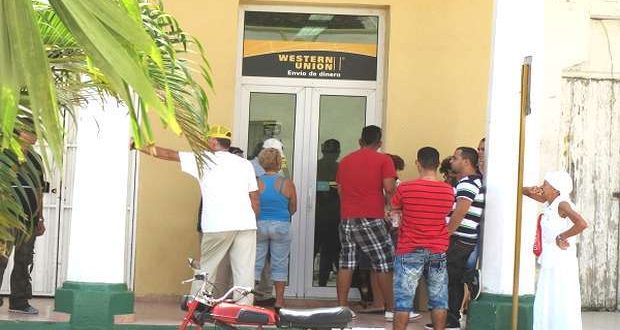
Western Union branch in Las Tunas. Photo by Alberto Méndez Castelló, taken from Cubanet.
Ivan Garcia, 8 July 2017 — Without too much caution, the CUPET tanker truck painted green and white begins to deposit fuel in the underground basement of a gas station located at the intersection of Calle San Miguel and Mayía Rodríguez, just in front of Villa Marista, headquarters of State Security, in the quiet Sevillano neighborhood, south of Havana.
The gas station, with four pumps, belongs to the Ministry of the Interior and all its workers, even civilians, are part of the military staff. “To start working in a military center or company, be it FAR (Revolutionary Armed Forces) or MININT (Ministry of the Interior), besides investigating you in your neighborhood and demanding certain qualities, you have to be a member of the Party or the UJC (Union of Young Communists),” says one employee, who adds: continue reading
“But things have relaxed and not all those working in military companies are 100 percent revolutionary. And like most jobs in Cuba, there are those who make money stealing fuel, have family in the United States and only support the government in appearances.”
Let’s call him Miguel. He is a heavy drinker of beer and a devotee of Santeria.
“I worked at the gas station six years ago. It is true that they ask for loyalty to the system and you have to participate in the May Day marches so as not to stand out. But it is not as rigorous as three decades ago, according to the older ones, when you could not have religious beliefs or family in yuma (the USA). I do not care about politics, I’m a vacilator. I have two sons in Miami, and although I look for my shillings here, if Trump cuts off the remittances to those of us who work in military companies, Shangó will tell me what to do,” he says and laughs.
If there is something that worries many Cubans it is the issue of family remittances. When the Berlin Wall collapsed and the blank check of the former USSR was canceled, Fidel Castro’s Cuba entered a spiraling economic crisis that 28 years later it still has not been able to overcome.
Inflation roughly hits the workers and retirees with a worthless and devalued currency, barely enough to buy a few roots and fruits and to pay the bills for the telephone, water and electricity.
Although the tropical autocracy does not reveal statistics on the amount of remittances received in Cuba, experts say that the figures fluctuate between 2.5 and 3 billion dollars annually. Probably more.
Foreign exchange transactions of relatives and friends living abroad, particularly in the United States, are the fundamental support of thousands of Cuban families. It is the second national industry and there is a strong interest in managing that hard currency.
“Since the late 1970s, Fidel Castro understood the usefulness of controlling the shipments of dollars from the so-called gusanos (’worms,’ as those who left were called) to their families. When he allowed the trips of the Cuban Community to the Island, the Ministry of the Interior (MININT) had already mounted an entire industry to capture those dollars.
“Look, you can not be naive. In Cuba, whenever foreign exchange comes in, the companies that manage it are military, or the Council of State, like Palco. That money is the oxygen of the regime. And they use it to buy equipment, motorcycles and cars for the G-2 officials who repress the opponents and to construct hotels, rather than to acquire medicines for children with cancer. And since there is no transparency, they can open a two or three million dollar account in a tax haven,” says an economist.
The dissection of the problem carried out by the openly anti-Castro exile and different administrations of the White House is correct. The problem is to find a formula for its application so that the stream of dollars does not reach the coffers of the regime.
“The only way for the government not to collect dollars circulating in Cuba, would be Trump completely prohibiting transfers of money. It’s the only way to fuck them. I do not think there is another. But using money as a weapon of blackmail to make people demand their rights, I find deplorable. I also have the rope around my neck. I want democratic changes, better salaries, and I have no relatives in Miami. But I do not have the balls to go out in the street and demand them,” says an engineer who works at a military construction company.
Twenty years ago, on June 27, 1997, the Internal Dissident Working Group launched La Patria es de Todos (The Nation Belongs to Everyone), a document that raised rumors within the opposition itself. Economist Martha Beatriz Roque Cabello, along with the late Félix Antonio Bonne Carcassés, Vladimiro Roca Antúnez and lawyer René Gómez Manzano, tried to get those Cubans who received dollars to commit to not participate in government activities or vote in the elections, all of them voluntary.
It is true that the double standards of a large segment of Cubans upset the human rights activists. With total indifference, in the morning they can participate in an act of repudiation against the Ladies in White and in the afternoon they connect to the internet so that a family member expedites the paperwork for them to emigrant or recharges their mobile phone account.
This hypocrisy is repulsive. But these people are not repressive. Like millions of citizens on the island, they are victims of a dictatorship. In totalitarian societies, even the family estate is perverted.
In Stalin’s USSR a ’young pioneer’ was considered a here for denouncing the counterrevolutionary attitude of his parents. There was a stage in Cuba where a convinced Fidelista could not befriend a ’worm’, or have anything to do with a relative who had left the country or receive money from abroad.
I understand journalists like Omar Montenegro, of Radio Martí, who in a radio debate on the subject, said that measures such as these can at least serve to raise awareness of people who have turned faking it into a lifestyle. But beyond whether regulation could be effective in the moral order, in practice it would be a chaos for any federal agency of the United States.
And, as much frustration as those of us who aspire to a democratic Cuba may have, we can not be like them. It has rained a lot since then. The ideals of those who defend Fidel Castro’s revolution have been prostituted. Today, relatives of senior military and government officials have left for the United States. And the elite of the olive green bourgeoisie that lives on the island likes to play golf, drink Jack Daniel’s and wear name-brand clothes.
If Donald Trump applies the control of remittances to people working in GAESA or other military enterprises, it would affect more than one million workers engaged in these capitalist business of the regime, people who are as much victims of the dictatorship as the rest of the citizenship.
The colonels and generals who changed their hot uniforms for white guayaberas and the ministers and high officials, do not need to receive remittances. Without financial controls or public audits, they manage the state coffers at will. One day we will know how much they have stolen in the almost sixty years they have been governing.
Council of Ministers during a meeting last September. (Juventud Rebelde)
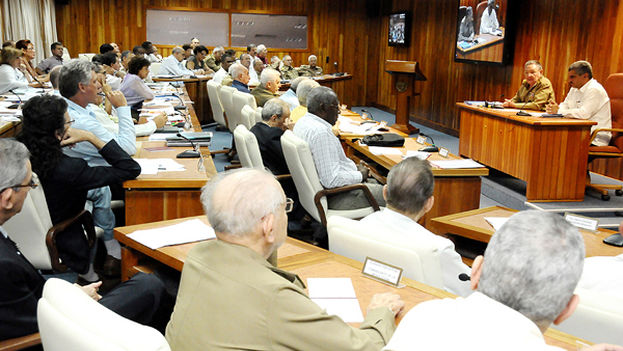
14ymedio, Havana, 30 June 2017 — The latest Council of Ministers, chaired by Raul Castro, has extended the term of the country’s land leases under the usufruct system to 20 years, but the leases can be cancelled if the beneficiaries use illicit funds, according to an announcement today in the official press.
The meeting analyzed the economic performance of the first half of 2017 and included the announcement of new measures “to improve self-employment” and the decision to consolidate the experiment of non-agricultural cooperatives.
According to Ricardo Cabrisas Ruiz, Minister of Economy and Planning, the national economy behaved as planned. For the second semester, higher levels of execution are expected with “the arrival of imported supplies and the completion of contracts.” continue reading
Marino Murillo Jorge, head of the Permanent Commission for Implementation and Development, announced that it will no longer be for 10 years, but rather for 20, that a ‘natural person’ will be able to enjoy the use of the land in usufruct, although he pointed out that these lands remain “nontransferable property of the State and must be kept in operation.”
If the authorities detect that the person leasing the land has used illicit financing, it may cancel the usufruct agreement, a move that could be an answer to the recent announcements of Donald Trump’s administration to support local entrepreneurs to the detriment of state- or military-owned and operated businesses.
During the Council of Ministers it was also announced that to receive land, “natural persons have to work and manage it in a personal and direct manner.”
As of September 2016, 4.7 million acres of land had been delivered in usufruct, representing 31% of the country’s agricultural area. Starting now, the taxes provided in the Tax Law concerning the use, possession and idleness of the land, will gradually begin to be applied.
The lack of growth in the delivery of land is due, as Murillo explained, to the fact that the number of requests have declined, since the currently available land extensions “are less productive, with high infestation from the invasive marabou weed, are far from the population settlements and basic services, or have difficulty accessing water sources.”
The measures to “improve self-employment,” which were not explained to the press, will be aimed at increasing control over entrepreneurs.
There was no report of any decisions made about the longed-for wholesale market, the ability to import, or an increase in authorized occupations.
However, concerns were expressed about “the use of raw materials, materials and equipment of illicit origin” in the private sector, in addition to “breaches of tax obligations and underreporting of income,” among other irregularities.
The authorities acknowledged that the presence of more than half a million people in self-employment activities “confirms its validity as a source of employment, while increasing the supply of goods and services, with acceptable levels of quality.”
The update of the policy of non-agricultural cooperatives was limited to “concentrating efforts on consolidating the 429 already constituted.”
The government reproaches these types of entities for “deviations from the original idea for which they were created,” their tendency to increase prices, and the use of bank loans for “purposes other than the concepts for which they were granted.”
However, the Government recognized that this type of management structure, authorized three years ago, “constitutes an alternative that frees the State from the administration of economic activities, production and services that are not considered primary,” which will continue to be treated as “an experiment” going forward.
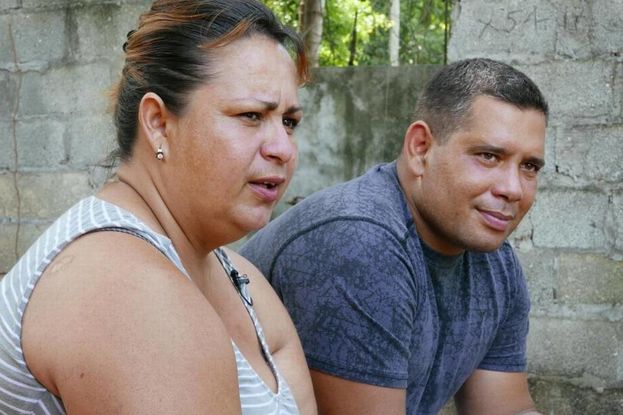
Cuban migrants Yudenny Sao Labrada and her husband Yoendry Batista talk to 14ymedio in Panama City. (El Nuevo Herald)
14ymedio, Mario J. Penton, Panama City, 2 July 2017 – They managed to escape Cuba to leave behind traces of corruption and negligence that, according to Yudenny Sao Labrado and her husband Yoendry Batista, reflect the prevailing system on the island. From a neighborhood on the outskirts of Panama City, the couple relates the story of their journey, a long trek that they hope will end with their arrival in the United States.
Yudenny Sao (born in Puerto Padre in 1979) was born just three years after the promulgation of Cuba’s Socialist Constitution. Born under the Revolution, she trained as a teacher and graduated from the University of Mathematics and Physics. She left the classroom to administer one of the thousands of bodegas spread across the island, in which the state subsidizes some of the products of the basic market basket through the ration book.
“I liked teaching, but the Ministry of Education pays very little,” she explains. In the bodega she had more opportunities to do business “under the table.” continue reading
“I made the decision to leave Cuba when they discovered a corruption plot in Puerto Padre’s retail network,” said Sao. In 2016, a series of audits revealed that several of the bodegas in Puerto Padre, where she worked, had irregularities in their accounts. Although there were invoices covering the sales, the money was never deposited in the bank. The directors of the institution are serving sentences of up to eight years for misappropriating state funds.
“I had nothing to do with that,” said the woman from Las Tunas province, defending herself. According to her, her business was to sell rice, sugar, and contraband cigarettes she bought on the black market, instead of the products sent by the state for “free” – that is unregulated – sales, which covered articles outside the rationing system.
Although basically she did not alter the prices of the products, she committed a crime because the rigid centralized economic system did not allow her to market articles that were not sent through the channels authorized by the authorities.
“I gathered my people and I told them about the situation, because the big fish always eats the little one,” she says. Sao’s family includes her husband, Yoendry Batista, a welder by profession, her three children ages 19, 10 and 7 years, and her parents. They made the decision that she should leave Cuba and asked relatives in Florida for $10,000.
“With that money I went to Havana. I wanted to go by boat to the United States, but instead of paying a ticket on the speedboats that traffic people to Miami, I learned that there were people who sold parts to build a boat, and after a phone call my husband came to Havana and we began to build the boat,” she says.
In the heart of Havana, a few blocks from the Sanctuary of the Virgin of Charity, they began the construction of the boat that would take them to the United States. The materials cost $7,500 and each of those interested in emigrating did their bit. All under strict secrecy, as the construction of boats to leave the country is punishable by law.
“We made the boat with polyethylene and sheets of platinum [an alloy so-called in popular slang] and iron. That’s illegal, it could cost us up to 15 years in jail,” says Yoendry Batista, Yudenny’s husband, who had never built a boat in his life. After weeks of working under the summer sun in a Havana courtyard the boat was ready.
“To take it to the coast we had to pretend we were moving. At three o’clock in the morning we started to assemble furniture and parts of the disassembled boat in a closed truck that carried supplies to the foreign exchange stores,” recalls Sao.
They headed towards the north coast, to the mouth of Arroyo Caimito. There they spent eight days together with another 17 people eating the bare minimum to conserve food for the trip. After weeks of preparation they were finally about to leave for the United States.
“When we heard the sound of the engine we were happy, we shouted ‘Adios, comandante [Fidel]’ and we embraced,” recalls Sao. However, the happiness was short-lived. The engine barely lasted 1 hour and 15 minutes. The swell flooded the electrical system and they were adrift. They had to get rid of the engine that cost them $2,000 and the gas drums they had for the trip. If the Coast Guard found them with that equipment they could be in serious legal trouble.
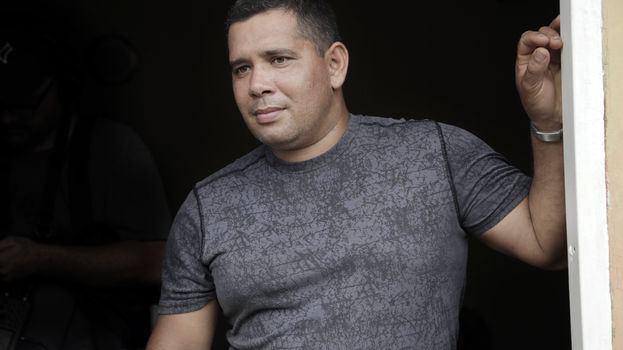
Yoendry Batista worked clandestinely in Panama City until he got the resources to continue on his way to the United States. (The New Herald)
“The Cuban Coast Guard appeared around noon. My wife had fainted from lack of food and dehydration. They had us handcuffed and in the sun picking up other rafters for hours. That August 12 they collected 32 rafters whose boats had broken down,” explains Batista.
Dehydrated and hungry they were exposed to the sun all afternoon on the deck of the boat and were taken to the port of Mariel. After being fined 3,000 pesos, they were released. “What saved you is that we are making preparations for the Commander-in-Chief’s birthday celebration,” the head of the military unit told them. August 13, 2016 was the culmination of a program of celebrations to commemorate the 90 years of the old ex-president Fidel Castro, who died three months later.
Without money, they returned to Havana to try to build a new boat. “We spent sleepless nights thinking what to do with a debt of $10,000 without even having left the country. In Puerto Padre the investigations began and Yudenny’s time was running out. It occurred to them to bribe a policeman to “throw them through the system.” Because they had no criminal records they could apply for a passport and travel legally to Guyana.
“We paid $100 to the police and because we had no priors we got our passports (which cost $100 per person). That’s how we traveled to Guyana and from there we embarked on the journey to the United States,” explains Sao.
From Guyana they went to Brazil, where she was employed domestically for some months. Her husband worked as a builder, not without being cheated by those who saw undocumented migrants as cheap labor with no rights.
“He worked in malls. On one occasion they promised 100 reals a week and in the end they paid him 40,” says Sao. Her husband, on the other hand, has good memories of the towns where he spent the time. “You get another image of these countries because it is not what they tell you in Cuba. In these countries there are many people with good hearts and they help the migrant,” he says.
Yudenny Sao Labrada and her husband Yoendry Batista in the house where they took refuge in Panama City. (El Nuevo Herald)
After collecting some money they left with another 60 Cubans via the Amazon river and after more than 20 days of travel crossed Peru, Ecuador and Colombia. The Darien jungle was the most difficult for Sao, diabetic and hypertensive.
“I did not want to continue, but my family sent us 200 dollars from Cuba. That, together with what we had earned, allowed us to pay the guides who guided us through the jungle,” explains Cao.
In Panama they took refuge with the Catholic charity Caritas, where they received the news of the end of the wet foot/dry foot policy. They stayed with Caritas until they were forced to leave for the eventual transfer to the holding camp at Gualaca. “I don’t care where, it can be Haiti, but I cannot go back to Cuba,” she says with regret.
The house where Sao and her husband took refuge in Panama City, after escaping from Gualaca, belonged to some Panamanians they met through Cáritas. During the weeks they stayed in it they refurbished, cleaned up the gardens and planted bananas.
“We are not going to pick the crop. Of that you can be sure,” says Batista.
A week after telling their story to this newspaper they left for Costa Rica, where the authorities seized their passports. They continued their journey and are now in Mexico, waiting for a humanitarian visa to continue their way to the United States and seek political refuge.
“The Cuban government is responsible for everything we’ve been through. Everything you have to do to have a decent life depends on them. To buy a pair of shoes for your children you have go without eating for five months,” says Sao, adding that she never would have left her village if it weren’t for the crime imputed to her. “It’s a macabre system.”
Note: Our apologies for not having the following video subtitled in English
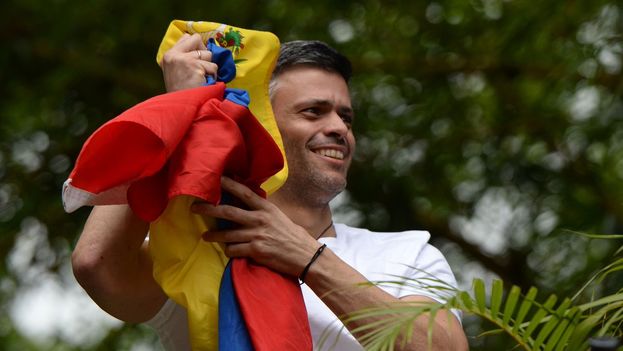
Leopoldo López greets the Venezuelans who gathered in front of his house to celebrate his release. (EFE)
14ymedio, Yoani Sanchez, Havana, 8 July 2017 — Authoritarian regimes must learn some lessons: imprisoning opponents increases their prestige. The government of Nicolás Maduro forgot that basic political truth and is now harvesting the fruits. This Saturday’s release of Leopoldo López from Ramo Verde Prison will bring unpredictable results for the dictatorship installed in Miraflores Palace.
Lopez has rejoined his family, although freedom is still far away. Now he must remain under house arrest, an electronic bracelet controls his movements and the operation around his house seems unbreachable. He’s stuck in a new perimeter, but he has the relief of hugging his kids, kissing his wife and looking out the windows at his city.
Leopoldo Lopez is in good health and happy to be home, according to his family
Every ladder has a first rung and today the one that leads to full freedom for the government opponent has been delineated. Venezuela’s oil oligarchy has released him from jail, hoping that this gesture will reduce the tension in the streets and allow the government to impose a Constituent Assembly so it can cement the totalitarian system within the country. A dismal calculation. continue reading
Lopez radiates freedom wherever he is. It doesn’t matter if he can’t access a phone, write a tweet, or accompany his compatriots in the protests. The symbols are there without being there, and in this he has become the founder of the Popular Will party. It has escaped the ruling party that putting him behind bars converted him into a symbol.
The Maduro government has chosen a fairly elegant excuse for granting release to Lopez, who has been in prison since 2014 and who was sentenced to almost 14 years; it is because of “health problems,” according to Venezuela’s Supreme Court of Justice (TSJ).
However, the first images of the prisoner upon arriving home show him vital and smiling. The excuse of an illness only tries to mask a truth as big as a mountain: the protests in the streets have forced the government to yield. The move from prison to house arrest is a victory for the Venezuelan opposition.
Chavismo is shaken and now must deal with a Leopoldo Lopez who no longer knows the narrowness of a cell, who again wakes up with his family, and more expeditiously receives information about what is happening beyond the walls of his house. His political reach grows by the hour.
One of those historical images … a man returns home … his country awaits him.
Every day that passes within that domestic enclosure, Lopez will continue to accumulate support. Letting him out is a headache for the populism that has hijacked the South American country, but keeping him in prison is worse. The Venezuelan government is up against an insoluble dilemma: if it releases the opponent, it loses; if it continues to hold him, it also loses.
Nicolas Maduro’s time is past, although right now he is surrounded by opportunists who applaud and nod. Leopoldo Lopez is the future, even though his cell is the size of a house filled with love but lacking in freedom. All that’s left is to get around those walls.
There is no neighborhood in the Cuban capital where you can not buy or sell a wide variety of preparations, pills and “flying” powders. (EFE)
14ymedio, Marcelo Hernandez, Havana, 7 July 2017 — He dries his sweat and takes a drink of water from a bottle he carries in his backpack. “In my time the young people spent the holidays in front of the television,” says Ignacio, the father of two teenagers. As he moves along crowded Avenida 10 de Octubre, in Havana, he looks for video games for sale. “So that they stay at home, because in the streets there are more and more drugs.”
Ignacio’s concern is shared by thousands of parents all over the Island. The country where, decades ago, the government controlled how many cigarettes an individual smoked, has given way to a more complex reality. Authorities warn of increased drug use among young people and call on families to be alert. continue reading
In recent years the official press has also begun to address the issue, albeit with some hesitancy and clarifying that this problem is not as serious as it is in the capitalist countries. However, there is no neighborhood in the Cuban capital where a wide variety of preparations, pills and powders for “flying” are not bought and sold.
His family life took a turn when his parents decided to take the route to the United States through Central America and he was left alone with his grandmother
Hannibal, 17, prefers to change his name to detail his relationship with narcotics. He began using at age 12 and what, at the beginning, was a game, later became an obsession. “I stopped going to school, I was only interested in getting high,” he relates to 14ymedio.
Over the last five years, Hannibal has been using and swearing off drugs. A week ago he broke his longest stretch without using drugs. “I was clean more than 80 days, but they invited me to a disco and I fell back into it,” he confesses.
His family life took a turn when, in mid-2015, his parents decided to take the route to the United States through Central America and he was left alone with his grandmother. In a short time, his consumption doubled. “I had at least two overdoses, but only once did they take me to the hospital.”
Hannibal’s friends did not want the doctors to report the case to the police and feared they “would all end up prisoners,” says the young man who, at 17, weighs no more than 110 pounds and whose hands shake all the time. “I lost interest in food and went for months almost without taking a bath.” He sold all the appliances in the house one by one to pay for drugs.
“I met others there like me and I promised to stop killing myself with all this, but in the street life is something else”
“One day I sold the bathroom mirror over the sink because I needed money and because I could not look at the face of how emaciated I was,” he says. At that moment he decided to seek help.
The young man went through the Provincial Center for Teen Withdrawal in Havana, an institution that since 2005 has been serving patients who have started taking drugs since very young ages. “I met others there like me and I promised to stop killing myself with all this, but in the street life is something else,” he says.
On weekends the wall of the Malecon becomes a massive meeting point, an open air brothel and display point for countless illegal substances. “I just have to go there and I always find something.” With the increase in tourism “the supply has diversified and there is a lot of marijuana,” although he says he prefers “faster and less adulterated” pills.
Synthetic drugs reign among the young and have become the currency with which foreigners pay for sexual favors, either in tablets or “dust,” says Hannibal. Although he says he has never sold his body to feed his addiction, he does know many who have. “Who’s going to pay for all these bones?” he asks wryly.
A confidential phone line helps those looking for information on the subject, although mistrust affects its reach. “Hello, you have contacted 103, Confidential Antidrug Line, we will soon help you,” says a voice. Claudia, 39, prefers to hang on. She has a daughter of 14 who has become “aggressive, she spends long hours in a stupor and sometimes she cannot get out of bed.”
Claudia fears the worst about what her daughter does when she leaves the house but does not want to “get her in trouble” by contacting a specialist
Data published by the Health Promotion and Disease Prevention Unit report that last year 14,412 calls were received on the confidential line, most of them in Havana, Pinar del Rio, Camagüey, Ciego de Ávila and Las Tunas.
Claudia fears the worst about what her daughter does when she leaves the house but does not want to “get her in trouble” by contacting a specialist. She has thought of another kind of solution. “I spoke with a cousin who lives in Quemado de Güines, in Villa Clara, about my daughter spending some time there.” The mother believes that “being in the countryside, outside of Havana and away from her friends” will help her, although no place in the national territory seems to be safe.
The entry of drugs into the country has been increasing in recent years. For all of 2016, the General Customs of the Republic (AGR) confiscated 67 pounds of drugs, however between January and May of this year the amount seized has already reached 72 pounds, according to data offered by Moraima Rodríguez Nuviola, AGR deputy director.
Ships are the main route of entry, especially of marijuana. Although the latter is also sowed on private farms where the owners risk ending up in jail with their land confiscated.
In the pocket of his jeans he carries a small envelope with ten pills. “These are the last, I promise.”
Drug trafficking is punished in the Cuban penal code with sanctions of four to ten years, if it is considered small scale, but if it is large amounts the sentence can reach 20 years. The size of the volume is determined in practice, it is not fixed in the law. International trafficking carries up to 30 years in prison and is aggravated if minors are involved. Consumption is also seriously punished, with fines of up to 10,000 pesos or deprivation of liberty of between six months and eight years.
Despite the severity of the national legislation “consumption begins very early,” according to a psychiatrist who preferred anonymity. “In Cuba initiation into these types of substances increasingly occurs at younger ages.” The specialist, who has treated about 100 patients, finds that “marijuana, psychotropic drugs and some medications used as drugs are displacing alcohol among adolescents.”
Hannibal is determined to try. “I want to leave this garbage, go back to study, redo my life and get married,” he says. In the pocket of his jeans he carries a small envelope with ten pills. “These are the last, I promise.”
Juan Juan Almeida, 26 June 2017 — Another legal trial is threatening the invulnerability of the Ministry of Culture. This time the prosecutorial gaze is focused on officials at the National Council of the Performing Arts (CNAE) while overlooking the culpability of Cuban leaders who, were they to fall, would make too big a noise.
The Cuban government maintains a “zero tolerance” policy against any form of human trafficking or related crimes. Its measures are intended to enhance prevention, confront offenders and severely punish those found guilty. But the business is lucrative, involving hundreds of thousands of dollars. Very conservative estimates indicate that more than 5,000 Cubans have emigrated legally using fraudulent documents procured for them by CNAE officials.
“The investigation is snowballing. After interviewing each new witness, investigators have to expand the probe,” says a source close to the Office of the Attorney General of the Republic of Cuba. continue reading
“According to our documents, there are several ongoing investigations. On the one hand, those presumed guilty remain silent for fear of reprisals. On the other hand, the victims being questioned — people willing to assist in the investigation — allege they consented to bribery by CNAE officials in order to emigrate safely. Everything points to the government as the sole culprit because it has not been able to provide them with the opportunity to have a decent life or a decent job.”
“Passing judgement should not be a political issue and we aren’t even at that stage yet. The question is: Did the people who committed these crimes do so in every case with the consent and for the benefit of those affected? Does it make sense to continue exploring the causes of the problem when we all know what the solution is? Whom does it harm? The law will have to wait but I imagine that in the end the case will be dismissed.”
Founded on April 1, 1989, the National Council of the Performing Arts is a legally recognized, financially independent cultural institution whose mission is to promote the development of theater, dance, pantomime, humor and the circus. All these categories were used as a ruse by non-artists to escape the fiefdom. For the time being, CNEA’s practice of issuing exit visas is “on hold” and the documents are in the possession of the state prosecutor after being seized as evidence.
Some members of the council have been temporarily suspended from their jobs. All of them are under investigation, accused of issuing visas and emigration documents to people with no formal connection to the institution who paid 90 to 300 CUC to secure a safe and guaranteed escape.
A former employee of the Ministry of the Interior — someone fired for political reasons who is now self-employed — notes with no small degree of irony, “Investigators are doing everything possible to keep news like this away from people like you because the consequences could be wide ranging.”
Like other migrants, the family of Nirvia Alvarez is not satisfied with the proposal of the Panamanian authorities. (14ymedio)
14ymedio, Mario Penton, Miami, 7 July 2017 – On Friday, Panama’s deputy minister of security, Jonathan del Rosario, offered Cubans stranded at the Gualaca camp $1,650, plus a ticket back to Havana and a multiple-entry visa for Panama, at a meeting to which 14ymedio had access.
The proposal, which the migrants will have until July 31 to accept, is the response promised by the Panamanian government to solve the crisis caused by the end of the United States’ wet foot/dry foot policy in January, which left Cubans already in Panama stranded.
“This option is a voluntary repatriation process. It is the way to obtain a visa to return to Panama legally and have seed capital to procure a different future for you and your family,” del Rosario told more than 100 Cubans in front of the temporary shelter where they are living. continue reading
The economic aid will be delivered at the airport, before the migrants board the flight that takes them to Cuba. Those who do not want to avail themselves of the Panama government’s offer could return to the point where they entered the country, or continue their journey undocumented.
“That’s all they have given us,” Yelisvarys Pargas, a migrant to Gualaca, told 14ymedio, because although the proposal appears good, he distrusts the Cuban authorities.
To attend the meeting, the deputy minister traveled by helicopter to the camp, an area of 104 acres far from any population center in the east of the country. The Panama government had transferred 128 Cubans there in April, after closing a temporary shelter maintained by Caritas in Panama City. Nine migrants escaped from the shelter of Gualaca, which is guarded by the presidential police and Migration and Public Security personnel.
“Panama and Cuba have diplomatic relations, and we have consulted representatives of the consulate and the Cuban embassy in the country about this option,” said the deputy minister.
Panama’s Deputy Minister of Security, Jonathan del Rosario (right), met with the Cuban migrants in Gualaca. (14ymedio)
The Panamanian authorities are also allowing migrants to pre-register for a application for a visa that would allow them, once in Cuba, to get an interview at the Panamanian consulate to obtain a tourist visa. With this visa they will be able to travel to Panama to make purchases for their businesses, according to the deputy minister. For migrants who have been away from Cuba for more than two years and so have lost their right, under Cuban law, to reside in the island, the Panamanian Government would facilitate the process of their return to the country.
Addis Torres, who was with her 13-year-old son and her husband in the shelter was devastated by the news. “I will continue, I cannot return to Cuba at this point. I will continue,” Torres said after the meeting with the deputy minister.
Nirvia Alvarez, another of the migrants said in a voice filled by emotion that Rosario’s proposal left her “on the verge of a heart attack.”
“After six months in this desperate wait and now they come out with this shit. I do not have a house in Cuba, I have nothing, because I sold everything I had. Go back, why? To live under a bridge?” protested the migrant, who is accompanied by her 11-year-old son and her husband.
When asked about the migrants, del Rosario explained that there are no options to emigrate to third countries. “To this day we have had no response from any country,” he explained. Nor did he open the door to regularizing the status of the Cubans in Panama, since the entry of migrants in an undocumented way precludes any kind of formalities for their regularization.
“There are other countries that have different migratory policies, maybe some of you want to return legally to Ecuador, what we can’t do is send you to a third country if we do not have the guarantee that the third country will welcome you,” said del Rosario.
After the presentation of the deputy minister, many of the migrants expressed their doubts about the proposal, arguing that Cuba is not a state of laws and that is why they fled the government of the Island.
Faced with the reluctance of migrants, del Rosario said that so far none of the people who have been returned to Cuba (more than 90 since the signing of the deportation agreement between Cuba and Panama) have filed a complaint at the Panamanian embassy to denounce the violation of their basic rights. “You have free will,” said del Rosario.
Arrival area in terminal 3 of Jose Marti International Airport in Havana. (14ymedio)
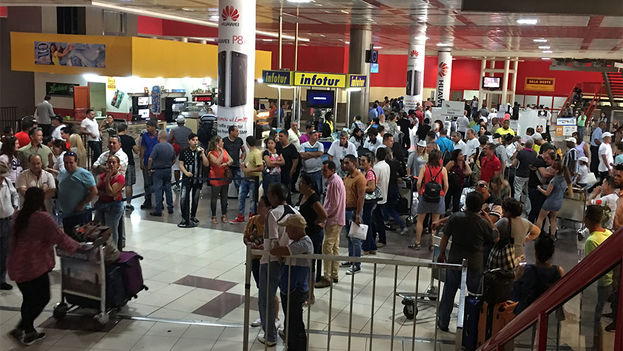
14ymedio, Zunilda Mata, Havana, 4 July 2017 — The passengers leave the plane and make their way around the buckets catching the leaks from the roof. They still have a long wait in at baggage claim and have to suffer under the air conditioning that hardly alleviates the heat. The José Martí International Airport in Havana is stumbling through the tourist boom that has brought a volume of passengers its services and infrastructure find difficult to serve.
The main air terminal in the country received 3.3 million passengers in the first half of this year, a figure that increased by 27.4% compared to the same period of the previous year. However, travelers’ experiences are far from satisfactory.
There are few places to eat and the lack is supplies is a problem. “We only have these two cafeterias up here,” says one of the employees. “Today we did not get any beer and there is no water, we are only selling coffee in addition to bread with ham and cheese,” she told several customers on Monday. continue reading
There is an unfinished wing on the exterior that will be filled with places to eat. “The financing of this infrastructure was linked to the construction company Odebrecht and everything was paralyzed by the corruption scandal in Brazil,” says a source from the Ministry of Construction who preferred to remain anonymous.
“We hope it will be open before the end of the year as an alternative for travelers and their friends,” the official said. “But the building is one thing and the supply of food and beverages is another; the latter is the responsibility Cuban Airports and Aeronautical Services Company (ECASA).”
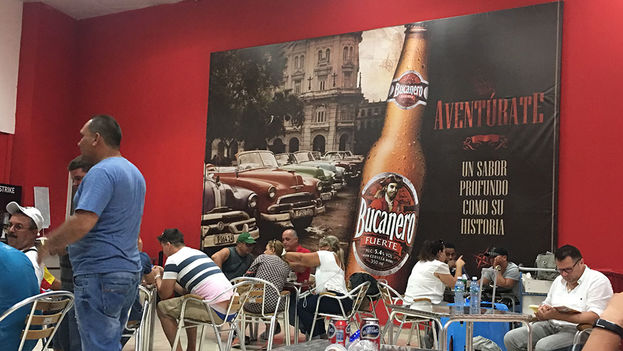
Cafe at Jose Marti International Airport in Havana. (14ymedio)
We can’t do magic. If there is no beer in the country, where are we going to get it from?” an ECASA employee asks rhetorically, speaking to this newspaper by phone from the central office. “We have tried to meet the demand with imported products, but the tourists want to drink a Cuban beer at the airport,” she says.
Hope arrived for the terminal employees when it was announced last August that French companies Bouygues and Paris Airports had won a concession to expand and manage the terminal.
“They haven’t pounded a single nail here,” protests the saleswoman at a handicrafts stand on the middle floor. Industry sources say that no feasibility studies have yet been done to start the works. “The French planners have not even arrived to evaluate the terminal,” says a senior Transport Ministry official adding that the project is waiting for support from the new French president.
One floor down crowd those waiting for the travelers who arrive in the country. “This shows a lack of respect,” says Manuel Delgado, 58, who complains that “there is no place to sit, the heat is unbearable and the cafeteria has no water” while waiting for the Air France flight returning his daughter, who has been living in Paris.
The bathrooms earn the worst of the opinions of those who wait. “They smell bad and although the service is free, the employees are asking for money, in a somewhat disguised way, but they ask for it,” says Yesenia, who came from Matanzas to meet a brother returning from Mexico.
In the women’s restroom a female worker holds the roll of paper for drying hands. “It’s not mandatory, but they look askance at you if you do not give them something,” says Yesenia. One of the female employees asked the customers to exchange for 25 centavo coins in Cuban pesos (CUP) “for a convertible peso.” Finally, a European-looking tourist agrees.
A few meters from the bathroom, located on the third floor, a young man tries to catch the wifi signal to surf the internet, a service only offered in the area after immigration and security controls. For every hour of navigation one must pay 1.50 in Cuban convertible pesos (CUC) but there is nowhere in the airport “today where they are selling recharge cards for the Nauta service,” he says frustrated.
There are also no hotels nearby for passengers in transit to other provinces. For two years the Ministry of Tourism (MINTUR) has planned to build five-star accommodation in the immediate vicinity of the airport, but the project has not yet materialized. The private sector, however, has taken the lead from the state and more and more private houses are renting to tourists in the vicinity of the area.
The problems of infrastructure and services do not end after approaching the exit doors from the flights. “I was traveling in first class and they gave me an invitation for the VIP area,” says José Mario, a Cuban who each month takes the Copa Airlines route to Panama working as a “mule.”
Numerous trips allow you to accumulate points that you can take advantage of, from time to time, to travel in more comfort. But the VIP area has not met their expectations. “They told me I had to wait for other customers to finish eating, because there were not enough dishes,” he remembers with annoyance after his failed attempt serve himself some nuts and cheese from the available buffet.
Jose Mario admits, at least, that the taxi service has improved. More than a year ago a fixed rate was established from the airport to different points of the city. “Before the driver decided the price, but now I know that I must pay 25 CUC from here to my house, not a peso more.”
The experience on arrival, on the other hand, does not get much praise. It varies according to the schedule, the flight and the amount of luggage. “Sometimes I have spent less than an hour waiting for my bags, but other times I have spent up to four in front of the luggage belt,” complains the traveler.
Employees agree that the waiting time after the landing fluctuates. “At night, when large flights arrive from Europe, such as Iberia, Air France or Aeroflot everything slows down,” says one of the doctors waiting for the national passengers to fill out an epidemiological form.
Souvenir shop at the Jose Marti International Airport in Havana. (14ymedio)
The pilots themselves have had to explain to the passengers about departure delays because of not having “enough vehicles to bring the luggage to the plane”.
Added to this is the strict customs control over luggage, whose thoroughness is not only designed to prevent crime but to control the bringing of technological devices into the country (such as DVDs, NanoSations, hard disks or laptops) or large quantities of commonly used products. The most “meticulously” checked flights are those from the US, Mexico, Panama, Haiti, Guyana, Trinidad and Tobago and other regular routes for the “mules.”
In the area before passing through immigration, employees are wandering around with posters bearing the names of some travelers. Some approach families with children or newcomers who look like Cubans living abroad. “For 40 dollars I can pass you without problems from customs,” whispers a worker to a couple with two children.
For a certain fee employees can avoid passing through the search or paying for excess imported luggage, a relief for many Cubans living abroad and arriving loaded with gifts. For each kilo of luggage that exceeds the limit of 50 kilos, there is a fee that must be paid in CUC, and the fees also depend on the type of objects transported. For residents on the island is also very advantageous, since they can only pay in CUP for their first annual importing of goods.
Jose Mario often resorts to this illegal service. “What I am going to do?” he justifies himself. “I pay to get myself out of this airport as soon as possible, because it’s unbearable between the heat and the bad conditions.”
Juan Juan Almeida, 5 July 2017 — The case is notable for its strict secrecy and a degree of coercion. The highly irregular trial and mystifying plight of those already found guilty and sentenced make “the top secret theft from the Ministry of the Interior (MININT) of the Republic of Cuba” perhaps the most surprising example of Cuban justice in the last twenty years.
Though a verdict has been handed down, the legal process is not yet over. The most recent defendant is Colonel Rafael, who coincidentally was the principal interrogator during the initial investigation but is now himself being investigated for leaking information about the indictment and the locations of those involved. continue reading
These post-trial developments are at odds with normal legal procedures. Though accused on May 9 of high treason, theft and sale of classified material to foreign governments, encouraging desertion and disobedience among senior officials, spreading malicious rumors intended to cause discontent among senior military commanders, personal enrichment, bribery and abuse of office, none of the defendants have been sent to prison. They are being detained in three houses in Havana’s Siboney neighborhood, where family members have been allowed to visit some of them.
“Look, Colonel Carlos Emilio Monsanto was sentenced to thirty-seven years in prison. Major Ernesto Villamontes was sentenced to thirty, Jorge Emilio Pérez to thirty, Román to twenty-two and the rest got similar sentences. Do you think they are going to serve those sentences in houses that are now serving as prisons? People like that are dangerous whether they are free or locked up. I don’t think they are going to serve those sentences under house arrest and I don’t think they are going to go to prison. Based on available information, it is logical to believe they will suffer some accident or come down with a sudden illness as happened to General Abrantes,” says a relative of one of the convicted men with resignation. This person requested anonymity, citing a non-disclosure agreement that family members were forced to sign in order to be able to visit their relatives.
“The one thing that is clear is that Ernesto (Villamontes) and the other defendants were sending money out of country and that they had been authorized to do so by the former directors of MININT and the country’s top leadership with the goal of investing in businesses and buying property. The documents were not taken from the ministry’s Building A in order to sell them; they were to be used as protection. And that is unforgivable.”
What keeps them safe?
“Corporations like Financiera Ricamar, Financiera Eurolatina and Financiera Bescanvi Occidental laundered money. Some of these corporations belong to Panamanian businessmen, including former president Martinelli. The Panamanian government is currently investigating the matter. That’s why they haven’t been sent to prison yet. On the contrary, the plan is to use them as scapegoats in a possible prosecution against the former Panamanian president. For better or worse, this could be significant in a political, media or international context and would go a long way in covering the tracks of the Cuban government, just as happened with Cause I and Cause II in 1989.”*
*Translator’s note: Cause I and Cause II refer to two famous trials of multiple Cuban military officials. In the first, General of the Western Army Arnaldo Ochoa was tried and executed by firing squad on charges including drug trafficking and treason. In a second related trial, former Minister of the Interior General José Abrantes, was sentenced to twenty years in prison but died in custody, allegedly of a heart attack, in 1991.
14ymedio, Marcelo Hernandez, Havana, 5 July 2017 — They arrived, enthusiastic and happy, to their party for the end of the school year. One mother brought a macaroni salad with mayonnaise, another brought from home some disposable plates and a third took on providing the croquettes. The celebration was ready in no time, while the horns played an off-color reggaeton song. This Wednesday many elementary schools ended the school year and opened the vacation season.
The parents gathered what they could, in the midst of one of the most severe shortages in the last decade, and the calls made by the authorities to ensure good food hygiene. Summer, with its high temperatures, has set off a spate of diarrheal diseases and the schools take extreme measures to prevent their spread.
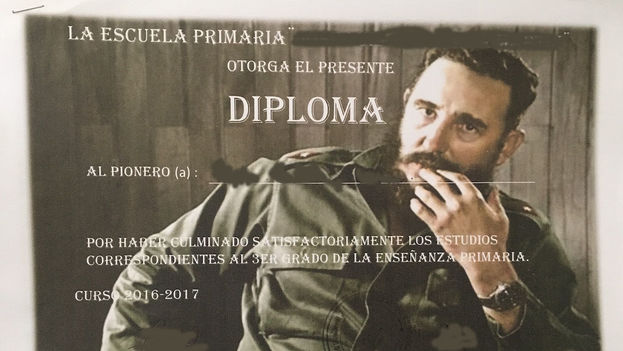
However, it was not the melodies – that set everyone to dancing – nor the sanitary precautions that marked the day. The face of the deceased Fidel Castro took the leading role, being printed on thousands of graduation diplomas throughout the island.
Fortunately, between running through the corridors and devouring the cake with meringue, most of the students didn’t even notice that, like the dinosaur in Augusto Monterroso’s tale, when the party ended, “The dinosaur was still there.”