The End Of The Cycle For Two Caudillos

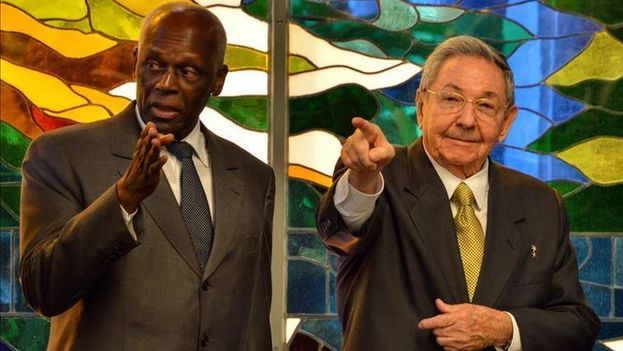
The presidents of Cuba and Angola, Raúl Castro and José Eduardo Dos Santos during the signing of bilateral agreements, in the Palace of the Revolution of Havana. (File / EFE)

14ymedio bigger14ymedio, Yoani Sanchez, Havana, 12 June 2017 — His mother died, his brother emigrated and now no one brings flowers to the tomb of one of those many young Cubans who lost their lives on the African plains. His death served to build the authoritarian regime of José Eduardo dos Santos in Angola, a caudillo who, since 1979, has held in his fist a nation of enormous resources and few freedoms.

At 74, Dos Santos knows the end is near. His health has deteriorated in recent months and he has announced that he will withdraw from politics in 2018, the same year that Raul Castro will leave the presidency of the Cuba. Both intend to leave their succession firmly in place, to protect their respective clans and to avoid ending up in court.

For decades, the two leaders have supported each other in international forums and maintained close co-operation. They are united by their history of collaboration – with more than 300,000 Cubans deployed in Angolan territory during the civil war, financed and armed by the Soviet Union – but also connected by their antidemocratic approach. continue reading

Longevity in their positions is another of the commonalities between Castro and Dos Santos.

The Angolan, nicknamed Zedu, is an “illustrious” member of the club of African caudillos who continue to cling to power. A group that includes men like the disgraceful Robert Mugabe, who has led Zimbabwe for 37 years, and Teodoro Obiang Nguema Mbasogo, who has governed for almost 38 years Equatorial Guinea.

Their counterpart on the Island surpasses them, having spent almost six decades in the control room of the Plaza of the Revolution Square, as a minister of the Armed Forces or, following his brother’s illness, as president. Neither Zedu nor Castro tolerate political opposition and both have fiercely suppressed any dissent.

Angolans also live amidst the omnipresence of the royal family. On the banknotes, the face of Dos Santos shares space with that of Agostinho Neto, and in political propaganda he is represented as the savior of the country. One of the many tricks of populist systems, but very far from reality.

What has really happened is that the family and the African president’s closest allies have made colossal fortunes. The largest oil exports in Africa today have fueled this oligarchy, which, ironically, was built on the efforts of thousands of Cubans who left their lives or sanity in that country.

Isabel dos Santos, nicknamed by her compatriots the Princess, has wasted no time in taking advantage of the prerogatives that her father grants her. Forbes magazine calls her the richest woman in Africa, with a fortune of around 3.1 billion dollars, and last year she was named head of the state-owned oil company Sonangol, the country’s most important economic pillar. She also controls the phone company, Unitel.

She resembles Raul Castro’s daughter Mariela in her taste for giving statements to the foreign media and presenting herself as someone who has achieved everything “by her own efforts.” She projects an image of a modern and cosmopolitan businesswoman, but all her businesses prosper thanks to the privileges she enjoys as the daughter of her father.

Her brother, José Filomeno de Sousa dos Santos, also economically advantaged, sits at the head of the Angolan sovereign fund that manages 5 billion dollars. An emulator of Alejandro Castro Espín, whom many credit for the impressive voracity that has led the Cuban military to seize sectors such as hotel management.

However, Zedu has preferred to choose a puppet as heir to the post of president and head of the Popular Movement for the Liberation of Angola (MPLA): Angola’s Defense Minister, João Manuel Gonçalves Lourenço. A figure who will be the public face while the true dauphins try to continue sucking dry – like voracious leeches – the resources of a country that is not experiencing good times.

Gonçalves Lourenço is seen as a moderate, as is his emulator in Cuba, first vice-president Miguel Díaz-Canal. Men who will try to give a face-lift to personality-centered systems to silence the voices of those who assert that the “historical generation” does not want to abandon power. Neither has been chosen for his abilities, but rather for his reliability and meekness.

Gonzalves arrived in Havana in mid-May with a message from President Dos Santos to Raul Castro. In Angola, 4,000 Cubans work in sectors such as healthcare, education, sports, agriculture, science and technology, energy and mines. It is one of the countries that most appeals to the Island’s professionals for the personal economic advantages that serving on an “internationalist mission” there affords them.

Gonzalves’ trip, of course, also included a commitment to continue to support the Island, perhaps with some promise of credit or oil aid to ease Cuba’s currently complicated situation. Most likely the heir to the throne came to tell the aging monarch not to worry, that Angola will continue to count itself among its allies. They are words that could be blown away in the wind before the uncertain future that awaits both countries.

For years the Angolan regime benefited from significant foreign investment and high oil prices, the main source of income. However, the fall in the value of crude oil in the international market has complicated the day-to-day situation of citizens subject to economic cuts, a rise in the cost of living and a decline in public investment. The discontent is palpable.

On the Island, not a week goes by without an obituary reminding us of the reality that the “historical” generation is dying off. The brakes are about to be applied to the thaw with the United States, and the mammoth state apparatus isn’t about to adapt itself to the new times. The double standard, corruption and diversion of resources undermines everything.

Neither Castro nor Dos Santos will leave power in the context they dreamed of. One falls ill, after having negated in practice his ideological roots, and senses that history will destroy his supposed legacy. The other loses control over Venezuela, that mine of resources that prolonged the life of Castroism. His worst nightmare is that young Cubans care more about Game of Thrones than the revolutionary epic.

Populism Cuban Style: Conquests, Threats and Leadership

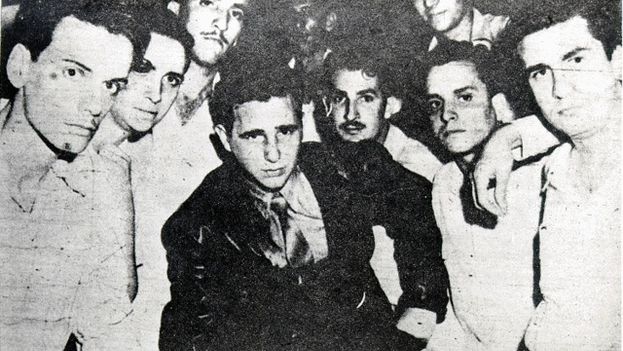
Fidel Castro in his gangster era when he belonged to the Revolutionary Insurrectionary Union (UIR). Here, in 1947, in the company of Rafael del Pino and Armando Gali Menéndez. (D.R.)

14ymedio bigger14ymedio, Yoani Sanchez, 6 June 2017 — The leader speaks for hours on the platform, his index finger pointing to an invisible enemy. A human tide applauds when the intonation of a phrase demands it and stares enraptured at the bearded speaker. For decades these public acts were repeated in Havana’s Plaza of the Revolution, shaping the face of revolutionary populism.

However, Fidel Castro’s extensive speeches constituted only the most visible part of his style of governing. They were the moments of collective hypnotism, peppered with promises and announcements of a luminous future that allowed him to establish a close bond with the population, to incite class hatred and to extend his growing power.

Castro has been the most complete product of Cuban populism and nationalism. Evils that sink their roots into national history and whose best breeding ground was the Republican era (1902-1958). Those winds brought the hurricane that shaped a young man born in the eastern town of Biran, who graduated as a lawyer and came to hold the military rank of Commander-in-Chief. continue reading

The political framework in which Castro was formed was far from a democratic example. Many of the leaders of that convulsed Cuba of the first half of the twentieth century did not distinguish themselves by presenting programmatic platforms to their constituents. The common practice was horse-trading to obtain votes, along with other aberrations such as stealing ballot boxes or committing fraud.

From his early days, the young attorney elbowed his way into the milieu of those figures who relied on gangster like behavior, rather than the transparent exercise of authority. He quickly absorbed many of the elements of demagoguery that would be greatly useful to him later when the time came to subject an entire nation.

Unlike republican populism, whose purpose was the conquest of electoral favor, revolutionary populism had as its goal the abolishment of the structures of democracy. From January 195,9 the civic framework was systematically dismantled and the laws were subjugated to the disproportionate will of a single man.

To achieve this dream of control, the Maximum Leader persuaded the citizens that they could enjoy a high degree of security if they renounced certain “bourgeois freedoms,” among them the ability to elect their leaders and a system of power in which leadership alternates.

The so-called Moncada Program outlined in History Will Absolve Me, is a concentration of these promises in the style of a tropical Robin Hood. The pamphlet was presented as Fidel Castro’s plea of self-defense during the trial in which he was indicted for the armed attack on the Moncada Barracks, the main military fortress of Santiago de Cuba, in July 1953.

Until that moment, this man was practically unknown as a political figure. The boldness that characterized the action enveloped him in an aura of heroic idealism that set him up as the leader of the revolutionary alternative to the dictatorship of Fulgencio Batista.

In his manuscript, where he described the problems the country faced, he never warned that solving them would require the confiscation of properties. He limited himself to detailing the necessity of an agrarian reform that would eliminate the latifundio and distribute land to the peasants. These were proposals that rapidly earned him sympathies among the poorest.

Upon leaving prison, Castro was convinced that the only way to overthrow the dictatorship was by force. He organized an expedition and opened a guerrilla front in the mountains of the eastern region of the Island. Two years later, his triumphal entry into the capital and his charismatic presence made him the beneficiary of a blank check of political credit, endorsed by the majority of the population.

The first populist ruse of the new regime was to present itself as democratic and to deny any tendency that could identify it with communist doctrine. At the same time that it presented itself as the enabler of freedom, it expropriated the newspapers, the radio stations and the television channels.

The regime struck a deadly blow to civil society by establishing a network of “mass organizations” to bring together neighbors, women, peasants, workers and students. The new entities had in their statutes a clause of fidelity to the Revolution and perform – still to this day – as transmission wires from the power to the population.

The first revolutionary laws, such as the Agrarian Reform, the rent reductions, the Urban Reform and the confiscation of properties, constituted a radical rearrangement of the possession of wealth. In a very short time the State stripped the upper classes of their property and became the owner of everything.

With the enormous flow of treasure, the new power made multi-million investments in social benefits that allowed it to achieve “the original accumulation of prestige.”

From its original proclamation in April 1961, the socialist system declared the irreversible nature of the measures taken. Maintaining the conquests achieved required the implementation of a system of system backed by a legal structure that would make it impossible for former owners to recover what was confiscated.

The new situation brought with it a powerful apparatus of internal repression and a large army to deter any external military threat. The most important bars of the cage in which millions of Cubans were trapped were erected in those early years.

To the binomial of an irreversible conquest and an undisputed leader was added the threat of an external enemy to complete the holy trinity of revolutionary populism.

Conquests

The main conquests in those initial years focused on education, health and social security. Economic centralism allowed the new ruling elite to establish ample gratuities and to distribute subsidies or privileges in exchange for ideological fidelity.

Like all populism that rises to power, the government also needed to mold consciences, impose its own version of history, and create from the teaching laboratories an individual who will applaud greatly and question little.

In 1960 the Island was already among the Latin American countries with the lowest proportion of illiterates, but even so the Government summoned thousands of young people to isolated areas to teach reading and writing. Participation in this initiative was considered a revolutionary merit and dressed in heroic tones.

The text of the primer to teach the first letters was openly propagandistic and the literacy campaigners behaved like political commissars who, on reading the phrase “The sun rises from the East,” needed to add as a clarification “and from the East comes the help we are given by the Socialist countries.”

At the end of the process, a massive plan of boarding schools operated under military methods began, the goal of which was to remove students from the influence of their families. Mass teacher training also began, thousands of schools were built in rural areas, and privately run schools were taken over by the Ministry of Education.

From this rearrangement the “New Man” was supposed to emerge, free from “petty-bourgeois laziness.” An individual who had never known exploitation by a boss, paid for sex in a brothel, nor exercised his freedom.

The fact that there was not a single child left on the island who didn’t attend school became a dazzling paradigm that blocked the view of the shadows. To this day, the myth of Cuban education is being used by the defenders of the system to justify all the repressive excesses of the last half century.

The state monopoly turned the education system into a tool of political indoctrination while the family was relegated to the role of a mere caretaker of the children. The profession of teacher was trivialized to an extreme degree, and the costs of maintaining this giant apparatus became unsustainable.

Many of the achievements that were put into practice were unworkable in the context of the national economy. But the grateful beneficiaries had no opportunity to know the high cost these campaigns imposed on the nation. The country was plunged in an inexorable decapitalization and the deterioration of its infrastructure.

For decades, the media in the hands of the Communist Party helped to cover up such excesses. But with the disintegration of the Soviet Union and the end of the massive subsidies that the Kremlin sent to the island, Cubans came face to face with their own reality. Many of these supposed advantages vanished or were plunged into crisis.

The Maximum Leader

One of the hallmarks of populism is the presence of a leader who is given full confidence. Fidel Castro managed to turn that blind faith into obedience and a cult of personality.

The merging of the leader with the Revolution itself and of Revolution with the Homeland gave rise to the idea that an opponent of the Commander-in-Chief was “anti-Cuban.” His flatterers called him genius but in his long speeches it is difficult to find a theoretical nucleus from which a conceptual core can be extracted.

In the oratory of the Maximum Leader, a preponderant role was played by his histrionic character, the cadence of his voice and his playbook of gestures. Fidel Castro became the first media politician in Cuba’s national history.

Voluntarism was perhaps the essential feature of his personality and the hallmark of his extended mandate. To achieve his objectives at the necessary price, to never surrender before any adversary and to consider every defeat as a learning opportunity that would lead to victory, served him to conquer a legion of fidelistas.

The target dates for obtaining the luminous future promised by the Revolution could be postponed again and again thanks to Castro’s apparently inexhaustible political credit. The demand for people to tighten their belts to achieve well-being became a cyclical political stratagem to buy time.

There were some rather abstract promises, in the style of there would be bread with freedom, and others more precise, such as the country would produce so much milk that not even three times as many people could drink it all. The largest zoo in the world would be built on the island and socialism and communism would be constructed at the same time.

In December 1986, after 28 years of failed efforts, Fidel Castro had the audacity – or desperation – to proclaim before the National Assembly the most demagogic of all his slogans: “Now we are going to build socialism!”

The Enemy

Populist regimes often require a certain degree of tension, of permanent belligerence, to keep the emotional flame burning. Nothing is better for that than the existence of an external enemy. Even better if it is a powerful one that makes alliances with the regime’s political opponents.

From the time he was in the Sierra Maestra commanding his guerrilla army, Fidel Castro determined who that enemy would be. In a letter dated June 1958, he wrote: “When this war is over, a much longer and larger war will begin for me, the war that I will launch against them [the Americans]. I understand that this is going to be my true destiny.”

Between April and the end of October 1960 there was an escalation of clashes between Washington and Havana. The expropriation of large tracts of land held by US companies, the suspension of the sugar quota enjoyed by the Island, the nationalization of US companies based in Cuba, and the start of the embargo on goods from the North are some of the most important.

During that same period, Soviet Deputy Prime Minister Anastas Mikoyan visited Havana, diplomatic relations were restored with the USSR and Fidel Castro met in New York with Nikita Khrushchev, who went on to say in an interview: “I do not know if Castro is a communist, but I am a fidelista.”

In the eyes of the people Fidel Castro’s stature rose and he begin to take on the outlines of a world leader. The exacerbation of nationalism, another characteristic of the populists, reached to its fullest expression when Cuba began to be shown as the little David facing the giant Goliath.

Revolutionary arrogance, driven by the conviction that the system applied in Cuba should extend to the whole continent, led many to believe that fomenting the Revolution beyond the borders was not only a duty but a right protected by a scientific truth.

The populist root of this “liberator of peoples” thinking led tens of thousands of Cuban soldiers to fight in Algeria, Syria, Ethiopia and Angola as part of the geopolitical interests of the Soviet Union in Africa, although wrapped in the clothing of a disinterested Revolutionary internationalism with other peoples toward whom there supposedly was a historical debt.

The enemy was not only “American imperialism” but the South African racists, the European colonialists, and any element that appeared on the international scene that could become a threat to the Revolution.

Convinced, like the Jesuit Ignacio de Loyola, that “in a besieged plaza, dissidence is treason,” every act of internal opposition has been identified as an action to contribute to that enemy and by the official propaganda every dissident deserves to be described as a “mercenary.”

However, the beginning of the diplomatic thaw between Cuba and the United States in late 2014 has shaken the thesis of a permanent danger of invasion. The death of Fidel Castro, the decline of leftist forces in Latin America and the announced stepping down of Raul Castro by February 2018 diminish what remains of revolutionary populism.

On the other hand, younger Cubans have a less grateful and more critical perception of those conquests in the field of education and healthcare that were presented as a generous gift of the system.

The reappearance of notable social differences arising from the urgent acceptance of the rules of the market and the growth of the economy’s “non-state sector” – the authorities are reluctant to call it “private sector” – have rendered unrepeatable the slogans of biased egalitarianism espoused by the ideological discourse that justified the obsolete rationing system for food products.

Haute cuisine restaurants and hotels of four or five stars, once exclusively for tourists, are now within reach of a new class of Cubans. The elimination of the exploitation of man by man, an essential banner of Marxist-Leninist socialism, has not even been discussed.

The widely shared conviction that the country has no solution is one of the main drivers of emigration in recent years. But this lack of hope for the future, combined with fierce repression, also limits the work of the opposition.

The system that once counted on enthusiasm is now supported by virtue of reluctance. The so-called historical generation still in power is fewer than a dozen octogenarians in the process of retirement and the new offspring are more inclined to business than to the podium. Today’s grandchildren of those populists have more talent for marketing than for slogans.

_______________

Editorial Note: This text is part of the collective book El Populismo del Populismo , which will be presented this Tuesday at the Casa de América, in Madrid. The coauthors are, among others, Alvaro Vargas Llosa, Carlos Alberto Montaner, Mauricio Rojas, Roberto Ampuero and Cayetana Álvarez de Toledo.

Private Carriers in Santiago de Cuba Complain About Inspections

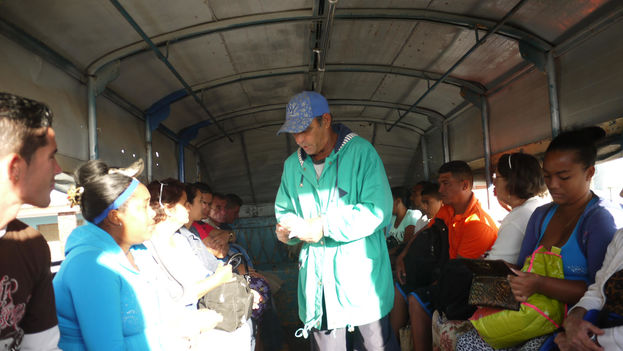
Inside a truck retrofitted for passenger transport that circulates through Santiago de Cuba

14ymedio bigger14ymedio, Havana, 12 June 2017 –Authorities have taken a firm stand with private transportation in Santiago de Cuba and have begun to demand exhaustive proof of fuel purchases from the state gas stations to verify that they are not from the black market.

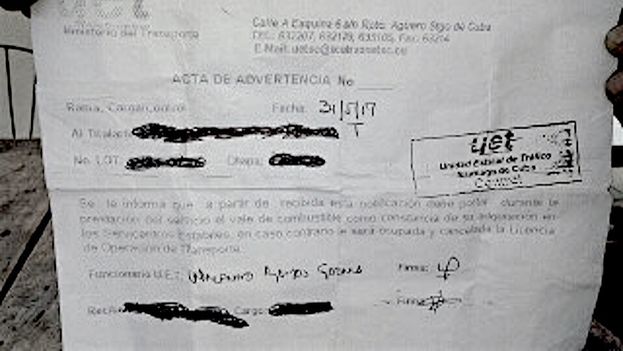
“Last Friday there was a massive operation, and four drivers were detained in the Micro 9 unit,” says activist Jose Antonio Lopez Pena, who closely follows the transportation issue in the eastern province. At least one of them had to sign a warning, to which this daily had access, in which they confirm that he cannot operate as a carrier if he does not buy fuel in the state gas stations. continue reading

The warning is issued by the Ministry of Transportation and signed by Wilfredo Ramos, an official with the province’s State Traffic Unit (UTE).

The application of the rule, which was already widespread in Havana and in the west, has been extended to the eastern zone since the end of May and deeply disturbs the carriers who resort en masse to the black market to buy fuel. Most of that gasoline comes from diversions from the state sector.

“The police and inspectors know that we can’t make a living if we buy oil and gasoline from the State,” explains Ramon, who drives an old truck from the middle of the last century to make the route between several Santiago municipalities.

Warning which confirms a private carrier cannot act as a driver if he does not buy fuel in the service centers.

The private carriers complain about the large sums of money they spend on licenses, taxes and vehicle repairs, so they try to make money by acquiring fuel on the black market at a lower price than the official rate.

During recent months instability in the petroleum supply from Venezuela caused significant cuts in distribution within the state sector. This situation triggered the price of the product in the informal market which is fed by diversions from businesses, entities and personal allotment that is given to some professionals like doctors.

From eight Cuban pesos (CUPs) per liter, petroleum suddenly rose to 15 on the so-called black market, while in the state service centers the equivalent is sold for 24 CUPs per liter (roughly 1$ US, or about $4 a gallon).

The government has responded by setting prices for private transportation in some places like Havana and also started a cooperative that tries to compete with individuals. However, the vintage taxis and trucks managed by the self-employed continue to be one of the most popular forms of transportation among the municipalities and provinces.

The carriers guild is quite big in the country but lacks its own union which could press for an improvement in work conditions. More than 80% of self-employed workers, according to official data, belong to the official Workers Center of Cuba.

Translated by Mary Lou Keel

Cuba: From Worse to Impossible (and We Haven’t Hit Bottom Yet) / Iván García

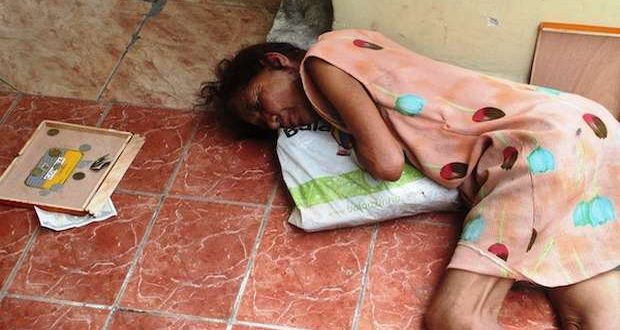
Beggar sleeping. See details of picture below.

Ivan Garcia, 3 June 2017 — In coming days when the administration of the unpredictable Donald Trump, following four months of review, announces its Cuba policy, it could be that Obama’s guidelines are retained save for touch-ups of a few items such as doing business with military enterprises that directly benefit the dictatorship.

Good news for the regime would be that the White House were to maintain the status quo.

To appease the internal dissident movement and a segment of the historic exile community that supported his election bid, Trump will demand respect for human rights, economic liberty and freedom of expression, and blah, blah, blah.

But the Castroite autocracy will counterattack with plausible and powerful arguments. continue reading

And it will point a finger at the Trump administration, which accuses his own country’s press of being his worst enemy and which makes multi-million-dollar deals with the Saudi monarchy, a government that violates innumerable human rights and reduces women to mere objects. All of which makes it not the best moral paragon to speak of freedoms.

During the Obama era–my god, how the regime misses him–Castroism did not allow small private businesses to access credit nor import products from the US.

The Cuban government’s strategy is simple. They want to do business with the powerful Norte, all comers, but with state–or military–run concerns as the sole partners.

If Trump maintains the scenario unfolded by Obama, i.e., academic, cultural, business and political exchanges between both nations, Raúl Castro will probably make his move and grant greater autonomy to small private businesses on the Island so as to placate the New York real estate mogul.

Not a few small private entrepreneurs, perhaps the most successful ones, are children or relatives of the olive-green caste, and they head up successful enterprises such as the Star Bien paladar (private restaurant), or the Fantasy discotheque.

If the panorama does not change, the regime will continue its diplomatic and academic offensive, utilizing its agents of influence in the US to continue efforts to bring down the embargo, or at least weaken it until it becomes a useless shell.

For the olive green autocracy, the plan to counteract that “damn obsession of US elites with democracy and liberties” involves conducting sterile negotiations that only buy time.

The Palace of the Revolution wants to change, but only in the style of China or Vietnam. It does not understand how those two communist countries can partner with the US while Cuba cannot. Castroite strategy is headed in that direction.

There are two subliminal messages coming from the military junta that governs the Island.

First: With an authoritarian government of social control in place, political stability is assured and there is no risk of a migratory avalanche or of the Island becoming a base of operations for Mexican drug cartels.

Second: Were there to be a change that provoked the people to take to the streets, the Island could become a failed state.

Trump, who is not known for his democratic qualities and has the discernment of an adolescent, could take the bait and do an about-face. “After all,” he might think, “if we’re partners with the monarchies in the Gulf, we continue to buy oil from the detestable Maduro government, and I want to make a deal with Putin, what difference if I play a little tongue hockey with Raúl Castro or his successor?”

But Trump is an uncontrollable reptile. And Cuba is not a center of world power, and it has a small market and laughable consumer power. Thus it could be that Trump will play the moralist and make demands that not even he himself lives up to, just to satisfy the Cuban-American political bloc in Miami.

Whatever happens, Trump has begun shooting tracer bullets. His announcement of a drastic $20 million cut in funding for dissident projects favors the Havana regime.

It is likely that this was not Trump’s intention. But remember that he is not a Franklin Delano Roosevelt. He is a man in his third age with the mind of a primary school student.

With all that the Island autocracy is going through–reductions in petroleum from Venezuela and a crisis that could annihilate Venezuelan President Nicolás Maduro, leaving Cuba bereft of an important economic support; Russia supplied a shipment of fuel but is asking where will the money come from next time; and a Raúl Castro who is supposedly destined to surrender power–for the military mandarins the scene that is coming into view at the moment is the worst possible.

Don’t worry about the repression. Hard-core dissidents will never want for punches and slaps. But in a country at its breaking point, any spark can give rise to a conflagration of incalculable proportions.

Right now, the average salary in Cuba is 27 dollars per month, but to live decently requires 15 times that amount. And Havana, the capital of the Republic, has gone for a week without water.

Food prices are through the roof. Public transit has gone from bad to worse. And, as if we were living in Zurich, Samsung has opened on the west side of the city a store (more like a museum) where a 4K Smart TV goes for $4,000, and a Samsung 7 Edge costs $1,300, double its price in New York.

Havanans, mouths agape, go to gaze and take selfies with their cheap mobiles. This is the snapshot of Cuba. A mirage. And all during a stagnant economic crisis dating back 27 years which few venture to guess when it will end.

While we thought we were in bad shape, the reality is that we could be worse off. And nobody knows when we will hit bottom.

Iván García

Photo: In the entryway of the Plaza Hotel, in the heart of the capital, a beggar uses a nylon bag containing her belongings as a “pillow.” To the side is an empty cigar box collecting coins from passersby. This image is part of The Black Beggars of Havana, a photo essay by Juan Antonio Madrazo published in Cubanet.

Translated by: Alicia Barraqué Ellison 

The Cuban Government, Complicit in Corruption and Peddling Favours / Iván García

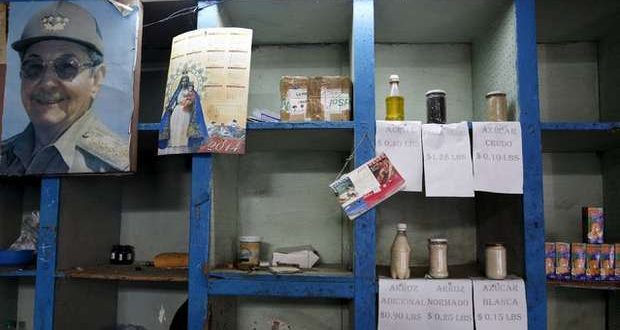
Cuban bodega (ration store). From AvaxNews.

Iván García, 26 MAY 2017 — Ideology is no longer the most important consideration if you want to get an administrative position in Cuba’s chaotic business and commercial network. They only ask you to do two things: fake support for the autocracy and show loyalty to government business.

If you have both these qualities, they will remove any common offences from your work record. Nor is it a problem if you frequently beat your wife or drink more rum than you should.

Human qualities are no longer a priority if you want to have a job in a company management team or join the ranks of the Communist Party. continue reading

Let’s call him Armando. He has always worked in internal trade. “It’s all been run down. Starting with the beginning of the Revolution. In the food and internal trade sector, the biggest wastes of space have occupied key positions. The employment culture is asphyxiating, like being in a prison. Money, extortion, nepotism and witchcraft are more important that professional qualifications and personal qualities”.

After letting his life go down the drain, what with getting into trouble, involving knives, robberies, public disorder, Armando decided to get himself back on track when his son was born. “I spent most of my youth and adolescence in the clink. With a family to support, I have to look at things differently. I have no family in the States who could get me out of here. I had to learn how to play the system. With the help of a friend, after paying him 300 chavitos (CUC), I got a bodega [ration store] for my wife and managed to include myself in the staff as an assistant to the storekeeper”.

After a year and a half, his wife started the process of joining the party. “She knows nothing about politics, but in Cuba having a red card opens doors for you. My next goal is to ’buy’ a bodega just for me.”

According to Armando, for 400 CUC you can get a bodega with lots of customers. “The more people buy things in your store, the more options you have to make money. In six months or a year, depending on your contacts with truck drivers and people running warehouses, you can recoup your investment”.

Although the neighbourhood bodegas have seen a reduction in the distribution of goods being issued through the ration books, various storekeepers have said that, in spite of that, they are still making money.

“It’s not like thirty years ago, when we had 25 different products delivered to the bodegas. You don’t get rich, but you can support your family. You can do two things: cheat on weighing, and buy foreign made things and sell them on to owners of private businesses or direct to customers”, admits a storekeeper with forty years’ experience.

If there is a robbery in a state-owned food centre or bodega, the boss or storekeeper has to meet the loss. “A little while ago, they stole several boxes of cigars and bags of coffee. I didn’t even report it. I paid about 4 thousand pesos for the loss and coughed up nearly another 200 CUC have new bars fitted and improvements to the security of the premises”, said a storekeeper

An official dealing with these things emphasises that, “When a robbery occurs, the first suspect is the storekeeper. It’s an unwritten law of business. If you get robbed, you should pay up and shut up, because police investigations usually uncover more serious problems”.

Naturally, in high-turnover food stores and markets you pay weekly bribes to the municipal managers. The manager of a state pizzeria explains: “The amounts vary with sales level. The more you sell, the more you have to send upstairs. At weekends I send an envelope with 1,500 Cuban pesos and 40 CUC to the municipal director, as I sell in both currencies”.

This hidden support network, of mafia-like construction, at the same time as it offers excellent profit on the back of State merchandise, also generates a de facto commitment to the government.

“It’s what happens in any important government activity. Whether it’s tourism, commerce, or import-export. The money comes from embezzlement, irregular financial dealings and corrupt practices. One way or another, the present system feeds us. It all comes together, as a kind of marriage of convenience. I let you do your thing, as long as you let me do mine”, is a sociologist’s opinion.

Raúl Castro has tried to sort things out, and designated Gladys Bejerano as Controller General of the Republic. “Successes have been partial. They get rid of one focus of corruption but leave others or change the way they work. If you were to arrange a thorough clean up of the network of government-run businesses, the system would break down. Because, like the bloodsuckers, they feed off other peoples’ blood”, explains an ex-director of food services.

Essentially, what is left of socialism in Cuba is a pact. In its attempt to survive, Castroism violates Marxist principles and, in place of loyalty, accepts that Catholics, Santeria priests and masons can enter the Communist Party.

In the business sector there is a different idea. Embezzlement in return for applause. In that way, not much is being stolen – kind of.

Translated by GH

Reinaldo Escobar: The Unqualified Cuban Truth / Somos+

Photo taken from the web

Somos+, Leyla Belo, 23 March 2017 — Those who ever speak with Reinaldo cannot deny his innate genius, his sense of humor and gentleness of expression. A matter of decorum, isn’t it? That quality which is so scarce among many people nowadays.  He does what he considers to be his duty: to disassemble our Island from within, dreaming that some of us, or all of us together, will fix it. Each one of his writings brims with endless sensibility, while leaving to others the use of easy adjectives and trivial cruelties.  A committed journal¡ist; of the kind of those no longer living, because his commitment is not centered around one man but around his Cuba, his suffering Cuba.

You had nearly two decades of work in official media under your belt. When did you decide to take another path and why?

When I was supposed to graduate from the School of Journalism in 1971, there was a “purge” at the University of Havana which meant the expulsion and punishment of several students. My “punishment,” caused by my “ideological issues,” consisted of working for a year for a tabloid by the name of El Bayardo, which was part of Columna Juvenil el Centenario, a youth brigade (a forerunner of the Youth Working Army), in Camagûey province. I stayed there until mid-1973. continue reading

After serving out my sentence I was placed with Revista Cuba Internacional where, according to my colleague Norberto Fuentes, we were involved in “sugarcoating.”  I worked there until mid-1987, when I transferred to the Juventud Rebelde newspaper, inspired by the Soviet glasnost, and thought that we would be able to engage in a different type of journalism in Cuba. I tried to do so with the best of intentions, and the result was that I was expelled from the newspaper in 1988 and disqualified from exercising the profession on the Island. Thus, some 18 years elapsed between mid-1971 and 1988 when I was engaged in official journalism.

I began working as an independent journalist in January, 1989, which was referred to at that time as “freelance” journalism, and contributed to several European publications by writing about Cuban subjects.

You are the founder of 14ymedio and are its Editor in Chief. How difficult is it to engage in serious journalism in an underground media?

The 14ymedio newspaper is not an underground newspaper. If I were to label it at all, I would rather call it an independent or unofficial newspaper. The best definition is that we are a digital, non-subsidized, non-printed newspaper.

That definition is essential to explain its difficulties. The problem other media have in securing ink and paper is experienced by us in achieving Internet connectivity. The largest volume of information flow is with our correspondents in the provinces and with other associates through the Nauta webmail network, which is slow and government-controlled.

The other difficulty is the scarcity of journalists who meet the appropriate requirements, as the first characteristic is for them to have the professional sensibility to sense everything which is really newsworthy. The second characteristic is to be able to truthfully and appealingly write in any journalistic genre, while checking with reliable sources. The third element is for them to dare to face the risks stemming from the threats by the political police.

At times those threats materialize into specific events which physically render it difficult to perform our job.

Current independent journalism (most of it) does not stem from a “passion” when dealing with the news.

One of the distinctive features of the current, independent journalism is the short distance that exists between many of its reporters and political activism. Arbitrary detentions, beatings, searches, evictions and everything that contributes to a true picture of a typical dictatorship seems to be the only thing of interest to that type of journalism. This can be explained because such news is absent from official media, and to counteract the official media monopoly on information is one of the raisons d’être of independent media. The passion is inherent to the nature of this reporting, hence the (always unnecessary) profusion of adjectives.

Independent journalism should also focus on other matters, such as the growing presence of entrepreneurs, and it should look at those –apparently insignificant– signs of defiance by our plastic artists, filmmakers, writers, humorists and musicians.

Authorized press in Cuba is subsidized by the Cuban Communist Party (PCC). In your opinion, what would be the ideal management paradigm for the media?

I do not think there is an ideal management paradigm for the media.

The issue of media ownership is a complex matter. When it is privately-owned,  under a market system, information becomes one more item of merchandise and “what sells” gains visibility over “what needs to be reported.” When management is in state hands and does not depend on advertisers, the media often becomes boring and doctrinaire. In addition, there is public management, which is somewhat different from state management in that it is governed by the readership.

Even though it is not noticed at first glance, the official broadcasting media in Cuba are privately-owned and are the monopoly of the Communist Party. If we understand that the concept of ownership specifically refers to the decision-making capacity and add to the aspect of material responsibility for what is owned, there is no question that the official media owner is the PCC, which designates the management staff, establishes the editorial line, manages material resources and pays the salaries.

Earnings are not measured in terms of money as under a market system, but in terms of the achieved control over the population, which only finds out about what those media report if they are privileged enough to connect to other media. It is acceptable for a political party to own its own publication, but it not acceptable for that party, having exclusive access to power in the name of the law, to use State funds to pay the cost of its media and, in addition, to take upon itself the right of prohibiting the existence of its competitors.

Eventually, we will have private newspapers and magazines in Cuba, perhaps full of advertisements, police-blotter journalism and trivial news about the world of show business; civil society institutions will manage their own media and perhaps there will be a public TV channel where people will learn about the debates in Parliament.

You interviewed the Law student expelled from Cienfuegos University. How do you define his action?

This young man only exercised his sacrosanct right to free expression when answering the test questions. If a student is asked on a test what his opinion is regarding a specific subject, whoever grades the test has to refrain from his or her political prejudices, otherwise they should pose the questions with more honesty, such as, “What do you think I would be pleased to hear regarding such subject?”

You were detained a few months ago while a Spanish journalist was interviewing you. Was that another violation of the freedom of expression?

During the days of mourning following the death of former president Fidel Castro, I was interviewed by journalist Vicent Sanclemente, from Televisión Española. I do not think I was being followed at that particular time, but “they” were just highly-strung. Maybe the informant who was keeping an eye by the Malecón sea wall thought my answers to be inappropriate. When this young man reported to his superiors that there was a Cuban guy saying strange things to a foreign journalist, the person who got the report was compelled to fulfill his duty. Something “natural” in our environment.

Violating the freedom of expression is expressed in the most acute way when, for instance, our 14ymedio.com newspaper becomes inaccessible to the domestic servers providing Internet browsing service.

The official discourse boasts of freedom of expression in Cuba. Yet the reality is different.

Once, I do not remember the exact date, Mr. Carlos Lage maintained that there was total freedom of thought in Cuba… and it is true. What happens is, as Friedrich Engels used to say, “the word is the material wrapping of thought,” so that it is totally worthless for someone to come up with a political formula if he or she cannot in absolute calmness expound upon it to all of his or her followers.

Freedom of expression, exercised in its public environment, is the best guarantee that all rights to which people are entitled are fulfilled, including, naturally, the right to education, public health and social security.

Translated by: Anonymous

Between the Official Utopia and Generational Realism / Cubanet, Miriam Celaya

Cuban youth at the Major Lazer concert in Havana, 2016 (Photo file)

cubanet square logoCubanet, Miriam Celaya, Havana, 1 June 2017. – A characteristic feature of ineffective and outdated political regimes is the constant appeal to the historical past as a mechanism for legitimizing the present, and as a resource for survival. In the case of Cuba, this principle has been the rector of official discourse and its means of diffusion, and it has been applied with particular force in the teaching of History.

As a consequence, several generations of Cubans born shortly before or after 1959 have grown up indoctrinated in the assumption that all events from the “discovery” of the Island by Christopher Columbus through Spanish colonization, the Taking of Havana by the British, the Wars of Independence, and the brief Republic were nothing more than the flagstones that paved the long road that would lead to this (even longer) path -with airs of eternity- known as the “Cuban Revolution”, our nation’s only and final destination. continue reading

The preaching took almost religious tones. Just as Noah saved all of Earth’s living species, the boat “Granma”, with its young crew, was the Cuban people’s “salvation”. Thus, judging from history textbooks at all levels of “revolutionary” teaching, the founding fathers, the illustrious pro-independence, the brightest Cuban-born intellectuals, and all decent Cubans for the last 525 years had their hopes set, though they didn’t know it, in today’s “socialist” Cuba and, above all, in the pre-eminent guidance of an undisputed leader of world stature who would continue to lead the ship even beyond material life: Fidel Castro.

Human Rights Violations: How to Report them? / Somos+

Somos+, 20 March 2017 — During the last session of Academia 10/10, we were joined by renowned Prof. Moisés Rodríguez Valdés, a physicist by profession but one with ample knowledge of human rights and civil liberties.

He is the chief spokesperson in Cuba for Corriente Martiana. Attendees enjoyed this very valuable conference during which, among other important topics, he explained how to formally report human rights violations to the United Nations. The following are some of the major points he shared with us.

Report violations of human rights you have experienced to the United Nations. continue reading

Not doing so encourages the perpetrators’ sense of impunity, even if this is not your intention.

The process is easy and does not take much time, but the effect can be significant if everyone follows established procedures.

We hear reports on a daily basis, through Radio Martí and other broadcasters, as well as through digital and print media, of human rights violations against civil society activists not formally recognized, who are vilified and repressed and, occasionally, are subject to unjustified physical violence.

Using the media to raise public awareness is NECESSARY, BUT IS NOT ENOUGH. That is because UN resolution 1503 precludes the organization from considering complaints based on press reports (see annex, UN Res. 1503).

Some complaints are forwarded to international human rights organizations, such as Human Rights Watch and Amnesty International, among others. There is nothing wrong with it, but this is also NOT ENOUGH. UN Res. 1503 establishes that the complaint must be filed by the victims, their representatives or organizations located in the places where the actions were known to have occurred.

Furthermore, it is well-known that complaints by the European Union and even the Inter-American Commission on Human Rights (IACHR), while noteworthy, have proved to be inadequate in stopping systemic and institutionalized violations depicting a persistent situation, which is what triggers UN mechanisms.

Failure to communicate individual facts to this international institution means to forego the one institution that can compel the Cuban government to halt violations committed by state officials and institutions, which essentially means State Security agents.

It is not a question of resolving individual cases but rather that out of all the complaints made it will be possible to put members of the Cuban government on the stand, as was done until prior to 2006, when the Commission on Human Rights was replaced by the current UN Human Rights Council (UNHRC).

The fact that the Cuban government has served on Council three times, or that it is currently a member, does not preclude us from seeking redress from that government through other channels provided we report each violation we have personally experienced, or that others we know have experienced, whether they are civil society activists or the population at large.

For information on how to go about filing a complaint, we are attaching the text of Res. 1503, which you should review prior to initiating such communication, as well as the sample form to report violations to the so-called special procedures.

We suggest that you begin the process by emailing your written testimony to Corriente Martiana:

corrientemartiana2004@gmail.com

It will be reviewed and forwarded to the UN by people who have years of experience in dealing with these matters. They will also send you suggestions on how to format any future correspondence.

Do not fail to do so, for only in this manner will we contribute to increase the political cost to the Cuban government for its systemic, institutionalized violations of human rights and fundamental freedoms, which keep the country in a continuous state of crisis, cause the steady exodus of fellow countrymen and keep the citizenry mired in an effort to survive amidst generalized fear and misery, which prevents them from acting as legitimate citizens but rather as accomplices due to their dependence upon the totalitarian regime imposed on our country.

Looking forward that you will carefully assess this suggestion, I remain,

Sincerely,

Moisés Leonardo Rodríguez Valdés

Human Rights Advocate

This document was prepared and distributed by Corriente Martiana, an institution currently focused on the promotion of human rights through face-to-face teaching, distribution of information and teaching material, and implementing pressure strategies on decision-making individuals.

Address: Ave. 45 # 2410 e/ 24 y 26. Cabañas, municipio Mariel, provincia Artemisa. Cuba

Emails:  corrientemartianacuba2004@gmail.com      moises47@nauta.cu

Web page:  www,corrientemartianacuba.org                                    @cubamartiana

Mobile phone:  +53 5 3351152

Annex 1

Procedure contemplated in Res. 1503, reviewed (summary of the main points for purposes of this suggestion).

The fact that a communication is forwarded to the applicable government and an acknowledgment of receipt is forwarded to the author thereof does not mean any opinion as to the admissibility or merits of the communication. When the Working Group finds that there is reasonable evidence to the existence of a persistent sitatuon of manifest human rights violations, the matter will be referred to the Working Group on Situations for review. The Working Group on Situations will consist, as before, of five members designated by regional groups, and due attention shall be given to the rotation of its members.

The Group shall meet one month, at the latest, prior to the Commission’s meeting, in order to review particular situations referred to it by the Working Group on Communications, and it shall subsequently decide whether or not to refer some of those situations to the Commission.

Then, the Commission shall adopt a decision on each particular situation brought to its attention in this manner. Confidentiality.

All initial steps of the process are confidential until a situation is referred to the Social and Economic Council (ECOSOC).  However, since 1978, the Chairman of the Commission on Human Rights has disclosed the names of those countries subject to review. Thus, if a situation of abuses occurring in a given country are not resolved during the initial stages of the process, it can be brought to the attention of the international community through the ECOSOC, which is one of the main UN bodies.

What are the admissibility criteria for a communication to be reviewed?

– No communication shall be admitted which is contrary to the principles of the UN Charter or which displays political motivations.

– Only one communication shall be admitted if, after having reviewed it, it is determined that there are reasonable grounds to believe –also having taken into account all replies sent by the interested country– that there is a persistent situation of manifest, conclusively proven violations of human rights and fundamental freedoms.

– Communications may originate from individuals or groups claiming to be victims of human rights violations or  from those having first-hand, reliable knowledge of those violations. Anonymous communications shall be inadmissible, as well as those based on media reports.

– Each communication shall describe the events and indicate the purpose of the petition, as well as the rights which were violated. As a general rule, communications containing offensive terms or insulting comments regarding the State against which a claim is made shall not be reviewed.

– In order for a communication to be reviewed all internal remedies must have been exhausted, unless it can be convincingly proven that national solutions would be ineffective or would take longer than reasonable expected to be achieved.

Annex 2

THIS IS THE MOST COMMON COMMUNICATION MODEL USED, WHICH YOU MAY USE:

Communication to UN Special Procedures from CUBA.

(Read the instructions at the end prior to beginning your communication.)

i. Identification of individuals(s) victim(s):

1. Surnames:

2. Given Names:

3. Sex: M____ F____

4. Date of birth or age (at the time of being subject to the violation):

5. Citizenship(s):

6. a) Type of ID (ID from your country, passport or similar).

ID Card

b) Number:

7. Profession and/or activity (if there are grounds to believe that the violation of rights and/or freedoms bears any relation to it(them):

8. Current address:

City:                        Province:

II.  Identification of violation’s perpetrators.

1. Date when violation occurred:

2. Place where violation occurred (please provide as many details as possible):

3.  Alleged perpetrators of violation:

4.  Are perpetrators members of any official institution? Which one?

III. Please provide a detailed description of events and circumstances under which the violation subject to the communication occurred (be brief and concise).

IV. Indicate which rights were allegedly violated during incident subject to the communication.

V. Identification of individual(s) or organization(s) filing the communication:

1. Name and surnames of individual(s) or name of the organization and representative’s name:

2. a) Address of the individual or the organization’s headquarters:

City:                            Province:

b) Email:

c) Telephone No. (landline):

d) Cell phone:

Instructions.

1. If you submit a handwritten communication, please use black or blue ink and write legibly, preferably in block letters.

2. Your communication shall not be reviewed if you use insulting language or political content.

3. Please limit yourself to describing the events in connection with the incident and clearly and concisely provide only the essential details. It is not a questions of evaluating or giving an opinion, only of describing the facts.

4. No anonymous communications shall be accepted.

To clarify any questions, you can contact Moisés Leonardo Rodriguez at:


Avenida 45 número 2410 entre 24 y 26, Cabañas, municipio Mariel, provincia Artemisa. CP 34100. Cuba.

 Email: corrientemartiana2004@gmail.com

Let’s do it! That way we will achieve a more favorable environment for the defense of Human Rights!

P.A. Mosés Leonardo Rodríguez

Original Corriente Martiana founder.

 Translated by: Anonymous

Cubans Want More Severe Laws for Criminals / Iván García

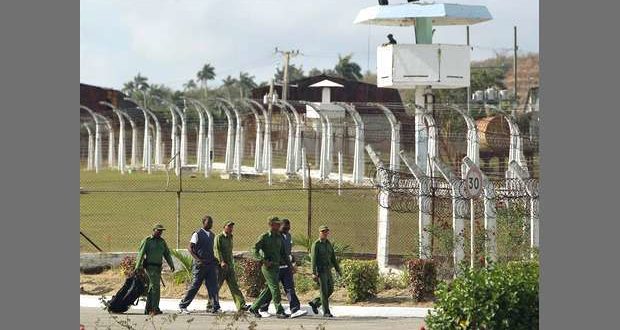
Cuban prison. Taken from the blog of Juan Carlos Herrera Acosta.

Iván García, 6 May 2017 — Some people in Cuba, not just a minority, want blood. And more severe laws for criminals.

While the Catholic Church and different international institutions are advocating a crusade to eliminate the death penalty on the Island, there are people who, for many reasons, think firing squads should be reactivated.

If you ask Gisela about the subject, her eyes fill hopelessly with tears. At one time this woman, who is pushing 50, was a brilliant nurse. She formed a model family together with her spouse, an ex-official of a foreign business. They lived in a well-cared-for apartment in Reparto Sevillano, in the south of Havana. continue reading

But the night of December 14, 2010, their marriage took a dramatic turn. “They killed our only son. He was only 15. He was with some friends in El Vedado. A gang assaulted him to take his clothes. Before running away, they stabbed him twice in a lung. After his death, our life changed and got worse. I always wonder, if God exists, where he was that night,” says Gisela.

After the loss of their son, the marriage dissolved. She became a habitual alcoholic. They sold their car and later exchanged their apartment for a smaller one. The money was spent on rum and psychotropics.

Gisela divorced the father of her deceased son, and they put him in a psychiatric hospital. When you ask her opinion about the death penalty or more severe laws for certain crimes, she answers without subtlety: “Whoever kills a person ought to be executed. Look at my case. The criminal who killed my son got 20 years in prison, and for good conduct he served only six and is now back on the street. It’s not fair.”

Those who have lost a family member or friends of violent crime victims are more susceptible and hope for the return of executioners and a State that decrees death.

In Cuba, the crime rate is notably low. Although official statistics are unknown, the Island is a safe place. But gangs of juvenile delinquents and home robberies have increased.

Since 2005, the Cuban Government has had a moratorium on the death penalty. The last convict executed was called “Crazy Victor” in the world of the marginal underground, and he was a sinewy mestizo almost 6’6″ tall, with an assassin’s soul.

At the end of the ’90s, he killed an old woman inside her house in the neighborhood of La Vibora. The day of his arrest he had a shoot-out with police in the style of an American action film.

In the spring of 2004, the Council of State ratified the death penalty for Victor, which was carried out in the adjacent courtyard at the Combinado del Este, a maximum security prison on the outskirts of the capital.

Fidel and Raúl Castro have not held back from pulling the trigger. From the very beginning of January 1, 1959, they used the death penalty to eliminate their recalcitrant enemies and even peaceful dissidents. A lawyer, now retired, relates:

“When an objective academic study is done, without political passion, the exact number of Cubans that the government of Fidel Castro has executed will be known. On principle, they eliminated criminals from Batista’s police and army. Several of these trials were real Roman circuses, televised to the whole country, without the proper judicial guarantees. They took advantage of the situation to deliver justice in order to liquidate the enemies of the revolution.

“In one step, the laws sanctioned the death penalty for betrayal of the country by soldiers, as in the case of General Arnaldo Ochoa. Or the execution of 19 people in an air base in Holguín in 1963, most of them war pilots. Fidel, Raúl and Che signed quite a few death penalties. The figures vary, according to the sources. Some say that 500 were executed; others, 3,000 or more.

“Dissident jurists consider these to be crimes of the State, because they were established offenses that didn’t necessarily call for capital punishment. But the Government claimed it was being persecuted by Yankee imperialism.”

In 2003, after a summary trial, three young black men, residents of Centro Havana, were executed for trying to hijack a boat to leave the country, which they weren’t able to achieve. “It was a counterproductive political error. It was an an act of Fidel Castro’s meant to set an example that cost him the condemnation of world public opinion,” said the ex-lawyer.

In the spring of that same year, among the 75 peaceful dissidents punished with long years in prison by Fidel Castro, who used only words as a weapon, the Prosecutor of the Republic requested seven death penalties. “It was something appalling. Luckily the Government didn’t carry it out. It would have been a crime in all meanings of the word,” said the old lawyer.

As in any revolutionary movement, whether in France, Russia or Cuba, violence begins with force. The death penalty always was a weapon of combat for intimidating the enemy. However, several people consulted considered that while political adversaries were sanctioned excessively or executed in a pit in the fortress of San Carlos de la Cabaña, Cuban justice was too permissive with some blood crimes.

“Right now someone who kills a cow gets more years in prison that someone who kills a human being. I know cases where they got only four or five years in prison in spite of having killed someone. Those who slaughter beef cattle are condemned to 20 or more years of privation of liberty,” says an ex-prisoner.

There are quite a few ordinary Cubans who think that crimes like robbery in occupied homes, sexual violations and other mean-spirited acts should be considered by the State as crimes, and the killers should be executed.

“Although my religion is against the death penalty, I’m in favor of executing those who commit horrendous crimes,” confesses Mayda, who defines herself as a practicing evangelical.

Saúl, who works for himself. considers that in addition to “executing serial killers or psychopaths, they ought to punish other infractions with more years. As in the United States, where they give them life imprisonment for these same crimes. The thugs would think twice before breaking the law.”

But in the opinion of another lawyer, in the case of major crimes or by resuming the death penalty, “the State could be tempted to condition these laws and carry out a purge of the opposition. The subject of the death penalty, whether to abolish it or keep it, should be debated nationally and the citizens should decide by vote.” But Cuba isn’t Switzerland.

Translated by Regina Anavy

The Ministry Ratifies the Expulsion of Professor Dalila Rodriguez from the University of Las Villas

Dalila Rodriguez, ex-professor for the Central University of Las Villas, whose dismissal has just been ratified

14ymedio bigger14ymedio, Havana, 3 June 2017 – The Ministry of Higher Education (MES) ratified the expulsion of Professor Dalila Rodriguez from the Marta Abreu Central University of Las Villas. A letter dated May 9 and delivered this Friday to the academic, responds to her earlier appeal and confirms the revocation of her teaching status, as Rodriguez explained to 14ymedio.

The document is signed by the MES legal advisor, Denisse Pereira Yero, and by the chief of the Legal Department, Jorge Valdes Asan. The officials will not consider an appeal by Rodriguez because “an infraction of Article 74 Subsection (d) suffices to lose Teaching Status directly.”

On April 11 the professor received an order of dismissal from her position on the Humanities Faculty, issued by the dean Andres Castro Alegria, and it invoked Article 74 of the Regulation for the application of the Higher Education Teaching Categories. continue reading

The argument put forward to justify the expulsion was that the professor had not managed “to rectify a set of attitudes that deviate socially and ethically from the correct teaching activity that her teaching status demands, and that can affect the education of students.” Rodriguez received the news with surprise.

The philologist, 33 years of age and a resident of the Villa Clara township of Camajuani, was, until her expulsion, studying for a doctorate in Pedagogical Sciences after having obtained a master’s in Linguistics and Publishing Studies. She was active in the union and in February received an excellent evaluation.

From the beginning of 2015, the academic experienced pressure from State Security. Several agents interviewed her in order to find out if she had contacts with the activist and evangelical pastor Mario Felix Lleonart. There were also interested in knowing about relationships of her father, Leonardo Rodriguez Alonso, coordinator of the Patmos Institute, an independent organization that defends religious rights in Cuba.

Dalila Rodriguez asserts that she does not belong to any dissident group, nor does she even attend events convened by independent entities on the Island. “They have done all this to make my father feel guilty,” she says.

Dissident Leonardo Rodriguez, father of Dalila Rodriguez. (Courtesy)

When they told her of her dismissal, the first vice-dean, Ossana Molerio Perez, and the legal advisor also informed her that she would not be allowed to appeal via the union, and they warned her that she must not “set foot” again in the University.

The dismissal process was plagued by irregularities, Rodriguez complains. According to regulations, her case should be reviewed first by the commission in charge of teaching categories and she should be offered seven days to appeal. Nevertheless, the dean made the decision directly and without respecting deadlines.

Rodriguez then decided to write to the Minister of Higher Education, Jose Saborido, but the answer received this week asserts that in her case, “there is no violation” because “it does not involve a disciplinary process but a special administrative proceeding.”

In a phone conversation with 14ymedio, the professor called it “incredible” that, shortly after having been evaluated with the highest marks in her work, she has turned into someone “with serious ethical and social problems who damages the education” of students.

She said she felt “totally helpless after working for 11 years in that university,” and she said that the teaching authorities “have not been able to show any evidence against her.”

Journalism student Karla Perez Gonzales was expelled a few days later from the same university after being accused of belonging to the Somos+ Movement and “having a strategy from the beginning of her studies to subvert youth.”

Her case inspired a wave of indignation, and official voices spoke in her favor, like that of singer-songwriter Silvio Rodriguez, who wrote on his blog: “What brutes we are, fuck, decades pass and we don’t learn.”

Translated by Mary Lou Keel

They Deceived Us With Tourism

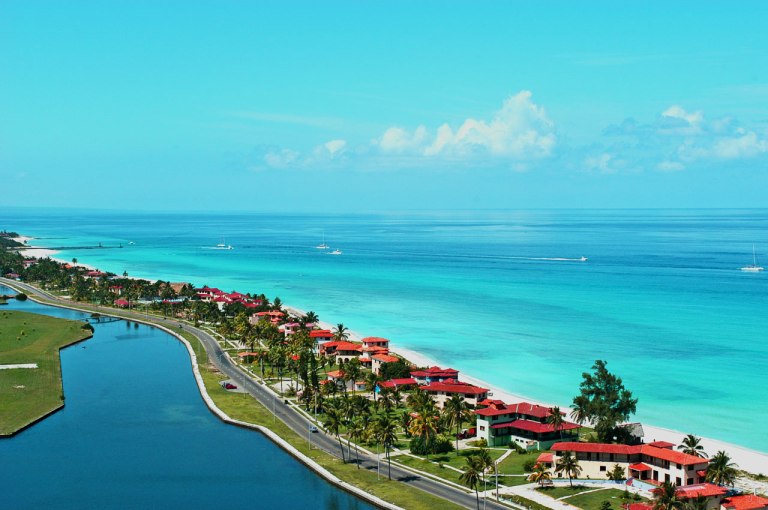
Luxury development along Varadero beach (RepeatingIslands.com)

14ymedio bigger14ymedio, Marta Requeiro, 29 May 2017 — There was a time when I saw it as natural. I understood, to say it in a certain way, that Varadero beach was not ours despite its being in Cuban territory.

My unconscious viewed the image of that strip of land, like many, as if it were part of another country to be destined to the enjoyment of the foreign tourist. Economic progress was needed and in an island with favorable climate and geography the resources are mainly provided by tourism, hence even feeling proud of it.

But the years go by and as part of a macabre plan the areas where ordinary Cubans live are deteriorating, and in contrast every day the are more tourist centers supplied with amenities, luxuries and the latest technology to better serve the foreign visitor. They put make up on facades so that people who come to visit don’t see how the rest is falling down little by little. continue reading

Once, with my family, we “dressed like tourists” and started to enjoy the, until then, unknown part of Cuba. We arrived with the children who we’d warned ahead of time about how to behave and carry themselves, and we got there on transport from Havana, planning to spend an exquisite day.

The place was full of persecutors and police who did not hesitate to return a ball to the son of a tourist but at the same time were “programmed” to detect and prevent Cubans and their children from swimming in the transparent waters of the spa.

Before long, we were detected by two police officers who ordered us to leave the area, as if we were criminals, and told us to go to Santa Marta, the village beach.

Today, Varadero is even more elitist, restricted and impassable.

Today a citizen struggles to get some bricks or some cement to repair their crumbling house and, even more painful, foreign companies are hired to carry out the construction of tourist hotels, preventing a professional or a national worker from earning a better salary.

We were deceived and it is time to stop believing that the profits that the tourism leaves will trickle down to the people and the most needy.

Another Friday Without Water for Thousands of Havana Residents

The new pipes will allow a smaller volume of water to run than before.

14ymedio bigger14ymedio, Havana, 2 June 2017 – The water supply pipe from the South Catchment area that suffered a rupture a week ago began to operate on a trial basis Thursday morning, according to a report by the Havana Water enterprise. Nevertheless, service has still not been re-established in all of the capital’s municipalities as 14ymedio was able to confirm.

Three tanker trucks supplied water Thursday afternoon to the Tulipan Hotel which housed the deputies who attended the last special session of Parliament. The scene of trucks and people moving buckets or tanks was repeated in the streets and avenues of the capital’s most populated zones on Friday morning.

Industry authorities assured the official press that the connection of 1.2 kilometers of the first two lines of high density polyethylene was concluded in the stretch where the rupture occurred. But the replacement pipes have a smaller diameter and will only gradually allow the transfer of some 1,300 liters per second. continue reading

This volume is half that which flowed through the original conduit, built 60 years ago and whose central, 36-kilometer line is composed of pipes two meters in diameter.

During the first six days after the break, the number of those affected exceeded 800,000 people throughout the city. The price of water shot up on the black market, and a medium-sized “pipe” doubled in price to more than 50 Cuban convertible pesos (CUC).

As of a week ago, more than one hundred construction workers from the Institute of National Water Resources and from the Ministry of Construction worked in order to repair the breakdown, which affected 50 meters of the South Catchment area in the Quivican municipality of Mayabeque province. It is estimated that the investment to repair the pipes is about five million Cuban pesos (roughly 200,000 CUC/US$).

The tests are targeted to fill the Palatino central tanks in the neighborhood of Cerro, which supplies water to the municipalities of Habana Vieja, Centro Habana, Plaza de la Revolucion, Cerro, Diez de Octubre and part of Boyeros.

Translated by Mary Lou Keel

Cuban Catholic Bishops Express Solidarity with Venezuela

Dionisio García Ibáñez, archbishop of Santiago de Cuba. (Networks)

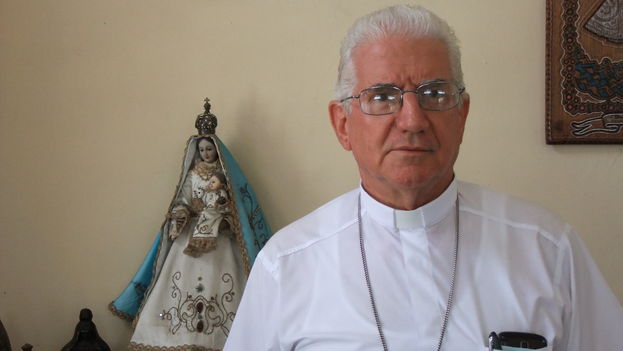
14ymedio bigger14ymedio, Havana, 30 May 2017—Cuba’s Catholic bishops are not “on the fringes of the suffering and uncertainty experienced by Venezuelans,” according to a letter released this week signed by Dionisio García Ibáñez, archbishop of Santiago de Cuba and president of the Conference of Catholic Bishops of Cuba .

The letter, addressed to the Venezuelan episcopate, refers to the “difficult moments” that the South American country has experienced since the beginning of protests almost two months ago in favor of and against the Government which have degenerated into acts of violence and left a 59 dead. continue reading

“We send them our prayer of solidarity,” adds the bishops’ statement and calls for “the paths of forgiveness, constructive and sincere dialogue as well as the yearnings for truth, justice and a commitment to constitutional legality to lead to a stable and true peace.”

The missive extends “firm support” to the Venezuelan Church in “the wishes expressed in its repeated interventions in favor of peace and concord.”

Recently, during the opening of the XLIII Special Plenary Assembly held in Caracas between May 16 and 18, the president of the Venezuelan Episcopal Conference, Diego Padrón Sánchez, drew attention to the “picture of barbarism and violence” installed in the country that has returned to “an anti-culture of death.”

The priest said that the “state of affairs” that has led “the current ruling political system is reasonably unjustifiable, ethically illegitimate and morally intolerable.”

Activist Joanna Columbie Deported to Camaguey

Joanna Columbie last Monday afternoon in Vivac when they were taking her to receive a visit. (Somos+)

14ymedio bigger14ymedio, Havana, 2 June 2017 – The principal of Academy 1010 and Somos+ (We Are More) Movement activist, Joanna Columbie, was deported Friday from the Vivac detention center in Havana to Camaguey province, as reported to 14ymedio by the leader of the Somos+ organization, Eliecer Avila.

“Joanna called from Vivac to say that she was going to be taken to Camaguey on a bus along with other detainees,” the dissident added. “The police have mounted an operation around the bus that looks like they are transporting dangerous criminals,” he said sarcastically.

“They have given her a warning about subversive activity and enemy propaganda,” he added. continue reading

The crime of enemy propaganda can carry “a sanction of incarceration from one to eight years” according to the Penal Code. It applies to those who prepare, distribute or possess “oral or written propaganda” that “incites against the social order, international solidarity or the socialist State.”

At the time of her arrest the opposition leader was carrying with her several compact discs “with material about Academy 1010,” says Avila.

Columbie was arrested a week ago in the Arroyo Naranjo township by State Security just two days after her temporary permit for residence in the capital had expired.

The activist’s permanent residence is in Cespedes, Camaguey where she was a victim of a robbery at the beginning of the year, but the police so far have arrested no perpetrators.

Joanna Columbie’s arrest and deportation add to a series of repressive actions against Somos+ in recent months. The expulsion of journalism student Karla Perez (member of the independent group) from the University of Las Villas and the raid on the home of Eliecer Avila are some of the most recent actions by State Security against this opposition group.

Translated by Mary Lou Keel

The Cuban Parliament Closes Ranks Around Nicolás Maduro

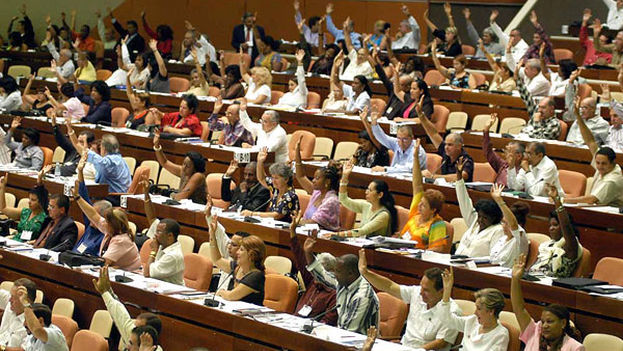
A session of Cuba’s National Assembly of People’s Power.

14ymedio bigger14ymedio, Havana, 1 June 2017 — A statement of support for “the people and the Government of Venezuela” came at the last minute in the extraordinary session of the Cuban Parliament this Thursday and was unanimously approved. The text salutes “the constant calls for dialogue” made by President Nicolás Maduro.

Deputy Yoerkis Sánchez, a member of the parliamentary group of friendship with the South American country, presented the statement denouncing “the serious escalation of internal violence and international intervention that has destabilized” Venezuela.

The document criticizes harshly the role of “the media of the oligarchy that distort the reality of the achievements of the Bolivarian Revolution.” An informative line that supposedly hides “the barbaric coup of the right, including the murder of young people.” continue reading

The members of the National Assembly had hard words for the Organization of American States (OAS) and its secretary general Luis Almagro, who they accused of “double standards.” According to the document, the entity seeks to “surround and overthrow the government of Nicolás Maduro, while silencing other serious manifestations of violence and the breakdown of democracy in other countries of the region.”

Deputy Yoerkis Sánchez, a member of the parliamentary group of friendship with the South American country, presented the statement denouncing “the serious escalation of internal violence and international intervention that has destabilized” Venezuela

Criticism against the OAS comes within hours of the organization’s foreign ministers failing to agree on a statement on the Venezuelan crisis on Wednesday and setting another meeting before the June General Assembly in Cancun.

The Cuban deputies called for “the cessation of any intervention in the internal affairs of Venezuela” and invoked “respect for the determination of its people and their right to build the model of society it determines.”

The statement included a call to the legislators of the world to show solidarity with the South American country.

Since the protests began two months ago, there have been marches convened by the opposition against Maduro’s government, which have resulted in at least 59 deaths. There have also been 2,977 arrests, of which 197 were ordered by military courts, according to the Venezuelan NGO Penal Forum.