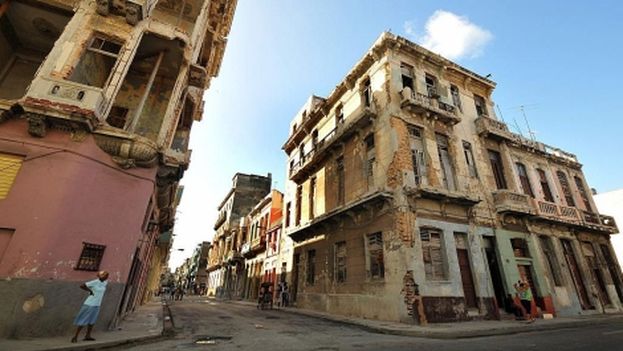
The Swamp Of Wealth

Limiting wealth requires specifying how much a person can possess and where the prohibitions begin. (EFE)

14ymedio bigger14ymedio, Generation Y, Yoani Sanchez, Havana, 6 June 2017 — Almost a quarter of a century ago, the government launched a battle against illicit income that ended with the detention of dozens of criminals but also of prosperous entrepreneurs. During the dreaded Operation Flowerpot, you could be denounced just for having a freshly painted house, wearing new clothes or sporting a gold chain.
Popular humor has coined a joke that describes the arrest of a “New Rich” in 2030, where the infraction is possessing three cans of condensed milk and two brooms. Jokes like this point out the weakest part of the raids against the well-to-do. What’s the starting point for someone to be considered wealthy or a hoarder? continue reading

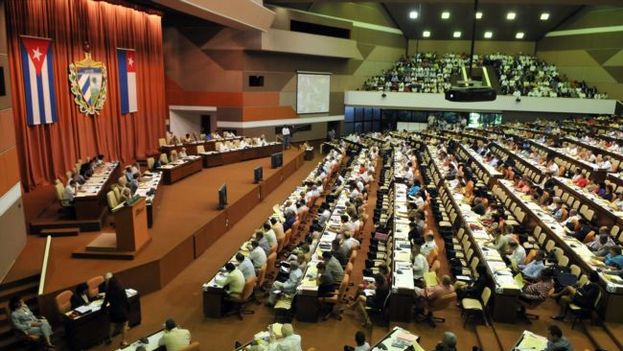
The relativism surrounding such definitions has come to the fore again during the last extraordinary session of Cuba’s Parliament, which supported a prohibition against accumulating property and wealth. Such limitations remain to be expressed in a law that establishes a clear limit on the possession of material goods.

The deputies of the National Assembly could see fit to define the amount of money that the savers will be allowed to keep in their bank accounts, how many clothes they can hang in their closets, the number of pairs of shoes they can wear and even the amount of shampoo they’re permitted to use when they wash their heads…

The champions of such prohibitions are, in most cases, people who do not even have to put their hands in their pockets to buy food

Such an enumeration seems absurd, but limiting wealth consists of specifying the quantity allowed and where the prohibitions begin. Without these exactitudes – generally ridiculous and elusive – everything remains in the realm of subjectivity, at the mercy of the whims of those who apply the punishments.

To add moisture to that legal swamp, the champions of such bans are, in most cases, people who do not even have to put their hands in their pockets to buy food. They live on privileges, free supplies and perks that insulate them from the daily life and the hardships of most Cubans.

They, who have accumulated all the wealth, fear that someone who has not assaulted a barracks, wielded a gun or shouted slogans, could move in a few feet from their mansions, run a hotel more competitive than those run by the Armed Forces and manage – and this is their worst nightmare – to have the economic autonomy to launch a political career.

Autonomy of Cuban Dissidents Will Always Be Beneficial / Iván García

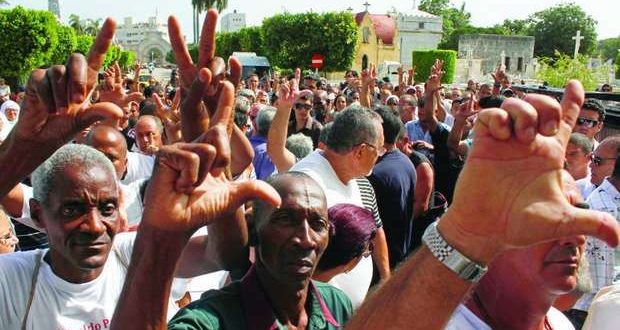
Photo: Diario Las Américas Dissidents attend the funeral of Oswaldo Payá Sardiñas on 24 July 2012, at Colón Cemetery in Havana. (Diario Las Américas)

Iván García, 1 June 2017– The majority of the openly anti-Castro opponents I know do not live in lavish mansions nor do they possess items fashioned with the latest technology. Neither do they boast bank accounts in financial paradises and they do not own yachts or beach houses.  I don’t believe any of them know how to play golf or can afford a vacation on a Greek island.

Those luxuries are reserved for the hierarchs of the olive green regime. Those who sing The Internationale, compose speeches replete with declarations on behalf of social justice and poverty, but who wear designer-label clothing, use French perfumes and employ household servants. continue reading

The national prosecutor’s office will never open a file on the Cuban functionaries involved in the Panama Papers. No state office exists where the average Cuban citizen can learn how public monies are spent or invested. The nomenklatura lives and performs its functions with total impunity.

That leadership style of never being accountable, which has taken root inside the olive green autocracy, has in a certain way been imitated by the opposition on the Island. Most certainly, it is a harmful style.

Corruption, and its variants such as nepotism and influence peddling, has permeated a significant sector of the dissident movement. There is no transparency regarding the funding and materials they receive.

Some opponents behave with dictatorial arrogance and manage their organization as if it were a family business.

One needs money to live. And it doesn’t fall from the sky. The ideal would be that the opposition obtains money through local financing mechanisms. But Cuba under the Castros is a genuine dictatorship.

Those on the Island who declare themselves dissidents, if they work or study, are expelled from their workplaces or schools. And even were they employed, because of the financial distortions caused by the country’s dual currency system and low wages, they would be unable to sustain their organizations. Prior to 1959* political parties supported themselves with membership dues and donations from sympathizers and anonymous supporters.

To make political opposition and free journalism, to maintain offices for independent lawyers or for any civil society organization, requires funds. How to obtain them?

There are foreign private foundations that award grants to approved projects. Government institutions in first-world democratic societies also provide aid.

Is this lawful? Yes. But for the Castro regime, it is illegal and you could be prosecuted under the anachronistic Ley Mordaza [Gag Law] in force since February 1999. If the nation’s laws prohibit obtaining funds from other countries to finance political, journalistic, or other types of activities, Cuba in this case should be able to count on banking mechanisms to enable to transmission of resources.

But the opposition on the Island is illegal. The dissident movement has almost always been financed by institutions or foundations based in the US, which is not illegal in that country and is publicly reported.

I am not against receiving money from US government institutions, as long as it can be justified by by the work performed. In the case of journalism, reporting for the Voice of America, Radio Martí, the BBC, and Spain’s RNE Radio Exterior is not a crime–except in Cuba, North Korea or perhaps in China and Vietnam.

Any funding from abroad is financed by that country’s taxpayers. In the case of political or journalistic activities, the ideal would be to receive monies from journalistic foundations and citizens or enterprises.

An important part of the opposition’s economic support has come from the US State Department or other federal institutions. Those local opposition groups who believe this to be ethical and a lawful way to obtain funds should therefore be transparent in their management.

Yet 95 per cent of them do not account for those monies nor do they publish reports about them. Most of the time, the members of these groups do not know how the funds received are managed. By and large they are administered by the individual at the head of the opposition group.

They justify this secrecy with the pretext, at times well-founded, that they are keeping this information from reaching the ears of the State Security cowboys, who act like 21st Century pirates and confiscate money and goods without due process of law.

However, and this is regrettable to say, that opacity in managing collective resources is the embryo of corrupt behaviors within the Cuban opposition. Within the majority of dissident organizations, whatever they may be called, such absence of managerial accountability and transparency leads some dissidents to skim money and goods that do not belong to them, or to appropriate a portion.

These organizations, with their erratic performance, hand over on a silver platter enough information for the counterintelligence to sow division and create interpersonal conflicts inside the dissident movement.

How to stamp out these corrupt and nefarious practices, which not only defame the dissident movement, but also set a bad precedent for a future democracy? Can you imagine one of those current venal opponents tomorrow becoming a State minister or functionary? The most reasonable way to nip this phenomenon in the bud is through practicing transparency.

This could take the form of quarterly or annual reports. For example, the reporters of Periodismo de Barrio [Neighborhood Journalism], led by Elaine Díaz, keep a running budget on their web page of receipts and expenditures.

The Trump administration’s measure to drastically cut aid to the Cuban opposition, more than being harmful, signifies a new way forward that will require the development of new funding models.

Besides, this will provide greater autonomy and credibility. And it might bury once and for all that very questionable mentality of seeking solutions to Cuba’s problems through mechanisms sponsored by other governments.

The interests of the US are their interests. They are not necessarily our interests. Of course, that nation’s solidarity and also the European Union’s, is a support at the hour of denouncing the lack of political freedoms and the Cuban regime’s human rights violations.

But that’s where it ends. The money needed to carry out political projects under the harsh conditions of absurd tropical socialism should be provided by those Cubans in exile who are concerned about the future of their homeland. Money from their own pockets. Not from a foreign government. And if they believe that to enroll in a cause that is not their affair or doesn’t interest them is not a smart investment, they are within their legitimate rights to not donate even a penny.

Cuba’s problems are for Cubans, those at home and abroad, to resolve. Not for anybody else.

Our society’s modernization and the future we design for ourselves is our problem and we should resolve it with creativity, greater humility and more unity of judgment.

Perhaps the Cuban opposition will end up being grateful to Donald Trump for cutting millions in funds of which few knew the ultimate destination. Believe me, it is always better to be as independent as possible.


Translated by: Alicia Barraqué Ellison

*Translator’s Note: Fidel Castro’s revolutionary forces overthrew the government of dictator Fulgencio Batista on New Year’s Day, 1959.

Cuba’s Parliament Positions Its New Straitjacket

The Constitution of the Republic does not establish that the deputies have the obligation or the assignment to analyze documents issued by the Communist Party. (EFE)

14ymedio biggerReinaldo Escobar, 1 June 2017 — With its usual unanimity, the National Assembly of People’s Power, on Thursday, supported the documents submitted to it by the Council of State. The extraordinary session put the final stitch in the straitjacket that the Communist Party of Cuba (CCP) is placing on the Parliament and other organs of power for the coming years.

Since Wednesday, the committees gathered at the Havana Convention Center have expressed their support for the Conceptualization of the Cuban Social Economic Development and Social Model and the updating of the Party Policy and Revolution Guidelines for the period 2016-2021. continue reading

The final versions of the documents were presented to the deputies, after a long process of debate that included modifications, additions and deletions. The Third Plenum of the Central Committee had given them the green light in mid-May, and all that was left was for the members of the Eighth Legislature to raise their hands to ratify their support.

In the Constitution of the Republic, where the powers of the Parliament are specified, it is not established that the Members have the obligation or the assignment to analyze documents issued by the PCC, nor those that the Council of State presents before them.

The absence of a healthy and democratic division of powers that the country suffers has become more visible in the last hours, with the act of parliamentary meekness that has meant that the non-partisan entity supports the documents emanating from the structures of a militancy.

The absence of a healthy and democratic division of powers that the country suffers has become more visible in the last hours, with the act of parliamentary meekness

So as not to overstate the confusion about responsibilities, the government chose the verb “to back,” rather than “ratify,” “vote” or “approve,” for what happened on June 1. In the selection of the word, the formal character of what happened was evidenced, for under no circumstances would the deputies have had the power to disapprove the documents.

If anyone had a question about parliamentary autonomy first vice-president, Miguel Díaz-Canel was responsible for dissipating it when he stressed that “everything that is approved here comes as recommendations prized by the higher echelons of the Party.”

When the Party “submits to the consideration” of the National Assembly its programmatic guidelines, it is not subordinating itself to this supreme body of state power, but using it as a docile executor of its policy. It makes the legislature the implementer of the narrow limits which Raul Castro wants to leave as a frame for the political class of the country before vacating the presidential chair next February.

Not in vain, the General stressed in his closing speech of the session that the documents backed by the legislature will permit “changing everything that should be changed,” but at “a speed that allows us to reach consensus.” An affirmation with which he reiterates his preferences that the transformations happen “step by step” or “gradually,” but in which he also reveals his fears.

When the Party “submits to the consideration” of the National Assembly its programmatic guidelines, it is not subordinating itself to this supreme body of state power, but using it as a docile executor of its policy

But the unanimity reached in these two days is not that strong either. In several of the speeches, the deputies made clear the distance between the theoretical postulates that were established as inviolable laws in the construction of socialism, and the times in which the island is living. Under the apparent uniformity lies the clash between entelechy and reality, plans and results.

In several historical moments and national instances in which this tension has manifested itself, the Solomonic – or chameleonic – formula has been called on to be able to continue to say that the country is guided by Marxist-Leninist doctrines, but shaded with “our own realities and experiences.”

The dominance of social property over the means of production and the exercise of power by a single party are the two pillars on which the whole program is dispersed in guidelines, conceptualizations and programs. However, there is no longer talk of eliminating the exploitation of man by man, nor is the superior society aspired to defined as “Communism.”

The National Assembly expects another bitter drink, because the Party does not legislate, at least directly. The PCC will have to instruct the deputies to determine the amount of wealth that citizens will be able to accumulate, and whether the redistribution of resources generated in non-state forms of production will be accomplished by way of taxes or confiscations.

At that time, the parliamentarians will be pushed to sew fine stitches and to reinforce with them the guide to action left to them by “Castroism.” It will be the last chance this organ of the Popular Power has, before becoming a total ventriloquist of the Party.

Carmelo Mesa-Lago: “The Cuban Government Panicked After Obama’s Visit”

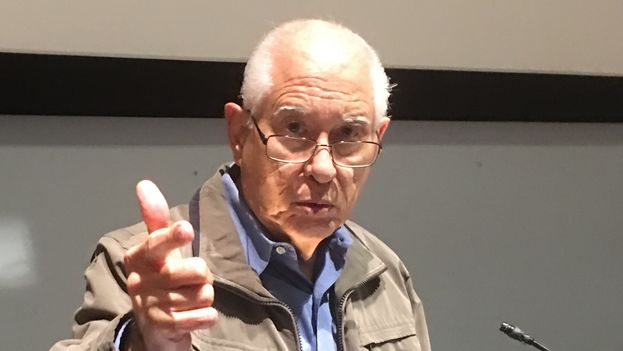
Cuban economist and academic Carmelo Mesa Lago. (14ymedio)

14ymedio bigger14ymedio, Maité Rico, Madrid, 1 June 12017 — Carmelo Mesa-Lago (born Havana, 1934) has spent a good part of his life trying to open a breach of good sense in the wall of absurdities with which that the Castro regime has ended up plunging into bankruptcy a country that was, in the 1950s, the third most developed in Latin America after Argentina and Uruguay.

A Professor Emeritus of the University of Pittsburgh in Pennsylvania, he has just presented in Madrid the only study on the private sector in Cuba (Voices Of Change In The Cuban Non-State Sector, published by Iberoamericana-Vervuert), based on interviews with 80 self-employed individuals. continue reading

Armed with the best statistical data, this economist views with perplexity how the economic reforms announced by Raúl Castro in 2010 are being diluted (“the Government takes one step forward and four steps back”), and how the country is losing the opportunity that was offered to it last year by the reestablishment of bilateral relations with the United States.

It was precisely Barack Obama’s outstretched hand that sowed panic in the Government, which fears that economic openness will lead to political change. Now there is a brake on the reforms, there are no investments, and the crisis in Venezuela, which replaced the USSR as Cuba’s economic supporter, has plunged the country into disaster.

Rico: Is Cuba entering a new “Special Period” [a euphemism to describe the period of hardship that followed the fall of the USSR and the end of aid to Cuba]?

Mesa-Lago: The situation is similar, but not so dramatic, because the dependence on the Soviet Union was much greater than that on Venezuela. That said, the trade volume with Venezuela has dropped significantly (from 42% to 27% in 2015) and the supply of oil has declined from 105,000 barrels a day to 55,000.

Cuba sold a part of that oil in the world market, and it was an important source of income that has also fallen by half. And another income that has fallen is the most important one: the sale of professional services (doctors, nurses, teachers) [to foreign countries], which went from 11 billion dollars in 2013 to 7 billion. In 2015, GDP growth was 4.4%. In 2016, it was minus 0.9%. Everything points to a very strong crisis, but I do not think it reaches the level of the Special Period.

Rico. At least, within this parasitic economy, tourism remains.

Mesa-Lago. There is a boom, for the first time they exceeded four million tourists and took in about 4 billion dollars. The problem is that this gross income has to be subtracted from the value of imports of goods and supplies for tourists. Cuba has to import everything. And that data is no longer published. So it’s not 4 billion. It’s less, but we do not know how much.

Rico. Despite the announcement of the investment plan and Obama’s trip, foreign investment has not materialized and the Special Development Zone in the Port of Mariel, the big Brazilian bet, is quite inactive.

Mesa-Lago. It is inexplicable. Cuba needs [new investments of] at least $2.5 billion a year. Until last month there were some 450 proposals for foreign investment, some of them already established in Cuba. And they have only approved some twenty of them. According to their figures, since the opening of the Port of Mariel Special Development Zone the cumulative figure has not reached 2 billion dollars. Why do they do this? It does not make sense to me.

Rico. But what can Cuba offer, beyond cheap labor? The system of production is destroyed.

Mesa-Lago. The infrastructure is a disaster. And the workforce, which is qualified, works extremely slowly. For the construction of the Manzana hotel, Kempinski brought workers from India because they were more productive. The problem is that the Cuban worker earns very little and is paid in Cuban pesos (CUP), and has to buy most things in convertible currency (CUC), and they can’t support themselves. There is no incentive, and it is a vicious cycle. Between 1989, the year before the crisis, and 2015, the purchasing power of Cubans fell by more than 70%.

Rico. And when are they going to solve the problem of the dual-currency system?

Mesa-Lago. Raul has announced it many times and two years ago made a very complicated resolution, full of equations. But nothing happened. The problem is that inflation will be about 12% this year, it is very high. And the unification of the currency, by itself, generates inflation. So I find it difficult to see them doing it in the short term. In addition, they must first do it in the state sector, and there will be companies that will cease to be sustainable, and then comes the population. It’s going to be a longer process than in Vietnam and probably in China.

Rico. How many workers has the state fired since the reforms began?

Mesa-Lago. They announced that between 2010 and 2015 they were going to lay off 1.8 million unnecessary workers, but in the end it was half a million. The private sector did not advance as rapidly as needed to create all those jobs, and there would have been a social explosion.

Rico. But why does private activity grow so slowly?

Mesa-Lago. Because of all the obstacles. It is as if the right hand doesn’t know what the left hand is doing. There are many activities that the Government has closed down or rescinded [the permission for, after initially granting licenses]: clothing sales, 3D movie theaters … now they have begun to regulate prices for private taxis and on the sale of homes, and to interfere in the free agricultural market. Taxation is brutal. There are something like seven taxes. The Government punishes those who succeed and who could help the State solve its problems. It is not logical.

Rico. And how do you explain it?

Mesa-Lago. The only explanation I have is that in Cuba there is no unified leadership with a single opinion, but there is a group that resists. Obama’s visit had a very positive impact on the population, but the government panicked. From there came a a paralysis. The most hardline group, the most orthodox, came out stronger than ever.

Rico. Are the Armed Forces putting obstacles in the way?

Mesa-Lago. Yes, and the Party, but the Army is more important because it has economic power. And it has like a reverse Midas touch. Everything it touches it turns to garbage … Restaurants, hotels … It is impressive.

Rico. The self-employed people interviewed agree on their problems: scarcity and lack of inputs, regulatory overspending, taxes, difficult access to the internet …

Mesa-Lago. Yes, and in spite of the continuous obstruction of the State, 80% of them are satisfied with what they do (although not with what they earn). And 93% made profits, and most reinvested them into their business. That is extraordinary.

Rico. Will the team in power be able to make the transition?

Mesa-Lago. If Raúl Castro, in ten years, has not pushed the reforms, I doubt that his successor can be more successful. Political logic prevails over economic logic. And they fear losing control.

_____

Editorial Note: This article was previously published in the Spanish newspaper El País and we reproduce it with authorization of the author.