
Trump, The Military And The Division Of Powers In Cuba

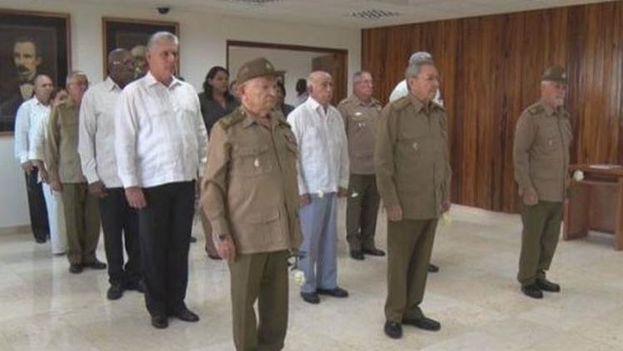
Members of the Revolutionary Armed Forces are present in all of Cuba’s power structures. (Prensa Latina)

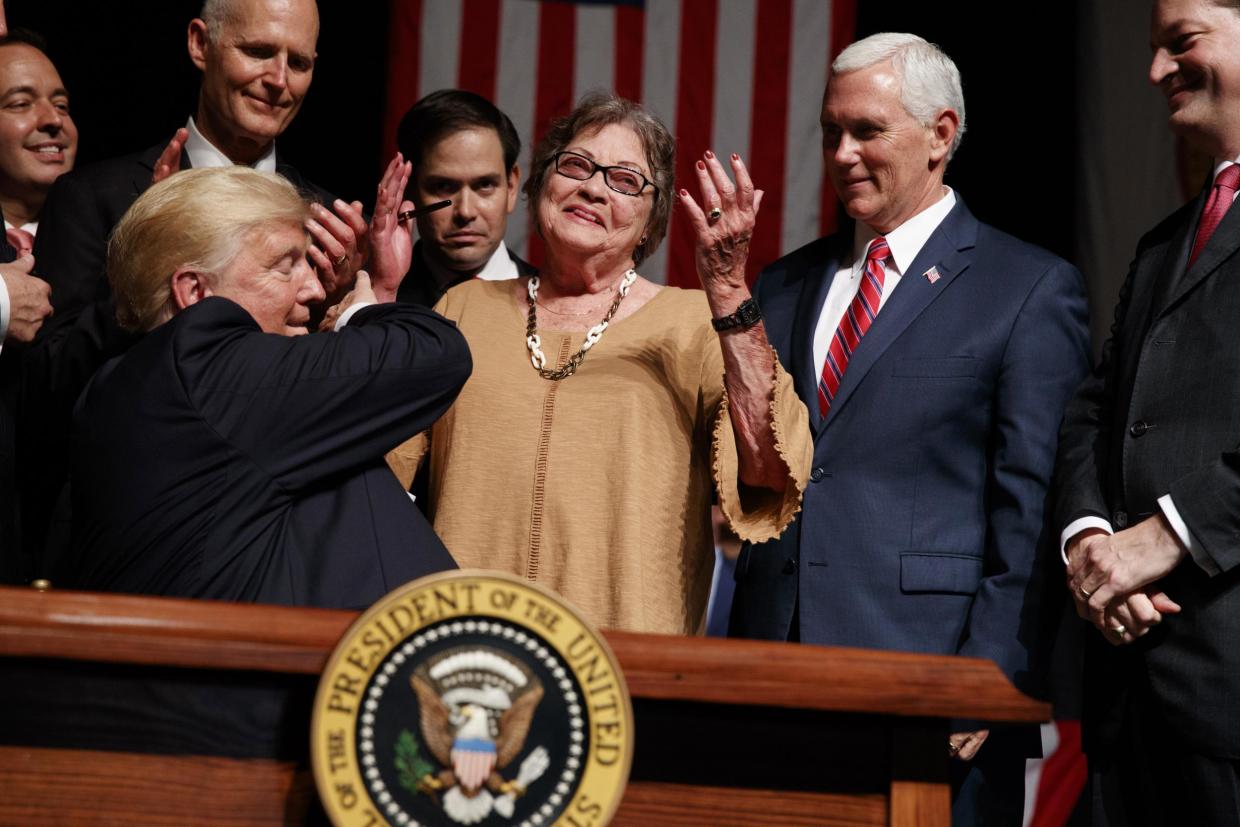
14ymedio bigger14ymedio, Reinaldo Escobar, Havana, 20 June 2017 — The recent decision by the president of the United States to limit commercial relations with Cuban companies controlled by the military highlights a rarely explored corner of the national reality.

Anyone who knows the Island minimally knows that there is nothing like what can be called a “division of powers” here. It was demonstrated recently when the deputies to the National Assembly of People’s Power unanimously raised their hands to “back” some program documents from the Communist Party, documents that the deputies had no legal capacity to approve but politically could not disapprove.

In other countries, it is to be expected that Congress will oppose what the Executive has proposed or that the Judiciary will rule unconstitutional what a Parliament has approved. In most nations, when some measure, new policy, or any law is applied, analysts wonder how the unions will react or what the students are going to do. In Cuba it is not like that. Those who rule give the orders and the rest obey or go to jail. continue reading

The ostensible presence of individuals from the military sector in power structures, especially in economic management, may lead one to think that the army enriches itself this way and that having so many resources in its hands makes it easier for it to repress the people. This reasoning thus forms part of the belief that there is some kind of division of powers and that introduces a huge error in the analysis.

The presence of colonels and generals (retired or active) in charge of tourism companies such as Gaviota, or powerful consortiums such as Gaesa, Cimex and TRD among others, may not mean the militarization of the economy as much as it means the conversion, the metamorphosis, of soldiers into managers.

Devoid of or “healed” of an authentic “working-class spirit,” they handle with the iron fists of ruthless foremen – loyal to the boss – any dispute with the workers. Their habits of discipline lead them to do what they are ordered to do without asking if it is viable or absurd. They do not demand anything for themselves and anything that improves their standard of living or working conditions (modern cars, comfortable homes, trips abroad, food and beverage baskets…) will be considered as a favor from the boss, a privilege which can be paid for only with loyalty.

Although difficult to believe, they are not backed by their cannons or their tanks, their influence is not determined by the numbers of their troops or the firepower of the armaments they control, but by the confidence that Raúl Castro has in them. It is as simple as that.

When we review the extensive documentation issued by the different spheres of the outlawed political opposition, or by the officially unrecognized civil society, we can barely observe any protest against the dominance that the military has gained over the economy in the last decade.

Civil society’s priorities are different. The liberation of political prisoners, the cessation of repression, freedom of expression and association, the right to choose leaders in plural elections… In the area of ​​economics, what is being questioned are the difficulties faced by private entrepreneurs in starting a business, limitations on access to the international market, excessive taxes, and the plunder to which the self-employed are subjected to by the inspectors.

The most perceptible concern in this sense is that placing these soldiers in key points of the economy is engineering the future economic empowerment of the ruling clans in a virtual piñata, which implies self-annihilation of the system by the heirs of power.

If it were not so dramatic it would be laughable to imagine the infinite solutions that the Cuban rulers have to circumvent “the new measures” announced by the president of the United States. All they have to do is change the name of the current monopolies and place civilian leaders in charge of supposed “second level cooperatives,” already foreseen in Guideline 15 from the 7th Congress of the Communist Party of Cuba.

This magic trick or, to use a Cubanism, “shuffling of the dominoes” would force the mammoth American bureaucracy to make a new inventory of entities with which trading is forbidden. “As the stick comes and goes,” they reorganize their forces while remaining at the helm of the country and watching Donald Trump’s term expire.

To perform this trick it will not be necessary to gather the Party together in a congress, nor to consult the constitutionalist lawyers, they would not even have to inform the Parliament. To make matters worse, in the streets there will be no protest against the chameleon gesture of the military exchanging their uniforms and their weapons for guayaberas or business cocktails.
Sweating Is Not For Cuba’s New Rich

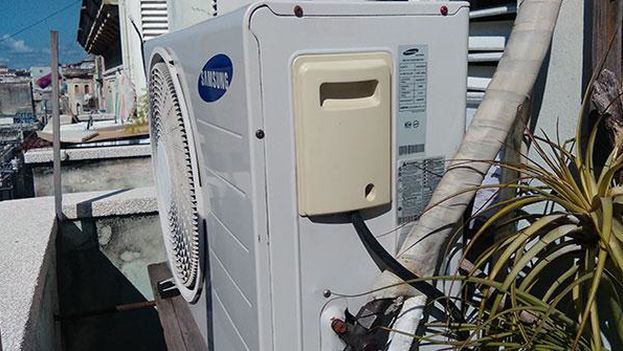
In recent years the supply of air conditioners in the informal market has increased considerably. (J. Cáceres)

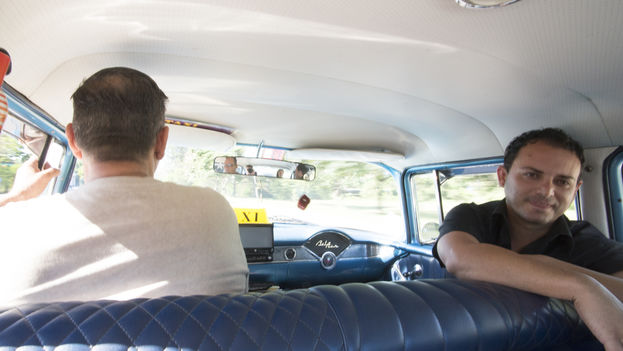
14ymedio bigger14ymedio, Zunilda Mata, Havana, 20 June 2017 — The passenger complains of the heat while frantically moving the fan. “In a few days I will install an air conditioning,” justifies the taxi driver and adds that he will charge “higher fares.” In summer everyone dreams of air-conditioning their rooms or vehicles, but whether or not one suffers the heat depends on the pocketbook.

In 2013, after eight years of prohibition, the government authorized travelers to import air conditioners, electric stoves, refrigerators and microwave ovens. It was the starting shot for an avalanche that invades the airports, the port terminals and the shipping agencies to Cuba.

“Six ‘splits’ (air conditioners) came on that flight,” said an employee of Terminal 3 at José Martí International Airport in Havana. The plane from Cancun, a route greatly appreciated by the mules, also brought a dozen flat-screen TVs, eight minibars and two desktop computers. continue reading

Among the boxes that are piled around the luggage belt are the units that will be placed inside rooms and others that will be placed on a roof or an outer wall, a cruel irony, because in the main airport of the country travelers complain about the heat and drip fat beads of sweat while waiting for their suitcases.

“It is difficult to know the number of AC units entering each day,” says the employee. “It is rare that a flight arrives from Panama, Mexico or any other nearby country that comes without at least two devices.” In the lines to pay for overweight luggage and the import of domestic appliances one sees the new arrivals loaded with bundles.

Permanent residents in Cuba, national or foreign, can import two air conditioners of up to one-ton capacity on each trip. On the first occasion only – over the space of a year — they pay tariffs in Cuban pesos at a price ranging from 150 to 200 CUP (roughly $6 to $8 US). For additional imports they pay that amount in convertible pesos (CUC – roughly $150 to $200 US).

The business is booming. Even paying in CUC the traveler can resell a one-ton air conditioner on the black market for about 650 CUC, for a device that originally cost less than 350 dollars. The brands that enter most frequently are Midea, LG, Carrier, Royal, Daewoo and Prestiger. Prices have fallen by up to 30% since the imports were authorized and given the volume of supply that trend will continue.

State stores try to compete with the “under the counter” sales but have higher prices, fewer models and shortages that make the supply unstable.

The air conditioners have slowly been incorporated into the landscape of cities and towns. If before the economic relaxations they were installed discreetly, now with a more open economy the tendency is to exhibit them.

“The people living there have cash,” says Igor, a pedicab driver who waits for his clients in the vicinity of the Plaza de Carlos III. While pedaling and showing some parts of the city, the cyclist glances at these signs of families with money. “Wherever there is an air conditioner they are affluent,” he muses. Not only does acquiring one of these devices mark membership in a social group, the most difficult thing is to pay for its operation.

Much of the electricity supply remains subsidized. “The average monthly consumption in the residential sector in 2013 was approximately 180 KWh per customer,” said Marino Murillo. For that amount a consumer pays 36.60 CUP, “while the cost to the state is 220 CUP,” said Cuba’s vice president.

Keeping a one-ton air conditioner on all night can trigger electricity consumption above 400 CUP monthly, the entire salary of a professional. However, many families decide to do so, overwhelmed by the heat or because they want to rent rooms to foreigners.

“Air conditioning and hot water cannot be lacking in this business,” says Rocío, who operates a colonial hostel in Trinidad with his mother. With three rooms for rent, each with AC, minibar and television, the entrepreneurs pay a four-digit electricity bill. They consider that, even so, it “brings in business” in an area with a high occupation rate throughout the year.

In November 2010, a new progressive electricity rate began to be imposed, which imposes a penalty of up to 300% on households that consume more than 300 KWh per month, a situation that has triggered electricity fraud.

An engineer from the Electricity Company in Havana told 14ymedio about the new ways in which citizens seek to steal electricity. Before there were “visible” cables that were easy to detect or they tampered with the meters in a way that technicians noticed right away, but now they conspire with the workers who repair the streets and get the cables installed underground.

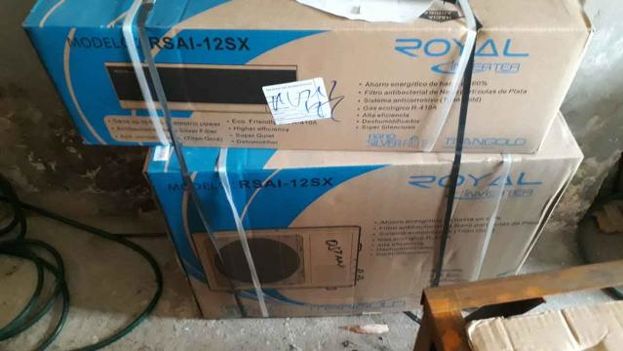
In 2013 the Cuban government authorized travelers to import air conditioners, electric stoves, refrigerators and microwaves. (J. Cáceres)

The specialist says that there are “people whose homes abut state entities and they steal electricity from a company, a warehouse, a carpentry workshop or even a polyclinic.” He says that almost always “it is a cases of people who have some highly customer-based business, like an electric oven to make pizzas, a body shop, a private restaurant or a lot of air conditioners.”

The engineer recalls a family in which “even the youngest children had AC in their room and left it on all day.” A neighbor reported the situation when he learned that they paid a very low electricity rate. The complaint brought the inspectors and they discovered that the meter was tampered with. In addition to the fine “they had to pay retroactively all that they owed.”

To counter fraud, analog meters were replaced by digital ones and in some areas of the country they are being changed again for new ones with infrared technology. But the tricks are inexhaustible.

“The upstairs neighbor lives alone and is retired, and he passes the cable with electricity to me and in return I also pay for his consumption,” says a prosperous entrepreneur who runs a coffee shop on Zanja Street. “So I share the consumption and it’s not as expensive” because it prevents all the kilowatts going on a single account with the consequent progressive surcharge.

The customer has three air conditioners installed throughout the house. “Without this you can not live here, because this house hardly has windows to the outside and the kitchen of the business generates a lot of heat,” he explains. He bought the devices in the informal market and is waiting for them “to lower prices a little” to buy a room.

“It is not the same to be Cuban with a fan as it is to be a Cuban with AC,” he reflects. “The first one is irritated but the second is less stressed because he has air conditioning.”

Cuba From The Inside With Alternative Tour Guides

Independent guides show what the state-run companies leave out.

14ymedio bigger14ymedio, Marcelo Hernandez, Havana, 21 June 2017 — Economic hardships turn many Cuban engineers to work as bartenders, doctors become taxi drivers and innumerable professionals become alternative guides for tourists. Among the latter, there are the experienced or the just-getting-started, but all of them earn more money than they would working in the state sector.

“When they change a picture I know instantly,” says Natacha, a Havana city guide who says she has visited “the Museum of Fine Arts more than 300 times” with her clients. She graduated from the Teaching Institute but she left the classrooms after five years of teaching in junior high.

“I had to think about what to do with my life and I realized that I spoke Spanish very clearly, I knew the history of Cuba and I was good at dealing with people.” A friend advised her to start offering tours to foreigners who came to the country. continue reading

At first, Natacha stood in a corner of Old Havana and whispered her services to travelers. Now, after the relaxations regarding self-employment, she has been able to legalize part of her activities and form a team. “We have a network that includes rental houses, dance teachers, masseuses and chauffeurs,” she says.

With the increase in tourism, which last year exceeded 4 million visitors, the guide has “a surplus of work,” but now fears that after the announcements of US President Donald Trump that “the business will decline.”

Natacha accompanies her clients “to places where a state guide will never take them…The program is flexible according to their tastes: from exclusive areas to poor neighborhoods, trips in collective taxis, a train ride and a santería party.”

She speaks English and French fluently and recently began studying Italian and Japanese. “Japanese tourism is still small but they pay very well and are very respectful people,” says Natacha. Most of her clients end up recommending her services to a friend who wants to travel to Cuba. “This is a chain of trust that has allowed me to have up to 200 customers a year.”

The prices of a walk with the former teacher vary. “They can go from 20 to 100 CUC (roughly $20 to $100 US) depending on the place, the time and the complexity of the subject.” For years she included visits outside of Havana but now she has left these to her younger colleagues because her mother is very old and she doesn’t want to leave the city.

“This work is hard because it takes a lot of personal involvement, learning something new every day and answering many questions,” she explains. “I spend hours walking, most of the time under the sun, but I would not give up my independence by going back to teaching.” She says that being a tourist guide has allowed her to “put a plate of food on the table every day… a good plate of food.”

A growing alternative is digital sites that advertise independent guides and offer a wide variety of services or entertainment packages. Recently a team of 30-something Cuban residents in Miami launched Tour Republic, a website to sell recreational activities on the Island.

The site connects the traveler with urban guides with a marketplace – similar to Airbnb – but instead of offering lodging it markets tours of varied intensity and duration, from a ride in a classic car through Havana, to an escape through the unique natural landscape of the valley of Viñales.

Máximo, a 30-year-old Italian newcomer to Havana, was hesitant Tuesday about whether to buy a three-day package worth $58 including visits to the Ernest Hemingway Museum, the University of Havana, the old colonial fortresses of the capital, and even an encounter with the sculpture of John Lennon located in a Vedado park.

With Tour Republic the customer pays the online service and must be at the site where the itinerary begins at the agreed-upon time. In the case of the tour that interests Maximo, the guide is at the bottom of the steps of the Capitol and departs every morning at ten.

The tourist says he prefers an independent guide because “the program is more flexible and can be adjusted more” to what he wants. In a small notebook he has noted some interesting places that escape the typical tourist route: the town of San Antonio, the Superior Art Institute and the Alamar neighborhood.

“In this arena there are people very prepared and with excellent training,” says Carlos, an alternative guide who leaves the statue of José Martí in Central Park every morning for a tour he has baptized Habana Real. “I take them through the streets where tourists do not normally pass, I have them try a drink of rum in a bar where the Cubans really go,” he says.

The young man, with a degree in geography, has been “wearing out shoe leather in the city for seven years.” At first “I did not know much about history, architecture or famous people, but little by little I have become an itinerant encyclopedia of Cuba,” he says.

The GuruWalk platform has also risen to the crest of the wave of tourist interest in Cuba. The Spanish company runs an international website for free walking tours and has chosen Havana as their preferred site to begin operations.

Communications director, Pablo Perez-Manglano, told 14ymedio that “the platform is completely democratic, anyone can join and create a tour.” Site administrators check the offers one by one, but the reviews are left to users after each visit.

“We are an open and free platform, we do not charge the guide or the visitor anything, and therefore, we hope that each person understands and takes responsibility to comply, or not, with the legality in their respective cities of the world,” he clarifies.

The site already has seven free tours in Havana, one in Santiago and another in Santa Clara. “In addition, we had about 200 registered users in the last month, which is a lot for such a new platform,” says Pérez-Manglano.

Unlike Tour Republic there is nothing to pay online and the money is delivered directly to the guide.

The perspectives that the web offers for entrepreneurs like Natacha sound promising. GuruWalk does not deny “entry to someone for not having an official guide qualification.” Rather, it seeks “people who are passionate about culture and history, who also enjoy teaching and transmitting that knowledge.”

One of the strategies of the company is to make itself known among “the owners of private houses” because it is to them that more often the foreigners ask: “What should we see in the city?”

Pérez-Manglano underlines that the cornerstone of GuruWalk is the “collaborative economy.” Instead of “certificates, rules, rules, or permits,” they are interested in trust, which “is built little by little.”

Thanks for Nothing, Trump

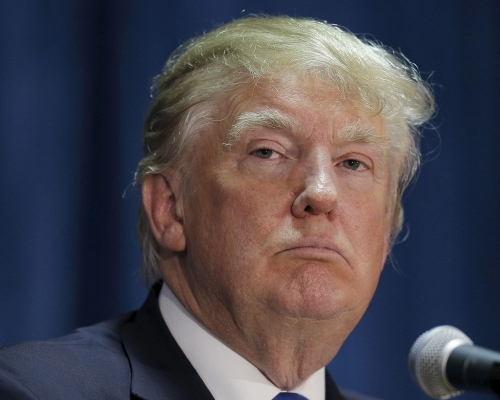
Donald Trump (Photo: Brian Snyder/Reuters)

cubanet square logoCubanet, Miriam Celaya, Havana, 21 June 2017 — After much media frenzy, Trump’s “new policy” toward Cuba has not gone beyond the rhetoric expected by most political analysts. His act was more a symbolic gesture towards his faithful than any practical novelty. In short, those who expected an announcement of truly transcendental changes in the policy toward Cuba by the US president during his speech in Miami on Friday June 16, were left wanting. As we say in Cuba, the show turned out to be more rigmarole than movie reel.

The long-awaited changes, far from being novel, are actually quite limited. In fact, the highlight of his announced “punishment” for the Castro dictatorship is enveloped in an inconsistent magic trick where the essential cards seem to be a ban on US businessmen to negotiate with Cuban military companies, the suppression of non-group tours visits by US citizens to Cuba and the auditing of group visits. The rest is garbage. continue reading

The whole of the Palace of the Revolution must be shaking in terror. The dictatorship can already be considered as having failed: judging by the enthusiasm of its fans gathered in the Manuel Artime Theatre in Little Havana, with Trump in power, the Castro regime’s hours are numbered. Those who know about such things say that the Castros and Miami’s “Dialogue Mafia” “have run out of bread,” that “the political actors (?) are now where they should be” And that Trump’s speech was “friendly towards the Cuban people.” If the matter were not so serious, it would probably be laughable.

The sad thing is that there are those who believed the sham, or at least they pretend to believe what he said. At the end of the day, everyone should stick to the role of the character he represents in the script of this eternal Cuban tragicomedy.

It would be another thing if all this elaborate anti-Castro theory (!) could be successfully implemented, which is at least as dubious as the construction of socialism that the extremists continue to proclaim from opposite points on the globe.

And it is doubtful, not only for the intricacy of the long process that each proposal of the US Executive branch must follow before being put into practice — as detailed in a White House fact sheet — but because its sole conception demonstrates absolute ignorance of the Cuban reality in trying to “channel economic activities outside the Cuban military monopoly, GAESA.”

It would seem that there is a division of powers and an autonomy of institutions in Cuba that clearly distinguishes “military” from “civil,” defines its functions and establishes to what extent the economic structure of companies, cooperatives and other sectors are or are not related to the military entrepreneurship, or with the State-Party-Government monopoly itself, which is one and the same, with which, nevertheless, relations will be maintained. Just that would be a challenge for Cubans here, let alone for those who emigrated 50 years ago or for the very Anglo-Saxon Trump administration.

On the other hand, Mr. Trump’s proposals carry another capricious paradox, since limiting individual visits would directly damage the fragile private sector — especially lodging and catering, not to mention independent transportation providers, and artisans who make their living from selling souvenirs and other trinkets, a market that is sustained precisely by individual tourism.

Tour group visits, which remain in effect, are those that favor the State-owned and run hotels, where these groups of visitors usually stay because they have a larger number of rooms and more amenities than privately-owned facilities.

This would be the practical aspect of the matter. Another point is the one relating to the merely political. It’s shocking to see the rejoicing of some sectors of the Cuban-American exile and the so-called “hardline opposition” inside Cuba, after the (supposedly) “successful” speech by the US president, and his pronouncements about benefits that the new-old politics of confrontation will bring “to the Cuban people” in the field of human rights.

In fact, such joy is hard to explain, because it is obvious that Trump’s speech fell far short of the expectations these groups had previously manifested. One of the most supported claims of this segment has been the break in relations between both countries, and, more recently, the reinstatement of the policy of “wet foot/dry foot,” repealed in the final days of the previous administration. Far from that, the unpredictable Trump not only reaffirmed the continuation of diplomatic relations, but omitted the subject of the Cuban migratory crisis and even the suppression of aid funds for democracy, which he had proposed a few weeks before.

Curiously, no member of the media present at the press conference held after the very conspicuous speech asked uncomfortable questions about any of these three points, which do constitute true pivots of change in US policy towards Cuba which affect both the fate of the Cubans stranded in different parts of Latin America on their interrupted trip to the US, and the financing (and consequently, the survival) of various opposition projects both inside and outside Cuba.

The truth is that, so far, the great winner of Trump’s proposals is none other than the Castro regime, since the rhetoric of confrontation is the natural field of its ideological discourse inside and outside Cuba. Thus, has rushed to evidence the official declaration blaringly published in all its press monopoly media last Saturday, June 17th, with plenty of slogans and so-called nationalists for the defense of sovereignty and against “the rude American interference”, which that gray scribe, Bruno Rodríguez Parrilla, Cuban chancellor by the grace of the divine green finger, repeated two days later in his apathetic press conference from Vienna.

Meanwhile, the “Cuban people” – with no voice or vote in this whole saga — remains the losing party, barely a hostage of very alien policies and interests, whose representation is disputed by both the dictatorship and the US government, plus a good part of the opposition.

We must thank Mr. Trump for nothing. Once again, the true cause of the Cuban crisis — that is, the dictatorial and repressive nature of its government — is hidden behind a mask, and the “solution” of Cuba’s ills is again placed in the decisions of the US government. At this rate, we can expect at least 50 additional years of burlesque theater, for the benefit of the same actors who, apparently and against the odds, have the

Translated by Norma Whiting

Cubans Feel Like Hostages to Both Castro and Trump / Iván García

Photo Montage Credit: Cubanos Por El Mundo

Ivan Garcia, 19 June 2017 — “Impotence.” This is the word that a performer in the Guiñol Theater (located in the basement of the FOCSA building in Havana’s Vedado district) uses when asked her opinion of the new Trump Doctrine regarding Cuba.

On a day of African heat, a group of eight waits to navigate the Internet in a hall administered by the state-run telecommunications monopoly ETECSA. The performer exchanges opinions with the others regarding the event of the week: the repeal by Donald Trump’s administration of Obama’s policy of détente. continue reading

On the street, for those Cubans who earn only token salaries, breakfast on coffee alone and complain constantly about the inefficiency of public services and the government’s inability to improve the quality of life, political machination is just an annoyance.

Human Rights, democracy and political liberties all sound good, but they are not understood in their full context. At least, this is what can be deduced from the opinions expressed by the people waiting in line. Some make clear that they are speaking from their personal perspective, that they watched Trump on Telesur but have yet to read the measures for themselves.

For lack of time, and the propaganda fatigue brought on by the barrage from the official press–which has caused many compatriots to decide to not keep up with news reports but instead take shelter in social-media gossip–the group waiting to go online is shooting to kill in all directions.

“Everybody talks about ’the people,’ about the ’dissidents,’ about the Cuban American congressmen over there, about the government over here, but nobody has hit on the formula for us to derive benefits from a particular policy. Obama tried, but the gerontocracy that rules us did not allow private business owners to get ahead. I feel like a hostage, to Castro and to Trump. A puppet,” the performer confesses.

One lady, a loquacious and chain-smoking housewife, asks, in a tone of disgust, “What have the people gained from Obama’s policy? Nothing.” And she explains to herself, “Those people (the government) don’t want to change. They will not give up,” she says ironically, “the honey of power. Trump is a crazy man, a clown. The guy is a pill. His speech was pure theater. It’s all cheap politicking. And in the middle of it all, we Cubans are–and will remain–screwed. Nobody can change this [regime], and nobody can take it down, either.”

A self-employed worker affirms that he does not see a solution to Cubans’ problems because “we haven’t had the balls to confront the arbitrariness of the government. To hold on and and get screwed, that’s our fate. With all his yammering, the only thing Trump will achieve is that the ’revolutionary reaffirmation’ marches will start up again, condemning ’yankee interference.’ You can already see that coming.”

At a park in Old Havana there are no optimists to be found, either. On the contrary. “Damn, brother, I thought that The One was going to put back the Wet-Foot/Dry-Foot law. The only way this shit’s going to be resolved is letting people leave Cuba. You think that over here the folks are going to sign up with the Ladies in White to get beaten up? No, man, people will mind their own business, getting by under the table and trying to scrape together a few pesos. There is no way that Cubans will take to the streets. Unless it’s to get in line at foreign consulates, or if Gente de Zona put on a free concert,” declares a young man in the Parque del Curita, waiting for the P-12 line to Santiago de las Vegas.

Almost 60 years since the protracted and sterile political arm-wrestling between the various US administrations and the Castro brothers, a broad segment of the citizenry sees itself caught in a no-man’s land–in a futile battle for which nobody, not the Cuban rulers nor the US, has asked their permission. They think also that political naiveté has always reigned supreme in the White House, given the oft-repeated intentions to export democratic values to a fraternity of autocrats with the mentality of gangsters and neighborhood troublemakers.

“It is a narrative replete with personal ambitions, pseudo-patriotic elation and cheap nationalism, which has served only to consolidate a history of sovereign and intransigent rulers who never allowed North American interference. It’s fine for a tale, but this politics of confrontation on both sides has left only one winner: the regime of Fidel and Raúl Castro. The rest of us have been the losers. Those who were not in agreement with the Revolution or who wanted to emigrate were called ‘gusanos‘ [worms]. Families were split up and kept from having contact with relatives in the US. The result of all this is what we see today: a great number of Cubans who cannot tolerate those who think differently from them, many who want to emigrate, women who don’t want to have children in their homeland and, in general, a great indifference on the part of citizens towards the problems of their country,” explains a Havana sociologist.

The official reaction has been restrained. For now. A functionary with the Communist Party assures me that “the government is not going to wage a frontal campaign to discredit Trump. Yes, of course, the various institutions of the State will mobilize to demonstrate that the government has it all under control. But Trump’s speech was more noise than substance. Except for the matter of US citizens’ travel to Cuba, which undoubtedly will affect the national economy, the rest [of the Obama-era policies] remains in place, because the military-run businesses are only two hotels.

The owner of a paladar [private restaurant] in Havana believes that “if the yumas [Cuban slang for Americans] stop coming there will be effects on the private sector, because almost all of them stay in private homes, travel around the city in convertible almendrones [classic cars], and eat lunch and dinner in private paladares.”

The news was not good for Cubans who had plans to emigrate to the US. “Many dreamers thought that Trump was a cool guy and would reinstate the Wet-Foot/Dry-Foot policy. I was not expecting as much, but I thought at least that the Cuban-American congressmen would influence Trump’s allowing the exceptional granting of visas to Cubans stuck in Central America, Mexico and the Caribbean, and reactivating the asylum for Cuban medical workers who have deserted their missions,” said a engineer who dreams of resettling in Miami.

The perception right now among Cubans on the street is that they are back to a familiar scenario. One of trenches. Replete with anti-imperialist rhetoric and zero tolerance for liberal thought of any stripe. The scenario most favorable for the hierarchs who dress in olive green.

Translated by Alicia Barraqué Ellison

A Bad Bet / Fernando Damaso

Fernando Dámaso, 13 June 2017 — Of the real and supposed problems that the Cuban Revolution proposed to solve, as the basis of its historical necessity, after more than half a century of exercising absolute power, many have not been solved, the majority have been aggravated, and others have emerged that did not exist before.

The housing shortage, the thousands of families living in precarious and overcrowded conditions, and more thousands housed in inadequate locations, constitute a clear demonstration of the Revolution’s failure. Insufficient and inefficient public transit, for years incapable of meeting the minimum needs of the population, and the appalling and unstable public services of all types, show another face of the failure. If we add to this the loss of important agricultural outputs, the obsolescence of the industrial infrastructure (lacking upgrades and needed investments), plus a generalized lack of productivity, the situation becomes chaotic. continue reading

Nor have the political and the social spheres achieved what was promised, what with the continued absence of freedoms and basic rights for citizens, as well as low wages and pensions, covert racial and gender discrimination, street and domestic violence, incivility, antisocial behaviors, corruption, and disregard for flora and fauna.

The blame for this string of calamities has always been cast upon the embargo–but even back when it went unmentioned while the country was benefitting from enormous Soviet subsidies* these problems went unresolved. At that time, the abundant resources were squandered on foreign wars, backed insurgencies, absurd and grandiose failed plans, and other frivolities.

The socialist state and its leaders, albeit abusing the revolutionary rhetoric, have reliably demonstrated in Cuba that the system does not work and is unfeasible–just as happened in the other socialist countries which erroneously bet on it.

To propose a “prosperous, efficient and sustainable socialism” is to propose a negation, and it constitutes no more than another utopia to deceive the citizenry and detain the march of time a little longer–knowing that, at the end, it will fail as it has up to now. Socialism, perhaps attractive in theory, is in practice a failure. A bet on it, in any of its forms, is to ensure a loss.

Translator’s Notes:

*Before the fall of the Soviet Union in 1989 and the start of Cuba’s “Special Period.”

Translated by: Alicia Barraqué Ellison

The Cuban Republic: Buried by Official Decree / Iván García

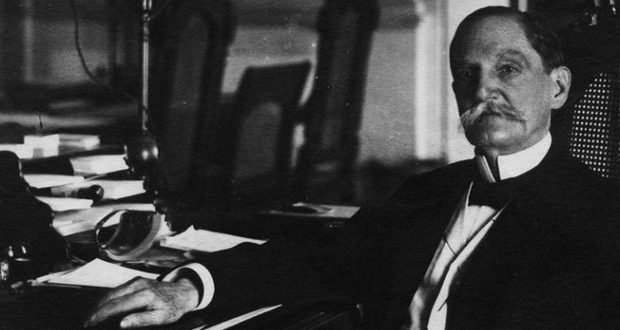
Photo of Tomás Estrada Palma by Remezcla. During his exile in Tegucigalpa, Estrada Palma met a Honduran woman, Genoveva Guardiola, whom he married in May of 1881. The marriage produced seven children: José Manuel, Tomás, Andrés, Carlos, Maria de la Candelaria, Mariana de la Luz and Rafael.

Iván García, 24 May 2017 — May 20 of this year with mark the 115th anniversary of the birth of the Republic of Cuba. In the Throne Room of the Palace of the Captains General, a building which now serves as the City Museum, Tomás Estrada Palma — born in Bayamo in 1835, died in Santiago de Cuba in 1908 — would go down in history as the first popularly elected president of the republic.

With heat bouncing on the asphalt so intensely that even stray dogs seek shelter under covered walkways, I go out to inquire about the May 20 anniversary.

Four pre-university students in their blue uniforms have skipped class to go to Córdoba Park, a free wifi zone in the 10 de Octubre district. They want to check out their Facebook wall, chat with relatives in Miami and read the latest soccer blog from the Spanish newspaper Marca. continue reading

Though the heat is stifling, the young men do not even notice it. They are eating ice cream cones, joking, gesturing and shouting at each other. Striking up a conversation with them is easy. They are seventeen-years-old and all four of them say that they hope to go to college when they finish high school. When I ask them if they know on what date the Republic of Cuba was founded, they hesitate and look at each other, trying to come up with a correct answer.

“January 1, right?” two of them respond simultaneously.

“You guys are so dumb,” says another, mocking his cohorts. “Independence day is 10 October, when Carlos Manuel de Céspedes freed his slaves.”

Another justifies his ignorance with the excuse that he does not like history. “That subject is a drag. You mechanically learn to answer exam questions like that, but the next day no one remembers the dates or what they commemorate.”

A man selling popcorn, who has been eavesdropping on the conversation, sums it up by saying, “There are a lot of opinions on this topic. Whether it was January 1 or October 10. But I think it was 1492, when Christopher Columbus discovered the island.”

It seems only academicians, professors, students of history and well-informed citizens can explain the significance of May 20, 1902 in the context of national history. Most Cubans are unaware of it. Keep in mind that around 70% of the current population was born after 1959.

For people over the age of sixty-five like Giraldo — from his wheelchair he asks people walking along the side streets of the nursing home where he lives for cigarettes and money — the date brings back fond memories.

“It was the most important day of the year,” he says. “The tradition was to debut a new pair of shoes and a change of clothes. Cuban flags were hung from balconies. I would go with my parents and brothers to Puerto Avenue. In Central Park there were public concerts by the municipal band. The atmosphere was festive. But this government erased it all from popular memory. Now the dates that are celebrated are those that suit them.”

While Cubans living in Miami enthusiastically celebrate May 20, in Cuba it is a day like any other. That is how the military regime wants it.

Dictatorships have a habit of manipulating events. Just as the official narrative would have us believe that José Martí was an admirer of Marxist theories, so too does a military confrontation take on aspects of science fiction. This is what happened in 1983 in Granada. According to the Castros’ version of events, during the invasion of the country by U.S. forces, a group of Cuban workers sacrificed themselves while clutching the Grenadian flag.

For Cuba’s ruling military junta, the past is something to be erased. Economic, urban infrastructure and productivity gains achieved in the more than half century that the republic existed do not matter.

In an article published in Cubanet, independent journalist Gladys Linares recalls that in 1902, as a result of the war for independence, “agriculture, livestock and manufacturing were in a disastrous state. In a gesture of great sensitivity, Estrada Palma’s first action was to pay members of the Liberation Army and to pay off the war bonds issued by the Republic in Arms. To do this, he secured a loan from an American lender, Speyer Bank, for $35 million at 5% interest, which had already been repaid by 1943.”

For its part, EcuRed, the Cuban government’s version of wikipedia, states that “Estrada Palma was noted for being extremely thrifty during his presidency (1902-1906). In 1905 the Cuban treasury held the astonishing sum of 24,817,148 pesos and 96 centavos, of which the loan accounted for only 3.5 million pesos. The accumulation of so much money compelled Estrada Palma to invest in public works. The government allotted 300,000 pesos to be used in every province for the construction of roads and highways as well as more than 400,000 for their upkeep and repair.

The state-run press labels this period with the derogatory term “pseudo-republic” or “hamstrung republic.”

“They have done everything imaginable to obviate or destroy it. From producing television programs such as “San Nicolás del Peladero,” which ridiculed the venal politicians of the time, to minimizing the advances in material well-being achieved by various sectors of society. But when you review economic statistics from the period 1902 to 1958, you realize that, despite imperfections, there was more growth,” says a retired historian.

He adds, “Render unto Caesar the things that are Caesar’s. The Republic of Cuba was founded on May 20, 1902. In the future, setting ideology aside, May 20 should be included in the schedule of national holidays and should be celebrated once again. Everything began on that day.”

That remains to be seen. For the moment, new (and not so new) generations are unaware of the significance of May 20.

This ignorance, a willful act of forgetting, is part of the late Fidel Castro’s strategy of building a nation from the ground up, burying its customs and values, rewriting history to suit his aims. And he succeeded.

Two Solstices Seen From Our Newsroom

The winter solstice (above) and the summer (below) seen from the newsroom. (14ymedio)

14ymedio bigger14ymedio, Generation Y, Yoani Sanchez, Havana, 21 June 2017 — It has been six months since a photo taken from 14ymedio’s newsroom, last 21 December, captured the moment when a reddish sun was about to sink into the longest night of the year. This Wednesday the image reflects the other extreme and the reporters of this newspaper look out over the day with the most light: the summer solstice.

From the municipality Diez de Octubre to Old Havana the restless star has traversed the landscape of our balcony. A brief route before the eyes, but incredibly transcendent for nature and life. Spring has ended in the northern hemisphere and the 93 days that summer “officially” lasts have begun, although the thermometers have us believing that we are already in the hottest season. continue reading

On this terrace it is impossible to ignore the resounding news that today, at noon, the sun will be at its highest point of the year and will illuminate us for the longest number of hours. In the southern hemisphere winter will begin and it will be the longest night. Meanwhile, in the street, life remains oblivious to how the stars place themselves above us.

The rainy season has also begun, although El Indio seems reluctant to cede prominence to the downpours and insists on mistreating with its rays the already affected Cuban landscape, which is suffering the most grueling drought in a century.

It is true that there will be scarcely any difference between today and tomorrow, that our spring is as close to the summer as one can imagine, and that the sun strikes equally in June as in August, but an avalanche of events has occurred in the six months since that other solstice. In December we were in a total diplomatic thaw with the United States and today we grind our teeth amid the political glaciation, led by President Donald Trump.

In half a year we have also had to say goodbye many times to the friends who have left, the official press has been filled with obituaries, and in our newsroom the gray hairs are sprouting and the impetus to report grows. I only wish that on this day, the longest of the year, the light will accompany us in both its real and metaphorical sense, and give us clarity to know what news is and what it is not; what sinks us and what saves us.

Being Rich Is Banned in Cuba / Iván García

Source: El Universal de Colombia

Ivan Garcia, 8 June 2017 — The die is cast. At the special session of the National Assembly of People’s Power held on May 31 and June 1 at the Palace of Conventions, delegates have, as expected, approved the economic plan for 2016 to 2021 and a national plan for economic and social development for 2030.

Were it not so serious, it would seem like a sketch from the late night American comedy show “Saturday Night Live,” especially since the parliamentary debates were more farcical than rational.

Numerous “discussions” were televised. Not even Pánfilo — an elderly character created by the famous Cuban comedian Luis Silva and a man obsessed with his ration book — generates as many contradictions and absurdities. continue reading

Committees made up of so-called peoples’ representatives held debates, attempted to change one word in a paragraph, tweaked a concept and championed trivialities in order to justify two days of meetings in an air-conditioned facility where attendees were provided with breakfast, lunch and dinner along with breaks for coffee and mineral water.

Mercenaries of a different kind. No parliamentarian asked the recently reappointed economics and planning minister, Marino Murillo, to specify just how much capital one would be allowed to accumulate in Cuba. In other words, how rich could one be?

A few official reports offer some clues. The regime is already preparing a series of measures aimed at limiting or restricting the prosperity of citizens and small business owners.

Lucio, an economist, believes that, “in addition to legal restrictions, they will issue repressive rulings and adopt tax provisions to curtail wealth. Those who accumulate certain sums of money that the government considers excessive will be subject to a severe fiscal knife. In the worst cases, they will face forfeiture or criminal sanctions. I see no other way to curtail the accumulation of capital.”

There is a dreadful incongruity to the new legislative stew. While the island’s ruling military junta grants approval and legal status to private businesses, it also uses a range of prohibitions to limit their growth and to prevent them from prospering or making money.

The island’s chieftains are paralyzed by fear that the state will lose its control over society.

They are worried that, as successful mid-size businesses grow, they will move large sums of money that could exceed a million dollars and create supply chains that will benefit society.

Or that the owner of a restaurant will open two or three branches, expanding within the same city or into other provinces, and acquire a million dollars or more in funding through bank loans or other sources.

Of course, if a private businessman plays his cards right, he will do well, even earning annual profits in the six figures. That is the basis of national economic growth. As long as they respect the law and pay their taxes, bring on successful private business ventures!

But the government has a specific strategy. The only companies that may accumulate millions of dollars and enter into joint-ventures with foreign firms are state-owned enterprises. In other words, GAESA-style military-run conglomerates or others of the same ilk. It is the state playing with capitalism.

I did not hear any voices in the boring, monotone Cuban parliament asking for explanations or details about how Gaviota and Rafin’s multi-million dollar earnings would ultimately be used.*

By 2020 Gaviota will operate 50,000 hotel rooms as well as marinas, golf courses and stores. Within the next ten years the military-run conglomerate will become the largest hotel group in the Americas yet the whereabouts of its revenues are unknown.

Rafin, which according to sources is an acronym for Raúl and Fidel Investments, is an opaque corporation in a country with a planned economy that has never stated publicly what its sources of capital are.

This mysterious company bought Telecom Italia’s stake in a joint venture with the Cuban government that was intended to modernize the state-owned telecommunications monopoly ETECSA. Rafin is now the sole owner of ETECSA.

What is it doing with its multi-million dollar profits? Are parliamentary deputies not concerned that ETECSA has not created a social fund to benefit primary, secondary and pre-university schools, whose makeshift computer labs lack internet access?

Furthermore, they did not complain about the high prices ETECSA charges for its mobile phone, wifi and internet services, a subject much discussed in online discussions sponsored by official media outlets and about which readers have expressed their frustration. Or about the alarming prices for goods sold at hard currency retail stores. Or, even more scandalous, the prices of cars on display in large, well-lit showrooms.

Nor did any parliamentarians demand that state-run companies lower the prices of household appliances, televisions and smartphones at places like the Samsung store on 3rd Avenue and 70th Street in Miramar in western Havana, where a Galaxy S7 edge costs the equivalent of $1,300 and a seventy-inch 4K television goes for around $5,000.

The fact that the state is planning the lives of its citizens through 2030 seems like science fiction when no one knows how we will make it even to year’s end. The average Cuban pays no attention to parliamentary debates or to party politics.

People often look the other way. Apathy, dissimulation and indifference to national affairs pave the way for regime’s excesses.

Workers attend labor union meetings where, without giving them any thought, they approve economic proposals they do not want and do not understand. And in their neighborhoods and districts, they vote mechanically for candidates to the National Assembly who solve nothing. Cuba has become a nation of domesticated zombies.

Everyone complains quietly at home to his or her family members, neighbors and friends. But in workplaces and schools, they feign loyalty to the government, especially when it comes time to have a document approved or to vote in sterile elections. We have gotten what we deserve.

Deng Xiaoping, a diehard communist and father of China’s economic reforms, understood that making money was neither shameful nor a crime. “It doesn’t matter if the cat is black or white. What matters is if catches mice,” he said in 1960. In Cuba’s dictatorship, the cat wears olive green battle fatigues.

*Translator’s note: Gaviota operates a chain of tourist hotels throughout the island and offers other tourism related services. According to Bloomberg, Rafin SA “operates as a diversified financial services company.” In 2011 it bought Telecom Italia’s 27% stake in the Cuban state telecommunications monopoly ETECSA for $706 million.

Consensus and Dissent in the Face of Trump’s Cuba Policy

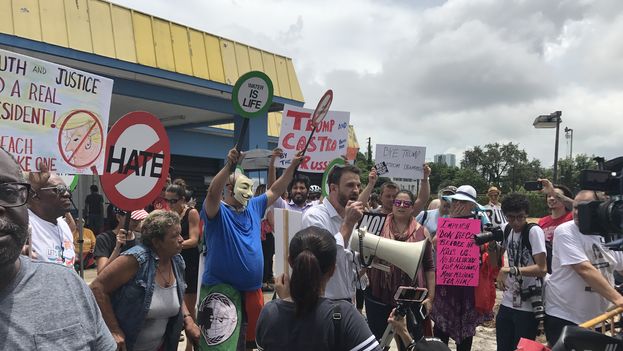
Hundreds of people gathered in the vicinity of the Manuel Artime Theater to show their disagreement with the change in policy toward Cuba. (14ymedio)

14ymedio bigger14ymedio, Reinaldo Escobar, Havana, 19 June 2017 – Over the weekend the official media have repeated ad nauseam the declaration of the government in response to Donald Trump’s speech about his policy toward Cuba. The declaration’s rhetoric recalls the years before the diplomatic thaw, when political propaganda revolved around confrontation with our neighbor to the north.

Beyond these words, many on the island are breathing a sigh of relief because the main steps taken by Barack Obama will not be reversed. The remittances on which so many families depend will not be cut, nor will the American Embassy in Havana be closed.

On the streets of Cuba, life continues its slow march, far from what was said at the Artime Theater in Miami and published by the Plaza of the Revolution. continue reading

Julia Borroto put a bottle of water in the freezer on Saturday to be ready for the line he expects to find waiting for him Monday outside the United States Embassy. This 73-year-old from Camagüey, who arrived in the capital just after Trump’s speech, remembers that Trump had said “he was going to put an end to the visas and travel, but I see that it isn’t so.”

The retiree also had another concern: the reactivation of the wet foot/dry foot policy eliminated by Obama last January. “I have two children who were plotting to go to sea. I just sent them a message to forget about it.”

The hopes of many frustrated rafters were counting on the magnate to restore the migratory privileges that Cubans enjoyed for more than two decades, but Trump defrauded them. Hundreds of migrants from the island who have been trapped in Central America on their way to the US were also waiting for that gesture that did not arrive.

Among the self-employed, concern is palpable. Homeowners who rent to tourists and private restaurant owners regret that the new policy will lead to a decline in American tourists on the island. The so-called yumas are highly desired in the private sector, especially for their generous tips.

Mary, who runs a lodging business in Old Havana, is worried. “Since the Americans began to come, I hardly have a day with empty rooms.” She had made plans on the basis of greater flexibilities and hoped “to open up more to tourism.”

On national television there is a flood of “indignant responses from the people” including no shortage of allusions to sovereignty, dignity and “the unwavering will to continue on the path despite difficulties.” The Castro regime is seizing the opportunity to reactivate the dormant propaganda machinery that had been missing its main protagonist: the enemy.

However, away from the official microphones people are indifferent or discontented with what happened. A pedicab driver swears not to know what they are talking about when he is asked about Friday’s announcements, and a retiree limits himself to commenting, “Those people who applaud Trump in Miami no longer remember when they were here standing in line for bread.”

Of the thirteen activists who met with Barack Obama during his trip to Havana, at least five expressed opinions to this newspaper about the importance of the new policy towards Cuba.

José Daniel Ferrer, leader of the Patriotic Union of Cuba (UNPACU), was at that table in March 2016 and was also mentioned on this occasion by Donald Trump during his speech. The activist had planned to be in Miami for the occasion, but at the airport in Holguin was denied exit and was subsequently arrested.

“It is the speech that had to be given and the person who could have avoided it is Raul Castro,” the former political prisoner asserts categorically. Ferrer believes that Obama did the right thing whenhe began a new era in relations between the two countries but “the Castro regime’s response was to bite the hand that was extended to it.”

In the opinion of the opposition leader, in the last 20 months repression has multiplied and “it was obvious that a different medicine had to be administered” because “a dictatorship like this should not be rewarded, it should be punished and more so when it was given the opportunity to improve its behavior and did not do so.”

Berta Soler, leader of the Ladies in White, was also prevented from flying to Miami to attend the event. For her, the words of the American president were clear and “if the Cuban regime accepts the conditions that Donald Trump has imposed on it, Cuba will begin to change.”

Soler believes that the Cuban government’s response is aimed at confusing the people, who “do not know exactly what is going on.” She says that Trump wants to maintain business with Cuba “but not with the military, but directly with the people,” something that the official press has not explained.

Opponent Manuel Cuesta Morúa, who manages the platform #Otro18 (Another 2018), is blunt and points out that “returning to failed policies is the best way to guarantee failure.” The measures announced by Trump, in his opinion, do not help the changes, and they once again give the Cuban government “the excuse to show its repressive nature.”

The dissident believes that the new policy tries to return the debate on democracy on the island to the scenario of conflict between Cuba and the United States, “just when it was beginning to refocus the national scenario on communication between the Cuban State and its citizens, which is where it needs to be.”

The director of the magazine Convivencia, Dagoberto Valdés, believes that there is a remarkable difference between the discourse itself “which seems a return to the past with the use of a language of confrontation, and the so-called concrete measures that have been taken.”

For Valdés there is no major reversal of Obama’s policy. “The trips of the Cuban Americans, the embassy, ​​the remittances are maintained… and the possibility of a negotiating table remains open when the Cuban Government makes reforms related to human rights.”

Journalist Miriam Celaya predicted that the speech would not be “what the most radical in Miami and the so-called hard line of the Cuban opposition expected. What is coming is a process and it does not mean that from tomorrow no more Americans will come to the Island and that negotiations of all kinds are finished,” she says.

In her usual poignant style, she adds that “regardless of all the fanfare and the bells and whistles, regardless of how abundant the smiles, and no matter how much people laughed at Trump’s jokes, it doesn’t seem that the changes are going to be as promising as those who are proclaiming that it’s all over for the government.”

Celaya sheds light on the fact that the official statement of the Cuban government “manifests its intention to maintain dialogue and relations within the framework of respect.” This is a great difference with other times when a speech like that “would have provoked a ‘march of the fighting people’ and a military mobilization.”

Instead, officialdom has opted for declarations and revolutionary slogans in the national media. But in the streets, that rhetoric is just silent. “People are tired of all this history,” says a fisherman on the Havana Malecon. “There is no one who can fix it, but no one who can sink it.”

Three “Paladares” Closed Were Among The Best Restaurants In Havana

Lungo Mare is another of the Havana closed in the middle of this week.(14ymedio)

14ymedio bigger14ymedio, Luz Escobar, Havana, 16 June 2017 – The closure of three private restaurants in Havana last week has sparked doubts among owners of food service businesses. The fact that the three paladares – private restaurants – were rated “excellent” on Trip Advisor, one of the most important travel sites on the web, has fueled fears that the authorities are acting against the more prosperous businesses.

The police closed El Litoral, Dolce Vita and Lungo Mare, all located in the Vedado neighborhood, after a high-profile operation and the seizure of many goods, 14ymedio was able to confirm.

Alejandro Marcel Mendevil, the visible face of El Litoral, which operates under the name of his mother, Nardis Francisca Mendivil, had previously had legal problems when working for a company linked to the Ministry of Tourism, according to an employee of the place who preferred to remain anonymous. On that occasion he was “under investigation with other employees” for an alleged diversion of resources detected in the entity, which operated with foreign capital. continue reading

That investigation ended without charges but according to the same employee “the suspicion clung to him that he was laundering the embezzled money through El Litoral.”

Nardis Francisca Mendivil, legal owner of El Litoral, refuses to talk to the press so as not to harm her son, who is imprisoned in 100 and Aldabó and subject to a warning from State Security, but she does deny the version published by some media according to which he was the proprietor of the three closed paladares.

“We have nothing to do with Lungo Mare,” said the mother of the detainee. Other sources stated that her son also managed that paladar at one time, but had sold it “a few months ago.”

In addition, Señora Mendival complains that it is not the first time that they have tried to impute false crimes to her son; in the past he was accused of the death of a police officer who, according to Señora Mendival, shot “himself in a patrol car,” a few yards from the restaurant.

The closing of the restaurants took place after an exhaustive search by the Technical Department of Investigations in cooperation with police forces.

The news of what happened circulated through emails in the Cubapaladar newsletter on food service businesses. Its organizers were quick to remove the premises from their list of recommendations and asserted that they will never include an establishment that is “under a legal investigation or involved in any case that violates any Cuban law.”

This Thursday, an improvised sign with the word “Closed” was the only visible sign to customers at door of number 161 Malecón between K and L where until recently the El Litoral was overflowing with activity. The area is now deserted.

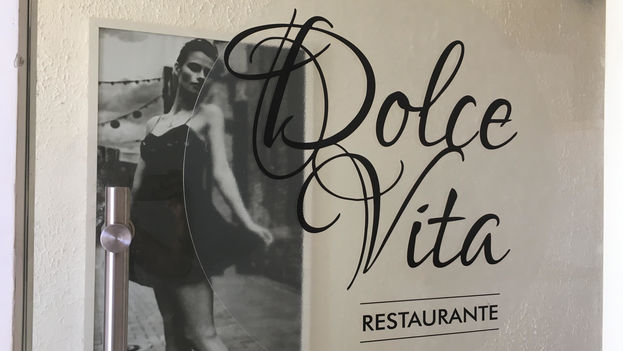
”Paladar” Dolce Vita. (14ymedio)

The operation and the confiscation of numerous belongings from the premises were the subject of comments from the whole neighborhood. “I saw many things: air conditioners, drinks of different brands they had in the cellar, chairs, tables, they even took the cutlery away,” says a neighbor.

According to an employee who spoke to 14ymedio, agents also took everything that was in the basement where a new space was going to be inaugurated for “tasting exquisite drinks and Cuban cigars.”

The site, with a wide-ranging menu specializing in seafood and fish, soon became a emblem of the new era for Cuban entrepreneurship after the flexibilizations for the self-employed sector promoted by Raúl Castro’s Government as of 2010.

“From the moment you walked through the door, you felt that you were not in Cuba because of the variety of dishes and the efficiency of the service,” says Grégory, a Frenchman who has visited Cuba more than a dozen times in the past decade, where he has “two daughters and many friends.”

However, those times of bonanza and glamor seem to have ended in the large house with a view directly to the sea.

The scene at El Litoral is repeated in the restaurant Dolce Vita, specializing in Mediterranean food and also located on Havana’s Malecón. The restaurant, which was a bustle of waiters and customers, is now closed, lock stock and barrel.

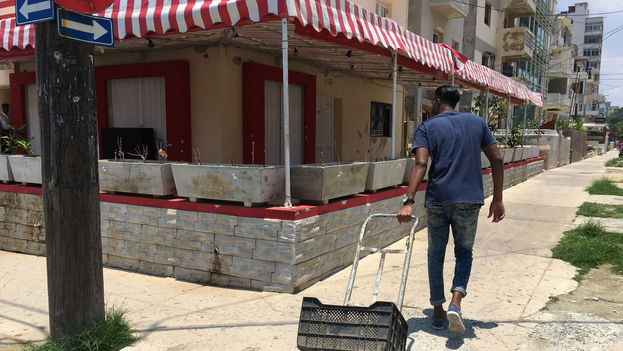
At the corner of Calle 1a and C, in Vedado, silence has also taken over the outside terrace and the interior area of ​​Lungo Mare. Underneath its distinctive red and white striped awning there is no longer the noise of the silverware or the clinking of the glasses. “This is dead and it will take a long time for it to rise again,” jokes a newspaper salesman who mourns the situation.

“The whole neighborhood benefited from this restaurant because many people came and I could sell some of my newspapers at a slightly better price,” he explains.

“This happened because it stood out a lot,” says Luis Carlos, a young man who delivers agricultural products for several restaurants in the area. “El Litoral became a reference point and many foreigners and diplomats came,” he explains. “Here they sold the best croquettes in Havana and that’s not a joke.”

No other private restaurant or coffee shop owner in the area has wanted to comment on the case.

The (Naked) King of Little Havana / Ernesto Morales

Source: The Independent (UK)

Cibercuba.com, Ernesto Morales, Miami, 16 June 2017 – When the lights and cameras went out, the choreographers of the event breathed a sigh of relief. Mario and Marco, both of Cuban descent, merged in a hug.

No child appeared to utter the alarm: “The king is naked!” This time the one humiliated would have been the President – who would like so much to be king.

But the stage, a Little Havana of arteries strangled by street closures, gates, cars with police lights, yellow tape, dust and vapors of dog shit, did not lend itself to bold and honest children.

The average age of the quorum of the President-King: 900 years.

The trait they all have in common: an anti-Obamaism comparable only in ferocity to their anti-Castroism, the overwhelming reason to welcome the President-King like a messiah from New York who comes, once and for fucking all, to sweep it all away. continue reading

Behind the pulpit of the President-King were the most Praetorian of the hosts, crowded together as best they could to catch the most advantageous camera angles. Man, nothing was missing: it was the day they’d dreamed of. The dismantling of a policy begun thirty months ago by Barack Obama, one that this Little Havana had identified as the alpha and omega of all possible evils: more repression in Cuba (without any evidence), more poverty for Cubans (despite Airbnb saying otherwise), more heat, more plagues of sparrows, more blisters on the feet of the peasants. Whatever.

And the President-King did not disappoint them. Far from it!

Although some of us, the self-marginalized among the troupe, still fail to completely understand why he did not disappoint them. Suspecting that we are passing through the gates of the inferno. That something is hidden from us. Something along the lines of, “And suddenly everyone will erupt in a collective anger and they will tell the President-King: This is a farce!”

The irreverent boy who will dare to shout to the President-King that his executive order, his policy review, his report on Cuba… that all this paperwork was naked.

The mockery is macabre. Not for me. I have cured myself in cynicism. But it is for the old man of genuine faith, who from a low-income apartment in Hialeah still dreams of doing justice to his executed father, his stoned mother.

The mockery is glaringly scathing: because it uses the weariness against a family dictatorship like gunpowder to gain subjects and followers. But this time without even pretending to fight against that same dictatorship!

“Effective immediately, I am canceling the last administration’s completely one-sided deal with Cuba,” came out of the president’s oracular mouth, and the room, criticized by the monarch himself for its narrow space and medieval heat, erupted in applause.

From some corner of the stage the strategists smiled. These are: Marco Rubio and Mario Díaz-Balart. The men who knew how to sell to the President-King the essence of what he had to do to win blind, deaf but very talkative faithful in this Miami devoid of common sense. He just had to fake a change.

It was not necessary for the President-King to dance. Just let him say, “Watch me dance this mambo,” motionless from his podium, and everyone would see him cut a rug.

I am still disoriented.

The cruise ships will continue to dock in Cuban ports. American Airlines, Jet Blue, Southwest Airlines, will continue to land from San Antonio to Maisí. Cuban Americans will have no restrictions on the number of visits per year or amount of remittances per year, as it was under – Yes! Really! – the iron fist of George W. Bush. The embassies will continue, both of them, on their sites. The diplomatic dialog will continue. The “wet foot/dry foot” policy will continue to be a thing of the past. Cuba will not once again be placed on the list of countries that sponsor terrorism.

One by one, without exception: all the elements of the Obama era regarding Cuba. Untouched. Intact. The icons of tropical Obamism, immovable.

“But to say that you dance the mambo, Mr. President, you have to play some music,” they told him. And then to the beat of the worst violinist who ever struck a chord in Little Havana, the President-King said that it will not be possible to trade with the military, and that the gringos must stay within the 12 categories already established to travel to the Island. (They didn’t even bother to remove one category or another, make it more difficult, less broad, the tickets more elusive!)

There was no need. The objective was already achieved: to enchant the plebs thirsting for magic, tricks, illusion.

Before ending the event, the President-King – for whom Cuba is only a reference to the site where, in 1995, he wanted to plant another of his pharaonic hotels – allowed himself a license: to praise the neighborhood. “I want to thank Little Havana.  Havana, we love.  Do we love it?  Would you move anywhere else?  You wouldn’t move to Palm Beach, would you?  No.  No way.  Little Havana,” he said.

And they all laughed, pleased.

All good, except for the detail that 99.99% of the amused crowd does not live in Little Havana, one of the most impoverished, violent, dirty, forgotten places in metropolitan Miami, and a place where now there are fewer and fewer Cubans – they’ve moved to Hialeah – and more and more Central Americans. Wow, a community of “bad hombres,” according to the peculiar reductionism of the President-King.

Miami attended the “Bufo” theater this Friday. To the barbarism of political laughter where the one who dazzles always wins and puts one over on the dumbest. The Miami exile community, to which I belong, is still the dunce of the class.

But a dunce who does not even dare to shout at the King that he forgot to put on his clothes.

Citizen Kastro-Citizen Alcides / Regina Coyula

Miguel Coyula (tallest in photo) and Rafael Alcides (3rd from right) collect the prize for the documentary ‘Nadie’ at the Dominican Global Film Festival. (Facebook FCGD)

Regina Coyula, 14 June 2017– Jorge Enrique Lage interviews Miguel Coyula (excerpts) 4

… at many times during the interview, Alcides interrupted himself and began to speak to Fidel as if he were right in front of him. It’s something one saw a lot in our parents’ generation: bothered by something Fidel was saying on TV and arguing with him, but supposedly there was no one listening inside the box. Documentaries offer that opportunity, that fantasy secret for many.

For me the film is a love-hate story between two men and a woman. The men are Rafael Alcides and Fidel Castro; the woman is the Revolution. Alcides lost her, and deeply resents the man who snatched her from him to dominate her, strangle her, and make her into an unrecognizable ghost. But in spite of it all, Alcides continues loving her somehow.

When he died I said that one of my actors had died, but Fidel appears in Memories of DevelopmentNobody, and Blue Heart. In the three films, I had to listen to many hours of his speeches and conversations to be able to edit and construct the dialogs in them. I can tell you it was pretty exhausting to work with him, who’d succeeded in telling me the lines I needed. But definitely he was one of the great actors of the 20th Century, including at the beginning of the 21st.

Supposedly, now one can read it as a great hallucination too, but when Alcides speaks, he addresses him in the present, as if he were alive. This doesn’t come out of nowhere. Anyone who reads Granma and reads the recycled quotes from Fidel in every issue can, as in the persistence embedded in all the talking heads you see on Cuban television, arrive at the conclusion that we’re being governed by a dead man.

Translated by: JT

Trump And Cuba, Or How To Bet On The Wrong Winner

President Donald Trump (EFE)

14ymedio bigger14ymedio, Reinaldo Escobar, Havana, 13 June 2017 – In less than 72 hours President Donald Trump will declare in Miami the new basis for the United States government’s policies towards Cuba. At that time the decisions of his predecessor Barack Obama, during the process of normalization of diplomatic relations with the island, could be paused or reversed.

The magnate will make the announcement into a spectacle like so many he has starred in since he has been at the head of the greatest power on earth. He will gesticulate, commit himself to human rights and elicit enthusiastic applause, but then he will return to the White House and the Island will fall off his agenda.

Why entrust the fate of this country to a man who has failed to keep a single one of the election promises he made to his own people? Is the policy toward Cuba the only thing that will turn out well from someone who has behaved like a political bull in a china shop? continue reading

Trump will try to please the voices asking him to tighten the screws on Havana. Sanctions, cutting back and revoking the measures taken during the thaw are among the demands of those who bet on confrontation, a strategy that has had half a century to demonstrate its ineffectiveness.

The president will especially address himself to those who insist on “turning off the tap,” cutting off communication and shutting down supplies to the longest dictatorship in the West, as if such measures will cut off the electricity, water supply or internet access to the homes of the Community Party elite.

It is symptomatic that demands for economic strangulation rarely spring from those who wait long hours for a bus, depend daily on the bread that is distributed in the rationed market and have to stretch a monthly salary that is barely enough to survive on for a week.

On the other hand, blaming Obama’s “soft hand” for the wreck of normalization leads one to forget that those in charge in Cuba did not seize the opportunity for fear of losing control. They were more frightened by Obama’s speech at the Gran Teatro de La Habana than by any threat of military intervention.

Those who have aspired for decades to unconditional surrender, to revengeful justice, and to “all or nothing” with Castroism, did not lose any time in putting roadblocks in the way of the process started on 17 December 2014. Starting this Friday they will be forced to accept everything that happens after Trump’s decisions, or to recognize this is not the way to emerge from a dictatorship.

The figures for arbitrary arrests compiled by the Cuban Human Rights Commission are unlikely to decline significantly, the Ladies in White will still be unable to march down Fifth Avenue in the west of Havana, and opposition groups will remain illegal and persecuted by the police.

What will be the foreseeable consequences on the Island of a return to the politics of the cudgel? An increase in repression and a better positioning of the more conservative sectors. The Plaza of the Revolution, the tyranny of the Castros, the regime… or whatever you prefer to call it, will not be alone in facing the tightening of the screws from Washington.

Russia, China, Angola, Nicolas Maduro and comrades from North Korea, Congo, Zimbabwe and Iran will rush to take sides with Raul Castro. Meanwhile, in the streets of the Island the population will mark Trump’s measures with renewed “marches of the fighting people,” shouting anti-imperialist slogans and accepting the postponement of the old promises of the Revolution.

Faced with “the new onslaught from the empire” the government will reinforce its aptitude for entrenchment. In the upper echelons of power there will be no cracks or disagreements. Persecutors will strengthen their power and enjoy the impunity to crush any resistance.

Trump will not achieve, with his new measures, a new march by university students with a “Down with the Dictatorship” poster, nor will the unions call for a general strike against the government, nor will the farmers march to the cities demanding land.

It is not even clear whether the president will serve out four years in office, cornered as he is by political scandals, alleged Kremlin intervention in the elections that brought him to power and his unfortunate way of managing politics through incendiary treatises or threats.

His decisions will not provoke another Maleconazo on the island like the one of August of 1994. That popular protest was spurred by the desire to escape the country, not change it. Those dramatic events were not sparked by the opposition, nor did they generate political changes, just the Rafter Crisis.

Such an outbreak would be a nightmare for a leader with a marked nationalism and an evident anti-immigrant phobia.

This Friday the American president will have his moment in front of the Cuban exile. The applause for him will be short-lived. The placebo effect of his announcements will dissipate to give way to the stubborn reality that no decision of a foreign government will change Cuba, regardless of whether Barack Obama or Donald Trump is at the head of it.

Where is Socialism in Cuba? / Iván García

Looking for a living in the trash

Ivan Garcia, 20 May 2107 — A downpour in May hits the corrugated metal roof hard. Water filters in through several holes into the house of Mireya, a blind, half-deaf seventy-one-year-old woman. She relies on pieces of black rubber to cover and protect her most precious possessions: an obsolete Chinese television with cathode ray tubes and a foam mattress on her bed.

“Every time it rains, it’s the same old story. Water comes in through every crevice. On a day I least expect it, the roof will collapse and bury me under it. That’s really not what I want,” says Mireya. Frustrated, she no longer remembers how many times she has asked for Social Security subsidies to pay for construction materials to repair her ramshackle shed.

“They drag their feet or they turn me down. They say my two sons should be the ones to do it. They send money but they’re not doing well either. Cuba stopped being a socialist society that gave help to those in need a long time ago. We old people are the ones who are worse off. The state does almost nothing to help the poorest people,” says the old woman. continue reading

A retired schoolteacher, Mireya receives a monthly pension of 225 pesos, the equivalent of ten dollars. It all goes to pay the light, gas and water bills and to buy a handful of vegetables at the farmer’s market.

To survive, she sells magazines and plastic bags on the street. “If I walk two blocks, my feet swell. I am being treated for it but sometimes I don’t have the money to buy the medication. And if I do manage to come up with the money, the pharmacy tells me they’re out of it, that there’s a shortage. If it’s not one thing, it’s another,” Mireya says in disgust.

Sergio, a retired metalworker, recalls that “in the early years of the revolution, if you produced good results at work, you could get a home. They would give you a week’s vacation in a house on the beach. Medical care was good. And though food was always rationed, you had a balanced diet. What we have in Cuba today is capitalism in disguise. The old slogan about socialism or death is only for poor people and fools. Those with hard currency have access higher quality products. Managers live just as well as any capitalist business owner.”

“In the Nordic countries and Switzerland, workers who earn the minimum wage and who, by those countries’ standards, are living in poverty, receive government assistance,” notes a sociologist who have been studying social welfare programs for five years. His research is based on interviews with Cubans living in developed countries. “When a Cuban retires in the United States, he receives about $740 a month in aid plus $170 dollars in food stamps, even if he has never worked in the country. Additionally, he receives free medical and psychiatric care if needed. And he can still work part-time. If he earns less than two thousand dollars, he does not have to pay income tax,” he observes.

“Cuba ceased being a socialist society long ago. Being a poor third-world country, the best it can offer is universal health care and free education, but the quality of those has deteriorated substantially. Costa Rica and Guyana, nations to which we should compare ourselves, also offer these free services but they are of better quality,” adds the sociologist.

Adalberto, a Cuban living in Washington, is currently visiting the island. Due to diabetes and the onset of Alzheimer’s he had to retire at age fifty-six. “I receive various medical benefits and, because I worked for thirty years, a monthly pension of $2,400. I don’t have a life full of luxury but have I have the essentials and can help my family in Havana. Let me tell you, real socialism is over there, in the U.S.,” he says.

The quality of life in Cuba has fallen markedly. Salaries are among the lowest in the world. The costs of food and other basic commodities are high. Allegedly socialist businesses such as the telecommunications monopoly ETECSA charge extremely high prices for internet and mobile phone service. Most Cubans cannot afford to vacation in their own country due to the high price of hotel rooms. The military controls 80% of the nation’s economy and engages in the worst form state-sponsored capitalism imaginable, taxing sales of goods by as much as 240%.

Cuban socialism can only be found in speeches by the military bourgeoisie. The Castro regime has discreetly and without fanfare abandoned the slogan “a revolution of the humble, by the humble and for the humble.” Instead, it now manages luxury hotels like the Kempinski Manzana, where a watch can cost four thousand dollars and a week’s stay in Varadero is the equivalent of a year and a half’s salary for the average worker.

What are the humble left with? A ration of seven pounds of rice and five pounds of sugar, twenty ounces of dried beans, one small bread roll per day and half a kilogram of chicken per month.

Health care and education are seemingly free (which is possible because salaries are so low). With any luck, one can hope for a stay at a campsite during summer vacation season. But little else.