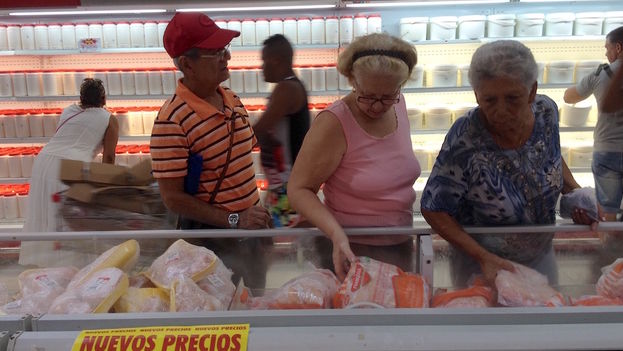

Average Monthly Salary in Cuba is $29.60 US

The average monthly salary in Cuba, is 740 Cuban pesos, equivalent to just under $30 dollars US

14ymedio biggerEFE, via 14ymedio, Havana, 30 June 2017 – The average monthly salary in Cuba in 260 was 740 Cuban pesos (CUP), the equivalent of $29.60 in US dollars, although the figure is higher in sectors such as the sugar industry – where the best paid earn 1,246 CUP ($48.80 US), and falls in public administration, defense and social security, with a figure a 510 (CUP) ($20.40 US).

The figures come from the publication “Figures for Average Salaries in 2016,” released on Thursday by Cuba’s National Office of Statistics and Information, which includes average monthly salaries by province since 2007, and average monthly salary by economic activity type since 2014. continue reading

According to the report, the average salary in Cuban increased from 408 CUP ($16.30 US) in 2007 to 740 CUP in 2016.

By province, the highest salaries are earned in Ciego de Ávila, Villa Clara and Matanzas

By province, the highest salaries are earned in Ciego de Ávila (816 CUP / $32.60 US), Villa Clara (808 CUP / $32.30 US) and Matanzas (806 CUP / $32.20 US), while the lowest wages are paid in Guantánamo (633 CUP / $25.30 US), Isla de la Juventud (655 CUP / $26.20 US) and Santiago de Cuba (657 CUP / $26.20 US).

The highest paid sectors on the island are the sugar industry (1,246 CUP / $49.80 US), mining and quarrying (1,218 CUP / $48.70 US), financial services (1,032 CUP / $41.20 US), and agriculture, livestock, forestry and fisheries (991 CUP / $39.60 US).

On the other hand, economic activities with lower wages are: “Other communal services, associations and personal activities,” (503 CUP / $20.10 US); public administration, defense and social security (510 CUP / $20.40 US); Culture and sport (511 CUP / $20.40 US); and education (533 CUP / $21.32 US).

The low wages paid to state employees in Cuba, compared to the high cost of basic products—Cuba imports 80% of its food—are constantly subject to criticism by international organizations and also by opposition movements.

Health and education are universal and free in Cuba, and citizens receive some basic food from the state through the “ration book.”

But the rationing system, which decades ago covered much of the population’s needs—including underwear, shoes and children’s toys—has been reducing the quantities and types of subsidized products.

The rationing system, which decades ago covered much of the population’s needs, has been reducing the quantities and type of subsidized products

Currently, an adult Cuban receives monthly from the ration stores about 7 pounds of rice, 4 pounds of sugar, one pint of soybean oil, one packet of mixed coffee (that is coffee mixed with fillers such as dried peas), one packet of pasta, five eggs and small quantities of chicken. Children also get one quart of milk a day until they turn seven.

In 2011, Cuban President Raul Castro approved the authorization of new categories of self-employment (the term used in Cuba means “own account-ism”) as one of the key measures to compensate for the progressive reduction of 500,000 jobs in the state sector.

Another of the main distortions in the Cuban economy is the simultaneous circulation of two currencies—the Cuban pesos or “national money” and the Cuban convertible peso, or “hard currency”—that the Government recognizes needs to be changed, but for the system remains in force and there is no firm date to merge the currencies.

See here for more on the dual currency system:

Without Confidence in the Money, Reinaldo Escobar

What Purpose Did the Dual Currency System Serve, Miriam Celaya
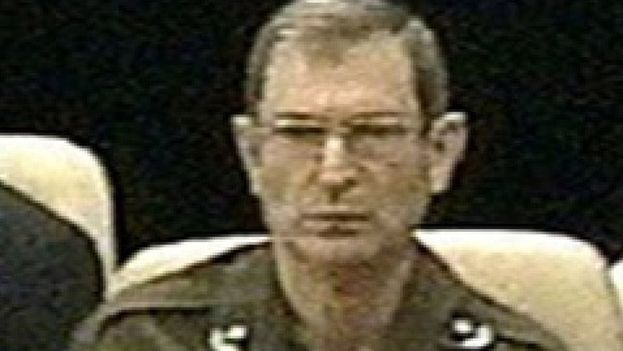
Cuban General Who Oversaw the Downing of ‘Brothers To The Rescue’ Planes Dies

Eduardo Delgado also directed the espionage work in Miami of the Wasp Network, and was in charge of infiltrating five Cuban spies in the USA. (Cuban Television)

14ymedio bigger14ymedio, Havana, 29 June 2017 — On Wednesday, Brigadier General Eduardo Delgado Rodriguez died in Havana. He had supervised the intelligence operations that led to the downing of the Brothers to the Rescue planes in 1996, and as director of the Miami espionage work of the Wasp Network, he was in charge of infiltrating five Cuban spies into the United States. A brief note in the official press reported his death without specifying the cause.

The notice, which appeared in the Granma newspaper, briefly details his biography since joining “fight against the Fulgencio Batista regime” up to his presence as a military man in Nicaraguan territory during the 1980s. It also lists his many decorations. continue reading

However, the obituary published in the official organ of the Communist Party does not mention that Delgado served as head of the General Directorate of Intelligence of the Ministry of the Interior (MININT) for 20 years, a post he ascended to after his performance during the trial of “Cause No. 1” in 1989.

Eduardo Delgado was in charge of conducting investigations against Major General Arnaldo Ochoa Sánchez and three other military officers, sentenced to death for drug trafficking and abuse of power

In that famous proceeding, Major General Arnaldo Ochoa Sánchez and three other military officers were sentenced to death on charges of drug trafficking and abuse of power. At that time Delgado had the rank of colonel and presided over the investigations of the case.

In 1994 he was promoted to brigadier general and from his position as head of MININT intelligence directed the actions of the Wasp Network.

Delgado was in charge of the operation that compiled the information to bring down the planes of Brothers to the Rescue on 24 February of 1996. In 2013 he was replaced as head of Director of Intelligence, and became director of MINIT’s Eliseo Reyes Rodriguez Superior Institute.

At the time of his death, Delgado was retired. His remains were buried Wednesday afternoon in the Pantheon of the Firefighters of MININT, in Havana’s Colón Cemetery.

The Impossible Letter

“You will write a letter addressed to Fidel Castro thanking him for free education,” the center’s educator told the students. (14ymedio)

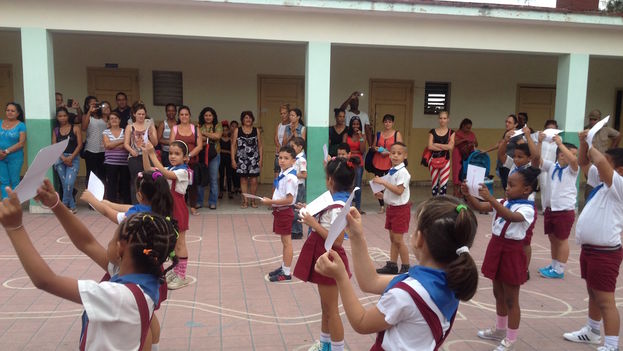
14ymedio bigger14ymedio, Generation Y, Yoani Sanchez, Havana, 29 June 2017 — “Today we are going to practice writing a letter,” announced the fourth grade teacher at a school in the Plaza of the Revolution district in mid-June. Immediately, Lucia, age 9, thought about writing a letter to her grandmother telling her about her latest acrobatics on skates, but the recipient had already been decided. “You are going to write a letter addressed to Fidel Castro thanking him for a free education,” declared the educator.

The girl froze. It never would have occurred to her to address a letter to a dead person, nor to anyone who wasn’t a friend or a member of her family. She scribbled the date on the top of the page and then stopped, with the pencil suspended in the air, not knowing what to do. “Lucia, you have to thank him for building schools and teaching Cuban children to read,” ordered the teacher. continue reading

The student remained paralyzed. “Come on, it is very likely that on the test they will ask you to write a letter to the Comandante and you have to practice.” The pencil didn’t move a fraction of an inch. “Look, I’m going to dictate some sentences to you and then you can continue on your own,” the teacher said, her tone increasingly irritable. “Fidel, without you I would have no shoes and no books and I would be illiterate,” she dictated. But the girl didn’t make a single mark.

When she got home the sheet of paper still had only the day and the month in one corner. So it was her mother’s turn to insist, “Think that you are writing another person and then later put ‘His’ name on it,” she proposed as a trick to get around the problem. Lucia imagined she was telling her grandmother about the games in the park, and thanking her for her affections and then signed it, squeezing in her name next to a drawing of a flower.

Last week the final exam included the request to write a letter. But this time it was addressed to the teacher and had to respond to the question, “What do you do to help your mom with the housework?” The girl stopped for several minutes with the pencil suspended over the paper without knowing what to do. No one came to dictate the sentences.

* This story is not literature, but absolute reality. The student’s name has been changed to avoid retaliation.

Soy Yogurt Will “Gradually” Return to Havana

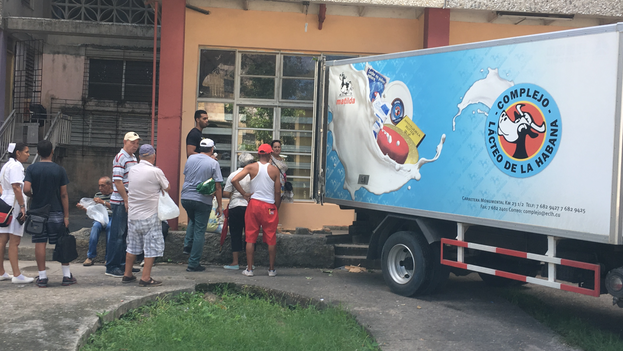
After the announcement, hundreds of customers crowded outside the dairy outlets. (14ymedio)

14ymedio bigger14ymedio, Havana, 28 June 2017 — This week the official media have fueled expectations among consumers in Havana with an announcement of “the return of soy yogurt,” a product of the rationed market that has not been distributed in the capital for nearly a year.

After the announcement, hundreds of customers crowded around outside the dairy outlets, but a national television report clarified that the distribution will be “gradual” until it reaches the 85,000 children in the city who are authorized to receive a share of this product. continue reading

During the last year, children between the ages of seven and fourteen have been receiving a powdered mix to make a dairy substitute shake, but it has been strongly criticized for its poor quality.

A national television report clarified that the distribution will be “gradual” until the it reaches the 85,000 children in the city

The interruption of the sale of soy yogurt was due to the technological deterioration experienced by Havana’s Milk Complex, especially the steam boiler, which has been in operation for more than 40 years.

The malfunctions forced production to stop for eight months in order to undertake a repair that included the importing of new boilers, and maintenance work on the cold storage facilities and the production rooms. In addition, the distribution service will now be made from a renovated truck lot.

However, many parents are wary about whether the renovations will last, and fear that the soy yogurt will disappear “gradually.”

The Death Throes of a Formerly Great Cuban Department Store

From the former glamorous Fin de Siglo, all that remains is a building with serious structural problems, empty and stinky. (14ymedio)

14ymedio bigger14ymedio, Reinaldo Escobar, 28 June 2017 – The shit, not the metaphorical kind but the kind that stinks, makes it nearly impossible to read the name Fin de Siglo, End of Century, imbedded in the granite floor. In five decades, one of the most emblematic Havana stores has transitioned from glamor to abandonment, passing also through experiments in socialist distribution and the self-employment sector.

Founded in the long ago 1897 and located on the central corner formed by San Rafael Boulevard and Aguila Street, Fin de Siglo was among the most important commercial establishments in Cuba, along with La Época and El Encanto. In its place today, however, there remains only a building with serious structural problems, vacant and stinky.

During what Fidel Castro labeled with euphemistically the Special Period in Time of Peace – a time of great economic hardship after the collapse of the Soviet Union and the end of its financial support for Cuba – Fin de Siglo sold only to distinguished workers awarded “vanguard” status, and to newly married couples. A nice 1992 documentary, made by the Belgian Madelin Waterlet and the Pole Simon Saleski and named after the store, relates the surrealist moment. continue reading

During the so-called Special Period in Time of Peace the business sold only to the distinguished workers awarded “vanguard” status and to newly married couples

That form of the socialist marketing could not be sustained for long and with the gentle winds of economic reforms the ground floor of the building was set up for private sector retailers to sell sandals, household utensils, objects for religious rituals and clothing.

Many tourists also came to acquire an ashtray with the face of Che Guevara or canvases from which shone the skin of beautiful mulatas. But a month ago the sellers were reassigned among the soulless state stores.

The authorities justify the relocations with the deterioration of the building. However, private individuals who paid rent for space in the building insist that their contracts with the state Empresa de Comercio stipulated that 30% of lease proceeds would go to repairs, which were never made.

At the end of 2012, the sellers were informed that restoration work would begin on the building, but after a few weeks and the placement of wooden beams to prop up the top floor, the works did not continue.

In order not to lose their clientele, the vendors proposed that the local government allow them to become a non-agricultural cooperative (CNA), a form of economic management which, as of January this year, had 397 examples throughout the country dedicated to food, personal and technical services.

However, the initiative did not prosper and for several weeks now the retailers have been relocated in nearby stores such as Cancha, Florida and Sublime, smaller and more poorly located.

“I have lost a lot of money in this move and also this place does not have the minimum necessary conditions,” says a clothing saleswoman with a counter in the Cancha store who preferred anonymity. However, she acknowledges that “Fin de Siglo also had problems because of the heat, the lack of windows and the constant obstructions in the sewer pipes.”

The merchant believes that if they had let the tenants invest the conditions of the ground floor would have been improved, since each year the premises collected about 3 million Cuban pesos (roughly $120k US) in rent receipts. “Why didn’t they use part of that for reconstruction?” she protests.

The merchant believes that if they had let the tenants invest the conditions of the ground floor would have been improved, since each year the premises collected about 3 million Cuban pesos in rent

Some vendors have placed handmade posters in the windows of Fin de Siglo alerting customers to their new locations. There is no obvious construction work taking place in the building but all the outlets and the bulbs from the ceiling lights are missing.

Carlos Alberto, a young jeweler wants an explanation. “When someone finds out what they are going to do there, let them come and tell me.” The artisan doubts the official version and maintains that the building will be “remodeled to become a store selling in convertible pesos” – that is to the well-to-do and tourists – a speculation which the authorities of the municipality of Central Havana do not want to comment on.

At the Sublime establishment, a CD vendor predicts a worse future for the emblematic store. “It’s going to be just like the Duplex cinema, a block away, which one day was closed because it had a problem in the bathroom and today is a ruin,” he says.

Cuban Authorities Block Seven Activists From Traveling to Mexico for Democracy Action Meeting

Regina Coyula was not able to board her flight this Monday, like six other activists, to go to Cancun to a Forum on Democracy in Cuba. (Courtesy)

14ymedio bigger14ymedio, Havana, 27 June 2017 – Cuban authorities blocked at least seven activists from traveling to Cancun, Mexico this Monday, to participate in the 4th Forum on Roads to a Democratic Cuba, a meeting of the United Democratic Action Roundtable (MUAD) organized by the Konrad Adenauer Foundation (KAS), according to blogger Regina Coyula speaking to 14ymedio.

“When I arrived at the immigration window in Terminal 3 of Jose Marti International Airport, they told me to step back and wait a minute” said the activist. Then she was approached by an immigration official who, after asking for her documents, informed her that there was “a ban on travel abroad” in effect against her.

Coyula demanded explanations for the reasons she was prevented from leaving, but the agent would only say that she “had nothing to do with this” and told her if she wanted more information to visit the Office of Attention to the Population near the Plaza of the Revolution. continue reading

The other activists who were not allowed to board the plane are Rafael León Rodríguez, general coordinator of the Cuban Democratic Project; Hildebrando Chaviano, director of the Center for Analysis of Public Policies of Freedom and Development; Wilfredo Vallín and Amado Calixto Gammalame, members of the Legal Association of Cuba; Erick Álvarez, promoter of the CubaDecide initiative; and Alexei Gámez, activist of the Somos+ (We Are More) Movement.

The practice of preventing dissidents from leaving the country has become a repressive method of State Security in increasing use in recent months.

The practice of preventing dissidents from leaving the country has become a repressive method of State Security in increasing use in recent months.

In early 2013 a Migration Reform measure came into effect which eliminated the “exit permit” required for travel abroad. In the first ten months after the approval of the new measures, Cubans made more than 250,000 trips abroad. The opposition also benefited from this relaxation of controls.

However, any time it likes the Government may invoke certain subsections of article 25 of the new immigration regulations that prohibit departure “for reasons of public interest or national security.”

Travel bans are put into practice in a number of ways, including preventing opponents from leaving their home, intercepting the vehicles taking them to the airport, or notifying them at the immigration window at the airport that they are forbidden to leave, as happened on Monday.

These Are Good Times For The ‘Weekly Packet’

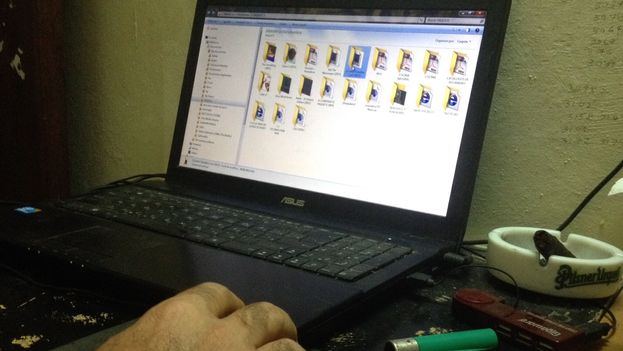
A Cuban accessing the Weekly Packet’ from his laptop at home. (14ymedio)

14ymedio bigger14ymedio, Generation Y, Yoani Sanchez, 27 June 2017 — Official propaganda has been euphoric since Donald Trump spoke at the Manuel Artime Theater in Miami. The government discourse rages with an intensity that hasn’t been seen since the campaign for ‘The Cuban Five’, the spies serving sentences in the United States. Faced with this saturation of slogans, many opt to take refuge in the ‘Weekly Packet.’

The Cuban Government seems to be advised by its worst enemies in terms of content dissemination, in view of the excess of ideology and ephemeris of the national media. The result is the galloping loss of viewers who opt for the informal networks of distribution of audiovisuals, series and films.

Each line of the incendiary political tirades published in the written press equals more than one los reader, tired of so much rhetoric. It is easy to detect through the comments on the street how the ‘rating’ of the media controlled by the Communist Party is collapsing these days, especially among the youngest. continue reading

It is easy to detect through the comments on the street how the ‘rating’ of the media controlled by the Communist Party is collapsing these days, especially among the youngest

In the past, television viewers tired of so much empty talk had to watch anyway, in the absence of other options, but now Cubans live in the age of USB memory and external hard drives.

Now, while the national media rant against the United States president’s new policy toward Cuba, the informal market is awash in entertainment material that has nothing to do with politics.

A bad quality copy of The Mummy starring Tom Cruise, or Wonder Woman featuring Patty Jenkins, along with the eighth installment of Fast and Furious, grab the attention of the fans of the Weekly Packet, and offer nothing but a headache for the government propagandists who don’t know how to attract that lost audience.

It is significant that science fiction, fantasy and car racing triumph where politics loses ground. Cubans escape reality through fiction, they evade propaganda by choosing programming far removed from ideology.

Planet Nothing

Rebeca Monzo, Havana, 16 June 2017 — Cuba is a distant planet. It has nothing to do with the rest of the world, because nothing functions there as in the majority of civilized countries. This “planet” is ruled by the whims of its ancient rulers who have spent almost 59 years doing whatever they please.

Now is when we were supposed to be doing better, thanks to the massive arrival of a tourist trade that for decades overlooked Cuba as a destination because of the innumerable restrictions imposed by the regime–and which now has no choice but to “loosen its grip” in this regard, because the country does not produce goods and is totally bankrupt. Curiously, almost all the tourists I talk with remark that they come to Cuba because they want to experience it before the great changes that are coming. It must be that they want to “feel” firsthand, rather than watch a movie about, a true Jurassic Park. continue reading

Nobody knows what is being done with the money collected via remittances [from Cuban émigrés abroad to their relatives on the Island] and tourism, being that the stores are practically empty, the public transportation service is worse every day, the city grows ever dirtier, and buildings continue to collapse–structures whose extreme deterioration is due to the government never having taken care of them adequately.

Yesterday at the the Panamericana chain store location on 26th Avenue between 17th and 15th Streets in Vedado, I was struck with consternation to see the huge line of people waiting to enter. I asked an employee who told me that they had only one cashier, because the other three had quit their jobs, as had the workers in the personal and household cleaning supplies department. Only one cash register, in the groceries department, was open to the public.

We go on floating in a state of absolute stagnation, where “nothing from nothing” is our daily reality.

Ed note: Rebeca has a room for rent on Airbnb if you are going to Havana. (Additional note: this “advertisement” has NOT been posted at her request or even with her knowledge.)

Translated by: Alicia Barraqué Ellison

The Dark Side Of Tourism in Cuba

Among the areas most affected by the avalanche of visitors are the Viñales valley, the city of Trinidad, the resort of Varadero and the Cuban capital. (JVY)

14ymedio bigger14ymedio, Zunilda Mata, Viñales, 27 June 2018 — At the entrance to Calle Obispo a guide explains to her customers the restoration works in the historical center of Havana. A few yards away, the line to exchange currency is full of foreigners and in the corner bar one hears English, French and German. Tourism is shaping the face of several areas of Cuba and becoming a problem for their residents.

“In this neighborhood you can’t even walk,” complains Idania Contreras, a resident of Obrapía Street in Old Havana and a law graduate. “At first people were happy because the area improved economically, but little by little the tourists have been taking over all the spaces and this is less and less like a neighborhood where people live.” continue reading

A pineapple never costs less than 20 Cuban pesos because the private restaurants in the area can pay that amount, because they sell the tourists a piña colada for three times that price

As a consequence of the increase in tourism, prices have also risen. “Now buying fruits in the markets is a headache because they are hoarded by the people who rent to tourists,” adds Contreras. “A pineapple never costs less than 20 Cuban pesos because the private restaurants in the area can pay that amount, because they sell the tourists a piña colada for three times that price,” she explains. In her view, those mainly affected are the citizens themselves who can’t afford these prices.

Contreras, who worked for a few months in a real estate management office, says housing prices are also up in the area. “The price per square meter has exploded around the Plaza de la Catedral, the Plaza de San Francisco and the streets where it is most profitable streets.” She also says that these areas are beginning to look like the center of Barcelona or Venice, where fewer and fewer families are living.

However, she acknowledges that “the problem has not yet reached the point of other cities in the world that receive many more tourists,” but she is concerned because there are no “public policies to alleviate the problems we are already experiencing.”

Contreras’s biggest fear is that there is only talk of the positive side of tourism, while some streets in the area are already showing symptoms of congestion and tourism activity aggravates the problems of waste treatment and water supply.

Several regions of the island face the challenge of absorbing an increasing number of travelers despite the precariousness of their infrastructure. Among the areas most affected by the avalanche of visitors are the Viñales valley, the city of Trinidad, the Varadero resort area and the Cuban capital.

“At night the discos are full of ‘yumas’ with young girls and it is a really pitiful show for our children”

“It is very difficult for a Cuban to rent a room because homeowners prefer to rent only tourists,” warns Gustavo, a handicraft seller near the Casa de la Trova in the city of Trinidad, which was declared a World Heritage Site by UNESCO in 1988 and is now an obligatory stop on many of the package tours.

“This whole area is focused on foreigners,” he says. The salesman, born on the outskirts of Trinidad, believes that there are many people who benefit from tourism, but on the way he has lost the city he knew as a child. “Now it has been commodified and everything has a price, even people,” he laments.

In all the tourist hubs, along with an increase in private businesses there is also an increase in prostitution. “At night the discos are full of yumas, foreigners, with young girls and it is a really pitiful show for our children,” notes Gustavo.

“[Tourism] is more positive than negative because 30 years ago this city had old and beautiful houses, but nothing more,” says the seller despite his reservations about this economic sector.

Carlos and his two children live on the road to Viñales. Coming from a family of farmers, they now sell fruit at a stand by the side of the road. “Most of our customers are foreigners coming and going from the Valley,” says the farmer. He hasn’t gone into town for two years because, he says, “you can’t take a step with so many tourists.”

“Before this was predominantly a farming area with strong traditions, but now everything is being lost”

The winding road that leads to Viñales also suffers with the increase of vehicles. “It’s a rare week that there is not an accident in this section,” recounts Carlos while pointing to one of the curves near his house. The number of travelers interested in the area seems to have grown, but the seller points out that the streets and roads remain the same and that no expansion has been undertaken.

Carlos’s closest neighbors have a thriving business that offers horseback rides to travelers. They gain much more from these “ecotours” than they could sowing beans or tobacco, another change that is due to the avalanche of visitors. “Before this was predominantly a farming area with strong traditions, but now everything is being lost,” he says.

A few yard away, a tobacco drying shed stands with its gabled roof and its walls made of logs. In the interior, a peasant shows a dozen tourists how the leaves re dried. “This shed has been set up for groups who want to see how the process is done, it’s pure showcase,” says Carlos. “In this town everything is already like this.”

Persecution Grows Against Independent Journalism In Cuba

Independent journalists Sol García Basulto and Henry Constantín Ferreiro. (14ymedio)

14ymedio bigger14ymedio, Mario Penton, Miami, 26 June 2017 — Independent communicators in Cuba are victims of an escalating repression, according to a complaint filed Monday by the Cuban Observatory of Human Rights (OCDH), based in Madrid. The alarm sounded by the organization coincides with an increase in complaints from journalists on the island as a result of the government persecutions and obstacles they suffer when exercising their profession.

“Last June 20 Henry Constantín and Sol Garcia, journalists for La Hora de Cuba and contributors to 14ymedio, were not able to participate in an event in Miami because each of them has been indicted for the alleged crime of “‘usurpation of legal capacity’ [that is practicing a profession without a license to do so] and so under Cuban law they are not permitted to travel outside the country,” OCDH reported.

According to the non-governmental organization, the Cuban government had maintained a kind of “moratorium” with regards to repression against independent journalists, but the strategy seems to have changed in recent weeks with actions such as those carried out against Henry Constantin, Sol Garcia Basulto and Manuel Alejandro Leon Velázquez. continue reading

Both Constantín and García Basulto have been expressly forbidden to practice journalism on the island and the judicial process opened against them has been criticized from various international forums, including the Inter American Press Association (IAPA).

Human rights lawyer and activist Laritza Diversent explained that there are more than 300 items within the Penal Code to crack down on dissent and journalism on the island

The OCDH also denounced the arrest of journalist Manuel Alejandro León Velázquez, a contributor to Radio Martí and Diario de Cuba . Leon returned from a trip to Spain and has been accused of “usurpation of legal capacity, association to commit a crime and dissemination of false news,” according to the organization.

The accusations against the three communicators are based on Article 149 of the Cuban Penal Code, which punishes those who carry out “acts of a profession for the exercise of which one is not properly qualified.” If they are tried for this offense they could face a sentence of up to one year of deprivation of liberty.

In Cuba, all the media belong to the State, according to the Constitution of 1976. However, the absence of a Media Law has allowed the independent press to flourish with sites such as El Estornudo, El Toque, Cubanet, CiberCuba, Diario de Cuba, Periodismo de Barrio, On Cuba, among others.

In Cuba, all the media belong to the State, according to the Constitution of 1976. However, the absence of a Media Law has allowed the independent press to flourish

Human rights lawyer and activist Laritza Diversent, who recently became a refugee in the United States, explained to 14ymedio via telephone that there are over 300 items within the Penal Code to crack down on dissent and journalism on the island.

“State Security is looking for different strategies to prosecute all types of dissidents or critics in Cuba,” explained Diversent, president of the legal group Cubalex, who went into exile after a police and State Security operation against her.

“Both illegal economic activity and the usurpation of legal capacity are nothing more than resources to punish any type of activism within the Island. Legal insecurity is very high because both the criminal law and the criminal procedure law have been designed as tools of repression,” said Diversent.

Independent journalist Maykel Gonzalez Vivero, who was arrested last October in Guantanamo and suffered the confiscation of his tools of the trade while covering the recovery in Baracoa after the passage of Hurricane Matthew, confirmed the difficulties of practicing the profession on the island.

“We do not have a law that supports us and protects the exercise of journalism, we are at the mercy of the arbitrariness of the authorities”

“We do not have a law that supports us and protects the exercise of journalism, we are at the mercy of the arbitrariness of the authorities,” he said. On that occasion, a team of correspondents from Periodismo de Barrio suffered the same fate as Gonzalez Vivero.

Other independent publications, such as Convivencia magazine, have been harassed during the last year with the arrest of members of its editorial team and threats by the authorities against its contributors. Foreign correspondent Fernando Ravsberg has been threatened with expulsion from the country and even with “having his teeth broken” for the critical entries he publishes in his personal blog Cartas desde Cuba.

Last year the IAPA emphasized, however, the timid rebellion of some official journalists against the information policy directed from the Communist Party. Among the examples cited by the IAPA was a letter signed by young journalists published by the Villa Clara newspaper Vanguardia, in which they claimed their right to collaborate with other media.

The IAPA also recalled the case of a Radio Holguin journalist Jose Ramirez Pantoja, expelled from the profession for five years for making public the remarks delivered at a conference where Karina Marrón, deputy editor of the official daily Granma, compared the country’s situation to that of the 1990s when massive protests occurred in Havana, which came to be known as the Maleconazo.

“We Exist Between Illusions And Fears”

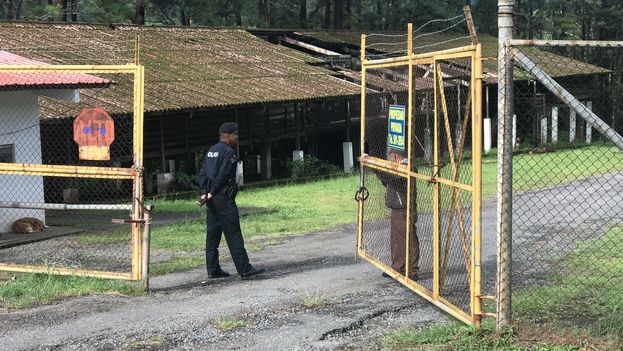
14ymedio bigger14ymedio, Mario Penton, David (Panama), 23 June 2017 — The green seems to fill everything in Chiriquí, in the western Panamanian province where the government hosts 126 undocumented Cubans in a camp in the region of Gualaca. The stillness of the morning in the middle of the huge pines that grow in the foothills of the mountains is only interrupted by the bites of insects, a true torture at dawn and dusk.

“This place is beautiful, but everything gets tiring, being in limbo is exhausting,” says Yosvani López, a 30-year-old Cuban who arrived in Gualaca in April after spending three months in the hostel set up by Caritas for Cuban migrants in Panama City.

“Sometimes we sit down and talk about what we would do if we could get out of here and get to another country. Some relatives tell us that they are preparing a camp in Canada to welcome us, others tell us that they have everything prepared to deport us. Illusions and fears,” he laments. continue reading

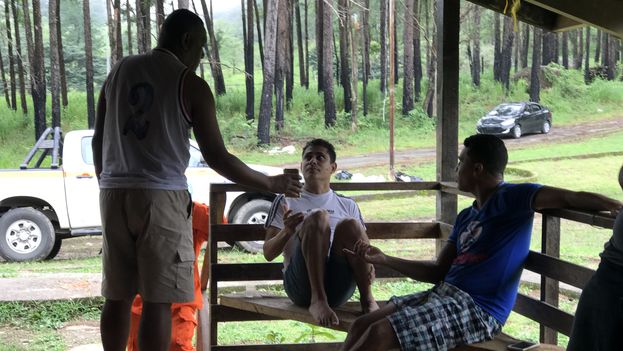
The camp that houses the Cubans was built by the Swiss brigades which, in the 1970’s, built the La Fortuna dam. It is 104 acres, occupied mostly by forests and a stream. One hour from the nearest city, the humidity is such that mushrooms and plants establish themselves even in the fibrocement roof tiles.

A day in the migrant camp for Cubans stranded in Gualaca, Panama (our apologies for not having this video subtitled).

Along with the wooden buildings, deteriorated by the passage of time, there are still satellite antennas, electric heaters and, according to the migrants, from time to time they find foreign currencies buried in the vacant land.

López was born in Caibarién, a city on the north coast of Cuba. Although he had the opportunity to emigrate using a speed boat to cross the Florida Straits, he preferred the jungle route to avoid the seven years moratorium on being able to return to Cuba that the government imposes on those who leave Cuba illegally.

“I wanted to go back before 7 years was up. I have my mother and my sisters in Cuba,” he explains.

He worked as a chef specializing in seafood at the Meliá hotel in the cays north of Villa Clara, earning the equivalent of $25 US a month. With the money from the sale of his mother’s house he traveled via Guyana and in Panama he was taken by surprise by the end of the wet foot/dry foot policy that allowed Cubans who reached American soil to stay.

“Here we pass the hours between chats with our relatives in Cuba and the United States, and searching the news for clues that will tell us what is going to happen to us,” he says.

The migrants in Gualaca not only do not have permission to work, but they can only leave the camp one day a week to go to Western Union, with prior notice and accompanied by presidential police officers, who are guarding the site.

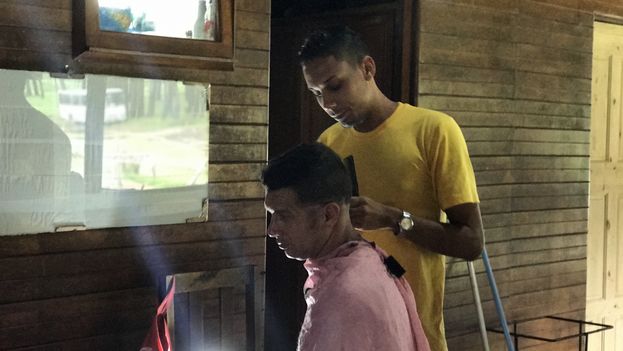
Some, however, have improvised coffee sales and even a barbershop. The locals also set up a small shop to supply the undocumented immigrants with the personal care products and treats, which they pay for with remittances sent by relatives from the United States.

Some migrants have taken the opportunity to develop their talents, such as this young man who set up a barber shop in the Gualaca camp. (14ymedio)

The authorities gave themselves 90 days to decide what they would do with the 126 Cubans who accepted the proposal to go to Gualaca. Two months later, the patience of the migrants is beginning to wear thin. At least six escapes have been reported since they were moved there. The last one, on Monday, was led by four Cubans, two of whom have already returned to the camp while two crossed the border into Costa Rica.

Since dawn, Alejandro Larrinaga, 13, and his parents have been waiting for some news about their fate. Surrounded by adults, Alejandro has only one other child to play in the hostel, Christian Estrada, 11. Neither has attended school for a year and a half, when they left Havana.

Alejandro spent more than 50 days in the jungle and, as a result of severe dehydration, he suffered epilepsy and convulsed several times. “It was difficult to go through it. It’s not easy to explain: it is one thing to tell it and another to live it,” he says with an intonation that makes him seem much more adult.

“We had to see dead people, lots of skulls. I was afraid of losing my mom and dad,” he recalls. But, although tears appear in the eyes of his mother while he recalls those moments, now he says he feels safe in Gualaca and spends his days playing chess.

“I want to be a chess master, which is more than a champion. Someday I will achieve it,” he says.

His mother, Addis Torres, does not want to return to the Island where she has nothing left because she sold their few belongings to be able to reunite with Alejandro’s grandfather, who lives in the United States. Although they have a process of family reunification pending at the US Embassy in Havana, the family does not want to hear about returning to Cuba.

They eat three times a day and even have a health program financed by the Panamanian government, but for Torres “that’s not life.”

“Detained, without a future, afraid to return to Cuba. We need someone to feel sorry for us and, in the worst case, to let us stay here,” she says.

Liuber Pérez Expósito is a guajiro from Velasco, a town in Holguín where he grew garlic and corn. After the legalization of self-employment by the Cuban government, Pérez began to engage in trade and intended to improve things by going to the US.

The presidential police and Panama Immigration officers guard the entrance of the camp Los Planes, Gualaca. (14ymedio)

In Gualaca he feels “desperate” to return to his homeland, but he has faith that, at least, he will get the help promised by the Panamanian Deputy Minister of Security, and leave a door open to engage in trade.

“I am here against what my family’s thinking. There (in Cuba) I have my wife, my nine-year-old son and my parents, they want me to come back and pressure me but I am waiting for the opportunity to at least recover some of the 5,000 dollars I spent,” he says.

His mother-in-law, an ophthalmologist who worked in Venezuela, lent him part of the money for the trip. Indebted, without money and without hope, he only thinks of the moment he can return.

“During the day we have nothing to do. Sometimes we play a little dominoes, we walk or we go to the stream, but we have 24 hours to think about how difficult this situation is and the failure we are experiencing,” he says.

Liuber communicates with his family through Imo, a popular videochat application for smartphones. “They recently installed Wi-Fi in Velasco and they call me whenever they can,” he adds.

“Hopefully, this nightmare we are living will end soon. Whatever happens, just let it end,” he says bitterly.

——

This article is a part of the series “A New Era in Cuban Migration” produced by this newspaper, 14ymedioel Nuevo Herald and Radio Ambulante under the auspices of the Pulitzer Center on Crisis Reporting.

The Lethargy Of A Coastal Town In Camagüey

Many houses are empty and uninhabited because their owners have moved to other towns in search of greater economic development. (14ymedio)

14ymedio bigger14ymedio, Reinaldo Escobar, Florida, Cuba, 26 June 2017 — “The sea water cleans everything,” Agustin reflects as he calls out his merchandise. This 74-year-old forensic assistant now works renting inflatable boats for the fishermen of Playa Florida, in Camagüey, a coastal strip where tourists rarely come and the economic crisis is strongly felt.

“I came here to escape the odor of death, and I did,” jokes the worker, one of the few residents in the unpopulated streets on Friday. On every side many of the few houses that do not seem vacant exhibit a “for sale” sign. “All of Playa Florida is for sale but no one wants to buy it,” a resident jokes. continue reading

Lacking the natural beauty of the north coast, with no functioning industries and no important crops, the area is experiencing times of hardship that have worsened in recent years. On the entrance road, a rusted out anchor gives visitors a preview of the lethargy they will find here.

Only 24 miles separate the fishermen’s village from the municipal center, but it takes between four and six hours to cover the route due to the poor state of the road and the lack of public transport. On both sides of the road, the invasive marabou weed rises defiantly.

“Without tourists there is no money,” says Bururu, an informal realtor. 

Lack communication characterizes the village. Nowhere among its crowded streets has a public telephone been installed and cell phones only manage to pick up a signal near the medical clinic, due to the poor coverage of the area.

The lack of mobility also sinks the area’s small businesses. The private restaurant Comida Criollo barely survives after being opened five years. Alfredo, the paladar’s chef, says that “from time to time a foreign tourist arrives.” People who “explore every corner with a map in hand,” but they are fewer and fewer.

Of the 4 million visitors who arrived in Cuba last year, only a few dozen came to this coast without white sands or crystal clear water, where to take a dip the bather must wear shoes to avoid the mud, stones and mangrove roots.

“Without tourists there is no money,” Bururu, an informal realtor, tells 14ymedio. The high number of homes for sale has caused a collapse of prices in the area. “A two-room house with a covered porch, cistern and garden can cost less than 1,000 CUC (roughly $1,000 US),” he says.

“People do not want to stay because there is nothing to do here”

“They put a jacuzzi in the bathroom and all the furniture inside is from the mall,” says Bururú while pointing to a newly painted building. The dealer takes his time to describe the characteristics of each house, hoping to make at least one sale.

“People do not want to stay because there is nothing to do here,” he explains to the 14ymedio. The man blames the stampede on the fact that “there are no recreational options and also nowhere to work”. “[The fishing] is not as good as in other places, so it gives you something to eat but not enough to make a living,” he emphasizes.

Near the coastline, a fisherman removes the scales from a sea bass he caught that morning. “I promised it to a family that wants to celebrate the birthday of their youngest son,” he tells a woman who inquires about the price of fish.

“The fishing is very affected since they built the embankment,” says the fisherman. “This area used to get a lot of oysters, but that has decreased a lot,” he adds.

The coast has also been affected by rising sea levels, to the extent that rumors of relocating the village have increased in recent years

The narrow and rugged access road divides the wetland in two and it has lost a part of the mangroves in its southern area. “Experts came here to research it and said that cutting the flow of water had increased the salinity and that is killing the mangroves.”

In 2009 the United Nations Small Grants Program provided more than $40,000 in funding for ecosystem recovery, but eight years later the damage has hardly been reversed. “The sea water has entered the river Mala Fama inland,” says the fisherman.

The coast has also been affected by rising sea levels, to the extent that rumors of relocating the village have increased in recent years. Wooden palisades are trying to slow down the push of the waves during hurricanes, but they seem like ridiculous chopsticks in the face of the immensity of the Caribbean.

The picture of deterioration is completed by the Argentina Campsite. where for months there has been neither electricity nor water. Julia, the guard who watches the entrance of the abandoned place, is categorical. “Here in Florida Beach, the only thing that is abundant is gnats and mosquitoes.”

From Joystick to Canon / Regina Coyula

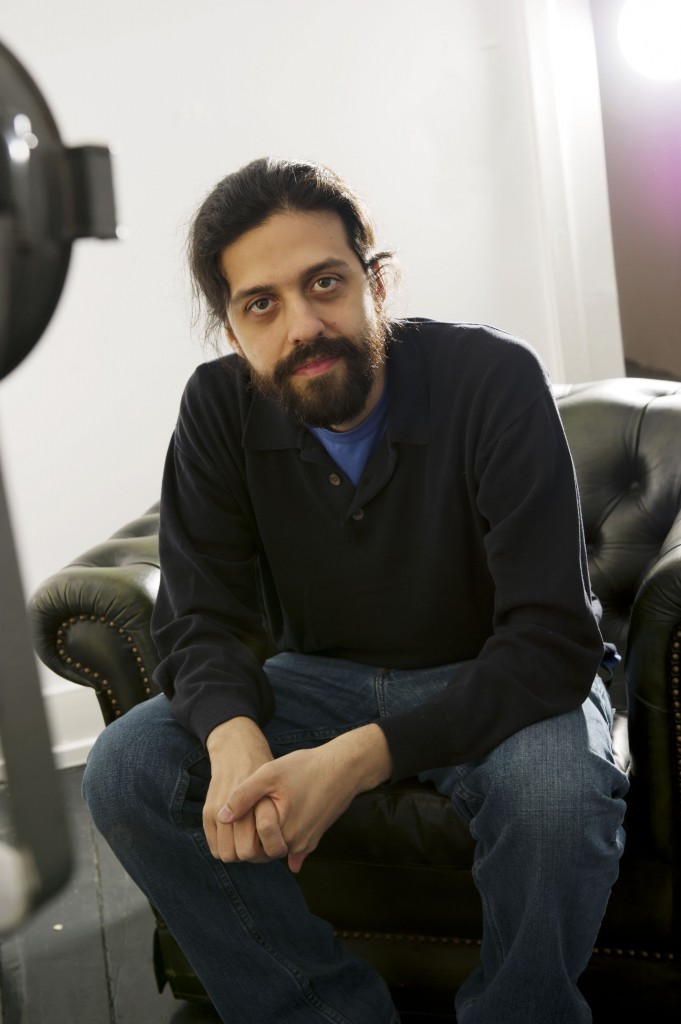
Cuban Filmmaker Miguel Coyula

From Regina Coyula’s blog, 9 June 2017 (Ed. note: These interview fragments are being translated out of order by TranslatingCuba.com volunteers. When they are all done we will assemble them in order into one post.)

Jorge Enrique Lage interview with Miguel Coyula (Intro) 1

The country was falling to pieces, there were people drowning in the sea and on land, there was something called the Diaspora, but we bourgeois teenagers of Havana’s Vedado neighborhood knew nothing. Our lives revolved around a company and Japanese console. In my SuperNintendo years, Miguel was already a legend. Coyula was a gamer before gaming. His name passed like a password between initials. You don’t know how to kill a boss on one of the levels of the game? Ask Coyula. You don’t know how to activate this or that power? Go see Coyula.

We were playing Street Fighter II Turbo and Coyula already had Super Street Fighter II. We went to see him so he could show us the four new fighters and the recent versions of others. I remember that he revealed on the screen the improved attacks of Vega, the Spanish ninja that was my favorite fighther. Afterwards he started to clarify for us some technical doubts about The Lion King.  And I remember that, while he was leading Simba over some cliffs, I looked at his hyperconcentrated face and had a revelation, “This guy is alienated, bordering on autism, he’s going to melt, he probably does nothing else in his life,” I said to myself. “I have to give up video games, because if I don’t, I’ll end up like Coyula.”

Unfortunately, I quit videogames. Then time passed and I saw [Coyula’s] movie Memories of Overdevelopment. I saw it, by the way, before I saw Memories of Underdevelopment, which now seems to me like a regular prequel and a little drawn out. Sergio, the protagonist of Memories of Overdevelopment, ends up in a desert landscape that looks like another planet. He’s carrying a Barbie doll and his brother’s ashes, which are the ashes of the Mariel boatlift and, after that, of the Revolution.  To summarize. In 2010, Miguel Coyula scattered the ashes of Cuba in the desert in Utah; he dispersed these ashes in a psychotronic dust, between mutant and Martian. Seven years later, there are many people who still haven’t noticed.

I like that there is a guy like him in Cuban cinema.

The Hijacking Of Social Networks

In Cuba users connect through a Wi-Fi network in parks or at strategic points in their different cities. (EFE)

14ymedio bigger14ymedio, Yoani Sanchez, Havana, 25 June 2017 – More than five years ago social networks were roiled by the Arab Spring, while the screens of their mobile phones lit up the faces of the young protesters. In those years Twitter was seen as a road to freedom, but shortly afterwards the repressors also learned how to publish in 140 characters.

With a certain initial suspicion, and later with much opportunism, the populists have found in the internet a space to spread their promises and capture adherents. They use the incredible loudspeaker of the virtual world to set the snares of their demagoguery, with which they trap thousands of internet users.

The tools that once gave voice to the citizens have been transformed into a channel for the authoritarians to enthrone their discourses. They assimilated that, in these post-truth times, a tweet repeated ad nauseam is more effective than billboards along the side of the road or paying for advertising space. continue reading

Totalitarian regimes have gone on the offensive on the web. It took them some time to realize that they could use the same networks as their opponents, but now they launch the information police against their critics. And they do it with the same methodical precision with which for years they have surveilled dissidents and controlled the civil society of their nations.

Totalitarian regimes assimilated that, in these post-truth times, a tweet repeated ad nauseam is more effective than billboards along the side of the road 

From the hacking of digital sites to the creation of false user profiles, the anti-democratic governments are trying everything to help them impose frameworks of opinion favorable to their management. They count on the irresponsible naivety with which content is often shared in cyberspace as a factor that works in their favor.

One of these radical about faces has been made by Turkish President Recep Tayyip Erdogan. During the 2013 protests, when he was prime minister, he wanted to enact several laws to restrict the use of Facebook and Twitter. He described the network of the little blue bird as “a permanent source of problems” and “a threat to society.”

However, during last year’s coup attempt in Turkey, Erdogan relied on these tools to summon people to the squares and to report on his personal situation. Since then he has dedicated himself to expanding his power through tweets, reaffirming in the virtual world the dictatorial drift of his regime.

Turkish President Recep Tayyip Erdogan has dedicated himself to expanding his power through tweets, reaffirming in the virtual world the dictatorial drift of his regime.

Last March, Twitter administrators had to admit that several of their accounts, some linked to institutions, organizations and personalities around the world, had been hacked with messages of support for Erdogan. The sultan urged his cyberhosts to make it clear that, even on the internet, he is not playing games.

In Latin America several cases reinforce the process of appropriation that authoritarianism has been making with the new technologies. Nicolás Maduro has opened on Twitter one of the many fronts of a battle through which he intends to stay in power and to quell the popular riots that erupted since the beginning of April.

Venezuelans not only must deal with economic instability and the violence of the police forces, but for many the internet has become a hostile territory where the chavistas shout and threaten with total impunity. They distort events, turn victimizers into victims and impose their own labels as they launch the blows.

The Miraflores Palace responds to images of protesters killed by the Bolivarian National Guard with hoaxes about an alleged international conspiracy to destroy chavismo. The social networks have taken up against the general prosecutor, Luisa Ortega Díaz, where Maduro’s supporters have branded her, at the very least, as a crazy person.

Nicolás Maduro has opened on Twitter one of the many fronts of a battle through which he intends to stay in power and to quell the popular riots that erupted since the beginning of April.

With so many attempts to manipulate trends and adulterate states of opinion on the web, Venezuelan officialdom has ended up getting caught with its fingers in the door. Recently, more than 180 Twitter accounts, which repeated government slogans like ventriloquists, were cancelled. The penalty could be extended to the accounts of other minions linked to government institutions and media.

Venezuelan Communications Minister Ernesto Villegas defined this suspension of accounts as an “ethnic cleansing” operation and Maduro threatened microblogging network administrators with a phrase fraught with outdated triumphalism: “If they close 1,000 accounts, we are going open 1,000 more.”

With his well-known verbal incontinence, Hugo Chavez’s successor was revealing the internet strategy that his regime has followed in recent years. That of planting users who confuse, lie and, above all, misrepresent what is happening in the country. A strategy taught to them by a close ally.

With his well-known verbal incontinence, Hugo Chavez’s successor revealed the regime’s internet strategy… confuse, lie and, above all, misrepresent what is happening in the country.

In Cuba, the soldiers of cyberspace have long experience in shooting down the reputations of digital opponents, blocking critical sites and unleashing the trolls to flood the comment areas of any posting that is especially annoying to them. But the main weapon is to limit internet access to their most reliable followers, and to maintain prohibitive prices for the majority.

“We have to tame the wild colt of new technologies,” said Ramiro Valdés, one of the Revolution’s historical commanders, when the first independent blogs and Twitter accounts managed by opponents began to surface.

Since then there has been a lot of water under the bridge and the Castro regime has launched an effort to conquer those spaces with the same intensity that it brings to its rants in international organizations. Its objective is to recover the space that it lost when it was suspicious of adopting new technologies. Its goal: to silence dissident voices with its hullabaloo.

The Castro regime’s goal: to silence dissident voices with its hullabaloo.

Even in the most long-standing democracies, technologies are being hijacked to inflict deadly blows on institutions.

In the White House, a man puts his country and the world at the edge of the abyss with every tweet he writes. Every night that Donald Trump goes to bed without publishing on that social network, millions of human beings breathe a sigh of relief. He has found in 140 characters a parallel way of governing, one with no limitations.

These are not the times of that liberating network that linked dissidents and served as the infrastructure for citizen rebellion. We are living in times when populism and authoritarianism have understood that new technologies can be converted into an instrument of control.
_______________

Editorial Note: This text has been previously published by the Spanish newspaper El País in its edition of Saturday, 24 June 2017.


Cuba and the United States Return to the Trenches / Iván García

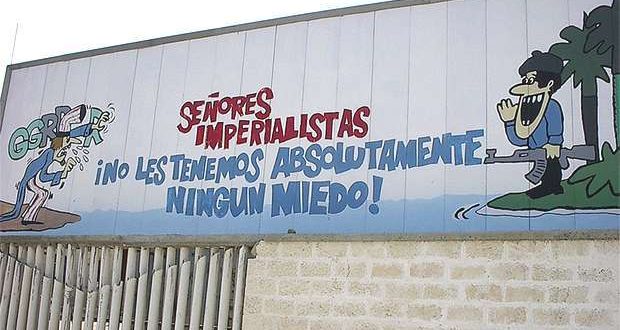
Propaganda billboard reads, “Messrs. Imperialists, we have absolutely no fear!” Source: Cartas desde Cuba

Iván García, 19 June 2017 — For both countries it amounts to a remake of the Cold War, this time in version 2.0. It will take time to determine the scope of the contest or if the new diplomatic battle will involve only bluffs, idle threats and blank bullets.

With an unpredictable buffoon like Donald Trump and a conspiratorial autocrat like Raul Castro, anything could happen.

The dispute between Cuba and the United States is like an old love story, one peppered with resentments, disagreements and open admiration for the latter’s opportunities and consumerist lifestyle. continue reading

Beginning in January 1959, the dispute between Havana and Washington took on an ideological tone when a bearded Fidel Castro opted for communism right under Uncle Sam’s nose. The country allied itself with the former Soviet Union and had the political audacity to confiscate the properties of U.S. companies and to aim nuclear weapons at Miami and New York.

Successive American administrations, from Eisenhower to George Bush Jr., responded with an embargo, international isolation and subversion in an attempt to overthrow the Castro dictatorship.

Times changed but objectives remained the same. Castro’s Cuba, ruled by a totalitarian regime which does not respect human rights and represses those who think differently, is not the kind of partner with which the White House likes to do business.

But the art of politics allows for double standards. For various reasons, Persian Gulf monarchies and Asian countries such as China and Vietnam — countries which have leap-frogged over democracy like Olympic athletes and are also heavy-handed in their use of power — are allies of the United States or have been granted most favored nation status by the U.S. Congress.

To the United States, Cuba — a capricious and arrogant dictatorship inflicting harm on universally held values — is different. Washington is correct in theory but not in its solution.

Fifty-five years of diplomatic, economic and financial warfare combined with a more or less subtle form of subversion, support for dissidents, the free flow of information, private businesses and an internet free of censorship have not produced results.

The communist regime is still in place. What to do? Remain politically blind and declare war on an impoverished neighbor or to try to coexist peacefully?

Washington’s biggest problem is that there is no effective mechanism for overturning dictatorial or hostile governments by remote control. The White House repeatedly shoots itself in the foot.

The embargo is more effective as a publicity tool for the Castro regime than it is for the United States. This is because the military junta, which controls 90% of the island’s economy, can still trade with the rest of the world.

The very global nature of modern economies limits the effectiveness of a total embargo. In the case of Cuba, the embargo has more holes in it than a block of Swiss cheese. Hard currency stores on the island sell “Made in the USA” household appliances, American cigarettes and the ubiquitous Coca Cola.

There are those who have advocated taking a hard line when it comes to the Cuban regime. In practice, their theories have not proved effective, though they would argue that Obama’s approach has not worked either.

They have a point. The nature of a dictatorship is such that it is not going to collapse when faced with a Trojan Horse. But as its leaders start to panic, doubts begin to set in among party officials as support grows among a large segment of the population. And what is most important for American interests is to win further approval from the international community for its geopolitical management.

Obama’s speech in Havana, in which he spoke of democratic values while directly addressing a group of wrinkled Caribbean strongmen, was more effective than a neutron bomb.

There are many Cubans who recognize that the root of their problems — from a disastrous economy to socialized poverty, daily shortages and a future without hope — lies in the Palace of the Revolution.

Hitting the dictatorship in its pocketbook has not worked. In Cuba, as Trump knows all too well, every business and corporation which deals in hard currency belongs to the government.

And all the money that comes into the country in the form of remittances ends up, in one form or another, in the state treasury. Sanctions only affect the people. I am convinced that, if Cuba’s autocrats lack for anything, it is more digits in their secret bank accounts.

Like other politicians and some members of Congress, Donald Trump is only looking at the Cuban landscape superficially.

The United States can spend millions to support Cuban dissidents (though 96% of the money goes to anti-Castro organizations based in Florida), launch international campaigns and impose million-dollar fines on various foreign banks to punish them for doing business with the Caribbean dictatorship, but they overlook one thing: the regime’s opponents — local figures who would presumably be leaders of any prolonged, peaceful battle for democracy on the island — are failing.

The reasons vary. They range from intense repression to the opposition’s proverbial inability to turn out even five-hundred people for a rally in a public square.

I understand the frustration of my compatriots in the diaspora. I too have suffered. I have not seen my mother, my sister or my niece in the fourteen years since the Black Spring in 2003 forced them to leave for Switzerland.

Various strategies have been tried yet the island’s autocrats still have not given up. They are not going to change of their own free will. They will retreat to the trenches, their natural habitat, where they can maneuver more easily. And they will have the perfect pretext for portraying themselves as victims.

As is already well known, the real blockade is the one the government imposes on its citizens through laws and regulations that hinder them from accumulating capital, accessing foreign sources of credit and importing goods legally.

The regime has created anachronistic obstacles to the free importation of goods from abroad by imposing absurd tariffs and restrictions.

But Cubans want a real democracy, not a caricature. We have to understand that we must find the solutions to our problems ourselves.

Cuba is a matter for Cubans, wherever they happen to reside. All that’s lacking is for we ourselves to believe it.