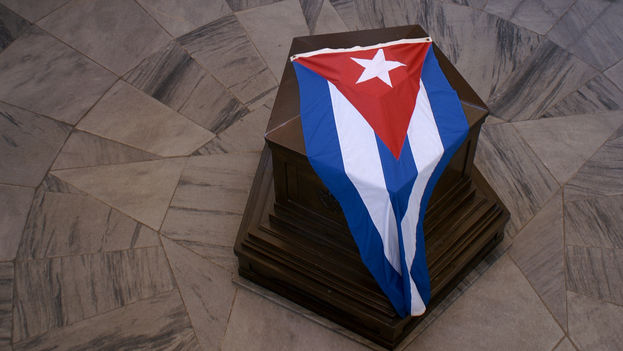
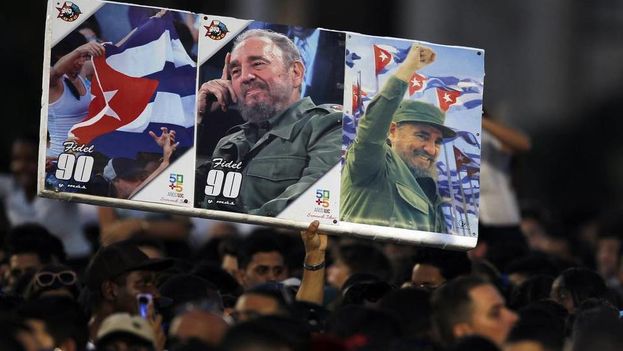
Funeral acts to say goodbye to Fidel Castro’s ashes in Havana (EFE)
14ymedio, Carlos Alberto Montaner, Miami, 3 December 2016 — Almost no one knows how his final hours passed. Did he die suddenly of a cardiac arrest, did he agonize for several days, or did he suffocate because a throat obstruction, as rumors circulate sotto voce in Havana ?
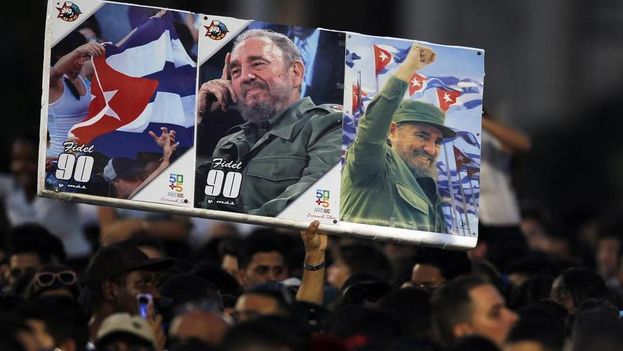
Why the hurry to cremate him? Was it that they didn’t want his final image to be that of a fragile and shrunken old man with a deranged expression? Is that why they made the people file past a photograph of the heroic Comandante on the Sierra Maestra? There is an old tradition of revolutionary primness. One of Stalin’s last requests was that his mustache be well combed. continue reading
Why did they place the urn with the ashes in the Granma Hall of the Ministry of the Revolutionary Armed Forces, far from the presence of the multitudes? Did they fear the improbable scenario that passions might overflow?
Or did they only want for his old comrades-in-arms, like Ramiro Valdés, to bid farewell privately to the caudillo and chief who guided them to victory and turned them into important — though hated and feared — personages?
Is it true that the Comandante’s mortal remains did not travel in the precarious jeep that allegedly carried them to their final destination so as not to endanger them on a pothole-riddled road made hard to navigate by government neglect? Did the idea of giving Cubans a symbolic farewell prevail? What did it matter if the vehicle carried sand or the ashes of another dead man if the act was purely ritual? If Raúl swapped Hugo Chávez’s cadaver, why wouldn’t he do the same with his own brother’s?
Is it true that they planned to switch the ashes at dawn Sunday, shortly before the burial? Using a body double was a trick that Fidel Castro used frequently in life. Was the custom followed after his death? Is that an example of the revolutionary cunning Fidel boasted of so often when he inhabited this vale of tears?
Why did no one interview his official widow and the five sons he had with her? Why didn’t the journalists record the reactions of the other 10 (more or less) unofficial heirs known or presumed to be his? Or the reactions of the 10 other grieving and presumably desperate women who at one time loved the Maximum Leader and dared to give birth to his child?
Is it true that between Raúl’s and Fidel’s families there are barely any channels of communication? Is it true that Raúl’s heirs consider themselves devoted revolutionaries and see their cousins as contemptible bon vivants who mindlessly waste the resources given to them in the sins of the dolce vita, while they themselves aggrandize the legacy of their elders in patriotic endeavors?
Or is it perhaps the domestic and familial variant of the face-off between Fidelistas and Raulistas who, according to the well-informed, has existed deep in the ruling cupola ever since, precipitously in 2006, Raúl came to power hanging from Fidel’s bowels, severely damaged by diverticulitis?
How does Raúl Castro really feels after the disappearance of the older brother who gave him the ideas, the vital drive, the structure of values, who made him Comandante, then Minister, then President and handed him a country he could make or break at will, all the time reminding him that he was an intellectually inferior pygmy without imagination, learning or charisma?
Is Raúl a victim of the love-hate and admiration-rejection provoked by relationships where one party feels he is someone else’s caboose? Does he resent the humiliations received or does he thank Fidel for giving him a remarkable life? Gratitude is the most difficult emotion to handle by most human beings.
Is Raúl aware that the solid juvenile adherence aroused in him by his brother-hero turned to a critical evaluation of the brother-loony with more darkness than glow who lived in a universe of unhinged words or initiatives — dwarf cows, moringa plantations and a thousand other inanities — that gradually destroyed the material foundation of Cubans’ coexistence?
There remains, of course, the most important of all questions. What will happen in the future, now that Fidel Castro lies in Santa Ifigenia Cemetery under a heavy stone, near José Martí’s tomb? That will be the subject of a future article.
The mausoleum that holds the remains of José Martí in Santa Ifigenia cemetery, Santiago de Cuba. (Marie, Flickr)
14ymedio, Pedro Campos, Miami, 3 December 2016 – Genius and figure to the grave, the boy born in Birán, who led an armed Revolution from the Sierra Maestra and governed Cuba for almost 60 years from Havana, wanted his ashes placed for eternity in Santiago de Cuba, near to the tomb of José Martí, in the Santa Ifigenia cemetery.
This could become one of the most controversial of all Fidel Castro’s decisions made throughout his life, for a simple reason: When we need equanimity and closeness between all Cubans, this could stimulate more divisions, given that the figure of Martí is ecumenical, while that of Fidel is divisive and, for many, a figure of conflict. continue reading
The location of the remains of the former president near to those of Martí is already being taken as a provocation by an important share of Cubans, and it is possible that some may not rest until they see them well away from those of Martí.
There are sad precedents in our history. Suffice it to recall the consequences of an alleged desecration of the tomb* of Don Gonzalo de Castañón in colonial times or disturbances during the armed and outrageous attack during the reception of the ashes of Mella in the Republic in 1933. Those events generated great confrontation among Cubans and left enduring marks.
The choice of this place, in addition to being controversial, will demand an enormous security effort and a substantial cost in resources and measures to guarantee the protection of the ashes. Given the foreseeable threats, a broad deployment of surveillance may be necessary, with a great number of professionals and technically sophisticated measures, because the ways in which people will attempt to remove the remains from there could be wide-ranging.
The personal security of Fidel Castro does not rest with his death. To avoid future complications, it might be suggested to the government of his brother that his remains rest only a few days in Santa Ifigena and then be taken to a less controversial place, where they can be honored by his admirers without causing litigation as, for example, the Sierra Maestra, symbol of the struggle, perhaps on Pico Turquino itself, the highest peak in Cuba, where there is a bust of Martí placed by Celia Sanchez, the unforgettable combatant close to Fidel.
Something like the general president thought of for himself, on the 2nd Front.
That might be a wise decision by Raul Castro’s government and an important contribution to the future reunification and peace of the Cuban homeland, for which Martí will always be the Apostle, founder of the nation, and shelter of all its children, while Fidel Castro is considered only by his followers as the most distinguished of his successors.
*Translator’s note: In 1871 eight medical students were executed after having been purposely but falsely accused of desecrating the tomb of this Spanish journalist.
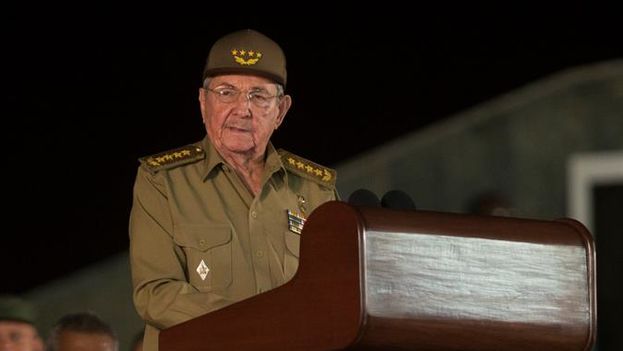
Raul Castro speaks during the ceremony of farewell to Fidel Castro on Saturday in the Antonio Maceo Plaza of the Revolution in Santiago de Cuba. (EFE)
14ymedio, Havana, 3 December 2016 – A somewhat hoarse and visibly tired Raul Castro gave the main speech at the final massive act of homage to Fidel Castro in the Antonio Maceo Plaza in Santiago de Cuba. The general president focused his speech on the voluntarism espoused by his brother and highlighted the phrase “Sí se puede” – Yes we can – as a summary of the actions of the fallen leader.
Those who expected a speech with definitions of the future direction the country will take after the death of the historic leader, had to be satisfied with a speech that the president devoted to reviewing the national history of the last six decades.
Raul Castro recalled the main events in the life of the country while his brother was in command. The Cuban president stressed the difficult years of the Special Period, when the Soviet Union disappeared and the island lost the millions in subsidies that had supported its economy. continue reading
Raul Castro said that Fidel Castro’s name and figure will not be used to name public places, streets or plazas, nor to raise monuments, busts or statues in his memory. A desire expressed by the deceased, who, according to the president, “rejected every kind of manifestation of a cult of personality.”
In the next session of the National Assembly there will be proposals to ensure that Fidel Castro’s desire in this regard is honored, announced his brother
At the event, which attracted thousands of people, representatives of pro-government organizations took the floor, including the Workers’ Central Union of Cuba (CTC), the Union of Young Communists (UJC) and the University Student Federation (FEU).
Miguel Barnet, president of the Writers and Artists Union of Cuba (UNEAC) said that “Fidel broke the traditional political scheme” and added that “Cuba without Fidel will not be the Cuba it is today.”
From the audience congregated in the plaza were heard slogans in the style of “Raul is Fidel” as a form of adherence to the system imposed since 1959, “Raul, amigo, the people are with you,” and the repetition of “Sí se puede,” as an echo of the words of the principal speaker.
In the main grandstand were sitting presidents Evo Morales, Daniel Ortega and Nicolas Maduro, as well as ex-presidents Dilma Rousseff and Luiz Inacio Lula da Silva; and the Argentine soccer player Diego Armando Maradona.
Raul Castro summed up the work of his brother as someone who, “yes, he could” and called to continue building socialism in Cuba “or, and it’s the same thing, to guarantee the independence and sovereignty of the homeland.”
Tonight will be the last vigil over Fidel Castro’s ashes, after four days of crossing Cuban territory from Havana. On Sunday he will be buried in the cemetery of Santa Ifigenia in a ceremony that Raul Castro labeled as “simple.”
Opposition groups in the eastern part of the country, especially the Patriotic Union of Cuba, has denounced the strong surveillance operation around the homes of their activists.
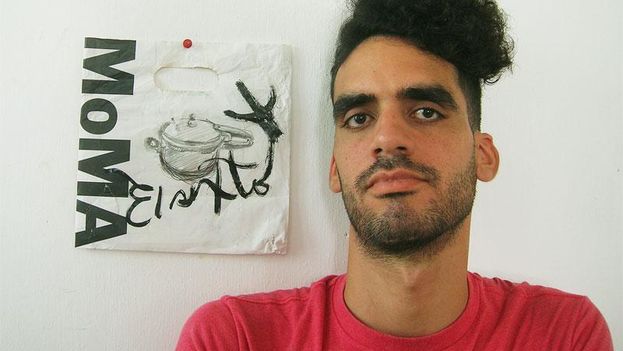
Danilo Maldonado, known as El Sexto (The Sixth). (Artist File)
14ymedio, Havana, 2 December 2016 — Danilo Maldonado, known as ‘El Sexto’ (The Sixth), began to eat the food, his mother, Maria Victoria Machado, told this newspaper. A week after his arrest for painting graffiti on a central Havana street corner and posting a video on his Facebook profile, the artist is still waiting to be released or presented with charges.
Machado explained that she was able to see her son today, and bring him some food at the Zapata and C Police Station in Vedado, where Maldonado is being detained. continue reading
The prosecution has not acted to date, although it is expected that El Sexto will be released on Sunday, according to his mother.
“He has refused to eat the food they give him in the station,” Machado said. On Tuesday, relatives of the artist reported that he had been severely beaten and was holding firm against what he considers an injustice.
“Mamá, I have had a lot of aché (luck/blessing) to be a Cuban artist the day that bloody tyrant died and to be able to express myself. I’ll get out of here,” Machado said her son told her, from the detention center in Guanabacoa, a township east of the Cuban capital.
“When I asked the official what my son’s sentence would be for this crime, he told me just a fine, but then he started to talk about ‘historic conditions’ the country is going through and right there I told him that for me the state property demagoguery wouldn’t work,” she explained.
According to his mother, Maldonado has been beaten on several occasions since his arrest. “He told me himself. In Guanabacoa two officers beat him up,” she explained.
Alexandra Martinez, Maldonado’s girlfriend who lives in Miami, said that El Sexto’s detention “shows the cruelty of the Castro regime that continues to violate its people.
“The regime must release Danilo immediately. His life, his health and his safety are in play and we need him,” she said.
Somos+, 3 December 2016 — Joanna Columbié has been released but with the “warning” that she cannot leave Havana until after December 10th*. Once again, the nervousness of the Cuban government in the face of people who know what they want for their country is on display.
*Translator’s note: December 10th is International Human Rights Day, which may or may not have played into the government’s choice of that date.
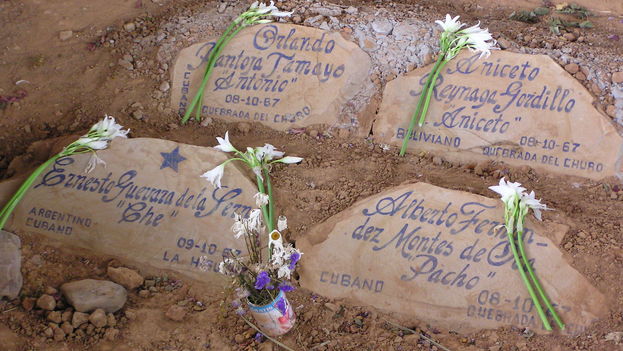
Pit where the remains where, in 1997, the remains of ‘Che’ Guevara and several of his colleagues were found in Vallegrande, Bolivia.(BdG)
14ymedio, Bertrand de la Grange, 1 December 2016 – In the Santa Clara mausoleum everything is genuine. Except, perhaps, Che’s bones. Thousands of people are making pilgrimages lately to this giant stone building to commemorate the 40th anniversary of Ernesto Guevara’s death. Official history says that a team of Cuban forensic scientists found his skeleton in eastern Bolivia and repatriated it in July of 1997. Ten years later, however, there were the first indicators that cast doubt on this version.
Three European experts – Dr Jose Antonio Sanchez, director of the School of Legal Medicine at the Complutense University of Madrid; his colleague José Antonio García-Andrade, from the same university, and a French physician specializing in forensic anthropology and archeology – have analyzed the technical documentation used by the Cubans. continue reading
“Scientific Accomplishment.” Thus, Havana classified the discovery of Che’s bones, made by a team directed by Cuban forensic scientist Jorge Gonzalez. He was buried with six other guerrillas – three Cubans, two Bolivians and a Peruvian – in a pit a few yards from the airstrip of Vallegrande, a town of 6,000 inhabitants near La Higuera, the village when the Argentinean was murdered by the Bolivian Army on 9 October 1967.
The triumphal arrival of the coffin in Havana, on 13 July 1997, gave the communist government a great political victory a time when Cubans were suffering from hunger following the collapse of the USSR, the country’s principal ally and supporter. The guerrilla’s capacity for sacrifice, despite his failure of his stated aim to create “many Vietnams” in Latin America, was an example that every Cuban should follow to endure hardships. The timing of the discovery of the grave could not have been more opportune: a few days from the most emblematic date of the Cuban Revolution, 26 July, and a few weeks from the Fifth Congress of the Cuban Communist Party and the 20th anniversary of the death of the “Heroic Guerilla.”
Operation Che was directed personally by the two Castro brothers through the men in whom they had the most confidence, Ramiro Valdes, Jorge Bolaños and General Fernando Vecino Alegret. Fidel Castro himself asked Bolivian president Gonzales Sanchez de Lozada directly, and he entrusted all responsibility for the operation to a common friend, Franklin Anaya Panka, then Bolivian Ambassador in Cuba. In a meeting we had at his home in La Paz, Panka bragged about the matter while showing me a letter from the Cuban president addressed to Sanchez de Lozada, who had gladly accepted the proposal from his “friend Fidel.”
In their desire to demoralize the guerrillas, the military used to bury the rebels in secret graves. It was known that most of the 36 dead guerrillas, from a troop that never exceeded 50, had been buried on the outskirts of Vallegrande. At the end of 1995 General Mario Vargas Salinas, who had fought the insurgency, broke his silence and said that Che’s body was near the airport runway. He didn’t know the exact place. The person charged with burying the guerrillas, Lieutenant Colonel Andres Selich, had taken the secret to his own grave when he was murdered in 1973. “Che was buried separately from the rest,” said the official’s widow from her house in Asuncion, Paraguay.
According to Vargas, six of the seven guerrillas killed in La Higuera were in a single grave, confirming that the Argentinean had been buried separately. However, when the Cubans, overseen by a “special commission” led by Panka Anaya, finally found the grave on 28 June 1997, they found seven skeletons. There was no time for digressions. Doctor Jorge Gonzales, then the director of the Havana Institute of Legal Medicine, designated one of the seven skeletons as Che’s, before subjecting it to any scientific proof.
“As of 29 June we were convinced that E-2 was the skeleton of Che,” Doctor Gonzalez and his colleague Hector Soto told the official newspaper Granma. “I told Soto to check to see if it had hands [the Army had amputated Che’s hands to check his fingerprints with the Argentine police]. He told me, ‘Negative the interested party,’ which is police language that we use. And indeed, it didn’t have hands.” Something, however, clouded the joy of Doctor Gonzalez. The doctor agreed to an interview with Granma which “worried” him when he saw a jacket and a belt on skeleton E-2. And that was because, according to the historic investigation undertaken by the Cubans and confirmed by other sources, Che had been buried without his clothing, which had been removed before the autopsy.
The last thing Doctor Moises Abraham expected was that the past would pursue him to a refuge in the Mexican city of Puebla. Abraham was the director of Vallegrande Hosptial in 1967 and was in charge of amputating Che’s hands, after completing the autopsy. The visit of the Cuban historian Froilan Gonzalez must not have given him much pleasure. “It was surprising, he never imagined it,” remembers the historian. “However, he tried to be courteous.” It was in the eighties. Froilan Gonzalez was immersed in the mission to find the bones of the guerrillas and rescue the history of the insurgency. His investigations had taken him from Bolivia to Puebla.
What did the Cubans want? Two things: the testimony of the doctor about his experience with the corpse of Che and, most importantly, to convince him to deliver Che’s corpse to Cuba. “On the first point there was no problem, although he didn’t give us authorization to publish his statements about the death.” However, there was no agreement on the other issue: “He set unacceptable conditions,” says Froilan Gonzales. What conditions? Money, a lot of money. On a visit to Puebla, where Abraham had his cancer surgery practice, he was able to confirm it. That time, it wasn’t as friendly. On the defensive, cantankerous, the Bolivian doctor only wanted to talk money: “How much are you going to pay me?”
In any case, Froilan Gonzalez did not reach an agreement with Abraham. Thus, the Cubans were “concerned” when they opened the grave in Vallegrande and saw a jacket on skeleton E-2. The forensic team, with aplomb, decreed that it was Che was because no one, apart from them, knew that Che’s jacket was in the possession of the Bolivian doctor. No one except a German citizen, Erich Blössl, who had arrived in Vallegrande in the sixties, as an agronomist before buying a restaurant. Blössl was a friend of Musa, as Dr. Abraham is called.
“Musa had kept Che’s jacket, all bloody. He showed it to me,” says the German. “It had a broken zipper, and was tied with a rope, exactly like in all the photos taken. There were several bullet holes. He took it to Mexico in the late seventies.”
Witness to the exception, Blössl was there when Cubans opened the pit and saw the jacket, and he sensed something was wrong. “Marcos Tufiño, Deputy Commissioner for Panka Anaya to monitor the excavations, came to my restaurant and asked about the jacket. I said it was not Che’s. He insisted I go to see it again and handed me a safe-conduct for the soldiers to let me pass. I went back. There was Tufiño. I went down to the pit and confirmed that it was not Che’s jacket. It was a waterproof, poncho type, like the Army had.”
After conducting several tests on the seven skeletons in the Japanese Hospital of Santa Cruz de la Sierra, Bolivian authorities authorized the departure of the remains of the guerrillas to Havana.
What does the forensic report about the bones said to be Che’s say? In the Japanese Hospital there is no trace of the document. When the Argentine Forensic Anthropology Team (EAAF) that collaborated on the exhumation in Vallegrande was asked for a copy, its president, Luis Fondebrider, said that only the Cubans could provide it. Jorge Gonzalez didn’t respond to a request. “The Cubans took all the papers. I was left with only this copy of the final report,” says Cueller, who specialized in surgery in Madrid and forensic medicine in Havana. “They have the pre-mortem reports on Che, his dental history, and the 1967 autopsy, and there is no reason not to trust them.”
A comparison between the forensic report edited by the Cubans and Argentineans in 1997 and the autopsy performed on Che at the time of his death is disconcerting for three doctors consulted in Madrid and Paris. Jose Antonio Sanchez, director of the School of Legal Medicine at the Complutense University of Madrid, said some wounds are consistent and others are not, but he believes the documents are insufficient to come to a conclusion. On the other hand, his two colleagues find clarifying elements. “It is two different bodies and they correspond to two different people,” says Jose Antonio Garcia-Andrada, who has had a long career in forensic medicine.
Both he and the French expert, who currently prefers to remain anonymous to not prejudice his own investigation on the matter, highlight the same discrepancies. “The 1997 reports describes fractures on the 2nd and 3rd left ribs. These fractures were not mentioned in the 1967 autopsy, which shows, instead, an injury between the 9th and 10th left rib, which is not in the other report,” they both say.
In addition, the cadaver analyzed in 1967 presents “injuries in both clavicles,” while the skeleton found in 1997 has “an injury only to the right clavicle,” says the French expert. The same is true for the femurs: Che did not show the wound on his right femur “measured at 11 by 13 millimeters” which appears on the 1997 skeleton. Garcia-Andrade added that “the spinal injuries are not consistent.”
The two experts also noted discrepancies in the analysis of the mouth. Che lacked a “lower left bicuspid,” according to the autopsy of 1967. The 1997 report does not indicate this detail, but it does indicate, however, the presence of a “third molar upper left” (wisdom tooth), which Che’s corpse did not have. Both the French physician and Dr. Sanchez were greatly surprised at the absence of references to the surgical removal of Che’s hands by Dr. Abraham. “This operation always leaves visible marks and yet, it is not mentioned,” says the professor from Complutense. One might suspect that the bones of the hands were removed when the skeleton was exhumed, adds the French doctor.
Plaque put in place in 1997 in Vallegrande, Bolivia. (BdG)
In these circumstances, experts agree, only a genetic analysis would allow the “accurate” identification of the remains attributed to Che. Only an independent and reliable analysis, conditions not met by the supposed DNA test that Cuba now claims was done. “I proposed not to do a DNA test and the decision was consensual,” Alejandro Inchaurregui, one of the Argentinean forensic anthropologists who was in Vallegrande, explained in March. “There is overwhelming evidence. There were anthropomorphic and dental records collected before he left Cuba, to be able to identify his remains if he died.”
So, does the documentation submitted by Havana really correspond to Ernesto Guevara, or does it correspond to another of the Cuban guerrillas buried in Bolivia? In a telephone conversation recorded in September, Inchaurregui was furious when asked this question. “You are a miserable person for arguing that the identification of the remains of Che is a falsehood. Sure, I’m that stupid that the Cubans took me by the nose and I ended up signing a document that says they are the remains of Che when in reality they are not.” The forensic anthropologist who no longer works for the EAAF concluded our conversation this way: “Where are you?” In Madrid … “In Madrid, what a pity! Because if you weren’t, I would kill you.”
Obviously, Inchaurregui is not “that stupid” but he seems to favor expeditious methods to solve problems. Che had to be in Havana before July 26, 1997 to celebrate the big homecoming of the prodigal son and give a little morale boost to the Cubans. It was Fidel Castro’s orders. That it wasn’t true would be, after all, a lesser evil.
_____________________________________
Editor ‘s note: This article was published on 7 October 2007 in the newspaper El País.
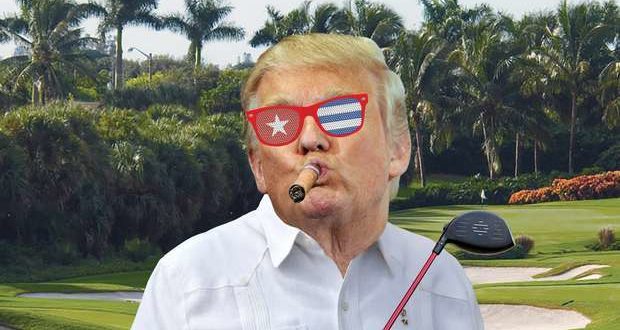
Cartoon published in Did Donald Trump’s Executives Violate the Cuban Embargo? Bloomberg, July 28, 2016.
Iván García, 25 November 2016 — After sweeping a park that spans entire block in the Vibora neighborhood of Havana, Silvio sits on a wooden bench and, in the shade of a carob tree and a fresh autumn breeze, guzzles a liter of cold water.
As for many Cubans, politics aren’t his forte. He’s serving a year of detention for hitting his ex-wife, and sweeping parks or weeding flower beds is part of his punishment.
“Things in Cuba are really bad. There’s no money, and it’s very hard to buy food. At the rate we’re going, we’ll soon be starving even more than during the Special Period. I don’t know how Trump could help make things better for Cubans. These scoundrels (of the Cuban regime) are the ones that have to do that. And they don’t. They steal all the money and then entertain us with their long speeches. Trump seems like an S.O.B., but the sitution in Cuba isn’t his fault. The solution is to sell the country in an auction. Can’t that be done?” asks Silvio in the warm, morning sun. continue reading
Cubans don’t really like to make predictions. They don’t do them any good.
“They’ve deceived us so many times that people prefer to live day to day. The future seems like a fairy tale. From Fidel Castro’s unfulfilled promises to produce as much milk or meat as Holland, to a quality of life comparable to that of New York.They’ve always sold us the theory that the U.S. blockade (embargo) is responsible for Cuba’s misfortunes. Then a guy like Obama arrives at the White House, who wants to change strategies and whom Cubans on the island love, and they keep blaming their problems on the Americans. That’s why a lot of people don’t care who’s governing in Washington. The solution to our problems depends on Cuban leaders,” says Carlos, a sociologist.
Cuba is hurting. The streets are destroyed, the people are tired of speeches and slogans, low salaries and decades of shortages. To escape the daily drama, people cope by settling into a recliner or an arm chair in front of the TV for hours, watching Mexican soap operas or game shows and reality shows made in Miami.
Orlando earns a living stuffing matchboxes on 10 de Octubre Avenue. He would have liked Hillary Clinton to win the election. “Forget the story that she would have continued the Cuba policies put forth by Obama. I wanted her to win because she would have become the first woman president of the United States. I think the world is lacking in female governance.”
Although polls seem unreliable after the resounding failure of Brexit in Great Britain, peace talks in Colombia, or Trump’s unexpected victory in the United States—where citizens hid their intentions in the voting booth—in Cuba an overwhelming majority preferred Hillary in the White House.
Influenced by Trump’s bad press on the island, the continuation of Obama’s legacy, and other diverse reasons—from our mixed races to empathizing with a black head of state—the average Cuban was for Clinton.
Cubans didn’t really care about Hillary’s email scandals or the accusations made against her husband by a campaign volunteer. Nor did they care about news reports accusing the Clinton family and their political dynasty of corruption.
For Delio Benítez, who has a degree in Political Science, there’s a strange phenomenon in Cuba. “In general, when Cubans are on the island, they lean toward Democrats in the U.S. elections; but once they’re living in North America, a large portion of them vote for Republicans.”
Benítez doesn’t know why. “I can’t prove it with scientific studies. Maybe it’s the prevailing anti-imperialism in Latin America, or the aggressive discourse of the Cuban regime. But in the Cuban subconscious, Democrats are, politically speaking, more reasonable than Republicans, with their tendencies toward war and their anti-immigration stance.”
For Josuán, a vegetable and fruit seller in an open-air market in Havana, Hillary was a better option because “she may not have abolished the Cuban Adjustment Act. For me, and for many who plan to emigrate, Clinton was our candidate. Trump is going to repeal that law. And those of us who planned to leave will have to speed up our trip.”
The majority of citizens that have coffee without cream for breakfast also don’t expect a disaster from the Trump administration. “He’s a businessman. Maybe he’ll fit in better with Castro than Obama. Hillary would have been perfect, but (Cuba-U.S.) relations won’t be broken with Trump. One thing for sure, things are going to be bad for us Cubans regardless of who wins in the United States. The blame for our misfortunes lies here at home,” claims Emilio, a personal barber, in a soft voice.
If you want to meet a sector of Cubans that applaud the election of Donald Trump, please visit the dissident, Antonio Rodiles, in the Miramar neighborhood in east Havana, or Berta Soler at the Damas de Blanco headquarters in Lawton on the south end of the capital.
That branch of the opposition, under the umbrella “Forum on Rights and Freedoms,” practically held a party over Trump’s victory. According to their statements, they believe that as repressed dissidents they will get more backing and financial assistance from the White House.
But it just so happens that, in Fidel Castro’s Cuba, anyone who has survived eleven U.S. administrations had an equal chance of being imprisoned or executed during a democratic era as they did a republican era.
Autocracies thrive and survive regardless of any major or minor international condemnation. Ending autocracy is Cuba’s business. No one else’s.
Somos+, Joanna Columbié, 2 December 2016 — It has been announced on any number of occasions — much anticipated by many and feared by others — but the death of Fidel Castro is now a reality. Nothing can delay it and nothing can stop it.
However, there is something that lives on after his death which is a greater evil, the one that should have died: Castroism. It is that compulsive obsession that demands homage and submission to the ideas of a human being named Castro, whose legacy to this nation cannot easily be reconciled by history.
Fidel left behind separated families, weeping mothers, children lost in the Florida Straits, young migrants traversing mountains and towns throughout the world, political and ideological division, persecution, prisons, death, hypocrisy and a country that is plunging ever deeper into material and spiritual poverty. continue reading
Fidel intoxicated those who were hoping for a better future for Latin America, infecting them with “his communism.” He tried to pass on to posterity his totalitarian legacy of always trying to hold onto power. His struggle against “Yankee imperialism” left an open wound which even now remains impossible to close. He spoke of people’s rights when his own people have long lived without those rights.
All this is indisputable, but what then do you do with this experience? Where to look? Backwards or forward? Will we simply stand still, frozen in time in the present?
Fidel Castro has died, but Castroism has not. The Cuban people cannot live forever subject to his ideas, to his doctrines, to his opinions, to his image and his symbols. They have divided our nation for too long. We are living in the midst of a societal breakdown but he is no longer here to define the goals or to point way to reaching them.
As Fr. José Conrado said some time ago, “our people are languishing in the middle of a desert whose scarcest water is that of hope. We are at the edge of a spiritual precipice much more serious and profound than the material deprivations that overwhelm and oppress us daily. The vision of society that has been promoted as the panacea to all our problems, as a solution to our vices and the fulfillment of our dreams, has led us to this dead end, to this sad condition.”
This is a decisive juncture; let us not allow the opportunity to pass by. It is the moment for reconciliation and hope. Enough with hate and separation, enough with forgetting our identity as a nation, as Cubans, as brothers. We must reconcile our differences, listen to proposals and discover the value of dialogue as a source of those proposals. This is necessary if a new dawn is to rise among us. We must be ready to find solutions for the future of a homeland that belongs to us and that demands it of us.
If you would like to comment on this post from within Cuba [ed. note: and do not have sufficient internet access to enables you to do so in real time, online], write to comunicaciones@somosmascuba.com. Your comments will be included in the blog.
El Sexto’s graffit after the death of Fidel Castro. (14ymedio)
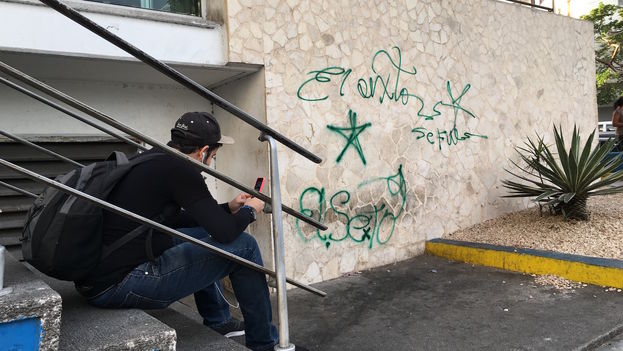
14ymedio, Mario Penton & Abel Fernandez, Miami, 2 December 2016 – The Cuban artist Danilo Maldonado, known as ‘El Sexto’ (the Sixth), declared a hunger strike this Thursday, according to reports to this newspaper from his mother Maria Victoria Machado. The artist’s decision comes six days after his arrest for having painted on a centrally located wall in Havana, the words “Se fue” – He’s gone – in reference to Fidel Castro.
El Sexto’s fast comes amid worsening repression against the dissidence and independent journalists on the island, during the period of national mourning for the death of the former president.
“I had the first interview with the investigator who is handling Danilo’s case today. He told me that as of yesterday my son does not want to eat to demand his release,” Machado told this newspaper by phone. continue reading
Maldonado was arrested on 26 November after painting graffiti on the exterior wall of the Habana Libre Hotel, at the centrally located corner of 23rd and L in the Vedado neighborhood, and publishing a video on his Facebook page celebrating Castro’s death.
On Tuesday, family members of the artist denounced that he had been severely beaten and said he was holding firm against what he considers an injustice.
“Mamá, I have had a lot of aché (luck/blessing) to be a Cuban artist the day that bloody tyrant died and to be able to express myself. I’ll get out of here,” Machado said her son told her at the Guanabacoa detention center to the east of the capital.
According to Machado, her son is accused of damaging state property.
“When I asked the official what my son’s sentence would be for this crime, he told me just a fine, but then he started to talk about ‘historic conditions’ the country is going through and right there I told him that for me the state property demagoguery wouldn’t work,” she explained.
According to his mother, Maldonado has been beaten on several occasions since his arrest.
“He told me himself. In Guanabacoa two officers beat him up,” she explained. The police told her that El Sexto’s phone was given up for lost, but had finally been found in police custody.
Alexandra Martinez, Maldonado’s girlfriend who lives in Miami, said that El Sexto’s detention “shows the cruelty of the Castro regime that continues to violate its people.
“The regime must release Danilo immediately. His life, his health and his safety are in play and we need him,” she said.
Family and friends of the artist are working with three human rights organizations, an international attorney and several local attorneys on the release of the artist, Martinez said.
“This shows how fearful and insecure the Cuban regime is,” she added.
This Saturday the prosecution is expected to rule on El Sexto’s case.
Fernando Damaso, 12 September 2016 — In light of the proliferation among Cubans of garments adorned with elements of the United States flag and, to a lesser degree, the flag of England, some “defenders” of the national identity and of patriotic symbols have proposed making the Cuban flag more visible, as “many Cuban flags.”
Being that the natives of this Island tend to outdo ourselves and we forget that there is a happy medium, some sportswear items have appeared (awfully designed for the Río de Janeiro Olympics)–shirts, shorts, caps, purses, tote bags, and even aprons–bearing elements of the national standard or, simply, reproducing it without any creativity. continue reading
Now, following the beat of these pioneers, other “purists” have raised their voices, demanding a prohibition against the use of the flag on items of clothing, because it is unnecessary to import “bad customs” from other countries. In the first place, to categorize the habits of others as “bad” or “good” seems a bit petulant: they are customs and should be respected, even if not imitated.
Besides, why this late defense of patriotic symbols, when in fact, officially speaking, they have been quite disrespected? Examples abound: utilizing the flag during any political activity, no matter how trivial; leaving it suspended eternally in closed-off areas, even exposed to the elements; printing it on paper and, later, allowing it to be strewn on the floor like so much trash, trampled on by passers-by; hanging it up in state-run establishments as a curtain on doorways and windows to block the sun; printing images of historic and not so historic figures on it; and, as if all this weren’t enough, having the Historic Leader write his signature on it with a felt-tip pen during a public act on the staircase of the University of Havana.
Let us not even mention the national coat of arms, for it has been obviated and forgotten, having not been present, as was customary before 1959, in government buildings, but rather, in observance of a blatant personality cult, substituted by photos of living personages.
All of this racket is due to some “dogmatics” who, from an “idiotological” point of view, want to confront a foreign custom that has been taken up in our country.
I think there are real problems that are more important to confront, unless this is one more entertainment designed to lull Cubans with cheap patriotism.
14ymedio, Luz Escobar/Mario Penton, Havana/Miami, 29 November 2016 — Women crying on camera, Facebook profiles turned into portraits of Comandante Fidel, long lines to bid farewell to his absent ashes. No reggaeton in the streets, no “good morning” from the announcers on national television. For a tourist, the people, Cuban and devoted to Fidel, transfixed by pain, have not lost any opportunity to say goodbye to their leader. But the reality is very different from the slogans.
“The Student Federation sent me this picture by email,” says a computer science student in Santa Clara, while looking at an image of a young Fidel Castro in his inbox. “The directions are for us to put it on our social networks and dedicate a dignified farewell to the old man,” says the teenager. “All of it, it doesn’t matter to me, but if I don’t do it, it could affect my career,” he adds. continue reading
Teresa, a woman from Cienfuegos who works in education, spends the hours as the sun passes overhead in front of a photograph of the former president and follows protocol to show signs of pain, which isn’t pleasant.
“I went because the union made me. If you dare not to go you’ll find out what happens to you. He died, but the system he created is just the same. He could have done a lot of good, but forcing us to go say goodbye to him seems abusive to me,” says the teacher, who added that she ended up with a migraine after so much time standing in the sun.
Perhaps the most notable case of following the forms was the debate between two news announcers, Froilán Arencibia and Mariuska Díaz, caught on open mike, about whether they should greet viewers with “good afternoon” or simply “greetings.” Finally, the direction to eliminate the “good” won the day because how could it be a good day if Fidel Castro had died?
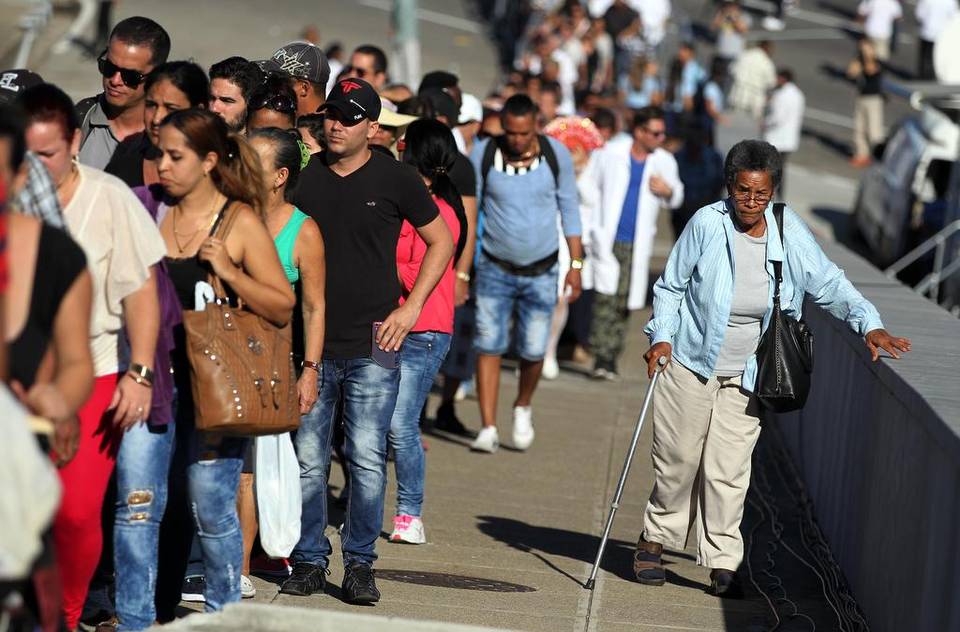
“They put us in a huge line where, at the end all we had in front of us was a photo and his medals, because the ashes were for the leaders,” an independent worker told 14ymedio.
On elderly messenger in Havana had his own hypothesis about why Castro’s ashes weren’t on display to the thousands of people who waited at least four hours to enter one of the three “altars” in the Plaza of the Revolution. “Looking at his photo were his admirers and opportunists who wanted to look good at work. If they’d put the ashes on display, they’d have to have someone guarding them and there might have been some damage done,” he said, in reference to the Afro-Cuban rites where the bones of the deceased or, failing that, the dust of the skeleton contains the spirit of the departed.
“There are people who really loved him and they’re sorry. Fidel had a people,” a lady of 60 years, retired from the army, says ruefully.
In a Havana street, a young man who was with his girlfriend in a car complains that a policeman knocked on his window and asked, discourteously, that he turn off the music with which the couple was passing the time.
In the case of Cubans abroad connected with the country, the directions have been clear: you must first participate in a ceremony in which a book of dedications and lamentations is filled, then you have to reflect that pain in social networks.
“We want to make Facebook into a place where our Comandante is remembered and colleagues from other countries can go there to see the pain of our people,” a coordinator of the Cuban medical mission told Cuban doctors at a meeting in Brazil.
“The truth is easy come easy go, they force us to stand in lines,” jokes one of the doctors of the mission who requested anonymity.
“This is like an open stage or one of the famous ‘marches of the combative people.’ Doesn’t anyone ask why there were not spontaneous mass gatherings after the announcement? The people have to wait for directions from above to be sad.”
The ’14ymedio’ journalist, Reinaldo Escobar. (Youtube)
14ymedio, Havana, 1 December 2016 — The journalist Reinaldo Escobar, editor in chief of 14ymedio, was detained for more than four hours on Thursday, in the midst of the control measures that the Government deployed after the death of Fidel Castro. The reporter gave an interview to Spanish Television (TVE) on the Malecon in Havana where he was intercepted by police and taken to the Zapata and C police station in Vedado, according to witnesses who confirmed the arrest.
A man in civilian clothes approached the place where Escobar was being interviewed by Vicenç San Clemente of TVE. “He said we could not be here because it was an avenue where many presidents were passing by,” the Spanish correspondent told this newspaper. The man remained nearby listening to Escobar’s answers. continue reading
“They were questions about the future of Cuba, about the possible legal reforms that might be made,” explained San Clemente. However, the man ended up calling a patrol car, with license plate 099, which took the two journalists to the police station.
The Spanish Embassy in Havana began negotiations for the release of both reporters as soon as they heard the news, a diplomatic source informed 14ymedio. San Clemente was held at the entrance to the police station, but Escobar was lost to sight when he was led into the interior of the building.
Four hours after the arrest, the Cuban journalist was released and when he inquired at the station about the infraction or crime which had been entered into the log book, the uniformed officer responded with the brief word: prophylaxis.
Escobar graduated from the University of Havana in journalism in 1972, and has served as editor-in-chief of this independent newspaper since its founding, in May of 2014; the newspaper is blocked on servers on the island by the government. Previously, Escobar worked for various press media, among them the magazine Consensus, which was founded in December of 2014, and on his personal blog, From Here.
In December of 1988, Escobar was fired from the newspaper Juventud Rebelde (Rebel Youth), the second most important newspaper in the country. The dismissal was due to several critical articles he published after being motivated by the new air of glastnost in the Soviet press. Since then the government has not permitted him to exercise his profession in any of the state-controlled media, which exercise a monopoly over the press.
One of the events in Havana in the 9-day mourning period for Fidel Castro (EFE)
14ymedio, Tania Bruguera, Havana, 1 December 2016 — Today in Cuba, we start a new phase, a phase that requires us to transition (shift) from an anecdote to historic data, from rumor to research, from passion to facts from what was symbolically assumed to what was actually done.
Time has come for us to ask for that archives be opened, to know how many truths were manufactured and to what extent victories were achieved, to know with certainty how many Cubans have died around the world, to understand what social progress we have made and to learn which agreements the government has made on our behalf.
The Cuban people have the right to know its history, all of it, and be able to draw their own conclusions. continue reading
Today Cubans have stopped being children waiting for orders.
However, refusing to be underestimated requires understanding other people’s feelings, those that think and feel differently. It means understanding that we are not always right and that the goal of discussion is not to win arguments but to clarify our ideas and send them out for consideration..
We need to stop thinking that only our feelings are valid because the project of The Revolution has been a different experience for each and every one of us, and since they were experiences, all of them are valid. There are things to rescue and things to remove. It would be more interesting to see how people have dealt with their experiences, what they have done with them, instead of denying someone to feel in their own terms.
We need to start saying “no” to the things we don’t like, to the things that keeps us from feeling clean and honest, even if this means losing a privileged position, because there’s no money, no professional opportunity, no material comfort that can be compared to feeling free, to being able to speak one´s mind.
But the life project that we can create from now on is only possible if we allow ourselves to stop having double standard ethics, if we stop telling something to some people and then something different to others.
We have an exceptional moment before us, not to defend a government or a position, but to create all together a vision for Cuba; one that is not biased to either extreme, a vision that can be a compilation of all our points of view.
It is the time to create a new legal infrastructure that includes respect for different opinions and stops political hate forever, that ensures that citizens’ preferences cannot be controlled by the government; that can be a space for fair and inclusive decisions.
It is the time to create a political infrastructure that guarantees that never again a president can hold all powers. This has happened 3 times in Cuba since 1902. There should never be another president who thinks he knows better than anyone, and what is better for us all.
This is the time to create a civic and social infrastructure that includes everyone, that includes rights for everyone, that includes political dissent as a civic right, that includes civic literacy.
It is the time to create an emotional infrastructure that nurtures room for mutual understanding, a structure that does not allow anything to horrify or minimize us.
A structure that allows solidarity and privacy, individual rights and social rights where the life we want to have is respected but also represents a common effort; a structure that allows truths and claims from everyone, the majority but also the minority. A place where a humanist utopia exists but never again paranoia among its citizens, where emotions don’t compromise what is fair.
Today, there is a real task for Cubans to complete: to balance what we want to rescue and what we want to change. It is the time to stop whispering our hopes, it is time to stop being afraid.
The best way to honor our homeland and ourselves is not being submissive, not being a cynical nation, never again being a nation with different classes of Cubans, nor a place from where to leave, but a place where life is a dignifying act we are proud of.
Placing love, family and friendship above ideologies is the only way Cuba will be a nation again.
14ymedio, Havana, 1 December 2016 – The Democratic Action Unity Roundtable (MUAD) has made a call to open a national dialog a few days after the death of former Cuban president Fidel Castro. The opposition alliance believes that the country is entering a new stage in its history, according to a declaration signed by its spokesperson, Boris Gonzalez Arenas.
MUAD said that for many Cubans the memory of the political leader is marked by “injustices and inhumane detentions” and the “unjustifiable loss of human lives.” The statement also references the “uprooting suffered” by thousands of islanders “on seeing themselves forced to abandon (…) the land in which they were born.” For these people, Fidel Castro will remain “a totalitarian dictator” the document emphasized.
However, for other Cubans he will always be considered as the ruler “who opened the doors and gave them opportunities for themselves and their families that they did not have before the revolutionary process initiated in 1959.” In the memories of this part of the population Castro will remain “the hero, the father, the ‘at your orders’ Commander in Chief,” the statement says.
The declaration focuses on “a new generation of Cubans” who have “their own interpretation of our history and our reality.” They are individuals with “desires for a respect for diversity of thinking and for freedom,” and who dream of “a truly plural Cuba with respect for human rights and oriented to the benefit of all.”
The challenge for the current government is to put into practice “a set of measures that really impact the economic and social environment” and that allow “wide participation of all Cubans, wherever they are,” MUAD emphasizes.
The renewal of the national legislative political order also is called out as an urgent matter, in the document made public by the opposition coalition.
“The only path we have to achieve all the economic, social and political transformations that we want for Cuba is an inclusive dialog,” says the final paragraph of the statement.
MUAD brings together more than thirty independent civil society organizations. In the middle of this year the alliance suffered a serious reversal with the Patriotic Union of Cuba (UNPACU), the largest opposition organization in the country, left its ranks. The same thing occurred with the United Anti-Totalitarian Front (FANTU), led by Guillermo Fariñas.
 14ymedio, Carlos Alberto Montaner, Miami, 3 December 2016 — Almost no one knows how his final hours passed. Did he die suddenly of a cardiac arrest, did he agonize for several days, or did he suffocate because a throat obstruction, as rumors circulate sotto voce in Havana ?