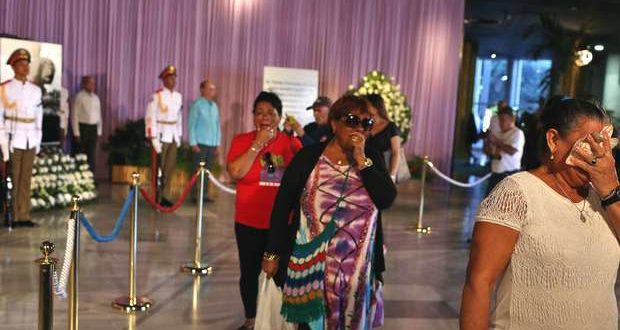
Somos+, Marcia Castillo Alvarez, 7 December 2016 — Today I woke up with many thoughts and memories I’m trying to sort out, and it seems incredible to me how time passes and we with it. I remember when I was a girl, how I dreamt of and visioned the future, always wanting to see farther. I was raised in a humble home of peasant origin, with great thanks to Fidel and the Revolution, where I only heard about achievements and good things, but no one talked about mistakes.
As a girl I didn’t question myself, because in my fantasy, for me the whole world was good. At home, on the block, at school, i was raised as a disciple of José Martí, a patriot and a revolutionary. When I saw the comandante on the TV screen I saw him as an infallible giant. Along with my classmates I wonder what day the leader would day and how people would react and what would happen. continue reading
Today everything is different, I’m no longer a child, and unlike those times I have a lot of questions, and my way of thinking has changed. I wonder how a man who has imposed his way of thinking, his ideology, his thinking, however, he transcends history today. How millions of Cubans recognize his achievements, while in other areas our country is paralyzed in time. It is impossible not to talk about these things that touch us very closely every day.
How one man who fought for a single social class, “the humble,” had at his disposal the car he wanted, while the people barely had a bicycle. How he partook of delicious banquets, when the working class didn’t earn enough money to eat, not to mention the keys to hunting lodges, luxury hotels and places he visited, when a Cuban could go only if he or she received help from abroad or if their family came, and on occasions hundreds have died without being able even to visit the capital city of all Cubans. If I continued to cite examples it would take me a long time to finish, and the truth is, they want us to see something that in reality doesn’t exist.
Today I ask myself, is if worth investing our time and paying tribute to a person who manipulated, cheated, abused, lied, just to remain in power? Can we teach today’s children to follow the example of a person whose deeds do not correlate with his principles, words and ideas?
I invite you all to reflect and decide what to follow, what to teach and what to remember. But beyond the differences, all of us together can bet on a better country, where man is truly free, to choose and to act, and that the people who lead us, we can really know them and choose them.
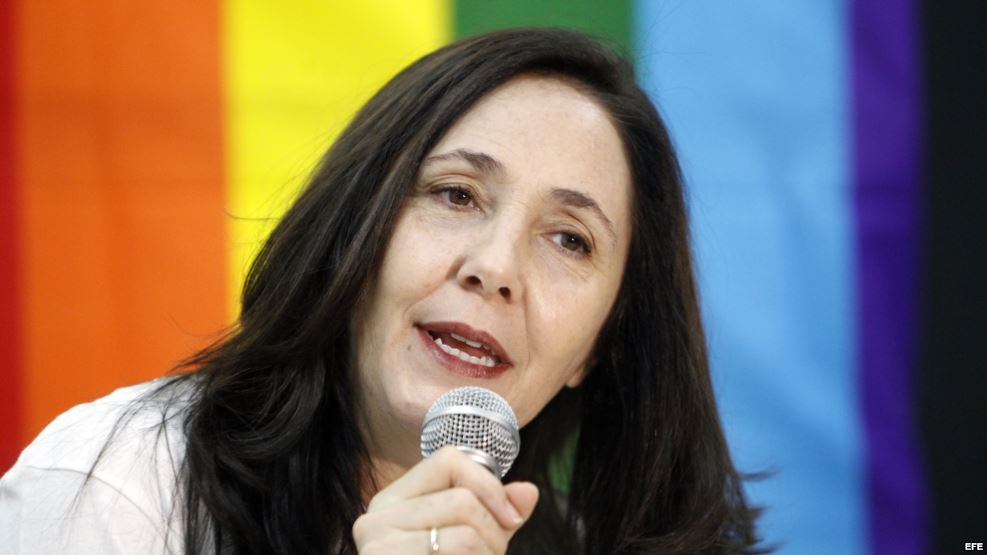
Cubanet, Jorge Ángel Pérez, Havana, 1 December 2016 — A cable from the Cuban press agency Prensa Latina, written by Waldo Mendiluza, warned me that the sexologist, parliamentarian, and daughter of Raul Castro, was in New York.
According to the cable, the director of Cuba’s National Center for Sexual Education (CENESEX) spoke to the United nations about the social justice that distinguished the Revolution that triumphed in 1959, and also the way in which this “generous politician” was dealing with the rights of Cuba’s LGBTI community. continue reading
According to the cable, Mariela praised the transformations on the island, at all levels, during the nearly six decades of the “Revolution” in power, and added that these developments contributed to the Cuban population being much more open to an understanding of social justice, facilitating this kind of work against homophobia and other prejudices.
The assertion that “this scenario means that, even when there are problems, they are not expressed through violence, with exceptions, as happens in other countries with major advances in legislation in the matter of the rights of the LGBTI community,” is odd.
And the oddity is that again, this official discourse is more interested in defending things, that is the “Revolution,” rather than persons, when it should be the exact opposition, and it seems disrespectful to me. No object deserves more respect than a person.
As we have known for a long time, respect is one of man’s greatest virtues. No wonder Zeus sent his son Hermes to teach men respect and justice, and this is what the homosexual community in Cuba most needs: respect and justice.
It is thoughtless to say that violence against homosexuals is less in Cuba than in the rest of the world. To forget that homosexuals have suffered from violence is thoughtless. To forget that homosexuals have been been victims of institutional homophobia is thoughtless. It is impolitic not to recognize that the “Revolution” did not care for the integrity and dignity of lesbians, gays and transexuals. We need to talk about this every day and name those responsible.
It is insolent to once again try to care for institutions, things, instead of protecting those men and women who prefer, each one of those days, those like themselves. Nothing can advance if praising the “goodness” of a “revolution” marginalizes homosexuals.
It is counterproductive to defend the politics of a revolution that created concentration camps for homosexuals, that expelled them from the universities, and called them “deviant.” It is odd that the voice singing of this “policy of vindication” is a heterosexual woman who doesn’t know the suffering of those she “represents” and “defends.”
In Cuba there is violence against homosexuals and to deny it is embarrassing. In this country they continue to be repressed, and hate crimes are not solved. In Cuba, the moral judgment of its institutions remains opposed to freedom. I, for one, have not seen the documentary “Mariela Castro’s March: Cuba LGBTI,” which was presented at the United Nations on 17 November in the presence of the director of CENESEX, and broadcast on HBO on 28 November.
It would be fair to put it on Cuban television in primetime. It was presented at the last Festival of New Latin American Cinema, albeit with some discretion, and could not be expected to act otherwise if the testimonies of some homosexuals who were offended by the homophobic policies of the “Cuban revolution” appear on the tape.
That is not, apparently, the fate of “Santa and Andres,” a film whose main subject, according to its director, is “freedom, freedom, freedom”; that’s disrespectful, as is the fact that Mariela Castro will use her visit to New York to do some shopping.
That day a friend wrote telling me he had seen her at The Home Depot where apparently she was trying to buy lightbulbs, I guess to light her home. And I wonder if she decided to buy the same energy saving bulbs I am forced to buy.
Mariella Castro buys lightbulbs in Manhattan, despite the fact that in an interview on Cuban television conducted by the journalist Cristina Escobar, she assured the viewers that her salary doesn’t last her to the end of the month.
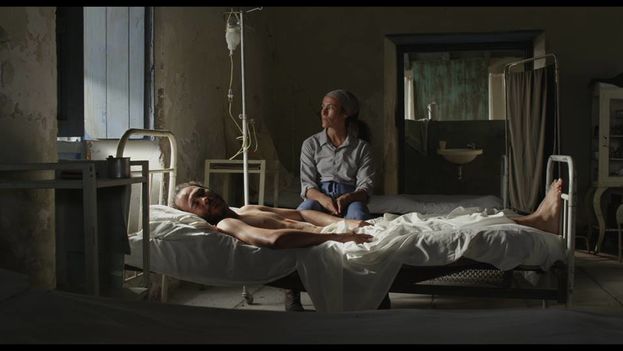
Frame from the film by Carlos Lechuga ‘Santa and Andrés. (Facebook)
14ymedio, Reinaldo Escobar, Havana, 7 December 2016 — In the 38th edition of Havana’s Festival of New Latin America Cinema, shining by its absence is the Cuban film Santa y Andrés, by the filmmaker Carlos Lechuga. Those responsible for its censorship certainly didn’t cross it off the list without first consulting non-artistic entities such as the organs of State Security and other custodians of the official dogma.
The controversy over the exclusion of the film has been unleashed on social networks and in several digital spaces. Arguing against Lechuga’s feature film are the voices tied to the “establishment,” who claim that it distorts history and that the many errors committed in the cultural field have been rectified. The defenders, for their part, laud the artistic values of the film and assert that it cannot be considered counterrevolutionary. continue reading
The Cuban Institute of Cinematographic Art and Industry (ICAIC) behaves like an entity privately owned by the only political party permitted in the country, and applies the resulting right of admission, an attitude contradictory and unacceptable for an institution that is publicly created as a representative the interests of the whole nation.
Many filmmakers act as if they believe that the ICAIC does not represent the interests of power. This apparent naiveté gives them a right to feel offended and surprised by the censorship imposed by the entity, like the teenager who comes home late with the illusion of not being scolded by her parents, who remind her of their right to search her belongings and to prohibit her next outing.
As long as artists continue to respect and revere institutions without directly questioning them, they will have to bow their heads and obey, or ultimately they will have to leave the country.
Santa and Andrés was conceived and created independently as if censorship did not exist, as if the stern father had softened and tempered over the years. One way of putting strength to the test and pushing the wall of prohibitions.
Regardless of its indisputable artistic values, Carlos Lechuga’s film will be remembered as another occasion when the repressors of thought were forced to take off their masks of good-naturedness. Cultural authorities have again demonstrated the hardened face of an intolerant patriarch showing his children who really holds the key to the house.
The film ‘Hands of Stone’, directed by Venezuelan filmmaker Jonathan Jakubowicz, will be presented this December at the Film Festival in Havana. (Courtesy)
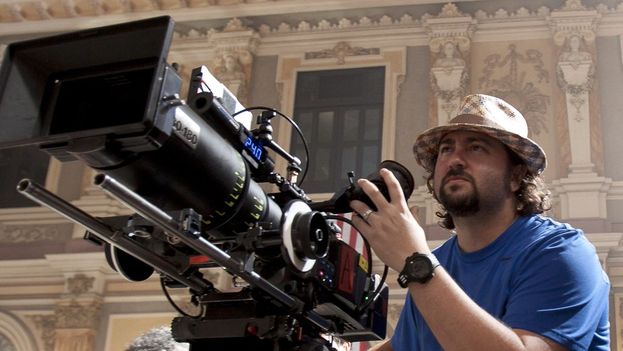
14ymedio, Yoani Sanchez, Havana, 7 December 2016 – He has a Polish last name, a first name of Hebrew origin, and Venezuelan blood running through his veins. Jonathan Jakubowicz is as complex and versatile a filmmaker as the skein of influences that make up his family tree. Born in Caracas in 1978, the director has received both pressure from the government of Hugo Chavez and the most resounding applause from his audience. This December his film Hands of Stone will be shown in Cuba during the Festival of New Latin American Cinema.
The film, based on the story of the Panamanian boxer Roberto Duran, includes in its cast the fellow Venezuelan Edgar Ramirez, in the starring role, and the Oscar winner Robert de Niro in the role of his trainer. Jakubowicz responded to questions from 14ymedio about his expectations on presenting his work to a Cuban audience, and his reaction to the exclusion from the festival of the Cuban film Santa y Andrés, by director Carlos Lechuga. continue reading
Sanchez. During the Havana Film Festival of Havana Cubans will be able to enjoy your film Hands of Stone, one of the most interesting films that will be screened in this year. How can viewers on the island inform themselves before seeing the story of the legendary Roberto ‘Mano de Piedra’ Duran?
Jakubowicz. I think that Cubans feel the story of Duran as their own. Duran is the son of an American Marine who was assigned to the Canal Zone and who had an affair with a Panamanian, and then left. The relationship between the boxer known as Manos de Piedra and the United States is complex starting from his birth. But paradoxically it is only thanks to the help of his gringo coach, the character played by De Niro, that he becomes world champion and beats the United States boxing idols on the biggest stages in the world. It is a Latin American epic, filmed mainly in Panama but with Hollywood legends. I am sure Cubans will enjoy it.
Sanchez. You’re aware of the censorship of the film Santa y Andrés, directed by Cuban filmmaker Carlos Lechuga, and even thought of withdrawing Hands of Stone from the Festival, in solidarity with that filmmaker. Why have you kept your film in the Festival line-up? What do you think about the exclusion of the Lechuga’s film?
Jakubowicz. Cuba and Venezuela are sister nations, not only in our history but in our political present. When my first film came out, Secuestro Express(Kidnapping Express), the Chavez government charged me twice and published in the state media all kinds of information to discredit me. Only someone who knows what it is to be persecuted because of his art can understand the pain that means. That is why it affected me so much to read about censorship being applied to this Cuban film.
I felt that going to the Festival to show my film would be a hypocrisy, like when I saw international filmmakers photographing Chavez while I was being persecuted. I was afraid of becoming that dismal figure of the artist who supports the repressor, a very common figure in our countries, and one that has done great damage to our people.
But Cuban filmmakers themselves asked me not to withdraw my movie from the program, because the festival is one of the few windows left on the island to see the outside world, and so I decided to do it. At the end of the day I don’t live in Cuba and the only thing I can to do is help those who do live there.
Sanchez. You’ve experienced first hand harassment within your own country. How do you experience all those pressures?
Jakubowicz. With much anguish and sadness. My film was not even against the government, but was made by people from all social classes in Venezuela, and the success filled Chavez with insecurity, because his power was always based on dividing the population. On attacking us, he attacked our invitation to overcome the problems we have as a society, but also made it impossible for me to continue making films in my country. So I am filled with admiration for Cubans like you, like Gorki Aguila, El Sexto and others who dare to stay in the cave of repressor to do battle for freedom from within.
I just published a book, Las Aventuras de Juan Planchard (The Adventures of John Planchard), showing the corruption of the Chavista revolution in all its glory. It is my grain of sand in this fight. There are people who ask me if I’m not afraid to publish it, and my answer is that if there are people in Cuba and Venezuela who put their lives on the line daily for freedom, the least I can do is support them with my art.
Sanchez. What do you think of the relationship between cinema and power? Between artists and official institutions?
Jakubowicz. Cinema and power have always been related, the problem is when those in power repress some filmmakers, and welcome and support others. There is nothing worse than an artist who collaborates with a repressive government. To put your sensibility at the service of a power that persecutes human beings who want to express themselves like you do is a contradiction which, in my opinion, annuls you as an artist and makes your work into propaganda.
History is full of talented artists who have done that and ended up persecuted by the very machinery they supported. Generally those who remain cozied up to power forever are mediocre, they would have no capacity for transcendence if not for the help they receive as payment for their complicity.
Sanchez. In Cuba, as of more than three years ago, a group of filmmakers has been promoting a Film Law to gain autonomy and protect their work. What would you recommend to your colleagues on the island in that regard?
Jakubowicz. In my opinion they should focus on creating methods for their films to be viewed online. Just as there are now journalistic spaces coming out in Havana and reaching everyone, create spaces for local filmmakers to put their work on the internet. Almost all filmmakers in the world are doing works that are exhibited on the internet.
Even Woody Allen is making a series for Amazon. No one can underestimate the power of the internet as a tool for the distribution of independent cinema of the future. I find it commendable that they are trying to pass this law, but in my experience art cannot beat authoritarian governments with laws. They can be conquered with art. The laws were not made for artists.
Cubanet, Gladys Linares, Havana, 5 December 2016 — I don’t remember exactly how much time had passed since I’d seen Cristina, but it must have been more than three years, because today, when I saw her at the home of a mutual friend and asked about her daughter, who had caused her so many headaches, she responded, very content, “She’s good, calm, married and has a son who is about to turn two.”
When Cristina turned 16 and was studying in high school, she started to change radically. At first she made up the story that she was studying with some classmates, and was late or that she slept over at some girlfriend’s house. And so, little by little, until she stopped showing up some night at all, although she continued in high school and some teachers said she was a good student.
Then she left school and started to disappear more often, sometimes even for a week. Desperate, her mother went out looking for her and tried everything to discipline her, from persuasion to violence, but without results. According to a friend, the young woman said she didn’t continue her studies because even if she graduated she would not be able to meet her basic economic needs, and that what she needed was “a yuma [foreigner] to be able to live well.” continue reading
Among her clients was a Spaniard three times her age. This gentleman wanted to meet her mom and came to collect her at home. The girl ended up pregnant. The Spaniard repaired the house, which was in very bad conditions. When the child was born he married her and came by even more often. He took her to live in Spain for a time, but she couldn’t adapt. His family lived there, his kids, his grandkids — some of them older than she was — and she didn’t feel comfortable among them.
Then, he bought her a mansion in La Vibora, on Santa Catalina Avenue. It had land with fruit trees, a swimming pool, servants and it was peaceful. The Spaniard even bought a car for when he was in Cuba, and when her husband was gone she had a chauffeur.
Although I can’t think that this is what Cristina as a mother would have wanted for her daughter, the truth is that at least the young woman is not spending her nights in the streets looking for clients, being extorted by pimps or police or risking going to jail at any moment.
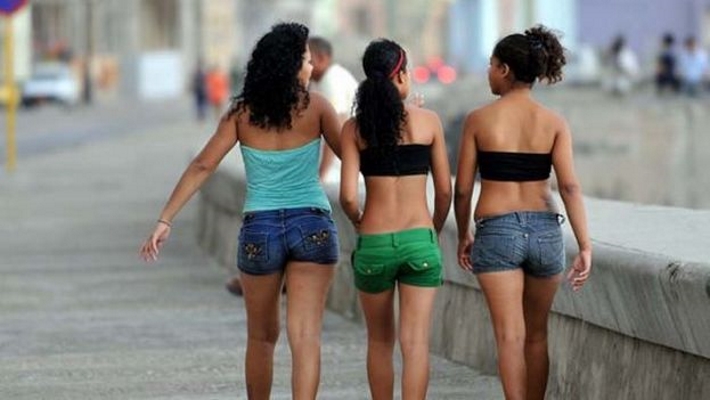
This story of the life of a prostitute is not the happiest, but in today’s Cuba, this has become the golden dream of a prostitute. Nor is it the exception: many young women come to the oldest profession to escape the poverty and the homelessness our population faces.
For years, Fidel Castro thundered that the Revolution had ended gambling and prostitution, “the evils of the capitalist society,” although later he was forced to publicly recognize its existence: “Our prostitutes are the healthiest and best educated in the world,” said Castro, which is also a lie.
And with the economic crisis that began in the ’90s, the so-called “special period in times of peace,” prostitution spreads like wildfire. Today, thousands and thousands of young people throughout the country turn to this practice to satisfy their economic needs and/or their anxiousness to emigrate. Surprisingly, the hookers are not looked badly on by a broad sector of the population, but in many cases are admired, because in general they display a higher standard of living that is possible in Cuba on the salary of a job.
Benzemá, Messi and Cristiano Ronaldo, before starting the classic Real Madrid-Barcelona, at the stadium of the latter, Camp Nou of Barcelona, on Saturday 3 December 2016.
Iván García, 4 December 2016 — There are three things in the spirituality of the island. Rumba, Santeria, and baseball, which for a decade has been replaced by the passion for football (soccer) among Cubans, especially the youngest generation.
But Fidel Castro is overwhelming. When the cedar casket reposed in Santa Ifigenia Cemetery in Santiago de Cuba, about 600 miles east of Havana, and the funeral is over with complete coverage by the media, perfect amanuensis of the Communist Part, is when people can find out what is happening in the world. continue reading
For nine days — something unprecedented in the cuntry — we Cubans have been disconnected from the events and sports overseas. A real media blackout.
Mourning, hymns and slogans rining in the ether. Also the mourners and exalted eulogy. In these nine days, Cuba smelled a little bit like North Korea, its ideological partner.
At this point, after 60 years of autocracy, the public applauds, fakes loyalty to the regime and signs whatever the government proposes [during the mourning period Cubans are being asked to sign a loyalty oath]. hallucinatory as it seems. But under the table Cubans continue to live in this stronghold of the real Cuba ignored by state media.
In that Cuba, people speak with fractured words, reinvent themselves every twenty-four hours, and clandestinely buy everything from cocaine to a yacht.
In the terrestrial island, not in the virtual or the delirious one that the Castro regime authorities sells us, after eliciting some tears on Via Blanca with the passing of the caravan with Fidel Castro’s remains, Oneida, on arriving at the shabby filthy room where he resides in the Luyano neighborhood, went to see the list-keeper who collects the money from the illegal lottery known as la bolita, and bet 200 pesos, around ten dollars US, on number 64, which stands for “big death,” according to the list that assigns a meaning to each number.
The funeral rites of the “big death” recalled that stage of the not so distant Soviet Cuba, full of prohibitions and a press worthy of Charlie Chaplin. It seems like a backward Middle East nation.
Now, from 26 November to 4 December, by state decree, there is zero alcohol. Zero films, zero soap operas, not even the news. The olve green mourning prevents Cubans from learning about Stefan Curry or LeBron Hames, paralyzes the insipid national baseball series and the fans missed the game of the year, between Real Madrid and CR7 and the Barcelona team of the flea Messi.
Spanish journalists who covered the funeral figured out where they could watch the game. “I hope in a hotel in Santiago de Cuba I can see the match,” commented a reporter from a Catalan newspaper.
In hotels and bars in Havana, where the fans usually gather with their scarves in the team colors — very hot in this climate — and wearing T-shirts with Leo Messi, Neymar, Luis Suárez, Cristiano Ronaldo or Sergio Ramos, were closed, complying with the official ukase of maximum mourning for the death of Castro I at the age of 90.
But in Cuba, there is always a Plan B. Those who have powerful shortwave radios try to get the signal from Spain’s Radio Exterior. Others, paid for an hour of internet connection, 50 pesos, the equivalent of two-and-a-half days pay, to follow the crucial game on line in the pages of El Pais or El Mundo.
At the end of the game, tied at one, Julian, who had connected in Cordoba Park, located on the border between the Sevillano and La Vibora neighborhoods, some crestfallen Barça were leaving: “33 games without losing, now we’re at eight points, goodbye league for you.” A friend asked him to speak softly: “Pal, keep it down with all this going on, the police are waiting to pounce.”
With the disappearance of Fidel Castro, the last guerrilla of the Third World, has deployed an dense ideological paraphernalia in Cuba, asphyxiating, that has brought back the animal fear among many Cubans.
Those who daily put their elbows on the bar do it in secret, so that the snitches and the intransigent followers of the regime don’t think they celebrating the death of the “great world leader.”
All the music has been shut off, and quinceñeras, weddings and anniversaries are postponed until further notice. Also cancelled were dances and religious festivals, like the night of 3 December, the eve of the day of Saint Barbara, who is also Changó in the Yoruba religion, one of the most venerated deities for Cubans.
“Fidel Castro owned the farm and the horses. There must be calm until his ashes are deposted in Santiago de Cuba,” said the peanut seller who was once a political prisoner.
The dissidents are also quiet. The Ladies in White didn’t go out into the street to protest on the last two Sundays, as a sign of respect and not to provoke the repressors.
On his way to paradise or hell, according to your viewpoint, Fidel Castro pounded the table with authority to demonstrate that even as dust, he generates absolute respect in the population.
Meanwhile, on the outskirts of Havana, in a big mansion about to fall down, but with an illegal satellite connection, the owner spent the whole game keeping a dozen young people quiet so they could see the match, each one paying 2 Cuban convertible pesos, a little more than two dollars.
“Gentlemen, don’t shout so much, we don’t want to go to jail,” he told the boys. But the joy could barely be controlled when Sergio Ramos, scored in the last minute of the game. Result: one to one.
And when it’s about Fidel Castro, even a football game can be an offense.
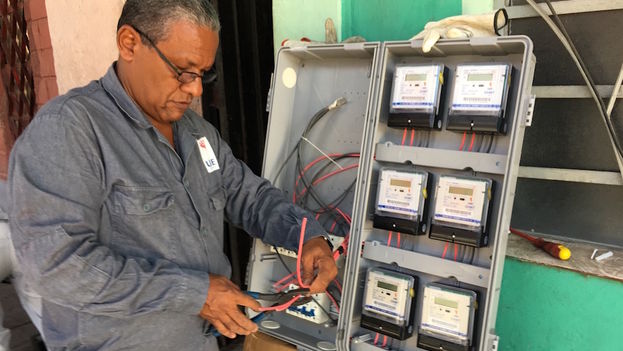
An employee of the Electrical Union of Cuba installing new meters in a building in Havana. (14ymedio)
14ymedio, Havana, 6 December 2016 — The installation of new electrical meters continues to spark controversy in the Cuban capital. It is not necessary to enter individual homes to read the new meters and, reportedly, they are virtually impossible to manipulate in order to fraudulently pay less for electrical service.
“With these, you can’t cheat. Now, if you have two air conditioners running all day, it’s going to know how much current you used,” a technician installing the new devices in a multifamily building on Belascoain Street near Lealtad told 14ymedio. continue reading
Complaints about the cost of electricity have skyrocketed in recent years. Although compared to other countries the costs do not stand out as the most expensive in the region, in relation to the average wages in Cuba the cost of kilowatts is absolutely scandalous.
A family possessing only essential light bulbs, a refrigerator and a television, can pay a bill of around 20 Cuban pesos (CUP) a month (less than one dollar US), less than 5% of the average salary on the island which is around 570 CUP. However, if you cook with electricity and turn on an air conditioner every night to ease the dog days of summer, then the electricity bill can take the entire monthly salary of an engineer.
For years, people have invented all sorts of ways to avoid the high costs, from manipulating the meters to the so-called “clotheslines,” which steal or move electricity from state buildings or nearby homes. With the installation of the new meters to register consumption, many of these tricks appear to be coming to an end.
So the complaints are raining down, lately, on the Electrical Union of Cuba.
14ymedio, Havana, 6 December 2016 — The artist Danilo Maldonado, known as ‘El Sexto’ (The Sixth), was transferred Sunday from the police station at Zapata and C in Vedado to the Bivouac Calabazar criminal prosecution center in Havana. The graffiti artist’s mother, Maria Victoria Machado, visited him on Monday morning and told 14ymedio that the prosecution could keep him there for up to two months.
Machado’s meeting with her son only lasted 10 minutes, in which the artist was able to eat food brought from home, but still refused to eat food provided by the prison.
Machado said that the investigator in the case, Fernando Sanchez, informed her that her son could be held “up to 60 days in preventive detention.” The official explained that the detention would be extended “until the file is investigated.” Machado presented a petition for habeas corpus, with legal advice from the independent legal association Cubalex, and in particular from the attorney Laritza Diversent who leads that association.
El Sexto is accused of causing damage to state property, a crime “that does not exist in the Criminal Code,” Cubalex emphasized in an article published on its digital site. “Painting the walls or facades of a hotel constitutes a violation against public adornment. Inspectors of the communal system are entitled to impose, in these cases, a fine of 100 Cuban pesos (roughly $5 US),” says the article.
Danilo Maldonado – known as El Sexto – at the Oslo Freedom Forum. (OFF)
Cubalex, Havana, 6 December 2016 – On Monday, María Victoria Machado González, mother of Danilo Maldonado, known as ‘El Sexto,’ petitioned the Provincial Court of Havana for a Writ of Habeas Corpus in favor of her son. In the petition, she asked the court to order the detaining authority to bring him before the court.
It is presumed that the arrest was carried out with violence. Witnesses said they forced his head between his legs. He was taken to 4 different detention. Currently he is in Vivac, in the Havana municipality of Boyeros.
The authorities informed Maria Victoria that on 5 December, nine days after his arrest, the prosecutor decided to keep him in preventive custody. The investigation is being carried out by the criminal investigator Fernando Sanchez. Maldonado is accused of damaging state property. This crime is not mentioned in the Criminal Code.
El Sexto’s mother also requested that the court order the immediate release of her son. The Criminal Code provides for a prison term or a fine for destroying, damaging or making unusable the belongings of another. This conduct does not correspond to Danilo’s actions.
According to the petition, preventive detention of El Sexto is arbitrary and illegal. Painting the walls or facades of a hotel constitutes a violation against public adornment. Inspectors of the communal system are entitled to impose, in these cases, a fine of 100 Cuban pesos (roughly $5 US).
Machado González also reported that her son was beaten by a Major of the Guanabacoa police when he asked for medical assistance because of asthma. She adds that Maldonado made the decision to only eat the food brought in by his relatives. He suspects that the meals offered at the detention center have sleeping pills in them.
Somos+, Arlenys Miranda Mesa, 4 December 2016 — Nine days of national mourning have been decreed for the death of Fidel Castro. Fidel has died, but it seems like he is still alive. However, we who are alive, it seems we are dead.
There are many ways one can be dead and not only physically or spiritually because of sin, as God says in his Word. From the moment we whisper to express what we believe or because we don’t want any trouble, denouncing the injustices that are committed daily in Cuba, we can talk about the death of the conscience.
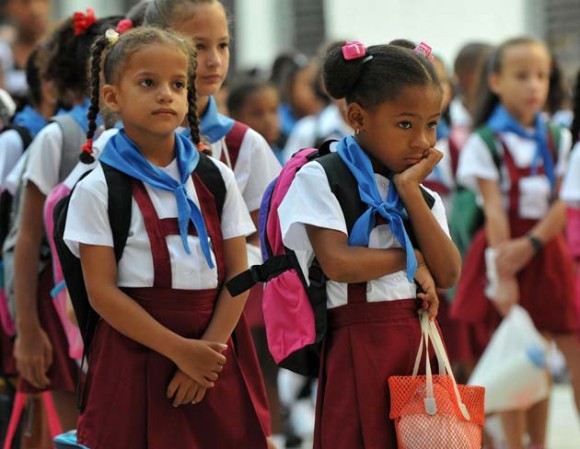
Today I took my younger son to Gerardo Domenech School, located in Jovellanos, Matanzas, Cuba, and I found that they didn’t ring the bell, because they haven’t had any electricity since yesterday. I approached one of the teachers and asked how they could hold class in classrooms without light. Maybe they don’t know that the low light is affecting our children’s vision and this will affect them for life because they are in the midst of their development. continue reading
I asked, then, “Why hasn’t the fault been fixed?” She explained to to me that it’s not a fault, but that the school has a determined amount of kilowatts assigned to it for each month and when that is used up then there isn’t any more. She told me about the efforts to save electricity, and that includes they themselves turning off the lights, but it still isn’t enough and doesn’t last and that from now until December 5th there won’t be any more kilowatts assigned.
Other mothers present in the group complained and then I asked them, “Will we continue bringing our children to school so they can be educated and authorized to slowly lose their vision?” They looked at me as if I were an extraterrestrial, and seeing the boldness with which I spoke and with that expression that shows the death of the consciousness, they said: “Nothing can be done, you’re going to make problems for yourself.”
Then the teacher approached me to ask why I hadn’t entered my son in the Mathematics Olympiad. “Teacher,” I said, making use of the Holy Spirit for self-control, “I don’t know how to do these problems,” and she said, “why don’t you ask the other children?”
I answered, “Because the Olympiads, so far, have been optional, not obligatory, because I don’t have any interest in solving them, because I won’t get anything from it, nor will anyone else, because I have more complicated problems than the Olympiads to solve every day and they are these:
“What am I going to feed my children, how can I stretch my income, when I have to get a transurethral resection (RTU) for my dad who has spent two months with probes but his urethra is obstructed, and we already went to the National Hospital, the Naval Hospital, Oncology and they couldn’t do it, because the equipment for the procedure is broken.
“From Oncology they sent to the Almejeiras Brothers Hospital, and without going into the details, they saw us, and for more than 15 days we have been waiting for the miraculous phone call that says: Come to the hospital.
“How can I guarantee that my children can study in a university and that they can become what they want, and not have some career determined by someone else? How do I resolve the problems in some of the stores where they change the prices of the products, or they don’t label them and you have to ask the clerks one by one, as happened to me in the Varadero Airport?
“How do I know what I’m buying in the state stores are industry made products and not handmade as has happened?
“How can you tell our children during school hours to have us come to sign a pledge* to give continuity to the Revolutionary Concept expressed by Fidel, involving my children in political matters without consulting their parents?”
“Sure, they know it, but we don’t, they want us to keep Fidel alive and they are trying to keep us dead, with a conscience callous to the reality of our country. And I am saying this to you, that I am here.”
Note: In the Naval Hospital they only see military and their families. My father is seen as a combatant who already lost his hands in a detonator explosion, during maneuvers by the Territorial Troop Militias (MTT), preparing for ’the war in a time of peace’ in the year 1996.
*Translator’s note: Since Fidel Castro’s death, the government has set up gathering points all over the country where Cubans are asked to come and sign a loyalty oath to his Revolution.
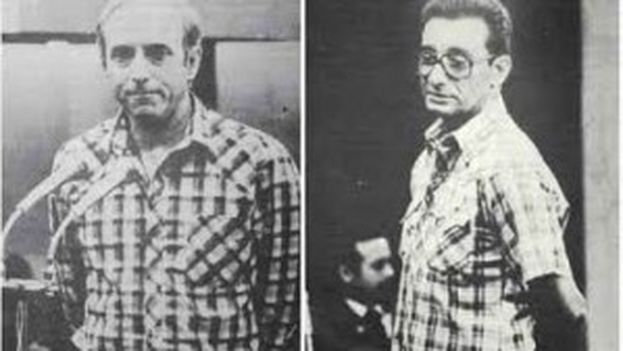
Antonio de la Guardia and Arnaldo Ochoa during their trial for drug trafficking in 1988. (CodigoAbierto)
14ymedio, Ileana de la Guardia, Paris, 5 December 2016 – Dawn comes to Paris, this 26 November, the sun barely over the horizon. From the depths of my dreams I hear the phone ring. I don’t want to answer it. It is my husband who does so. His voice tells me:
“He died, he died, wake up! Fidel died!”
I murmur:
“Him again… he comes again to wake me from my dreams.”
Thus it was 27 years ago, when they announced the arrest of my father. And so, this call pursues me like a ghost. No, I don’t want to wake up, he doesn’t have that right. continue reading
Some hours later I get out of bed and from my window I can see the Eiffel Tower on the horizon, my symbol of freedom, of my freedom. Then the horrible memories return: the murder of my father, of course, and of all the others who paid with their lives for the blindness of the tyrant.
Is he really dead this time? There is no doubt. I feel relieved, as if freed from the persecution of a maleficent shadow.
The monster died in his bed, without even being bothered by his crimes. The funeral rites are already prepared. Nothing is left to chance. No one is going to spit on his ashes. And yet…
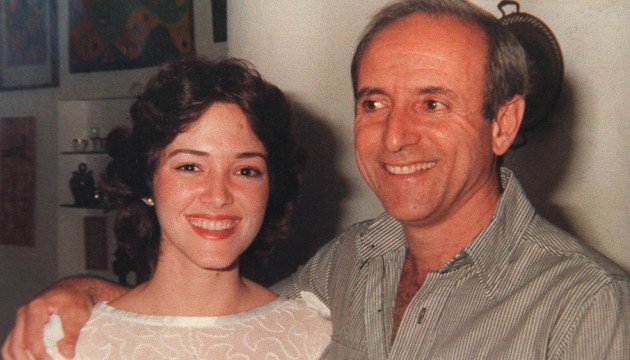
My father, Tony de la Guardia, departed at dawn on 13 July 1989. He didn’t have the luck to grow old, to know his grandchildren, he was a confidant of the tyrant. He had served in difficult military missions, at times secret ones.
On 12 June 1989 he was arrested by the political police. A month later, after a summary trial, which I will allow myself to call Stalinist, Fidel Castro ordered him shot without mercy. He had not betrayed anyone, nor cheated, nor stolen. He had only carried out the orders of Castro himself: “Find hard currency, by any means, to save Cuba from disaster.”
That day the world collapsed around me. I was young, not political, convinced that Fidel Castro — who at that time, like so many of my generation, I nicknamed El Congrejo, The Crab because with him everything was always backwards — taking into account the missions my father had served on, would pardon his life. It wasn’t like that.
At the same time as my father, Arnaldo Ochoa was shot. The great general of the Cuban Army, The Lion of Ethiopia as the Africans called him when he served on missions over there. Another two officials, Amado Padrón and Jorge Martínez, were also sent to the firing squad. My uncle, General Patricio de la Guardia, my father’s twin brother, was sentenced to 20 years in prison, “for failing to promptly denounce his brother,” as the text of the sentence prepared by the prosecutor states. Today he is in Cuba under house arrest.
All these men fell under suspicion because they felt a certain weakness for Gorbachev’s perestroika. Castro had no real proof, just doubts, from statements of discontent made somewhere, in some meeting of officers, at some family gathering. He had to make an example. Stop this wave from spreading. Be ruthless. Exercise terror to perpetuate his kingdom… Forever.
Despite these terrible memories, I go for a walk in Paris. The city opens its arms to me. I realize what good luck I have. I came to France in 1991, the country of Voltaire, the champion of freedom of expression. Voltaire, the enemy of tyrants, whom I love more every day, because he knew the price of freedom.
Curiously, I am happy, even if in principle we should not rejoice in the death of a human being. I know that I should not jump for joy, but I can’t contain myself. Because beyond all the funeral rites that are intended to be grandiose and docile, as in all communist regimes, what I see is the executioner. The hard man, implacable, willing to sacrifice his closest collaborators to protect his system.
And his power. How can I not seem my father trapped in the lies of the dictator? To get rid of him and others, Castro sold them a perverse and criminal fable: for the good of the country, of the Revolution, he asked them to incriminate themselves for offenses they had not committed. A classic of Stalinist regimes, where children denounced their own parents.
At that time, the agency that fought against drugs in the United States, the Drug Enforcement Administration, suspected that Fidel Castro was lending, charging very dearly, parts of his territory, including his airports, to Colombian drug traffickers as a transit area. How to escape this trap? Turn some high officials into scapegoats, high officials suspected of sympathy for Gorbachev. My father, like the others, persuaded that Fidel demanded of them a new sacrifice, and perhaps to protect their families, accepted this farce without imagining it would cost them their lives.
The process was a sham, a nightmare. At the end of the trial the monster had them shot as traitors. I have been living with this image of horror for 27 years. I see my father’s smile, exhausted by imprisonment and interrogations. His last look full of tenderness. They did not even allow us to put his name on a grave in the cemetery in Havana. He was erased from history. Forgotten, thrown into a common grave, like the heretics of the Middle Ages.
Today I shouted his name so that it will never be forgotten: Tony de la Guardia, my beloved father. May my voice cross the Atlantic to the Malecon in Havana, where dreams are lost on the horizon.
From Paris, I think about all the Cuban families who have experienced tragedies similar to mine. That also mourn their dead in silence and with fear in their bellies, with the hope that perhaps one day they will have the right to return home.
Today, the despot is nothing more than an urn with ashes, but the system didn’t collapse along with him. The propaganda machinery is working at full steam. The political police are not on strike: they spy, monitor, intimidate, beat and isolate all those who disagree, all those who make demands.
Raul Castro has undertaken some insufficient changes, it’s true, why deny it? One more masquerade? A simple trick to escape the judgment of History?
To those who cry for Fidel, with sincere or crocodile tears, I ask you to open your eyes, to listen to the stories of the pain of hundreds of families, victims of the dictatorship. The Castro dynasty wants to perpetuate itself so as to never be called to account for more than 50 years in power.
It is difficult to have illusions; the descendants of the comandante are still pulling the strings of the country. Fidel is dead, but his family is still in charge. Raul Castro’s son directs the repression and intelligence services and his son-in-law manages the country’s economy with an iron hand.
Without hate, without rancor, I demand justice for my father and for others, the political opponents, the cursed poets, the homosexuals, the military dissenters. This dynasty of hoarders must go.
From me, they took everything. I don’t even have the right to step foot on the land of my family, the land where I was born. I have no property, no fortune, but I possess the most beautiful of all diamonds: freedom.
I offer it to my father, Cuban martyr. One day I will put a bouquet of flowers and a marker over his grave. I swear.
Reproduction of a photo taken in Cuba in 1986, of Cuban Colonel of Special Brigades, Antonio de la Guardia posing with this daughter, Ileana de la Guardia. AFP PHOTO / REPRODUCTION
___________________________________
Editor ‘s Note: This text was published in Le Nouvel Observateur. It is reproduced with permission from the author.
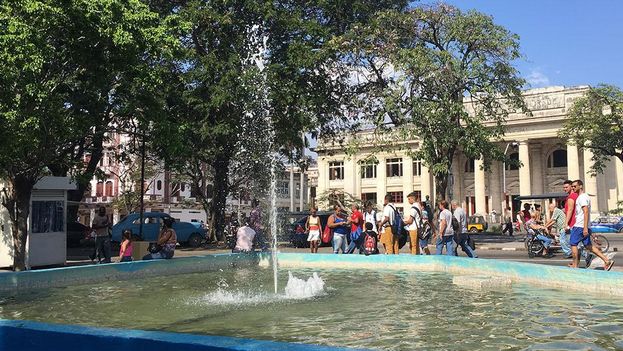
After decades without working the fountain at the corners of of Xifré Street and Carlos III Avenue, in the heart of Central Havana is working again. (14ymedio)
14ymedio, Marcelo Hernandez, Havana, 3 December 2016 — For decades this fountain remained dry. It was built in the late ‘80s as an ornament to the entrance to the day-care center located in the corner of the Xifre Street and Carlos III Avenue, in the heart of Central Havana. The children who opened this day-care center never called the place “The Little Martís,” which is its official name, but rather the “the fountain day-care center.”
The employees of the center say that a few days ago some workers came from the Communal Works Company. “It seems the problem was simple because they had it fixed in no time.” Asked about the exact date it began working again, no one could agree. They weren’t sure if it was “after the news that Fidel Castro died…” or “a little before.” continue reading
Now, water flows in the middle of the bustle of the most populated district in all of Cuba, a piece of the city that some consider the “real Havana,” for its tough daily life, its serious housing problems and the power of the informal market over the streets. The nearby neighbors don’t fail to find coincidences between the reestablishment of the fountain and the sprucing up of the city for the for the funeral of the former president.
A septuagenarian who was walking with his dog told this newspaper that he had worked on the fountain when he was in the microbrigades. “In addition to building our houses we built many day care centers in Havana. Every time I passed by here and saw this fountain without water it gave me great sadness. Let’s see how long…”
In a city where most fountains are dry, thanks to negligence and lack of maintenance, it is beautiful news to see this source revive.
Cubans viewing displays honoring Fidel Castro after his death. Source: Voz Populi
Ivan Garcia, 3 December 2016 — The flag with the three blue and two white stripes, red triangle and solitary star in the middle hung from a black flagpole. For the Rodriguez family, it served as the perfect diversion, taking the attention of the neighborhood’s informers and die-hard supporters off them.
They live right in the heart of the oldest part of Havana, in a poor, largely mixed race neighborhood, which is a hotbed of hustling and guile. Residents here think twice as fast as other Cubans.
They have always relied on illegalities and whatever fell off the truck. It seems to have served them well. In the morning they would wildly applaud a speech by Fidel Castro while at night they would stockpile sacks of detergent stolen from a state-run store. continue reading
Those born in Cuba know these tricks all too well. While the Rodríguez family appears loyal to the regime, everyone in the neighborhood knows they sell cooking oil at thirty pesos a liter.
“You do it so you don’t stand out. You know how it is. In order to survive in Cuba, you have to be be ’inventive.’ You learn to play along these people (the regime),” as one of them points out before boarding a bus to the Plaza of the Revolution to participate in a public farewell to Fidel Castro, founder the first communist state in Latin America.
Daniel, a Spanish journalist assigned to covering the funeral, cannot understand the stories he reads and hears outside of Cuba about autocratic methods, repression and widespread discontent.
“You look at hundreds of thousands of people waiting in line under a blazing sun in order to sign a book of condolence and you ask yourself how it is possible that these people are paying tribute to a guy who built a system that has so drastically impoverished them,” wonders the astonished reporter outside the Havana Libre Hotel.
The reason is that Cuba is not a typical country. Only those who have lived under a dictatorship can understand such unexpected and widespread human behavior.
It cannot be said that the Communist Party forces people to attend organized demonstrations. Attendance is completely voluntary. But it is conditional.
When Fidel Castro was at the height of power twenty years ago, the head of the Committees for the Defense of the Revolution — a neighborhood-based organization that was a precursor to the powerful social control exercised in Cuba today — went door to door, urging families to sign up for mass mobilizations or to vote in sham elections.
In the Castros’ Cuba the state is the entity that both punishes and rewards its citizens. To get a house, a television or an alarm clock, Cubans must demonstrate at labor union meetings just how much effort they have made to support the Revolution.
Improving one’s standard of living depended on participating in mobilization efforts and volunteering for work brigades. It was a period when an odd disingenuousness, or double standard, took root in the Cuban population.
Twenty years ago, being able to study at a university depended on commitment to the communist cause. After the demise of the Soviet Union, the iron grip lessened and things began to change.
Fidel Castro strategically decided to allow Catholics and other religious believers to join the Communist Party. Little by little the rigid control over Cubans’ lives began to ease.
But there is still room for improvement and much to overcome, such as the pervasive fear felt by ordinary Cubans. “My daughter is in her third year at university. Do you know that, if she comes off as being disinterested to them, it could have an impact on her future?” asks Ada, a convenience store worker.
Liudmila, who works in a five-star hotel, believes that, if she does not participate in “mass demonstrations, certain people (in the party, labor union or young communists union) might take note and sack me from my job, which is a contract position.”
Such moral calculation, which numbs a person’s will and judgement, is the reason people like Lorenzo — a seventeen-year-old, third-year pre-university student — can devise a speech for domestic and foreign television cameras from talking points while expressing the opposite opinions in his living room to an independent reporter, provided his name is changed.
Classic examples of this disingenuousness are the widespread comments and displeasure over the government’s decision to not place Fidel Castro’s ashes in the José Martí Memorial at the Plaza of the Revolution.
“It shows a lack of respect. There were people waiting in line for up to three hours in the sun to sign the book of condolence not knowing that Fidel’s remains were not there. It was a farce. They were keeping vigil for a ghost,” says Miguel, a construction worker.
These opinions do not echo the official party line. It is this kind of societal hypocrisy that allows the regime to govern so easily. Most people in Cuba think one way but act in another.
They prefer to watch from the sidelines, without making political compromises. They just wait for things to change. Assuming things do change.
Raul Castro placed the urn with the ashes of Fidel Castro in the mausoleum of Santa Ifigenia cemetery. (EFE)
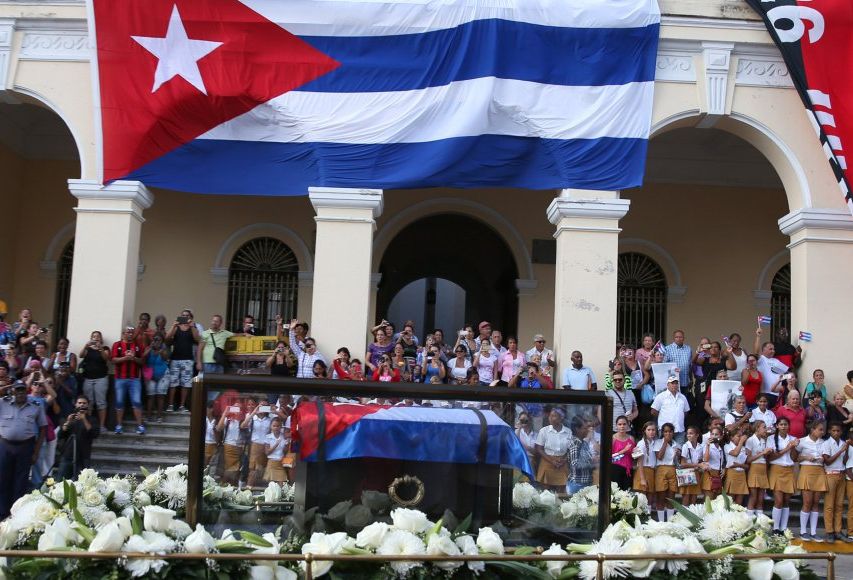
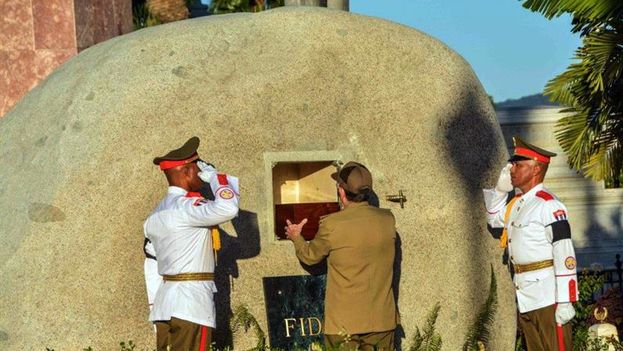
14ymedio, Havana, 4 December 2016 – After nine days of intense media frenzy, the final goodbye to Fidel Castro has taken place far from the national television cameras. The remains of the former president were placed in a mausoleum in Santa Ifigenia cemetery, in the early hours of Sunday in a private and simple ceremony, as stated by his brother Raul Castro.
The third highest official of the French government, Ségolène Royal, explained to AFP that, “There was no speech, it was very sober.” continue reading
The caravan with the ashes of Fidel Castro left Sunday at 6:40 AM local time from Antonio Maceo Plaza, heading to the famous cemetery where the remains of national hero José Martí lie, along with those of famous patriots of Cuban independence.
The ceremony inside the cemetery was attended only by family members of the deceased leader and “specially invited guests,” as confirmed by the national press. The cemetery remained closed throughout the duration of the farewell and guests entered through a private door, which prevented the press and hundreds of people waiting outside Santa Ifigenia from seeing them. Everything indicates that the guests included the presidents of Venezuela, Nicolas Maduro, and Bolivia, Evo Morales, along with former Brazilian presidents Luiz Inacio Lula da Silva and Dilma Rousseff.
Castro’s crypt resembles an immense gray rock, which at its center has a niche covered with a marble plaque with the name “Fidel” inscribed on it in gold letters. Although the first images of the funeral monument, a few steps from that of José Martí, were published as of midmorning, television and the official press did not air the news until several hours later.
During the placement of the urn with the ashes of Castro in Santa Ifigenia, the official television only broadcast scenes of the massive event of the night before, which, according to official figures, involved more than half a million people and where President Raul Castro extolled voluntarism and the tenacity of his brother.
In the streets of Santiago and at the advance of the funeral procession, thousands of people shouted slogans such as “I am Fidel!” and “Long live Fidel!” The procession that moved the remains to the cemetery was presided over by the Minister of the Revolutionary Armed Forces (FAR), General Leopoldo Cintra Frias, and deputy FAR ministers Ramón Espinosa Martin and Joaquin Quinta Solas.
The ashes of Fidel Castro arrived in Santiago de Cuba after a journey of almost 600 miles from Havana, that lasted about four days. The leader of the Revolution died on 25 November, at age 90.
Cubanet, Vladimir Turró Páez, Havana, 3 December 2016 — The independent journalists Manuel Guerra Pérez and Lisbey Lora, arrested this last Monday by the United Territorial Investigations of the San Jose Police in the province of Mayabeque, have been threatened with going to trial, according to information from their families.
The two reporters were arrested by State Security when they made a tour of the town of San Jose, searching for stories to publish in the “Mayabeque Cimarron” bulletin, which they work for. continue reading
Paula Perez Leiva, Manuel’s mother, said that her son told her during a ten-minute visit to the police station that they would be brought to court for exercising their work as reporters.
“He told me, that the authorities, in addition to wanting to send them to prison, are demanding they turn over the laptop and printer they use to produce the bulletin,” said Perez Leiva.
Manuel and Lisbey are the principle managers of the independent bulletin, “Mayabeque Cimarron,” supported by the Cuban Institute for the Freedom of Expression and the Press (ICLEP). The bulletin is distributed free in the province, in a four-page format, with stories about the events of the place.
The journalist Rosa Aviles, who accompanied Manuel Guerra’s mother on the visit, said that the two arrestees are very pale because they are kept locked in a cell without any drinkable water and no sunlight.
The reporter warned that the ICLEP correspondents were well known by the town officials and had already been arrested previously on several occasions for distributing the newsletter in the area.
“This is the third time they arrested them, and in particular Manuel, whom they even wanted to beat up,” she explained.