My Absence at the Meeting / Regina Coyula

Regina Coyula, 25 April 2016 — The political police, who consider themselves such faithful followers of Jose Marti, know that with regards to the battles of thought, they’ve lost. Thus this weekend’s operation to prevent me from participating in a meeting in Pinar del Rio was unnecessary and ridiculous. Following is a report from the meeting.

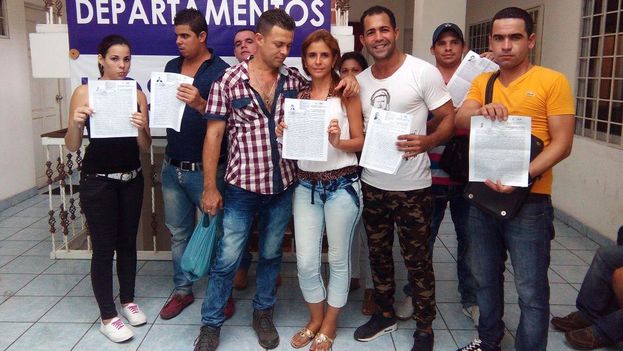
The Coexistence Study Center Begins its Second Meeting of Thoughts For Cuba

Convened by the Coexistence Study Center, for 23-24 April in Pinar del Rio, the Second Meeting of the Journey of Thinking and Proposals for Cuba, with the participation of more than 20 Cubans from five provinces began today. continue reading

The theme of this Second Meeting is “Legal and Constitutional Transition” and its objective is to propose a set of laws that provide a secure framework and facilitate the reforms Cuban society needs. And, as a result, to prepare, with citizen participation, an orderly and peaceful constitutional text that will lead the Cuban nation to a future of freedom, social justice and progress, transitioning from law to law without traumatic ruptures.

The result is expected to be published on the Center for Coexistence Studies website, once the proposals have incorporated proposals from the session held in our Diaspora Center, as well as the proposals for  “The Cuban economy in the short, medium and long term.”

The debates and creative workshops on thoughts and proposals are animated by the presentations of renowned Cuban jurists among whom are Lic. Rene Gomez Manzano and Lic. Laritza Diversent, who, although she was prevented from leaving her residence in Havana to participate in the meeting in Pinar del Rio, offered her lecture by telephone.

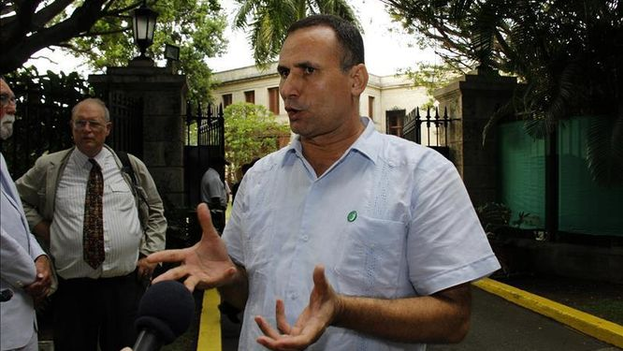
When one wants to work and think for Cuba nothing it is impossible. Also prevented from participating in this meeting was Pedro Campos, a member of the Academic Board of the Centre for Coexistence Studies and Regina Coyula. All other guests were able to attend.

Dagoberto Valdes Hernandez, director of the Center for Coexistence Studies, said in his opening remarks for this second academic session that “Cuba needs organic thinking and constructive and feasible proposals emanating not only from experts in each topic, but also from an increasing citizen participation and broad inclusive consensus building , for the good of the whole nation.”

Cuba-Disneyland and Its Leftist Pimps / 14ymedio, Isaac Nahon Serfaty

Who gives a crap that repression continues against political dissidents?

14ymedio bigger14ymedio, Isaac Nahon Serfaty, 10 May 2016 — Cuba is now the Disneyland of the fashion show business. The list of celebrities who go to the island as almost archeological tourists is growing every day. The Mummy Stones, the Lagerfield effigy, and the inevitable voluptuous Kardashion have made their Havana pilgrimage. From Miami comes a cruise ship acclaimed by local enthusiasts. The gringos, like the expected Mr. Marshall from Garcia Berlanga’s film, wander along the Malecon and enjoy their mojitos. Fascinated, they discover a theme park populated by dilapidated American sedans, Old Havana with its architectural gems both restored and in ruins, and a people hungry for change. All this under the admiring acclaim of Western media fascinated by a supposed “opening” in the Pearl of the Caribbean.

It is worth the exercise of historic imagination to show the inconsistency of the liberal politicians and the enthusiastic journalists. Let’s consider, for example, that some legendary rockers, a fashion designer and an exemplar of the “beautiful people” had decided to visit Chile in the times of Pinochet to celebrate the economic opening implemented by the dictator at the hands of his neoliberal technocrats. continue reading

It is not difficult to imagine the reaction, fully justified, of leftist intellectuals and politicians: “What barbarity to endorse the bloody dictator!” “We must reject this propaganda maneuver of Yankee imperialism!” “Enough with the manipulation to conquer the fragile minds of our people, poor victims of industrial culture!” “Let’s boycott the music, clothes and porno photos of these agents of imperialism!” And so we could continue with variations on the same manifestations of indignation.

However, when this happens in the Cuba controlled by the monarchical Castro dictatorship, everything is all parties and laughter. Who gives a crap if the repression against political dissidents continues? Who cares if the regime’s propaganda machinery continues to vomit its hollow slogans while it limits freedom of expression? Who worries about the refugees escaping the island for the United States (via Costa Rica, for example), before Obama, or whoever succeeds him, eliminates the privilege of the Cuban Adjustment Act? Who denounces the military nomenklatura that controls the state enterprises, collecting bribes and preparing the terrain for an economic opening in the style of savage capitalism?

The hypocrisy of the leftist pimps has annulled their critical capacity. They is not capable of digesting that in their breast there is too much corruption (so says Lula); that with the excuse of the liberation of the people they proclaim a discourse of anti-Semitic hatred (as some in the British Labour Party say); with the alibi of the struggle against injustice and inequality they mount a new class of privileged cynics (so say the “bolichicos”—the young and politically connected Venezuelan entrepreneurs—of Chavism).

Carlos Rangel, a Venezuelan writer prematurely disappeared and despised by this left, in the seventies drew the portrait of that intellectual misery that idealizes the myth of the “good revolutionary.” Myths are not only symbolic resources. They are instruments to legitimize interests and businesses, like those now being cooked up in Cuba-Disneyland.

__________

Editor ‘s note: Isaac Nahon Serfaty is professor at the University of Ottawa (Canada). This text has been published in the Spanish newspaper El País and is reproduced here with the author’s consent.

Trash and Condoms / Regina Coyula

Regina Coyula, 4 May 2016 — The residents of 13th Street in Havana’s El Vedado neighborhood had quite a night on the eve of May Day, let’s say atypical. Near the intersection with Paseo, the gallent young people who would close the parade the following day camped out.

According to the Secretary General of the Cuban Central Workers Union, these young people would “make the Plaza tremble and would be a faithful reflection of the support of the new generations for study, work and defense, their usual trenches.”

Mobilized early in the morning and deposited there, the gallant ones decided to have fun as if they were on a camping trip; and before shaking the Plaza they shook the neighborhood. They pulled out their bottles, improvised some percussion and some farsighted soul brought a trumpet. But the improvised music didn’t compete with the reggaeton. And this was “shared” with great enthusiasm with all the neighbors.

With the parade, tranquility returned, and the neighborhood was able to observe the effects of the camp out: Empty bottles and other detritus.

“Trash and condoms! That is what we have left from May Day!” exclaimed an indignant old man in the area who had the task of cleaning out the passageway of his building.

A Laboratory Man: The Official Party ‘Cadre’ in Cuba / 14ymedio, Reinaldo Escobar

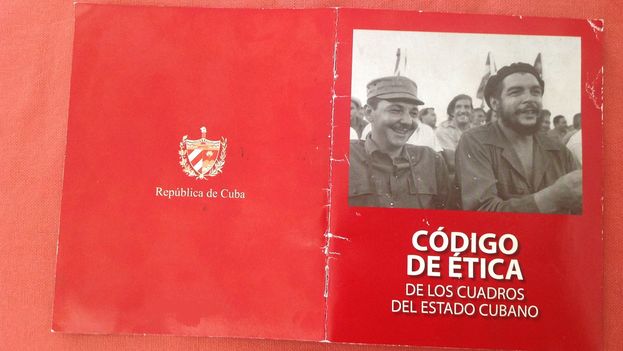
The Code of Ethics for Cuba’s Communist Party cadres. (14ymedio)

14ymedio bigger14ymedio, Reinaldo Escobar, Havana, 9 May 2016 – Marxist thinkers from the last century appeared to be convinced that the communist ethic could only work after the elimination of the different social classes or, and it’s the same thing, when the communist society triumphed in the economic plane. “How can stealing be ethically condemned when there is no property?” they asked with the same guileless eagerness medieval theologians brought to their debates about the carnality of the glorious bodies resuscitated after the final judgment. continue reading

In practice, politicians who have had to get their hands dirty in an attempt to implement different Marxist experiments have come to understand the length of this “transition stage” called socialism. They have confronted the contradiction of not being able to lay their principles in the already rejected “bourgeois morality” and, on the other hand, they have seen the impossibility of applying communist morality in anticipation, impractical without the support of the material base assumed in the scientific fulfillment of their inexorable laws.

In consequence, each “historically determined” model found its provisional ethics, negating the previous one but incompatible with those of the future. It was that ethic that enabled Joseph Stalin’s forced collectivization, Mao’s Great Step Forward, and Fidel Castro to decree the Revolutionary Offensive. From this moral relativism arose the Code of Ethics for the cadres of the Cuban State.

The original version of this little known document was promulgated on 17 July 1996, signed by the then all-powerful Carlos Lage Davila. It was called Agreement 3050 and was displayed as a “proposal presented by the Cadres’ Central Committee, concerning the need to define and systemize a code of standards that would rule the lives and conduct of the Cadres of the Cuban State.”

Among the purposes and forms of application summarized in seven points, is the need to alert and prevent cadres “facing tendencies that could arise in the face of economic transformations and aggressive enemy action.” Compliance with the principles codified would be obligatory for the heads of the state’s central administrative organs, national entities, and presidents of the provincial and municipal People’s Power Administrative Councils, among others, who will have to determine “within their respective systems, the positions to which the Code of Ethics will be applied.”

Once these functionaries know and accept the content of the new rules, they will have to express their willingness to comply with them “publically, in an official act at the acceptance of the position.” Not content with that, “in cases of promotions and transfers, in the process of preparation for the new position,” the cadre is obliged to update his or her knowledge of the document, as well as again publicly ratify the commitment to fully comply.

Through a table of commandments broken down into 27 points, the Code demands “high moral values, deep revolutionary sensitivity, and a clear sense of duty” along with other virtues that cadres must have, such as sincerity, honesty, modesty, austerity, simplicity and discretion.

At the same time, it condemns lying, deceit, demagoguery, fraud, apathy, indolence, pessimism, hypercriticism and defeatism. Among other harmful attitudes indicated are the spirit of justification, inaction in the face of difficulties and mistakes, lack of initiative, the features of ostentation and consumer habits. It warns that the performance of cadres should be stripped of voluntarism, vanity, improvisation, professional injustice and mediocrity as well as sectarianism, and contempt for the dignity of others. Cadres must combat boasting, self-sufficiency, conceit, intolerance and insensitivity.

Paradoxically, the inability to be consistent with such requirements has promoted a defect not mentioned in the text: simulation – that is, faking it – the only alternative to which has been, for many, desertion, an action not contemplated among the violations.

In the 20 years of the Code of Ethics’s existence, probably not a single one of the sins of listed here has ceased to be committed, nor has there flourished even one of the untarnished virtues advertised therein. Not only that, but sins have been abundant and virtues few at all levels of the government and political leadership of the country, and at all levels of administration.

In the wasteland of moral values there has been unleashed a plague of brazen cynicism, of sordid impudence that nobody knows how to stop. And not even mentioned is the advent of the New Jerusalem the communist utopia would suggest. There will be a final judgment where we all will have to be forgiven for something.

57 Years Later: Towards a New Contract for Cuba (Pt. 2) / 14ymedio, Manuel Cuesta Morua

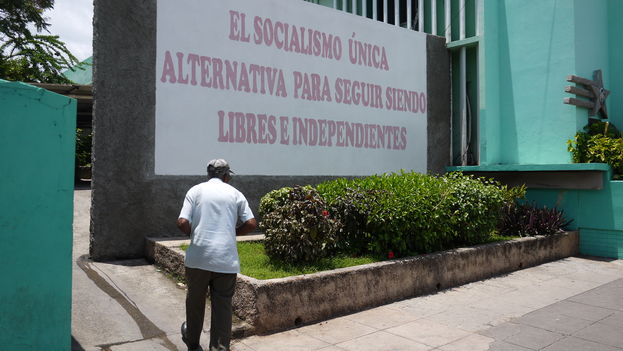
A man walk past a political billboard in Havana: “Socialism is the only alternative to continue to be free and independent.” (14ymedio)

14ymedio, Manuel Cuesta Morua, Havana, 8 May 2016 — The only certainty in Cuba in political terms is that the government accumulates a lot of power but lacks leadership. The kind of leadership required when a country faces an economic challenge, or a cultural, sociological, information, knowledge and generational one, plus the obvious dangers of any new era. They could all be summarized, therefore, by the following: how to manage the Government to maintain a political model that is beneath the basic intelligence, the accumulated experience of Cuban society and cultural pluralism?

Faced with this dilemma, the government has sacrificed the possible options for a new leadership before the metaphysics of the Revolution.

But, 57 years later, can we speak, beyond a memory and a name, of the Cuban Revolution? From the point of view of conviction—a psychological support—there is no doubt it exists. It is this kind of conviction that founds religions and that can only be respected in its specific dimensions. But from the point of view of its initial proposals, the Cuban Revolution has long since dissolved its only assumable scope: the external independence and sovereignty of Cuba. continue reading

Those who defend the Cuban government using the record of the Revolution, never satisfactorily answer these two questions: Is Cuba the only country where healthcare and education are free? Is it legitimate for current generations to express the need for another revolution? A revolution that blocks the possibilities of other futures is not a revolution made by revolutionaries.

But from the point of view of its initial proposals, the Cuban Revolution has long since dissolved its only assumable scope: the external independence and sovereignty of Cuba

But the revolutionaries do not surrender, not even in the face of clear evidence that the Cuban Revolution no longer exists because, beyond its convictions and proposals, it was, by nature, conservative. I offer the example par excellence for the followers of cultural studies and their relationship to political models: faced with three subjects that, by their anthropological condition gave substance to every emancipatory revolution of the 20th century, and within diverse societies, the Cuban government launched an active defense that closed the possibilities for a coherent social, political and cultural modernization, in line with global dynamics: the movements of feminists, blacks and the homosexuals. This was an early sign of the conservative nature of the 1959 project.

Moreover, the closing of Cuba with respect to the initial freedom that in the ‘60s of the 20th century citizens around the world began to respond to, the freedom of movement, was the hallmark of this conservatism that disconnected Cubans from their foundational dynamic as a country. And the Revolution’s reaction in the face of the impact of technology was and is antediluvian: witness the political impact on the regime of technological processes that are democratizers in their own right. Nor today, in Cuba, are these matters are discussed—present here despite and against the policies of the state—but they have been incorporated for a long time into the reality of most nations, from Haiti to Sweden.

By its nature, the Cuban Revolution is the last expression, in the 20th century and so far in the 21st, of the criollo modernization project, with its two clearest models: the expanded model of the plantation-economy export-power, and the restricted model of farm-bodega-control, more anchored in the structure of the Spanish conquest of the Americas.

This project of modernization began its long march with the hegemonic invention of Cuban in the 19th century. And this criollo conservatism was updated through a dictatorship of social benefit that created, with the Cuban Revolution, the second Jesuit state of the Western Hemisphere, after the state of the same kind founded by Dr. José Gaspar Rodríguez de Francia in Paraguay in the 19th century.

This criollo conservatism was updated through a dictatorship of social benefit that created, with the Cuban Revolution, the second Jesuit state of the Western Hemisphere

Now, facing a crisis, it has no more economic imagination than that of the restoration of old models: the development of tourism, that was Fulgencio Batista’s celebrated project cut short, and the development of a port, this one in Mariel, which was the most “modernized” project possible for the Spanish metropolis.

The most important achievements of this Revolution, then, have to do with its ability—taking as a starting point its own definition of itself—to arrest poverty at the limits of misery exhibited by many Third World countries, and with its confrontational visibility with the first power in the world: the United States. This was a never a project for the future.

These success of image and minimal cohesion fed a certain romanticism on both the left and the right, often at the edge of political obscenity, of the darkness of history before 1959, of cultural racism, and of a vision of post-imperialist borders for its constant opposition to the policies of the United States. They masked the conservative structure of the society encouraged by the Revolution, and the revolutionary imperialism toward the Third World: in the form of ‘missions’–military, medical and educational.

The conservative revolution, for 57 years, has triumphed. This allows us to understand how it became a movement of diminishing expectations, how it made the ration book a virtue, how it made a desire for modernization counterrevolutionary and exchange with the United States a problem of national security. This latter, taken to the limit, has meant a cultural weakening of the country in the face of the challenge represented by the United States in terms of the cultural continuity of Cuban society—we could speak of the cultural ripe fruit—and an exhaustion of the Cuban project in its inability to project and continue its policies in an era of full globalization. To the extent that this criollo project has tried to identify itself with the fundamentals of Cuba, it also endangers the viability of the nation.

To the extent that this criollo project has tried to identify itself with the fundamentals of Cuba, it also endangers the viability of the nation

As a criollo project, with one foot in the structure of colonial Spain, the Cuban Revolution is a project of hegemony and domination that has legitimized the “counterrevolution,” only the one made by the revolutionaries in power.

The original 1959 contract updated itself in 1961 styling itself as socialist; and updated itself again in 1976 with a Constitution that established the hegemony and superiority of the communists; it broke in 1980 with the events at the Peruvian embassy and the resulting Mariel Boatlift; it updated itself again in 1992, with the admission of another moral universe within the Communist Party with the laicization of the state; and it broke again in 1994 with the Malecon Uprising in Havana; and it is trying to re-update itself with the liberalization of the markets in food and other areas, which subsequently are distorted.

Throughout all this time, the government has done one thing and then the opposite to remain in power, regardless of economic, social or political practices that have been in absolute contradiction with earlier or later ones. All in the name of the Cuban Revolution. Every one of these “revolutions” and “counterrevolutions” carried out by a power ever more divorced from society and that allowed them, finally, in 2002, to rethink their organic relation with citizens.

Yes, “Within the Revolution, everything,” but “within the counterrevolution, also,” is the epilogue of the political process launched in 1959.

Incapable of criticizing its fundamentals—unlike representative democracies, the Cuban Revolution does not permit a discussion based on its pillars, which explains its lack of democracy—the government undertook a constitutional reform in 2002, an authentic political counter-reform, which was the ultimate and definitive rupture between the criollo project and Cuban citizens.

On constitutionally declaring the “irreversibility of socialism,” the government pulverized the constitutional precedents of the founding of Cuba. From our origins as a national project, these assimilated, without contradictions, the unity of subject and sovereign that is the base of the modern citizen. Subject to the law, sovereign to shape it, we Cubans lost with this counter-reform the condition of citizens and the organic relationship with a state that only knows and cares how to justify itself.

Starting from here it became clear that for the state we Cubans are only a source of duties, not of sovereignty. Thus, the republican nature of Cuba is dissolved, establishing a political “contract” to block any future contract. An aberration that must have few precedents in the constitutional history of the world.

If we want to understand, then, why the relationship of Cubans with their state is fundamentally cynical, when it should be an ethical relationship, the reason can be found in this static fluidity that the Cuban Revolution has established with society, based on the assumption that what is, is not, but should continue to remain as if it were, to achieve mutual survival amid the blackout of our future and the suspension of all strategic perspective.

The complicity and mutual deception that the society-state comes to forge, over the span of 57 years, that modus vivendi has dissolved more than one hope and has placed the country at a dead end. Corruption as a zone of shared tolerance both by power and by citizens, in the midst of a vital tension, is a clear example of the progressive national collapse and crashing demoralization of the decent foundations of coexistence.

The last definition of the Cuban Revolution, offered by Fidel Castro on May Day of 2000, is reducible to the phrase, “change everything that should be changed,” when a revolution is defined by changing everything, only confirms the diagnosis: for 50 years the Revolution has made a costly transition from justification based on its essences to justification based on its circumstances. In this sense, “counterrevolution” and “revolution” are vacant words fixed in the general vocabulary of society for the purpose of psychological control.

Outside of this—and only for a tiny minority of honest men and women who have a sense of communion in the work and defense of a past that doesn’t contradict the answer to this question: What, ultimately, is the Cuban Revolution?

It is this: Power and its circumstances defined both by a rogue state, which was updated, at the recently concluded 7th Congress of the Cuban Communist Party, with a bad monarchic joke: Our bipartisanship will bring together the same surnames, Castro Ruz.

From this irresponsible rogue state we must move to the responsible reconstruction of a national project that is anchored in something less metaphysical and more promising: a democratic state governed by the rule of law.

Part 1 of this article is here.
The Cuban Exile is Young, and It Hasn’t Died / Somos+, Javier Martinez

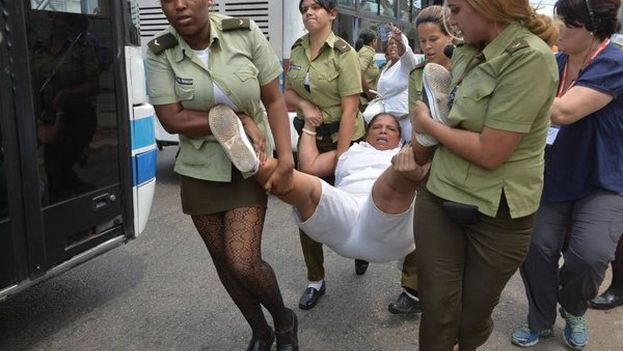
Cuban emigrants in Central America waiting to continue their journey north to the United States

Somos+, Javier Martinez, 9 May 2016 — The Cuban exile is not dead. I am 28 and I live outside my country for political reasons, so I consider myself an exiled Cuban. The Cuban exile has not died, and will not die as long as we Cubans have to leave our country to seek in other countries what the dictatorial government of the Castro brothers and their clique has denied us for more than six decades. I can agree that the exile now is different, but it hasn’t died, and it will not die as along as dignified Cubans are fighting for the future of their country.

To put this in context, some days ago a text circulated on social networks referring to the death of the Cuban exile.

Starting from a situation that since the 1990s has plagued Cuban emigration: all the Cubans who are benefitting under the Cuban Adjustment Act, ask for political asylum from the emigration authorities when they reach the borders of the United States but, the truth is, these new emigrants when they receive their residency permits after a year and a day, return to visit Cuba, and the vast majority of them do nothing to achieve the political freedom of the country they were forced to leave. continue reading

We cannot cover the sun with a finger, the Cuban exile has changed, and greatly. At the beginning of the Revolution the majority of exiles were from the upper class, Cubans whose property had been expropriated, members of Batista’s military, intellectuals, and also those who could see, from the first months, the socialist and communist direction the country’s leadership was taking. Today the people leaving Cuba are not only those opposed to the government, but also those who want to escape from the shortages, the neglect and the bad treatment from the government.

The vast majority of the emigrants of today prioritize their personal wellbeing above politics, even when sheltering themselves under a law that shelters them for political reasons. We could say that only one is ten is tied to opposition organizations in exile, not an exact figure, but Somos+ is a living example that not all are economic emigrants, as many of the Cubans now leaving the island are called; some, when they leave Cuba, are expressing their desire to fight for freedom.

We know that the exile has changed, these are not the years when exile groups planned armed actions from Miami. The exile has also changed, in many ways, like Cuban society has changed. The forms of struggle have moved to the social networks and today’s weapons do not assault directly; now they transform, educate, show Cubans on the island that change is possible through civic struggle, through a knowledge of our rights and a study of our duties, which leads to a gradual transformation of an entire society.

To clarify, this does not mean that the young people of the exile–and when I refer to them I am speaking on behalf of dozens of friends who belong to Somos+ and live in the United States, Spain, Ecuador and Switzerland, to mention some of the countries where young Cuban opponents to the Castro government live–are trying to occupy a space that the historic exile might say belongs to only a few, on the contrary, we want them to open its doors to us.

We call on this historic exile that some pretend has died, to join our ranks, we want to learn from them and show them that today we believe in a path that could lead us to achieving what they have been fighting for for years: full freedom for Cuba. A freedom where the rights of everyone to think differently are respected, even if we don’t agree with their ideas. That is, those who try to force us to think in a unilateral way, their time is past.

We young exiles who now form a part of the opposition to the socialist government do so from the deepest democratic convictions, and thus we respect the personal right of every person to decide what to do with his or her life, but of one thing we are certain: the exile has not died, as long as Cuba is not free we will continue to fight for the ideals of justice and freedom that we desire for our people.

For Mima, the Best Kiss… / Somos+

Somos+, Eliecer Avila, 8 May 2016 — First of all I want to send a huge kiss to all the mothers of the world, and especially the Cuban mothers, many of whom cannot sleep peacefully knowing that a mysterious black wolf called State Security stealthily monitors their young children day and night.

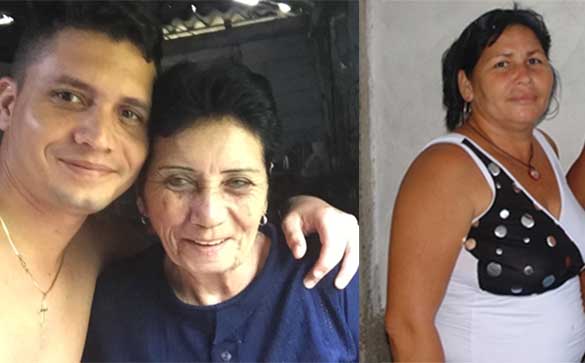
Among these mothers is mine. Or all of mine… because I have several. The one who gave birth to me from whom I was separated by divorce when I was three (although we still see each other), the one who raised me, my grandmother (Mima), my aunt Arelis, perennial guardian of the entire family; at least two memorable stepmothers whom I love very much, and dozens of mothers who have appeared to me recently because according to them they pray for me every night and have adopted me as their son.

But today I want to talk about Mima, because she is now almost 70 and every day she fills my thoughts. It has been five months since I last saw her, because of the 450 miles that separate us since the end of 2013 when I came to live in Havana. At times it’s hard even to talk on the phone because I know that sooner or later she is going to ask the question that causes a lump in my throat, “M’ijo… when are you coming?” continue reading

Recently, seeing me come through the door is her moment of greatest happiness. I could almost say she lives for this day. She keeps for me in the fridge a little piece of each chicken she kills on the yard, spared from her own little pounds (a tiny checkbook), and I don’t know how she manages to have for me “pineapple juice that you like, powdered milk and even a little piece of red meat…” All luxuries that she can’t give herself during the time we are apart.

When I see her, along with my grandfather (Tata) I can’t help feeling some remorse and a sense of guilt. I don’t know if I have to the right to build my own life, going far away to look to improve to, for access to culture and work opportunities. I have tried a thousand times to convince her to come with me, even if just for a time, because I want to give her the first day of the rest in her entire live and take care of her as she always did me, but there is no one who can get her off the farm and she is an expert in manufacturing pretexts…

I also wonder how it is that, living on an island, we can feel such a strong sense of distance. I am convinced that it would be a whole different thing if instead of this absurd government we had a normal one. We would have access to hundreds of technological tools that would allow me to see her face and talk with her a little bit at night, persuade her to eat more and work less, ask her how the services went in the little church she attends, where sometimes she even preaches and constantly fasts for her children and grandchildren. Now my aunt tells me she has become infatuated with the idea of my grandfather “having women out there…” Which he denies saying, “If only…” ha ha ha. How I would love to laugh and enjoy every day with them.

This situation makes me think of the thousands of children who are in other countries, while their mothers are here, sometimes sick and always getting older. The family crisis this country has been experiencing for decades is really terrible.

This morning I went to Monaco Park, one of the wifi points in the Capital, and it was even fuller than usual, which makes sense. But what most struck me was a woman of some 90 years in a wheelchair and with an IV drip at her side. She got out of a Moskovich car with the help of several family members who put a tablet in front of her to share with her what was probably her last wish: to see her son who lives in Orlando whom she hasn’t been able to hug for 27 years.

On the other side of the screen was a gray-haired gentleman surrounded by two sons and a newborn granddaughter, crowded together on a couch, trying to say something but unable to do so. Several minutes passed without a word, the tears never stopping and then a sister’s cracking voice, “Mama, say something, the [internet] card is going to run out…” The old woman tried to compose herself and then the words I hear so often and that pain me emerged, “M’ijo… when are you coming to see me?” and she added, “I’m waiting millet.”

I couldn’t take it any more, I closed the computer and left to walk the mile and a half from the park to my house. Determined to find a way to go and see my grandmother and my mother this month. It is really very hard that so many Cubans are forced to bear this damned circumstance, simply because some men retain for themselves the desire to keep this country in the dark ages of technology on one side and in material and spiritual poverty on the other, distancing thousands of children from their mothers every day.

I will never understand by Fidel preferred to separate rather than unite, to discriminate rather than protect, to hate when he could have used his charisma to support the Cuban people to cultivate love, togetherness, the family and pride in being Cuban.

There is a great deal we can do for our mothers as a new generation that clings to its natural right to participate in the politics of the country. We hope that very soon we will have that opportunity and we will live up to such an honorable responsibility.

Here I share photos of my mother and grandmother. And I invite everyone to share on this day images of your mothers, those here and those who care for us from above, those far away and those at our side. Let us fill all the spaces today with their sweet faces.

Beggars and Madmen: The Latest Spectacle in Cuba / Iván García

Source: Quo Vadis Cuba blog

Source: Quo Vadis Cuba blog

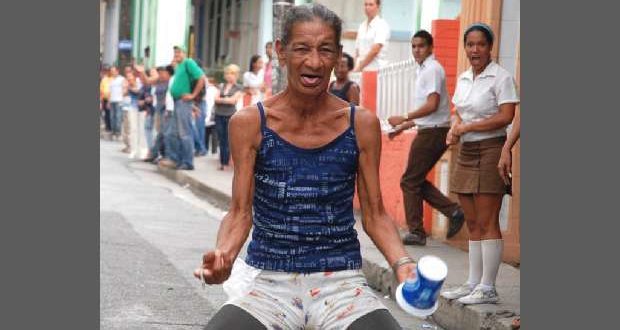
Ivan Garcia, 1 May 2016 — Guillermo tries to run away, to avoid the stones the kids are throwing at him, as if he were a doll stuck on a target, but his legs, which are atrophied and beginning to go gangrenous because of his diabetes, can’t respond to the urgent messages from his brain.

So he tries to hide behind some small bushes, but the stones keep flying around his head. It’s four in the afternoon on a normal day in La Vibora, and, without anything better to do, the pair of youngsters do their target practice with an old man of over 80 who can hardly support himself on his crutches.

People eating pizzas in a cafe in Heredia Street, on the corner of Acosta, watch what’s happening, like spectators who have come to watch someone being stoned to death in Iran. continue reading

Some women try to persuade the kids to stop. But a hail of insults is hurled at them, like “Go and find husbands, you old lesbians,” which they shout as they clear off.

The old man, a beggar who hangs around the neighbourhood and who tries to deal with his hunger by looking through rubbish bins, bent over on the pavement, can’t understand why the kids hate him.

“I don’t interfere with anybody. They are abusive. And it isn’t the first time. Almost every week children and youngsters throw stones and insults at me. I only want to find some food in the rubbish. It’s Fidel and Raúl Castro’s fault,” he says, and starts off on a fiery tirade against the autocratic brothers.

Some onlookers take off. Others record what’s happening on their cellphones. It’s the fashion now to record on mobile phones whatever quarrel or degrading spectacle is going on.

Then they upload it onto YouTube. That’s what happened with a group of kids of primary school age in Camagüey, when parents with cellphones left evidence of their degrading erotic reggaeton dancing.

Or a body which fell off a Legal Medicine truck on 23rd and G in Vedado, and that’s where the crowd went to record what happened. Two years ago a youngster was killed by a train on a level crossing at Café Colón and Calzada de Diez de Octubre, and the rabble started filming before help arrived.

For Eulogio, a customer in a state-owned cafe in Galiano Street, it is worrying how many beggars and crazy people there are in the capital, and the audio visual activity that occurs each time something happens.

“Two months ago a drunk who slept in doorways died, and people, instead of calling the police or an ambulance, recorded it on their mobile phones, as if it was nothing serious. And every day there are more layabouts and mad people, who are always dirty and hungry, in the city. What’s the government doing? I ask myself,” says Eugenio.

There is an alarming number of beggars in Havana. The government calls them “itinerants,” and, if we believe an official study, the number is between 2,500 and 3,000 in the country.

But José Carlos, a geriatric nurse, says this information doesn’t accord with reality. “Just in 10 de Octubre district, I have dealt with more than 200 itinerants sleeping on the street.”

The number of destitute drunks and poor people is unknown. On the corner of Carmen Street, opposite Plaza Roja de la Víbora, a dozen needy people, alcoholics and madmen gather early in the day in the entrance to a warehouse finding a selection of things in the rubbish bins.

From books on Fidel Castro’s speeches, Sovet-era alarm clock parts, clothes and used shoes to old computer parts. The prices range from 5 to 20 pesos. After that, they use the money to drink the worst kind of home-made rum or eat something hot in a stinking state-run greasy spoon.

According to a People’s Power delegate in Central Havana, “there have been discussions with the authorities in the province to find a solution to the growing number of layabouts, people collecting raw materials without a licence, with serious problems of dementia, who are swarming around the city. But, except when a foreign leader visits the country, when they round them up, wash them and feed them in a state hostel, the rest of the year they don’t do anything. Or very little.”

The Catholic church, and other religious orders do what they can. “Every afternoon we give a snack or a meal to various needy people. Many of them sleep in the street. We would like to do more,” admits a nun from Mónaco parish.

Some of the beggars were common criminals and are violent. Others are leftovers from a revolution which left them in the ditch.

Papo, a homeless guy who sleeps in boxes in a park in Reparto Sevillano, claims that he fought in the clearance of bandits in Escambray and Angola. And look how I am repaid by the government for whom I risked my life.”

Nobody remembers Cubans like Papo. Not in the official press, nor in the Communist Party’s future plans. They are always forgotten.

And now, with cellphones, they have become a spectacle for kids who, without any sense of feeling, record them and upload them onto YouTube or Facebook. Human beings who could be their parents or grandparents.

Translated by GH

57 Years Later: Towards A New Contract For Cuba (Pt. 1) / 14ymedio, Manuel Cuesta Morua

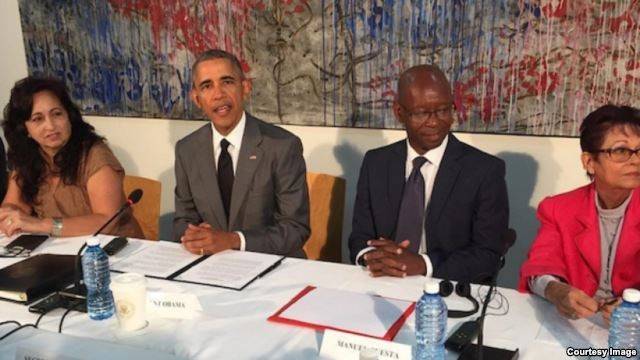
Miriam Celaya, President Obama, Manuel Cuesta Morua and Miriam Leiva meeting during Obama's recent trip to Cuba (courtesy image)
Miriam Celaya, President Obama, Manuel Cuesta Morua and Miriam Leiva meeting during Obama’s recent trip to Cuba (courtesy image)

14ymedio bigger14ymedio, Manuel Cuesta Morua, Havana, 7 May 2016 — I am offering, for critical discussion, a viewpoint discussed in more than one place about what I consider the progressive and punctilious deconstruction of our national project. Cuba is no longer one nation, but rather an unfinished project. I will offer this in two parts, not only in line with the needs of newspaper publishers, but also so as to not overly exhaust my readers with a piece of writing that could become tedious. I insist, however, because like many Cubans, I feel the dynamic drive of my country, as described by Manuel Manolín González Hernández, “the Salsa doctor” as he is called, in his cogent letter to Fidel Castro.

It is always necessary to think of one nation, but after the fiasco of the recently concluded pedagogic 7th Party Congress, in which the substantive content of the words were the words themselves, to think of the nation plurally, I believe, is an imperative for survival.

Where is the Cuban nation headed? Almost everyone agrees, as commonly expressed, we are all in the same boat. And as the boat must sail in a reasonable and civilized way, I believe it is necessary to think and discuss, to read and reread, and above all, to imagine. continue reading

The Cuban nation is not defined by a self-selected group, but by its citizenry: the only legitimate body for such an enterprise.

As we have been trapped in very harsh political processes, people get used to it and are no longer impressed or intimidated by the idea that Cuba belongs to a “very special” group of people who are given to calling themselves revolutionaries. Cubans and foreigners both, we have accepted this classification, which could have great weight and standing, but which does not coincide with Cuban culture and nationality, which are the two main conditions of belonging to Cuba or to any other nation and, above all, the two that can experience collateral damage or benefit, according to the angle of position.

Still today, after the almost grotesque exhaustion of all the most respectable meanings of revolution—that of Nicolas Maduro’s Venezuela is dreadful—many people are put on the defensive for desiring changes for Cuba. They must explain that they are not counterrevolutionaries and do not want to work in support of “imperialism” without considering that the term counterrevolution in Cuba can now acquire the same—exceedingly positive—connotation as mambí, the term pejoratively applied by the Spanish in the nineteenth century to refer to Cuban insurrectionists, that is those who were fighting for Cuba’s independence. And that is not right. At least in the arena of words and ideas. The debate of ideas in Latin America has lacked mental strength. On the side of the democrats.

For me, any case, beyond this discussion, the fundamental question that must be asked so as not to let oneself be impressed by the psychological violence of power is, who defines what? And the Cuban nation is not defined by a self-selected group, but by its citizenry: the only legitimate body for such an enterprise. Revolution as a source of law is a reactionary concept. What is overlooked, perhaps in an opportunistic way, is that there comes a time in which the revolutionaries make themselves the power, and thus, unfortunately, they have not differed either in form or in justifications from more traditional political models.

In any case—that of Cuba is special in this sense—they have revived modes and rationales that were supposedly buried by modernity. A simple irony is that, once in power, the revolutionaries openly and profusely use the concepts of subversion and stability to defend themselves against their adversaries. The least revolutionary concepts that could exist, and ones that would be applauded by Prince Metternich, the Austrian Chancellor who led the most thunderous conspiracy against the French Revolution.

The second essential thing is the realization that the citizen is the legitimator par excellence, if we want to avoid regressing to states of more or less divine origin.

The citizen is the legitimator par excellence, if we want to avoid regressing to States of more or less divine origin

In Cuba we need to define a new country from history, from politics and from culture, and from the mentality of subjects and actors in and for an inclusive national project. This definition, after all, must include a consideration of the international context to explain to ourselves our options and possibilities as a nation, something that in Cuba is fundamental, because it has historically been defined in negative terms. We who should not belong, rather than we who own the nation, is an old and unresolved dilemma.

At the end of the ‘90s and in the early 2000s, Cuba let the beginning of the new era pass it by, an era which, from my perspective, began with the end of apartheid in South Africa.

The end of apartheid in South Africa was the stark political expression of this cultural movement, and demonstrated the ethical unviability of cultural hegemony in territories with diverse populations. Nelson Mandela’s reconciliatory solution captured the message that the new South African contract could not be based on a new hegemony that marginalizes diverse traditions within a single nationality.

In the Western Hemisphere, this new contract begins in Bolivia, with the ascent to power of Evo Morales as a representative of America’s forgotten and exploited ancestry. And even though he has been repeating the same pattern of hegemony he fought against, his importance is there: the Western Hemisphere is open to this cultural movement that defines the new legitimacy of future social and political contracts: cultural diversity conveyed through the political citizen.

The latest and most vigorous expression of this movement was the ascent to power of Barack Obama in the United States. His arrival brought a nuance that confirms the irreversibility of this cultural movement: the ascent of cultural minorities, given their capacity to build majorities, to the legitimate field of political decisionmaking.

The new era begins with two connected powers: the power of diversity for the civil reconstruction of states and the power of the imagination which this diversity provides for solving the problems that the world has inherited from the excess of hegemonies based on criteria of superiority. It is the clear triumph of the new anthropology and of its associated aesthetic, which has few global precedents.

Cuba, which needed to sign this new contract in order to structure a new country, dangerously distanced itself from this global current, 57 years after the failure of its own scheme of hegemonies.

In July of 2006 [ed. note: when Fidel Castro, seriously ill, transferred the duties of president to his brother Raul] it seemed that the Cuban authorities approached society in order to enter this new era, and in order to take the initial steps toward this new contract. Ten years later, they irresponsibly wasted the opportunity, only to behold how the United States took the initiative within this cultural movement, even within Cuba.

Beyond the contrast or the comparison between the two societies, the issue is capital from the strategic point of view, due to the political and cultural dispute with which the American political class confronts the Cuban government, and the importance of the political decisions in Washington for the kinds of defensive responses from the Cuban government.

The fact that an ever increasing number of citizens are willing to leave behind revolutionary citizenship in favor of dual citizenship is a sign of lack of confidence in Cuba’s possibilities as a nation.

The paralysis in the project—which does not proceed—of “structural and conceptual changes” that demand the country to reflect, in any case, both on the lack of imagination in the current political hegemony of Cuba as well as on its inability to absorb the force, the elements and the civil consequences of our own cultural diversity, is endangering Cuba’s continuity as a viable nation in the medium and long term.

The danger is also immediate, although its consequences are strategic. The accelerated loss of confidence in the government accelerated the loss of time-confidence in society and, most importantly, of nation-confidence. The fact that an ever increasing number of citizens are willing to leave behind revolutionary citizenship in favor of dual citizenship is a sign of lack of confidence in Cuba’s possibilities as a nation. A message that in Cuba one can live as a Spaniard, as French, American or Italian, that is, as a global citizen, but not as a Cuban.

We have here a first foundational rupture that now confronts two other dangers: first, the lack of leadership and vision within the Government to address the country’s challenges in a global era; and, second, its metaphysical perseverance in the idea of a Revolution that is rapidly losing its social registers to strengthen its punitive registers. That Revolution is supported more by the police force than by its philosophy. First hand out bread, to later offer punishment.

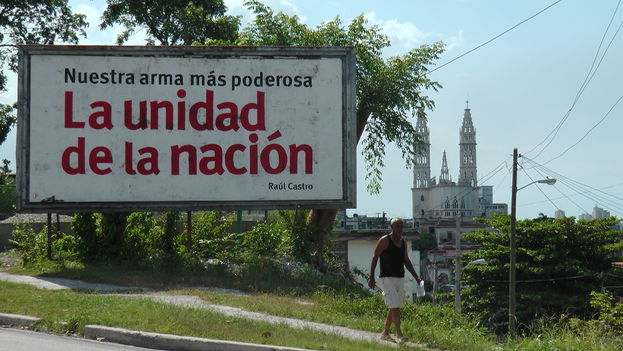
A billboard quotes Raul Castro: Our most powerful weapon: The Unity of the Nation. (14ymedio)

Part 2 of this article is here.
Broken Families in Cuba / Iván García

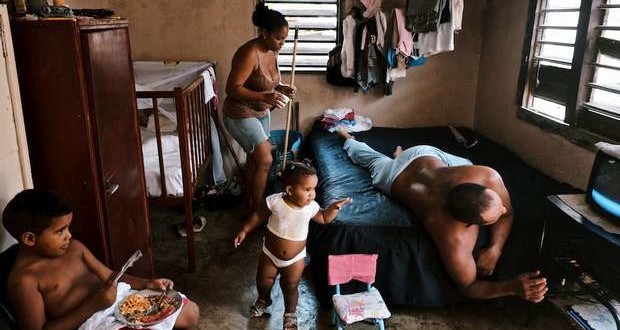
A Cuban family (X bit labs Community)

Ivan Garcia, 2 April 2016 — The dilapidated old house where the Varona family lives, in the Lawton district of Havana, could serve very well as a set for a television series about marginalisation and violence.

The front wall cries out for a coat of paint. Cracked roof tiles threaten to fall off. And inside, the house is subdivided into seven small apartments.

Agustín, one of tenants, has an informal business selling building materials. Therefore he has been able to improve his apartment with Italian ceramic floor tiles, build a tiny bathroom with a modern shower and hot and cold running water. continue reading

His room has a heavy Samsung Split air conditioner. Opposite the bed is a tiled table with a microwave, induction cooker and a two-door fridge.

The rest of the apartments are absolute ruins, with dirty old beds, but other bedrooms have been treated with grouting. On shelves on the wall, tacky plastic ornaments and empty rum bottles. And, of course, every room secured with bars on the windows and doors.

“It’s to avoid being robbed, which is common here. Hardly anyone speaks to us. Some of them are trying to legalise their place as a separate dwelling. There are various ration books. And when the people come to fumigate the mosquitos it’s a shambles, because not everyone is at home, or they don’t allow them to fumigate. The atmosphere is like a prison, but I’ve got nowhere else to live,” admits Agustín.

Of the sixteen people who live in the house, twelve of them have family ties through their mother or father. The quarrels range from obscene shouting, punch-ups, up to fighting with machetes.

“It’s like a jungle. People get beaten up for anything, because someone has eaten up the bread ration, or stolen a piece of chicken from the fridge,” says Raisa, who lives in this jungle with her husband and daughter.

There are three refrigerators in what was the living room of the house. They all have padlocks, as if they contained valuables. In the neighbourhood they call them Los Muchos. “When they start their fights, you don’t know when they’ll finish. They have set up a protocol in the block. When the insults start, a neighbour informs the police,” a neighbour tells us.

These degrading spectacles form part of the neighbourhood entertainment. “These fights make people want to grab a front-row seat. They are more entertaining than TV soaps, and some fights are more enjoyable than a boxing match programme,” a neighbour told us.

You might think this is an isolated case. It isn’t. Too many Cuban families have split up for silly little things, ideologies or marital conflicts.

When Fidel Castro seized power at gunpoint, a large number of families began to break up. “There were examples of brothers who fought at the Bay of Pigs or in Escambray on different sides. Families who stopped talking to each other, writing or accepting phone calls from family members in Florida just for thinking differently. The government owes a public apology to these broken families,” said Carlos, a sociologist.

For reasons of economic necessity, when they got married, Sergio and Margot agreed to accept money and food and clothing parcels from their daughter Yanira, a prostitute who married an Italian in 1994.

“Before my sister left, my parents broke off contact with her. Then, when she went off to Italy, they said that as far as they were concerned, their daughter was dead. My parents were, and still are, intransigent communists. But, when the ’Special Period’ started, with twelve hours of power cuts and an extreme shortage of food, the old people relented. And now they are living off the euros and things sent them by my sister. She comes every summer and arranges a party in the doorway of the house of the president of the CDR (Committee for the Defence of the Revolution),” explains Ramsés, Yanira’s brother.

The other problem suffered by many families is domestic violence and marital arguments in front of their kids. “Cases of mistreatment of women are frequent. Most of them, because they are ashamed, don’t report them. But I believe that right now, domestic violence is the number one category of crime in Cuba,” said a police inspector in Havana.

These dysfunctional family members are the germ of the perfect storm of the decline of values in Cuba. Until the autocrat Raúl Castro launches a crusade to end it. They run from, for example, vulgar speech, bad manners and lack of courtesy, up to drunks boozing on street corners and then urinating in the street.

For the sociologist Carlos, this degradation “is a terrible anthropological damage. Developing the economy and rebuilding the country should be simpler. But poor education, violence and lack of respect for your neighbour’s private space will be difficult to remedy.”

And it is not the fault of the US embargo.

Appeared in:  Hispanopost, 30 de marzo de 2016.

Translated by GH

Cuban Small Farmers Association Defends State Monopoly On The Export Of Coffee / 14ymedio, Zunilda Mata

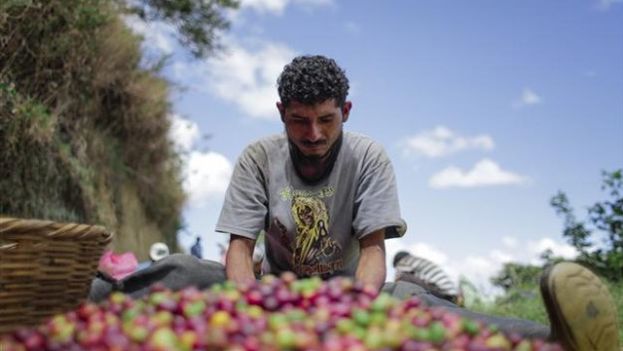
A grower selects mature coffee. (EFE)

14ymedio bigger14ymedio, Zunilda Mata, Havana, 5 May 2016 — The National Bureau of the National Association of Small Farmers (ANAP) in Cuba rejects the recent measures from the U.S. Department of State which include coffee among the products produced by the non-State sector in Cuba that can be imported into the United States.

In a statement published Wednesday, the Association lambastes the flexibility, which came into force on 22 April, allowing the import into the United States of coffee and textile products from “independent businesspeople” in Cuba. continue reading

John Kavulich, President of the U.S.-Cuba Trade and Economic Council, acknowledged at the time that Washington aims to support the small private sector of the island with this measure, although he highlighted its “very limited impact.”

However, ANAP does not appear to assess new business opportunities in the same way. The organization, created in May 1961 defines itself by its “social character” and claims to represent “the interests of Cuban farmers.” In response to the US State Department actions, it explains that “the objective pursued by this type of measure is to influence the Cuban peasantry and separate it from the State.”

The entity, with around 200,000 members, details that something like that “cannot be permitted, because it would destroy a Revolutionary process that has provided participatory democracy, freedom, sovereignty and independence.” The National Bureau statement does not say, however, if farmers devoted to the cultivation of coffee were consulted before the statement was published.

Among the arguments put forth in the statement released in the official press is the fact that “no one can imagine that a small agricultural producer can export directly to the United States… To make this possible Cuban foreign trade companies would have to participate and would have to produce financial transactions in dollars, which so far they have not been able to achieve,” added.

ANAP presents itself in different forums as part of Cuban civil society, but this statement says that the Cuban peasants are “members of the socialist society” and they exist “as part of the State and not as opposed to it.”

The text which repeats an idea that has been raised by several figures of the ruling party in recent months, says: “We face the objective of the imperialist policy of promoting the division and disintegration of Cuban society.”

In 2014, Cuba managed to produce 6,105 tons of coffee, an amount that does not cover annual domestic demand, which stands at 24,000 tons. This figure is very far from that achieved in the decade of the 1960s, when more than 62,000 tons of this grain were produced.

Translated by Alberto

Sale of Airline Tickets to Mexico Begins for Cuban Migrants Stranded In Panama / 14ymedio, Mario Penton

Hotel Milenium. (Silvio Enrique Campos)

14ymedio bigger14ymedio, Mario Penton, Miami, 5 May 2016 — Panama began selling airline tickets, on Thursday, to Mexico for Cuban migrants who find themselves stranded in the country. Tickets cost $805 and the first to benefit from the measure will be those staying at the Millennium Hotel, in the province of Chiriqui, according to a high ranking official who spoke to this newspaper and asked not to be identified.

Starting this coming Monday, two daily flights will connect to Nuevo Laredo in the Mexican state of Tamaulipas, operated by Copa and Aereomexico airlines. Along with the cost of the airfare, to qualify for a Mexican visa the mirgrants will also have to pay 34 dollars for the journey by bus to the Panamanian airport and the trip to the border between Mexico and United States. The airline will offer a differential rate for children between age 2 to 11, of $322, while children one year and under will fly for $160. continue reading

So far, nobody knows if the Cubans who have recently arrived in Panama and who are not on the official lists of migrants will be part of the agreement with Mexico.

A Cuban who came to the immigration offices in the city of David, about 30 miles from the border with Costa Rica, told 14ymedio that some days ago migrants began to receive money through Western Union and MoneyGram to buy their tickets.

“Regardless of the high cost per ticket, we have been asked for a medical checkup, three ID format photos and a photocopy of our passports,” said the migrant, who asked not to divulge his name.

Many of the stranded are worried about not having enough money to pay the cost of the airline tickets.

Panamanian official institutions claim not to have a report on the costs entailed for the nearly 3,500 Cubans who find themselves stranded in their territory. However, the local press reported on Thursday that about $19,000, just from the Presidency’s discretionary funds, have been destined to the immigration crisis in the first three months of this year.

Translated by Alberto

Patriotic Union Of Cuba Launches A Political Program / 14ymedio, Reinaldo Escobar

UNPACU leader, Jose Daniel Ferrer, believes that a new document integrates the entire opposition. (EFE)

14ymedio bigger14ymedio, Reinaldo Escobar, Havana, 5 May 2016 — Since early this month, members of the Patriotic Union of Cuba (UNPACU) have begun to disseminate the document Minimum Program and Projections, which outlines guidelines for the actions of the opposition organization, forms of struggle, and a proposal for the country ‘s future.

With the publication of this text, which summarizes the experience of the nation’s largest group of activists, UNPACU is demonstrates maturity and responds to criticisms about the Cuban opposition’s lack of a platform or agenda.

In nine pages, the program underlines the commitment of the opposition to use peaceful means to reach its goals. It also clarifies that the proposals contained are addressed to those living in the country and in the diaspora and proclaims the need for “a free, democratic, just, fraternal and prosperous Cuba.” continue reading

This inclusiveness is appreciated in a nation that for decades no longer exists only within the island, and where the phenomenon of emigration is growing in numbers rather than diminishing in recent months.

Jose Daniel Ferrer, national coordinator for UNPACU, is optimistic that the program’s reach to date. Speaking to 14ymedio he noted, however, that “the document is not final and is subject to changes or corrections.”

For this former prisoner of the Black Spring, the platform is a “more complete tool” in the work of the organization and has been received “very well,” mainly in Santiago de Cuba. Right now, he says, it is “being distributed throughout the province, we will continue to print it and send it to the rest of the country.”

The text has not been the result of improvisation or a race against time to publish a program. Several activists consulted confirmed that the text originated in March of 2013, when the UNPACU instructed the lawyer Rene Gomez Manzano, its chief legal adviser, to write the first draft.

That initial text was worked on by regime opponent Elizardo Sanchez Santa Cruz and Ferrer himself, who used as sources for the final wording of the document other texts, including: UNPACU, For The Cuba Of Your Dreams and We Are UNPACU. Only after the recent close of the 7th Congress of the Communist Party, with its disappointing results, did the organization publish its program.

Ferrer explained that the dissemination of the text was preceded by “many days of work and consensus in meetings occurring in several provinces of the country.” Technology was an ally in this effort, as they were also able to share opinions through “emails, Facebook chat and Twitter direct messages,” he says.

The organization describes itself in the pages Minimum Program and Projections as “a pluralistic and ecumenical effort of a union of activists and former organizations.” Its managers collected and summarizes in their ideology components ideology “of Christian belief and the liberal and social democratic doctrines.”

Their main proposal for the country is summarized in “the establishment of a democratic order that combines a social market economy, political pluralism and makes possible greater equity and solidarity between the individuals and groups that make up our society.”

Copies of the program will be delivered to the “different levels of the so-called People’s Power, and, why not, the oppressor Party,” said Ferrer, who is quick to note that the “the main audience is the millions of Cubans tired of living without rights, without freedom and in complete misery. ”

In its project for the economy, the program lists the current situation as “an authoritarian capitalism, combining the worst of a savage market and a state centralism,” and details the main problems affecting items such as wages, food, housing, transport, industry and agriculture, among others.

As a counterpart, UNPAC advocates a social market economy, where “both the State and the markets, open to citizen control and advocacy, serve as mechanisms to generate personal and public prosperity.” It is also committed to “the fertile combination of all forms of property and production: small, medium or large, national, foreign or mixed,” but rejects the existence of state or private monopolies.

The group claims the right of Cubans living abroad to invest and own property in the country and proposes the creation of “genuine agrarian reform that recognizes the full rights of those who work the land.” Detailing the need to respect the properties acquired after 1959, especially those used as living quarters, it intends to seek “compensation formulas” and the right to put forward impartial claims for confiscated property.

In the socio-political approach, the program calls for a new constitution and a new electoral law “to ensure free, fair and competitive elections,” and proposes the establishment of freedom of expression and association and the right to strike and unionize.

The document calls for respect for all religious beliefs and fraternal organizations, and the promotion of Internet access, freedom in art, academic freedom in teaching, university autonomy, the repeal of all laws in force today that violate human rights and the immediate and unconditional release of all political prisoners.

For those who see this emergence of this platform as a possible cause of friction between dissident forces, Ferrer says that, on the contrary, the new text “enriches and strengthens the struggle for the democratization of Cuba.” A clarification that is worth taking into account is that the Democratic Unity Roundtable a coalition of opposition organizations to which UNPACU belongs, is about to publish its own program.

Ferrer does not believe in haste or improvisation, but stresses that UNPACU members do not “like to leave for tomorrow what you can do today.”

Mexico Is Not Deporting Cuban Migrants Despite Minrex Announcement / 14ymedio, Mario Penton

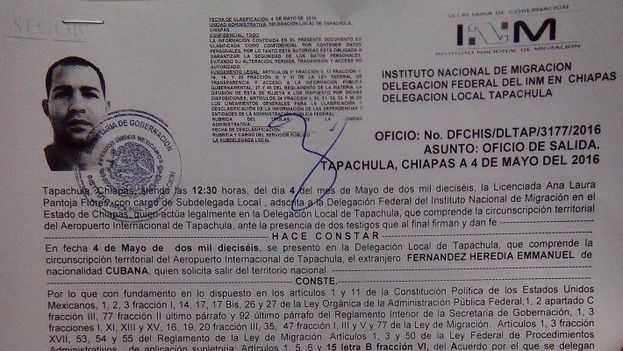
A group of Cubans show the exit permits they received today in Tapachula, Mexico.

14ymedio bigger14ymedio, Mario Penton, Miami, 4 May 2016 — Mexico continues to grant “exit permits” to Cuban migrants arriving in Mexican territory from Central America, according to comments made to 14ymedio by an official of the National Institute of migration in Tapachula, Chiapas. On Tuesday, the Cuba’s Ministry of Foreign Affairs (Minrex) released in a statement saying that a memorandum of understanding between the two Nations to “ensure a regular, ordered and safe migration” was now in effect.

The document Minrex is referring to is part of a set of agreements signed by Mexican President Enrique Peña Nieto, during Raúl Castro’s last visit to Mexico with the purpose of strengthening relations between the two countries. continue reading

The publication of the official note triggered alarms among the thousands of Cuban migrants scattered across the continent, for whom Mexico is a necessary stage on the way to the southern border of the United States. The media never had access to the document, signed last November during Raúl Castro’s visit to Mérida, although the note of the Cuban Foreign Ministry clarifies that its purpose is to “enhance the cooperation between the two countries in the fight against illegal migration.”

This newspaper got in touch with Chiapas’ 21st Century Immigration Station, and an official who asked not to be identified said that they have no instructions to stop granting exit permits to Cuban migrants.

Mexico’s Foreign Secretary confirms that he is aware that the agreement has taken effect, and said that it is an update of what was already in effect. However, officials were surprised by the Minrex announcement and said they are considering issuing a public statement.

The official “exit permit” that Cuban migrants continue to receive from Mexican authorities.

Luis Enrique Pastrana is the owner of the Plaza Emmanuel Inn in Tapachula, Chiapas. He has devoted himself for some years to hosting dozens of Cuban migrants seeking to reach the immigration station. As he said to 14ymedio, “Cubans fear that the exit permit will be withdrawn but so far everything remains the same.”

According to Pastrana, on Tuesday 21 Cubans who were staying in his hostel received the document, and this Wednesday another 11 guests have arrived who plan to follow the same path.

“Every day many Cubans arrive and replace the ones who leave, although people are fearful since a rumor is spreading saying the laissez-passer, as they call it, won’t be issued anymore,” he said.

After crossing the Guatemalan border, Cuban migrants gather outside the immigration offices from six in the morning and into the afternoon to receive the document authorizing them to travel through Mexican territory, with the condition that they must leave the country within 20 days.

Rosmery Valledor is a Cuban architect who was stranded in Panama. From 2012, she lived in Venezuela but she decided to emigrate because of the difficulties she was going through there. As she says, “the situation in that country is unsustainable.”

Valledor spent more than one month in Panama until she succeeded in continuing on her journey across Central America in a clandestine way.

For her, the most difficult thing about the journey was “the terror to which we are subjected by the coyotes (guides).” The young woman says it is “a journey for which you need not only money but also a lot of courage.”

“We were afraid that once we got there they would not want to grant us the laissez-passer, but we went to the immigration station and they agreed that the next morning we would be assisted without any problem,” she added.

According to the Mexican daily La Jornada citing IMN (Mexican Immigration), since the end of October of last year 7,455 Cubans have appeared before the country’s immigration centers, an unusually high number since records have been kept. Of these, 243 were sent back to the island.

Contacted by telephone, an official of Cuba Embassy in Mexico said he knew nothing about the matter and referred it to the press officer, who did not answer calls.

Translated by Alberto