When Will the Government of Cuba Have Normal Relations With the Cuban People? / 14ymedio, Henry Constantin


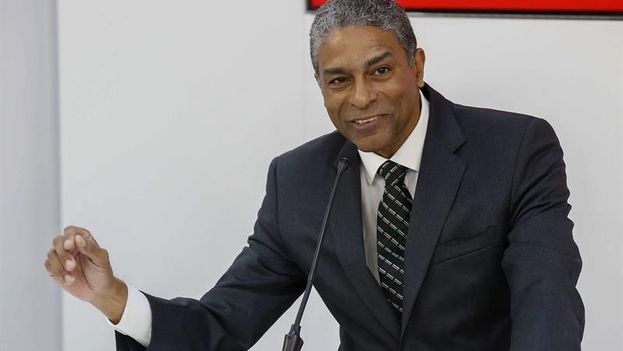
14ymedio bigger14ymedio, Henry Constantin, New York, 31 May 2016 — This video is mute. Like Josefina Vidal, an official from Cuba’s Ministry of Foreign Relations (MINREX), and José Ramón Cabañas, Cuba’s ambassador to the United States, when I asked them questions that they did not expect, after their lecture on “normalization” at the Latin American Studies Association (LASA) held in New York a few days ago:

  • Most Cubans believe that the real blockade is what “those up above” in Cuba maintain against the initiatives of the rest of us.
  • The normalization between Cuba and the United States is well advanced: Cubans receive with joy both the United States president as well as the simple tourist from the north. And they have privileged status when they arrive on the northern soil.
  • We Cubans want not only tourism or entertainment from the United States, but also to be its counterpart in politics, business, media, academics…
  • The biggest obstacle to normalization is that put in place by the Cuban government.
  • This occurs because the Cuban government does not have normal relations with its own people, neither asks nor listens to them, on this or any other subject.
  • And, finally: When will Government of Cuba have normal relations with the Cuban people?

They did not respond. They don’t know how. The “abnormal” is in effect.

At the end of the video I am standing against the conference room wall but content, because it is they who will be against the wall of the future, the day that more Cubans are encouraged to question them. And demand from them.

Villa Clara Sugar Harvest Will Be Much Less Than In 2015 / 14ymedio, Jose Gabriel Barrenechea

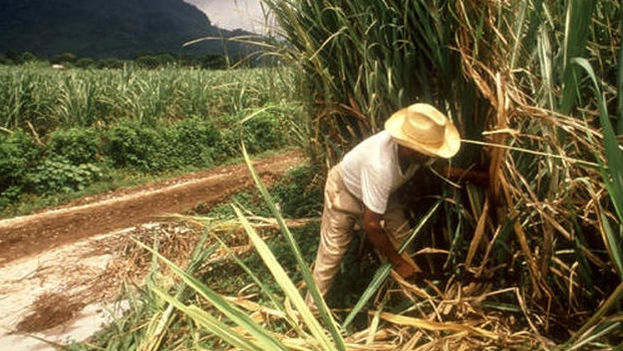
The sugar harvest in Villa Clara will not reach 2016 levels (CC)

14ymedio bigger14ymedio, Jose Gabriel Barrenchea, Santa Clara, 29 May 2016 — With the shutdown of seven of its nine active sites, the 2016 sugar harvest is nearly complete in Villa Clara. It has emerged that the province that currently produces the most sugar in the country has fallen far short of the 250,000 metric tons programmed: as of last Thursday only 180,000 metric tons have been produced, well below the previous harvest.

Only two centers are still milling, Hector Rodriguez of Sagua la Grande, and Panchito of Quemado de Guines. With expected quantities of 36,200 and 39,700 metric tons, respectively, only these plants now have a chance, however remote, of meeting their planned targets. It is very unlikely that the province will reach the 190,000 metric tons proposed by the first secretary of the Communist Party in the region and, in any case, that result would only represent a fulfillment of 76% of its sugar plan. continue reading

Among the causes of this marked decline are the late delivery of the assurances needed to start up the plants, but especially the very low agricultural yields and scant maturity of the reeds. This latter, by the way, is a result of last season’s cutting ahead of time much of the cane that would have reached its full development only this year, as a result of last year’s government stubbornness to meet that year’s plans, whatever it took.

The cane cutters are saying that this year they have cut fields that are yielding less than 30,000 arrobas (a measure of weight that varies by country; in Cuba it is 25 pounds) per caballeria (about 33 acres). In addition, the small size of many fields and their less than optimal location prevents a rational distribution of the cutters and resources needed to transport the cane to the mills, which is also taking a toll on the season.

The provincial authorities have insisted, however, that this disastrous season is the fault of the rains, a statement completely at odds with their frequent pronouncements that the province is experiencing a drought. But in Villa Clara, it seems, it is a question of drought when they are talking about aqueducts, and of rains when they are talking about sugar harvests.

Colombia Repatriates Undocumented Cuban Couple Who Arrived From Ecuador / 14ymedio, Mario Penton

Two migrants were repatriated to Cuba on Sunday from Colombia (courtesy)

14ymedio bigger14ymedio, Mario Penton, Miami, 29 May 2016 – A Cuban couple who arrived from Ecuador, were repatriated to the island by the Colombian authorities this Sunday, after being detained in the center of the country without proper documentation.

Leira Valle Piedra and Yoandy Boza Canal, ages 19 and 23 respectively, entered Colombia through its border with Ecuador with the intention of joining the Cubans who are in the town of Turbo, in Antioquia Department, but they were discovered two hours from Medellin and transferred to Pereira, where they were informed they would be returned to Cuba. continue reading

“They told us it will be the same for all Cubans who are in Colombia without a visa,” Leira Valle told 14ymedio. She said that they decided to cross into Colombia with the aim of continuing the journey to the United States, where they have family. “They refused to renew my husband’s visa in Ecuador so we had to leave there,” she said.

The deportation to Cuba happened after Colombia Migration issued a statement on 25 May in which it expressed that the new measures that the country was taking in the face of human trafficking are beginning to show good results.

The new actions consist of an increase in checkpoints both along highways and at border points. The authorities referred to the new irregular migration routes they detected in the departments of Nariño, Huila and Amazonas.

The communiqué also said that more than 150 migrants were deported in recent days to their countries of origin or to the location where they had entered Colombia.

With regards to hundreds of Cubans who are being housed in a warehouse in Turbo the text was categorical: “Colombia Migration and the National Government will not facilitate any aircraft to transport them to a different place that is not the border where they entered Colombia or their place of origin. To do otherwise would be contributing to the criminal bands of human traffickers.

In 2016 alone, the town of Turbo has discovered more then 3,700 irregular migrants. Most of them obtained a safe conduct giving them 10 days to pass through the country but, after the closing of the border with Panama to the avalanche of Cubans and migrants from other continents, the Colombian government has decided to deport the undocumented to their countries in origin.

In response to the request for information on the case, the communications office of Migration Colombia told this newspaper that, due to the internal policies that manage the institution, they can not address the issue only from the Cuban problem, “every time, for the Colombian state these people are victims of migrant trafficking networks and we would be ‘revictimizing’ them.”

Soldiers in Business: Bad Deal / Cubanet, Luis Cino Alvarez

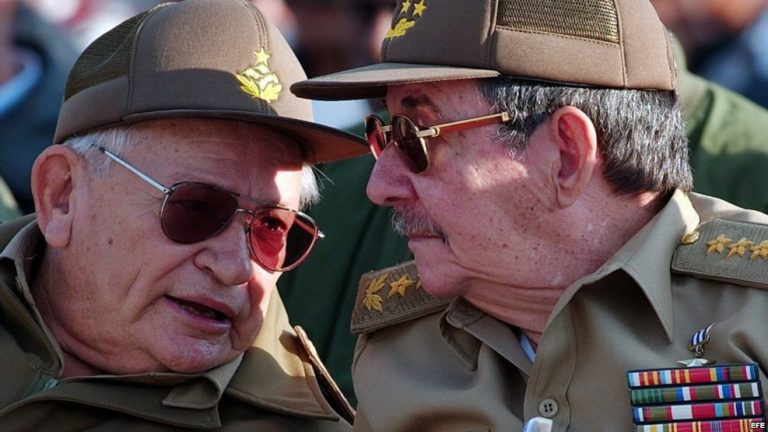
Soldiers in the economy: A bad deal (photo EFE)

cubanet square logoCubanet.org, Luis Cino Alvarez, Havana, 30 May 2016 – The survival of the Castro regime increasingly appears to be in the hands of the Revolutionary Armed Forces (FAR). And not only because of the generals who run some of the most important ministries but also because of the general-businessmen of the Enterprise Administration Group (GAESA).

GAESA, whose managing director is Colonel Luis Alberto Rodriguez Lopez-Callejas, father of one of Raul Castro’s grandsons, invoices more than a billion dollars a year. It has sugar plants, the TRDs (Hard Currency Collection Stores), Caribe and Gaviota, which impose abusive taxes on commodity prices, the Almacenes Universales SA, farms, mills, telecommunications and computer industry, trade zones, etc. And if that were not enough, having most of the hotel and marina capacity, it governs tourism, one of the country’s main sources of foreign income. continue reading

Some things borrowed from capitalism have functioned successfully in FAR’s enterprises.

At the beginning of 1985, after the shipwreck of the Economic Planning and Management System copied from the Soviet model, FAR implemented the Business Improvement System on a trial basis in the company “Ernesto Guevara,” in Manicaragua, Villa Clara, the largest facility of the Military Industries Union.

The experiment was supervised by General Casas Regueiro, who kept General Raul Castro, then FAR Minister, regularly informed about the matter.

Two years later, the experiment was extended to the military industries throughout the country.

The Business Improvement System (SPE), which Raul Castro called “the most profound and transcendent change to the economy,” copied capitalist forms of organization and administration: corporations, joint stock companies, management contracts and partnerships with foreign companies.

SPE permitted the Cuban army to ride out the worst years of the Special Period. If it was not introduced on a national level it was for fear of its consequences, which would have been worse than those of shock therapy.

In 1994, Fidel Castro, pressured by the deteriorating situation, agreed that a group of businesses from the Basic Industry Ministry would enter the SPE on an experimental basis. Later 100 more businesses were incorporated.

In 1997, the Fifth Congress of the Communist Party adopted the SPE as an economic strategy. After Raul’s succession, the extension of business improvement to the entire Cuban economy was conceived as a long-term strategy for preserving the status quo.

At the end of the last decade, when more than 400 businesses that implemented SPE were the most efficient in the country in terms of costs and results, it seemed that the Cuban economy was beginning to move to general application of that system. But it was a too-artificial model to extrapolate it to the rest of the national economy. To begin with, the unaffordable and disastrous enterprise system in Cuban pesos was not compatible with business improvement in dollars.

With SPE, the military men played the economy to advantage. Their businesses bore fruit in a greenhouse environment. They did not have to face labor or capital competition, they had unlimited access to state resources and benefitted from disciplined labor accustomed to obeying orders. Production factors, prices and marketing were at their disposal. Investments were provided by foreign businessmen prepared for unscrupulous deals in exchange for a minimum participation in the businesses.

Although they have had relatively modest success, there is not much to learn from the FAR businesses. And that is because a nation is not governed as if it were an armored division.* War is one thing, and managing a country’s economy efficiently is something else, although both things use bellicose language interchangeably.

FAR, dragging its old slogans and obsolete Soviet weapons, also reflects the system’s wear and tear and the distortions of current Cuban society.

Military men crammed into businesses can become problematic in the not-too-long term. Distanced from the interests of the people, they contribute to the system’s continuity. But they will always be stalked by temptation. Contact with foreign capitalists foments greed and corruption. This has been happening for some years.

When they feel their privileges and properties granted by the proprietary state threatened, their loyalty to the bosses or their successors will be put to the test. We will see what will happen then.

About the Author: Luis Cino Alvarez

*Translator’s note: An allusion to Cuba’s hero of independence José Martí’s words to General Maximo Gomez during the independence struggle: “A nation is not founded, General, as a military camp is commanded.”

Translated by Mary Lou Keel

Campaign Against the Mosquito / Rebeca Monzo

Havana Tribune: Official Organ of the Provincial Committee of the [Communist] Party
Havana Tribune: Organ of the Provincial Committee of the [Communist] Party
Rebeca Monzo, 30 May 2016 — On my planet, Cuba, dengue fever has been brought on by unsanitary conditions, which in turn were brought on by the revolution. Neglect and abandonment have caused the Aedes aegypti mosquito to proliferate from buildings abandoned due to collapse, from leaks in water mains, from uncollected piles of trash, and from plastic bottles and cans accumulating in roofless houses and open spaces in the city.

Now the public relations campaign to eradicate the mosquito has almost become a joke. The government blames citizens, attacking the symptoms rather than the causes.

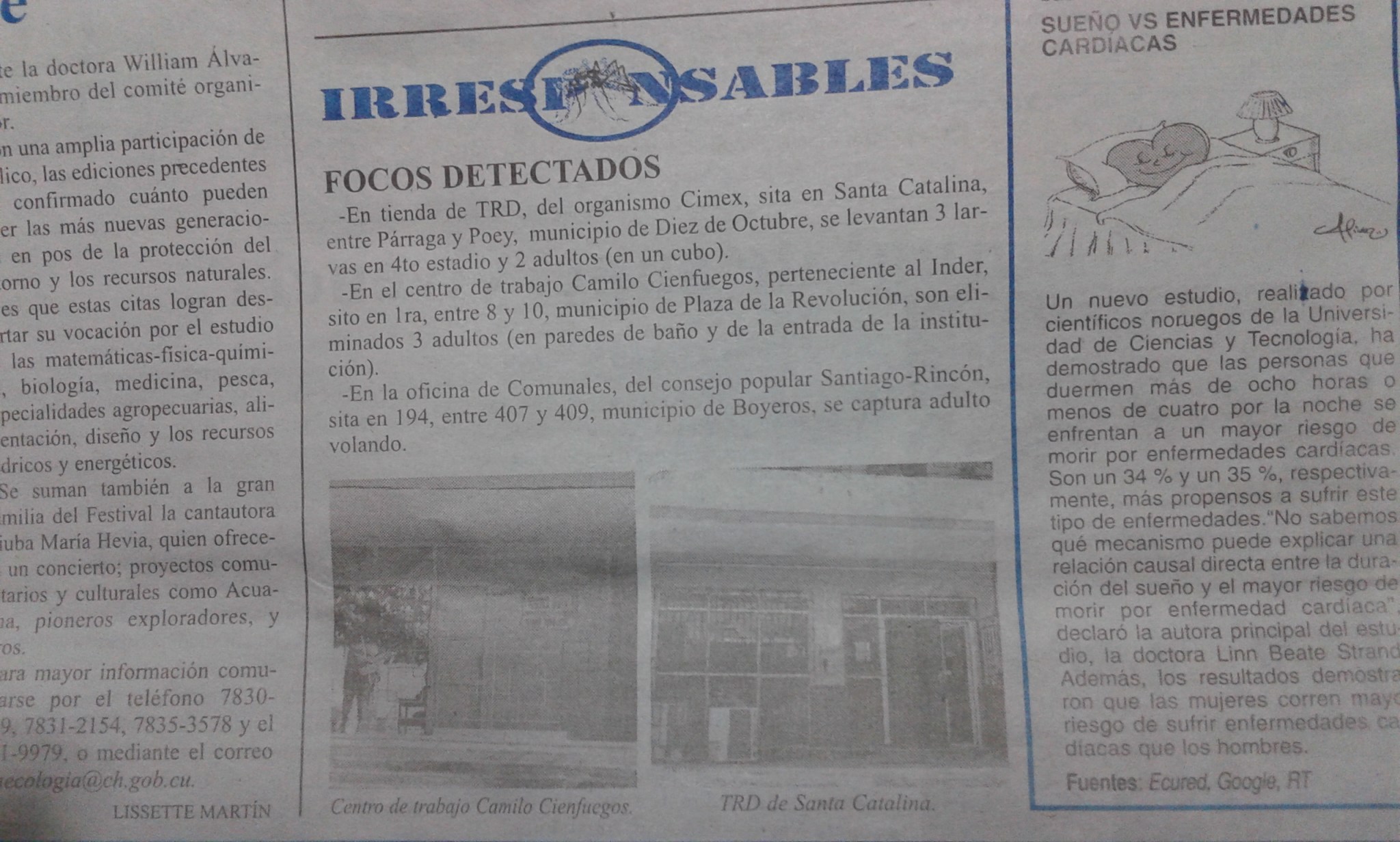
Irresponsibles. Breeding Sites Detected. (See full text below)
Irresponsibles. Infestations Detected. (See full text below)

Irresponsibles

Infestatations Detected

– In the Cimex currency exchange office on Santa Catalina between Parraga and Poey streets in the Tenth of October district, three larvae and two adults (in a plastic water bottle).

– In the Camilo Cienfuegos workplace, an Inder branch, on First between 8th and 10th streets in the Plaza de la Revolucion district, three adults (in bathroom walls and the building entrance) eliminated.

– In the Comunales office in the Santiago-Rincon people’s council at 194th between 407th and 409th in the Boyeros district, one adult captured in flight.

Please carefully read the notice above, published in the weekly Tribuna, and tell me honestly if this is serious or a joke that “got out of hand.”

Without Haste and With Many Pauses / Somos+, Joanna Columbie

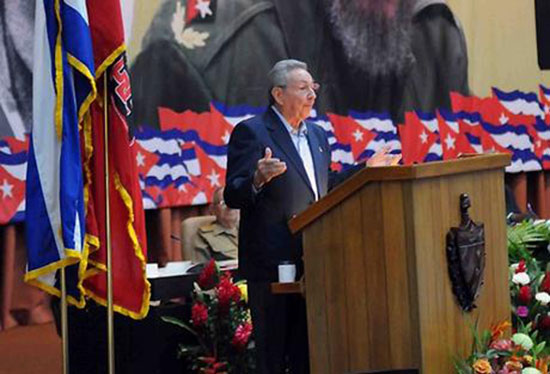
Raul Castro speaking at the recent 7th Congress of the Cuban Communist Party

Somos+, Joanna Columbié, 24 May 2016 — The Cuban economic model, one that is imprecise, vague, and very particular to Cuba, does not manage to meet the needs of the Cuban people. The nominal wage does not come close to the actual salary that a Cuban citizen needs to cover their basic necessities and, in this respect as in many others, the Guidelines set forth in the previous Congress of the Communist Party of Cuba have failed to be implemented effectively; according to official figures, only 21% of the proposals have actually been carried out.

In Cuban president Raúl Castro’s own words, this whole process should be carried out “without haste but without pause,” however we should ask ourselves whether this phrase can ever be realistic for the Cuban people. Having to wait over 57 years for the promises made by Fidel Castro in his speech known as “History Will Absolve Me” to be put into effect puts this current wait into question. continue reading

It is not the first time that a similar process has been implemented in Cuba. Appearing to recognise the mistakes that have been made, necessary rectifications of mistakes and negative trends have been set out on more than one occasion, in each case with the apparent objective of distracting the population, making sure that their attention is diverted away from the serious economic and social situation that has plagued the country at various points in history.

And now Raúl is back at the 7th Congress of the Communist Party of Cuba (known as the PCC) with the same discourse. Nothing has changed and in his speech he repeats this same fateful phrase that has led to many a frustrated hope for the people of Cuba and many a useless plan.

Part of the population hoped that this 7th Congress would bring change, change that has to happen sooner or later, but we did not think that it would come via a party that has lost its reason for being in this society, if it ever had one. Remaining in the same political confinement to which we are accustomed will not be a sufficient reason for the opposition movements in Cuba to walk step by step towards necessary change, even though the communists finish their congress in the same way it started: without haste and with many pauses.

Translated by E Hill

Away From “The Honey Of Power” Carlos Lage Focuses On Fighting Mosquitoes / 14ymedio, Zunilda Mata

President Raul Castro with Carlos Lage, then vice president, when everything was still complicity. (EFE)

14ymedio bigger14ymedio, Zunilda Mata, Havana, 30 May 2016 – Every evening he emerges with his briefcase from the place where he purges his fate of being ousted. Carlos Lage, former vice president of Cuba’s Council of State, works on the campaign against the Aedes aegypti mosquito at the 19 de Abril polyclinic. Seven years ago he was removed from office and accused by Fidel Castro of being addicted to “the honey of power,” but today he is an employee of the Ministry of Public Health and avoids talking about his past.

At 64, Lage barely practices the pediatrics that he specialized in after studying medicine. His activities as president of the University Students Federation (FEU) and subsequent responsibility as secretary general of the Union of Young Communists (UJC) left him no time to attend patients. After his political downfall, in 2009, he went through several minor administrative positions in which he has had little contact with the public. continue reading

Currently, the man who is also the former secretary of the Council of Ministers works in the Department of Hygiene and Epidemiology in a polyclinic that often receives visits from foreign delegations. More than once, in the hallways, he has run into former colleagues and diplomats who revered and honored him when rumors suggested he might become the first vice president.

The name of Lage was among the successors mentioned in the proclamation with which Fidel Castro announced his departure from power due to health problems, read out on national media on 31 July 2006. In paragraph six of that text Lage is called out for his accomplishments, such as being the “driving force of the energy revolution program” and the management of its funds. Off the Island, the vice president was seen as a civil figure with whom it might be possible to negotiate a future transition.

Between 1993 and 2009, from his high position, Lage represented Cuba at several Latin American summits, in speeches before the United Nations and at the inaugurations of numerous presidents. Popular humor baptized him as “the administrator of the madhouse,” for showing a certain sense in the midst of the political delusions that characterized those moments in Cuba.

However, rather than promote him to the position of first vice president, in February 2008, Raul Castro named the orthodox Jose Ramon Machado Ventura, thus sending a clear signal of strengthening the power of the so-called “historic generation” and avoiding potential reformers. A Reflection published by Fidel Castro confirmed the disgrace, when he accused Lage and Foreign Minister Felipe Perez Roque of having played an “undignified role.”

Now, every morning, el benjamín—the youngest son—separated from power imparts guidance to workers in the campaign against the mosquito that transmits dengue fever and chikungunya. The rest of the day he receives complaints from residents of Nuevo Vedado about the fumigators and medical personnel linked to the inspections for mosquito breeding sites.

Lage’s relations with the rest of the polyclinic workers are cordial, according to what several of his colleagues told this newspaper. Few dare to remind him of the times when his order was sufficient to appoint a director or remove an administrator. Often, after work, he offers a colleague a ride in his red-wine Russian made Lada, a replacement for the car he kept in his time in power.

In the corridors of the healthcare center he is called “the goodies bag man,” an allusion to his order at the beginning of this century that put an end to the bags with products like soap, frozen chicken and detergent that were distributed among healthcare personnel. Scornfully, his current compañeros remind him of that cut.

Not even in the domino games regularly organized at his home, where he invites other polyclinic workers, does Lage speak of that 3 March 2009, when Raul Castro removed him from his position as vice president. He was also dropped from the Central Committee of the Communist Party and lost his position as a deputy in the National Assembly of People’s Power.

“He will not mention his previous life,” an employee of the 19 de Abril laboratory told 14ymedio. “At first they maintained a visible surveillance operation” on him, said the employee, but “over time it has been lessened.”

An attempt to obtain statements from Lage himself received no response. “That man knows that silence is what keeps him alive,” commented his colleague.

Korea, That Distant But Nearby Country / Yosmany Mayeta Labrada

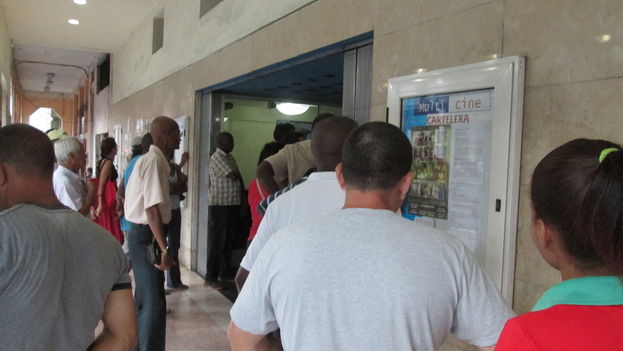
The audience outside the Infanta Multicinema during the first day of the South Korean cinema week in Havana (14ymedio)

14ymedio bigger14ymedio, Yosmany Mayeta Labrada, Havana, 28 May 2016 — When Cuban children playing mention distant countries, they talk about Singapore, Burundi and Korea. But in the latter case, they do not think about the country controlled by Kim Jong-un, but the one on other end of the peninsula, where Samsung was born. With film production the same thing happens: the theaters fill up for productions coming from the land of Hyundai and remain empty if the films come from the country’s “eternal president.”

With all seats occupied and dozens of people outside the theater, the screening of the first movie of South Korean Film Week in Havana occurred this Thursday at the Infanta Multicinema. The event, which this year celebrates its third edition, was organized by Cinemateca de Cuba with the Cuba-Korea Exchange Association. continue reading

The audience that gathered in the centrally located theater turned out to be very diverse, especially considering that Cuba does not have diplomatic relations with South Korea and this Asian country lacks official representation on the island. Nevertheless, officials from the Cuban Institute of Cinematographic Art and Industry (ICAIC) attended, along with the very official Cuban Institute of Friendship with the Peoples (ICAP).

Also in attendance were South Korean students residing on the island and several diplomatic representatives of other nations, including the ambassador of the People’s Republic of China.

The founder of the Busan International Film Festival, Kim Dong-Ho gave the welcome in Spanish and said that a week of the films of his country would help with “understanding Korea” and “improving our relationship.” After he praised the cultural level of Cubans he closed with an emotional “thank you” that hastened the applause of spectators. Then came darkness and with it a point of light that widened on the screen.

The night gave way to “A Hard Day,” by South Korean director Kim Seong-Hoon. The thriller maintained its suspense until the end, with the avatars of Detective Gun-Su, trying to hide the body of a person he ran over. A standing ovation just as the credits started to roll confirmed that the organizers were right to choose this film to “break the ice” for the week.

Among those responsible for the careful film selection is Susana Molina, vice president of ICAIC, who told 14ymedio that “all the films in previous years have been good quality, but the curation of these was done by Tony Mason and also this edition presents a wider program.”

The programming for Korean film week will run until next Thursday. Stand outs among the films are titles such as: I’m a Cyborg But That’s OK, Moebius, 200 Pounds Beauty, Coin Locker Girl, and The Satellite Girl and the Milk Cow. Productions that deal with romance and survival in a world of violence, as well as police dramas and the conflicts of an obese girl trying to make it in the world of pop music.

However, few moments are likely to exceed those of opening night, when the cinema mixed diplomacy with a certain dash of showbiz. After the screening of the first film, the celebrations moved to the Bar Su Restaurante in Miramar, where the surprise of the evening was the presentation of young Cubans who sang in Korean and danced typical dances of the region.

From the tables nearest the stage well-known actors such as Enrique Molina, Isabel Santos and Luisa Maria Jimenez applauded and laughed, all spellbound by that distant but nearby country.

The “Little Witches” Arrived / 14ymedio, Yoani Sanchez

”Little witches” (known is rail lilies in English) in the 14ymedio newsroom. (14ymedio)

14ymedio bigger14ymedio, Yoani Sanchez, Havana, 14ymedio – There are those who believe that the pages of newspapers only have space for tragedy, armed conflicts and diatribes against politicians. In a world where the newspapers prioritize the extraordinary and the TV screens are filled with crises or shipwrecks, the little things, the common moments, lose narrative space. However, a good part of our existence takes place among the everyday, in the middle of a cycle that repeats itself over and over, like the seasons and the flowerings.

In the 14ymedio newsroom, 130 feet above the ground and amid the informational hustle, these “little witches” have been born. Known as “rain lilies” in English, no one planted them in a flowerbed, but they have arrived in the earth of some other plant and bloomed this summer. They are fragile and fleeting, but their simple presence convinces us that life continues, despite the problems, the fears, and the stubbornness of the leaders.

With their herringbone stems and ephemeral petals, these “little witches” have wrested a smile from the work team that reports a reality where there are few reasons for joy. One afternoon, just after a very long power outage, they sprang into bloom, on the same day that the political police browbeat one of our provincial collaborators. But here are these “little witches,” to remind us that being journalists is also narrating the diminutive, describing the ordinary and supporting freedom, like a plant, that returns to bloom again.

“I Am Prepared To Go to Prison Today,” says Berta Soler / 14ymedio

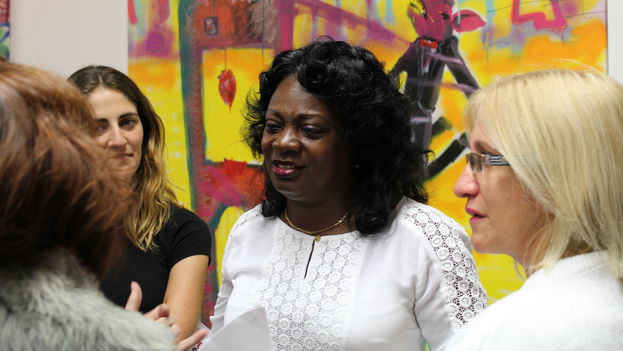
Berta Soler, leader of the Ladies in White, during the art exhibit by El Sexto in Miami, Florida. (14ymedio)

14ymedio bigger14ymedio, Havana, 29 May 2016 – From early hours Sunday a major police operation surrounded the headquarters of the Ladies in White in the Havana neighborhood of Lawton, according to denunciations by several activists from that organization. At least “13 women and four opponents were brutally intercepted outside the house” and forced into police cars in the last 13 hours, dissident Luisa Ramona Toscano Kendelan said by telephone to 14ymedio. continue reading

The group that surrounded the property included, as has become customary, a conga line with music through powerful speakers and signs that use the opposition campaign slogan “We All March” together with the phrases “with Fidel,” “with the Revolution” and “with socialism.”

At several points in the city similar operations prevented the women who form part of the human rights organization from reaching Santa Rita Church. Several on-scene witnesses report that at least two Ladies in White had managed to reach the vicinity of the parish on the western periphery of Havana.

Minutes before her arrest and in statements to this daily, Berta Soler, leader of the Ladies in White, declared that she was ready to confront the risks of leaving her organization’s headquarters in order to exercise the right of “peaceful demonstration.” She explained that she was prepared to go “to prison to await the trial” with which they threatened her last week for a charge of resisting the authorities.

“I am prepared, I have my blood pressure monitor, my pills, shots, personal hygiene articles, flip flops … I carry it all. I am again going to commit the crime they accuse me of, so I expect to end up in the Manto Negro women’s prison.”

In the morning hours in the Matanzas province, Lady in White Leticia Ramos Herreria, who urged agents to take her directly to prison to await trial, was detained. Nevertheless, the State Security officers responded to her that “it was still not time.”

Translated by Mary Lou Keel

UNPACU Activists Denounce Raid On Their Homes / 14ymedio

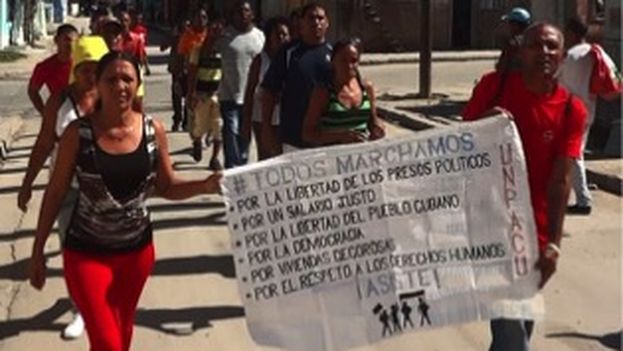
UNPACU Activists marching in protest. “We all march, for the release of political prisoners, for fair wages, for freedom for the Cuban people, for democracy, for decent housing, for respect for human rights. (UNPACU Archive)

14ymedio bigger14ymedio, Havana, 28 May 2016 – This week has been one of surprises for several activists from the Patriotic Union of Cuba (UNPACU) who denounce that they have been victims of a raid on their homes and the confiscation of their belongings. The dissidents detailed that the political police raided three houses in the city of Santiago de Cuba on Saturday morning and a fourth in Havana on Wednesday.

Ermito Morán Sánchez, an UNPACU activist, confirmed to14ymedio that they “raided the homes of Carlos Oliva Torres, Yusmila Reyna and Karel Reyes where they seized printed materials, a camera, and other items in response to our activities to disseminate the reality of this country among the people.” continue reading

In a telephone conversation with 14ymedio, Yusmila Reyna said that at six in the morning, while her family was sleeping, there was a “knock on the door.” It was the police with “a search warrant for subversive activities.” An officer showed her a paper, but did not allow her to read it carefully or to take it in her hands. The incident occurred on 12th Street in the Mariana de la Torre neighborhood in Santiago de Cuba.

Reyna managed to read that the order specified that they came to “seize methods of communication, money, and any other means of counterrevolution.” A total of ten uniformed officers plus two in plain clothes, who supposedly came to witness the search (Cuban law requires two civilians to witness such a search), participated in the operation.

The raid lasted over an hour and ultimately they seized working notes, two laptops, an electronic tablet, two hard drives, a printer, a camera, “and even receipts for items acquired abroad,” according to Reyna.

The activist circulated a text where she says that “acts like these do not prevent us from continuing our work in defense of human rights and accelerating the process of democratization of our island.”

During the search of her house they also seized a number of issues of the magazine Coexistence, documents relating to the initiative Otro 18 (Another 2018)—in support of free multiparty elections—and documents relating to the Roundtable for United Democratic Action (MUAD).

“They took two staplers and the boxes of staples, and a hole-punch. They didn’t leave any document I was working on and warned me that any demand [for the return of the seized items] would have go to the ‘Confrontation Offices’ but that they were not going to return anything.”

Meanwhile the dissident Arcelio Rafael “Chely” Molina Leyva said that Wednesday morning the police arrived to search his home, which serves as the UNPACU headquarters in Havana.

“They came with several gentlemen in plainclothes and after a thorough search took three laptops, a battery to recharge cell phones, two mobile phones, office supplies, news from international agencies, printed civic material and digital backups,” Chely enumerated.

This is the fourth search of this nature by the political police on UNPACU’s Havana headquarters. As a part of the operation they arrested Carlos Amel Oliva Torres, who despite having a temporary residence permit for Havana was taken to the third station of the National Revolutionary Police (PNR) in Santiago de Cuba, where he is still under arrest.

Oscar Elias Biscet Says That Cuba Can No Longer “Bring Down” The Opposition / EFE (14ymedio)

Cuban dissident Oscar Elias Biscet. (EFE)

14ymedio biggerEFE (via 14ymedio), Miami, 26 May 2106 — Cuban dissident Oscar Elias Biscet said Wednesday, on arriving at the Miami airport from Spain, that the opposition on the island is “well defined” and that the regime “can no longer bring it down.”

Biscet, who was happy to be in “land of freedom” for Cubans, told reporters that he would explain to the Cuban exile community in South Florida his civic political project to end the dictatorship and promote democracy, through a method of non-violent struggle. continue reading

The medical doctor said that the opposition is “very united” and that part of the opposition is his initiative, the Emilia Project, which has gathered the support of more than 3,000 signatures.

He noted that the signers are “brave people, who gave their names, who gave their addresses, their identity card data, saying they do not want more communism.”

Biscet, 54, was optimistic that this group would become “a crowd that would end the dictatorship in Cuba.”

He said his initiative seeks to “make change by shifting the superstructure” and he calls this “the revolution on non-violent human rights.”

The dissident was arrested in late 2002 and sentenced to 25 years in prison for being part of the so-called Black Spring, where a group of dissidents known as the Group of 75, were accused of conspiring with the United States.

Biscet was released from prison in March 2011 during the process of the release of political prisoners carried out by Raul Castro’s government after mediation by the Vatican.

The dissident, who visited Madrid to give a lecture and see friends, admitted this week in Spain that he is afraid of reprisals in Cuba when he returns.

Hollywood Conquers Havana with a Fistful of Dollars / Ivan Garcia

Filming during Fast & Furious 8 in Havana. From Mundo Motorizado.

Ivan Garcia, 7 May 2016 — A black helicopter hovers at low altitude over Havana Bay. Meanwhile, dozens of pedestrians on the streets below wave and try to capture the image on their mobile phones.

The aircraft makes an acrobatic turn and flies back towards the port. “Mijail, hurry up and try to get a photo now,” yells a girl almost hysterically to her boyfriend, who wastes no time activating the camera from his old Motorola phone. continue reading

At the bus stop near the cruise terminal in the old part of the city, everyone has a story to tell about filming in Havana for the eighth installment of Fast & Furious.

Adelfa, a peanut vendor, observes, “A friend of mine who collects empty beer and soda cans told me that — at the Hotel Saratogo, where the actors and some yumas (Americans) are staying — they were handing out twenty dollar bills to everyone who was in the Fountain of the Indian across the street. I missed out. Now I am trying to sell peanuts where people from Hollywood might be to see if they will give me something.”

A guy with the look of a government official says to several people, “The film producers paid forty million dollars to the local People’s Power administration for any inconvenience that might be caused.”

His comments open up a debate. “Would you happen to know what the government plans on doing with this money?” asks a man who says he has been waiting an hour for the P-5 bus. “Will they fix the houses that are falling down or buy new buses?”

A black youth who is listening to music removes his ear buds and replies, “You want me to tell you what I think they will do with the money? They will put it in a bank account in an overseas tax haven for Daddy’s kids: Antonio or Mariela Castro.”

Some of those present cast sideways glances, an instinctive gesture in Cuba denoting fear, to see if someone from the “apparatus” (political police) have heard the young man’s outburst.

On Wednesday, April 20, rehearsals began and on Friday, April 22, they started shooting. From then until Thursday, May 5, when filming is scheduled to end, several streets of Central Havana and Old Havana were closed to traffic, forcing people to walk or take long detours to reach homes or workplaces in those areas.

Production trailers, parked on the corner of Infanta and San Lazaro streets, are surrounded by local residents and curious onlookers. Cuban security personnel hired by the studio are harsh with people taking photos and recording cell phone videos.

“It’s what the producers ordered,” a security guard, justifying this behavior. “They claim that anyone can film a bit of something and then post it on the internet. These people pay a lot and pay well but they always want to control the rights to the film. In Cuba we don’t know anything about this.”

Rumors about Fast & Furious producers handing out money by the fistful are spreading throughout Havana.

Osvel, a driver for a taxi collective who works the Vibora-Vedado route, notes, “They gave ONAT (the government agency that regulates self-employment) three hundred dollars to give for every private-sector worker in the area where they are filming. But the workers only got forty convertible pesos apiece. They’re taking a big cut.”

Arianna, a secretary for ONAT, says, “I cannot confirm how much producers paid. My bosses have not said anything about that, but I do not think the government got that much, as always turns out to be the case with these things.”

As usually happens when it comes to the subject of money in Cuba, the government has remained silent, which has only fed the rumor mill. Getting anything out of a movie studio spokesperson is a mission impossible for a independent journalist.

“When filming is complete, there will be a press conference,” says a man with a Universal Pictures badge. Not even the United States embassy in Havana knows what the studio’s plans are nor anything about a hypothetical press conference with the actors and director.

“Private companies do not necessarily have to contact the embassy to carry out their work. We only have access to governmental agencies,” says an embassy spokeswoman.

Nor can she confirm various Fast & Furious rumors circulating through the city. It is said, for example, that old car owners were paid eighty thousand dollars for the use of their vehicles in collision scenes and that extras were paid fifty dollars an hour.

The fact is that not since Fidel Castro’s revolution has Cuba seen so much Hollywood paraphernalia or such a waste of money.

“The last time Americans filmed here was in the mid-1959s when they shot Our Man in Havana. They paid me ten dollars to play a fruit vendor,” says Ramon, a seventy-six-year-old man who, six decades later, sells corn tamales corn from a bucket of hot water.

The movie, starring Alec Guinness and Maureen O’Hara and based on novel by Graham Greene, won a Golden Globe in 1960.

But the street vendor was mistaken. Our Man in Havana was not an American film; it was British. To Cubans all English speakers look alike.

 

Cubans Demonstrate In Front Of The US Embassy In Quito / 14ymedio, Mario Penton

Cubans demonstrating in front the US embassy in Quito, Ecuador, on Friday. (14ymedio)

14ymedio bigger14ymedio, Mario Penton, Miami, 27 May 2016 — Hundreds of Cubans, more than a thousand according to organizers, marched this Friday morning in front of the United States embassy in Quito, to ask for Washington’s intervention in the negotiation of an immigration agreement that would allow more than 5,000 migrants reach the US border.

“They didn’t let us go past the embassy. The Ecuadorian police blocked the way,” said Peter Borges, who leads the protests along with Fernanda de la Fe. continue reading

According to the activists, it was a peaceful demonstration intended to deliver a letter to the ambassador to ask him to mediate with the Ecuadorian government for the passage of thousands of Cubans who want to emigrate to the United States and take advantage of the Cuban Adjustment Act. Since 1996, the Act has given special treatment to the island’s citizens who are able to reach US territory with regards to emigration.

“Cubans do not want to leave here, we spent several hours in the demonstration,” said the activist.

The letter, which they were not able to deliver, denounced the “horrendous episodes of extortion, rapes, murders and the disappearance of entire families,” which the migrants have suffered on their journey as undocumented emigrants across the continent with the objective of “reaching the freedom and well-being permitted by the generous United States government.”

The purpose of the missive is “to seek help to avoid further loss of human lives.” The letter also states that Cubans living in Ecuador are worried because “the Ecuadorian government has implemented a document review process for a large group of ‘irregular’ Cubans who make their lives here on the occasion of this crisis and as a form of retaliation.”

The demonstration comes after the Mexican government rejected a similar request on 18 May. On that occasion, Jaime del Arenal, Mexican ambassador in Ecuador, explained in a communication that the Cubans, many of whom have not been able to regularize their immigration status in the country, “do not qualify for the granting of visas.”

According to the organizers, the initiative also seeks to avoid adding to the number of Cubans who are stranded in Turbo, Colombia, after Panama closed its border to the passage of undocumented migrants. Panama recently transfered more than 3,800 Cubans to Mexico as the result of an an exceptional migratory agreement.

Following the restoration of diplomatic relations with the United States and the worsening of living conditions on the island, tens of thousands of Cubans are trying to reach the US border for fear that the Cuban Adjustment Act will be repealed. In the current fiscal year alone, between October 1 and April 30, 35,652 Cubans had been accepted under the special “parole” program available to them in the United States. It is expected that more than 60,000 Cubans will arrive in the United States this year.

Cuban Migrants Criticize The High Prices Of Airfares To Mexico / 14ymedio, Mario Penton

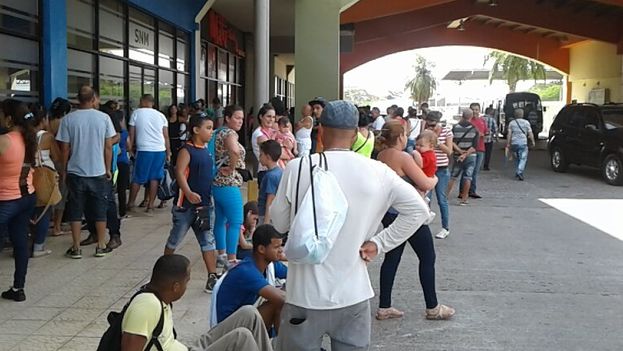
Cuban migrants stranded in Mexico wait to buy airplane tickets to Mexico

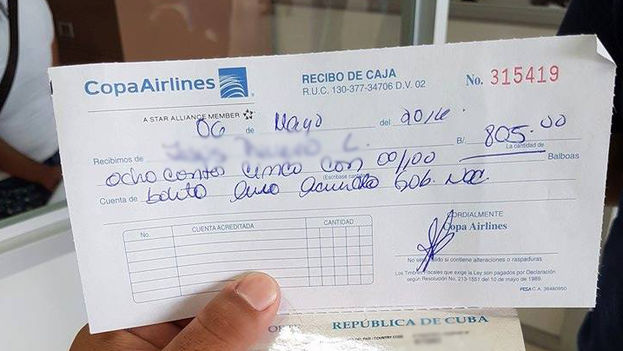
14ymedio bigger14ymedio, Mario Penton, Miami, 6 May 2016 — Accustomed to standing in long lines on the island, thousands of Cuban migrants stranded in Panama were waiting for hours Friday to buy an airline ticket to Mexico. Among these “middle class rafters” criticism was rising over the high price of airfares which has reached $805 for an adult ticket.

José Antonio Quesada and his wife, both lawyers, are among those who were waiting in the sun today to get tickets. As of May 5, the Panamanian Government authorized the sale of airline for Cuban migrants and at least 800 of them have already purchased their tickets to continue their journey. continue reading

The two attorneys spent 1,669 dollars in tickets, including the trip by bus to the airport, the equivalent of more than five years wages for a in Cuba. Both have managed to raise the money with the help of relatives in Miami, but they are concerned because they have no more cash for when they reach the U.S. border.

Quesada and his wife traveled from the island to Ecuador with the intention of settling there and improving their economic condition. However, the obstacles to legalizing their residence and finding jobs pushed them to make a difficult journey through Colombia and the Darién jungle. They departed with the hope of taking advantage of Cuban Adjustment Act which grants immigration benefits to all residents of the island who reach United States.

Now the two professionals are among the lucky ones who have been able to purchase a ticket for flights starting next Monday to the city of Nuevo Laredo in Tamaulipas State, Mexico. The cost of the trip by plane for a child between 2 and 11 years is $332 whereas for a child under a year the amount drops to $160.

The sale of tickets has been marked by the absence of official statements from the Panamanian president’s office, which arouses suspicions among migrants, who fear shady dealings with regards to prices or lack of transparency in the process. “The Government does not give us information,” complains the Cuban Elizander Roque.

As of noon this Friday hundreds of migrants from the island had undertaken, on their own, to travel to the David’s Mall, 25 miles from the shelters where they are staying in Los Planes, Gualaca, to buy tickets.

The prices have surprised Sisleydis Moret, a 25-year-old Cuban who says she feels “desperate” at not having enough money to buy them, due to the expenses of supporting herself during her stay in Panama.

The ticket from Panama to Mexico costs $805 per each adult. (Courtesy)

Her companion in the hostel, Keily Arteaga, age 29, is in a similar situation. “The news was like a bucket of cold water,” she says and comments that, “now we don’t have the money they are asking for.”

Arteaga, who resides in a house in San Isidro, left Ecuador because she was not able to legalize her immigration status. She had “a good job” but she was illegal, which mean that “all the doors” were closed to her, she explains. She says she has taken advantage of “all of this turmoil” of the immigration crisis in Central America to reach Panama.

Those who travel accompanied by several family members experience the most delicate situation. Isleyda Lelle said she was glad to hear that tickets sales had begun to Mexico, but now she needs to wait for her mother, resident in the United States, to help her “complete” the cost of the trip for her, her brother and her sister-in-law.

For Andy Llanes, the situation is more difficult because he says that he does not have “a single dollar” to buy the ticket. “My journey was very hard, we were attacked along the way and they stole from us all that we had.” In the trip to Panama he details that his partner “was raped and now the poor woman is pregnant from the Coyote who abused her.”

Llanes says the only thing he owns is the “flip-flops” he is wearing and says that if he cannot continue the trip, he will stay in Panama because “I won’t return to Cuba even if they threaten me with death.”

Alfredo Córdoba, regional head of the National Migration Service in the Chiriqui province told 14ymedio that he still does not know what will happen to those Cubans who cannot afford the airfares.

An official source who requested anonymity explained that Cuban migrants found in Puerto Obaldia have not received their passports yet and so far there are no specific directions about whether they will or will not be part of the humanitarian program.

This newspaper has gotten in touch with both the Panama National Migration Service and the country’s Ministry of Foreign Affairs, but so far we have not received answers to our questions.

Ed. note: Since this article was written the price of the airfare was lowered and then the sale of tickets was cut off altogether. Translations of articles detailing these subsequent events will follow.

Translated by Alberto