ALASKA AND MY DAD / Orlando Luis Pardo Lazo


ALASKA
Orlando Luis Pardo Lazo

“Would you like to live in Alaska?”,
my father used to say.
“If you never go to Alaska, son,
death will surprise you incomplete”.

Mysterious words
pronounced in the late 70´s of an island
under the shrieking socialist sun of
La Habana.

Words not in English
nor in Spanish, of course,
but in a Cuban jargon with no references:
a dead tongue that in my childhood
sounded
as a curse.

I was 9 or 10
or maybe no age at all
and I looked as frightened as today.
But I had my father
which was also my grandpa
although he talked of death
and
Alaska
and
other incomprehensible
fates.

He was 52
when I was born
in the early 70´s of an island
under the socialist sunny shrieks of
La Habana.

Besides the transparency
of his Sicilian eyes,
I inherited two private homelands
from dad:
chess
and
English,
two labyrinths hard to distinguish
in the magic of his bookshelf.

We lived in Lawton
a delicate neighborhood
in the outskirts of La
Habana
now turned into a suburban wasteland
in the outskirts of La
Revolución.

My father so humble
so lucid
so loser
so tamed under the spell
of the official speech,
swallowing permitted pills
to overcome his nightmares of
Alaska
and
death.

My father so much my
grandfather.

He retired when I was still a kid.
Here and there he insisted
with his northern case
(technically, an escape)
calling me sometimes
“son”
and sometimes
“grandson”.

He hated life under Fidel
for sure
but this was something nobody around him
ever
guessed.

My father so shrewd.

He thought he would survive the
Commander in Chief.
But August is the cruelest month.
And on the 74th birthday of the
Maximum Leader
my father was generous enough
as to pass away
thus losing forever his bet
with his former Jesuit classmate:
Fidel.

It was a sudden Sunday and grandpa
had just turned 81.

An amateur autopsy
told us later he had cancer,
a merciful metastasis
that put him to sleep with no nightmares
and
no pain.

Never been to a doctor.
Never suspected a thing.
Just a couple of coffee-like throw-ups
and the transparency of his Sicilian eyes
became so opaque.
Maybe he did win his bet
with the decaying corpse of
Fidel.

“Forget about life in Alaska, son”,
were almost his last words:
“there´s not such a place on Earth”.

His name was Dionisio Manuel Pardo Fernández
(almost a 19th century name).

Since then,
I has taken me 13 years to understand
I wouldn´t need to pronounce more
his long and musical name.
No need to take him out of his sacred chamber
where decades and decades of American magazines
were frozen after the splendor of the 50´s
in his bookself.
His reading resistance resembled
the dearest delusions of a Don Quixote in La Habana of
Fidel.

I´m sorry, grandpa.
A deal is a deal, dad.

Not only there was indeed such a place on Earth called
death
or
Alaska
but I am here now
to challenge you to display
the chessboard
over those archaic English dictionaries
bought in the 80´s for a couple of Cuban pesos in
La Habana.

1. Pawn King-Four.

I know how you will defend.
Once Sicilian, always Sicilian.
The terminal transparency of your eyes
makes obvious that black square
now emptied for the ages.

1. (…) Pawn Queen-Bishop-Four.
Note: Original poem is in English

30 November 2013

Prison Diary LXX: Maturing Maduro in the Raul Castro Version / Angel Santiesteban

Now that the President of Venezuela has assaulted the stores in his freeform version of “Robin Hood,” with the mistaken and desperate idea of getting the poor on his side, while others stage a faithful version of “Ali Baba and the Forty Thieves,” the Cuban leader Raul Castro should imitate him and assault and lower the inaccessible prices that he sets for his impoverished people.

1-1385672602_miseria-132-1385672603_miseria-153-1385672603_racionamientoThe “hard currency collection stores*” can only be visited by those Cubans who receive remittances from friends and family abroad, or by those nationals who survive through the black market, the majority of them by taking whatever possible from their workplaces. The average salary of an ordinary worker is 450 Cuban pesos (also called “National Money”), which converts to 18 Cuban Convertible Pesos (CUC). A Chinese Panda brand TV is sold in the national network of hard currency stores for 300 CUC, meaning that this average worker would have to work seventeen months to acquire it, when the cost of the TV, according to what a functionary told me secretly, doesn’t exceed 8 dollars each, which converts into a net profit of nearly 38 times the cost.

Of course, this whole “happy dream” for the exploited Cuban worker, could be realized if he can survive for almost a year and a half without eating or grooming or dressing himself, without electricity or water, and God help him if he has a wife and child. Therefore, a common joke among workers is “they pretend to pay you, we pretend to work.”

4-1385672603_televisor-atec

Photo: Pablo Morales Marchán/ Hablemos Press

Years ago I talked with a foreigner who had been interested in importing food to Cuba. The first thing he discovered was that the government did not care to offer a better price to the people, they are only concerned with adding up their profits.

He was alarmed by the 2.40 cents on the dollar for which a bottle of the lowest quality of oil was sold to the people. He would offer the country a business it couldn’t refuse, for example: a bottle of sunflower oil for between 9 and 11 cents per unit, including transportation to the port of entry, less than the 12 to 14 cents they were paying at the moment, without adding on the cost of the functionary who traveled abroad, his costs for food, air transportation, lodging, expenses, etc.

Despite his good offer, it was rejected. After gaining the functionaries’ trust, they explained, between invitations to restaurants and whiskey, that leaving the country was their benefit, because they received commissions from the capitalists they agreed to buy from.

A country led by a wolf, can only turn itself into a pack of wolves. “A madhouse would never be able to organize itself,” the foreigner told me and he never was interested in returning.

5-1385672604_fidelcastro-refinamiento

6-1385672604_che7-1385672605_raul-castro-alcohol8-1385672605_raulcastroexecutes9-1385672605_raul-castro-sierra-maestra10-1385672605_camilo-raul

The worst part is that he was right.

Ángel Santesteban-Prats

Lawton Prison settlement. November 2013

*Translator’s note: A literal translation of what the government itself calls its stores that sell goods only in Cuban Convertible pesos.

Translated by: Shane J. Cassidy
28 November 2013

Cuba on the UN Human Rights Council: No One Should be Surprised / Juan Juan Almeida

When I was a lad, it seemed a crazy thing to see the instant when the results of the elections for members of the National Assembly, the Council of State, Council of Ministers and the Executive Committee were announced. It was, or is, for the high leaders of the eccentric Cuban Revolution, a moment of acting and feigning shock, the re-elected leaders embrace each other with artful surprise, as if they did not know beforehand what would happen.

For the same reason, but with different motives, the excessive outrage seemed quite ridiculous to me, this astonishment that some displayed on learning that Cuba (the government) had been chosen to be a member of the United Nations Council on Human Rights.

Although some time ago I learned that politics carries a heavy dose of overacting, it’s hard to understand in this case the avalanche of opinions, running from hilarious outrage, to the point of lousy theatrics, through a sovereign naiveté, before the ironic reality that places the island as the country with the most votes from Latin America to occupy one of the two regional seats on the Human Rights Council during the term starting on 1 January 2014 that will run for three years.

Could so much astonishment be because they didn’t know that this appointment was expected? Did anyone really think it would be worthwhile to ask Havana to sign and/or ratify the international human rights accords?

Please, let’s be objective, the world has never been governed by the opinion of the millions of people who are underestimated daily, but by figures and statistics which, on frequent occasions, governments themselves invent, manipulate, alter, synthesize, multiply, sweeten… and you can add all the synonyms you want, because I know in “macropolitics” semantics is irrelevant.

It is well-known that compartmentalization has been and is the Cuban government’s most effective and most used weapon, as a result of which with dangerous frequency many analysts looking at the island do it from mistaken or fragmented perspectives that don’t allow them to have a real view of anything.

Meanwhile, the government itself, knowing that their capital and their exact limitations, through their embassies and different NGOs (for example CENESEX), buy into the opinions of some influences in the powerful groups, and manage to manipulate politicians, get commitments from entrepreneurs, get support from international artists, and use alliances such as ALBA. These are the new battalions that help them to transform old cannons into commercial contracts.

I wonder if at this point there is anyone who hasn’t noticed that when the world turned and the borders moved, the world map changed color.

Cuba is a poor nation, and not a bankrupt business, governed by very rich men, within a dictatorial group, with a family monopoly which, in other times, financed subversive movements, and which today invests great resources in lobbying in support of themselves in whatever international forums are held, because in their struggle, that of today, the adversary is simply an obstacle and what matters is knowing who to use as an ally to achieve your objectives.

Because for the Cuban government,as in the gangland underworld, or the strategic military academy, one’s associate is almost always a temporary comrade, who can be selected for certain issues from a list of enemies.

20 November 2013

Two Fatalities in Building Collapse in Havana / Augusto Cesar San Martin

IMG00576-300x240
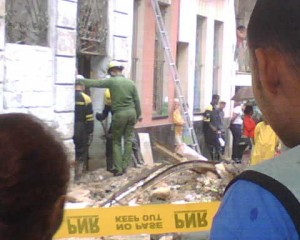
Rescue brigades extract the bodies from the rubble. Photo: Augusto César San Martín

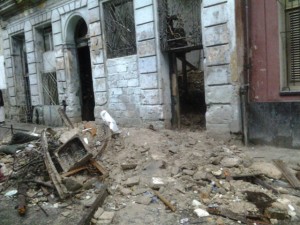
HAVANA, Cuba , November 29, 2013 , www.cubanet.org.- A man and a woman died at noon today in the collapse of a building located at 619 Campanario Street, between Reina and Salud in Central Havana.

The couple lived with seven other families on the first floor of the building declared uninhabitable.

According to eye-witnesses, the collapse began on the stairs of the two-story building. Three of the residents had time to reach the exit. The victims were sleeping when one of the walls on the second floor collapsed on the stairs.

The two children living there were in school.

Fire crews and forensic medicine worked until 4:15 pm to rescued the bodies.

Facade of the affected building
Facade of the affected building. Photo Augusto Cesar San Martin.

One of the neighbors said that last week the neighbors had alerted the local authorities about the danger of the building collapsing.

At 4:30 pm, a second collapse occurred, this one of the roof of a house located at 612 Zanja at Lealtad in the same municipality, alarming the neighbors.

One of the affected who went out to the Campanario Street for help said there were no casualties, during a conversation with the deputy of the Popular Power in the area.

The heavy rains of the last 24 hours have caused the Havana Bay Tunnel to be closed because of flooding, along with San Lazaro Avenue in Central Havana.

Every time it rains non-stop for several days on the capital, old buildings collapse.

Cubanet, 29 November 2013

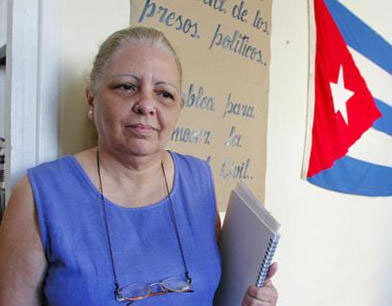
The Political Police Intensify the State of Siege Against Martha Beatriz Roque

The siege situation against political opposition leader Martha Beatriz Roque Cabello has reached extreme tension.  Today her apartment continues cordoned off by the State Security (political police) and supposed neighbors insult her through a megaphone, calling her “traitor” among other affronts.

In a telephone conversation with this Paper, the pro-Human Rights activist and former prisoner of the so-called Group of 73, exhibited an alarming state of nerves. They do not let her move from there and they do not let anyone pass to visit her. On her door they have placed a photo of Fidel Castro and another with the five Cuban government spies who form part of the Castro campaign.

Neighbors who visited her yesterday at 6 in the afternoon told her that they could not permit counterrevolutionaries to go to her house because that damages the elderly and children.

Martha Beatriz wants to pursue a legal claim on the grounds that what they are doing is unconstitutional.  A lawyer has already interviewed her.

In the midst of her desperation, she has asked that if they do not leave her in peace, they should return her to jail, since, she says, she is a prisoner in her own home.

Today eleven members of the Cuban Community Communicators Network, an independent press agency that she organizes, were arrested.  These reporters were trying to get to her house.  Of the eleven arrested, six were taken to the Guanabacoa township and released. Of the other five nothing is known.

It also transpired that the political opposition leader Arnaldo Ramos Lazurique, recently arrested when he visited Roque Cabello, was freed at the Dragones police station.

What they are doing now to Martha Beatriz brings to mind the sad episodes that occurred in Cuba in 1980, when citizens who were leaving the country forever were persecuted, beaten, stoned, humiliated openly in public and their houses were besieged.

Cubanet, November 27, 2013

Translated by mlk

Strange Processes / Fernando Damaso

Photo: Rebeca

For several years the Cuban economy has come up with some strange processes which raise questions and cause us to think. On the one hand there is talk of an interest in attracting foreign investment to jump-start the economy. Some of these investments — those from Russia, China, Vietnam, Brazil and Venezuela — have a certain selective political character. Along these lines is the recently approved Mariel Special Development Zone (ZEDM).

Spanish investment has been principally focused on the tourist industry and a few other sectors. Investment by Cuban-Americans has been ruled out, though they would logically and naturally be the group most interested. In spite of geographic proximity American investment has also been rejected in favor of establishing an import-export market and attracting tourists once the embargo is lifted.

On the other hand authorized investments by Cubans residing in the country have been limited to businesses of little importance which provide only subsistence incomes. Most of these have been primarily in the service sector, not in small and medium-sized industry, which it seems will continue to form the basis, along with “the great socialist state enterprises,” of the inefficient and failed governmental monopoly.

It is worth noting that, after the passage of legislation in accordance the the principles of the so-called economic “updating,” management control of these enterprises has been transferred from technocrats to high-ranking military officials retired from active service, to their family members and to individuals close to them.

For anyone who has read about the transitions in former socialist countries, starting with the former Soviet Union, the process will seem very familiar. The similarities between what happened there and what is happening here do not seem to be accidental. Rather, it all seems well-planned, with the aim of ensuring principal economic control in an inevitable process of transition.

These strange processes, as well as others being done under the table and behind the backs of citizens, indicate that the current authorities — no matter what they may say publicly — know socialism is a failure. They will not allow corrections to be made even though a profound change is necessary to get the country out of the abyss in which it finds itself and place it on the road to development.

However, since they share a high degree of responsibility for what has happened, they lack the political will to accept this. Instead, they attempt to gain time with tepid measures — mainly economic but some social — trying to create conditions so that whomever comes after them will respond to their own interests and assume the task of bringing about a happy ending in the style of China or Vietnam.

Fortunately though, as the old saying goes, “man proposes and God disposes.” No one knows for certain what is to come, but one might assume that new forces, which are already in the wings, will become part of the transition.

It will not happen as the current authorities, accustomed to rigid socialist planning and secretive five-year plans, have assumed. Rather, it will be a process of debates and exchanges with different sectors of society, which is desirable for peaceful development in an atmosphere of tolerance, mutual respect and civic responsibility if we are to avoid greater ills for the country.

It is necessary to keep paying attention to the changes being implemented, no matter how minimal they might be, as well as to their regulation, their progress and their set-backs. Perhaps we might then find the keys to moving closer to what is most possible and to a method for achieving it with the goal of not being surprised by events. Whether we like them or not, they will involve all Cubans, no matter what they think, no matter where they live.

27 November 2013

“With The Misery that We Have in This Countr”: Listening to Citizens Unburdening Themselves / Gladys Linares

“The transition now is taking place in the most important place, that is, in the soul and mind of Cubans, frustrated and disillusioned by so many broken promises.”
Oscar Espinosa Chepe

Havana, Cuba, November, www.cubanet.org — Every day the discontent of the people becomes more evident. It is not unusual for strangers to take advantage of any forced waiting to let off steam about their own problems, and in many cases, shared problems.

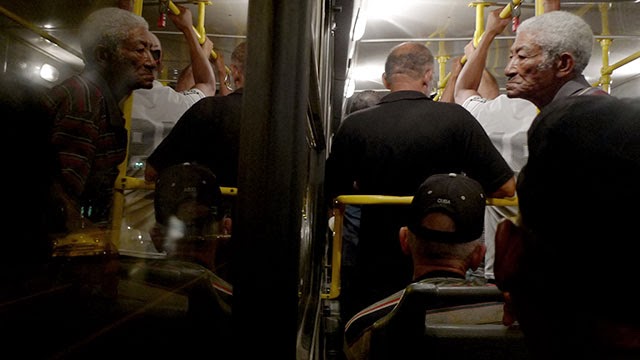
So, now it is customary to hear complaints and curses against the government at bus stops, in lines at the bodega, the butcher shop, the bakery, and in line at the medical clinic.

For example, in line at the clinic, one Saturday at midday, the following scene took place.

The almost thirty seats of the waiting room of the 30th of November Polyclinic  were practically full, because there was only one doctor on duty.  The really needy patients stayed, with no other option than to arm themselves with patience, but some left, figuring that they would not get out of there in two hours.

Catalina had no other option than to do like the former because she urgently needed a prescription and already at the Lawton Polyclinic they had “steamrolled” her: that doctor showed her her pitiful supply of three prescriptions, which, she said, demanded that they economize, so if it was not urgent…

And here the woman was now, waiting, like another twenty-odd people, for her turn.  After a while, a man of about fifty years of age arrived, aching, and asked who was last in line, so he would know his place, in a bad humored voice because of the number of people.

When a woman told him that there was only one doctor on duty, the man answered her that it was natural, if all the Cuban doctors are in Venezuela, Bolivia, Brazil or Haiti, or in whatever country except Cuba.  That is why so many clinics are closed and lines are so long in the ones that are open.

A very correct and well dressed young man intervened, who added that, it seems, the medications have gone with the doctors.  Another agreed, convinced that the same thing had happened to medical devices, judging by the news of NTV, in which they often spoke not only of medications freely shared, but entire hospitals donated by Cuba to those countries.

A girl asked where the Government gets what it gives, since when you go to a hospital, there is almost never anything with which to do tomography, nor a plate, nor a blood analysis, to which the gentleman replied that surely it has to do with donations which, instead of delivering them to the Cuban people, for whom they are managed, the Government uses them to earn followers in all of Latin America. Those present were in agreement that that was criminal, with the misery that we have in this country.

And so, between complaints and opinions — that if Maduro goes down the same road, that if medical attention that is worth it in Cuba is that of Cira Garcia or what the Venezuelans receive — time was passing.  Suddenly, another doctor with a foreign appearance arrived, who a little later opened the other consultation room.

Coincidentally, it was this one to whom Catalina was assigned when her turn arrived.  The woman entered with fear that this time too they would refuse her prescription, but by luck the complete opposite happened.  This doctor had an enormous bundle of them, and did not hesitate to give one to her and another to the gentleman who “slipped” in to ask for it.

Catalina left the clinic very happy, because now she could continue with her treatment.  On passing through the waiting room, she heard the patients who were continuing to unburden themselves: that if my cousin was a prisoner in UMAP for having long hair and listening to the Beatles, that if “this guy” is a cheeky one, so much that he prohibited them, and then to send him to make a statue of Lennon and to say that “he too is a dreamer,” that if the scarcity is in agriculture, because in the hotels and in the houses of the “pinchos” — the nomenklatura — nothing is lacking, that what they are going to do to recover the investment of those who had set up video rooms, that they commanded them all to shut down their businesses overnight, instead of giving them a license. . .

And for background music, Juan Gabriel on the laboratory’s mp3 and a blast of water falling from a tank on the roof.

Translated by mlk.
27 November 2013

Havana Smells Very Bad / Victor Ariel Gonzalez

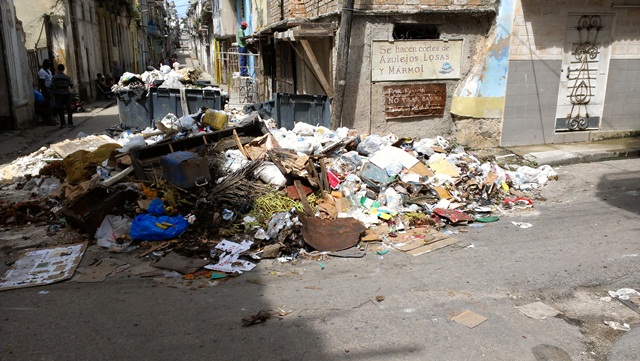
Havana, Cuba, November 2013, www.cubanet.org – In Cuba there exists no consumer society.  Or heavy industrial activity.  The quantity of debris should not be frightening. But the treatment of waste is troubling, because it pollutes the country and promises to future generations.

There exists no appropriate policy for dealing with the debris.  And if it is true that Cuban reality demands a solution for more urgent problems, where the trash goes, it should not be left behind.

The frowned upon dumpster divers

In homes, work centers, dumpsters on the streets, everything that is thrown in the trash falls in the same compartment where glass or metal or biodegrables are not distinguished. The whole lot ends up at the landfills, where the trash is not classified or its treatment facilitated.

One of the effective ways of contending with trash is recycling.  In Cuba it is a task of extreme difficulty.  There is no education nor political will directed to the necessary separation of wastes.  Moreover, the State hinders the process.

An example of that is the negative attitude towards “divers,” who are dedicated to searching for empty beer and soft drink cans to sell to raw materials recovery companies.  These individuals are frowned upon by the government in spite of the fact that their labor is ecologically laudable and they are socially useful since they have honest work.

Beyond not separating trash, the system does not even recognize the work of those who could be called “little aluminum businesses.”

If other discarded materials also gave business, there is no doubt that the waste recovery industry would rapidly flourish and contribute to the city’s improvement.

Fire at the big dump

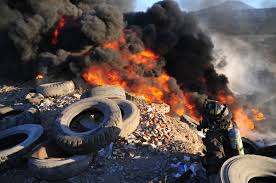
From the heights of one of the faculties of the Superior Polytechnic Institute, Jose Antonio Echeverria observed how a dense column of smoke rose, born in the entrails of the big dump of Avenue 100.  The toxic spectacle was nothing new: the uncontrolled combustion of debris would be dragged by the wind to the classroom of the university grounds.  The students in class there were going to inhale however much undesirable chemicals the fire generated.

Only after many sinister — and repeated — complaints was the cause of the fire removed, giving certain treatment to the wastes.  The decomposition of large quantities of organic material can generate sufficient heat to unleash accidental fires.

The fire out, the bad odor of the Dump of Avenue 100 continued flogging the surrounding population.

The first mistake is to locate an enormous landfill in the middle of Marianao township, near well traveled areas, but of course, quite distant from the Havana neighborhoods where the country’s ruling class lives.

Lack of containers

Another of the problems is the lack of trash containers and the irregularities in collection.  Parts and fuel are stolen from the garbage truck, as they are from all state vehicles.  Garbage cans are also vandalized.  Their wheels are ideal for making street vendor carts.  Wastes accumulate for days on the corners.

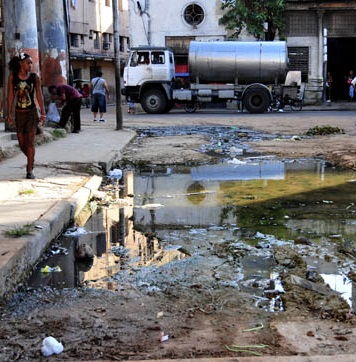
Not to mention sewer networks.  The growing population has made the water collection and treatment system collapse.  And the construction going up lacks the most basic technical standards.  Entire communities are found with a deficient and even non-existent sewerage.  Sewer water runs through the streets or seeps into the lower soil, contaminating springs, while the toxic wastes in rivers and oceans destroy various ecosystems in their wake.

The lack of control, the accumulation of trash and the deterioration of water treatment systems contribute to the fact that in Cuba there exists the danger of a widespread epidemic.  Signs of the health crisis have already started to be seen:  the resurgence of illnesses that were eradicated from the country indicates that the filth that surrounds us will have disastrous consequences.

By Victor Ariel Gonzalez

Cubanet, November 26, 2013

Translated by mlk

Another Bastion / Regina Coyula

For speaking so much about peace, being at an economic crossroads, and having announced moderation in the use of resources, the government spared nothing on its Bastion 2013 strategic exercise, and the entire country came out to prepare against an illusionary enemy. That is, if we believe what we read in the media; my son experienced it a different way.

A call was made by the University during the normal class schedule, and attendance was guaranteed since not attending amounted to an unexcused absence. Male students in Economy, Finance, Cybernetics, Tourism, and Geography were gathered in the university stadium. Noisy and disorganized, the students gathered in the center of the field into something vaguely resembling formation. In front, a stranger in civilian clothes, tried to bring them to order; for their part, the professors spread among the students tried to do the same.

Before the general disorder with microphone in hand, the stranger in front shouted in a booming voice “Attention!” Failure. Mockery broke out among the students and the man with the microphone had to resort to conciliatory patriotism without much success. However, he did manage a general laugh after haranguing them with his diatribe when he put “At ease!” students who had never been in any other position. Troublemakers in the group yelled at him to shut up and there was spontaneous applause for problems with the sound.

The only moment of silence came during the hymn; an even bigger silence if you keep in mind that the students weren’t singing; a silence broken only by a cell phone that rang twice. Later, a girl read the requisite communication from a Lieutenant Colonel who spoke of compromise, country, the enemy, and such things. The activity ended with the students moving to the theatre of the School of Psychology to see the movie Caravana, Kangamba, or some other bellicose audiovisual presentation. Failure. With attendance now taken, most students found better things to do.

A television camera witnessed what happened at the University stadium: perhaps with good editing of the material, something has come out of these days of victorious exercise to guarantee “our military invulnerability”.

 Translated by: M. Ouellette

25 November 2013

Impartiality / Cuban Law Association

Wilfredo Vallín Almeida

Last month marked the second anniversary of the death of Laura Pollan, spokeswoman for one of Cuba’s most renowned dissident groups, the Ladies in White.

On that day, we gradually learned, many people in different parts of the country were detained, apparently because of official concern about demonstrations commemorating the anniversary.

Some of those detentions lasted for two to three days, as we learned directly from those affected.

Many of these people came to the Law Society seeking help in bringing charges against their captors for the way they had been treated.

In many countries a situation exists that has no place in Cuba: the independence of the judiciary in relation to the other branches of government.

In Cuba the police, both political and regular, belong to the executive branch, in other words to the state power. The Prosecutor’s Office (military or civilian) also belongs to the apparatus of the state (the government). The same applies to the courts.

Bringing a complaint to the Military Prosecutor to be presented before the court against the military that belongs to the same ministry, and that is also subordinate to government authority, does not seem to have much chance of success, especially when it comes to political issues.

The impartiality spoken of in Article 10 of the Universal Declaration of Human Rights, namely:

Everyone is entitled in full equality to a fair and public hearing by an independent and impartial tribunal, in the determination of their rights and obligations and of any criminal charge against them.

It requires, as you can read in the underlined portion, that the court be independent and impartial; in Cuba neither of these two things exist.

We continue to use that proposition in advising those who come to us, but we must lay out the truth, even if we don’t like it.

It is not likely that these allegations will have any result because the ideological obedience of the state institutions does not allow anything else, much less the punishment of its own members for actions “against the class enemy,” that is, those who don’t think like they do.

In a perfect justice system, every citizen should have the right that we are analyzing. But a critical element does not even exist in our national courts: their impartiality.

Translated by: Tomás A.

25 November 2013

I Have Not “Stayed” in the USA… / Orlando Luis Pardo Lazo

Having spent eight months traveling in the US, I’m starting to make Cuban State Security nervous, just as I’m making the island’s dissidents nervous, since the two entities are sometimes so similar that you can barely tell them apart.

Several state police agents went to intimidate my neighbors on the corner of Fonts and Beales in Havana’s Lawton neighborhood, and threatened the friend who took me to José Martí International Airport on March 5. They accused him of illegally loaning me his vehicle, which is untrue. They spread the rumor that I had applied for political asylum in the US and was conspiring against the Cuban government as part of an organization, which is also untrue. They made sure that my 78-year-old mother was shaken up when she realized what was going on, although they didn’t interrogate her this time.

They have also pressured friends of mine on the island who are not linked to pro-democratic social activism, getting them to communicate with me by email and “extract” information on my activities in the US. They forced one of my friends to visit my mother and place a hidden microphone in my house, even though I wasn’t there at the time. They interrogated another friend about my sexual orientation, and practically forced him to testify that I was having clandestine homosexual relationships (under Castroism homophobia is criminal).

I have also received messages from supposed activist colleagues in Cuba, urging me to come back immediately. Apparently there’s no one on the island who can take over my work. One of them even called me from Havana, despite the fact that I’ve never given my cell number to anyone in Cuba. To top it all off, the independent journalist Julio Aleaga went so far as to spread lies about me on a Cuban protest site, suggesting that I was an “economic migrant”: A term with which the Castroist government makes a mockery of the always political nature of Cuban exile.

If my foreign residence permit is valid for two years, why is there such anxiety over my presence here from everyone in Cuba? Forget about OLPL for a little while, I beg you. Then—and only then—will I give you a surprise that the people will never forget. Thank you.

From Sampsonia Way

26 November 2013