The transportation crisis and blackouts turn the trip home into another shift of endurance for healthcare workers in Matanzas
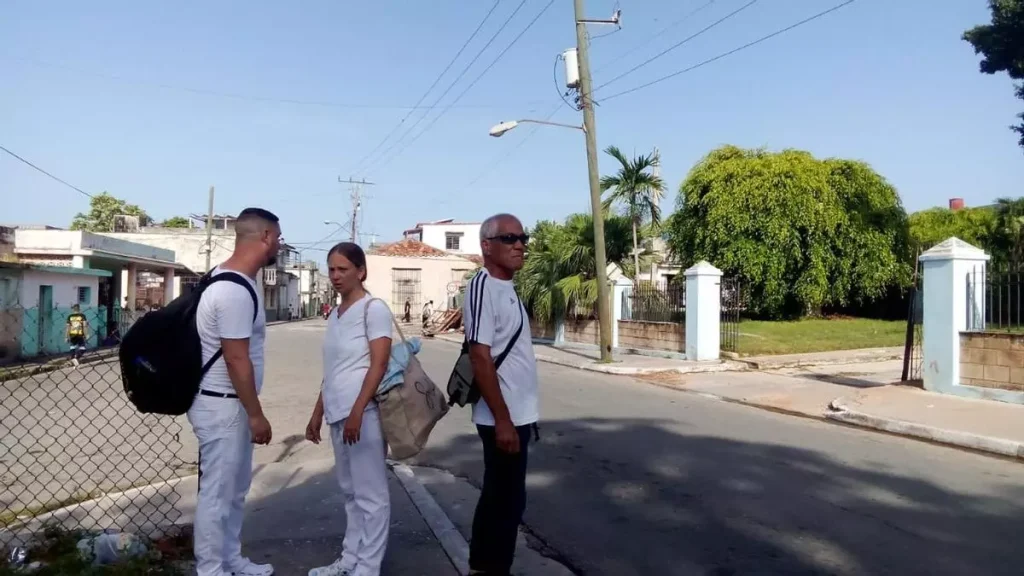
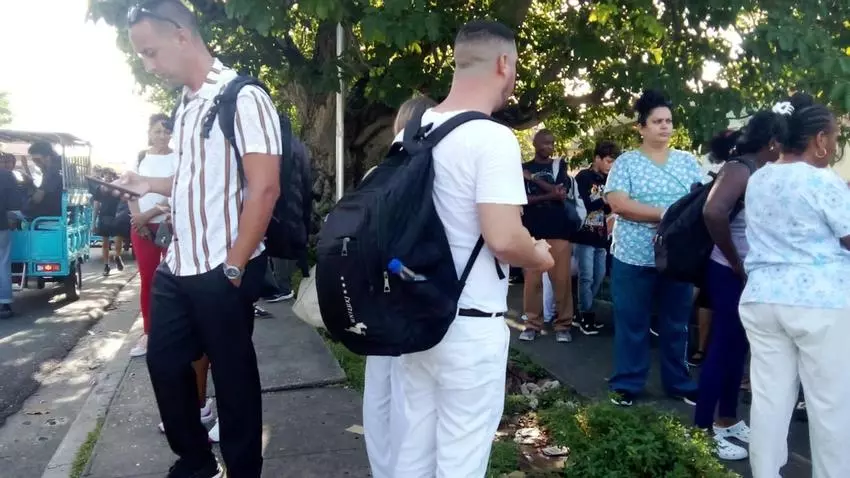
 14ymedio, Julio César Contreras, Matanzas, July 18, 2026 / At 10:30 in the morning, the sun is already beating down on the Versalles neighborhood, and the shade of a leafy tree becomes the busiest waiting room in the Public Health system in Matanzas. There, on a concrete wall, doctors, nurses, and technicians rest with the same posture as someone who has been awake far too long. Some have taken off their shoes to relieve swollen feet after 24 hours on shift. Others hold their mobile phones, hoping for news about a bus that should have left a while ago and which, once again, is nowhere to be seen.
The white coats are still on, but they are no longer a symbol of medical authority – only of exhaustion.
The bus meant to carry healthcare workers to different municipalities in the province should already have picked up staff from the Materno, Pediátrico, and Faustino Pérez hospitals. Yet no one knows when it will arrive. The scene repeats so often that few are surprised anymore. Only the level of accumulated exhaustion changes.
The delay is “a mess” that happens practically every week, one the authorities seem to have grown accustomed to ignoring
Maricela, a nurse with 31 years of experience, watches the clock with a mixture of resignation and indignation. She says the delay is “a mess” that happens practically every week, one the authorities seem to have grown accustomed to ignoring.
“Given how critical the transportation situation is, this is the only way to manage it for those of us who depend on a salary. I’m about to request a transfer to the Jovellanos Polyclinic, because with this uncertainty over whether the bus will come or not, it’s impossible to work,” she tells 14ymedio. The hours without sleep are still visible on her face.
Around her, the conversations all turn on the same subject. They are not talking about diagnoses or patients, but about missed schedules, endless routes, and broken promises. One nurse absent-mindedly checks a backpack full of belongings; another fans herself with a yellow folder while calculating how long it will take her to get home.
“Those of us who work at the Materno never know what time in the morning we’ll get out of here. It’s at our own risk,” Maricela sums up. For many, the problem doesn’t end once the bus finally shows up. A doctor who makes the trip to Limonar twice a week says the journey has become a real ordeal.
“At the hospitals themselves, there are already people off the street who, without any shame, ride comfortably seated, while those of us who are supposed to be the ones benefiting from the service have to stand, packed in like sardines,” he says. According to him, the vehicle makes stops all along the way to pick up private passengers who pay the drivers directly.
“It picks up anyone it comes across, with backpacks, sacks, or goods. Their business is pocketing the money, without caring that the contract between Public Health and Ómnibus Transmetro was meant to meet our needs, not create more problems,” he complains.
When he manages to get on, he knows he will probably spend much of the trip standing by the door, surrounded by bags and bundles that other passengers are carrying to sell in rural communities.
Breakdowns, fuel shortages, and blackouts affect the operation of state transportation and end up extending the workday well beyond official hours. After a night attending to births, pediatric emergencies, or critical patients, many healthcare workers must spend several additional hours simply getting home, or be prepared to pay a private driver to take them.
Not even Elena, a well-known nurse who has completed three international missions, can hide the discouragement and indignation the transportation crisis causes her.
“After a shift full of hardships, we don’t even have safe transportation to get back to our towns. That’s the bare minimum the Government should guarantee.”
“I’m going to do everything I can to keep just one shift a month whose departure isn’t on a Monday or a Friday, because those are the most difficult days to get transportation,” she says. She explains that many professionals from outlying municipalities no longer want to work at the provincial hospitals precisely because of the uncertainty of getting home.
“After a shift full of hardships, we don’t even have safe transportation to get back to our towns. That’s the bare minimum the Government should guarantee.”
Her motivation, she admits, has been wearing thin from all the waiting.
More than once she has thought about requesting leave and looking for any other job that would let her earn more money and live with less frustration.
She always carries cash in her purse in case she has to resort to private transportation. “Thanks to my husband, who’s self-employed,” she clarifies.
“This very day, if the bus doesn’t come soon, I’ll have to go to the taxi stand at the terminal. It’s 2,000 pesos to Jagüey Grande, an amount I can’t afford to pay more than once on my salary. If I do, how do I make it to the end of the month?”
The question hangs unanswered beneath the trees of Versalles. No one responds. Perhaps because everyone already knows the answer. It is the same one that has led so many doctors and nurses to hang up their white coats for good, worn out not only by the shortages inside the hospitals, but also by the endless wait, week after week, for a bus that almost never arrives on time.
Translated by GH.
______________________
COLLABORATE WITH OUR WORK: The 14ymedio team is committed to practicing serious journalism that reflects Cuba’s reality in all its depth. Thank you for joining us on this long journey. We invite you to continue supporting us by becoming a member of 14ymedio now. Together we can continue transforming journalism in Cuba.