The Taming of the Pony / Regina Coyula

Imagen de Pulido

The phenomenon of the 2.0 “caught moved” the Cuban government and its think tanks. They reacted late although massively, when the image of life inside Cuba was not issued only by the official press the tourist brochures, but by citizens, either organized or as individuals, who filtered it through the mesh of the Internet to give another version, one where a phenomenon like Yoani Sanchez’s blog Generation Y was world famous.

The Arab Spring demonstrated the importance of these media of political and social activism. Redoubling our government’s concern, because internal conditions have deteriorated, and the disappointment, previously heard in whispers among trusted people, is expressed loudly today among strangers. The tendency to keep internet connection to a minimum is for this reason very evident; which should be read as state access when talking about social issues.

Speaking at the international forum on “Alternative Media and Social Networks, New Scenarios of Political Communication in the Digital Realm,” organized by the Minister of Foreign Affairs, our chancellor offered “issued guidelines.” Taming the pony–putting a patch on it–keeping a lid on it–keeping it under wraps.

This forum recently concluded, and it is presumed — if it’s true that the fiber optic cable is already operational and restricted to strategic institutions — that the cable will be thrown into the cyberwar designed at the Conference Center last week. The ancient Comandante can feel proud: the fighting spirit of old in super modern binary language.

December 7 2011

New Graffiti / Regina Coyula

This grand wall at 19th and 42nd survived for a long time displaying the graffiti of El Sexto* with its pink criticism and his trademark star all the way to the walls of El Vedado. Apparently, the pink lacquer he used has been extinguished because last week it was covered up — as you can barely make out in the photographic image. Now, it is yellow over black and you notice it more than ever. There’s nothing like censorship to get your attention.

*Translator’s Note: “El Sexto” is a Cuban graffiti artist.

Translated by: Hank

December 1 2011

Reduced Vocabulary / Yoani Sánchez

Fuegos artificiales frente a La Habana por el día de los DDHH
Fireworks off Havana for Human Rights Day*

In the long list of the words forbidden in my childhood, there were two in particular that were censored: “Christmas” and “Human Rights.” The first I heard from time to time, in a whisper, from the lips of a grandmother who had known the trees with garlands, the traditional nougat candy and turkey. But the other, the second, was muttered disparagingly to allude to someone who — it was said — was involved in counterrevolutionary acts, enemies. And so I grew up, oblivious to the festivities of the last week of the year, and believing that evil lurked in that statement adopted by the United Nations. My compartmentalized vocabulary ended up conditioning me to a civic attitude full of fears and led me to fall into line with so many prohibitions.

This December the stores display twinkling lights and trees loaded with ornaments. A Santa Claus with hardly any belly smiles in the window of an important commercial center in the city. People run into each other and delight in every syllable of expressions such as “Merry Christmas”; “I’m shopping for Christmas”; “drop by to celebrate Christmas.” The reduced vocabulary of my childhood has given back a word, a term cursed for decades. But my next door neighbor still says, “Careful, don’t get too close, they’re ‘human rights people’.” At some repudiation rally — across the country — someone might now scream, “Down with human rights!” and the political police stationed on the corner confirm on their radios, “Yes, here comes a little group of ‘Human Righters’.” And there’s always a friend who asks us to whisper, “because if you’re going to mention such ‘things’ it’s better to turn the music up.”

A fake snow falls on the red Christmas hats, but a huge downpour dissolves it; the rain of intolerance, the big fat drops of the arrests, the gales created on this Island when someone dares to barely pronounce the phrase “human rights.”

Translator’s note: These photos from Havana are of the greeting in fireworks for Human Rights Day from a flotilla of Cuba exiles, who remained in international waters as they showed their support for Cubans on the island working for freedom and democracy.

December 10 2011

Fidel Castro’s Experiments / Iván García

It causes chills to know that the historic leader of the Cuban revolution did research on different crops to improve nutrition for the Cuban people.

I don’t want to be a harbinger of ill omen. But reviewing Castro’s “experiments” in 52 years of olive-green government, he didn’t come up with any that were successful.

Let’s review the record. Let’s leave aside his social, military or political essays, which are being published in a collection. Let’s forget that insanity of designing in vitro a communist society having the village of San Julián, Pinar del Río, as the test case.

Let’s avoid his militant manias of directing, from a distance of 10,000 kilometers, the theater of operations of the civil war in Angola. From a mansion in Nuevo Vedado, sitting in a black leather easy chair, pointer in hand, facing a massive full-scale model full of toy soldiers and tin cannons. And like a common grocer, ordering the distribution of candy, ice cream and chocolates to the troops.

Let’s overlook his promises that in 2000 we would have an industry on the level of the U.S. Still, listen to the excited masses, gullible and faithful, cheering wildly at one of the many public plazas built for him to give his speeches. Yes, that is a personal achievement of Castro: As of today, Cuba is one of the countries on the planet with the most plazas per square kilometer for political acts.

The little father of the country also embarked us on fierce media campaigns against the foreign debt in Latin America, back in the 80’s. He said that for such a financial hardship he would send the bill to the continent.

And that from the third world we would land in the fourth. He was wrong. Right now, Latin America is growing, and Brazil and Argentina – who would have thought, comandante? – are studying the option of loaning money to rescue the faltering European economies.

It’s Cuba that isn’t taking off. His list of broken promises is long. One night of revolutionary partying at the Karl Marx theater, after putting a finger in his mouth, looking at the smooth ceiling and doing the math, Castro promised that every year 100,000 homes would be built.

A troop of intellectuals, engineers and judo coaches, who never in their lives had picked up a trowel, were converted by decree into construction workers in order to build their own homes. And those of others.

Let’s jump over the shoddy workmanship and frightening design of those buildings. There was no question of style. It was sheer necessity. In the workplace, the Union and the Party gave the apartments to the most loyal, in meetings comparable to a brawl among lions in the African jungle.

You might think that we are very demanding with this old man of 85 years. In the end, anyone can make mistakes.

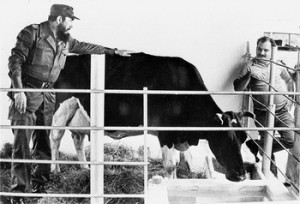
But the ex-president has put his foot in it many times. In all fields. The most painful has been in regard to food. A sleepless night, back in 1964, brought from France the agronomist André Voisin, to implement on the island his new concepts about agriculture and the crossbreeding of cattle.

Later Castro said that the”Frog” knew less than he. And he sent him back home. As always, he laid the ground rules. He ordered the construction of air-conditioned dairies in the Valley of Picadura, on the outskirts of Havana, and said we would be eating so much beef that we would suffer from gout.

And that we would have malanga, fruits, vegetables … And microjet bananas. He published cookbooks with Ecuadorian recipes, so that Cuban housewives could take out part of a banana and prepare fufú (mashed), ladybugs (banana chips) and tostones.

With the river of surplus milk, after exporting a few thousand tons, we would produce Camembert and Gruyere cheeses of such high-quality that France and Switzerland would pale with envy.

As for sugar, once our national pride, he was its gravedigger. The beginning of the end of a secular tradition was initiated by the comandante in 1969-70, with his harvest of 10 million tons and the introduction of new and “more resistant varieties of cane.”

So now, in the 21st century, we occasionally import sugar from abroad. And finally to put the lid on the jar, we don’t even take advantage of the many qualities of sugar cane and its derivatives. The bagasse furniture sold in hard currency is imported from Brazil.

Coffee was another one of his whims. Thousands of habaneros planted Chilean coffee along and across the capital. Together with fresh air, we would be washed with the smell of strong, sweet coffee, said the optimistic local leaders.

Yes, today the average Cuban has coffee for breakfast. But mixed with peas. The depressed state coffers can’t afford the luxury of spending 40 million dollars to import a better bean.

Therefore, it applied the fiscal scissors. For the common people, of course. Officials in their offices have thermoses with coffee of superior quality. Those who can buy it in the “shoppings” (hard-currency stores) also drink good coffee.

When in 1990 that dark period began, which still floats in the air of the republic, known as the “Special Period in Time of Peace,” – in fact a war without the thunder of cannons – the drawer of the bearded one’s “food solutions” was opened.

Those were hard years. The Cubans were going hungry and fell into bed with optic neuritis. The old drank tea with leaves of orange or grapefruit. Which made those with low blood pressure, like my grandmother, dizzy, so they had to lie down.

Through the ration book, they began to sell food that they knew bordered on rubbish, baptized with original names. Soy hash. Meat paste. Fricandel. Root pasta. Hollow hotdogs. Cerelac. The invasion of the palate continued with soy and chocolate yogurt.

When on the night of July 31, 2006, Fidel Castro’s personal secretary, Carlos Valenciaga (where are you, Charlie?), looking mournful, announced that his jefe was retiring, many thought that the experiments had come to their end.

But no. The incombustible leader reappeared with his gibberish and forecasts. He prophesied that the world would end in a world war. He couldn’t wait to enter the fray. Which he liked. The issue of food.

And now he’s telling us that he’s seriously investigating a solution? To nourish the “sacrificed population that is suffering the rigors of the blockade as never before.” Which are double. The gringo and the regime.

People have received his” research” with concern. If in 52 years his attempts weren’t successful, would they be now? Let’s pray that he will be a passive grandfather. That he will play with his grandchildren and take a nap. That he will write his memoirs and surf the Internet.

But please, stop the experiments. Give it up, comandante.

Translated by Regina Anavy

November 26 2011

The Havana Tribunal will judge a former military man today who shot a teenager / Laritza Diversent

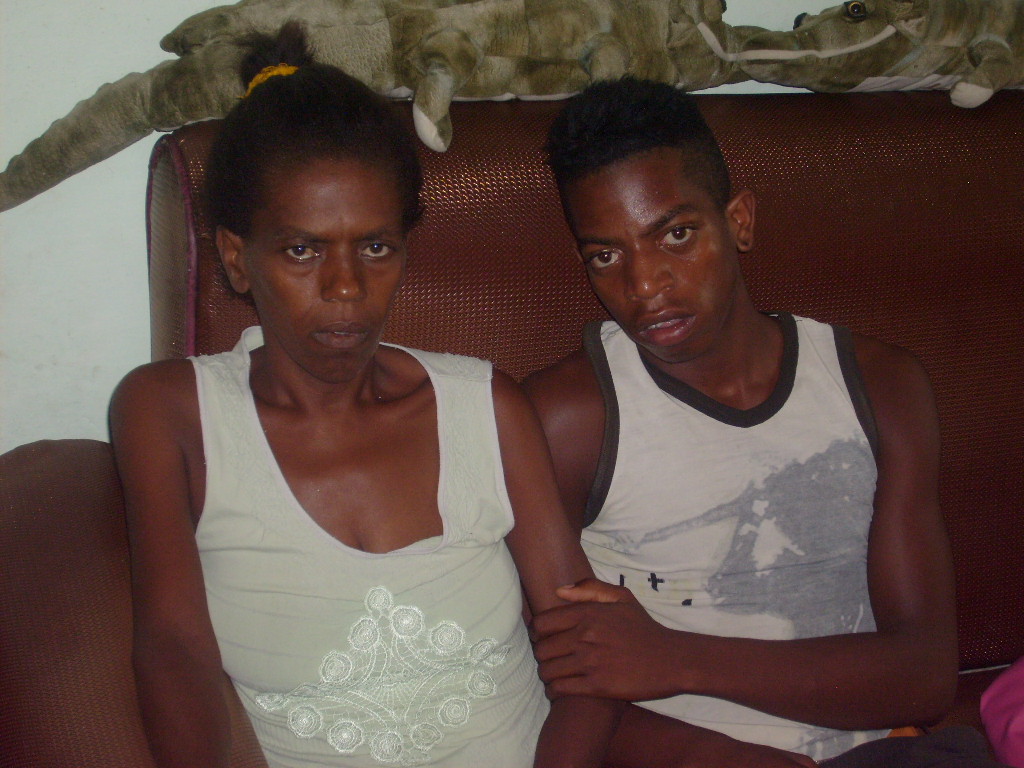
Various witnesses were called by the Havana Tribunal to participate in a murder trial which began this morning, December 9th, against Amado Interian, a retired police officer who is accused of shooting a black, 14-year-old teenager on July 15th of this year.  The teenager’s name was Alain Izquierdo.

According to Ismael Suarez Herce, a 17-year-old cousin of the victim who is an eyewitness to what happened, Interian (also known as “El Pinto”) caught the two of them climbing a mamoncillio tree on a farm.  The approximately 60-year-old man got mad and said to them “Hey, negro, you’ll see what’s going to happen to you,” and then he shot his 45 caliber revolver.  At the time of these acts, the former military man had a license to carry firearms.

The bullet entered Izquierdo’s body through his left buttock.  It destroyed his femoral artery, passed through his kidney and reached his lung.  Death was almost instantaneous. The funeral parlor gave the family a death certificate stating that the cause of death was acute anemia. Despite the demands of the family, the coroner never gave them any autopsy information.

The farm where this happened is located in Las Lajas, in Mantilla, a marginal neighborhood with a predominantly black population of low means which is relatively dangerous.  Suarez Herce said that they dared to go there in order to jump into the Abelardo dam in Calvario to swim.

The former policeman, Amado Interian, was the head of the police sector in various localities in Arroyo Naranjo, the poorest and most violent municipality in the Cuban capital.  Neighbors and family of the victim describe Interian as an angry man who was trigger happy.  As a retired military man, he will be tried under the civil penal code which provides a penalty for the crime of murder of up to 15 to 30 years of incarceration.

The current location of the former official is unknown.  He was being held in Valle Grande, the same place where the older brother of his victim was, awaiting trial.  Prisoners residing in the Mantilla zone are sure that he is not there or in Combinado del Este, the maximum security prison located in Havana.

The victim’s mother, Raiza Medina, believes that they want to exclude her from participating in the trial of the man accused of killing her son.  She has not received any summons as an affected party.  An official named Aiza, who attends to victims at 100 and Aldabo, told her that affected parties are not summoned.  She recommended that Raiza contact the official in charge of the case.  As of today, no one in the criminal investigation division has responded to her calls.

Translated by:  Hank

December 9 2011

The Mathematics of Dictators / Angel Santiesteban

Photo: AP

What mystique surrounds “power” for tyrants, that the obsession of keeping it leads to sacrificing their people, their family and their own lives? They disguise their obstinacy with ideals, which require constant sacrifices, with those whom they have betrayed and they pursue no other real intention except continuing to “command” the nation. All dictators create totalitarian government structures, where democracy is stifled so that fair elections are not even remembered, which undoubtedly would cause the loss of their regimes.

When the riots started in Libya, I realized what the final result would be for the dictator Muammar Gaddafi, although I imagined the legal variation with which the absolutist Saddam Hussein was condemned. The leaders, after appropriating power, executed those who opposed them, and determined to do everything to keep in power.

History has shown that you can not hold a people in rebellion. You do not get to lie and frighten several generations without being punished for that. No political machinery and repressive, even Cuban, which I consider the most effective of the many that have existed, can contain the right to freedom for all Cubans.

Fidel Castro has lived like a king who demands that his subjects the sacrifice their lives. Several generations in the twentieth century have dedicated their existence as ritual human sacrifices offered to the supreme god. Lives lost that did not receive anything in return. not even their children and grandchildren have understood what they were offering. They understand that they were deceived, martyrs in vain who did not manage to change or improve the present nor the future.

Fidel Castro knows that time of life left to him is no longer “important”, if we estimate what he has accomplished in his years of full and vital life, it has not been enough to recall it as a happy past (meaning “important,” given his proven incapacity to contribute to the ailing economy or to democracy). Nothing of what he promised my grandfather, then my father, as he also tried to do with me, with my children, and if we let him right now with my grandchildren, has been achieved. Ideals are to empower people, not vice versa. Ideologies can not devour a country. And that great forgery of Fidel Castro, his big scam.

His brother Raul Castro, now President of the nation by appointment of the dynasty, who realizes that his presence is like a bus stop along a route where the bus will soon continue on its route after half a century of dictatorship, tries to delay as much as possible a natural evolution of the society which will oust him from power. He tries to fool us with the unattainable carrot, false political strategies, which are nothing more than dikes that try to contain the force of water beating against the iron gate that blocks our way to the future, to social, intellectual and economic development. His political inexperience leaves a bad taste making us feel undervalued.

What is sad is that it is probable that lives will be lost. The amazing thing is that the Castro brothers know it, as Hussein and Gaddafi knew it, and they do nothing to avoid it. They came to power violently, and will leave it in a bloodbath similar to the one they committed in 1959. Disgracefully the color red will stain the streets and the history of their country will be, in their departure, as it was in their arrival.

I still have a hope, that they will listen to reason and think of their descendants. They say they love their grandchildren more than their children. Fidel has never been affectionate not even with his children even (they say so themselves), then why is he going to be with his grandchildren? His egotism leaves no space to think of another being that is not himself. But Raul Castro is known for his filial attachment. We know that somehow he has managed to situate his offspring in several countries. It could be interpreted as a choice of flight, or at least an attempt to save his offspring, which is why I suspect they also expect a revolt.

We must make the Castro brothers and the rest of their lineage aware that, if they definitely decide to cling to power and provoke a civil war, they will expose the lives of their descendents. They will leave a rancor on this earth that will not allow sharing anything with their offspring. Their bank accounts and property will be frozen and returned to the coffers of the State, whose leaders, by then, will be democratically elected.

Of the expressions delivered by Fidel Castro himself, I remember one very clearly, when the dictator Pinochet was arrested in England. At that moment he revealed that he always traveled with a grenade to avoid being captured alive. It’s known that when the time come, usually they shake hands (and not just because of Alzheimer’s), as we already saw with Hussein and Gaddafi, influenced by cultures more prone to suicide, who didn’t have the courage to shoot themselves, nor even to chew a cyanide capsule; we can suppose that Fidel Castro will not have the courage to pull the pin on the grenade; and perhaps, after avoiding a popular lynching, the brothers will face a legal process, overseen and assisted by an International Court, where their final days will not be dignified. Paraphrasing Jose Marti, it’s worth noting that “men don’t look at on which side it is better to live, but on which side it is better to die.”

As we’ve heard since childhood: informed war doesn’t kill soldiers; it’s high time for the Castro rulers and their entourage, after resigning from power, to sense and weigh the intelligent possibilities of a peaceful outcome; so that in the end, aided by the Great Architect of the Universe, all we Cubans will have, for the first time and forever, a republic with progressive civic and democratic development.

God help us and support us in this endeavor.

November 9 2011

The Circus is in Town! CELAC is Born / Ernesto Morales Licea

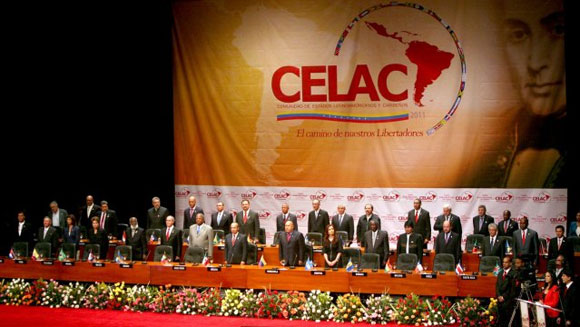
That the first summit of the “Community of Latin American and Caribbean States,” the newly born CELAC, would be a quaint circus where some of the worst habits of our part of Latin America would be on display was well-known. We didn’t know the dimensions of the tent, the variety of numbers that its protagonists would perform, and the rare specimens that would make up the circus acts.

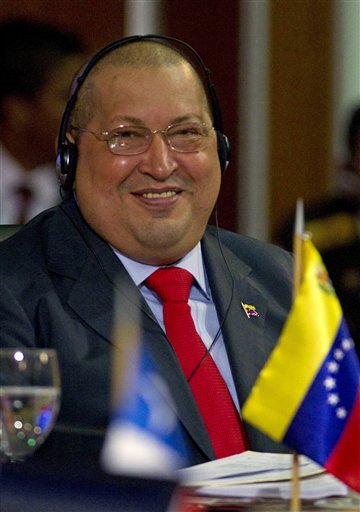
Who didn’t count on the star of the cartel being the bloated Venezuelan president, whom not even the terrible cancer cells can bring to his senses?

Hugo Chavez has managed to establish himself as the official harlequin of all attending the conclave. Suffice to recall that the Iberoamerican Summit of 2007, where he was ordered to shut up by King Juan Carlos I who’d had enough of the leader’s verbal incontinence; or the Trinidad and Tobago Summit of 2009 where, in one of those act supposedly symbolic but in fact ridiculous, he presented Barack Obama with a copy of “The Open Veins of Latin America.”

(It was never clear if the gesture had a symbolic purpose or if was just a boost to the economy of his comrade Galeano, the book’s author; after the git to Obama “The Open Veins of Latin America” moved up on Amazon’s bestseller list from position 60,280 to position 10. A commercial miracle.)

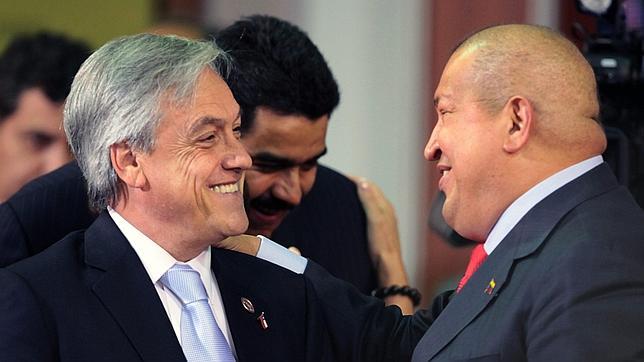
Now, a Chavez of inexhaustible rusticity is one-man band: he described with hand movements and delightful onomatopoeia (“Rrrrrrrrrrr”) how he had looked inside the Cuban scanners; he presented Argentine president Cristina Fernandez with a gigantic painting of her deceased husband and former president Nestor Kirchner, (that he himself painted), which even without the triple squint represented by the artist was, per se, in bad taste; and to put the icing in the cake: he named as provisional leader of CELAC a Chilean president who had arrived in Caracas with Sebastian for a name, and sent him back to Santiago rebaptized (again, by he himself) as Samuel.

Sebastian “Samuel” Pinera is, in my judgment, a figure of major importance this time. And not because of his heroic and Hollywoodesque rescue of the miners. But I will leave that for X paragraphs below.

Does anyone doubt other proved comic incidents would season the meeting that, according to figures from the always nebulous government in Caracas, cost Venezuela some 25 million dollars?


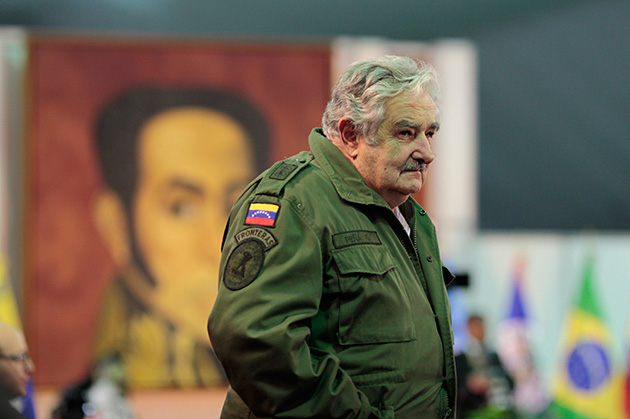
Appearing there was the sullen president of Uruguay, Jose Mujica, in a Venezuelan army jacket that more than an attack on the morale of the Uruguayan army was a crime against aesthetics. Under the most pleasant acts of Mujica, with his everlasting affect of a friendly armadillo, we can include the words of the Uruguayan senator Ope Pasquet in a radio broadcast on El Espectador: “The image of the president is the image of the country, and the image of the president dressed liked this is the image of a backwater.”

Among the endemic species impossible to ignore at such a Summit was Fidel Castro. The old guy was there. Through the mouth of his brother.

As an apology for being such a teeny thing, such a tiny little President, Raul Castro stepped foot in Venezuela and excused himself, “He who should really be here is Fidel. He is the one who deserves it.” and of course he said it with that voice of his, in the higher octaves.

During his speech at the summit, a speech that was written badly and read worse, Raul Castro had to interrupt his words and ask if the gunshots he heard were Chavez’s war against the mosquitoes. A very refined sense of humor. No, the General has no one to tell him that those cannonades silenced by Chavez’s acolytes were the Venezuelan people banging on pots and pans demanding food.

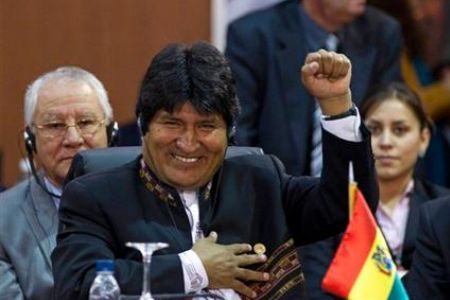
And someone for whom food is a first priority, is the graceful Evo with whom I share a last name. Morales swore that the new community, without the presence of the perturbing United States, would be able to debate “how to deal with the energy crisis, the economy and the hunger ravaging the countries of the region.”

Yes, Evo is concerned about feeding his people. So to do this he has taken chicken off the Bolivian menu; he knows, he knows very well that chicken hormones create baldness and homosexuality, as immortalized in another little speech, and this cannot be allowed among his comrades of the coca and the poncho.

However, perhaps the least visible and at the same time most scandalous act, a number subtly presented, without the spotlights of the spectacle, was another. It was that starred in by the democratic presidents, decidedly distant from the populists and their totalitarian derivatives, those such as Sebastián Piñera, Felipe Calderón, Juan Manuel Santos, and Ricardo Martinelli, reunited with the repulsive ruling class of Daniel Ortega, Raul Castro, Evo Morales Rafael Correa and the host, Hugo Chavez.

I definitely cannot find a sensible explanation.

What Latin American Unity are they talking to me about, that functions as a framework for cooperation that can exist between countries led by impresarios of the center-right such as Piñera and the Panamanian Martinelli, and those run by individuals from the fierce left with authoritarian mentalities such as Raul Castro and Daniel Ortega?

Still worse: I can’t believe that none of these statesmen gathered at the 1st CELAC Summit ignored that this organization, conceived in minute detail by the Chavez brain, is not pursuing, even from afar, an economic purpose. Before, long before, it has a political objective: distancing itself from the only two countries in the Americas that were invited to join the group The United States and Canada.

If, as is an open secret, the principal directive of CELAC was to dilute the Organization of American States (OAS); if only to supplant the OAS by another community with more respect and credibility were its essence, I think that I myself would have signed on to create it. It would be about burying once and for all an organization dull and useless like few others, whose death throes would not trouble me too much.

But, to give shape to a CELAC whose economic and strategic framework is that of Chavez and Castro, establishing a distance from the United States that frankly could be defined as hypocritical (even the Phoenix capsules that rescued the 33 miners were made by the Chilean Army working with the United States’ NASA), seems to me to be an ethical and moral disaster unparalleled in recent history.

Ugly history begins to demarcate the entrepreneur Piñera, one of the politicians with the most democratic vocation and liberal thinking in the whole region, if he has no qualms in leading a ruling troika of CELAC whose other two members are none other than Hugo Chávez and Raúl Castro. From the time I was small I learned what happens to someone who sidles up to a bad seed: tell me who your friends are and I’ll tell you who you are.

CELAC’s Big Top rose in Caracas, amusing many, surprising others with its bizarre actions. But having dropped the colorful mantle and started up the ruckus, a strange sensation of Latin American farce, of the populism of some interwoven with the opportunism of others, left the too attentive audience with a frozen smile.

Contextualizing and broadening the spectrum of the most famous phrase of the disenchanted Peruvian, it seems that for too long we’ve continued to ask ourselves, like that delicious character of Vargas Llosa, at what moment in time did we fuck over the region.

(Originally written for Martí Noticias)

December 7 2011

Tomorrow the Havana Tribunal will try the former military man who shot a teenager / Laritza Diversent

Tomorrow, December 9th, the Havana Tribunal will hear the case against a former military man named Amado Interian who is accused of having used his 45 caliber pistol to shoot a teenager named Alain Izquierdo Medina — a black 14-year-old who was coming down from a fruit tree on his property.

Translated by Hank

December 8 2011

“That Old Newspaper Yellowed With Age“ / Yaremis Flores

Yaremis Flores Marín

A few days ago I read in Granma, the official mouthpiece of the Central Committee of the Party, an article about the end of the debate by the Parliamentary Commission, in whose mind they had analyzed among other things, the effectiveness of the economic model.

What they were saying to the population was “we are working for…, we are analyzing…, we are satisfactorily completing…”

To summarize, all of the Commissions inflated in one way or another, efficiency; and those that did not meet some parameter, they justified with those empty slogans which we have become accustomed to — that they work to achieve the development of the country and the satisfaction of the people.

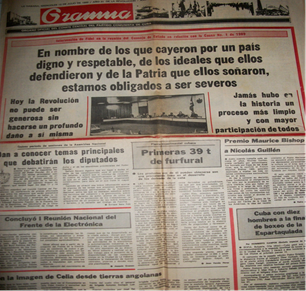
A few days ago, dusting off memories, my grandmother found an edition of Granma dated Wednesday, July 12, 1989. It was yellow with age. She had saved it as though it were a relic. I was just a girl back then.

The first thing that surprised me about that old edition of Granma was the size of the publication (twice what it is today). Aside from that, on its first page it talked about the subjects that were to be debated during the 5th National Assembly. From that day forth the subjects of construction, public services and worker protections were all on the table.

Moving forward to the present, the failure is evident. The housing situation is precarious; the shortage of building materials; public services in decline; and don’t even talk about the protection of the workers, when today we’re all threatened by the era of “availability”, which is simply a word that tries to put lipstick on what I prefer to call “unemployment.”

So I ask myself, do I have to wait another 20 years to read another edition of Granma which will capture the same thing?

Translated by: Hank

December 6 2011

Vulgarity as a Resource (I) / Miriam Celaya

Osmani García, the scapegoat of the day. Photo taken from the Internet

A disproportionate scandal has been unleashed these past few days around a vulgar Cuban video clip officially demonized and quasi-banned by the Culture Minister himself. It is the reggaeton entitled “Chupi Chupi” whose lyrics, in fact, are such a monument to audio-visual vulgarity that it could be considered record-breaking within a genre that is prominent in Cuban music, by its crudeness and by the lack of substance of its lyrics and images, and the obnoxiousness and repetitiveness of its refrain.

It is clear from the preceding paragraph that I detest reggaeton, though I acknowledge and respect the sovereign right of the followers of this (music genre?) to fully enjoy it, provided that, in turn, it does not invade my ears with its aggressive and artless lyrics. However, I am very surprised at the virulence of the official attack on a video clip that basically does not differ too much from others of equally vulgar, pornographic and similar insipid content. And if I understand that the scandal is “disproportionate”, it’s because in a reggaeton and reggaeton performer’s fight against the formidable cultural and official press apparatus, the song Chupi Chupi and its author, Osmani García, will be able to do little to defend themselves.

On the other hand, I cannot understand such last-minute Puritanism in the face of a phenomenon that has ruled over the Cuban music scene, not in “recent years”, as the high ranking Commissioner with a doctorate in Arts and Sciences claims in an article published by the press (Granma, Wednesday, November 23rd, 2011, pages 4-5) — the artistic Commissioner appointed to sanctify censorship to the public — but for at least the last two decades. It could be said that the specialist author of the journalistic diatribe, with the rank of Faculty Professor in the Department of Musicology at the Higher Institute of Art –- such are her very polished and lengthy titles and crests — was locked in her ivory tower, just listening to classic music all this time, therefore she had not heard that, in effect, musical vulgarity has claimed the throne in the taste of a good part of the Cuban people. I wonder how someone could be a specialist in musicology and ignore the process of impoverishment that has been gnawing away at Cuban popular music in its own environment.

I say this because it is impossible to drive through the streets of this city without passing a rickshaw dispensing reggaeton in its path, out loud, polluting the environment with its low-life sounds and the marginalization of its lyrics. Some bus drivers have similar habits and share with passengers in their crammed vehicles what they consider the greatest of musical creations, assuming that they are like-minded and want to share. The same goes for many of the classic old cars that serve as taxis on fixed transportation routes, where passengers that pay their fares have to suffer, whether they like it or not, the dissemination of reggaeton at high decibels … and God help anyone who dares to suggest to the driver to turn down the volume! The driver’s abuse is worse than the very lyrics of the music. If you don’t believe it, just ask Yoani Sánchez, who on one occasion had to get out of the car because of the driver’s anger when she protested discretely. Since that time, she has decided to board protected by headphones that allow her to build a defensive anti-reggaeton barrier, and, at the same time, enjoy her own music without making trouble or bothering anyone.

But specifically against the “El Chupi” onslaught… I started to think about other reggaeton and other lyrics that for several years have occupied the popular taste. Some of these creations are more vulgar and “stupefying” than others, but all are part of a repertoire under whose influence many, who are now in their adolescence and youth, have been brought up. I remember some of those gems, whose lyrics say “suck my sweet sugar cane, Mom …” another cried out in the voice of a cat in heat “Aaaayyy, I like Yumas!*…” Another urged: “Suck, suck, suck lollipops, take them out of your mouth, and put them in your nose….” And so forth, with the same level of excessively rhythmic idiocy.

These freaks have been a constant even at children’s birthday parties, so-called cultural activities in schools at all levels of education, at the feasts of the Committees for the Defense of the Revolution, in Pioneer camping trips and — believe it or not — even at day care center celebrations, promoted by the organizers of these activities, namely, teachers, educators, school leaders, cultural promoters, trainers, etc. At such times, it often happens that competitions are held, and those children who best mimic the pelvic movements of adults with ease and are able to “get onto the floor,” are the most applauded and encouraged by adults. So, in effect, a taste for reggaeton has become a widespread phenomenon. Not by chance was “El Chupi” nominated by popular vote for the latest and recent Lucas Awards, the annual Cuban video clip contest, from which it was eliminated by the decision of the Minister, against the proposal of his highly cultured people.

Until today, I think that promoting this type of music has spread in Cuba under official protection, aimed at a particular audience: large masses. Disseminating meaningless lyrics, keeping the public in an apathetic and lethargic state before the repetition of such empty refrains, appealing to the exaltation of the sensual and sexual as a way to alleviate the angst of so many hardships, reducing people to a state of idiocy, eroding minds and dehumanizing has been a “cultural” strategy employed by the authorities to channel and control energies, far from claims and reasoning. On the other hand, this type of thing tends to reinforce the image of a sexual paradise that is so appealing for the purposes of encouraging tourism, an economic stake par excellence for the government, only that, apparently, the image of the Cuban culture that was being presented is becoming too obscene and, for some unknown reason, they are putting an end to it.

At any rate, it is known that censure and bans only serve to encourage the consumption of the forbidden. These days, people have not stopped commenting on “the case of El Chupi,” and those who didn’t yet own a copy of the video clip ran to get it, the reverse effect of the reaction that turns subversive, and therefore, attractive, everything that upsets the authorities. Perhaps it is time for media owners to understand that banning is not what it’s about, but diversifying areas and options. It is time to open up true and total artistic and esthetic freedom and to allow all avenues for creativity to flow through. That would make Cubans a more cultured and selective peoples. May reggaeton not continue to be the only popular nor banned music. This could be another of so many beginnings we need.

*Translator’s note: Yumas are people born in the US.

Translator: Norma Whiting

November 28 2011

Dr. Carlos Juan Finlay and “Doctors Day“ / Regina Coyula

With good reason, today is “Doctors Day.” The work of Dr. Carlos Juan Finlay in investigating the causes and transmission agent of yellow fever is monumental. I can’t help but speculate that if Finlay had lived in this time, how he would have been seen by the authorities. In the fights for independence he remained on the sidelines, despite being of age to participate. Two of his sons were active in the War of Independence, but that did not separate him from his research either. However, he worked as a doctor in the interventionist U.S. Army, and worked in campaign hospitals in Santiago de Cuba, and in cleansing the city from the scourge of yellow fever. To him, the cause of independence seems to have been a peripheral issue.

Don’t misinterpret me. Finlay was clear about his priorities: In the swamp he would have been just one more doctor; his objective was to save millions.

December 3 2011