Two-for-One Minutes: Now is the Time to Recharge a Blogger’s Phone

You can help the bloggers by putting minutes on their cell phones… from the comfort of your home or office.

CLICK HERE FOR THE BLOGGERS’ CELL PHONE NUMBERS AND HOW-TO

This recharge site – EZETOP – is offering a two for one special for Cuban recharges from December 5-8. They will double your minutes. They are reputable, fast and confidential.

Closed for Renovations / Regina Coyula

I delighted in entering the spacious indirectly-lit lobby, I loved those seats that reclined. I begged my mom to leave me in the Rex watching the cartoons and shorts while she walked through the shops. In the Duplex I saw Waltz for a Million something like four times, a Czech film, Spartacus, with a catchy musical theme that came after many battles and many tears to refresh the film industry of the sixties.

But time and the eagle of the sea passes, and the first Cuban multiplex was closed to renovations, the renovations never happened, the place lost the box office, the carpets, chairs, ceiling and was turned into the dump of the old Bristol Hotel, reinvented as multi-family housing. The plumbing system of the old hotel, also old and lacking maintenance, couldn’t stand up to the onslaught of residents, and they chose to dispose of their excrescences out the window… right into the space of the Rex and the Duplex.

In the first repairs tackled on the Boulevard, they thought to save the building, but except for the facade there was nothing left. They chose to block the entrance with glass and aluminum doors, and not even the glass survived.

By size, the strongest impression comes from Fin de Siglo, Flogar or Cuervo y Sobrinos, then the Praga jewelry store, dark and dirty premises that let you search among their repetitive merchandise sold in national currency for a past splendor. Walking along San Rafael, almost no one under forty might suppose, fleeing from the plague that identifies the place today, the existence of those agreeable little movie theater rooms.

December 5 2011

Work in Progress / Laritza Diversent

Roberto Lopez arrived early at the Arrroyo Naranjo Property Registry. His plan was to divide his house. One part of the house was to be donated to his only granddaughter and the other was to be sold. He is 70 years old and he needs resources to live. He was number 10 in line that morning, but when it was his turn, they told him that he could not register his house.

As of the enactment of the new norms decreed by the Council of State, which modifies the law regarding housing, Cuban property owners are running en masse to the Notary of Property Registration in order to comply with the new laws required to place their titles in compliance with the new legal standards.

The now traditional lines in front of these institutions start in the early morning, and by the end of the day there are always people who have not been seen. Not all has been resolved. Time ran out to get things done, but the government does not provide an adequate infrastructure or sufficient personnel to deal with the demand required by the new laws.

It doesn’t matter, Cubans are used to it. With incredible patience, they wait for their turn to be attended to. There is, however, no shortage of people who lack the right paperwork. After waiting four hours in line, it is not easy to deal with not achieving your goal simply because of omissions or errors that are not your fault but which are the fault of the office that granted the title to the property in the first place.

“You need to update your title in order to sign up your house on the Property Register,” the specialist tells Roberto. The procedure is required for those who want to sell, trade or donate their houses. “What does that mean?” asked the old man disconcertedly.

“The measurements, boundaries and also the area are missing in the description of your house,” responded the lawyer who was looking over his documents. An omission that most of the property titles written before 2003 suffer.

“First you should go to the office of the community architect and request his services to carry out a technical opinion and an appraisal, then, with the architectural document, you need go to the notary so they can rectify the omissions, and last return here to request the registration of your property,” added the specialist.

It sounds easy enough, but the process would require getting up early and losing a day of work to stand in line at the architect’s, another day at the Notary’s, and yet another day at the Property Registry. That’s without counting the time that each step would take. “It looks like my plans will take at least three more months,” commented Mr. López without much enthusiasm.

The buyer for Roberto’s house is not disposed to wait. He plans to pay to speed up the process. Haste is valid in all parts of the world, but it signifies corruption for the Cuban government, one of the aggravating battles of life on the inside.

That’s how the island’s recently approved regulation has begun to be applied. It permits the buying and selling of houses and eliminates one source of illegalities. It also increases the workload of the state functionaries without increasing their salaries. No doubt the corruption and prevarication of those workers remains as a work in progress.

Translated by: Hank and Scott

December 3 2011

The Rebellion of the Righteous / Ernesto Morales Licea

He’s brought Raul Castro an excellent opportunity to demonstrate the possible honesty of his words. In the handful of years during which he’s been the regent of this feudal family that is the whole Island, the younger of the Castros has never stopped repeating a maxim in his sharp voice and as if it were revolutionary: “Let everyone say what he thinks, let everyone criticize with sincerity, and their disagreements will be heard.”

Now that Eliécer Ávila, a young man of 25 from the countryside, without international awards to worry him nor family abroad to mitigate his unemployment, has returned to the news, Raul Castro, were he interested, could give proof as an example of his attention, showing that when he speaks, he means it.

How? An infinite number of possibilities come to mind: a five-minute phone call ordering a certain pockmarked vassal: “The next guest on the Roundtable TV show will be the young man Eliécer Ávila. The program will be the same length as his interview on Estado de SATS, two hours, so you will have equal time to analyze the critiques of a young revolutionary.”

I recognize, with an insolent itch, that my imagination can be unfortunately fertile. Because not even Raul Castro is interested in demonstrating some truth, nor does he have to in a country that only obeys, never demands: nor are the claims of its weary citizens of interest to him, much less those of a boy from Puerto Padre, a village almost adjacent to his native Birán, which he wouldn’t know how to find on a map of his country.

After listening to the two hours of dialogue where the now unemployed computer engineer and ex ice cream vendor, giving vent to his catharsis of nonconformity and undisguised rage, I thought again of the same thing that happened three years ago when Eliécer Ávila became an underground celebrity: the most beautifully sad thing being that he doesn’t speak for himself alone. In the throat of Eliécer Ávila are the voices of millions of the enslaved, whom biology hasn’t given the balls to make them worthy of licking his boots.

As during that questioning of Ricardo Alarcón de Quesada, Eliécer has exploited again, without even knowing it, a factor which determines the impact of his words: he is an exponent of the rebellion of the most humble, the lowly, those just now coming to life (he’s 25) who refuse to accept the destiny of their parents, of their grandparents; this destiny in which they grew up, came to awareness, and which they are no longer afraid to begin to face: the tragedy of living in a country without dreams or aspirations.

Leaving aside the obvious historic references in which he rests his ideals, ignoring the reading and study that this computer scientist with a humanistic vocation displays in spades, the best of all is that the discourse of Eliécer Ávila is not a political discourse. This, I believe, is the heart of his enormous reach.

Even to those in politics in its pure state it seems to us a lamentable but essential matter, without which a social entity is incomplete, the tone in which some of the discordant voices on the Island confront the establishment weighs on us at times. It sounds to me like hollow discourse, shouting, an archetypal method with its valid reasons but not defensible ones.

The beauty of Eliécer’s exposition, which provokes this turning of heads, nodding while listening to his complaints, his sentences, his questions, is that he is not someone who portrays the disillusionment; he is someone who incarnates the disillusionment.

Disillusionment with a failed promise of happiness, a failed promise of equality and progress. Disillusionment with an electoral system that rather than serves to choose, serves to perpetuate the inept and tyrannical. Disillusionment with a timid press that he doesn’t categorize as good or bad, simply as nonexistent. Disillusionment with the neglect of his leaders, with the chaos that is his country, with its poverty, its hunger. Disillusionment with the mountain of feces that the Revolutionary Project turns out to be that he, as I two years earlier, was taught in high school history class was perfect.

And the great thing in the personal history of this computer engineer, is that the disillusionment didn’t come at birth. It came from his own learning.

Eliécer Ávila was president of the Federación de Estudiantes de la Enseñanza Media (FEEM), Federation of High School Students, during his pre-university years. Those of us not that removed from the Cuban school year can attest to the atrocious indoctrination, the machinery of manipulation that young “cadres” are exposed to convert them into what the Argentine Guevara promulgated: the basic clay of the Revolution.

After those three years of high school, Eliécer Ávila led an Information Security project at the University of Information Sciences (UCI) where he studied. Needless to say that in the school pampered by el Comandante, the school that is the apple of his eyes, the doses of ideological injections are doubled.

So then what happened to this young man, shaped like all of our generation in the iron-scheme, among the bars of Marxist-Leninism that island philosophy that is the most idolatrous cult of the Castro regime? What happened to this young man they educated to extract from him a docile Paul, that he became an ungovernable Saul? What happens to all the honest, the free-thinkers, the uncastrated is what happened to him: All the lies were too big, they could not fit in his brain anymore.

Because of this he had to challenge with his native words and his (our) eastern accent the member of the Island Olympiad whose title is President of the Parliament and who is only worried about the fates of the five members of Cuba’s Wasp Network, imprisoned in the U.S. Because of this Eliécer Ávila couldn’t escape this opportunity of the gods, the ultimate circumstance; that moment in which he held in his nervous hands a notebook with precise points, and freed a part, barely a portion of the questions that millions of Cubans have choked one without ever finding the courage to express them.

And also because of this, facing the questions of the moderator Antonia Rodiles at Estado de SATS, three years after having come to the attention of the country and the world, Eliécer Ávila returned to the headlines: it is not usual for a Cuban “in Cuba,” and even more a Cuban not linked to any formal opposition group, to express with such naturalness (and so much oratory talent) his distance from the official doctrine under which he was raised biologically and cerebrally.

Cubans now replay this interview in their homes. They comment on this talk show with relief, they quote it, talk about it. They heard him say that he feels cheated by a system that allowed him to study information science but then left him hopelessly unemployed. In Puerto Padre, Eliécer Ávila receives the social payment for daring so much: a lemon vendor doesn’t charge him (he tells us from his Twitter account), a woman takes off her sunglasses to confirm that it is him, and gives him a wink of complicity and admiration.

Today, relying on the telephone as the only solution, I spoke for some minutes with this guajiro from Puerto Padre to whom, as I said myself three years ago in another text, every worthy Cuban owes a handshake.

Precisely in the name of those, those who admire and celebrate the rebellion of the righteous; those who yearn for a country of hope and promise, where their children don’t need to flee like ruffians in search of fortune and freedom; in the name even of the readers of this writing; of those who died waiting for sovereign voices like Eliécer’s to sing out of tune with the official choir; and those millions of his compatriots who find in his courage the only reason not to lose faith, from afar I offer him gratitude impossible to quantify, and a subtle warning: your country will not forget you.

(Published originally in Martí Noticias)

November 30 2011

Granma vs. Grammy / Regina Coyula

Before the Latin Grammy Awards, the newspaper Granma published the names of nominees from among the musicians of our island … who live on our island: Omara, the diva of the Buena Vista Social Club, with a recording of children’s music; Adalberto Alvarez, with his usual presence in the tropical music category; and the Santiago de Cuba Septet.

After the awards night: headlines for Calle 13, the big winners in this year’s Grammys. And who else? A mystery.

The press coverage of this cultural event illustrates how the thinking of Cuban journalists in government institutions will not change. They can’t.
November 16 2011

Cubans Can Sell Their Homes / Laritza Diversent

This past November 2nd, the Cuban government published the Legal Decree Number 288 that modified the “General Law of the Home”, and permitted the buying and selling of real estate between private parties, until then it was prohibited by national legislation.

The new law took effect the 10th of November and generally permits owners: Cubans and foreign permanent residents in the country to dispose freely of their real estate.

However, it keeps as a legal requirement, the possibility of owning only one family home and another located in a vacations or summer area. With respect to the exchanges, donations, and trading, it establishes that it can be formalized before a notary public of the municipality where the real estate is located, prior to registration in the Property Registry.

The real estate registry started to operate in Cuba in the middle of the 19th century. In the 60s, it came to a standstill with the creation of the General Housing Law, ending legal sales. It was reopened in 2003, due to the requirements of foreign investment. Currently, it constitutes an indispensable requirement to carry out transfers of ownership.

The legal decree also eliminated the existing permit that owners had to obtain from the Municipal Director of the Home, to trade and donate their real estate. Also, it repealed the method of losing a building (confiscation), in cases of transfers of property, construction, expansion, and illegal rehabilitation of houses.

Nevertheless remaining in force are the restrictions of freedom of residence, which impose migratory rules for the capital and for zones of high significance for tourism undergoing a special administrative regimen, as is the case with Old Havana, in the capital, Veradero, and Matanza.

The Legal Rules permit compensation in the case of a difference in the values of the real estate that is traded, which was forbidden before. Also, they reestablish the rights of heirs who are able, in every case, to be awarded the housing, if and when they have no other property. Previously, the beneficiary dweller acquired the property, otherwise, the law recognized the cohabitant.

It maintains the confiscation for leaving the country, but it permits family members to acquire the real estate for free. Before, the state sold the confiscated houses, or some of them, to the co-owner or cohabitant who could show they had lived for 10 years with the emigrant owner. Also, they could not dispose of the housing during the four years before their departure, a restriction that was eliminated.

It imposed the payment of taxes for the Transfer of Real Estate for those who acquire the housing and for the sellers, through Personal Taxes. The taxes on the purchase are based on 4% of the value of the home and are paid in Cuban pesos.

In general, the new law eliminated a series of prohibitions that prevented Cubans from exercising the powers of disposal arising from their ownership. However, it keeps some restrictions pertaining to freedom of movement within the national territory, which impedes the full realization of this right.

On the other hand, it simplifies a series of bureaucratic obstacles. However, the paperwork and the time it takes to exercise this right will be hardly reduced. The state does not have the adequate infrastructure and the conditions for the provision of legal services with the efficiency and the quality that the new regulations require.

Translated by: BW, Haydee Diaz

November 14 2011

Dictated Hashtags / Yoani Sánchez

The sign reads: Alternative media and social networks. New scenarios of political communication in the digital environment.

Architecture that was once daring, a carefully tended lawn, and well-guarded doors to ward off the curious. The Palace of Conventions has been the site of so very many events organized by the government that it is difficult to separate its name from the word “official.” It has also served as the parliamentary hall for a National Assembly that doesn’t have its own space and refuses to use the gorgeous chamber of Havana’s Capitol. This, in the inner sanctum of the state and government, has been the site of this week’s Forum on Alternative Media and Social Networks, called by the Ministry of Foreign Affairs. The ragged grass of any park would have been a better site, but there the participants would have been exposed to passersby and the uninvited… and this, of course, they could not allow.

In a country where the alternative blogosphere and twittersphere are both expanding, they held a meeting on Web 2.0 without inviting a single non-institutional voice. To ignore the existence of “the other” is at the very least childish; to hold exclusive events to talk about social networks displays a strong fear of differences. Perhaps among the attendees — from five continents — none was warned about the ideological bias of the Forum. They probably truly believed they would find the wide range of opinions so strongly on display in the blogs and Cuban-themed sites created on and off the Island. But what they discovered was a structured script, where the Internet is analyzed as a weapon, a trench, a shield. The already exhausted methods of political confrontation and extremism, now painted over with a thin mantle of kilobytes.

It’s enough to read the 14 points that came out of the meeting, which lasted two days, to conclude that the participants weren’t there to be heard but rather to receive instructions. I found one of the accords especially surprising for the authoritarianism it reveals: the one where daily hashtags are established for use on Twitter. As if they don’t realize that putting this mandate in writing exposes the lack of spontaneity of their Web campaigns. To the organizers of this Forum, believe me: defined sets of labels, mandated articles, imposed postures, have nothing to do with social media or alternative media. The seams of the vertically ordered are obvious. Readers prefer the spontaneity of the individual who interacts horizontally with others, versus agreements reached in the office of some palace official, in the most official zone of this city.

The Declaration that came out of the event is translated below from the text in Cafe Fuerte.

Final Declaration of the International Workshop “Alternative media and social networks, new scenarios of political communication in the digital realm.” Havana, November 29-30, 2011.

Delegates from Argentina, Brazil, Canada, Cuba, Ecuador, El Salvador, Spain, USA, France, Guatemala, Italy, Mexico, Nicaragua, Palestine, Venezuela, participants in the International Workshop “Alternative media and social networks, new scenarios of political communication in the digital realm,” Havana, November 29-30, 2011, present the following:

  1. Create a directory of contacts with participants of the event to allow us to connect in real time and face attacks against our countries, alert us to different topics and place our messages. This directory will be sent via email. (Ventanapolitica@yahoo.es)
  2. Articulate a collaborative network, starting with the participants in this international workshop, that allow us to socialize content, information, contacts and experiences to work on Internet platforms and tools, on the basis of a defined political strategy. Its expression on the Web will be the www.ventanapolitica.wordpress.com blog.
  3. Work together synergistically on the overall campaign.
  4. Generate actions to enhance the continuous updating and training in the effective use of new technologies in the context of hypermedia, support the creation of multidisciplinary teams and the use of online tools and services such as videoconferencing, online courses, and others.
  5. Create a multidisciplinary group, including technical experts, that allow us to assess able all the proposals we articulate emanating from the network.
  6. Support the reissue of events like the World Bloggers Meeting or this Workshop on Alternative Media and Social Networking.
  7. Promote the creation of quality content, that allow us to overcome our shortcomings in technological development.
  8. Support the incorporation into the network of younger generations and transform them into active progressive forces in these new platforms.
  9. Work together to design communication projects in social networks and other media that include the variety of themes, media and channels, as well as different audiences.
  10. Intensify work and research, in order to design and create our own alternatives (such as platforms, support, and even information security services) that allow us technological independence from the empires of capitalist production.
  11. Express our solidarity and support with the newspaper La Jornada, a publication that has been maligned by the magazine Letras Libres which has accused this prestigious Mexican publication, without arguments or evidence, of being complicit in terrorism.
  12. The theme of the five Cubans unjustly sentenced in the United States must be an axis of permanent struggle. And it will be efficient if we always keep in our minds that each one of us could be in their place. Every Cuban could be one of the 5. Demand the return of the 5 Cuban heroes to their homeland. Send a daily Twitter message in favor of their release. Create and utilize the following hashtags: #FreetheFive #Liberenlos5ya, #LosCinco, #TheFive.
  13. Convert the interventions of Aylin, Rosa Aurora and Olguita into a group of tweets that are socialized at once.
  14. Explore with our respective responsible government bodies responsible the appropriateness of the mechanisms of integration that exist or are now being born in Latin America and the Caribbean to give priority to the issue of Communication and especially to the alternative media and social networks for the dissemination of the new reality to our geographical area.

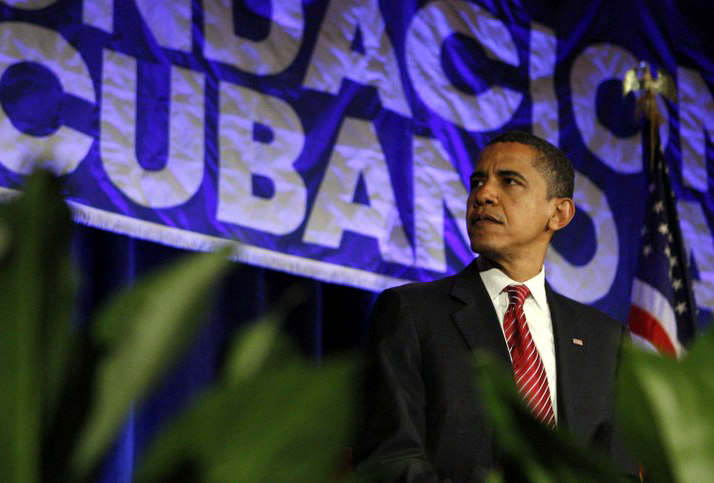
Obama, Cuba, and the Confederacy of Dunces / Ernesto Morales Licea

According to Jonathan Swift, when a true genius appears in the world we can recognize him by a sign: All fools conspire against him.

I believe we could easily adapt this maxim – taken from the stupendous novel “A Confederacy of Dunces” by John Kennedy Toole – to another context: When a sensible president appears in one of the world’s great nations, it is not long before fools join against him.

I think of this each time I hear Barack Obama uphold his policies in that singular case which has come to be called Cuba. I think it each time I hear his thoughts consonant with the primary needs of Cubans in these times.

For my part, knowing that President Obama distanced himself from previous positions — unsustainable as they were within the current context of the Caribbean nation — as soon as he arrived at the White House, seemed to me a breath of fresh air. A good omen that came to me in my remote provincial city in Cuba.

I was not alone. I remember the endless debates among young people who in different ways, both more publicly and more surreptitiously, disapproved of the monolithic system under which we grew up, of the harmful policy promulgated by George W. Bush during the eight endless years of his government.

I risk a generalization: the vast majority, by far, of Cubans on the Island, the generations who undoubtedly will build a better country for their children and grandchildren; the huge majority of dissidents both notorious and unknown, Cubans detached from the indoctrination, tired of lies and bland politics, wholeheartedly approve the measures taken vis-a-vis Cuba by the current U.S. administration.

While not a few idiots conjure the accusation that Barack Obama has allied himself with the tropical regime in Havana, allowing Cuban-Americans to travel at will to the country of their birth, and ignoring how much money a waiter in Hialeah sends to his mother in Santa Clara.

Another tiny and poorly mounted campaign offers as evidence of this insensitivity of the Obama administration toward Cuba the cutting of funds to promote Democracy in Cuba to organizations such as the “Cuban Democratic Directorate,” or “Advocates for a Free Cuba,” intentionally ignoring the reallocation of these funds to other institutions more in sync with the current administration, such as the Human Rights Division of the Cuban American National Foundation.

Suspiciously, this class of anti-Castro fighters who call themselves “intransigents” and fiercely defend the asphyxiation of Cubans as a route to regime change, do not inhabit the country. I didn’t meet them in the Cuba I left behind nine months ago. They are outside of it, well-sheltered from the prevailing misery, and the asphyxiation of the official disinformation. In the overwhelming majority of cases, their families are. As a mountain song very popular in the Cuban sierras would say, “Yep, it’s easy, pal!”

The rationale for this is simple: restricting remittances from Miami to Cuba would have its effect in the stomachs of the Cubans, who would inevitably end up toppling the dictator. What none of these thinkers and architects of Cuban freedom has ever explained to me is what they themselves are doing outside Cuba. What are their families doing outside Cuba? Why should my mother, my grandmother, be the ones who rise up against the tyrant as a result of their policies while they are sitting safely by with a shot of Bacardi in hand.

What has been the policy focus of Barack Obama? Towards truth like a temple: the natural scenario, the preferred habitat of every dictator is isolation. It is at a distance, separated, in the prohibitions, where all the authoritarian regimes in History have found the best conditions to perpetuate themselves. This is their sauce, cooked there with skill.

When I hear Obama defend his positions on Cuba, defend the need for Cubans to demarcate themselves from the State and take advantage of new forms of communication with the exterior, I come to see only two possibilities with regards to his detractors:

1. Either their disconnect with that country is so insurmountable — even when they don’t sense it — that they do not understand the damage that has been done to the monolithic regime in Havana from the entry into its lands of inhabitants from the free world, the contacts between human beings and slaves.

2. Or blind Republicanism of the type, “do whatever you have to do to confront him” clouds their reason and distorts their attempted good intentions toward the Island.

There is no other way I can understand, for example, how these champions of the Cuban cause can praise George W. Bush as the most consistent, hard and admirable president of the last decades.

Setting aside the shame that surrounds the most unpopular president in American history, the most uneducated and the most notoriously incompetent, I believe that a single question collapses the myth: What did the “admirable” Bush policy achieve in Cuba, with his fiery little speeches and his limits on remittances and travel between both shores?

Did it, in fact, achieve anything? Yes, a lot: under his administration the regime of Fidel Castro dictated the most astronomical possible sentences against independent journalists; mobilized interminable forced marches in the country; suppressed with great effectiveness popular protests; sustains an absolute monopoly on information; and enjoyed silently the estrangement of families, this time imposed not by its own directives, but by the country that for many is the paradigm of a modern democracy.

In short: I would be willing to believe in the effectiveness of the Republican prohibitions if they showed me one, just one, of the accomplishments of these policies in the lives of Cubans on the Island.

All this discounts a fundamental factor: the Texan Bush was not only the most unpopular president among Americans. He was also so among Cubans on the Island: as if it’s not enough to have the iron fist of the family dictatorship shoved down the throats of 11 million people, now the president of a nation that should ally itself with the victims did exactly the opposite — it prevented our families from visiting us, from alleviating our hunger and longings. And meanwhile, Bush won applause in Miami’s Little Cuba for “doing what was really necessary.”

Making Cubans independent of the State; breaking the monopoly on information so often mentioned by Yoani Sanchez and directly promoted by Barack Obama; allowing contact between Cubans on both shores — not only as a political strategy but as a sacred right that belongs to them — seems to me not only defensible for those of us who know the tropical monster from within, but for all those who have a genuine interest in prosperity and democracy for Cuba, beyond the demagoguery disguised as patriotism.

The rest goes a long way to please the stiff ears of certain sectors that don’t live in Cuba and seem not to notice it. It serves to disguise the lack of serious and effective policy proposals, with the mantle of exhausted rhetoric. But at least to Cubans now, those on and off the Island, it definitely does not deceive us. Not by coming together will the voices of certain dunces be heard any louder.

October 10 2011

A Beautiful Lady Comes to Less / Rebeca Monzo

Patchwork, Rebeca

Because of the 492nd Anniversary of the Villa of Saint Christopher of Havana, between the many television programs dedicated to this celebration, Hurón Azul, of the UNEAC (Union of Writers and Artists of Cuba), presented some interviews with renowned architects and artists, where they poured out their opinions about the the deteriorating image of the city, the beautiful lady coming to less.

Some of the views expressed that, effectively, at present, due to a uncontrolled profusion of little ground-floor businesses, the cast majority of them improvised, depressing small shops (a derogatory term to describe them), are not due only to the bad taste and scanty resources of the owners, but more to the total absence of control and lack of demand that they at least present a small project plan to the managers in charge of granting the licenses or permits.

Undoubtedly, this could also be caused, by the urgency of the government in offering an escape route for the population, before the massive layoffs and their growing disapproval and the hopelessness, accentuating the impossibility of the State’s ability to offer them other work alternatives.

The urgent need of the citizens to cover the basic necessities has made these stalls proliferate in an uncontrolled manner, using doorways, stair landings, gardens and even sidewalks (mostly common-use areas), in those that unfortunately abound in bad taste and precariousness, consequently contributing to making things more ugly in the already abandoned city that formerly was considered one of the most beautiful in the world, and that survives miraculously, going through half a century of indolence and abandonment, without the Cuban authorities having done the least thing to preserve this beautiful heritage inherited by the district and the republic, that is the city of Havana.

Its decadence started very early, back in the 1970s, when they closed up and plunged into total abandonment premises that belonged to local shops, bookstores, stores, and department stores, whose owners went into exile, or else those of the people who stayed were confiscated, while some were subsequently handed over by the State for housing without the necessities nor demands that the future owners undertake a minimum of effort to make them habitable. Thus they urgently tried to solve a problem that years later led to a larger one.

Now, in this new anniversary of the city, they have sounded the warning once again, before the growing fear that they are continuing to lose the architectural value that made Havana so famous.

Translated by: BW

November 22 2011

Bad Handwriting in La Joven Cuba (14) / Regina Coyula

Translator’s note: This series of posts are comments from Regina to authors or commentators on the blog La Joven Cuba.This one is addressed to someone using the nickname “Edu.”

I don’t know if there is, among us, some historian, but if you take [the 1920’s student leader and proponent of revolutionary socialism] Antonio Guitaras as a symbol, the least is to know him by heart, the natural curiosity that would have led them from beginning to end; not that I or anyone else come with knowledge of this era, and they would consider them at least superficial. You must go beyond the nationalized Guiteras, the one that appears in the textbooks, and know the total Guiteras. You refer to two anecdotes where you have heard bells. He gave Summer Welles ten minutes to abandon Cuba, where they met, and not in his office. Wells kept on protesting and Guiteras recorded that he had lost three of the ten minutes.

The anecdote about the National Hotel you also do not have clearly. Officers of the Army of the Republic had taken shelter there, some of them very committed to Machado, who did not accept the 4th of September Movement. Guiteras, as minister of government and Batista has head of the army led the attack on the National Hotel, they were with everyone, because the officers had been holed up there for nearly a month, about which Guiteras said: We can’t permit a State within a State. It’s a mockery.

Joven Cuba — Young Cuba — was a clandestine organization whose objective was armed conflict. The Batista-Guiteras dispute was political, but also very personal. The members of Joven Cuba undertook fund-raising activities to create a “suitable climate,” consisting of bombs, Tony’s methods prior to JC. Although you can dive into the biography of Guiteras by Jose A. Taberes del Real, or into the books of Lionel Soto and Newton Briones published by the non-suspect Political Publishers, I offer you a family anecdote. My uncle Fernando Perez-Puelles, then an engineering student, belonged to the Young Cuba board, and previously had belonged to the University Students Directorate (DEU). Fernando armed explosive devices, and on one opportunity my mother, four years younger, helped him transport one of these devices wrapped as a present. I have known this story since I was a girl. Edu, this also part of not fragmenting the history that so concerns you.

I can explain your annoyance with the Miriam Celaya’s commentary (which was not a diatribe). She doesn’t need defenders because she is a born debater, but beware, don’t disqualify her so quickly. You can like her or not, but Miriam is cultured and educated. I ask you to reflect and reread your comment, where there are a few blemishes and an excess of testosterone. You allege it is against Miriam, but the immediacy betrays you and you fall into the plural again are mistaken. A little restraint would not hurt. The country I would like is one in which you are exactly as you describe, Miriam doesn’t like Guiteras, and the group of the University Students Federation (FEU) is not useful to triumph, this time in a literal sense, to a peace-loving citizen.

Edu, I don’t know if you consider that I adopt a pose of wisdom, I confess to you that to comment to you often forces me to revisit the history books, which I love and which reinforce my Cubanness and what it means to be Cuban. (The italics are quotes from you.) My greetings.

August 19 2011

Bad Handwriting in La Joven Cuba (16) / Regina Coyula

Translator’s note: This series of posts are comments from Regina to authors or commentors on the blog La Joven Cuba.

For Osmani, for your post on the “Five.”

The “Wasp Network” is, I believe, the only Cuban intelligence network discovered by the American government over more than fifty years of dispute. You must have noticed, given that you undertook a preliminary investigation, that there is a gap of years between the date on which the arrests were carried out and the date when the national press published the existence of those five names, ignoring that the rest of the network had pleaded guilty and accepted a plea bargain with the prosecutor, under which they incriminated the five who chose to declare themselves innocent. That is how American law works, with its Anglo Saxon roots, different from our Hispanic antecedents.

Personally I believe the trial was polarized; personally I believe that the sentences were excessive, especially in the case of Gerardo. The agents informed the Central Intelligence Agency and they didn’t know that plans that such information generated because of compartmentalization; so I believe that Gerardo was not responsible for the shooting down of the planes and the deaths of the Brothers to the Rescue crews. I have spoken with combat pilots who have assured me that they are capable of forcing any civil aircraft to land. So why the decision to shoot them down? I think the Cuban government wanted to give a warning, and also wanted to stop President Clinton from lifting the Embargo.

My respect for the decision of these five Cuban agents to accept responsibility for their intelligence work, my respect as well for remaining steadfast in their beliefs, in this time when ideologies have undergone drastic changes. But they are not innocents, they knew in accepting the mission the risks involved, the greatest of these being to be detected and arrested.

The Cuban government spares no expense when it comes to them: they have lawyers, solidarity groups, media campaigns, the presence of their relatives across wide geographical points to defend their cause. And it makes sense. The Cuban government was giving clues to the FBI to follow the thread that ended with the capture of the network, and if I’m not mistaken, also led to the arrest of Ana Belen Montes, a Cuban intelligence agent who infiltrated the Department of Defense, about whom Cuba has not said one word.

Our government would do well to publish a tabloid with all the relevant information, but all, not only what suits them. This would be transparency, something very scarce in the information we receive.

September 17 2011