
A Judge Suspends Deportation of Thousands of Cubans and Other ‘Parole’ Beneficiaries

Family members of Cuban migrants who received humanitarian parole waiting to receive them at the airport in Miami, Florida / 14ymedio

14ymedio bigger14ymedio, Madrid, 15 April 2025 — A US federal judge temporarily blocked the cancellation of the Humanitarian Parole Program for Cubans, Haitians, Nicaraguans and Venezuelans. Indira Talwani, a magistrate in Boston, has ruled that the Government cannot abruptly end protection measures “pending a new court order.”

The conclusions also include a decision to suspend all “individual notifications” received by parole recipients urging them to leave the country.

The decision, which had been advanced by the Reuters agency, was confirmed on Monday when Talwani issued the opinion. “The defendants have not offered any substantial reason or public interest that would justify compelling persons who were granted temporary residence permits in the United States for a specified period to leave (or obtain undocumented status) prior to the original expiry date of their parole,” wrote the judge.

“Nor is it in the public interest to state summarily that the presence of hundreds of thousands of people is no longer legal in the country, so that they cannot work in their communities or support themselves and their families”

In addition, Talwani said, “it is not in the public interest to summarily state that the presence of hundreds of thousands of people is no longer legal in the country, so that they cannot work in their communities or support themselves and their families.” The order halts the cancellation of the program, scheduled for April 24, and provides that the stay of the beneficiaries is maintained during the two calendar years for which it was granted.

The Humanitarian Parole Program came into effect for citizens of Cuba, Haiti, Nicaragua and Venezuela (CHNV) in January 2023, along the lines of continue reading

those already in place for Ukrainians and Afghans. The aim, as argued by the Biden administration at the time, was to end the disorderly and dangerous immigration that also gave rise to human trafficking.

Through the program, migrants from these countries who have their support guaranteed by sponsors could obtain a temporary status that allowed them to stay on the U.S. for two years, with work and residence permits. In the case of Cubans, the time could be used to invoke the Cuban Adjustment Law, which after one year allows them to obtain a green card and permanent residence.

Some 530,000 people benefited from the parole during the two years it was in force, of whom 110,240 were Cubans, 213,150 Haitians, 96,270 Nicaraguans and 120,760 Venezuelans. These migrants arrived in the U.S. with their documentation already arranged and on regular flights

However, the restrictive migration policy of Donald Trump was a threat to such mechanisms. The Republican, who came to power promising mass deportations of migrants, considered that programs such as Humanitarian Parole – among others – had favored an uncontrolled immigration. Irregularities were detected in the summer of 2024, when the plan was put on hold for a few months to correct the errors and abuses.

According to a report by the Republican majority Congress, blank forms were found, telephone numbers that did not work, postal codes that did not exist, social security numbers associated with deceased persons, repetitive texts or persons who submitted their applications more than once.

In March 2025, the Trump administration announced that the program would end on April 24, when the final suspension order would be issued. The Government indicated that beneficiaries who did not have a legal basis to remain in the US after the expiry of their permit should leave the country before the end of their parole.

“On behalf of all those who came to the United States through the CHNV program, did everything the government asked of them and have been living with the fear that their legal status and work permits would be withdrawn on April 24, we are relieved “

A group of migrants with humanitarian parole and their sponsors in the United States filed a lawsuit against the decision, claiming that the abrupt suspension of the program would cause serious harm to thousands of people who had been granted permission to be in the country.

“On behalf of all those who came to the United States through the CHNV program, did everything that the government asked them to do and have been living with the fear that their legal status and work permits would be withdrawn on April 24, we are relieved by the court’s decision, which is based both on the harm these people would suffer and their likelihood of winning this case,” Anwen Hughes, claimants’ representative and lawyer for the refugee programs of Human Rights First, told the media.

The Department of Justice has not yet responded to requests for comment from the American press.

Thousands of Cubans may feel, at least temporarily, relieved by this measure, although it remains to be seen what the Government will do next. In addition, the legal status of those who arrived through the CBP One appointment application – also suspended by the White House – and those who were detained at the border and are on parole with the permit known as I-220A is still pending.

Translated by Regina Anavy

____________

COLLABORATE WITH OUR WORK: The 14ymedio team is committed to practicing serious journalism that reflects Cuba’s reality in all its depth. Thank you for joining us on this long journey. We invite you to continue supporting us by becoming a member of 14ymedio now. Together we can continue transforming journalism in Cuba.

Baseball in Our Country, a Symbol of Cuba’s National Identity

Sports betting is banned in Cuba, although many people turn to regulated international online casinos / Pixabay

14ymedio bigger14ymedio, 14 April 2025 — Since its introduction to the Island in 1864 by students returning to Cuba from the United States, baseball has woven its history into our culture. The first official recorded game was played in 1874 at the Palmar de Junco Stadium, in Matanzas, considered the oldest still active baseball field in the world. Since then, the tradition has become an identity and a symbol of resistance.

A controversial theme

Unlike other countries, sports betting is banned in Cuba, although many people turn to regulated international online casinos to follow games and bet informally. Meanwhile, in other Latin American countries, sports entertainment goes hand in hand with casinos that follow the law. In fact, those who travel to Santiago or Viña del Mar can enjoy one of the best casinos in Chile, where sports and gambling coexist in a legal and safe environment.

The statistics that define us

In 1961, Fidel Castro abolished professional baseball, replacing it with an continue reading

amateur system that prioritized homeland pride over professionalism. Nevertheless, our country dominated international events in the same way. Teams like Industriales and Santiago de Cuba became icons, filling stadiums with fans who chanted revolutionary slogans.

Numbers that will live in history

Today, despite the massive exodus of talent, Cuba has won 25 gold medals at the Pan American Games and has brought to stardom such great legends as Omar Linares, José Contreras and the Gurriel brothers, who became the first family to have two people who have won World Series (Yuli with the Astros, Lourdes Jr. with Arizona).

Over the course of baseball history, more than 380 Cuban players have made it to the major leagues, including stars like José Abreu, who won 2014 the Rookie of the Year and Aroldis Chapman, who remains one of the most dominant pitchers with his straight exceeding 100 mph. In 2016, Chapman helped the Cubs break the curse of 108 years without winning a World Series.

Cuba has also had memorable performances, such as José Miguel Fernández’s batting average in the 2013 World Baseball Classic. And who didn’t get excited when “Dick” Abreu won the MVP in 2020 with the White Sox, crying like a child when they gave him the award?

Our daily ceremony

From the streets of Havana and the Malecón to the stadiums of Major Leagues, the players carry with them that unmistakable Caribbean style. The victories of Industriales or Santiago are celebrated with the same passion as the successes of the national team of Cuba, while the fans who play on improvised grounds in neighborhoods like Lawton or Alamar create their own language about it: a “home run” is always “a stick”; a skillful pitcher “has tremendous fire,” and the strikes are counted with a mixture of resignation and humor typical of our country: “that pitch was bought!”

Translated by Regina Anavy

____________

COLLABORATE WITH OUR WORK: The 14ymedio team is committed to practicing serious journalism that reflects Cuba’s reality in all its depth. Thank you for joining us on this long journey. We invite you to continue supporting us by becoming a member of 14ymedio now. Together we can continue transforming journalism in Cuba.

The Judge Judged

Juana Orquídea Acanda claims her right to be wrong. It would be good to know if she used to be so benevolent from the bench.

Juana Orquídea Acanda Rodríguez “has had bad luck: on the day of her retirement, Castro’s television praised her repressive work.” / X.

14ymedio bigger

14ymedio, Juan Manuel Cao, Miami, 14 April 2025 — The judge feels judged. Misjudged. She, who for more than thirty years was part of a flawed judicial system. What an irony! Juana Orquídea Acanda Rodríguez has been deported to Cuba for hiding her communist militancy and her work in one of the key ministries of official repression. Judge Juana, like the Pope, claims her right to be wrong. It would be good to know if she used to be so benevolent from the bench. She even considers herself a victim of injustice, and now refers to the American dream like the fox in the fable of the apples: “After all, they’re unripe.”

But the unjust Judge Juana, it must be admitted, has had bad luck: on the day of her retirement, Castro’s television praised her repressive work, and she declared herself proud of it. She even had a lyrical outburst, hugging a bouquet of Soviet flowers, her eyes half-closed, as she uttered the sentence that condemned her: ” This tribute is indescribable; it is recognition of a lifetime’s work, of what I did; realizing my dreams, and it is the greatest example of what the work of the Revolution is all about.”

Unfortunately for her, and for her idyllic retirement in enemy territory, the internet immortalized such partisan enthusiasm, and the relentless YouTube has played a trick on her. Now, she is back in the socialist paradise, enjoying the blackouts and all the work she praised in public and planned to betray in secret. continue reading

Now, she is back in the socialist paradise, enjoying the blackouts and all the work she praised in public and planned to betray in secret.

But, I repeat, our ill-fated Joan of Arc wasn’t as lucky as others: those many who have been just as complicit as she, or worse, and yet were never paid in public honors, and therefore, as in the movie Men in Black, they live among us, go to the same supermarket, buy with coupons, or have Medicaid, and nothing will happen to them because there is no proof of their infamy and their lies.

Miami is the capital of republished biographies, where many have found the opportunity to rewrite their pasts. Some with such an excess of imagination that, in two strokes, they have gone from being repressors to repressed, metamorphosing into heroes of a movie they never starred in. And that’s fine: we all, like cats, have the right to a second and even a third or seventh life, but we must recognize that there are some who go overboard. And there are others who are as strongly anti-Castro as they were for Castroism before.

That’s the human side. Let’s now look at the strategic side. It is good for the repressors to know there is no impunity; that should discourage them. Theoretically, it serves to protect the victims. It is also ethically correct. But on the other hand, a closed-door policy could entrench the scoundrels: finding no way out, seeing that there is no possible forgiveness on the other side, they would rally around the power that protects them and defend it tooth and nail.

Those who call, for example, on the Castro army to rebel, might as well be plowing the sea. It is because of dilemmas like these that it is so difficult to deal with arbitrary powers. History is replete with similar examples. Although, as Grau San Martín said: “When the dog is dying, the ticks leave.”

Those who call, for example, on the Castro army to rebel, might as well be plowing the sea.

There is one aspect of Judge Juana that’s shocking. When journalist Mario Pentón manages to interview her about her abrupt repatriation, she gives an extremely superficial and frivolous assessment of what happened: “I think I had an experience. Having experiences is a good thing. I lived, at least, under the conditions that were, but I lived 21 days in the United States. I didn’t know that. It’s something I learned.” Her reflection seems insubstantial. One would expect something less stupid from someone who passed sentences for so many years. Poor convicts. It’s what Hannah Arendt defined as the banality of evil.

Here we go.

Meanwhile, we continue to pluck the daisy, here and there.

I hope not for much longer.

____________

COLLABORATE WITH OUR WORK: The 14ymedio team is committed to practicing serious journalism that reflects Cuba’s reality in all its depth. Thank you for joining us on this long journey. We invite you to continue supporting us by becoming a member of 14ymedio now. Together we can continue transforming journalism in Cuba.

US Embassy Chief in Havana Escorts Ladies in White to Attend Mass

Unlike on other Sundays, Berta Soler was able to reach the church of Santa Rita.

The dissident was accompanied by Mike Hammer, head of mission at the U.S. Embassy in Cuba. / Ángel Moya

14ymedio biggerEFE (via 14ymedio) Havana, 14 April 2025 — Unlike on other Sundays, the leader of the Ladies in White, Berta Soler, was able to attend Mass, this time for Palm Sunday, at the Santa Rita Church in the Havana neighborhood of Miramar. The dissident was accompanied by Mike Hammer, head of the U.S. Embassy mission in Cuba, according to the opposition leader herself posting on social media.

However, seven members of the female group were detained for a few hours while attempting to attend the service, Soler reported, referring to the event as the “seventh repressive Sunday” against that group in 2025.

In addition, she reported the arrests of several Ladies in White in the towns of Cárdenas and Colón, in the province of Matanzas, and another in Havana.

They were all headed to mass, as is their usual practice, to pray for the release of political prisoners.

The Ladies in White movement emerged from the initiative of a group of women, relatives of the 75 dissidents and independent journalists arrested and sentenced to lengthy prison terms in March 2003 during the period of repression known as the Black Spring.

From then on, the wives, mothers, and other relatives of those prisoners were identified by always wearing white, and after attending mass at a Catholic church, they began holding Sunday marches to demand their relatives’ release, becoming a symbol of dissent.

In 2005, the Ladies in White received the Sakharov Prize for Freedom of Thought from the European Parliament.

____________

COLLABORATE WITH OUR WORK: The 14ymedio team is committed to practicing serious journalism that reflects Cuba’s reality in all its depth. Thank you for joining us on this long journey. We invite you to continue supporting us by becoming a member of 14ymedio now. Together we can continue transforming journalism in Cuba.

Mario Vargas Llosa and Cuba

The scene of a toast and libertarian laughter on the Havana coast will no longer be able to materialize.

Yoani Sánchez and Mario Vargas Llosa, at the Casa de América in Madrid, in 2014. / 14ymedio

14ymedio bigger14ymedio, Yoani Sánchez, Havana, 14 April 2025 — The last time we spoke was in his native Peru. After sharing the stage and reflecting on literature, authoritarianism in Latin America, and the paths of journalism, Mario Vargas Llosa and I parted, joking about a possible lecture he might offer at the University of Havana. I remember telling him that the Aula Magna would surely be too small, Plaza Cadenas would be filled with young people, and all of La Colina would be packed with Cubans who had read him despite the publishing censorship imposed on his books. But the return to the island never happened.

In 2000, while working on my thesis, Words Under Pressure: The Literature of the Dictatorship in Latin America, I received from the Peruvian the greatest literary gift I could have hoped for. The publication of The Feast of the Goat was not only a delight for the ardent reader of his work I had long since become, but also reinforced the hypothesis of my thesis: literature on the dictatorship has not been exhausted on this continent, as the satraps continue to taint our lands with repression and authoritarianism.

Vargas Llosa had the ability to touch my life, twisting and turning it with some of his works. In 1993, spurred by the desire to read a novel by that son of Arequipa, blacklisted by Cuban publishing houses and universities, I found myself in the office of an irreverent journalist estranged from his profession. From that encounter, I gained two experiences that shaped my life: immersing myself in The War at the End of the World and meeting Reinaldo Escobar, the person with whom I share my life, dreams, and a son to this day.

Vargas Llosa had the ability to touch my life, twist it and turn it with some of his works.

Another earthquake, but this time an academic one, was the inclusion of that book about Rafael Leónidas Trujillo in the list of works analyzed in my thesis. Mario had managed not only to portray the Dominican dictator with his excesses and moral decadence, but he had also drawn a map that made it possible to track any tyrant. It was very difficult not to find analogies between the capricious Chapita and the fickle Fidel Castro, who would continue reading

embark on a pharaonic sugar harvest or economically devastate the island just as easily as he would imprison a poet for his sharp verses against power.

The Feast of the Goat was about one leader, but at the same time, it affected them all, because tyrants share more traits than meets the eye. Most lack a sense of humor, reject public debate with their opponents, locking them in dark dungeons or shooting them, and turning their omnipresence in every aspect of national life into a way of controlling everything from the uniform children wear to the best-selling ice cream flavor.

Approaching the dark depths of the personality of El Jefe, El Benefactor de la Patria Dominicana, or El Perínclito, as he was known, also evoked the tenebrous depths of the Commander who, in January 1959, initiated the destruction of the Cuban nation in all its aspects—economic, ethical, educational—and condemned its population to an unprecedented mass exodus.

Those similarities between Trujillo and Castro were not only evident to me as I read the book

Those similarities between Trujillo and Castro were not only evident to me as I read the book, which was covered with a page from a pro-government magazine to ward off informers and extremists. The panel evaluating my graduation thesis also noted those overlaps and was annoyed, especially because I included as the main author of that work the “black beast of Latin American literature,” according to the narrow confines of revolutionary cultural politics.

It wasn’t easy to earn my diploma after that daring act. The thesis discussion proved to be a test to avoid the humiliations and provocations that sought angry responses from me and thus cancel my graduation. I resisted. I clung to the character of Urania, who had been locked in a room with El Chivo and had seen his perversions, his excesses of power, but also his human fragility. I swallowed hard, defended my work, and they gave me that card with Gothic letters stating that I was now a philologist. That same day I buried my profession. I didn’t want to dedicate myself to words in a country where so many of them were prohibited.

Years later, when I managed to travel to Spain after almost a decade of being banned from leaving Cuba, I was able to meet Mario. Talking to him was far better than reading him, if anything can surpass the joy of delving into the thousands of pages he wrote throughout his life. A loquacious interlocutor, he also had a gift for listening and asking good questions. He was generous with his personal anecdotes, his literary advice, and his extensive political knowledge. He treated the group of Cuban activists and journalists who spent several days with him at Casa de América with deference and respect. By then, he was a Nobel Prize winner in Literature.

In 2014, when the newspaper 14ymedio’was born, he showed us his loving and enthusiastic support.

One of those days, I asked him to let me know when he published his next book: I wanted to prepare for the earthquake those pages were going to cause in my life. “Thanks to you, I found the love of my life, and I was on the verge of not graduating from university, so I need to make the necessary arrangements for the next cataclysm that a title from yours will cause,” I told him. He laughed like a child, with that mischievous little snicker reminiscent of Fonchito, the angelic, yet demonic boy in his Elogio de la madrastra In Praise of the Stepmother .

We met again on several occasions. He always wanted to know what had become of some of the places, officials, and writers he had met on those trips to Cuba, when, like so many other Latin American intellectuals, he saw the Cuban Revolution as an emancipatory and libertarian process. That idyll didn’t last long, and Vargas Llosa’s keen sense of smell soon detected Fidel Castro’s authoritarianism, his allergy to artists, and the totalitarian drift of the regime he built through censorship and firing squads.

In 2014, when the newspaper 14ymedio was founded, he showed us his loving and enthusiastic support. He was as good a journalist as he was a novelist, so he fully understood the importance of a free press to cement a democratic opening in Cuba. He offered us an interview at his home in Madrid. I heard that childish laugh again, and we fantasized about sitting on the wall of Havana’s Malecón on a starry night, where, together with thousands of people, we would celebrate the fall of Castroism.

This Sunday, Mario Vargas Llosa died. The scene of a toast and libertarian laughter on the Havana waterfront will no longer be realized. Nor will the predicted talk in the Aula Magna at La Colina come to fruition, packed with young people who would bring their novels, no longer having to cover them to hide the author’s name, for the Peruvian to sign.

However, I am convinced that in a future closer than we can imagine now, the name of the author of Aunt Julia and the Scriptwriter, Conversation in the Cathedral, and The Green House will grace chairs, research centers, literary competitions, and faculties on the Island. Graduation theses on his work will be countless, and no student will feel pressured for including it in their bibliography. That day, perhaps I will take my philology degree out of the drawer and return to a profession that Mario helped shape, like so many other things in my life.

____________

COLLABORATE WITH OUR WORK: The 14ymedio team is committed to practicing serious journalism that reflects Cuba’s reality in all its depth. Thank you for joining us on this long journey. We invite you to continue supporting us by becoming a member of 14ymedio now. Together we can continue transforming journalism in Cuba.

Dear Mario

When Haydée Santamaría signs her last letter to Vargas Llosa, she addresses a man who has already written some of the greatest novels in the language

Santamaría was responsible for the “revolutionary education” of the new Latin American writers. / Casa de las Américas

14ymedio bigger14ymedio, Xavier Carbonell, Salamanca, 9 February 2025 — How little we know of Haydée Santamaría. An odd woman who suffered from depression, someone consumed by incurable resentment. She committed suicide in 1980. But we are familiar with her writings. “A bullet cannot end infinity. For fourteen years I have seen human beings I so dearly loved die. I am at Fidel’s side. I have always done what he wanted me to do. I am tired of living. I believe I have lived too much. The sight of the sun is no longer as beautiful to me. Looking at a palm tree gives me no pleasure. And all the rest of it,” she wrote.

In the book of horror stories that the Castro regime created for Cuban school children, Haydée and her brother Abel assume the roles Hansel and Gretel while Batista plays the witch. Repulsed and frightened, I listened as my teachers recounted the story of the boy’s martyrdom dozens of times. The son of Spanish parents – his father was from Orense, his mother from Salamanca – he was born in Encrucijada, forty kilometers from my hometown. They gouged his eyes out, we were told, as his sister looked on. She looked on, they reiterated, as if the real crime was not so much the murder itself but their choosing to make Haydée their accomplice.

This, we now know, was a myth, a twisted fiction repeated ad nauseam as propaganda. According to one of my teachers, Abel’s eyes were removed and then shown to Haydée. According to another, she witnessed the torture. In the latter version, she seems to have held his eyes in her hands like Saint Lucia. I cried as I listened to the story. But who knows if this grotesque image of her brother — a ghostly, blind twenty-something — was engraved on Haydée’s retinas with the same innocence, with the same clarity, as on ours at age ten or eleven. continue reading

Patron saint of hippies and other outcasts under the Castro regime, Haydée was the tsarina of Casa de las Américas until her death

Patron saint of hippies and other outcasts under the Castro regime, Haydée was the tsarina of Casa de las Américas until her death. Her responsibility was the “revolutionary education” of young Latin American writers. She claimed to have made that generation famous, something she admitted in numerous documents, but never with greater elation than in a letter she sent to Mario Vargas Llosa on May 14, 1971.

The document is famous, having been cited by the likes of Jorge Fornet and Rafael Rojas. I myself discovered it between pages 66 and 67 in a 1971 issue of the journal “Casa.” The whole magazine is one long artillery barrage. It starts off with a speech by Fidel. The main course follows, with instructions on cultural “parameterization.”* And for dessert, the self-incrimination of Cuban poet Heberto Padilla.

The letter to Vargas Llosa shows up on a little slip of paper, folded like the message in a fortune cookie, to aid the reader’s digestion. As the note itself explains, it is presented this way because of the urgent need to respond the Peruvian writer’s resignation from the magazine’s editorial board. Fortunately, I was able to steal that issue of “Casa” from a dusty bookshelf at Central University before the termites could get to it. I now have it in front of me along with the letter.

By the time Haydée adds her signature to the letter’s four long pages, she was addressing a man who had already written some of the Spanish language’s most acclaimed novels: The City and the Dogs, The Green House and Conversation in the Cathedral. She freely reveals the author’s address –Via Augusta 211, Ático 2.o, Barcelona. Like Beethoven, she knows how to create a big bang.

Haydée lurches between totalitarian coldness and revolutionary coarseness, the two rhetorical styles of Cuban strongmen

She addresses him as “sir,” not “comrade,” as Cuban poet Nicolás Guillén liked to do, because Vargas Llosa is no longer her colleague. First, the formalities. He cannot resign from the board because the board no longer exists. It was abolished “because having a divergence of opinions among committee members was unacceptable.” Surgical castration to treat the cancer of free expression. “We thought this action was preferable to simply excluding people like you from the board,” she explains. Haydée lurches between totalitarian coldness and revolutionary coarseness, the two rhetorical styles of Cuban strongmen.

What a shame, the midwife mentions in an aside. “A young man like you,” someone who could have done so much for Fidel, like García Márquez, who would go on to enjoy a personal friendship with the Cuban leader, something Haydée denies to Vargas Llosa. He is exiled from the communist firmament, dragging dozens of intellectuals with him. The Peruvian writer had to add his voice — “a voice that we helped get heard” — to the unanimous chorus.

The talent of the Revolution’s old aristocrats to turn a statement into a judicial weapon is also employed here. She mentions Padilla, a writer “who has acknowledged his counterrevolutionary activities” and has never been tortured. “It is clear that you have never faced terror,” Haydée says. It is clear that the ghost of her brother still haunts her. If the regime does not defend itself, it would really be like “letting Abel die.”

The trial continues. Vargas Llosa acceptance of Venezuela’s Rómulo Gallegos prize in 1967, which the Chavez government later rescinded, was an insult. He should have given the money to Che Guevara and his guerrilla fighters, as Havana suggested. “Buying a house was more important to him than showing solidarity with Che’s military efforts at a decisive moment.” Thus, Vargas Llosa is responsible for Guevara’s death later that same year.

At the end, Haydée asks that her death be viewed as a sacrifice – like Che, like the Vietnamese, like Abel – and that is what she will get, but not from Vargas Llosa

The tone of the letter becomes more strident. His opinions on Fidel’s position regarding the Soviet invasion of Czechoslovakia are “ridiculous.” Appearing at an American university is a sin. Not going to Havana when he is invited is also a sin. Vargas Llosa can only “regret” being “the living image of the colonized writer, contemptuous of our people, vain, confident that writing well not only makes one forgive bad actions but also allows one to pass judgement on a great movement like the Cuban Revolution.”

At the end, Haydée asks that her death be viewed as a sacrifice – like Che, like the Vietnamese, like Abel – and that is what she will get, but not from Vargas Llosa. After a lifetime “of fuses and cannon fire all around”, she kills herself in a conventional way, by a self-inflicted gunshot wound, like Eduardo Chibás and Osvaldo Dorticós before her. Abel and Celia, her children with Armando Hart, will also die prematurely, in an accident that occurred in 2008. Fidel Castro will outlive them all. As will Vargas Llosa.

*Translator’s note: a process of establishing “parameters” and categorizing anyone who falls outside of them as misfits.

____________

COLLABORATE WITH OUR WORK: The 14ymedio team is committed to practicing serious journalism that reflects Cuba’s reality in all its depth. Thank you for joining us on this long journey. We invite you to continue supporting us by becoming a member of 14ymedio now. Together we can continue transforming journalism in Cuba.

‘Crónicas del absurdo’ by Cuban Filmmaker Miguel Coyula Wins Another Award in Argentina

The film has won awards at several film festivals, but has been censored on the island.

The film won in the category of Avant-Garde and Genre / Facebook/Miguel Coyula

14ymedio biggerCrónicas del absurdo [Chronicles of the Absurd], the film by Cuban filmmaker Miguel Coyula that has traveled around the world in cinema events in recent months, won the Special Jury Prize at the International Independent Film Festival of Buenos Aires (Bafici) this Saturday. Censored on the Island, it is not the first time that the film received recognition abroad.

“Congratulations to the whole team. We are very happy,” wrote Coyula on his social networks and explained that the film had won the award in the competition of Vanguard and Genre.

Starring actress Lynn Cruz, wife of the director, the film “narrates with artistic brilliance the debacle of the Cuban nation,” said the jury, made up of filmmakers and critics Leandro Listorti, Sol Miraglia, Sook-Yin Lee and Jara Yañez.

“Although it gives a good description of the Castroist depravity in its processes of repression, the succession of corrupt officials and the promotion of abject values, it is no less true that it specifies humanity’s resistance to such a perverse hegemony, and this is the opposite message: a message of hope and regeneration,” they said. continue reading

Organized by the Ministry of Culture of Buenos Aires, the Bafici is the most important film festival in the country

Organized by the Ministry of Culture of Buenos Aires, the Bafici is the most important film festival in the country. In its 26th edition, the event featured three competitions that included both feature films and short films. In addition to Avant-Garde and Genre, the other two categories were Argentina Competition and Internacional Competition.

In late 2024, Crónicas also won the Best Film Award at the Envision event of the International Documentary Film Festival in Amsterdam. In addition, it was shown at other festivals like the one in Miami, E Tudo Verdade in Brazil and the ZagrebDox in Croatia.

However, not a single Cuban cinema has screened the film. The closest that the film has come to being seen by the public of the Island was during its presentation at the Koubek Center Theater in Miami. “It went a long time without being shown in a cinema with a majority Cuban audience,” said Cruz about the screening

In an interview with Jorge Fernández Era for 14ymedio, both Cruz and Coyula talked about the censorship of Crónicas at the Havana Film Festival. “I always send my films to Cuban festivals so that it is documented that they are rejected,” said the director.

“I always send my films to Cuban festivals so that it is documented that they are rejected,” said the director

As he added, the limitations of dealing with certain subjects that are uncomfortable for the regime discourage the production of many filmmakers. “The premises of my last four feature films would never have been approved by the Icaic (Cuban Institute of Art and Film Industry). So, the only way to function is to stay away from the institutions,” he explained.

The actress, for her part, criticized the willingness of some artists to comply with the demands of the censors: “The Festival is alive because it continues to open itself up and will continue to do so. What is worrisome is the cinema that is made to fit into those controlled spaces for the few opportunities that filmmakers have to exhibit their works.

Translated by Regina Anavy

____________

COLLABORATE WITH OUR WORK: The 14ymedio team is committed to practicing serious journalism that reflects Cuba’s reality in all its depth. Thank you for joining us on this long journey. We invite you to continue supporting us by becoming a member of 14ymedio now. Together we can continue transforming journalism in Cuba.

The US Deports to Cuba the Former Judge Detained in Miami for Lying About Her Affiliation With the Communist Party of Cuba

“Life goes on. We all make mistakes,” the woman declared from her residence in Havana.

Juana Orquídea Acanda Rodríguez worked for more than three decades as a judge. / Girón

14ymedio bigger14ymedio, Havana, 13 April 2025 — Former Cuban judge Juana Orquídea Acanda Rodríguez lived in the United States for only 21 days, “under the conditions that were,” after being detained at Miami airport. Accused of lying in her family reunification interview about her affiliation with the Communist Party (PCC), the jurist was deported to the island this Saturday.

In a brief phone call from her residence in Havana, the 62-year-old former judge told journalist Mario J. Pentón her reaction after being returned to the country. Accompanied by her partner, she said she was “calm.” “I arrived in Cuba today. I’m fine; I don’t feel bad or good. I think I had an experience. Having experiences is a good thing, and I lived for at least 21 days—under the conditions they were—in the United States. I didn’t know anything about it. It’s something I learned,” she told the reporter.

Asked about her false statement to US immigration authorities, to whom she claimed she had no ties to the Cuban Communist Party (CCP) during the consular interview, Acanda replied: “It doesn’t matter, men make mistakes.” According to the retiree, she has always led a “dignified life.”

“Life goes on. We all make mistakes. We all have the right to make them. I am a humble woman,” she concluded.

Acanda was intercepted on March 20 by Customs and Border Protection (CBP) agents upon arrival at Miami International Airport. For U.S. authorities, any ties to the Cuban Communist Party, the judicial system, or law enforcement can be considered a critical factor in evaluating visa, asylum, or residency applications from Cuban citizens.

“The former judge appears in several Matanzas media outlets, in articles covering galas, ceremonies and decorations, many of them in her honor.”

Despite having worked for more than three decades in the island’s courts, Acanda erased her past as a civil servant, and in fact, no profiles with her name can be found on social media.

However, the former judge appears in several Matanzas media outlets, in articles covering galas, ceremonies, and awards, many of them in her honor. In one of those reports where she is mentioned, it reads: “Perhaps retirement will keep her, so to speak, away from the courts, but in her mind and heart, Orquídea will always be a judge.”

A similar case, though it hasn’t resulted in deportation, is that of Cuban judge Melody González Pedraza, who arrived under the Humanitarian Parole Program but was detained at a U.S. airport after her history of repression was revealed. The former official had convicted four ’11J’ protesters in Cuba.

At the beginning of April, the case of Misael Enamorado Dager, former first secretary of the PCC in Santiago de Cuba, who self-deported from the United States to Cuba at the end of last March, also became known.

The former official returned to the island with his family after arriving in the United States approximately a year ago through the Humanitarian Parole Program.

According to Pentón’s report, the former official returned to the island with his family after arriving in the United States approximately a year ago through the Humanitarian Parole Program.

“The former communist official made the voluntary decision to return to Cuba after receiving multiple legal notifications and increased public scrutiny,” the journalist explained at the time. Pressure on Enamorado had intensified after Republican Congressman Carlos Giménez included his name on a list of 100 Cuban oppressors who were to be deported to the island.

____________

COLLABORATE WITH OUR WORK: The 14ymedio team is committed to practicing serious journalism that reflects Cuba’s reality in all its depth. Thank you for joining us on this long journey. We invite you to continue supporting us by becoming a member of 14ymedio now. Together we can continue transforming journalism in Cuba.

Vietnam Donates 10,000 Tons of Rice to Cuba

Vietnam’s deputy finance minister has promised another 1,500 tons in a future shipment

The cargo corresponds to the agreements signed by both countries in September 2024. / Cubadebate

14ymedio bigger14ymedio, Havana, 13 April 2025 — During an official visit to Cuba, Vietnamese Deputy Minister of Finance Le Tan Can donated 10,000 tons of rice to the island’s government and promised another 1,500 tons in a future shipment. The containers containing the rice were unloaded at a dock in Mariel and, according to authorities this Saturday, will be distributed as part of the regulated quota.

The Vietnamese leader, who concludes his stay in Cuba on Monday, said the donation is a “gesture of gratitude and solidarity with the Cuban people,” reported Cubadebate. The official outlet also noted that the shipment corresponds to the agreements established during the visit to the island by General Secretary of the Communist Party of Vietnam, To Lam, in September of last year. “Vietnam will continue to support Cuba in rice production, to contribute to the Caribbean country’s food security,” Le Tan Can emphasized.

Cuban Deputy Minister of Domestic Trade Aracelys Cardoso emphasized that “once again, Vietnam is reaching out to us in difficult times.” She also added that “this rice donation demonstrates the special nature of the ties between Cuba and Vietnam, as this grain is an essential part of the Cuban people’s diet.”

Vietnam’s deputy finance minister met earlier with Cuban Prime Minister Manuel Marrero, and they emphasized the “strategic” nature of bilateral ties, “particularly economic, commercial, financial, and cooperation,” the official newspaper Granma reported.

Vietnam is the main supplier of rice to Cuba, where the cereal is a staple food and an average of more than 60 kilograms are consumed per person per year.

Vietnam has seven companies located in the Mariel Special Development Zone, making it the country with the second largest number of companies in the free trade zone. It is also the main supplier of rice to Cuba, where the cereal is a staple food and an average of more than 60 kilograms per person are consumed annually. Aid is not limited to sporadic donations; Vietnam has been involved in rice planting on the island for years, although without achieving the expected results.

14ymedio has documented the Vietnamese workers’ adventures in one of the country’s most important rice fields in La Sierpe, Sancti Spíritus, in several reports. The Asian technicians returned to the province this year after the 2022 suspension of the program through which Vietnam advises Cuba on production.

The agreement between the two nations came into effect in 2002, and in addition to providing equipment and machinery to Cuban producers, it also kept dozens of Vietnamese specialists and technicians in Cuba for 20 years. The La Sierpe region was the main focus of this collaboration, and dikes were built on its plain, canals were cleared, and local specialists were trained. The Cubans’ apathy, however, ultimately scared off the Asians.

A Vietnamese company was also the first to receive land in Cuba to plant rice in Pinar del Río.

A Vietnamese company was also the first to receive land in Cuba—initially 308 hectares—to plant rice in Pinar del Río. The company AgriVMA will be responsible for growing the rice in the municipality of Los Palacios for three years. The plan is to complete planting the first 1,000 hectares of rice in early 2025, and the goal is to expand to 5,000 hectares.

Cuba harvested approximately 80,000 tons of rice in 2024, barely 11% of its annual consumption and only 30% of what it produced six years earlier, according to official data. The crop’s numbers are consistent with those of many other agricultural products that have declined drastically.

In recent years, state and private markets have been filled with packages imported from neighboring countries like Panama and Mexico, and even Spain and Italy. The daily ration, which underpins nutrition in homes, has been cut to the point of disappearing for several days a month in many homes.

____________

COLLABORATE WITH OUR WORK: The 14ymedio team is committed to practicing serious journalism that reflects Cuba’s reality in all its depth. Thank you for joining us on this long journey. We invite you to continue supporting us by becoming a member of 14ymedio now. Together we can continue transforming journalism in Cuba.

Add Some Sauce, but Without Lime, It’s Very Expensive

Private businesses have opted for imported citrus because the island’s lemons “are small and hard.”

As he did with other crops, Fidel Castro sought to make the island the largest regional producer of those fruits. / Cubadebate

14ymedio bigger14ymedio, Natalia López Moya, Havana, 12 April 2025 — When dancers in the last century moved their bodies to the catchy beat of Ignacio Piñeiro’s “Échale salsita!” (Add some salsa!), they imagined not only adding more fun to the moment, but also eating a butifarra (sausage) laced with mojo criollo (criollo sauce). But there’s no good marinade without lime in Cuba, so the musical theme now clashes with the reality of markets where the citrus fruit has reached 500 pesos a pound.

“The most affected are the bars that prepare many cocktails and drinks that include fresh lime,” Ismael, a 56-year-old bartender who has worked at several state-run establishments before finally working at a private paladar in the city center, tells 14ymedi . ” We continue to use freshly squeezed juice because that’s a guarantee of quality, and the customer can immediately tell when tasting the drink if it’s been substituted with an artificial concentrate.”

However, cocktail purists face a serious problem. “Supply is unstable, and prices can spike dramatically from one week to the next,” he explains. “We have a combination of suppliers: a couple of guajiros from Mayabeque, and the other part is supplemented with imported limes.” In his opinion, “the limes coming in right now come primarily from Mexico and are of quite high quality, with good yields.”

When asked to describe the ideal fruit for his concoctions, Ismael explains: “Large, with plenty of juice, few seeds, and an intense flavor.”

When asked to describe the ideal fruit for his concoctions, Ismael explains: “Large, with plenty of juice, few seeds, and an intense flavor.” But those qualities seem to have been lost in the citrus fruit that sprouts from Cuban fields. “They’re small, hard, hard to squeeze, and you have to use twice as much to make the drink flavorful.” This decline in national citrus fruits has come with pests, hurricanes, the loss of international markets, and government inefficiency. continue reading

Ismael is a close witness to the debacle. “I was in the Isla de la Juventud camps because I’m from Girona, so I can say I grew up among orange groves, planted with grapefruit and limes.” Those immense, fragrant fields were part of the National Citrus Program, created in 1967 by Fidel Castro, who, in the same way he did with livestock, coffee farming, and the sugar harvest, sought to turn the island into the largest regional producer of the fruits that nations with long winters craved.

In the 1980s, per capita citrus consumption was around 25 kilograms per year, and exports to the communist countries of Eastern Europe reached 200,000 tons. It’s hard to believe these figures now in a country where limes are rarely found in many markets, and many have opted to multiply them by zero in family kitchens due to their high prices. At the beginning of this century, according to the FAO, per capita consumption barely reached 15 kilograms per year, and it has continued to decline significantly, although official data have not been updated to the same extent.

“The other day I went to a private cafe, and they said they had all kinds of juices, so I asked for a grapefruit one,” Nuria, a 68-year-old Havana resident who also did “a lot of volunteer work for those citrus projects” that spread across the island in her youth, told this newspaper. “I asked the girl if they had a grapefruit one, and from her face, I thought she didn’t quite know what I was asking for,” she says. With a hint of irony, the woman explained to the clerk that it was a large fruit with a thick rind and a bitter taste. The clerk’s face gave no indication that she had found anything matching the description in her memory.

Nuria believes that many Cuban teenagers and children also believe that lime is a liquid squeezed from one of those containers containing such an unnatural extract, which are increasingly common in homes on the island. “If we were experts at peeling tangerines and squeezing local limes, what these children know how to do is take the cap off the bottle and pour a little bit into their food.”

In this setting, it’s easy to imagine the scene: the Ignacio Piñeiro septet singing “Échale salsita!” (Add some salsa!) and a beardless Cuban shaking a plastic container over a sausage fresh out of the package, because there’s not even any butifarra left.

____________

COLLABORATE WITH OUR WORK: The 14ymedio team is committed to practicing serious journalism that reflects Cuba’s reality in all its depth. Thank you for joining us on this long journey. We invite you to continue supporting us by becoming a member of 14ymedio now. Together we can continue transforming journalism in Cuba.

Chile Votes To Grant Citizenship to Blind Cuban Swimmer Yunerki Ortega

Although the Lower House voted in favor, the decision will be made by the Senate.

“I felt like the gladiators in Roman times. They brought me out to fight, but everything was for them. I was a slave,” said Ortega / Instagram

14ymedio bigger14ymedio, Havana, 13 April 2025 — Blind Cuban swimmer Yunerki Ortega has taken a step to represent Chile in international events. Last Tuesday, the Lower House of that country approved with 129 votes in favor, one against and one abstention, the bill granting citizenship by grace to the athlete who escaped from a Cuban delegation during the 2023 Parapan American Games in Chile. The final decision will be determined by the Senate.

The announcement comes in the same week that Yunerki Ortega has been declared South American paratriathlon champion. “It’s a way of showing my gratitude for all the solidarity and support to fulfill my dreams,” he said. “I can’t swim for Chile because I did it for Cuba, but I can try in other disciplines and thus repay the tremendous support that I have received,” he added, before he obtained Chilean citizenship.

Citizenship by grace is granted to those who are regarded by the authorities and the government as notable persons contributing to the public and common welfare of society. Ortega was the last of the Cuban athletes who fled to Chile, after a group of 10 athletes from the Island sought to disassociate themselves from the regime.

The swimmer won a silver medal for the Cuban team at the Parapan American Games in Rio 2007 and in Toronto 2015, achieving a national record. He also won bronze medals at the events held in Guadalajara 2011 and Lima 2019. He participated in the Paralympics of London 2012 and Rio 2016, where he ranked among the top ten. continue reading

Yunerki Ortega works for the municipality of Puente Alto, which he represents in competitions, and teaches para-swimming classes. / Instagram

Ortega claims that in Cuba he was never comfortable with the treatment he received from the authorities. “I felt like the gladiators in Roman times. They took me out to fight, but everything was for them. I was a slave,” he told Vergara 240, the digital media platform of the Diego Portales University School of Journalism, before facing the vote in the Lower House. “Many times I had to train with only one boiled egg and white rice to eat, a very bad diet. I was on the team for 15 years and had nothing. Athletes from other countries with poorer results than mine had things, businesses, everything.”

Given the terrible conditions, he requested his discharge and went several months without participating in sports in his native Ranchuelo, in Villa Clara, until he received a call asking him to participate in the event in Chile. Ortega said his family convinced him to attend and use the event as a springboard to leave the Island.

According to Chilean television T13, Ortega left the Pan American Village on November 18. “Passersby helped him take a taxi to a gas station near the National Stadium,” they reported.

Later, Yunerki Ortega explained to Vergara 240 that he had three escape plans. However, none of them succeeded because the Cubans reinforced surveillance after information leaked that at least 10 athletes were planning to flee. He didn’t give up the idea and shared it with a Mexican competitor who helped him.

On the day of the escape, the Mexican hid him in his room until 5:00 a.m., when there was no guard on the first floor

On the day of the escape, the Mexican hid him in his room until 5:00 a.m., when there was no guard on the first floor. They left the village and went to Avenida Pedro Aguirre Cerda, where they climbed into the taxi that took them to the National Stadium, the only reference point they knew in Santiago. They arrived and walked to a gas station. There they waited for more than 15 minutes for a taxi to pass. Ortega said goodbye and left.

The swimmer went to a compatriot’s house and contacted an exiled Cuban lawyer, Mijail Bonito, who helped him start his process of refuge.

Through Facebook, he contacted people related to the sport, but that search took two months. He passed from swimming to the triathlon. The 27th International Triathlon Cup Viña del Mar and Continental Cup were held last March 30 and 31, in which Ortega participated with the Venezuelan Miguel Brito as his coach.

Ortega is currently in the municipality of Puente Alto, representing it in competitions, and teaching paranatation classes. His goals are the Continental Cup in Colombia, on August 18, and the World Triathlon, which will take place in Spain next October.

Translated by Regina Anavy

____________

COLLABORATE WITH OUR WORK: The 14ymedio team is committed to practicing serious journalism that reflects Cuba’s reality in all its depth. Thank you for joining us on this long journey. We invite you to continue supporting us by becoming a member of 14ymedio now. Together we can continue transforming journalism in Cuba.
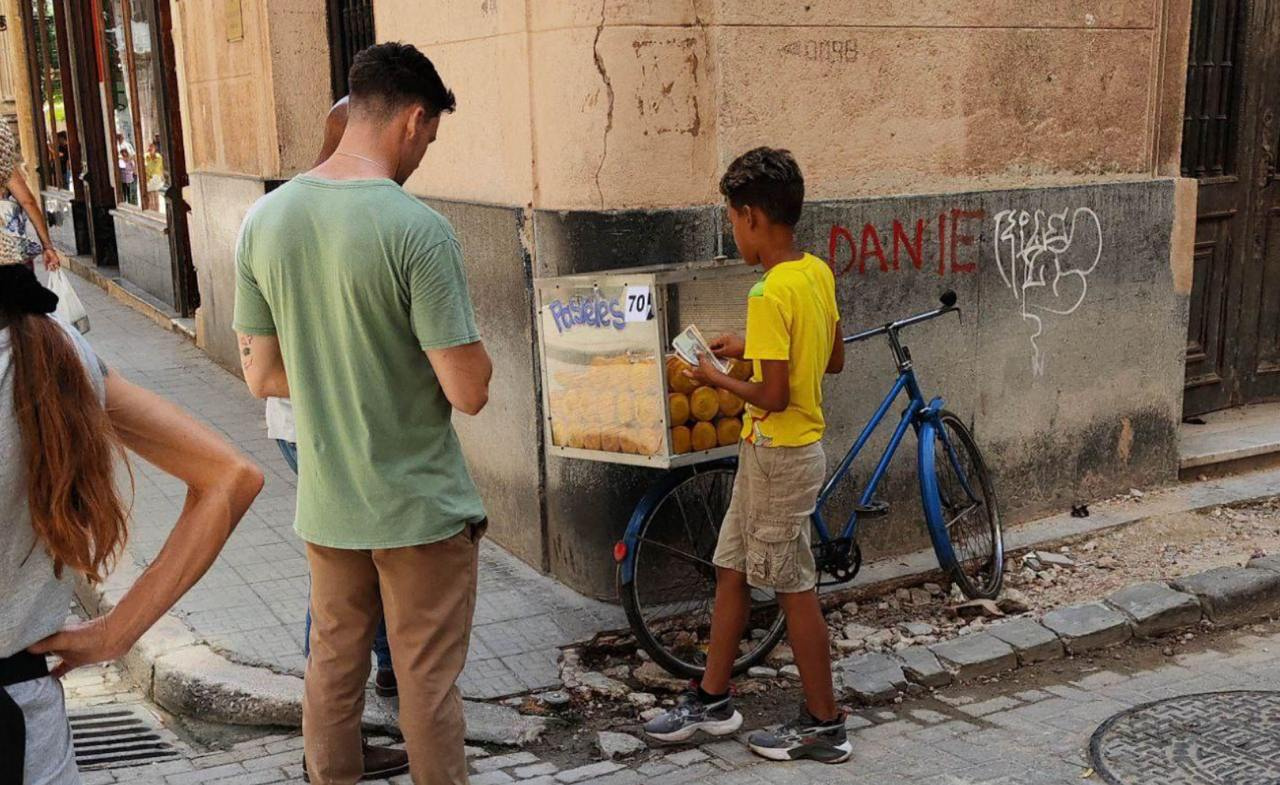
“Although No One Wants to Say It Out Loud, Child Labor Exists in Las Tunas”

‘Periódico 26’ claims that cases in the province are few and that there is no “crisis.”

File photo of a boy selling candy on Obispo Street in Havana. / 14ymedio

14ymedio bigger 14ymedio, Havana, 11 April 2025 — Sharply, but cautiously, Periódico 26 admits: “Although one might not want to say it out loud, child labor exists in Las Tunas.” The statement is part of a lengthy report, published this Friday in the Communist Party newspaper in that province, in which complicit parents and exploited children appear, and in which there is only one “hero”: the authorities.

“Addressing this issue doesn’t mean there’s a crisis in Las Tunas,” the newspaper insists from the outset, but the testimonies it gathers show a different reality. The article begins with the story of Pablo, a 16-year-old boy who works as a coal miner, even though the law sets the starting age at 17.

In his case, the problem isn’t the months separating him from legality, but the fact that “he learned the trade from the moment he opened his eyes.” Now, it’s “the main source of income that puts the food on the table” in his house.

His story is one of the most common. Families, driven by poverty, allow and sometimes encourage children to take up a job that can contribute to the family economy, even without knowing they are committing a crime, explains Daisy Torres Álvarez, chief prosecutor of the Family Protection Department.

Not all cases, however, are so “innocent.” “It’s shocking and outrageous that behind the little boy who sells bread in the neighborhood is a 35-year-old mother, physically and mentally fit, who lives off the ’invention’ because she can’t find a job and prefers to ’starve to death’ rather than work for the state,” the newspaper criticizes. continue reading

The presence of teenagers on the streets selling everything from food to electronics has raised some alarm.

In recent years, the presence of teenagers on the streets selling everything from food to electronics has raised a certain amount of alarm, the authorities acknowledge. “It’s good for children to be hardworking and diligent from an early age, but be careful. A few days ago, I came across a little boy on the street selling tamarinds with his mother. That’s child labor,” warns Juan Miguel Barrios, deputy director general of education in the province.

In any case, although poverty reigns supreme on the island, authorities maintain that families are primarily responsible for caring for their children.

“Some parents have allowed themselves to be dragged down by the shortcomings and complexities, but there’s no need to drop out of school or have children with work obligations,” the judge argues. In their favor, she adds, parents have the support of the State, which guarantees financial assistance for families in similar situations. However, even Periódico 26 is aware of the Cuban government’s limits and offers a caveat: “We know, it’s not an amount that will make all hardship disappear, but it does alleviate it.”

The authorities claim to have everything under control and have found a solution for each case, even if it’s often not ideal: “There were some teenagers who didn’t go to school because they had to help their families with the farm, and we met with the parents, agreed on days and times, and they returned to classes. Everyone wins.”

For readers who found the article on Facebook, the situation doesn’t seem as ideal as the media outlet claims. “And the children in Havana begging for money at traffic lights. There’s one every day at the 124th St. in Marianao. The children in Old Havana begging tourists for money. Oh, and if they check the girls who are prostitutes. It’s horrible. How far will we go? They’ve had to grow up too fast,” laments one internet user at the bottom of the post.

The authorities claim to have everything under control and to have found a solution for each case, although it is often not ideal.

Others took their criticism further: “ Periódico 26, better that you say that as a society we’re swimming in shit. So I ask myself, what kind of financial aid is supposedly being provided? How can you talk about the education system when classes often aren’t even held due to a lack of teachers?”

This is not the first time the official press has discussed child labor on the island. In June 2024, Sierra Maestra published a note acknowledging its existence and attributing it to the “complexity of the country’s economic context.”

Before the government’s attention, independent media had already focused on the problem, which is often disguised as “housework” and minor responsibilities that children are given at the social and family levels, even though they are not appropriate for their age.

Barely a month after the Sierra Maestra report, 14ymedio reported on the appearance of children begging for food or alms in the doorways of restaurants and stores in Havana and Holguín. A look at these cases, or any of those reported by Periódico 2 , reveals the connection between children forced into the labor market and a country where poverty is rampant.

____________

COLLABORATE WITH OUR WORK: The 14ymedio team is committed to practicing serious journalism that reflects Cuba’s reality in all its depth. Thank you for joining us on this long journey. We invite you to continue supporting us by becoming a member of 14ymedio now. Together we can continue transforming journalism in Cuba.

Former Miami Mayor Tomás Regalado Affirms that Radio Martí is Still ‘Indispensable to the Cuban People’

The former mayor of Miami is confident the station can continue broadcasting, despite a “restructuring.”

For Regalado, the future of Radio Martí is linked to strengthening its journalistic content and its presence on digital platforms. / EFE

14ymedio biggerEFE (via 14ymedio) Ivonne Malaver, Miami, 8 April 2025 — Former Miami Mayor Tomás Regalado asserted that Radio Martí continues to fulfill its original purpose of promoting freedom in Cuba, and rejected criticism that its existence responds solely to the interests of Cuban exiles in the United States.

In an interview with EFE, Regalado emphasized that Radio Martí will not disappear as a result of the cuts imposed by President Donald Trump, considering that stations like this one are essential to promoting press freedom globally.

“I think there will be a restructuring, but it will remain up in the air. I think the United States realizes it needs to have a voice, that they can’t speak for it,” he explained. Regalado, who also served as director of the Office of Broadcasting to Cuba (OCB)—responsible for operating and supervising media outlets targeting Cuban audiences—affirmed that Radio Martí continues to fulfill its original purpose. continue reading

Regalado insists that Radio Martí continues to fulfill its initial purpose.

“Radio Martín was created in the 1980s, at the request of the Cuban exile community, by President Ronald Reagan and the then-Congress. It was said to be the instrument to bring the truth to the Cuban people,” recalled Regalado, 77, who was born in Havana and served as mayor of Miami from 2009 to 2017. “It has always served to guide, inform, and entertain the Cuban people,” he added.

Regalado said that during his tenure at the OCB, during the first Trump administration (2017-2021), he commissioned a survey from the U.S. Embassy in Havana that confirmed the station’s high audience level in Cuba, especially in rural areas.

“That’s why the regime has acted with such rage” and has demanded its closure as a condition for improving relations with the United States, said the now Miami-Dade County property appraiser.

In the face of the criticism that Radio Martí only responds to Cuban exiles, Regalado emphasized that although he has politically supported the station, the priority has always been to give a voice to the opposition within Cuba.

He recalled that at one point they had more than 100 dissidents participating weekly. “In fact, the participation of leaders from the Cuban exile was minimal because they understood that the priority was for the Cuban people to speak to the world,” he added.

He also refuted the perception that the station doesn’t connect with younger generations. He noted that during his administration, they incorporated popular musical content banned by the regime and broadcast Major League Baseball games, which had a huge impact because baseball remains a national passion in Cuba, he stated. The criticisms, he said, are a misguided narrative, promoted largely by the Cuban regime itself.

The criticisms, he said, are a misguided narrative, promoted largely by the Cuban regime itself.

Asked about a possible closure, Regalado stated that “Radio Martí will not cease broadcasting” because Congress and the State Department, led by Cuban-American Secretary of State Marco Rubio, are aware of its importance. He admitted he was concerned when employees were recently sent home, but recalled that in less than a week and a half, they were called back, the transmitters were reactivated, and regular programming was back on the air.

The former mayor of Miami ignored the fact that the workforce has been severely depleted, with only about 50 federal employees returning, while contractors—at least 20 of them— have had their contracts terminated, including technicians .

For Regalado, the future of Radio Martí is linked to strengthening its journalistic content and its presence on digital platforms. It’s not about criticizing governments, but rather telling the truth and letting the people judge, he explained.

He also highlighted the station’s growth on social media, where it generates “millions of views,” especially at key moments like the July 2021 protests in Cuba.

Regalado considers his greatest achievement as director to be rekindling enthusiasm for the station among younger generations with modern history programs. They shared visual content about Cuba’s past on social media, and that, he said, fascinated many young people who were unaware of that past.

“There were young Cubans who didn’t know that Cuba was the first country in Latin America, after the United States, to have television,” he said.

The former director believes that, despite the technological and political transformations in the US, Radio Martí must continue its mission because “it is essential for many people, millions in Cuba, to be informed.”

____________

COLLABORATE WITH OUR WORK: The 14ymedio team is committed to practicing serious journalism that reflects Cuba’s reality in all its depth. Thank you for joining us on this long journey. We invite you to continue supporting us by becoming a member of 14ymedio now. Together we can continue transforming journalism in Cuba.

Cuban Singer ‘Ovi’ is Willing to Pay $5 Million for Residency in the US

Ovidio Crespo dropped out of university and the island in 2017

“If Donald Trump wants to deport me, I’ll buy him a Gold Card,” said Cuban singer ’Ovi’. / Instagram

14ymedio bigger14ymedio, Havana, 11 April 2025 — “If Donald Trump wants to deport me, I’ll buy him a Gold Card.” This was the message Cuban singer Ovidio Crespo, known as Ovi, posted on Instagram to avoid deportation from the United States. This is the alternative the U.S. government launched last February: the ability to obtain residency in exchange for an investment of $5 million.

Although Ovi doesn’t have a deportation order, he does have a criminal record. According to the Laken Riley Act, the singer’s criminal record would be an aggravating factor for his deportation from the country. Last September, Ovidio Crespo was arrested in Miami. He was charged with possession of illegal substances, carrying a revolver, and armed assault. He was released after posting $8,000 bail. On that occasion, his lawyers prevented the singer’s deportation.

Crespo also has a history of other offenses. In March 2022, he was arrested for domestic violence. He was released after posting $1,500 bail. Four months earlier, in December 2021, he was arrested after getting into a fight with fellow countryman, reggaeton artist Manny La Figura, outside a jewelry store in Miami.

Ovi arrived in the United States in 2017 after a 25-day journey. / Instagram

The alternative proposed by Trump generated controversy. “The proposal has the form and flavor of a golden passport program,” reported Fortune. The same edition emphasized that in Europe, “some countries have continue reading

successfully used this system to sell the rights and benefits of EU citizenship.” However, it warned that it runs the risk of “accepting payments with minimal scrutiny, exposing oneself to the risks of corruption and money laundering.”

An Al Jazeera investigation revealed that an investment of more than €2,000,000 ($2,266,693) in Cyprus secured EU citizenship for at least 30 people with pending criminal charges or convictions, as well as 40 politically exposed persons. Faced with the evidence, Cyprus canceled the program in 2020 and Bulgaria did so in 2022.

Ovi, who dropped out of the University of Medical Sciences in Havana, left the island in 2017. The singer began his journey through Ecuador and after 25 days arrived in the US and began his dream of making music. Two years after his arrival, he became a household name for his musical performance with Adriel Favela and Yendi on the song “Cuando me ve.”

The Rancho Humilde record label boosted his career and with the songs Se me dio, Bailen and Pacas verdes he has achieved a place as an exponent of the so-called corridos tumbados, reggaeton and Latin trap.
____________

COLLABORATE WITH OUR WORK: The 14ymedio team is committed to practicing serious journalism that reflects Cuba’s reality in all its depth. Thank you for joining us on this long journey. We invite you to continue supporting us by becoming a member of 14ymedio now. Together we can continue transforming journalism in Cuba.

Fernando Dámaso, the Blogger Who Left the Cuban Army After Ochoa’s Execution, Dies in Havana

Author of the blog ‘Mermelada’, he was an expert in republican history and a contributor to the independent press.

In several interviews, Dámaso pinned Cuba’s future on the tension between dogmatists and pragmatists. / Facebook/Fernando Dámaso

14ymedio bigger14ymedio, Havana, 11 April 2025 — Born in 1938, a Sagittarius, a former Piarist student, a former military officer of the regime, and a writer passionate about Cuba, literature, sports, and cinema: this was the calling card of Fernando Dámaso, once one of the most active authors on Cuban topics on the Internet. He died at 8:00 a.m. this Friday at the age of 87, in Havana.

His wife, Rebeca Monzó, confirmed the death of the man who was also, for a time, a contributor to 14ymedio and Diario de Cuba. Familiar with the inner workings of the Army, he rose to become a colonel in the Armed Forces under the command of General Ulises Rosales del Toro, one of the men who held the reins of Cuban troops in Africa.

After the execution of Arnaldo Ochoa and three others implicated in the notorious Case 1 in 1989, Dámaso resigned from the Communist Party and the Armed Forces. His protest cost him dearly. He was not only sanctioned, but also subjected to a ban on the pretext—applied to all high-ranking Cuban military personnel who deserted —that he might reveal secrets to the “enemy.”

By then, Dámaso had accumulated several military “missions” in Africa on his service record, a period in his life about which he preferred to remain discreet. continue reading

Dámaso had accumulated several military “missions” in Africa on his service record, a period in his life about which he preferred to remain discreet. 

In Mermelada, his blog – active until 2020 – Dámaso addressed a myriad of topics, from the politics of both sides to the history of the island. From that space, he repeatedly criticized the regime, always with calm arguments and expressed ironically, especially in the form of comments on the official press. [Selections from Mermelada in English are here.]

He also published Mapa perdido de La Habana (Lost Map of Havana) with Hypermedia Ediciones, which compiled some of his historical and cultural texts, exploring the character of the capital through the origins of its emblematic streets and corners. He was an expert on culture and politics during the Republic, chronicling its “buried history.”

In several interviews, Dámaso pinned Cuba’s future on the tension between dogmatists and pragmatists, two extremes of the nomenklatura who, he believed, would enter into a definitive confrontation when the so-called historic generation, beginning with Fidel Castro, was dead and buried. He lived to see that Castro’s death did little to shake the foundations of a dictatorship that made “continuity” its watchword.

When questioned by media outlets around the world, he invited caution and urged against underestimating the military-based structure on which the leader had built his dominance over Cubans. Change would not be “imminent, not even close,” he predicted back in 2017, at least as long as Raúl Castro continued to dictate the country’s course from his retirement.

Regarding the possibility of change, he did venture at least that it would be carried out by “someone who will emerge from the process, someone no one knows today.”

Translator’s note: This is the first personal note I have added to a post on this project. From the beginning of my translating, Fernando and Rebeca’s voices were among my most treasured; cogent, gentle and calm.  How I wish I had met them. Perhaps in some yet unimagined future I can still meet Rebeca. Safe travels my friends. May my work here continue to honor you and your lives.