Martha Beatriz Roque Returns to Cuba Despite the Regime’s “Terrible Hatred” for Her

“They bet on me staying in the United States.”


The opposition leader expressed her willingness to return to the country, fully aware of the seriousness of the situation. / 14ymedio

14ymedio bigger14ymedio, Havana, 2 May 2025 — Martha Beatriz Roque returned to Cuba this Thursday from the United States, where she had been undergoing medical treatment since February, after an unsuccessful stay in several hospitals on the island. A human rights activist and one of the most outspoken critics of the regime, her delicate state of health has not prevented her from returning to her country, which is immersed in a new wave of repression against long-standing dissidents.

Waking up early in Havana, Roque explained to 14ymedio that she had “quite a few difficulties” entering the country, though she didn’t go into details. Somewhat weak and fatigued from the trip, she affirmed that she hasn’t lost one iota of her will to be, think, and speak in Cuba.

“I was born in Cuba, and in Cuba I have to live,” she states emphatically. “Many people are shocked.” State Security detained her at the airport. “They explained to me that they wouldn’t allow me to do anything, as always: a warning.” She claims she has a medical treatment program from the US that she must comply with on the island, despite all kinds of restrictions.

She completely denies the rumor that she returned to the country “to complete some paperwork.” “I’m going to return to the US whenever I deem it appropriate,” she clarifies. She has part of her family in that country. On the island, she will continue to work tirelessly, she emphasizes. “All the strategies the dictatorship has used to persuade me not to return to the opposition have had no influence on me.” continue reading

Now, one of her problems is getting her house in the Havana neighborhood of Lawton ready, it having been completely closed up during her trip. For now, she prefers to recover from the trip and enjoy some tranquility before giving interviews or making statements about what’s happening in the country.

This week, two prominent regime opponents—José Daniel Ferrer in Santiago de Cuba and Félix Navarro in Matanzas—were arrested again just months after being released from prison, thanks to negotiations between the Vatican and Havana. In a police operation, supported by televised statements from the Supreme Court, political police agents ransacked Ferrer’s home during his arrest and handcuffed Navarro as he went to see his daughter, Sayli, also a political prisoner.

In an interview with the Recate Jurídico Foundation shortly before her return to Cuba, Roque addressed this situation and expressed his willingness to return to the country, fully aware of the gravity of the situation. “The island is in a very difficult situation, not only politically but also economically and socially. I would like to spend some time there so I can personally experience what is happening,” he said. For Roque, this is a State Security operation against dissidents “who are capable of reaching out to the people, of expressing themselves.”

She also explained that her recovery has been slow. “I feel fine and plan to return to Cuba. I’ve already bought my ticket.”

She also explained that her recovery has been slow. “I feel fine and plan to return to Cuba. I have already booked a ticket,” she told the Foundation bluntly. “I don’t think I’ll be welcome on the island. They were banking on me staying in the United States, but they know very well that I’m not going to stay there.”

She opened the possibility of visiting the United States for medical reasons, but only for “a month or two,” before returning immediately. “I have my home in Cuba,” she concluded. “I have spent many years trying to free the country from communism.” With some bitterness, she predicted that Cuba will not experience any change for the time being due to many “interests,” both internal and external, that tend to maintain the status quo .

On the verge of turning 80, Roque experienced a moment of extreme sadness in February, when several organizations expressed their willingness to support her in the hospital. Finally, taking advantage of a slight improvement, she traveled to Florida to recover her health.

Nominated for the Nobel Peace Prize in 2007 and recipient of countless awards, Roque was the only woman among the group of 75 Cubans arrested during the so-called Black Spring of 2003 and sentenced to long prison terms.

In 2024, the ” woman most hated by the regime” was one of 14ymedio’s faces of the year. At the time, the newspaper celebrated the presentation of the Woman of Courage award, which the US government grants to those who “have demonstrated exceptional courage, strength, and leadership in defending peace, justice, and human rights.” Roque, however, was unable to attend the Washington ceremony because she was on medical leave at the time.

At that time, she repeated to 14ymedio a phrase that reflects her work promoting democracy over the past 35 years and its impact on the regime: “The hatred they have for me is terrible.”

See also Wikipedia

____________

COLLABORATE WITH OUR WORK: The 14ymedio team is committed to practicing serious journalism that reflects Cuba’s reality in all its depth. Thank you for joining us on this long journey. We invite you to continue supporting us by becoming a member of 14ymedio now. Together we can continue transforming journalism in Cuba.

Cuba Seeks Foreign Investment To Enter the Lucrative Plasma Business

Historically, the Cuban government forced prisoners sentenced to death to donate blood, in order to “feed” the island’s blood banks

Workers at Laboratorios Aica, a subsidiary of BioCubaFarma. / Laboratorios Aica/Facebook

14ymedio bigger14ymedio, Havana, 30 April 2025 — Aica Laboratories, one of the jewels in the BioCubaFarma group’s crown, announced that it is open to foreign investment to boost the manufacturing of blood-derived medicines. The project, which is seeking a “risk investor” to finance it, includes the construction of a plasmapheresis center. If successful, Cuba will enter the lucrative business of extracting and marketing plasma and its derivatives.

Although they are related procedures, extracting plasma from the human body is not the same as extracting blood. Plasma—the viscous substance left in the blood after removing red and white blood cells, composed of 92% water and the rest proteins, fat, oxygen, and other substances—is used to manufacture medications, following the artificial separation process known as plasmapheresis.

John Wilber Arrazcaeta, director of Aica, assured the official press that they have obtained government permission to open up to foreign financing because the country lacks the necessary funds to sustain an industry of this magnitude and complexity.

He briefly discussed the differences between blood and plasma donations and stated that his company aims to return the red blood cell concentrate to the donor after plasmapheresis. This is relevant information, given that while the body can recover lost plasma within 48 hours, red blood cell continue reading

regeneration takes about eight weeks.

While the body can recover lost plasma within 48 hours, red blood cell regeneration takes about eight weeks. 

According to Arrazcaeta, the process involves “high costs,” especially when it comes to obtaining plasmapheresis kits—which typically contain needles, syringes, reservoirs, and other items—which cost between 30 and 50 euros in Spain.

The potential opening of a plasmapheresis center in Cuba raises multiple questions. Arrazcaeta states that “the investment will be recovered through the sale of the plasma obtained,” a statement that assumes the existence of donors on the island. However, he does not explain how much AICA will pay donors—a common practice in the plasma business—or whether it will pay them at all for the “marketable plasma standards” it aspires to.

A company with vast experience in the field, such as the Spanish company Grifols, makes it clear that compensation for donating plasma is essential, given the enormous profit a company makes from this substance, in addition to its significant importance in the production of blood products. In the case of Grifols, each donor is given a credit card, into which funds are deposited based on the amount of plasma donated and the frequency of donations.

The official newspaper Granma did not raise any of these issues with Aica Laboratories, although it concludes its article with a sort of declaration of principles: the Cuban biotechnology industry operates in “full alliance” with the Ministry of Public Health, a “coordinated” effort that in practice translates into subordination.

BioCubaFarma is not immune to the multisectoral crisis affecting Cuba, which is having a brutal impact on the pharmaceutical and healthcare sectors. The business group must deliver to the Public Health Department “medicines, reagents, diagnostic systems, among other products” which it lacks the resources to produce.

The business group must deliver to Public Health “medicines, reagents, diagnostic systems, among other products.”

At two recent international events—the Health for All Trade Fair and the 5th Cuba Health 2025 Convention—its executives have reminded participants that the company is seeking partners interested in investing in the Cuban biopharmaceutical industry. The obstacle, they claim, is Washington, whose sanctions scare away suppliers.

Venture capitalists who decide to invest in BioCubaFarma must be prepared to offer “significant capital investments,” commensurate, according to health officials, with the “highly innovative products” Cuba plans to launch, including blood products.

The topic of blood donation has traditionally been one of the most controversial when it comes to health care in Cuba. A report by Archivo Cuba from a few years ago, which stated that the regime had forced political prisoners to donate blood and then sell it, highlighted the historical and political repercussions of the issue.

The Archivo Cuba investigation, led by María Werlau, argues that since at least 1961, the Cuban government has forced prisoners sentenced to death to donate blood, in order to “feed” the island’s blood banks. According to a quote from Castro cited in the report, Fidel Castro said that year: “The blood of these traitors is extracted before execution to save the lives of many.”

This quote, however, does not appear in any of Castro’s speeches—as Archivo Cuba admits—and is only cited in the book Diario de una traición: 1959 (Diary of a Betrayal: 1959 ) by Leovigildo Ruiz. The organization also proposes interpreting another phrase literally, this one compared with the leader’s speeches: “We are willing to give the people of Vietnam not just our sugar, but our blood, which is worth much more than sugar!”

Following further investigations, Archivo Cuba concludes that 31 prisoners – 28 Cubans and 3 Americans – were forced to donate blood between 1960 and 1964, before their executions.

In any case, the situation posed by BioCubaFarma’s announcement this week is radically different. And the problems it brings are not historical, but current: empty blood banks, patients who must obtain blood abroad for surgical procedures, and a healthcare system in total crisis.

____________

COLLABORATE WITH OUR WORK: The 14ymedio team is committed to practicing serious journalism that reflects Cuba’s reality in all its depth. Thank you for joining us on this long journey. We invite you to continue supporting us by becoming a member of 14ymedio now. Together we can continue transforming journalism in Cuba.

Eduardo López-Collazi, Scientist and Writer Who Left Cuba ‘To Be Free’

The Elena Fortún Library was packed with a broad ranging audience./ 14ymedio

14ymedio bigger14ymedio, Yunior García Aguilera, Madrid, 26 april 2025 – “I left Cuba to be free”, Eduardo López-Collazo said on Saturday in Madrid at the launch of his first novel, ’Narcisos’. After thirty years in Spain his life has become an example of personal and professional realization, combining rigorous investigation with creativity, a passion for the arts and literature, scientific dissemination and activism to promote diversity and inclusion.

On account of this, the psychologist and neuroscientist Ana Asencio wondered: “How can so many lives fit into one single body?” López-Collazo himself rebels against the insistence, in certain sections of society, for always classifying or pigeonholing people with one single label. It’s a long time since he decided to come out of all the closets: he stopped signing his cultural critiques with a pseudonym, and in his LinkedIn profile he stopped hiding the fact that he wrote about dance in El Cultural. He’s not worried that they call him a twenty-first century Renaissance man.

The amazing thing is that this Cuban, born on 3 July 1969, in Jovellanos, Matanzas, manages to do it all “like crazy”. He graduated as a nuclear physicist from the University of Havana, a city in which, in his own words, he was “hungry and homeless”. In Spain he got his doctorate in pharmacology at the Complutense University of Madrid and ended up running, over the course of a decade, the biggest centre for scientific investigation in the Spanish capital. The impact of his work has been recognised by Forbes, El Mundo and El Español, all of which have described him as one of the most influential people in the country.

Narcisos presents us with the lives of eight men through the eyes of Carmen, a psychologist who will go on to have a journey of self discovery over the course of the narrative. The author describes the novel as a search for understanding “who we are when nobody is looking at us, not even ourselves”. The work is dedicated to his lifetime companion Holden, with whom he discussed the evolution of many of his characters. continue reading

[The filmmaker and writer Carlos Lechuga, charged with presenting the book, described its cinematic potential

The filmmaker and writer Carlos Lechuga, charged with presenting the book, described its cinematic potential. The reader will be able to confirm this immediately, thanks to the fluidity of the dialogue and the richness of the images transmitted through its pages.

Although this is the first novel he has had published – by Mayda Bustamante and Ediciones Huso – it is in fact the third one he has written. The previous two are very personal and it might take a little more time for them to see the light of day. Nevertheless, anyone who has followed his work, including his most scientific texts, will recognise the ease of his writing. It’s not for nothing that El País included one of his titles in their list of “books with an unsettling theme that are a pleasure to read”.

When questioned about whether there exists a battle between the rigour of science and the chaos of creativity, López-Collazo replied that he always looks for freedom. Naturally, he’s a firm believer in discipline: he admits that on occasion he sometimes found himself counting the number of words that he’d ascribed to each of his characters in order to achieve perfect equilibrium. “But without freedom”, he confessed, “growth is lateral, never upwards”.

It’s no surprise that the Elena Fortún public library was packed with a broad ranging audience, many of them standing, to be witness to this presentation. Among those present were the singer-songwriter Liuba María Hevia, the Nobel Peace Prize winner Carlos Umaña, the former Vice Mayoress of Madrid Begoña Villacís and the dancer María Pagés, worthy winner of the Asturias Prize for Princess of the Arts. And many others, who, when it was all over, rushed to buy the book – in which some of the characters are real… and others are too.

Translated by Ricardo Recluso

____________

COLLABORATE WITH OUR WORK: The 14ymedio team is committed to practicing serious journalism that reflects Cuba’s reality in all its depth. Thank you for joining us on this long journey. We invite you to continue supporting us by becoming a member of 14ymedio now. Together we can continue transforming journalism in Cuba.

The Private Sector, Key to the Egg’s Return to the ‘Basic Basket’ in Cuba

In Ciego de Ávila, production went from 120 million annually in 2016 to just 16 million currently.

The alliance between a state company and private producers is giving results in Ciego de Ávila / Cubadebate

14ymedio bigger14ymedio, Havana, 2 May 2025 — In the last decade, the debacle of egg production in Ciego de Avila, according to official press reports, has been “brutal.” From reaching a maximum of 120 million units in 2016, the province barely reaches 16 million currently, five million less than it needs to meet local demand. The disastrous figures were exposed by the authorities last Wednesday to Miguel Díaz-Canel, who predicted that “the time will come when we can offer them again for the [family ration] basket.”

The hope of the president seems to be placed in a new mode of business of a poultry company in the province that resorted to private sales after being shut down eight months for lack of feed. The deal, explains the newspaper Invasor, is that the private part rears the hens and guarantees production, of which it delivers 36% to the state company. Feed is obtained from Tabacuba, which pays for the feed in meat, eggs or freely convertible currency (MLC).

The media does not explain why Tabacuba did not deliver feed to the poultry company in exchange for payment, without the need for mediation by the private producer, but the answer seems to be in the chronic lack of resources and money of state institutions. With private individuals, Tabacuba has a better chance of getting payments on time and not having to deal with debts. continue reading

“We will be able to overcome all the decline that we have suffered in the production of eggs, which is an important protein for the population”

“We will be able to overcome all the decline that we have suffered in the production of eggs, which is an important protein for the population, through these links with the non-state sector,” said Díaz-Canel.

Aware of the unattainable price of eggs on the Island, and that they are easier to find in a MSME or a small dollar market than in a ration store, the representative gave even more importance to the success of the company: “There came a time when we did not have eggs. Now, they are sold both in foreign currency and in national currency, but in the end, the price goes down, and as this system continues to advance, production and sales will continue to grow”.

Apparently, by “linking” to the poultry company nothing bad happens. Profits exceed 3 million pesos, and it has managed to give its 24 workers benefits that have increased their wages to between 14,000 and 23,000 pesos. However, a carton of 30 eggs in the neighboring province of Sancti Spíritus is around 2,100 pesos, according to the market data from 14ymedio, between 9% and 15% of these wages.

At the end of 2024, the Ministry of Agriculture revealed a catastrophic decline in the population of laying hens from 8 million to 3 million in four years. Egg production, reduced by the lack of feed, had fallen from 5 million units per day to a mere 1,200,000.

Cuba has started to rely more and more on imports in order to deal with the demand for eggs

Cuba has begun to rely more and more on imports in order to deal with the demand for eggs. Although it is known that both Colombia and the Dominican Republic have exported eggs to the island, imports from “sister countries” such as Mexico also appear in the foreign currency markets and in the informal market.

There is also the question of whether all poultry companies in Ciego de Ávila are doing as well as the one visited by Díaz-Canel, who criticized producers for “drooling” while waiting for state aid.

The head of state, who seems to have noticed that problems are “solved” by his presence – at least for the duration of the government visit – encouraged the authorities to monitor agricultural production more closely and to visit the municipalities to see that good work is being done. And he promised, “See you in a month”.

Translated by Regina Anavy

____________

COLLABORATE WITH OUR WORK: The 14ymedio team is committed to practicing serious journalism that reflects Cuba’s reality in all its depth. Thank you for joining us on this long journey. We invite you to continue supporting us by becoming a member of 14ymedio now. Together we can continue transforming journalism in Cuba.

Mexico Proposes Employing Migrants, Including Cubans, on Public Works Like the Maya Train

The state government of Chiapas has launched two programs to provide temporary employment to 890 people from other countries.

Deivy Gurrola, Cuban, wants to settle in Tapachula, Chiapas / EFE

14ymedio bigger14ymedio, Ángel Salinas, Mexico City, 22 April 2025 — The municipal president of Tapachula, in the Mexican border state of Chiapas, Aarón Yamil Melgar Bravo, has proposed that migrants from Cuba, Venezuela and Haiti who are stranded in the municipality be employed in different public works and factories. Among them, mentioned to EFE, was the Maya Train, the Interoceanic Corridor.

According to the official, the state has almost 400 hectares available for industrial projects that promote trade between the Pacific and the Atlantic, and between North and Central America. The migrants, Melgar Bravo told the Spanish agency, could be inserted into the crews for “the completion of the train tracks connecting the Isthmus of Tehuantepec to Puerto Chiapas.”

The municipal president has specified that the migrants “will be able to remove the containers from the boats and take them to the trains. Obviously, the other branch of the railway tracks is going to go to Suchiate (the border with Guatemala).”

However, the recruitment process has not yet started, and no date is set in the near future, as the Cuban Yumili Acosta told 14ymedio. Last February she joined the three-month temporary program that the government of Chiapas promoted for 500 migrants, most of them with asylum procedures continue reading

before the Mexican Commission for Refugee Assistance (COMAR).

Cuban Anaeliet Salgado is part of one of the temporary employment programs in Tapachula / EFE

“In May the program ends, and we were told that we would have to wait. Everything depends on their budget. If the money doesn’t arrive, the program will end,” says Acosta, 27, who has received 1,250 pesos ($61.59) per week for five-hour days from Monday to Friday.

Cuban Yaniel Ponce de León, who is also part of the group that sweeps streets, collects garbage and paints public spaces, says that “the municipal president of Tapachula says the money is not certain. I was told (by officials) that it is more for Guatemalans.”

Between February and March, the state of Chiapas promoted two temporary employment programs for migrants, opening 890 places during this period. The most recent is for fumigators to stop the spread of diseases such as dengue, malaria, zika and chikungunya.

Each of the 390 migrants is paid a salary of just over 2,300 pesos every two weeks, less than the average wage of 3,350 that a worker receives. In addition,  they do not have medical services or other benefits stipulated in the Federal Labour Law such as the payment of utilities, a savings fund and food vouchers.

Despite the unfavorable working conditions, for the Cuban Deivy Gurrola, the possibility of having a job is an incentive: “I could rent a room and support myself here in Mexico, because yes, we want to live cheaply, and we will work in able to afford that,” she told EFE. She also wants  the Mexican authorities to encourage a regular stay for those who wish to work on these projects, “so they can find work quickly in established factories and companies.”

Translated by Regina Anavy

____________

COLLABORATE WITH OUR WORK: The 14ymedio team is committed to practicing serious journalism that reflects Cuba’s reality in all its depth. Thank you for joining us on this long journey. We invite you to continue supporting us by becoming a member of 14ymedio now. Together we can continue transforming journalism in Cuba.

New Party Leader in Las Tunas, Cuba: ‘The People Can’t Eat Explanations’

Osbel Lorenzo pointed out that only a third of the “production plans” in the province were implemented.

Osbel Lorenzo Rodríguez, secretary general of the PCC, scolded the executives of state-owned companies. / Cubadebate

14ymedio bigger

14ymedio, Madrid, 30 April 2025 — The arrival of the Party’s first secretary in Las Tunas will be hard to forget. Osbel Lorenzo Rodríguez, who assumed the position just a month ago, didn’t mince his words in his first analysis of the province’s economy. “People can’t eat explanations,” he retorted, “in response to the justifications of representatives of state-owned companies in this region for clearly failing to meet their production plans,” reported Periódico 26 this Wednesday.

The description of the province’s economic ruins is, however, less surprising than the leader’s forcefulness, who, while not missing the opportunity to blame the negative context on “external factors,” demanded that the executives find solutions. “No one is empowered to fail to comply for subjective reasons,” he retorted.

Among the biggest dramas unfolding was the agonizing sugar harvest. On a day when the Sancti Spíritus press was celebrating on its front pages because the Melanio Hernández sugar mill in Tuinucú had met its planned schedule, Lorenzo Rodríguez—also from Sancti Spíritus—lamented that sugar production in Las Tunas “will reach historic lows.” The company could see its targets saved thanks to the sugar cane syrup, but the concern is paramount, since the province had been entrusted with the largest production plan — 45,000 tons — which could “force the country to import the sweet grain and thus satisfy minimal domestic demand.”

All of them are doing poorly “without this being attributable to the commercial and financial siege.”

Lorenzo Rodríguez referred to the “slow economic recovery” and listed sectors such as certain crops, sheep and rabbit meat, and charcoal. All of these are doing poorly “without this being attributed to the commercial and financial siege,” the leader noted.

There was a lot for the new party leader to criticize, but the failure to execute 4% of the quarterly budget for social assistance took the cake. “We’re talking about money that must be spent efficiently, but without continue reading

unnecessary delays, because it benefits the most vulnerable segment of the population,” argued Lorenzo Rodríguez, who called the incident “incomprehensible.”

Data from the results analysis for this period, between January and March, indicate that only a third of the planned production was realized. “Simply put, this means that we can only touch with our hands one out of every three products or inputs that public entities forecast to have at the beginning of April,” the scolding continued.

In addition, an aggravating factor is that sales and retail trade remain stable, “an unequivocal sign that too many state-owned companies are still boosting their balance sheets with high prices; something that lines the pockets of their workers, but is terrible news for the economy of Las Tunas as a whole, because it perpetuates the vicious cycle of inflation and depressed supply,” he charged.

“They pale in comparison to the failure to deliver the agreed quantities of merchandise to be created, which are literally what people need.”

On the positive side, the official noted, are the balanced budget and the reduction in cash flow, but “they pale in comparison to the failure to meet the agreed quantities of goods to be produced, which are literally what people need.”

Although there are no figures, it has tentatively emerged that the private sector is the only one that meets the targets. “According to official figures, individual entrepreneurs, private companies, and cooperatives as a whole exceed the estimates made before the beginning of the year,” states the official press release, which nevertheless indicates that administrative measures and other sanctions have been taken against the non-state sector for violations of the regulations.

Lorenzo rose to his current position due to his “perseverance and determination to promote and recover decisive economic and social programs,” according to PCC officials at the end of March, when Walter Simón Noris, who had held the position for barely a year, was removed from office. The new 51-year-old secretary general faced the challenge of leading a province that the previous governor, Jaime Chiang —removed in December 2023—had declared “ungovernable.”

The latter was succeeded by Yelenys Tornet Menéndez, who joined forces with Lorenzo at the economic meeting to emphasize that physical production “is the key indicator and what makes the difference.” The governor requested that these issues be discussed immediately “in order to find solutions,” as serious problems remain, the most significant being non-payments, coupled with illegalities related to land use and livestock.

Las Tunas has recently stood out for serious problems that go beyond the economic and include uncontrolled dumping of trash, use of the drug known as ‘químico‘ [chemical], and violence. “The opinion of the people,” said Lorenzo, “is a barometer for measuring the efficiency of the management of the leaders and their connection with the people, especially in areas farthest from urban centers. And this popular judgment is showing that the connection between decision-makers and their constituents is not occurring as it should.”

The problem is inherited by the new cadres, as Simón Noris had already warned that the situation was such that in just one week, 300 crimes had been detected, most of them “felonies against state entities” in which members of the bureaucracy had participated. The provincial leader was also undeterred and called for firm action against corruption. “Police are not enough,” he said in early March 2024. He only lasted another twenty days in office.

____________

COLLABORATE WITH OUR WORK: The 14ymedio team is committed to practicing serious journalism that reflects Cuba’s reality in all its depth. Thank you for joining us on this long journey. We invite you to continue supporting us by becoming a member of 14ymedio now. Together we can continue transforming journalism in Cuba.

The Artist Otero Alcántara, Winner of the Vaclav Havel Prize for Creative Dissidence, Remains Imprisoned in Cuba

The leader of the San Isidro Movement shares the recognition with two creators from Syria and Russia, who were imprisoned in their respective countries.

Artist Luis Manuel Otero Alcántara, in a 2017 image, after being released from arbitrary detention. / 14ymedio

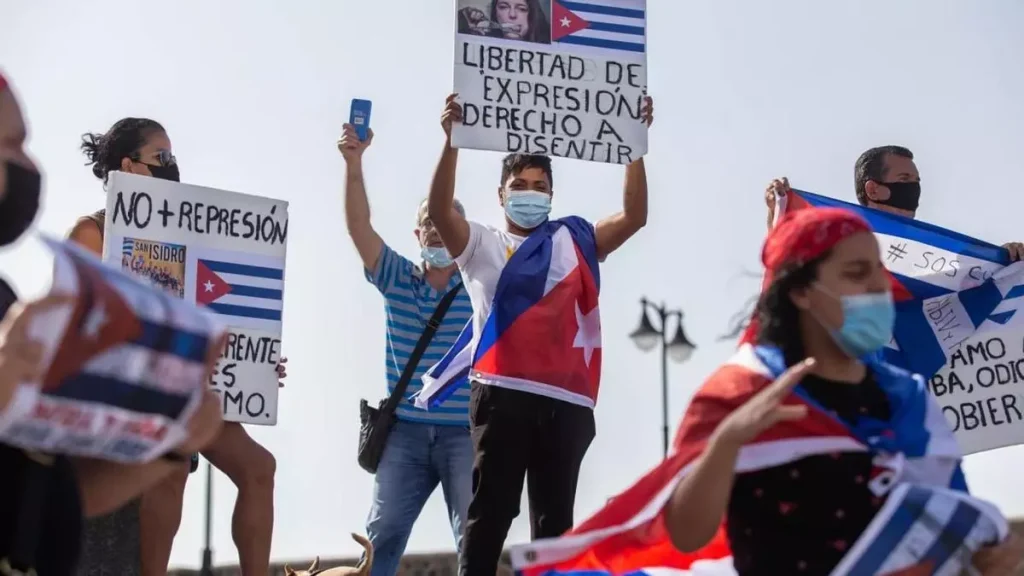
14ymedio bigger14ymedio, Madrid, 2 May 2025 — Luis Manuel Otero Alcántara is one of three recipients of the Vaclav Havel Prize for Creative Dissidence, which was announced Thursday. The artist, founder of the San Isidro Movement and a Cuban political prisoner, has been recognized for his leadership of this collective, which “emerged in 2018 to challenge censorship and demand greater freedoms in Cuba.”

The Human Rights Foundation and Oslo Freedom Forum, the organizations that award the prize, note in their statement that Otero Alcántara “gained international attention for his performance art and peaceful protests, including hunger strikes and symbolic acts of resistance.” They also note that his arrest occurred during the “historic protests in Cuba in 2021,” after which he was sentenced to five years in prison in a closed-door trial.

The organization also emphasizes that his imprisonment is considered arbitrary according to the opinion of the United Nations Working Group on this matter, and that the Cuban regime has been urged to release him immediately. Although not expressly stated, this is the same opinion held by independent organizations such as Amnesty International and Human Rights Watch, which have named him a prisoner of conscience. Despite this, Otero Alcántara has one year remaining on his sentence, which he is serving in the maximum security prison in Guanajay.

A post published on the artist’s official social media profile thanked the Human Rights Foundation for the recognition, noting that “it not only honors his courage and commitment to freedom of expression, but also highlights the fight for human rights in Cuba.”

The Cuban artist shares the honor this year with Syrian Azza Abo Rebieh and Russian Sasha Skochilenko. The former, who currently resides in Beirut, has portrayed in drawings and prints her time in Bashar al-Assad’s prisons, where she has been held for protesting against the Damascus regime since 2012. The latter, an artist, musician, and poet, was arrested in 2022 for distributing leaflets against the war in Ukraine in a supermarket and sentenced to seven years in prison for enemy propaganda. In 2024, she was released in an exchange and lives in Cologne, Germany.

Otero Alcántara is the third Cuban to be honored with the Vaclav Havel Prize for Creative Dissidence, which was previously awarded to Danilo Maldonado, El Sexto, in 2015, and Berta Soler, on behalf of the Ladies in White, in 2013. The list also includes two Venezuelans, two Iranians, and two Syrians, among others.

The Human Rights Foundation, a nonprofit organization that promotes human rights worldwide, founded this award with the endorsement of Dagmar Havlová, widow of the late poet, playwright, and statesman Václav Havel, to honor those fighting against dictatorships. Among its most well-known winners are Chinese artist Ai Weiwei, the Russian group Pussy Riot, North Korean democracy activist Park Sang Hak, Burmese politician Aung San Suu Kyi, and Nicaraguan cartoonist Pedro X Molina.

____________

COLLABORATE WITH OUR WORK: The 14ymedio team is committed to practicing serious journalism that reflects Cuba’s reality in all its depth. Thank you for joining us on this long journey. We invite you to continue supporting us by becoming a member of 14ymedio now. Together we can continue transforming journalism in Cuba.

Havana Carlos III Shopping Center Joins in on Cuba’s Dollar Fever

“Good morning, this store is now open only in foreign currency, cash or card,” warns an employee.

The Sport store previously operated in freely convertible currency (MLC) until its closure. / 14ymedio

14ymedio bigger14ymedio, Juan Diego Rodríguez, Havana, 30 April 2025 — The long-awaited dollarization has arrived at Plaza Carlos III with the opening this week of the first store operating exclusively in dollars within the well-known Centro Habana shopping complex. Upon arriving at the entrance to the Sport store, an employee greets customers with a clear warning: “Good morning, this store is now accepting only foreign currency, cash or card.”

Sport previously operated in freely convertible currency (MLC) until its sudden closure. Several employees confirmed to 14ymedio in March a change in its reopening: “It’s not a rumor, they’re going to change it to dollars very soon.” Although they didn’t know if the measure would affect the entire Carlos III complex or just certain locations, they explained that all cashiers were receiving training to operate the Clásica, a national dollar top-up card.

A couple of regular Sport customers told 14ymedio about their impressions: “When I was at MLC, I bought some shoes that were supposedly from well-known brands,” says Mario, “but when you read the fine print, they turned out to be Chinese copies. They lasted three or four months and then fell apart.”

With the reopening, she says little has changed: “The sweaters are faded; you can tell they’re made in Cuba, and they have no visible branding. The store just opened, and those stained and dirty sweaters cost $12.”

Sandra, his girlfriend, adds: “The sneakers are Italian brands, although unknown in Cuba, and cost $113. There are others, worse, that look like cheap imitations of those sold by some MSMEs [micro, small and medium-sized businesses]. The flip-flops are plastic.”

Dollarization is an active part of the current economic policy on the Island.
In October 2020, then-Economy Minister Alejandro Gil Fernández asserted that the MLC stores were a temporary measure and that the country’s strategy was not to dollarize. Now, in 2025, the minister’s exact whereabouts are unknown, but what is no longer in doubt is that dollarization is an active part of the island’s current economic policy.

Parliament, without the slightest hesitation in its own rhetoric, announced a “partial” dollarization in December 2024. To close out the year, it reopened the brand-new supermarket on 3rd and 70th Streets, where payments in Mexican pesos, much less Cuban pesos, are no longer accepted. As 2025 approaches, dozens of state-owned businesses across the country have joined the dollar fever, which shows no signs of being temporary.

The Clásica car—whose name evokes tradition—has been presented by Cimex on social media as “a financial product denominated in USD, designed to facilitate your transactions in the country.” It requires no minimum balance or predetermined amounts, offers a 5% discount for its use, and charges one dollar for each balance recharge transaction.

More stores in Carlos III are expected to adopt this approach, although customers aren’t confident that it will improve product quality. Mario and Sandra agree when talking about Sport: “It seems like a store without an owner. A ‘revolutionary’ attempt by the Carlos III chain to embrace dollarization. No one was there. But yes, right from the entrance they warn you that it’s in dollars.”

____________

COLLABORATE WITH OUR WORK: The 14ymedio team is committed to practicing serious journalism that reflects Cuba’s reality in all its depth. Thank you for joining us on this long journey. We invite you to continue supporting us by becoming a member of 14ymedio now. Together we can continue transforming journalism in Cuba.

continue reading

The Cuban Revolution Celebrates Its Agony This May 1st With a Lackluster Display

Tens of thousands of disaffected citizens were herded into a parade in front of Raúl Castro and President Díaz-Canel.

Decrepit, Raúl Castro and José Ramón Machado Ventura escort Miguel Díaz-Canel, wearing his tight-fitting national flag sweater. / Cubadebate

14ymedio, Juan Izquierdo/Juan Diego Rodríguez/José Lassa, Havana, 1 May 2025 — In ​​a city drowned in garbage, like Havana, you can march on all sorts of things this May Day. Papers, shells, cans, and even Cuban flags scatter beneath your feet. They are the best symbol of a parade where apathy is as common as the slogans, and whose zero coordinate is the giant “abrasion” in Revolution Square.

On the platform, at the feet of JoséMartí, in a Masonic pose—as designed by Batista’s architects—the regime’s top brass also wave small flags. Decrepit, Raúl Castro and José Ramón Machado Ventura escort Miguel Díaz-Canel, in his overly-tight national flag sweater. Manuel Marrero in garish red, generals in a dry olive green, sweaty guayaberas: the colors of Castroism.

A crowd that the official press estimates at “almost a million” also passes by, poses for a photo, and continues walking under the Havana sun. The nearly 30 degrees of steamy heat that plagues the capital today hasn’t stopped a small group of elderly military personnel, displaying a sort of vest covered in medals, from enthusiastically waving their portraits of Fidel.

A “worker” parades alongside a solemn poster of Fidel, but his shorts feature rapper Tekashi 6ix9ine. / 14ymedio

If May Day is good for anything, it’s for creating picturesque symbolic convergences: a “worker” parades alongside a solemn poster of Fidel, but his shorts feature rapper Tekashi 6ix9ine—a great friend of the Revolution—making an obscene gesture. A clean-shaven man in running shoes rests next to a ragged beggar. Upside down and already forgotten next to the curb, a banner: “Together we create Cuba.”

14ymedio never misses the parade, but not to demand rights—the independent press doesn’t have them in a dictatorship—but to report in great detail on the carnival of reaffirmation of a regime that calls its workers together out of obligation, and that turns May Day into an event of pure pathos. continue reading

Early in the morning, Havana even resembles a city with electricity. “There was no blackout last night!” is repeated insistently by the crowd, like another slogan. The avenues leading to the “abrasion” were momentarily spared from the power outage so that drones from the Armed Forces, Cubadebate, and Granma could take photos of the umpteenth “historic occasion.”

Members of the police and the FAR [Army] spill onto the sidewalk, exhausted even before the march begins. / 14ymedio

The Cuban Television cameras—directed by the voiceover of Froilán Arencibia, the regime’s master of ceremonies—relentlessly focus on the section of the stands where the “friendly” diplomats are sheltering from the sun. Standing out among them are Hua Xin, the Chinese ambassador, and a large group of North Korean soldiers, for whom the atmosphere could not be more familiar.

On the street, the parade is seen in its true form: buses miraculously “appearing” to transport the participants, legs tired from a walk of several kilometers, half-asleep “proletarians” taking a nap on the curb, and garbage that is only a harbinger of the tons of waste that will remain in the streets after the event.

The trucks packed with “unionists” start rolling off, with a picture or banner plastered on their noses. The buses start rolling off with stickers designed and printed by the Communist Party’s Propaganda Department, which recently boasted on television that May Day was its time of plenty. The protocol cars, with tinted windows, start rolling off with the “high-class” leaders inside.

The trucks and buses carrying their “haul” heading to the parade. / 14ymedio

Since Wednesday, the Red Cross and other institutions have deployed medical tents and command posts. “We need to provide a lot of stretchers,” says a staff member. “With the number of people who will be arriving without breakfast, fainting spells will be common.”

This year is special, Cubadebate warns, because 25 years ago, an ailing Fidel Castro pronounced the “concept of Revolution,” an apostolic creed that officials repeat and canonically fail to fulfill: “change what must be changed” in the country of immobility; “full equality and freedom” with hundreds of political prisoners in the cells; “defend values” when those who express a dissenting opinion are imprisoned; “never lie” when corruption, violence, drug addiction, and despair are the order of the day.

Foreigners wait excitedly in the Plaza. They are the Revolution’s groupies, invited by the Institute of Friendship with the Peoples, headed by former spy Fernando González Llort. Americans, Latin Americans, Africans, Europeans… all shout slogans in support of a regime they don’t understand, yet support.

From early morning, after a night without a blackout, the main avenue was filled with thousands of people heading to the Plaza. / Cubadebate

Cubans are also marching—in large numbers, of course—but they know what awaits them when they return home: blackouts and hardships, which won’t be erased no matter how many signs and flags they wave, regardless of whether they’re Cuban, Palestinian, or from any “brother country.” Many wouldn’t know how to find Palestine or Vietnam on a map, but the order to support causes aligned with the regime has been given.<

There’s no shortage of Armed Forces cadets and Interior Ministry agents, cordoned off along the street in case any proletarian gets out of control and shouts the wrong slogan. They, too, are human and spill onto the sidewalk, exhausted even before the march begins. Others gamble, flirt with a female captain, or grab a cigarette from someone lucky enough to have a pack in their jacket.

When the event ends, another parade begins: that of the street sweepers. / 14ymedio

The march ends, and the soldiers look irritably at the contingent of foreigners. Even they don’t understand the outpouring. “Comrade,” a soldier says to a groupie leader, not sure if he understands, “thank you for your solidarity, but you need to leave.”

Now comes the next parade: that of the street sweepers, who throw their brooms at the holy cards of Díaz-Canel and Fidel that have been left on the ground. They gather the banners, gather the slogans, and mix them with the dust of the Plaza. They are little bundles of the Revolution that belong in the trash.

____________

COLLABORATE WITH OUR WORK: The 14ymedio team is committed to practicing serious journalism that reflects Cuba’s reality in all its depth. Thank you for joining us on this long journey. We invite you to continue supporting us by becoming a member of 14ymedio now. Together we can continue transforming journalism in Cuba.

Tuambia Announces Its Closure Due to Difficulties in Offering a “Sustainable” Service in Cuba.

The platform assured that it will fulfill all orders placed until April 30.

The unloading area of ​​a Tuambia warehouse in Havana. / 14ymedio

14ymedio bigger14ymedio, Havana, 1 May 2025 — The e-commerce platform Tuambia announced this Thursday the “interruption of its operations” and the suspension of new orders through its website. This is a “difficult but necessary decision,” which the company attributes to the difficulties in continuing to operate “sustainably” in the current context of the crisis and financial difficulties in Cuba.

In a statement posted on its social media, the platform assured that it will fulfill all orders placed by April 30th and that it has opened lines to address “any issues.”

However, it promised that Tuambia customers will continue to have access to their purchase history through the website, and that their customer service team—at least during the closure process—will remain active.

Tuambia’s farewell message was also sent by email to all customers registered on the portal.

Tuambia’s farewell message was also sent by email to all customers registered on the portal. For weeks, the company had announced that it was discontinuing the digital wallet, where consumers could store funds for continue reading

future purchases. Last week, it also announced a 10% discount on all its products, including household appliances. In light of Thursday’s announcement, this offer indicates a clearance sale of merchandise in its warehouses.

However, the service dedicated to preparing ready-to-serve food was still operating this Thursday, according to 14ymedio‘s website. The delivery of pre-cooked food is linked to restaurants and eateries located in several Havana municipalities, which apparently continue to offer a menu ranging from Creole dishes to Asian recipes.

In recent years, Tuambia had emerged as an alternative to other digital portals selling food, basic products, and household appliances for delivery on the island. With a diverse catalog, the online store grew rapidly and expanded to all provinces, also delivering pre-cooked and ready-to-eat meals, construction materials, and pharmaceutical supplies.

On the streets of Havana, its fleet of minibuses became an increasingly frequent part of the urban landscape, and the company also became an attractive source of employment for couriers who make a living delivering goods to homes.

On the streets of Havana, its fleet of minibuses became an increasingly frequent part of the urban landscape.

On the company’s Facebook page, the post with a farewell had surpassed 600 comments in just a few hours. Some customers inquired about the possible return of operations in the near future, but Tuambia’s response was emphatic: “The store has closed its operations. We appreciate that you were part of this process.”

The company had been taking its final steps for months. Last October, in another public statement, they noted the impact of the energy crisis on the normal operation of their services. At that time, they had to suspend deliveries “to protect the preservation of frozen foods, and taking into account that they could not be received by recipients at this time if they do not have the conditions to maintain their refrigeration.”

“As soon as the energy situation stabilizes, we will resume deliveries,” they promised at the time. The long-awaited stability never arrived. In the following months, the country faced four complete blackouts caused by total disconnections from its electrical system.

In addition, the platform faced technical difficulties also caused by the energy imbalance.

In addition, the platform was facing technical difficulties also caused by the power outage. “We have implemented solutions to continue working, but we ask for your cooperation to avoid overloading the service at this time, as the high volume of messages slows our response capacity,” they stated.

According to its own figures, Tuambia has made more than 1,200,000 deliveries, benefiting, it claims, more than 360,000 homes on the island. The company was allegedly linked to former Deputy Prime Minister Jorge Luis Perdomo Di-Lella – who was dismissed last December – through his brother Yoel, a businessman with very good connections within the elite.

____________

COLLABORATE WITH OUR WORK: The 14ymedio team is committed to practicing serious journalism that reflects Cuba’s reality in all its depth. Thank you for joining us on this long journey. We invite you to continue supporting us by becoming a member of 14ymedio now. Together we can continue transforming journalism in Cuba.

The CELAC Summit in Honduras: Another Missed Opportunity

This is the umpteenth juncture in which the regional organization demonstrates its inability to embody the urgencies and dreams of an entire continent.

The group signed the Tegucigalpa Declaration, which was adopted by 30 member states of the Community. / EFE

14ymedio bigger14ymedio, Yoani Sánchez, Generation Y, 12 April 2025 — Alliances are tested in times of crisis. The worst moments subject relations between nations to a strain that either breaks them or strengthens them. The 9th Summit of the Community of Latin American and Caribbean States (CELAC), held on Wednesday in Tegucigalpa, Honduras, demonstrated that Latin America still lacks the diplomatic maturity to face, as a bloc, difficult situations.

In the midst of the tariff war unleashed by Washington, the regional mechanism has opted to appeal to belligerent rhetoric rather than putting forward practical proposals.

The regional meeting, which includes 33 countries, has made clear the lack of a common strategy in the face of new economic pressures and mass deportations of migrants. None of this is surprising in a CELAC (National Commission for the Elimination of Discrimination against Women), which has been structured more around political interests and ideological affinities than as a representative body for the millions of inhabitants of this part of the world. Confronting the choice between articulating joint action to ease trade tariffs or resorting to empty pronouncements, they have chosen the latter.

Confronting the choice between articulating joint action to ease trade tariffs or resorting to empty pronouncements, they have chosen the latter.

The group signed the Tegucigalpa Declaration, adopted by 30 member states of the Community, which will be forgotten as soon as the trails of condensation of departing presidential planes dissipate in the sky. Bland, the declration emphasized its support for “democracy and the rule of law, multilateralism, and the protection continue reading

and promotion of all human rights,” even though the organization’s membership includes three of the hemisphere’s largest dictatorships: Cuba, Nicaragua, and Venezuela.

While Europe meets to agree on how to respond to new trade challenges, Latin American leaders have preferred to pose as intransigent and vociferous for the family photo, although many of them are already negotiating quietly and alone with the White House. The meeting in Honduras also lacked a regional plan to improve the quality of life for those young people seeking to realize their dreams on the other side of the Rio Grande, mostly due to the lack of opportunities in their countries of origin.

At times it gave the impression that each new president who spoke before the microphone wanted to demonstrate greater integrity and bellicosity towards the United States.

This has also been a meeting for catwalks and political posturing. At times, it seemed as if each new president who took the microphone wanted to demonstrate greater integrity and bellicosity toward the United States than his predecessor.

The excesses of the quarrelsome posturing led Cuban President Miguel Díaz-Canel to denounce the arrest of immigrants on U.S. soil “without respect for due process, without proof of guilt, and under harshly repressive conditions.”

The same man who, on 11 July 2021, claimed on national television that the combat order had been given against the protesters of that day, now says he is concerned about the possible arbitrary arrests of those who had to flee the island precisely because of his repressive excesses.

Once the frowns were caught on camera, the well-worn slogans repeated, and the final declaration signed, the IX CELAC Summit concluded by missing another opportunity, the umpteenth opportunity in which the regional organization demonstrates its inability to embody the urgent needs and dreams of an entire continent.

____________________

COLLABORATE WITH OUR WORK: The 14ymedio team is committed to practicing serious journalism that reflects Cuba’s reality in all its depth. Thank you for joining us on this long journey. We invite you to continue supporting us by becoming a member of 14ymedio now. Together we can continue transforming journalism in Cuba.

‘14ymedio’ Reporter Yadiel Hernández Released Without Charges After Three Months in Prison

This newspaper published a statement on April 15 demanding his release and that of José Gabriel Barrenechea, who remains in prison.

According to his family, Yadiel Hernández had to pay a fine of 15,000 pesos. / Facebook

14ymedio bigger
14ymedio, Madrid, 30 April 2025 — 14ymedio reporter Yadiel Hernández Hernández, known as Kakashi, was released without charges on Monday after months of near-incommunicado detention in Combinado del Sur prison in Matanzas, Cuba. “Thanks to the solidarity of many, after three months of incarceration, starting yesterday, April 28th, I am free,” he wrote on his Facebook wall on Tuesday.

According to his family, he had to pay a fine of 15,000 pesos, although they still don’t know the exact offense. The journalist was able to communicate over the phone “very briefly,” the source says. When this newspaper learned of Kakashi’s exact whereabouts, his relatives reported that he was charged with “propaganda against the constitutional order.”

On April 15, 14ymedio issued a statement demanding the release of both Yadiel Hernández and José Gabriel Barrenechea, also a contributor to this newspaper and imprisoned in La Pendiente prison in Villa Clara for participating in the Encrucijada protests against the blackouts last November. It called “for the international community to act to protect journalists, victims of the Cuban regime’s arbitrary actions and censorship.”

Open to signatures from organizations and other media, the statement has been signed, so far, by 22 signatories.

Open to signature by organizations and other media, the text has been signed, so far, by 22 signatories, including Civil Rights Defenders, Prisoners Defenders, Cubalex, Justicia 11J, Committee to Protect Journalists, Article19, Cadal, Plataforma Cívica Archipiélago, CubaNet, Árbol Invertido and Alas Tensas.

Yadiel Hernández, 33, a designer and graduate in theological studies as well as an independent journalist, was arrested on January 24 while collaborating with 14ymedio investigating drug trafficking at the Matanzas pre-university school.

Communication with this newspaper has been cut off since then, but initially, the silence was attributed to the long power outages that plagued the island at the time, which also caused frequent internet outages. However, a few weeks later, a source close to Hernández’s family confirmed his arrest: “They detained him and took him away.”

While he was imprisoned at Combinado del Sur, the reporter’s communication with the outside world was very limited, and he was unable to even contact legal advisory organizations or the media.

“He was detained for many days in Versalles,” the source explained at the time, referring to the State Security operations center in Matanzas. “They took him after the incident involving a suspected gas leak at the pre-university school,” the source added, referring to an incident at the José Luis Dubrocq high school, where, according to the official press , several students experienced nausea and discomfort after smelling a strong odor, and some were even hospitalized.

Together with this legislation, the Penal Code and Decree Law 370, they form a clamp that closes on the press.

Although the official version of the incident blamed a student who sprayed pepper spray on a teacher’s motorcycle, causing the student to inhale the substance, the incident fueled rumors about drug use at the high school and the sale of such substances within the school. “The police arrested people who could report what had really happened, and on January 24, they arrested Kakashi, who had been investigating this trafficking network for some time.”

Repression against independent reporters has been a constant in recent decades in Cuba, but it intensified following the popular protests of July 11 and 12, 2021, when social media and outlets not controlled by the Communist Party reported on the scale and desire for political change that characterized the demonstrations. Cuba’s new Social Communications Law, which came into effect on October 4, has tightened the censorship rules. Journalists working outside of official media outlets report an increase in threats and pressure.

Along with this legislation, the Penal Code and Decree Law 370 form a clamp that tightens around the press. The Social Communications Law only recognizes media outlets linked to the regime and marginalizes all independent platforms, many of which are also blocked on national servers. The arrest of reporters, the confiscation of their technological devices, and prison sentences are also part of the repressive scheme against the free flow of information.

____________

COLLABORATE WITH OUR WORK: The 14ymedio team is committed to practicing serious journalism that reflects Cuba’s reality in all its depth. Thank you for joining us on this long journey. We invite you to continue supporting us by becoming a member of 14ymedio now. Together we can continue transforming journalism in Cuba.

21 Organizations Sign Petition for the Release of Two ‘14ymedio’ Collaborators Detained in Cuba

Yadiel Hernández and José Gabriel Barrenechea are being held without trial for “propaganda against the constitutional order” and “public disorder.”

The imprisonment of both journalists demonstrates the impunity with which the regime violates freedom of expression and human rights. / eldia.es Tenerife

14ymedio bigger14ymedio, Havana, 25 April 2025 — A total of 21 human rights and press freedom organizations have endorsed a statement by 14ymedio demanding the release of two of its collaborators, Yadiel Hernández and José Gabriel Barrenechea, who have been held in Cuban prisons for months.

Hernández, 33, is being held in Combinado del Sur, Matanzas, and faces prosecution for “propaganda against the constitutional order.” His arrest occurred on January 24 while he was investigating drug trafficking at a school in the city. He was taken to a State Security headquarters, where he was interrogated and held for almost a month before being sent to prison.

Kakashi, as he is also known, has been deprived of legal counsel, and this newspaper wishes to express its concern about his stay in a prison known for its appalling conditions and reports of abuse.

Three months before Hernández’s arrest, on November 8, 2024, José Gabriel Barrenechea was arrested. The 14ymedio contributor has been imprisoned for almost six months, without trial, for participating in protests against the blackouts that day in the municipality of Encrucijada, Villa Clara. Initially, authorities tried to charge him with sedition, but he will ultimately be tried for “public disorder,” the journalist himself said a few weeks ago from prison.

Following the mass protests of July 11, 2021, the regime has increased its repression against independent journalists.

During his incarceration, Barrenechea has suffered from several illnesses and, above all, has been unable to care for his 84-year-old mother, Zoila Esther Chávez, whose health has also deteriorated significantly in recent days.

The statement emphasizes that, following the mass protests of July 11, 2021, the regime has increased its repression against independent journalists and anyone attempting to disseminate Cuban reality, a measure consolidated with the entry into force of the Social Communications Law on October 4, 2024.

“Both Hernández and Barrenechea exemplify the Cuban regime’s allergy to press freedom and the excessive use it makes of independent media,” the statement adds, calling on the international community to take action on behalf of Cuban journalists who are being harassed by State Security.

The following organizations, both Cuban and international, have signed 14ymedio ‘s complaint , and we invite other organizations and media outlets to join this call by sending an email to contacto@14ymedio.com:

Signatories

  1. Civil Rights Defenders
  2. Prisoners Defenders
  3. Cubalex
  4. Justice 11J
  5. Committee to Protect Journalists
  6. Article 19
  7. Cadal
  8. Cuban Prison Documentation Center
  9. Museum V
  10. Dialogue Table for Cuban Youth
  11. Peace Laboratories
  12. Artists at Risk
  13. 4metric
  14. Citizenship and Freedom
  15. Access to Justice
  16. Human Kaleidoscope
  17. Encounter, justice and forgiveness
  18. Nicaragua Never Again Collective
  19. Cubanet
  20. Inverted Tree
  21. Tense Wings

New signatories

  1. Archipelago Civic Platform

Cuban Rapper Maykel ‘Osorbo’ Has Spent Four Days in a Punishment Cell

The artist had a dispute with a State Security agent last Thursday and lost the right to a visit.

Maykel Castillo in an image posted by Anamely Ramos. / Facebook

14ymedio bigger14ymedio, Madrid, 28 April 2025 — Maykel Castillo ‘Osorbo’ has been in a punishment cell at Kilo 5.5 in Pinar del Río Provincial Prison for four days today. Curator Anamelys Ramos announced the news on Saturday and reported yesterday, Sunday, that she had received information from inside the prison that the political prisoner might be on strike.

“Maykel already had a virus before entering the cell, and if he’s in a state of isolation, his body will weaken faster than normal. If you want things to calm down, don’t keep pushing people to the limit,” the activist posted on her Facebook account, where she has been offering updates on the artist’s situation.

According to Ramos, last Thursday, Maykel Castillo had an argument with a State Security agent during a scheduled visit, which was suspended and should be reinstated, the curator claims. From her account, it can be inferred that the political prisoner confronted the official in response to his “provocations.”

“Regarding Maykel’s ’indiscipline’: They have been provoking Maykel to act violently for months. They have also been insisting for months that Maykel is misbehaving. They want to convince those close to him, and everyone else, that the blame for what is happening to Maykel, and therefore also this punishment, lies with him,” she wrote this Sunday. continue reading

“On Maykel’s ’indiscipline’: They’ve been provoking Maykel to act violently for months. They’ve also been insisting that Maykel is misbehaving for months.”

The activist warns State Security that the artist’s reputation precedes him. “Here we all know who Maykel is, and we also know who you are. No one will ever believe you’re innocent, so you’d better give up now. You’re late rewriting history. Maykel is in prison for nothing. Maykel is the one enduring constant humiliation and violence for making a song, in a filthy prison where there’s not even running water in the bathrooms. Before being sent to a prison for adults, Maykel was imprisoned in Combinadito and grew up learning that YOU ARE THE ENEMY (sic), something the Cuban people have also learned at the cost of much pain and misery,” she emphasizes.

Ramos demands that Castillo be able to make the phone call this Monday to which he should be entitled—if he’s not in isolation—to further confirm his condition. “To know that Maykel is okay, I only believe it on hearing his voice on a call. If it’s a lie that Maykel is plantado*, if it’s a lie that you’re plotting to open a new case against him, then let Maykel himself tell me,” she demands.

Just a few weeks ago, authorities denied Castillo—recognized by Amnesty International as a Prisoner of Conscience—the right to attend the funeral of his grandmother, Hilda Rojas Mora, who died on March 31 at the age of 85. Officials argued that regulations did not allow such a benefit for relatives with that degree of kinship.

“To the two soldiers who came here to offer their condolences, don’t feel sorry for me. Nothing hurts you, you’re not consistent people. Stop the nonsense, because the rules, what rules? You violate all the rules, you’ve violated them with me from beginning to end. I have dignity, I have plenty of dignity. How many people haven’t you sent to punch me, and I’ve gotten up? How many people haven’t you sent to beat me up, and I’ve gotten up? I’ll always get up. You didn’t take me, it doesn’t matter; my grandmother knows I love her. But if you came here thinking that when you gave me the news you were going to take me somewhere, you’re crazy. You take one of these brats, but me… If to take me somewhere you have to move half the country,” the artist said in an audio recording.

“You violate all the rules, you have violated me from beginning to end. I have dignity, I have plenty of dignity.

Osorbo, one of the authors of the song “Patria y Vida” (winner of two Latin Grammys), has been serving a nine-year prison sentence for contempt, assault, public disorder, and “defamation of institutions and organizations, heroes, and martyrs” since May 2022, although he had already spent 13 months in prison—since April 2021—which are being discounted from his sentence. In the same trial, artist Luis Manuel Otero Alcántara was sentenced to five years.

Since then, Castillo has suffered countless punishments and health problems, and although it has been mentioned on several occasions that he could reach an agreement to leave prison in exchange for forced exile—he himself has expressed openness to the option—the fact has remained a rumor.

And although it was hoped that he would benefit from the releases made by the government as a “gesture for the Jubilee Year” decreed by the late Pope Francis, Osorbo remained among the thousand political prisoners—some of them emblematic—who remain behind bars, frequently subjected to mistreatment and humiliation. He currently has five years left on his sentence.

*Translator’s note: “Plantado’ — literally ’planted’ — is a term with a long history in Cuba and is used to describe a political prisoner who refuses to cooperate in any way with their incarceration.

____________

COLLABORATE WITH OUR WORK: The 14ymedio team is committed to practicing serious journalism that reflects Cuba’s reality in all its depth. Thank you for joining us on this long journey. We invite you to continue supporting us by becoming a member of 14ymedio now. Together we can continue transforming journalism in Cuba.

At the Pediatric Hospital in Matanzas, Cuba, Families Must Bring Everything From Syringes to Medications

The lack of cleaning staff is another problem that is severely affecting the health center.

There are barely enough seats, so many remain standing. / 14ymedio

14ymedio bigger14ymedio, Julio César Contreras, Matanzas, 28 April 2025 — The medical care received at the Matanzas Children’s Hospital is directly proportional to the amount of resources the family brings. A heavy bag of supplies, gifts, and snacks, the patient is more likely to complete treatment, successfully overcome an emergency, and fully recover. A meager or empty bag predicts a worse outcome, as those who visit the health center every day know.

The scene in the ground-floor lounge of the Eliseo Noel Caamaño Provincial Pediatric Teaching Hospital on Friday morning was similar to any other day. Parents held their young children while waiting to be seen. There were barely enough seats, so many remained standing, waiting for a healthcare professional to appear from a hallway or at the door of an office.

Hanging from the shoulders of many of the waiting adults was a bag or a heavy backpack. Inside, there were all kinds of medical supplies, as well as food. Gauze, syringes, suture thread, sterile cotton, and alcohol for cleaning a wound shared space with ham and cheese sandwiches or canned soft drinks. “It’s no longer enough to bring food to the doctors; now you also have to carry the medications,” warned Yudith, a mother who was lucky enough to get a chair to sit next to her baby.

With a daughter who suffers from a chronic, hereditary illness, the woman has already stocked up on a first-aid kit with the medications and supplies needed for her little one’s treatment. “I’ve had to quickly become an expert and get the whole family involved in getting what my daughter needs,” she explains to 14ymedio. “I’m coming with everything so I don’t delay the treatment and so they don’t offer me excuses and 1 have to come back another day.”

As in the film The Oil of Life, where a child develops a disease so rare that his father must research the condition and find the relief himself, Cuban families have also had to train in all kinds of health issues in the face of the crisis hitting Public Health on the Island. Some have learned to give injections, immobilize an arm after a fracture due to the lack of a cast in continue reading

hospitals, and some have become true experts in the medications their little one needs.

“The specialists themselves say that all they can do is give a diagnosis,” Yudith explains. After learning the name of her daughter’s condition, the mother launched a frantic search for information and resources. Her family, the black market, and personal connections in the healthcare sector paid off. Within a few months, she had the treatment kit and even a second opinion on her daughter’s case, sent to her by a cousin who works as a doctor in Miami.

Dust in the waiting room of the children’s hospital covers the walls, windows, and floor; the bathrooms stink and barely flush. / 14ymedio

But there are things that cannot be replaced with resources or personal relationships. Dust in the waiting room of the pediatric hospital covers the walls, windows, and floor; the bathrooms stink and barely flush. The lack of cleaning staff is one of the problems that most affects the Cuban healthcare system, given that low wages and harsh working conditions discourage potential employees. To alleviate the situation, the government sends common-law prisoners to maintain hospital hygiene, but the supplies they have hinder their performance.

Near Yudith this Friday, a young couple was also waiting to enter a doctor’s office. They weren’t carrying any bags or backpacks, which was a bad sign. “My child has had a high fever for several hours. The pediatrician recommended giving him acetaminophen to lower his temperature, but the bad news is that the medication is out of stock,” the mother said. After hours of waiting and seeing that the pediatrician wouldn’t come up with the drug, the father decided to go to a nearby neighborhood to buy it on the black market.

For others, immersing themselves in the informal buying and selling industry isn’t enough to get what they need. “My daughter needs thyroid surgery, but, believe it or not, there aren’t even disposable gloves in this hospital’s operating room,” Tamara explained. “When the doctor told me that, apart from the anesthesia, I had to take care of everything else, I couldn’t believe it.” Due to a lack of resources, the surgery has been postponed several times, and the family fears that the delay will cause irreversible damage to the child.

More and more Cuban parents are turning to social media, desperate for relief for their children’s health problems. Fundraisers, donations of medicines, and applications for humanitarian visas to seek care in another country are becoming more frequent. From blindly trusting the Public Health system, many have gone on to fear for their children’s lives due to the debacle of materials and specialized personnel suffered by hospitals.

“It’s not just the medications or supplies; a doctor tells you your child has a particular disease, and it’s very difficult to get a second opinion because that’s the doctor you’re assigned to because of the bureaucracy. Going to another hospital, moving to another province for a consultation, that’s something only patients with a lot of money or leverage can do,” Tamara complains. Her dream is to be able to get her daughter out of the country and “have surgery abroad, in a clean, well-resourced place.”

“I joined several Telegram groups where they sell medicine, and I quickly found someone who had some of what I needed.”

For the time being, the family sees no possibility of leaving the island, so the mother has been searching for what she needs for the operation. “I joined several Telegram groups where they sell medicine, and I quickly found someone who has some of what I need.” After purchasing sterile water for the injections, syringes, scalpels, and adhesive tape, she now needs to acquire a blood donation, which is essential for authorization of the procedure and which currently costs up to 5,000 pesos on the informal market in Matanzas.

Once she has everything, Tamara will return to the pediatric ward, but this time with a full bag, a sign that she has secured not only the resources for the surgery but also the corresponding gifts and snacks for the medical staff. But she may still encounter another obstacle: the operating room may be closed due to a technical problem or the presence of a dangerous bacteria that they haven’t been able to eradicate. To overcome this difficulty, she’ll have to arm herself with another, heavier bag, full of patience.

____________

COLLABORATE WITH OUR WORK: The 14ymedio team is committed to practicing serious journalism that reflects Cuba’s reality in all its depth. Thank you for joining us on this long journey. We invite you to continue supporting us by becoming a member of 14ymedio now. Together we can continue transforming journalism in Cuba.