In the midst of the ruins, the constant shouting of a seller seemed to awaken a neighborhood where the crisis has imposed a slumber.
The veins are visible in the seller’s neck and the youthfulness in his figure. / 14ymedio
Juan Diego Rodríguez, Havana, 28 April 2025– How alive or dead is a street? Is it the ruins, the shells of houses barely standing, and the decrepit facades that define the throb of a thoroughfare; or, in reality, is its death certificate only the signature of the lack of traffic, of street vendors, and of shouts from balcony to balcony. If it is the latter, it can be said that the central San Lázaro Avenue in Central Havana has not yet been buried because it still breathes.
This Monday morning, a young man placed his cart right in front of a building with windows boarded up due to a collapse. Life and obsolescence just a few meters away. A few ripe banana trees here, a balcony about to collapse there; tomatoes with their skins gleaming in the sun on this sidewalk, a column cracked from top to bottom on the other. Amid the ruins, the merchant’s constant shouting seemed to awaken a neighborhood where the crisis has imposed a slumber.
The mango, with its season just starting this year, contributes to that sense of resurrection.
The mango, with its season just starting this year, contributes to that sense of resurrection. Green, plump, and ripe they peek out from the vendor’s improvised platform. The wheels supporting the platform, probably taken from some vandalized garbage container, allow the small stand to move: up San Lázaro, down San Lázaro, like blood in the arteries of an organism in intensive care, but alive. Some cucumbers add urgency because their tips continue reading
are turning yellow and the skin is beginning to look sunken in in several places. The sack, in the shade, protects the most expensive item: a pound of imported rice, which, in the Cuban capital, is now approaching 300 pesos.
The veins are visible in the vendor’s neck and the youthfulness in his figure. The pushcart vendor hawks his wares and the avenue shakes. An old woman leans out from a balcony, a neighbor opens the blinds next to a bus stop. “Come on, your papaya is here!” is heard, and it is as if the commercial defibrillator gives a few minutes of life to the avenue that connects Old Havana with Vedado, just a few seconds, but they seem eternal and enough to certify a heartbeat.
____________
COLLABORATE WITH OUR WORK: The 14ymedio team is committed to practicing serious journalism that reflects Cuba’s reality in all its depth. Thank you for joining us on this long journey. We invite you to continue supporting us by becoming a member of 14ymedio now. Together we can continue transforming journalism in Cuba.
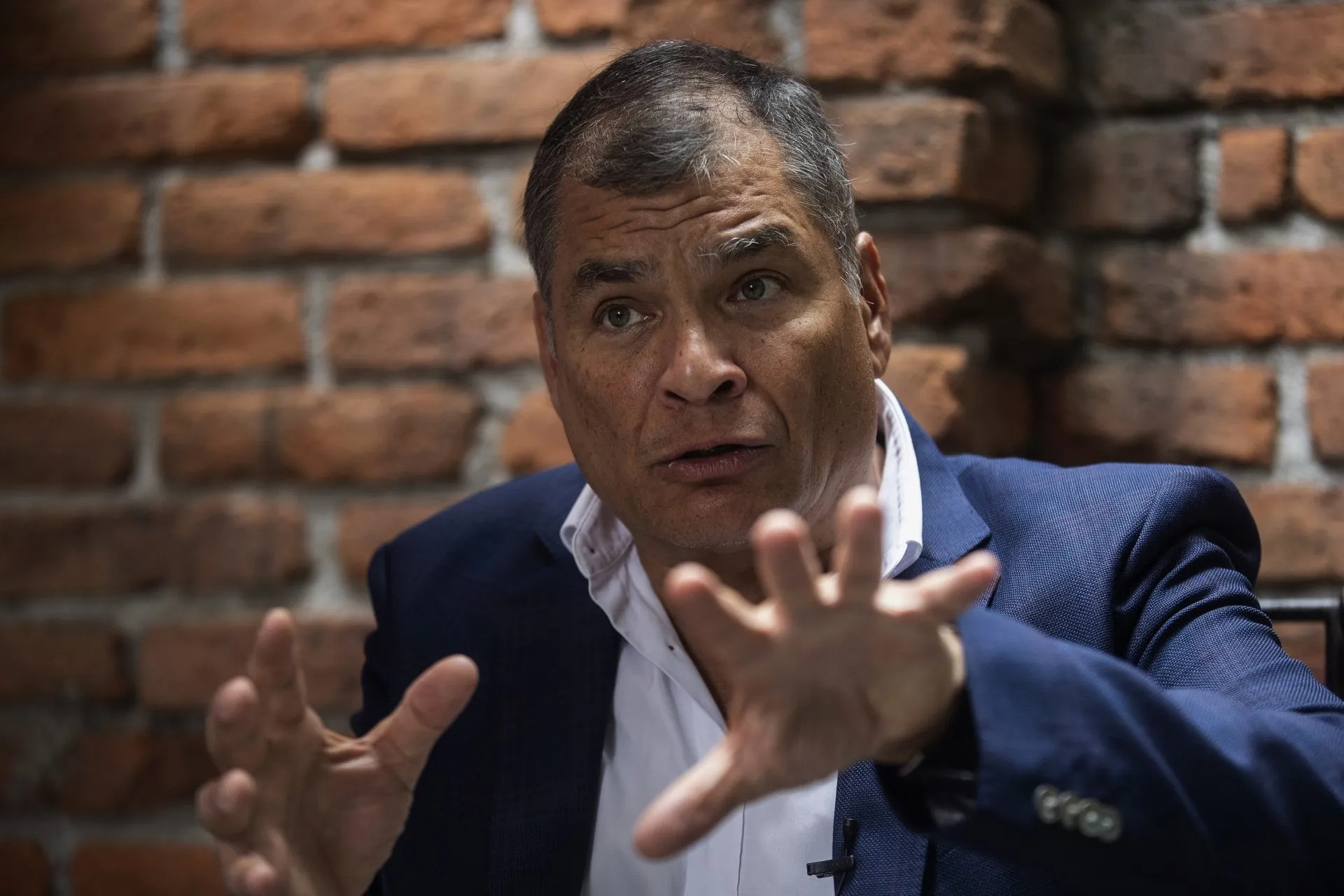
The former president of Ecuador during an interview with the EFE agency.
14ymedio, Pedro Corzo, Miami, 27 April 2025 — It is more than obvious that the Ecuadorian people have given thought to what it would have meant for their country to reelect president Rafael Correa, a criminal convicted for corruption who will lament until his last day having supported Lenin Mareno in his quest toward the nation’s highest office.
This individual, newly in power, would have made a turn of the screw that would irrevocably rob them of the future, and what happens in Cuba, Nicaragua, Bolivia and Venezuela, where the Castro-Chavistas proposals have plunged those peoples into a state of moral and material prostration that is very difficult to overcome.
The populism sponsored by this autocrat is extremely dangerous because it personifies the enlightened despot who, armed with academic knowledge, uses that insight to more efficiently exploit the prerogatives of the citizenry. Correa, in my opinion, is the despot in the hemisphere who most resembles Fidel Castro, because he is an enlightened possessor of absolute truth who does not suffer the agony of doubt.
This individual, newly in power, would have made a turn of the screw that irredeemably shaped the future, as has happened in Cuba, Nicaragua, Bolivia y Venezuela
Subjects like Correa exercise a kind of fatal attraction over a sector of the population. They are capable of interpreting the anxieties of an important nucleus of people, who regardless the abuses and mistakes they commit, things always go in their favor. They count on a following that responds to the rhythm of their piper and revels in the vicissitudes of the abyss. continue reading
Correa, like Fidel Castro, Nicolas Maduro, Evo Morales y Daniel Ortega, to mention just a few of the caudillos of Castro-Chavista who possess a magical charm that, for their supporters, places them beyond good and evil, a reason that makes them a real danger in any democratic society.
An individual with firm democratic convictions can never agree to have their rights violated by a ruler who assumes the power to interpret the nation’s desires by creating committees of whistleblowers who scrutinize the lives of others or permits economic changes that would deepen the misery of all.
To claim that Nicolas Maduro represents a legitimate regime is an absurdity from the early days of 21st-century socialism, as when Hugo Chávez proclaimed he would lead Venezuela to the sea of Cuban happiness. Both Cuba and Venezuela are far from being a paradigm for any society, and anyone who proclaims this commits political suicide, as did candidate Luisa González.
Furthermore, the survival capacity of these individuals is unprecedented. They are capable of allying themselves with their bitter enemies in order to remain in power, as Daniel Ortega did in Nicaragua when he reached an electoral agreement that allowed him to win the presidency in 2007, or as Fidel and Raúl Castro did in Cuba, having managed to blame the US embargo for all their faults, even though they spend hundreds of millions of dollars a year in that market, while imposing a blockade on the people they misgovern that has been in place for 66 years
Correa, in my opinion, is the despot in the hemisphere who most resembles Fidel Castro, because he is an enlightened possessor of absolute truth who does not suffer the agony of doubt
It would seem that Ecuadorians have become acutely aware of reality when they realize that the election of a Correa front man would imply his return, since he would have carried out the necessary maneuvers to allow the fugitive from justice to return, just as Argentine Justicialist* leader Héctor Cámpora did in the 1970s, when upon becoming president, he eliminated all existing restrictions against Juan Domingo Perón, making it possible for him to become president.
The fugitive who lost in the polls was not candidate González. However, I do not doubt the survival capacity of these demiurges, as Anatole France would say, and as my friend Alberto Paz, a profound connoisseur of Ecuadorian and Cuban reality, has told me. He believes that Correa’s failure was a consequence of the many campaign errors of his front men, a claim echoed by some media outlets in the South American.
The thing is, these guys never lose. They accuse the winner of fraud, yet they haven’t filed a complaint backed up with sufficient evidence.
The former president has proven himself as among those who believe themselves chosen. His vision of reality only allows him to appreciate the existence of two colors, black and white, a character he manages to instill in his supporters, just as it enables his followers to seek only confrontation, the all-or-nothing attitude we experienced in Cuba when the masses demanded the firing squad without knowing why or for whom.
*Translator’s note: The Justicialist Party is a major political party in Argentina, and the largest branch within Peronism.
____________
COLLABORATE WITH OUR WORK: The 14ymedio team is committed to practicing serious journalism that reflects Cuba’s reality in all its depth. Thank you for joining us on this long journey. We invite you to continue supporting us by becoming a member of 14ymedio now. Together we can continue transforming journalism in Cuba.
14ymedio, Juan Diego Rodríguez, Havana, 21 April 2025 — On the Island, inflation does not give respite to even the most basic needs. The price for using the public restroom in the busy Parque Fe del Valle, in Centro Habana, has gone up from 10 to 20 pesos. According to one of the local workers, the National Tax Administration Office increased their tax payments and also took away the little income they received from the State. Now they must pay for everything on their own.
What used to be a quick relief is now almost a luxury, and the new tariff did not come with improvements.
The measure is already beginning to be noticed in the urban landscape. “There are now old men who, when they say 20 pesos, leave without urinating and end up behind a bush. I have seen that with my own eyes,” said a regular user of the park. The price increase not only tightens pockets but also bladders.
Translated by Regina Anavy
____________
COLLABORATE WITH OUR WORK: The 14ymedio team is committed to practicing serious journalism that reflects Cuba’s reality in all its depth. Thank you for joining us on this long journey. We invite you to continue supporting us by becoming a member of 14ymedio now. Together we can continue transforming journalism in Cuba.
Without gloves and without supplies to carry out his task, he is faced with an inhumane task: saving what is the dirtiest city in Cuba.
What brought him down there wasn’t the rum or the chemical, but the excess of trash dumps in the city / 14ymedio
14ymedio, Juan Diego Rodríguez, Havana, 22 April 2025 — The man was slumped on the sidewalk, in the shadow of a crumbling wall. He could have been a beggar—it’s not unusual for hunger or alcohol to bring many to the ground—but he’s a street sweeper. Beside him are the tools of his trade: two broken buckets and a broom, attached to a wheelbarrow that can’t hold another thing.
The fact that the street is littered with garbage suggests that what brought him down there wasn’t rum or el químico —the dangerous and now common Cuban street drug, an anesthetic against reality—but rather the city’s excess of trash piles. One ox can’t plow, goes the Creole saying; one street sweeper isn’t enough to combat the capital’s filth.
The complaints and protests, the calls to order, and the complaints to Municipal Services have been of no avail. The street sweeper, without gloves to operate, without supplies to carry out his task, is faced with an inhumane task: saving what is the dirtiest city in Cuba.
So the man, dressed and shod in rags, seeks respite in the shade from the scorching Creole sun and the no less torturous stretch of city he must overcome. Cars with state-issued license plates pass by him with their usual indifference. On the corner, there’s a food stand, also not free from dirt.
So the man, dressed and shod in rags, seeks respite in the shade from the scorching Creole sun and the no less torturous stretch of city he must overcome. Cars with state-issued license plates pass by him with their usual indifference. On the corner, there’s a food stand, also not free from dirt.
A short distance from the “fallen” dump, a grotesque ‘landfill’ continues to challenge passersby and hinder traffic / 14ymedio
In a little while, he’ll be walking again, barely recovered, to continue “in the little fight,” a diminutive that doesn’t soften the mountains he’ll literally continue reading
encounter in his path. In Key West, Central Havana, a short distance from the “fallen man,” a grotesque landfill continues to challenge passersby and hinder traffic.
It is the Hospital Street dumpster, ironic not only because of the name of the street on which it’s located, but also because of its resistance to any sort of cleanup. What person, armed only with a broom and two buckets, could have dealt with such a prodigious accumulation of paper, shells, bags, excrement, and liquids?
The only ones who dare to launch expeditions to such dumps are the divers, dressed and armed with the same precariousness as the street sweepers, who try to make a virtue out of necessity, or if not a virtue, at least food and raw materials. In exchange for a few kilos, the State will pay the divers—usually elderly or needy—for any useful “treasures” they find. This is the closest it has come to taking any real measure in favor of street hygiene.
Even the official press knows that the situation is completely out of control. Reporters financed by the Communist Party have been unable to hide their disgust at the garbage dumps multiplying in almost every corner of the country.
Some—like the author of an article published this Tuesday on the Matanzas radio station’s website—are crying out for a solution. However, they continue to attribute the rot to a source as remote as Washington. “The blockade exists and affects every sphere of Cuban society, and that’s something we have to live with, at least for the moment,” the journalist asserted.
With a photo of a sato dog also collapsed—in exactly the same position as the Havana street sweeper—on a garbage dump in Matanzas, the article lists the dirtiest municipalities: Matanzas, Cárdenas, Colón, Perico, Jagüey Grande, and Jovellanos.
The number of MSMEs approved by the State has been directly proportional to the growth of landfills.
It refers to a provincial government meeting where the conclusion was that, precisely in those areas, the number of MSMEs approved by the State has been directly proportional to the growth of dump sites. This isn’t the first time the “new enemy” of hygiene has been singled out, but without stating what the authorities will do with the existing garbage.
Where do the “almost 1,000 liters of fuel distributed daily in Matanzas”—or in the rest of the provinces—end up, according to Radio 26 ? The station doesn’t explain.
Nor does Trabajadores —another of the official newspapers that have commented on the garbage crisis that month—explain what Havana will do to contain a reality that has disfigured, in its own words, a “clean city” in a matter of years.
“Raising social awareness” is the only solution the regime offers. But what conscience—social, personal, or of any kind—can remain for a man who, face to face with the landfill, collapses in the face of a seemingly impossible mission.
____________
COLLABORATE WITH OUR WORK: The 14ymedio team is committed to practicing serious journalism that reflects Cuba’s reality in all its depth. Thank you for joining us on this long journey. We invite you to continue supporting us by becoming a member of 14ymedio now. Together we can continue transforming journalism in Cuba.
A young doctor tells ’14ymedio’ that among his colleagues “there are many hooked” on this cheap and highly addictive drug.
Hospital Calixto García, in Havana / 14ymedio
14ymedio, Natalia López Moya, havana, 21 April 2025 — “Time of death 2:32 in the morning, cause: cardiac arrest,” summarizes the death certificate of a young man from Havana, 28, who died earlier this year in the emergency room of the Calixto García, in Havana. The small print, however, hides a much more dramatic story of addiction, drug use and meager resources in the Cuban health system, faced with the spread of “el químico” [the chemical].
“I was on duty that night, and when he arrived I thought he had an asthma attack,” recalls Marieta, a nurse at the hospital center whose name has been changed for this story. “He came with two friends after midnight on a Saturday, which is usually a time with many cases of knife wounds, cuts from bottles thrown at some party and also injuries from domestic altercations,” she says.
When she graduated, two decades ago, Marieta remembers that on weekends in the emergency room of the central hospital, a few meters from 23rd street with its clubs, bars and recreational centers, most of the emergencies were from “alcohol and fights.” The newly recruited doctors and nurses received the hardest shifts. In those long hours of late Saturday and Sunday, they learned very well to “sew heads and knife wounds while the patient’s foul smell of rum almost asphyxiated us,” she recalls.
“More and more cases arrive of people intoxicated with drugs”
However, for some time now the uninvited guest of the night has changed. “More and more cases arrive of people intoxicated with drugs, especially the “chemical,” but in recent months we have treated cases of all kinds of drug mixtures,” she explains to 14ymedio. One of the serious problems faced by health professionals who assist these patients is the lack of information about what has happened to them.
“We know an accident victim has been run over by a car or hit by a motorcycle, because the people who brought him tell us and give us the details, but with drug addicts it doesn’t happen,” she says. “People have left them lying on the entrance ramp and run away so they don’t show their faces. Others come accompanied by friends, but these people don’t talk. They won’t tell us what happened or just say that the person started feeling bad.”
Not only do you see the progression of drug addiction among patients treated in the emergency room. The medical sector itself is also being rocked by the chemical, which is currently sold in Havana at a price ranging from 150 to 200 pesos per dose. A pound of beans costs more than one of those little pieces of paper that envelop the substance for its illicit trade. In a country where commodities are on the rise, this drug is still surprisingly cheap.
A young doctor tells this newspaper that among his colleagues “there are many who are hooked” on the addictive mixture. “It comes from the bad neighborhoods,” he warns. “My girlfriend and several friends in the healthcare profession are consuming it in an uncontrolled way; it is no longer just something for poor people.”
Among their most complicated cases are those who have recently come in with serious breathing problems and heart failure after having consumed the ’chemical’
In the emergency room, a police officer takes note of patients arriving with knife wounds, gunshots or signs of violence, but the protocol for drug users who arrive in bad shape “is not so clear,” says the woman. “If it is a slight intoxication, the doctor himself doesn’t want to report it so as not to get into trouble with the patient, but there are some who arrive in an obviously very high state, and there is no way to hide it.”
Among their more complicated cases are those who come in with serious breathing problems and heart failure after having consumed the chemical, the most popular drug right now in Havana. With a formula that may vary depending on who prepares it, its base is synthetic marijuana mixed with drugs, some intended for the treatment of epilepsy, tranquilizers for animals or compounds used in surgery. Once hooked, addicts try other very risky combinations, such as adding lidocaine, a local anesthetic that is readily available on the Island’s informal market.
“I saw a boy who was not even 18 take one of those lidocaine patches that you put, especially on your back, when you have some pain. He cut it into small pieces, ate it and immediately had neurotoxic and cardiotoxic reactions. When they brought him in, there was nothing that could be done,” he says. “They’re not just mixing the chemical with drugs that are hard to get or more expensive. Now even a less-controlled medication can be a hazard if it is consumed incorrectly or in conjunction with other substances.”
Among the products most imported by mules to the Island, protected by the exemption of tariffs on food and medicines, are not only coffee, spices and multivitamins, but also the popular lidocaine patches. In an aging population like the Cuban one, there is a wide demand. Light-weight, without customs controls and apparently harmless, in the wrong hands these patches become a danger.
In a society that is very loquacious about defining illegal phenomena, it is surprising that there is no clear term for defining the drug trafficker
“After oral ingestion, lidocaine enters the systemic circulation very quickly due to the extensive hepatic metabolism of the compound,” warns a patient from another hospital in Havana who prefers anonymity. “It begins its action very quickly, and the signs of intoxication begin to be noticed within the first 10 to 25 minutes. By the time these patients arrive at an emergency room, their clinical condition is very advanced.”
The code of silence spreads among addicts and those who accompany them to the hospitals. Describing what they consumed can draw the attention of the police, who will pressure them to report the dealer. The producers and sellers of the chemical, ambrosio* and other mixtures are mostly thugs who threaten to retaliate against the snitches and their families.
In a society that is very loquacious when it comes to defining illegal phenomena or the vagaries of the informal market, it is surprising that there is no clear term for defining the drug trafficker. This figure, who is known elsewhere with expressions ranging from the well-known “camel,” through “eraser” to the explicit “coke pusher,” has just begun in Cuba to have its own name. In a country where the illegal lottery, known as the “bolito,” has a wide range of terms, and prostitution also contains a vast vocabulary, the world of drugs, however, is more sparse. Perhaps the language has not evolved at the same speed as the spread of the chemical through the streets.
“Some say ’quimiqueros’,” advises El Pury, a resident of the Los Sitios neighborhood, who knows very well the damage that drugs are causing among the young people in his community. Proud to be”ten years clean” after spending time in the addiction ward of a psychiatric hospital, he now works as a stretcher-bearer. “I was inside the monster and I know its entrails,” he says, reinterpreting José Martí’s well-known phrase.
“I just have to see a little kid who arrives trembling, skinny because he barely eats and with skin the color of paper, and I know that it’s because of the drug,” he says. “It’s one thing to see it in the movies, or someone from abroad telling you about it, and another to experience it here.” Two weeks ago he had to carry a body from the emergency room to the morgue on a stretcher. The official cause of death was respiratory arrest, but El Pury knows that the young man died “from the shit that is killing everyone.”
*Translator’s note: Ambrosio is a mixture primarily involving drugs like Diazepam, Parkisonil, and Amitriptyline. Sprinkled with Ketamine, it is smoked in a roll or added to an alcoholic drink.
Translated by Regina Anavy
____________
COLLABORATE WITH OUR WORK: The 14ymedio team is committed to practicing serious journalism that reflects Cuba’s reality in all its depth. Thank you for joining us on this long journey. We invite you to continue supporting us by becoming a member of 14ymedio now. Together we can continue transforming journalism in Cuba.
The regime revoked the release of a 11J prisoner for refusing to collaborate with the political police.
He explained that 33 minors remain on the list, of whom 29 are serving sentences. / EFE14ymedio, Havana, 10 April 2025 — Prisoners Defenders (PD) denounced this Thursday that the Cuban regime revoked the release of one of the 230 prisoners released after its promise to the Vatican in January to grant “gradual release with prison benefits” to 553 inmates, a process that has now been completed.
This prisoner who was re-imprisoned is Jaime Rodríguez, imprisoned during the protests of July 11, 2021. On January 18, he was released and “not even a month later”—according to Javier Larrondo, president of the PD—imprisoned once again “for refusing to collaborate as an undercover agent for State Security.”
The remaining 230, Larrondo explains, “are under house arrest, their sentences are intact, and many of them are under extremely serious restrictions on their fundamental freedoms of movement and forced labor.”
In the island’s prisons, the PD recorded 1,152 political prisoners in Cuba this March, with two more added to its registry compared to the previous month. Eight people were added to its monthly list, and another six were released after fully serving their sentence or measure.
“They are under house arrest, their sentences are intact, and they are under extremely serious conditions.”
Three of them were arrested in Villa Clara and convicted of the “increasingly common type of propaganda against the constitutional order.” Hunger, thirst, and other conditions in Cuban prisons are, PD insists, “forms of torture” for the 90,000 prisoners who remain behind bars for various crimes.
Several political prisoners have “highly worrying” health conditions, such as Yoruba priest Loreto Hernández, 53, who suffers from ischemic heart disease and hypertension, among other illnesses aggravated by malnutrition. Also mentioned are Alexander Díaz, who suffers from throat cancer and, like Hernández, is being denied parole by the regime.
Another case is that of journalist Jorge Bello, who suffers from “multiple health problems: diabetes and inflammation of the testicles.” Bello suffered a heart attack in January. Amalio Álvarez, who suffers from a psychiatric disorder and cognitive impairments—in addition to several suicide attempts—is also ineligible for release, Larrondo said.
PD maintains the 230 individuals already on its list, as their sentences have not expired. These individuals were released after Washington removed Havana from its list of countries that sponsor terrorism.
The Cuban government, which never publicly linked the list and the releases, announced two months later that it had successfully concluded the process. The move was described as a “fraud” by PD and criticized by several human rights NGOs, including Amnesty International, Human Rights Watch, Justice 11J, Cubalex, and the Cuban Observatory of Human Rights.
The monthly PD report identified 473 people with “serious medical conditions.”
The PD’s monthly report identified 473 people (41% of its records) with “serious medical conditions” and 40 with mental health problems, all of them “without adequate medical or psychiatric treatment.”
It explained that 33 minors remain on the list, of whom 29 are serving sentences and four are being prosecuted “with precautionary measures without any judicial protection.” The minimum age for criminal prosecution in Cuba is 16.
PD reported that its registry includes 222 people accused of sedition, when in most cases they participated in peaceful protests, adding that all of them “have already been sentenced to an average of ten years of imprisonment each” (including 15 minors). The NGO also highlighted the treatment suffered by the 121 women on its list.
Since July 2021, when the largest anti-government protests in decades took place on the island, a total of 1,821 people have been imprisoned for political reasons.
Larrondo also had a few words of solidarity for Venezuelans, who are subjected to a regime allied with Havana, and where the situation of political prisoners is similar. A total of 896 people remained deprived of their liberty in Venezuela as of last Monday, and according to the NGO Foro Penal as political prisoners, the organization reported Thursday on X.
The organization indicated that of the total detainees, 808 are men and 88 are women, including 891 adults and five adolescents between the ages of 14 and 17. Most were arrested after last July’s elections in Venezuela, in which the electoral body declared Nicolás Maduro’s victory despite accusations of “fraud” from the majority opposition.
According to the Attorney General’s Office, more than 2,400 people were arrested—of whom 2,006 have been released—for causing “violence” during the post-election protests. Both Maduro and Attorney General Tarek William Saab maintain that there are no political prisoners in the country, a position also upheld by Havana.
____________
COLLABORATE WITH OUR WORK: The 14ymedio team is committed to practicing serious journalism that reflects Cuba’s reality in all its depth. Thank you for joining us on this long journey. We invite you to continue supporting us by becoming a member of 14ymedio now. Together we can continue transforming journalism in Cuba.
These damages are as or more destructive than the others that make up Castroism’s tragic legacy.
Orlando Zapata Tamayo (center) died while on a hunger strike in 2010 to demand his rights; pictured receiving medical care. / UEPPC
14ymedio, Pedro Corzo, Havana, 20 April 2025 — A few days ago, in a conversation with friends, we discussed how regimes of force, particularly those of a totalitarian or messianic nature, cause numerous and different types of harm to society.
We talked about those executed and killed in combat in the struggle for democracy. The hundreds of thousands who spent long years in prison, the economic destruction of our country, the general deterioration of buildings, and the millions who were forced into exile or decided to emigrate due to the catastrophic situation the dictatorship has created.
We were immersed in these aspects when my wife mentioned that, like most observers and analysts, we were referring to the human and material damage, overlooking the intangible, ignoring the fact that each of the people whose lives were changed or ended by the regime could have contributed many positive things to Cuba.
We also thought about the contributions to the Republic of the hundreds of thousands who were imprisoned and are still in Cuba.
This observation led us to address issues that some of us had never considered or had only vaguely addressed, such as the contributions to a democratic Cuba of student leaders such as Pedro Luis Boitel, who died on a hunger strike in 1972, and Porfirio Ramírez, who was shot along with four comrades in October 1960, and the civil rights activist Orlando Zapata Tamayo, who also died on a hunger strike in 2010 demanding his rights. continue reading
We also thought about the contributions to the Republic made by the hundreds of thousands who served time in political prison and are still in Cuba, such as former prisoners Guillermo Fariñas, Félix Navarro, and José Daniel Ferrer, and the many female political prisoners, such as Sayli Navarro and María Cristina Garrido, if only human dignity were fully respected in our country.
Immediately afterward, the conversation turned to the exile, the professional success of tens of thousands of compatriots, and the economic success of many more. The numerous university professors and those at other levels of education, as well as the large number of workers who perform important functions in all sectors of society, such as communications, industry, construction, and services in general.
Of course, the discussion took us to politics and the Cuban politicians involved in that activity in the United States and other countries, the numerous congressmen of Cuban origin who have served and are serving in the House of Representatives and those who have been members of the exclusive club of 100 in the United States Senate, in addition to the two Cubans who actively participated in a presidential campaign, including one who is now Secretary of State, the most important unelected position in this great country.
Speaking of the deceased, Daniel Pedreira remembered another great Cuban in American politics, Congressman Lincoln Diaz-Balart, who recently passed away.
The conversation was enriched by the mention of politicians when Luz Martínez, my wife, and Jose Antonio Albertini mentioned the recently deceased Miami City Commissioner, Manolo Reyes. We all fell silent, paying a modest tribute to a person who had earned our respect for his actions and simplicity.
Manolo Reyes was a respectable man. Cordial and sincere, and we all agree that in a “Cuba for all and for the good of all,” he would have been a very valuable source of talent for the republic. Manolo would have made an excellent public servant in any Cuban institution, and we have no doubt he would have been an invaluable mayor for the city of Miami.
Speaking of the deceased, Daniel Pedreira remembered another great Cuban figure in American politics, Congressman Lincoln Diaz-Balart, who recently passed away. A man who, like Reyes, felt a deep passion for Cuba and felt obligated to serve it in any capacity where he could develop his talents.
Unfortunately, Castro’s totalitarianism made it impossible for these two honest, hardworking men, along with others deeply committed to the community, who also disappeared, on the island or abroad, to contribute their talent and dedication to the Cuban nation. These intangible damages of Castroism are as destructive, if not more so, than the other consequences of its tragic legacy.
____________
COLLABORATE WITH OUR WORK: The 14ymedio team is committed to practicing serious journalism that reflects Cuba’s reality in all its depth. Thank you for joining us on this long journey. We invite you to continue supporting us by becoming a member of 14ymedio now. Together we can continue transforming journalism in Cuba.
Literature is duplicity: one cannot write without conversing with the evil twin, the hypothetical, the quantum double.
Star Wars mercenary Boba Fett next to a lead Napoleon, in the author’s library. / Elena Nazco
14ymedio, Xavier Carbonell, Salamanca, 6 April 2025 — In Spain, I gorge myself on the childhood I had in Cuba, but especially the one I didn’t have. Tintin, Corto Maltese, The Rabbi’s Cat, tin soldiers, drawing—now with prodigious Staedtler pens that I gazed at in catalogs from the 1980s—pencils the same dark green as a figurine of Boba Fett, the intergalactic mercenary, all of that on the desk. Toys, Toblerone bars, books. It’s still a sad obsession, but how can I live without it?
In the end, we are vain, diverse, and fluctuating animals, Montaigne would say. I get excited and spend hours in toy stores, stationery stores, browsing the shelves of an antique dealer. I recognize myself in all of this, even though I never possessed it. Did its absence shape me? I wouldn’t be surprised. There are Cubans who become true Malaysian tigers when faced with a beef tenderloin, and others who would stab Willy Wonka to keep his chocolate factory. Why give up the harmless, less expensive world of paper?
I reconstruct, for my own good and that of my novels, the child I was and the one I wasn’t. Literature is duplicity. You can’t write without conversing with the evil twin, the hypothetical, the quantum double, the one waiting for us on the other side of the Time Machine. And if this reconstruction can have an anesthetic effect along the way, so much the better. continue reading
Who can forget their toys, or the things that served as toys?
Who can forget their toys, or the things that served as toys? A cigar box from which I cut out an entire paper city, which I assembled and disassembled in my living room. Some plastic soldiers from World War II—they appeared under my bed one Three Kings’ Day, a tradition that communism failed to eradicate—with binoculars and flags, rampant or rolling in the trench, belonging to imaginary states.
A pair of astronauts, with their spacecraft, armed with detectors for lunar dust, who I now remember as the forerunners of Daft Punk. (Much later, on the beaches of Valencia, I saw dozens of searchers moving their instruments on the sand, like those little figures in spacesuits.) I also had a crossbow, a bow that shot arrows, coloring books—one of them only had the frustrating silhouette of Lassie, the collie—light swords made from radio antennas, magic wands.
There were toys left behind in Cuba that I should have brought. Toys that were so old they were considered relics. An American wooden box with ten miniature bowling pins, which one could knock down with a ball hanging from a pole. The Lone Ranger, whose hat eventually became toasted in the tropical heat, harder than the Western one. To keep it covered, I put a bottle cap on it: it looked like a horseman with his charro or an Arab with his fez.
George Washington, in a blue jacket and tricorn hat—that one survived—was his unlikely expedition companion, both on horseback. There was also a clarinet, made of fine black plastic, with a small notebook of melodies. Almost everything else was lost.
At least once a year, my entire town allowed itself to indulge in toys and imaginary life.
At least once a year, my entire town indulged in toys and imaginary life. It was the month of revelry, March, although in some years it was held in August. I hated and still hate that atmosphere. At seven in the morning, the hammering and welding began. The sparks from the tips of the rods crackled on the iron frames. When everyone left, I went out to play in that rusty fortress, on top of which the carriage was built.
In none of my novels have I recreated that world, which has brought so much money to the cheap folklorists who proliferate like midges in that place. Everything frightened me. The crush of people, the glitter, the makeup, the immobility of the characters in the wings.
There were always half-naked girls – often classmates, the only incentive to go and see the float – and a voice- over narrating some corny legend: Troy: Blood and Fire, The Sun of Austerlitz, Sissi Empress, Prayer in the Desert, The King and I, Beyond the Sea , A Midsummer Night’s Dream, a thousand silly things, all financed by the exiles.
I didn’t like going out but staying in my room, knowing that all the houses in the town were going to be empty at that moment.
I didn’t like going out, but rather staying in my room, knowing that every house in town would be empty at that moment. What a wonderful feeling. I’d take out my toys, my books, whatever, and start inventing that phrase whose wickedness only a Cuban can accurately gauge. Then the firecrackers would explode, rise into the night sky, and descend like kamikazes onto the rooftops. Scared to death. My cats would protest. The neighbors’ dogs would howl.
Five in the morning. Total drunkenness, trash, urine. Toy enthusiasts—and sometimes me too—scaled and looted the float. They stole cranes, cobras, monkeys, tea and smoking tables, marvelous lamps, thrones, and dragons. Everything stuffed with Styrofoam, an entire world of Styrofoam. Everything designed to shine once and die, like naked girls, like flying cars, like the child one once was.
____________
COLLABORATE WITH OUR WORK: The 14ymedio team is committed to practicing serious journalism that reflects Cuba’s reality in all its depth. Thank you for joining us on this long journey. We invite you to continue supporting us by becoming a member of 14ymedio now. Together we can continue transforming journalism in Cuba.
The Cuban-American believes that silence in the face of this situation “is not neutrality or ignorance, it is complicity and cowardice.”
Earlier this month, an unequivocal sign of this discontent surprised drivers passing under the billboard on the Palmetto Expressway in Miami. / 14ymedio
14ymedio, Havana, 20 April 2025 — “Immigration policy must reflect the same compassion for those in need today that we received,” Cuban-American businessman Miguel Mike B. Fernández stated in a letter dated April 14. The pharmaceutical magnate sent the letter, criticizing Donald Trump’s immigration policy, to Secretary of State Marco Rubio and Florida Congressmembers Mario Díaz-Balart, Carlos Giménez, and María Elvira Salazar.
The article, published by El Nuevo Herald, emphasizes what Fernández calls “the silence of our own leaders” in the face of Washington’s “cruel stance toward immigrants.” The businessman, president of MBF Healthcare Partners, believes that the silence of Cuban-American politicians in the face of this situation “is not neutrality or ignorance, it is complicity and cowardice.”
Fernández, who has supported Rubio and Salazar in previous campaigns, believes that the attitude of Republican leaders, who are themselves children of Cuban exiles, has caused “real fear and harm to many in our community, in your districts.” Trump has adopted “a cruel stance toward immigrants that falls short of the values this country has always promised,” he emphasizes. continue reading
He warns that “revoking protected status for Venezuelan and Cuban immigrants, many of whom fled oppression just like our families, is not just policy, it’s hypocrisy.”
Mike’s family, born in Manzanillo, was forced to leave the island in 1964 and went into exile in Mexico. Shortly after, he moved to the United States with his parents and sister, where he began an impressive career in the health insurance sector. The philanthropist has become a much-talked-about voice in South Florida in recent decades. Now, in his letter, he warns that “revoking protected status for Venezuelan and Cuban immigrants, many of whom fled oppression just like our families once did, is not just a policy, it’s hypocrisy.”
Fernández also wrote about former co-finance director of Florida Governor Rick Scott’s 2014 reelection campaign, stating “When USAID funding, which directly supports efforts to foster political and social change in Cuba, Venezuela, Nicaragua, and throughout the region, is eliminated overnight, it is a betrayal.” He also has made a harsh allusion to the cuts suffered by Radio and TV Martí in recent weeks.
The multimillionaire believes that Cuban-American leaders “must focus on addressing the needs of our neighbors throughout Miami-Dade County: immigrants, workers, families struggling with housing, healthcare, and opportunities.” This requires “a new strategy, one built on courage and centered on the people of South Florida, the people who elected you to represent them,” he warns Rubio, Díaz-Balart, Giménez, and Salazar.
“For decades, I have stood by you, defending the freedoms we hold dear—those denied us in the country of our birth and found in the grace of this one.”
In the statement, he also maintains his criticism of the Cuban regime: “For decades, I have stood by you, defending the freedoms we hold so dear, those denied to us in the country of our birth and found in the grace of this one.” According to the businessman, the priority of Cuban-American representatives must be, among other things, “defending human rights, condemning authoritarianism wherever it arises, whether in Havana, Caracas, Managua, Moscow, or Washington, D.C.”
“In the end, we are not measured by loyalty to a party or a president, but by loyalty to the Constitution and our principles, even when it costs us something,” he adds, but clarifies that he is not writing the letter “with anger, but with urgency, alarm, and purpose.” His letter goes beyond a public questioning of the politicians’ attitudes and assures that he will seek to enlist more people to join his petition and speak out.
“I intend to use my efforts and to ask other voices to join us in elevating this crisis in our community that cannot be ignored,” he warns. “These are the voices of mothers and grandmothers, fathers and grandfathers, students, workers, and Dreamers , all crying out for dignity, for safety, and for leadership that remembers their roots.”
Fernández recaps that Cuban-American leaders were elected thanks to the votes of the island’s exile community: “Remember, public trust is not guaranteed; it is earned and maintained,” the text emphasizes.
“I intend to use my efforts and ask other voices to join in raising this crisis in our community that cannot be ignored.”
The questioning of Cuban-American politicians has escalated in recent weeks. Earlier this month, an unequivocal sign of this discontent surprised drivers passing under the billboard on the Palmetto Expressway in Miami. “Traitors: To the immigrants, to Miami-Dade, to the American dream,” read a sign in white on red, alongside the faces of Rubio, Salazar, Giménez, and Díaz-Balart.
“Protect TPS (Temporary Protected Status),” added a smaller sign, accompanied by the Venezuelan flag. The billboard, an illuminated sign alternating with other advertisements, located in the parking lot of the Palmetto Metro station on the outskirts of the city, was funded by the Miami-Dade County Democratic Hispanic Caucus, an organization linked to the Democratic Party. Salazar, speaking to El Nuevo Herald, called the sign “cheap Castro-style propaganda.”
A few days later, the sign received a response. “We must be grateful,” read a new billboard, featuring portraits of Fidel and Raúl Castro, Miguel Díaz-Canel, Hugo Chávez, Daniel Ortega, and Nicolás Maduro. They are “the true traitors,” reads the text accompanying the images, “to freedom, to their people, to human rights.”
____________
COLLABORATE WITH OUR WORK: The 14ymedio team is committed to practicing serious journalism that reflects Cuba’s reality in all its depth. Thank you for joining us on this long journey. We invite you to continue supporting us by becoming a member of 14ymedio now. Together we can continue transforming journalism in Cuba.
The Peruvian writer contributed like few others to the universal expansion of Latin America.
Peruvian writer and Nobel Prize winner for Literature Mario Vargas Llosa, in a file photo. / EFE/EPA/Teresa Suárez
14ymedio, Federico Hernández Aguilar, San Salvador, 20 April 2025 — With Mario Vargas Llosa’s passing (1936-2025) the last great exponent of the so-called Latin American boom died, an extraordinary creative and editorial phenomenon that, strictly speaking, should be called the boom of the Spanish-American novel. All of its members were primarily novelists and none were originally from Brazil, Quebec or the French-speaking Caribbean, nor did they write their works in any language other than Spanish, although Julio Cortázar, who was born by chance in Belgium, wrote Les discours du Pince-Gueule (1966) in French, which was later translated into Spanish as Los discursos del Pinchajeta.
With the passing of Vargas Llosa, who died at the height of his fame, the life cycle of a host of writers who enriched the world’s literary landscape comes to an end, as their names moved from editorial obscurity to mass circulation, the thunder of advertising, critical acclaim, awards, and international tours. The protagonists themselves, however, more than once confessed their personal skepticism about the boom.
Cortázar was uncomfortable with such an onomatopoeic term in English, Gabriel García Márquez barely referred to it, and Carlos Fuentes, the only one to dedicate a book to the subject, preferred the title The New Hispanic American Novel (1969). All of them, however, left abundant testimony to the implications of the phenomenon: a break with previous language, an avant-garde update of the reality-fiction binomial, and a clear political (not merely aesthetic) commitment to the historical changes then taking place in the subcontinent.
The Peruvian, in fact, would be the first and the only one who would clamorously disenchant himself from the Cuban revolution with open criticism of the philosophical and anthropological foundations of socialism.
In 1971, Vargas Llosa commented: “What is called the boom, and which no one knows exactly what it is—I personally don’t—is a group of writers—no one knows exactly who either, since each has their own list—who, more or less simultaneously in time, acquired a certain amount of dissemination, a continue reading
certain recognition from the public and critics. This can perhaps be called a historical accident. However, it was never a literary movement linked by an aesthetic, political, or moral ideology. As such, that phenomenon has passed.”
The Peruvian, in fact, would be the first and only to become blatantly disenchanted with the Cuban revolution, openly criticizing the philosophical and anthropological foundations of socialism, an aspect that would bring him numerous ideological and even personal attacks. His editor at Alfaguara, Juan Cruz, maintains that “creating misunderstandings about Vargas Llosa has always been an international sport.”
Curiously, among such numerous detractors, it is rare to find one with sufficient theoretical capacity to refute him in the realm of ideas, either because they ignore or dismiss the ideas from the outset, or because they find it difficult to contradict him based on the knowledge of liberal authors that this requires. (I will address this topic in another column.)
The fact is that Mario Vargas Llosa became, above the rest of his colleagues of the boom, the writer who would exercise the greatest influence as a media personality, from frequent guest appearances on interview programs to prestigious international columnist, passing through theater actor, sports columnist, failed film director, member of official commissions – such as the one he presided over in 1983 to investigate the massacre of journalists in Uchuraccay, (Ayacucho) – and even a jury member of the Miss Universe pageant, on whose panel he was joined, in 1982, by the actor Franco Nero and the illusionist David Copperfield.
The fact is that Mario Vargas Llosa became, above the rest of his colleagues of the boom, the writer who would exercise the greatest influence as a media personality.
The world of show business followed the Nobel Prize winner until his final years, when he made the unexpected, autumnal decision to share a pillow with socialite Isabel Preysler, a star of Spanish celebrity gossip magazines with two divorces under her belt, the mother of five children, and the widow of former minister Miguel Boyer. After this strange relationship broke up in 2022, Vargas Llosa returned to the same house with his wife, Patricia, who was by his side when he died on April 13 in Lima.
The author of The Feast of the Goat, as we know, also lived and suffered the harshness not only of political activism but of active politics. In his youth, following Jean-Paul Sartre’s postulates regarding “commitment,” he seriously adhered to the idea—”persuasive and exhilarating,” he would later say—that the world could be radically improved through empowered humanism and that literature had the obligation to contribute to this process.
In 1966, he stated: “The raison d’être of literature is protest, contradiction, and criticism. The writer has been, is, and will continue to be a malcontent. No one who agrees with the reality in which they live would undertake such a misguided and ambitious enterprise: the invention of verbal realities.” But as early as 1967, in a Letter to the Spokesperson of the Peruvian Communist Party, he argued that if a writer is “deeply committed to his vocation, he will love literature above all else.”
“The reason for literature’s existence is protest, contradiction, and criticism.”
And although between 1987 and 1990 Vargas Llosa worked diligently on a presidential candidacy that ended in a frustrating defeat, we must remember something he had written in 1983 when he published Contra viento y marea (Against Wind and Tide), his first collection of journalistic articles: “Literature, in the end, is more important than politics, which every writer should approach only to block its path, remind it of its place, and counteract its missteps.”
In short, as an imaginative and persevering builder of new realities, that is, as an essential and vital writer, Mario Vargas Llosa contributed like few others to the universal expansion of Latin America, in an unequivocal commitment to that art in which everything can be created “from the truths and lies that constitute the ambiguous human totality.”
____________
COLLABORATE WITH OUR WORK: The 14ymedio team is committed to practicing serious journalism that reflects Cuba’s reality in all its depth. Thank you for joining us on this long journey. We invite you to continue supporting us by becoming a member of 14ymedio now. Together we can continue transforming journalism in Cuba.
Soler and Moya together with the head of the US Embassy in Cuba, Mike Hammer
14ymedio, Havana, 20 April 2025 — The police operation set up around the headquarters of the Ladies in White and the home of opponents Berta Soler and Angel Moya, this Sunday, were confirmed by them in a call to 14ymedio. However, this Sunday’s siege, Moya notes, is similar to the one they usually suffer on weekends to prevent them from attending church. Saturday, on the other hand, was enormous. “They are on both corners with tremendous impunity because we cannot directly publish anything of what they are doing to us because we do not have phones, Moya confirmed yesterday to this newspaper.
“Several of our neighbors have told us that there is also a large operation on Porvenir Avenue,” said the former prisoner of the Black Spring who, along with his wife, activist Berta Soler, was arrested last Thursday and had their phones confiscated by State Security. He added that their legal status, at this time, is that both are “under a precautionary measure of house arrest for the alleged crime of violating the established constitutional order.”
Both Soler, leader of the Ladies in White, and Moya are under house arrest for 48 days and cannot leave their homes because, among other charges, they “violate the country’s independence and sovereignty” due to their recent meeting with the head of the US Embassy in Cuba, Mike Hammer.
Hammer accompanied Soler on April 13, Palm Sunday, to the church of Santa Rita, in the Havana neighborhood of Miramar. He escorted her to the parish after several Sundays in which a large police operation prevented her from leaving her home. Subsequently, last Thursday, both opponents were arrested around 2:00 pm in the area of the Virgen del Camino, in Havana, as reported by the organization Cubalex. continue reading
Moya clarifies that although they have not yet been formally charged, they are “under investigation”
Moya clarifies that although they have not yet been formally charged, they are “under investigation.” During the arrest, Soler and Moya’s mobile phones were seized by State Security, a concern for both. ” They are the cell phones that we use to connect to social networks and were switched off when we handed them over. They asked us for our passwords and we refused to tell them.” The political police officers warned them that despite this they were going to “open and technically check” the devices.
The opponent warns: “if our social networks and our private channels contain confusing and biased messages then it is State Security that is writing them.”
The activists have tried to spread the word about their situation through various channels despite being under house arrest. This Sunday, Moya and Soler managed to appear on social networks and said that they would go out on the street after 12 noon. “The house is not a dungeon,” argued Soler. Moya explained that after the arrest they had been taken to different police units -Soler to the station of Cotorro and he to Guanabacoa – where they stayed for more than 24 hours. After returning to their home, they were cut off from internet access.
The US Embassy in Havana shared on Saturday a publication from the Office of Western Hemisphere Affairs expressing its “outrage” at the repression against the dissidents. “This further demonstrates the regime’s ruthless disregard for religious freedom and once again exposes the brutal ill-treatment that the regime inflicts on its own people by attempting, as it admits, to intimidate US diplomats,” the Office denounced.
It added that the Embassy “will continue to meet with Cubans from all walks of life, particularly those who defend human rights, fundamental freedoms and human dignity.”
The previous arrest of both dissidents occurred on Sunday, April 6, when they tried to attend mass
The previous arrest of both dissidents occurred on Sunday, April 6, when they tried to attend mass. In recent years, Berta Soler has reported multiple temporary arrests of her and members of the organization she leads, mostly on Sundays when they are preparing to go to church and are prevented by the police.
The Ladies in White movement was born on the initiative of a group of women relatives of the 75 dissidents and independent journalists arrested in March 2003 and sentenced to long prison sentences during the so-called Black Spring. From then on, the wives, mothers and other relatives of those prisoners identified themselves as always dressed in white and, after attending mass in a Catholic church, began to hold Sunday marches to ask for their release.
In 2005, the Ladies in White received the European Parliament’s Sakharov Prize for Freedom of Thought
This beginning of the year has been active for the repressive apparatus of the regime. In parallel with the release of 230 political prisoners through the Vatican, the Island’s government has intensified its persecution of activists and relatives of detainees.
Last Wednesday, the writer and collaborator of 14ymedio, Jorge Fernández Era, was arrested for more than 10 hours after he tried to demonstrate in Havana in solidarity with the protests that teacher Alina Bárbara López carries out every 18th day of the month. Another colleague of the scholar, Jenny Pantoja, who also wanted to support López, was forced to stay in her home by State Security.
Two other 14ymedio collaborators are currently imprisoned: Yadiel Hernández Hernández, known as Kakashi, in Matanzas, since late January, when he was investigating drug trafficking and consumption at a school in the city. The other is José Gabriel Barrenechea, who has been in prison for five months, awaiting trial, for participating in the protests against the blackouts on 8 November at Encrucijada, Villa Clara.
Translated by Regina Anavy
____________
COLLABORATE WITH OUR WORK: The 14ymedio team is committed to practicing serious journalism that reflects Cuba’s reality in all its depth. Thank you for joining us on this long journey. We invite you to continue supporting us by becoming a member of 14ymedio now. Together we can continue transforming journalism in Cuba.
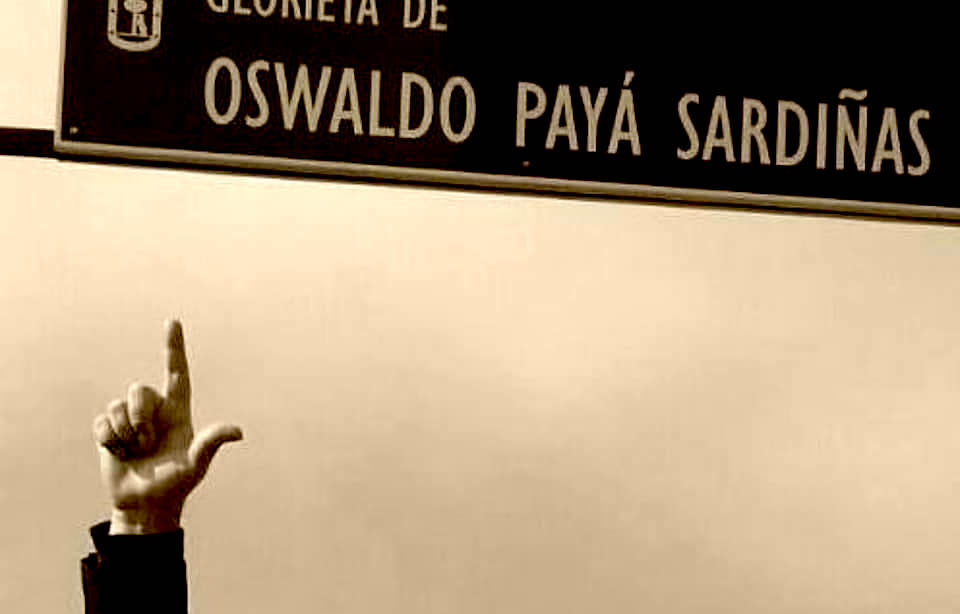
Street sign dedicated to Oswaldo Payá in Madrid / Facebook/Oswaldo Payá
14ymedio, Xavier Carbonell, Salamanca, 20April 2025 — Oswaldo Payá died on July 22, 2012, when I was 17 years old and people were expecting the end of the world. Did I have what you’d call a political stance back then? I suppose so, not only because at 17 one is pretty clear on who’s who, but also because of my irritation every time Fidel Castro appeared on television.
Nevertheless, I’ve always associated Payá’s death with the awakening of something visceral, something bilious and profound, which I’ve carried as a moral compass ever since. Payá was killed by Cuban State Security, no matter how, although every effort was made to reconstruct a false scenario, animated by some Pixar fanatic in Villa Marista.
The bright blue Hyundai describes an improbable parabola until its rear end crashes into a tree. The junction between metal and wood is ghostly. The curve, impossible. It all happened on one of those eastern roads that look, curiously, like something out of the American West.
I don’t know how long the regime waited to give its version. Those were different times, and information spread at a different pace, especially in a town in central Cuba where very few people signed the Varela Project. I remember the television report, in which the living—the Spaniard Ángel Carromero and the Swede Jens Aron Modig—appeared, and the dead, both continue reading
Cubans, were defamed.
The second one who died was Harold Cepero and I will never forget the devastation his death caused in the circles in which I moved
The second death was Harold Cepero, and I’ll never forget the devastation his death caused in the circles I moved in. Harold had studied to be a priest, a term that carries with it an ethical and cultural background. He had dropped out of the seminary, found a girlfriend, and I think he raised pigs—a detail that touched me, I don’t know why—and all his friends remembered him as a lovely man.
Payá and Harold, Harold and Payá. How many times have I heard their names without having seen their faces, which the news was careful not to publish. Religious magazines, on the other hand, published photos and testimonies from Harold’s former seminary classmates, heart-wrenching testimonies, and I am still friends with those who offered them.
With one of those friends, a close friend of mine, I got in a car headed for Remedios. I’ve always had an irrational fear of any means of transportation other than the train. Later that year, and with the rumor that the political police had “cut the wires” of Payá’s Hyundai, the tension escalated to its peak. My destination was the Remedios Parish Church.
That is where the Franciscans lived, who, in some ways, shaped part of my sentimental upbringing. They were Mexican, but completely overwhelmed. My friend and I would meet one of them for lunch. In fact, my entire circle began holding these “chance” Masonic meetings, of the third kind, to talk about Payá. No one would have trusted a landline—those in churches are tapped: the ABC of caution—so we had to travel and whisper.
It was a conspiracy, and I was involved in it. I knew it, I accepted it, I savored it. Thanks to the priests and nuns, when I was 14, I heard Dagoberto Valdés and witnessed a human rights protest in Placetas. I’ll never forget the priest, steadfast and in his white cassock. I wondered which policeman would have the courage to remove him from the scene to search for those who had taken refuge in the church.
During the after-dinner conversation in Remedios, over coffee, my friend and the friar began to talk in code
Over coffee at the Remedios table, my friend and the friar began to talk in code. At 17 and coming from where I came from, I was above suspicion, but even I had to learn to speak that way. And I did.
“What did you think of that man?” the priest said. “Terrifying,” my friend said. “Did you turn on the television last night?” “Yes, for a while,” the other replied, “no one believes those little cartoons.” “It seems they’re scared.” “Yes, scared, very, very scared.” “And with the sick old man, even more so.” “And that wasn’t all,” the friar theorized, “an order in extremis from you know who?” “I couldn’t believe it,” my friend replied.
But it didn’t end there, in that easy-to-decipher dialogue. Payá’s death, at the heights of politics, had consequences at every level. What’s above, so it is below. “And our friend?” my friend asked with a small smile. “He hasn’t reacted,” the priest replied, “he knows how to pretend very well, he’s intelligent.” Our friend was one of the agents that Security had infiltrated into the Franciscan ranks. They’ve done the same with the Jesuits and the Dominicans and every religious order that has passed through that country.
What was expected of our friend—I learned from that conversation—was a flash of conscience, a turmoil that would make him confess, feel guilty, and die of shame for Payá and Harold, whom he surely knew. The human improvement, no less, of the unbeatable New Man!
The human improvement, no less, of the unbeatable New Man!
But the epiphany never came, it never would, and that was the second lesson I learned in Remedios, after the coded language. As Creole wisdom warns, the snitch is the most vile animal of the tropical fauna; and as Dr. House emphasizes, people don’t change.
I think of Payá and my humble beginnings as a conspirator, in that time that seemed so full of possibilities, to console myself for the mediocrity in which we live. When everything falls apart, who will I vote for? When there are political parties, what will the options be? When there is freedom, what quality will conversation have? What privileges will those who struggle today, those in exile, those in prison, demand? What country is this, that the closer it gets, the more frightening it becomes?
I think that with that blue Hyundai, raising a cloud of yellowish dust in the East, many answers were lost.
____________
COLLABORATE WITH OUR WORK: The 14ymedio team is committed to practicing serious journalism that reflects Cuba’s reality in all its depth. Thank you for joining us on this long journey. We invite you to continue supporting us by becoming a member of 14ymedio now. Together we can continue transforming journalism in Cuba.
EFE (via 14ymedio), Carlos Seijas Meneses, Caracas, 20 April 2025 — Nicolás Maduro reached the first 100 days of his controversial third term in Venezuela this Sunday, marked by questions about his legitimacy, sanctions and the return of more than 2,500 migrants, mostly deported by the United States.
The following are the eight events that have marked the Chavista’s management since his inauguration on January 10:
Proclaimed winner by the National Electoral Council (CNE), which is linked to the Chavista regime, Maduro advances in his third term without, almost nine months later, disaggregated results being known -contrary to the established official schedule- which led the Carter Center, which was an observer, to conclude in February that these elections “cannot be considered democratic.”
The largest opposition coalition, the Unitary Democratic Platform (PUD), denounced the consummation of a “coup,” insisting that the winner was Edmundo González Urrutia.
Washington tightened sanctions against Caracas after Donald Trump’s return to the White House
Maduro is backed by countries such as Russia, China, Iran, Turkey, Qatar, Belarus, Serbia, Equatorial Guinea, Cuba, Nicaragua, Bolivia, Honduras, Saint Vincent and the Grenadines.
By contrast, the US, Canada, Argentina, Chile, Costa Rica, Ecuador, El Salvador, Guatemala, Panama, Paraguay, Peru, Colombia, Brazil, the continue reading
Dominican Republic, Uruguay, the United Kingdom, Ukraine, Germany, Italy and Japan have questioned his legitimacy.
Washington tightened sanctions against Caracas following the return of Donald Trump to the White House, ending oil licenses and imposing 25% tariffs on Venezuelan crude buyers, as well as 15% tariffs on products from the Caribbean nation, whom the Republican accuses of having sent “tens of thousands of criminals” to the United States, which rejects Chavism.
Maduro insists that “there is no threat in the world that can intimidate” his country, and this month he decreed an economic state of emergency in response to Washington’s measures. Caracas also issued a “travel alert” about “risks” in the United States.
Since February, according to official figures, 2,559 Venezuelans have returned to their country – most of them from the United States- on 13 flights, three of them American planes, as part of an agreement reached during a visit to Caracas by Richard Grenell, special representative of Trump, in January.
Since February, according to official figures, 2,559 Venezuelans have returned to their country, mostly from the United States, on 13 flights
On April 9, Maduro denounced a “civilizing aggression” against migrants in the United States, which in March deported more than 200 people to El Salvador, accused of allegedly belonging to the criminal gang of Venezuelan origin Tren de Aragua, designated as terrorist by Washington and condemned by the Maduro administration.
Maduro assured that this year there will be at least a dozen elections, including regional and parliamentary ones, to be held on 25 May. This has created divisions within the opposition between those who call for voting and those who do not.
Maduro also plans to submit for consultation a draft constitutional reform that is being prepared by a commission headed by the attorney general, Tarek William Saab, to be presented in May, when the 90-day deadline given by Maduro in February expires.
Translated by Regina Anavy
____________
COLLABORATE WITH OUR WORK: The 14ymedio team is committed to practicing serious journalism that reflects Cuba’s reality in all its depth. Thank you for joining us on this long journey. We invite you to continue supporting us by becoming a member of 14ymedio now. Together we can continue transforming journalism in Cuba.
Another Day With Long Blackouts in Cuba: “It Was the Lord’s Turn To Rise From the Darkness”
14ymedio, Havana, 20 April 2025 — For Cubans, Lent does not end at the same time as in the rest of the world. Especially when it comes to energy, the Island’s electricity never arrives on Easter, and the resurrections promised by the Government for the national electricity system (SEN) never take place: for this Sunday the deficit forecast is 1,766 megawatts (MW), 52% of national demand.
“It was the Lord’s turn to rise again in the dark,” says Rubén, a resident of the Luyanó neighborhood in Havana, who has been suffering a blackout since midday, less than 24 hours after the previous one ended. “And I even live in the hospital circuit.” He, like all Cubans, has learned to live with the cuts, reconnections and shortages of the SEN and has memorized the geography and nomenclature of the thermoelectric power plants.
If the more than 1,700 MW of deficit this Sunday do not surprise Rubén, he explains, it is because since Saturday he knew about the departure from the system of unit 1 of the Felton, in Holguín.
Scheduled to start on Saturday, the Felton was stopped by an “unexpected” break. As explained by the authorities, a leak in the boiler that had not been detected before by the steam caused the disconnection. The plant had been running for a little over a month since its last failure in early March, which kept it out of action for four days. continue reading
This weekend there was also the breakdown of unit 5 of Nuevitas, in Camagüey, which, according to the Electric Union has contributed to the deficit being “higher than planned.” However, the deficit on Saturday, which peaked at 1,678 MW, remains scandalous.
The company also explained that there are 79 MW affected by the output of electric generation engines due to lack of diesel or fuel oil, in addition to another 77 generators for the same reason.
This year, the capital repair of the largest power plant on the Island, the Antonio Guiteras de Matanzas, has also been scheduled. According to the Minister of Energy and Mines, Vicente de la O Levy, the intervention could last between eight and ten months.
“The Guiteras rotors have not worked since that breakdown in 2004. So do the math. Since 2004 it should have had two capital repairs, and not one was done,” he said weeks ago about the calamitous state of the only thermoelectric plant of French technology, which is also the one with the most power in the country.
Other interventions are also planned, for about six months, in East Havana 2, Santa Cruz del Norte (Mayabeque), and in Rent 5, Santiago de Cuba. In addition, Felton 2, lost “completely” after the fire of 2022, has begun its comprehensive rehabilitation, “a gigantic engineering project” that will last two years. The clock began running long ago, although the minister did not clarify when.
With only two of the eight Turkish patanas [floating power plants] generating power in its waters and its largest plant out of service, the Government is betting everything on the solar parks that it has begun to build throughout the country, with financial and technical support from China.
Translated by Regina Anavy
Note to readers: Technical issues are preventing the normal formatting of this article’s image and text.
____________
COLLABORATE WITH OUR WORK: The 14ymedio team is committed to practicing serious journalism that reflects Cuba’s reality in all its depth. Thank you for joining us on this long journey. We invite you to continue supporting us by becoming a member of 14ymedio now. Together we can continue transforming journalism in Cuba.
Migrants from Venezuela, Colombia and Jamaica were also working in the bar.
Navy personnel supervising the sealing of the King Bar, where prostitution was practiced. / Quintana Roo Federal Government
14ymedio, Ángel Salinas, Mexico City, 14 April 2025 — Immigration authorities in the state of Quintana Roo are reviewing the status of nine Cuban women, two Venezuelan women, two Colombian women, and one Jamaican woman who were rescued last Saturday by Navy personnel from the King bar, located on Bonampak Avenue in the Benito Juárez municipality of Cancún, where they were engaged in prostitution and offered escort services to clients.
“The crime of human trafficking is being investigated,” an official who requested anonymity told 14ymedio. According to official data, 31 cases for this crime were opened in the first two months of the year. So far in April, 72 searches have been carried out. “None of the women stated they were being held there against their will, although there is one anonymous complaint, so the investigation is ongoing.”
Initial investigations confirmed that prostitution was taking place there. “The women were offered like fruit in the market. Entry to a private establishment cost 5,000 pesos ($248), and the fee for a single encounter reached 15,000 pesos ($745). A quarter of that was given to the migrants,” the police officer said.
The place was promoted near Bonampak Avenue near Superblock 6 as “a VIP place to enjoy drinks for discerning palates,” the source told this newspaper.
The women who weren’t in the private rooms “signed up (escorted customers at tables). The cheapest drink in the place cost 500 pesos, according to one of the migrants; they were given half of the customer’s bill. A bucket (of beer) was sold for 600 pesos.”
There is additional information about the place, such as that “the migrants had to offer dances to clients in exchange for 250 pesos, which was continue reading
obviously a lure to get the subjects to consume drinks and, already intoxicated by alcohol, end up in the private rooms.”
Interior of the King Bar, where 16 women were present, nine of them of Cuban origin. / Quintana Roo Federal Government
“The end of the American dream—this is important to emphasize—without money or papers, job opportunities are minimal. Desperation has led many migrants to seek work in beer halls, bars, and cantinas, and in these places they are targets for trafficking networks.”
Activist María Ángel Vielma explained that another way women are lured to Mexico is with the promise of jobs and other false promises. “The abuser sees what their needs are and manipulates them. It’s bait disguised as love,” she said.
This was the modus operandi of Cuban-Mexican Cristóbal Paulino Fernández Viamonte, who was extradited to the country last March, where he faces charges of human trafficking and sexual exploitation.
Fernández Viamonte was arrested by Interpol last July in Medellín, where he presented himself as a successful businessman. The investigation indicated that the detainee led a network based in the state of Yucatán (Mexico).
Those close to the Cuban-Mexican would “cast the bait” to young women—mainly from Cali, Medellín, and Bogotá—and offer them jobs as waitresses in Cancún and Mérida, where the Cuban-Mexican is listed as the owner of supposed entertainment establishments.
Behind that facade were the Candela, Bandidas, and Tropicana Angus nightclubs, which were raided by Mexican authorities last July, resulting in the rescue of eight Colombian victims. In one of these operations, Soledad “A,” alias La Capitana, who operated the trafficker’s illicit businesses, was arrested.
____________
COLLABORATE WITH OUR WORK: The 14ymedio team is committed to practicing serious journalism that reflects Cuba’s reality in all its depth. Thank you for joining us on this long journey. We invite you to continue supporting us by becoming a member of 14ymedio now. Together we can continue transforming journalism in Cuba.

 Juan Diego Rodríguez, Havana, 28 April 2025– How alive or dead is a street? Is it the ruins, the shells of houses barely standing, and the decrepit facades that define the throb of a thoroughfare; or, in reality, is its death certificate only the signature of the lack of traffic, of street vendors, and of shouts from balcony to balcony. If it is the latter, it can be said that the central San Lázaro Avenue in Central Havana has not yet been buried because it still breathes.