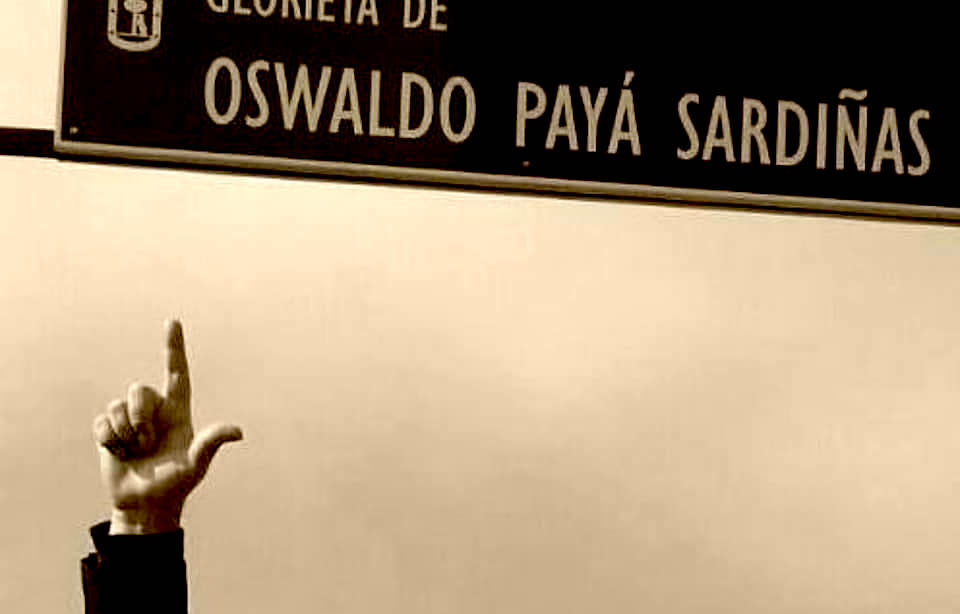
 14ymedio, Xavier Carbonell, Salamanca, 20April 2025 — Oswaldo Payá died on July 22, 2012, when I was 17 years old and people were expecting the end of the world. Did I have what you’d call a political stance back then? I suppose so, not only because at 17 one is pretty clear on who’s who, but also because of my irritation every time Fidel Castro appeared on television.
Nevertheless, I’ve always associated Payá’s death with the awakening of something visceral, something bilious and profound, which I’ve carried as a moral compass ever since. Payá was killed by Cuban State Security, no matter how, although every effort was made to reconstruct a false scenario, animated by some Pixar fanatic in Villa Marista.
The bright blue Hyundai describes an improbable parabola until its rear end crashes into a tree. The junction between metal and wood is ghostly. The curve, impossible. It all happened on one of those eastern roads that look, curiously, like something out of the American West.
I don’t know how long the regime waited to give its version. Those were different times, and information spread at a different pace, especially in a town in central Cuba where very few people signed the Varela Project. I remember the television report, in which the living—the Spaniard Ángel Carromero and the Swede Jens Aron Modig—appeared, and the dead, both Cubans, were defamed.
The second one who died was Harold Cepero and I will never forget the devastation his death caused in the circles in which I moved
The second death was Harold Cepero, and I’ll never forget the devastation his death caused in the circles I moved in. Harold had studied to be a priest, a term that carries with it an ethical and cultural background. He had dropped out of the seminary, found a girlfriend, and I think he raised pigs—a detail that touched me, I don’t know why—and all his friends remembered him as a lovely man.
Payá and Harold, Harold and Payá. How many times have I heard their names without having seen their faces, which the news was careful not to publish. Religious magazines, on the other hand, published photos and testimonies from Harold’s former seminary classmates, heart-wrenching testimonies, and I am still friends with those who offered them.
With one of those friends, a close friend of mine, I got in a car headed for Remedios. I’ve always had an irrational fear of any means of transportation other than the train. Later that year, and with the rumor that the political police had “cut the wires” of Payá’s Hyundai, the tension escalated to its peak. My destination was the Remedios Parish Church.
That is where the Franciscans lived, who, in some ways, shaped part of my sentimental upbringing. They were Mexican, but completely overwhelmed. My friend and I would meet one of them for lunch. In fact, my entire circle began holding these “chance” Masonic meetings, of the third kind, to talk about Payá. No one would have trusted a landline—those in churches are tapped: the ABC of caution—so we had to travel and whisper.
It was a conspiracy, and I was involved in it. I knew it, I accepted it, I savored it. Thanks to the priests and nuns, when I was 14, I heard Dagoberto Valdés and witnessed a human rights protest in Placetas. I’ll never forget the priest, steadfast and in his white cassock. I wondered which policeman would have the courage to remove him from the scene to search for those who had taken refuge in the church.
During the after-dinner conversation in Remedios, over coffee, my friend and the friar began to talk in code
Over coffee at the Remedios table, my friend and the friar began to talk in code. At 17 and coming from where I came from, I was above suspicion, but even I had to learn to speak that way. And I did.
“What did you think of that man?” the priest said. “Terrifying,” my friend said. “Did you turn on the television last night?” “Yes, for a while,” the other replied, “no one believes those little cartoons.” “It seems they’re scared.” “Yes, scared, very, very scared.” “And with the sick old man, even more so.” “And that wasn’t all,” the friar theorized, “an order in extremis from you know who?” “I couldn’t believe it,” my friend replied.
But it didn’t end there, in that easy-to-decipher dialogue. Payá’s death, at the heights of politics, had consequences at every level. What’s above, so it is below. “And our friend?” my friend asked with a small smile. “He hasn’t reacted,” the priest replied, “he knows how to pretend very well, he’s intelligent.” Our friend was one of the agents that Security had infiltrated into the Franciscan ranks. They’ve done the same with the Jesuits and the Dominicans and every religious order that has passed through that country.
What was expected of our friend—I learned from that conversation—was a flash of conscience, a turmoil that would make him confess, feel guilty, and die of shame for Payá and Harold, whom he surely knew. The human improvement, no less, of the unbeatable New Man!
The human improvement, no less, of the unbeatable New Man!
But the epiphany never came, it never would, and that was the second lesson I learned in Remedios, after the coded language. As Creole wisdom warns, the snitch is the most vile animal of the tropical fauna; and as Dr. House emphasizes, people don’t change.
I think of Payá and my humble beginnings as a conspirator, in that time that seemed so full of possibilities, to console myself for the mediocrity in which we live. When everything falls apart, who will I vote for? When there are political parties, what will the options be? When there is freedom, what quality will conversation have? What privileges will those who struggle today, those in exile, those in prison, demand? What country is this, that the closer it gets, the more frightening it becomes?
I think that with that blue Hyundai, raising a cloud of yellowish dust in the East, many answers were lost.
____________
COLLABORATE WITH OUR WORK: The 14ymedio team is committed to practicing serious journalism that reflects Cuba’s reality in all its depth. Thank you for joining us on this long journey. We invite you to continue supporting us by becoming a member of 14ymedio now. Together we can continue transforming journalism in Cuba.