In total, eight migrants have been detained at a US military base in Djibouti since late May awaiting judicial decision.
The Supreme Court has twice ruled that the Trump administration can deport migrants to third countries / EFE
EFE (via 14ymedio), Washington, 5 July 2025 — The eight migrants, including two Cubans and a Mexican, who remain held by the US in Djibouti, have lost their last appeal against the US government’s controversial attempt to deport them to South Sudan. Late on Friday, federal judge Brian Murphy of Massachusetts denied the appeal, which opens the door for all of them to be sent to the African country, where the human rights situation is worrying, according to various organizations, and which the US itself recommends not to visit due to the escalation of the local armed conflict.
All eight have been detained at a US military base in Djibouti since the end of May, when Murphy determined that the Trump administration violated an order preventing him from deporting these immigrants to a country where they can be tortured without giving them the opportunity for a proper legal defense.
Since his return to the White House in January, Trump has been pushing for express expulsions
The US Supreme Court has twice ruled that the Trump administration can deport migrants to third countries, most recently last Thursday. The ruling then overturned a motion issued by Judge Murphy, and that same night the appeal was filed, which the magistrate himself has ultimately denied. continue reading
Since his return to the White House in January, Donald Trump has been pushing for express expulsions as part of his campaign for large-scale deportations, one of his campaign promises. This has led to various entities accusing their government of violating basic rights such as due process.
Of the eight deportees, only one is from South Sudan and the rest are from Cuba, Mexico, Laos, Burma and Vietnam.
Translated by Regina Anavy
____________
COLLABORATE WITH OUR WORK: The 14ymedio team is committed to practicing serious journalism that reflects Cuba’s reality in all its depth. Thank you for joining us on this long journey. We invite you to continue supporting us by becoming a member of 14ymedio now. Together we can continue transforming journalism in Cuba.
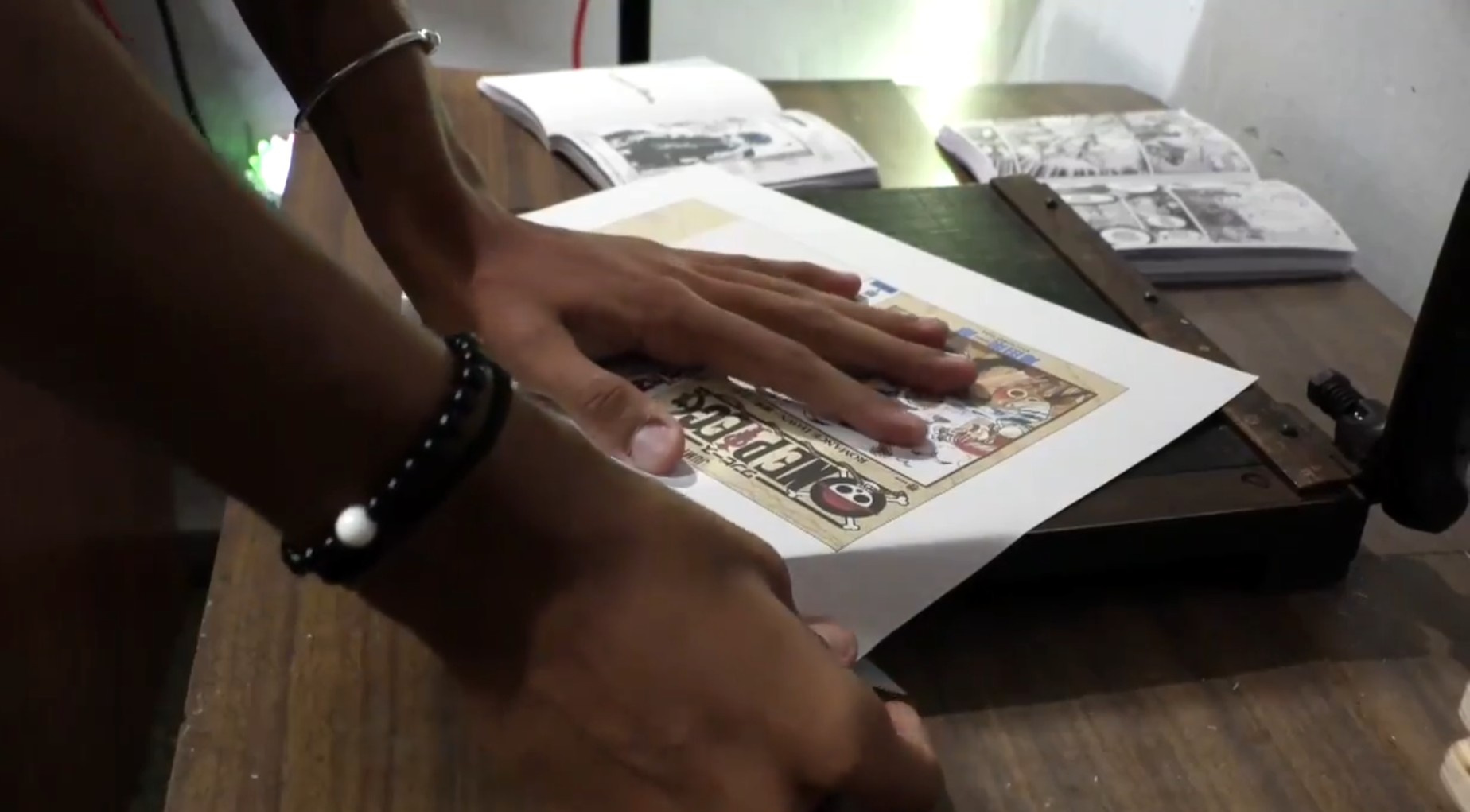
Álex Jiménez, a 21-year-old, has been running a thriving business that he has decided to call Mangatiny
Jimenez hand-covers the books to deliver them to a wave of followers of this type of literature in Havana. / EFE / Screen Capture
EFE (via 14ymedio), Juan Carlos Espinosa, Havana, 6 June 2025 — The room of Álex Jiménez, a 21-year-old Cuban, is an operations center with a katana on the wall, a desk with Dragon Ball Z dolls and a Death Note mouse pad.
His computer contains about 20 gigs of manga — illustrated Japanese stories, similar to comic books, read from right to left — and a couple of design programs, a passion he developed from an early age.
But his uniqueness is what he has done with that digital mini-library. For three years now, the young Cuban has been running a thriving business that he decided to call Mangatiny.
Jiménez hand-stitches the books to deliver them to a wave of many followers of this type of literature in Havana.
The interest in manga (written medium) – as well as anime (animated medium) – has risen like foam in Cuba in recent years. And the young man knew that there was a unique opportunity in a country where buying the original volumes is practically impossible, either because there are none or because, when there are, they are at exorbitant prices. continue reading
“The culture in Cuba has expanded completely, and thank God my business has continued to grow”
As he tells EFE in an interview in his room, in the Havana neighborhood of Alamar, the idea originated when he was in military service and saw a colleague in his dead time reading a miniature copy of Harry Potter that he printed at home.
He didn’t think twice and did something similar, though much more professional, with his favorite manga: Chainsaw Man. Everything was positive from that moment on.
“In previous years, if you watched a manga, you were someone special. Something like: ’ay, you’re a child’, you know? The culture in Cuba has expanded totally and thank God my business has continued to grow,” says Jiménez, while showing how he makes a customer’s order.
José Ángel González, a 21-year-old friend of Jiménez is a good example of how Cubans have embraced Japanese popular culture in recent years. His first approach to that world was, like many other compatriots who grew up before the arrival of Wi-Fi in 2014, with a burned CD that his mother bought him at a street stall. Inside the disc was the anime “One Piece.”
The jump from anime to manga was natural. There came a point where he just couldn’t wait to copy new arcs (seasons) from his favorite, Bleach, onto a memory stick.
González explains to EFE that, unlike its counterpart, comic strips, manga, and in general the very particular way of telling stories in Japan, has a much deeper exploration of characters than in the West. And that has connected very well with the average Cuban.
“Today, I would dare to say that four out of five people consume anime”
“They are stories that reach the heart and, at the same time, the mind. In the West, for example, the comic strip ultimately is more about the epic, the hero: the invincible protagonist overcoming certain problems. But they do not go to the center, the core of what the character feels, of what is going on”, he says.
The popularization of manga in Cuba is more evident if we analyze the varied profile of Jiménez’s clients. His orders range from the lifelong otaku (young person), who isn’t over 18, to a husband’s birthday gift to his wife.
The fans can be a worker, student, reggaeton, rocker or athlete. Jiménez knows it well and reaffirms: “Today, I would dare to say that four out of five people consume anime”. He sees it with his own eyes when the orders arrive.
According to him, printing a manga can take only a few minutes, although wrapping it in cloth can increase the time to an hour.
On a normal day, he may spend 6 to 7 hours working, alternating with his computer studies, not counting the long blackouts in his municipality. In fact, the lights went out during the interview.
Jiménez sees himself in the years to come doing the same thing he does now, but with a much larger operation. He knows that the consumption of manga will continue to rise, and his offer will continue to satisfy that hunger for new issues every week.
Translated by Regina Anavy
____________
COLLABORATE WITH OUR WORK: The 14ymedio team is committed to practicing serious journalism that reflects Cuba’s reality in all its depth. Thank you for joining us on this long journey. We invite you to continue supporting us by becoming a member of 14ymedio now. Together we can continue transforming journalism in Cuba.
Francisco García paid nearly $13,000 to a trafficker to take him to Greece, where he is living on the street
The Cuban Francisco García escaped the war last October. / La Tijera
14ymedio, Havana, 6 June 2025 — It was made clear to Francisco García that he would “return to Cuba in a coffin or as a hero”. The 37-year-old understood that the attractive online advertisement shown to him by a friend months earlier, offering 204,000 roubles ($2,594) a month and a Russian passport for repairing buildings damaged by Ukrainian shelling, was a lie. He had been recruited as a mercenary. “My life is over,” he told the British newspaper Daily Mail.
García witnessed the death of dozens of Cubans in combat, “Russians who committed suicide” because they could not bear the war. However, mercenaries are not “allowed to show fear”, they cannot feel pain or compassion. “We were asked to be like robots on the battlefield.”
Garcia, who escaped last October and is in Greece surviving on the streets, is one of more than 20,000 Cubans recruited by Russia since the war began in February 2022. A man who “has fought in a war” that has nothing to do with him. Ukrainian intelligence data shows that there are about 7,000 Cubans currently on the battlefield with little or no training.
From the moment he stepped off the plane that took him from Havana to Sheremetyevo International Airport, the presence of a Cuban man in military uniform and backed by Russian soldiers who forced them into army trucks made him fearful. “They didn’t give us food or water. After a long journey, we arrived at an abandoned sports school, guarded by armed police,” he told the same newspaper.
García corroborated the same modus operandi that other Cubans have gone through. Once in Moscow, they are given contracts in Russian and, amid shouts and threats, they are forced to enlist as mercenaries. continue reading
Garcia was forced to carry heavy weaponry, including an assault rifle, a portable rocket launcher and four grenades. / La Tijera
He was given an assault rifle. “It was the first time I held a gun in my hand,” said the man who lives haunted by Russian President Vladimir Putin’s words: “traitors will never be forgotten”. The Cuban insists that he has not killed anyone, but admits: “I don’t know if I wounded anyone because I fired in panic, but that is always in my mind.”
After 30 days with other Cubans and people from Asia and Africa, he was pushed to the front lines of the war without warning because “Russia was losing many soldiers every day”. Garcia was forced to carry heavy weaponry, including an assault rifle, a portable rocket launcher and four grenades.
He quickly realised that war was “not a game” and that his mission from then on was to survive. “There were 90 Cubans like me at the beginning, but more than half of them died in combat,” he said.
In combat, he witnessed the destructive capacity of kamikaze drones, which “we Cubans didn’t even know what they were” and which “caused a lot of damage, much more than hand-to-hand combat”.
The mercenaries, Garcia said, are abandoned by the Russians when they are wounded on the front lines.
On one occasion while on the front line he was hit by bullets and left a scar on his right bicep. “I rushed to protect myself, but I was hit. It felt like I was hit with a giant hammer, but I didn’t feel much pain because of the adrenaline and trying to save my life.” Garcia was shocked and was quickly put in a tourniquet and injected with morphine to overcome the pain.
The second injury occurred when “a bomb hit a building near me. I can still hear the bang. Some metal fragments from the explosion hit my left arm and both legs, and a toxic smell came out.”
After a year in the Russian artillery brigade in Rostov, Donetsk and Soledar, the Cuban was awarded a medal and a certificate in honour of his service. In addition, he was given two months off in October 2024. That was the time he took the opportunity to escape. He contacted a people smuggler who, for 1,000,000 roubles ($12,715), guaranteed to take him “safe and sound to Greece”.
Garcia was counting on the money he had been paid for his services because he was not allowed to send it to the island. His journey took place in airports between flights through six countries, from Belarus to Azerbaijan, then to the United Arab Emirates and Egypt, before finally arriving in Athens, he told the Daily Mail.
He explains, “I have gone through many difficulties and no one helps me. I sleep on the streets and struggle to survive. I wish I could go back to the simple life I had before in Cuba, but I can’t.”
Translated by GH
____________
COLLABORATE WITH OUR WORK: The 14ymedio team is committed to practicing serious journalism that reflects Cuba’s reality in all its depth. Thank you for joining us on this long journey. We invite you to continue supporting us by becoming a member of 14ymedio now. Together we can continue transforming journalism in Cuba.
The hardliners (Taliban) of the Cuban regime cannot stand that the young man displays the contradictions of the system
The ’influencer’ grandson mocks the Electric Union with a Yankee flag at his back. / Screen capture / Instagram
14ymedio, Yunior García Aguilera, Madrid, July 5, 2025 — The orthodoxy of Castroism has unleashed a strong offensive against the most viral grandson of Fidel Castro, founder of the oldest dictatorship in Latin America. Sandro Castro has gained more than 100,000 followers on Instagram for brazenly demonstrating the strong contrasts in today’s Cuba. While most suffer blackouts, shortages and hardships, a privileged few like him will never know the words sacrifice or effort. His main sin has been to break a golden rule in his family: enjoy and shut up.
Yuliet Teresa Villares, communication coordinator at the Martin Luther King Jr., Memorial Center, suggests in a publication that Sandro is an “unpunished shithead”. The propagandist Pedro Jorge Velázquez -nicknamed El Necio – calls him an “ideological enemy” on X. Ernesto Limia, vice-president of the Union of Writers and Artists of Cuba, publishes a pamphlet on Facebook, fills it with appointments to cover his back, and finally releases it: “Sandro is an idiot.” Immediately the former spy Gerardo Hernández Nordelo, high priest of the monitoring committees, blesses his post with an “amen.”
Pedro Jorge Velázquez – nicknamed El Necio – calls him an “ideological enemy” on X
Sandro is the son of Alexis Castro Soto del Valle, the eldest of five sons of Fidel and Dalia. The boy’s mother, Rebecca Arteaga, has been a faithful observer of the family golden rule and keeps a low profile.
The boy assaulted his own Moncada four years ago, when he posted pictures with his girlfriend pressing the throttle of a Mercedes Benz, “one of the toys I had at home.” After a boxing of ears, he offered apologies publicly, although behind his words he seemed to say: Condemn me, it doesn’t matter, Instagram will absolve me. continue reading
Curiously, the same people who now want to burn him at the stake of the Fidelist inquisition go in procession to the center that treasures the relics of the Commander, to venerate the armored Mercedes Benz model 500 SEL that “the first of his name” used for two decades to drive through his estates.
Sandro is the broken mirror of a political project that swore to create the “New Man” and has ended up generating an influencer who mocks the Electric Union with the Yankee flag at his back. He owns a bar, never strays from a cold Cristal beer and is a fan of vampires. Perhaps it was Sandro who enlightened the official Alexis Triana to get in Spain a copy in good condition of the film Vampires in Havana. Before the media grandson made reference to a film that the Cuban Institute of Art and Film Industry had not been able to preserve, the skilled squire Triana stepped forward.
“Ah, but look at Fidel Antonio Castro Smirnov, so discreet, so intelligent, so committed”
To prove that he does not have a genetic defect, the ultra-fidelistas compare Sandro to one of his cousins. They say: “Ah, but look at Fidel Antonio Castro Smirnov, so discreet, so intelligent, so committed”. Smirnov is the son of a Russian woman with Fidel Ángel Castro Díaz-Balart — Fidelito, the second of his name — who threw himself from a fifth floor window in 2018. Smirnov, unlike Sandro, was trained outside Cuba. His passion is not for Cristal; it is for cigars. He is not attracted to vampires but to parachuting. His partner is not an instagrammer, she is a presenter of the television program Cuadrando la caja: Marxlenin Pérez. What conservatives like about him is his silence.
The anger of the “loyalists” has exploded because Sandro disassembles all their rhetoric and represents what they will never be. El Necio and Limia may become mere propagandists, perhaps with minor privileges, perhaps with the possibility of reaching some position within the nomenclature. But they will never be untouchable. They belong to a lower caste, like Carlos Lage, Felipe Pérez Roque and Alejandro Gil. They will taste the honey of power as long as they are useful, and if the power in the shadows decides to discard them, it will do so without a blink of an eye.
Limia did not say “I can’t speak out of turn” when Raul’s grandson-bodyguard ran over a 19-year-old girl with impunity
Attacking Sandro seems easy. Comparing him with Smirnov too. The one the Taliban will never mention is Raúl Castro’s favorite grandson: El Cangrejo (The Crab). Raúl Guillermo Rodríguez Castro – son of Débora Castro Espín and the late López-Calleja – makes Sandro look like a commoner.
Limia did not say “I can’t speak out of turn” when Raúl’s grandson-bodyguard ran over a 19-year-old girl and her young son with impunity on April 23, 2022. He will never dare to question his videos shot on luxury yachts singing “I’m a Playboy model.” El Necio – whose nickname fits perfectly with his scarce talent – will never dedicate a measly criticism against the most powerful dauphin of Cuban royalty. Opportunists always know where it says “danger.”
Translated by Regina Anavy
____________
COLLABORATE WITH OUR WORK: The 14ymedio team is committed to practicing serious journalism that reflects Cuba’s reality in all its depth. Thank you for joining us on this long journey. We invite you to continue supporting us by becoming a member of 14ymedio now. Together we can continue transforming journalism in Cuba.
While Russia announces many projects without finalizing them, Beijing delivers solar parks without stopping.
Solar park under construction in Cabaiguán, Sancti Spíritus. / Escambray
14ymedio, Mercedes García, Sancti Spíritus, 30 June 2025 — They complained about too-long power cuts and got a substantial reduction because Chinese engineers have installed a photovolcaic park in the key sector of Cabaiguán, Sancti Spiritus, the province worst affected by blackouts.
The Chinese, who have shown themselves able to install solar parks much faster than normal on the island, have received power cuts from their local electric supply where they live much shorter than the normal 14 continuous hours
“They complained about the cuts, and as a result they have sevice from 5 pm to 9 pm and 6 am to 10 am,” said a local woman who knows about the situation but wanted to remain anonymous. “They were not shouting about it.” she said. “They asked to meet the authorities and raised their concerns, it was a complaint along the lines of we don’t agree with being without service at a time when we need it.”
The Chinese, she said, are staying at the Rancho Hatuey hotel, within circuit 119 of Sancti Spíritus, which, according to the authorities’ schedule, was only planned to have one hour of power for 14 hours of blackout. This continue reading
circuit, she explained, called Los Laureles, “runs from the Rotonda to Chambelón and surrounding areas,” where the Rancho Hatuey and Los Laureles hotels are located, as well as the Communist Party of Cuba’s guest house, the Cupet asphalt plant, the poultry slaughterhouse and other important centres. “They don’t take any notice of us, but they do to the Chinese”, the neighbour concluded. “Since they are the ones bringing the panels.
With the Chinese equipment comes trucks and fuel to transport it overland to make sure it reaches its final destination.
On this subject, Reuters published on Monday that shipments to Cuba from China via Mariel increased in August last year. The British agency has sources in import data and several foreign businessmen, and reports that the ships brought solar panels, steel, tools and other parts from ports such as Shanghai or Tianjin for the photovoltaic parks that are being built on the island at an accelerated pace.
And it’s not just the equipment that arrives. Coming with them are trucks and fuel to transport them overland to ensure they reach their final destination. “The impact of the arrival of Chinese ships can be seen throughout the Cuban countryside, where trucks with Chinese lettering travel over bumpy roads to reach remote destinations such as Jatibonico,” Reuters explains in its report, naming the city in Espiritu.
One of the sources, Noel Gonzalez, a driver, is “amazed and grateful” to the agency “for the Chinese diligence”: “The Chinese come and periodically check every litre of oil, every route we take,” he said.
In its article, titled “China quietly replaces Russia as Cuba’s main benefactor,” Reuters also refers to the announced arrival of the Russians at the Uruguay sugar mill in Jatibonico, which has yet to materialise. “When are they coming? That’s all anyone is talking about,” Carlos Tirado Pino, one of the few remaining employees at the sugar mill, which remains inactive, told the British agency.
In October 2022, four months after this newspaper first reported the closure of the “colossus of Jatibonico”, the news was confirmed by the official newspaper Escambray. The article hinted that the hope for hundreds of workers who were left without jobs was in Moscow, as a Russian delegation had visited Uruguay and expressed its intention to create a joint venture that would save it.
Eddy Gil Pérez, director of Empresa Agroindustrial Azucarera Uruguay, showed his enthusiasm at the time for the possible Russian management: “We are among the nine sugar mills in the country chosen for this business”, he revealed. More than six months later, in February 2023, workers in the sector were informed that the agreement had been finalised with Moscow and that Uruguay was not to be counted on for the harvest because it was undergoing refurbishment work.
But since then, nothing has happened. A state worker sceptically told 14ymedio “They talk about coming here, and projects, but all in an idealistic tone, like back in Soviet times.”
According to Reuters, while China is getting on with building solar parks – with 55 programmed for this year – Russia’s plans for the island are just promises.
“Bogged down in the war in Ukraine and reluctant to invest more money in the Cuban crisis, it is now less of a historical partner,” the agency commented, quoting William LeoGrande, professor of Latin American politics at American University: “Russia’s words have always been bigger than its deeds. If China is stepping up its aid in the face of Cuba’s desperate situation, it could be a real lifesaver”.
Translated by GH
____________
COLLABORATE WITH OUR WORK: The 14ymedio team is committed to practicing serious journalism that reflects Cuba’s reality in all its depth. Thank you for joining us on this long journey. We invite you to continue supporting us by becoming a member of 14ymedio now. Together we can continue transforming journalism in Cuba.
Lescay, from Santiago, aspires to surpass his personal record of 8.35 meters and reach the level of other Cubans who have represented Spain
This year, the athlete obtained Spanish nationality after marrying his girlfriend. /EFE
14ymedio, Havana, 5 July 2025 — Cuban long jumper Lester Lescay had to wait three years for the European country to grant him citizenship after leaving a Cuban delegation in Belgrade and marrying his girlfriend in Spain. “I was not given citizenship because of my sport, as has happened in other cases. The path has been different, but in the end I have managed to integrate well,” he tells OnCuba in an interview in which his determination to migrate appears as the final turning point of his career.
“I left Cuba because I didn’t want to spend my youth there,” the athlete begins saying and the phrase gives title to the interview. His youth career is not negligible: At the age of 15 he took second place in the U-18 long jump world championship, a year later he already jumped more than eight meters and at 17 was crowned champion of the Buenos Aires 2018 Youth Olympic Games. “It was very fast, I almost didn’t have time to assimilate it, I just jumped trying to make a competition better than the previous one,” he remembers.
Despite being among the best of the Cuban squad, other names stood out for accumulating better results, something that the 23-year-old santiaguero attributes to the speed with which some boys manage to improve their technique while others go at a slower pace. “We do not all go at the same pace, some explode before others. Sometimes you lose patience very quickly with the young people, but you can’t despair,” he explains. Still, he qualified for the 2020 Tokyo Olympics.
Lescay explained that it was right after the games in Japan that he had determined that his future wasn’t in Cuba
In an interview given to Runners World two years later and after his escape, Lescay explained that it was right after the games in Japan that he had determined that his future wasn’t in Cuba. “I decided that as soon as there was a trip, I would leave the Island,” he said. The poor state of Cuban sport and the story of his aunt, Mabel Gay Tamayo – world runner-up in triple jump at Berlin 2009 and bronze at the Indoor World Cup in Istanbul 2012 – helped him decide. “She was a good athlete, and I saw that almost immediately after she finished she was nothing,” he added about Tamayo, continue reading
who reached 14.67 meters.
Integrating into the Spanish sport has not been easy for Lescay. Initially, OnCuba claims, “he wasn’t seen as a potential addition to their national team,” and the fact that they did not grant him citizenship because he is an athlete proves it. It wasn’t until last January that, with his red passport in hand, Lescay was endorsed by the World Athletics to enter the professional sport in Spain.
However, the athlete does not complain. “I stayed with a super nice Spanish family who welcomed me as one of their own,” he says in reference to his wife’s family. He also received support from the Playas de Castellón club, of which he has been a part since he arrived in Spain. “Their help has been crucial, because when you migrate you don’t know how you’re going to live. It’s a lot of uncertainty, and they were always there for me,” he says.
Gradually, Lescay has started to add titles representing the colors yellow and red. This year he won bronze at the European indoor track held in the Netherlands. “That was my official debut with Spain, unforgettable, both for the medal and for having competed injured, almost without being able to run. I had to worm my way in to jump. The hardest thing was not being able to enjoy the event, but it is a happy memory for the result,” he estimates.
The Puma brand, which sponsors events and sports professionals, was also interested in Lescay, who recently signed a contract with them.
His first disappointment came with the European Championship by Nations, held in the Spanish capital, where he was left out of the first division
His first disappointment came with the European Championship by Nations, held in the Spanish capital, where he was left out of the first division. “It’s a pity that here in Madrid I didn’t make the leap that the fans were waiting for. It was not a good day, but not for lack of legs: I simply didn’t jump well,” he regrets, but without losing momentum: “The important thing was to bring points to the team. I’m not sad, but I know I could have done more.”
His plans are also ambitious for the upcoming competitions. “If I take care of myself, I have few limits,” he told the media, and he described his plan for the next event on his agenda. “There is the World Cup next September in Japan, where I will give everything I have. There will be no team involved: Only I will compete, and if I fail, the harm will be exclusively to me,” he explains.
However, the priority of the Cuban, who has managed to sneak into the Spanish sports scene, is to exceed his personal record of 8.35 meters, a jump he achieved in 2024 in Guadalajara with Luis Felipe Méliz, another Cuban exponent of the sport who is currently his coach. When he left Belgrade in 2022, his maximum was 8.28 meters outdoors.
Translated by Regina Anavy
____________
COLLABORATE WITH OUR WORK: The 14ymedio team is committed to practicing serious journalism that reflects Cuba’s reality in all its depth. Thank you for joining us on this long journey. We invite you to continue supporting us by becoming a member of 14ymedio now. Together we can continue transforming journalism in Cuba.
The summer offer of leisure time for Havanans is a trip to nowhere
The train has three railway wagons that can accommodate about 200 passengers / 14ymedio
14ymedio, Darío Hernández, Havana, July 5, 2025 — “Hurry up, the trains waits for no one,” screams a woman on the Central Station passenger platform. This Friday, barely 20 people boarded the train bound for Expocuba, reactivated on July 2 after being paralyzed for a decade. With great fanfare, the authorities celebrated the availability of the route this summer for leisure offers to Havanans.
In the intense midday heat, the yellow and green locomotive starts; children jump from one seat to another as the blue railway wagons rattle.
“This route has been closed for more than ten years. They put it back now because of the huge deficit of buses. It is guaranteed for all the holidays and will continue for the whole year,” one of the engineers, cigarette in hand, tells 14ymedio. With three used railway wagons and a price of 20 pesos, the train was enabled to transport 204 people and makes stops in Luyanó, Dolores, La Víbora, Naranjito, Miraflores, Los Pinos, Alcázar, Arroyo Naranjo, Galapagos, Calabazar and La Piscina.
he stations through which the train now passes were closed for a long time due to deterioration and accumulation of garbage /14ymedio
The stations, he continues to explain, were closed for a long time and began to deteriorate and accumulate garbage. The section that the train covers today had to be cleaned before starting the route, and on the side of the tracks you can still see traces of waste, but “they will continue cleaning it up until Bejucal,” he adds. “They even took down several power and telephone wires that were on the tracks. On one of the trips, the neighbors had to raise a cable with a stick so that the train could pass.”
Bushes, abandoned warehouses, houses and hovels in the middle of nowhere, and a river from which some boys wave to the train is all the journey has to offer. At each stop the train loses passengers, and by the time it reaches Expocuba at 3:30 pm, there are only a grandmother with two grandchildren left. They came to spend some time at the fairgrounds and are going to be disappointed.
The park is closed because the bus carrying the workers broke down, and most of them could not get there. Inflatable toys, confesses an employee, is continue reading
the only children’s attraction available.
“Today we have hardly had any visitors,” she explains to the newspaper. “I was sitting with only two people until now,” she says. Asked about how Expocuba works when employees can arrive, the woman admits that “normally we have almost all the pavilions closed.”
With a glance at the park’s condition the reason is obvious. The deterioration of the buildings, the wear and tear of the attractions – faded by the sun and with missing pieces – and the almost zero gastronomic offers are eloquent. “There is no longer even the agricultural pavilion where they kept the exhibition animals that everyone was told to go see. They were removed because people started stealing them,” she explains.
“Yes, we do have the inflatable toys park, and all the bars function: La Solera, El Mirador, El Ranchón. The Casa del Queso has a variety of cheeses that aren’t very abundant because we have, as does the country, a shortage of many things,” she says.
Keeping the park running is no easy task. “We workers have no transport. We have a bus that leaves us off on the Calabazar bridge, and none of us lives in Arroyo Naranjo or nearby. When we get off on the bridge we have to figure out how to get home,” she complains. “What happens? The bus also broke down. So, today the famous train has arrived, and the workers are going to go on it to see how it is working”.
The condition of the buildings, the attractions with missing pieces and the almost zero gastronomic offers are eloquent / 14ymedio
On the return, the journey does not differ much from the one-way trip. The sun continues punishing the tin roof of the wagons, which are half bent, and the boys who were in the river have already left.
Expocuba is no longer an option for many in Havana, who are looking for other ways to enjoy, even briefly, the summer days. The state doesn’t offer much either: this Saturday the train to Playas del Este that takes more than an hour and a half on each trip was enabled. Transtur offers trips from Havana to the same destination, with departures every hour from 9:00 am, for 10 dollars or 1,200 pesos.
For those who can pay these prices, a day awaits in which they will have to guarantee, with their own means, everything from the food they consume to the drinking water.
Translated by Regina Anavy
____________
COLLABORATE WITH OUR WORK: The 14ymedio team is committed to practicing serious journalism that reflects Cuba’s reality in all its depth. Thank you for joining us on this long journey. We invite you to continue supporting us by becoming a member of 14ymedio now. Together we can continue transforming journalism in Cuba.
La patria, homeland, that word that for some is barely an echo—is the largest chessboard that life gives us. And on it, each person must decide whether to play like a knight or to crawl like a pawn.
Capablanca knew that true glory in the game of chess couldn’t be sullied by dirty politics or by a despot’s ambitions. / CC
14ymedio, Jorge Luis León, Houston, 30 June 2025 – It was Savielly Tartakower who, with an acuity that distinguished him as much off as on the chessboard, uttered the following sentence which still resonates today with some force:
“Chess is only a game; any nobility attributed to it is owing, without a doubt, to any nobility in those who play it.”
This sentence contains a deep truth. Chess, in itself, is just a mixture of rules, pieces and movements. But when honest men take up the game and when they turn it into a way of life, those of them who don’t compromise themselves through lying then ennoble the game; it becomes dignified and reaches an ethical dimension that goes beyond any art or sport.
Capablanca: honour versus power
Cuba, cradle of one of the most immortal geniuses of chess, found in José Raúl Capablanca not just a world champion, but a man of principle. Few people know or remember that during Gerardo Machado’s dictatorship there were attempts at using him as a propaganda tool for the regime. Capablanca refused, with elegance but also with firmness. He knew that true glory in the game of chess couldn’t be sullied by dirty politics or by a despot’s ambitions. He was an example of that nobility that Tartakower had revered. He never betrayed his dignity, even when silence could have been easier.
Cuba, cradle of one of the most immortal geniuses of chess, found in José Raúl Capablanca not just a world champion, but a man of principle
Miguel Alemán: voice of the people and of conscience
In more recent times another name shone out in my memory as a symbol of courage: Miguel Alemán, ex national champion of Cuba, a modest gentleman, he stayed away from public focus but remained immense in his truth. I listened to him speaking when I was barely an adolescent in a small chess club:
“Living under dictatorship is unbearable.”
He said it without embellishment, without fear, and with the simple clarity of a pawn who sacrifices himself for the greater good. Years later, ill and continue reading
lying in a hospital bed, he reaffirmed to me the same thing: “The revolution is a swindle.” And with these words his consistency was confirmed. He was never recompensed for his talent, never exalted by the system, but today he figures as a giant in the face of many others’ cowardly silence.
Dignity on the chessboard
What has become of Cuban chess players in these our tragic times? Where is their nobility? Why are they so full only of analysis, of replayed matches, of calculated movements and detail, whilst Cuba is being pushed into the abyss of desperation?
Perhaps it’s simply enough for them to adjust their player’s seat and set the timer while the nation bleeds and dies beyond the edges of their chessboard? No need to defend anything more than a well-plotted chess move? Where are their voices whilst the fatherland is trapped, whilst the people – the same ones that applaud them during their tournaments – are drowning in misery?
Many of these chess players, some of them with enviable academic titles – lawyers, historians, sociologists – have preferred to stay silent. Or even worse, they’ve decided to repeat empty slogans about the “blockade”, joining in with the con like docile pieces in a match that lacks any dignity. In their social networks they show brilliant chess moves, digital chessboards, victories which save nobody. And not a word about the repression, not a single gesture in the face of all the people’s pain. They settle for a few crumbs here and there, a bit of travel, a medal. Some even openly declare “fidelity” to Cuba’s tormentor.
Other examples, same shame
In other parts of the world there’ve been chess players who raised their voices. Gary Kasparov, for example, openly confronted Putin’s regime, knowing he was putting his own safety at risk. He chose the truth. He chose to be a man over being a champion. He didn’t sell his voice for a title or for a chair on some committee.
In Iran, champion player Dorsa Derakhshani was expelled from the national team for not wearing the veil in one tournament. She refused to give in, refused to pretend
In Iran, champion player Dorsa Derakhshani was expelled from the national team for not wearing the veil in one tournament. She refused to give in, refused to pretend. Today she represents the United States and continues to speak up for the oppressed. What does this tell us about force of character?
Silences that are betrayals
I have put questions to a few Cuban chess players. I’ve spoken to them with respect, called on them to join the debate, to bare their souls. The majority told me I should just keep silent. Others, more cowardly, simply blocked me. Is that the fortitude of a chess master? Is that the spirit of Caïssa? No. It’s just the alternative sham for which they have preferred to bend the knee.
I say this to them, out of a passion I’ve had for the game since infancy:
Your dignity is worth so much more than any medal, than any trophy, than any foreign trip.
The fatherland – a word that for some is merely an echo – is the biggest chessboard that life has given us. And on it, each one of us must decide whether to play like a gentleman, or whether to be sold, as a pawn, and swept away.
The nobility of a chess player isn’t measured by their titles, but rather by their commitment to the truth. It’s in their refusal to be complicit.
Today more than ever, Cuba needs chess players to play the hardest match of all: that of dignity against oppression. And in that match there is no possibility of a draw.
Mary Luz Borrego, one of the most critical voices in the state press, tried to buy eggs and ended up with “discreet” bruises.
Egg production on the island has been calamitous in recent years / 14ymedio
14ymedio, Havana, 4 July 2025 — La Época, a dollar store located in the city of Sancti Spíritus, was the protagonist, according to an article in the official press this Friday, of a scenario that has been repeated for years on the island: the long and tumultuous lines with resellers lying in wait, and with stratospheric prices. The cause, says an official reporter stunned by the crowd, was the sale of eggs at $5.25 fulas (American dollars) per carton.
Relatively cheap – at least compared to meat – and rich in protein, eggs are a coveted food on the island that in recent years has seen a scandalous collapse in production. Usually chaos is unleashed when they are for sale, but Mary Luz Borrego, a journalist for Escambray and one of the most critical voices of government authorities, seems to have experienced it for the first time.
“I endured more than three and a half hours of battle in a kind of Roman coliseum, being shoved and bumped into, which not only bruises the body but also the spirit of those who were there,” complains the woman. She is most indignant about the “mobs of resellers who bought one, two, three, four or more times because they took several turns; they stood in line for each other, strategized, disguised themselves, blocked the door to only let in their allies, and fought with shouts and obscenities to get what they could before leaving.”
At the end of the day, she regrets, the resellers won: “they took as many cartons as possible to get their share”
At the end of the day, she regrets, the resellers won: “they took as many cartons as possible to get their share,” but they weren’t the only ones. The workers and owners of private businesses, “who apparently never have enough of their usual profits,” were also successful.
Contrary to the usual official discourse, which blames the “unscrupulous” for worsening the country’s economic situation, Borrego recognizes that “this sad reality is not based on the backs of a few scoundrels, but on the economic situation of the country, the productive-financial deficit that has turned the scarcity of everything or almost everything into fodder for the informal market with science fiction prices.” continue reading
The situation forces citizens to choose a cheaper product – even if that means lining up for several hours in the hot sun – and one that is easier to buy on the informal market, but at prohibitive prices. The eggs of La Época are not “given away,” but the price is up to 1,300 pesos cheaper, changing the dollar at street price, than if they were purchased on the black market, where even spoiled eggs are sold, she admits.
“When the wait was beyond funny, this reporter asked for permission and went to talk with the manager of La Época, who argued that they only had the responsibility to guard the goods of the store and the hard money in their cash registers but could not organize the line, that this was the business of the customers outside,” says the journalist, and she gives an eloquent example of the “questionable” methods of the sellers in these shops.
The manager not only refused to call the police – claiming that on other occasions they had not responded to the request to restore order – but also at one point, “when one of the most successful coleros [line standers] was about to enter for the umpteenth time, she poked her face out, stopped him and asked if we were going to allow it. Faced with the shocked silence because of what seemed to be an incitement to violence, she made an eloquent gesture – something like ‘if you don’t solve it, I will’ – and let him pass.”
Throughout the day, the employees were limited to “taking care of the products and the dollars collected”
After gaining several “discreet” bruises, the journalist managed to acquire the last carton of eggs. In the purchase she noticed the presence of several “close friends” of the store, “who managed to enter and waited furtively, perhaps to collect their own eggs, which remained safe and well guarded in the shade of some shelf.”
After the sale, the “mess” ended and most people went home empty-handed. Throughout the day, the employees were limited to “taking care of the products and the dollars collected,” as they are ordered to do from above.
Borrego, however, is reluctant to overlook the “impotence” and “shame” felt on that day. “Is it logical that a public institution like La Época should allow such arbitrariness in front of its nose?” she asked, appealing to a decorum that was lost long ago by the authorities.
Translated by Regina Anavy
____________
COLLABORATE WITH OUR WORK: The 14ymedio team is committed to practicing serious journalism that reflects Cuba’s reality in all its depth. Thank you for joining us on this long journey. We invite you to continue supporting us by becoming a member of 14ymedio now. Together we can continue transforming journalism in Cuba.
Images and a video show the deterioration of the Eide Ormani Arenado, the Manuel Fajardo Faculty of Physical Culture and the 19 de Noviembre Multipurpose Hall.
The Eide Ormani Arenado hosted on June 15 the selection of the artistic gymnastics team in Pinar del Río / Facebook/Pinar Indir
14ymedio, Havana, 4 July 2025 — The foundation of Cuban sports is falling apart. Athletes, coaches, circus artists and users denounced on social networks the abandonment of the Ormani Arenado School of Sports Initiation (Eide), the November 19 Multipurpose Room (both in Pinar del Río) and the Manuel Fajardo Faculty of Physical Culture (Santa Clara).
They have had to remove pieces of rotten wood from the floor of the Eide Ormani Arenado, which looks like a minefield. One of the revolutionary emblems inaugurated in 1963 inside the Athenaeum is in ruins. “Seeing it like this causes immense pain,” lamented US-based Cuban boxer Yuniesky González, who shared the image of the facility. “Wow! I had to see it to believe it. How we ran around on that floor! How many of us went through there?”
Adriana Lazaga, a teacher of the National Institute of Sports, Physical Education and Recreation (Inder), recognized that the Eide has been forgotten for years. “Nobody cares about sports anymore, let alone the well-being of our athletes. When I entered in 1997, at the height of the Special Period, it was 100 times better than now, 28 years later.”
The boxer’s post generated comments from athletes who visited his site. “In 1990 that part of the gym was flawless, but now it is unattended,” recalled Noel Tapia Morales, who practiced wrestling.
Circus artist Yandisley Leal commented that the deterioration of the facilities in the Eide Ormani Arenado “is not even half the conditions we had before, and they were bad.” The member of the German company continue reading
Circus Probst, Osmaikel Otaño, mentioned that in a decade the gym has “fallen into pieces.”
The investment seems insufficient. In June 2024, the vice president of Inder, Omar Venegas Echemendía, spoke about new developments for the sports infrastructure in Pinar del Río. As part of the advancement of 65×60=Fidel Program, the official highlighted two new dormitories for the more than 400 athletes participating in the National School and Youth Games, concluded this Friday.
Image of the Eide Ormani Arenado in Pinar del Río / Facebook/Yuniesky González
Venegas praised “the tangible repair work on the floor for artistic gymnastics, the wrestling mattress and the baseball field, which have received a transformation,” according to the official media Guerrillero.
However, the alleged improvements to the floor are not noticeable. During the selection of the artistic gymnastics team held on June 15 at Ormani Arenado headquarters, the lack of wood and paint in some places and the worn implements that athletes deal with every day are evident.
Handball coach Iván Roger Pérez Díaz said that the abandonment in the Eide is minimal compared to the deterioration of the infrastructure in the November 19 Multipurpose. “Don’t be surprised,” he warned.
Last year the sports authorities expanded the floor repair to the hallway, in addition to the judo tatami mats and surrounding areas. Work also continued on restoring the asphalt covering on the roof, which was torn away by Hurricane Ian.
In August 2023, the sports management told the official newspaper Granma that the waterproofing of the Multipurpose Hall 19 of November was “highly expensive,” despite the fact that at that time there was a donation of $15,000 from the Cuban Volleyball Federation and another 3,000,000 pesos allocated by the Provincial Defense Council after the passage of Hurricane Ian.
The waterproofing work continued but was a failure. Last March, Cubadebate reported that a few months after the work was completed, “the leaks persist.”
The main investor of the Provincial Direction of Sports, Luis Ricardo Ferreiro, said that the work “is poorly done in every way,” and, in addition, “the asphalt they used was expired.”
The specialist explained that the asphalt used for waterproofing has a type of small pebble that melts together with the rest of the material when steam is applied. “We have picked it up with shovels and sacks; it has obstructed the gutters up there. This means that it did not meet the required quality.”
Pinar del Río is the birthplace of champions. Mijain López, Marlenis Costa, Omar Linares, Pedro Luis Lazo, Yarisley and Idalys all come from there, promoted by Tele Pinar in 2022. At that time it warned that “for decades, in the midst of the difficult economic context of the country, the policy of the government and of Sports in Pinar del Río has been aimed at rescuing sports facilities to maintain results.”
The Faculty of the Manuel Fajardo Physical Culture (Santa Clara) is also abandoned. Ariel Martínez shared on Facebook a photo of the facade and the reactions from Internet users. Professor Maritza Aguila was sorry to see the center where she worked for 30 years in ruins.
Josefa Pons recalled that she started in 1976, “when it was inaugurated. It was a beautiful school, really a wonder. What a stage! There was everything.” She said that back then the place “had comforts, a culture and education. I was fourteen years old and enjoyed it very much. What I liked was modern gymnastics.”
From that time of glory only memories remain. The reality was shown in a video by Gabriel Nodarse. In the small area where football and basketball were played, only piles of rusty wood and iron remain, just like the judo area.
Translated by Regina Anavy
____________
COLLABORATE WITH OUR WORK: The 14ymedio team is committed to practicing serious journalism that reflects Cuba’s reality in all its depth. Thank you for joining us on this long journey. We invite you to continue supporting us by becoming a member of 14ymedio now. Together we can continue transforming journalism in Cuba.
The 10th Plenary Session is committed to closing ranks and militarizing the political apparatus.
Major General Raúl Villar Kessel, head of the Central Army, is one of the new members of the Central Committee / Cubadebate
14ymedio, Havana, 4 July 2025 — The X Plenary of the Central Committee of the Communist Party of Cuba (PCC) began this Friday in the Palace of the Revolution with the usual speeches laden with a rhetoric of resistance. The meeting, which will conclude this Saturday, called for in-depth analysis and national mobilization, although the immediate result was a greater militarization of the political apparatus.
In a context where shortages, deterioration of essential services, mass migration and social disenchantment are reaching critical levels, the leadership decided to strengthen the core of the Central Committee with figures coming directly from the Armed Forces and the Ministry of the Interior. Major General Raúl Villar Kessel, head of the Central Army, and Brigadier General Oscar A. Callejas Varcalce, head of the Political Directorate of the Ministry of the Interior, were added as new members of the highest organ of the PCC. The “unanimity” that approved their admission is not surprising, as it follows the logic of total consensus that characterizes these events.
Brigadier General Oscar A. Callejas Varcalce, head of the Political Directorate of the Ministry of the Interior, was also added
The third person to fill the vacancies generated by the internal cadre movement was Magda Resik Aguirre, First Vice-President of UNEAC. A frequent face on official television, the presenter and screenwriter has called the population’s weariness that manifests itself in social networks as a work of “the enemies of the Revolution,” who “make every effort to offer a theoretical platform for the disenchantment and delegitimization of socialism.” continue reading
Chaired by Miguel Díaz-Canel, first secretary of the Party and president of the Republic, the plenary began with appeals to unity and denunciations of the US embargo, in an attempt to justify the economic and social paralysis that is choking millions of Cubans.
The “vitally important” event began without the presence of Raúl Castro Ruz
Despite the fact that the event was classified as “of vital importance,” it began without the presence of Raúl Castro Ruz. His absence from such meetings has become increasingly frequent. Nor did he attend the previous plenary session held in December, although he was present on June 6 for the promotion of the main figures of the Ministry of the Interior.
Beyond the political theater, the incorporation of two high-ranking military officers into the party leadership structure shows a clear trend: the regime is facing the crisis by closing ranks rather than giving signs of political reform. Far from renewing ideas, they insist on shielding positions. Faced with economic collapse and the erosion of ideological control, the leadership is betting on military discipline as a guarantee of internal stability.
The leadership is betting on military discipline
Despite the symbolic references to Fidel Castro and the patriotic dates of the revolutionary calendar, this Plenary resembles more a declaration of political survival than a strategy for the future. Raúl Castro’s absence does not mark the end of an era, but the advance of a direction increasingly disconnected from the real country, locked in its epic narrative while the people face endless lines, blackouts, uncontrolled inflation and deep despair.
The Communist Party of Cuba, far from being a “compass and force,” as proclaimed by Organization Secretary Roberto Morales Ojeda, remains a wall. And this X Plenary is confirming it.
Translated by Regina Anavy
____________
COLLABORATE WITH OUR WORK: The 14ymedio team is committed to practicing serious journalism that reflects Cuba’s reality in all its depth. Thank you for joining us on this long journey. We invite you to continue supporting us by becoming a member of 14ymedio now. Together we can continue transforming journalism in Cuba.
The managers of Consolación del Sur complain that part of the plantations have been ruined due to the lack of irrigation.
All varieties of the leaf grown in the municipality have been affected. / Tele Pinar
14ymedio, Havana, 27 June 2025 — The constant power outages are not only trying the patience of Cubans, but also affecting important sectors of the country’s economy. Tobacco, one of the privileged sectors because it is almost entirely exported, is one of the hardest hit. According to official press reports, in the municipality of Consolación del Sur in Pinar del Río alone, 385 hectares were lost due to the blackouts this season.
In a note published in the local newspaper, Guerrillero , the loss is reported, which damaged “all varieties of tobacco” grown in the area, including the sol en palo variety and Virginia.
The municipality’s initial production was also not expected to be high from the outset. At the start of the campaign, only 1,500 hectares of tobacco could be planted, which have been depleted due to the lack of electricity to operate the irrigation systems. “We estimate an impact of half the contract, which translates to 0.6 tons per hectare; as a result, we have a production of 1,301 tons, compared to an initial plan of 1,778 tons,” Mario Luis Zamora, director of the Comprehensive and Tobacco Company in the municipality, told Guerrillero.
According to the leader, by this date his company should have collected about 2.5 million cujes
According to the leader, by this date his company should have harvested nearly 2.5 million cujes, but the harsh conditions for maintaining the crops have left the amount at just 1.9 million, equivalent to 79% of what was forecast for this year’s campaign. continue reading
Zamora is hopeful that the situation will be different next season—an unlikely outcome given the state of the country’s electrical system—and that they will be able to reach 2,100 hectares planted. To ensure the current production of 327 tons and the next, he adds, 1,036 drying houses for the leaves have been built, and “we are receiving the zinc needed to roof another 85.” In total, he estimates that around 1,800 houses will be roofed next year.
As for the current crop, we’re working with what we have. “We already have all the selected crops working and processing the stored tobacco, and we hope to have more than 80% of the producers with their lands cleaned and their accounts settled by the 26th.”
With cigar production clearly in trouble, Habanos SA—half Spanish, half Cuban—has begun to pay more attention to machine-rolled cigars at the Internacional Cubana de Tabacos (ICT) factory in the capital. These aren’t Cuban cigars, nor do they have the prestige of being rolled by the sweat of the destemmers, but the profits the brand makes from the smaller, easier-to-roll, and more affordable sizes position them among its most profitable products. In 2024 alone, machine-rolled cigars brought in $38 million of the $827 million the company recorded.
With 400 workers, the International is the only industrial cigar factory in Cuba, and can deliver about 800,000 units daily.
With 400 employees, Internacional is Cuba’s only industrial cigar factory and can deliver around 800,000 cigars per day. Production delays, even minimal, translate into losses because everything produced, its managers assured AFP weeks ago, “goes on sale immediately.”
In 2001, the company became a joint venture with Tabacalera, a Spanish company that, according to AFP, belongs to “a consortium of Asian investors whose names have never been officially revealed.” It has 64 machines that can produce up to 42 cigars per minute, from the Cohiba, Partagás, Montecristo, and Romeo y Julieta brands. To maintain the pace, workers told the agency, the staff is divided into three work shifts per day, from Monday to Sunday.
However, Habanos SA can’t rely solely on machine-made cigars. Its clientele with luxurious tastes and deep pockets prefers thick, exotic vitolas that sometimes cost thousands of dollars. However, with the company’s $827 million in revenue in 2024—breaking its own record—it will surely be able to survive for a while.
* Cujes are sticks of attached tobacco leaves used in drying.
Translated by Regina Anavy
____________
COLLABORATE WITH OUR WORK: The 14ymedio team is committed to practicing serious journalism that reflects Cuba’s reality in all its depth. Thank you for joining us on this long journey. We invite you to continue supporting us by becoming a member of 14ymedio now. Together we can continue transforming journalism in Cuba.
“The bruises on the neck and arms, the stiffness of the body, and the marks do not match the official version of the drowning.”
The family of the young man, arrested during a blackout on June 23, claims he was beaten to death. / Facebook
14ymedio, Havana, 1 July 2025 — The death of 32-year-old Félix Lázaro Reinoso Rodríguez, while in the custody of the Technical Department of Investigations (DTI) in Matanzas, Cuba, has sparked outrage both on and off the island. The family of the young man, arrested during a blackout on June 23, claims he was beaten to death and that authorities tried to cover up the crime. Images of his body, covered in bruises and showing visible signs of violence, contradict the official version of an alleged escape and subsequent suicide.
“The death certificate is absurd. He was buried in a common grave, like a stranger, without a wake or dignity,” his cousin told independent media. The police, according to her testimony, tried to justify the death by claiming that Reinoso jumped into the sea with a 43-pound rock tied to his body. “But that rock wasn’t there when we went to identify him,” she added. A forensic doctor told them that Reinoso had been dead for more than 48 hours, something that contradicts the official version.
“No one can escape from there.”
Matanzas intellectual Alina Bárbara López Hernández—who knows Reinoso’s family—also doesn’t believe the escape story. “No one escapes from there,” she told 14ymedi . “Those who were inside on 11J say it’s not clear whether it’s day or night.” López also describes how the workers enter through an iron gate where there’s a sentry box with 24-hour guards. Furthermore, there are several blocks between the place where he was detained and the coast. “It doesn’t make sense that that young man escaped to go throw himself into the sea and kill himself,” she added. continue reading
Reinoso was arrested Monday night at his home in the municipality of Jovellanos on charges of receiving stolen goods. He had apparently purchased car parts without knowing they were linked to a homicide . From then on, his family’s ordeal began.
“The head of the DTI confronted her and threatened to arrest her.”
On Wednesday, a maternal aunt tried to see him at the DTI station with a lawyer. “They told her she couldn’t enter without an appointment. When she suggested he might have been beaten, the DTI chief confronted her and threatened to arrest her,” her daughter recounted.
On Thursday, the family was informed that Reinoso had “escaped” due to an investigator’s carelessness. And on Friday, they received the worst news: his body had been found in Matanzas Bay. The blow to his family was doubled. Along with the pain came suspicion. “False news is being spread saying he participated in another crime. It’s not true. All he did was buy some car parts. They want to make him look guilty to justify what they did,” his family member lamented.
A doctor close to the family, who was able to examine photos of the body, also denied the official version. “A person who drowns turns pale, not purple, and their eyes don’t pop out. That happens due to asphyxiation,” she explained. Furthermore, “the bruises on the neck and arms, the stiffness of the body, and the marks do not match a fall or drowning.”
“They are crossing all limits”
The most unusual thing was the police’s insistence on burying him as “unknown,” claiming that the water had washed away his fingerprints. “They wanted to get rid of him quickly,” the cousin complained. Only after family pressure were they able to recover the body, but with no possibility of a wake or farewell.
The family has hired lawyers and says they will take this to the bitter end. “We’re going all out. The more that’s known, the harder it will be for them to get away with it,” the cousin asserted.
López compared what happened to the repressive practices of the Batista dictatorship. Even Caridad Suárez Díaz, a veteran of the clandestine movement, regretfully confessed to him, “This is not what we fought for,” upon learning of Reinoso’s case. “They are crossing all boundaries,” López warned. “We are in the final phase of a process that we knew would be very difficult. And the worst is yet to come.”
____________
COLLABORATE WITH OUR WORK: The 14ymedio team is committed to practicing serious journalism that reflects Cuba’s reality in all its depth. Thank you for joining us on this long journey. We invite you to continue supporting us by becoming a member of 14ymedio now. Together we can continue transforming journalism in Cuba.
The leader of UNPACU began a hunger strike this Saturday to denounce the poor conditions at the Mar Verde prison.
“Two Castro hitmen arrested Nelva Ortega and took her to an unknown location” / Facebook
14ymedio, Havana, July 1, 2025 — Around eleven o’clock on Tuesday morning, Nelva Ortega, wife of political prisoner José Daniel Ferrer, was arrested in Santiago de Cuba. The activist was also arrested while demanding a proof of life for Ferrer, who began a hunger strike on Saturday to denounce the bad conditions facing prisoners in Mar Verde prison, where he is detained.
The prison authorities denied the woman a visit to Ferrer, and “two Castro thugs arrested Nelva and took her to an unknown location,” according to a Facebook post by Ana Belkis Ferrer García, sister of the leader of the Patriotic Union of Cuba (UNPACU). To date, the whereabouts of Ortega are unknown, although she is presumed to be in the custody of State Security.
The two minors who accompanied the doctor, her young son Daniel José and Ferrer’s daughter Fátima Beatriz, had to return to UNPACU headquarters in Altamira.
Ferrer also seeks to denounce the decision of the Cuban regime to send him back to Mar Verde
The political prisoner’s hunger strike is not only a form of protest against “the abuses, hunger, rotten food and contaminated water that makes so many prisoners sick,” as his sister detailed in an earlier note. Ferrer also seeks to denounce the decision of the Cuban regime to send him continue reading
back to Mar Verde on April 29, three months after his release from prison.
The Supreme Court revoked the opponent’s parole, granted last January after a negotiation between Havana, Washington and the Vatican. According to Maricela Sosa, vice president of that court, Ferrer was found guilty of not going to court twice after his release.
“Not only did he not show up, but he also announced on his social networks, in flagrant defiance and contempt of the law, that he would not appear before any judicial authority,” Sosa told British news agency Reuters.
After his return to prison, several organizations issued an “urgent alert” for Ferrer. The Complaints Center of the Foundation for Pan American Democracy recalled that the opponent is “a beneficiary of precautionary protective measures granted by the Inter-American Commission on Human Rights (CIDH)”.
After his return to prison, several organizations issued an “urgent alert” for Ferrer
“We condemn this new aggression by the Cuban regime against those who are fighting peacefully for freedom and democracy, and we demand the immediate release of all detainees, as well as respect for their physical integrity and fundamental rights,” said the Center in a statement.
For its part, the Council for the Democratic Transition in Cuba issued a document where they not only demand the release of Ferrer but also give details about his legal status and assurance that he had already fully served his sentence of August 2024.
For the Cuban Observatory for Human Rights it is also “a new assault of the Cuban regime against opponents and human rights activists and reveals the increase in the repressive climate on the island”.
The organization fed hundreds of needy people in the city of the Cuban East
UNPACU and its leader lived through months of extreme tension with the political police for their humanitarian activities in Santiago de Cuba. During his release, Ferrer told in videos and statements the process by which the organization fed hundreds of needy people in the city of the Cuban East, and the obstacles that the regime has placed on his work.
Throughout this time, Ferrer assured that he would not accept conditions for his release, and that he would continue to denounce both the critical situation of the country and the responsibility of the government in the multisectoral debacle of the island.
Translated by Regina Anavy
____________
COLLABORATE WITH OUR WORK: The 14ymedio team is committed to practicing serious journalism that reflects Cuba’s reality in all its depth. Thank you for joining us on this long journey. We invite you to continue supporting us by becoming a member of 14ymedio now. Together we can continue transforming journalism in Cuba.
After suggesting a regional ‘Schengen’, García Granda proposes taking advantage of the World Cup
Juan Carlos García ha visitado México tras su paso por Colombia y Brasil en un intento de impulsar el turismo en la región. / El Sol de México
14ymedio, Madrid, 2 July 2025 — Juan Carlos García Granda, Minister of Tourism, does not lack ideas; the problem is to concretize them. His Latin American tour has already left a proposal in Colombia, where he launched the suggestion of creating a regional common visa area similar to the European Schengen and now he has raised another idea: to create a joint promotion with Mexico with soccer (football) as its engine.
This idea slipped into an interview with El Sol de México in which, after García Granda talked about working with Claudia Sheinbaum’s government to reactivate sunken Cuban tourism, the journalist asked him if there is any tangible agreement. “We aren’t talking about agreements yet. We are talking about the willingness to agree to do many things, such as mutual tourism promotion for the football world cup that will take place next year. We want to bring many Mexicans to Cuba,” the minister replied.
This is how the article ends, without it being clear what Cuba has to do with a sports event that takes place in 2026 with a triple venue: the United States, Mexico and Canada. It is also not understood how the proposal to attract Mexican travelers to Cuba appears in this context, when thousands of sports fans from all over the world will want to go to one of the three North American countries that hosts the most continue reading
important international football competition in the world.
“We are defending and trying to justify multi-destination tourism. We are beginning to discuss it as a way of doing a lot of good for the region of the Americas”
García Granda, who had told El País of his idea for a Latin American Schengen, was more general this time. “We are defending and trying to justify multi-destination tourism. We are beginning to discuss it as a way of doing a lot of good for the region of the Americas,” says the minister, eager to highlight a twinning with the region that has taken him these weeks to Colombia, Brazil and Mexico. Although his meetings have been with entrepreneurs in the field, it is symptomatic that all three are countries with governments in ideological harmony with Havana.
“I talk about Cuba, but really when you visit the countries of Latin America you can see that we have many similarities. We are unique people, hospitable, with a lot of culture, but at the same time we have great possibilities because we are authentic. We all have those common qualities but we do it each in its own way, and instead of dividing us, this can unite and add to us,” he insisted.
When García Granda referred to Europe as a model, he did not take into account that beyond a common culture there is political unity among the majority of countries in the Common European Area (EU) and agreements for other members to be part of it, a feature that is not present in Latin America.
The Cuban minister admitted, to questions from the journalist, that the island is far from recovering the tourism figures it once reached, with 4.8 million international travelers in 2018 as a record. “Tourism at the moment is going through a rather difficult situation, which is multifactorial, but what we have done is analyze the causes and drawn up strategies and actions to solve the problems, and being here is proof of it,” he said, faced with the prospect of not reaching the official target of 2.6 million foreign visitors in 2025.
Cuba’s traditional markets, with Europe in the lead, have suffered a huge setback, which has led the island authorities to try fishing in other waters. The initial bet, which began in the best years of the sector, was Russia. But the Russians abandoned the destination for other areas of the Caribbean with similar beaches and greater abundance, and did so before the worst of the pandemic. Only the war in Ukraine, which marginalized Russian citizens by sanctions against their government, allowed Cuba to regain ground, but the prosperity soon faltered. After a promising 2024 in which it reached 185,000 travelers from Russia, so far this year the numbers have been reduced by half.
Cuba was already trying to gain the Chinese market, very desired for its immensity, as well as for the important spending by its people when they travel outside their borders. Now Cuba’s greatest hope is Latin America, especially Argentina, Mexico, Colombia, Peru and Brazil, although only the first three bring relevant numbers of tourists to the Cuban market.
Cuba was already trying to gain the Chinese market, very desired for its immensity, as well as for the important spending by its people when they travel outside their borders
García Granda points out in the interview that Mexico has “a lot to contribute” and says that it is counting on its ally, President Sheinbaum. “Together, with the Mexican government, we could have a lot of support in promotion, advertising. We could also do things together to sell attributes of both countries as part of a service, a vacation, because we are bringing people from China and Russia, and these people need unique experiences after traveling so far. They want to experience something unique,” he persisted.
However, the most striking thing in this conversation has been his analysis of how Cuba faces the US sanctions, which have again taken center stage by insisting on the new memorandum of Donald Trump in the audit of travel from that country to the island, as he ordered in 2017. “Cuba does have a large part of its impact due to the intentional measures generated by the blockade, but we make an assessment of these impacts and do not cry in a corner but try to turn them into challenges,” he said. On the same day, the official press is filled with complaints about the “inhuman measures” of the United States.
Translated by Regina Anavy
____________
COLLABORATE WITH OUR WORK: The 14ymedio team is committed to practicing serious journalism that reflects Cuba’s reality in all its depth. Thank you for joining us on this long journey. We invite you to continue supporting us by becoming a member of 14ymedio now. Together we can continue transforming journalism in Cuba.

 EFE (via 14ymedio), Washington, 5 July 2025 — The eight migrants, including two Cubans and a Mexican, who remain held by the US in Djibouti, have lost their last appeal against the US government’s controversial attempt to deport them to South Sudan. Late on Friday, federal judge Brian Murphy of Massachusetts denied the appeal, which opens the door for all of them to be sent to the African country, where the human rights situation is worrying, according to various organizations, and which the US itself recommends not to visit due to the escalation of the local armed conflict.